Dark Matter: Reactivating Myth to Visually Express the
Existential Experience of ‘The Change’
Janelle Mendham
Bachelor of Fine Arts (Honours) University of Tasmania
Bachelor of Arts (Honours) University of Sydney
Signed statement of originality
This thesis contains no material which has been accepted for a degree of diploma by the University of Tasmania or any other institution. To the best of my
knowledge and belief, it incorporates no material previously published or written by any other person except where due acknowledgement is made in the text.
Janelle Mendham
Signed statement of authority of access to copying
This exegesis may be made available for loan and limited copying in accordance with the Copyright Act 1968.
Janelle Mendham
Abstract
My investigation is concerned with developing a visual language to express the existential transition from fertile womanhood. As Germaine Greer points out, whilst a vast array of medical material on this transition exists, we hardly ever hear the voices of women on the experience. This experience remains
undescribed and invisible except for rare voices such as Simone de Beauvoir in her study The Second Sex, Doris Lessing in the literary arts, and Rosemarie Trockel in the visual arts.
The strange phenomenon of invisibility of archetypal experience such as this in our contemporary language is related by Carl Jung, Mircea Eliade, Joseph Campbell, and Suzi Gablik as symptomatic of our cultural constructs that view humans as apart from nature, and perpetuates a fragmented, abstracted and rationalistic way of seeing the world.
My investigation re-engages with this experience of transformation through appropriating the ancient vehicle of myth which traditionally gives form and meaning to archetypal experience, and inherently affirms connection between humans and the rest of the natural world. The mythological symbols which emerge in my art-making mostly have their origins in my Western cultural heritage and include the symbol of woman as vessel/grail, the moon, and the horn. Classical mythological figures such as Hekate are also referenced in my work.
The artists who contextualise this research draw on myth, or archetypal form, generate works from the body, and/or contribute to a dialogue on feminine experience. At a more essential level they re-affirm connection with our bodies, heritage, and the world of nature including our ancient and primal selves. These artists include: Rosemarie Trockel, Kiki Smith, Antony Gormley, Louise Bourgeois, Anselm Kiefer and Bronwyn Oliver.
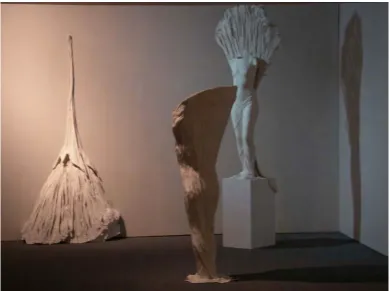
Although much of my studio-based research has been conducted through drawings, the final works find resolution as sculptural objects. This submission presents a mythical landscape of metamorphosing object sculptures in a
darkened space. Lighting is used to partially illuminate the sculptures and generate shadows that reveal other dimensions to the space and works. Each work describes something of liminal experience and is bound to the other works through repetition and variants of form, shape and pattern.
This investigation contributes to the field through redressing the silencing of women’s voice on the experience of transformation beyond fertile womanhood, by re-engaging with modes of thinking and expression that remain undervalued in our contemporary world, and through contributing to an emergent voice that is concerned with the connectivity of humans with the rest of nature.
Acknowledgements
I wish to extend a very special thank you to my studio supervisor Milan Milojevic and my exegesis supervisor Dr Llewellyn Negrin for their guidance and advice. My final submission owes much the rigorous and insightful supervision I received throughout my candidature
Thank you also to my friend/collaborators: Susan Dickson, for modeling for the template cast and for initiating the collaboration that launched this research; And Patrick Toohey whose generative and playful approach to our mutual
investigation, visual dialogue and exhibition is something to which I now aspire. I am also indebted to technical officers Stuart Houghton and Phillip Blacklow for teaching me how to engineer and make the works, and for professionally crafting some aspects of the final works. Thank you also to Ian Mundy for his advice, assistance and support in regard to the making of the works.
Though many colleagues provided community and criticism, I would especially like to thank, Asma Mather, Kirsty Butler, Daniel Schnieder, Sophie Carnell, Mana Hogan and Antoinette Obrien for their practical assistance throughout the candidature. Thank you also to the Post Grad Print Group who remained an important source of criticism and development throughout the project - in particular Iona Johnson, Linden Langdon, Gaby Falconer and Leonie Oakes. A huge thank you to Adrian Read for putting together the final document, and for his invaluable assistance both physical and conceptual in setting up the exhibition; Anita Hansen for the very beautiful invites and the initial proofing of the exegesis; Diana Giblin for the final proofing; Alyssa Simone for her insightful criticism, documentation of the works, and video documentation of the exhibition; Terrance Munday for photographic documentation of the exhibition; and Leigh Hobba for his assistance as a shadow maker .
Finally, I thank my Mum and Dad for their support and enthusiasm throughout the research, and most importantly I thank my partner and Love, Christopher Brown, without whose support this research would not have been undertaken.
vii
Table of Contents
Introduction 1
Chapter One: Central concerns of the research 8
Chapter Two: Contextualisation of the visual work 31
Chapter Three: How the work progressed 56
Conclusion 103
Appendix I - Bibliography
Appendix II - List of illustrations
Introduction
My research is concerned with visually expressing the existential experience of the transition from fertile womanhood. In our Western culture this transition is described as menopause which is a medical term. It tells us more about the world we live in, our aspirations and our values as a group, than it does about the
experience of change. We euphemistically call this transition ‘the change’, which is appropriate for my title, as the nature of change is one of the areas of
investigation undertaken, and the use of a euphemism alludes to the taboo nature of my subject. However, in the body of this exegesis I speak of this as a transition from fertile womanhood as this transition is a movement into the unknown. As Germaine Greer points out: in Western culture we have no rites to acknowledge this change and we hardly ever hear the voices of women on this experience. This experience also remains undescribed and invisible in the fine arts except for rare voices such as Doris Lessing in the literary arts and Rosemarie Trockel in the visual arts.
The absence of a cultural language to describe archetypal experience such as this, is not an isolated, unrelated phenomenon. Carl Jung, Mircea Eliade, Joseph Campbell, and Suzi Gablik speak of it as symptomatic of our culture’s loss of myth, which is sustained by values that perpetuate a fragmented, abstracted and rationalistic way of viewing the world.1 As Gablik says
The loss of myth, the assumption that the only valid ways of knowing are logical and linear, has resulted in a profound loss of moral orientation and meaning for life. Archetypal themes give form and meaning but as a culture, we have fallen out of meaning, leaving only the dreariness of calculated, mechanical process.2
1
Although Jung speaks of our Western culture as having lost myth, he also says every culture, including our own, lives by myth. For the sake of clarity in this exegesis I use the term construct
when referring to our contemporary Western cultural myths such as ‘menopause’, and I use the word myth specifically to refer to traditional myths that give form and meaning to archetypal experience.
2
Gablik, S. The Reenchantment of Art. Thames and Hudson, New York, 1991. p. 47
This way of seeing separates us from even the most intimate areas of our lives; including our bodies, our senses, and the liminal spaces where we make sense of existence and change.
In the face of this absence of a cultural language, and as a remedy to this
separateness, my visual investigation re-engages with transformative experience through appropriating the ancient vehicle of myth. Myth traditionally gives form and meaning to archetypal experience, and inherently affirms connection between humans and the rest of the natural world. The reactivation of myth has at its heart an affirmation of human interconnectedness. With the aim of transcending the limits of connectedness imposed by rational thought, I also re-engage with modes of thinking and expression that value the intuitive, the whole, and the
subconscious.
While this investigation focuses on the transition from fertile womanhood, I have had a long-standing concern to create works that seek to come to terms with being a creature of nature belonging to a cultural group that denies its nature. These works previously took the form of an exploration of our evolving cultural perspectives on female mythological figures from my own cultural heritage, and often found their genesis in my dreams.
Myth provided another way of seeing the world that viewed humans as nature. Dreams provided unmediated access to my own nature. My first work addressing this concern was Red Felt Vessel Dress (Fig.1)− an image of ‘Pandora’s Pithos’3 that was the making of a dream.
Fig 1: Red Felt Vessel Dress 2001 130 x 150 x 150 cm, paper, rope and felt.
3
Pithos is an ancient vessel used to store grain, and acted as a burial urn, harbouring associations with both life and death. The term Pandoras Pithos comes from Hesoids storytelling in Works and Days which described the creation of the first woman in Hesiod and Homer. Works of Hesiod and the Homeric Hymns. Translated by Hine, D. The University of Chicago Press. Chicago, 2005.
The most recent body of work, The Shadow Gardens (Fig.2)4 made prior to this project examined the archetypal experience of the movement into womanhood − of sexual initiation − giving visual form to the Ancient Greek myth of the underworld journey of the Goddess Persephone. This archetypal exploration carried through to my Master research, although my Masters research is more directly informed by my own personal experience. Through this research I take an internal journey.
Fig 2: Works from TheShadow Gardens 2004
Fall 260 x 140 x 60cm, plaster and muslin.
Bloom 180 x 60 x 60cm, plaster and muslin.
Prowl 240 x 120 x 60cm, plaster, muslin and wood
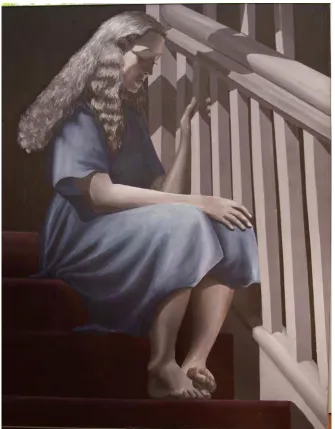
This internal journey represents the second time in my art practice I have used self
as subject. The first was given expression in a painting called Solitude (Fig.3)
4
The Shadows Gardens takes its name from Roberto Calasso’s retelling of Persephone’s underworld journey in Calasso, R. The Marriage of Cadmus and Harmony. Alfred. A. Knopf., New York, 1993. p.197–221
which records my movement into maturity, and was painted at the time of rupture from my childhood life. On the brink of this current transition I developed a strong empathy for the young woman that was depicted in this painting − the young woman that was once me. I was again facing a transition between stages of life that Simone de Beauvoir describes as ‘dangerously abrupt’ and ‘manifests in crises’.5 This transition was no less dangerous than the first.
Fig 3: Solitude 1979. 120 x 94 cm , acrylic paint on canvas.
This research is concerned with the existential expression of my internal journey. It is not concerned with what happens to us in the world, but rather how we make sense of what happens to us. This intent takes the research beyond the realm of
5
De Beauvoir, S. The Second Sex. Penguin Modern Classics, Middlesex, 1972. p 587
the physical and the everyday life, and engages with the inner space where we construct meaning and face existence.
My initial experience of the inner space in this investigation was from the outside looking in. It was the space revealed through the rupture created by the inherent contradictions between my experience of change that permeated every aspect of my life, and my cultural language that celebrated youth as an unchanging ideal, and failed to describe this change in any meaningful way. What I faced was an experience that was based in absence and loss, that lacked a cultural form or image. This space I called Dark Matter.
The title Dark Matter acts as a metaphor on many levels. It refers to the liminal space of change between stages of life that remains ‘dark matter’ as it is largely undescribed and undervalued. It also refers to my fear that manifested an experience of nothingness; to my dark state of Being; and to my movement into the unknown. Dark Matter also refers to my intent to value, voice and face this experience through an investigation into the subterranean landscapes of the earth and Being – to return to what my ancient predecessors called Matter6. This opposes the ethereal elevated height to which we culturally aspire that extols our superiority to all else on earth. Dark Matter named my search for something dark, primal and essential − something that was invisible to me.
In cosmology, Dark Matter is invisible; it is experienced as absence, but it is thought to be a massive presence that is essential to existence. My title Dark Matter draws an analogy to this phenomenon, as it was my intent to change my consciousness and see the liminal space of change that initially appeared to me as an absence, as a presence that is essential to existence.
In my studio-based research this initially took the form of a formal investigation into space and change through the medium of drawing. My drawings were exploratory and broad ranging, depicting subjects, events and experiences that
6
Jung, C. (conceived and edited), Jung, von Franz., Henderson, Jacobi, and Jaffe, Man and his Symbols. Picador, London, 1964. p. 85
vii
resonated with my experience of change. My works however, ultimately found resolution in the sculptural medium. My sculptural works exploited the learnings attained through drawing and focused specifically on the existential expression of my current experience of change.
The artists who contextualise this research, namely Rosemarie Trockel, Antony Gormley, Louise Bourgeois, Kiki Smith, Anselm Kiefer, and Bronwyn Oliver − draw on myth, or archetypal form, generate works from the body, and/or
contribute to a dialogue on feminine experience. At a more essential level, they re-affirm connection with our bodies, our heritage, and the world of nature, including our Ancient and primal selves. They do not use a paradigm that
perpetuates a model of supremacy and separateness; instead their approach to art-making is generative.
In Chapter One I discuss the lack of an adequate means to express the experience of the transition from fertile womanhood in contemporary Western culture and the reasons for this. As a remedy to this, I examine the function, pattern, form and expression of myth that has informed my approach to my reactivation of myth in my art-making. Chapter Two places the research project in the context of the work of artists who generate a ‘living cosmology’7engendering awareness of the
‘whole’ and of the interconnectedness of life. Chapter Three reports on the development of the visual work and how the studio based research was pursued.
7
Central concerns of the research
‘The change’ – an undescribed experience
My investigation seeks to contribute to what Germaine Greer calls ‘the
undescribed experience’.1 Through this research I aim to make sense of, value and give a voice to my recent experience of the transformations in consciousness and Being2 as I move from fertile womanhood toward another stage in the life cycle.
The phenomenon of human change through life is not adequately reflected in our Western cultural constructs which could serve to equip us to make sense of this experience. Instead, our culture denies our passage through life with its constant change, in favour of dictating ideals of eternal youth. The movement from fertile womanhood and ageing in Western culture breeches our cultural ideal and is looked upon as something to be avoided and remedied.
By contrast, in many other cultures moving through the life cycle is viewed as a series of transformations that can be seen anywhere in nature. It is marked by stories of transcendence, understood through myths handed down, and enacted through rites of passage that equip the society and individual for such change, and define a social role beyond that change.
A fundamental difference between these two perspectives on human change is based on the cultural view of human’s place in nature. Western constructs perpetuate a hierarchical belief of humans as apart from and superior to nature. The seeds of such a belief can be read in the Old Testament where God, the
1The Undescribed Experience is the title of Chapter 1,
The UndescribedExperience, p. 11–35 in
Greer, G. The Change: Women, Ageing and the Menopause. Hamish Hamilton, London, 1991.
2 In Sartrean terms, being is purely a state of existing, but Being is a state of being which reveals one’s essence, one’s willingness to use one’s freedom and act upon the world. It is a term used to describe a consciousness that has not submitted to being determined. I am using the Existential term Being as this investigation is not concerned with what happens to us in the world, although this certainly is part of the investigation ─ I am concerned with how we make sense of what happens to us in the world ─ relating to our consciousness and our construction of meaning. See Sartre, J. Being and Nothingness. Citadel Press, NY, 1966.
Father’s, very first instruction to the first man Adam was to name all His creation. In this myth, through naming, Adam ‘gains dominion … over all the earth’.3 With this God-given right, we have developed a constructed world that physically, psychologically and spiritually removes us fromour use and misuse of the earth.
This is the antithesis of Indigenous consciousness which embodies a deep respect for nature and an understanding of human as nature. As evidenced in Native American Chief Seattle’s reply to President Washington’s request to buy land in 1852
This we know: the earth does not belong to man, man belongs to the earth. All things are connected like the blood that unites us all. Man did not weave the web of life; he is merely a strand in it. Whatever he does to the web, he does to himself.4
It is from this perspective of respecting the human as nature − the belief that we are the stuff of this earth − that I intend to pursue in this investigation.
In pursuit of this perspective, my initial research looked to the form, the pattern and the nature of change that is the passage of life of all organic and inorganic matter, as a means of moving beyond the veneer of our constructed world to illuminate, understand, and give a voice to my experience of change in the light of change that happens everywhere in nature.
What if we, like the Native Americans, viewed ourselves as an interconnected strand in the web of life? Or like our Ancient predecessors revealed humans’ affiliation with the rest of the natural world through our stories, images and forms? What if the series of transformations we go through in life were illuminated by the patterns and forms of transformations seen everywhere in nature? How might we then understand the profound experience of the transition
3 Authorized King James Version.
The Holy Bible: Containing the Old and New Testaments.
Holman Bible Publishers, Nashville, 1979. Old Testament , Genesis 1 : 6 4 Campbell, J. with Moyers, B; Flowers, S. (ed).
The Power of Myth. Doubleday, New York,
1988. p 34
from fertile womanhood? What would it be to embrace and value this mystery? These possibilities reveal some of the aspirations of the research.
Our patterns of transformation are like those of many other living creatures. David Suzuki’s Eastern heritage and lifetime of observations of the natural world
equipped him to understand his own changes in this light. He observes
In retrospect, my life has been marked by a series of transformations. It’s interesting to note that in the rest of the biological world, profound change in the lives of many organisms is a natural and necessary part of their development. Often these changes involve dramatic transitions in physical makeup, behaviour and habitat. This process is called metamorphosis.5
Dramatic transitions in physical makeup often include transitions in behaviour and habitat, as shown in our own movement into adulthood. The plethora of changes resulting from bodily maturation; the change in study, the movement into work − or worse: no work − the movement to independent living, the changing nature of relationships with family and friends, the differing expectations imposed on us, the new awareness and lost innocence, are all linked to the inheritance of a body that obeys its own laws and drives us in unfamiliar and unnerving ways. All
this change propels us into the unknown. We have never experienced this before and the path ahead has not been interpreted for us, so we have to work it out for ourselves. Our old way of Being in the world no longer has relevance, and much of what we had is lost, and most of what we face is new, unfamiliar, confusing and dark.
The existential journey from fertile womanhood, like the earlier transition to sexual maturity, is a rupture with an old way of Being and a journey into the unknown, into a frightening labyrinth of confusion and darkness where change is apparent in every aspect of life. And once again the propelling factor is
fundamental hormonal and chemical changes in the body. This is a rare and significant event in a woman’s life.
5 Suzuki, D.
Metamorphosis: Stages in a Life. Allen & Unwin, Toronto, 1987. Preface (npn)
Although this transition is a universal experience for women (who live long enough), this investigation is based within my story, and it has its own texture based in my experience.
Of my experience, I had noticed my body changing almost imperceptibly from the intense bloom of womanhood eight years earlier, which at the time reminded me of a tree putting out flowers in a final attempt to reproduce. The first point of distress which marked the transition in consciousness began with my body and happened suddenly. My journey was prematurely precipitated by injury, which gave me my first real taste of my mortality. Injury alone is enough to change one’s place in the world, but this injury and the ensuing brush with death was intimately bound with the hormonal change that comes with ageing.
After injury and illness, and after my monthly cycle began to falter, I no longer recognised my body. It was not mine, I did not know it. I looked the same, but I did not feel the same. I had loved my body; its pleasures, strength and speed. Its erotic, sensual, maternal and violent drives, although sometimes overwhelming gave me passion in my expressions. Suddenly I felt like a mere shadow of this. The rhythms and cycles that once flourished had spilled. Through these cycles I had known myself as woman and felt my connectedness with a bigger world. The loss of these cycles was a source of tremendous grief and sadness − but more importantly this bodily change disconnected me from me − I had lost my way of reading and understanding myself.
Sapped of strength and immobilised − the dangerous, languid creature that used to purr beneath the skin, had turned into a raging screaming harpy. I was subject to a disrespect I had never known before; and often treated as invisible in the world. I burned with a heat that prevented sleep and regeneration. The comfort of daily patterns that could have kept me steady: the patterns of walking, sleeping,
physical work, paid work, had changed through physical necessity. Darkness crept into every crevice of my Being. I found myself disorientated, my confidence shattered, my sense of self shredded, and my place in the world changed. Like my earlier transition into maturity this journey was perilous, unwanted and hit at my core − at my very reasons for existence.
Our reasons for existence are essential for life. As Julia Kristeva says: ‘if the meaning of life is lost, life can easily be lost, when meaning shatters, life no longer matters’.6 This loss of meaning is also related by de Beauvoir as a death in her discussion of the experience of the loss of fertility: ‘When the first hints come of the fated and irreversible process which is to destroy the whole edifice built up during puberty, she feels the fatal touch of death itself’.7
I felt this fatal touch of death. It permeated my whole Being. Further, I
recognised this death as I had seen my sorrow and grief in other animals – some lambs when weaned would mourn for a long time – some did not recover from the loss and simply died.
For me it was not the very real brush with death that mattered. Although this was frightening, it was tangible and had physical evidence − it was real and
understood by others. The death that mattered was the death that was happening on the inside. This death was unnamable, invisible, without form, and apparently ungraspable, yet it was inscribing a crippling fear upon my Being. Not only fear for myself, but for those I loved. With a deeper awareness of my mortality, came a feeling that our time is always ending and an inability to deal with any change at a time when change was rampant. Every change was a source of distress.
This unnamable has been named by Jean Paul Sartre as nothingness. Nothingness
describes an empty state of being; a being who is purely existing, who is
immersed in mere life, not acting upon the world. It describes a walking shell of a human concealing a state of consciousness where one has denied one’s
transcendence. Nothingness is to exist in a life with no meaning. Sartre said nothingness lies “coiled in the heart of Being, like a worm”. It inhabits “realities which are not only objects of judgments, but which are experiences opposed, [and] feared”.8
6 Kristeva, J
. Black Sun: Depression and Melancholia. Translated by Roudiez, L. Columbia
University Press, New York, 1989. p6 7 De Beauvoir, S.
The Second Sex. Penguin Modern Classics, Middlesex, 1972. p 588
8 Satre, J.
Being and Nothingness. Citadel Press, New York, 1966. p 21
In cultures based in nature, rite of passage rituals force a confrontation with what is feared thus rendering the worm of nothingness benign. Fear helps us escape
danger, or prepares us to confront it in a heightened state, but in our contemporary Western culture, fear can take hold, as what is feared has no image or form to confront. To me, what I feared appeared as a black square, a void, an empty space in a forest of confusion.
As social Beings, the construct which frames our understanding of this experience is called menopause. Menopause is a clinical term that ‘treats’ this transition as a
sickness of the body and the mind with a tableau of hormones, chemicals, creams and surgeries that mask, deny and invalidate the experience. In our individualistic world, this transition has no social value, and it is left to the individual to deal with it alone. Inability to do so is evidence of weakness and worthy of disdain.
Unlike Ancient and Indigenous cultures, where one re-emerged from the rites acknowledged as transformed to assume a meaningful role, our construct of
menopause provides nothing to move toward. De Beauvoir describes the situation
of women moving through this transition in the Western world
Whereas man grows old gradually, woman is suddenly deprived of her femininity; she is still relatively young when she loses the erotic
attractiveness and fertility which, in view of society and her own, provide the justification of her existence. With no future, she still has about one half of her adult life to live.9
This absence of a future is inbuilt into the word menopause itself which defines
the experience through its absence – menopause is literally a cessation of menses. In Greer’s social and political analyses of menopause, she chooses to use the word
climacteric, which was the word that preceded menopause to describe this change.
The climacteric is taken ‘from the Ancient Greek word Klimacter meaning
critical period’.10 Unlike the climacteric that relates something of the existential
9 De Beauvoir, S.
The Second Sex. Penguin Modern Classics, Middlesex, 1972. p 587
10 Greer, G.
The Change: Women, Ageing and the Menopause. Hamish Hamilton, London, 1991. p 25
crossroads one encounters in liminal experience, the word menopause is a medical term.
Menopause is a relatively new concept. It was first defined in a medical journal just over a hundred years ago in 1899, under the heading of Climacteric
Insanity.11 Women like myself moving through the transition from fertile
womanhood, were thus named sick and deranged. Naming this transformation a medical condition ensured that the authority on this transition belonged not to women, nor elders, but to medical practitioners.
This construct of menopause has served to silence the voice of women moving through this transition. As Greer observes
though the literature of menopause is vast, almost none of it is written by women. Most of it has been written by men for the eyes of other men; thousands of middle-aged women troop meekly through the pages of thousands of studies assessing their health, their well-being, their status, their needs….and we hear hardly a word in their own voices.12
Our construct of menopause tells us more about the world we live in, our aspirations, our psychology and our values as a group, than it does about the condition of human change and the experience of the movement from fertile womanhood. The dynamic involved to perpetuate this construct requires the complicity of women like myself moving through this transition. As Greer points out
Older women themselves suffer from youthism, and contribute to the prejudice themselves; they endure the never-ending jibes against
11
Climacteric Insanity was defined in an article titled Epochal Insanities, which was Dr Cloustons
contribution to a publication called: A System of Medicine by Many Writers. France 1899. Greer,
G. The Change: Women, Ageing and the Menopause. Hamish Hamilton, London, 1991. p 25
12 Greer, G.
The Change: Women, Ageing and the Menopause. Hamish Hamilton, London, 1991.
p 13
menopausal women … against crones in general, without a word of protest. 13
A rare voice that helped me make sense of the existential experience of this transition was Doris Lessing in her fictional storytelling −The Summer Before the
Dark.
In this story, Lessing provides a much needed female hero in a world where ‘All our heroines are young’.14 Kate, her heroine, faces the archetypal ordeal of an internal wilderness and severance from that which went before in her existential search for a presence in the space that was created through loss.
Although we are told Kate’s story, which is uniquely her own, the essence of her transformation is archetypal and told through her dream. In her dream we are plunged into the strange shifting world of unknowing, emotional imperatives, contradictory imagery and altered sense of time which characterise dreams. Kate’s serial dream, by her description, is ‘like a myth’. Like rite of passage myths, her dream is elemental, and speaks of darkness, winter and the labyrinth which resonates with the Ancient and inner language of transformation
Far away behind her, far below the horizon, she knew the sun still shone. But it never rose; it had not risen in her sleep now for days, for weeks. She was still travelling north, away from the sun. Ahead of her lay winter, ice, an interminable dark. 15
The vast cold spaces of winter lead her to a point in the labyrinth where she had a sense of being ‘yards from the centre of a maze, but no matter how she turned and tried, she could not reach it.’ 16
13 Greer, G.
The Change: Women, Ageing and the Menopause. Hamish Hamilton, London, 1991.
P 22
14 Greer, G.
The Change: Women, Ageing and the Menopause. Hamish Hamilton, London, 1991.
P 23
15 Lessing, D.
The Summer Before the Dark. Jonathan Cape, London, 1973. p 218
16 Lessing, D.
The Summer Before the Dark. Jonathan Cape, London, 1973. p 168
Kate’s dream taps the same archetypal root I seek to tap as I give form to the experience of transformation that Kate describes as ‘reflections like fire lit shadows on the walls her sleep.’17
I recognised my own experience in Kate’s bodily and psychic experience, although
Part of the difficulty with The Summer Before the Dark is that the
climacteric is never identified as a factor … in Kate’s spiritual malaise. In fact her sensations, that a cold wind is blowing on her, that the stuffing is running out of her, that she is being flayed alive, are all typical of the climacteric. 18
Despite the absence of menopause as a stated reason for Kate’s transformative
experience, this story is important as it gives a voice to the primordial unformed state of transformation where
‘psychic chaos’ is valued as a reply to ‘pre-cosmogonic chaos’, … [where] the return to Chaos is indispensable to all new creation19
It is a storytelling embodying the Ancient and Indigenous rite of passage that values psychic chaos as generative of a new creation. As a reflection of the ‘the amorphic and indescribable state’ 20 of transformative experience, it provides an image of the space between stages of life, that challenges our dominant cultural language of menopause, and moves toward remedying the isolation of this experience.
Our cultural language of menopause was not born in a vacuum. It evolved from a heritage of Western mythologies that has systematically vilified the older woman. This can be seen in the evolving cultural perspectives on the mythological figure
17 Lessing, D.
The Summer Before the Dark. Jonathan Cape, London, 1973. p 133
18 Greer, G.
The Change: Women, Ageing and the Menopause. Hamish Hamilton, London, 1991. p 33
19 Eliade, M.
Symbolism, the Sacred, and the Arts. The Crossroad Publishing Company, New
York, 1986. p 8 20 Eliade, M.
Symbolism, the Sacred, and the Arts. The Crossroad Publishing Company, New
York, 1986. p 8
of Hekate who remained associated with the broomstick, the cauldron/grail, the night and the moon through out her evolutions.
To some Ancient Greeks, Hekate was an elder, a wise woman − a Goddess at the Crossroads. Homer speaks of her as ‘dear’ and ‘considerate’.21 Hesiod speaks of her as ‘esteemed’ by Zeus, ‘sitting by reverend kings enthroned, she assists them in judgment’.22 To the Church Fathers in medieval times, Hekate was feared and loathed, as the evil Queen of Witches in league with the devil. Today, we
probably know her best in her mythological form, as the chief witch in
Shakespeare’s Macbeth urging him on to greater atrocities in his quest for power.
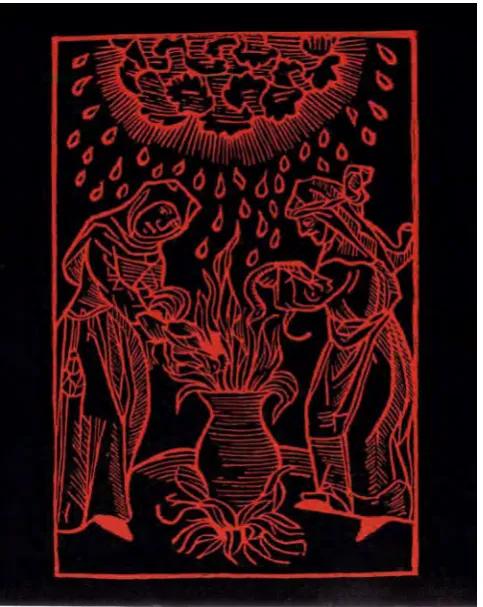
[image:24.595.207.449.380.684.2]This demonisation of Hekate’s character since the Ancient Greeks reveals our evolving cultural view that nature is corrupt; that women are not to be trusted; that the natural process of ageing is a corruption of the ideal; and that the body is base, and must be overcome by the mind.
Fig 4: Witches conjuring up a hailstorm 1400’s. Size, medium and artist unknown
21
Hymn to Demeter by Homer in: Hesiod and Homer. Works of Hesiod and the Homeric Hymns.
Translated by Hine, D. The University of Chicago Press. Chicago, 2005. p 99-100 22
Theogony by Hesiod in: Hesiod and Homer. Works of Hesiod and the Homeric Hymns.
Translated by Hine, D. The University of Chicago Press. Chicago, 2005. p 68
Although Hekate was resurrected again as the title of a feminist magazine in the 1970s, the witch is now usually represented in popular culture in a diluted form as a pretty young thing, who titillates an audience, and sets the world to rights. The crone, the old witch, remains an evil presence in fairytales and represents all that we would not want to be − diabolical, mean, and deserving of very bad treatment. In today’s world, to be called an old witch is to be patronised and out cast as a
meddling old woman. (Fig.4)
It is important to note that the elder equivalent of Hekate is not present in the Christian retelling of the rite of passage myth, with Eve in the Garden of Eden who had no elder guidance. This is very sad for us culturally, as the writing out of the elder’s role in mythology has left the legacy of taking away personal and cultural aspirations for transcendence as we move toward another age in the life cycle, and has left us without an answer to where we are moving once we have left behind fertile womanhood.
This illuminates the nature of the void that first presented to this investigation. The void is: an absence of that which went before when we knew our place in the world; an absence of a cultural language to guide us through profound change; and an absence of a cultural construct of a meaningful social role to move towards beyond that change.
The title of this investigation Dark Matter, names this void. Dark matter not only
refers to the existential alienation, my fear that manifested in an experience of
nothingness, and my movement into the unknown, but it speaks of my intent to
journey beyond the visible, into this apparently empty space between stages of life in search of something essential.
In cosmology, dark matter appears as absence, but is thought to be a very big presence. 23 It is thought to make up the universe, being at least 90 per cent of everything, including our body. Apparently there is an entire cosmos of dark
23 Walsh, T. The Dark Matter of Words; Absence, Unknowing, and Emptiness in Literature. Southern Illinois Press, Edwardsville, 1998. p 4
matter in the nucleus of every cell where matter floats or skittles about like stars. As John Stewart Collis points out ‘It is not easy for us to realise the essential hollowness of things, that we are all hollow men [women].”24 As science today is beginning to map black holes, voids, dark matter, and see space as a presence essential to existence − through this investigation, I seek to do the same.
What science is beginning to discover − that apparently empty space is essential to existence, is not new knowledge. This is something that has long been recognised in many Eastern and Indigenous cultures. 25 The Australian
[image:26.595.174.479.336.571.2]Aboriginals for example, whilst acknowledging the stars, also mapped the cosmos through its emptiness with a flying emu seen in the darkest point, in the Milky Way.
Fig 5: Diagram describing Flying Emu as described in Australian Aboriginal cosmology – location
Dark Nebulas.
Similarly, the primordial giant black cube, the Ka’ba at Mecca is also empty
(Fig.6-7). The Ka’ba is the liturgical centre of the Islamic world. Lines drawn
24 Walsh, T. The Dark Matter of Words; Absence, Unknowing, and Emptiness in Literature. Southern Illinois Press, Edwardsville, 1998. p 35-36
25 In Eastern philosophy the idea of empty space is an integral concept. In the Ancient text, the Tao Te Ching, dated somewhere between 600 and 300 BCE, the void denotes the origin of Being. Similarly Qi (Chi) is a principle concept in Chinese culture, signifying the spiritual energy and life force. This is also represented by emptiness.
through its corners, crossing inside and extending beyond, describe it as the centre of the terrestrial worlds, and the point of intersection in its empty centre is the point where the Heavenly axis pierces the earth. 26 The Ka’ba’s emptiness represents the ultimate mysteries of Being that are beyond all categories of thought. It is ‘the earthly reflection of the celestial temple’27 which is also reflected in our innermost Being.
Left Fig 6 : Ka’ba Artist and date unknown. Said to be built by Adam and rebuilt by Abraham
Right Fig 7 : Schematic image of Mecca – Ka’ba centre. Artist, date, medium unknown.
In the Western world, we see the outside; in Indigenous and Eastern worlds they
also see the inside. The inside space that we view as empty; they view as
occupied, integral, and meaningful. Through this investigation I also seek to see the inside space that first appeared as ‘nothing’, as occupied, integral and meaningful, as it was my intent to enter the void, the apparently empty space between stages of life, to face my experience of change.
Regardless of how badly equipped we are for this journey into the void − change happens − and each of us at a personal level can deny it, and try to remedy it, or we can try to make sense of it and create our own place and meaning in the world.
26 Burckhardt, T.
Art of Islam: Language and Meaning. World of Islam Festival Publishing
Company Ltd, Kent, 1979. p 3 27 Nasr, S.
Islamic Art and Spirituality. Fine Dot Printers, Lahore, 1987. p 43
The choice is essentially to say no to life, and have no meaning, and just exist in
nothingness, OR to say yes to life, face fear, and find meaning in existence.
According to Jung this happens at an essential level
Meaning and purposefulness are not the prerogatives of the mind; they operate in the whole of living nature. There is no difference in principle between organic and psychic growth. As a plant produces its flower, so the psyche creates its symbols. Every dream is evidence of this process. 28
28 Jung, C. (conceived and edited), Jung, von Franz., Henderson, Jacobi, and Jaffe,
Man and his Symbols. Picador, London, 1964. p 53
The reactivation of myth
This space between stages of life which is denied and unspoken in Western culture is very visible, tangible, and meaningful to peoples who view humans as nature. It is embedded in culture, made visible, and understood through myth which is enacted through rites of passage. Although rites vary from culture to culture, the patterns of rites of passage are archetypal
they are without known origin; and they reproduce themselves in any time or in any part of the world − even where transmission by direct descent or ‘cross-fertilization’ through migration must be ruled out.29
Myth, and its enactment through rite of passage, thus describes something essential to our human nature from which we have been separated. The rites follow a distinctive journey regardless of the stage of development or the culture enacting the rite. The rites require participation in an ordeal, to undergo a death, from which may spring a rebirth, a new life.
Death and rebirth may mean return to the womb of Mother Earth, and a rebirth into an after life, or in the rite of passage, the rebirth is into a transformed self. The alchemists use the word VITRIOL to describe this experience. Translated it means ‘Visit the interior of the earth; through purification thou wilt find the hidden stone’.30 This relates the journey into the earth, as a journey into the inner self.
As myth is the Ancient and traditional vehicle to give form, image and story, to the space between stages of life, it would also be my vehicle to speak of my experience. But in a contemporary world where only the relics of rite of passage myths remain, I would have to reactivate myth to make what we would render invisible, visible once again.
29 Jung, C. (conceived and edited), Jung, von Franz., Henderson, Jacobi, and Jaffe,
Man and his Symbols. Picador, London, 1964. p 58
30 Purce, J.
The Mystic Spiral: Journey of the Soul. Thames and Hudson, Great Britain, 1974. p 29
From other cultures there is little we can glean that gives specific knowledge of the rite of passage from fertile womanhood as these rites are universally secret and often specific to the initiate. The nature of these rites varies in accordance with the group’s cultural constructs, the group’s needs and the initiate’s aptitude and fears. What the initiate fears most, is what she is most likely to face in this rite of passage.31 In many cases, an initiate undertaking the rites ‘must be willing to experience this trial without hope of success. In fact, [s]he must be prepared to die’.32
The secrecy and sacredness surrounding rites indicates a different valuing of knowledge to our Western way. That is, with the knowledge gained through rites comes responsibility, and one becomes a caretaker of that knowledge for future generations. The consciousness surrounding this perspective is embedded in words attributed to Native American origin, ‘We do not inherit the earth from our parents; we borrow it from our children’. 33 In the same way, myth is not about nostalgia for the past, but preservation for the future − a way of thinking and Being that is beyond ourselves.
Myth draws from the past; but the rites are defined through their aspiration. The Australian Aboriginals for example often call the rite of passage from fertile womanhood −the getting of wisdom.
Like myth and rites, to go forward, this investigation required me to go back to locate the terrain of my myth both in my personal history, and in my cultural heritage.
31 ‘In Eleusis, north of Athens were celebrated the holiest mysteries of the Ancient world, those of Demeter and Persephone; their initiates were sworn to a secrecy so profound that we know little about them.’
Hine D (translated by). Works of Hesiod and the Homeric Hymns. The University of Chicago
Press. Chicago, 2005. p 101
Also speaking of the mysteries at Eleusis; ‘the women admitted to the sanctuary were compelled to endure one or more initiation ordeals whose form was kept secret’.
Branston, B. The Lost Gods of England. Thames and Hudson, London, 1974. p 133
Likewise, Australian Aboriginals have an ‘open story’ for all, and a ‘closed story’ for the initiated – the person who becomes the caretaker of the story’s hidden meaning.
32 Jung, C. (conceived and edited), Jung, von Franz., Henderson, Jacobi, and Jaffe,
Man and his Symbols. Picador, London, 1964. p 124
33 These words are engraved in stone in the Aquarium in Baltimore, America. They have been appropriated by the Green movement and are often quoted.
My myth-making began in wonderment at the enigmatic figure of the Ancient Greek Goddess Hekate who had been a hovering silent invisible presence in a previous body of work. In the Homeric Hymns, the ‘cave dweller’ Hekate acted
as a guide to the young initiate Persephone, bringing her out of the passages of Hades from which few return. For the Ancient Greeks, Persephone’s
re-emergence into the light-filled world brings an end to earth’s winter. Her yearly return to Hades explains the phenomenon of winter, as her grieving Mother ceases to bless the earth.34
I wondered what knowledge or rites equipped Hekate to walk the paths of the dead as if death itself did not exist, ‘No woman knew the paths that linked the earth and underworld better than she.’35 But her rites remain a mystery − I found
no answers. Still, her presence in the archetypal ‘mysteries’ of my own cultural heritage set the path of my investigation and drew a relationship between winter, the earth and my journey.
Winter, like my journey, speaks of drawing into the self to survive transformation. It is an apparently latent season, belying the most profound and secret changes. In winter, above the ground: the skeletal structures of trees are revealed, a carpet of dead leaves lies ready to nourish new life, darkness has its longest hours,
dampness lingers in the air, and fires instead of the sun warm us.36
Winter’s transformation begins with a necessary death, and death is very real to those who live with the seasons. Lambs born prematurely, seeds sprouting too early, and roaming creatures of the earth have scarce food, and all can easily be killed by the cold. Winter even threatens us in our cushioned constructed
34 The story is told in the
Homeric Hymns to Demeter , published in Hesiod and Homer. Works of Hesiod and the Homeric Hymns. Translated by Hine, D., The University of Chicago Press.
Chicago, 2005. p 98-114 35 Calasso, R.
The Marriage of Cadmus and Harmony. Alfred. A. Knopf., New York, 1993. p
221
36 Fire has its own language of transformation. Fire transforms matter, and its transformational qualities are embedded in myths such as the phoenix rising from the ashes.
Cooper, J. An Illustrated Encyclopedia of Traditional Symbols. Thames and Hudson, London,
1979. p 66
environments as the weak, the sick and the elderly become more vulnerable. But whilst the world above the ground may appear as a desert of bones, ruins and skeletons, a different world is happening underground in the earth. Winter’s life is hidden in the core, in the centre of our shelters, in the centre of our Beings − in readiness for regeneration.
In the Ancient myths in our Western heritage, the rite of passage into womanhood often draws this connection between existential winter and winter on earth, giving a language to that profound change: the loss and the renewal that accompanies change - the passage which begins with a death and ends in a new life – spring.
Many of these rite of passage myths, Ancient Greek, Ancient Egyptian, and Ancient Sumerian tell a story of the Goddess’s descent into the underworld. Evidence from Babylon, Greece, Rome and North West Europe suggests that initiates ritualising the fearful underworld journey were required to experience descent into the earth.37 This mimics the snakes that hibernate underground whose transformation is apparent in the shedding of their skins, and the trees and plants that suck their nourishment into the roots and bulbs to survive winter and renew themselves in spring. These myths reveal the belief in the connectedness of the human experience to the seasons, the earth, plants and other living things. In myth − cosmic, earthly and social orders are one. Myth removes us from the separation of our way of seeing into a realm where all is interconnected.
In our Ancient heritage, this descent into the earth, into the underworld, was considered a return to Matter. ‘The words Matter, Matrix and Mother all derive
from the Latin word Materia which means Substance.’ 38 Carl Jung points out,
the image of Matter is without any psychic significance for us, but for our
Ancient predecessors it encompassed ‘the profound emotional meaning of a return to Mother Earth.’39
37Branston, B.
The Lost Gods of England. Thames and Hudson, London. 1974. p 133
38 Shlain, L.
The Alphabet Versus the Goddess: The conflict between word and image. The
Penguin Press, Great Britain, 2000. p 268
39 Jung, C. (conceived and edited), Jung, von Franz., Henderson, Jacobi, and Jaffe,
Man and his Symbols. Picador, London, 1964. p 85
The movement into the earth, the inner being, the unknown, is dark, and this is also associated with the feminine. Black, the darkest of colours can be attained through mixing material/matter of all colours, as opposed to mixing these same colours in light in order to make white. Ancient female deities were often associated with the dark, the night, the darkness of the earth with its caves and grottoes, as opposed to male deities that often were associated with the light and day.40 Hekate was ‘crow black with a shining crown’.41 Some versions of the fertile Artemis of Ephesus were portrayed as black (Fig.8), as was the Ancient Egyptian Goddess Isis (Fig.9-10). Her colour symbolised; the rich, fertile soils of the Nile; her affinity with the moon; the star Sirius; and by association, the
night.42
Left Fig 8: Artemis of Ephesus Artist unknown. First century.
Centre Fig 9: Isis Artist unknown. Dynasty XVIII New Dynasty 1550 – 1500 BC.
Right Fig 10: Isis suckling an infant Pharaoh Artist unknown. Ptolemaic date
40 Shlain, L. The Alphabet Versus the Goddess; The Conflict between Word and Image. The Penguin Press, London, 1999. p 268
41 Calasso, R. The Marriage of Cadmus and Harmony. Alfred. A. Knopf., New York, 1993. P 221 42Shlain, L. The Alphabet Versus the Goddess; The Conflict between Word and Image. The Penguin Press, London, 1999. p 268
Witt, R. Isis of the Ancient World. The Johns Hopkins University Press, Baltimore and London, 1997. p 14
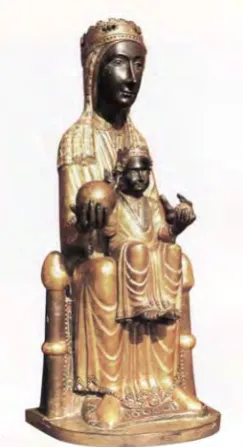
Black was also the colour of the heir of Isis, the most sacred Black Virgin who was widely worshipped in the Middle Ages across Europe, from Russia to Spain.
Fig 11: Our Lady of Montserrat. Artist Unknown.
So my title Dark Matter also refers to this Ancient language of womanhood and
affirms the aspirations of this investigation to explore the subterranean landscapes of the earth and the Being. This is in opposition to the Christian myths that aspire to ethereal elevated spaces like the Garden of Eden or Heaven. My investigation rejects the constructs of my culture that instigate the separation of humans from nature. Within the in-between space of this investigation I am seeking to explore our connectedness, searching for something primal and essential to us as animals and as social Beings.
It follows then, that my research methods also reflect my search to acknowledge and affirm our connectedness
The coherent way to investigate any field is to examine its possible
relatedness to other things … Everything is shared by everything else: there are no discontinuities … Images have sources and antecedents. To turn away from them is to have no image to breath life into.43
43 Summer. F. quoted in Weiss, J (ed.)
Venus, Jupiter and Mars, Delaware Art Museum,
Wilmington, 1980. p 16-17
Myth embodies a way of thinking and expression that enables us to see the ‘whole’. If Jung is right, myth traverses the same realm in the subconscious, which expresses itself through dreams and symbols
Symbols are natural and spontaneous products …No one can take a more or less rational thought and ... then give it symbolic form. No matter what fantastic trappings one may put on an idea of this kind, it will still remain a sign, linked with the conscious thought behind it, not a symbol that hints at something not yet known. In dreams, symbols occur spontaneously, for dreams happen and are not invented: they are, therefore, the main source of all our knowledge and symbolism.44
Thus, the way forward in my reactivation of myth, does not and cannot draw from the intellect alone. Rather, it collapses the intellect into the subconscious that retains many traces from previous stages of development and grasps experiences as a whole.
Dreams draw from this same source as myth, and they are a known, although an undervalued experience in our contemporary lives. In reactivating myth I cannot know what a myth based nature is, but I can know something of my primal nature through dream. As such, my experience of dreams is important to my reactivation of myth. Of dreams Jung says
They originate in a spirit that is not quite human, but is rather a breath of nature – a spirit of the beautiful and generous as well as cruel goddess. If we want to characterise this spirit, we shall certainly get closer to it in the sphere of Ancient mythologies or in fables of the primeval forest, than in the consciousness of modern man. 45
44 Jung, C. (conceived and edited), Jung, von Franz., Henderson, Jacobi, and Jaffe,
Man and his Symbols. Picador, London, 1964. p 41
45 Jung, C. (conceived and edited), Jung, von Franz., Henderson, Jacobi, and Jaffe,
Man and his Symbols. Picador, London, 1964. p 53
Inverting this relationship, I seek to get close to the spirit of the ‘sphere of Ancient mythologies’ in my myth through the spirit of dream, and through appropriating methods that collapse our fragmented view. The quality of my voice in my myth thus also appears as a dreamscape, which may seem to the rational mind ambiguous, contradictory and even absurd. It embodies dream’s altered sense of time, and maybe relates the commonplace with a fascinating and threatening aspect.
My myth, like Kate’s dream in The Summer Before the Dark, necessarily
transgresses the logical linear constraints on our contemporary consciousness to re-engage us with the greater part of our Being that speaks of archetypal
experience. This transgression in form is necessary. As Gablik says
if we are ever to change the basis of our experience … we need to go beyond the limiting patterns built up by our present environment and renew our connection with the collective dream body, with the soul, and its
magical world of images.46
As such, my myth not only transgresses in subject matter, but it also transgresses in modes of thinking and expression, and forms of telling. Myths based in nature are not literal or static truths. They are metaphors for what lies behind the visible world and are repetitive and ongoing, evolving organically as they are passed on orally and through form and image. Form and image provide a way of telling that obliterates the fragmentation, reduction and abstraction inherent in the written word and enables a holistic, intuitive, relational approach to the telling that describes the whole being.
Leonard Shlain argues, the predominance of the written word in our contemporary culture hardwires our brains to this reductive, abstract and linear thought and comes at the cost of seeing the whole. 47 This is because, unlike images, a written word bears no relation to the object or action it symbolises. In reading, we are
46 Gablik, S.
The Reenchantment of Art. Thames and Hudson, New York, 1991. p 46
47 Shlain, L. The Alphabet Versus the Goddess; The conflict between word and image. The Penguin Press, London, 1999. p 65-68
xxiii
required to reduce each word to its component parts of letters and then reassemble each letter to make a word. In opposition to this, my myth told through form and image, re-engages with modes of thinking and expression that value the whole, and provide an inherent link to Ancient and Indigenous forms of telling, that have addressed these fundamental mysteries of life and death.
Images have the power to connect us with our pasts, each other and nature −
including our Ancient and primal selves. Our contemporary hunger for Indigenous and Ancient imagery and forms is evidence of this. In a world where our primal response lies gagged, and our myths lie buried, these images resonate with us, connecting us with that from which we have been separated. Even if we are not inducted into the meaning of the image, we can still have a fundamental response. Joseph Campbell explains this response
You’ve got the same body with the same organs and energies, that Cro-Magnon man had thirty thousand years ago. Living a human life in New York City or living a human life in the caves, you go through the same stages of childhood into responsibility of manhood or womanhood,
marriage, then failure of the body, gradual loss of its powers and death. You have the same body, the same bodily experiences and so you respond to the same images.48
This phenomenon of moving through the cycle of life has been the source of images, forms, and stories since pre-historic times. Essentially we are all born, we all move through transformations between stages of life, and we all die. In our contemporary world, where we disconnect our consciousness from this, my myth seeks to reconnect us with this mystery. The phenomenon of human
transformation, and in particular my journey from fertile womanhood, is a primal and essential experience that is as real to us today as it ever was.
48 Campbell, J. with Moyers, B.; Flowers, S.(ed).
The Power of Myth. Doubleday, New York, 1988.
Contextualisation of the visual work
The artists who contextualise my research have been selected because they draw on myth, or archetypal form, generate works from the body, and/or contribute to a dialogue on feminine experience. At a more essential level they re-affirm connection with our bodies, our heritage, and the world of nature including our Ancient and primal selves. They do not use a paradigm that perpetuates a model of supremacy and separateness; instead their approach to art-making is generative. In this chapter I discuss works by: Rosemarie Trockel, Antony Gormley Louise Bourgeois, Kiki Smith, Anselm Kiefer and Bronwyn Oliver.
Through these artists’ works we encounter spaces and subjects which have been
undervalued in the dominant cultural narrative. These include: menopause, inner space, the emotional, our animal nature, past injustice, the tragic nature of our heritage and our mortality. They engage us in the mysteries of existence and re-engage us with an experience of ourselves that is whole.
This experience of ourselves as ‘whole’ is the potential of an aesthetic experience that transcends our fragmented way of Being and collapses the separations between emotion, intellect, and the senses. Ross Gibson in his essay Aesthetic Politics, argues that an
aesthetic experience has the potential to change the way we experience the world. He explains this process:
aesthetics, you feel an urge to engage with whatever experiences the world might offer. 1
The affirmation of connectedness that characterises the works discussed in this chapter moves us on ‘the inside’. The works and artists discussed contribute to a way of art-making that engenders in us, the possibility of engaging differently with subjects that have been undervalued, opening our world to a sense of connectedness that begins to redress our cultural hardwiring to separateness. They begin to redress a predicament of contemporary existence
Our culture has failed to generate a living cosmology that would enable us to hold the sacredness and interconnectedness of life in mind … awareness of the whole escapes us.2
Rosemarie Trockel’s work Yes, but (Fig.12&13) in her exhibition Post Menopause for
example, engages us on the subject of menopause in a way which is far removed from the cold clinical treatment of it in medical literature. Her work opens us to an experience of ritual and the sacred. She begins my discussion on contextualision of my work as she provides a rare and strong voice on my subject of the transition from fertile womanhood.
1 Gibson, R. in his essay on ‘Aesthetic Politics’ in Seear, L. and Raffel, S. (ed).
The 5th Asia-Pacific Triennial of Contemporary Art. Queensland Art Gallery Publishing, Brisbane, 2006. p. 18
2 Gablik, S.
Fig 12: Yes but. Rosemarie Trockel 2005
Trockel’s title Yes, but in her exhibition Post menopause, frames our understanding of
her installation. The title prepares us to be confronted with works that address what our culture regards as a base experience, yet the work convulses our response as she provides a sacred, sensual and richly affirming view of this transition that speaks to our inner selves. Through this powerful and beautiful work we are re-engaged with the Ancient value of transformative experiences.
Yes, but is a thick, tall, wide wall of suspended red wool, and white wool threads. This
wall serves as a barrier and an entrance to the exhibition beyond which is a retrospective on her thirty year practice. At the points of entrance, the white wool wall bleeds red at the end of each thread. In other places along the wall, wool spills onto ledges. These gestures may reference the spillage from a woman’s body that has been considered obscene for centuries, but in this work the spillage is imbued with reverence and beauty. As Caroline Jones says, ‘the exhibition calls for a metaphysical and embodied reading of her presumably ageing body – of work’.3
Trockel says of her exhibition Post Menopause in relation to her own change
3 Jones, C.
There will be art for me after this retrospective; there will be life after my death; there will be pleasure, potential, and production even after (maybe even especially
after) ‘the change’ as it used to be called.4
The wool wall thus serves to separate the works from before her metaphorical death of menopause, in the form of a retrospective exhibition, placing these works inside and apart from the works that will come after. As such Yes, but gives physical form to implied
rituals that can be seen to occupy liminal spaces between life and death, between the sacred and profane, which are often imagined as doorways through which to symbolically move from one space to the next.
Yes but awakens our senses through the soft material of wool, with its elemental colours;
with the invitation to plunge our bodies into the wool through deep cavities in the structure; and with the caress of the wool as one participates in the ritual and moves through the metre thick wall into the space beyond.
Once seduced by the senses, and having moved through the wall, one is reawakened to the subject of menopause with a warning sign to visitors “Touch at your own risk! Colour of wool rubs off”.5 Disarmed and re-engaged through our sense of comedy this statement encourages a transformation in the mind.
4 Jones, C.
Rosemarie Trockel: Museum Ludwig Cologne. ART FORUM International January 2006. p. 213
5 Jones, C.
Fig 13: Yes but. Rosemarie Trockel 2005
The ritual enactment involved in participating in Yes, but is also affirmed through the
making of the work, which implies ritual repetition. The work evokes the nourishing, healing, feminine rituals implied in the act of spinning and dying, and the repetitive action of carefully suspending what amounts to be one ton of woollen thread.
The processes that underpin the work are as important as the experience of the work itself as they affirm the same values, connecting the work with its genesis. The repetition is also evocative of the repetition found everywhere in nature which resonates a sense of harmony. Ritual repetition is the basis of human ritual practices across the world and through time, and is used to evoke a sense of the sacred, a sense of connectedness with our inner selves and with something beyond ourselves.
the nameless numberless females ‘manning’ textile looms, mills, and fibre-wielding machines around the world are called forcefully back into the picture by Trockel’s titular gesture.6
This work values materials and processes which have an Ancient root and have been devalued in our more recent history. The use of materials that have feminine associations demonstrates the addition of feminine materials to the fine arts lexicon. This speaks of the relatively new inclusion of women in the fine arts field. Wool has been central to Trockel’s practice and appears in the form of knitting in many of the works installed inside the exhibition.
The subject matter of menopause not only adds to the narrative of women’s experience but also the material of wool engenders and values this new voice.
Instead of the world closing in on the subject of menopause, Yes, but opens it out to a
connection with the sacred, the ritual, our heritage, feminine narratives, feminine practices and to an engagement based in our senses, including our sense of humour. When we think about the work, it is about making sense of our deeper experience of the work, as Gibson7 pointed out, the cognition comes after. The connections we make as a response to the work are not dictated, instead they are generated from own aesthetic experience and its resonance with our Ancient and primal natures.
The movement into the space beyond the opening in the wool wall is analogous to moving into inner space. It is this inner space ‘beyond the opening’, which is barely visible to us in our contemporary world, that is the site of my investigation.
While Trockel evokes the experience of the body indirectly, Gormley’s sculptural works derive directly from the body, many of which are based on casts of the body. There is a strong connection here with my work, as my first works begin with the body and the
6 Jones, C.
Rosemarie Trockel: Museum Ludwig Cologne. ART FORUM International January 2006. p. 213
7 Gibson, R. in his essay on ‘Aesthetic Politics’ in Seear, L. and Raffel, S. (ed).