Knowledge Management in the Shipping Industry:
The Effects of Human Mobility on the Organisational
Knowledge Base and Effective Knowledge Transfer Practices
– A Perspective from China
Jiangang Fei
BEng, MBA (Distinction)
Submitted in fulfilment of the requirements for the degree of
Doctor of Philosophy
Australian Maritime College
University of Tasmania
II
DECLARATION OF ORIGINALITY
This thesis contains no material which has been accepted for a degree or diploma by
the University of any other institution, except by way of background information and duly acknowledged in the thesis, and to the best of the candidate‟s knowledge and
belief no material previously published or written by another person except where
due acknowledgement is made in the text of the thesis.
III
STATEMENT OF AUTHORITY OF ACCESS
This thesis may be made available for loan and limited copying in accordance with
the Copyright Act 1968.
IV
ABSTRACT
The severe shortage of skilled and qualified personnel in the shipping industry has
been addressed in various ways. This thesis looks into the issue from a new
perspective where high mobility in the shipping industry is seen as a vehicle of
knowledge flows that can be used for knowledge transfer. The rationality of this
approach is that knowledge has been considered the most important asset that an
organisation can possibly use as a leverage to gain competitive advantage, and the
fact that knowledge management practices have been successfully applied into
industries such as the pharmaceutical, oil and gas industries where skill shortages
have been a major obstacle for development. It is argued that while an organisation
cannot stop personnel leaving, it is possible, by utilising effective knowledge
management practices, to retain part of the knowledge held by such personnel.
As there is a dearth of research on knowledge management in the shipping industry,
the objective of this thesis is to explore the appropriate application of knowledge
management practices to the industry. This is achieved by (i) identifying the
components of an organisational knowledge base (OKB); (ii) examining the effects
of human mobility on the OKB; and (iii) investigating management practices for
effective knowledge transfer in the shipping industry. A conceptual framework is
established to address these three research questions.
In order to empirically validate the research models, a sample of Chinese shipping
companies (ship owners, manning companies, ship managers) was selected for a mail
survey. The mail survey generated a 60 per cent response rate in which 166 valid
questionnaires were returned. A wide range of statistical techniques such as reliability,
V
The study made a number of findings. First, an OKB consists of fourteen knowledge
components with four dimensions, and the perceived importance of these components vary according to business sectors, fleet sizes, and respondents‟ total work experience.
Secondly, all personnel movements except those of ratings are considered critical to
the OKB. Such perceived effects can be predicted by two of the three factors
regarding current workforce stability (total preferred workforce, total stability and optimism). Finally, effective knowledge transfer practices are comprised of fourteen elements from three main management domains, that is, culture, leadership, and
technology. A multiple regression analysis finds that current management practices (a
four-factor solution) do not explain perceived effective knowledge transfer practices.
It is found, however, that some elements are affected by the establishment of a
knowledge management department or the designation of a chief knowledge officer,
and that there are correlations between information communication technology
related practices and the current/preferred means of communication.
It is suggested that through the identification of the composition of an OKB, an
organisation should provide a supportive culture, strong leadership, and relevant
resources to manage its knowledge asset through effective knowledge transfer, given
VI
ACKNOWLEDGEMENTS
When I got my Master‟s degree, I said to my fellow graduates: „this is the end of my academic study‟. This was not true. It has been a long journey – much longer than I
have expected to get to this point. During the journey, there were a number of people
who showed interest, support and understanding, made the journey a much more
bearable and even enjoyable learning experience. To all of you, thank you and I hope
you will join me in celebrating this moment. There are however, some people who
deserve special mention for their assistance in completing this thesis:
Dr Devinder Grewal, my supervisor. „Go for it and do not worry about anything else‟
was your first encouragement when I decided to start this journey. Your insights,
comments, suggestions, and support were invaluable and formed an integral part of
this thesis. Your encouragement and sincere care meant so much to me along this
long journey. I am so thankful for having been under your supervision.
Dr Solomon Chen, my supervisor after Dr. Devinder Grewal left. Your involvement
in the journey greatly accelerated the process. Your suggestions and pragmatic
assistance made the data collection smoother and more successful. I cannot imagine
how much longer it would have taken me without your enthusiastic involvement. For
all that you have my gratitude.
Dr Barrie Lewarn and Dr Stephen Cahoon: I am very grateful for your invaluable
comments and suggestions as my supervisors and for your latitude in providing time
and resources in the Department of Maritime and Logistics Management.
Dr Peggy Chen and Dr Vinh Thai, the sharing of your doctoral journeys was such an
inspiration and encouragement. Many thanks. My sincere gratitude goes to all team
members of the Department of Maritime and Logistics Management and others at
VII
helped me along the journey.
To Ailin Tan, words cannot express my sincere gratitude for your professional
proof-reading. Your exceptional work greatly polished the thesis. My thanks to Sally Strong
for your proof-reading of Chapter Six and to David Strong too for your proof-reading
of Chapter One and to Helen Edwards and Tania Strong for your excellent linguistic
corrections on the survey instrument. I am so grateful for having continuous prayer
support from my church family especially the spiritual mentoring from Dr David Tan.
These prayers made me mentally and spiritually strong to complete the journey. I now believe that „I can do everything through Him who gives me strength‟.
To my wife‟s parents, Bangyong Rao and Xiulian Jiang, for your unreserved love,
support, and encouragement, thank you. To my wife‟s sister Xiaodan, thank you so
much for your great help in administrating the mail survey.
To my Mum, Aé Fei, I learnt perseverance and persistence from you at an early age.
Without these, I would not be here. Thank you, Mum.
To my wife Xiaolin and my son Haoxiang, words cannot express my appreciation and
love. Your patience, understanding, and support made this moment possible. Xiaolin,
thank you so much for your unshakable faith in my ability to complete the thesis and
your contagious optimism whenever I faced a problem. Haoxiang, thank you for your
incredible patience and understanding when I made excuses not to spend time with
you. You know, you are so much more important than my thesis. I am looking
forward to spending more time with you.
I would like to dedicate my doctoral thesis to a very special woman in my life, my
VIII
TABLE OF CONTENTS
DECLARATION OF ORIGINALITY ... II
STATEMENT OF AUTHORITY OF ACCESS ... III
ABSTRACT ... IV
ACKNOWLEDGEMENTS ... VI
LIST OF TABLES ...XIV
LIST OF FIGURES ... XVII
LIST OF ABBREVIATIONS... XIX
CHAPTER 1: INTRODUCTION ... 1
1.1RESEARCH BACKGROUND ... 1
1.2RESEARCH QUESTIONS ... 6
1.3RESEARCH OBJECTIVES ... 7
1.4OUTLINE OF THE THESIS ... 8
CHAPTER 2: THE CONCEPT OF ORGANISATIONAL KNOWLEDGE
BASE AND ITS COMPONENTS ... 11
2.1INTRODUCTION ... 11
2.2THE MULTIDIMENSIONAL CONCEPT OF KNOWLEDGE ... 12
2.2.1 The distinction of data, information and knowledge... 12
2.2.2 The relationship between data, information and knowledge ... 13
2.2.3 The classification of knowledge ... 16
2.2.3.1 The epistemological dimension ... 18
2.2.3.2 The relationship between explicit and tacit knowledge ... 19
IX
2.2.3.4 The relationship between individual and organisational knowledge .. 21
2.3CONCEPTUALISING THE ORGANISATIONAL KNOWLEDGE BASE ... 23
2.3.1 Organisational Knowledge base and related constructs ... 24
2.3.1.1 Knowledge-related constructs ... 24
2.3.1.2 Organisational memory and knowledge base ... 27
2.3.2 Measurement approaches on knowledge assets ... 32
2.3.3 Components in the organisational knowledge base ... 39
2.3.3.1 The dynamics of the organisational knowledge base ... 41
2.3.3.2 Assessment of the OKB ... 42
2.4OKB IN THE SHIPPING INDUSTRY ... 44
2.5SUMMARY ... 52
CHAPTER 3: KNOWLEDGE MANAGEMENT AND ITS APPLICATION
TO THE SHIPING INDUSTRY ... 53
3.1INTRODUCTION ... 53
3.2EFFECTS OF HUMAN MOBILITY ON THE OKB ... 53
3.2.1 Turnover and mobility ... 54
3.2.1.1 Dysfunctional and functional turnover ... 55
3.2.1.2 Consequences of turnover ... 56
3.2.2 Mobility and knowledge flows ... 58
3.2.2.1 Intra- and inter-firm knowledge flows ... 60
3.2.2.2 Explaining knowledge flows ... 61
3.2.3 Perceived effects of human mobility on the OKB in the shipping industry 64 3.3HUMAN MOBILITY AND KNOWLEDGE TRANSFER ... 67
3.3.1 Individual learning and organisational learning ... 67
3.3.1.1 Perspectives of organisational learning ... 68
3.3.1.2 Levels of learning ... 70
3.3.1.3 The relationship between individual and organisational learning ... 70
3.3.2 Knowledge management processes ... 75
3.3.2.1 The scope and activities of knowledge management ... 75
X
3.4IDENTIFYING BARRIERS TO KNOWLEDGE TRANSFER ... 83
3.4.1 Factors influencing knowledge transfer ... 83
3.4.1.1 The characteristics of context ... 84
3.4.1.2 The characteristics of relationship ... 85
3.4.1.3 The characteristics of organisations ... 86
3.4.1.4 The characteristics of the individual ... 87
3.4.1.5 The characteristics of the knowledge ... 90
3.4.1.6 Transfer mechanisms ... 91
3.4.2 A framework of knowledge transfer and the gap in the literature ... 91
3.5EFFECTIVE KNOWLEDGE TRANSFER PRACTICES IN THE SHIPPING INDUSTRY 93 3.5.1 Characteristics of the shipping industry ... 94
3.5.2 A knowledge transfer model ... 97
3.5.2.1 Technology ... 98
3.5.2.2 Culture ... 101
3.5.2.3 Leadership ... 105
3.6SUMMARY ... 106
CHAPTER 4: RESEARCH DESIGN AND METHODOLOGY ... 108
4.1INTRODUCTION ... 108
4.2RESEARCH PROCESS AND DEVELOPMENT ... 108
4.3THE RESEARCH CONCEPTUAL FRAMEWORK... 113
4.3.1 Components of an organisational knowledge base in the shipping industry ... 114
4.3.2 The perceived effects of human mobility on OKB ... 116
4.3.3 Effective knowledge management transfer practices in the shipping industry ... 119
4.4JUSTIFICATION FOR THE PARADIGM AND METHODOLOGY ... 120
4.4.1 Justification for the methodology...120
4.4.2 The unit of analysis ...122
4.4.3 Population, sampling design, and sample size ...123
4.4.3.1 Target population and sampling frame ... 123
XI
4.4.4 Methods of data collection ...126
4.4.4.1 Designing survey instruments (including translation) ... 126
4.4.4.2 Pre-testing survey instruments ... 133
4.4.4.3 Administration of instruments or procedures ... 135
4.4.5 Data editing, coding, and entering ...139
4.4.6 Data analysis ...141
4.4.7 Control of biases ...141
4.5SUMMARY ... 143
CHAPTER 5: ORGANISATION KNOWLEDGE BASE AND KNOWLEDGE
MANAGEMENT PRACTICES IN THE SHIPPING INDUSTRY ... 145
5.1INTRODUCTION ... 145
5.2SELECTION OF STATISTICAL TECHNIQUES ... 145
5.3INFORMATION ON DEMOGRAPHIC VARIABLES ... 147
5.4KNOWLEDGE COMPONENTS IN THE OKB ... 153
5.4.1 Reliability analysis on measurement scales ...153
5.4.2 Perceptions of knowledge components of the OKB ...155
5.4.3 Perceptions of the OKB according to demographic variables ...159
5.4.3.1 Perceptions of OKB according to the business sector ... 159
5.4.3.2 Perceptions of the OKB according to the total work experience ... 162
5.4.3.3 Perceptions of the OKB according to the fleet size ... 164
5.5THE EFFECTS OF THE HUMAN MOBILITY ON THE OKB ... 166
5.5.1 Reliability analysis on measurement scales ...166
5.5.2 Perceived effects of human mobility on the OKB ...168
5.5.3 Perceived effects of human mobility on the OKB according to current workforce stability ...171
5.5.3.1 Factor analysis of current workforce status ... 171
5.5.3.2 Predictability of three factors on the perceived effects of human mobility on the OKB ... 176
5.6EFFECTIVE KNOWLEDGE TRANSFER PRACTICES ... 180
XII
5.6.2 Perceptions of effective knowledge transfer practices ...182
5.6.3 Perceptions of EKT according to current management practices ...184
5.6.3.1 Factor analysis of current management practices ... 185
5.6.3.2 Predictability of four factors solution on the perceptions of EKT... 192
5.6.3.3 Perceptions of EKT according to current KM practices ... 194
5.7SUMMARY ... 198
CHAPTER 6: DISCUSSIONS OF FINDINGS ... 201
6.1INTRODUCTION ... 201
6.2DISCUSSIONS OF FINDINGS FROM THE FIRST RESEARCH QUESTION ... 201
6.2.1 Components of an OKB in the shipping industry (H1) ...201
6.2.2 Perceived importance according to demographic variables (H2)...206
6.3DISCUSSIONS OF FINDINGS FROM THE SECOND RESEARCH QUESTION ... 208
6.3.1 The perceived effects of human mobility on the OKB (H2, H3) ...208
6.3.2 The perceived effects by current workforce stability (SRQ2.2) ... 211
6.4DISCUSSIONS OF FINDINGS FROM THE THIRD RESEARCH QUESTION ... 213
6.4.1 The effective knowledge transfer practices (H4) ...214
6.4.2 The perceived EKT by existing management practices (SRQ3.2) ...218
6.5SUMMARY ... 222
CHAPTER 7: CONCLUSIONS AND RECOMMENDATIONS... 224
7.1INTRODUCTION ... 224
7.2SUMMARY OF RESULTS ... 224
7.3LIMITATIONS OF THE STUDY ... 229
7.4CONTRIBUTION OF THE RESEARCH ... 230
7.5IMPLICATIONS FOR FUTURE RESEARCH ... 232
REFERENCES ... 235
APPENDICES ... 274
APPENDIX I SAMPLE SIZES FOR DIFFERENT SIZES OF POPULATION ... 274
XIII
APPENDIX III COVERING LETTER (ENGLISH) ... 277
APPENDIX IV COVERING LETTER (CHINESE) ... 278
APPENDIX V QUESTIONNAIRE (ENGLISH)... 279
APPENDIX VI QUESTIONNAIRE (CHINESE) ... 288
APPENDIX VII REMINDER LETTER (ENGLISH) ... 297
APPENDIX VIII REMINDER LETTER (CHINESE) ... 298
APPENDIX IX MAILING LIST ... 299
APPENDIX X CROSSTABULATION OF DEMOGRAPHIC DATA ... 306
APPENDIX XI SCREEPLOT (WORKFORCE STATUS)... 307
APPENDIX XII SCREEPLOT (CURRENT MANAGEMENT PRACTICES) ... 308
APPENDIX XIII NORMAL P-P PLOT, SCATTERPLOT ... 309
XIV
LIST OF TABLES
Chapter Two
Table 2.1 The classification of knowledge 22
Table 2.2 Knowledge-related constructs 30
Table 2.3 Property of decision information retained in organisational memory 34
Table 2.4 Measurement approaches on knowledge assets 38
Table 2.5 Restructured measurement approaches on knowledge assets 39
Table 2.6 A generalised measurement structure 41
Table 2.7 Assessment of components in the OKB 46
Table 2.8 Knowledge components and their indicators in an OKB in the shipping
industry 51
Chapter Three
Table 3.1 Perceived effects of personnel mobility on the OKB in the shipping
industry 68
Table 3.2 Perspectives on organisational learning 70
Table 3.3 Classification and scope of knowledge management 77
Table 3.4 Phases of knowledge processes 79
Table 3.5 Factors affecting knowledge transfer 85
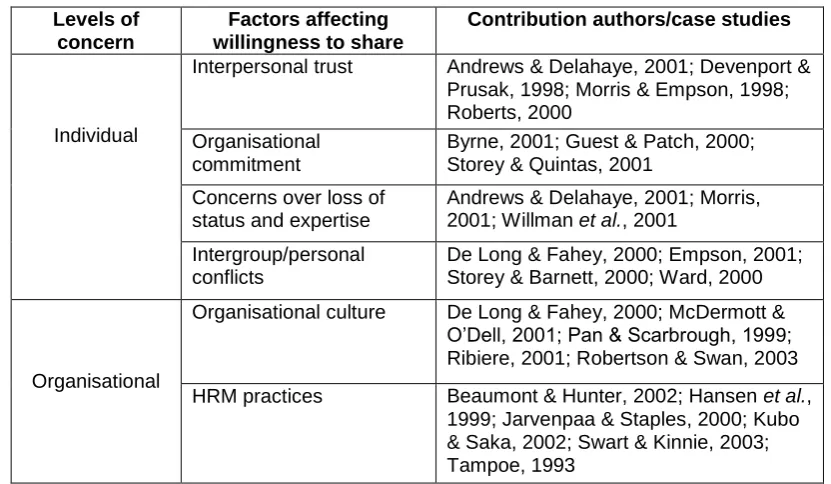
Table 3.6 Factors related to people‟s willingness to share knowledge 91
Table 3.7 Six KT-related factors in the shipping industry 97
Chapter Four
Table 4.1 Survey questions by type 131
Chapter Five
Table 5.1 Respondents‟ demographic information 150
XV
Table 5.3 Code of 14 components of the OKB 154
Table 5.4 Reliability analysis of scale measuring the OKB 155
Table 5.5 Perceptions of the proposed 14 knowledge components of the OKB 157
Table 5.6 Descriptives for normality of distribution (OKB06) 158
Table 5.7 Descriptives for normality of distribution (OKB09) 158
Table 5.8 Perceived importance of knowledge components in an OKB 159
Table 5.9 A t-test of OKB by the business sector 161
Table 5.10 ANOVA – OKB by total work experience 164
Table 5.11 Post-hoc test (Tukey HSD) – OKB by total work experience 165
Table 5.12 ANOVA – OKB by fleet size 166
Table 5.13 Post-hoc test (Tukey HSD) – OKB by fleet size 167
Table 5.14 Codes of perceived effects of human mobility on the OKB 168
Table 5.15 Reliability analysis of scale measuring perceived effects of human mobility on the OKB 169
Table 5.16 Perceived effects of human mobility on the OKB 170
Table 5.17 Perceived effects of human mobility (frequencies) 171
Table 5.18 KMO and Bartlett‟s Test (workforce) 174
Table 5.19 Total variance explained (workforce) 174
Table 5.20 Monte Carlo PCA for Parallel Analysis (workforce) 175
Table 5.21 Comparison of eigenvalues (workforce) 176
Table 5.22 Pattern and Structure Matrix for PCA with Oblimin Rotation of three-factor solution of workforce status 177
Table 5.23 Component correlation matrices (PCA and Oblimin with Kaiser normalisation) 177
Table 5.24 Correlations between variables (MOB) 179
Table 5.25 Model Summary (tintramob) 180
Table 5.26 ANOVA (tintramob) 181
Table 5.27 Coefficients (intramob) 181
Table 5.28 Codes of effective knowledge transfer practices 182
XVI
Table 5.30 Perceptions of effective knowledge transfer practices 184
Table 5.31 Perceptions on the proposed effective knowledge transfer practices 185
Table 5.32 KMO and Bartlett‟s Test (management practices) 186
Table 5.33 Total variance explained (management practices) 187
Table 5.34 Monte Carlo PCA for Parallel Analysis (management practices) 188
Table 5.35 Comparison of eigenvalues (management practices) 189
Table 5.36 Pattern and Structure Matrices for PCA with Oblimin Rotation of four-factor solution of current management practices 190
Table 5.37 Result of reliability analyses of four factors 192
Table 5.38 Reliability results after the deletion and reassignment of items 193
Table 5.39 Interpretation of factors 193
Table 5.40 Model Summary (tekt e.9 deleted) 194
Table 5.41 ANOVA (tekt e.9 deleted) 194
Table 5.42 Coefficients (tekt e.9 deleted) 195
Table 5.43 A t-test of EKT by CKO 196
Table 5.44 A t-test of EKT by KMD 196
Table 5.45 Correlations (total perceptions of ICT – current) 198
Table 5.46 Correlations (total perceptions of ICT – preferred) 198
Chapter Six
Table 6.1 Knowledge components in four dimensions ranked by mean scores 204Table 6.2 Comparison of mean scores among groups 209
Table 6.3 Effects of mobility with mean scores and percentage of agreement 212
Table 6.4 Predictability of current workforce stability (as a model) 214
Table 6.5 Predictability of current workforce stability by individual factor 214
Table 6.6 EKT practices with mean scores and percentage of agreement 217
Table 6.7 Predictability of existing management practices (as a model) 221
Table 6.8 Predictability of existing management practices (by individual factor) 221 Table 6.9 Comparison of mean scores (CKO & KMD) 222
XVII
LIST OF FIGURES
Chapter One
Figure 1.1 The structure of this thesis 12
Chapter Two
Figure 2.1 DIKW hierarchy 17
Figure 2.2 The knowledge hierarchy 18
Figure 2.3 The triangular relationship of data, information and knowledge 19
Figure 2.4 Four modes of knowledge conversion 23
Figure 2.5 A matrix of organisational knowledge base 26
Figure 2.6 Five bins in an OKB matrix 35
Figure 2.7 Knowledge components in an OKB matrix 44
Chapter Three
Figure 3.1 Scope of mobility 60
Figure 3.2 Intra- and inter- firm knowledge flows 62
Figure 3.3 Personal mobility and its effects on the OKB in the shipping industry 66
Figure 3.4 How does an organisation learn 73
Figure 3.5 An integrated model of organisational learning 74
Figure 3.6 Knowledge flows and the OKB 83
Figure 3.7 A framework of knowledge flows and related factors 93
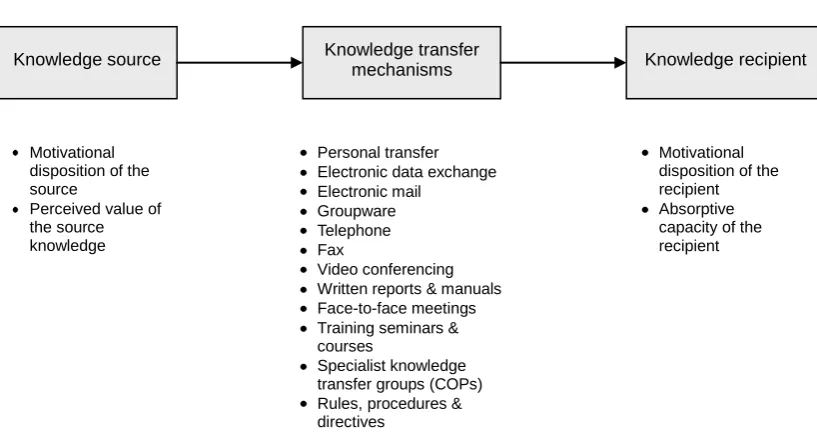
Figure 3.8 A knowledge transfer model 98
Figure 3.9 Culture elements influence knowledge transfer 102
Figure 3.10 Effective knowledge transfer practices 106
Chapter Four
Figure 4.1 The business research process 110
XVIII
Figure 4.3 Research development of this study 114
Figure 4.4 The conceptual framework 115
Figure 4.5 Steps followed in the design of the questionnaire 129
Figure 4.6 Principles for questionnaire design 130
Figure 4.7 The translation process 133
Chapter Five
Figure 5.1 Respondents‟ business sector 151Figure 5.2 Respondents‟ fleet size 151
Figure 5.3 Respondents‟ work experience 151
Figure 5.4 Respondents‟ onboard experience 151
Figure 5.5 Ship owners by fleet size and work experience 153
Figure 5.6 Ship managers by fleet size and work experience 153
Figure 5.7 Normal P-P Plot of regression standardised residual (tintramob) 179
Figure 5.8 Scatterplot (dependent variable: tintramob) 180
XIX
LIST OF ABBREVIATIONS
ANOVA Analysis of Variance
BBS Bulletin Board System
BIMCO The Baltic and International Maritime Council
CI Confidence Interval of the difference
CKO Chief Knowledge Officer
CoP Communities of Practice
DWT Dead Weight Tonnage
EDI Electronic Data Interchange
EKT Effective Knowledge Transfer
HR Human Resource
IC Intellectual Capital
ICT Information Communication Technology
IGO Individual-Group-Organisational
IT Information Technology
KMO Kaiser-Meyer-Olkin
KMD Knowledge Management Department
KT Knowledge Transfer
MNC Multinational Corporation
MEI Maritime Education Institution
MOB Mobility
NIH Not-Invented-Here
OADI-SMM Observe, Assess, Design, Implement – Shared Mental Model
OKB Organisational Knowledge Base
PCA Principal Components Analysis
SCA Sustained Competitive Advantage
SECI Socialisation, Externalisation, Combination, Internalisation
RBV Resource-based View
R&D Research and Development
XX
SM Ship Manager
SO Ship Owner
SRQ Subsidiary Research Question
1
CHAPTER 1: INTRODUCTION
1.1 Research background
Nearly a century ago, Marshall, in his book: Principles of Economics, explicitly pointed out the importance of knowledge within economic affairs by stating: “Capital
consists in a great part of knowledge and organisation…knowledge is our most powerful engine of production” (Marshall 1920, IV.I.2). Economic prosperity rests
upon knowledge and its useful application (Teece 1981). Drucker (1993) comments
that we have entered a knowledge society in which knowledge is not just another
resource alongside traditional resources such as land, labour and capital, but the only
meaningful resource today. The importance of knowledge-related resources to
organisational success ranks highest among all intangible resources an organisation
possesses (Hall 1992). Knowledge is thus considered the ultimate replacement of
other resources (Toffler 1990; Quinn 1992) therefore the key or even the only
resource (Drucker 1993) to a firm‟s sustained competitive advantage (SCA).
While the critical importance of knowledge was recognised nearly a century ago, the
development of theories has been a long race. In the course of the development of
theories regarding knowledge management, two distinct lines of thinking appeared in
the literature. One is the scientific line, for example: Porter (1980, 1985), Simon
(1945, 1973) and the other is the humanistic line represented by Mayo (1933), Weick
(1979) and Pfeffer (1981). Attempts have been made to synthesise these two camps,
for example: Argyris and Schön (1978), Drucker (1993), Nonaka and Takeuchi
(1995), and Senge (1990), bringing more camps of theories into management and
organisation theories such as organisational learning (Argyris & Schön, 1978), the
learning organisation (Senge, 1990), the resource-based approach (Prahalad & Hamel
1990; Stalk, Evans & Shulman 1992), and Drucker‟s (1993) knowledge worker and
the knowledge society.
2
1991; Prahalad & Hamel 1990; Teece et al. 1997; Wernerfeld 1984), organisational learning (Hedlund 1994; Wenger 1998), to a knowledge-based view of strategy
(Grant 1996; Nonaka 1994; Spender 1996). Despite continuous debates on theories, a
wide range of strategies and tools has been designed and implemented to manage
knowledge assets of organisations in various industries. In comparison with other
industries, the shipping industry appears to have lagged behind in embracing these
new management practices. This is evidenced by a dearth of research on the
application of knowledge management practices in the context of the shipping
industry.
The need for the exploration of a new approach such as knowledge management in
the shipping industry arose from the severe skill shortages being faced by the
industry as a result of high personnel mobility in the industry. A comprehensive study
conducted by the Baltic and International Maritime Council, in conjunction with the
International Shipping Federation showed an imbalance of supply and demand of
seafarers (BIMCO 2000; 2005) as a result of on-going outflow of its highly
experienced personnel to other shore-based industries and low intakes to refill its
skill base. It is projected that by 2010, the shipping industry will be faced with a
shortage of 46,000 skilled and qualified personnel worldwide (BIMCO 2005).
Because these highly qualified personnel are the main source to fill up onshore
positions in many sectors of the shipping industry for example, management
positions in shipping companies, and professional ship managers including technical,
operational, legal, financial, and commercial management of shipping activities, the
shortage will impact the shipping industry‟s ability to meet ever increasing demands
on maritime transport, which will in turn affect the wellbeing of international trade
and world economy. The skill shortage will also be a threat to safe shipping practices,
with impacts on costs of trading, the marine environment, and the wider economic
stability that the global community has come to expect.
Due to the shipping industry‟s unique characteristics, personnel movement across
3
a one-way direction with the shipping industry constantly losing its expertise to other
industries (for example: Gardner & Pettit 1999; Kong & Ruan 2001). The problem is
compounded by the difficulty in attracting personnel into the industry for various
reasons (Dinwoodie, 2000; Leggate 2004; Moreby 1975; Sambracos & Tsiaparikou
2001). Conventional teaching from human resource management cannot effectively
solve the problem of high turnover in the shipping industry due to, not only high
costs involved in retaining leaving personnel, but also the initial motives of leaving
being irrelevant to retention incentives (Abassi & Hollman 2000). The battle to retain
expertise and skills has continued for years with little success. It is against this
background that this research was initiated as an attempt to address the effects of high
mobility of personnel in the shipping industry from a new perspective.
The underlying rationale is to regard the high personnel mobility as an opportunity
rather than a problem because the movement of personnel is widely recognised as a
mechanism for distributing tacit knowledge and skills across space and time
(Almeida & Kogut 1999; Cooper 2001; Gruenfeld, Martorana & Fan 2000). As
personnel are knowledge carriers (Grant 1996; Polanyi 1962; Von Krogh & Roos
1995), when they move they bring their knowledge into the new workplace. While
inflow mobility may bring in new knowledge that the organisation previously did not
have, outflow mobility may be translated into a loss of certain knowledge if the
knowledge of the person leaving is not known to the others in the organisation. The
impact of personnel mobility, to a great extent, depends on whether there are
mechanisms in place to manage these knowledge flows for the best interest of the
organisation.
The attempt to apply knowledge management principles to the shipping industry
brings with it three important tasks. The first task is the identification of knowledge
assets in a shipping organisation. The significance of this process is three-fold:
Any management practices is pointless if their purpose is not clear.
The identification of knowledge assets provides measurable items to examine
4
For management practices to be effective, their design and implementation
must be relevant to what is being managed.
While there is abundant research on knowledge related constructs (for example:
Aaker 1989; Amit & Schoemaker 1993; Grant 1991; Hall, 1992, 1993, 1994; Hamel
& Heene 1994; Itami & Roehl 1987; Lyles & Schwenk 1992; Prahalad & Hamel
1990; Rumelt 1994; Teece 1998; Walsh & Ungson 1991; Winter 1987; Zander &
Kogut 1995) and knowledge measurement approaches (for example: Brooking 1996;
Edvinsson & Malone 1997; Marr & Schiuma 2001; Roos et al. 1997; Sveiby 1997), there is a lack of definition of concepts to capture the wholeness of organisational
knowledge (that is, both individual and organisational, explicit as well as tacit) in
particular in the shipping industry.
The second task is to examine the effects of high personnel mobility seen from the
point of view of each shipping organisation. Mobility is a more neutral description of
turnover in that turnover traditionally has been seen as an important organisational
problem that is costly and dysfunctional to the organisation. The differentiation of
dysfunctional and functional turnover, rather than the traditional categorisation of
voluntary and involuntary turnover, clarifies that turnover incurs negative as well as
positive effects (Abelson & Baysinger 1984; Dalton & Todor 1979; Muchinsky &
Tuttle 1979; Staw 1980). The belief that personnel are knowledge carriers (Grant
1996a; Polanyi 1962; von Krogh & Roos 1995) reveals that personnel mobility
(Graversen 2003; Langberg & Graversen 2001) in fact creates knowledge flows. For
a given organisation in a particular industry, knowledge flows at different levels and
in different directions (for example: Almeida, Song & Grant 2002; Bolton 1994;
Eisenhardt & Santos 2002; Hauknes & Ekeland 2002; Tomlinson 1999; Winter &
Szulanski 2001). The effects of these complex knowledge flows are yet to be
examined in the context of the shipping industry, although general discussions of the
effects of turnover on organisations have been provided in the literature.
5
brought about by personnel mobility, then how can these knowledge flows be
managed in a way that organisational knowledge assets can be increased over time
becomes an important question. This brings to us the third task, which is to find an
appropriate set of management practices to effectively manage knowledge flows. The
knowledge management process includes a range of activities such as knowledge
creation or acquisition, distribution or dissemination, interpretation, and application
(Hubber 1991). Depending on the priority of knowledge management application,
these activities have been emphasised differently in the literature. For example, while
Nonaka and Takeuschi (1995) emphasise the creation of knowledge, Almeida and
Grant (1998) argue that the major source of value creation from knowledge
management is likely to be in knowledge application. Due to the nature of the
problem faced by the shipping industry (the high knowledge attrition caused by high
personnel mobility), the main management task is knowledge retention if a high level
of personnel movement is inevitable. It is identified that the most effective way of
knowledge retention is through knowledge transfer (Abou-Zeid 2002; Almeida &
Grant 1998; Govindarajan 2000).
Research in different contexts has identified knowledge-related and partner-specific
factors that might affect the effective transfer of knowledge (Gupta & Govindarajan,
2000; Simonin, 1999; Szulanski, 1996). Knowledge-related factors include the value
of knowledge being transferred (Gupta & Govindarajan, 2000), tacitness and
complexity (Simonin, 1999) and causal ambiguity (Szulanski, 1996). Partner-specific
factors mainly concern the recipient‟s absorptive capacity (Gupta & Govindarajan,
2000; Szulanski, 1996) or prior knowledge (Simonin, 1999), the relationship between
source and recipient (Szulanski, 1996), the cultural and organisational distance
(Simonin, 1999), and the motivation of source and recipient (Gupta & Govindarajan,
2000; Simonin, 1999; Szulanski, 1996). Research on these variables lays a firm
foundation for the examination of barriers and facilitators of knowledge transfer in
the context of the shipping industry, which in turn helps the identification of effective
6
1.2 Research questions
The discussion of the three tasks elaborated above provokes the following three
fundamental research questions in this study:
Research question one: How is an organisational knowledge base described in the shipping industry?
To answer the first requestion, two hypotheses are proposed:
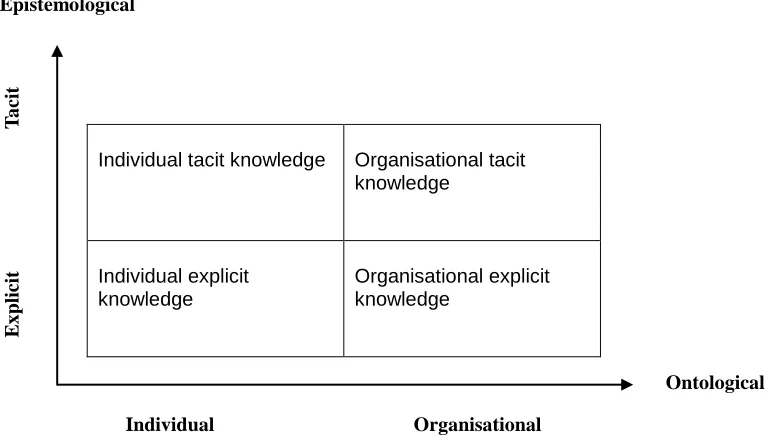
Hypothesis 1: Organisational knowledge base is a construct of 14 identified components associated with four groups of knowledge: individual explicit, individual tacit, organisational explicit and organisational tacit.
Hypothesis 2: The perceived importance of knowledge components in an organisational knowledge base (OKB) varies according to the observer’s business sector, fleet size, and work experience.
Research question two: How are the effects of human mobility on the organisational knowledge base perceived in the shipping industry?
The second research question is divided into two subsidiary questions (SRQ) with
the first being answered through three hypotheses:
SRQ2.1: What are the effects of human mobility on the OKB?
Hypothesis 2a: There is a positive relationship between the inflow of personnel and the OKB.
Hypothesis 2b: There is a negative relationship between the outflow of personnel and the OKB.
Hypothesis 3: The effects of mobility on the OKB differ with different movement patterns.
7
predicted by the current workforce stability?
Research question three: What are the effective knowledge transfer practices in the context of the shipping industry?
To investigate the third research question, a hypothesis and a subsidiary research
question are proposed as follows:
Hypothesis 4: Effective knowledge transfer practices in the shipping industry consist of 14 factors involving 3 groups of management practices: organisational culture (6), leadership (3), and technology (5).
SRQ3.2: Can perceived effectiveness of knowledge transfer practices be predicted by existing management practices in a shipping organisation?
1.3 Research objectives
The research background outlined earlier revealed some gaps in the literature and in
management practices. The main objectives of this research are, therefore, to identify
the knowledge components of the OKB in a shipping organisation, to determine the
effects of personnel mobility on the OKB, and to identify the effective knowledge
transfer practices in the context of the shipping industry. The research will focus on
the perceptions of shipping organisations (including ship owners and ship managers)
in China as listed in the World Ship Directory 2007-2008 (Lloyd‟s Register 2007).
More specifically, the research sets out to achieve following objectives:
To propose a conceptual model of the OKB in the shipping industry with
associated dimensions and components;
To empirically explore the perceived importance of knowledge components as
identified in the conceptual model from the perspective of shipping
organisations in China;
To investigate whether the perceived importance of knowledge components
8
To establish the projected relationships between the high level of personnel
mobility in the shipping industry and the OKB;
To empirically validate respondents‟ attitudes toward the projected
relationships between mobility and the OKB in the context of China;
To investigate whether such attitudes toward the projected relationships
between mobility and the OKB can be explained by current workforce
stability of respective shipping organisations;
To suggest a conceptual model of effective knowledge transfer for the
shipping industry with identified management practices;
To explore the perceived effectiveness of these knowledge transfer practices
in the context of the shipping industry in China;
To examine whether the differences of perceptions of effectiveness can be
predicted by current management practices of the respective shipping
organisations.
1.4 Outline of the thesis
The thesis follows a conventional structure with the current chapter establishing the
purpose of the research and explaining the three primary research questions and their
subsidiary research questions and hypotheses.
Chapter Two reviews the concept of knowledge and organisational knowledge assets
for the first research question. It begins with a review of the literature on the
dimensions of knowledge, followed by a discussion of different measurement
approaches with regard to knowledge assets. The concept of organisational
knowledge base is then proposed with the identification of knowledge components.
Finally the shipping specific knowledge components are identified and examined
under the concept of the OKB.
Chapter Three covers a review of the literature for the second and the third research
9
linking turnover with mobility and then with knowledge flows. This section
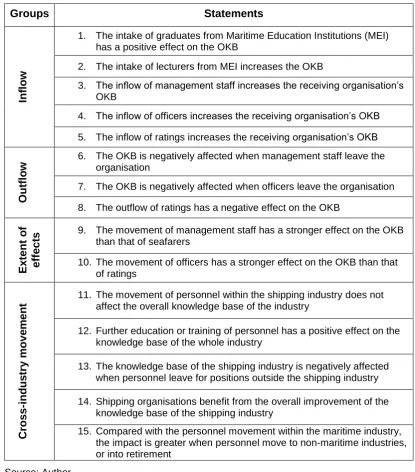
concludes with the establishment of perceived effects of human mobility on the OKB
in the context of the shipping industry. The chapter then moves on to a review of the
literature on knowledge transfer including individual learning and organisational
learning, and the knowledge management process, followed by the identification of
barriers and facilitators of knowledge transfer. Based on the effective knowledge
transfer practices identified through the literature review, a knowledge transfer model
is proposed. This model is then used for the investigation of knowledge transfer
practices in the context of the shipping industry.
Chapter Four presents the research design and methodology used in this study. It
begins with the development of the research framework in which all conceptual
models are summarised. The unit of analysis, target population, sampling design, and
sample size are discussed next, followed by the explanation of methods of data
collection including the design of the survey instrument and the administration
process. The final section covers the discussion of data editing, coding and entering,
and methods of data analyses.
Chapter Five analyses the collected data and reports on the profiles of respondents. It
begins with the analyses of demographic variables followed by three sections of data
analyses for the three research questions. Each section of data analyses provides
detailed discussion of statistical techniques being used and the process of the data
analyses. Findings are presented along with hypotheses and subsidiary research
questions. Chapter Six discusses the findings from Chapter Five. The discussions of
findings are linked back to the review of the literature conducted in Chapter Two and
Three wherever appropriate.
Chapter Seven draws conclusions on the three research questions and makes
recommendations for future research. The chapter begins with a revisit of the purpose
of the study followed by a summary of results. The contribution and limitations of the
10
Figure 1.1 The structure of this thesis
Source: Author
Chapter One
Introduction
Chapter Two
The Concept of the Organisational Knowledge and Its Components
Chapter Three
The Effects of Human Mobility on the OKB in the Shipping Industry
Chapter Four
Research Design and Methodology
Chapter Five
Organisational Knowledge Base and Knowledge Management Practices in the Shipping Industry
Chapter Six
Discussions of Findings
Chapter Seven
Conclusions and Recommendations Conceptualisation and model building
Methodology
11
CHAPTER 2: THE CONCEPT OF ORGANISATIONAL KNOWLEDGE
BASE AND ITS COMPONENTS
2.1 Introduction
The main objective of this chapter is to provide an overview of the concept of
organisational knowledge, on which the concept of organisational knowledge base
(OKB) is presented. The chapter begins with an overview of the concept of
knowledge, its distinction between data and information through which a definition
of knowledge is given and adopted as the understanding of knowledge. The
conceptualisation of the OKB is achieved through the review of literature on the
classification of knowledge and other knowledge-related constructs such as
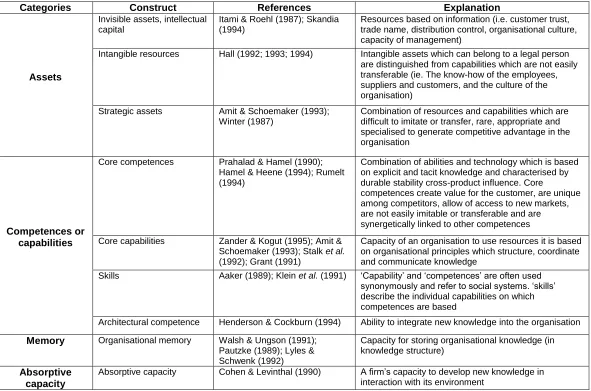
intangible assets, core competency/capabilities, absorptive capacity and
organisational memory.
Another main task of this chapter is to identify the components of knowledge in the
cells of the OKB matrix. By reviewing measurement models on intellectual capital,
components of knowledge in each category are examined and discussed and then
reorganised and restructured into a table to illustrate the composition of the OKB.
The final sections of this chapter endeavour to apply the concept of OKB in the
shipping industry and identify its relevant components for the empirical test. The
identification of knowledge components of the OKB lays the foundation for
examining the effects of human mobility in the shipping industry. Based on the OKB,
these knowledge management practices can be identified and applied into the
shipping industry to mitigate the problem of severe skill shortages the industry has
12
2.2 The multidimensional concept of knowledge
2.2.1 The distinction of data, information and knowledge
There has been a long history of confusion and debate in both academia and the
practitioner with regard to the relationship between data, information and knowledge.
In fact, confusion between knowledge and information has resulted in enormous
expenditure in information technology ventures that have yielded only marginal
results (Sveiby 1997; Davenport & Prusak 1998). The intuitive idea that knowledge
is something more than information has led literature in knowledge management to
make distinctions between data, information and knowledge, for example, Boisot
(1995), Choo (1998), Davenport and Prusak (1998), Hayek (1952) and Nonaka and
Takeuchi (1995). However, despite the efforts of distinction and definition, many
researchers use the terms casually and interchangeably. It is argued that equating
information and knowledge oversimplifies and even confounds the already
contentious division among biologists, cognitive psychologists, sociologists, and
organisational researchers regarding data, information and knowledge (Miller 1978).
Thus, a brief discussion of the distinction between data, information and knowledge
is given to clarify the author‟s stand as to how knowledge is understood.A definition
of knowledge is provided at the end of this section as adopted in this thesis.
The distinction of data, information and knowledge tends to be related to the ability
of their independency from their owner. Data is seen as syntactic and invariant with a
potential meaning to someone who can interpret them (Hirschheim et al. 1995; Setzer 2001). Information is created through a process of meaning attribution or
interpretation of data by individuals (Hirschheim et al. 1995). Unlike information, knowledge is embedded in people, and its creation occurs in the process of social
interaction (Sveiby 1997). Knowledge resides in individuals and is based at least
partially on personal experience (Leonard & Sensiper 1998). Therefore, information is a personal, variable, esoteric and ephemeral concept, dependent on the receiver‟s
point of interest and knowledge base, which is private and only available to the
13
however more stable than information (Boahene & Ditsa 2003). Although related to
both, knowledge is neither data nor information and the differences between these
terms are often a matter of degree (Davenport & Prusak 1998).
2.2.2 The relationship between data, information and knowledge
The relationship between data, information and knowledge is widely recognised in
the literature and is popularly referred to as a hierarchy (Ackoff 1989; Alavi &
Leidner 2001; Knight & Howes 2002; Stenmark 2001; Tuomi 1999). The hierarchy
where data sit at the base, and followed by information and then knowledge is
referred to as the knowledge hierarchy (figure 2.1). Information is data endowed with
relevance and purpose and the conversion from data to information requires relevant
knowledge (Drucker 1988). Information tends to be relatively static in time and linear
in nature, while knowledge is dynamic and has completeness in it (Bellinger 1997).
Information can become knowledge only when the patterns and their implications are
realised and understood. The process of transition from data to information, to
knowledge or finally to wisdom is illustrated through a pyramid-shaped diagram
[image:33.612.224.466.472.690.2](figure 2.2).
Figure 2.1 DIKW Hierarchy
14
Figure2.2 The Knowledge Hierarchy
Source: Knight & Howes (2003)
The underlying view of this knowledge hierarchy intends to reveal that the value of
the various forms of data-information-knowledge increases through learning or
understanding (Bender & Fish 2000; Choo et al. 2000; Knight & Howes 2002). It considers the construction of knowledge as somewhat similar to using letters as
atoms for building words that are subsequently combined to meaningful sentences
and then context. However, knowledge emerges through inter-personal validation
(Earl 1994). A broad knowledge base is needed to understand, interpret and integrate
the information at hand (Leonard-Barton 1995; Kogut & Zander 1992). Thus, there is
suggestion of a reversed knowledge hierarchy (Alavi & Leidner 2001; Stenmark
2001; Tuomi 1999), contending that the presumption of a hierarchy from data to
information to knowledge with each varying along some dimension such as context,
usefulness, or interpretability, rarely survives scrupulous evaluation. The key to
effectively distinguish between information and knowledge is not found in the
content, structure, accuracy or utility of the information or knowledge, rather in
15
Central to this argument is the belief that knowledge is embedded in a knower and is shaped by one‟s needs as well as one‟s initial stock of knowledge (Fahey & Prusak
1998; Tuomi 1999). Data can emerge only if a meaning structure, or semantics, is
first fixed and then used to represent information. Information is achieved when the
meaning is articulated within a linguistic and conceptual context. Information is
converted to knowledge once it is processed in the mind of individuals and
knowledge becomes information once it is articulated and presented in symbolic
forms (Alavi & Leidner 2001). The transformation process involves individual and
collective cognitive efforts.
From a more neutral perspective, Stenmark (2001) argues that information and
knowledge are interwoven and interrelated in more complicated ways than the
knowledge hierarchy or reversed hierarchy has suggested. In some way, knowledge is
a prerequisite to make sense of data and information (Drucker 1988). At the same
time, new knowledge is developed and constructed through available data and
information. Data and information are considered two opposite ends on a continuum
and what one conceives as information might be data to another (Stenmark 2001).
Therefore, instead of considering the relationship between data, information and
knowledge as hierarchy, where one is superior to another, a triangle (figure 2.3) is
suggested to illustrate the interwoven and interrelated relationship among these three
[image:35.612.229.399.549.686.2](Ancori et al. 2000; Boahene & Ditsa 2003).
Figure 2.3 The triangular relationship of data, information and knowledge
Source: Developed by the author based on Ancori et al. (2000) and Boahene & Ditsa (2003)
Experience Learning Cognitive efforts
Knowledge
16
The definition provided by Bell (1999) with regard to the distinction of data,
information and knowledge can be a summary for the above discussion. For Bell,
data is an ordered sequence of given items or events. Information is a context-based
arrangement of items whereby relations between them are shown. Knowledge,
however, is the judgement of the significance of events and items, which comes from
a particular context and/or theory. What differentiates knowledge from information
therefore is that knowledge presupposes values and beliefs, and is closely connected
with action.
The definition of knowledge suggested by Davenport and Prusak (1998, p5) is
adopted as what knowledge means in the context of this thesis. Knowledge is:
A fluid mix of framed experience, value, contextual information, and expert
insight that provides a framework for evaluating and incorporating new
experiences and information. It originates and is applied in the minds of
knowers. In organisations, it often becomes embedded not only in
documents or repositories but also in organisational routines, processes,
practices, and norms.
Tsoukas and Vladimirou (2001) comment that Davenport and Prusak pack into
knowledge too many things in this definition, it is believed that this definition
captures three important characteristics of knowledge: 1) the distinction and
relationship between knowledge and information which has been discussed in this
section; 2) the ontological dimension of knowledge, that is, knowledge as existing
both in individuals and organisations and 3) the epistemological dimension of
knowledge, that is, tacit and explicit knowledge. The ontological and epistemological
dimensions of knowledge are explained in the following section.
2.2.3 The classification of knowledge
Knowledge has been classified into different categories from different perspectives.
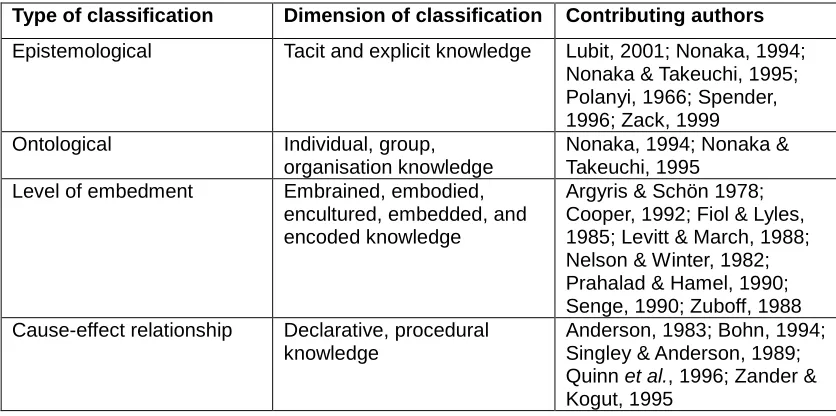
17
1994; Nonaka & Takeuchi 1995; Polanyi 1966; Spender 1996; Zack 1999).
Ontologically, knowledge can exist in an individual, a group or an organisation
(Nonaka 1994; Nonaka & Takeuchi 1995). Some have classified knowledge
according to its level of embedment (Argyris & Schön 1978; Cooper 1992; Fiol &
Lyles 1985; Levitt & March 1988; Nelson & Winter 1982; Prahalad & Hamel 1990;
Senge 1990; Zuboff 1988), or its causal-effect relationship (Anderson 1983; Singley
& Anderson 1989; Quinn et al. 1996). The level of embedment includes such subcategories as embodied, encoded, embrained and embedded knowledge.
Embodied (Blackler 1995; Collins 1993; Zuboff 1988) and embedded (Astley &
Zammuto 1992; Badaracco 1991; Brown & Duguid 1991) knowledge emphasises
more the process of knowledge development and construction. Knowledge is
generated and shared in different language systems, organisational culture and work
groups. Encoded knowledge (Blackler 1995; Collins 1993; Zuboff 1988) on the other
hand, remains in the organisation even if all employees have gone. Knowledge is
retained in databases, product categories, rules and regulations, and operation
manuals. Embrained knowledge (Argyris & Schön 1978; Blackler 1995; Collins 1993;
Fiol & Lyles 1985; Prahalad & Bettis 1986) depends on the cognitive abilities which
allow the recognition of underlying patterns and assumptions. Thus embodied and
embrained knowledge reflect the tacitness of knowledge, whereas encoded
knowledge represents the explicit characteristics of knowledge. Moreover,
declarative (Anderson 1983; Singley & Anderson 1989; Quinn et al. 1996) and procedural (Bohn 1994; Zander & Kogut 1995) knowledge, captures the explicit side
on the one hand and encompasses the tacit nature of knowledge on the other. A
summary of classification can be found in table 2.1.
From the above discussed classification of knowledge, it is fair to conclude that the
epistemological and ontological classification of knowledge has well captured the
full dimensions of knowledge, though there may be many other possible ways of
classifying it. This classification is then adopted in this thesis as a basis to
conceptualise the organisational knowledge base in the later sections. The
18
management as it allows management to identify relevant barriers and enablers in
knowledge creation and transfer process, which will be discussed in the next chapter.
The epistemological and ontological dimensions of knowledge are further discussed
[image:38.612.127.545.194.402.2]in the following sections.
Table 2.1 The classification of knowledge
Type of classification Dimension of classification Contributing authors
Epistemological Tacit and explicit knowledge Lubit, 2001; Nonaka, 1994; Nonaka & Takeuchi, 1995; Polanyi, 1966; Spender, 1996; Zack, 1999 Ontological Individual, group,
organisation knowledge
Nonaka, 1994; Nonaka & Takeuchi, 1995
Level of embedment Embrained, embodied, encultured, embedded, and encoded knowledge
Argyris & Schön 1978; Cooper, 1992; Fiol & Lyles, 1985; Levitt & March, 1988; Nelson & Winter, 1982; Prahalad & Hamel, 1990; Senge, 1990; Zuboff, 1988 Cause-effect relationship Declarative, procedural
knowledge
Anderson, 1983; Bohn, 1994; Singley & Anderson, 1989; Quinn et al., 1996; Zander & Kogut, 1995
Source: Author
2.2.3.1 The epistemological dimension
Epistemological classification distinguishes between tacit and explicit dimensions of
knowledge. According to Polanyi (1966), tacit knowledge is deeply rooted in action
and specific context and is subjective, situational and intimately tied to the knower‟s
experience (Kidd 1998). It is difficult to express, formalise or share in an explicit way.
Tacit knowledge involves both cognitive elements which include mental models,
schemata, paradigms and beliefs, and technical elements which include know-how,
crafts and skills (Nonaka 1993). The acquisition of tacit knowledge usually involves
(unconscious or semi-conscious) actions (Leonard-Barton & Sensiper 1998; Zack
1999), which reflect the effortlessness of tacit knowledge (Polanyi 1966). Tacit
knowledge is further classified into four categories (Lubit 2001): a) skills or
know-how, b) mental models, c) ways of approaching problems and d) organisational
19
intangible and difficult to imitate, and therefore a source of competitive advantage to
an organisation (Barney 1991).
Explicit knowledge refers to knowledge that is structured and independent of the
knower (Kidd 1998) therefore, capable of articulating in formal, systematic language.
It is captured in records of the past such as libraries, archives and databases, and is
assessed on a sequential basis. In organisations, explicit knowledge is stored in
databanks, standard operating procedures, and manuals as objective knowledge
(Spender 1996).
2.2.3.2 The relationship between explicit and tacit knowledge
Explicit and tacit knowledge are not totally separate but mutually complementary
entities (Nonaka 1993). In fact, “All knowledge is either tacit or rooted in tacit
knowledge; a wholly explicit knowledge is unthinkable” (Polanyi 1996b, p. 7).
Knowledge is created through four patterns of interaction between tacit and explicit
knowledge: socialisation, externalisation, combination and internalisation – SECI
model (Nonaka & Takeuchi 1995) (figure 2.4).
Figure 2.4 Four modes of knowledge conversion
Source: Nonaka & Takeuchi (1995)
Through socialisation, an individual is able to acquire tacit knowledge directly from
others without using language but through observation, imitation and practice. The
key to acquire tacit knowledge is shared experience. Externalisation is the knowledge
creation process in which tacit knowledge becomes explicit, taking the shape of Socialisation Externalisation
Internalisation Combination
From
To
Tacit knowledge
Tacit knowledge Explicit knowledge
20
metaphors, analogies, concepts or models. Externalisation holds the key to
knowledge creation, because it creates new, explicit concepts from tacit knowledge.
Combination involves combining different bodies of explicit knowledge into a
knowledge system. Reconfiguration of existing information in the knowledge system
through sorting, combing and categorising of explicit knowledge can lead to new
knowledge. Internalisation is a process of embodying explicit knowledge into tacit
knowledge. It is closely related to learning by doing.
When experience through socialisation, externalisation, combination and internalisation is initialised into an individual‟s tacit knowledge base, in the form of
shared mental models, they become valuable assets. For organisational knowledge
creation to take place, however, the tacit knowledge accumulated at the individual
level needs to be socialised with other organisational members, thereby starting a
new spiral of knowledge creation.
2.2.3.3 The ontological dimension
Ontological dimension classifies knowledge into individual, group and organisational
knowledge. Knowledge can be viewed as existing in individuals, groups or
organisations (Nonaka 1994). Knowledge is created by individuals, and
organisational knowledge creation is considered as a process in which individual
knowledge is amplified, and integrated into organisational knowledge. The process is
referred to as the spiral of organisational knowledge creation (Nonaka & Takeuchi
1995), where organisational knowledge creation happens through the amplification of
the patterns of knowledge conversion throughout the organisation, starting from the
individual rising to the inter organisational level. The ontological classification of
knowledge coincides the distinction between individual and organisational learning
(Kim 1993), defining different levels of social interaction, that is, individual, group
21 2.2.3.4 The relationship between individual and organisational knowledge
The character of knowledge has been debated for a long time. While some insist on
the personal character of knowledge (Polanyi 1962; Von Krogh & Roos 1995), others
claim that all knowledge is, in a fundamental way, collective (Wittgenstein 1958).
Other statements suggest that knowledge is the individual capacity to draw
distinctions, within a domain of action, based on an appreciation of context or theory
(Baumard 1999; Nonaka & Takeuchi 1995; Tsoukas & Vladimirou 2001), that is,
knowledge can be personal as well as collective. That organisations provide concrete
settings, sets of abstract rules for individual action illustrates how knowledge, in the
organised context, becomes organisational (Tsoukas & Vladimirou 2001).
The development of organisational knowledge is not achieved by aggregating
individual knowledge, but rather by synthesising through social interaction between
individuals and is mediated through multiple levels (Probst, Büchel & Raub 1998).
At the individual level, interpretation of the environment leads to the revision of
individual knowledge structures. At the group level, individual knowledge structures
are synthesised to create shared briefs or a shared mental model (Nonaka & Takeuchi
1995). At the organisational level, the routinisation of shared beliefs leads to
organisational knowledge. These are social processes which are composed of the
interaction of individuals and not of their isolated behaviour.
In Nonaka and Takeuchi‟s knowledge creation model (1995), the ontological
dimension consists of four different levels of knowledge creation: individual, group,
organisation and inter-organisation. Organisational knowledge is created in the
process that organisationally amplifies the knowledge created by individuals and
crystallises it as part of the knowledge network of the organisation. This process takes place within an expanding “community of interaction” which crosses intra- and
inter-organisational levels and boundaries (Nonaka & Takeuchi 1995). The
amplification of knowledge is achieved through the four modes of knowledge
conversion (SECI), which creates a spiral effect as it progresses from individual to