
City, University of London Institutional Repository
Citation:
Moustakidis, S ORCID: 1090-2177, Meintanis, I. ORCID:
0002-1920-1801, Halikias, G. ORCID: 0003-1260-1383 and Karcanias, N. ORCID:
0000-0002-1889-6314 (2019). An Innovative Control Framework for District Heating Systems:
Conceptualisation and Preliminary Results. Resources, 8(1), 27.. doi:
10.3390/resources8010027
This is the published version of the paper.
This version of the publication may differ from the final published
version.
Permanent repository link:
http://openaccess.city.ac.uk/21886/
Link to published version:
http://dx.doi.org/10.3390/resources8010027
Copyright and reuse: City Research Online aims to make research
outputs of City, University of London available to a wider audience.
Copyright and Moral Rights remain with the author(s) and/or copyright
holders. URLs from City Research Online may be freely distributed and
linked to.
City Research Online:
http://openaccess.city.ac.uk/
[email protected]
Article
An Innovative Control Framework for District
Heating Systems: Conceptualisation and
Preliminary Results
Serafeim Moustakidis† , Ioannis Meintanis *,† , George Halikias† and Nicos Karcanias†
Systems and Control Research Centre, School of Mathematics, Computer Science and Engineering, City University of London, Northampton Square, London EC1V 0HB, UK;
[email protected] (S.M.); [email protected] (G.H.); [email protected] (N.K.)
* Correspondence: [email protected] † These authors contributed equally to this work.
Received: 23 December 2018; Accepted: 24 January 2019; Published: 31 January 2019
Abstract: This paper presents a holistic innovative solution for the transformation of the current district heating and cooling systems to automated more efficient systems. A variety of technological advancements have been developed and integrated to support the effective energy management of future district heating and cooling sector. First, we identify and discuss the main challenges and needs that are in line with the EU objectives and policy expectations. We give an overview of the main parts that our solution consists of, with emphasis on the forecasting tools and an advanced control system that addresses unit commitment and economic load dispatch problems. The proposed control approach employs distributed and scalable optimisation algorithms for optimising the short-term operations of a district heating and cooling plant subject to technical constraints and uncertainties in the energy demand. To test the performance and validate the proposed control system, a district heating plant with multiple energy generation units and real-life heat load data were used. Simulation experiments were also used to evaluate the benefits of using thermal storage units in district heating systems. The results show that the proposed method could achieve significant cost savings when energy storage is employed. The proposed control strategy can be applied for both operating optimally district heating plants with storage and supporting investment planning for new storage units.
Keywords: district energy systems; district heating networks; thermal energy storage; decision-making systems; model predictive control; hierarchical control
1. Introduction
Europe, forced by climate change and the need for a sustainable economic and social growth, should focus on an energy revolution to reverse present-day unsustainable trends and live up to the ambitious policy expectations. A rational, consistent and far-sighted approach to heating and cooling is key for ensuring such transformation [1], which is also in line with the EU policies of almost zero carbon energy solutions by 2050. More precisely, the European objectives are distinguished between short-term (towards 2020) and medium term (towards 2030), while taking into account that any of the developments described must remain sustainable and future-proof also in the long-term (towards 2050). To achieve these goals and accelerate the development of technological advancements, research efforts should focus on integrated, flexible, highly efficient and environmentally friendly solutions. As previous research studies have shown, the district heating infrastructure has the potential to play a key role in sustainable energy systems [2–5]. Towards this direction, future District Heating and Cooling (DHC) systems can help Europe achieve the objectives [6] reported in Table1.
Table 1.European objectives for DHC of the future [6].
by 2020
- Avoidance of 9.3% of all European CO2emissions by District Heating - Additional 40–50 million tons of annual CO2reductions by District Cooling - Decrease of primary energy consumption with 2.14 EJ (595 TWh) per year, corresponding to 2.6% of entire European primary energy demand
- 25% share of renewable energies in District Heating
by 2030
- A smart energy exchange network, allowing for optimal resource allocation between the multiple low carbon energy sources feeding into the system and various temperature demands of customers
by 2050 - Fully carbon neutral energy solutions through regional, integrated networks
Unfortunately, due to the limited use of green industry, the first batch of objectives set for 2020 seem to be very far away from being accomplished. As of today, the DHC sector is considered as a green industry. This means that, on average, 86% of heat for DH in Europe is sourced from a combination of recycled and renewable heat sources [7]. On the other hand, in an attempt to steer clear from fossil fuels and support a combination of more efficient renewable and competitive energy supplies, DHC emerges as a viable short-term solution for various European communities [8], as indicated in TableA2(AppendixA). By no means however has the full potential of DHC been exploited and there is ample room to grow as, currently, it accounts for a limited 10% market share [9]. Future DHC systems need to be more efficient, intelligent and cost-effective. It is necessary to develop and deploy intelligent systems using smart metering, including autonomous sensors supplied by their environment (energy harvesting), and control solutions for optimisation and consumer empowerment. Exploiting multiple energy resources and considering co-generation and integration with renewable energy systems will help towards that goal. Moreover, an open challenge is to roll-out intelligent solutions for the integration of thermal and cooling networks with the future smart electricity grids, the so-called tri-generation energy networks [10–12].
Scientific Challenges
Based on the future EU objectives and policy expectations outlined above for the DHC sector, we identify several technological requirements that have been emerged [13–16]:
(a) Need for transport, distribution and storage of thermal/cooling energy: To be as efficient as possible, the future DHC systems must even further decrease thermal losses in transport and distribution [17]. The constant improvement of pipe technology in accordance with contextual developments is a prerequisite to minimise energy losses and to support new connections of low-energy buildings which require heat transport in smaller pipes. Thus, the development of plug-and-play pipe systems could help to decrease the construction/maintenance time [8] and the associated costs by ensuring quick localisation and problem identification.
(b) Need to satisfy and analyse the heating/cooling demands: Energy balance between production and demand is the most crucial condition for reducing costs without sacrificing consumer satisfaction. To fit with the evolving demand trends of end-users, the energy sector must better understand and analyse the present and future demand levels [18] (population developments, densification of cities vs. low-energy buildings, impact of new demands, and own production) [19,20]. Collection and efficient use of data are essential to that aim, since this information helps the network operator manage the grid efficiently, while at the same time the consumers will be better informed about their consumption and about any possibilities to decrease their energy bills [8,21]. Thus, intelligent Advanced Metering Infrastructures (AMI) with data mining algorithms need to be developed to support the above prerequisite.
with the development of advanced forecasting tools that provide short-term predictions of the heating and cooling (H&C) needs for various types of buildings [22]. Such tools are of paramount importance since accurate (near real-time) load demand forecasts are crucial for the performance of DHC control systems. Recent advancements in Artificial Intelligence (AI) technology [23] would help to fulfil that need.
(d) Need for intelligent monitoring and control of DHC systems: In general, current DHC systems are controlled by conventional PID controllers and most adjustments are still performed manually based on the experience of the network operator. Hence, there is a strong need to support the transformation towards automated DHC systems by developing intelligent control strategies that guarantee efficient energy management and reduction of energy costs [24]. Such control systems should be: (i) able to predict ahead in time consumer demand profiles; (ii) adaptive to any changes in the network status as well as copying with faults [25]; (iii) robust to stochastic uncertainties; and (iv) flexible and scalable. Moreover, monitoring tools for energy storage units and renewables power generation could assist the control system to take optimal decisions, whereas simulation tools help to evaluate the outcomes of such decisions. Data-driven artificial neural networks (ANN)-based models have proven to be suitable and could support the monitoring, simulation and development of decision-making algorithms for future DHC systems.
(e) DHC systems as an integrated solution: The integration of the various technological advancements (control systems, prediction tools, monitoring tools, etc.) is essential to be able to provide a complete solution to fully achieve the efficient management and operation of DHC systems. To address the challenges and the technological needs raised above, we propose a holistic approach integrating a variety of innovative solutions for the efficient management and operation of DHC systems. More precisely, an advanced automated decision-making system was developed employing a control framework with multiple decision layers. The proposed system is supported by a variety of tools, such as: (i) forecasting tools that provide short-term energy demand and weather predictions; (ii) modelling and monitoring tools that allow the network operator to know the level of energy stored in storage unit(s); and (iii) intelligent control algorithms for optimal scheduling of production units and distribution of loads that guarantee economic performance and energy efficiency. The aim of this paper is to stimulate a discussion on the future challenges of the DHC sector towards more energy efficiency and intelligent automated solutions. To accomplish such a transformation, a novel approach for optimal energy management in DHC systems that incorporates advanced control algorithms and mathematical programming, supported by AI-based modelling tools, is investigated and discussed. Research efforts are also devoted to the development of new insulation materials for DHC pipelines and intelligent AMIs, that addresses Scientific Challenges (a) and (b), but these will be discussed in a future work.
The rest of the paper is organised as follows: Section2reviews the main existing approaches for control and optimisation in DHC systems and gives an overview of the proposed modelling and control framework as well as the supporting technologies. The high-level control strategy is discussed here, along with a brief description of the decision-making and control problems for each layer of the control hierarchy. In Section3, we report simulation results where the optimal decisions of the control strategy were applied to address unit commitment and economic load dispatch in a DH plant with and without energy storage. The results derived were used to evaluate the benefits of using storage units in DH systems. The integration and interconnection of the supporting technological modules is also discussed. Finally, conclusions are drawn in Section4together with ideas for future research activities.
2. Methodology
we review the main control approaches for DHC systems with emphasis on model-based predictive control strategies.
2.1. Current Control Approaches in DHC Systems
Many optimisation models have been studied in the literature for operational planning and control in district heating systems (DHS). In [21,26], the authors presented energy management strategies to optimise the energy distribution of smart buildings in districts, with the aim to limit wastes and costs, while respecting the users’ comfort preferences. Mixed-integer programming with mathematical models and Lagrangian relaxation based algorithms is proposed in [27], for short-term production planning in co-generation and power systems. A control strategy for the economic optimal operation in a combined heat and power (CHP) system with renewable sources, including wind energy, photovoltaic and heat recovery boiler, is reported in [28]. Similar control strategies with linear programming models are analysed in [29,30] for optimising the operations in CHP systems and evaluating the benefit of using different sized storages.
Most of the works reported above employ a static optimisation model that is not suitable for capturing the time-evolution of energy vectors. A model predictive controller (MPC) overcomes the shortcomings of the static optimisation due to the use of receding horizon strategy and disturbance models. Mixed-integer linear programming (MILP) models combined with MPC strategies have been applied to several cases that require decision-making and scheduling, e.g., in microgrid power plants feeding both electrical and thermal loads [31,32]. A similar formulation that tackles the unit commitment problem in thermal systems is presented in [33]. A hybrid evolutionary linear programming optimisation algorithm is used in [34] to minimise the total operating costs of DH networks, whereas, in [35], structural, design and operational multi-objective optimisations are performed for distributed energy systems including heating networks. The work in [36] describes a decision support system based on a short-term optimal predictive control law considering the network’s lifetime consumption. Comprehensive reviews of the most recent studies in control and optimisation for DHC systems can be found in [37,38], whereas the available software for production planning can be found in [39,40].
2.2. The Proposed Control Architecture
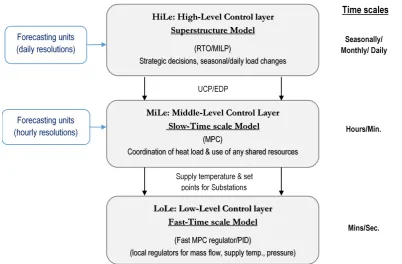
possibility to impose constraints on physical and operational variables of the real system. To function well, the MiLe prediction horizon should be longer than the slowest dynamic in the pipe network, i.e., the maximum transport delay. Having this in mind, the MiLe time-scale can be set-up from minutes to several hours, depending on the network under study. A typical MiLe prediction horizon is 6–12 h. The lower control layer corresponds to a fast time-scale model that handles the basic regulation of process variables, such as supply temperature, mass flow rate and pressure, at the substation/building level.
Figure 1.The proposed decision-making and control hierarchy for DHC systems.
2.3. Supporting Machine Learning-Based Tools
Efficient forecast tools are necessary components for energy planning in energy networks playing a key role in operational decision making. Short term weather forecasting could be a crucial contributing factor for estimating future energy demand in DHC systems. Several weather parameters, such as temperature, solar radiation, atmospheric pressure, humidity and precipitation, are widely available nowadays. The availability of this information base sets the stage for a great adoption of more advanced data-driven computer modelling and automated processing of meteorological data. However, data-driven weather prediction remains a challenge due to the inherent uncertainties of the existing weather forecast methodologies. Big data and advances in sensors and smart meters have resulted in massive growth of energy datasets, thus creating new opportunities for energy prediction in DHC systems. Taking advantage of the vast availability of data, a machine learning (ML) approach is proposed that relies on readings from smart meters and contextual information such as weather data or forecasting weather parameters. The proposed two-stages prediction tool comprises of:
(a) a data-driven weather forecasting unit that is trained on local weather data (many years of historical data) and predicts future weather parameters within a horizon of 24 h at maximum; and
Advanced deep learning (DL) models (Long Short Term Memory (LSTM)) are employed to implement the weather forecasting task. For the training phase of the models, a set of training examples is used in the form of input–output pairs. Historical values of different weather parameters (e.g., temperature, solar radiation, atmospheric pressure, humidity and precipitation) are used as inputs to the DL model, whereas temperature is the desired output parameter. The dimensionality and the format of the training and testing samples are dependent on three parameters: (i) the number of input features (Nf); (ii) the size of the look-back window (NLB); and (iii) the size of the look-ahead
window (NLA) (or forecasting horizon). The first parameter, Nf, denotes the number of weather
parameters that are considered as inputs to the DL model (Nf =4 in our case). The second and the
third parameters are measured in hourly time-steps. NLBdenotes the number of previous hourly
time-steps of the input parameters used from training, whereasNLAis the desired number of predicted
temperature hourly time-steps. Therefore, the input dimensionality of the weather forecasting model isNLB×Nf, while the dimension of the output vector isNLA×1. Similarly, the energy demand
prediction model receives as inputs theNLBhistorical energy consumption values, theNLApredicted
temperatures from the weather forecasting model along with some extra parameters (such as day of the week and time of day). TheNLB+NLA+2 inputs parameters are fed into the DL model (LSTM)
for training and learning to estimate the future energy consumption of the DHC network for the next
NLAhours. It should be noted that the detailed performance analysis of the proposed forecasting tools
is out of the scope of this paper.
As far as the necessary hardware, smart metering systems and wide-area communication infrastructure are needed at the physical level to achieve an efficient two-way communication that will allow commands to be sent from/to end-users. Smart meters will enable consumers to utilise energy in an intelligent way by providing them with information such as time-of-use, pricing information demand response actions or remote service disconnects. The main parameters that need to be measured by the smart meters to calculate the energy consumption are water temperatures and flow-rates in both supply and return pipelines.
2.4. The High-Level Optimal Control Strategy
Apart from the main demand constraint that handles the energy balance between supply and consumer demand, other typical constraints that the decision algorithm takes into account are: (a) production units’ energy generation limits (min/max capacity)
(b) minimum up/down times that a boiler should be kept on/off (c) temperature limits per each generation unit
(d) ramp limits (up/down) per each generation unit
(e) thermal energy storage dynamics and physical constraints (f) reliability constraints
Note that the above constraints include some of the typical constraints used in modelling of such systems. Depending on the network under investigation, some of them might not be applicable, or other constraints, such as plant layout and interconnection topology might be considered as well. To anticipate forecast inaccuracies and make the decision-control algorithms more robust to uncertainties, the optimisation model is embedded into a receding horizon control (RHC) framework with a moving-time horizon. With this approach, we create a feedback mechanism that can potentially compensate for any disturbances or uncertainties acted meanwhile.
The overall integrated system (optimisation, control module and supporting tools) can be viewed as a decision and support system (DSS) that provides with optimal suggestions the network operators for the optimal management of the DHC systems. The decision and support mechanism is designed to be flexible and can be used to any small, large-scale network by suitably adjusting the model inputs and constraints.
3. Simulation Results and Discussion
The main components of a typical DH system are: the plant that consists of the energy (heating and/or cooling) generation units, the distribution network (pipeline), and the consumers’ substations. Typical units used for heat production include biomass boilers, heat-only boilers, CHP units, etc. The thermal power produced is then distributed through a network of pipeline to the connected consumer substations, where the thermal energy from the primary network is transferred to the end-users internal heating system, e.g., radiators. The proposed control strategy was applied to a pilot DHS to test its performance in a realistic simulation scenario with real-life energy demand data, as described subsequently.
3.1. Simulation Set-Up and Network Characteristics
Table 2.Energy production units’ main parameters.
Production Unit
Pmin (kW)
Pmax (kW)
Tmin (◦C)
Tmax (◦C)
Rmax (kW/h)
Biomass (B1) 120 750 70 100 30
Gas (B2) 100 700 70 110 40
Oil (B3) 80 750 75 115 60
We should note that the focus of this study is on the demonstration of the unit commitment and load dispatch problems, addressed at the top-layers of the proposed control hierarchy, by assuming that suitably tuned low-level controllers exist that regulate the local process variables at the desired levels.
3.2. Simulation Experiments
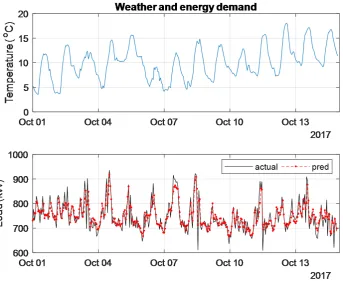
Two main scenarios were considered in our investigation, employing the TES unit or not, and we compared both cases with a reference case derived by assuming perfect forecast, i.e., the controller used the actual demand data in place of forecasts. To run the simulations, the control algorithms required as exogenous inputs the aggregated thermal demand and the corresponding weather conditions for the whole time horizon. Figure2shows the outside temperature (upper plot) and the actual versus the forecasted thermal power demand profile (bottom plot) from 90 connected consumers, based on real historical data from October 2017.
Figure 2.(Top) outside temperature; and (Bottom) actual versus forecasted aggregated thermal load demand over a 14-day horizon.
In the following analysis, a simulation scenario of 14 days=336(h)with sampling time interval
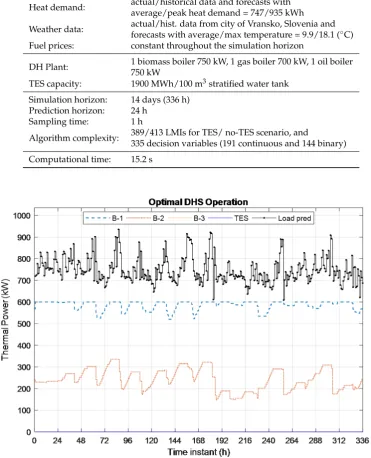
[image:9.595.118.462.371.652.2]As Figures 3and 4display, the biomass boiler (B1: ciel line) was mainly used to meet the consumers’ energy demand due to its lower production cost compared to the other available energy production units. To increase the operational efficiency of the biomass boiler, the control algorithm suggested a working power at about 80% of its maximum capacity. When more heating power was required, the gas boiler (B2: orange line) was employed, working at low-medium power level. The oil boiler (B3) was only used to cover peak demands, as it was the most expensive production unit, and especially when the peaks were short, due to the longer minimum-up time constraints.
Table 3.Simulation inputs and parameters.
Heat demand: actual/historical data and forecasts with average/peak heat demand = 747/935 kWh
Weather data: actual/hist. data from city of Vransko, Slovenia and forecasts with average/max temperature = 9.9/18.1 (◦C) Fuel prices: constant throughout the simulation horizon
DH Plant: 1 biomass boiler 750 kW, 1 gas boiler 700 kW, 1 oil boiler 750 kW
TES capacity: 1900 MWh/100 m3stratified water tank
Simulation horizon: 14 days (336 h) Prediction horizon: 24 h
Sampling time: 1 h
Algorithm complexity: 389/413 LMIs for TES/ no-TES scenario, and
335 decision variables (191 continuous and 144 binary)
Computational time: 15.2 s
Figure 3.Optimal heat production and load distribution amongst energy units without TES.
[image:10.595.106.478.220.679.2]Figure 4.Optimal heat production and load distribution amongst energy units without TES.
Figure 5.Optimal heat production and load distribution amongst energy units with TES.
When TES was employed, the decision algorithm planning suggested reducing the usage of the biomass boiler (running at lower levels) and eliminating the usage of the gas boiler when available energy was stored at TES and the demand was low. The only drawback that might be undesirable here was the multiple start–stop actions of the gas boiler (B2), however this could be tackled by adjusting the corresponding constraints.
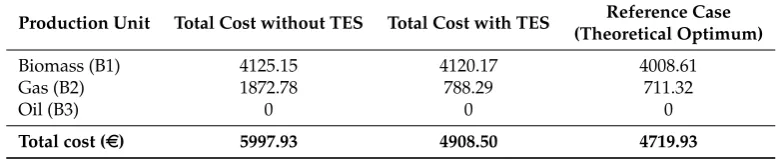
[image:11.595.107.476.375.612.2]feasibility of the optimisation algorithm. Thus, the derived costs might seem higher than the real energy production costs. Table4shows that employing a thermal storage unit made the DHS more economically efficient. Moreover, the control algorithm could achieve about 85% cost savings compared to the reference case.
[image:12.595.138.459.363.512.2]Figure 6.Optimal heat production and load distribution amongst energy units with TES.
Figure 7.Average daily net operational costs for both cases (with and without TES).
Table 4.DH plant energy production costs for 14-day planning.
Production Unit Total Cost without TES Total Cost with TES Reference Case (Theoretical Optimum)
Biomass (B1) 4125.15 4120.17 4008.61
Gas (B2) 1872.78 788.29 711.32
Oil (B3) 0 0 0
Total cost (e) 5997.93 4908.50 4719.93
4. Discussion and Future Work
[image:12.595.102.491.567.647.2]Two set of results are reported over a 14-day simulation horizon. The scenario without TES led to costs of 5997 e, i.e., 1278 e more expensive than the reference case, 4719e, which defined the theoretical optimum that cannot be achieved in practice. The scenario with the TES employed yielded net operating costs of 4908e, which implies cost savings of about 20% compared with the without-TES case. This implies that the control algorithm despite the forecast uncertainties can obtain about 85% of the theoretically possible savings derived based on perfect forecasts. From the results above, we may also conclude that the proposed strategy produced in both cases a solution close to the benchmark (optimal scenario). In addition, the fact that the performance of the control algorithm, when applied in a DH plant with TES, was better than the without-TES case (about 85% as good as the theoretical optimal case) validated the proposed methodology. Apart from the economic benefits, a list of practical benefits also exists by integrating energy storage units in DHC systems, e.g., TES can decouple heat production, allows for price-driven power production schemes and flexible demand, and improves the overall system efficiency. As future activities, we plan to test the robustness of our proposed method by examining the forecasting error and its effect on the operational costs and the control performance. Robust or stochastic MPC variants will be examined in order to cope with the uncertainty. The thermal energy storage monitoring tool, which is currently under development, will be integrated with the control framework to provide information about the energy storage content ahead in time. A future goal we also consider as crucial is to integrate the advanced control framework and the supporting technologies in an online platform with a human–machine interface in order to build an intelligent decision and support system that will assist the network operators to take optimal planning decisions, evaluate their actions and anticipate any undesirable effects.
Author Contributions: Conceptualisation, S.M.; Data curation, I.M.; Methodology, I.M.; Project administration, S.M.; Supervision, G.H. and N.K.; Writing—original draft, S.M. and I.M.; and Writing—review and editing, S.M., I.M., G.H. and N.K.
Funding:This research was funded by European Union’s Horizon 2020 research and innovation programme under grant agreement No.: 696174 (InDeal project).
Acknowledgments:The authors would like to thank the anonymous reviewers and the associate editor for their valuable comments and suggestions.
Conflicts of Interest:The authors declare no conflict of interest.
Abbreviations
The following abbreviations are used in this manuscript:
AMI Artificial Metering Infrastructure ANN Artificial Neural Networks DHC District Heating and Cooling DHN District Heating Network DHS District Heating System DL Deep Learning
DSS Decision and Support System EDP Economic Dispatch Problem HiLe Higher-level
LoLe Lower-level
LSTM Long Short Term Memory MiLe Middle-level
MILP Mixed Integer Linear Programming ML Machine Learning
Appendix A
Table A1.Energy costs per production unit.
Fuel Cost (Euro/MWh)
Biomass Boiler 22.4 Gas Boiler 32.8 Oil Boiler 60.1
Table A2.DHC infrastructures in European countries [8].
Country Citizens Served (%)
DH/DC Pipeline (km)
Heated Surface (106m2)
Heating Capacity (MWth)
Cooling Capacity (MWth)
Austria 24 4918/11.2 66 10,300 75
Denmark 63 29,000/- - -
-France 7 3725/158 - 21,230 669
Germany 12 20,219/51 - 49,691 153
Italy 6 3807/67 112 8056 182
Poland 53 20,139/20 506 56,521 43
Slovenia 15 753/0.6 8 2276 1
Sweden 52 23,667/506 308 -
-References
1. Euroheat&Power.ECOHEATCOOL: Work Package 3: Guidelines for Assessing the Efficiency of District Heating and District Cooling Systems; Technical Report; 2005. Available online:www.ecoheatcool.org(accessed on 16 May 2018).
2. Lund, H.; Werner, S.; Wiltshire, R.; Svendsen, S.; Thorsen, J.E.; Hvelplund, F.; Mathiesen, B.V. 4th Generation District Heating (4GDH): Integrating smart thermal grids into future sustainable energy systems. Energy
2014,68, 1–11. [CrossRef]
3. Schweiger, G.; Rantzer, J.; Ericsson, K.; Lauenburg, P. The potential of power-to-heat in Swedish district heating systems.Energy2017,137, 661–669. [CrossRef]
4. Mathiesen, B.; Lund, H.; Connolly, D.; Wenzel, H.; Østergaard, P.; Möller, B.; Nielsen, S.; Ridjan, I.; Karnøe, P.; Sperling, K.; et al. Smart Energy Systems for coherent 100% renewable energy and transport solutions.
Appl. Energy2015,145, 139–154. [CrossRef]
5. Connolly, D.; Lund, H.; Mathiesen, B.V.; Werner, S.; Möller, B.; Persson, U.; Boermans, T.; Trier, D.; Østergaard, P.A.; Nielsen, S. Heat Roadmap Europe: Combining district heating with heat savings to decarbonise the EU energy system. Energy Policy2014,65, 475–489. [CrossRef]
6. DHC Technology Platform. District Heating and Cooling: Strategic Research Agenda; Technical Report; Euroheat & Power: Brussels, Belgium, 2014.
7. Colmenar-Santos, A.; Rosales-Asensio, E.; Borge-Diez, D.; Blanes-Peiró, J.J. District heating and cogeneration in the EU-28: Current situation, potential and proposed energy strategy for its generalisation.Renew. Sustain. Energy Rev.2016,62, 621–639. [CrossRef]
8. EuroHeat&Power. District Heating and Cooling Country by Country Survey. Available online:
http://www.euroheat.org/publications/country-country-2017(accessed on 21 January 2019).
9. Paardekooper, S.; Lund, R.S.; Mathiesen, B.V.; Chang, M.; Petersen, U.R.; Grundahl, L.; Persson, U.
Heat Roadmap Europe 4: Quantifying the Impact of Low-Carbon Heating and Cooling Roadmaps; Technical Report; Aalborg Universitetsforlag: Aalborg, Denmark, 2018. Available online:https://heatroadmap.eu/roadmaps/
(accessed on 23 January 2019).
10. Afonso, C.; Rocha, C. Evaluation of the economic viability of the application of a trigeneration system in a small hotel.Future Cities Environ.2016,2, 2. [CrossRef]
11. Kang, E.C.; Lee, E.J.; Ghorab, M.; Yang, L.; Entchev, E.; Lee, K.S.; Lyu, N.J. Investigation of energy and environmental potentials of a renewable trigeneration system in a residential application. Energies2016,
9, 760. [CrossRef]
[image:14.595.80.524.206.326.2]13. Lund, H.; Möller, B.; Mathiesen, B.V.; Dyrelund, A. The role of district heating in future renewable energy systems.Energy2010,35, 1381–1390. [CrossRef]
14. Lund, H.; Duic, N.; Østergaard, P.A.; Mathiesen, B.V. Smart energy systems and 4th Generation District Heating. Energy2016,110, 1–4. [CrossRef]
15. Li, H.; Nord, N. Transition to the 4th generation district heating: Possibilities, bottlenecks, and challenges.
Energy Procedia2018,149, 483–498. [CrossRef]
16. Münster, M.; Werner, S.; Svendsen, S.; Furbo, S.; Elmegaard, B. Disctrict heating and cooling systems innovation challenge. In Accelerating the Clean Energy Revolution: Perspectives on Innovation Challenges; Technical University of Denmark (DTU): Kgs. Lyngby, Denmark, 2018; pp. 89–97.
17. Persson, U.; Werner, S. Heat distribution and the future competitiveness of district heating. Appl. Energy
2011,88, 568–576. [CrossRef]
18. Noussan, M.; Jarre, M.; Poggio, A. Real operation data analysis on district heating load patterns. Energy
2017,129, 70–78. [CrossRef]
19. Li, H.; Svendsen, S. Energy and exergy analysis of low temperature district heating network.Energy2012,
45, 237–246. [CrossRef]
20. Weissmann, C.; Hong, T.; Graubner, C.A. Analysis of heating load diversity in German residential districts and implications for the application in district heating systems. Energy Build.2017,139, 302–313. [CrossRef] 21. Sheng, W.; Matsuoka, Y.; Ou, Y.; Liu, M.; Mastrogiovanni, F. Guest editorial special section on home
automation. IEEE Trans. Autom. Sci. Eng.2015,12, 1155–1156. [CrossRef]
22. Choudhury, A.R. Demand Forecasting in DHC network using machine learning models. In Proceedings of the 8th International Conference on Future Energy Systems, Hong Kong, China, 16–17 May 2017; pp. 367–372. 23. Geysen, D.; De Somer, O.; Johansson, C.; Brage, J.; Vanhoudt, D. Operational thermal load forecasting in district heating networks using machine learning and expert advice. Energy Build.2018,162, 144–153. [CrossRef]
24. Gustafsson, J.; Sandin, F. District heating monitoring and control systems. InAdvanced District Heating and Cooling (DHC) Systems; Elsevier: Amsterdam, The Netherlands, 2016; pp. 241–258.
25. Gadd, H.; Werner, S. Fault detection in district heating substations.Appl. Energy2015,157, 51–59. [CrossRef] 26. Fanti, M.P.; Mangini, A.M.; Roccotelli, M.; Ukovich, W. A district energy management based on thermal comfort satisfaction and real-time power balancing. IEEE Trans. Autom. Sci. Eng. 2015,12, 1271–1284. [CrossRef]
27. Dotzauer, E. Energy System Operation by Lagrangian Relaxation; Division of Optimization, Department of Mathematics, Linköpings Universitet: Linköping, Sweden, 2001.
28. Gu, W.; Wu, Z.; Yuan, X. Microgrid economic optimal operation of the combined heat and power system with renewable energy. In Proceedings of the Power and Energy Society General Meeting, Providence, RI, USA, 25–29 July 2010; pp. 1–6.
29. Abdollahi, E.; Wang, H.; Rinne, S.; Lahdelma, R. Optimization of energy production of a CHP plant with heat storage. In Proceedings of the 2014 IEEE Green Energy and Systems Conference, Green Energy and Systems Conference (IGESC), Long Beach, CA, USA, 24 November 2014; pp. 30–34.
30. Fang, T.; Lahdelma, R. Optimization of combined heat and power production with heat storage based on sliding time window method. Appl. Energy2016,162, 723–732. [CrossRef]
31. Gambino, G.; Verrilli, F.; Meola, D.; Himanka, M.; Palmieri, G.; Del Vecchio, C.; Glielmo, L. Model predictive control for optimization of combined heat and electric power microgrid. IFAC Proc. Vol.2014,47, 2201–2206. [CrossRef]
32. Gambino, G.; Verrilli, F.; Canelli, M.; Russo, A.; Himanka, M.; Sasso, M.; Srinivasan, S.; Del Vecchio, C.; Glielmo, L. Optimal operation of a district heating power plant with thermal energy storage. In Proceedings of the American Control Conference (ACC), Boston, MA, USA, 6–8 July 2016; pp. 2334–2339. 33. Carrión, M.; Arroyo, J.M. A computationally efficient mixed-integer linear formulation for the thermal unit
commitment problem. IEEE Trans. Power Syst.2006,21, 1371–1378. [CrossRef]
34. Vesterlund, M.; Toffolo, A.; Dahl, J. Optimization of multi-source complex district heating network, a case study.Energy2017,126, 53–63. [CrossRef]
36. Gallestey, E.; Stothert, A.; Antoine, M.; Morton, S. Model predictive control and the optimization of power plant load while considering lifetime consumption. IEEE Trans. Power Syst.2002,17, 186–191. [CrossRef] 37. Sameti, M.; Haghighat, F. Optimization approaches in district heating and cooling thermal network.
Energy Build.2017,140, 121–130. [CrossRef]
38. Vandermeulen, A.; van der Heijde, B.; Helsen, L. Controlling district heating and cooling networks to unlock flexibility: A review.Energy2018,151, 103–115. [CrossRef]
39. Haeggstaahl, D.; Dotzauer, E.Production Planning with Respect to Uncertainties: Simulator Based Production Planning of Average Sized Combined Heat and Power Production Plants; Värmeforsk: Stockholm, Sweden, 2004. 40. Viana, A.; de Sousa, J.; Matos, M. A new metaheuristic approach to the unit commitment problem.
In Proceedings of the 14th Power Systems Computation Conference, Seville, Spain, 24–28 June 2002. 41. Energetika Project. Available online:http://www.energetika-projekt.eu(accessed on 11 January 2019).
c

![Table A2. DHC infrastructures in European countries [8].](https://thumb-us.123doks.com/thumbv2/123dok_us/1349030.88560/14.595.219.376.127.175/table-a-dhc-infrastructures-in-european-countries.webp)
