Merging In-Solution X
‑
ray and Neutron Scattering Data Allows Fine
Structural Analysis of Membrane
−
Protein Detergent Complexes
Gaëtan Dias Mirandela,
†Giulia Tamburrino,
¶,‡,§Miloš
T. Ivanović,
¶,∥Felix M. Strnad,
⊥Olwyn Byron,
#Tim Rasmussen,
∇Paul A. Hoskisson,
†Jochen S. Hub,
*
,††,∥Ulrich Zachariae,
††,‡,§Frank Gabel,
*
,††,○,◆and Arnaud Javelle
*
,††Strathclyde Institute of Pharmacy and Biomedical Sciences, University of Strathclyde, Glasgow, G4 0RE, United Kingdom
‡Computational Biology, School of Life Sciences, University of Dundee, Dundee, DD1 5EH, United Kingdom
§Physics, School of Science and Engineering, University of Dundee, Dundee, DD1 4NH, United Kingdom
∥Theoretical Physics, Saarland University, Campus E2 6, 66123 Saarbrücken, Germany
⊥Institute for Microbiology and Genetics, University of Goettingen, Justus-von-Liebig-Weg 11, 37077 Göttingen, Germany
#School of Life Sciences, College of Medical, Veterinary and Life Sciences, University of Glasgow, Glasgow, G12 8QQ,
United Kingdom
∇School of Medical Sciences, University of Aberdeen, Foresterhill, Aberdeen AB25 2ZD, United Kingdom
○Institut Laue-Langevin, 71 Avenue des Martyrs 38042 Grenoble, France
◆University of Grenoble Alpes, CEA, CNRS, IBS, 38000 Grenoble, France
*
S Supporting InformationABSTRACT: In-solution small-angle X-ray and neutron scattering (SAXS/SANS) have become popular methods to characterize the structure of membrane proteins, solubilized by either detergents or nanodiscs. SANS studies of protein-detergent complexes usually require deuterium-labeled proteins or detergents, which in turn often lead to problems in
their expression or purification. Here, we report an approach whose novelty is the
com-bined analysis of SAXS and SANS data from an unlabeled membrane protein complex in solution in two complementary ways. First, an explicit atomic analysis, including both protein and detergent molecules, using the program WAXSiS, which has been adapted to predict SANS data. Second, the use of MONSA which allows one to discriminate between
detergent head- and tail-groups in anab initioapproach. Our approach is readily applicable
to any detergent-solubilized protein and provides more detailed structural information on
protein−detergent complexes from unlabeled samples than SAXS or SANS alone.
I
ntegral membrane proteins form the entry and exit routesfor nutrients, metabolic waste and drugs in biological cells, and they are involved in key steps of signaling and energy transduction. They thus play a central role in a variety of
bio-logical processes with exceptional medical relevance.1
Struc-tural information on membrane proteins has traditionally been obtained by X-ray crystallography aided by detergent mole-cules that replace the lipids during the purification and crystal-lization processes. Detergents stabilize membrane proteins by shielding the hydrophobic domains from the aqueous
environ-ment.2 However, the translocation cycle underpinning
mem-brane transporter activity requires substantial conformational variability and, in many cases, the static structural insight
achieved by X-ray crystallography has proven insufficient to
capture the essential functional information on these systems.3
For this reason, there is considerable interest in the application of small angle scattering (SAS) methods to structurally
charac-terize membrane proteins. Recently, efforts have been dedicated
to develop combined in-solution small-angle X-ray/neutron
scattering (SAXS/SANS) approaches to investigate membrane
proteins stabilized by detergents or nanodiscs.4−6 Further
developments in these areas have faced important obstacles. Crucially, the electron density of the detergent shell
encom-passing the hydrophobic domains of membrane proteins differs
from the electron density of the protein. Hence, it is difficult to
obtain a model of a protein-detergent complex usingab initio
SAXS-based methods, which typically assume a uniform elec-tron density across the entire complex. To circumvent this problem, SANS experiments making use of contrast variation either by using deuterium-labeled proteins and/or detergent
molecules have been employed. However, difficulties are often
encountered in the expression and purification of deuterated
proteins, as well as the limited availability of deuterated
deter-gents.4To overcome these issues, we report a new methodology
Received: May 22, 2018 Accepted: June 25, 2018 Published: June 25, 2018
Letter
pubs.acs.org/JPCL Cite This:J. Phys. Chem. Lett.2018, 9, 3910−3914
License, which permits unrestricted use, distribution and reproduction in any medium, provided the author and source are cited.
Downloaded via UNIV OF STRATHCLYDE on July 5, 2018 at 09:32:39 (UTC).
that combines SAXS and SANS from unlabeled (i.e., non-deuterated) proteins and/or detergent samples to obtain detailed
structural information on protein−detergent complexes. This
approach is readily applicable to any detergent-solubilized protein.
We used the ammonium transporter AmtB fromEscherichia
coli,a structurally well-studied member of the ubiquitous and medically important Amt/rhesus family of proteins, to develop
and validate our methodology.7 To stabilize AmtB, the
detergent n-dodecyl-β-D-maltoside (DDM) was used
through-out the purification process (Supporting Information). Size exclu-sion chromatography in-line with multiangle light scattering (SEC-MALS) analysis showed that the AmtB-detergent complex
comprises 285±12 DDM molecules (Figure S1 and Table S1).
Independently conducted analytical ultracentrifugation (AUC)
experiments revealed a detergent shell of 321±1 DDM
mole-cules (Figure S2 and Table S1). Taken together, these
inde-pendent findings indicate that the detergent corona around
AmtB is likely to include between 260 and 320 DDM molecules. We next exploited atomistic molecular dynamics (MD) simulations of the AmtB-DDM complex and scored the models against SAXS data to resolve the experimental uncertainty regard-ing the size of the detergent corona. AmtB in the physiologically
functional trimeric form (PDB ID: 1U7G)8 was simulated
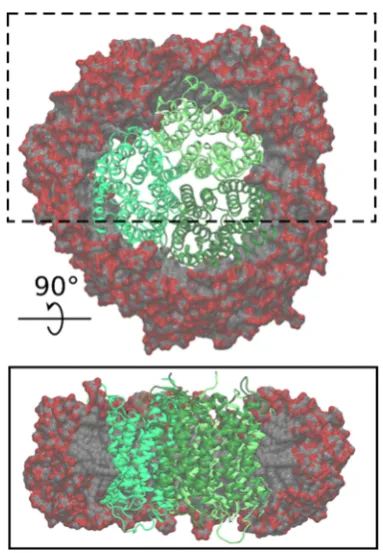
[image:2.625.348.540.63.340.2]surrounded by DDM coronas of 260, 280, 300, 320, 340, and 360 molecules. A representative model obtained for a deter-gent corona containing 320 molecules of DDM is shown in
Figure 1.
During the equilibration phase, the DDM molecules adopted the typical toroidal shape reported for other protein-detergent
complexes,9,10with their hydrophilic heads facing the aqueous
solution and their hydrophobic tails oriented toward the inside
of the complex (Figure 1). As previously shown, the detergent
corona further adapted to the shape of the transmembrane
surface of the protein.10 Our simulations indicate that the
protein−detergent complexes are stable, and although some
reorientation of DDM was observed, in particular during thefirst
stages of the simulations, no dissociation of detergent mole-cules from the protein was detected after 20 ns of simulation time. We next computed SAS curves for the simulated com-plexes and compared them with experimental SAS measure-ments (Figure 2−3).
It has previously been shown that single structures extracted from MD trajectories do not fully capture the characteristics of
the solution ensemble.9 We therefore calculated the predicted
SAXS curves from conformational ensembles comprising 9000
individual configurations as observed in 70−160 ns simulations
of each differently sized complex. The SAXS curves were
obtained using explicit-solvent calculations as implemented in the WAXSiS method, thereby taking into account accurate atomic models for both the hydration layer and the excluded
solvent, and consequently avoiding any solvent-relatedfitting
parameters (Figure 2).11,12
SAS experiments are very demanding in terms of
require-ments of sample quality,13,14therefore, before recording SAS
data, we ascertained that our samples were monodisperse and that AmtB was pure, stable, and critically active in detergent
(Supporting Information, Figure S1−S3). We subsequently
collected experimental SAXS data following size-exclusion
chromatography of the AmtB−DDM complex. The radius of
gyration (Rg) was found to be constant across the elution peak
(Figure S1), indicating the monodispersity of the complex and
good data quality. Importantly, the scattering curves predicted
for the models containing 260, 280, 300, 340, and 360 DDM
molecules deviate slightly from the experimental data (Figures 2
andS4). By contrast, the curve computed for the MD model
containing 320 DDM molecules was nearly indistinguishable
from the experimental SAXS data (Figure 2andS4).
Further-more, the values forRgobtained by the Guinier approximation
from the experimental data and from for the MD model containing 320 DDM molecules were in quantitative
agree-ment (Table S3 and Figure S5). This suggests that the overall
dimension of the simulated protein−detergent complex
con-taining 320 molecules of DDM is identical to that in solution. It is important to note that the overall information content of SAXS is relatively low, and thus agreement between
experi-mental and back-calculated curves may be insufficient to serve
as unambiguous evidence for a structural model.15Specifically,
in the context of a protein−detergent complex, SAXS data
reports on the overall shape of the complex, whereas they do not provide independent information on the individual contri-butions from the protein and the detergent corona. Therefore, we employed SANS together with contrast variation to more
firmly validate our computational model.
We collected SANS data at four contrast points (0%, 22%,
42% and 60% (v/v) D2O) to differentiate between the
individ-ual components of the protein−detergent complex. To ensure
that the samples were stable over the course of the SANS experiment, the hydrodynamic behavior of the proteins were analyzed before and after the SANS measurements by
ana-lytical size exclusion chromatography. No differences were
observed in the elution profile, confirming the stability of the Figure 1. Atomistic model of the AmtB-DDM complex containing 320 DDM molecules. The model displays an equilibrated complex. In the trimer, each AmtB monomer is shown in a different shade of green, and the DDM carbon and oxygen atoms are shown in gray and red, respectively. The upper panel shows the complex seen from the top; the lower panel is a side-view of the complex where the DDM molecules outside of the box highlighted in the top panel are omitted, to illustrate the interior of the micelle.
protein during the SANS experiment (Figure S6). To ascertain the reproducibility and the quality of our measurements, two independent sets of SANS data were acquired, using two
batches of AmtB purified independently. The two data sets
were found to be identical within the limits of the observed
experimental noise (Figure S7). It has previously been shown
that in the absence of D2O in the buffer, neutron scattering
from DDM micelles originates primarily from the hydrophilic
head groups.16 We calculated (Supporting Information) the
overall contrast match point of DDM to be at 22% D2O, while
the contrast match point for typical proteins is around 42%
D2O.4,17 Consequently, the scattering contribution is
domi-nated by the protein and the DDM hydrophilic headgroup in a
buffer containing 0% D2O, by the protein at 22% D2O and by
the complete detergent corona at 42% D2O. To compare the
experimental neutron scattering data with the MD-generated models, SANS curves were calculated using WAXSiS for 9000
individual configurations observed during 70−160 ns MD
trajectories of each of the complexes. To this end, we extended the WAXSiS method, originally developed for SAXS predic-tions, to also allow SANS predictions with explicit-solvent models at various D2O concentrations (Supporting Information).
The experimental curves werefitted to the calculated curves
following Ifit = f·Iexp + c, thereby accounting for scattering
contributions from the incoherent background with thefitting
parameter c. However, neither the hydration layer nor the
excluded volume were adjusted. Congruent with the analysis of
the SAXS data, all SANS data sets were best fitted by the
curves calculated for the model incorporating 320 molecules of
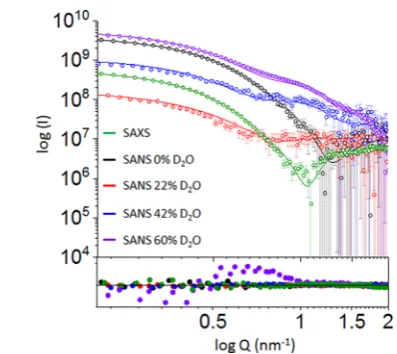
DDM (Figure 3 and S8). Hence, the SANS and SAXS data
consistently validate our MD model with 320 DDM molecules. Second, the excellent agreement we observe between the experimental and calculated SAXS curves shows that the
overall organization of the complex is accurately reflected by
the atomistic model. Finally, the good agreement between experimental and computed SANS curves indicates that the MD model describes accurately the hydrophobic and hydro-philic phase of the detergent ring as well as the position of AmtB inside the corona.
Importantly, the crystal structure of AmtB was used to pro-duce our MD trajectories, which precludes the possibility of applying this combined MD/SAXS/SANS approach to mem-brane proteins of unknown structure. We therefore applied, in
thefinal step, an independent“MD-free”approach to obtain a
fullab initiomodel that captures detailed structural information on the complex without using the crystal structure of AmtB. To achieve this, we merged our complete SAXS and SANS data and conducted a multiphase volumetric analysis of
the complex using MONSA18,19(Figure 4). Importantly, we
introduced two separate phases to describe the head and tail groups of the DDM detergent corona.
Assuming the volume of a DDM molecule to be 690 Å3
(350 Å3and 340 Å3for the head and the tail, respectively),4 we
[image:3.625.73.284.67.272.2]imposed a volume of 112 000 Å3 and 108 800 Å3 for the
Figure 2. (A) Comparison of the experimental (symbols) and computed (red line) SAXS curves for the AmtB-DDM complex containing between 260 and 360 DDM molecules. For all plots, the maximum and minimum values for the y-axis are 1011 and 105.
[image:3.625.73.272.368.545.2](B) Residual error plot expressed as the experimental minus com-puted scattering intensity. For all plots, the maximum and minimum values for they-axis are 40 and−40.Q= (4πsin(θ)/λ), where 2θis the scattering angle.
Figure 3.Comparison of the experimental (symbols) and computed (red line) SAXS/SANS curves for the model containing 320 DDM molecules. Residual error plot expressed as the experimental minus computed scattering intensity. The maximum and minimum values for they-axis are 40 and−40, respectively.
Figure 4. (A) MONSA multiphase modeling using experimental SAXS and SANS data. The phase corresponding to the protein is represented in red mesh, while the hydrophilic and hydrophobic detergent densities are represented in green and blue, respectively. (B) Molecular-dynamics generated model of the detergent corona (320 molecules) surrounding AmtB.
[image:3.625.326.563.478.623.2]hydrophilic and hydrophobic phases of the 320 DDM
mole-cules. The volume of AmtB (166 864 Å3) was calculated based
on its amino acid sequence alone (Supporting Information).
Moreover, since the trimeric nature of AmtB in solution was
confirmed by our SEC-MALS and AUC data (Figure S1−S2
and Table S1), we imposed a P3 symmetry on the complex.
Crucially, all this information can be readily obtained for any membrane protein solubilized in detergent, using widely acces-sible and complementary biophysical techniques (e.g.,
SEC-MALS/AUC in this study). Ten MONSA runs (Figure S9)
were performed yielding similarab initioenvelopes for AmtB.
A representative MONSA model is shown inFigure 4, which
faithfully reflects both the size and shape of the MD-generated
model. The protein envelope is a good representation of the crystallographic structure of AmtB and is, furthermore,
con-fined inside the detergent corona. Importantly, the joint use of
both SAXS and multiple SANS data sets allowed us to distin-guish the head- and tail-groups of the detergent corona and place them correctly with respect to the protein surface and solvent. Such detailed insight is usually not achieved with ab initiomodels unless additional contact restraints are applied:20
the detergent ring fits the contours of the protein and the
positions of the two detergent phases (head- and tail-groups) are particularly clear. The hydrophobic phase is strictly con-tained between AmtB and the hydrophilic ring, with only the tails of DDM being in contact with the hydrophobic surface of the transmembrane domain. Hence, without using deuterated protein or detergent, and without information about the 3D structure of AmtB, the combination of SAXS and SANS data
capture the essential structural details contained in membrane−
protein detergent complexes in solution.
In summary, there is considerable interest in developing SAS methodology further to allow routine investigation of mem-brane proteins. We have adapted WAXSiS to account for SANS data and therefore open up this software package for future projects including both types of scattering data. Using our methodology, based upon a combination of SAXS/SANS measurements and MD simulations, we have been able to propose an atomic model of a protein-detergent complex. Our integrative approach demonstrates that combining SAXS, SANS, and iterative simulations provides much more detailed structural information than each of the methods alone.
It is widely recognized that cryo-electron microscopy (cryo-EM) will revolutionize the structural analysis of membrane proteins in the near future.21,22It is our belief that a hybrid approach,
combining in solution SAS techniques,in silicomodeling, and
cryo-EM will allow for better tracking and description of conformational changes of membrane proteins in solution, induced by ligand or cofactor binding. In this context, it was important to account accurately for the bound detergent molecules, which is greatly improved by combining SAXS and SANS data at various contrasts. Second, our multiphase anal-ysis, which merges SAXS and SANS data, without using deuter-ated protein or detergent, allowed us to obtain unprecedented structural information on the phase density of the detergent, in particular to distinguish head- and tail-groups in the assembled
membrane protein−detergent complexes. This is particularly
relevant as deuterated media/detergents are often expensive and/or toxic for bacteria, leading to decreased protein yields.23 Crucially, the multiphase analysis does not require information on the 3D structure of the protein, which opens up the possi-bility of applying this methodology to a wide range of impor-tant membrane proteins that have so far remained inaccessible
to high resolution structural analysis. While SAS has become a popular technique among structural biologists, combinations of SANS, SAXS and MD simulations have remained underexploited by the community. In this context, our work represents a
sig-nificant advancement in data acquisition, model validation,
development of new software, and multiphase volumetric
anal-ysis tofirmly establish SAS technology as a standard method
for membrane protein structural biology.
■
ASSOCIATED CONTENT*
S Supporting InformationThe Supporting Information is available free of charge on the
ACS Publications websiteat DOI:10.1021/acs.jpclett.8b01598.
Computational and methodological details, as well as
three supporting tables and nine supporting figures
(DOCX)
■
AUTHOR INFORMATIONCorresponding Authors
*E-mail:[email protected].
*E-mail:[email protected].
*E-mail:[email protected].
ORCID
Gaëtan Dias Mirandela:0000-0001-5871-6288
Jochen S. Hub:0000-0001-7716-1767
Ulrich Zachariae:0000-0003-3287-8494
Arnaud Javelle:0000-0002-3611-5737
Author Contributions
¶G.T. and M.T.I. contributed equally to this work.
††J.S.H., U.Z., and F.G. contributed equally to this work.
Notes
The authors declare no competingfinancial interest.
■
ACKNOWLEDGMENTSG.D.M. and A.J. were supported by a Ph.D. and a Chancellor’s
Fellowship from Strathclyde University, respectively, G.T. and
U.Z. acknowledge funding from the Scottish Universities’
Physics Alliance (SUPA). P.A.H. acknowledges the support of the Natural Environment Research Council (NE/M001415/1) and A.J. the support of Tenovus Scotland (Project S17-07). M.T.I., F.M.S., and J.S.H. acknowledge support by the Deutsche Forschungsgemeinschaft (HU 1971-1/1, HU 1971-3/1, HU 1971-4/1). We thank the ILL Block Allocation Group (BAG) system for SANS beamtime at D22 and Dr A. Martel for help with the setup of the instrument. We acknowledge Diamond Light Source for time on Beamline B21. We thanks Dr. P. Soule (NanoTemper Technologies GmbH) and Dr. M. Tully (DIAMOND, U.K.) for help with the microscale thermopho-resis experiments and SEC-SAXS data acquisition, respectively.
■
REFERENCES(1) Dubyak, G. R. Ion homeostasis, channels, and transporters: an update on cellular mechanisms.Adv. Physiol. Educ.2004,28, 143−154. (2) Werten, P. J.; Remigy, H. W.; de Groot, B. L.; Fotiadis, D.; Philippsen, A.; Stahlberg, H.; Grubmuller, H.; Engel, A. Progress in the analysis of membrane protein structure and function.FEBS Lett.
2002,529, 65−72.
(3) Stahlberg, H.; Engel, A.; Philippsen, A. Assessing the structure of membrane proteins: combining different methods gives the full picture.Biochem. Cell Biol.2002,80, 563−568.
Hartlein, M.; Ebel, C. Small angle neutron scattering for the study of solubilised membrane proteins.Eur. Phys. J. E: Soft Matter Biol. Phys.
2013,36, 71−86.
(5) Kynde, S. A.; Skar-Gislinge, N.; Pedersen, M. C.; Midtgaard, S. R.; Simonsen, J. B.; Schweins, R.; Mortensen, K.; Arleth, L. Small-angle scattering gives direct structural information about a membrane protein inside a lipid environment. Acta Crystallogr., Sect. D: Biol.
Crystallogr.2014,70, 371−383.
(6) Skar-Gislinge, N.; Kynde, S. A.; Denisov, I. G.; Ye, X.; Lenov, I.; Sligar, S. G.; Arleth, L. Small-angle scattering determination of the shape and localization of human cytochrome P450 embedded in a phospholipid nanodisc environment. Acta Crystallogr., Sect. D: Biol.
Crystallogr.2015,71, 2412−2421.
(7) Merrick, M.; Javelle, A.; Durand, A.; Severi, E.; Thornton, J.; Avent, N. D.; Conroy, M. J.; Bullough, P. A. TheEscherichia coliAmtB protein as a model system for understanding ammonium transport by Amt and Rh proteins.Transfus. Clin. Biol.2006,13, 97−102.
(8) Khademi, S.; O’Connell, J., III; Remis, J.; Robles-Colmenares, Y.; Miercke, L. J.; Stroud, R. M. Mechanism of ammonia transport by Amt/MEP/Rh: structure of AmtB at 1.35 Å. Science 2004, 305, 1587−1594.
(9) Chen, P. C.; Hub, J. S. Structural Properties of Protein-Detergent Complexes from SAXS and MD Simulations.J. Phys. Chem.
Lett.2015,6, 5116−5121.
(10) Berthaud, A.; Manzi, J.; Perez, J.; Mangenot, S. Modeling detergent organization around aquaporin-0 using small-angle X-ray scattering.J. Am. Chem. Soc.2012,134, 10080−10088.
(11) Chen, P. C.; Hub, J. S. Validating solution ensembles from molecular dynamics simulation by wide-angle X-ray scattering data.
Biophys. J.2014,107, 435−447.
(12) Knight, C. J.; Hub, J. S. WAXSiS: a web server for the calculation of SAXS/WAXS curves based on explicit-solvent molecular dynamics.Nucleic Acids Res.2015,43, 225−230.
(13) Trewhella, J.; Duff, A. P.; Durand, D.; Gabel, F.; Guss, J. M.; Hendrickson, W. A.; Hura, G. L.; Jacques, D. A.; Kirby, N. M.; Kwan, A. H.; Perez, J.; Pollack, L.; Ryan, T. M.; Sali, A.; Schneidman-Duhovny, D.; Schwede, T.; Svergun, D. I.; Sugiyama, M.; Tainer, J. A.; Vachette, P.; Westbrook, J.; Whitten, A. E. 2017 publication guidelines for structural modelling of small-angle scattering data from biomolecules in solution: an update.Acta. Crystallogr. D. Struct.
Biol.2017,73, 710−728.
(14) Jeffries, C. M.; Graewert, M. A.; Blanchet, C. E.; Langley, D. B.; Whitten, A. E.; Svergun, D. I. Preparing monodisperse macro-molecular samples for successful biological small-angle X-ray and neutron-scattering experiments.Nat. Protoc.2016,11, 2122−2153.
(15) Petoukhov, M. V.; Svergun, D. I. Ambiguity assessment of small-angle scattering curves from monodisperse systems. Acta
Crystallogr., Sect. D: Biol. Crystallogr.2015,71, 1051−1058.
(16) Oliver, R. C.; Pingali, S. V.; Urban, V. S. Designing Mixed Detergent Micelles for Uniform Neutron Contrast.J. Phys. Chem. Lett.
2017,8, 5041−5046.
(17) Zaccai, N. R.; Sandlin, C. W.; Hoopes, J. T.; Curtis, J. E.; Fleming, P. J.; Fleming, K. G.; Krueger, S. Deuterium Labeling Together with Contrast Variation Small-Angle Neutron Scattering Suggests How Skp Captures and Releases Unfolded Outer Membrane Proteins.Methods Enzymol.2016,566, 159−210.
(18) Reyes, F. E.; Schwartz, C. R.; Tainer, J. A.; Rambo, R. P. Methods for using new conceptual tools and parameters to assess RNA structure by small-angle X-ray scattering. Methods Enzymol.
2014,549, 235−263.
(19) Svergun, D. I. Restoring low resolution structure of biological macromolecules from solution scattering using simulated annealing.
Biophys. J.1999,76, 2879−2886.
(20) Koutsioubas, A. Low-Resolution Structure of Detergent-Solubilized Membrane Proteins from Small-Angle Scattering Data.
Biophys. J.2017,113, 2373−2382.
(21) Vinothkumar, K. R. Membrane protein structures without crystals, by single particle electron cryomicroscopy.Curr. Opin. Struct.
Biol.2015,33, 103−114.
(22) Rawson, S.; Davies, S.; Lippiat, J. D.; Muench, S. P. The changing landscape of membrane protein structural biology through developments in electron microscopy.Mol. Membr. Biol. 2016, 33, 12−22.