0022-538X/89/020912-07$02.00/0
Copyright X 1989,American Society forMicrobiology
Helicase,
DNA-Binding, and Immunological Properties of
Replication-Defective
Simian Virus 40
Mutant T
Antigens
K. AUBORN,t M. GUO, AND C. PRIVES*
Department ofBiologicalSciences, Columbia University, New York, New York 10027
Received 8 August1988/Accepted24October1988
Simian virus 40 T antigen (TAg) exhibits nonspecific and origin-specific DNA binding (ori binding) and ATPase and helicase activities, all of which are related to its roles in viral DNA replication. We have characterizedsomeof thepropertiesof fourreplication-defectivebuttransformation-competentmutantTAgs, C6-2,T22, Cil, and C8A.C6-2and T22TAgswereeachpreviouslydeterminedtolackori-binding properties, while CllTAgwasreportedtolackATPaseactivity.TheC8A TAgdid not exhibit defects in eitherori-binding
orATPasefunctions. We haveanalyzedadditional aspects of these mutant TAgspertainingtotheirhelicase,
DNA-binding,andimmunological properties.Withtheexceptionof theC11 TAg,all theotherTAgsexhibited helicase activity. The lackofhelicaseactivity byCllTAgwasconsistent with itspreviouslyshowninabilityto
hydrolyzeATPortoreplicateviral DNA. These results therefore show thaton-bindingand helicaseactivities
areseparatefunctionsofTAg. Wild-typeand mutantTAgsbound with similarefficiencytoeither nativeor
denatured calf thymus DNA-cellulose, indicating no marked differences in their nonspecific DNA-binding
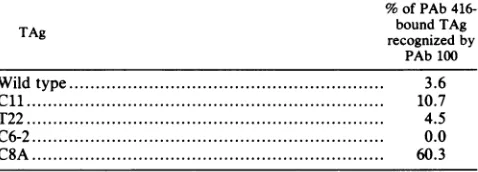
properties. Wealsotestedthebinding of wild-type andmutantTAgstoamonoclonalantibody,PAb100,that waspreviouslyshowntorecognizeanextremelysmallclassofTAgthatmayrepresentauniqueconformational formof theprotein. Interestingly,while less than 10% of thewild-type, C6-2,Cll,and T22 mutantTAgswere
recognized by PAb 100, more than 60% ofthe C8A mutant TAg was bound by this antibody. Therefore,
although no defect in biochemical function was observed with the C8A TAg, its deficiency in viral DNA
replicationmayberelatedtoanunusual conformation,asdetectedbyitsdramaticallyincreasedrecognition by
PAb 100. These results showthat thehelicase activity of TAgis notrequiredforitstransformationfunction.
Thesimian virus40(SV40) largetumorantigen(TAg), the productoftheviral A gene, is a multifunctionalproteinwith roles in both viral DNA replication and oncogenic cell transformation(forreviews,seereferences 15and46). That these two functions are discrete and separable has been indicated by the existence both of TAg mutants that are
replication-defective but competent to transform cells (16, 23, 26, 32, 44) and, reciprocally, ofthose that can replicate viralDNA but aredeficient in transformation (9, 23, 33). The multifunctional nature of TAg is also reflected in its several biochemical properties. TAg binds nonspecifically to both double- and single-stranded DNA (2, 5, 30, 34, 35, 40). It also bindsspecificallyand withhigh affinitytosites1and 2 within the viral regulatory region (ori), which contain multiple copies of the consensus pentanucleotide 5'-GA/GGGC-3' (12, 22). Inaddition, TAg hasbeen shown to bind ATP (4), tobe anATPase(6, 7), andtoexhibithelicase activity in a manner that requires ATP hydrolysis (11, 42). All of these activitiesaremostlikely related to its function in viral DNA replication.Twooftheseproperties,namely oribinding (23, 27, 36) and ATP hydrolysis (8, 27, 42), have each been shown to be absent or deficient in several replication-defective mutants. That many of these mutant TAgs were also shown to be capable of immortalizing (45) and trans-forming (23, 26) cells suggests that both ori-binding and ATPase activitiesarenotessential for these processes.
The study of SV40 TAg has been aided by the develop-mentof systems for the purification of substantial quantities of the viral protein. Tofurther clarify its biochemical func-tions, analysisof purified replication-defective mutant TAgs
*Correspondingauthor.
tPresent address: Department ofOtolaryngology, Long Island JewishMedical Center, NewHyde Park, NY 11042.
can provide additional useful information. A series of
non-conditional replication-defective but
transformation-compe-tentmutantTAg genesweregenerated(17), cloned(16,26), and then inserted into the helper-independent adenovirus vector AdSVRIII (18, 43). Mutant TAgs purified from recombinant virus-infected human 293 cellswere shown to be unable tomediate the replication ofviral DNA in vitro, whilewild-type TAg that had been similarly expressed and purified exhibited levels ofreplication activity in vitro that were comparable with other sources ofTAg (43). Two of these mutants, C62 and T22, exhibited wild-type ATPase activity but were unable to bind specifically to the viral origin(27, 36, 43).Another mutant,Cll, wasshownto lack ATPaseactivitybuttoexhibit ori-bindingproperties similar to thoseofwild-type TAg (27, 36). The final mutant, C8A, exhibitedboth wild-type ori-bindingand ATPase activities, andtherefore posedamysteryastowhy itcannotreplicate viral DNA (27, 43).
Subsequent to the discovery of its DNA-binding and ATPase properties, TAgwas showntobe ahelicaseand, in the presence of single-stranded binding protein and topo-isomerase,tounwind viral DNAatthereplicationorigin(11, 42, 50). Because both the helicase and nonspecific DNA-bindingproperties ofTAgareclearly likelytobe relatedto its function in viral DNA replication, we have determined thesepropertiesfor this group ofmutantTAgs. Inaddition,
wehavetested thebinding of theseproteins toamonoclonal antibody, PAb 100, previously shown to recognize an un-usual immunological subclass of SV40 TAg (13, 19, 37).
MATERIALS ANDMETHODS
Materials. Recombinantadenoviruses, derivedfrom AdS VRIII(18, 43) andencoding wild-type or mutant TAgs,were very generously provided by Y. Gluzman. PAb 100 was
912
on November 10, 2019 by guest
http://jvi.asm.org/
obtained from the American Tissue Culture Collection, Rockville, Md. The 31-nucleotide (nt) oligomer used for helicase assays was a gift from M. Kenny and J. Hurwitz. The M13 sequencing primer was obtained from New En-gland BioLabs,Inc., Beverly,Mass.,andradioisotopesused in these studies were purchased from the Radiochemical Centre, Amersham, England. ProteinA Sepharoseand A15 M Sepharose were bought from Pharmacia, Inc., Piscat-away, N.J. Native and denatured calf thymus DNA-cellu-lose werefromP-L Biochemicals, Inc., Milwaukee, Wis.
Purification of TAgs. Wild-type or mutant TAgs were
purified fromhuman 293 cellsthatwereinfected with
recom-binant adenoviruses by using immunoaffinity columns
con-taining TAg monoclonal antibody PAb 419 cross-linked to Protein A-Sepharose by published methods (14, 38). The procedure was modified so that the TAgs wereeluted from the antibody columns in buffer containing 20 mM Tris hydrochloride, pH 8.5, 0.5 M NaCl, 1 mM EDTA, 1 mM dithiothreitol, 10% glycerol, and 50%
ethylene
glycol.
The concentrations of TAgs recovered wereapproximately
equivalent as determined by comparison on silver-stained polyacrylamide gelsandwereestimatedtorangefrom 300to 500 ,uglml. When purified wild-type TAgwasaddedto anin vitro replication reaction aspreviously described (24, 29, 43, 48), approximately 98 to 100 pmol ofdTMP were
incorpo-ratedintoacid-soluble material in the presence ofa
plasmid
containing the SV40
replication origin
region.
Levels of incorporation in the absence ofTAg or in the presence of plasmidDNAlackingtheSV40origin
were2.0and 2.5pmol,
respectively.
Helicase assays. The 15-nt
sequencing primer
or a 31-nt oligomer(5'-CCGAGGAGGC
1T GGAGGCCTAGGC TTC-3')thatcontains29 ntspanning SV40 TAgbinding
site 1 was32P
end labeled by kinase (25). A 100-ngsample
of either oligomer was annealed to 10 ,ug ofsingle-stranded
circular M13mp9SVO that contained the SV40 L strand spanningnt 5171 to 294 (2)for 5 minat
95°C,
for 20 minat65°C, and for20 minat 20°C inabuffer
containing
100 mM NaCl, 10 mMTrishydrochloride, pH 7.5,10 mMMgCl2,
and 1 mM dithiothreitol. Labeledheteroduplexes
werepurified
from free oligomers on A-15
Sepharose
columns. Helicase reactions containing 2 ,ug of TAg, 15 ng of32P-labeled
heteroduplex, 25 mM Tris
hydrochloride (pH 7.8),
5 mMMgCl2,
5 mM ATP, and 5 mM dithiothreitol in 15 ,ul wereincubatedfor60minat
37°C.
AfteradditionofDNAsample
buffer, reaction mixtures were
analyzed
by
electrophoresis
in 10%polyacrylamide gels and
autoradiography.
DNA-cellulosebinding. Human 293 cellswerelabeled with
[35S]methionine
(200,uCi/ml)
2hprior
to extraction at 20 h after infection with recombinant adenovirusesexpressing
wild-type or mutant TAgs, and
DNA-binding
procedures
were performed with minor modifications as
previously
described(2). All stepswere
performed
at4°C.
Extractsof4 x 106cells were dialyzedagainst NBbuffercontaining0.1MNaCl, 10 mM
potassium phosphate, pH 6.2,
1 mMdithio-threitol, 0.5%
NonidetP-40,
and 10%glycerol.
Dialyzed
extractsequivalentto5 x 105cellsweremixed with 200 mg of nativeor denatured calf
thymus
DNA-cellulose or cellu-lose alone that had beenpre-equilibrated
with NB buffer. After being rocked at 4°C for 1h,
the mixtures werecentrifuged
for 2 min in anEppendorf
centrifuge
and thesupernatants
containing
nonboundproteins
were collected. The pellets were suspendedby stirring
them in B buffer containing0.3MNaCl,
50mMTrishydrochloride (pH 8.5),
1 mM
dithiothreitol,
0.5% NonidetP-40,
and 10%glycerol
for30 min. After the bound
proteins
eluted from thecellu-lose orDNA-cellulose inB bufferwere
similarly collected,
the mixtureswere
suspended
in B+ buffercontaining
1.0 MNaCl,
and thetightly
boundproteins
were collected asbefore. Between each step, mixtures were washed
exten-sively
with thecorresponding
elution buffer to remove all unbound material.Equal quantities
oftheunbound, bound,
andtightly
boundfractionswereadjusted
to0.3 MNaCl,
pH
7.5,
and thenimmunoprecipitated
withTAg
monoclonalantibody
PAb419-protein
ASepharose
beads.TAg
waseluted fromthebeads
by
boiling
the beads inelectrophoresis
sample
buffer and wassubjected
tosodiumdodecyl
sulfate-polyacrylamide gel
electrophoresis
andautoradiography
asdescribed
previously
(2).
Densitometry.
To estimate relativequantities
of[35S]me-thionine-labeled
TAgs,
autoradiograms
werescanned withadensitometer
(Bio-Rad
Laboratories,
Richmond,
Calif.).
Quantification
ofdensitometry
wasperformed by
published
procedures (31).
RESULTS
Defectiveness ofCllmutant
TAg
in helicaseactivity.
TAgs
expressed
from293 cells infected with recombinant adeno-virusesencoding
eitherwild-type
or mutantproteins
werepurified by
immunoaffinity procedures.
Thewild-type TAg
purified
in this manner and tested in the in vitro DNAreplication
reaction exhibited levels ofactivity
similar tothose
previously
reported
(see
Materials andMethods).
Totest the helicase activities of
wild-type
and mutantTAgs,
their
ability
todisplace
end-labeledoligonucleotides
an-nealedto
complementary
single-stranded
circularDNAtem-plates
wasanalyzed.
Either the 15-ntsequencing
primer
ora31-nt
oligomer
spanning
SV40
TAg
binding
site 1 on theSV40
E strand washybridized
tosingle-stranded
M13mp
9SVO
containing
SV40
DNAfromnt5174to294. The latterhybrid
createdTAg
high-affinity binding
site1asthedouble-stranded part ofthe
heteroduplex.
Bothlabeled substrates were incubated with the variouspurified TAgs
in the pres-ence or absenceofATP.Wild-type TAg
and mutantsC62,
T22,
and C8A were allcapable
ofdisplacing
substantialquantities
of the labeled 15- and 31-ntoligomers (Fig.
1,
Table
1).
Inall of thesecases,thehelicaseactivity
depended
upon the presence of ATP in thereaction,
as has beenpreviously
shown forwild-type TAg
(11,
42).
By
contrast, the CllTAg
wasmarkedly
less efficient inATP-dependent
helicase
activity.
The relativequantity
ofoligonucleotides
displaced
by
Cli
wasat leastfivefoldlower thanthat ofthe otherTAgs
tested(Table 1)
andfrequently
exhibited noincreaseoverthe
quantity
observed whennoTAg
wasaddedto the reaction. As the helicase
activity
ofthe otherTAgs
was
dependent
uponATP,
itis reasonabletoassumethatatleastoneofthereasons
why
Cli
cannotfunctioneffectively
as a helicase is becauseof its
previously
determinedfailureto
hydrolyze
ATP.It isinteresting
that thequantities
ofthe 31-merdisplaced by
wild-type,
C6,
orT22TAgs
weresimilardespite
thefactthatthis substratecontainedthehigh-affinity
TAg
binding
site 1 within theduplex region.
Both mutants are unable to bindspecifically
andtightly
to thisregion,
in contrast towild-type TAg.
Thus thespecific ori-binding
propertyofTAg
didnot affect theefficiency
ofoligonucleo-tide
displacement
under theseconditions.Wild-type
andmutantTAgs
exhibitsimilarnonspecific
DNAbinding.
TAg
bound to both double- andsingle-stranded
DNAnonspecifically.
Thisproperty
maybenecessaryfor its role in viral DNAreplication, especially
if,
as has beensuggested
(41, 47,
49),
TAg
isrequired
for theelongation
on November 10, 2019 by guest
http://jvi.asm.org/
FWrT1 rFCSA] rcliI -T 5millIAT'lI + - + - +
Aknrnealled _ _
substlrate
rWTI fC621 F T221
- +- + - +
bib.-
#ai~rm
l)isplaced
31-nier
FIG. 1. Helicase activity of TAgs. TAgs are indicated at top ofautoradiograms. Each (2.5 ,ug) was incubated with helicase buffer containing 32P-labeled 31-mer annealed to M13mp9SVO in the presence (+) or absence (-) of 5 mM ATP, and then analyzed by electrophoresison10% polyacrylamide gelsandby autoradiography.
stages of DNA synthesis. Furthermore, the sequences con-tributingtospecificandnonspecificDNAbindingarelocated within different regions of the TAg polypeptide (34). One assaythat has proven useful forstudying nonspecific DNA binding is retention on DNA-cellulose matrices (1). This assay hasprovided estimates of both the efficiencyof TAg binding (i.e.,theproportion of totalproteinboundby DNA) and the ability of the protein to bind tightly to DNA as measured by criteria such as salt sensitivity (2, 5, 30, 35). Thebinding of the wild-type and mutant TAgs to double- or single-strandedcalf thymus DNA-cellulosewascompared in ordertodetermine the relative efficiencies of their retention and the proportions thatwere more tightly bound. Of par-ticularinterestwastheC8A TAg, which exhibitedwild-type ori-binding and ATPasefunctions and comparable levels of helicase activity.
Extracts of
[35S]methionine-labeled
293cells that had been infected with recombinant adenoviruses encoding either wild-type or mutant TAgs were dialyzed against bindingTABLE 1. HelicaseactivityofmutantTAgs" 32P-labeled
TAg 5mM ATP oligonucleotide
displaced (fmol)
WT + 134
WT 9
T22 + 118
T22 21
C62 + 98
C62 13
C8A + 133
C8A 34
C1l + 23
C1l 0
aTAgs (2.5,ug) wereincubatedin helicasebuffer containingthe32P-labeled 15-ntsequencing primerannealed to M13mp8 and analyzed by polyacrylamide
gel electrophoresis and autoradiography. Bands corresponding to the
dis-placed oligonucleotidewere identified inautoradiograms, excised from dried
gels,and countedby liquid scintillation. The amount of labeled oligonucleo-tide (19fmol)displaced from the heteroduplex substrate in the absence of TAg wassubtractedfrom these values.
(NB) buffer and incubated with samples of either single- or double-stranded DNA-cellulose or cellulose alone that had been treated similarlytothatwhich hadundergonecoupling
to DNA(1). The initial binding conditions, i.e., pH6.2 and 0.1 MNaCl,hadpreviouslybeendeterminedtoresult in the most efficient binding ofwild-type TAg to DNA-cellulose. The resultsofatypicalexperiment, showingtheproportions of unbound, bound, and tightly bound wild-type TAg, are shown inFig.2. As canbe seen, thevastmajorityof labeled
via
b
cd
ef
y
..ie:T
Ag
*.
S_.
Ag ,_
[image:3.612.131.489.74.262.2].
a
zl,; .trTAFIG. 2. Nonspecific bindingofTAgtoDNA-cellulose. Extracts of[35S]methionine-labeled AdSVRIII-infected 293 cells were dia-lyzed againstDNAcellulose NBbuffer and incubated with cellulose (lanesbtod), double-strandedcalfthymus DNA-cellulose(lanese
tog),orsingle-stranded calfthymus DNA-cellulose(lanes htoj). Samplesnotretained in NB buffer(lanes b,e,andh)orretained and elutedwithBbuffer(lanesc,f,andi)ornotelutedwith Bbuffer but eluted with B+ buffer(lanes d,g, andj)wereimmunoprecipitated with PAb419-Sepharoseand then analyzed by electrophoresis on 12% polyacrylamide gels and by autoradiography. Lane a, Total immunoprecipitatefrom 5 x 10⁵cells. LaneM,'4C-labeled protein size markers in kilodaltonsasindicatedon the left.
ri i j
..6li _ _
on November 10, 2019 by guest
http://jvi.asm.org/
[image:3.612.321.557.442.611.2]TABLE 2. Binding of TAgs to double- andsingle-stranded DNA-cellulosea
Binding(% of total Binding(%of totaleluted)
eluted) todouble-stranded to single-stranded
TAg DNA-cellulose DNA-cellulose
NBb Bc B+d NBb Bc B+d
Wildtype 31.2 66.1 2.8 32.6 62.2 5.2
C6-2 44.2 52.5 3.2 31.8 63.1 5.0
T22 35.6 59.1 5.4 41.0 47.5 11.5
C8A 35.4 56.8 7.7 27.4 67.0 5.6
C1l 46.5 47.3 6.1 31.2 63.2 5.6
a TAgpolypeptides were quantified by densitometry and normalized by
subtracting amounts that boundto cellulose aloneineach case. Valuesare expressed as percentage of total normalized TAg summed from the three
DNAfractions.
bTAgnotretainedby DNA-cellulose andeluted inbuffer containing 0.1 M NaCl,pH 6.2.
cTAg retained by DNA-cellulose and eluted in buffer containing 0.3 M NaCI, pH 8.5
dTAg retained by DNA-cellulose in0.3 M NaCl, pH 8.5, and eluted in buffercontaining 1.0 MNaCl,pH 8.5.
TAg did notbind to cellulose alone at pH 6.2, although a small proportion (<5%) bound and was eluted at 0.3 M NaCl, andasmaller proportion(<0.5%)was eluted by 1.0 M NaCl. By contrast, between 50 and 65% of the TAg bound to either single- or double-stranded DNA-cellulose and was elutedat0.3 MNaCl, and afurther3 to 10% eluted at 1.0 M NaCl. A 20,000-Mr truncated TAg (trTAg), expressed in cellsinfectedwith derivativesofthe recombinant adenovirus (AdSVRIII) and estimated to contain amino acids 1 to -130 (29), didnot bindtoeither double- or single-stranded DNA-cellulose. This is consistent with previous studies showing that small t antigen does not bind DNA (35) and that sequences mapping within the COOH-terminal portion of TAg arerequiredfor nonspecific DNA binding (34). Densi-tometry of all the TAg bound and not bound to DNA-cellulose was
performed
and corrected for the amounts boundtocellulosealone. Under the experimental conditions described, between 50 and 70% of either wild-type or each mutantTAgbound to DNA-cellulose, and the majority was elutedat0.3 M NaCIin all cases (Table 2). No significant or striking differencesbetween either their binding to single- or double-stranded DNA-cellulose or their binding very tightly to either type of DNA-cellulose was noted. Thus all the mutant TAgs tested, including C8A TAg, exhibited similar nonspecific binding to both single- and double-stranded DNA-cellulose.The specific DNA-binding properties of these TAgs to viraloriginDNAfragments has been characterized by using both immunobinding (27, 28, 36) and filter-binding (43) assays. Asdescribedabove, C8A andCllbound specifically toviral DNAregulatorysequences,while C6-2 and T22 were shown to lack origin-specific DNA-binding activity. These results thus extend previous reports (34, 37) that the non-specificand specific DNA-bindingproperties are two sepa-rable activities of SV40 TAgs. Furthermore, the binding of Cll TAg to DNA-cellulose indicated that this property is independent of the ATPase function of TAg.
Binding of wild-type and mutant TAgs to monoclonal anti-bodyPAb 100. Studiesonthe structureandfunction of TAg have beenfacilitatedby the generation of several monoclo-nal antibodies directed against various epitopes on the wild-type protein(3, 19-21). One of these monoclonal anti-bodies,PAb 100(19),hasexhibited uniqueproperties.Itwas shown to recognize a small subclass ofTAg which
consti-TABLE 3. Proportion of TAg recognized by PAb iooa % of PAb
416-TAg boundTAg
recognizedby PAb 100 Wildtype... ... 3.6
C1i... 10.7
T22... 4.5
C6-2... 0.0
C8A... 60.3
a Extracts of
10i
293 cells infected withADSV5RIIIrecombinant viruses expressing wild-typeor mutant TAgs were incubated with eitherpurified PAb 416 or PAb 100 (at predetermined equivalence levels) and then immune complexes were precipitated with goat anti-mouse immunoglobulin G bound to inactivated Staphylococcus aureus bacteria. TAg polypeptides were re-leasedfromcomplexes and analyzed by polyacrylamide gel electrophoresis and autoradiography. Bands corresponding to TAgs were quantified by densitometry, and the percentage of PAb 416-bound TAg that was recognized by PAb 100 was estimated.tuted approximately 10% of the total immunoreactive pro-tein (19, 37). Intriguingly, despite the small proportion ofthe TAg that was bound by PAb 100, when this antibody was used in the DNA-binding immunoassay, the majority (60 to 80%) of the DNA-binding activity was immunoprecipitated (37). That the antibody may recognize a unique DNA-binding subclass of TAg was further supported by the fact that the C6-2 ori-binding-defective TAg was not recognized by PAb 100 (36). Thus, the antibody appeared to recognize a unique DNA-binding subclass of TAg that was absent in the C6-2 TAg population. To continue the analysis of the PAb 100 antibody and to further characterize its epitope, the abilities of the various mutants to bind this antibody were compared with that of another TAg-specific monoclonal antibody, PAb 416, which has been shown previously to recognize the great majority of the immunoreactive TAg extracted from cells (21, 37). TAgs present in [35S]methionine-labeled extracts of wild-type or mutant-infected 293 cells were bound to either antibody, and then autoradiograms ofimmunoprecipitates were quantitated by densitometry.Asmallproportion ofwild-type, Cll,and T22 TAgs was recognized by PAb 100 (Table 3). Consistentwith previous studies, C6-2 TAg was not bound to PAb 100. However, the ability of the T22 TAg to bind PAb 100 to an extent similar to that observed with wild-type TAg showed that PAb 100 does not recognize a specific DNA-binding subclass that is absent in all ori-binding-defective TAgs.
Surprisingly, in contrast to the other TAgs, there was a dramatic increase in the amount of C8A TAg recognized by PAb 100 suchthat more than 60% of the total immunoreac-tive C8A protein was immunoprecipitated by this antibody (Table 3 and Fig. 3A). Furthermore, in contrast to the wild-type (Fig. 3A) or other mutant (data not shown) TAgs, the 20,000 Mr trTAg encoded by C8A was immunoprecipi-tated with PAb 100. As the trTAgcontains neither the PAb 100epitope (13) nor the C8A mutation as mapped bymarker rescue (26), it is conceivable that this fragment associates with the C8A TAg but not with the wild-type TAg. The increased binding of the C8A TAg to PAb 100comparedwith thatof wild-type TAg was observed not only with metabol-ically labeled TAg in extracts of infected 293 cells but also in immunoaffinity-purified preparations of TAg (Fig. 3, right) as detected by silver staining. The absence of the trTAg in the preparations of purified wild-type or C8A TAgs is most likely due to the fact thatthis polypeptide is removed very ineffi-ciently from PAb419-protein A Sepharose columns with the
on November 10, 2019 by guest
http://jvi.asm.org/
[image:4.612.56.298.95.193.2]A a b c d e B
94
g-..
.-r t.:._ TAg,
69-
46-.,t,; ,.w?, ;g, ... j.' .i
30 ? :
; _.S--v.!. i4trTAg
g
3...
e1
,-FIG. 3. Binding of wild-type and C8A TA Extracts of 105 [35S]methionine-labeled 293 Ad5SVRIII recombinantviruses expressing eitl
toc)orC8A(lanes dtof)TAgswereimmunopr
PAb F4(anti-polyomaTAg)(lanesaandd);PA or PAb 100 (lanes c and f) and then autora indicateTAg and trTAg. Positions of14C-lab kilodaltons)are indicatedonthe left. (B) A 1
purified wild-type (lanes g to i) or C8A (lar
immunoprecipitated withPAb F4 (lanesgand
andk), orPAb 100 (lanesiand 1)followed bi
electrophoresis and silver staining.
elutionbuffer employed inourprocedure
C. Prives, unpublished observations).
DISCUSSION The twomost well-studied consequenc
ofSV40TAgarethereplication of the vii
oncogenictransformationof the hostcell. approaches have provided insight into First, the generation oflarge numbers ol
provided information about the biologica tions of TAg. Second, the developmen systemsthat yieldsufficient quantities of ical analysis hasledtoconsiderableprogi
its biochemical activities during DNA rc
perimentsdescribed herein have combinei Table4 provides a summary of the prof
typeandmutantTAgsusedin thisstudy. be madefrom thiscompendium.
First, a mutant that lacked ATPase a
helicaseactivity. Second, neitherspecific
ase, norhelicase activities of TAgare ob
[image:5.612.65.298.77.239.2]its nonspecific DNA binding properties
TABLE 4. Properties ofmutan
ori- ATPase Helica TAg Mutation Binding activity activit
C6-2 Asn-153--*Thn - + +
T22 His-203-->Gln - + +
C8A
Lys-224--*Glu
+ + +Cll Pro-522- -Ser + -
-aPAb 100bindingtoC8ATAgwas6- to10-fold1 otherTAgs.
conditions tested, all of the
TAgs
bound to double- and single-strandedcalf-thymusDNA-cellulosesimilarly.
Third,
h i k I as all of these mutants have been previously shown to be capable of
transforming
both established andprimary
cells (16, 26), it can be concluded that neitherori-binding,
AT-Pase, nor helicase activities arerequired
for theability
of SV40 TAg to alter thegrowth
properties
of cells. Presum-ably, one or moreofthebiochemicalproperties
ofTAg
that are related to its transformationfunction(s)
remain to be identified.The
binding
ofPAb 100towild-type
andmutantTAgs
wasinformativefortwo reasons.
First,
it demonstratedthat notall
ori-binding-defective TAgs
lack the PAb 100epitope.
Thisantibody was
previously
showntorecognize
less than 10% of theTAg from Coscells,
but in theDNA-binding
immu-noassay itimmunoprecipitated
60to 80% of itsori-binding
activity (37).
Thefact that the C6-2mutantTAg
whichfailstgs to PAb 100. (A) to bind specifically to theori is also not recognized by PAb cells infected with 100 supported the suggestion that PAb 100 recognizes a her wild-type (lanesa
DNA-binding
subclass ofTAg
(36). The results of the -ecipitatedwith either current study contradict ourprevious
conclusion,
because B 416(lanesb ande), the T22 TAg that also lacksori-binding activity isrecognizedldiographed.
Arrows by this antibody to the same extent as wild-type TAg. The eled sizemarkers (in PAb 100-specific conformation, if necessary at all, is clearlyn-,ug
sample ofeither not sufficient for specificori
binding.Ij) PAb 416(lanes h The second reason that the PAb 100 study was useful was y
polyacrylamide
gel that it revealed apossible
clue as towhy
the C8A TAg is unable toreplicate
viral DNA.Among
the mutantstested,
only
the C8ATAg
exhibited nodefects eitherinspecific
ornonspecific
DNAbinding
or in ATPase and helicaseactivi-Ps (K. Auborn and ties. This may
suggest
that there is another biochemical function ofTAg
that isimportant
forviralreplication,
suchas
binding
to DNApolymerase
(39),
or that there is someadditional
TAg
propertythatisrequired
forunwinding
DNAat the
origin. However,
although
aspecific
biochemical
ces ofthefunction defect of C8A TAg has not yet been reported, we have ral genome and the observed that this mutant differs immunologically fromthe Twoexperimental other proteins tested. Monoclonal antibody PAb 100 was these processes. shown to bind to amarkedly higherproportion ofC8ATAg fTAg mutants has than the other TAgs that were tested. Studies on the inter-il effectsand func- actions of PAb 100 with TAg have indicated that it recog-Lt of a number of nizes a small subclass of TAg that is determined by the TAgfor biochem- conformation of the protein. Depletion of all of the PAb ressindetermining 100-bound TAg population required repeated rounds of Dplication. The ex- immunoprecipitation even in the presence of excess anti-d bothapproaches. body, suggesting that this represents adynamic subpopula-)erties ofthe wild- tion (19; A. Scheller and C.Prives, unpublished).Whilethe Severalpointscan precise mapping of its epitope has not beenreported, PAb
100
recognizes
theSV40truncatedpolypeptides
encodedby
Lctivity also lacked the adenovirus-SV40 hybrid virus,
Ad2+ND2,
that areen-ori-binding, ATP- coded by sequences between 0.43and 0.28 mapunitsonthe
Aligatorily
linked to viralgenome(approximately
aminoacids300to525)
(13).
Its because under the epitope therefore lies outside of the region containing the C8Amutationthat isresponsible
for itsinability
toreplicate
viral DNA. The
proportion
of theAd+ND2
42-kilodalton LtTAgs truncated TAg that was recognized by PAb 100 was mark-Bindingto:edly
greater than that of full-length TAg, suggesting that the Lse conformation of full-length wild-type TAg reducesaccessi-ty PAb 100
DNllulo
bility
of theepitope
tothisantibody (13).
Furthersupport
fora PAb 100
conformation-dependent
epitope
is derived from - + ourobservations thatTAg
binding
to PAb 100 isdenatur-+ + ation sensitive and increases uponmildheattreatmentof the +++a + viral antigen (10). That PAb 100
recognized
6- to 10-fold+ + greater
quantities
of C8ATAg
than it didofwild-type,
T22,
higherthan itwas to the or
Cll
TAgs supports the possibility that the C8A mutant TAghasanalteredconformation. Thisalteration,
whichwason November 10, 2019 by guest
http://jvi.asm.org/
[image:5.612.65.304.625.705.2]detected by antibody recognition,maybe responsible forthe
inability of this mutant to replicate viral DNA. ACKNOWLEDGMENTS
WearegratefultoI.Mohr andY.Gluzman for helpfuldiscussions duringthecourseofthesestudiesandforsharing theirunpublished datawithus.
This workwassupported by Public Health ServicegrantCA26905 from the National Institutes of Health.
LITERATURECITED
1. Alberts, B., and G. Herrick. 1971.DNA-cellulose chromatogra-phy. Methods Enzymol. 21:198-217.
2. Auborn, K. J., R. B. Markowitz, E Wang, Y. T. Yu, and C.
Prives.1988. Simian virus 40(SV40)Tantigen binds specifically
to double-stranded DNA but not to single-stranded DNA or
DNA/RNA hybrids containing theSV40regulatorysequences.
J.Virol. 62:2204-2208.
3. Ball, R. K., B. Sigel, S. Quellhorst, G. Brandner, and D. G. Braun. 1984. Monoclonal antibodies against Simian Virus 40 nuclear largeT tumorantigen: epitope mapping, papova virus cross-reaction and cell surfacestaining. EMBO J. 3:1485-1491. 4. Bradley, M. K., J. Hudson, M. S. Villaneuva, and D. M.
Livingston.1984.Specific in vitroadenylation ofthesimianvirus
40large tumor antigen. Proc. Natl. Acad. Sci. USA 81:6574-6578.
5. Carrol, R. B., L. Hager, and R. Dulbecco. 1974.Simian virus40 T antigen binds to DNA. Proc. Natl. Acad. Sci. USA 71: 3754-3764.
6. Clark, R., K. Pedan, J. M. Pipas, D. Nathans, and R. Tjian.
1983. Biochemical activities of T antigen proteins encoded by simian virus 40 A gene deletion mutants. Mol. Cell. Biol. 3:220-228.
7. Clark, R., M. J. Tevethia, and R. Tjian. 1984. The ATPase activity ofSV40large Tantigen. Cancer Cells 2:363-372. 8. Cole, C. N., J. Tornow, R.Clark,and R.Tjian.1986.Properties
of the simian virus (SV40) large Tantigens encoded by SV40
mutantswithdeletions ingeneA. J. Virol. 57:539-546. 9. Cosman, D. J., and M. J.Tevethia. 1981. Characterizationofa
temperature-sensitive, DNA-positive, non-transformingmutant
ofSV40.Virology 112:606-624.
10. Covey, L.,PsKwok, and C. Prives. 1987.Characterizationofan
immunologically-distinct population of simian virus 40 large
tumorantigen,p. 163-183.InY.Aloni (ed.),Molecularaspects
of papovaviruses. MartinusNijoff Publishers, Boston. 11. Dean, F. B., P. Bullock, Y. Murakami, C. R. Wobbe, L.
Weissbach, and J. Hurwitz. 1987. Simian virus 40(SV40)DNA replication: SV40large Tantigen unwinds DNAcontaining the SV40 origin of replication. Proc. Natl. Acad. Sci. USA 84: 16-20.
12. DeLucia,A. L., B. A.Lewton, R.Tjian, and P.Tegtmeyer. 1983.
Topography of simian virus 40 A protein-DNA complexes:
arrangementof pentanucleotide interactionsitesattheoriginof
replication.J. Virol. 46:143-150.
13.EDeppert, W., E.G. Gurney, and R. 0.Harrison. 1981.
Mono-clonal antibodies against simian virus 40 tumorantigens:
anal-ysis ofantigenic binding sites, using adenovirus type-2simian
virus 40 hybrid viruses.J. Virol. 37:478-482.
14. Dixon, R. A. F., and D. Nathans. 1985. Purification ofsimian
virus 40 large T antigen byimmunoaffinity chromatography. J.
Virol. 53:1001-1004.
15. Fried, M., and C. Prives. 1986. Thebiologyof simian virus 40
andpolyomavirus. Cancer Cells4:1-16.
16. Gluzman,Y.,and B. Ahrens.1982.SV40earlymutantsthatare
defective for viral DNAsynthesis but competent for
transfor-mation of culturedratand simiancells. Virology 12:78-92.
17. Gluzman, Y., J. Davison, M. Oren, and E. Winocour. 1977.
Properties of monkey cells transformedbyUV-irradiatedsimian
virus 40. J. Virol. 22:256-266.
18. Gluzman, Y., R. Herwig, and D. Solnick. 1982. Helper-free
adenovirus type-5 vectors, p. 187-192. In Y. Gluzman (ed.), Eukaryotic viralvectors. ColdSpring HarborLaboratory, Cold
SpringHarbor,N.Y.
19. Gurney, E. G., R.0. Harrison,andJ. Fenno.1980.Monoclonal antibodiesagainst SV40Tantigens: evidence for distinct sub-classesoflargeTantigenandfor similaritiesamongnonviralT antigens. J. Virol.34:564-573.
20. Gurney, E. G., D.Tamowsky, and W.Deppert. 1986.Antigenic
bindingsitesof monoclonal antibodiesspecificfor simian virus 40large Tantigen. J. Virol. 57:1168-1172.
21. Harlow, E., L. V.Crawford,D.C.Pim,and N. M.Williamson. 1981. Monoclonal antibodiesspecific for simian virus40tumor antigens. J.Virol. 39:861-869.
22. Jones, K. A., and R. Tjian. 1984. Essential contact residues within large T binding sites I and II identified by alkylation interference. Cell36:155-162.
23. Kalderon,D., and A. E. Smith. 1984. In vitro mutagenesis ofa putativeDNAbinding domain of SV40largeTantigen.Virology
139:109-137.
24. Li, J. J., and T. J. Kelly.1984.Simian Virus40DNAreplication
invitro. Proc. Natl. Acad. Sci. USA81:6973-6977.
25. Maniatis, T., E. F.Fritsch,andJ. Sambrook. 1982. Molecular cloning: alaboratory manual. Cold SpringHarborLaboratory, ColdSpring Harbor, N.Y.
26. Manos, M. M., and Y. Gluzman. 1984. Simian Virus40largeT antigen point mutants thataredefective in viralDNAreplication
but competent in oncogenic transformation. Mol. Cell. Biol. 4:1125-1133.
27. Manos, M. M., and Y. Gluzman. 1985.Geneticandbiochemical analysis of transformation-competent, replication-defective
simian virus40largeTantigenmutants. J. Virol. 53:120-127. 28. McKay, R. D. G. 1981. Binding ofa Simian Virus 40large T
antigen relatedproteintoDNA. J. Mol. Biol. 145:471-488. 29. Mohr, I. J., B. Stillman,and Y. Gluzman. 1987. Regulation of
SV40DNAreplication byphosphorylationofTantigen.EMBO J.6:153-160.
30. Oren, M., E. Winocour,and C. Prives. 1980. Differential affin-ities of SV40Tantigen forDNA. Proc. Natl. Acad. Sci. USA 77:220-224.
31. Orlovsky, A., and L. Chasin. 1985. A domain ofmethylation
change at the albumin locus in rat hepatoma cell variations. Mol. Cell. Biol. 5:214-225.
32. Peden, K. W.C.,andJ.M.Pipas. 1985. Site-directed mutagen-esis ofthe simian virus 40 large T antigen gene:
replication-defective aminoacidsubstitutionmutants thatretaintheability
toinduce morphological transformation. J.Virol. 55:1-9. 33. Pintel, D., N. Bouck, and G. diMayorca. 1981. Separation of
lytic andtransforming functions ofthesimian virus40 Aregion:
two mutantswhicharetemperature sensitive forlyticfunctions haveoppositeeffects on transformation. J. Virol. 38:518-528. 34. Prives, C., B. Barnet, A.Scheller,G. Khoury, and G.Jay. 1982.
Discreteregions of simian virus 40large Tantigenare required fornonspecificand viralorigin-specific DNAbinding. J. Virol. 43:73-82.
35. Prives, C., Y.Beck,and H.Shure. 1980. DNAbinding proper-ties of simian virus 40 T-antigens synthesized in vivo and in vitro. J. Virol. 33:689-696.
36. Prives, C., L.Covey, A. Scheller,andY.Gluzman. 1983. DNA binding properties of simian virus 40T-antigen mutants defec-tivein viral DNAreplication. Mol. Cell. Biol.3:1958-1966. 37. Scheller,A., L.Covey, B.Barnet, and C. Prives. 1982. A small
subclassofSV40 Tantigen binds tothe viralorigin of
replica-tion. Cell29:375-383.
38. Simanis,V., and D. P. Lane. 1985. An immunoaffinity
purifica-tionprocedure for SV40largeT antigen. Virology 144:88-100. 39. Smale, S. T., and R. Tjian. 1986. T antigen-DNA polymerase
complex implicated in simian virus 40 DNA replication. Mol. Cell. Biol. 6:4077-4087.
40. Spillman,T.,D.Glacherio,andL. P.Hager.1979.
Single-strand
DNA bindingofsimian virus 40tumorantigen. J. Biol. Chem. 254:3100-3104.41. Stahl, H., P. Droge, H. W.Zentgraf, andR. Knippers. 1985. A large tumorantigen specific monoclonalantibody inhibits DNA replication of simian virus 40 minichromosomes inan in vitro elongation system. J.Virol. 54:473-482.
on November 10, 2019 by guest
http://jvi.asm.org/
42. Stahl, H., P. Droge, and R. Knippers. 1986. DNA helicase activity ofSV40large Ttumorantigen. EMBOJ. 5:1939-1944. 43. Stiliman, B., R. D. Gerard, R. A. Guggenheimer, and Y.
Giuzman. 1985.Tantigenandtemplate requirementsforSV40 DNAreplication in vitro. EMBOJ.4:2933-2939.
44. Stringer, J. R. 1982. Mutantof simian virus40large Tantigen that is defective for viral DNA synthesis but competent for transformation of culturedratcells. J.Virol. 42:854-864. 45. Tevethia, M. J., J. M. Pipas, T.Kierstead, andC. Cole. 1988.
Requirements for immortalization of primary mouse embryo fibroblasts probed withmutantsbearing deletionsinthe 3' end ofSV40geneA. Virology 162:76-89.
46. Tooze, J. (ed.)1981. Molecular biology oftumorviruses,part2. DNA tumor viruses. Cold Spring Harbor Laboratory, Cold Spring Harbor, N.Y.
47. Wiekowski, M., P. Droge, and H. Stahl. 1987. Monoclonal
antibodiesasprobesforafunctionof largeTantigen duringthe
elongationprocessofsimian virus40 DNAreplication.J. Virol. 61:411-418.
48. Wobbe, C. R., F.Dean, L. Weissbach and J. Hurwitz. 1985. In vitroreplication of duplex circularDNAcontainingthesimian virus 40 DNA origin site. Proc. Natl. Acad. Sci. USA 82: 5710-5714.
49. Wobbe, C. R., L. Weissbach, J. A. Borowiec, F. B. Dean, Y. Murakami, P. Bullock, and J. Hurwitz. 1987. Replication of simian virus 40origin-containing DNAwith purified proteins. Proc. Natl. Acad. Sci.USA84:1834-1838.
50. Wold, M. S., J. J. Li, T. J. Kelly. 1987. Initiation of Simian Virus 40 DNA replication in vitro: large tumor antigen and origin-dependent unwindingof thetemplate. Proc.Natl. Acad. Sci.USA84:3643-3647.