City, University of London Institutional Repository
Citation:
Artz, B. M., Goodall, A. H. and Oswald, A. J. (2016). Do Women Ask? (10183). Germany: Deutsche Post STIFTUNG.This is the accepted version of the paper.
This version of the publication may differ from the final published
version.
Permanent repository link:
http://openaccess.city.ac.uk/15273/Link to published version:
10183Copyright and reuse: City Research Online aims to make research
outputs of City, University of London available to a wider audience.
Copyright and Moral Rights remain with the author(s) and/or copyright
holders. URLs from City Research Online may be freely distributed and
linked to.
City Research Online: http://openaccess.city.ac.uk/ [email protected]
1
Do Women Ask?
Benjamin Artz, Amanda H. Goodall, and Andrew J. Oswald‡
September 2016
Abstract
Women typically earn less than men. The reasons are not fully understood. Previous studies argue that this may be because (i) women ‘don’t ask’ and (ii) the reason they fail to ask is out of concern for the quality of their relationships at work. This account is difficult to assess with standard labor-economics data sets. Hence we examine direct survey evidence. Using matched employer-employee data from 2013-14, the paper finds that the women-don’t-ask account is incorrect. Once an hours-of-work variable is included in ‘asking’ equations, hypotheses (i) and (ii) can be rejected. Women do ask. However, women do not get.
Keywords: matched employer-employee data; female discrimination; wages; gender.
JEL codes: J31, J71
‡ The authors’ affiliations are, respectively, University of Wisconsin at Oshkosh; Cass Business School, City,
2
“Women don’t like to negotiate.”
“Why don’t women ask for themselves? Socialization as children, types of acceptable behavior for adult women,...”
http://www.womendontask.com/stats.html
1. Introduction
This paper explores one of the major puzzles of the modern workplace. Across the
industrialized world, female workers typically earn less than their male counterparts. It is still not
fully understood why this pattern -- one consistent with the existence of gender discrimination --
persists.1 This study offers a new, and particularly simple, form of survey evidence. It constructs
a test of two oft-heard claims, namely, that:
(i) Claim 1: Women intrinsically do not ask for pay rises;
(ii) Claim 2: The reason that women do not ask is because they are more concerned
than men about the quality of their relationships in the workplace.
One reason why it seems important to scrutinize this theoretical account is that the theory assigns
at least part of the responsibility for gender differentials on to female workers and their actions.
We estimate econometric ‘asking’ equations. Despite the prominence of the above
conceptual account (for example, the heavily cited books by Babcock & Laschever 2003 and
Sandberg 20132), this study is not able to find empirical support for either (i) or (ii). Instead, to
anticipate the paper’s later findings, the evidence suggests that -- once we are able to control for
variables unavailable to prior researchers such as the authors of the important book by Babcock
3
and Laschever -- women do ask but they do not get. 3,4 The data used in this study are for the year
2013/14. One possibility is that negotiating behavior in the modern era has begun to change. 5
In most of the survey data sets used by labor economists, it is hard to assess Claim 1 and
Claim 2. The reason is that the information gathered in conventional surveys is on people’s actual
earnings (rather than on whether workers are ‘asking’) and on other objective aspects of
workplaces (rather than on underlying psychological reasons and attitudes). This may be why
little formal testing of these ideas has been done on real-world field data, even though there is
evidence, largely from the laboratory, to suggest that women may shy away from competition
(Niederle & Vesterlund 2007, 2010, 2011; Gneezy et al. 2003, 2009; Booth and Nolen 2012;
Shurchkov 2012; Garrat et al. 2013; Flory et al. 2015).
The present paper uses a different, and direct, form of survey evidence. The study is
conceptually a simple one. Nevertheless, it has two advantages that have been denied to most, and
perhaps all, previous researchers on the topic of gender differentials. First, the sampled individuals
here are questioned in detail about their motives, behavior, and histories. Unlike in standard data
sets, therefore, it is in principle possible -- admittedly in an imperfect way -- to inquire into ‘why’
women and men choose to act in the ways observed6. Second, our data are from matched
worker-employer surveys in which random samples of male and female employees can be studied. This
is a valuable feature for the present inquiry. It makes it possible to control for a large number of
3 In particular, the studies described in Babcock and Laschever (2003) could not control for the number of hours
worked, and our later results suggest that it is principally this, rather than gender itself, that is associated with ‘not asking’.
4 To our knowledge, no previous study has documented our result. However, there is one important and potentially
related conclusion in the literature. Leibbrandt and List (2015) find in a field experiment that when workers are assigned to a job where the possibility of negotiation is mentioned there is no statistically significant difference between the negotiation approach of the males and females in their sample.
5 Consistent with this, although not conclusive, because we cannot separate cohort and age effects, is that young
women and young men in our data set appear to act in identical ways (see Appendix 1A).
4
background factors about workplaces that are not observable to the econometrician and would be
impossible to allow for properly in many of the conventional data sets. The paper’s later
econometric estimates are thus ‘within-employer’.
The paper follows in the intellectual footsteps of previous researchers such as Arrow
(1973), Becker (1957), Aigner and Cain (1977), Frank (1978), Barron et al. (1993), Blau and Beller
(1988), Lazear and Rosen (1990), Albrecht et al. (2003), and Blackaby et al. (2005). It links to a
growing modern literature on why females have less success in the labor market. Various ideas
have been proposed (here we follow sources such as Goodall and Osterloh 2016). One is that
women might consciously choose a less ambitious career path than men -- with concomitantly
lower salaries7 (Eagly, 1987; Eagly and Karau, 2002). Another hypothesis is that it may be risky
for females to be ambitious. Some research suggests that if women deviate from a perceived
female stereotype, this can produce “identity costs” for the individuals, and if women behave “out
of role” (Heilman 2001; Heilman & Okimoto, 2007; Inzlicht 2011) they may be less popular in
professional life. In one laboratory experiment, for instance, it was shown that males dislike
females who negotiate (Bowles, Babcock & Lai 2007). Moreover, women who display
anti-stereotypical behaviour are sometimes accused of exhibiting poor social skills (Phelan,
Moss-Racusin & Rudman, 2008). Lastly, all such beliefs can become “self-fulfilling-prophecies”
(Merton, 1948: 195). The performance of individuals who belong to negatively stereotyped groups
is lower (Schmader & Johns, 2003). Girls’ mathematics scores decrease when their gender is made
salient (Spencer et al., 1999). The same happens for performance in competitions (Guenther et al.,
2010), and in risk-aversion (Booth & Nolen, 2012).
7 It has been argued that more than 50 percent of male candidates negotiate their salary after the first job offer following
5
We are interested in the particular issue of pay gaps between men and women. As Blau
and Kahn (2016) carefully put it, a distinctive hypothesis is that:
“Women’s lower propensity to negotiate over salaries, raises, or promotions, could
reduce their pay relative to men’s. The observed gender difference could reflect social factors,
including women being socialized to feel that they are being pushy or overbearing…”
Similar ideas have been suggested in modern work by Mazei et al. (2015), Leibbrandt and
List (2015), and Croson and Gneezy (2009). This emerging literature has documented various
kinds of differences, under controlled laboratory conditions, between the actions of males and
females.
2. The Data Set
The data source used in the analysis is a representative sample of Australian employees
and workplaces. The recently available Australian Workplace Relations Survey (AWRS) covers
2013-2014. It has the distinctive feature that it asks individuals a set of questions about whether
their pay is set by negotiation with the company, whether they have successfully obtained a wage
rise since joining the employer, whether they preferred not to attempt to negotiate a pay rise
because they were concerned about their relationships, why they decided that, and about their
levels of satisfaction.
Using these new AWRS data, Tables 1 and 2 provide descriptive information about the
sample. The data set offers information on approximately 4600 randomly sampled workers across
840 workplaces. For the later analysis, we will be especially interested in answers to questions
asking for information such as whether:
6
“Why have you not attempted to attain a better wage/promotion for yourself since you commenced your employment? … I’m concerned about negative effects on my relationship with my manager/employer”
“I have successfully attained a better wage/salary for myself through negotiating with my manager/employer (i.e. without changing roles)”
We will, for example, set a dummy to equal zero if respondents agreed with "I have not
attempted to attain a better wage/salary for myself since I commenced employment with this
employer", and equal to one if they did not agree with the statement. This can then be treated as a
dependent variable in a regression equation, and standard demographic and workplace variables
then included as independent variables.
In the data set, a little over half of workers are female, and the mean age of the sample is
slightly under 41 years old. For 20% of the workforce, the highest educational qualification is a
bachelor’s degree. A further 16% of workers have further degrees. These proportions on
educational attainment do not vary greatly across males and females. Just over half the sample are
married, and for 86% of employees their language used at home is English. Fulltime workers
make up 64% of the sample. At the mean, the number of hours worked is 37 per week. Table 2
gives data broken down by gender.
The paper’s focus is upon what happens during pay-setting. Approximately 39% of
employees say, as shown in Table 1, that they are in a job where they negotiate their salary with
the company. This proportion is broadly comparable to the U.S. figure of 33% reported in Hall
and Krueger (2012) 8. In the raw data of Table 2, women are noticeably less likely than men to
say they are in a job where they negotiate wages. The figure for males is approximately 48%; the
7
figure for females is approximately 33%. Although the authors do not focus upon the issue of
gender, Hall and Krueger report a figure of 25% for U.S. females.
In AWRS, information is also available on whether employees say they have attempted to
attain a better salary since they commenced employment with the organization. Here, in Table 2,
it can be seen that 75% of males say they have asked for a pay rise, while 66% of women have
asked. Hence, in terms of Claim 1 above, it is true as a descriptive statement that women ask less
(when joining and when inside the employer). Later tables explore whether that remains true when
other characteristics are held constant. Table 2 also reveals that 14.6% of males say they have not
attempted to obtain a pay rise because of concern for their relationships in the workplace. A
smaller number, 12.9%, of females say this. Hence, in the raw data, there is no support for Claim
2 above, that women for such a reason are more wary of requesting a rise in salary.
3. Regression Results
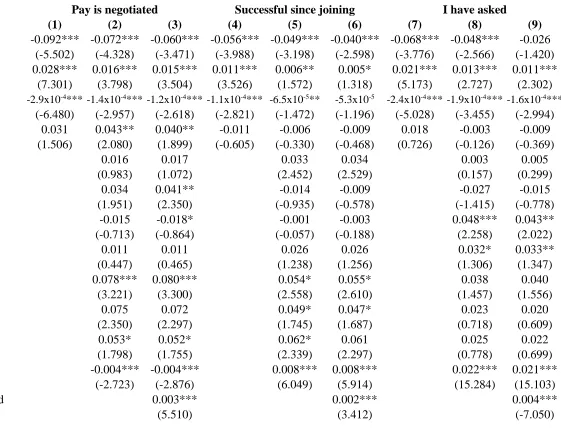
Table 3 turns to regression-equation results. In this table, three dependent variables are
used. These are dichotomous answers to questions on ‘My pay is negotiated’, ‘I have successfully
obtained a pay rise while with the employer’, and ‘I have attempted to obtain a pay rise’. In each
of these, there are three columns in the tables, and the regression equations build up to longer
specifications in right-hand columns as more variables are added. In all equations, a set of 840
separate employer dummies have been included. Hence the estimates are effectively
within-employer. This has the statistical advantage that a variety of background influences -- that are
specific to each company but not observable to the statistical investigator -- are held constant.
8
increases some of the coefficient sizes (these specifications, without the set of employer dummies,
are available from the authors upon request).
Columns 3 and 6 of Table 3 suggest there are differences between men and women. With
a large number of other covariates included, females are less likely to say that pay is negotiated
(with a coefficient of -0.060 in column 3) and less likely to say they have been successful in
obtaining a salary rise while working for the current employer (with a coefficient of -0.04 in
column 6). Given the mean success rate of 0.16 in the data, this implies that women are one
quarter less likely to obtain a raise. A number of the other independent variables enter significantly
in columns 3 and 6. Age, for example, enters with a concave shape. There is evidence that
individuals with higher levels of education are both more likely to be in a job with negotiation and
to have been successful in negotiating a pay rise after they joined the employer. Job tenure enters,
respectively, negatively in the Negotiated column and positively in the Successful column. Those
employees with longer hours of work are more likely to say their pay is set by negotiation, and
also more likely to say they have been successful in obtaining a salary increase.
4. Not Asking or Not Getting?
Is it true that women do not ask for pay rises? Table 3 allows a particularly simple test of
the hypothesis. The key evidence is in column 9 of Table 3 and suggests that the null hypothesis
of zero cannot be rejected. The analysis finds no statistical difference between men and women
in the probability of having asked. This inference rests, crucially, upon the statistical investigator
having information about the number of hours worked by each employee. Once the equation
-9
0.048 on Female, with a statistic of 2.566, becomes in column 9 a coefficient of -0.026, with a
t-statistic of 1.421.
There is a potential concern here with Type II errors. However, -0.026 is a small
coefficient, and not merely a large one for which the null of zero cannot be rejected, so the chance
of Type II error does not seem a natural explanation. The dominant effect, in the last three columns
of Table 3, is coming not from being a woman per se. Instead, on closer scrutiny, the appearance
of a lack of ‘asking’ is being driven statistically by working a shorter number of hours. Males who
work shorter hours also ‘do not ask’.
To check more fully whether the insignificance of gender for ‘asking’ is being caused
erroneously, Table 4 explores a further permutation. Here the sample is divided into Part-timers
and Full-timers, where the cut-off is defined as fewer than 38 hours9. Table 3’s substantive
conclusions continue to hold. Once again, there is no difference, in the ‘I Have Asked’ columns,
between male workers and female workers. Column 6 of Table 4 seems of particular importance,
because this provides a test for full-time males compared to full-time females. In column 6 of
Table 3, the coefficient on the female dummy is only -0.015, with a small t-statistic of 0.619.
A possible cause for concern is the lack of a measure of frequency-of-times that workers
have asked for a raise at their employer, or a variable for when workers began asking for raises. It
might be that men ask for raises earlier and more frequently than women and that this is why men
are more successful than women at eventually securing a raise. While the AWRS data do not
provide full information on this issue, a suitable variable may lie in workers’ tenure. If men request
raises earlier and more often than women, we should find a statistically significant difference
9 The AWRS survey itself defines the cutoff between part-time and full-time work in Australia to be 38 hours per
10
between newer (lower tenure) male and female employees in their requests for raises. A check for
this was done. Appendix 1B presents results among workers with less than 1 year, 3 years, and 5
years of tenure -- and finds no difference between men and women in how often, or how early,
they ask for a raise.
In Table 1, nearly one third of workers said they had not attempted to get a higher wage.
Among workers who never requested a pay rise, what do they give as reasons for their lack of
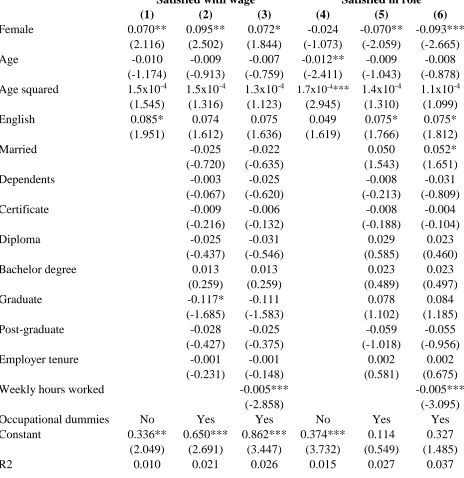
asking? Tables 5 and 6 provide regression-equation evidence. They test among a variety of
verbatim potential explanations that were offered to the interviewees as part of the AWRS survey.
Column 3 of Table 5 documents weak evidence10 for the fact that women may be being influenced
by the fact they are more satisfied -- than equivalently qualified men -- with their wage (consistent
with results in Clark and Oswald, 1996). However, column 6 of Table 5 implies that it is not
because women are relatively satisfied -- in comparison with the males answering the same
question -- with their role in the organization.
Table 6 explores additional possibilities. It gives regression equations where, in the three
columns, the dependent variables are respectively dichotomous variables for ‘I have not asked for
a salary rise because there is no process here for doing so’; ‘I have not asked for a salary rise
because I am concerned about negative effects on my relationship with my manager/employer’; ‘I
have not asked for a salary rise because my role would not be seen as worthy of a higher wage’.
The female dummy is insignificantly different from zero in each of the columns of Table 6. These
findings are pertinent to the hypothesis that female workers do not ask for fear of damage to their
relationships in the workplace. Column 2 of Table 6 does not support such a hypothesis.
Moreover, as before, the estimated coefficient here (of -0.012) is small, and not merely
11
insignificantly different from zero. Women are apparently not being influenced by a
disproportionate concern for their relationships.
It is relevant to inquire into potential differences across age categories. One possibility is
that there might be some form of cohort effect. It could be that younger generations of employees
have different attitudes to the topic of gender than did their parents. In our data set, it is not possible
to distinguish a true cohort-effect from a true age-effect. However, as in Appendix 1A, it is feasible
to split the sample into age sub-categories. Interestingly, for workers under the age of 40, in the
table of Appendix 1A, there appears to be no difference, in a regression-adjusted sense, between
males and females in: whether they are in a job where pay is negotiated; whether they have been
successful in obtaining a rise in pay if they asked for one; whether they did request such a raise.
Overall, in this sample there are differences across age-groups. The younger women in the
labor market appear statistically indistinguishable from the younger men. Hence it could be that
negotiating behavior has begun to change. Future research may be able to calculate whether true
cohort-effects can be detected.
5. Conclusion
This paper uses matched employer-employee data to try to understand why females earn
systematically less than males. It uses a survey in which employees provide information of a kind
not typically recorded in nationally representative data sets. The survey material allows us to
create within-employer estimates and to explore the hypotheses that, first, women are reluctant to
ask for pay rises (Claim 1 in the Introduction) and, second, this occurs because they fear for the
12
strength of this conceptual account is that the theory places some of the responsibility for the
existence of gender differentials upon female employees and the choices they make.
The paper estimates ‘asking’ equations. The results of the empirical testing are
unfavorable, in these modern data, to the women-don’t-ask account of gender differentials. Once
we control for hours of work -- something that was not possible for previous researchers -- so that
the comparison being made is between full-time males and full-time females, and between
part-time males and part-part-time females, the regression equations for the likelihood of ‘asking’ find there
is no difference between men and women.11 This study has also been able to test whether, in
considering to ask or not, females say they are more cognizant than males of possible deleterious
effects on their relationships. There seems not to be evidence for that idea, either, in the data.
Moreover, it appears that these conclusions are not the result of Type II errors; the key estimated
coefficients are tiny and not merely insignificantly different from zero.
In some domains, there are differences between men and women. Adjusting for all the
variables available to us, females are less likely to be in a job where they say that pay is negotiated
(as illustrated in column 3 of Table 3). They are also less successful in getting a pay raise during
their time with the employer (as in column 6 of Table 3). However, when explaining the reasons
they did not ask for a pay raise, there are almost no detectable differences between males and
females; the closest is in Table 5, although it is not true that women feel more satisfied than men
in their workplace role.
Some caveats remain. First, in this study we have relied on what people tell us in surveys.
If, say, men have a disproportionately greater propensity to conceal the truth, then our results
might, in principle, be biased in some way. It is possible that, perhaps as part of a desire to appear
11 Perhaps it should be added that is there no evidence for the possible additional hypothesis that women ask for
13
assertive, male workers are more likely than females to claim to have asked when they have not 12
done so. Second, this data set is for modern Australia. If that country is unusual, the findings from
our study might not apply elsewhere. Third, our results hold when hours of work are held constant.
This is natural, because we wish here to do a ceteris paribus comparison between males and
females, but we have not attempted to explain the observed difference in the mean number of
working hours between men and women. 13 Fourth, the analysis has been unable to explain
properly why women are paid less than men.
In conclusion, this paper documents evidence, of a direct and simple kind, that women do
ask but do not get. Such a finding is potentially consistent with the existence of discrimination in
the labor market.
12 The authors of the paper would like to record that they are not persuaded about this; it is listed here only as a
conceptual possibility. Moreover, this kind of bias would lead to an under-estimate, not over-estimate, of women’s rate of asking.
13 These differences in working hours presumably stem in part from historical and sociological differences in the
14
References
Aigner, D. J. & Cain, G.C. 1977. Statistical theories of discrimination in labor markets. Industrial
& Labor Relations Review 30 (2): 175–87.
Albrecht, J., Bjorklund, A., & Vroman, S. 2003. Is there a glass ceiling in Sweden? Journal of Labor Economics 21 (1): 145-77.
Arrow, K. 1973. The theory of discrimination. In O. A. Ashenfelter & A. Rees, (Eds.),
Discrimination in Labor Markets, 3-33: Princeton, NJ: Princeton University Press.
Azmat, G. & Petrongolo, B. 2014. Gender and the labour market: What have we learned from field
and lab experiments? Labour Economics 30: 32–40.
Babcock, L., Gelfand, M., Small, D. & Stayn, H. 2006. Gender differences in the propensity to initiate negotiations. In D. De Cremer, M. Zeelenberg, & J. K. Murnighan, Mahway (Eds.), Social psychology and economics: 239-62. New Jersey: Lawrence Erlbaum Associates, Erlbaum, Mahwah, NJ.
Babcock, L. & Laschever, S. 2003. Women don’t ask: Negotiation and the gender divide. Princeton, NJ & Oxford, UK: Princeton University Press.
Barron, J., Black D. A., & Loewenstein, M.A. 1993. Gender differences in training, capital and wages. Journal of Human Resources 28 (2): 342–64.
Becker, G. S. 1957. The economics of discrimination. Chicago, IL: University of Chicago Press.
Blackaby, D., Booth, A. L., & Frank, J. 2005. Outside offers and the gender pay gap: Empirical evidence from the UK academic labour market. Economic Journal 115: F81–F107.
Blau, F. D. and Beller, A.H. 1988. Trends in earnings differentials by gender, 1971-1981.” Industrial & Labor Relations Review 41 (4): 513-529.
Blau, F. D. & Kahn, L.M. 2016. The gender wage gap: Extent, trends, and explanations. Journal of Economic Literature, forthcoming.
Booth, A. L. & Nolen, P. 2012. Gender differences in competition: the role of single-sex education. Journal of Economic Behavior and Education, 81: 542-555.
Bowles, H. R., Babcock, L. & Lai, L. 2007. Social incentives for sex differences in the propensity to initiate negotiation: sometimes it does hurt to ask. Organizational Behavior and Human Decision Processes, 103: 84–103.
15
Croson, R. & Gneezy, U. 2009. Gender differences in preferences. Journal of Economic Literature, 47:448–74.
Eagly, A. H. 1987. Sex differences in social behavior: A social-role interpretation. Hillsdale, NJ: Erlbaum.
Eagly, A. H. & Karau, S. J. 2002. Role congruity theory of prejudice toward female leaders. Psychological Review, 109(3): 573- 598.
Flory, J., Leibbrandt, A. & List, J. A. 2015. Do competitive workplaces deter female workers? A large-scale natural field experiment on job entry decisions. Review of Economic Studies, 82(1): 122-155.
Frank, R., H. 1978. Why women earn less: The theory and estimation of differential over-qualification. American Economic Review 68 (3): 360-73.
Garrat, R. J., Weinberger, C. & Johnson N. 2013. The state street mil: Age and gender differences in competition-aversion in the field. Economic Inquiry, 51(1): 806–815.
Gneezy, U., Leonard, K. L. & List, J. A. 2009. Gender differences in competition: Evidence from a matrilineal and a patriarchal society. Econometrica, 77: 1637-1664.
Gneezy, U., Niederle, M. & Rustichini, A. 2003. Performance in competitive environments: Gender differences. Quarterly Journal of Economics, 118(3): 1049-1074.
Goodall, A.H. & Osterloh, M. 2016. Random selection of female leaders. Working paper, Cass Business School and University of Zurich.
Gregory, M. & Connolly, S. 2008. Feature: The price of reconciliation: Part-time work, families and women’s satisfaction. Economic Journal, 118(526): F1-F7.
Guenther, C., Ekinci, N. A., Schwieren, C. & Strobel, M. 2010. Women can’t jump? – An experiment on competitive attitudes and stereotype threat. Journal of Economic Behavior & Organization, 75(3): 395-401.
Hall, R.E. & Krueger, A.B. 2012. Evidence on the incidence of wage posting, wage bargaining, and on-the-job search. American Economic Journal: Macroeconomics 4: 56-67.
Heilman, M. E. 2001. Description and prescription: How gender stereotypes prevent women’s ascent up the organizational ladder. Journal of Social Issues, 57: 657-674.
Heilman, M. E. & Okimoto, T. G. 2007. Why are women penalized for success at male tasks? The implied communality deficit. Journal of Applied Psychology, 92: 81-92.
16
Lazear, E. P. & Rosen, S. 1990. Male-female wage differentials in job ladders. Journal of Labor Economics, 8(1): 106-123.
Leibbrandt, A. & List, J.A. 2015. Do women avoid salary negotiations? Evidence from a large-scale natural field experiment. Management Science, 61(9): 2016-2024.
Mazei, J., Hueffmeier, J., Freund, P.A., et al. 2015. A meta-analysis on gender differences in negotiation outcomes and their moderators. Psychological Bulleting, 141(1): 85-104.
Merton, R. K. 1948. The self-fulfilling prophecy. Antioch Review, 8: 193–210.
Niederle, M. & Vesterlund, L. 2007. Do women shy away from competition? Do men compete too much? Quarterly Journal of Economics, 122(3): 1067-1101.
Niederle, M. & Vesterlund, L. 2010. Explaining the gender gap in math test scores: The role of competition. Journal of Economic Perspectives, 24(2): 129–144.
Niederle, M. & Vesterlund, L. 2011. Gender and competition. Annual Review of Economics, 3: 601-630.
Phelan, J., Moss-Racusin, C. & Rudman, L. 2008. Competent yet out in the Cold: Shifting criteria for hiring reflect backlash toward agentic women. Psychology of Women Quarterly, 32(4): 406-413.
Sandberg, S. 2013. Lean In: Women, Work, and the Will to Lead, Random House: New York.
Schmader, T. & Johns, M. 2003. Converging evidence that stereotype threat reduces working memory capacity. Journal of Personality and Social Psychology, 85: 440–452.
Shurchkov, O. 2012. Under pressure: Gender differences in output quality and quantity under competition and time constraints. Journal of the European Economic Association, 10(5): 1189-1213.
17
Table 1: Descriptive statistics (AWRS data 2013-2014)
Number of observations: 4582 employees across 840 employers
Whole sample
Variable Description Mean SD
Female = 1 if worker is female and 0 if male 0.576 0.494
Age Age of worker in years 40.374 12.506
Age squared Age of worker squared 1,786.403 1,049.501
English = 1 if English is primary language; 0 otherwise 0.860 0.347
Married = 1 if married and 0 if not 0.519 0.500
Dependents = 1 if worker has children 15 or younger; 0 if not 0.327 0.469 Secondary = 1 if completed secondary education; 0 if not 0.241 0.428 Certificate = 1 if completed certificate education; 0 if not 0.254 0.435 Diploma = 1 if completed diploma education; 0 if not 0.147 0.354 Bachelor degree = 1 if completed bachelor education; 0 if not 0.201 0.401 Graduate = 1 if completed graduate education; 0 if not 0.064 0.244 Post-graduate = 1 if completed postgraduate education; 0 if not 0.093 0.291 Employer tenure Length of time spent with employer in years 5.808 6.039 Weekly hours
worked Usual weekly hours worked 37.154 10.882
Part time job = 1 if weekly hours worked is less than 38; 0 if not 0.359 0.480
Pay is negotiated = 1 if salary is a “negotiated amount with employer”
and 0 otherwise 0.389 0.488
Successful
= 1 if “successfully attained a better wage/salary through negotiating with the manager/employer (without changing roles) and 0 if not
0.160 0.367
Has asked for raise
= 1 if “attempted to attain a better wage/salary since commencing employment with this employer” and 0 otherwise
0.696 0.460
Has asked for promotion
= 1 if “attempted to get a promotion” and 0
otherwise 0.891 0.312
Satisfied with wage = 1 if “satisfied with wage/salary” and 0 otherwise 0.338 0.473
No process
= 1 if “there is no process/procedure to be able to access a better wage to perform role” and 0 otherwise
0.213 0.410
Concerned about relationships
= 1 if “concerned about negative effects on relationship with manager/employer” and 0 otherwise
0.136 0.342
Role not worthy = 1 if “role wouldn’t be seen by manager/employer
18
Table 2: Gender sub-sample statistics (AWRS 2013-2014)
Males Females
Variable Mean SD Mean SD
Age 41.124 12.393 39.820 12.561
Age squared 1,844.738 1,061.886 1,743.376 1,038.375
English 0.852 0.355 0.866 0.341
Married 0.579 0.494 0.475 0.499
Dependents 0.369 0.483 0.297 0.457
Secondary 0.245 0.430 0.238 0.426
Certificate 0.270 0.444 0.242 0.429
Diploma 0.136 0.343 0.155 0.362
Bachelor degree 0.192 0.394 0.208 0.406
Graduate 0.059 0.236 0.067 0.250
Post-graduate 0.098 0.298 0.089 0.286
Employer tenure 6.107 6.335 5.588 5.802
Part time job 0.174 0.379 0.496 0.500
Weekly hours worked 41.602 9.862 33.873 10.426
‘Pay is negotiated’ 0.477 0.500 0.325 0.468
‘Successful since joining’ 0.200 0.400 0.131 0.337
‘I have asked for pay rise’ 0.745 0.436 0.660 0.474
‘I have asked for promotion’ 0.902 0.298 0.883 0.322
‘Satisfied with wage’ 0.361 0.481 0.324 0.468
‘No process’ 0.182 0.387 0.231 0.422
‘Concerned about relationships’ 0.146 0.354 0.129 0.336
‘Role not worthy’ 0.160 0.367 0.144 0.352
‘Satisfied in role’ 0.251 0.434 0.225 0.418
The variable ‘pay is negotiated’ is a dummy for whether the employee says that pay levels are fixed by negotiation with the employer. ‘Successful since joining’ is a dummy for having attained a higher salary during this job tenure with the current employer. ‘I have asked for pay rise’ is a dummy for having requested a greater salary during this job tenure with the current employer. ‘I have asked for promotion’ is a dummy for having requested a promotion with the current employer. ‘Satisfied with wage’ is a dummy for reporting that I am satisfied with my income in the job with the current employer. ‘No process’ is a dummy for reporting that there is no process in this job for
obtaining a higher salary. ‘Concerned about relationships’ is a dummy for answering yes to “Why have you not attempted to attain a higher salary… I’m concerned about negative effects on my relationship with my
manager/employer.” ‘Role not worthy’ is a dummy for answering yes to “Why have you not attempted to attain a higher salary… My role wouldn’t be seen by my manager/employer as worthy of a higher wage.” ‘Satisfied in role’
19
Table 3: Regression Equations for My Pay is Negotiated, I Have Been Successful in Negotiating Since Joining, and I Have Asked for a Pay Rise (AWRS 2013-2014). Includes a Full Set of 840 Employer-Dummy Variables.
Pay is negotiated Successful since joining I have asked
(1) (2) (3) (4) (5) (6) (7) (8) (9)
Female -0.092*** -0.072*** -0.060*** -0.056*** -0.049*** -0.040*** -0.068*** -0.048*** -0.026 (-5.502) (-4.328) (-3.471) (-3.988) (-3.198) (-2.598) (-3.776) (-2.566) (-1.420) Age 0.028*** 0.016*** 0.015*** 0.011*** 0.006** 0.005* 0.021*** 0.013*** 0.011***
(7.301) (3.798) (3.504) (3.526) (1.572) (1.318) (5.173) (2.727) (2.302) Age squared -2.9x10⁻⁴*** -1.4x10⁻⁴*** -1.2x10⁻⁴*** -1.1x10⁻⁴*** -6.5x10⁻⁵** -5.3x10⁻⁵ -2.4x10⁻⁴*** -1.9x10⁻⁴*** -1.6x10⁻⁴***
(-6.480) (-2.957) (-2.618) (-2.821) (-1.472) (-1.196) (-5.028) (-3.455) (-2.994)
English 0.031 0.043** 0.040** -0.011 -0.006 -0.009 0.018 -0.003 -0.009
(1.506) (2.080) (1.899) (-0.605) (-0.330) (-0.468) (0.726) (-0.126) (-0.369)
Married 0.016 0.017 0.033 0.034 0.003 0.005
(0.983) (1.072) (2.452) (2.529) (0.157) (0.299)
Dependents 0.034 0.041** -0.014 -0.009 -0.027 -0.015
(1.951) (2.350) (-0.935) (-0.578) (-1.415) (-0.778)
Certificate -0.015 -0.018* -0.001 -0.003 0.048*** 0.043**
(-0.713) (-0.864) (-0.057) (-0.188) (2.258) (2.022)
Diploma 0.011 0.011 0.026 0.026 0.032* 0.033**
(0.447) (0.465) (1.238) (1.256) (1.306) (1.347)
Bachelor degree 0.078*** 0.080*** 0.054* 0.055* 0.038 0.040
(3.221) (3.300) (2.558) (2.610) (1.457) (1.556)
Graduate 0.075 0.072 0.049* 0.047* 0.023 0.020
(2.350) (2.297) (1.745) (1.687) (0.718) (0.609)
Post-graduate 0.053* 0.052* 0.062* 0.061 0.025 0.022
(1.798) (1.755) (2.339) (2.297) (0.778) (0.699)
Employer tenure -0.004*** -0.004*** 0.008*** 0.008*** 0.022*** 0.021***
(-2.723) (-2.876) (6.049) (5.914) (15.284) (15.103)
Weekly hours worked 0.003*** 0.002*** 0.004***
20
Occupational dummies No Yes Yes No Yes Yes No Yes Yes
Constant -0.205** 0.224*** 0.123*** -0.061 -2.6x10⁻⁴ -0.073 0.696*** 0.498*** 0.664***
(-2.468) (2.209) (1.149) (-0.921) (-0.003) (-0.819) (8.140) (5.215) (6.498)
R2 0.032 0.128 0.137 0.014 0.043 0.046 0.020 0.103 0.114
T-statistics are in parentheses. ***, ** and * represent statistical significance at the 1%, 5% and 10% levels. All estimations consist of 4582 observations. Standard errors are clustered by employer.
Table 4: Part-time and Full-time Subsamples: Regression Equations for My Pay is Negotiated, I Have Been Successful in Negotiating Since Joining, and I Have Asked for a Pay Rise (AWRS 2013-2014). Includes a Full Set of 840 Employer-Dummy Variables.
Pay is negotiated Successful since
joining I have asked Part-time Full-time Part-time Full-time Part-time Full-time
(1) (2) (3) (4) (5) (6)
Female -0.023 -0.051** 0.039 -0.053** -0.026 -0.015
(-0.624) (-2.387) (1.374) (-2.396) (-0.608) (-0.619)
Demographic controls Yes Yes Yes Yes Yes Yes
Job controls Yes Yes Yes Yes Yes Yes
Constant 0.058 0.172 0.340 -0.198* -0.181 -0.625***
(0.242) (1.259) (1.430) (-1.748) (-0.926) (-4.817)
R2 0.090 0.111 0.046 0.033 0.073 0.101
Observations 1646 2936 1646 2936 1646 2936
T-statistics are in parentheses. ***, ** and * represent statistical significance at the 1%, 5% and 10% levels. Standard errors are clustered by employer.
Demographic and job controls are as listed in Table 3.
22
Table 5: Regression Equations for the Reasons that I Did Not Ask for a Pay Rise: (i) I Am Satisfied with My Wage and (ii) I Am Satisfied with My Role (AWRS 2013-2014). Includes a Full Set of 840 Employer-Dummy Variables.
Satisfied with wage Satisfied in role
(1) (2) (3) (4) (5) (6)
Female 0.070** 0.095** 0.072* -0.024 -0.070** -0.093***
(2.116) (2.502) (1.844) (-1.073) (-2.059) (-2.665)
Age -0.010 -0.009 -0.007 -0.012** -0.009 -0.008
(-1.174) (-0.913) (-0.759) (-2.411) (-1.043) (-0.878) Age squared 1.5x10⁻⁴ 1.5x10⁻⁴ 1.3x10⁻⁴ 1.7x10⁻⁴*** 1.4x10⁻⁴ 1.1x10⁻⁴
(1.545) (1.316) (1.123) (2.945) (1.310) (1.099)
English 0.085* 0.074 0.075 0.049 0.075* 0.075*
(1.951) (1.612) (1.636) (1.619) (1.766) (1.812)
Married -0.025 -0.022 0.050 0.052*
(-0.720) (-0.635) (1.543) (1.651)
Dependents -0.003 -0.025 -0.008 -0.031
(-0.067) (-0.620) (-0.213) (-0.809)
Certificate -0.009 -0.006 -0.008 -0.004
(-0.216) (-0.132) (-0.188) (-0.104)
Diploma -0.025 -0.031 0.029 0.023
(-0.437) (-0.546) (0.585) (0.460)
Bachelor degree 0.013 0.013 0.023 0.023
(0.259) (0.259) (0.489) (0.497)
Graduate -0.117* -0.111 0.078 0.084
(-1.685) (-1.583) (1.102) (1.185)
Post-graduate -0.028 -0.025 -0.059 -0.055
(-0.427) (-0.375) (-1.018) (-0.956)
Employer tenure -0.001 -0.001 0.002 0.002
(-0.231) (-0.148) (0.581) (0.675)
Weekly hours worked -0.005*** -0.005***
(-2.858) (-3.095)
Occupational dummies No Yes Yes No Yes Yes
Constant 0.336** 0.650*** 0.862*** 0.374*** 0.114 0.327 (2.049) (2.691) (3.447) (3.732) (0.549) (1.485)
R2 0.010 0.021 0.026 0.015 0.027 0.037
23
Table 6: Regression Equations for the Reasons that I Did Not Ask for a Pay Rise: (iii) There is No Process Here, (iv) I Am Concerned about My Relationships, (v) My Role is not Worthy of Higher Pay (AWRS 2013-2014). Includes a Full Set of 840 Employer-Dummy Variables.
No process Concerned about
relationships Role not worthy
(1) (2) (3)
Female -0.053 -0.012 -0.015
(-1.546) (-0.397) (-0.429)
Demographic controls Yes Yes Yes
Job Controls Yes Yes Yes
Constant 0.158 0.090 -0.042
(0.883) (0.573) (-0.248)
R2 0.030 0.024 0.030
24
Appendix 1A: Estimations by Age Sub-Samples (AWRS 2013-2014). Full Set of 840 Employer-Dummies Included.
Pay is negotiated Successful since
joining I have asked Age<41 Age>40 Age<41 Age>40 Age<41 Age>40
Female -0.008 -0.123*** -0.019 -0.077*** -0.041 0.009
(-0.329) (-4.100) (-0.875) (-2.912) (-1.445) (0.335)
English 0.033 0.033 0.024 -0.078** -0.003 0.008
(1.000) (1.022) (0.907) (-2.343) (-0.093) (0.190)
Married 0.032 0.011 0.031 0.033 0.058** -0.043*
(1.187) (0.504) (1.314) (1.606) (2.145) (-1.815)
Dependents 0.068** 0.029 -0.004 -0.015 -0.060** 0.011
(2.427) (1.255) (-0.170) (-0.691) (-2.115) (0.434)
Certificate 0.021 -0.042 0.006 -0.036 0.049 0.040
(0.695) (-1.446) (0.228) (-1.320) (1.481) (1.217)
Diploma 0.039 -0.019 0.009 0.039 -0.016 0.080**
(1.029) (-0.568) (0.265) (1.167) (-0.402) (2.089) Bachelor degree 0.081** 0.086** 0.055* 0.045 0.038 0.085**
(2.325) (2.557) (1.761) (1.309) (1.039) (2.074)
Graduate 0.040 0.094** 0.027 0.056 0.041 0.040
(0.743) (1.960) (0.673) (1.224) (0.787) (0.862)
Post-graduate 0.020 0.088* 0.066 0.065 0.052 0.046
(0.463) (1.916) (1.600) (1.541) (1.034) (0.928) Employer tenure -0.003 -0.002 0.016*** 0.005*** 0.041*** 0.015***
(-0.940) (-1.544) (5.646) (3.408) (11.411) (8.872) Weekly hours worked 0.004*** 0.001 0.002* 0.002** 0.004*** 0.007***
(2.787) (1.041) (1.681) (2.065) (3.321) (4.873)
Occupational dummies Yes Yes Yes Yes Yes Yes
Constant 0.442*** 0.592*** 0.012 0.105 0.428*** 0.354*** (3.974) (6.362) (0.125) (1.328) (4.006) (3.971)
R2 0.112 0.160 0.048 0.043 0.130 0.107
Observations 2370 2212 2370 2212 2370 2212
25
Appendix 1B: Estimations for I Have Asked for a Pay Rise by Tenure Sub-Samples (AWRS 2013-2014). Includes a Full Set of 840 Employer-Dummy Variables.
I have asked for a pay rise
Tenure<1 year Tenure<3 years Tenure<5 years
Female -0.047 -0.017 -0.010
(-0.419) (-0.466) (-0.326)
Age 0.015 0.009 0.015**
(0.510) (0.931) (2.052)
Age squared -2.7x10⁻⁴ -1.4x10⁻⁴ -2.2x10⁻⁴**
(-0.718) (-1.198) (-2.328)
English 0.088 -0.050 -0.027
(0.607) (-1.241) (-0.813)
Married 0.107 0.017 0.015
(1.081) (0.500) (0.575)
Dependents -0.120 -0.063* -0.055*
(-1.401) (-1.680) (-1.867)
Certificate -0.007 0.057 0.053
(-0.067) (1.328) (1.564)
Diploma -0.105 0.029 0.048
(-0.675) (0.566) (1.178)
Bachelor degree 0.270*** -0.021 0.033
(3.066) (-0.437) (0.837)
Graduate 0.252** 0.020 0.040
(2.066) (0.334) (0.780)
Post-graduate 0.489** 0.014 0.037
(2.482) (0.246) (0.739)
Weekly hours worked 0.001 0.003* 0.003**
(0.183) (1.779) (2.209)
Occupational dummies Yes Yes Yes
Constant 1.171* 0.422* 0.365**
(1.822) (1.945) (2.184)
R2 0.032 0.049 0.054
Observations 413 1976 2687
26
Appendix 2: Estimations for I Have Asked for a Promotion (AWRS 2013-2014). Includes a Full Set of 840 Employer-Dummy Variables.
I have asked for a promotion
(1) (2) (3)
Female -0.008 0.003 0.013
(-0.717) (0.199) (0.971)
Age 0.015*** 0.011*** 0.010***
(4.698) (3.341) (3.019)
Age squared -1.6x10⁻⁴*** -1.3x10⁻⁴*** -1.2x10⁻⁴*** (-4.259) (-3.263) (-2.896)
English -0.003 -0.014 -0.017
(-0.206) (-0.877) (-1.067)
Married 1.8x10⁻⁴ 0.001
(0.014) (0.108)
Dependents -0.004 0.002
(-0.297) (0.167)
Certificate 0.022 0.019
(1.581) (1.389)
Diploma 0.016 0.016
(0.912) (0.937)
Bachelor degree -0.008 -0.007
(-0.449) (-0.374)
Graduate 0.000 -0.002
(0.007) (-0.068)
Post-graduate -0.023 -0.024
(-0.981) (-1.035)
Employer tenure 0.004*** 0.004***
(4.932) (4.741)
Weekly hours worked 0.002***
(3.803)
Occupational dummies No Yes Yes
Constant 0.573*** 0.737*** 0.652***
(8.623) (9.970) (8.480)
R2 0.014 0.040 0.047
27
Appendix 3: Extracts from the Questionnaire Wording in the AWRS Survey
Method of Setting Pay
C1 How is your wage/salary determined? Please select one response only
CODE FRAMES MOSP
Negotiated amount with my employer 1
By an enterprise agreement (EBA) 2
By an award (i.e. the relevant pay rate contained in the award, and no more) 3 My employer offered me an amount that was more than the award/standard rate,
and I accepted
4
Other (Please specify) 990
Don’t know 997
Salary Negotiations (After Commencement)
C2 Which of the following best describes the actions you have taken in relation to your wage/salary since you commenced your employment with your employer?
Please select all that apply
[PROGRAMMER: A RESPONDENT CAN’T BE CODE 7 IF THEY ARE CODE 4, AND CAN’T BE CODE 6 IF THEY ARE CODES 2, 3 OR 5]
CODE FRAMES SALNEG1
I received a better wage/salary without pursuing it 1 I have successfully attained a better wage/salary for myself through a promotion 2 I have successfully attained a better wage/salary for myself through negotiating
with my manager/employer (i.e. without changing roles)
3
I have attempted to attain a better wage/salary for myself though applying for a
promotion, but have been unsuccessful
4
I have attempted to attain a better wage/salary for myself in my role, but was
unsuccessful (e.g. request refused or ignored)
5
I have not attempted to attain a better wage/salary for myself since I commenced employment with this employer
6
I have not attempted to get a promotion 7
Prefer not to say 998
Why No Salary Negotiations
[ASK IF C2 (SALNEG) = CODE 6 OR CODE 7]
C2a Why have you not attempted to attain a better wage/promotion for yourself since you commenced your employment?
Please select all that apply
CODE FRAMES SALNEG2
I’m satisfied with my wage/salary 1
There is no process/procedure to be able to access a better wage to perform my role 2 I’m concerned about negative effects on my relationship with my
manager/employer
3
My role wouldn’t be seen by my manager/employer as worthy of a higher wage 4
I am satisfied in my role 5
Other (Please specify) 990