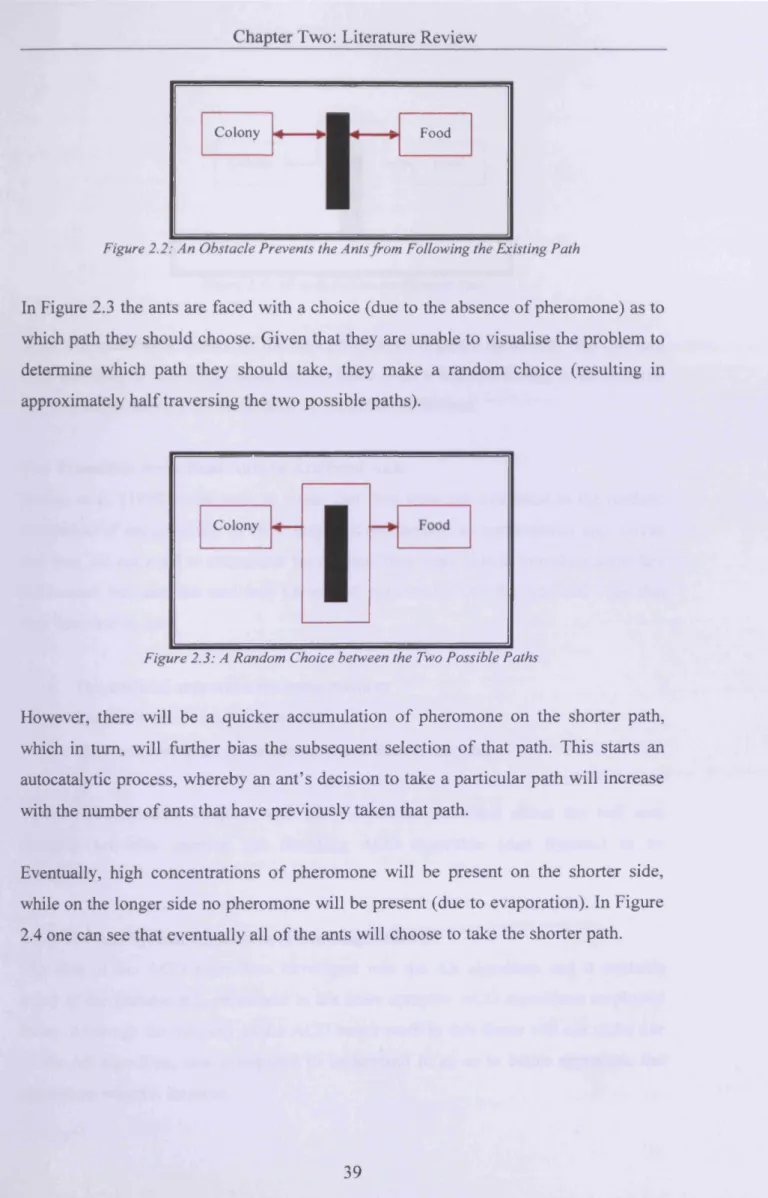
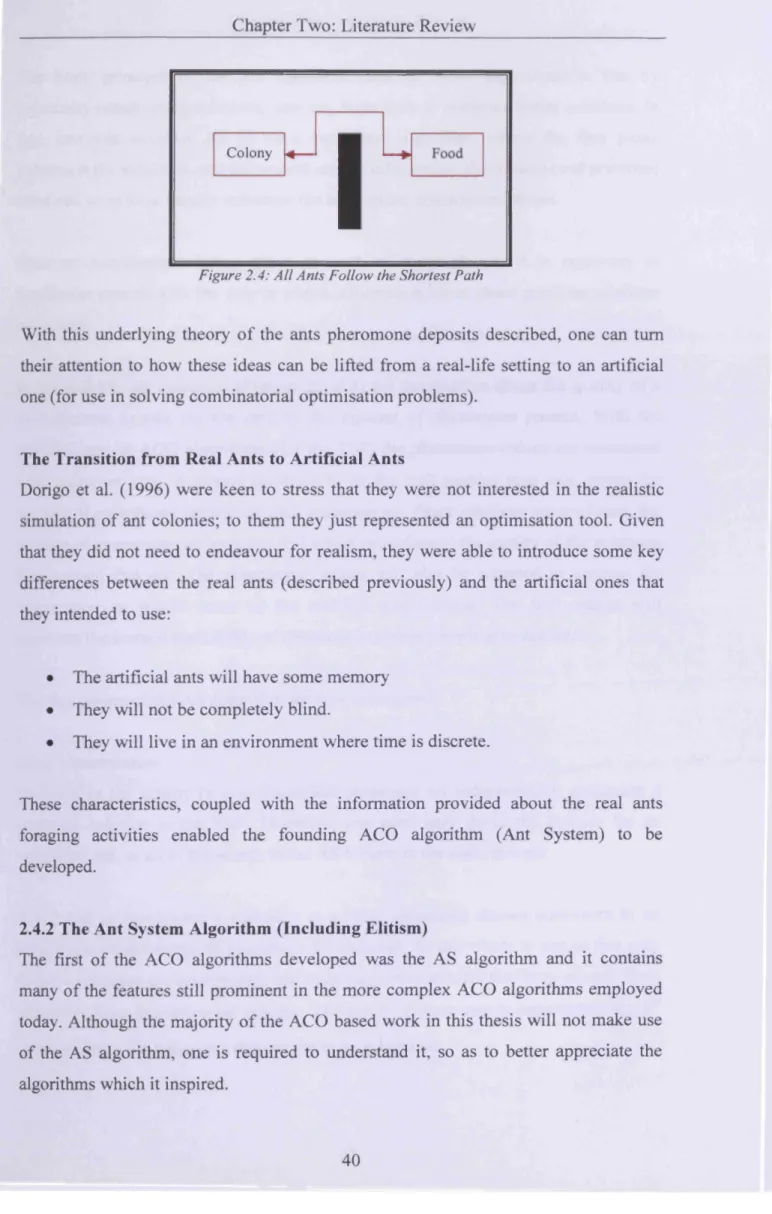
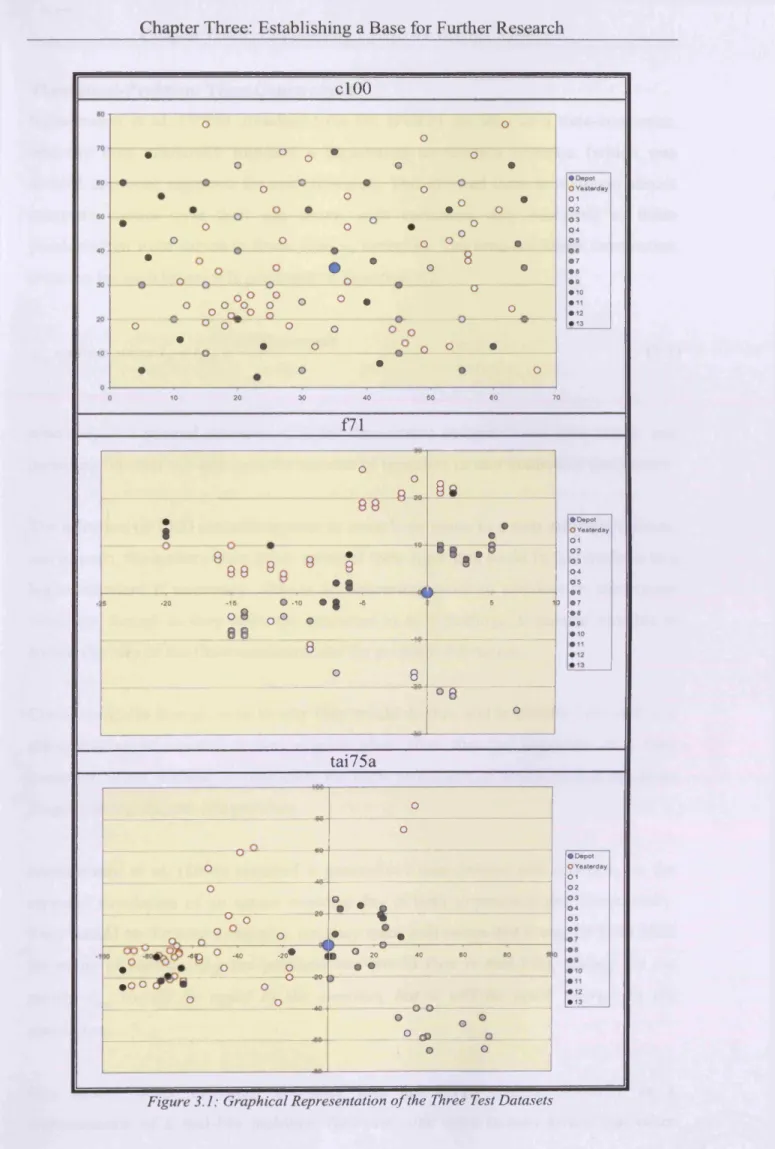
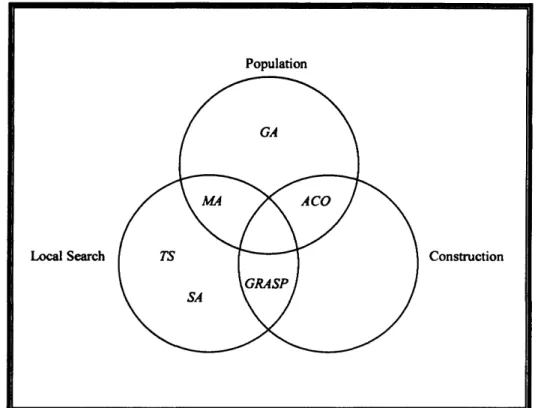
School o f Mathematics
The Dynamic Vehicle Routing Problem
A Metaheuristics Based Investigation
By
Maxwell Wallace
B.Sc. Mathematics, Operational Research and Statistics, Cardiff University
A thesis submitted for the degree of Doctor of Philosophy
All rights reserved
INFORMATION TO ALL USERS
The quality of this reproduction is dependent upon the quality of the copy submitted. In the unlikely event that the author did not send a complete manuscript and there are missing pages, these will be noted. Also, if material had to be removed,
a note will indicate the deletion.
Dissertation Publishing
UMI U584999
Published by ProQuest LLC 2013. Copyright in the Dissertation held by the Author. Microform Edition © ProQuest LLC.
All rights reserved. This work is protected against unauthorized copying under Title 17, United States Code.
ProQuest LLC
789 East Eisenhower Parkway P.O. Box 1346
This work has not previously been accepted in substance for any degree and is not concurrently submitted in candidature for any degree.
Signed ... D a te ...
STATEMENT 1
This thesis is being submitted in partial fulfilment o f the requirem ents for the degree o f PhD.
S ig n ed ... D a te . . . . ...
STATEMENT 2
This thesis is the result o f my own independent investigation, except w here otherw ise stated. Other sources are acknowledged by explicit references.
S ig n ed ... D a te g?....
STATEMENT 3
I hereby give consent for my thesis, if accepted, to be available for photocopying and for inter-library loan, and for the title and summ ary to be m ade available to outside organisations.
Signed... ... Date . . . . Z z - e . y . r P * ....
I would like to thank Dr. Jonathan Thom pson for his guidance, support and friendship; without him this work would never have been completed. Further thanks are expressed to the staff and my fellow postgraduates o f C ardiff University School o f Mathematics for making my tim e here so enjoyable.
My thanks go to the Engineering and Physical Sciences Research Council (EPSRC ) for provision o f funding for this research.
The desire to optim ise problem s is as prevalent in today’s society as it has ever been. The demand for increases in speed and efficiency is relentless and has resulted in the need for m athem atical m odels to bear greater resem blance to real-life situations. This focus on increased realism has paved the way for new dynam ic variants to classic optimisation problem s.
This thesis begins by considering the Dynamic Vehicle Routing Problem. The basic premise o f this routing problem is as follows; a percentage o f custom ers are know n a priori, for w hich routes are constructed, further customers then arrive during the course o f the w orking d ay and need to be incorporated into an evolving schedule.
Literature has proposed a tim eslot approach, whereby one partitions the w orking day into a series o f sm aller problem s, that one is then required to solve in succession. This technique is used to produce a variety o f m etaheuristics based im plem entations, m ost noticeably Ant C olony O ptim isation and Tabu Search.
Consideration is then given to the Dynamic Vehicle Routing Problem w ith Tim e Windows. This problem is sim ilar to the Dynamic Vehicle Routing Problem , but requires each custom er to be serviced within a predefined period o f the day. A metaheuristic approach adapted from the most successful algorithm im plem ented on the Dynamic V ehicle R outing Problem is presented.
Finally consideration is given to a time-based decom position technique for the Vehicle Routing Problem s with Time W indows (Large-Scale instances). This work makes use o f the dynam ic solution technique developed in the preceding w ork, and is used in conjunction w ith an Ant Colony Optim isation algorithm and a descent algorithm.
Chapter One: Introduction (1*9)
1.1 Introduction (1)
1.1.1 Background (2)
1.2 Thesis Aims (4)
1.3 Thesis Structure (5)
1.3.1 Chapter Two: Literature Survey (6)
1.3.2 Chapter Three: Establishing a Base for Further Research (6) 1.3.3 Chapter Four: ACO: Enhancing its Performance (6) 1.3.4 Chapter Five: TS: Enhancing its Performance (7)
1.3.5 Chapter Six: ACO for the DVRPTW (7)
1.3.6 Chapter Seven: Problem Decomposition for the VRPTW (8)
1.3.7 Chapter Eight: Closing Comments (8)
Chapter Two: Literature Review (10-89)
2.1 Introduction (10)
2.2 The Evolution o f Vehicle Routing Problems (11)
2.2.1 The Traveling Salesman Problem (12)
2.2.2 The Capacitated Vehicle Routing Problem (19)
2.2.3 The Vehicle Routing Problem with Time Windows (26)
2.3 The Development o f M etaheuristics (33)
2.3.1 Understanding the Term M etaheuristic (34)
2.3.2 M etaheuristic Techniques (36)
2.4 Ant Colony Optimisation (37)
2.4.1 Inspiration by Nature (38)
2.4.2 The Ant System Algorithm (Including Elitism) (40) 2.4.3 The Two Direct Extensions to the AS Algorithm (46) 2.4.4 The Ant Colony System (Including the Ant-Q Algorithm) (49)
2.5 Tabu Search (52)
2.5.1 Background Principals (52)
2.5.2 Short-Term Memory (53)
2.5.3 Complementary Memory Structures (54)
2.6.2 Greedy Randomised Adaptive Search Procedure (GRASP) (58)
2.7 CVRP Metaheuristic Implementations (59)
2.7.1 ACO for CVRP (59)
2.7.2 Tabu Search for the CVRP (63)
2.7.3 Other Prominent Metaheuristic Implementations for the CVRP (67)
2.8 VRPTW Metaheuristic Implementations (67)
2.8.1 ACO for the VRPTW (68)
2.8.2 Tabu Search for the VRPTW (71)
2.8.3 Other Prominent M etaheuristic Implementations for the VRPTW (75)
2.9 The Dynamic Vehicle Routing Problem (76)
2.9.1 Problem Categorisation (77)
2.9.2 Problems that One Might Incorrectly Assume to be Dynamic (78)
2.9.3 Problems that are Dynamic (79)
2.9.4 The Dynamic Vehicle Routing Problem (with Dynamic Customers) (81)
2.9.5 The ACS-DVRP (86)
Chapter Three: Establishing a Base for Further Research (90-158)
3.1 Introduction (90)
3.1.1 DVRP Benchmark Datasets (92)
3.1.2 Computational Details (93)
3.2 Metaheuristics, Details and Discussion (101)
3.2.1 M etaheuristic Classification (101)
3.3 Implementation o f the Chosen Heuristics (105)
3.3.1 Nearest Neighbour (NN) (106)
3.3.2 Descent (109)
3.3.3 Summary o f Heuristics (115)
3.4 Implementation o f the Chosen M etaheuristics (115)
3.4.1 Ant Colony Optimisation (ACO): Ant System (AS) (118) 3.4.2 Greedy Randomised Adaptive Search Procedure (GRASP) (126)
3.5.2 The Information Learnt and the Potential for Improvement (154) 3.5.3 Metaheuristics to Take Forward (Chapter Conclusions) (157)
Chapter Four: ACO: Enhancing its Performance (159-212)
4.1 Introduction (159)
4.1.1 A B rief Recap o f the ACO Algorithms (161)
4.1.2 ACO Performance Review (164)
4.2 The ACS-DVRP (168)
4.2.1 The ACS-DVRP Parameter Settings (169)
4.2.2 Potential Shortcomings o f the ACS-DVRP (171)
4.3 Improving the ACS-DVRP (173)
4.3.1 New Criterion for Tentative Schedule Completion (174)
4.3.2 Non-Sequential Construction (176)
4.3.3 Encouraging the Use o f Fewer Vehicles (178)
4.4 The First Implementation and the First Proposed Remedy (180) 4.4.1 Criterion for Tentative Schedule Completion: Current vs. TTV (181)
4.5 Parameter Optimisation (184)
4.5.1 Combining Information for Solution Construction (185)
4.5.2 RPR Component Parameters (188)
4.6 The Proposed Improvements (195)
4.6.1 The ERWACS-DVRP (195)
4.6.2 Vehicle Reduction Techniques (197)
4.6.3 Reintroduction o f Improvement Phase (199)
4.7 Results and Conclusions (201)
4.7.1 Results: Non Time-Constrained (202)
4.7.2 Results: Time-Constrained (205)
4.7.3 Analysis Summary and Chapter Conclusions (211)
Chapter Five: TS: Enhancing its Performance (213-276)
5.1 Introduction (213)
5.1.1 A Brief Recap o f the TS Algorithm (214)
5.2.2 A Larger and More Complex Neighbourhood (218) 5.2.3 Generalising the Neighbourhood: The CROSS Neighbourhood (224) 5.3 Reintroducing Tabu Search: Generalising the Tabu Criterion (236) 5.3.1 Generalised Type 1: Cost Based Tabu Criterion (237) 5.3.2 Generalised Type 2: Customer Pair Based Tabu Criterion (241)
5.3.3 Selecting a Tabu Criterion (247)
5.4 Intensification and Diversification (247)
5.4.1 Tabu Tenure (248)
5.4.2 Further Diversification Techniques (257)
5.5 Results and Conclusions (266)
5.5.1 Results: Non Time-Constrained (267)
5.5.2 Results: Time-Constrained (271)
5.5.3 Analysis Summary and Chapter Conclusions (275)
Chapter Five (Addendum): Varying the Degree of Dynamicity (277-283)
5a. 1 Introduction (277)
5a. 1.1 Varying Dynamicity in the Benchmarks (278)
5a.2 Results (279)
5a.2.1 Analysis (281)
5a.2.2 Analysis Summary and Addendum Conclusions (283)
Chapter Six: ACO for the DVRPTW (284-344)
6.1 Introduction (284)
6.1.1 The VRPTW (286)
6.1.2 The DVRPTW (286)
6.2 Datasets and Initial Results (287)
6.2.1 Inclusion o f Dynamic Element into Benchmark Datasets (291)
6.2.3 Creating Feasible Solutions (296)
6.3 Minimising the Number o f Vehicles (300)
6.4.2 Consecutive Phases (316)
6.4.3 Interlaced Techniques (321)
6.4.4 Pi Feasibility (327)
6.5 Reintroduction o f the Improvement Phase (329)
6.5.1 BI Descent in P j (329)
6.5.2 Striking a Balance between Construction Cycles and Descent (333)
6.6 Results and Conclusions (338)
6.6.1 Analysis Summary and Chapter Conclusions (343)
Chapter Seven: Problem Decomposition for the VRPTW (345-409)
7.1 Introduction (345)
7.1.2 Why use a Dynamic Technique on Static Problems? (346) 7.1.3 Comparing the Traditional and Timeslot Solution Techniques (351)
7.2 Improved Artificial Dynamicity (360)
7.2.1 Artificial Dynamicity: How Best to Create it? (360)
7.2.2 Customer Distribution (363)
7.2.3 Number o f Timeslots (366)
7.3 Efficient Time Management (368)
7.3.1 Distribution o f Time (368)
7.3.2 Reintroduction o f Descent (371)
7.4 Large Scale VRPTW Results (200-400 customers) (377)
7.5 Extra-Large Scale VRPTW (600-1000 customers) (390)
7.5.1 Initial Results (390)
7.5.2 Lexigraphical Objective Function (393)
7.5.3 Undoing a Potential Poor Customer Selection (398)
7.5.4 Vehicle Bounds (400)
7.5.5 Extra-Large Scale VRPTW Results (600-1000 customers) (401)
7.5.6 Analysis Summary and Chapter Conclusions (408)
Chapter Eight: Conclusions and Further Work (410-426)
8.1 Introduction (410)
8.2.3 General Comments: The DVRP (416)
8.2.4 Results Comparison (417)
8.3 The DVRPTW (421)
8.3.1 General Comments and Further Work (422)
8.4 Large Scale VRPTW (423)
8.4.1 General Comments and Further Work (424)
8.5 More Diverse Applications (425)
8.6. Closing Comments (426)
ACO Ant Colony Optimisation
ACS Ant Colony System
AS Ant System
BI Best Improvement
CH Commitment Horizon
CU Capacity Utilisation
CVRP Capacitated Vehicle Routing Problem DDV Decreased Depot Visibility
DOD Degree o f Dynamicity
DVRP Dynamic Vehicle Routing Problem
DVRPTW Dynamic Vehicle Routing Problem with Tim e W indows EAS Elite Ant System
FI First Improvement
GA Genetic Algorithm
GRASP Greedy Randomised Adaptive Search Procedure
LP Linear Programming
MMAS Max-Min Ant System
NN Nearest Neighbour
PNN Probabilistic Nearest Neighbour RCL Restricted Candidate List
RPR Random Proportional Rule
SA Simulated Annealing
TC Tabu Characteristic/Criterion
TL Tabu List
TS Tabu Search
TSP Traveling Salesman Problem TTV Temporary Taboo Vehicle VRP Vehicle Routing Problem
Chapter One
Introduction
1.1 Introduction
The need to produce vehicle schedules is as prevalent in today’s society as it has ever been. People and business often rely on the picking-up and delivery o f goods on a daily basis, and as a result o f this, the costs associated with transporting goods are often significant. However, one is able to minimise these costs, if efficient schedules can be produced within a suitable timeframe.
Although the exact costs o f picking-up or delivering goods are often specific to an individual person or business, they will usually relate to the num ber o f vehicles required (and driver costs) and the distance the vehicles have to travel (e.g. petrol costs).
With very small problems, one may be able to produce high quality solutions by intuitively building solutions a custom er at a time, until they are all included in the vehicle schedule. However, as the problem size increases, this becom es a more complex task; people cannot rely on their own logic to produce the schedules.
In response to this problem, mathematicians developed a family o f combinatorial optimisation problems known as Vehicle Routing Problems (VRP). These different problems were able to effectively model a variety o f different problem scenarios (through the introduction o f various constraints and objectives) that one might be faced with in real-life. It is within one o f the less studied variants (that has only recently become solvable due to increases in computing power) that this thesis begins.
Given that this chapter is sim ply introducing the work in this thesis, it only provides an overview o f the problem and the information required to produce solutions (further details will be included within the main chapters as and when required). The remainder o f this chapter is structured as follows:
Firstly, some further background information about why these types o f problem exist is presented. This section will include some basic details about general routing problems as well as a b rie f discussion on uncertainty (an idea central to the variants that this thesis considers) and the impact that this can have on solving these problems.
Secondly, the aims o f this thesis are outlined. With a piece o f work as sizable as this, it is important to establish a reason for conducting the research, and what one hopes to achieve from it. Note that these aims are o f a very general nature (more detailed aims are outlined at the beginning o f each chapter) as one cannot pre-empt the direction in which the research is likely to progress.
Finally, details relating to the structure o f the thesis are presented (including a short discussion o f the contents o f each chapter). These details are discussed in a generalised way, so one is not required to have read the preceding chapters to understand.
1.1.1 Background
As explained previously, this thesis is concerned with a recently introduced complex variant o f the VRP. The idea o f adjusting certain components o f the VRP to create a new problem is a popular way o f furthering research in this area; m any such variants have already been proposed (see Section 2.2). As they were developed at different times, and people have varying levels o f interest in certain variants, the research into
these problem variants is at different stages o f advancement. Some problems (such as the traditional Capacitated VRP (CVRP), explained in Chapter Two) are beginning to become o f less interest, as so much research has been conducted; producing optimal (or near-optimal) solutions is now commonplace (for many o f the standard benchmark datasets).
However, there is still a wide selection o f more recent (or less fashionable) problem variants that have received relatively little attention. It is within one o f these variants that this thesis begins (though in Chapter Six an entirely new problem variant is considered). Before further details about the specific problem variant are presented, it seems sensible to discuss some m ore general details about routing problems.
Introducing Routing Problems
The VRP and its variants all share the same principal aim, that being the production o f a set o f vehicle routes starting and ending at the depot(s), such that all customers are serviced. Complementing this aim, are a series o f constraints that must be adhered to in order for a solution to be declared valid. These constraints often try to provide increased realism (or complexity) to the mathematical problem, introducing ideas such as vehicle capacity and the m axim um distance vehicles can travel.
The particular constraints being applied to a problem determine which variant o f the VRP family is being considered. A more complete definition o f the VRP can be seen in Chapter Two along with an overview o f some o f the most prominent members o f the VRP family.
Although constructing a valid set o f routes is often trivial (unless the constraints are particularly difficult to adhere to), it is the desire to produce these routes with a predefined objective o f m inimising some characteristic(s) that makes these problems so complex. There is a considerable number o f possible characteristics that can constitute the objective, including minimising: distance, number o f vehicles, waiting times etc. To further complicate proceedings, it is often common practice to try to produce a schedule that minimises a combination o f these (in which case a weighting
With the basic details about VRPs presented, the idea o f routing with uncertainty can now be introduced. This is the key component that distinguishes the work in this thesis, from much o f the research into routing problems that preceded it.
Routing with Uncertainty
With the majority o f routing problems being NP-Hard, the production o f optimal solutions is a complex task. As people often require solutions within a predefined timeframe, they often have to rely on good solutions that can be identified in a considerably shorter period o f time (see discussion in Section 2.2).
However, due to recent enhancements in computing power, people have been able to consider more complex variants o f the VRP (whilst still solving them in an acceptable period o f time). One particular class o f problem variant that has only recently begun to receive attention is the idea o f routing with uncertainty; whereby one does not have all o f the information one requires to produce a vehicle schedule.
Although there are different types o f routing problem containing uncertainty (see Section 2.9 for details), the type considered in this thesis requires one to produce an initial schedule that is then updated (while it is being traversed) to account for the uncertain component being revealed. This type o f uncertainty is known as dynamicity and allows for many new variants o f the VRP.
With the details o f the types o f problem that are to be investigated presented, consideration can be given to the aims o f the thesis and what one hopes to achieve by investigating these problems.
1.2 Thesis Aims
At its most basic, the aim o f this thesis is to contribute to the growing body o f work on routing problems containing uncertainty. It was felt that this would be an interesting area to investigate, given that solving this type o f problem has only recently become possible.
With enhancements in computational power making the solution o f dynamic problems a reality, this thesis abandons the idea o f theoretical discussions (favoured
by many previous publications) in favour of producing results (akin to the way one would be likely to consider a well researched problem variant such as the CVRP). Note that as these problems are so recent, the scope for this work is also much wider reaching than it would have been for a problem that has received greater levels of attention.
In Section 2.9 there is a discussion on the different forms of uncertainty that could have been investigated, and the reasons presented as to why the Dynamic VRP (DVRP) with Dynamic Customers was decided upon. This problem is similar to the CVRP (with an objective of minimising distance) but one is only aware of a predefined proportion of customers in advance; others become known as the vehicles are traversing their routes (i.e. new customers need to be incorporated into an evolving schedule). When considering which solution techniques (i.e. metaheuristics) to utilise, it seemed beneficial to consider a wide selection and continue with the best performing. The results of this analysis suggested that the ACO metaheuristic was particularly well suited to this type of problem, and thus constitutes the main solution technique utilised in this thesis.
U Thesis Structure
When undertaking research of this nature, it is not possible to identify in advance the direction that one is likely to end up pursuing. A structure was not established in advance (and followed rigidly), the work evolved as one discovered more about the problems being investigated.
The majority of the research in this thesis was conducted in the order in which it is now presented1; thus enabling one to see how the research has evolved over time. Although they consider similar problems, one is able to view each chapter as an individual piece of research, which relies on information obtained from certain aspects of the work that preceded it.
13.1 Chapter Two: Literature Survey
This chapter is designed to complement the work that is in the subsequent chapters. It presents details regarding a considerable volume of literature that will support the work in this thesis and provide one with a greater understanding of the techniques involved. It should be noted that the literature is also discussed within the chapters (specifically the earlier ones), where one is provided with greater details than given in this overview.
Consideration is given to similar problems (to those tackled in this thesis) and a variety of solution methods. The amount of detail provided for each solution method is proportional to the techniques prominence in the subsequent chapters. One is encouraged to refer back to this chapter should they be unfamiliar with either the problem or solution technique that is being considered.
13.2 Chapter Three: Establishing a Base for Further Research
This chapter is concerned with identifying the best direction (in terms of solution methods) that this thesis should take. Given that the problem being tackled (described in Section 2.9.4) is so recent, there is no significant body of research on which to base this decision. It seems prudent to try to test a variety of techniques, with the intention of identifying whether any are likely to be particularly successful or interesting.
This chapter contains two heuristic and five metaheuristic implementations that are all assessed on the same benchmark problems (thus allowing one to make a comparison of the results produced). This chapter will consider only very basic implementations of the metaheuristics, and from this set two techniques will be carried forward for further research in Chapters Four and Five (Ant Colony Optimisation (ACO) and Tabu Search (TS) respectively).
1 3 3 Chapter Four: ACO: Enhancing its Performance
In Chapter Three the ACO metaheuristic is identified as one that is worthy of further research; this chapter details that investigation. Using an existing algorithm that had been produced for the same problem (the ACS-DVRP, see Section 2.9.5) as a base, attempts are made to improve the quality of the solutions produced by considering a series of adaptations.
This chapter will conclude with a set of results that will be directly comparable to those produced via the ACS-DVRP, thus allowing one to critique the algorithm as one would for a traditional combinatorial optimisation problem.
1.3.4 Chapter Five: TS: Enhancing its Performance
In Chapter Three the TS metaheuristic is also identified as one that is worthy of further research; this chapter details that investigation. The direction that this work takes is fairly intuitive, with consideration given to the two key components of the TS metaheuristic: the neighbourhood and the way in which one determines if a move is tabu.
Once the basic TS algorithm has been developed, consideration is given to a variety of intensification and diversification techniques, aimed at further improving the performance of the search. As with Chapter Four, this chapter concludes with a set of results that will be directly comparable to the ACS-DVRP (though one will also be able to compare it to the algorithm developed in Chapter Four).
A short addendum is also included in this chapter. It presents the first steps of an interesting direction that one could explore were one interested in continuing work on this problem (the subsequent chapters of this thesis consider different problems). It concerns altering the amount of uncertainty and considering the impact that this has on the quality of solutions one is able to achieve.
1 3 3 Chapter Six: ACO for the DVRPTW
This chapter considers a different type of routing problem from the three chapters that preceded it. Although there remains considerable scope for further work on the previously investigated problem, it seems sensible to see if the techniques developed could be applied to a different problem.
The same type of uncertainty (i.e. dynamic customers) is introduced into a popular routing problem, which requires customers to be serviced during a predefined period of the day (known as a time window). Although the introduction of time windows
Instead of minimising distance, the VRP with Time Windows (VRPTW) (and hence the Dynamic VRPTW (DVRPTW)) is primarily concerned with minimising the number of vehicles deployed (though distance is retained as a secondary objective). With the existing ACO algorithm developed for the DVRP, this chapter is concerned with tailoring this algorithm to the new constraints and this new objective function.
Results for a newly created set of benchmark problems are presented, enabling one to assess the quality of the algorithm developed.
1.3.6 Chapter Seven: Problem Decomposition for the VRPTW
This chapter presents an interesting by-product of the work that was produced in Chapter Six. It considers making the VRPTW artificially dynamic, and by employing the techniques developed previously, enabling one to decompose large problems into a series of smaller sub-problems.
Given that the VRPTW is NP-Hard, there are obvious time benefits associated with solving smaller problems. If one can identify a suitable way of decomposing the problem (and then bringing it back together) one may be able to produce better solutions than would be possible when considering the problem as a whole. Problem decomposition is a well-known technique for the CVRP, but has received little attention with regards to the VRPTW.
1.3.7 Chapter Eight: Conclusions and Future Work
The key findings of each chapter will be summarised, along with details regarding future work that could be conducted (were one to wish to continue to build on the work in this thesis). Note that as each chapter contains its own conclusions and discussion on where further work may be of particular interest, many of these details will already have been presented.
As it is hoped that research will continue beyond the problems and techniques developed in this thesis, some potential further work of a more diverse nature (than that presented within the chapters) will also be discussed.
Note that this chapter also includes a comparison of the results produced by the algorithms developed in Chapters Four and Five, with results that have recently become publicly available.
Chapter Two
Literature Review
2.1 Introduction
This chapter is intended to act as a support document to the work contained in the main body of this thesis. One can choose to read it in advance (if one is unfamiliar with combinatorial optimisation problems and metaheuristic solution techniques), or refer bade to it as and when required.
Although a considerable volume of literature is also included within the earlier chapters to support the work being undertaken, it seemed sensible to include the discussion of the less prominently involved publications within a separate chapter. This chapter presents details of existing research that has been conducted in areas related to either the problems considered or the solution methods explored. It is structured as follows:
It begins with consideration being given to the most prominent (and relevant) routing problems (TSP, CVRP and VRPTW). This section includes details on how and why these problems were first developed, and a discussion on the different ways people have solved them (exact and approximation techniques). Details for further reading on
these problems are also included, though any information required to understand the work in this thesis will have been presented.
A short introduction into the development of metaheuristics is then presented. This is followed by more detailed discussions (Sections 2.4-2.6) into the most relevant solution techniques. These methods are discussed in a very generalised way as they can be applied to a variety of problems (TSP implementations are presented where applicable). Given that one is simply intending to convey the theory of the techniques, no further reading is suggested.
Once the solution techniques have been suitably introduced, implementations of these for the CVRP and the VRPTW are presented (Section 2.7 and 2.8). These will include details for further reading should one be interested in learning more about a particular solution technique (for one of these two problems).
Finally, consideration is given to the idea of dynamic vehicle routing problems, what the term can mean, and what it means in this thesis. This section will include a discussion on the first set of benchmarks to be used in this thesis (Chapters Three through Five) and the only existing algorithm that has been implemented upon them.
12 The Evolution of Vehicle Routing Problems
The term VRP has come to encompass a great number of routing problems, each with their own different properties. As these varied problems were established over a period of time (spanning many years), it is useful to see how the problem evolved into the dynamic problems that are considered in this thesis.
There are three key routing problems (TSP, CVRP and VRPTW) that support the work in this thesis, and each of them is to be considered individually. The same basic structure will be used to present the prominent literature on each of the problems:
• Problem Introduction/Definition • Background Information
• Neighbourhoods for Route Improvement.
The considerable volume of research that has been conducted in this area makes it impossible to present all of the details and literature that has been produced, and as such, this literature review is simply an introduction to the work. Readers will be directed to further workings should they desire a greater knowledge in problems being discussed.
As is the case throughout this chapter, these details are being provided to support the work in this thesis. One will find further information (often in greater depth) when the particular techniques (or variants of them) are first implemented on the problems tackled in this thesis.
2.2.1 The Traveling Salesman Problem
Perceived by most as the single most important routing problem in combinatorial optimisation, the TSP is the most sensible place at which to begin this journey through the family of routing problems. It acted as a precursor to the many more complex routing problems (including the two of particular interest, the CVRP and VRPTW) and was the environment in which many of the solution techniques were developed.
There exist multiple ways in which one can explain the TSP, with many authors choosing to reword the explanation, presenting the problem in their own way. However, with little to be gained from a further definition being proposed, an existing explanation is presented. Taken from the book ‘The Traveling Salesman Problem’ Hoffman and Wolfe (1985), it not only offers up a concise description of the problem, but offers an insight into its complexity.
I f a salesman, starting from his home city, is to visit exactly once each city on a given list and then return home, it is plausible fo r him to select the order in which he visits the cities so that the total o f the distances traveled in his tour is as small as possible. Let us assume he knows, fo r each pair o f cities, the distance from one to another. Then he has all the data necessary to find the minimum, but it is by no means obvious how to use these data in order to get the answer'.
While it is simple to describe the problem, the history behind the problem is somewhat complex. It does not appear that there is a definitive answer as to who first considered the problem, but some of the early important workings are now discussed.
Background Information
The origins of the problem are still debated today, though it is believed that the current earliest example of a similar problem can be found in German texts dating back to the early 1800s. However, even this is debated with some believing the works of the mathematicians Sir William Rowan Hamilton and Thomas Penyngton Kirkman should (also) be credited.
The TSP is one of the earliest (and is easily the most famous) routing problems ever studied. Many believe that its popularity stems from the contrast between the simplicity of its description and the complexity of solving it. It was a problem that non-mathematicians could identify with, and it had an obvious real-life application.
Regardless of who was responsible for its inception, what is known, is the person who brought the problem to the operational research and wider mathematical community, Merrill Flood. In 1940s America, whilst working at the RAND Corporation, Flood described the problem to colleagues and the challenge of producing techniques to solve this problem was bom.
To consider why some mathematical algorithm is needed, it is necessary to look at how one would solve the problem otherwise. To solve the problem one would have to evaluate all possible solutions, from which the best could be chosen (this technique is known as complete enumeration). However, for all but the smallest problems this is not a feasible idea. The number of possible solutions (each of which would need to be evaluated) to the TSP is shown in Equation 2.1, where n represents the number of cities (known as customers in the VRP) to be visited.
Number o f possible tours = ——— (2.1)
The factorial element of this equation increases at such a rate that even for small problems, this soon becomes too large to contemplate complete enumeration (e.g. for rt=10, there exist 181440 different solutions).
While one may be able to compute this number of tours on the computers of today, Flood and his colleagues did not have access to such technology. Furthermore, the size of problems being tackled now is far higher than even modem computers can deal with e.g. a popular current TSP instance, known as the Sweden Tour contains 24978 cities.
Solving problems of this size by compete enumeration (even on the most powerful computers) is completely infeasible, hence the need for a more mathematical
%
approach.
The first published (with regards to modem mathematical journals) work, containing the moniker TSP was a report by Robinson (1949) from the RAND Corporation entitled ‘On the Hamiltonian game (a travelling salesman problem)’. This work does not contain a working TSP solution technique (it solved a variant of the problem), but it discusses how their work came about via an unsuccessful attempt to solve the TSP.
The first breakthrough on the TSP came in 1954 when an optimal solution for a n=49 TSP was presented in Dantzig et al. (1954). It utilised a linear programming method, and contained many of the ideas still prominent in modem linear programming techniques. Interestingly, the title of this work made reference to it being a solution technique for a large-scale TSP problem, and while it would not be considered such now, n=49 was sizable for the time.
TSP: Route Construction Techniques
Two years after the breakthrough of Dantzig et al. (1954), the first heuristic approach was presented in Flood (1956). This work was responsible for the development of the nearest neighbour heuristic that is still central to many of the modem day techniques.
Flood (1956) implemented this method on the same n=49 problem that was solved to optimality by Dantzig et al. (1954) and produced a solution in 904 units (an increase
of nearly 30% to the optimal of 699). Regardless of this poor performance, the idea of approximation techniques for TSPs was bom; an area of research that was to provide many challenges for years to come.
The seminal nature of this paper did not stop with the creation of the nearest neighbour technique, the first TSP improvement heuristic was developed and the two were used together in a composite procedure. Given that there is a discussion on improvement techniques in the next sub-section, this part of the algorithm is not discussed here.
There exist many other TSP construction techniques, though one does not need to focus too heavily on their descriptions, as they are not used in this thesis. Two examples of these are outlined below to demonstrate how the techniques can vary:
• Furthest Insertion
One begins with a tour consisting of the two customers furthest apart; the next furthest customer (r) is added to the route in the place at which it will cause the smallest increase to the distance travelled, see Equation 2.2.
Cir+CrrCy (2.2)
where i and j are the customers which r is to be placed between and c is the distance.
This process is repeated until all customers have been included in the route, see, Rosenkrantz et al. (1977).
• Convex Hull
One begins with the convex hull of the customers (the smallest route that encloses all of the customers); the best place to insert each of the remaining customers (r) is then identified according to Equation 2.2. The insertion that has the smallest impact on the distance is made, and the process is repeated,
Although these are only outlines, one can see how varied the construction techniques can be. Given that this thesis is to focus on the use of metaheuristics, it seems sensible to not dwell on the simple construction techniques. Further details of these and other construction techniques can be found in Golden et al. (1980).
TSP: Neighbourhoods for Route Improvement
Once a feasible tour has been identified via a construction heuristic (e.g. through one of the methods explained previously), one might wish to try to improve that solution. A number of methods exist for this, and are grouped under the heading, improvement heuristics. Many metaheuristics have a similar objective, but they will be discussed in a later section.
«*•
*
0
The general technique is known as descent and although the implementation details are not discussed here (they appear in Chapter Three when one of these improvement heuristics is first implemented), it seems sensible to present an outline of the theory here.
The basic premise of all of these methods is to make some form of adjustment to the current solution, and assess whether the distance has been reduced. If the distance is reduced, then the move is accepted, and adjustments to this new solution are considered. If the adjustment would have increased the distance, the move is discarded and a new adjustment is considered.
The way these adjustments are identified is through the concept of a neighbourhood, which is explicitly defined within each implementation. A neighbourhood contains all of the moves that can be made to a solution under its proposed definition. The various TSP improvement heuristics are essentially a collection of different neighbourhood definitions, the most prominent of which are now discussed.
The most common neighbourhood definitions are 2-Opt and 3-Opt:
• 2-Opt (Croes (1958), though the move was suggested in Flood (1956))
This edge exchange neighbourhood removes two edges from the tour and reconnects the route in the only alternative way possible. This will result in the
latter part of the tour being traversed in the opposite direction to that which it was previously. This is not a problem for the TSP, but one should be aware if the problem is asymmetrical this is unlikely to be a productive neighbourhood.
• 3-Opt (Lin (1965))
This works in a similar way to the 2-Opt neighbourhood but removes three edges from the tour. This means that there are two ways of reconnecting the resulting three paths into a valid tour (excluding 2-Opt moves) and both must be assessed.
The processing of these moves continues until one reaches a solution where no further moves can be made that reduce the $ost (within the neighbourhood definition). Once this has been reached, the solution is said to be either 2-Optimal or 3-Optimal (depending which neighbourhood was used).
Perttunen (1994) states that ‘a 3-optimal tour is always 2-optimal9, and as such, one can be sure that 3-Opt is a better neighbourhood than 2-Opt for reducing the cost. However, given the exponential increase in time required to run the 3-Opt algorithm compared to 2-Opt, one is often unable to run the algorithm to 3-Optimality.
One area of particular interest is in finding a balance between 2-Opt and 3-Opt such that the performance is increased to a standard higher than 2-Opt without requiring the processing time of 3-Opt. These neighbourhoods are found by only allowing certain 3-Opt moves to be made, the imposed restriction on the 3-Opt neighbourhood will lowo* the quality of the result but speed up the algorithm.
There are two popular neighbourhoods that exist between the 2-Opt and 3-Opt algorithms:
• 2.5-Opt (Bentley (1992))
This neighbourhood expands upon the 2-Opt neighbourhood, by including a single type of 3-Opt move. The extra move relocates a single city from its
Johnson and McGeoch (1995) report that the inclusion of this move will result in an improvement of 0.5-1% in solution quality, though at an expense of increasing run times by 30-40%.
• Or-Opt (Or (1976), though made popular by Golden and Stewart (1985))
This neighbourhood further expands the 2-Opt (and 2.5-Opt) neighbourhood by including the relocation of chains of cities (of length 1, 2 or 3). These chains are then repositioned between two current tour neighbours. Johnson and McGeoch (1995) suggest that "...an implementation should be a bit faster than fu ll 3-Opt, although a slight loss in tour quality is to be expected’.
Although the majority of work focuse^on 2-Opt, 3-Opt or somewhere in between, one need not stop at removing this restricted number of edges. This technique can be expanded to the idea of fc-Opt1, where k is a used defined parameter. 4-Opt was considered in Lin (1965), but it was shown that there was little improvement in the solution quality beyond the more traditional 3-Opt.
The lade of success provided from higher levels of k (along with the obvious increase in run time) led people away from the area of k-Opt neighbourhoods, and towards variable-Opt neighbourhoods.
The most famous variable-Opt neighbourhood, and the only one discussed in this review is the Lin-Kemighan neighbourhood (Lin and Kemighan (1973)). This is widely accepted to be one of the best performing TSP neighbourhoods and has been used in multiple algorithms since its inception.
The traditional k-Opt algorithm required that one specify a value for k in advance of the algorithm being run. Lin-Kemighan removed the need to do this, by allowing the algorithm to increase the value of k based on how the search is progressing. The Lin- Kemighan algorithm is too complex to be described in further detail here, though readers are directed to the founding paper and Johnson and McGeoch (1995) for further details.
Discussion on Other Prominent TSP Workings
The workings of Dantzig et al. (1954) and Flood (1956) could be seen as causing a split in the way in which the TSP was tackled. With the early approximation techniques having been discussed, and the metaheuristics due for a similar analysis later in the chapter, consideration is now given to the exact methods.
The identification of optimal solutions via LP methods has continued to the present day, with much success. The many workings of Applegate, Bixby, Chvatal and Cook e.g. Applegate et al. (1998) built upon the cutting plane work of Dantzig et al. (1954) and lead to successfully identifying optimal solutions for problems of size «=7397, 13509 and n -\S \\2 . The same group of authors (though this time in conjunction with Helsgaun) also managed to fing the optimal solution for the Sweden Tour (n-24978) in 20042.
This concludes the introduction to the heuristic and exact methods for solving the TSP. The TSP is one of the most researched combinatorial optimisation problems of all time, and as such, producing an exhaustive review in this thesis is not possible. Readers are directed to Reinelt (1994) for a more detailed discussion of the history of this problem.
22 2 The Capacitated Vehicle Routing Problem
As interest in the TSP continued to grow, people began to adapt the problem to fit real-life situations that they were being faced with. It was within one of these adaptations, that another of the most important and heavily researched combinatorial optimisation problems was first identified.
Dantzig and Ramser (1959) (see upcoming background information for further details) proposed generalising the TSP; instead of allowing one vehicle (then referred to as the salesman) to service all of the customers, one has a fleet of vehicles with limited capacity. If a single vehicle can service all of the customers, one is faced with a TSP, if not, one must decide which vehicles are going to service which customers (this problem is known as the CVRP).
The CVRP usually employs a single objective function, whereby one is solely concerned with the distance that the vehicles have to travel. However, other variants exist, such as minimising the number of vehicles deployed then distance, or equalling die distribution of work amongst the fleet. All CVRP (and its associated DVRP) in this thesis will use the standard distance based objective function.
Although at first glance one may feel that this is very similar to the TSP, one should not underestimate the difference it has upon producing solutions.
Background Information
Nearly twenty years after Flood (1956) had introduced the TSP to his colleagues (though only three years after his first^published work), this new, more generalised variant of the problem was proposed. Dantzig and Ramser (1959) introduced the problem that has come to be known as the CVRP (though it was then referred to as the trude dispatching problem).
Concerned with 'the optimum routing o f a fleet o f gasoline delivery trucks between a bulk terminal and a large number o f service stations' they proposed the first mathematical programming formulation and an associated procedure for producing what they described as near optimal3 solutions.
The results produced by Dantzig and Ramser (1959) were soon improved upon by a simple greedy heuristic known as the Clarke and Wright Savings (C&WS) algorithm (Clarke and Wrigiht (1962), implementation details will be discussed later). In this paper they present a problem instance (w=30) and solve it via their method and that of Dantzig and Ramser (1959).
In this analysis they were purely concerned with the minimisation of distance, and reported that their method resulted in a 17% reduction. It should be noted that they also used two less vehicles, though as this is not accounted for in either technique’s objective function, such a comparison has little validity.
These two papers were responsible for interest in the CVRP ‘taking-off, and subsequent research usually credits these papers with the problem’s establishment.
With the first two workings differing so significantly, one is drawn to how one might best solve the CVRP. Lenstra and Rinnooy Kan (1981) have shown that the CVRP is an NP-hard problem, and as such, solving it exactly is going to be a complex and time-consuming affair. Toth and Vigo (2002) believe that there are five main solution techniques for solving the CVRP:
• Branch-and-bound algorithms • Branch-and-cut algorithms
• Set-covering-based algorithms £ • Classical heuristics
• Metaheuristics
The first three of these focus on the complex task of solving the problem exactly. As die idea is not central to the work being pursued in this thesis, an understanding of these workings is not of paramount importance. However for completeness, an indication of the work, along with further reading will be presented at the end of this section.
The final two of these techniques are approximation techniques, of which a working knowledge is required, to support the work that is presented later in this thesis. Given that the metaheuristic methods will themselves have a dedicated section in this chapter it seems sensible to delay their discussion until they have been suitably introduced.
It is therefore the heuristic methods that are the primary area of interest for the remainder of this discussion on the CVRP. The heuristic techniques can be split into two sub-groups (in much the same way as they were for the TSP), namely construction techniques and route improvement techniques.
Following a review of the prominent early work on each of these sub-groups the exact methods will be introduced along with any other literature that is of particular relevance.
CVRP: Route Construction Techniques
The most famous construction algorithm is that of Clarke and Wright (1962); developed soon after the founding work of Dantzig and Ramser (1959). It begins with each customer being serviced by an individual vehicle i.e. routes are of the form (0-i-0) where i-\...n and the depot=0. If two of these routes can be feasibly merged into a single route, then one can compute the saving associated (see Equation 2.3).
sy^cjo+corcy £ (2.3)
The C&WS algorithm then computes every feasible merge and implements the merge that has the greatest reduction on the distance travelled. The process is then repeated until there exist no feasible merges that reduce the distance..
Over time, various enhancements were made to the algorithm. Gaskell (1967) proposed the introduction of a parameter into the savings function to place greater emphasis on the distance between the vertices being connected in the route merge, while Golden et al. (1977) focused on reducing the time taken to compute and sort the savings (needed for each iteration of the algorithm).
Alternatively, one can use one of the many sequential construction algorithms that exist; instead of calculating the savings from the merging of two routes, the solutions are constructed one customer at a time. These techniques rely on different ways of selecting the next customer to insert into a partial solution and can be implemented in either a sequential (one vehicle at a time) or parallel manner (multiple vehicles at once). Although they have been shown to be successful, they are not of paramount importance to the working of this thesis, and as such, one is directed to Mole and Jameson (1976) and Christofides et al. (1979) for further reading.
Other prominent construction algorithms such as the sweep algorithm of Gillet and Miller (1974), the petal algorithm of Ryan et al. (1993) and the matching based
savings algorithm of Altinkemer and Gavish (1991) have not been discussed as they are of little relevance to the work in this thesis.
CVRP: Neighbourhoods for Route Improvement
In much the same way as for the TSP, upon the construction of a solution, one may choose to try to improve the solution through some form of descent. As before, this requires a suitable neighbourhood in which the moves can be made. However, when improving a CVRP solution, one has to take account of the fact that there exist multiple vehicle routes. These can significantly alter the way in which the neighbourhoods can operate.
It is commonly accepted (e.g. Baker ^nd Schaffer (1986)4 and Laporte and Semet (2002)) that there are two distinct ways in which these improvements can take place:
• Intra Vehicle (Single Route)
These moves do not alter the clustering that was made in the construction process and simply seek to improve the individual routes. Each of these routes is essentially a TSP, and as such, one can attempt to optimise each one separately.
• Cross Vehicle (Multiple Route)
These moves are a much more complex affair, as they directly alter the clustering. By allowing customers to move between routes, one is expanding the size of the neighbourhood considerably; reaching a local optimum is likely to take a considerable time.
One need not give too much consideration to the intra vehicle improvements as they are essentially TSPs, and as such, all of the previously discussed neighbourhoods are appropriate. Though it should be noted that if there are not many customers assigned to each vehicle, one could choose to solve them to optimality via one of the exact methods.
Of more interest are the cross vehicle moves, though they are a complex affair as one is faced with multiple ways in which these moves can be made. Much of the early work on cross vehicle neighbourhoods relied on the TSP k-Opt edge exchange strategies of Lin (1965) e.g. Stewart and Golden (1984), but with the exception of 2- Opt (which exchanges the beginning and ending portions of two routes) larger values of k are more complex to explain.
Cross vehicle 3-Opt procedures tend to be of a 2.5-Opt ilk, whereby a customer is removed lfom one route and placed between two adjacent customers on a different route. This move was given the moniker SHIFT in Salhi and Rand (1987) and expansions to this type of neighbourhood were soon considered.
C
The generalised version of the SHIFT neighbourhood, which includes moves similar to those in Or-Opt (though again cross route), was given the name X-Opt by Osman (1993). Although there is some ambiguity in the term X-Opt, with Lin (1965) and Osman (1993) offering different definitions, the definition of Lin (1965) was quickly renamed as k-Opt (Lin and Kemighan (1973), see TSP discussion), and as such, one can continue to use the term X-Opt to refer to the method of Osman (1993).
Osman (1993) introduced early SA and Tabu methods for the CVRP (and will be discussed in the metaheuristics section), but for now it is purely the neighbourhood definition that is of interest. The neighbourhood defined was a cross route neighbourhood for the CVRP that relied on customer exchanges as opposed to edge exchanges.
A X-Opt move consists of the exchange of two subsets of customers5 (each of size ^X) between two vehicles. To help explain the neighbourhood, Osman (1993) proposed two examples (where, X=l), a summary of which is now provided:
5 The customers were not required to be consecutive (see the CROSS Neighbourhood in Section 2.2.3).
• The (1,0) Shift Process (later presented as i: 1,0)
This removes a customer from one route and places it between two successive customers in another. This is the same move as the SHIFT move of Salhi and Rand (1987).
• The (1,1) Interchange Process (later presented as x: 1,1)
This move exchanges two customers from different routes. If this move were to be explained in &-Opt terms it could be thought of as a special case of cross route 4-Opt.
In a similar fashion to fc-Opt, as X increases, so does the complexity of the neighbourhood and the time it will takjp to reach X-Optimality. One should be aware that if X is set high enough to cover the entire route, amongst the many moves assessed will be the traditional 2-Opt move.
Although many other neighbourhoods exist for the CVRP, the examples that have been detailed here will give the necessary information to understand the history of the methods employed in this thesis.
Other Prominent Early CVRP Workings
There have been many efforts made to solve the CVRP exactly, though given the NP- hard nature of the problem, their success is always going to be limited to solving problems of a restricted size. The most well known exact method is branch-and- bound, thus details are provided about this type of solution technique as opposed to the two other exact methods identified previously. References for further reading (for each of these techniques) will be provided, as the level of research in this area is far beyond the remit of this chapter.
Much of the success of the branch-and-bound techniques has been achieved on the asymmetric variant of the CVRP. However, given the symmetric problem is a special case of the asymmetric problem, one can often implement the same algorithm on both problems. Laporte et al. (1986) produced the first branch-and-bound algorithm, the
This algorithm was able to solve instances with n£90 provided the number of vehicles was restricted to one or two. In instances where a greater number of vehicles were required, the level of performance was significantly reduced. The computing times for the most difficult instances considered were in excess of 5000 seconds6 for the problems solved, though no details were reported for the problems that remained unsolved.
Fisher (1994) produced a branch-and-bound algorithm that did not require any restriction on the number of vehicles, and successfully solved a problem with «=100 (though the computation time was in the region of 60,000 seconds7).
One is directed to Toth and Vigo (20(12) for further reading on branch-and-bound, while details regarding branch-and-cut and set-covering-based algorithms can be found in Naddef and Rinaldi (2002) and Bramel and Simchi-Levi (2002) respectively.
This concludes the introduction to the heuristic and exact methods for solving the CVRP. Note that as the CVRP is a very well-researched problem, producing an exhaustive review in this thesis is not possible. Readers are directed to Toth and Vigo (2002) for a more detailed discussion of the history of this problem.
2 2 3 The Vehicle Routing Problem with Time Windows (VRPTW)
As before, as time passed the interest in routing problems continued to grow, and it was not long before people began to consider the possibility of evolving the problem further. One area that seemingly captured the imagination of the research community was the idea of time windows, whereby each customer had to be serviced during a particular time of the day.
The VRPTW builds upon the CVRP framework; one is still required to build a series of vehicle schedules subject to all of the constraints that were previously applicable, but accompanying this is the need to satisfy a time window constraint also. The time windows are expressed as [e/,/J for each customer i, whereby e, represents the earliest
6 On a VAX 11/780
point at which customer i can be serviced and U the latest. When a vehicle arrives at a customer it must remain for duration (di), to complete the service.
hi contrast to the CVRP, one is no longer solely concerned with the distance that the vehicles are scheduled to travel. The VRPTW employs a dual objective function, primarily concerned with the number of vehicles being deployed. Solutions that are produced in the same number of vehicles are then assessed according to distance.
There are two types of time windows that can be considered:
• Soft Time Windows
These time windows can be vio^ted at a penalty cost (an artificial increase to die objective function), and as such, allow greater flexibility in the schedules that can be produced.
• Hard Time Windows
These cannot be violated and as such, service must begin before // has passed. If a vehicle were to arrive at a customer prior to e, it must wait (till ei) until it can begin its service
Soft time windows, although equally valid as a problem, have not received the same level of attention as hard time windows, and as such, all references to the term time windows will relate to the hard windows unless specified otherwise. The work in the later parts of this thesis (Chapter Six) that investigates the VRPTW and the associated DVRPTW will focus on the problem with hard time windows.
Consideration is now given to how and why time windows were considered such an important and interesting variant to develop.
Background Information
The addition of time windows to instances was not simply proposed as a way of making the CVRP more complex; they appeared gradually as people encountered
paramount interest in this section, but time windows have been considered in all manner of routing problems (e.g. Traveling Salesman Problem with Time Windows and Pick-up and Delivery Problem with Time Windows), a review of them is available in Solomon and Desrosiers (1988).
There appear to be three central papers that led to the establishment of the VRPTW as it has come to be known. Given that they were real-life problems, each one was slightly different in its make up, but they were restricted variations of the more general VRPTW.
The first of these workings, Pullen and Webb (1967), concerned the delivering of mail in the Central London area. Focusing on the reduction of the idle time that was apparent in the driver’s schedules when waiting to service a customer, it used a simple construction heuristic to identify which vehicles were best suited to which customers. Given the ad-hoc nature of this investigation and the lack of numerical results, critiquing the performance of this algorithm is not possible. It is likely that the performance was relatively poor in comparison to modem techniques, but the authors report that result quality was of a higher standard than the existing manually developed schedules.
The remaining two early workings: Knight and Hofer (1968) and Madsen (1976) focused on the establishment of schedules for a contract transport company and a newspaper and magazine distribution company respectively.
Knight and Hofer (1968) developed a simple heuristic for increasing vehicle utilisation (which they defined as the average number of calls per vehicle hour) while
minimising the number of vehicles required. They report that their implementation was successful and ‘resulted in about 15% o f vehicle time being made available fo r additional revenue-earning work without increasing the fleet size'.
Madsen (1976) considered a time window problem without vehicle capacities or earliest service points. He developed two algorithms: a basic insertion heuristic and one based on Monte Carlo simulation. Solutions were improved via a cross route neighbourhood.
Since these early workings, Savelsbergh (1985) has identified that the VRPTW is an NP-hard problem, and that finding a feasible solution with a fixed fleet size is itself an NP-complete problem. In addition to this, Savelsbergh (1985) and Solomon (1986) have both shown that the VRPTW is a more difficult problem than the VRP, and as a result of this, it is clear why the majority of the early work into the problem focused on the use of heuristics.
The VRPTW represented a significant step in the evolution of vehicle routing problems, as it appears to be primarily a customer-orientated enhancement. The improvement of solutions to the TSP and CVRP shortened the routes travelled by drivers, but there was less discernible difference to the individual customers. If a company were able to produce high quality solutions to the VRPTW, then it would be possible for it to allow for customers to express a preference for when they wished to be serviced.
VRPTW: Route Construction Techniques
As mentioned in the previous section, the majority of the early workings did not focus on the identification of optimal solutions. People were well aware of the complexity of the problem, and as such, tended to pursue the use of heuristic techniques that had proved successful when applied to the TSP and CVRP.
The heuristics will be discussed first, while a short discussion of the early work into producing exact solutions will be provided at the end of this section.
The very earliest workings focused entirely on construction heuristics; they can be either sequential, where one vehicle is considered at a time, or parallel, where several routes are constructed simultaneously. In Solomon (1987) a comparison between seven sequential construction heuristics was conducted. With the problem still very much in its infancy, it appears that this work was conducted with the aim of establishing a base from which other work could stem.
methods considered were a time-orientated nearest neighbour heuristic and time- orientated sweep heuristic (adapted from the original sweep algorithm of Gillet and Miller (1974)).
The results of this analysis, although quite varied, suggested that one of the insertion techniques (a two-phase approach) was the most successful of the techniques when applied to a variety of problems. In the first phase, for each customer not assigned to a vehicle, the best feasible insertion position was calculated based on minimising the additional distance and time required. The second phase selected which of these customers to insert via the use of the savings concept. A parallel version of this algorithm was later developed and can be seen in Potvin and Rousseau (1993).
m
%
VRPTW: Neighbourhoods for Route Improvement
As with the TSP and the CVRP that preceded it, one is able to improve a constructed solution via some form of neighbourhood. The use of neighbourhoods in the VRPTW is a complex affair as moves must also satisfy the extra constraints that the time windows present.
However, as one will see through this discussion of the VRPTW neighbourhoods, one can select a neighbourhood that is less likely to fall foul of the time window constraints. However, careful neighbourhood selection does not make the time window constraints redundant; they still severely impact the search.
Their presence greatly decreases the number of feasible moves, and as such making improvements to a VRPTW is a more complex and time consuming affair than improving either the TSP or CVRP.
Two of the earliest published workings regarding improvement heuristics for the VRPTW are Russell (1977) and Baker and Schaffer (1986). These workings both make use of the same neighbourhood (a cross vehicle 2-Opt), though Baker and Schaffer (1986) supplement it with a further two components:
• Cross Vehicle (2-Opt)
This is the same as the 2-Opt edge exchange procedure seen in Russell (1977) and they simply describe the method as having ‘. . .the effect o f exchanging the