Rochester Institute of Technology
RIT Scholar Works
Theses
Thesis/Dissertation Collections
2003
A Framework to assess the value of web services
Robert Campbell
Follow this and additional works at:
http://scholarworks.rit.edu/theses
Rochester Institute of Technology
B. Thomas Golisano College
of
Computing and Information Sciences
Master of Science in Information Technology
Thesis Approval Form
Student Name:
Project Title:
Robert G. Campbell
A Framework to Assess the Value of Web Services
Thesis Committee
Name
Prof. Jeffrey A. Lasky
Chair
Signature
Date
.:...;pr:...::o..:.:..f...:.:M.:..:..:ic~h=ae::.:.I....:..W..:..:.
...:...A=xe:.:l.:...=ro:.=.d
---..6w~Eo:::::::;L-/~
Committee Member
Thesis Reproduction Permission Form
Rochester Institute of Technology
B. Thomas Golisano College
of
Computing and Information Sciences
Master of Science in Information Technology
A Framework to Assess the Value of Web
Services
Copyright
2003
Robert
G.
Campbell
Rochester
Institute
of
Technology
A Framework
to
Assess
the
Value
ofWeb
Services
Thesis
December
12,
2003Abstract: Largeorganizations oftenbegintoadopt new softwaretechnologiespriorto
establishingappropriatevalueframeworks. Thisapproachmayproduce sub-optimalinvestment
decisions and
technology
adoptionrates, andintroduceexcessive risk. Inthisthesis,
a value-based framework is developed forassessingtheimpactofWeb Servicestechnology
investments onbusinesssystems development. Thevaluefactors includedintheframeworkare datamanagement, applicationdevelopmentand
deployment,
systemintegration,
and responsetime toAcknowledgements
TheauthorisgratefultoProfessor
Jeffrey Lasky
forhiscontributionsto thedevelopmentofthis thesis.Also,
theauthor wouldliketothankProfessors MichaelAxelrodandSteven Zilora forTableofContents
1
ORGANIZATION
& DEFINITIONS 91.1 Organization 9
1.2 Definitions 9
2 THE POTENTIAL 11
3 LITERATUREREVIEW 16
3.1 The RelevanceofValue 16
3.2 The AlignmentofIT InvestmentswithBusiness
Strategy
183.3 The
Growing
ImportanceofWeb Services andService-Oriented Architectures 183.4 Web ServicesTechnologies 19
3.5 Areasof
Opportunity
forImplementing
Web Services 203.5.1 DataManagement 20
3.5.2 System Integration 21
3.5.3 Application DevelopmentandDeployment 21
3.5.4 Response Time 22
4 BACKGROUND 23
4.1 Web Servicesemergence 23
4.2 XML 26
5.1.1 Theframework 30
5.1.2
Identifying
value withintheframework 305.1.2.1 Cost Benefits 31
5.1.2.2 Revenue Opportunities 31
5.1.3 Opportunities 32
5.1.3.1 Data Management 32
5.1.3.2 System Integration 32
5.1.3.3 Application Development & Deployment 33
5.1.3.4 Response Time 33
6 ANALYSIS 35
6.1 Datamanagement 35
6.1.1 Technicalanalysis 35
6.1.1.1 Background 35
6.1.1.2 Data accessibility 39
6.1.1.3 Datatransformation 42
6.1.1.4 Datasemantics 43
6.1.1.5 Contentmanagement 46
6.1.2 Benefits summary 48
6.2 System integration 51
6.2.1 Technicalanalysis 52
6.2.1.1 Service-Oriented Architectures
(SOA)
526.2.1.2 Platformindependence 55
6.2.1.3 WebServices anddistributedcomputing 56
6.2.1.4 Just-in-time integration 57
6.2.1.5 Vendor-supplied Web Servicesframeworks 59
6.2.1.6 Web Servicesmanagement 59
6.2.1.7
Legacy
systems 606.2.2 Benefits summary 62
6.3 Applicationdevelopment&deployment 66
6.3.1 Technicalanalysis 66
6.3.1.2 Application deployment 69
6.3.1.3 Use ofbest inclass capabilities 69
6.3.1.4 ReducedITresource requirements 70
6.3.1.5 Developmentoutsourcing 71
6.3.1.6 Serviceaggregation withintheenterprise 72
6.3.2 Benefits summary 73
6.4 Responsetime 77
6.4.1 Technical analysis 78
6.4.1.1 Background 78
6.4.1.2 Reducedtime-to-marketin existingmarket
segments'
80
6.4.1.3 Newbusinessmodels andemergingmarketopportunities 84
6.4.1.4 Reducedbarrierstoentry 85
6.4.1.5
Leveraging
existingintellectualassets 866.4.1.6 Integrationof mergers and acquisitions 86
6.4.1.7 Responsetoregulatoryrequirements 87
6.4.1.8 Compliancewith verticalandhorizontal
industry
standards 896.4.1.9 Focusonbusinessprocesses 89
6.4.2 Benefits summary 91
7 OBSTACLES TO WEB SERVICES IMPLEMENTATION 94
7.1
Primary
obstacles 947.1.1 WebServices
Security
947.1.2 Orchestrationoftransactionsandbusinessprocesses 94
7.2 Otherobstacles 95
8 CONCLUSIONS 99
APPENDIX A- ACRONYMS 102
APPENDIX B
-RESOURCES 104
Figures
Figure 2.1 - The Value
Framework 12
Figure2.2
-AMore CompleteValue Framework 13
Figure2.3 - WebServices
adoptiontimeline 14
Figure4.1 - U.S. Web Services
projectspending
by
ITsegment,2002-2014 23Figure 4.2- SOA
components 25
Figure 4.3 - Core WebServices
operations 28
Figure 5.1
-The Value Framework 30
Figure 6.1 - Files systemsdata
storage 36
Figure 6.2 - DBMS data
storage 37
Figure 6.3 - Corporate database
systems 38
Figure 6.4- Content
management systems 47
Figure6.5 - Servicesgrid 53
Figure 8.1
Tables
Table 4.1 - RangeofWeb
Services'
applicability 24
Table 5.1 - Detailofissuestobeevaluated 33
Table 6.1.1
-Costbenefitstodatamanagement 48
Table 6.1.2
-Businessvaluetodatamanagement 49
Table6.2.1
-Costbenefitstosystemintegration 62
Table 6.2.2- Business
valuetosystemintegration 64
Table 6.3.1
-Cost benefitstoapplicationdevelopmentanddeployment 73
Table6.3.2 - Business
valuetoapplicationdevelopmentanddeployment 75
Table 6.4.1 -Web Servicesavailable fromthirdparties 83
Table 6.4.2
-Regulatory
requirementsimpacting
ITinfrastructure 87Table6.4.3- Business
1 Organization & Definitions
1.1 Organization
Thisthesis isorganized as follows:
Chapter2provides adescriptionofthe technical andbusinessopportunitythatWeb
Services affords enterprises.
Chapter3 contains asurveyofrelevantliteratureused inthedevelopmentofthisthesis. Chapter4provides abackgroundonWeb Servicesconcepts andtechnologies to
establish atechnical frameworkforthisanalysis.
Chapter5 introducesthemethodologyusedinthisthesisto*
examinethevalue
contribution ofWeb Servicesto theenterprise.
Chapter 6 containsthedetailedanalysis and assessment of costbenefitsand revenue
opportunities associatedwith
implementing
Web Services. Impactstofourkey
areas are examined: datamanagement,systemintegration,
applicationdevelopmentanddeployment,
and responsetime.Chapter 7 summarizes current obstaclestorealizingthefullpotential valueto the
enterprise of
implementing
WebServices.Chapter 8presentstheconclusionsdrawn fromtheresearch and analysis presentedin
this thesis.
Appendix Aprovides asummaryofthemeaningof acronyms usedinthis thesis.
Appendix Bprovides alistof general resourcesfor further informationonWeb Services.
The
Bibliography
provides a completelistofliterature and articles referencedintheServices grid
-Thecomposition of
technology
components andbusinessprocessesthat affordstheopportunitytocreate economic valueby
respondingtounanticipatedbusiness opportunities (Hagel&Brown,
2002b).Value framework
-Aframeworkwithin whichthebusinessvalue(cost benefits and revenueopportunities) of a specificinvestment strategycanbeexamined
(Boehm,
2003).Web Services andService-Oriented Architecture
(SOA)
- "WebServicesisa
technology
thatallows applications tocommunicate with each otherinaplatform and programming language-independentmanner. A Web Service isa softwareinterfacethatdescribes a collectionofoperationsthatcanbeaccessed overthenetworkthroughstandardized XMLmessaging. ItusesprotocolsbasedontheXMLlanguagetodescribeanoperationto execute ordatatoexchangewith anotherWebservice.A groupofWeb Services
interacting
2 The Potential
Web Services technologies comprise a serviceinteroperationarchitecturewhere
components provide a real-timedescriptionoftheservices
they
provideanddynamically
connect toformadistributedapplication(IDC,
2003b). Servicearchitectures use standard protocols forcontentdescriptionandmessagingandsothepotentialimpact ofWeb Servicesisvast.
Many
believeWeb Servicesrepresentsthenexttechnicalwave of architecturedrivers,
and willimpactfuture ITinfrastructures onthe same scale asdid client/serverarchitectures inthe 1980sand 1990s.
Inthecorporatecommunity,
technology
investments suchasWeb Services oughttobeexamined
by
senior managers with respectto the expected valuethateachinvestmentwill yield.However,
in Software Economics: ARoadmap,
BoehmandSullivan(2000)
arguethat theprimaryreasonforthelackof a clear connectionbetween suchinvestments insoftware and systems andvaluecreationis the"lackof adequateframeworksformodeling,measuringand analyzing"
investmentdecisions.
Therefore,
inordertomakeanadequate value-basedassessmentofinvestment in Web Services
technologies,
wemustfirstestablishtheframework within whichthatassessment canbeconducted.Reducing
overall costshastraditionally
beenakey
factorindetermining
thevalue ofITinvestmentsand shouldbeincluded intheframework. Costreductionalone
however,
isan incompletemeasureofthevalueofsoftware investments (Boehm &Sullivan,
2000). Allinvestments,
including
ITinvestments,
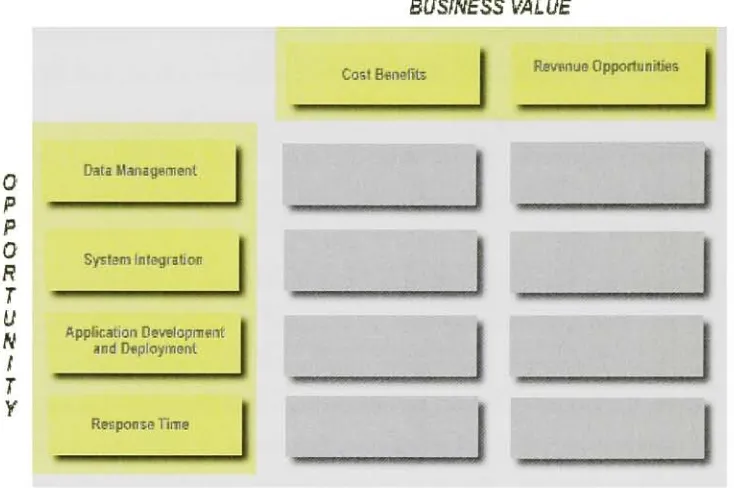
shouldbeconsideredinthebroadercontext ofbusinessFigure 2.1 - The Value Framework
BUSINESS VALUE
Cos1 Benefits RevenueOpportunities
DataManagement
0 R T U N / J Y
SysfsmIntegration
Appfication Development andDeployment
Response Tims
J
While
taking
intoaccountbothrevenue opportunities aswellas costbenefitsrepresents a more completevalueframeworkthanassessingcostbenefitsalone, we acknowledgethat thisframeworkdoesnot addressothercomponents ofbusinessvaluethatcouldbeconsidered. For
example, onecomponentofbusinessvalue thatisnotaddressed
by
thisframework isthevalue ofmaking IT investments tocreatestrategic advantage(Luftman,
Lewis &Oldach,
1993). Notall investmentsin
technology
areintendedtoreducecosts or generateimmediaterevenue. Some are intendedtocreatestrategicadvantagesthatdrive future businessvalue.Furthermore,
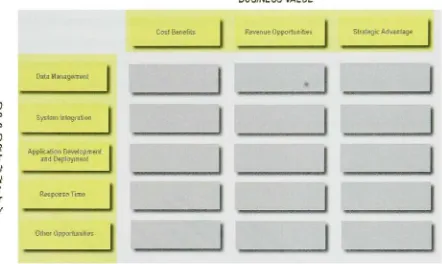
a more completevalue frameworkcouldbepresentedby
addressingmore areas ofopportunity,ofwhichtherearemany.
Therefore,
hefollowing
diagrammayrepresent a more complete valueFigure 2.2
-A MoreComplete ValueFramework
BUSINESS VALUE
0 P P 0 R T U N t T Y
Co&t Benefits RevenueOpportunities SiriitagieAdvantage
Data Management ft 1 1
1
-1
1
System Integration
1
1
1
AppBcatiiin Dw3laprniit 1 andDeployment
Response lime
1
1
1
Otbw Opportunities
Nevertheless,
thescope ofthisthesiswillbelimitedtosearching forcostbenefitsandrevenue opportunitiesintheareas ofdatamanagement,system
integration,
application developmentanddeployment,
and responsetime;
i.e. wewillbe usingthe frameworkasproposedin Figure 2.1.
opportunities.This integrationof value considerations intosoftwareinvestmentdecisions
enables a more comprehensive recognition ofthepotential valuecontributionsofWeb Services
(Boehm&
Guo,
2003).(Atthe timeofthis writing, the eventuallevelof acceptance and adoptionofWeb
Servicestechnologiesremains uncertain.The rate at whichthesetechnologiesareadoptedwill
dependgreatlyon a number offactors
including
thematuration of proposedstandards, theavailabilityof commercialized
tools,
theavailabilityofindividualswithappropriate skilllevels,
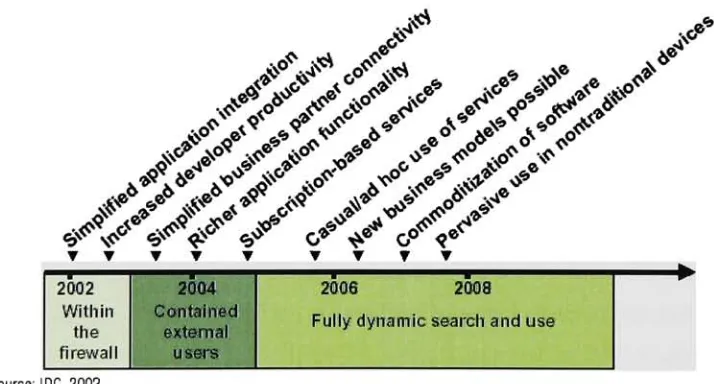
economic conditions and patterns ofITinvestment forenterprisesingeneral. IDChasproposedtheWeb Servicesadoptiontimelinedepictedinfigure2.3 below. Itprojects
that,
giventheconditions whentheIDCreportwas written
(2002),
wewill not see widespread availabilityofWebServices offeringsbefore2005. NotethatIDCdefines "Contained ExternalUsers" as
[image:18.562.119.476.347.539.2]businesspartners, suppliers, or major customers
(IDC,
2002).)
Figure 2.3- Web Services
adoptiontimeline
*A
^
f
?j>s
Y ? ? ? ? ? Y T ?
2002
Within
the
firewall
2004
Contained
external
users
2006 2008
Fullydynamicsearch and use
Source:IDC,2002
The expectedbenefitsofWeb Services described
herein,
andtheassociatedvalue-basedcontributionstothe enterprisearedependenton
broad,
industry-wide acceptanceofWebServicestechnologiesand standards across enterprises. Withthatinmind, the
following
Hypothesis
Business justification for
investing
in Web Servicestechnologiescanbe basedonthe expectationthat these technologieswillcontributebusiness
3 Literature Review
3.1 The RelevanceofValue
Thisthesisfocusesonassessingthevalue ofIT
investments,
andspecificallythevalue ofinvestmentsin Web Servicestechnologies.Thispresumesthatwe candefinevalueas itpertains
toWeb
Services,
andthat thenotion ofvalueis relevanttosuchinvestments.InhisarticleFundamentals of
Value,
Sawhney (2003)
assertsthat the definitionofvalue shouldbeconsideredtobecontextual.Thevalue oftechnology
is notindependentfromthecontextinwhichit isused.Withoutathoroughunderstandingofthebusinesscontextand
implications of a
technology investment,
thereisarisk ofcreatingvaluepropositions thatarenot relevantforcustomers. Whenthebusiness contextiswellunderstood,valuecanbedefined,
created anddeliveredtocustomers. InadditionSawhney
arguesthat thevalueofIT investments shouldbe definednotintermsoffeaturesandfunctionality
butratherintermsof whatitcando forcustomers."Value,"
hesays"is defined
by
those...whopay for it".We definevalue intermsofrevenue opportunities andcostbenefits as showninthe
frameworkofferedin Section 2. This frameworkprovidesthecontextfor
linking
businessvalue(andvaluepropositionsforthecustomer) toIT infrastructures.
Furthermore,
by defining
value inpart as revenue opportunities,webuildonSawhney'sassertionthat(Web
Services)
investmentsshouldbe
directly
linkedto theneeds ofcustomers andthatsuchinvestmentsresultinnew revenueopportunities.Britt,
ofthe IBM Institute for BusinessValue,
says,"Consultantshavelong
proclaimedtheneedforstrategic alignmentbetweenbusiness andIT: Setyourbusiness strategy,andthen
determine how
technology
canhelp.Unfortunately,
traditionalalignment approaches inviteriskandleaveopportunities untapped. Higherreturns canbeachievedthroughahigher degreeof
strategic alignment thefusionofbusinessandIT". Like
Sawhney,
BrittarguesthatIT investmentcanonlycreate valueto theextentthatitis carefullyaligned withthe enterprise's business strategy(Britt,
2002).This focuson value isarecurringthemein many
leading
publicationsfocusing
onbusinessand
technology
leadership. Andcreationof valueis commonly linkedtomakingcertainthateachandevery investmentthatanenterprise makes supportsboththebusinessstrategyof
theenterpriseandcustomer needs. "Valueisnota synonymforprofit",suggests
Moneypenny
is customerdefinedand customer
focused,
butatits coreistheinherent abilitytomeetacustomer need
(Sawhney,
2003).JohnHagelIII andJohn
Seeley
Brownhaveauthored a numberof articles addressingthevalue ofWeb Services insupporting businessobjectives (Hagle &
Brown, 2001; 2002a;
2002b).Most notably,in
Orchestrating
Business Processes-Harnessing
the Value of Web ServicesTechnology, they
describe howIT investmentsinWeb Servicestechnologiescanbe leveragedtodirectly
supportkey
businessprocessestocreate customer value.Theirconclusions are similartoSawhney,
Brittand others: thattechnology
canbea significant enablerinrespondingtobusinessopportunities, andthatITmanagers and organizationsplaya
key
role inenablingenterprisestorealize economic value fromWeb Servicesinvestments.
John Hagleprovidesthemost comprehensivetreatment todate ofthebusiness impactof
Web Services in his book Out oftheBox(2002a). Hagle specificallyaddresses strategies for
achievingprofitsthroughWebServices as well asenablingopportunitiesfor futuregrowth. He
arguesthatWeb Services
technology
willplaya major role in creatinganddelivering
business valueby
addressingthreebusiness/technicalchallengesfacing
enterprisestoday:"Distribution of centers of
control"
-As business processesbecomemore
complex, andthenumberofbusinesspartners
increases,
theassumptionof a single point of controlbecomesincreasingly
unrealistic."Diversity
oftechnology
platforms" - Given
the
decreasing
existenceofsingle points ofcontrol, thereis agrowing
diversity
oftechnology
platformsthatmustbeconnectedintheprocess ofassemblingbusinesscapabilitiesto
deliverproducts and services.
"Dynamicenvironment"
-According
toHagle,
business conditions arechangingatan ever
increasing
pace and enterprises needtobeabletoquicklyservicesgrid, a conceptthatistargeted towardenablingfuturegrowth as opposedtocapturing
immediaterevenues and profits.
Hagel'sdiscussionoftheimmediateopportunitiesforcapturingvalue
(profits)
throughthepragmatic adoption ofWeb Servicestechnologies
directly
supportsthehypothesisofthisthesis.Hepresents thepathtaken
by
earlyadopters such asDellaswellastheirmotivation andtheresults thathave beenachieved. Hagelprovides extensive support for hisargumentthatearly
implementations ofWeb Services shouldfocuson
leveraging
existingtechnology infrastructure,
incrementalimplementation,
tangible earlysuccesses, andextensibilityovertime.Barry
Boehmisaleading
proponent ofavalue-based perspectiveonsoftwareengineering.
According
toBoehm,
whilemany ITprojectsare implementedsuccessfully, thevaluederived islessthanexpectedbecausebusiness objectives were
incorrectly
anticipated(Boehm, 2003),
(Boehm&Sullivan, 2000),
(Boehm &Guo,
2003).Again,
valuegenerationis dependenton an alignment oftechnical strategyandinvestmentwithbusiness objectivesandcustomer needs.
IDC,
workingwithIBMCorporation,
publishedawhitepaperentitledIBMandthe Strategic Potential of Web Services:Assessing
the Customer Experience. TheirfindingssupporttheimportanceofconsideringvaluegenerationwithrespecttoITinvestments.
They
foundthat"theuse ofWebservices enhancesbusinessvalue
by
reducingthe timeandcosttolaunchapplications ... potentially,
increasing
revenue"
(IDC,
2003b).3.2 TheAlignmentofITInvestmentswithBusiness Strategy
Toalargeextent, this thesisattemptstoestablisha connectionbetween Web Services
technology
andvalue creationfortheenterprise.Britt,
oftheIBM Institute for BusinessValue,
underscorestheimportanceofaligning businessobjectives (value creation)andIT investmentinMultiplying
Business Value: The Fusion ofBusinessandTechnology
(2002). Luftman et al.(1993)
provide furtherevidenceoftheimportance ofthisalignmentinTransforming
the Enterprise: The Alignment ofBusinessandInformationTechnology
Strategies.3.3 The GrowingImportanceofWeb ServicesandService-Oriented Architectures
Whilethefull impactofWeb Services cannot yetbeassessed, ITorganizationsare
taking
hardware,
software andintegrationspendingonWeb Services isincreasing
(IDC,
2003a).Furthermore,
there is evidencethatmajor players intheIT domainaretaking
Web Servicesseriously. For example, IBM lists nofewerthan
forty
emergingWeb Servicestechnologies ontheirdeveloperWorks
web site,
including
severalimplementationsofSOAP andUDDI.They
providetoolkitsfor generating WSDLandforevaluatingtheperformance ofWeb Service
implementations.
Many
ofthe technologies listedareintendedtohelp
earlyadopters ofWebServicetechnologies to create,
define,
discoverandintegrate services. Inaddition,IBMresearchershaverecognizedtheoverarchingsignificance of
SOA,
andthatthepotential importanceofWeb Servicesgoesfar beyondtheindividualcapabilities. In hisarticle entitledThe Tao ofeBusinessServices: The Evolution of Web Applications Into Service-Oriented
Componentswith Web
Services,
Burbeck(2002)
clearlyarticulatestheimportanceofapproaching Web Services fromthearchitectural perspective.
Otherpublicationshave movedbeyondtheinitialhype ofWeb Servicestechnologies to
emphasizetheimportanceofthose technologiesin creatingvaluefortheenterprise.
Among
themare(Hagel&
Brown, 2001), (IDC, 2003b),
and(Hagel,
2002b).In (Hagel &
Brown,
2002a)
theauthors focus ontheeconomic propositionsdriving
theimplementationofWeb
Services,
providingadescriptionofhowthepragmatic implementationofWeb Servicestechnologiescanadd valueto the enterprise. Moschella
(2003)
documentsthoseaspects ofITinfrastructurethatcanimprove customerfocus.HagelandBrown
(2001)
describetheissuesaddressed
by
WebServices and proposethebasis fora strategic approachtointroducing
Web Services into ITorganizations.The March 2003 issue of ACM'
s Queue Magazineprovides adetailedexamination of Web Services andtheopportunities
they
present. Inthisissue,
Arsanjani,
et al. lookattheW3C isresponsibleforthedevelopment of common protocolsthatpromotetheevolution
oftheWeband ensureits interoperability.
XML,
SOAPandWSDLaredescribedintheworkproducts oftheW3C (www.w3c.org).
AdditionalbackgroundmaterialforWeb Services isfound in
(Barry,
2002).Barry
provides ahigh leveldescriptionofthe technologiesandissuesin ordertoprepare organizations
fortheimplementationofWeb Services.
Barry
suggests thatWeb Services aregoingto"fundamentally
changethewaywebuild ourinternalsystems-theinformationsystemsthat
support our organizations
-andhowourinternalsystems interactwith external systems".An additional resource usedtocompilebackgroundmaterialfor Web Services is
(Newcomer,
2002).Burbank'sarticle describestheimportantarchitectural conceptsbehind Web
Services,
anddescribesthemasthebasisof a new set oforganizingprincipleswithinthe enterprise(2002). Burbeckmakestheimportant observationthat the termSOAshouldbereservedfor
"architecturesthatfocusonhowservices aredescribedand organizedtosupporttheir
dynamic,
automated
discovery
and use".Withrespectto
SOA,
HagleandBrownagainhavebeen instrumental indescribing
theneedfor
thinking
ofWeb Services intermsoftheevolutionofITarchitectures. Intheir publicationService Grids: TheMissing
Linkin WebServices,
they
assertthatadistributedservicesarchitecture is necessary before Web Services
technology
canbe widelydeployed. The IBM Systems Journalarticle,"IntroductiontoWebServicesArchitecture"provides bothanintroductiontoimportantarchitectural concepts relatedtoWeb
Services,
aswellasexamples ofbusinessscenariostowhichthe technologiescanbeapplied(Gottschalket al.).
Placing
theWeb Servicetechnologies inthecontextof a specificbusiness situation provides a higherlevel ofclarityandunderstandingofpossibleapplications(Gottschalk, Graham,
Kreger&Snell,
2002).3.5 AreasofOpportunityforImplementing Web Services
3. 5. 1 Data Management
The issuesrelatedtodatamanagementin IT organizations are
described
by
Applegateetal. in(Applegate, McFarlan,
&McKenney, 1996), (Applegate,
McFarlan,
&forITinformationarchitectures. Thesedatamanagementissues continuetoberelevant
regardless oftheIT technologies andinfrastructures inplace. Web Servicesmaydrivethe next wave of architectural principles withinthe enterprise,butexisting
legacy
datarepositoriesinplace mustbecarefullyconsidered whencreating SOAusingthesenew technologies.
The datamanagement analysis relies
heavily
onCoyle(2002). Thistextprovides a comprehensivedescriptionofthedatamanagementissuesfacing
largerenterprisesand howXMLandWeb Serviceswilladdressthem. Inadditiontothese text references, anumber of
industry
reports and opinions from IDC(2003a),
Forrester(2002a),
and Gartner(2003)
have beenused.3.5.2 SystemIntegration
Linthicumdocumentsmanyoftheintegrationchallengesfaced
by
ITmanagersare discussed
including
disparatelegacy
systems, heterogeneous hardwarearchitectures,operatingsystems, networking
technology
andproprietaryapplications anddataformats(1999).
The primaryissuespertainingto
legacy
software aredescribedby
LehmanandBelady
(1985),
andSeacord,
PlakoshandLewis (2003). Thesetexts characterizetheunique challengesofmanagingandupgrading
legacy
systems withoutdisrupting
the operation ofthe enterprise.3.5.3 Application DevelopmentandDeployment
IDC assertsthatWebServiceswill
directly
impacta number ofkey
application development areas including:business functionswillbemore accessible, andthatdependencies onunderlying
technologieswillbereduced(2003b).
In
Investing
inInformation Technology:Productivity
Payoffsfor U.S.Industries,
Stiroh(2001)
underscores theimportanceofinvesting
in informationtechnology
to improveproductivity. Heconcludesthat theacceleration oflaborproductivitygrowthin theU.S. isadirectresult ofITinvestment.3.5.4 Response Time
Many
ofthepublications cited aboveidentify
one ofthekey
benefits ofWeb ServicesandSOA astheabilitytorespond morerapidlyto emerging,unanticipatedcustomerneeds.Thecore assertionisthat thestrategic valueofWebServices ismore
thananimprovement intechnology.
Rather,
itisadvancementinthewaysinwhich informationtechnology
can supportbusinessobjectives,andhowa strategicadvantagecanbeestablishedintheprocess.
Luftman,
et al.(1993)
characterizethetransforming
impactofinformationtechnology
such asWeb Services inthefollowing
way: "Thegoal ofservingthewidest rangeofcustomerneedsinthemost cost-effective and responsivewayrepresentsa shift tonew competitivestrategies."
TheimplicationofWebServices deploymentisthatmass
customization of productandserviceofferingsis enabled
by
theexistence of servicesthat canberapidlyorganizedtomeetdynamiccustomerneedsquicklywith minimumexpense. SifonisandFlynn
(2001)
arguethatthevalue ofWebServicesis intheoptions thatarecreatedandtheconsequentabilitytorespondtocustomer needs more quicklythanthecompetition.
Britt
(2002)
refersto this synergy betweenenablinginformationtechnologiesandevolvingcustomer needsasthe creationof valuethrough the "fusionofbusinessand
technology".
Hagel
(2002a)
again providesinsight intotheissueofenablingenterprisestorespondquicklytoemergingopportunities.Hisdiscussionoftheservices gridis helpful inunderstandingoneway inwhich enterprisesmaypreparetocapturefuturerevenues
4 Background
4.1 WebServicesemergence
Thisthesisassertsthatbusinessvalue will resultfromthe implementationofWeb Services. Thatvalue willbeenabled
by
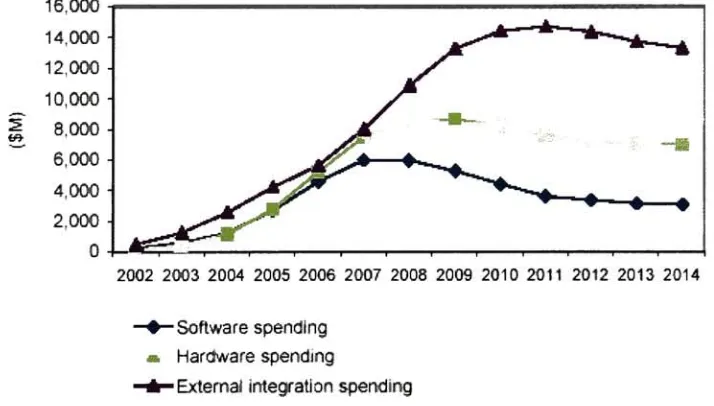
a number ofexistingandemergingtechnologies andstandards.Figure 4.1 indicates thatenterprises areindeedmakingsubstantial investments inWeb Services hardwareand software. IDC defines software, hardwareand externalintegration
spending inthe
following
way. "Softwareincludesallspendingonanytype of softwareforthe purpose oftheproject. Hardware spendingis likewise definedas spendingonphysicalinfrastructuretosupportthe project,andsystemintegration (professional services) spending is
spendingonexternal consultants of allkindstoimplementtheproject"
[image:27.563.100.457.377.580.2](IDC,
2003a).Figure 4.1 - U.S. Web Servicesproject
spending
by
ITsegment, 2002-20142002 2003 2004 2005 2006 2007 2008 2009 2010 2011 2012 2013 2014
?Softwarespending
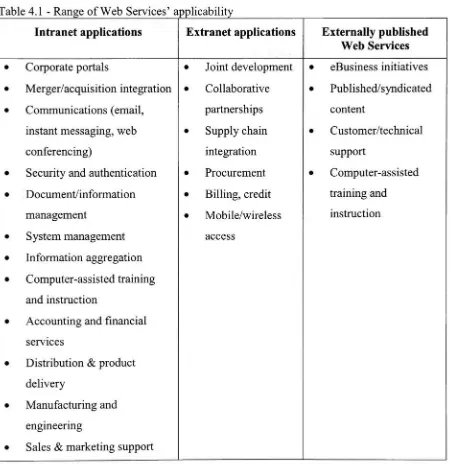
Table 4. 1 presents example applicationsthatpotentiallywillbenefit fromIT
[image:28.562.58.508.108.580.2]infrastructures thatincorporateWeb Services.
Table 4.1 - Range
ofWebServices' applicability
Intranetapplications Extranetapplications
Externally
published WebServicesCorporateportals Joint development eBusiness initiatives
Merger/acquisitionintegration Collaborative Published/syndicated
Communications
(email,
partnerships contentinstantmessaging,web
Supply
chain Customer/technicalconferencing) integration support
Security
andauthentication Procurement Computer-assistedDocument/information
Billing,
credittraining
and management Mobile/wireless instructionSystemmanagement access
Informationaggregation
Computer-assisted
training
andinstruction
Accounting
andfinancialservices
Distribution&product
delivery
Manufacturing
andengineering
Sales & marketingsupport
The
key
torealizingthefullpotential istorecognize thatWeb Servicespresents astandards-based approachto
integrating
existing systems,applications such asthoselistedabove, anddata. Itisnotnecessarilyaboutimplementing
new systemsfromthegroundup,butrathertaking
advantage oflegacy
dataandcapabilities inwaysthatallowthosecapabilitiestobeInthepast, data
integration
has beenanespeciallydifficultchallenge.Theuse ofXMLand other
industry
standardtechnologiesprovidesaframework foruniversaldataintegration. The standards upon whichWeb Servicesis basedattacktheproblem ofdataexchange andinteroperability
whilepreservingplatform independence. In addition,XML-based messagingmakesitpossibletodeliverapplicationindependent data inrealtime. Thiswill enabletherapid introductionof new servicesthatmayhave otherwisehavetakenyears to
develop
because ofthe labor-intensivenature ofdeveloping
andtesting
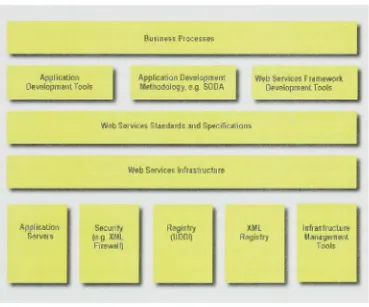
newinterfaces.WebServices is implemented inthecontextof aSOA.A SOAiscomposed of
loosely
coupled collections ofservices,often organized aroundbusinesscapabilitiesratherthan technical functions. Figure 4.2illustratesthehigh-levelcomponents of a
SOA'
[image:29.563.111.480.305.612.2](Hagel &
Brown,
2002b).Figure 4.2- SOAcomponents
Business Processes
Application Development Toote
Appfcation Development Methodology,e.g.SODA
WebService's Framework Development loots
WebSeivices StandardsandSpecifications
mmmmmmmmmmmmm
J
WebServices Infrastructure
Application
Servers (e.g.SecurityXML
Firewall)
Registry
(UDOFj
XML
Registry
Inlrashuctiire Management
The
following
sections provide abrief descriptionofthecoreWeb Servicestechnologies.4.2 XML
Extensible
Markup
Language(XML)
isthecatalystdriving
theadoption ofWebServices.XMLallowsdatatobe definedinawaythatseparatesinformationaboutcontentfrom informationabout presentation.This approach addressestheprimaryflawofHypertext
Markup
Language
(HTML),
whichcombinesdataand presentationinto a singlemarkuplanguage(Newcomer,
2002).ThesignificantimpactofXMLis not rootedintheexpectationthatalldataeverywhere
willbestoredin XML
format,
butratherthatgiven a standards-baseddatatransformation capability,legacy
datafromexistingrepositories canbemade availabletoXML-enabledapplications. Thetransformationisrequiredonlyonce.Middlewareapplications often require
multipledatatransformations
depending
onthecontextwithin whichthedatawouldbeused(Coyle,
2002).Withwelldesignedschemas andsemanticallyuseful
tags,
XMLenables applications toeasily
identify
and extractonlythose dataelementsthatareusefulinthe current context regardlessofwherethedataoriginated andinwhatformat itwas stored(Coyle,
2002).4.3 SOAP
SOAP
(originally
an acronymfor Simple Object AccessProtocol)
is anXML-basedprotocolallowing applications tocommunicate overtheInternet. SOAP isthecommunication protocolof choice formostWebService applicationsandframeworksandhasbeenproposedto theInternet
Engineering
Task Force(IETF)
asa standard.SOAPis XML-based. One oftheobstaclestoapplication
interoperability
hasbeentheinability
ofapplicationsdeveloperstoagree onthebestmethodfor exchanging informationabout services andobjectsand
doing
soinawaythatisplatformindependent. SOAPdefines for componentdevelopershowtouseXMLandHTTPtoexchangesuchinformation. AndsinceHTTP isubiquitous,andXMLis
becoming
so,itprovides agluebetween dissimilarcomponents4.4 UDDI
Universal
Description, Discovery
andIntegration(UDDI)
isanXML-baseddirectory
facility
thatallows service providers toadvertisetheircapabilitiestoapplications searchingforservices
(Newcomer,
2002).Initially,
itwasthought thatUDDIwould provide a grandopportunity foreBusinessdirectoriesthatwould actasthebasisofthe "frictionlesseconomy",
providingrapididentificationandinvocationofWeb Servicesacrossthe Internet.
Now,
themore pragmatic role forUDDI istobethecornerstone of services orientedITinfrastructures. This evolution supportsthenotion ofinitialWebServices adoptionoccurring
withintheenterprise.
Finally,
UDDIprovides scalabilityandflexibility,
twokey
characteristics inmeetingtherapidly changingneeds of applications developers inaservice-orientedenvironment.
4.5 WSDL
Web Services Description Language
(WSDL)
isanXML-basedfacility
usedtodescribeaWeb Service'scapabilitiesindependentofthecommunication protocol usedtoaccessthose
services. Itspecifies notonlywhat services areavailable,butalso howWSDLworksin
conjunction withUDDItoprovide comprehensiveinformationaboutthecapabilities of available
WebServices ontheInternet (or
Intranet) (Burbeck,
2002).Ina
SOA,
WSDLmeetstheneedforanXML-based,
protocolindependentmechanismfor easilypublishing,andupdating, servicesina standardformat.PotentialusersofWeb
Servicesadvertisedinthisyellow pages-likefashioncaneasily
identify
and compare availableservices anddeterminewhichmaybebest fora particular application. Forconsumers ofWeb
Services,
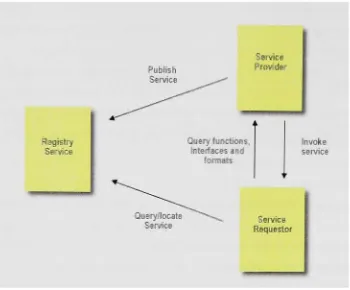
dynamic serviceidentificationand update are simplifiedby
eliminatingdetailsof access protocols and message encoding. Figure4.3 summarizesthecoreWeb ServicesFigure 4.3 - Core Web Services
operations
Registry Servic*
Publreh Service
Service Provider
QueryFunctions, Interfacesand
formats
Invoke
service
Query/locate
Service Seivice
Requestor
4.6 Applicablestandards
The existence of proposedstandards,specificationsandmethodologiesthatprovidethe
basis foraWeb Services framework is instrumentalto
increasing
thelikelihoodthatapplicationswillmeet
interoperability
expectations. Whileprogress isbeing
made, thestandardsunderlyingWeb Servicesare stillevolving, and sothereis stillthepotentialforvendor specific
implementationandfragmentationthatcould underminetheprimary objective, indeedthe
promise ofWeb
Services,
ofenablingatruly
interoperable frameworkofdisparateinformation
producers and consumers(Gottschalketal.,2002).
Inadditionto thosestandards mentionedabove,Extensible Stylesheet
Language
(XSL)
iscritical toenablingthedevelopmentofWeb Servicesapplications. XSLprovidesconsistent
grammars for
defining
thewaysinwhichdataistransformed(Newcomer,
2002).4.7 Applicationframeworks
Thedistinctionbetween Web Servicesapplications andWeb
Services
frameworks isServicesapplications are developedwithinthecontext of a framework.
They
are softwareapplications,products or servicesthatmakedataandprocessingcapabilityavailableto other
applications. Theseapplications canbeconsideredindependent
building
blocks advertisingand providingservices or capabilities toother applications on anetwork. Theseapplications canbecombinedinvirtually
limitless
combinationstoprovide end users a unique informationproductor service. AWeb Services
framework,
ontheotherhand,
consists ofstandards, specificationsand methodologies for
building
such interoperableapplications. J2EEand.NETaretwooftheleading
applicationframeworks fordeveloping
Web Servicesapplications. These frameworks5
Methodology
5.1 Approach
5.1.1 Theframework
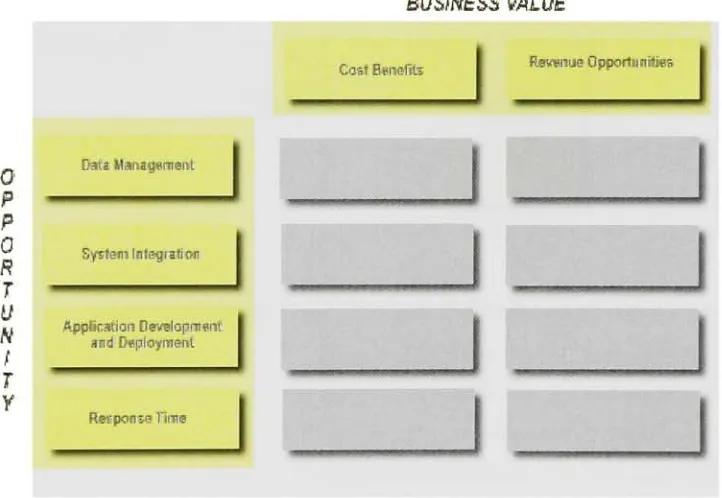
As mentionedabove, the
following
diagramdescribestheframeworkwithin which wewillevaluatethepotential valuecontributions ofWeb Services.Figure 5.1-The Value Framework
BUSINESS VALUE
CostBenefits Revenue Opportunities
0 p p 0 R T U
rV / T Y
Data Management
System Integrator!
ApplicationDevelopment
andDeployment
ResponseTime
^))IJll^Jl.milMMl)iiWI| mfijmnifmmmmmiwiuamwviuvm
5.1.2
Identifying
value within theframeworkForeach oftheabovefour identifiedareasofopportunity
-datamanagement,
system
integration,
applicationdevelopmentanddeployment,
and responsetime - the benefits ofWeb Services implementations willbeestablishedby
showing howsuch implementationsresultinoneorbothofthe following:Cost benefits intheformofincreased efficiencyintheuse ofIT resources
[image:34.562.121.482.279.528.2]Revenueopportunitiesthatare realized as a result of
implementing
WebServices technologies
5.1.2.1 CostBenefits
Costefficiencies can resultfrom lowercapital
investments,
lowerongoingsupportcosts, or reducedlaborcosts. Whilecost efficienciesalone areinsufficient toestablish a comprehensive valueframeworkwithin whichtomakeinvestment
decisions,
suchdecisions are oftendriven inpartby
theexpectationthatcostefficiencieswillresult(Boehm &
Guo,
2003). InvestmentsinITtechnologies such asWeb Servicesare no exception. Inthis thesiswe willidentify
anddescribe thecost efficienciesresultingfromtheadoption ofWeb Servicestechnologies.Costbenefits foreach ofthefourareas ofopportunityare summarizedin
tableformat in sections
6.1.2, 6.2.2,
6.3.2and6.4.2.5.1.2.2 RevenueOpportunities
Revenueopportunitiesresulting fromimplementationofWebServices
technologiesare manifestedinatleasttwoforms.
First,
by delivering
productsand services inthe targetmarkets where afirmalreadycompetesmaygenerate
new revenues.Theseproducts and servicesmay be ofbetter qualityor contain enhanced
functionality,
butthey
largely
representdelivery
of productstoexisting customersusing (and extending) existing businessprocesses.Second,
new revenue opportunities are affordedfirmsthathavetheabilitytorespondtoemergingbusinessopportunities. This isespeciallytruewiththose firmswhosebusinessmodels are
heavily
dependent onrapidly changing5.1.3 Opportunities
Theverticalaxis ofthisframeworkidentifies fourareas ofopportunitytobe
examinedin detailwith respecttoWeb Services implementation.
They
are: Data managementSystem integration
Application development & deployment
Response time
These fourare selectedbecause
they
representimportantvalue driversofcompetitive advantagefor firms intoday's markets,regardless oftheproductorservice
they
mayprovide.5.1.3.1 Data Management
Data Managementis selectedas onedimensionofthevalueframework
because lackof
industry
standardsandlackofenterprise-widedata definitionshaveresultedinpervasiveinefficiencies. Improvements in Data Management
techniqueshavethepotentialtoreturn valueto theenterpriseboth intheformof
reducedcostsaswellasrevenue opportunities.
5.1.3.2 SystemIntegration
Web Services maybeviewedas anadvanceinsystemintegration.The
value isrealized when
they
areintegratedwith otherservices ina uniquewaytoprovideasolutiontosolveaspecificbusinessproblem. SystemIntegration has
beenselectedas adimensionwithinthevalue frameworkbecauseofthehistorical
5.1.3.3 ApplicationDevelopment&Deployment
Applicationdevelopment anddeployment
has
traditionally
beenslowandinefficient
as newITtechnology
isintroduced,
consumingsignificantresources intheprocess.
Reducing
theresourcesrequiredtodevelop
anddeploy
newapplications represents a significantopportunity forenterprises.
5.1.3.4Response Time
Thevalue ofITadvancements is oftenderivednotfromthe
technology
butratherfromthebusinesspossibilitiesthatresult
(Masud,
2002). With WebServicesenterprises canfocusonassemblingservices and solutionsfroma
technology
agnosticviewpoint,worrying onlyabouttheorchestrationthatmakesitpossible. Forthis reason,responsetime
(or,
thereductionthereof) is selected as [image:37.563.117.541.374.710.2]thelastdimensionofthevalueframework.
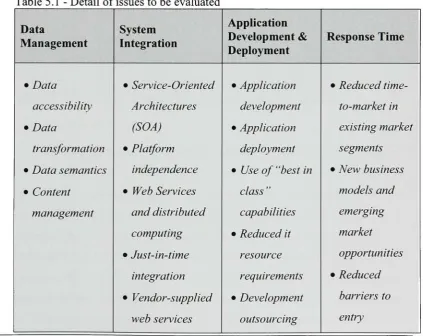
Table 5.1 describesinmoredetailtheopportunities thatmakeupthe
frameworkwithin whichthisthesiswillproceed.
Table 5.1 - Detail
ofissuestobe evaluated
Data
Management
System
Integration
Application
Development &
Deployment
Response Time
Data Service-Oriented Application Reduced
time-accessibility Architectures development to-marketin
Data
(SOA)
Application existingmarkettransformation Platform deployment segments
Datasemantics independence Use of "bestin New business
Data
Management
System
Integration
Application
Development&
Deployment
Response Time
frameworks
Web Services
management
Legacy
systemsService
aggregation
withinthe
enterprise
Leveraging
existing
intellectual
assets
Integration of
mergers and
acquisitions
Responseto
regulatory
requirements
Compliance
with vertical
andhorizontal
industry
standards
Focuson
business
6 Analysis
6.1 Datamanagement
Enterpriseshave been facedwithcomplexdatamanagementissues for decades. Lackof
industry
standards andlackofenterprise-widedata definitions haveresultedinpervasiveinefficiencies.
Changing
existingdatamanagementpractices,however,
canhave significantcostimplications andwide-rangingimpacts across an enterprise.
Therefore,
suchinvestmentsare notmadewithouta clearunderstandingofthepotentialbenefitstoberealized.
Withrespecttodatamanagement, the expectedbenefitsof
investing
inWeb Servicestechnologies,
especiallytheuse ofXML,
include improved dataexchange,reduced maintenancecosts and reduceddevelopmenttime. The
following
sectionprovidesadetailedanalysis ofhowthesebenefitsand others applicabletodatamanagementwillberealized
by
investing
inWebServicestechnologies.
Forthepurpose ofthis analysis,datamanagementhasbeen further broken down intothe
following
sub-categories:Data accessibility
Datatransformation
Data semantics
Content management
6.1.1 Technicalanalysis
6.1.1.1 Background
Enterpriseshavebeen expandingandevolvingtheapproachto
building
multiplelocationsresultedinredundancy,
inconsistency,
andultimately highermaintenance costs andhadtobemanagedcarefullyacrosstheenterprise
(Applegate etal.,
1996;
2002).Furthermore,
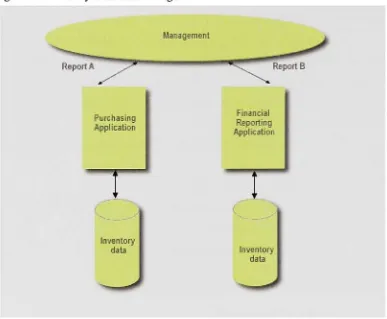
reports generatedby
applicationsusingdata from dedicatedrepositories could resultin inconsistent reportingas
[image:40.562.124.511.183.502.2]shownbelow.
Figure 6.1 - Files systems datastorage
Management
Purchasing Application
Financial Reporting Application
Inventory data
Theapproachtostorage ofthis data graduallyevolvedfrom file-based
systemstoDatabase Management Systems (DBMS). DBMS tookonmany
functionssuchasdataentry,updateandmanagementthatwere
formerly
performed
by
aspecialized applicationorset ofapplications.DBMS vendorsprovided productsthathandledtheserolesand published alimitedset of
functionality
throughanApplicationProgramming
Interface (API). Thismadethedatamoreindependent from theapplicationsrequiringaccess.The
interface
between applicationsand
DBMS, however,
remainedtightly integrated
andhighly
Database systemsfurtherevolvedfrom
hierarchical,
to relational, toobject-orienteddatabase systems(Applegate etal., 1996). Thecommonthread
withusing DBMSto storedata isthatforeach functionalapplicationthatneedsto
accessthedatarepository, a specialized and ofteninflexible interface mustbe
implemented
as shownbelow. The interfaces definedby
individualvendors can [image:41.563.122.487.197.570.2]vary widely fromDBMS toDBMS.
Figure 6.2- DBMS data
storage
Management
Report A
Purchasing
Application
Financial
Reporting
Application
DBMS API
DBMS API
DBMS
1
Inventory
contain an
inappropriate
level ofdetail foreachfunctionalapplication.Rather,
each application must accept records ofinformationthathave beengeneralizedto
meetthedemandsof multipleapplications, andparsethedata
looking
for onlythepertinent information itrequires.
Further,
each application must adapttheformat [image:42.562.117.509.275.634.2]ofthedatatoa
format,
ortype,
appropriateforuseinthecurrentcontext.Figure 6.3 showsacentralizedenterprisedata repositorythateliminates
theredundancyandinconsistenciespossiblewith multipledatarepositories,but
retainsthe
tightly
integratednature oftheinterfacebetweenapplications andtherepository (Applegate &
Bock,
1995).Figure 6.3 - Corporatedatabase
systems
Subsequentmigrationfrom hierarchical DMBS torelational and
repositorytosupportbusinessprocesses,but has done littletoalleviatethe
problems associated withthe
tightly
integrated
interfaces betweenapplications anddatarepositories. Changes inunderlyingdatarepositoriesultimatelyresultin application maintenance (Applegate etal.,1996)
(Applegate &Bock,
1995).There is evidencethatWeb ServicesandXMLwillpositively impact Data Managementwithin theenterprise.The primaryreasonforthisisthearchitectural
advantages ofseparating
data,
and servicesthatprovide accesstoit,
fromtheapplications thatconsumethat
data,
reducingtheinterdependenciesthathavetraditionally
drivenupdevelopmentand maintenance costsforITorganizations.6.1.1.2 Data accessibility
Web Serviceswillpositively impact dataaccessibility ina numberof ways.
First,
massivelegacy
datarepositorieswillcontinuetoexist wellintotheforeseeable future. Largevolumes ofbusiness datareside,and will always reside,
on
legacy
systems such as mainframe computers.Thecost ofmovingthisdata will prohibit rewrite ofmany largescale systems thatmanagetheselegacy
data repositories(Peng
etal., 1998).These
legacy
repositories canbemade availabletoWebServiceswithintheenterprise
by
"wrapping"them in Web Servicestechnologies,
andadvertisingtheirabilitytoprovide certaintypes ofdatausing SOAPthroughaWSDLdefined interface(Gottschalketal.,2002).
Tightly
integratedlegacy
applications cancontinuetoaccessdatathrough traditional
APIs,
while new applications can accessthedatathrough themore flexible WebServices interface. As Web Services applications and services gainacceptance,andproprietary APIs arefunctionalsilos withintheenterprise.Forexample, the serviceorganization
maintains one set ofdataregardinga particularcustomer, andthefinance
organization maintainsdataaboutthesamecustomer, but ina separateDBMS.
Thisdata isoften redundantand,intheworstcase,inconsistent. Organizational
turfwars and politicalissuesaside, wrappingdatarepositories in Web Services
technologiescan extenddata accessibilityacrossthesefunctional siloswithinthe
enterprise (Gottschalketal.,2002).
Consequently,
a customer servicerepresentative canhavea complete and consistent set ofpertinent customerdata
infront ofthemwhencommunicatingwith acustomer,andboththespeed and
qualityof customer engagements canimprove.
Providing
ahigh qualitycustomerexperience is
key
toremainingcompetitivewhencustomerscanchoose frommany firms fora productorservice.
Improveddata accessibilityviaWeb Servicescanalsopositively impact
theabilityof anenterprise torespondquicklytonewbusinessopportunities inthe
following
way.As new combinationsofdataandfunctionality
becomeavailableto WebServices applications, opportunitiestoadd valueinunique waysemerge.
Forexample, imagine afirm specializing in publishingscientific educational
content. The firm hastwo
divisions,
onethatpublishescontentintheformoftraditionalperfect
bound,
paperback volumes.Theother, to date hasfocusedonpublishingcontent,predominantlyvideoand audiocontent, onCDROM. After
eachdivisionhasmadetheirinformationassetsavailableusing Webservice
technologies,
theopportunityarisestocreate a3r
division. Thisdivisioncould
accesstheinformationassetsoftheothertwo inordertocreate aweb-based
scientific
learning
centerthatcombinestext,
audio and video assets availablefromtheothertwodivisions. Takenonestep
further,
theweb-basedlearning
centercouldallowsubscribersto tailor theirinstructionto their own optimal
leaning
style
by
selectingthecontentthatbestsuitsthem.Inthis example, a newapplicationthatconsumesdatamade availablethroughWeb Services
technologies(inparticular
SOAP)
can focus on"what"
data is available,rather
than"how"togetit. BrandnewAPIs allowing access
information
assets ina newwhen and whereinformation isdeliveredcanbean advantageforenterprisesin
highly
competitive markets.Similaropportunities areavailable within
enterprises'
IT infrastructures.
For example,employee portals are
becoming
integral indisseminating
informationthroughout theworkforce oflargeenterprises. Theinformation
distributedoften comesfromavarietyof organizations.Anemployee portal will
have
breaking
news aboutthe enterprise,linkstobenefitsinformation,
jobopportunities, companydirectoriesandresources, and ahostof other pertinent
data foremployees. Accessto the
information,
ifmade availablethroughWebServices interfacescanbeaccessed more easily,andthelikelihoodthatthe
information isuptodate and accurate is higher. Inthissense employee portals are
anintranetinformationaggregation applicationthatcantakeadvantage of service
providers withintheenterprise.
Thisphenomenonisthemost powerfullatent opportunitypresentinthe
adoption ofWeb Services. In Out oftheBoxHagel
(2002a)
defines then-squaredproblem as theexponentially
increasing
complexityofintegration activityasthenumber of nodestobe integrated increases. Wecanapplythisnotionto the
positiveimpactofmaking datamore accessible
by
arguingthat thereis ann-squaredopportunity,
i.e.,
that thenumberofvalue propositionsthatcanbeconstructedinresponsetocustomer needs increases asthenumber of nodeswith
uniquedatatocontributeto the solutionincreases.
Improvements in data accessibilitycanhaveanother,more subtle effect on
customerfocus. Asmore and more data becomes accessibleto applications,
redundancies willbecome more apparent.
Emerging
applicationsaccessingdataparticular piece ofdata.
Using
UDDIandWSDL,
multipleservices canbe locatedandcompared, andthebestmatch selectedforintegration.
6.1.1.3 Data transformation
Enterpriseswill, forvaryingreasons,continuetostore data inon vendor
specific platforms innativeformatsthatare application specific.
Wrapping
datainWebServicestechnologiesas describedaboveisone ofmanytransformation
stepsthatmayoccur asdataisprocessedinthecontextofindividualapplications
(Gottschalketal.,2002).
Thesetransformationsteps are made possible
by
themultitude oftools andtechnologiesavailablefor
transforming
XMLdatastreamsinto otherformatsthatare either morewidelyacceptedor, formatsthatareapplication specific. The
existence ofDTDsand/orSchemaforaparticularXMLdatastreammakes it
possibletoautomatetransformationsfrom XMLtoanyotherdesired
format,
using XSLT. Inthis way, applicationscantransformXMLdataintoapplication
specific formatswithoutsignificantprogrammingefforts.
Thesetransformationstepsare not newinthe ITdomain. Systems have
always requiredthatdata be inaformthatcanbeunderstood andprocessedinthe
context ofthecurrentapplication. Whatisnewisthat
they
canbe automatedusingtechnologieslike XSLTsothattransformationenginesdonot needtobe built fromtheground up.
Furthermore,
whileinitial Web Servicesimplementationswill replicatedatatransformationprocesses withinthecontext of aservice, it is
likely
thatwiththegrowingsophistication ofWebServicesinfrastructures,
datatransformationengineswill reside onthenetwork and offertransformationservices formultiple applicationsand services across the
enterprise
(Forrester,
2002a). Withthepotentialexistence ofdatatransformationengines in a
SOA,
notonlyis data liberated fromtheapplicationsthatuseit,
(Coyle,
2002)
dataisalso liberated fromtheengines usedto transformit.Further,
transformationfromnativeDBMS formatto XML has become easieras morevendors providetheabilitytoexportXMLdata directly. DBMSvendors suchasOracleallow structured querylanguage
(SQL)
commandsthatdatatransformation isactuallyencapsulatedintheoff-the-shelfproduct,
eliminatingtheneedforaseparatetransformationengine. Thistrendisnot limited
tolargesuppliers ofenterprise solutions. For example,
MySQL,
thedatabasesolution made available undertheGNUGeneral Public License
(GPL)
providessimilar capability. Theexistence oftransformationcapabilityinDBMS reduces
theneedforenterprises toexpendITresourcesto
develop
transformationengines.6.1.1.4Datasemantics
Today,
mostCIO'srecognizethatXMLisnot a completesolutionto theproblem ofdataexchangeacrosstheenterprise. It
does,
however,
playasignificant role in establishingsharedmeaningacrosstheenterprise. XMLtags
can
help
inidentifying information,
but interpretationof whatis betweenthe tagsstill requires commonunderstandingtobeestablished(Hagel&
Brown,
2001).Forexample, theXMLtags<name> and </name> leaveopentointerpretation
whether or notthecontentbetweenthem isfirstname, last name,orpossibly
both.
Making
thewrongassumption aboutthecontents withinthetags couldpotentiallyresultincommunicationstoa customerthatbeginswith, "Dear
William H.
Jones",
which,while notincorrect,
isnot aspleasingas "DearWilliam"
or"Dear Mr.
Jones"
andmayhave aninfluenceonthecustomer's
perception.
Having
saidthat,
XMLismorethanjustanewwaytomarkup data. Thedegreeofindependenceofdatain XMLformat isrevolutionary. DatainXMLis
independentof rendering. Itis independentoftransportmechanisms. It is
independentofprogramminglanguages andhardware/softwareplatforms,and
Initially,
thedefinitionofXMLvocabularieshasfocusedonvertical industriessuch asfinance, banking,
scienceandtechnology.Butthesameopportunities exist withintheenterprise. JustastheOpen Financial Exchange
(OFX,
2003)
ismeanttoestablish aninterfacewithbrokerageclientstodownload financialdata intotheirlocal applications such asQuickenorTurboTax,
aninternally
definedvocabularycanallowlaborcostdata,
forexample, tobeexchangedbetweentwoorganizations within an enterprise seekingtoproject
costsfora project onwhich
they
willbecollaborating.Vocabulariescanbe definedthataccommodate adiverse set ofusers ofdataacrosstheenterprise. Andonceasharedvocabularyhasbeenestablishedthatcontainstheappropriate
data,
attheappropriatelevelofdetail,
multiple applicationscan storeand processdata withinthecontext oftheirlocalapplication and exchangedatawith others withminimaltransformation.
Let's saythatmultiple organizations within an enterprisehaveestablished
adefinition foradataelement called"customer"thatmeetstheirlocalapplication requirements.The customer serviceorganization,leftto theirowndevices has
requirementsthatwoulddrivethem todefine"customer"
inthe
following
way:<customer>
<name></name> <address></address> <phone></phone> <email></email> </customer>
Asecondorganization, accounting, withinthesame enterprise mayrequire boththecompanynameaswell as acontactname forthis customer sothat the
customers'
companyname canbeplacedoninvoices. Thisorganization would describethecustomerdataelementinthisway:
<customer>
<company_name></company_name>
<contact_name></contact_name>
<address></address>
<phone></phone>
<email></email>
Athird organization, sales, mayrequire an additional levelofdetail inthe
contact name. Firstandlastnamemaybeuseful forthisorganizationsothat
they
can personalizetheircommunicationstoindividuals. This organization would
definethecustomerdata inthe
following
way:<customer>
<first_name></first_name>
<last_name></last_name>
<address></address>
<phone></phone>
<email></email>
</customer>
Giventhese threedefinitions of a customerdataelement, it ispossibleto
defineavocabularythatcontains a single customerdataelementthat
accommodates allthreeapplications. Thedefinitionofthecustomerdataelement
thatwould accommodate allthreeorganizations'
requirements wouldlook like
this:
<customer>
<company_name></company_name>
<first_name></first_name>
<last_name></last_name>
<address></address>
<phone></phone>
<email></email>
</customer>
Thepoint ofthisillustration is thatinorderto realizethefullpotential of
using Web Serviceswithinthe enterprise,agreeduponvocabularies mustbe
definedjustas
they
mustbe defined forspecific applications across enterprisesjustasis
being
donewith vertical andhorizontal standards.Oncethesevocabularies existtheincentivetocreate independent datarepositorieswithdata
maintainingthedata. Inthepast,dataelements wouldhavebeenreplicatedwith
varyinglevels of
detail,
inrepositories ondifferentplatforms.One organizationwould store customerdataelementsina network-accessibleOracle
DBMS,
anotherin anAccess
database
on alocal server. Withtheconvergenceofdatarepositories anddataelementdefinitionsthroughstandardizedvocabularies and
XML,
redundant maintenancetasks canbeeliminated.Avoiding
maintenancecosts contributesto thecompetitiveness oftheenterprise.
6.1.1.5 Contentmanagement
Contentmanagementisaspecialized caseofdatamanagementthathas
significantimplicationstoenterprise-wide efficiencyand operation. Enterprises
have digitalassetsthatare often usedformultiple purposes. Forexample, a
product or servicedescriptionmayberenderedina
brochure,
ontheWebandonproductpackaging.Ratherthan
developing
andmaintainingthree separate assetsbasedontheir
destination,
a singledigitalasset canbe developedanddeliveredtoanyapplicationrequiringthatcontent. Enterprise-widecontent managementis
increasingly
importantas companies findmore and more channelsfordelivering
product information. XMLandWeb Services canplaya significantrole in
improving
content managementeffectivenesswithintheenterprise.XMLdata may beplaintext,formatted
documents,
messages,images,
numeric
data,
oranyoneofthewide varietiesofdigitalrepresentations fordatawehave devisedto
date,
or willdevise inthefuture. Forexample,productimages,
descriptions andspecifications are renderedin marketing collaterals, onthe company'swebsite,andincatalogs. Contentmanagement systemsbasedon
XMLallowenterprisestouse a singlesourceforcontentthatcanbe
"re-purposed"
depending
onthedestination. ProductdescriptionscanbetaggedinXML format for flexibleaccess,maintained ina single
location,
anddeliveredtoFigure 6.4 - Contentmanagementsystems
Enterprise Website
Content Creators e.g.productmarketing
Product descriptions, Images,logos. Specifications,
etc.
WebService Interface
I
Enterprise Portals
Content Management
System
Contentmanagement systemsbasedonXMLandWebServicesallow
enterprisestomanage digitalassets in awaythatnotonlyimprovesaccessibility
and eliminates redundanciesbutalso reducesthe likelihoodofinconsistent
messagesbothinsideand outside oftheenterprise. Contentassets developed
independentoftargetdestinationsand propagated sothatexact same message is
deliveredno matter whatthecontext.Thisapproach enables more effective
6.1.2 Benefits summary
Thepositiveimpact ofWeb Servicesondatamanagementismanifestedinthe
formof costbenefitsas well as added value intheform ofnew revenueopportunities.
The
following
tableprovides asummaryofthecostbenefitsassociated with [image:52.562.68.530.194.670.2]implementing
Web Serviceswithinthedomain ofData Management.Table 6. 1.1
-Costbenefits todatamanagement
Cost Benefits
Identified Benefit Explanation ofBenefit
Legacy
datarepositoriescanbemadeaccessibletoa widevarietyof applications
by
"wrapping"theminWebServicestechnology.
Costsof
integrating
datasourcesthroughproprietary APIscanbeavoidedwhendata
repositories are wrapped in Web Services.
Improved data accessibilitycanenhancethe
speed andqualityofcustomer service.
Speeding
accesstopertinent datacan reducethecost of
delivering
productsand services.An underlyingprocess of natural selection
willmaketheproducer ofthehighest
qualitydataa preferred source.
Maintaining
fewersources with similardataiscosteffective, reducingmaintenance costs
especially.
Transformationofdata intoapplication
specificformatscanoccurautomatically
usingreadilyavailable
industry
standardtools.
Costsof
implementing
proprietarydatatransformationengines canbeavoidedin
some cases.
By delivering
XML documents basedonSQLqueries,vendors areproviding
transformationcapabilities.
Costsof
implementing
proprietary datatransformationengines canbeavoidedin
some cases.
Converging
oncommon vocabulariesandeliminatingredundantrepository
implementationscan reducemaintenance.
Costsassociated withmaintenanceof multiple
Cost Benefits
Identified Benefit Explanation ofBenefit
XML-based
data
repositoriesinaSOAprovidethebasis forenterprise-wide
content management.
Treating
digitalcontentascorporate assetsandmanagingthoseassetsefficientlycan
reduce redundancies and maintenance and
associated costs.
The