SOME METHODOLOGICAL ISSUES IN DEVELOPING A TEST OF GENERAL ABILITY FOR THE ARMY
Anthony James cotton
Thesis submitted in complete fulfilment of the requirements for the degree of Master of Science at the Australian National University
May 1992
l
Declaration
I declare that this thesis reports my original work, and that no part of it has been previously accepted or presented for the award of a degree or diploma by any university. To the best of my knowledge, no material previously published or written by another person is included except where due acknowledgement is given .
i i
Acknowledgements
I would like to thank the following individuals for the parts they played in the completion of this thesis. Doctor Don Byrne who, as my supervisor, was prepared to take me on as a student at the ANU. My principal advisers for the thesis, Professor Reg Marsh and Doctor Richard Bell who provided me with excellent guidance in both the writing of the thesis and in dealing with the experimental and methodological issues that arose during the course of the work. Naturally any errors are entirely my own responsibility.
I would also like to thank Colonel Wal Hall, the Director of Psychology - Army, who provided me with valuable support and
encouragement, particularly in the initial stages; and my
Commanding Officer, Lieutenant Colonel Ron Furry without whose continuing support the thesis would not have been completed. Finally, I would like to thank my wife Leanne who has been extremely supportive and understanding throughout~
...
1.1.1.Abstract
The aim of this study was to investigate the model of
intelligence and the test theory used in the actual development of a test of general ability. It was hypothesised that a three factor model of intelligence, comprising verbal, numeric, and spatial
abilities, would provide as good a fit to the data as a similar model including fluid intelligence. It was also hypothesised that a test based on Classical Test Theory (CTT) and one based on Item Response Theory (IRT), although having different item compositions, would perform similarly in predicting scores on an existing general ability test. It was further hypothesised that, for the IRT based test, examinees' number right score would provide an adequate
approximation of the formal IRT ability estimates.
A 52 item test was administered to a sample (N=209) to
investigate the factor structure and to develop the IRT and CTT tests. A factor analysis of the items and a reliability analysis of the scales showed good support for the three factor model of intelligence over the four factor model. Two twenty item tests
were then developed from this item set and administered to a second sample (N=371). These results showed strong support for both
hypotheses, namely, there was little difference between the CTT and IRT based tests in the amount of criterion variance they predicted; and number right scores and IRT ability estimates showed extremely high correlations.
TABLE OF CONTENTS
Declaration
Acknowledgements
Abstract
1 INTRODUCTION
1.1 General Entry Selection
1.1.1 1.1.2
Recruit Training
Allocation to Initial Trade Training
1.2 The Importance of Psychological Testing 1.3 The Current Problem
1.4 Chapter Summary
2 MODELS OF INTELLIGENCE
2.1 The Cognitive Paradigm
2,,2
2.3
2.1.1 2.1.2 2.1.3
Sternberg's Triarchic Theory Carroll's Theory
Application of the cognitive Approach to the Current Problem
Psychometric Models
2.2.1 Spearman's Model
2.2.2 The Work of Burt and Vernon
2.2.3 Thurstone's Primary Mental Abilities 2.2e4 Guilford's Structure of Intellect Model 2.2,,5 Fluid and Crystallised Intelligence
2.2.6 Common Methodological Problems 2.2.,7 A Unifying Model
2.2.8 Selecting a Model 2.209 Testing the Model Chapter Summary
3 TEST THEORY
3.0.1 3.0.2
Selecting Items Scoring the Test
3.1 Classical Test Theory
3.1.1 3.1.2 3.1.3
The Basic Assumptions of Classical Test Theory
The Methodology of Classical Test Theory Limitations of Classical Test Theory
3.1.4 Benefits of Classical Test Theory 3.2 Item Response Theory
3.2.1 3.2.2 3.2.3 3.2.4 3.2.5 Dimensionality
Local Independence Item Response Models
The Methodology of Item Response Theory Limitations of Item Response Theory
3.3 Comparing the Models 3.4 Chapter Summary
4 METHOD
4.1 The Instrument 4.2 Analyses
4.3 Sample
5 RESULTS
6
5.1 Sample
5.2 First Phase of the Research 5.2.1
5.2.2 5.2.3 5.2.4
Factor Structure of the Item Set CTT Analysis
IRT Analysis
Supplementary Analyses 5.3 Second Phase of the Research
5.3.1 5.3.2
Regression Analysis Supplementary Analyses 5.4 Chapter Summary
DISCUSSION
6.1 Study Findings
6.1.1 The Model of Intelligence 6.1.2 Test Theory
6.2 Implications of the Findings
6.2.1 Models of Intelligence 6.2.2 Test Theory
6.2.3 Latent Traits versus True Scores 6.3 Improvements to the Study
I:
6.4 contributions of the study 96
References 98
Annex A. Unique Variances - Different Factor Models 112
Annex B. Classical Test Theory Item statistics - TO 114
Annex C. Item Response Theory Item Parameter Estimates - TO 116
Annex D. T1 Item-Model Fit stastistics: Two Parameter and 120
Rasch Models
Annex E. Item Parameter Estimates for both Samples
Annex F. Details of NOHARM Analysis
Annex G. A Note of Reliabilities
121
125
130
Figure 2-1:
Figure 5-1:
Figure 5-2:
Figure 5-3:
Figure 5-4:
II·
List of Figures
Vernon's (1950) Hierarchical Model of Abilities
Plot of Item p-values TO versus T1
Plot of Item Reliabilities TO versus T1
Plot of Item Difficulty Parameters TO versus T1
Plot of Item Discrimination Parameters TO versus T1
[image:8.796.24.779.26.1069.2]Table 5-1:
Table 5-2:
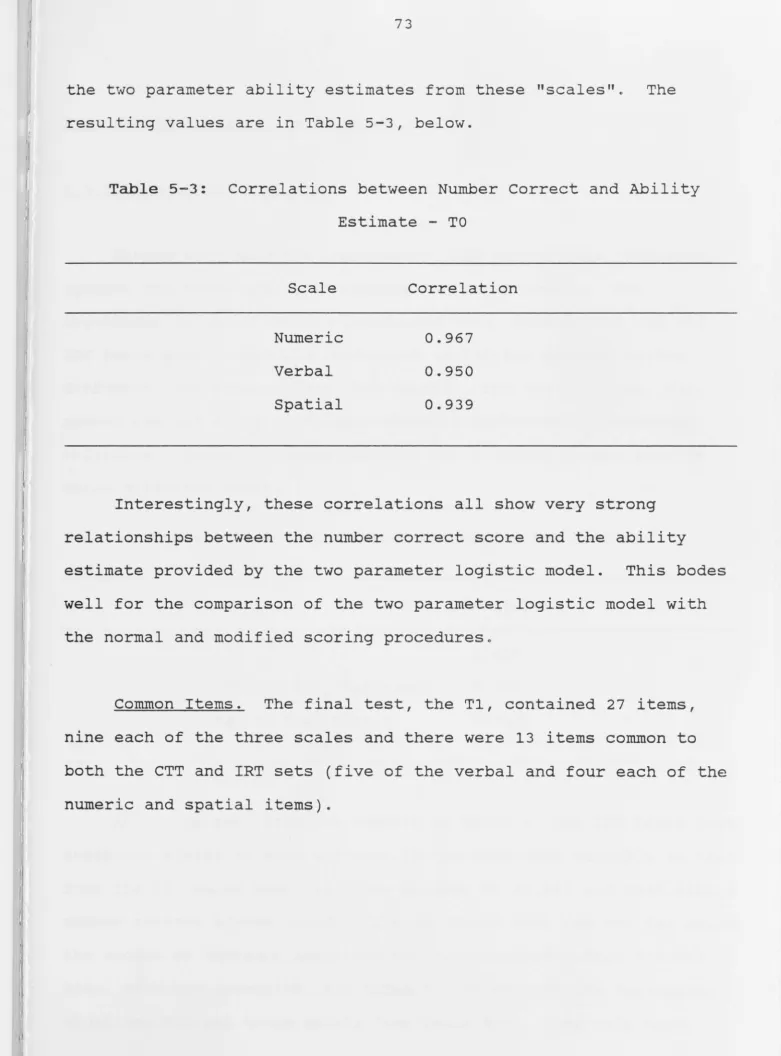
Table 5-3:
Table 5-4:
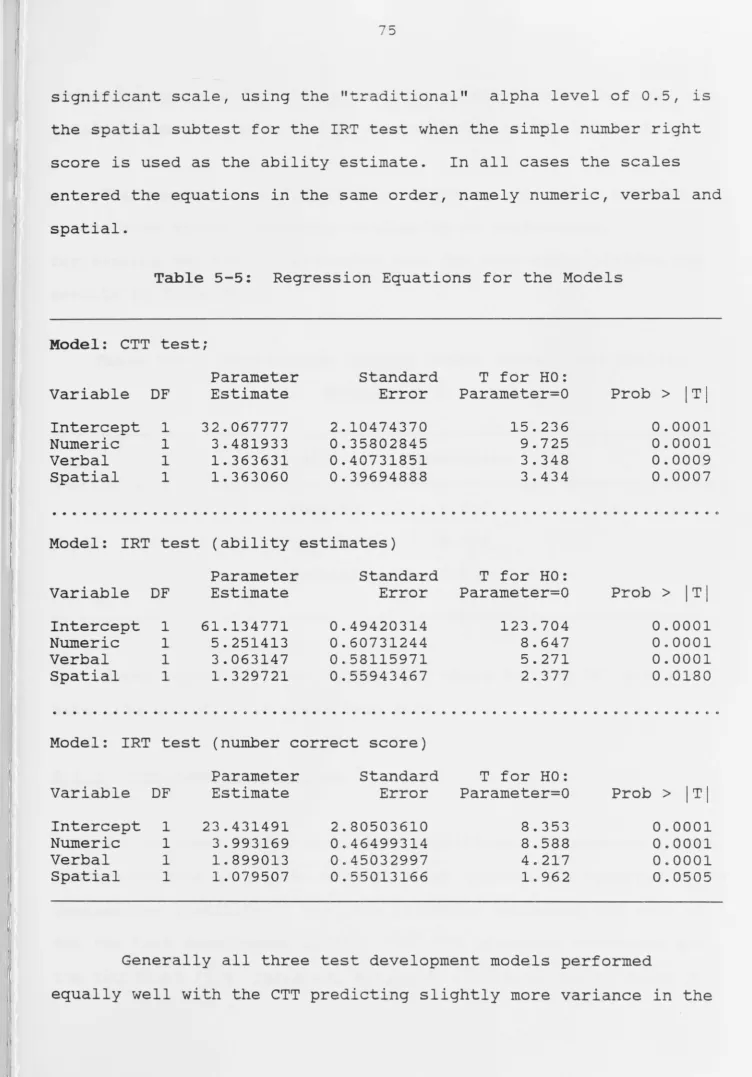
Table 5-5:
Table 5-6:
I."
List of Tables
RMSR Values
Reliabilities for Three and Four Factor Models
Correlations between Number Correct and Ability Estimate - TO
R-square Values for Regression Analyses
Regression Equations for the Models
Correlations between Number Correct and Ability Estimate - Tl
[image:9.796.24.773.31.1079.2]CHAPTER 1
INTRODUCTION
The Australian Army Psychology Corps is one of the largest organisations of psychologists in Australia, employing nearly 50 psychologists and a similar number of clerical and administrative staff. The Corps has a number of roles and one of the principal ones is to act as the "quality control" for the Army's recruiting efforts screening in excess of 15,000 people per annum for the
various avenues of entry to the Australian Regular Army (ARA). The role of the screening is twofold; first to identify those candidates who lack the necessary traits to complete initial training; and
secondly, to provide adequate information for the future training and allocation of the individual.
The selection procedures for the different avenues of entry to the Army have a common foundation, that is:
a. some measure of general ability,
b. some measure of ability or aptitude that is specific to the avenue of entry,
c. some measure of personality or coping ability,
d. an interview with an Army psychologist, and
-2
e. a final screening process where the examinee is considered in competition with those others applying for the same entry.
There are three types of entrant to the Army; General Entry (GE) applicants, Officer and Apprentice applicants. GEs provide by far the bulk of Army entrants with about 6,000 tested each year.
1.1 General Entry Selection
I
Applicants for general entry to the Army must be between 17 and 34 years of age when they enlist and must otherwise be literateenough to complete the application form. This is a straightforward document requiring the applicant to provide information about
family history, nationality, basic employment and education historYe
After making initial contact with an Army recruiter the
individual will complete and submit an application form and will be given a date to present for "testing" where he or she will undergo further screening for entry to the Army.
On the test day the examinee will go through the following process (in the order specified):
a. a preliminary medical screening;
b. a psychometric test battery consisting of a 14 item test of written comprehension called the Recruiting Office Form 1
-3
(R01), a 100 item test of general ability called the Army
General Classification Test (AGC) and a 52 item anxiety
checklist called the Self Descriptive Inventory (SDI), all of
which have all been developed specifically for the Army;
c. a structured interview with an Army psychologist which covers
family history, education, employment history, motivation, and
expectations for recruit training;
d. a complete medical examination; and
e. an interview with the Enlistment Officer which covers similar
ground to what the psychologist investigates and also addresses
drug use, criminal record, etc.
All of the information is collated by the Enlistment Officer
who has the final say on the individual's success or otherwise on
the day. The successful examinee will be enlisted at some later
stage (normally two to six weeks depending on c i rcumstances).
1.1.1 Recruit Training
Recruit training involves an intensive 13 week training course
covering topics ranging from physical fitness, to navigation to
elements of military law. As well as completing these studies, the
recruit spends considerable time (often hours per day) preparing and
maintaining his or her equipment and uniforms.
Recruit training places considerable other pressures on the
recruit. In particular the socialisation process the recruit
undergoes and the generally dangerous training undertaken, for example rifle shooting, grenade practise, and gas training. The recruit training environment requires a great deal of the recruits' personal resources, over and above their cognitive abilities.
1.1.2 Allocation to Initial Trade Training
Further psychometric testing is conducted during recruit training which involves tests of arithmetic and mathematical
achievement, clerical aptitude and mechanical comprehension. The results of these tests are combined with the recruit's initial testing to provide a psychometric profile which is fundamental to the allocation of the recruit to initial employment traininge
Immediately on completion of recruit training the soldier will commence Initial Employment Training (IET)e Employments available for lET range from Medical Assistant and Rifleman, which have few
prerequisites for allocation in terms of cognitive ability, through
to Electronics Technician which requires a high level of general ability and mathematics ability.
1.2 The Importance of Psychological Testing
The initial psychological testing serves two purposes: i t is
used to screen the individual for an complex selection/rejection
5
process, and i t is used for allocating those selected to a very broad range of employments. Finally, i t must also be able to
provide valid information and stand up to scrutiny at indeterminate points in the future.
Two important points need to be considered; first, while there is a cognitive component in recruit training, the bulk of the
stressors are essentially non-cognitive, the communal living, the discipline, the physical requirements. Secondly, the Army enlists large numbers of individuals and only those who are considered
manifestly unsuitable are screened out (e.g. the bottom 5-6% based on performance on the AGC, among other criteria).
Thus, on the surface of it, the screening instrument need only provide a measure of the individual's functioning level at the
particular cut point chosen to maximise its effectiveness. In this
case at the very lower end of the scale. Certainly there can be
only limited predictive value in a test of cognitive ability when the bulk of the stressors for the recruit are non-cognitive. More may be gained by making the test highly accurate around the cutting point rather than providing a reasonable level of information across a more broad range of ability.
This would make the task of the initial test o~ general ability seem, on the surface, fairly easy because the test would only need to provide discrimination at the lower end of the ability spectrum.
Unfortunately the test also needs to be able to identify potentially
successful candidates for intensive and lengthy vocational courses
6
(electronics trade as an example). Thus the test needs considerably more versatility than i t would seem on first appearances.
The Current Instrument. The current instrument used by the
Army for the selection and allocation of general entry soldiers is a 100 item spiral omnibus format test of general ability, the Army
~ Ilf General Classification test (AGC). This test was purpose built for
the Army and has been in use for about 30 years, but until 1987 was only used for allocating recruits and their future career
management. In 1987 i t was introduced for selection as well.
II'
1.3 The Current Problem
Due to changes in the availability of another test used by AA Psych Corps, the AGC was reviewed in 1989. This highlighted the age of the instrument and some other limitations of the test and the
testing procedure (e.g. the time taken to administer the test, the fact that only a single general ability score was available, etc).
It was decided that the test was lacking in face validity and that i t should be replaced.
This decision led to a set of test guide-lines being developed
by the Directorate of Psychology - Army, the salient features of these were that:
7
b. the test should be stable and not dated over 10-20 years if
possible;
c. the test should be free of (unspecified) bias; and
d. the test should take advantage of the current test development
and administration technologYe
These guidelines raised a number of issues for the development
of the test. The first was an organisational constraint that the
test must be able to discriminate between different abilities, this
dictates much of the form of the construction of the test. Also the
I
.
,: construction of the test is necessarily constrained, seriously, bythe other three requirements as they are fundamental to the design
of any test. These organisational constraints highlighted the two
aspects that are fundamental to any test design project, namely the
model of ability that provides the foundation of the test and the
test development methodology to be used in constructing the test.
These would have to be investigated as part of the test development
process.
1.4 Chapter Summary
The Army tests a broad range of individuals for entry to the
Army. The results of this testing is not only used for selecting
individuals, i t is also critical in the allocation of soldiers and
I"
B
A review of the existing sel ection test found that i t lacked
face validity and needed to be replaced. Test guide-lines were
developed and these indicated that i t was necessary to investigate both the model of ability on which the new test would be based and the test development methodology which was to be used in the
development of the test.
...
9
CHAPTER 2
MODELS OF INTELLIGENCE
Intelligence, along with personality, is one of the most
written about topics in psychology. The list of individuals who
have written in the field reads like a "Who's Who" of psychology;
Spearman, Thurstone, Terman, Cattell, Eysenck, Wechsler, Burt,
Vernon; the list seems endless. Unfortunately, with so many
researchers working in the field, one tends to get a range of
theories proliferating, not to mention a range of definitions of
intelligence.
There are many definitions of intelligence and they cover a
wide range of approaches from the totally operational definition of
Boring (1929) that intelligence is whatever is measured by
intelligence tests, to "physiological" definitions concerning the
connections of the synapses in the brain, to "biological"
definitions that describe intelligence in terms of its impact on
the organism's ability to adapt to its environment, to
psychological definitions that refer to the types of thought
processes that comprise "intelligent behaviour" (usually abstract
thinking). Many different approaches have been taken to the study
of intelligence over the years; the developmental approach of Binet
and Piaget, the psychometric approach, the "neo-behaviourist"
approach (Butcher, 1968), and the recent componential approach of
the cognitive scientists.
10
Despite the proliferation of theories, there are two main
paradigms in intelligence today; these are the
information-processing (or cognitive) theories of people like Sternberg (1985),
Jensen (1982), and Pellegrino and Kail (1982), and the
"traditional" psychometric approach of people like Thurstone
(1938), Guilford (1967), Cattell (1971), and Horn (1988).
2.1 The cognitive Paradigm
The cognitive approach to intelligence can be seen as largely
the result of the enormous growth in cognitive psychology in recent
years. Although relatively recent, the origins of this approach
date back to some of the earliest work done in the area of
measuring human differences, namely that of Francis Galton in the
latter half of the 19th Century. Indeed, Spearman's early work
took as much cognizance of "Sensory Discrimination" as i t did of
academic performance (Spearman, 1904).
The early researchers in the experimental psychology field
were primarily concerned with measuring individuals on basic
sensory discriminations, e.g. using visual and auditory stimuli,
and tactile stimuli such as telling the distance between two pin
pricks on one's finger. Using these procedures the L~pothesis
developed, particularly among psychologists with some physiological
training, that there was " ... a general cognitive capacity probably
dependant upon the number, complexity of connections and
organization of nerve-cells in the cerebral cortex." (Butcher,
1968, pIS).
~
11
Although the early work was strongly physiological in nature,
the approach today is an area of cognitive science. The cognitive
theorist is interested in understanding the mental "processes" that
occur during "intell'igent behaviour" and the theories in the field
concentrate on the components or rules, that are used in solving
cognitive tasks.
The concept of an "information-processing component" is
fundamental to the cognitive approach. An information-processing
component is a cognitive operation or function that is a building
block of intelligent behaviour. Generally components include
memory functions, information acquisition processes (perception)
and information-processing processes.
Components have been used for the development of tests (smith,
1986; Irvine, Dann and Anderson, 1990), for the analysis of
existing tests (Carpenter, Just and Shell, 1990), the analysis of
general intelligence (Hunt, 1982; Detterman, 1987; Sternberg and
Gardner, 1982; Detterman, 1982) and the analysis of the factors of
intelligence (Maybery, 1990; Pellegrino and Kail, 1982).
There are many theories of cognition, some dealing with
specific' cognitive tasks, e.g. Pel'~grino and Glaser's theory of
inductive reasoning (Pellegrino
&
Glaser, 1980, 1982), while othersdeal with more general cognitive aspects of intelligence. Two of
the more influential writers in the field are Sternberg and Carroll
who have both contributed significantly to the work in the area,
particularly in the area of general theories of human cognition.
12
2.1.1 Sternberg's Triarchic Theory
Sternberg's (1985) theory is perhaps the best-known of the
cognitive theories. It is based on three basic components of
intelligence (or cognition), hence the term "triarchic", these are:
the "meta-components", the "performance components", and the
"knowledge acquisition components".
Meta-components. These are the higher level components that
are responsible for the planning and monitoring of intelligent
behaviour. They are responsible for a range of tasks that include:
deciding the nature of the task at hand, selecting the lower order
components required to complete the task, selecting a mental
representation for the information, and monitoring the solution of
the problem.
Performance Components. These are the lower order components
referred to above that act on the instructions of the
meta-components. While there are some general performance components,
e.g. encoding the nature of the stimulus, most are specific to the
task.
Knowledge Acquisition Components. These are the components
required for acquiring information and storing i t in memory.
Sternberg (1985) cites three as the "most important" for
intelligence, these are: selective encoding, selective combination,
and selective comparison. Generally these components act together
J'
13
in a highly interactive way which makes them difficult to analyse separately.
sternberg (1980) defines four ways in which these components can interact: direct activation of one by another, indirect
activation of one by another through the action of a third, direct feedback from one to another, and indirect feedback from one to
another again through the action of a third component. All control in the system rests with the meta-components which are the only
type of components that are able to receive feedback from their own type.
2.1.2 Carroll's Theory
Carroll's theory differs from that of Sternberg in that the former is more specific about the components of intelligence where Sternberg takes a broader view of his components.
After investigating a number of the major tests available Carroll (1981), identified a set of ten information-processsing
components. These were:
a. Monitor - during a task, this process drives the operation of the other processes.
'r--I
14
c. Apprehension - this is the registering of a stimulus.
d. Perceptual Integration - this is the process of integrating the perception of the stimulus and comparing i t with previous representations.
e. Encoding - this is the forming of an internal representation of the stimulus.
f. Comparison - this is used to ascertain whether two stimuli are the same or similar.
Ii
g. Co-representation Formation - this is used to form a newrepresentation, related to a pre-existing representation.
h. Co-representation Retrieval - this is the process of finding, in memory, a representation related to another representation.
i. Transformation - this is used to change a r epresentation based
on some specified rule.
j. Response Execution - this is the process of producing a
response, either overt or covert, to a mental representation.
Carroll (1981) states that these cover all of the basic
processes involved in a range of cognitive processes and these
'I components can be used to form the basis of a componential task
performance.
I'
15
2.1.3 Application of the Cognitive Approach to the Current Problem
According to Sternberg (1985) the cognitive approach is
interested in mental processes whereas the psychometric approach is
interested in mental structure. The cognitive psychologist is
interested in how a task is performed, and is less interested in
how people differ on their performance on the task, unless i t aids
the understanding of the underlying process.
Despite this, the cognitive approach has been applied to the
study of individual differences. Snow (1979) identified four areas
of information-processing where individuals may differG He
labelled these: parameter differences, or differences on the
components used; sequence differences, or differences in the order
in which the same components are executed; route differences where
different sequences of components are used; and strategic
differences.
Sternberg (1977) suggested six areas where individuals differ: the components they use, their rules for combining components, the
order of component processing, the mode of component execution, the
time taken to execute a component, and the mental representation on
which the component acts. Both of these examine indiv~~ual
differences on the components of information-processing, but the
fundamental aim is to aid the understanding of cognition rather
than the differentiation of individuals.
~
'::"6
Another consideration in t he application of the cognitive
approach to the study of individual differences is the types of
tasks involved. Due to the requirement to measure response latency
as well as response accuracy, the tasks used in the cognitive
approach are more effectively presented in an interactive computer
environment. In fact the recent growth in availability of this
type of equipment is in part responsible for the recent upsurge in
work in this area.
Although there have been cases where a cognitive analysis of
the types of tasks found in traditional pencil-and-paper tests have
been conducted, these are necessarily post hoc analyses (Carpenter,
Just and Shell, 1990). There have been attempts to apply the
principles of the cognitive approach to pencil-and-paper tests but
they are few and far between (Irvine, Dann, and Anderson, 1990;
Smith, 1990).
The information-processing approach is inappropriate for
the present Army project for two reasons:
a. Cognitive theorists are primarily concerned with identifying
the fundamental components of "intelligence" and as yet have
focussed little attention on using their techniques for
differentiating between individ~~~ls. Some progress in this
area has been made, the work of Irvine, Dann, and Anderson
(1990) for the British Army is one example, but they are, as
yet, few.
~
17
b. As stated above the techniques and tasks are much more suited
for computer administration, involving such things as
measuring latencies, real time pattern matching, etc. The
current project called basically for the replacement of a
pencil-and-paper test with another pencil-and-paper test.
There was no provision for the acquisition of the equipment
necessary to really take advantage of this approach.
This is not to say that the information-processing approach is
without merit, on the contrary i t is continually making advances in
the understanding of how humans process information and behave
cognitively. The current problem for the Army, however, is to
differentiate between individuals and (generally) try to predict a
pattern of human behaviour, i.e. successful completion of recruit
training. This is a task for which the psychometric approach
provides a much more appropriate foundation.
2.2 Psychometric Models
The psychometric approach is the traditional approach to
intelligence and can be seen as being characterised by two things:
first, the use of "higher" order tasks such as analogies, series
etc rather than the simple perceptual or cognitive tasks used by
the cognitive theorists; and secondly, the use of correlational
techniques (in particular factor analysis) developed by Galton
(1888), Pearson (1900), and Spearman (1904b) and extended by Burt
(1940), and Thurstone (1947).
18
Like the cognitive approach, the psychometric area has, as a
result of the number of different individuals working in the field,
developed a wide range of theories to account for the structure of
intelligence in humans. One of the major divisions in the many
models proposed is between those that allow a general intelligence
factor and those that don't (Gustafsson, 1984). These two schools
of thought have also been called the British and American schools
because of their location and the whole controversy was initiated
as a result of the work "of Spearman (1904a).
2.2.1 Spearman's Model
Spearman (1904a) was the first researcher to propose a
general factor in human intelligence. His work was, in many ways,
a reaction to what he perceived as the failure of experimental
psychologists to find a connection between the laboratory and real
life. He felt that this was due to the poor experimental methods
of the researchers at the time. Generally he felt that there was a
lack of problem definition, a general failure to take into account
experimental error, and poor understanding and use of correlation
techniques. After providing solutions to these problems Spearman
examined performance on sensory discrimination tasks, a variety of
academic subjects, and ratings of intellectual ability in an
attempt to identify the source of individual differences of
intelligence. In this study he found an almost perfect
relationship between "general discrimination" and "general
intelligence" and went on to claim that there existed a general
factor which was common to all areas of intellectual activity.
...
19
This general factor of Spearman's, labelled "g", can be seen
as representing an individual's "mental energy" (Carroll, 1991,
p558), and is present in all intelligence tests along with a factor
labelled "s" which represents that component that is specific to
that test alone. This became known as Speaman's "Two Factor
Theory" of intelligence. Spearman also developed the "tetrad
difference" (Spearman, 1904b) method of analysing a matrix of
correlations to demonstrate that g and s are the only significant
factors.
After Spearman much of the work that included a general factor
of intelligence was conducted by British psychologists, ln
.
particular Sir Cyril Burt and P.E. Vernon.
2.2.2 The Work of Burt and Vernon
While Burt (1940) generally supported Spearman's two factor
theory, he divided the general or common factor (as he called it)
into universal and group factors, the latter common to "a certain
group of traits" (pl03). The specific factors he divided into
singular (relating to a single trait) and accidental (relating to a
particular testing occasion) factors. Burt considered the
combination of these four types of factors as a " ... fundamental
logical postulate ... " (pl03), expressing i t as a mathematical
equation.
.... 0
Burt's model was supported empirically by his discovery much
earlier (Burt, 1909) of evidence of a sensory discrimination group
factor in addition to g. Later Burt (1939) was to provide fairly
strong evidence for the existence of verbal and numeric group
factors in the abilities of school age children. Although the
general factor accounted for more variance than the group factors
combined, their contribution was none-the-Iess significant.
Although Vernon (1950) supported Spearman's concept of general
intelligence, he felt that Spearman had neglected the existence of
group factors. This was because the sample sizes employed by
Spearman were too small for the residual correlations between the
tests and the general factor to be statistically significant. As
Vernon (1950) states, n • • • lack of statistical significance does not
disprove the existence of additional factors; i t only fails to
prove it. n ( p 14).
Vernon had empirical support for his position from an earlier
(1947) study he had conducted where he analysed the results of an
administration of thirteen tests to a sample of about 1,000 Army
recruits. From this, the existence of two group factors was quite
clear, although the variance accounted for by the general factor he
also identified was double that of the group factors. Vernon
labelled these; v:ed, a verbal-numerical-educational fac~or, and
k:m, a practical-spatial-mechanical factor. He further
demonstrated that these factors would divide into minor group
factors if the analysis was thorough enough (in this case v:ed was
divided into verbal and numerical abilities). Vernon's model is
graphically depicted in Figure 1.
21
g
I
I
1
Major group factors v:ed k:m
Minor group factors
Specific factors
Figure 2-1: Vernon's (1950) Hierarchical Model of
Abilities
Despite this support for the concept of a general factor of
intelligence from Britain, in the US the concept received much less
support. with the refinement of factor analysis, particularly the
work done by Thurstone (1938 and 1947) in developing the procedure
to allow multiple common factors and in developing the concept of
"simple structure", the emergence of theories of intelligence based
on a multitude of relatively equal factors occurred.
Many models of this type have been developed, but three of the
most important (for a variety of reasons) were Thurstone's Primary
Mental Abilities (1938), Guilford's Structure of Intellect model
(1967), and the theory of fluid and crystallised intelligence
developed by Cattell and Horn (Horn and Cattell, 1966).
~
[image:30.794.9.774.32.1107.2]22
2.2. 3 Thurstone's Primary Mental Abilities
One of the problems that Vernon identified in Spearman's work was that the sample sizes he used were too small to educe the
existence of group factors. A second problem was that general intelligence is more evident in children, the sample with which Spearman worked, than adults because they are more intellectually homogeneous than adults. Working with much larger samples of
adults, Thurstone applied the new factor analytic techniques to large test batteries and was able to identify a number of
replicable factors (Thurstone, 1940; Thurstone and Thurstone,
1941). These he reduced to seven Primary Mental Abilities (PMA): Verbal Comprehension, Numerical Facility, Induction, Deduction, Spatial Ability, Perceptual Speed, and Rote Memory.
While in his original analyses Thurstone kept his factors orthogonal, that is uncorrelated, he later allowed the factors to be correlated (oblique factors), something which greatly
facilitated the attainment of simple structure within the set of factors. Simple structure, as defined by Thurstone, really means that only a small number of tests should load on anyone factor and
all other tests should have very small (approaching zero) loadings with the factor. Similarly, each test should load on preferably only one factor with near zero loadings on the other factors.
Simple structure is one of the primary sources of difference between this model and that of Spearman and the British school. In particular, achieving simple structure means that i t is unlikely that a general factor will appear that correlates with all of the
23
tests. Rather, each test will correlate with one or two factors
and each factor will cover a separate but possibly overlapping set
of tests (Vernon, 1950).
2.2.4 Guilford's structure of Intellect Model
Guilford's model developed as an extension of Thurstone's
PMAs. His work with the US military during World War 2 verified
Thurstone's work and identified more primary abilities so that
Guilford identified some 25 abilities (Guilford, 1985). His work
after the war verified the existence of most of these factors and
added to the list, bringing the total of identified factors to
about 40. It was at this time that Guilford decided that some
organisation of these abilities was required.
He did this by defining abilities in terms of three facets:
their contents, that is the type of information featured; their
products, that is the form that the types of information took; and their operations, the kind of mental processes that were involved.
He defined different types of operations, contents and products,
some empirically and some theoretically, and he conceptualised the
model so that primary abilities were represented as the conjunction
of a content, product and an operation.
Guilford's facets or categories were operationally defined
(Guilford, 1985) as:
24
a. operations - cognition, memory, divergent production,
convergent production, and evaluation.
b. Contents - visual, symbolic, semantic, and behavioural.
c. Product - unit, class, relation, system, transformation, and implication.
Guilford later refuted this, allowing his factors to correlate
with one another and showing that higher order abilities could be
extracted from the SOl model (Guilford, 1984). Other researchers have also demonstrated the obliqueness of the SOl model (Kelderman,
Mellenbergh and Elshout, 1981). Despite this he stopped short of
supporting a hierarchical model as suggested by Burt and Vernon. In fact Guilford was quite opposed to the idea of a general factor
of intelligence finding "Of some 48,000 correlations between pairs of tests, about 18% were below .10, many of them below zero . . . "
(Guilford, 1985, p238).
~
5
Although theoretically elegant, Guilford's model has been
broadly criticised on a variety of methodological and conceptual
grounds (cf Horn and Knapp, 1973; Undheim and Horn, 1977; Vernon,
1979). Certainly more recent work, using more sophisticated
research methods, have found his work wanting in a number of areas
(Bachelor, 1989). Despite this, Guilford's model was a serious
attempt at providing some order to the many factorial models of
intelligence that exist.
2.2.5 Fluid and Crystallised Intelligence
One of the more popular models of ability is that of Cattell
and Horn (Horn and Cattell, 1966; Cattell, 1971). This model is
based on factor analysis of several orders. That is an oblique
factor analysis of a set of tests yields a number of first order,
or primary, factors. The intercorrelations of these factors are
subsequently factor analysed to yield second order factors
(secondaries), and so on.
This process has yielded a two level hi erarchical model with
five secondaries, these are:
a. fluid intelligence - Gf;
b. crystallised intelligence - Gc;
c. visualization capacity - Gv;
...
26
e. general speededness - Gs; and
g. general fluency - Gr.
Of these the most commonly identified secondaries are
those pertaining to fluid and crystallised intelligence. Indeed
the original model proposed that there was no single general factor
of intelligence, but that general intelligence was a combination of
Gf and Gc (Cattell, 1971) a position that is still argued (Horn,
1988).
2.2.6 Common Methodological Problems
All of the psychometric models are based on some form of
factor analysis, which has been typically applied in an exploratory
fashion to a set of standard tests. until recently, and certainly
in most, if not all, of the models discussed here, this analysis
used a principal components analysis (PCA) of the matrix of
intercorrelations of the tests for the extraction of the initial
set of factors (singular or multiple). PCA provides only a rigid
(i.e. orthogonal) rotation of the coordinate axes of the matrix of
correlations. By deriving these in such a way as to maximise the
amount of variation explained by each ~~msequent component, one is
left with a set of linear composites equal in number to the number
of variables in the original matrix, in decreasing order of the
amount of variation they account for in the original data. It is
then up to the researcher to try and determine the minimum number
of components that adequately describe the data.
27
There are fundamentally two problems with this approach.
First, the derived components relate only to the variables in the
original data set. That is, in strict theoretical terms, the
components obtained are not generalisable outside that particular
data set. Secondly, there is no provision for statistically
testing the fit of the model chosen. While there are many "tests"
for the "correct" number of components such as the scree test
(Cattell, 1966) and the Kaiser criterion (Kaiser, 1960), they are
not tests in the sense of traditional inferential statistics.
The advent of more sophisticated common factor analysis
techniques has gone some way to reducing the problems faced by the
early factor analysts. In particular, the development of
confirmatory common factor analysis (as opposed to exploratory
component analysis) by Joreskog (1969) has allowed a more
rigourous, statistically testable application of the factor
analytic technique. This is not to say that common factor analysis
is a perfect analytic tool (Marsh, Balla, and McDonald 1988); also ,
there are good arguments for the use of both component analysis and
factor analysis (Velicer and Jackson, 1990) . Confirmatory common
factor analysis has, however, allowed some more statistically
rigourous analyses of some common models of intelligence to be
undertaken (e.g. Bachelor, 1989).
Another, related, development that has had a significant
impact on psychometric methods has been the development of
sophisticated techniques for covariance structure analysis
(Joreskog, 1970). This has allowed some especially powerful and
II
11
28
interesting results to be obtained from analyses of existing models
of intelligence (Gustafsson, 1984; Undeheim and Gustafsson, 1987).
2.2.7 A Unifying Model
The recent revision of Cattell's model by Gustafsson and
Undheim (1987; Gustafsson, 1984; Undheim, 1981a, 1981b) has
provided an interesting alternative to the models of Cattell and
Horn and Vernon. Basically Gustafsson has found that Cattell and
Horn's Gf, or fluid intelligence, is statistically identical to
what Vernon (1950) called general intelligence.
Gustafsson (1984) felt that "The kinds of tests identified to
measure Gf comes very close to the kind of tests that Vernon lists
as measures of g in his model." (p 184). After identifying Gc
with Vernon's v:ed and Gv with k:m and then allowing a third order
factor, labelled g, he had what he felt was a resolution of the
main differences between the two major hierarchical models of
ability. Gustafsson recognised that the relationship between g and
Gf was an empirical question and, following the work of Undheim
(1981a, 1981b), he used covariance structure analysis to examine
his model.
Gustafsson (1984) found support for his model, that is three
secondaries (Gf, Gc, and Gv) and one tertiary factor g. He also
found that, statistically, g was identical to Gf. This result was
later verified in a series of experiments (Undheim and Gustafsson,
1987).
--/1
29
2.2.8 Selecting a Model
Of the psychometric models of intelligence available, those of
Vernon and Cattell-Horn are, as described by Gustafsson, the
... two most important hierarchical models ... " (1984, p184).
Gustafsson also provides strong evidence that his combination of
the two models is empirically sound and theoretically reasonableG
How then does the model fit the organisational constraints set for
our project, that is the provision of a score for verbal, numeric
and spatial abilities?
Although not tightly defined in the original instruction, one
could conceptualise our required spatial ability as Gv from the
Cattell-Horn model. The remaining two required factors, verbal and
numeric ability, are consistent with Vernon's (1947) findings that
these were the minor group factors that comprised v:ed, or in this
case Gc. Thus we would have our numeric and verbal abilities
combining to form Gc and our spatial abilities representing Gc with
general ability as a higher-order factore
2.2.9 Testing the Model
Although Undheim and Gustafsson (1987) provide fairly sound
support for their model, i t was based on an analysis of existing
standard tests. In the current situation the project will be
starting from scratch, that is, writing the items rather than using
...
30
existing tests, therefore i t seems prudent to test the adequacy of
the model using item data rather than test score data.
The main aim of this test will be to determine whether we
should include some measure of fluid intelligence as a separate factor from general intelligence. Despite the evidence of
Gustafsson, fluid intelligence is one of the most enduring features of the Cattell-Horn model. Also, given the way i t has been
conceptualised, that is as an individual's capacity to deal with
new and unfamiliar problems, and given the wide roles to which the current test will be put, Gf may be one of the most important
abilities that we could measure.
Testing the model will involve comparing the adequacy of fit of the three factor model (verbal, numeric, and spatial abilities) against the fit of the four factor model (verbal, numeric, spatial, and fluid abilities). Given that all of the secondaries correlate
with general intelligence, the three factor model should provide at least as good a fit to a set of test items as the four factor
model.
After examining the different types of items that are
generally used in psychometric tests two conclusions were drawn:
a. there are generally three broad types of stimuli or content
areas in test items, namely verbal, numerical and spatial ;
b. test items can address abilities that are specific to the
stimulus type, eg addition in a numerical item, word knowledge
~
It
31
in a verbal item, or they can address abilities that can be
generalised over stimulus, eg inductive reasoning as in
analogy problem.
This latter set of abilities are those that are typically used
to define Gf and thus i t was decided to write four types of items,
labelled as follows:
a. numerical operations, eg arithmetic, clock questions, etc;
b. verbal operations, eg word knowledge;
c. spatial operations, eg paper form board, paper folding, etc;
and
d. fluid ability items, eg analogies, series, etc using all three
stimulus types.
By combining these in a test we should be able to test the
model by conducting a confirmatory factor analysis on the set of
items and hypothesising two factor structures; a four factor
structure comprising verbal, numeric, spatial and fluid ability,
and a three factor structure of verbal, numeric and spatial
ability. In the three factor model, th€ fluid ability items of
appropriate stimulus type would be included in the other scales;
for example, the verbal reasoning items would be included with the
verbal operations items to form the verbal factor.
~
!l~·
'I I
II
32
The Hypothesis. Our hypothesis is that the three factor
structure will produce at least as good a representation of this
set of items as the four factor model.
2.3 Chapter Summary
There are two main paradigms of intelligence extant today; the
cognitive paradigm and the psychometric paradigm. The former
seeks primarily to understand the processes involved in intelligent
behaviour. Its models are characterised by identifying the basic
components of intelligent behaviour and examining their operations
through the accuracy and latency of responses to very simple
cognitive tasks. The cognitive paradigm was seen as being
difficult to operationalise for the current project.
The psychometric paradigm traditionally uses factor analytic
techniques to identify the underlying structure of ability tests
and items. It can be characterised by its use of more complex
cognitive tasks than the cognitive paradigm and its greater
reliance on differentiating between individuals.
There are many models of intelligence under the psychometric
paradigm ranging from nne to over one hundred factors underlying
intelligence. Of all of these, Gustafsson's combination of the
hierarchical models of Cattell-Horn and Vernon is considered the
most empirically sound and theoretically reasonable. Furthermore
i t fits the organisational requirements quite well and was
~
.-33
therefore chosen to provide the basis for the test development
project.
The importance of fluid ability is difficult to discount and
the current project will be developing a test from scratch rather
than using developed instruments (as had Gustafsson in developing
his model) and therefore i t was decided that the model should be
tested. This would be done by examining the factor structure of a
set of items and comparing a structure that includes a fluid
ability scale with one that did not. It was hypothesised that the
latter would provide as good a fit to the data as the former.
...
34
CHAPTER 3
TEST THEORY
Having determined the model of ability that will be used to
develop the test the next feature that is critical in any test
development project is the theory chosen with which one will
develop the test. This includes the theory underlying the
selection of items to be included in the test, the calibration of
these items and the test, and the development of the scale of
measurement of the test.
Why have a test theory? Writing appropriate questions,
grouping them together and counting up the number that an
individual examinee gets right does not generally produce an
outcome that is consistent with other tests aimed at the same
target group. So consistency (reliability) is the first goal of
having a test theory.
There are two main components to any test theory; the
technique for selecting "good" items, and the technique by which
one generates a "score" for an individual.
3.0.1 Selecting Items
The selection of the items to include in a test is obviously
fundamental to the development of the test. There are two features
...
35
to this process; selecting items that tap the ability that you are
trying to measure, and selecting items that will glve you a
meaningful measure of the particular ability you are trying to
measure.
There is hardly any point in asking a question about the
history of Australia, for example, if you are trying to measure
someone's ability to manipulate two dimensional figures. Thus the
first step in selecting items is to draw items from appropriate
content areas. This is largely an experiential and theoretical
issue. The test developer, after deciding what content areas are
to be measured, selects items that he believes are appropriate to
that content area.
Having selected a pool of items, the test developer tests
these on a sample of individuals who are representative of the
intended test audience. The items must be tested because what the
developer considers representative of a content area may not accord
with what is really the case. Also, the sampl e must be somewhat
representative so that the information from the sample at least
pertains to the group to whom i t will be admi nistered.
3.0.2 Scoring the Test
Once the test has been developed and we are satisfied that t he
items in the test all tap the appropriate content area, we can
administer the test. Then the next question is how are we to use
...
II
36
the test to differentiate between individuals? This is, after all , the reason for which we have written our test.
Do we simply add up the number of items that an individual answers correctly and assign that as the person's "score"? How do we group individuals in this case; if one examinee answers one more
item correctly than another examinee, is that sufficient to
differentiate between them for a selection decision? What degree of error, if any, is there in the measurements made by our test?
All of these considerations reinforce the need for a test theory_ Our test is a measuring instrument. Unfortunately, we don't have the luxury of being able to directly measure the things that psychologists typically want to measure. In some cases, that which we wish to measure can only be defined in terms of the
instrument used to take the measurement. One is reminded of
Boring's (1929) operational definition of intelligence as whatever the intelligence test measures.
Our test needs to measure that which we claim i t measures, and i t must be able to measure that ability consistently over repeated uses. It is for these and the above reasons that we need a test theory. Today there are two predominant test theories; Classical
Test Theory (CTT) and Item Response Theo~~ (IRT).
~
I
37
3.1 Classical Test Theory
This is the "traditional" test development model and until the
1970's nearly all of the psychometric tests in use were based on
Classical test theory.
3.1.1 The Basic Assumptions of Classical Test Theory
Classical test theory as described by people like Gulliksen
(1950) and Nunnally (1978) is fundamentally a "true score theory"
(Lord and Novick, 1968). The theory states that for any trait we
attempt to measure, each individual so measured has a "true score".
This is based on the assumption that there is an infinite domain of
items relevant to the trait and that the true score is the number
of correct answers the person would make if they were administered
all of the items in this domain of items (Kline, 1986)e
Obviously i t is not possible to administer every item from an
infinite domain of items and therefore random samples of items,
tests, are used. Thus an individual's score on a test will be
comprised of two components, their true score on that trait and an
error component (as the test is only a random sample from the item
domain); and the equation for an individual's test score is:
X·
=T
+E·
1 1
Where Xi is the observed score on test i, T is the individual's
true score on the trait (note that this is a constant) and Ei is
the error component associated with this test.
( 1 )
~
38
Being a random sample from the domain of test items, i t is
assumed that the errors will be random and that the distribution of
the errors will be independent of the individual's true score. I t
is also assumed that the distribution of errors has a mean of zero,
and that the error of measurement for an individual on any two
tests is uncorrelated. These are expressed mathematically as
follows:
r(T,Ei) = 0
E(Ei) = 0
r(E· E·) l ' J
=
0( 2 )
( 3 )
( 4 )
Where r indicates the correlation coefficient, and E in Equation 3
is the expectation operator.
These assumptions form the basic structure of Classical Test
Theory. It is on these equations that the methodology of Classical
Test Theory is based.
3.1.2 The Methodology of Classical Test Theory
The methodology of Classical Test Theory involves the
following steps:
a. developing a pool of items,
b. trialling these on a sample of subjects that is representative
of the test's intended audience to obtain appropriate item
statistics,
~
...
39
c. selecting those items which meet the test's design specifications (normally based on the obtained item statistics), and
d. assembling these into a test which is calibrated (or normed) on a representative sample of subjects.
The first of these steps, developing a pool of items, 1S
.
common to any test development procedureG It is unrealistic to expect that all of the items that one writes will be exactly what is required. Rather an experimental approach is taken and one develops a pool of items that are trialled on a representative sample, with the expectation that some of the items will not be adequate for the task.Item writing should be considered both a science and an art and is fundamental to the test development process. Briefly, item writing is an extremely complex process that requires a good
knowledge of the subject matter, of the types of items that can be used, and, overall, considerable planning (see, for example,
Tinkleman, 1971; Wesman, 1971). Needless to say, good item writing
can contribute considerably to the development of the test (Kline, 1986) .
Having developed a pool of items, they are then trialled on a representative sample to obtain two item statistics that are
fundamental to the item selection process; the item difficulty and the item reliability.
40
Item Difficulty. The item di fficulty is simply measured as the proportion of subjects who correctly answer an item; this also represents the easiness of the i t em and for this reason has also been more correctly called the item facility value. The value of this statistic is that an item with too few or too many individuals correctly responding will provide little discrimination between
individuals, that is, too little information. Kline (1986)
recommends that items with facilities between 0.2 and 0.8 can be considered for further use in a test but that items falling outside these limits provide too little discrimination to be of any
practical value.
Item Reliability. An item's reliability, or discrimination as
i t is sometimes known, is its correlation with the overall test score. In the case of items scored dichotomously (i.ee right or wrong, as is generally the case with ability test items) this is the biserial correlation (Lord
&
Novick, 1968)e This statistictells how much the item contributes to the scale score and gives an indication of how important the item is to the scale score. The higher the item reliability the better the particular item relates to that scale as measured with that sample. There is,
theoretically, no upper bound for item reliability, and Kline
(1986) recommends that any item with a reliability in excess of 0 .3
can be further considered.
Selection of items for high reliability needs to be tempered,
however, by consideration of what Cattell (1972) calls "bloated specifics". Cattell holds that choosing items with too high
reliabilities can lead to selecting only a very narrow range of
"""IIiIIIII
>1 ,
--: ..J...
item types, and while this would l ead to a scale with high
reliability, the scale's items would be too specific to properly measure the trait in which we were interested. For example, if the test concerned were for verbal ability, then selecting only word
knowledge items would lead to a scale with high reliability but i t
would be an imperfect measure of the verbal ability trait. Dealing with "bloated specifics" is an experiential issue and requires the
test developer to ensure that an adequate range of test item types
are included in the test.
Having trialled a set of items and selected those which . meet
the prescribed item statistic guidelines, these are now assembled
into a test and the test is trialled. This trial results in two
outcomes; an estimate of the test reliability, and, evidence of
whether further refinement of the test is needed.
Test Reliability. A test's reliability, is the extent to
which i t reflects an individual's true score on a trait, that is,
the correlation of the observed score with the true score. It can
be shown that the square root of a test's average correlation with
all other tests in the domain of interest is its reliability, (Kline, 1986; Nunnally, 1978). Thus reliability is defined,
operationally, in terms of parallel measures. There are two types of reliability coefficients; coefficients ~= stability which
examine parallel measures over time, and coefficients of
equivalence which examine the equivalence of two parallel measures. Unfortunately a test's reliability can only ever be estimated as we can never test all of the tests in the universe, but sampling
theory shows that such estimates are more than adequate.
~