White Rose Research Online URL for this paper: http://eprints.whiterose.ac.uk/86212/
Version: Accepted Version
Article:
Sims, N.D. (2015) Fast chatter stability prediction for variable helix milling tools. Proceedings of the Institution of Mechanical Engineers, Part C: Journal of Mechanical Engineering Science . Published online before print May 12, 2015. ISSN 0954-4062 https://doi.org/10.1177/0954406215585367
[email protected] https://eprints.whiterose.ac.uk/ Reuse
Unless indicated otherwise, fulltext items are protected by copyright with all rights reserved. The copyright exception in section 29 of the Copyright, Designs and Patents Act 1988 allows the making of a single copy solely for the purpose of non-commercial research or private study within the limits of fair dealing. The publisher or other rights-holder may allow further reproduction and re-use of this version - refer to the White Rose Research Online record for this item. Where records identify the publisher as the copyright holder, users can verify any specific terms of use on the publisher’s website.
Takedown
If you consider content in White Rose Research Online to be in breach of UK law, please notify us by
variable helix milling tools
c
The Author(s) 0000 Reprints and permission:
sagepub.co.uk/journalsPermissions.nav
DOI: 10.1177/ToBeAssigned
www.sagepub.com/
Neil D Sims1
Abstract
Regenerative chatter is a well-known form of self-excited vibration that limits the productivity of machining operations,
in particular for milling. Variable helix tools have been previously proposed as a means of avoiding regenerative chatter,
and although recent work has analysed the stability of such tools there has not always been a strong agreement
with experimentally observed behaviour. Furthermore, the analysis of variable helix tool stability can be tedious and
numerically slow, compared to standard tools. Consequently it has been difficult to gain insight into the potential
advantages of variable helix tools. The present work attempts to address these issues, by first developing an efficient
approach to variable helix tool stability based upon the Laplace transform. Then, this new analysis method is used to
demonstrate the importance of multi-frequency effects and nonlinear cutting stiffness. The work suggests that whilst
variable-helix tools can have more operating regions that are stable, un-modelled behaviour (such as nonlinearity and
multi-frequency effects) can have a critical influence on the accuracy of model predictions.
Keywords
milling, machining, machining dynamics, milling dynamics, regenerative chatter, bode diagram, comb filter
1The University of Sheffield, UK
Corresponding author:
Neil D Sims, Department of Mechanical Engineering, The University of Sheffield, Mappin Street, Sheffield, S1 3JD, UK Email: [email protected]
Nomenclature
a coordinate along tool axis (m)
axx direction coefficient
axy direction coefficient
ayx direction coefficient
ayy direction coefficient
b depth of cut in coordinate directiona(m)
bc critical depth of cut (m)
ft,j tangential cutting force for toolj (N)
fr,j radial cutting force for toolj (N)
fx force inx-direction (N)
fy force iny-direction (N)
g unit step function
h chip thickness (m)
j tooth number
rt tool radius (m)
st feed per tooth (m)
t time (s)
vj,0 previous instantaneous chip thickness for toolj(m)
vj current instantaneous chip thickness for toolj (m)
x tool position (m)
y tool position (m)
Gc cutting gain (N/m)
Gd delay transfer function
Gtot total transfer function
Gx transfer function inx-direction
Kt tangential cutting force coefficient (N/m2
Kr radial cutting force coefficient (N/m2)
Nt number of cutting teeth
α helix angle (rad)
αxx time-averaged direction coefficient
αxy time-averaged direction coefficient
αyx time-averaged direction coefficient
αyy time-averaged direction coefficient
β variable helix delay coefficient (s/m)
φst angle of tool entry into workpiece (rad)
φex angle of tool departure from workpiece (rad)
φj angular coordinate of toolj(rad)
τ time delay (s)
Cutting tooth
Helix angle
Pitch angle
[image:4.595.163.432.55.224.2](a) (b)
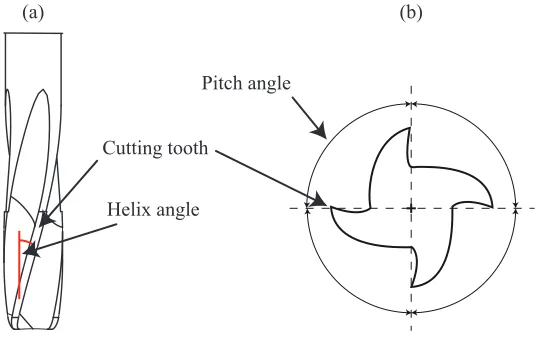
Figure 1. Milling tool geometry. (a) side view; (b) end view of the tip of the cutting tool
1 Introduction
The productivity of metal removal operations is often limited by the onset of regenerative chatter1.
Consequently, there has been a great deal of research to try to understand, predict, and avoid, the onset of
this unstable self-excited vibration. In recent years, techniques proposed to avoid chatter have included:
active vibration control2, tuned mass damping,3;4 variations in machine spindle speed5, and
variable-helix tools. The present study is concerned with variable variable-helix tools, which are introduced with reference
to Fig. 1.
For regular tools, the time delay between successive teeth is constant and fixed, because the helix and
pitch angles are the same for every tooth. For variable pitch tools the time delay can be different for
each tooth due to changes in the pitch angle. However, for variable helix tools the time delay can change
along the axis of the tool, due to changes or differences in the tooth helix angle. These changes in the
time delays within the system are the key to potentially enhanced stability from the more complex tools
geometries. However, in practice other factors (such as the ability to remove swarth from the flutes of the
tool) are also important in evaluating the performance of the tool. The background literature concerning
variable helix tools will now be briefly discussed.
One of the first studies to propose variable helix tools was the work of Stone6 in 1970. Whilst
variable pitch tools have received a great deal of attention (e.g. Budak7), variable helix tools been more
difficult to understand and exploit in practice. A detailed methodology for analysing the stability of
variable helix tools was described by Simset al.8. The modelling approach was partly motivated by the
work of Turner et al.9, who developed an averaging-based approach to modelling variable-helix tool
stability. Simset al.extended the semi-discretisation approach (developed by Stepan and Insperger10;11)
to consider axial discretisation of the cutting tool. As a result, the variations in time delay could be
geometry and perform experimental comparisons. More recently, Jinet al.13 also explored the use of
semi-discretisation methods. Dombovari and Stepan14 further extended the semi-discretisation method
by applying weighted distributed delays; a technique that allowed them to consider harmonically varying
helix angles. Meanwhile, Khasawneh and Mann15 developed a spectral element approach that could
consider multiple delays in a generic configuration of time-delayed system. Finally, Compean et al.16
applied the Enhanced Multistage Homotopy Perturbation Method to accommodate the multiple delays
within a variable helix tool.
Despite this recent work, it is still difficult to properly understand the potential benefits of variable
helix tool geometries, and to the author’s knowledge there is a lack of experimental validation of the
various modelling approaches that have been proposed. In the present study, an alternative variable helix
model formulation is developed. Whilst this has some additional assumptions, it can provide a useful
insight into the stability improvements by allowing the stability to be visualised using a filter frequency
response function. Furthermore, the approach is hundreds of times faster computationally, compared to
previous work by the author8, which could enable better design and optimisation of the tool geometry.
The present work does not seek to provide new experimental analysis of variable helix tool stability.
However, the potential modelling and validation challenges are explored by comparing the analytical
stability predictions to well-established methods. First, fully-discrete and semi-discretised stability
analysis approaches are compared to the new method. Second, time-domain simulations are used to
illustrate the potential influence of non-linear cutting force coefficients. Consequently, this contribution
illustrates possible reasons why variable-helix tools have more complex stability behaviour that is harder
to predict, compared to regular tool geometries.
The remainder of the paper is organised as follows. First, the background theory (which can be found
in many textbooks1;17is summarised for completeness. Then, the new modelling formulation is derived.
A visual interpretation of the variable helix stability is presented, before describing the numerical
approach used for stability analysis. Numerical and analytical stability results are then compared, in
order to explore the significance of different modelling assumptions. Finally, following a discussion,
some conclusions are drawn.
2 Theory
2.1 Classical milling dynamics
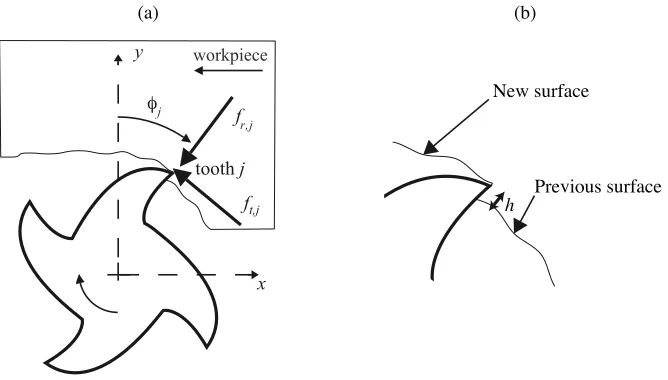
In the standard approach to modelling regenerative chatter17(Fig. 2), the total chip thicknesshfor tooth
j at angleφj is given by:
whereg(φj)is a unit step function:
g(φj) =
1 ← φst< φj < φex
0 ← φj < φstorφj > φex
(2)
This defines when the tool is engaged within the workpiece, i.e. within the angles φst and φex.
Meanwhile,vj,0−vj is the difference between the previous and current instantaneous chip thickness.
Neglecting the quasi-static componentstsinφj in Eq. (1), and rewritingvj,0−vj in terms ofxandy
coordinates gives
h(φj) = [∆xsinφj + ∆ycosφj]g(φj) (3)
where
∆x=x(t)−x(t−τ) (4)
∆y =y(t)−y(t−τ) (5)
Here,τ is the time delay between each tooth pass - with a variable helix tool the aim is to replace this
with a distributed delay term that provides improved chatter stability. The cutting forces in the tangential
and radial directions are given by:
ft,j =Ktah(φj)
fr,j =Krft,j
(6)
This assumes that the cutting forces are proportional to the instantaneous chip thickness. Some studies
have suggested that this empirical approximation is inappropriate, and have instead proposed nonlinear
h
New surface
(a) (b)
Previous surface
[image:6.595.132.466.579.769.2]r,j
(power-law) relationships18. This issue will be revisited later on, using a numerical time-domain model.
However, for the present analysis a linear cutting force coefficient is assumed. Resolving the forces into
thexandydirections, and summing for all theNtteeth of the cutter gives:
fx = Nt
j=1
−ft,jcos(φj)−fr,jsin(φj)
fy = Nt
j=1
+ft,jsin(φj)−fr,jcos(φj)
(7)
Further manipulation leads to:
fx = aKt 2
Nt
j=1
axx[x(t)−x(t−τ)] +axy[y(t)−y(t−τ)]}
fy = aKt 2
Nt
j=1
ayx[x(t)−x(t−τ)] +ayy[y(t)−y(t−τ)]}
(8)
where the parametersaxx, a...are the instantaneous direction factors, that relate thexandy-direction
vibrations to thexandy-direction forces. They are given by17:
axx =−g(φj) [sin(2φj) +Kr(1−cos(2φj))]
axy =−g(φj) [1 + cos(2φj) +Krsin(2φj)]
ayx = +g(φj) [1−cos(2φj)−Kr(sin(2φj))]
ayy = +g(φj) [sin(2φj)−Kr(1 + cos(2φj)]
(9)
In their pioneering work, Budak and Altintas19 considered the Fourier series expansion of these
coefficients, and discussed the validity of neglecting all but the first term. This is equivalent to taking
the average of each term over one tool revolution. For example, the term αxx, corresponding to the
time-averagedaxx coefficient, is:
αxx = 1 2π
2π
0
−g(φj) [sin(2φj) +Kr(1−cos(2φj))]dφj (10)
Here, the step functiong(φ)can be removed and the limits of integration changed:
αxx =− 1
2π
φex
φst
This can be repeated foraxy, ayx, ayy, leading to:
αxx = 1
4π[+ cos(2φj)−2Krφj+Krsin(2φj)]
φex
φst
αxy = 1
4π[−sin(2φj)−2φj +Krcos(2φj)]
φex
φst
αyx = 1
4π[−sin(2φj) + 2φj+Krcos(2φj)]
φex
φst
αyy = 1
4π[−cos(2φj)−2Krφj−Krsin(2φj)]
φex
φst
(12)
which (when the limits are evaluated) become independent of the tooth numberj.
These equations form the basis of many stability analyses methods proposed in the literature. In the
next section, the approach is revisited to consider the variable helix case. To simplify the analysis the
case of vibrations in a single direction (thex-direction) are considered; the more general case ofxand
y-vibrations is given some thought in Section 7.
2.2 Variable helix formulation
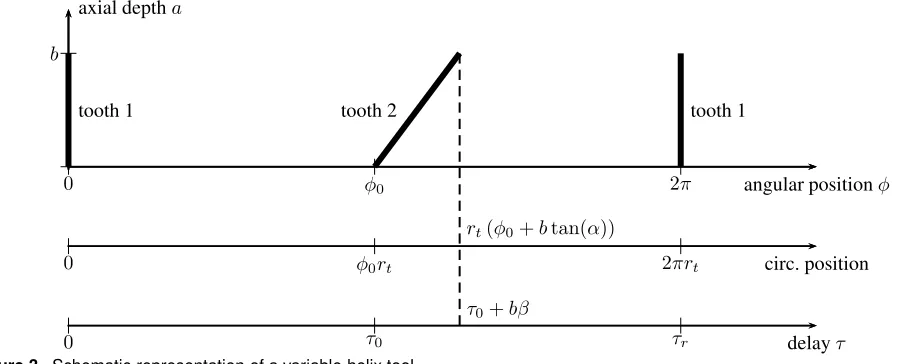
In order to introduce the analysis method, consider a milling tool with two flutes, where the helix angle
difference between the two flutes is α as shown in Fig. 3. Assume that the tool/workpiece system is
flexible in the surface feed directionx, and completely rigid in the mutually perpendicular directiony.
Define the tool rotation period asτr, and define the coefficientβas:
β = τrtan(α)
rt2π
(13)
The cutting force in thex-direction is therefore:
fx(t) = Kt
a=b
a=0
axx,1(t)(x(t)−x(t−τ0−βa)) +axx,2(t)(x(t)−x(t−τ0+βa))da (14)
where axx,i is the time-periodic cutting force coefficient for the ith tooth. Accounting for this
time-periodic behaviour allows the prediction of period-one and period-two instabilities20;21. Accounting for
each tooth iindividually enables the influence of the twisted flutes to be considered22. In this work, we
neglect both of these effects and use the time-averaged cutting force coefficient,αxx. This simplification
gives:
fx(t) =Ktαxx
a=b
a=0
x(t)−x(t−τ0−βa) +x(t)−x(t−τ0+βa)da. (15)
angular positionφ axial deptha
circ. position
delayτ φ0
0 2π
φ0rt
0 2πrt
rt(φ0+btan(α))
τ0
0 τr
τ0+bβ
tooth 1 tooth 2 tooth 1
[image:9.595.65.525.57.239.2]b
Figure 3. Schematic representation of a variable helix tool
L(fx(t)) =Fx(s) =
t=∞
t=0
e−st Ktαxx
a=b
a=0
x(t)−x(t−τ0 −βa) +x(t)−x(t−τ0+βa)dadt. (16)
Changing the order of integration leads to:
Fx(s) =Ktαxx a=b a=0 t=∞ t=0
e−st
(x(t)−x(t−τ0−βa) +x(t)−x(t−τ0 +βa))dtda. (17)
WritingL(x(t))asX(s)and applying the shift theorem gives:
Fx(s) =KtαxxX(s) a=b
a=0
2−e−s(τ0−βa)
−e−s(τ0+βa)
da (18)
which can finally be integrated with respect toa:
Fx(s) =KtαxxX(s)
2a−e
−s(τ0−βa)
sβ +
e−s(τ0+βa)
sβ
a=b
a=0
. (19)
Evaluating the limits of the integration leads to:
Fx(s) =KtαxxX(s)
2b− e
−s(τ0−βb)
sβ +
e−s(τ0+βb)
sβ . (20)
As an aside, it should be noted that the equivalent equation for a non-variable-helix tool can be
obtained as:
lim β→0
Fx(s) =KtαxxX(s)b(2−2e−sτ0
which can be found in many textbooks, e.g.1.
Eq. (20) allows the cutting process to be written as two transfer functions: a zero-order orientation and
scaling coefficient, referred to as thecutting gain,Gc, and a delay termGd(s).
Gc = 2Ktαxxb (22)
The delay transfer function for the variable helix tool is:
Gd(s) = 1−
e−s(τ0−βb)
2sβb +
e−s(τ0+βb)
2sβb (23)
whilst for a regular helix tool it becomes:
Gd(s) = 1−e−sτ0
. (24)
Eq. (24) is the transfer function for a rotating unit vector, as described by Tlusty1, whilst Eq. (23) is the
equivalent transfer function for a variable helix tool. To the author’s knowledge, previous studies have
not been able to obtain this transfer function for variable helix configurations. This is one contribution
of the present study, and it should be reiterated that the key to the approach is the use of the Laplace
transform and the shift theorem, in order to simplify the analysis of the continuous delays.
This paves the way for both (a) frequency domain solution of the variable helix stability problem; and
(b) visual interpretation of the variable helix effect as a filter.
3 Visual interpretation for regular helix tools
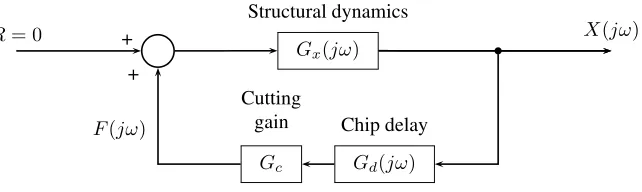
A block-diagram representation of the regenerative chatter effect is shown in Fig. 4. Here, the system
inputR (which would ordinarily represent the forced vibration of the system) is set to zero, in order to
perform a stability analysis of regenerative chatter. Assuming a harmonic response at frequencyω, and
noting that Fig. 4 is a positive feedback system, the transfer function that governs the stability of the
system is:
Gtot(jω) =−Gx(jω)Gd(jω)Gc (25)
and from the Nyquist stability criterion
Gx(jω)
Gc Gd(jω)
R= 0 X(jω)
Structural dynamics
Cutting
gain Chip delay +
+
[image:11.595.162.483.115.211.2]F(jω)
Figure 4. Block diagram for regenerative chatter instability
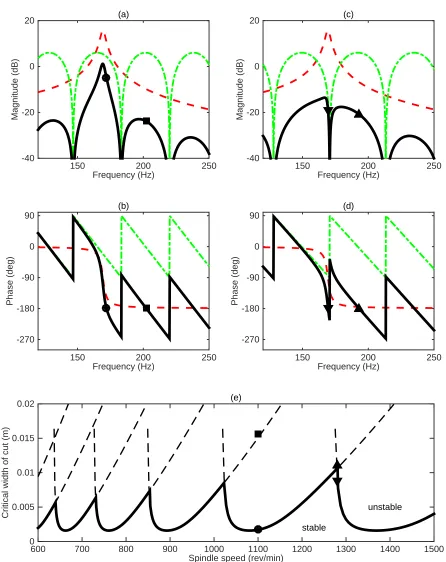
The consequence on stability is best explained using the bode diagrams depicted in Fig. 5, for the case
of a regular helix tool (Eq. (24)). This approach is not new, but it is helpful to recap the concepts
before extending them to the case of variable helix tools. In Fig. 5, Only the Gx(jω) and Gd(jω)
transfer functions are shown, along with the total transfer functionGtot(jω). The depth of cut is chosen
arbitrarily as 1mm, and two spindle speeds are chosen.
At the stability boundary, the phase must be −180◦
to partially satisfy Eq. (26). At these points the
‘critical’ frequency is denoted ωc. The points are shown with solid markers on the bode diagrams. For
each marker, the corresponding magnitude term can be used to determine the stability of the system, i.e.
if|Gtot(jωc)|<1(or<0dB), then the system is stable.
In fact, for regular helix tools the magnitude response|Gtot|is directly proportional to the depth of cut
b, sincebonly appears in the cutting gainGc. Consequently it is straightforward to compute the stability
boundary directly as:
bc = b
|Gtot(jωc)|
(27)
These results are shown on Fig. 5e, along with a traditional stability lobe diagram. It can be seen
that for each spindle speed there are multiple candidate chatter frequencies ωc and that one of these
candidates will govern the overall stability since it leads to the lowest possible value for bc. Note that
Fig. 5 only shows two potential chatter frequencies at each spindle speed, for clarity.
The behaviour at 1280 rpm (Fig. 5c&d) is particularly interesting because this demonstrates how
aligning the tooth passing frequency with the natural frequency leads to increased stability. In other
magnitude responseGtotat the natural frequency of the structure. This is well known in the machining
dynamics literature, but not normally considered in the context of Bode diagram stability analysis.
Frequency (Hz)
150 200 250
Magnitude (dB)
-40 -20 0
20 (a)
Frequency (Hz)
150 200 250
Phase (deg)
-270 -180 -90 0 90
(b)
Spindle speed (rev/min)
600 700 800 900 1000 1100 1200 1300 1400 1500
Critical width of cut (m)
0 0.005 0.01 0.015 0.02
stable
unstable (e)
Frequency (Hz)
150 200 250
Magnitude (dB)
-40 -20 0
20 (c)
Frequency (Hz)
150 200 250
Phase (deg)
-270 -180 -90 0 90
[image:12.595.71.517.132.694.2](d)
Figure 5. Schematic representation of stability analysis. (a) & (b) Bode diagram forb= 1mm, 1100 rpm; (c) & (d) Bode diagram for b=1mm, 1280 rpm. Structure Transfer FunctionGx(jω)(mm/kN); Delay transfer functionGd(jω);
Negative feedback transfer functionGtot(jω). Markers show the magnitude at critical frequencies where the phase is−180◦. (e)
4 Visual interpretation for variable helix tools
Having summarised the Bode diagram stability analysis of regular helix tools, it is now possible to
illustrate the implications of using a variable helix tool. To recap, the Laplace transform approach
has shown that the difference between variable helix and regular helix tools can be entirely captured
by the delay transfer functions shown in Equations 24 and 23. For regular helix it can be seen that
the delay transfer function is a simple unit vector rotating around (1,0) on the Nyquist plane. This
is reiterated in Fig. 6a; where the phase and amplitude responses are identical to those observed in
Fig. 5, and the rotating unit vector is illustrated by the Nyquist plot. In Fig. 6, the frequency axes
are non-dimensionalised by scaling by the tool rotation period τr. Low magnitude responses occur
at dimensionless frequencies of 2,4,..., corresponding to the tooth passing frequencies. The transfer
function is similar to a comb filter; in the previous section it was shown that the low amplitude
frequencies can be harnessed to achieve high stability of the machining process.
For variable helix tools, the delay transfer function takes on a different form (Eq. (23)), which involves
the depth of cut b. The transfer function frequency response is shown in Fig. 6b. As the depth of
cut increases, the behaviour changes substantially compared to the comb filter observed in Fig. 6a. In
particular, as the dimensionless frequency increases, the comb filter effect is diminished and the response
tends toward unity. This could be shown more formally by inspection of Eq. (23). This behaviour is more
pronounced for deeper depths of cut b. At intermediate dimensionless frequencies (e.g. 5-10) there are
still regions of low-amplitude response, but the low amplitudes occur at different frequencies compared
to the regular helix tool. On the Nyquist plane, the response appears as a spiral that winds towards the
(1,0) coordinate as the frequency increases. This is in contrast to the regular helix behaviour, which
exhibits a unit circle that continuously rotates around the (1,0) coordinate.
The behaviour illustrated in Fig. 6 can be directly interpreted to consider the implications for chatter
stability and machining process design. This is in contrast to many previous studies on variable helix
stability8which have not offered direct insight due to the numerical methods (e.g. eigenvalue analysis)
employed. The most significant observation from Fig. 6b is that the response tends toward unity as the
dimensionless frequency or depth of cut is increased. In contrast for a regular helix tool the magnitude
will always alternate between 0 and 2, leading to strong patterns of stable (magnitude near 0) and
unstable (magnitude near 2) behaviour as illustrated in Fig. 5. Meanwhile, the variable helix phase
response tends towards zero, so that the delay transfer function has a very small influence on the total
phase response.
Since this interpretation is a key feature of the present work, the approach is further illustrated in Fig. 7.
(a) Amplitude 0 0.5 1 1.5 2
Dimensionless frequency ω 2π
τr
0 5 10 15 20
Phase
-90 0 90
Real
0 0.5 1 1.5 2
Im ag -1 -0.5 0 0.5 1 Nyquist (b) Amplitude 0 0.5 1 1.5 2
Dimensionless frequency ω 2π
τr
0 5 10 15 20
Phase
-90 0 90
Real
0 0.5 1 1.5 2
[image:14.595.50.544.52.610.2]Im ag -1 -0.5 0 0.5 1 Nyquist
Figure 6. Chip transfer function. (a) regular helix tools, Eq. (24); (b) variable helix tool, Eq. (23), two flute tool with 25◦helix angle
difference, Black to cyan shows increasing depth of cut.
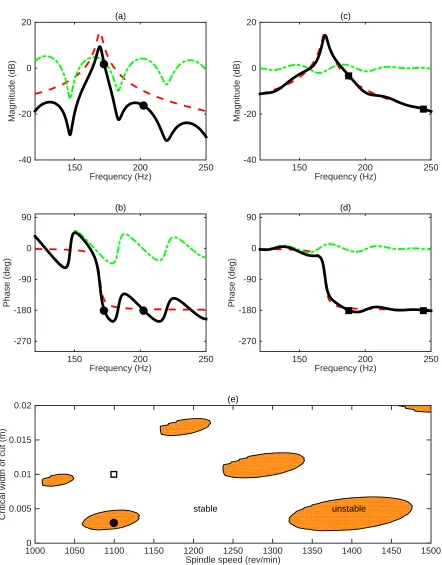
of cut (Fig. 7a-b) the behaviour is very similar to the regular helix case. There is some ‘smoothing’
of the delay transfer function, but the response is unstable as the magnitude is greater than 0dB at
ωc = 173Hz. When the depth of cut is increased (Fig. 5c-d), the delay transfer function is substantially
by the structural dynamics and cutting gain. The system is stable, because the magnitude is less than
0dB for all critical frequencies (ωc = 187,244, ...)Hz.
In Fig. 7e, the overall stability of the system is shown. This is obtained by repeating the bode
diagram stability analysis for permutations of spindle speed and depth of cut. The two example results
are shown superimposed. Finally, it is important to note that small ripples in the chip delay transfer
function (Fig. 7d, green dashed line) can still have an influence on stability. In Fig. 7d the effect is to
slightly increase the phase response near the structure’s natural frequency. This has increased stability.
However, at other spindle speeds the effect can be reversed, so that a critical frequency occurs close to
the structure’s natural frequency. This leads to islands of instability shown in Fig. 7e.
5 Implementation and validation
This section summarises the numerical procedures required for the new stability analysis method, and
compares the results to alternative analysis methods.
The new method involves the following computational steps, which are straightforward to implement,
as well as being computationally inexpensive:
1. Obtain the numerical frequency response function for the structural dynamics, Gx(jω), from
analysis or experiment.
2. Obtain the numerical value for the chip gain, Gc, from the cutting parameters of the system
(Eq. (22)).
3. For each required spindle speed 60τ
r (revolutions per minute);
(a) For each depth of cutb
i. EvaluateGd(jω)numerically (Eq. (23)).
ii. Combine with measured values ofGx(jω)andGc to obtainGtot(jω)(Eq. (25))
iii. Identify frequenciesωc where∠(Gtot(jω)) =−180◦.
iv. Determine the corresponding value of|Gtot(jωc)|.
v. Choose the highest value of these|Gtot(jωc)|.
vi. If the gain is less than unity then the system is stable.
The solutions for this approach are now compared to those for the semi-discretisation method
described by previous work8. The numerical parameters are summarised in Table 1, and these are
chosen to be similar to Table 2 and Figure 14 in the previous study8, although a higher spindle speed
is considered in order to improve convergence of the semi-discretisation method, and to illustrate
stable unstable (e)
Spindle speed (rev/min)
1000 1050 1100 1150 1200 1250 1300 1350 1400 1450 1500
Critical width of cut (m)
0 0.005 0.01 0.015 0.02
Frequency (Hz)
150 200 250
Magnitude (dB)
-40 -20 0
20 (a)
Frequency (Hz)
150 200 250
Phase (deg)
-270 -180 -90 0 90
(b)
Frequency (Hz)
150 200 250
Magnitude (dB)
-40 -20 0
20 (c)
Frequency (Hz)
150 200 250
Phase (deg)
-270 -180 -90 0 90
[image:16.595.74.516.54.619.2](d)
Figure 7. Schematic representation of stability analysis. (a) & (b) Bode diagram forb= 3mm, 1100 rpm; (c) & (d) Bode diagram for b=10mm, 1100 rpm. Structure Transfer FunctionGx(jω)(mm/kN); Delay transfer functionGd(jω); Negative
feedback transfer functionGtot(jω). Markers show the locations of critical frequencies where the phase is−180◦. (e) Overall
chatter stability. Markers show stability boundaries obtained from the gain margins of (a) (•, unstable) and (c) (, stable). Shading
shows unstable regions.
The time-averaged semi-discretisation approach8 was based upon the semi-discretisation method,
but the cutting force coefficients were time-averaged, rather than accounting for their periodicity.
Consequently, this method is most similar to the new Laplace approach presented in this work. The
parameter value
modal mass (kg) 6.4363
modal natural frequency (Hz) 169.3090 modal damping ratio (-) 0.0112 cutting stiffnessKt(N/mm2) 550
cutting stiffnessKr(-) 0.3636
tool radius (m) 0.0095
number of teeth 2
tooth pitch at tool tip 180◦-180◦
tool helix angle difference 25◦
cutting radial immersion full slot milling
Table 1. Numerical parameters for validation study.
The differences can be attributed to the numerical challenges associated with each method. In the new
Laplace solution, the stability margin is calculated based upon discrete data points on the numerical
frequency response function Gtot(jω). Although the accuracy of this could be improved using linear
interpolation, the present study simply used a nearest-neighbour data point. In the time-averaged
semi-discretisation method, the accuracy of the stability boundary depends strongly on the semi-discretisation step
size. In the present study 400 discretisation points per tool revolution were used, leading to an eigenvalue
problem of a similar order. Accuracy can be improved by increasing the number of discretisation points,
but this can drastically increase the computational effort.
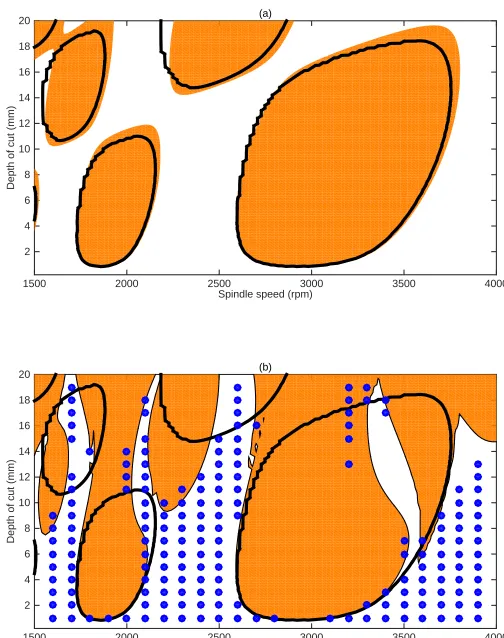
In Fig. 8b, the new method is compared to the discretisation approach. The time-averaged
semi-discretisation method took 75 minutes to solve on a desktop pc, whilst the new Laplace solution took
just 22 seconds. However, it is clear that there are substantial differences between the time-averaged and
multi-frequency methods at this range of spindle speeds.
This behaviour is explored in more detail by using a time-domain simulation, based upon the model
described in previous work23. The model was computed for 100 simulated tool revolutions with 2048
time steps per revolution. Stability was determined by analysing the variance of once-per-revolution
samples of the simulated vibration. For clarity, only the stable solutions are shown on Fig. 8b; it can
be seen that these agree reasonably with the semi-discretisation solution at low spindle speeds (<3000
rpm). At higher speeds the time-domain and semi-discretisation results differ from one-another: this
could be due to differences in their convergence behaviour.
Further work is needed to investigate this behaviour in more detail, but given the close agreement
between the two time-averaged methods (Fig. 8a) it is reasonable to conclude that the variable helix
stability prediction is more susceptible to multi-frequency effects, compared to regular helix tools, for
Spindle speed (rpm)
1500 2000 2500 3000 3500 4000
Depth of cut (mm)
2 4 6 8 10 12 14 16 18
20 (a)
Spindle speed (rpm)
1500 2000 2500 3000 3500 4000
Depth of cut (mm)
2 4 6 8 10 12 14 16 18
[image:18.595.47.551.59.697.2]20 (b)
Figure 8. Validation against the semi-discretisation, fully discretised, and time domain methods. (a) New Laplace solution, Unstable discretised solution; (b) New Laplace solution, Unstable semi-discretisation solution;•Stable
6 Influence of nonlinear cutting stiffness
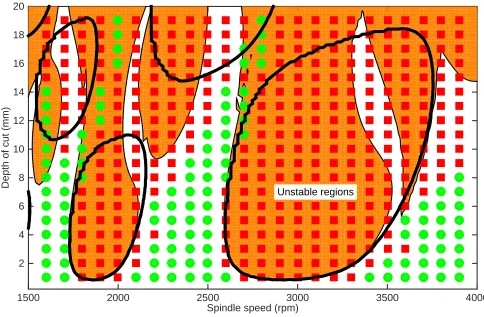
The influence of nonlinear cutting force coefficients is less straightforward. In the present study, this
phenomenon is demonstrated with the aid of a time-domain simulation, again based upon the model
described in previous work23. Following Stepan18, the cutting force coefficient is rewritten as
ft,j =KtK1ah(φj)3/4. (28)
The new coefficient K1 was chosen so that the linearised cutting force coefficient is unchanged at
the mean chip thickness. The time domain results are compared to the Laplace solution, and the
semi-discretisation solution, in Fig. 9. It can be seen that there are significant differences between the three
results. This also suggests that the variable helix stability prediction is susceptible to un-modelled effects
such as nonlinear cutting stiffness, compared to the behaviour of regular helix tools.
However, it should be noted that for the non-linear scenario it is not straightforward to compare
time-domain simulations with analytical stability methods. For example, the analytical methods imply
linearisation around an operating condition (e.g. the mean chip thickness used for Eq. (28)), and the
nonlinearity may cause sensitivity to the choice of initial conditions.
Spindle speed (rpm)
1500 2000 2500 3000 3500 4000
Depth of cut (mm)
2 4 6 8 10 12 14 16 18 20
[image:19.595.53.537.429.746.2]Unstable regions
7 Discussion
Before drawing conclusions, a number of points are worthy of further discussion.
7.1 Two-direction formulation
One drawback with the approach presented here is that the formulation has only been presented for
vibrations in a single degree of freedom. However, the main focus of the present study was to offer a
new means of visualising variable helix stability, and to illustrate some of the inaccuracies that can occur
when well-established assumptions are used for the special case of variable helix tools. The points have
been illustrated without resorting to the more cumbersome formulations needed for vibrations inxand
ydirections. Despite this, it is useful to briefly consider whether, and how, the new Laplace approach
could be extended to the two-direction formulation.
Returning to Eq. (14), it is clear that for the two-direction case there will be two simultaneous
equations, describing forces in the x and y directions, and coupling introduced by the axy and ayx
coefficients (Eq. (9)). Time averaging of these coefficients will lead to corresponding simultaneous
equations replacing Eq. (15). Now, the Laplace transform can be applied separately to each of the terms
in the simultaneous equations, because the transform is linear and follows the principal of superposition.
Continuing with this approach will lead to the coupling terms being collected in a2×2matrix of gains
Gc, along with a scalar transfer functionGd(jω).
In order to perform a stability analysis, the multi-input-multi-output coupled system can be
transformed into two uncoupled single-input-single-output systems. In the general case this requires
an eigenvalue solution for each frequencyωc, but since the system is2×2, the solution can be achieved
analytically.
Consequently, it seems feasible that the approach can be extended to the case of mutually
perpendicular vibrations with a relative straightforward development of the approach, and only a small
increase in computational cost. This should certainly be considered for further work, but in practice the
need for further experimental validation of behaviour is probably a more urgent step.
7.2 Multi-frequency formulation
An alternative to the time-averaged approach is to consider the Fourier series expansion of the direction
factors shown in Eq. (12). In this case, a frequency domain solution could be achieved by following the
detailed methodology described by Wereley24. However, in this case the stability analysis becomes
functions. It remains to be seen whether this approach would offer any advantages compared to the
semi-discretisation method, in terms of computational cost or visualisation/design aids.
7.3 Other helix geometries
A final concern with the new Laplace approach is the assumption that the helix angles are constant for
each tooth. This can be overcome in two ways. First, it could be possible to rewrite Eq. (16) to describe
other geometries in an analytical fashion. An example would be sinusoidal variations in the tool delay.
However, solving this analytically is probably not possible and so Eq. (19) could not be written using
such an approach. The alternative approach is to consider the helix angles as piecewise constant. In this
case, it should be possible to write Eq. (19) as a summation of terms, leading to a more complicated but
otherwise useful expression forGd(jω).
7.4 Role of structural damping
Before drawing conclusions, it is useful to consider one nuance of the bode diagrams presented in Fig. 7.
The examples suggest that at higher depths of cut the critical frequencies are more sensitive to the
phase of the structural dynamicsGx(jω), because the variation in the delay transfer functionGd(jω)is
smaller. This raises the question of whether variable helix tools are more likely to benefit from damping,
compared to regular helix tools. This damping could be in the form of structural damping (inherent,
or intentionally added), or un-modelled damping mechanisms (such as process damping25;26). Further
work could explore this experimentally.
8 Conclusions
In this contribution, a new formulation for predicting the chatter stability of variable helix tools has been
described. The following conclusions can be drawn:
1. The Laplace formulation provides new insight into the stability of variable helix tools as it allows
the distributed delay parameters to be visualised as a filter. This can be contrasted with the comb
filter effect that is well-known for regular helix tools.
2. The formulation is compatible with numerical frequency response function data, and consequently
does not require modal models to represent the structural dynamics of the system. This offers some
convenience compared to previous formulations. In addition, the new formulation is hundreds
of times faster than some other methods for variable helix stability analysis. Consequently the
3. A major issue with the formulation is that the stability prediction appears to be highly sensitive
to the un-modelled effects of nonlinear cutting stiffness. In addition, the time-averaging of the
cutting force coefficients appears to have a dramatic effect on the stability. Both of these issues
have been illustrated on a specific scenario. Further work is needed to explore the relevance of
these on practical machining problems.
9 Acknowledgements
The author is grateful for the constructive comments made by both reviewers. In addition, Dr T
Baldacchino kindly proof-read the nomenclature and equations in the draft manuscript. This research
received no specific grant from any funding agency in the public, commercial, or not-for-profit sectors.
References
1. Tlusty J.Manufacturing Processes and Equipment. New Jersey: Prentice Hall, 1999.
2. Chung B, Smith S and Tlusty J. Active damping of structural modes in high speed machine tools. Journal of Vibration and Control
1997; 3(3): 279–295.
3. Tarng Y, Kao J and Lee E. Chatter suppression in turning operations with a tuned vibration absorber.Journal of Materials Processing
Technology2000; 105(1): 55–60.
4. Sims N. Vibration absorbers for chatter suppression: A new analytical tuning methodology.
Jour-nal of Sound and Vibration 2007; 301(3-5): 592–607. DOI:10.1016/j.jsv.2006.10.020. URL
http://www.scopus.com/inward/record.url?eid=2-s2.0-33846429613&partnerID=40&md5=4d2c6898f1f5cd4630
5. Seguy S, Insperger T, Arnaud L et al. On the stability of high-speed milling with spindle speed
vari-ation. International Journal of Advanced Manufacturing Technology 2010; 48(9-12): 883–895. URL
http://www.scopus.com/inward/record.url?eid=2-s2.0-77953608906&partnerID=40&md5=8c9eda0ef6a9c0746a
6. Stone BJ. The effect on the chatter behaviour of cutters with different helix angles on adjacent teeth. Advances in Machine Tool
Design and Research, Proc of 11th International MTDR Conference University of Birmingham1970; A: 169–180.
7. Budak E. An analytical design method for milling cutters with non-constant pitch to increase stability, part 1:
Theory and part 2: Application. Journal of Manufacturing Science and Engineering 2003; 125: 29–38. URL
http://www.scopus.com/scopus/inward/record.url?eid=2-s2.0-0039335175&partnerID=40&rel=R6.0.0.
8. Sims N, Mann B and Huyanan S. Analytical prediction of chatter stability for variable pitch and variable helix milling tools.Journal
of Sound and Vibration2008; 317(3-5): 664–686. DOI:10.1016/j.jsv.2008.03.045.
9. Turner S, Merdol D, Altintas Y et al. Modelling of the stability of variable helix end mills. International Journal of Machine Tools
and Manufacture2007; 47(9): 1410–1416.
10. Insperger T and Stepan G. Updated semi-discretization method for periodic delay-differential equations with discrete delay.
International Journal for Numerical Methods in Engineering2004; 61(1): 117.
11. Insperger T and St´ep´an G. Semi-discretization for time-delay systems: stability and engineering applications, volume 178. Springer
12. Yusoff A and Sims N. Optimisation of variable helix tool geometry for regenerative chatter
mit-igation. International Journal of Machine Tools and Manufacture 2011; 51(2): 133–141. URL
http://www.scopus.com/inward/record.url?eid=2-s2.0-78650713355&partnerID=40&md5=cf8e0a0b69371b5f15
13. Jin G, Zhang Q, Hao S et al. Stability prediction of milling process with variable pitch and variable helix cutters.
Proceedings of the Institution of Mechanical Engineers, Part C: Journal of Mechanical Engineering Science 2014; 228(2):
281–293. DOI:10.1177/0954406213486381. URL http://pic.sagepub.com/content/228/2/281.abstract.
http://pic.sagepub.com/content/228/2/281.full.pdf+html.
14. Dombovari Z and Stepan G. The effect of helix angle variation on milling stability.
Jour-nal of Manufacturing Science and Engineering, Transactions of the ASME 2012; 134(5). URL
http://www.scopus.com/inward/record.url?eid=2-s2.0-84867019429&partnerID=40&md5=c88c058cd1bd53804c
15. Khasawneh F and Mann B. A spectral element approach for the stability analysis of time-periodic delay equations
with multiple delays. Communications in Nonlinear Science and Numerical Simulation 2013; 18(8): 2129–2141. URL
http://www.scopus.com/inward/record.url?eid=2-s2.0-84875254350&partnerID=40&md5=e99f261ad402b03e91
16. Compean F, Olvera D, Campa F et al. Characterization and stability analysis of a multivariable milling tool by the enhanced multistage
homotopy perturbation method.International Journal of Machine Tools and Manufacture2012; 57: 27–33.
17. Altintas Y.Manufacturing Automation: Metal Cutting Mechanics, Machine Tool Vibrations, and CNC Design. Cambridge University
Press, 2000.
18. Stepan G. Modelling nonlinear regenerative effects in metal cutting. Philosophical Transactions of the Royal Society of London, Part
A2001; 359: 739–757.
19. Budak E and Altintas Y. Analytical prediction of chatter stability in milling - part i: general formulation.Journal of Dynamic Systems,
Measurement and Control1998; 120: 22–30.
20. Merdol SD and Altintas Y. Multi frequency solution of chatter stability for low immersion milling.Journal of Manufacturing Science
and Engineering, Transactions of the ASME2004; 126(3): 459–466.
21. Insperger T, Stepan G, Bayly PV et al. Multiple chatter frequencies in milling processes. Journal of Sound and Vibration2003;
262(2): 333–345.
22. Khasawneh F, Bobrenkov O, Mann B et al. Investigation of period-doubling islands in milling with simultaneously
engaged helical flutes. Journal of Vibration and Acoustics, Transactions of the ASME 2012; 134(2). URL
http://www.scopus.com/inward/record.url?eid=2-s2.0-84856013830&partnerID=40&md5=5f406cffc8b8efdf4e
23. Sims N. The self-excitation damping ratio: a chatter criterion for time-domain milling simulations.Journal of Manufacturing Science
and Engineering2005; 127(3): 433–445.
24. Wereley N.Analysis and control of time periodic systems. PhD Thesis, Massachusetss Institute of Technology, 1991.
25. Sims N and Turner M. The influence of feed rate on process damping in milling: Modelling and experiments. Proceedings
of the Institution of Mechanical Engineers, Part B: Journal of Engineering Manufacture 2011; 225(6): 799–810. URL
http://www.scopus.com/inward/record.url?eid=2-s2.0-80051862668&partnerID=40&md5=cf7f08a563caed7f73
26. Budak E and Tunc LT. A new method for identification and modeling of process damping in machining. Journal of Manufacturing