This is a repository copy of
Infusion device standardisation and dose error reduction
software
.
White Rose Research Online URL for this paper:
http://eprints.whiterose.ac.uk/130580/
Version: Accepted Version
Article:
Iacovides, Ioanna orcid.org/0000-0001-9674-8440, Blandford, Ann, Cox, Anna L. et al. (3
more authors) (2015) Infusion device standardisation and dose error reduction software.
British Journal of Healthcare Management. pp. 68-76.
10.12968/bjhc.2015.21.2.68
[email protected] https://eprints.whiterose.ac.uk/
Reuse
Items deposited in White Rose Research Online are protected by copyright, with all rights reserved unless indicated otherwise. They may be downloaded and/or printed for private study, or other acts as permitted by national copyright laws. The publisher or other rights holders may allow further reproduction and re-use of the full text version. This is indicated by the licence information on the White Rose Research Online record for the item.
Takedown
If you consider content in White Rose Research Online to be in breach of UK law, please notify us by
i
Infusion device standardisation and the use of dose error reduction
software: a UK survey
Ioanna Iacovides¹, Ann Blandford¹, Anna Cox¹, Bryony Dean Franklin², Paul Lee³ and Chris J. Vincent¹.
¹UCL Interaction Centre, University College London, London
²Centre for Medication Safety and Service Quality, Pharmacy Department, Charing Cross Hospital, Imperial College Healthcare NHS Trust and UCL School of Pharmacy, London
³ Abertawe Bro Morgannwg University Local Health Board, Medical Physics and Clinical Engineering Department, Morriston Hospital, Swansea, Wales
Ioanna Iacovides (corresponding author)
Address: UCL Interaction Centre, MPEB 8th floor, University College London, Gower Street, London, WC1E 6BT
Tel: 02076792769 (internal ext. 32769) Email: [email protected]
Ioanna Iacovides, is a postdoctoral research associate at the UCL Interaction Centre (UCLIC).
Ann Blandford is Professor of Human Computer Interaction at UCLIC.
Anna Cox is Reader in Human-Computer Interaction and Deputy Director at UCLIC.
ii Paul Lee is the Medical Devices Training Manager for ABM University Local Health Board and is also Chairman of NAMDET UK (National Association of Medical Device Educators and Trainers).
Christopher J. Vincent is a postdoctoral research associate working on the CHI+MED project at UCLIC.
Acknowledgments
1 Abstract
In 2004, the National Patient Safety Agency (NSPA) released a safety alert relating to the management and use of infusion devices in England and Wales. The alert called for the
standardisation of infusion devices and a consideration of using centralised equipment systems to manage device storage. There has also been growing interest in smart pump technology, such as dose error reduction software (DERS) as a way to reduce IV medication errors. However, questions remain about the progress that has been made towards infusion device standardisation and the adoption of DERS.
We report on the results of a survey investigating the extent to which the standardisation of infusion devices has occurred in the last 10 years; how far centralised equipment libraries are being used in practice; and about the prevalence of DERS use within the UK.
2 Key phrases
1. Infusion device standardisation, the use of centralised equipment libraries and DERS have all been suggested as ways to improve patient safety but there has been little research on establishing the prevalence of all three on a national level.
2. P
does not always mean that only one type of device is being used, and there is still some variability in the devices used across whole organisations.
3. Due to specific clinical areas requiring different devices or alternative configurations of the same device centralised equipment libraries are not the most common method of device storage management across entire hospitals.
4. Due to the significant practical and organisational challenges that face institutions wishing to implement DERS, only a small number of hospitals are using this technology, especially across entire trusts and health boards.
3 Introduction
Ten years ago, the National Patient Safety Agency released a safety alert relating to the management and use of infusion devices in England and Wales (NPSA, 2004). The alert noted that 19% of 700 annual incidents involving intravenous infusions were attributed to user error. In order to reduce the chances of error occurring, it was argued that NHS organisations should review the way in which they purchase, manage and use infusion devices. On the basis of a pilot study in six acute trusts, it was also recommended that organisations providing acute care reduce the range of device types available (where each type has agreed default configurations) and that centralised equipment libraries should be considered a more effective way of managing devices that can also improve patient safety. A toolkit was provided by the NPSA, as well as an audit tool to help organisations make the changes suggested in order to improve patient safety (Quinn, Stevenson & Glenister, 2004).
As a result, organisations have made changes to purchasing policy (NPSA, 2006) and standardisation has been shown to be effective (Lee, 2010), where a strategic approach to the ongoing management of infusion devices with board level responsibility is recommended to help maintain the high profile that these high risk devices and therapy demand (MHRA, 2013). However, since 2004, it is unclear the extent to which the standardisation of infusion devices has occurred and how far centralised equipment libraries are being used in practice.
4 s can vary, for the purposes of this review, the term is used to describe infusion devices which require additional information about the patient (e.g. weight) and medication (e.g. drug name, dose, concentration) to be entered and also performs checks to detect possible
prescribing and programming errors. I
C Limits for maximum and minimum dosages and infusion rates
can be programmed into the associated software which can also be used to form the basis of a risk management plan. Hard limits are fixed and cannot be overridden by the user, whereas soft limits can be temporarily overridden depending on therapy and individual circumstances.
It has been suggested that DERS can help to improve patient safety, particularly in intensive care (Murdoch and Cameron, 2008), and there are examples of successful implementation within particular hospitals (Cousins et al, 2013). Furthermore, Keohane et al (2005) highlight the role of the nurse as critical within the selection, implementation and continuing evaluation of smart pump technology. However, it has also been argued that the evidence base for DERS use in practice is currently limited, particularly within the UK (Hertzel and Souza 2009; Taxis and Franklin, 2011, Lee 2013). Upton and Quinn (2013) also note that the uptake of DERS within Europe and the UK appears much lower when compared to the USA. The reasons they suggest for this include:
A lack of standardisation of equipment. Low investment in new technology. Resistance to change.
Lack of robust evidence of effectiveness.
Lack of promotion by manufacturers.
5 While 68% of hospitals in the USA were found to be using DERS in 2011 (Pedersen et al, 2012), there has not been a similar survey to explore the prevalence of use within UK hospitals is (Cousins et al, 2013). Understanding current usage would help inform future studies of IV infusion safety and DERS usage.
We aimed to address this gap by investigating the following questions in relation to UK hospitals:
1. To what extent are volumetric infusion devices and syringe pumps currently standardised? 2. How are infusion devices currently stored and management?
3. How is DERS being used and to what extent?
Method
An online survey was sent to infusion device managers and trainers within NHS organisations across the UK between April July 2013. Respondents were recruited from a previous interview study (Iacovides et al., 2013), various mailing lists and websites (e.g. the Institute of Physics and
Engineering in Medicine mailing list and the National Association of Medical Device Educators and Trainers website) and through attempting to directly contact departments within a list of 162 acute
trusts in England (NHS, 2013). A researcher
6 The survey was hosted online and included questions on standardisation, the pumps in use, how they were stored and accessed, and details of any DERS use.
Results
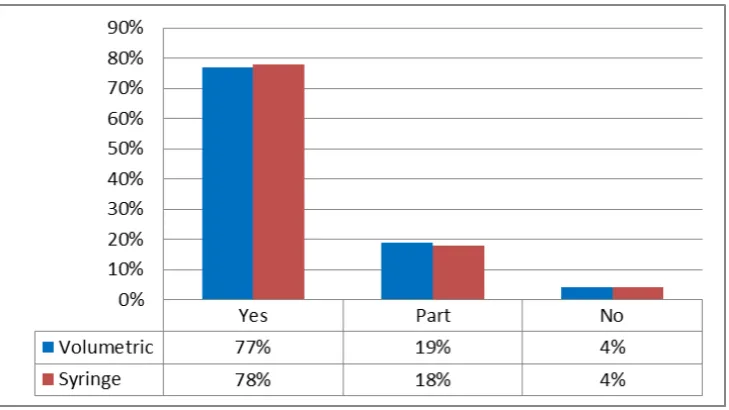
[image:9.595.73.438.351.556.2]In total, forty five respondents participated in the study. These included NHS staff who were involved in medical device management, maintenance and/or training within 49 UK organisations (44 trusts in England, 3 health boards in Scotland, and 2 health boards in Wales), representing 120 hospitals (64 acute, 37 community and 19 specialist: e.g. urgent care, cardio-thoracic). These responses have been included in the analysis. The replies to the survey were collated and tabulated for further analysis.
Figure 1: Standardisation of infusion devices (n = 120)
Standardisation
7 areas for volumetric pumps (n=23) and syringe pumps (n=22); only 4% reported there was no
standardisation at all (n=5).
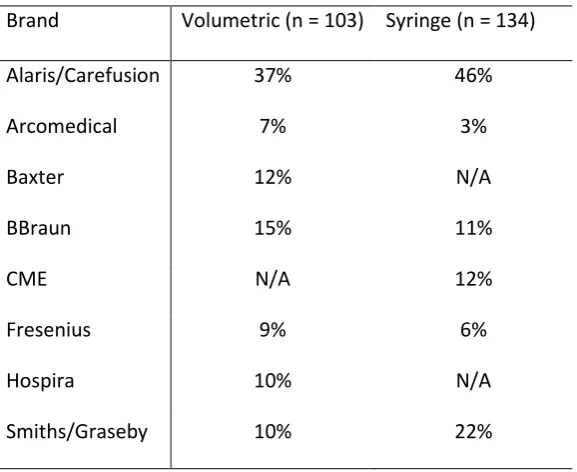
[image:10.595.69.358.332.568.2]To further investigate the extent of standardisation, respondents were asked to list which volumetric and syringe pumps were being used within their trusts. Table 1 indicates the different brands of devices that were mentioned in relation to this question (where n refers to the total number of brand mentions). The figures do not indicate individual makes or models of devices in use or variations between device types as detailed information was not always provided by respondents.
Table 1: Brands of volumetric and syringe devices (where n = number of mentions)
Brand Volumetric (n = 103) Syringe (n = 134)
Alaris/Carefusion 37% 46%
Arcomedical 7% 3%
Baxter 12% N/A
BBraun 15% 11%
CME N/A 12%
Fresenius 9% 6%
Hospira 10% N/A
Smiths/Graseby 10% 22%
Of the 39 organisations who reported standardising their devices and where more detailed information about models was provided, the average number of types of volumetric devices listed per trust was 1.3 (range = 1-5). The average number of types of syringe devices was 2.8 per trust (range = 1-9).
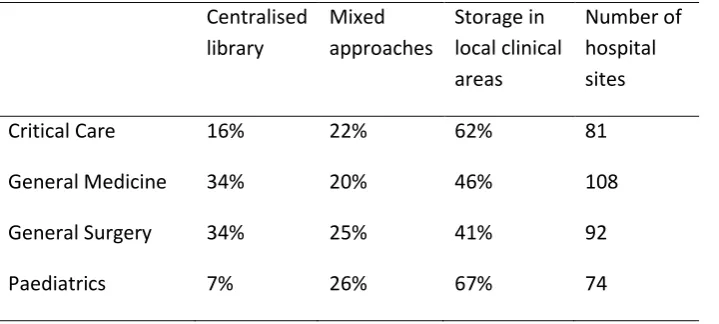
8 Table 2 summarises the reported storage and management arrangements of infusion devices in terms of local storage and the use of central libraries across four clinical areas. While some areas use both centralised libraries and local storage systems, the most common approach was to store pumps in local areas only: critical care (62%, n = 50); general medicine (46%, n = 49); general surgery (41%, n = 38) and paediatrics (68%, n = 50). The use of centralised libraries alone does not appear to be very common, particularly within critical care (16%, n = 13) and paediatrics (7%, n = 5).
Table 2: Device storage (rounded to the nearest percentage)
Centralised library
Mixed approaches
Storage in local clinical areas
Number of hospital sites
Critical Care 16% 22% 62% 81
General Medicine 34% 20% 46% 108
General Surgery 34% 25% 41% 92
Paediatrics 7% 26% 67% 74
Use of DERS
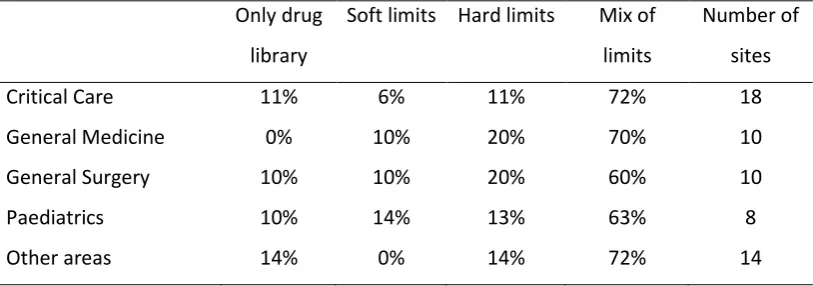
9 In terms of how DERS was used at an organisational level (i.e. across whole trusts or health boards), Table 3 indicates that most areas use a mixture of both hard and soft limits: critical care (72%, n = 13); general medicine (70%, n = 7); general surgery (60%, n = 6); paediatrics (63%, n = 5). Out of the respondents, the most common area to utilise DERS was critical care (18 organisations) and the least common was paediatrics (8 organisations). Other specialist areas reported to use DERS include oncology and neonatal intensive care.
Table 3: DERS use across 19 organisations (rounded to nearest percentage)
Only drug library
Soft limits Hard limits Mix of limits
Number of sites
Critical Care 11% 6% 11% 72% 18
General Medicine 0% 10% 20% 70% 10
General Surgery 10% 10% 20% 60% 10
Paediatrics 10% 14% 13% 63% 8
Other areas 14% 0% 14% 72% 14
[image:12.595.71.397.520.710.2]On a site level, across 24 hospitals implementing DERS, almost all respondents reported updating drug libraries manually, (96%, n = 23), with only one hospital using wireless updates (4%, n = 1).
10 Figure 2 illustrates that within specific hospitals, Critical Care is the most common area for DERS to be used (92%, n = 22). These results also suggest that DERS is not necessarily implemented across all areas within the same hospital. Some respondents also selected O DER“
most popular areas later specified as Neo-natal ICU (22%, n = 5) and Oncology (17%, n = 4).
Reasons for not using DERS
Of the 30 organisations who said they were not using DERS, 43% (n = 13) reported that there were no plans to introduce this technology within the next 12 months. Only 20% (n = 6) stated that there was a plan to do so, with a further high proportion of respondents not knowing about future plans (37%, n = 11).
Respondents were asked to explain their choice of answer regarding the future plans for DERS and several reasons were provided for their being no plans to introduce this technology within the next 12 months. For some, this was due to practical issues, such as being tied to an existing device
contract e.g. E DER“
OEM [Original Equipment Manufacturer]. This contract has 18-24 months [to run] (Respondent 43).
In addition, there were concerns about the lack of resources available e.g. T T
DER“ , (Respondent 7); and the time required to
implement DERS and train staff e.g. R
lack of training and high staff turnover and 2) the time and effort required to maintain drug libraries
were felt to be significant enough to at least equal the benefits if not outweigh them , (Respondent 36).
Furthermore, there were some issues around not being able to standardise across an entire site e.g.
11 which talks to its own pump. Problem is each of the softwares will not talk to each other, and
standardisation is difficult when certain pumps are purchased for different criteria and application ,
(Respondent 41). This particular response also suggests there is an issue concerning lack of interoperability between multiple brands of device.
Discussion
The survey results suggest that in the last 10 years (since the NPSA alert in 2004), progress has been made towards the standardisation of infusion devices. Standardisation is particularly important to achieve before implementing DERS and is likely to aid nurses in their day to day tasks (Cousins et al, 2013). There is room for improvement however, especially since Lee (2010) has shown that using a multidisciplinary group to help manage and achieve standardisation can reduce clinical risks effectively. There is also an indicati
one type of pump is being used across the whole hospital as there is still variability in the type of devices used. This is most likely due to specific areas, e.g. critical care and paediatrics, requiring different devices or alternative configurations of the same device. The fact that certain clinical areas require a different set up may be the main reason why centralised equipment libraries are not the most commonly used method of device storage management across entire hospitals.
12 Furthermore, it seems that organisations who wish to implement this type of technology need to overcome several challenges before being able to proceed. Similar to those noted by Upton and Quinn (2013), these challenges involve practical and organisational issues such as existing device contracts; the infrastructure and resources available; not being convinced that implementing the technology is worth the time and financial investment required, and complications related to a lack of standardisation and communication between devices. The survey findings indicate that many organisations are responsible for multiple sites, which can be at different stages of standardisation and use different types of infusion pumps; this is likely to further complicate the introduction of DERS across entire trusts and health boards.
However, in terms of gathering the data, it was a real challenge to identify individuals who could answer all the questions included for each hospital within a single organisation. Multiple people, including manufacturers, are often involved in the procurement, management and setting up of infusion devices while job titles and departments are not always consistent. This difficulty means that response rates were lower than initially anticipated and also serves to highlight the complexity of working in the area of device management.
This study was the first step in identifying the prevalence of DERS and considering related issues such as standardisation and effective infusion device management. The findings have established a foundation upon which to proceed with further research which is able to consider the effectiveness of DERS and possible recommendations for interventions relating to infusion devices that have greatest potential for aiding nurses in their day to day tasks and increasing patient safety.
13 Cousins D, Keyser T, Catrwright E (2013) Implementing and evaluating the patient safety benefits of dose error reduction software in electronic infusion devices in one NHS Hospital Trust. Br J Nurs CareFusion supplement 22(14):9-14
Hertzel C, Souza VD (2009) The use of smart pumps for preventing medication errors. J Infusion Nurs 32(5):257-67
Iacovides I, Cox AL, Blandford A (2013) Supporting learning within the workplace: Device training in healthcare. Proceedings of the European Conference on Cognitive Ergonomics (ECCE 2013), article no. 30. New York: ACM
Keohane CA, Hayes J, Saniuk C, Rothschild JM, Bates DW (2005) Intravenous Medication Safety and Smart Infusion Systems Lessons Learned and Future Opportunities. J Int Nurs 28(5):321-8
Lee PT (2013) Foreword: Safer systems for IV therapy: what role does drug error reduction software play? Br J Nurs CareFusion supplement 22(14):3
Lee PT (2010) A team approach to identify and manage risk in infusion therapy. Br J Nurs Intravenous Supplement 19(5):12-8
Medicines and Healthcare Products Regulatory Agency (2013). Infusion Systems v2.1 December 2013
14 National Health Service (2013) Authorities and Trusts. Available:
http://www.nhs.uk/servicedirectories/pages/acutetrustlisting.aspx. Accessed 13th May 2013
National Patient Safety Agency (2004). Safer practice notice 01: improving infusion device safety. Available: http://www.nrls.npsa.nhs.uk/resources/?EntryId45=59788 Accessed 26th April 2014
National Patient Safety Agency (2006). Evaluating safer practice notice 1. Available:
http://www.npsa.nhs.uk/EasysiteWeb/getresource.axd?AssetID=1605&type=Full&servicetype=Attac
hment Accessed 26th April 2014.
Pedersen CA, Schneider PJ, Scheckelhoff DJ (2012) ASHP national survey of pharmacy practice in hospital settings: dispensing administration - 2011. Am J Health Syst Pharm 69(9):768-85
Quinn C, Stevenson E, Glenister H (2004). NPSA infusion device toolkit: a cost-saving way to improve patient safety, Clinical Governance: An International Journal 9(3):195-9
Taxis K, Franklin BD (2011). Smart infusion pumps in safe drug administration. Hospital Healthcare Europe