ì[Dff0p©(3m Dmw©8ö[ru©CDö © s m
©SOD ©cyiiiS(ô)giôÊC© DffiRi^^
[ÏÎÊMM] ©QQ(Ko](ö]@a [0)07
ρ
QöiK!^S^M)@lliS
No 43-March 1985
ISSN 0250-3091Ths loDtsmatiûoai Capfel Mlarket
οίπι 1984
International borrowing in the form of public Issues of international and foreign securities and syndicated bank loans and facilities grew substantially in 1984 after experiencing a partial set-back the preceding year (Table 1). The growth, however, was unevenly distributed between different sectors of the bond market and the market in syndicated credits. While the amounts raised in the dollar sector of the inter national market and in New York itself in 1984, when converted into ECUs for the purpose of comparison
with capital issues on other markets (see inset on conversion rate), were nearly double those recorded in 1983, internationally syndicated bank credits denominated in dollars continued to decline in spite of an increase in such bank lending in other curren cies. Other facilities in the form of stand-by credits and underwriting to cover the issuance of short-term notes increased more rapidly than any other form of financing even after deducting the equivalent of about 30 billion ECUs of backing for mergers.
The increase in 1984 in the propor tion of international and foreign is sues accounted for by dollar bor rowing could be ascribed to a number of factors of which perhaps the most important may have been uncertainty over the direction of in terest rate movements. The uncer tainty encouraged the resort by bor rowers and investors alike to vari able rate instruments such as float ing rate notes, short-term "euro-notes" backed by medium or long-term undenwriting facilities and simi larly backed issues of commercial paper in the U.S.A. On the other hand, while there were prospects of prolonged decline in interest rates, issues with warrants entitling hol ders to purchase further securities at a later date on similar terms gained in popularity.
At the beginning of the year, interest rates were still tending to decline in dollar markets as on others (see graph) but soon began to climb under the influence of strong de mand for credit to finance a rapid rise in economic activity in the U.S.A. and the very large and grow ing deficit in the Federal budget. Reinforcing these influences, as the growth rate of the money supply rose above the upper limit of the official target range, were the fore casts of a number of market analysts that interest rates would reach re cord highs by the end of 1984 or soon after. The fairly steep upward
movement in interest rates that re sulted continued into July when an apparent slowing of economic activ ity and a slackening of the rate of growth of the money supply induced a slight easing of the stance of monetary policy. In the meanwhile, however, the rise in interest rates on dollar markets together with the brighter prospects offered by invest ment in U.S. equities strengthened the flow of capital into dollar se curities and the dollar itself. As a reflection of the movement of funds into dollar securities, interest rates on other capital markets also rose during the second quarter of the year in spite of the threat that this posed to the somewhat fragile economic recovery in industrialised countries in Europe.
During the second half of 1984, as the slowdown in economic growth
in the U.S.A. became more evident, market uncertainties were translated into questions of how far the easing of monetary policy in the U.S.A. would go and how long it would last in view of the need to fund an even larger Federal budget deficit. The decline in interest rates on dollar markets and a temporary and limited reversal of the U.S. dollar's appreci ation against other major currencies enabled monetary authorities in Europe and in Japan to bring inter est rates doyynwards, a movement which continued to the end of the year in spite of a fresh strengthening
of the dollar against their respective currencies when President Reagan's re-election in November became vir tually certain. Bond yields on major capital markets, as Table 2 shows, consequently ended the year lower than when it began, the largest falls being in markets of EEC currencies and the ECU.
Further factors making for uncer tainty in securities markets were in troduced by the decision of the U.S. authorities in mid-year to suspend the 30% withholding tax on interest owing on securities held by non residents. This seemed for a while to threaten the separate existence of the dollar eurobond market until it became clear that investors still pre ferred the assured anonymity of bearer bonds issued on the interna tional market to other arrangements designed by the U.S. authorities with the same end in view. In conse quence an issue launched directly by the U.S. Treasury on the interna tional market was not perhaps as successful as had been hoped. U.S. official entities and private corpora tions, however, have benefitted from being able to borrow directly on the international market without having to launch their issues through a subsidiary in an offshore tax-haven.
The Japanese authorities did not suspend withholding tax in 1984, although this was expected, but eased eligibility criteria and raised the ceiling on the amount of individ-ual public issues of foreign bonds in Japan (the Samurai market) as from the beginning of the new financial year in October and opened the euroyen market as from the begin-ning of December to first class priv-ate sector borrowers. The easing of access to the euroyen market is reflected in Table 4 in the large increase inthesecondhalf of 1984in Yen issues on the international mar-ket. The majority of the borrowers consisted of American corporations reportedly raising Yen for swapping into dollars through Japanese banks.
The growth of the ECU sector of the bond market matched that of the
total of issues of international and foreign securities. The recompo-sition of the ECU in September 1984 when the Greek drachma was in-cluded as the tenth component cur-rency had little impact at the time on bond yields as the market had dis-counted a fractional rise in such yields in advance. An increase of about 76% in the flow of new issues was absorbed by a widening geo-graphical range of private and insti-tutional investors. In addition to purely euro-issues, new borrow-ings aimed at investors on specific national markets such as in Italy, Switzerland, Denmark, the Nether-lands, the U.S.A. and, at the begin-ning of 1985, in France were suc-cessfully launched. The range of borrowing instruments was also widened to include convertible and non-voting preference shares. The
Note
Unless otherwise stated, the statistics of bond issues in this article are of public issues with a maturity of three years or more on the international market or of public issues by foreign borrowers on national markets. For the breakdown by period the date of payment is used.
International issues are those which are sold through international banking syndicates, usually in more than one market, including markets outside Europe; they include all issues to which special monetary clauses are attached (ECU, EUA, SDR and other multiple-currency issues).
Foreign bond issues are those which are sold on a single national market on behalf of non-resident borrowers by financial institutions of the country concerned. The distinction between international and foreign bond issues is no longer clear-cut.
The statistics on bank loans and other facilities cover publicised credits and facilities with a maturity of more than one year. They are recorded at the time of signature.
International bank loans consist of credits granted by banks — often in the form of an international banking syndicate — out of euro-currency funds. Facilities to back up the issue of other financial instruments are recorded under other international facilities.
Foreign bank loans cover credits by banks — denominated in the currency of fhe providing banks' country — to non-resident bor-rowers.
The classification of developed or industrialised and developing countries is based on that of the World Bank, i.e., developing countries are mostly those which had an average income per head in 1982 of up to about US$ 5 500. South Africa and Portugal, however, have been classified as industrialised countries.
For the purpose of comparison, amounts in various currencies and currency units have been converted in the summary tables into ECUs. The rates appljed in this article in converting the ECU into the main currency units in use on the international market are as follows;
US$ DM Sfrs Yen £
1983 1984
1982 1983
1 ECU 1 ECU
1 ECU 1 ECU
0.911 0.808
Can.$
2.268 2.239
Fl
1.889 1.843
Ffrs
216.0 189.1
0.596 0.589
1.121 1.040
2.535 2.522
6.732 6.871
amount of syndicated credits and note issuance facilities denominated in ECU grew by 267%, more sharply in fact than that of bond issues.
The recourse during 1984 by a sub-stantial number of borrowers, par-ticularly those of higher standing, to note issuance facilities for their re-quirements in variable rate finance rather than to issues of floating rate notes or borrowing from internation-al banking syndicates has tended to blur the usual demarcation lines be-tween different forms of borrowing activity. The note issuance facilities, which the market is able to offer at lower cost than the earlier forms of variable rate finance, involve the continuing presence of the borrower or his agent in the money market as a seller of short-term paper against the long-term backing of a line of credit or cover from underwriters. Such facilities resemble medium or long-term security issues, on the one hand because of their longer term backing and syndicated cre-dits, on the other because of the lines of credit which they could in certain circumstances be obliged to activate. Excluding the substantial amount of merger-related stand-by lines of credit agreements con-cluded in 1984 which seem for the most part unlikely to be activated, the establishment of back-up lines of credit rose sharply and made inroads into the sector of interna-tionally syndicated and foreign bank loans which was already suffering from the aftermath of the third world debt crisis. The role of the new financial instruments is described in more detail below.
The further development of financial techniques
The sharp growth of activity in inter-national capital markets last year can largely be ascribed to the con-tinuing effort on the part of financial intermediaries to adapt to rapid changes in the economic and monetary environment. The wide ar-ray of financial instruments offered to the market, in order both to ex-ploit fast changing relationships be-tween borrowers and lenders and to bring together their often contrast-ing interests, is evidence of this flex-ibility.
de-veloped under these broad headings are varied and sometimes complex.
Issues of bonds with warrants
Broadly held expectations of inter est rate declines and, to a lesser extent, of US dollar depreciation, prompted a robust expansion in the volume of eurodollar issues with bond warrants attached, especially in the second half of the year. War rants, which are options to buy at any time during a specified period newly issued securities with pre defined characteristics, are not an innovation. Over 1984, however, bond warrants became prominent not only for the large amounts in volved (an estimated 7 billion ECUs worth of eurobonds with warrants is believed to have been issued), but also for the remarkable technical evolution they underwent. Basically, the aim was on the one hand to encourage the participation of a wider range of investors through the offer of instruments of a more speculative character, while on the other to allow borrowers to reduce current and prospective borrowing costs by sharing in, or even anti cipating, the cost-saving brought about by falling interest rates. To increase the warrants' intrinsic val ue, the periods for the exercise of options were significantly leng thened, while in a number of cases payment for the "host" bonds was either delayed or to be effected in instalments and distributed over a period of time, in order to reap the benefits of expected market de velopments.
Borrowers, however, with a view to protecting themselves against the possibility of having to raise finan cial resources far in excess of their original intentions, tended to insert in the prospectuses of the original bond issues various early redemp tion clauses, to be activated at the borrower's option in parallel with the exercise of the warrants. The effective limitation of the appreci ation potential of the ex-warrant bonds, which often ended up in the portfolios of individual investors, re sulted in these securities being traded at sometimes heavy dis counts in the secondary market. Coupled with the modest liquidity and the insufficient transparency of the secondary market in the de tached warrants, this feature sub stantially reduced the attractiveness of the bond-with-warrants packages and exerted a dampening influence on the pace of issuing activity in this sector, particularly towards the end of the year.
Though far less flexible and univer sal instruments than interest rate futures or currency options as hedges for both borrowers and len ders, warrants have a certain oper ational and conceptual simplicity and could still command significant market interest, especially in Europe. Among the ways currently being explored of rectifying the
above-mentioned secondary market imperfections, is the possible resort to swap operations as the funds obtained through the exercise of the warrants become available.
Interest rate and currency swaps Probably to a greater extent than any other financial technique, inter est rate and currency swaps were at
Table 1 Total international financing 1980-1984 through public issues of securities, short-term Issuance facilities, merger facilities, Interna tionally syndicated and foreign bank loans.
million ECUs
1980 1981 1982 1983 1984
International securities Foreign securities Security Issues total (of which floating rate notes)
Internationally synd cated and foreign bank loans Other international facilities
Total bank and bank guaranteed finance
GRAND TOTAL
13 312 20 981 43 902 49 959 92 458
5 833 9 529 14 127 14 805 22 955
19145 30 510 58 029 64 764 115 413
(3 160) (6 018) (10 469) (14 527; (41246)
58 158 81577 98 902 73 764 77 274
45 759 5 426 14 830 68 217
58158 127 346 104 328 88 594 145 491
77 303 157 856 162 357 153 358 260 904
'nter national bank stanii-hy crt'd ts csnd underwriting fac'.it'cs to provide med-um long-tiTpi cover for !hp issuance of snorl-ter-ri notes and (app'oxmatelv USS 50 bn IR ΙΟβΙ arn LISS 26 5 bn ir-198·!) backing for take-over and merger bids
' Not separfltely reccrdec and included m internationally syndicated dnd fuieiqr bank loans
Table 2: Secondary bond market yields of International and foreign Issues.
Bonds denominated m US dollais
Deutsche Mark Guilders ECUs Yen SWISS francs
1983 average
12 21 78 8 23 1251
7 78 6 10
1984 average
12 73 7 8 7 94 10 95 7 45 6.01
1984 January
li!32 8 0 8 22 11 45
7 46 6.02
1984 December
11.76 7 3 7 21 10 00 712 5.91
Table 3: Total financing through public Issues of International and foreign securities and syndicated bank loans and facilities, classified according to borrowers.
million FCUs
Developed countries Borrowers in EEC countries (incl. EEC organisations) Other developed countries Developing countries OPEC countries
Other developing countries Eastern European countries (incl. Comecon organisations) Other international
organisations Unallocated
1982
107 301
36 533 70 768 45 942 8 565 37 377
709
8 196 209
%
66 1
22 5 43 6 28 3 5 3 23 0
04
5 1 0 1
1983
103 976
39 815 64 161 38 378 7 694 30 684
1 175
8 933 896
67 8
26 0 418 25 0
5 0 20 0
0 8
5 8 0 6
1984
202 745
55 332 147413 39 959 4 697 35 262
4 199
13 541 460
^•o
77 7
21.2 56 5 153
1.8 135
1 6
5.2 0 2
Table 4 : I n t e r n a t i o n a l a n d f o r e i g n s e c u r i t y c l a s s i f i e d a c c o r d i n g t o c u r r e n c y or c u r r e n c y unit, in milllori ECUs
International issues Foreign securities Totai
Currencies U.S. dollars Deutsche Mark Pounds sterling Yen Swiss francs Canadian dollars Guilders French francs ECUs
Other currencies/currency units
Totai ISIH. 21 022 3 362 478 162
—
513 128—
900 29 26 594 1983 2ndH. 17 822 1717 1568 162—
669 103—
1030 294 23 365 Total 38 844 5 079 2 046 324—
1 182 231—
1930 323 49 959 IStH. 28 390 2 792 2 316 364—
474 85—
1 728 280 36 429 1984 2ndH. 45 265 2 848 3 023 1 108—
1 860 171—
1471 283 56 029 Total 73 655 5 640 5 339 1 472—
2 334 256—
3199 563 92 458I s t H . .
1 373 661 373 1829 . 2 708
—
. 466 212—
190 7 812 1983 2ndH. 846 684 650 1 503 2 828—
430—
—
52 6 993 Total 2 219* 1 345 1023 3 3?2 5 536—
896 212.—
242 14 80SI s t H .
3 210 669 719 1 687 3 082
—
325 175—
279 10146 1984 2ndH. 2 809 872 977 3194 2 772—
762 • — 200 1 223 12 809 Total 6 019* 1 541 1696 4 881 5 854—
1 087 175 200 1 502 22 955I s t H .
22 395 4 023 851 1991 2 708 513 594 212 900 219 34 40S 1983 2ndH. 18 668 2 401 2 218 1 665 2 828 669 533
—
1030 346 30 356 Total 41063 6 424 3 069 3 656 5 536 1 182 1 127 212 1 930 565 64 764%
63.4 9.9 4.7 5.7 8.6 1.8 1.7 0.3 3.0 0.9 100.0I s t H .
31 600 3 461 3 035 2 051 3 082 474 410 175 1 728 559 46 575 1981 2ndH. 48 074 3 720 4 000 4 302 2 772 1860 933
—
1 671 1506 68 838.
Total 79 674 7 181 7 035 6 353 5 854 2 334 1 343 175 3 399 2 065 11!>413%
69.0 6.2 6.1 5.5 5.1 2.0 1.2 0.2 2.9 1.8 1U0.0Table 5 : I n t e r n a t i o n a l a n d f o r e i g n security i s s u e s c l a s s i f i e d a c c o r d i n g t o b o r r o w e r , m i l l i o n ECUs
Borrowers
I. Developed countries Borrowers in EEC countries (incl. EEC organisations) Other developed countries II. Developing countries
OPEC countries
Other developing countries III. Eastern European countries
(incl. Comecon organisations)
IV. Other Internat, organisations"!
Total
International issues Foreign securities
1983 1984 1983 1984
I s l H . 2ndH. Total I s t H . 2ndH. Total 1stH. 2ndH. Total I s t H . 2ndH. Total
25 055 20 283 45 338 10 604 9 742 20 346
33 718 51 621 85 339 12102 15 507 27609
4 986 4 800 9 786 1 680 1 634 3 314
7 963 7 201 15164 1729 2530 4 259
14 451 277 8 269
—
1 262 26 594 10 541 Ί 269 292 977—
1813 24 992 1546 300 1246—
3 07523 365 49 959
21616 36114 57 730 1.127
—
1 127—
1584 36 429 1 684 333 1351 87 2 637 56 029 2811 333 2478 , 87 4 221 ·92 458
• 3 306 232 32 200
—
2 594 7 812 3 166 162 46 116—
2 031 6 993 6472 394 78 316—
4 625 14 8056 234 4 671 179 407
— —
179 407
. — —
2 004 5 201
10146 12 809 10 905 586
—
586 7 205 22 955 Total1983 1984
I s t H . 2nd H. Total I s t H . 2ndH. Total
30 041 25 083 55124 85.1 12284 11376 23 660 36.5
17 757 13 707 31 464 48.6 509 1 431 1 940
40 338 378 469 1093 1562
3.0 0.6 2.4
3856 3844 7 700 11.9
41 681 58 822 100 503 87.1 13 831 18 037 31868 27.6
27850 40 785 68 635 59.5 1 306 2 091 3 397 2.9
— 333 333 0.3 1306 1 758 3 064 2.6
— 87 87 0.1 3 588 7 838 11 426 9.9
34 406 30 3S8 64 764 100.0 46 575 68 838 115 413 100.0
m African Development Bank, Asian Development Bank, Council of Europe, Eurofima, Inter-American Development Bank, Nordic Investment Bank, World Bank. Source: EIB.
%
Average yields on new bond Issues made in selected marketsI O _
Ì /
16
1.*)
14
IJ
i:^
11
10
y
8
-7
6_
ò_
4_
^ !
S |
^_
^
\
· · .
^
Κ
\
^
" • ^V
\
t
··«
. '
V .
^
L
Ν
»^
*
' • •
^
•
/
r
^
r
^
—J
•
f
\
\
\
\
1
^
,*
t
κ
a
^ k^
V
• • •
rmm
—1
λ
\
\
\
kJ S ^
Λ
•tea
k ^
•
'
' • .
·«
I V
*
-• >
• ^
•^
t ^
i ^
\
»
%
»,
··
_
\
'
k
\
\
• * ^
1 * *
V
' ^
,··
'•^
—Η
*v
\
^*«
^ ^ I
M-·
/ I
•m .
'*.
.•!*
Il
rf-v '
^
Jy
' • ; • '
k
>
/ ^
>
A
L
!*•
1 ^
^Jl
^^^
ktrfl
^ - 4
—
ζ^
X
ai
b.J
l·^ ky
•>«· • • «
" ^
ί-»
i'.·.
^
^ e
—I
^ J
,;
,•'
·.*·!
• • i '1
**
—'
1
p"
— •
>
X
s
».
"•"i
/*
i
/
r
'*.
••Î
-^^
J
/^
>
/
,»··
. ,
*~m
J
/
• · ·
<
é-^
i ^
y
I t '
• · ·
—,
ν
\
\
^^
· •
,**
*
^
V
\
Λ
' • ·
!»^
V
>
^
\
L**.
*«
i—^ V Λ
^^
^.^
s^
^-•1
κ
>
ν
Λ^<-' ^
K ^
* ;
—
|-—\
1
^^^
1
'v'
Iw j
^ T
- i t
—
L
% 18
17
16
15
14
13
12
11
10
J F M A M J J A S O N D J F M A M J J A S O N D J F M A M J J A S O N D
1982 1983 1984
Η International U S S bond markel • • International DM bond market
m SWISS market in foreign issues • • Japanese market m foreign issues
^ US domestic market (medium-term issues by Aa rated public utilities)
bonds with maturities between 7 and 15 years issued by first class borrowers Source EIB
Source Salomon Brothers
the forefront of financial develop-ments last year, especially on the international capital market. With an estimated amount of swapped prin-cipal probably not far off a US$ 70-80 billion annual range, and an in-creasingly liquid secondary market, the swap concept has been gradu-ally extended to accommodate a widening spectrum of financial re-quirements and to cater for the fund-ing and hedgfund-ing needs of a more and more diversified clientele. Swapping techniques were evolved in order to profit from changing market opportunities, as the con-cept itself became more thoroughly understood and the full range of possibilities was more properly ap-preciated. This tended to increase the integration of capital markets and the arbitrage between market imperfections. Swaps also tended to enhance the possibilities of access to a larger number of financial centres both for borrowers and in-vestors.
By the same token, however, certain dangers have become apparent to a number of monetary authorities who fear being confronted with a widen-ing of the international use of their currencies beyond their control caused by a growing penetration of their domestic capital markets by often unidentifiable borrowers via swap operations. Limiting the latter to already outstanding liabilities, while denying authorisation to the initiation of swap-oriented fund rais-ing transactions by non-resident borrowers, appears on the other hand to have been an effective coun-termeasure. Against this the danger-ously low or even negative margins accepted by some domestic banks on currency swap business in Japan and In the euroyen market in taking advantage of the movement towards financial deregulation has provoked criticism by the monetary authorities in that country.
Developments in floating rate note issues
Also spearheading the innovative ef-forts of the international financial community were new developments in issues of floating rate notes, partly in response to competition from the growingly popular note issuance facilities. Even though an increas-ingly competitive lending environ-ment and the particular point reached in the recovery phase of the economic cycle also played a role, their outstanding performance in the 1984 financial scene is mainly attributable to three independent circumstances. These were in the first place the need to allow
borrow-ers to profit from generally falling interest rates, secondly, the oppor-tunity offered by issues of very long dated or perpetual floating rate notes to correct unduly high gearing ratios and, thirdly, the opportunity of improving the liquidity of loan port-folios (burdened, in the case of a substantial number of the most ac-tive international banks, with illiquid long-term loans) and to increase the amount of fee-earning activities and bolster sagging asset returns.
For the more creditworthy borrow-ers, both sovereign and corporate, the search for improved borrowing terms led quickly beyond the paring of Interest rate margins on their securities to produce a radical over-haul of pricing techniques. Both the US prime and the London inter-bank offered rates saw their pre-eminence as universal benchmarks of eurodol-lar transactions rapidly eroded in favour of usually lower reference rates, such as the bid or the average of bid and offered interbank rates or, in a more dramatic departure from traditional euromarket practices, the growing use of the US domestic short-term rates, such as the com-mercial paper and Treasury bill rates. These new pricing techniques were most conspicuously used by Sweden in its repeated forays into the international capital markets last year, but also by other sovereign borrowers such as Denmark, Italy and Spain, and, among supranation-al bodies, by the World Bank. A large number of well-known international banks and prime corporate names also issued floating rate notes or arranged note issuance facilities priced at rates lower than Libor.
Financial intermediaries not enjoy-ing a broad fundenjoy-ing base in the US domestic market found it increas-. ingly hard to compete. Even though the swap of fixed rate eurodollars for floating rate domestic
dollar-de-nominated liabilities was an occa-sional answer to the new funding requirements, alongside the some-times more promising route of a broader use of non-dollar currencies in international finance (the ECU in particular), a number of financial intermediaries were obliged to ex-pand their lending to lower rated borrowers in so far as they wished to remain in this sector of business.
The squeezing of interest rate mar-gins had adverse implications for the loan portfolios of many banks which had participated in syndi-» cated credits because of the inten-tion, often declared, of certain of the largest and most creditworthy bor-rowers to use the proceeds of their newly acquired, cheaper funds to prepay previously arranged costlier credit lines. This latter development, particularly pronounced in the case of a number of European sovereign and corporate entities, was promp-ted by the substantial turnaround in European current account balances (mirrored in the parallel worsening of the US external accounts) and by the improving economic conditions which tended to generate healthier corporate cash-flows. Thus, even though the funding programmes of certain borrowers may have seemed likely to be overstretched, the net increase in their outstanding foreign debt was small in the majority of cases, and the aim of reducing its average cost and of lengthening and smoothing its maturity profile ap-peared on the whole to be success-fully achieved.
In an attempt to strengthen thejr financial structures without having to tap sometimes unreceptive stock
[image:6.589.219.536.590.795.2]markets, a number of prime interna-tional banks resorted to an old de-vice in launching their floating rate notes by issuing variable rate sec-urities bearing several equity-type features. The most common features
Table 6: Resources raised by official International Institutions for financing development
million ECUs
World Bank
Inter-Amencan Development Bank Asian Development Bank African Development Bank European Investment Bank
' prelimindfv
Public bond issues
4 345 1 180
811 25 2 315
1983
Others
5 683 366 202 135 1 304
Public bond issues
6 107-1814 1 203 433 3417
1984
Ot tiers
7 782· 369
which duly attracted attention were very long terms to maturity (or, in a number of instanceSi even the ab-sence of a maturity date) and their nature of subordinated debt instru-ments. Though the stated objective was, as just mentioned, to increase the proportion of funds which rank as primary capital, some supervisory authorities made it clear that they were unprepared to accept such funds as fully equivalent to equity for regulatory purposes, unless specific and very strict criteria were met. Despite this reaction on the part of certain authorities, however, interest in issuing long-term bank floating rate notes remained strong and as the year drew to a close more of these instruments came to the market.
Other technical variations
Finally, low coupon bonds and fixed rate securities offering variously de-signed interest rate revision and pre-payment clauses made brief re-ap-pearances in 1984 as short-term win-dows of investors' interest opened, but on the whole their quantitative significance has been far more mod-est than in earlier years.
The currencies in which bonds were issued
Because of the sharp appreciation of the dollar, it is particularly difficult to compare the performance of dol-lar markets in 1984 with that of other currency sectors but unmistakably, the u s dollar retained its dominant position in international new issues. The amount raised in US dollars, which reached 79.7 bn ECUs, was almost double that of 1983 and rose to 69% of total public issues from 63.4% in 1983. Most of this growth occurred in international issues in spite of a narrowing in the yield differential between them and issues on the New York (Yankee bond) market, helped largely by the repeal in July of the withholding tax on foreign holders of bonds issued in the U.S.A.
The strength of the US dollar against most other major currencies has at-tracted international investors, tak-ing into account the high real rates of interest available, but at times it has also been a deterrent. An important factor in the growth of the dollar eurobond market, however, has been that by far the greater part of floating rate issues which ex-panded so rapidly in 1984 are con-ducted in this currency.
6
Other capital markets were all af-fected by the strength of the dollar and the comparatively high interest rates on dollar securities. Particu-larly affected were Deutsche Mark International and foreign bond is-sues which declined from 9.9% of the total of such issues in 1983 to 6.2% last year even though the amount raised exceeded that of 1983 by 12%.
Similarly, public issues denomi-nated in Guilders increased in amount by 19% in 1984 but their contribution to total public issues for the year declined to 1.2% from 1.7% the previous year.
However, in contrast, the relative importance of the pound sterling as currency used in international and foreign (Bulldog) issues rose to 6.1 % in 1984 from 4.7% the previous year, moving into third place and almost on a par with the Deutsche Mark. This continues the progres-sive expansion in the use of the pound sterling in international finan-cial transactions since exchange controls were withdrawn in 1979, an
important development in 1984 be-ing a threefold increase in floatbe-ing rate issues. It is also possible that in 1984 the comparatively high yields on sterling issues may have ap-pealed to investors, while the weak-ness of the pound may have in-creased its acceptability among a larger number of borrowers.
An increase in the amount of euro-yen denominated bond issues in De-cember of last year resulted from an easing of regulations by the Japan-ese authorities. The amount of euroyen issues for 1984 consequent-ly rose by about 350% compared to the previous year. Nevertheless, the proportion of the total of interna-tional and foreign issues accounted for by euroyen and foreign issues on the domestic (Samurai) market of Japan taken together fell slightly to 5.5% as compared with 5.7% in 1983. A more significant drop was observable in the foreign issues de-nominated in Swiss francs, which when compared with the total mar-ket accounted for only 5 . 1 % of the issues, down from 8.6% in 1983.
The popularity of the ECU continued to expand as the spectrum of inves-tors willing to hold ECU securities widened impressively. The sector suffered at times from indigestion but nevertheless the amount of new issues increased by 76% to reach 3.4 bri ECUs in 1984, accounting for 2.9% of the total market. Among these was the first foreign ECU issue in New York, launched by the EEC.
The popularity of the ECU has with-out doubt been a major factor in the disappearance of issues denomi-nated in SDR and the European unit of account.
Among issues denominated in non-community currencies, those in Canadian dollars were in relatively strong demand and the differential between yields on Canadian dollar securities issued on the internation-al market and those on the US dollar securities narrowed substantially, especially after the second quarter of 1984.
The relative strength of the Norwe-gian Krone, permitted the admission of more borrowers to the sector, while other smaller amounts were raised in Australian and New Zea-land dollars. The amount of French francs borrowed in the form of for-eign issues declined slightly in 1984.
The borrowers
u s enterprises were the biggest single category contributing to the sharp increase in the amount raised through public bond issues in 1984, borrowing 20 bn ECUs as compared with 5 bn in 1983. Since last July, when the repeal of the US withhold-ing tax legislation took effect, the eurobond market has attracted ab-out 20 u s corporations as new bor-rowers. And for the first time, the US Treasury and two US Federal agen-cies issued a total of 2.2 bn ECUs of bonds targeted at non-US investors. While foreign investors may now buy registered domestic corporate bonds free of withholding taxes, eurpbonds issued by American con-cerns still attract a premium be-cause they are issued in a bearer form evidently preferred by interna-tional investors. Japanese corpor-ations also more than doubled their borrowing on external markets in 1984, raising more than 11 bn ECUs and continuing the upward trend of the past few years.
As may be seen in Table 5, de-veloped countries accounted for more than 87% of international and foreign bond market issues in spite of a decline in the share of borrow-ers from the European Community to 27.6% from 36.5% in 1983 when the EEC borrowed 4 bn ECUs on behalf of France.
markets. Hungary and the Soviet Union were the two Eastern Euro-pean'countries to reappear on the international markets after an ab-sence of three years.
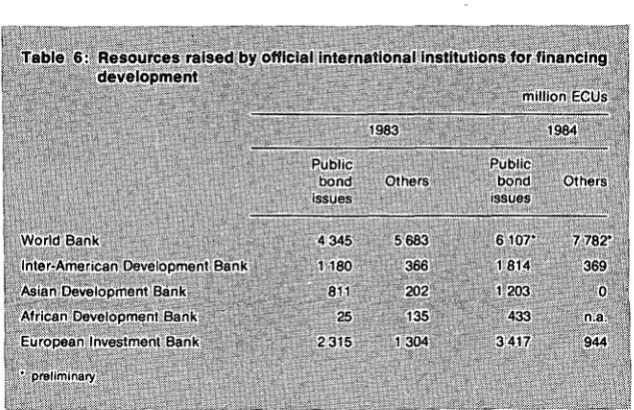
To the direct borrowing by develop-ing countries should perhaps be ad-ded that of international develop-ment banks such as the World Bank, Inter-American Development Bank, Asian Development Bank and Afri-can Development Bank. These banks raised about nine-tenths of the 11.4 bn ECUs included under "Other international organisations". Table 6 indicates that the amounts obtained through private place-ments by the same institutions also rose considerably in 1984 and al-most matched the amounts raised through public issues.
On the other hand, only about a tenth of the amounts borrowed by the EIB appearing at the bottom of the table by way of illustration would be destined for projects outside the European Community. Taking this into account, however, it would seem that in total between 18 and 19 billion ECUs would have been raised in 1984 through these international agencies for the ultimate benefit of developing countries.
International issues by sector
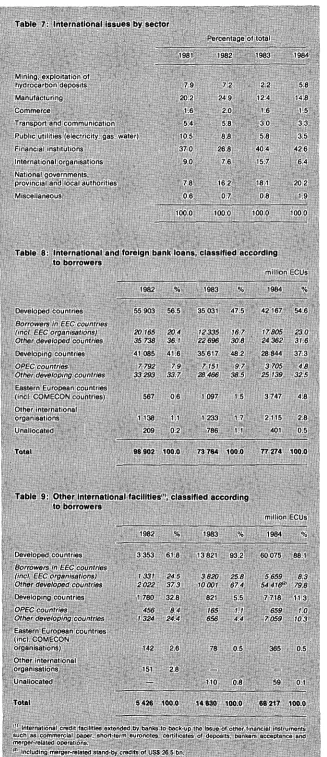
Table 7 shows that issues by finan-cial institutions continued to domi-nate in the pattern of international borrowing, amounting to 42.6% of the total market as compared with 40.4% in 1983. The increase re-flected the wider use of floating rate borrowing by financial institutions to obtain long-term funds and the expansion of swap related borrow-ing activities.
Heavier borrowing by American corporations and the general im-provement in the investment climate worldwide led to an increase in the funds raised by the manufacturing sector and by the mining sector. In contrast, the share of public utilities in international borrowing became smaller as declining energy con-sumption made cut-backs in large scale energy investment projects possible.
[image:8.588.213.540.30.787.2]The sharp decline in the share of the total market obtained by internation-al organisations took place from an exceptionally high 1983 figure which contained the large 4 bn ECUs bor-rowing by the EEC on behalf of France. On the other hand, the per-centage of Government and subsidi-ary authorities increased partly be-cause of efforts by these borrowers
Table 7: International Issues by sector
Percentage of total
Naming, exploitation of fiydrocarbon deposts Manufacturing Commerce
Transport and communication Public utilities (elecricity gas waten Financial institutions
International organisations National governments, provincial and local authorities Miscellaneous
1981
7 9 20 2 1 6 5 4 105 37 0 9 0
7 8 0 6
100.0
1982
7.2 24 9 2 0 5 8 8 8 26.8 7 6
162 0 7
100 0
1983
2.2 124 1 6 3 0 5 8 40 4 157
18 1 0 8
100 0
1984
5.8 148 15 3 3 3 5 42 6 6 4
20 2 19
100 0
Table 8: International and foreign bank loans, classified according to borrowers
million ECUs
Developed countries Borrowers in EEC countries (incl EEC organisations) Other developed countries Developing countries OPEC countries
Other developing countries Eastern European countries (mcl COMECON countries) other international organisations
Unallocated
Total
Table 9: Other international facilities'", classified according to borrowers
1982
55 903
20 165 35 738 41085
7 792 33 293
567
1 138 209
98 902
%
56 5
2 0 4 36 1 416
7 9 33.7
0 6
1.1 0 2
10Q.Q
1983
35 031
12335 22 696 35 617 7 151 28 466
1 097
1 233 786
73 764
l o
47.5
16 7 308 48 2 9 7 3 8 5
1 5
1 7 1 1
100.0
1984
42 167
17805 24 362 28 844 3 705 25 139
3 747
2115 401
77 274
%
54.6
23.0 3 1 6 37 3 4 8 3 2 5
4 8
2 8 0 5
100.0
million FCUs
1982 1983 1984
Developed countries Borrowers in EEC countries (incl EEC organisations) Other developed countries Developing countries OPEC countries
Other developing countries Eastern European countries linci COMECON
organisations) Other international organisations
Unallocated
Total
3 353 618 13 821 93 2 60 075 88 1
7 33/ 24 5 3 820 25 8 5 659 8 3 2022 3 7 3 10001 67 4 54 4 1 6 - 798 1 780 32 8
456 8 4 1324 24.4
142 2 6
151 2 8
821 5 5 165 1 1 656 4 4
78 0 5
110 0 8
7718 11.3 659 10 7 059 103
365 0 5
59 0 1
5 426 100.0 14 830 100.0 68 217 100.0
•nternatinnal credit facilitips oxtpncicd by banks to bnck-up thb issue o' otnpr tinjnnal instiumcr^tu such as comrporciat paper, short-term ouronotos cfrrtificntp;» of deposits bankers acceptanre and merqer-reiated operat.jns
to refinance older debt bearing high coupons at lower cost and partly because of the US Treasury and US agencies venturing into the interna-tional market for the first time to borrow the equivalent of 2.2 bn ECUs.
Internationally syndicated and foreign bank loans and other facilities
Traditional medium- and long-term credits arranged by banking syndi-cates (see Table 8) increased by much less than activity on interna-tional and foreign bond markets. Even this increase is more than ex-plained by the appreciation of the u s dollar — which is the main cur-rency — in terms of the ECU. If a correction is made for this appreci-ation, new business contracted by 7%.
The continuing debt problems of a number of Third World countries and the better foreign exchange position of others kept them away from credit markets and contributed to the decline in lending activity of international banking syndicates.
Loans signed by OPEC were more than halved as borrowing by Algeria almost disappeared and other mem-bers, with the exception of Qatar and Saudi Arabia, also reduced their borrowing. East European countries obtained credits for an amount more than three times that raised in the previous year. Main borrowers were the Soviet Union, East Germany and Hungary.
Borrowing through syndicated bank credits by countries around the Mediterranean Basin in which the EIB may lend declined by almost 25%. To the sharp reduction in Alge-rian operations was added a consid-erable drop in new borrowings by Yugoslavia as well as more modest declines for several other borrowers. Increased lending to Spain and Tur-key only partly offset the general decline. Lending to the signatories of the Lomé Convention was almost halved: while Papua New Guinea and Mauritius increased their bor-rowing. Borrowing elsewhere, par-ticularly in Nigeria, Cameroon and Trinidad and Tobago, fell.
Although the U.S. dollar remained by far the most important currency of denomination, the progressive érosion of its role continued. Re-flecting the increasing international-isation of the Japanese Yen and importance of Japanese banks in international finance, the proportion
8
of credits granted in Yen grew larger. A further notable develop-ment was the rising amount of new credits denominated in ECU which have placed it fourth after the US dollar, the Yen and the pound sterl-ing in this sector of the market. Among other currencies used in the granting of credits were principally the Swiss franc, the Deutsche Mark and the Australian, Canadian and Hong Kong dollars.
Against a background of a net re-duction in demand for credit and intensified competition between banking syndicates, spreads above reference rates tended to narrow, maturities to lengthen and commis-sions to diminish. A number of bor-rowers were able to negotiate re-scheduling packages in which the terms of the new credits were lower than on the original credits. A furth-er feature is that credits have in-creasingly been priced off LIBOR rather than the generally higher U.S. prime rate.
In contrast to the reduction in bor-rowing by the Third World, the take up of credits by developed countries was larger in 1984 than in the previ-ous year but might have been larger still, were it not for the sharp in-crease in other medium-term facilities favoured by first class cor-porate and sovereign borrowers be-cause of their lower cost. These facilities mainly consist of medium-and long-term lines of credit to back the continuous issue of short-term notes. The issues of notes have themselves met with good demand from banks and institutional inves-tors, particularly when launched by prirne sovereign and corporate bor-rowers. A few of such borrowers have proceeded to arrange multi-purpose cover which would enable them to activate a range of borrow-ing instruments accordborrow-ing to choice. Contrasting with the rapid development of such financing techniques in Industrialised coun-tries, the number of borrowers in developing countries granted back-up facilities has been small and re-stricted to those in relatively adv-anced environments such as of South Korea and Hong Kong.
If all forms of international borrow-ing are taken together, 1984 seen in retrospect was undoubtedly a year of rapid expansion in spite of more than usual uncertainty over the di-rection of interest rate movements and over the exchange rate for the dollar against all other major curren-cies. This expansion was made possible by a number of different elements, among which the main
were the adaptability of various sec-tors of the international market and those of national markets handling external lending in developing their methods of financing, the extent of the deregulation introduced by a number of monetary authorities and, on the demand side, the need for finance in an economic climate that seems to have been more buoyant not only in the U.S.A. but also in other industrialised countries than was first thought to be likely.
It is a little early to assess how far the changes in international borrowing which characterised 1984 are likely to progress or even persist. How-ever, the growth in borrowing through security, issues at variable rates of interest, as a means of com-pensating for interest rate uncertain-ty, extended over so many tech-niques and markets in 1984 that this type of borrowing could constitute a much larger part of the market than in the past, possibly making further inroads into the present role of inter-nationally syndicated credits.
ElB-INFORMATIOiM Is published per-iodically by the European Invest-ment Bank In seven different languages (Danish, Dutch, English, French, German, Greek and Italian). Material which appears In EIB-INFORMATION may be freely repro-duced; an acknowledgement would be appreciated and also a clipping of any article published.
700, bd Konrad Adenauer L-2950 Luxembourg tel. 4379-1 - telex 3530 bnkeu lu
telecopier 43 77 04 Department for Italy: Via Sardegna. 38 - 1-00187 Rome tel. 4711-1 - telex 611130 bankeu i
telecopier 474 58 77 Representative Office in Brussels:
Rue de la Loi 227 B-1040 Brussels
tel. 230 98 90 - telex 21721 bankeu b . telecopier: 230 58 27
Liaison Office for the United Kingdom:
68. Pall Mall London SWIY5ES
tel. 839 3351 telex 919159 bankeu g
telecopier 930 9929 Representative Office in Athens:
Odos Ypsilantou 13-15 GR-10675 Athens
tel. 724 9811 telex 222126 bkeu gr
telecopier 724 9814