This is a repository copy of The determinants of election to the United Nations Security Council.
White Rose Research Online URL for this paper: http://eprints.whiterose.ac.uk/129617/
Version: Submitted Version
Article:
Dreher, A., Gould, M., Rablen, M.D. orcid.org/0000-0002-3521-096X et al. (1 more author) (2014) The determinants of election to the United Nations Security Council. Public Choice, 158 (1-2). pp. 51-83. ISSN 1573-7101
https://doi.org/10.1007/s11127-013-0096-4
[email protected] https://eprints.whiterose.ac.uk/
Reuse
Unless indicated otherwise, fulltext items are protected by copyright with all rights reserved. The copyright exception in section 29 of the Copyright, Designs and Patents Act 1988 allows the making of a single copy solely for the purpose of non-commercial research or private study within the limits of fair dealing. The publisher or other rights-holder may allow further reproduction and re-use of this version - refer to the White Rose Research Online record for this item. Where records identify the publisher as the copyright holder, users can verify any specific terms of use on the publisher’s website.
Takedown
If you consider content in White Rose Research Online to be in breach of UK law, please notify us by
The Determinants of Election to the United Nations Security Council
Axel Dreher Matthew Gould
Heidelberg University University of Westminster
Matthew D. Rablen James Raymond Vreeland
Brunel University Georgetown University
June 2013
Abstract The United Nations Security Council (UNSC) is the foremost international body
responsible for the maintenance of international peace and security. Members vote on issues
of global importance and consequently receive perks – election to the UNSC predicts, for
instance, World Bank and IMF loans. But who gets elected to the UNSC? Addressing this
question empirically is not straightforward as it requires a model that allows for discrete
choices at the regional and international levels; the former nominates candidates while the
latter ratifies them. Using an original multiple discrete choice model to analyze a dataset of
180 elections from 1970 to 2005, we find that UNSC election appears to derive from a
compromise between the demands of populous countries to win election more frequently and
a norm of giving each country its turn. We do find evidence that richer countries from the
developing world win election more often, while involvement in warfare lowers election
probability. By contrast, development aid does not predict election.
Keywords: United Nations, Security Council, turn-taking norm, elections JEL: F53, F55, O19
Acknowledgements: For comments, we thank three anonymous reviewers and the editors of
1
1. Introduction
Endowed with the legal power to authorize whatever foreign policies it deems necessary to
maintain international peace and security, the Security Council has become the preeminent
organ of the United Nations (UN). It has the legal authority to suspend economic and
diplomatic relations between countries, impose blockades, and authorize the use of armed
force (see Voeten 2001; Hurd 2007; Chapman 2011). The body includes 15 members: the
five ever-present Permanent Members, and the ten Non-Permanent Members (NPMs), who
must win election to serve limited two-year terms.
Our study seeks to explain which countries win election to the United Nations Security
Council (UNSC) as NPMs. Note that at least four NPMs must vote in favor of a resolution for
it to pass, giving these members a central role on the world stage. The President of the
Security Council – a position that rotates among the members – has influence over the agenda
and the order of voting (Bailey and Daws 1998: 130-131). Most importantly, the UNSC votes
by open ballot so that the voice of an elected member has a global reach on central matters of
world security. Accordingly, some countries appear willing to bribe and reward NPMs. For
instance, the United States increases bilateral foreign aid by more than 50% when a country
serves on the UNSC (Kuziemko and Werker 2006). Also, NPMs become more likely to
receive World Bank project loans and International Monetary Fund (IMF) loans with
relatively soft conditionality (Dreher et al. 2009a; 2009b; 2010). Asian NPMs see their loans
from the Asian Development Bank rise around 30% (Lim and Vreeland 2013).
Understanding which countries receive these rewards can serve to inform longstanding
economic questions over the allocation and effects of foreign aid and IMF/World Bank loans
(see, e.g., Rajan and Subramanian 2008; Bueno de Mesquita and Smith 2010). Does the
UNSC election process direct these funds towards countries with particular characteristics?
2 Council is by no means random.” Yet, to our knowledge, no established study details the systematic determinants of election to the Security Council.1
The power to elect the NPMs formally rests in the hands of the United Nations General
Assembly (UNGA), which includes delegates from all UN member countries. Usually,
however, the UNGA vote serves as a mere ratification of decisions made by regional
caucuses, which play a privileged role in the nomination process. Only when there remains
disagreement at the regional level, which happens in about 20% of elections, does the UNGA
vote become meaningful. On these occasions, the interplay of two separate sets of
preferences – those at the regional level and those at the global level (the UNGA) – determine
election to the UNSC.
What shapes these preferences? To choose NPMs, the UN Charter calls on government
representatives to consider “the contribution of members of the United Nations to the
maintenance of international peace and security and to the other purposes of the
Organization.” In practice, however, matters are more complex. A detailed set of procedural
rules and at least two unwritten gentlemen’s agreements also shape the UNSC election
procedure. Moreover, UN Ambassadors appear to consider factors beyond contributions to
peacekeeping: political affiliations, economic strength, and foreign aid may all play a role.
For instance, Iceland’s sudden financial collapse in 2008 seemingly derailed what had
1 Bueno de Mesquita and Smith (2010) briefly analyze the determinants of UNSC membership with a probit
model, but the authors focus on the effects of membership. Region-specific studies have been published. Lim
and Vreeland (2013) use a logit model conditioned on year to examine the election of Asian countries. Scharioth
(2010) analyzes the election of Western European countries to various UN committees. Part of the work here is
based on our earlier working paper (Dreher and Vreeland 2009). Two other working papers on the election of
UNSC members that have been presented at conferences include Iwanami (2012) and Schmitz and Schwarze
(2012). Thorough qualitative accounts of the selection of specific UNSC members have been published, e.g.,
3 previously looked a secure candidacy, while US support for the candidature of Guatemala
appeared important in stymieing the rival candidacy of Venezuela in 2006. Cases such as
these might just represent idiosyncrasies, but they may also be part of a regular pattern. How
then should one go about investigating the systematic determinants of UNSC election?
To investigate discrete choice settings, scholars often employ the conditional (fixed effects)
logit model in which a single decision-maker chooses a single option according to utility
maximization (see McFadden 1973). The UNSC election process differs from this model in at
least two respects. First, as discussed above, up to two different sets of preferences can be in
play: the regional and the global. Second, in some election years the UNGA regularly elects
two candidates from one region, not just a single candidate. We therefore develop a
multiple-discrete choice model that extends the conditional logit model to allow, in a simple way, for
the separate identification of two intermingling sets of preferences, and for the number of
choices from the set of alternatives to vary (from zero to two).
Our empirical analysis of election to the UNSC considers five broad theoretical questions: (i)
Does the UNGA follow a norm of choosing countries committed to peace, as directed by the
UN Charter? (ii) Does the receipt of foreign aid predict UNSC election? (iii) Is election
driven by international power or close relationships with powerful countries? (iv) Do cultural
traits play a role? (v) Do governments practice a turn-taking norm of sharing seats by rotating
through the eligible candidates? The last question derives from the common misconception
that membership on the UNSC “rotates” through the full UN membership roster. Formally,
membership does not rotate, but in practice the regional groups and the UNGA might follow
such a norm.
Analyzing data on UNSC elections between 1970 and 2005, we find some evidence of a
commitment to peace. At least countries engaged in intra- or inter-state conflict since the end
4 Caribbean. There is also a positive link between troop contributions to UN peacekeeping
missions and election from Africa and Asia.
As for international power, all regions except Eastern Europe exhibit some evidence of a
preference for populous countries. We also find evidence that richer countries, measured by
gross national income (GNI) per capita, enjoy an advantage in Africa, Asia, and Latin
America.
We find only patchy, and somewhat mixed, evidence that foreign financial support
determines election. US development assistance does not predict election from the
developing world, and US military support similarly plays little role in regional decisions.
When the UNGA votes, however, countries that receive US military assistance – as opposed to development aid – are more likely to win election.2
Political-cultural factors appear to hold occasional influence within regions. Governments
that share a common political ideology with their region are more likely to be elected from
Eastern Europe and Latin America, but not from other regions. Colonial legacy also has
mixed effects. A British colonial legacy helps in Asia, Latin America, and Western Europe
but not in Africa. Corruption also has inconsistent effects. It pays off only in Africa and Latin
America, and the effect in Africa is of marginal statistical significance. In contrast to these
findings, the UNGA as a body has shunned corrupt countries since the end of the Cold War.
Indeed, our results suggest the presence of significant heterogeneity in the determinants of
UNSC election across regions. Therefore, while culture and history have marginal and
inconsistent effects within regions, they may drive substantial differences across regions.
2 Strictly speaking, US military aid does not count as official overseas development assistance, according to the
5
“Turn-taking” stands as the only finding that holds across all regions and time periods
without exception. A country whose turn arrives is more likely to receive regional
nomination, which accords with the common “rotation” perception. These regional turn-taking rights do not, however, hold sway in elections contested at the UNGA level.
The results of this study contribute to the ongoing discussion of UNSC reform, which centers
on the question of representation but lacks a systematic study of membership (see Hosli et al.
2011). Our analysis also connects to the literature on leader selection (e.g., Hamermesh and
Schmidt 2003, Besley and Reynal-Querol 2011). Importantly, we further contribute a generic
econometric model of elections wherein there is a nomination process at one level and an
endorsement vote at another (also see Glasgow et al. 2012 and Golder et al. 2012).
The paper proceeds as follows. Section 2 outlines the UNSC election process, and Section 3
presents various hypotheses about the determinants of election. In Section 4 we formally
develop the econometric model, providing a likelihood equation for UNSC election, and
discuss important methodological details. Section 5 presents the results, and Section 6
concludes with some implications of our main findings.
2. The election process
The UNSC election process for NPMs follows certain rules and agreements.3 The ten NPM
seats are divided among five regional caucusing groups: one country from Eastern Europe
(EE); two from the Western European and Others Group (WEOG); two from the Latin
America and Caribbean Group (GRULAC – el Grupo Latinoamericano y Caribeño); and five
3 Some background for this section comes from Security Council Report, an independent not-for-profit
6 from Africa and Asia.4 An unwritten, but unbroken, gentlemen’s agreement divides the five seats for Africa and Asia into three seats for Africa and two seats for Asia. Around 1968, a
further unrecorded agreement between Africa and Asia reserved one of their five seats for an
Arab state, with the regions taking turns every two years to provide a suitable candidate
(Security Council Report 2011: 7). This seat is often called the “Arab swing seat.”
The UNGA conducts staggered elections for five seats every autumn. Terms begin the
following January.5 To be eligible for election, a country must, first, belong to one of the five
regional caucusing groups. Prior to 2000, when it gained temporary membership in the
WEOG, Israel was not a member of any group (Security Council Report 2011: 6); and
Estonia, having joined the UN in 1991, did not become a member of the Eastern European
(EE) caucus until 2004 (Estonia 2011) while it awaited the outcome of an (ultimately
unsuccessful) application to the WEOG (Daws 1999). The small island-country of Kiribati,
which has never designated a permanent representative to the UN, is the only country to
presently have no group affiliation (UN 2012). Second, NPMs in the final year of their terms
cannot run for immediate re-election (UN Charter 23(2)).
4 The “others” in the modern-day WEOG include descendent countries of Western Europe, mainly from the
British Commonwealth: Australia, Canada, and New Zealand. The United States also caucuses with this group,
as do Turkey and, more recently, Israel (see, e.g., Security Council Report 2011). Before 1966, there were only
six elected UNSC members. See Daws (1999) for the development of the UN regional groups.
5 The Eastern European term begins in even years. The two WEOG terms begin in odd years. The GRULAC
and ASIA stagger their two terms; the UNGA elects one from each of these groups every year. Africa’s three
terms are also staggered: two begin in even years and one in odd years. The Arab term (shared between Asia and
7 Countries may declare candidacy by notifying the chairman of their regional group.6 Before
voting begins in the UNGA, the chairman of each group announces the countries that have
declared candidacy (the chairman’s list).7 Although details of the regional negotiations are scarce, there appears to be a preference for the choice of NPMs to be kept “in house,” insofar
as is possible. The vote in the UNGA is, as a result, usually sidelined by regional groups
offering a “clean slate,” whereby the chairman announces only as many candidatures as seats available. Contested elections, when the chairman announces more candidatures than seats
available, appear to occur when efforts at agreement at the regional level have failed.8
Africa appears to have the most disciplined rules for selecting candidates.9 It operates a
system of turn-taking within sub-regional groups, which should, in theory, ensure that all
countries in Africa eventually serve on the Security Council.10 Even here, however, the
situation is more complex than might first appear. According to the independent
6 We know from the UNGA’s minutes that group chairmen stand up in sequence before the vote and announce
the group’s candidates. The chairman position rotates among the region members, and terms last one month. See
various issues of the Journal of the United Nations for details on specific elections
(http://www.un.org/en/documents/journal.asp, accessed 5 April 2012).
7 Sometimes countries announce their intention to run years in advance. Other times they do so much later, even
in the midst of elections. The timing of such announcements appears idiosyncratic, and data are not available.
8 For the 36 election-years (1970-2005) we analyze, the WEOG is the most competitive group, with nine
contested elections, and EE is the least competitive, with just five. As we detail further in footnote 23, we define
an election as “contested” if an additional candidate receives ten votes or more. Using this threshold, there are a
total of 36 “contested” elections out of 180 total elections, or 20%.
9 Africa is the only region for which we have found explicit rules, codified by the African Union in their “Rules
of Procedure of the Ministerial Committee on Candidatures within the International System – Doc. EX.CL/213
(VIII).” See African Union (2006: 8).
10 North Africa and Central Africa rotate one seat every two years; Western Africa has one seat every two years;
8 profit organization known as Security Council Report (2011: 6) there are at least three
complications. First, some countries that straddle more than one sub-region have shifted from
one to another. Second, challengers can emerge within the same sub-regional grouping,
upsetting the rotation.11 Last, within a subgroup, some members may choose to run more
often, while others choose, or are persuaded, to run less frequently or not at all.
To win election, a country must receive at least two-thirds of the votes in the UNGA (UN
Charter 18(2)). In theory, members of the UNGA face no requirement to vote for “chairman’s
list” countries, though in practice they seldom do otherwise (save for isolated protest votes). Therefore, to date, after a chairman has announced a “clean slate” the UNGA has almost
always ratified the regional selection. When there are multiple candidates, if no candidate
meets the two-thirds threshold for a specific regional seat, the UNGA holds runoff elections,
allowing any country from the region to enter the subsequent elections (and allowing write-in
candidates on ballots). Runoff elections for remaining seats continue until all seats have been
filled by countries winning two-thirds of the UNGA votes. On rare occasions, no country has
garnered the required two-thirds majority after many rounds. In these cases, the leading
candidates have withdrawn, ceding the election to a compromise candidate.
3. Hypotheses
Who wins election to the UNSC? Bueno de Mesquita and Smith (2010) present a cursory
examination of this question using a simple probit model in an effort to show the exogenous
11 According to the Security Council Report (2009: 6), such queue-jumping occurred three times in the sample
period: Ghana queue-jumped Liberia in 1985, and Nigeria queue-jumped Niger in 1977 and Guinea-Bissau in
1993. In the last case, Rwanda and Guinea-Bissau had been nominated for the two African seats. Rwanda
garnered sufficient votes (153) in the first round to win election, while Guinea-Bissau received only 82 votes, at
9 nature of UNSC membership selection for their study of the effects of membership.12 No
published study has presented, however, a tightly focused examination of the question of
UNSC election using quantitative methods. In the next section, we offer the main
contribution of our paper: a multiple-discrete choice model to examine the joint determinants
of UNSC election at the regional and global levels. First, however, we draw on the broad
literature in international relations and political economy, as well as qualitative accounts of
UNSC election, to develop the testable hypotheses that we apply to our statistical model.
We begin with the UN Charter, which asks members of the UNGA to elect UNSC members
on the basis of their contributions to the maintenance of international peace and security. We
thus test the impact of the contributions that countries make to UN peacekeeping missions,
measured as the log of the number of troops supplied. We also include an indicator variable
for countries involved in intra- and/or inter-state conflict. We further test for an effect of
democracy, which is often associated with openness, justice, and peace.13
Two further hypotheses reflect the political economy literature. A growing body of work
shows that countries receive perks from UNSC membership, including US foreign aid (e.g.,
Kuziemko and Werker 2006), World Bank projects (Dreher et al. 2009a), and IMF programs
with comparatively soft conditionality (Dreher et al. 2009b, 2010). If these same perks that
result from UNSC membership were also found to predict UNSC membership, this would
point to the presence of development cycles whereby countries that gain election receive
perks that, in turn, increase their prospects of future election. To test this possibility, we
12 Bashir and Lim (2013) challenge this assumption.
13 On the association of democracy with openness, see Hollyer et al. (2011). On the association with justice see
Dowding et al. (2004). On the general proclivity of democracies to peace, see Russett and Oneal (2001). For a
10 consider whether US economic and military assistance, IMF program participation, and the
number of new in-country World Bank projects, predict election to the UNSC.14
If countries expect perks from membership on the UNSC, then perhaps more heavily
indebted governments push harder to be elected. Or causality may run the other way: perhaps
when governments anticipate that they will be elected to the UNSC, they allow their
countries to go deeper into debt, anticipating a bail-out on the horizon. Either way, levels of
indebtedness may predict UNSC membership. We test this hypothesis using debt service as a
percentage of gross national income.
If UNSC membership is valuable, heavily indebted countries may well desire membership,
but they may not be in a strong position to win. Stiff competition for UNSC seats may lead
the most powerful countries to win election most often. Having worked with the Canadian
government in their successful 1998 election bid, Malone (2000) notes the importance of
campaign funds. Canada, for example, apparently spent $1.3 million. Scharioth (2010) argues
that “realist” variables measuring a country’s power predict election to a wide range of UN
committees, at least for the WEOG. To test the impact of a country’s strength, we consider
14 IMF programs themselves come in cycles (Conway 2007). Omitting participation in IMF programs might thus
bias our results in favor of finding a turn-taking norm. A substantial literature argues that IMF and World Bank
loans might be given for political-economic reasons rather than need (e.g., Kilby 2009, 2013; Reynaud and
Vauday 2009; Stone 2002). As for bilateral foreign aid, we limit our attention to the US role for two reasons: (1)
its prominent place – both in quantitative magnitude and in the literature and (2) parsimony. If we include
foreign aid from all potential countries, degrees of freedom become low in certain regions. Preliminary analyses
of foreign aid patterns from other OECD countries did not reveal any statistically significant correlation with
UNSC election. We suggest that more in-depth analyses –for example Japan’s use of foreign aid to win favor –
11 three measures: population size (logged), per capita income (logged, measured in constant
US$), and territorial size (logged).15
A government’s connections to powerful countries might also affect its election prospects.
We measure international connections in four ways. First, we include two variables to capture
how frequently each country votes in the UNGA with the United States and USSR/Russia,
respectively. Second, we include an indicator for countries with “pariah” status in the eyes of one or more of the major powers, and hence subject to US and/or UN sanctions, as defined by
Morgan et al. (2006). Third, we test whether the membership of various political groupings
that operate within the UN – the Group of 77 (G77), Non-Aligned Movement (NAM),
Organisation of Islamic Cooperation (OIC), and JUSCANZ (a subset of the WEOG including
Japan, the United States, Canada, Australia, and New Zealand) – predicts UNSC election.16 Last, membership in other non-UN groupings may also be important, so we allow for an
effect of membership in the European Union (EU) and NATO.
Cultural affinity may also matter. The variables we use to test the influence of culture include
the percentage of the country that is Muslim or, alternatively, Catholic. We also test if a
history of British or French colonization plays a role.17 Beyond religious and historical
15 We use GNI/capita, as opposed to the more common GDP/capita, as it is the income measure used by the UN
in the computation of member state contributions to the General and Peacekeeping budgets. We also follow the
UN’s methodology in using US$ exchange rate estimates of GNI. International, rather than domestic,
purchasing power is more relevant in this context.
16 Because of substantial overlap in membership between G77 and NAM, indicator variables for membership in
each cannot be included in the same regression equation. Instead we create three separate indicator variables:
one for countries that are members of both groupings, and one for countries that are members only of NAM or
only of G77, respectively.
17 Since it impacts foreign aid, UNSC membership may be a channel by which colonial history affects
12 affinities, we test the importance of political affinity within the region, measuring the
percentage of the region with which the chief executive shares the same broad political
ideology (either left, center, or right).18 We also consider another variable that may be related
to culture: the level of corruption associated with a country. On the one hand, perceived
corruption may hurt if regions and the UNGA disdain such countries. On the other,
corruption may help if such countries willingly disregard norms of turn-taking, jumping the
queue while paying whatever bribes necessary to win support.
Finally, behavioral norms that have evolved within the decision-making process may also
play a role. One such norm, which is observed in human evolution as well as in a wide range
of other species, is turn-taking (Colman and Browning 2009; Franz et al. 2011). In the
context of the UNSC election process, the turn-taking norm implies that membership on the
UNSC should rotate among the members of each caucusing group. This turn-taking norm
relates to the egalitarian norm, which features importantly in the literature on distributive
justice (e.g., Rawls 1971) and is consistent with recent models of inequity-aversion (e.g.,
Fehr and Schmidt 1999).
The Africa group explicitly claims to operate according to the turn-taking norm, but whether
some degree of turn-taking actually occurs among the remaining regions is less clear. To test
the possibility that a region practices the turn-taking norm, we construct a variable, “turn -taking,” which is calculated as the number of years a country has waited to serve on the
18 We calculate the percentage of the region according to the number of the countries in the region – minus the
country in question – sharing the same ideology (left, center, or right). The variable is coded zero for
13 UNSC divided by the number of countries currently eligible for election.19 If the turn-taking
norm holds, this variable should be positively correlated with election.
Thus, we consider five broad perspectives: (i) a commitment to peace, (ii) a foreign aid story,
(iii) a realist international relations perspective, (iv) a cultural approach, and (v) a turn-taking
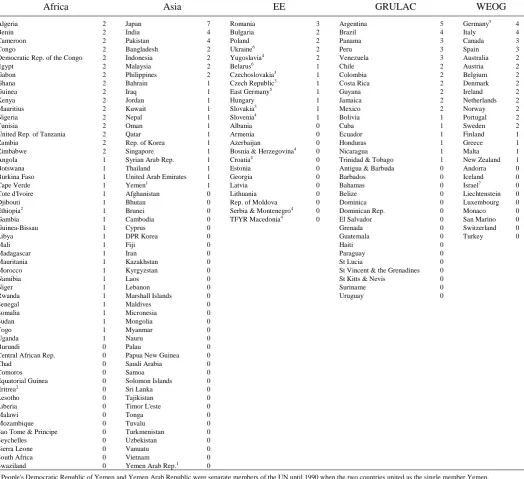
norm. Table 1 summarizes our hypotheses and the variables we use to test them along with
their sources.
4. Econometric Model and Methodology
4.1 Preliminaries
Let the set of members of the UNGA in year t be decomposed into the set of member
countries with permanent member status (PM) and the set of all other “ordinary” member
countries. Denote J =
{
Africa,Asia,EE,GRULAC,WEOG as the set of caucusing groups}
(regions), and let the set of ordinary member countries belonging to region j in year t be
denoted Rjt, where t {0,…,T}. We let Rj = t Rjt denote the set of all past and present
members of caucusing group j, and we define Cij as the ith country within Rj.20 The set of
ordinary member countries belonging to a caucusing group in year t (a necessary condition to
19
Using the model, which we present in the next section, we tested several possible measures of a turn-taking
norm against a benchmark of perfect turn-taking. In a given year, let ti denote the number of years since country
Cij was last elected to the UNSC (or since it entered the UN, if no such instance), t denote the mean of ti, and
denote the number of countries, excluding Cij, eligible for election. The measures we considered were: (1) ti; (2)
ti / ; (3) ti - ; (4) 1{ti> t }; and (5) (ti - t )1{ti> t }, where 1{A} is the function taking the value 1 if condition A is
true and 0 otherwise. We found the second of these measures to be best suited for capturing turn-taking effects.
20 Our analysis accounts for the creation of new nations and the disappearance of existing ones. These events
change the sample size, which complicates the calculation of the marginal effects. We discuss this issue in depth
14 serve as a NPM in year t + 1) is therefore Rt = j Rjt.
Let NPMt denote the set of NPMs on the UNSC in year t, then the UNSC in a given year, t, is
defined by UNSCt = NPMt PM. In any given year a set of ordinary member countries –
NPMs in the first year of their terms – gain automatic membership on the UNSC in the following year: At = NPMt \ NPMt – 1. A second set of ordinary member countries, those that
are in the final year of their terms on the UNSC, are ineligible for election to the UNSC in the
following year: It = NPMt NPMt – 1. The remaining ordinary member countries are eligible
for election to the UNSC in the following year: Et = Rt \ NPMt. Last, historical data on
non-permanent membership of the UNSC are summarized by the indicator variable dijt, where dijt
= 1 for Cij NPMt.21
4.2 Preferences
Denote the utility to the members of region j from electing country Cij in period t to the
UNSC (to serve in periods t + 1 and t + 2) as uijt = jxijt, where xijt contains the characteristics
of Cij in year t and j contains the preference weights of region j. Similarly, denote by uGAijt =
GA
xijt the utility to the members of the UNGA of electing country Cij in period t.
Election to the UNSC can be conceived of as a two-stage process. In the first stage, the
regional groups make nominations, resulting in the chairman of each region announcing to
the UNGA a set of candidate countries Njt Ejt for election to the UNSC. In the second stage,
the UNGA votes. As discussed in Section 2, because members of the UNGA almost always
choose to vote for members of Nt, the vote in the second-stage can be viewed as taking place
over these countries only.
One approach to estimation is to model this two-stage process explicitly (see, e.g., de Vries et
15 al. 2009). The resulting likelihood function is complex, however, and often fails to converge
in estimations that include more than a few variables.
Instead, we simplify the problem in two important ways. First, we treat the decision-maker in
the first stage (the region) as myopic. That is, the region’s selection does not depend on how
the UNGA will act. To allow for strategic interdependence would make our model
intractable. Moreover, we suspect that regions do not act strategically in proposing
candidates, although we acknowledge that individual countries have made strategic decisions
to enter – or not to enter – specific elections.
Second, we treat the actors in each stage as unitary decision-makers. We make this
simplification because we are interested in a country’s overall chance of election onto the
UNSC. Our reduced-form representation of the real election process should be a good
approximation because the vast majority of elections result in landslides for the winning
candidate. Regions tend to operate by consensus while the two-thirds majority rule in the
UNGA tends to produce a single dominant candidate – with some exceptions. These
exceptions notwithstanding, our decision to model each collective decision-maker as a
unitary actor allows us to construct an estimable model that proxies the typical election
process fairly well. Future work might explore modifications to one or more of these
assumptions.22 One could, for instance, model the UNGA as a collective and estimate how
many votes the candidate-countries receive.
Under these assumptions we may employ a simple mathematical formulation to capture the
idea that election to the UNSC may be co-determined by two separate sets of preferences:
those of the caucusing group (which shape the nominations) and those of the UNGA (which
votes over nominated candidates). Specifically, we model UNSC election as arising from a
16 composite latent utility function, U, of electing Cij at time t, given by
Uijt jtuijtGA
1 jt
uijt ijt, (1)which is a weighted average of the underlying regional and UNGA preferences, plus a
stochastic component ijt. The parameter jt [0,1] measures the weights attributable to the
preferences of the UNGA, and may vary by region and year. In particular, we relate jt to the
size of Njt. If |Njt| equals the number of eligible seats, njt, the UNGA merely “rubber stamps”
the clean slate of nominations from the caucusing group, and its preferences play no role ( jt
= 0). At the other end of the spectrum, if |Njt| = |Ejt| (every eligible member of a region is
nominated to the UNGA), the regional preferences play no direct role, thus jt = 1. We
assume that jt adjusts linearly between these two extremes: jt = (|Njt| – njt)(|Ejt| – njt)–1.23
4.3 Election Probabilities
We view the elections to the UNSC as choosing, for each region, njt {0,1,2} countries from
the set of eligible countries according to the utility function Uijt, where njt = |NPMjt| – |Ajt|.
This setting extends the well-known choice model of McFadden (1973) in two important
23 We compute
jt using Costa Rica (2005), which contains full UNGA voting records for all UNSC elections
prior to 2004. Voting records for 2004 onwards come from the relevant UNGA minutes. Costa Rica (2005) does
not explicitly identify the “chairman’s list” countries. In the overwhelming majority of elections, the patterns of
voting in the UNGA clearly identify the “chairman’s list” countries (who garner large numbers of votes) from
countries that merely are recipients of votes cast in protest or error (who garner only one or two votes). In a
small number of cases, the voting patterns identify the “chairman’s list” countries less clearly, as a country
garners an intermediate number of votes between five and 15. In these cases we identify the set of “chairman’s
list” countries as those that received ten or more votes. Our main results are, however, robust to lowering the
threshold down to three votes (thereby counting more elections as contested). Obviously as we employ higher
thresholds than ten, there are fewer and fewer elections counted as contested and eventually the model does not
17 respects. First, the set of alternatives is time varying. This occurs because (i) countries move
between the sets (Ajt,Ejt,Ijt) from year-to-year as a result of the realizations of dijt; and (ii)
entry and exit from Rt, principally as new members join the UN and others leave.24 Second,
the number of members to be chosen from Ejt is also time-variant, and need not be unity.
The tractability of McFadden’s model is lost when, as in the UNSC, more than a single
alternative is chosen simultaneously. To retain tractability, we therefore model election by the
UNGA as a sequential process, in which countries are elected one-by-one. This methodology
develops that of Manski and Sherman (1980), who use a multiple-discrete choice model to
examine household car purchases. Whereas a family may buy two of the same car brand,
however, a country cannot have dual membership on the UNSC in any year, so we must
explicitly rule out this possibility. Formally, in each of njt rounds, there is a new realization of
and a single country from Ejt is elected according to utility maximization (dijt = 1 Uijt >
Ukjtki). In the case when njt = 2, if the same country is elected in both rounds, the result is
annulled and the whole process repeated until two distinct countries are selected.
If we assume, following Manski and Sherman (1980), that the ijt in equation (1) are
independent across regions and time and have identical type-1 extreme value distributions,
we then have that: 25
Pr
dij,t1 1|CijAjt
1; Pr
dij,t1 1|CijIjt
0; (2)pijt0 Pr
dij,t1 1|CijEjt,njt 0
0; (3)
24 In the sample period 68 countries joined the UN, and four (Czechoslovakia, East Germany, Yemen Arab
Republic, and Yugoslavia) left. Table 2 provides further details.
25 Elections are not independent across time, however. Each year’s election depends on the outcome of the
18
ijt jt GA ijt jt E C ijt jt GA ijt jt jt jt ij t ij ijt u u u u n E C d p jt ij 1 exp 1 exp 1 , | 1 Pr , 1 1; (4)
. 1 1 2 2 , | 1 Pr 2 1 1 1 1 , 2 ijt E C ijt ijt jt jt ij t ij ijt p p p n E C d p jt ij (5)
When only one seat is contested in a region, the distributional assumptions on ijt imply that
the probability in equation (5) of a single country being elected to the UNSC from Ejt follows
the conditional logit form.26 We then use pijt1 to form equation (6) as the binomial probability
of observing a distinct country pair containing Cij, where the denominator corrects for the
impossibility of a single country obtaining dual membership. Note that, by construction,
∑CijEjt pijt
njt = n
jt. Equations (2) and (3) require no further explanation.
Using equations (1)-(5) the likelihood of having observed a given NPMjt of size njt (Lijtnjt) is
therefore
Ljt0 =1; Ljt1 = pijt1 ; Ljt2 =
1 2 1 1 2 ijt E C NPM C ijt p p jt ij jt ij
;where Ljt2 uses the relevant multinomial distribution to compute the joint probability of having
observed a given country pair. The likelihood function for having observed
{
NPMt : t {
1,…,T}
}
is then
26 These distributional assumptions are strong but necessary to retain the conditional logit form. Also, when
estimating the final likelihood in equation (6), we can allow for the possibility of within-group clustering.
Because we model the probability of choosing Cij in year t as conditional on the number of eligible countries in
year t, our model, like the original conditional logit, implicitly addresses fixed effects for year. For an approach
19
. log log
1
jt
n jt T
t J j
L
L
(6)
4.4 Imputation
Fewer than 3% of our data points are coded as missing, yet a significant number of
years are incomplete for at least one variable (2,853 of 5,330). Dropping incomplete
country-years is problematic for both theoretical and practical reasons. From a theoretical perspective,
as the probabilities of election in equations (4,5) are functions of the characteristics of every
member of the eligible set, artificially excluding a country-year biases the estimates for the
remaining countries in that year. From a practical perspective, the sample size becomes
unduly small for some regions, leading to a failure of model convergence.
We therefore employ multiple imputation techniques (with ten imputations).27 We impute
continuous variables using a truncated regression (to preserve, e.g., non-negativity
constraints) that includes as independent variables all those that are fully observed. We
similarly impute IMF program participation (the only binary variable with missing
observations) with logit.
4.5Preference change
Preferences, both regional and global, may change over time. In particular, Kim and Russett
(1996) present evidence of a shift in preferences around the end of the Cold War: voting
patterns in the UNGA shifted from an East-West orientation towards a North-South
orientation.28 Accordingly, we consider two distinct time periods – during and after the Cold War, where we deem the Cold War to end in 1989. We report separate estimates for these
27 The variables with missing values are: United States and Russia voting in the UNGA; debt service; shared
regional ideology; control of corruption; and IMF program participation.
20 two periods for variables where the effects for each period differ.
4.6Country-specific effects
We would like to control for country-specific effects, as outlying countries that exhibit an
idiosyncratic effect might drive some results, and obscure others. Indeed, as is observed by
Schwartzberg (2003) and Zacher (2004), the UNSC membership data in Table 2 do contain
some surprises. In particular, these studies highlight Saudi Arabia, which has never served on
the UNSC, or even been nominated, and Panama, which has been a UNSC member unusually
often – it served three terms on the UNSC in the sample period (only Brazil and Argentina served more for GRULAC). We are also aware of the case of Mexico, whose participation in
the UNSC elections of 2001 marked the end of two decades during which it had adopted a
policy of not seeking election to the UNSC (Malone 2000: note 7).29
A complication is that a country-specific effect, if present at all, may exist at either the
regional or global (UNGA) level, or at both levels. We therefore allow separately for
country-specific effects at the regional and global levels.
4.7Model selection
The discussions above imply that there is a vector of explanatory variables x = (s,s × w,c,r)
we would like to use to explain UNSC election, where s denotes the vector of substantive
variables relating to the hypotheses discussed in Section 3 (see Table 1), s × w denotes the
vector of interaction terms between each substantive variable and a Cold War indicator
variable, c is a vector of country indicator variables to be included in the region utility
function, and r is a vector of country indicator variables to be included in the UNGA utility
function. Estimating this “full” model is infeasible, however, for x contains some 436
29 For more on the Mexican case, see, for example, Serrano and Kenny (2006: 298-314). We are grateful to
21 variables, which exhausts the degrees of freedom for certain regions in the earlier years.
Instead, we adopt a model selection procedure that chooses a subvector of the explanatory
variables for inclusion in the model. Our approach to model selection reflects a number of
factors. First, because the full model cannot be estimated, backward-looking approaches
cannot be applied. Second, because of the large number of explanatory variables, methods
based upon computing a reasonable criterion for all possible subsets of x are also infeasible.
These two considerations point to a forward-looking approach. As our model is non-linear,
however, popular forward-looking algorithms for linear regression, such as the least absolute
shrinkage and selection operator (Tibshirani 1996) and least angle regression (Efron et al.
2004), are inapplicable.
We therefore employ a stepwise forward selection procedure that, in each stage, selects one
additional variable into the model. In each stage, all elements of x not already selected into
the model are added individually and the t-statistic of each variable is recorded. The variable
recording the highest t-statistic is added to the model (and a new stage commenced) if it
records statistical significance at the 10% level. Otherwise, the procedure ends.
We employ this model selection procedure to select two independent models. Model 1 is
intended to provide a broad-based analysis of UNSC election in the presence of a full set of
control variables. It is selected under the a priori assumption that the elements of s belong to
the model, such that the model selection procedure is applied only to the selection of Cold
War interactions and regional and global country-specific effects. Model 2 is a test of the
robustness of the substantive variables with respect to model selection, for it is selected
without a priori assumptions on inclusion.
A subtlety that arises in the selection of Model 2 is that it is possible that the interaction
22 substantive variable itself is not. Because the interaction variable takes the value of the
substantive variable during the Cold War and zero thereafter, this implies that the substantive
variable is, in effect, included in the model for the Cold War period only. As it stands,
however, there is no means for the selection procedure to include a substantive variable in
only the post-Cold War period. In selecting Model 2, we therefore augment x with a further
vector, s × (1 – w), which contains the interaction between each substantive variable and a post-Cold War indicator variable.
We also note that, because of the different assumptions maintained in selecting the two
models, it is not, in general, expected that the variables selected into Model 2 will form a
proper subset of those selected into Model 1. Also, although every variable selected into
Model 2 shows statistical significance at 10% or better in the stage where it is selected, in
some cases variables already included in the model may gradually lose statistical significance
as further variables are included. Some variables may, therefore, not show statistical
significance at the 10% level in the final model.
5. Results
We present two sets of results, both of which are estimated using the likelihood function in
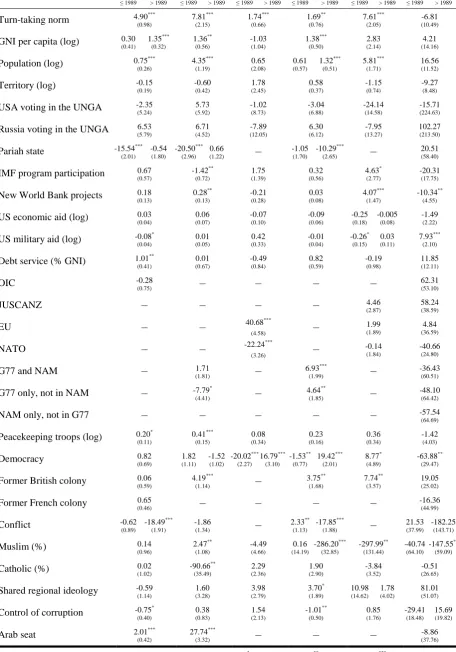
equation (6) for UNSC elections between 1970 and 2005. The first set (presented in Table 3a)
results from the procedure for Model 1 and thus includes the full set of control variables, as
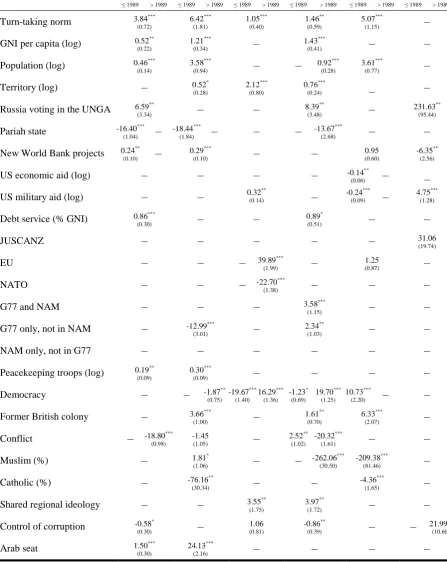
described in the previous section. The second set (presented in Table 3b) results from the
procedure for Model 2 and thus includes the more robust findings, again, as described in the
previous section. To match the timing of the election process, we lag the independent
variables by one year relative to UNSC membership. We report robust standard errors,
within-23 region and within-year correlation, respectively, and for heteroscedasticity.30 We control for
the operation of the Arab swing seat by including an indicator for Arab countries eligible for
election to the seat in a given year (see Table 1).
The model selection procedure described in Section 4.7 selects 17 Cold War interaction
effects into each of Models 1 and 2, although note that these 17 effects differ between
models. In Table 3a, cases where a Cold War interaction is selected show two separate
coefficients side-by-side in the relevant column. The left-side coefficient is only for the
period during the Cold War, and the right-side coefficient is only for the post-Cold War
period.
To present the results in this form, we re-analyzed the final selected model, and, instead of
including the substantive variable alongside its interaction variable, we include instead the
two interaction variables associated with the substantive variable – one for the interaction
with the Cold War indicator and the other for the interaction with the post-Cold War
indicator. The coefficients for these two interaction variables are those reported in Table 3a.
Hence, the estimated coefficient we obtained for the Cold War interaction variable when
included alongside the substantive variable corresponds to the difference between the two
coefficients we report.31 The interpretation of the results in Table 3b is similar. However,
when the selection procedure chooses either the Cold War interaction variable or the
30 As in other contexts, we are unable to adjust the standard errors for the effective degrees of freedom used by
the model selection procedure itself. As such, it is appropriate to urge caution in the interpretation of findings on
the margin of statistical significance at conventional levels. We note the necessity of such model selection,
however, given the weak steer provided by theory, and the number of potential explanatory variables.
31 We do not include a separate Cold War intercept because the conditional logit model has the property that any
variable that takes the same value for every country in a group in a particular year (like the Cold War indicator)
24 Cold war interaction variable but not the associated substantive variable, two coefficients
appear side-by-side, of which one is missing.
The model selection procedure also selects a regional country-specific effect for 16 countries
into Model 1, and a global country-specific effect for nine countries.32 We include indicator
variables for these countries in the model of Table 3a, though, for reasons of space, we do not
report their effects in the table.33 As well as selecting the known outliers discussed in Section
4.6, the other countries identified as possible outliers include Nigeria, an African country that
has pursued an overt policy of queue-jumping (Security Council Report 2009: 6).
As discussed previously, the country-specific effects selected into Model 2 need not
correspond to those of Model 1. In practice, however, we observe a high degree of
congruence: each of the 16 region country-specific effects allowed for in Model 1 are also
selected into Model 2; only one global country-specific effect not selected into Model 1 is
selected into Model 2 (the Philippines); and only one global country-specific effect selected
into Model 1 is not selected into Model 2 (Egypt).
Before discussing the results, we stress special caution in interpreting the results for Eastern
Europe and for the UNGA because of the limited number of observations that each includes.
The EE group contains the fewest countries and the most imputed data. And only 36 out of
the 180 elections in our sample are contested in the UNGA.34
32 The regional country-specific effects we allow for are (by region), Africa: Benin, Guinea, Madagascar,
Malawi, South Africa, Zimbabwe; Asia: India, Japan, Nepal, Philippines, Saudi Arabia; EE: Bulgaria; the
GRULAC: Costa Rica, Mexico, Panama; the WEOG: Austria, Belgium, Switzerland. We allow for a global
country-specific effect for Australia, Austria, Burkina Faso, Egypt, Greece, Madagascar, Romania and Slovakia.
33 These are available in the replication materials.
34 The estimates for the UNGA in Tables 3a-b seem of a different order of magnitude than the estimates in the
25
5.1 Commitment to peace
Turning to the results, we hypothesize above that a country’s commitment to peace should
influence UNSC membership because of the explicit guidelines in the UN Charter. We test
this hypothesis using a measure of inter- and intra-state conflict, a measure of peace-keeping
contributions, and a measure of democracy. At the regional level, we find some evidence to
support the commitment-to-peace conjecture, albeit in somewhat different guises in each
region. We find no evidence supporting the conjecture at the UNGA level – if anything, we
find dictatorships more likely to win contested UNGA elections.
During the Cold War period we find little evidence of an association between UNSC election
and engagement in intra- or inter-state conflict. The effect of conflict for the GRULAC is
actually positive during the Cold War (in both models). The finding is mainly driven by the
nomination of Peru in 1983, which was then engaged in civil conflict with Sendero Luminoso
(Shining Path). Note, however, that Barbados contested that election (unsuccessfully) as a
second GRULAC candidate. Since the end of the Cold War, Table 3b shows that, for Africa
and the GRULAC, involvement in an international conflict significantly reduces a country’s chances of sitting on the UNSC; for both regions, the negative effect is statistically
significant at the 1% level. The implied marginal effects of the model in Table 3a suggest, for
instance, that engagement in conflict reduces the probability of election by around 0.01 in
Africa – post-Cold War.35 This may seem small, but note that the average election probability
and group preferences by (1 – jt) in the composite utility function. Even for election years with non-zero values
of jt, that coefficient typically is close to zero; E( jt | jt≠ 0) = 0.039, so the apparently large UNGA effects we
estimate are offset by the very low weight UNGA preferences receive in the composite preference.
35 We calculate elasticity and marginal effect estimates for 2005, the final year of our sample, using equation
(4). We evaluate these using the mi predict command in Stata 12, at the group-specific means x¯jt. Different
26 in Africa for this period was only around 0.05. Hence, involvement in international conflict
cuts this probability by around one-fifth.
The UNGA does not appear to have strong preferences over engagement in conflict: during
the sample period it twice elected conflict countries in contested elections: Nicaragua in 1982
and Peru in 1983. In 1993 it also elected Rwanda – then engaged in civil war – in a clean-slate election, but did not elect the other African country on the clean-slate, Guinea-Bissau, which
was then not engaged in conflict (see footnote 11 for further details of this election). Overall,
in neither time period do we observe a statistically significant effect at the 10% level.
We also detect a role for peacekeeping troop contributions, although not in every region.
Specifically, Table 3b shows that in Africa and Asia, the more troops a country contributes,
the more likely it is to gain UNSC membership. The effect is significant at the 1% level in
Asia and at the 5% level in Africa. A 1% increase in troop contributions is associated with a
0.41% rise in election probability in Asia, and a 0.19% rise in election probability in Africa.
We find no evidence of a role for troop contributions in EE, the GRULAC, or the WEOG.
Peacekeeping contributions do not appear to influence the UNGA either.
Both models indicate that democratic countries in EE and the GRULAC are more likely to be
elected in the post-Cold War era. This contrasts with the effect of political regime in these
regions during the Cold War, when autocracies were more likely to be selected (although the
autocracy effect in Eastern Europe is essentially artifactual – only one country-year is coded
as a democracy, namely Poland in 1989). Table 3a also shows that democracy is positively
Ej( jt | jt≠ 0). We find negligible differences between these estimates, however, so we do not report each
separately. Estimates also vary according to njt: we report estimates for njt = 1, but in group-years with njt = 2, a
different estimate based on equation (5) does apply in practice. Last, the estimates vary across years owing to
the evolution of the eligible set. We have evaluated the estimates for 2005 under different assumed eligibility
27 associated with regional nomination in the WEOG. As may be seen from Table 3b, this result
is driven by the Cold War era, for all countries in the WEOG are coded as democratic in the
post-Cold War era. The only authoritarian regime ever elected to represent the WEOG was
Spain in 1968. The dictatorships in Portugal and Greece never won election. Since
democratizing, Spain has been elected three times, and Portugal and Greece have each been
elected twice. Democratic countries are less likely to be elected in the UNGA in Table 3a, but
this result may not be robust, as democracy is not selected for the UNGA in Model 2.
5.2 Foreign aid and debt
With respect to foreign aid, we find only weak evidence that it plays a role, and not always in
a consistent direction. In Table 3a, IMF program participation plays a role in the WEOG,
where it is positively associated with election, and in Asia, where it is negatively associated
with UNSC election. The IMF has become supremely unpopular in Asia since the East Asian
Financial Crisis, so Asian support may genuinely decline for governments cooperating with
that institution. Alternatively, IMF program participation might indicate political or economic
weakness, reducing the incentives to apply, and the probability of receiving, temporary
UNSC membership. Neither of the IMF findings, however, is robust to the stricter selection
procedure of Model 2, and IMF program participation is thus not present at all in Table 3b.
New World Bank projects are positively associated with receiving a regional nomination in
Asia in both sets of results. The same finding also holds for the WEOG in Table 3a (but this
effect does not survive in Table 3b) and for Africa during the Cold War in Table 3b (but the
effect is not robust to the inclusion of the further control variables in Table 3a). Interestingly,
both models indicate that countries with more new World Bank projects are less likely to be
elected by the UNGA. As there are contrasting effects at the regional and global levels, it is
unclear whether, even in Asia, new World Bank projects have an overall positive effect on
28 US economic assistance plays a role only in the WEOG, where it associates negatively with
UNSC election during the Cold War (Table 3b). This result, however, does not hold in the
presence of wider controls in Table 3a. A stronger role is found for US military assistance,
which, in both sets of results, associates positively with the probability of election by the
UNGA. We also find that, during the Cold War, receipt of US military support associated
negatively with obtaining a regional nomination in the WEOG. This result is present at the
1% level in Table 3b, but at only the 10% level in Table 3a. Table 3a shows a negative
correlation with nomination in Africa, statistically significant at the 10% level. A final result,
seen only in Table 3b, is that US military assistance is positively associated with regional
nomination in EE.
Of interest, more heavily indebted countries are more likely to be elected from Africa and the
GRULAC. As debt service contains the most imputed values of our variables, it is sensible to
be cautious in interpreting these results. Indeed, the result for the GRULAC holds only in
Model 2 (Table 3b), not in the presence of all the control variables. Still, as we find evidence
of a turn-taking norm in these regions, governments may have a good idea of when they will
get their chance to serve on the UNSC, and thus pursue lax macroeconomic policies in
anticipation of the windfall in foreign aid that UNSC membership brings.
5.3 International power: population, economic development, political ties, and Pariah states
The finding that US military aid influences contested UNGA elections may indicate that
politically powerful countries strategically employ their influence. Further exploring the role
of international power, we find that the statistical significance of one of our measures holds
across all but one region: the more populous is a country, the more likely it is to take a seat
on the UNSC. In both sets of results the statistical significance of the effect holds at least at
29 for the GRULAC). The coefficient estimates in Table 3b imply that a 1% increase in
population generates an increase in election probability of between 0.46% (Africa) and 3.6%
(Asia). Interestingly, however, we find no evidence that the UNGA takes population into
account in its voting decisions.
In light of the significance of population, one might expect the statistical significance of a
country’s level of economic development. We find a robust effect in Africa, Asia and the
GRULAC (significant at the 5% confidence level or better in Table 3b): richer countries in
these regions are more likely to gain representation on the UNSC. Territorially large
countries are also more likely to obtain a regional nomination in Asia and the GRULAC, as
well as in EE, but these findings hold only in Table 3b. The UNGA does not appear to take
either income or territorial size into account in its election decisions.
As for political connections to powerful countries, we find no evidence that voting with the
United States in the UNGA has an effect on election to the UNSC. Yet, voting with the
Soviet Union/Russia is positively associated with gaining group nomination in Africa and the
GRULAC (Table 3b). Table 3b further shows that voting with the Soviet Union/Russia is
associated with a positive effect in the UNGA, significant at the 5% level. None of these
findings hold, however, in the presence of additional controls in Table 3a.
The “Pariah state” indicator for countries subject to US and/or UN sanctions shows evidence of a change in preferences over time. During the Cold War, sanctioned countries were largely
unable to obtain regional nomination, as indicated by the strong negative findings in Africa
and Asia. The principal exception was Cuba, which won election from the GRULAC in 1989.
Since the Cold War, however, Table 3b indicates that sanctions do not predict UNSC
election, with the exception of a negative association in the GRULAC. In the post-Cold War
period, Nigeria in 1993, Indonesia in 1994, Sudan in 2000, and Syria in 2001 all have
30 votes in the UNGA, Nigeria triumphed in a contested vote, and Sudan lost in a competitive
vote.
We also investigate whether membership in particular political groupings influences election
to the UNSC. We find evidence that such membership matters in some regions, but not in the
UNGA. Moreover, the effects on regional nomination go in different directions. In both
models, we see that membership in the G77 – but not in the NAM – has a negative effect in Asia, but a positive effect in the GRULAC. In the GRULAC, dual membership in NAM and
G77 also positively predicts regional nomination. No statistically significant effects from OIC
membership are found in Table 3a, and it is, unsurprisingly, missing in Table 3b.
Membership in JUSCANZ is included only in the UNGA in Table 3b, and the estimated
positive effect falls short of significance at the 10% level. As for groupings external to the
UN, EU membership appears to raise a country’s probability of receiving a regional
nomination in EE, but not in the WEOG. NATO membership has a pronounced negative
effect on regional nomination probability for members of EE, but has no effect in the WEOG.
5.4 Culture: colonial heritage, religion, and corruption
In both sets of results we find evidence that countries with a history of British colonialism
enjoy a larger probability of election in Asia, the GRULAC, and the WEOG, but the effect
does not hold for Africa or the UNGA.36 In contrast, countries with a history of French
colonialism do not appear to have greater probabilities of election. Governments sharing a
common political ideology with other governments in its region have a greater likelihood of
election from EE and the GRULAC according to Table 3b. The finding survives the presence
of further controls for the GRULAC but not for EE (table 3a).37
36 The former British colonies in the WEOG are Ireland (elected twice) and Malta (elected once).