A finite element method for transient
analysis of concurrent large
deformation and mass transport in gels
The Harvard community has made this
article openly available.
Please share
how
this access benefits you. Your story matters
Citation
Zhang, Jiaping, Xuanhe Zhao, Zhigang Suo, and Hanqing Jiang.
2009. “A Finite Element Method for Transient Analysis of Concurrent
Large Deformation and Mass Transport in Gels.” Journal of Applied
Physics 105 (9): 93522. https://doi.org/10.1063/1.3106628.
Citable link
http://nrs.harvard.edu/urn-3:HUL.InstRepos:41461222
Terms of Use
This article was downloaded from Harvard University’s DASH
repository, and is made available under the terms and conditions
applicable to Other Posted Material, as set forth at
http://
A finite element method for transient analysis of concurrent large
deformation and mass transport in gels
Jiaping Zhang,1Xuanhe Zhao,2Zhigang Suo,2and Hanqing Jiang1,a兲 1
Department of Mechanical and Aerospace Engineering, Arizona State University, Tempe, Arizona 85287, USA
2
School of Engineering and Applied Sciences, Harvard University, Cambridge, Massachusetts 02138, USA
共Received 3 December 2008; accepted 23 February 2009; published online 8 May 2009; publisher error corrected 21 May 2009兲
A gel is an aggregate of polymers and solvent molecules. The polymers crosslink into a three-dimensional network by strong chemical bonds and enable the gel to retain its shape after a large deformation. The solvent molecules, however, interact among themselves and with the network by weak physical bonds and enable the gel to be a conduit of mass transport. The time-dependent concurrent process of large deformation and mass transport is studied by developing a finite element method. We combine the kinematics of large deformation, the conservation of the solvent molecules, the conditions of local equilibrium, and the kinetics of migration to evolve simultaneously two fields: the displacement of the network and the chemical potential of the solvent. The finite element method is demonstrated by analyzing several phenomena, such as swelling, draining and buckling. This work builds a platform to study diverse phenomena in gels with spatial and temporal complexity. ©2009 American Institute of Physics.关DOI:10.1063/1.3106628兴
I. INTRODUCTION
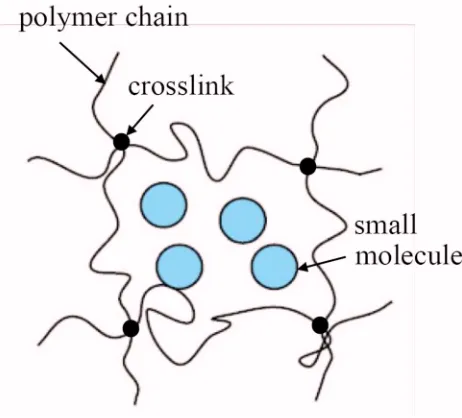
Long-chain polymers may crosslink by strong chemical bonds into a three-dimensional network. The resulting mate-rial, an elastomer, is capable of large and reversible deforma-tion. The elastomer may imbibe a large quantity of solvents, aggregating into a gel共Fig.1兲. The solvent molecules in the gel interact by weak physical bonds and can migrate. The dual attributes of a solid and a liquid make the gel a material of choice in nature and in engineering. For example, gels constitute many tissues of animals and plants. The solid at-tribute enables the tissues to retain shapes, while the fluid attribute enables the tissues to transport nutrients and wastes. Gels are also synthesized for diverse applications, including food processing,1 drug delivery,2–5tissue engineering,6,7 ac-tuators in miniaturized devices,8–10and packers in oil wells.11 Many processes in gels involve concurrent deformation and migration. For example, a drug loaded in a gel can mi-grate out in response to a change in the physiological condi-tions 共i.e., the temperature, the level of pH, or the concen-tration of an enzyme兲. The rate of the release may be modulated by the deformation of the gel 共e.g., Ref.12兲. As another example, patterns of crease often appear on the sur-face of a swelling gel 共e.g., Refs 13 and 14兲, along with many other forms of buckling.15–18 Furthermore, swelling may induce stress localization in gels, which leads to cavita-tion and delaminacavita-tion.19 Hydrogels with submillimeter size have been extensively used as valves in microfluidics due to the short swelling time and large deformation.8
This paper studies the concurrent deformation and mi-gration in the gel by a finite element method. Our method builds upon a theory dating back to Gibbs共1878兲, who for-mulated a thermodynamic theory of mobile molecules in an
elastic solid. Biot 共1941兲 combined the thermodynamic theory and Darcy’s law for mass transport in a porous me-dium. Both Gibbs and Biot used phenomenological free-energy functions, and their works were not specific for the polymeric gel. Using statistical mechanics, Flory and Rehner20 developed a free-energy function for the gel, in-cluding the effects of the entropy of stretching the network, the entropy of mixing the network polymers and the solvent molecules, and the enthalpy of mixing. Reviews of subse-quent contributions to the theory of polymeric gels are found, among others, in Refs.15and21–26. Another theory that is able to study the deformation and migration is the mixture theory,27in which the fluid and solid follow different field equations.
a兲Electronic mail: [email protected]. FIG. 1. 共Color online兲A schematic of structure of a gel.
[image:2.612.321.552.506.715.2]There have been several previous efforts to develop fi-nite element methods for gels. Westbrook and Qi28and Hong et al.29have developed finite element methods for gels in a state of equilibrium. Suematsuet al.30 conducted the three-dimensional explicit finite element analysis to study the pat-tern formation of swelling gels by introducing a friction con-stant between the polymeric chains and solvents.15 As pointed out by Suematsuet al.,30this method is not suited for larger systems over longer time intervals. Dolbow et al.22 used a hybrid eXtended-Finite-Element/Level-Set method to study the swelling of gels. Liet al.24used an explicit method to alternately solve the coupled problems for gels, namely, the deformation of gels is solved after the convergent results for mass transport is obtained. Birgerssonet al.31 conducted transient analysis of temperature-sensitive two-dimensional gels by using finite element solver,COMSOL MULTIPHYSICS.
Given various theories and numerical methods, as well as a large number of phenomena and applications, ample room exists for more computational work to connect prin-ciples of mechanics, thermodynamics, and kinetics to experi-ments and to molecular models. In particular, we will de-velop a finite element method using the free-energy function of Flory and Rhener共1943兲and the kinetic model proposed by Honget al.26The implicit method for time discretization is used, and transport and deformation are solved concur-rently. We will implement the method inABAQUSvia a user-defined element 共UEL兲.
The plan of the paper is as follows. Section II outlines the theory in a form suitable for the finite element method. The gel undergoes an irreversible thermodynamic process that simultaneously evolves two fields: the displacement of the network and the chemical potential of the solvent. Sec-tion III describes the material model: the free-energy func-tion and the mobility tensor. Secfunc-tion IV describes aspects of finite element implementation. Section V demonstrates the method by analyzing several time-dependent processes for three-dimensional gels, including swelling, draining, and buckling.
II. THEORY OF CONCURRENT DEFORMATION AND MIGRATION IN A GEL
This section summarizes the theory of concurrent defor-mation and migration, describing in turn the kinematics of the network, the conservation of the solvent, the conditions of local equilibrium, and the kinetics of migration. The theory is essentially that of Gibbs 共1978兲 and Biot 共1941兲, and the notation follows that of Honget al.26,29
A. Kinematics of the network
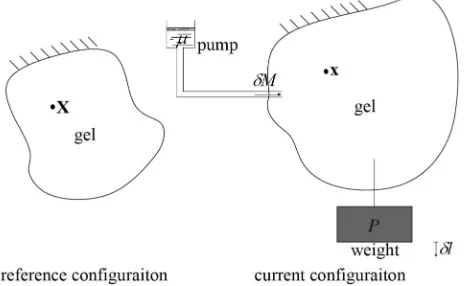
We use a standard approach in continuum mechanics to describe the kinematics of the network. The gel moves in a three-dimensional space. Imagine that each differential ele-ment of the network is attached with a marker. Any configu-ration of the gel can serve as a reference configuconfigu-ration共Fig.
2兲. When the gel is in the reference configuration, the marker occupies in the space a place with coordinatesX, which we will use to label the marker. In the reference configuration,
letdV共X兲be an element of volume,dA共X兲be an element of area, andNK共X兲be the unit vector normal to the element of area.
At timet, the gel is in the current configuration, and the markerXmoves in the space to a new place with coordinates x. The functions xi共X,t兲 specify the kinematics of the net-work. As usual, the deformation gradient of the network is defined as
FiK共X,t兲= xi共X,t兲
XK . 共1兲
We will useFto characterize the state of deformation of an element of the gel.
B. Conservation of the solvent molecules
We next use nominal quantities to describe the conser-vation of the solvent molecules. Let C共X,t兲be the nominal concentration of the solvent in the gel in the current configu-ration, namely,C共X,t兲dV共X兲 is the number of solvent mol-ecules in the element of volume. LetJK共X,t兲be the nominal flux of the solvent in the gel, namely,JK共X,t兲NK共X兲A共X兲is the number of the solvent molecules per unit time migrating across the element of area. Imagine that the network is at-tached with a field of pumps, which inject the solvent into the gel. In the current configuration, the pumps inject r共X,t兲dV共X兲 number of the solvent molecules into the ele-ment of volume per unit time, and i共X,t兲dA共X兲 number of the solvent molecules into the element of area per unit time. We assume that no chemical reaction occurs, so that the number of the solvent molecules is conserved, namely,
C共X,t兲
t +
JK共X,t兲
XK
=r共X,t兲, 共2兲
in the volume of the gel, and
JK共X,t兲NK共X兲= −i共X,t兲, 共3兲
[image:3.612.323.555.54.197.2]on the part of the surface of the gel where the pumps inject solvent molecules.
FIG. 2. The reference and current configurations with an illustration of two ways doing work on a gel in the current configuration: a mechanical loading is applied by hanging a weight and a chemical loading is applied by using a pump to inject small molecules into the gel.
C. Conditions of local equilibrium
We now examine the conditions of local equilibrium. Elements of the gel in different locations may not be in equi-librium with each other, and this disequiequi-librium motivates the solvent to migrate. Each differential element of the gel, however, is taken to be locally in a state of equilibrium. That is, the migration of the solvent is such a slow process that the effect of inertia is negligible, the viscoelastic process in the element has enough time to relax, and the solvent in the element has enough time to equilibrate with the solvent in the pump attached to the element. Furthermore, the gel is assumed to be held at a constant temperature. We character-ize the thermodynamic state of the differential element of the gel by the deformation gradient of the networkF共X,t兲, and the chemical potential of the solvent共X,t兲. LetWˆ共F,兲be a free-energy density function of the gel, namely, Wˆ共F,兲dV共X兲is the free energy associated with the element of the gel. The conditions of local equilibrium require that the nominal concentration be given by
C= −W ˆ共F,兲
, 共4兲
and the nominal stress be given by
siK=W ˆ共F,兲
FiK
. 共5兲
When the free-energy density functionWˆ共F,兲is prescribed for a gel, Eqs.共4兲and共5兲constitute the equations of state.
Imagine that the network is attached with a field of weights, which apply forces to the gel. In the current con-figuration, the weights apply a force Bi共X,t兲dV共X兲 to the element of volume, namely,Bi共X,t兲 is the applied forces in the current configuration per unit volume of the reference configuration. Similarly, the weights apply a force Ti共X,t兲dA共X兲 to the element of area, namely,Ti共X,t兲 is the applied forces in the current configuration per unit area of the reference configuration. The conditions of local equilibrium require that the inertia effect be negligible and that the vis-coelastic process in the element be fully relaxed, so that
siK共X,t兲
XK +Bi共X,t兲= 0, 共6兲 in the volume of the gel, and
siK共X,t兲NK共X兲=Ti共X,t兲, 共7兲
on the part of the surface of the gel where forces are applied.
D. Kinetics of migration
We will also use the nominal quantities to describe the kinetics of migration. The flux of the solvent is taken to be linear to the gradient of the chemical potential of the solvent
JK= −MKL共F,兲
共X,t兲
XL , 共8兲 where MKL is the mobility tensor. The mobility tensor is symmetric and positive definite, and in general depends on
the thermodynamic state of the element, namely, on local values of the deformation gradient and the chemical poten-tial.
The above theory evolves the configuration of the gel, namely, evolves concurrently the two fields x共X,t兲 and 共X,t兲, once the following items are prescribed:
• the initial conditionsx共X,t0兲and共X,t0兲at a
particu-lar time t0,
• the applied force Bi共X,t兲 and the rate of injection r共X,t兲inside the gel,
• eitheri共X,t兲 or共X,t兲on the surface of the gel, • eitherTi共X,t兲orx共X,t兲on the surface of the gel, and • the free-energy functionWˆ共F,兲and the mobility
ten-sor MKL共F,兲.
III. MATERIAL MODEL
Within the theory presented in the previous section, a material model is specified by the functionsWˆ共F,兲and the mobility tensor MKL共F,兲. Following Honget al.,
26
we re-write the free energy of Flory and Rehner20in the form
Wˆ共F,兲=1
2NkT关FiKFiK− 3 − 2 log共detF兲兴
−kT
v
冋
共detF− 1兲log冉
detF detF− 1
冊
+ detF
册
−
v共detF− 1兲, 共9兲
whereNis the number of polymer chains in the gel divided by the volume of the gel in the reference state, kT is the temperature in the unit of energy,vis the volume per solvent molecule, andis a dimensionless parameter characterizing the enthalpy of mixing. In writing Eq.共9兲, the reference con-figuration is taken to be the dry network, and= 0 when the solvent is in the pure liquid state in equilibrium with its own vapor.
Assuming that the small molecules diffuse in the gel and that the coefficient of diffusion of the solvent moleculesDis isotropic and independent of deformation gradient and con-centration, Honget al.26 expressed the mobility tensor as
MKL= D
vkT共detF− 1兲HiKHiL, 共10兲
whereHiKis the transpose of the inverse of the deformation gradient, namely,HiKFiL=␦KL. In writing Eq.共10兲the refer-ence state is taken to be the dry network.
We normalize the free-energy density bykT/v, the stress bykT/v, and the chemical potential bykT. The theory has no intrinsic length scale or intrinsic time scale. LetLbe a char-acteristic length in a boundary-value problem. We normalize all the other lengths byL, and normalize the time byL2/D.
A representative value of the volume per solvent mol-ecule isv= 10−28 m3. At room temperature,kT= 4⫻10−21 J
under the small-strain conditions, with the representative val-ues NkT= 104– 107 N/m2, which gives the range Nv
= 10−4– 10−1. The parameteris a dimensionless measure of
the enthalpy of mixing, with representative values = 0 – 1.2. For applications that prefer gels with large swelling ratios, materials with low values of are used. In the nu-merical examples below, we will take the values Nv= 10−3
and = 0.2. The coefficient of diffusion for water is D= 8
⫻10−10 m2/s.
IV. FINITE ELEMENT FORMULATION
Subject to external forces and immersed in an environ-ment, a gel will deform and exchange solvent molecules with the environment. If the applied forces are time-independent, and the chemical potential of the solvent in the environment is homogenous and time-independent, after some time the gel will reach a state of thermodynamic equilibrium, in which the chemical potential of the solvent inside the gel becomes homogeneous and takes the same value as that in the environment. The time needed for the gel to equilibrate scales with L2/D, where the length L is a characteristic length of the gel. When the gel equilibrates, both the defor-mation of the network and the concentration of the solvent in the gel can still be inhomogeneous, as studied by Zhao et al.32 and Honget al.29
In many applications, however, the gel may not be in a state of thermodynamic equilibrium, so that the chemical po-tential of the solvent in the gel is inhomogeneous. The field of chemical potential of the solvent 共X,t兲and the field of displacement of the networkxi共X,t兲evolve concurrently. To study this coevolution, we now use the above theory to for-mulate a finite element method.
Multiply Eq.共6兲by a test functioni共X兲, integrate over the volume of the gel, and then apply the divergence theo-rem, we obtain that
冕
WˆFiK
i
XKdV=
冕
BiidV+冕
TiidA. 共11兲In deriving Eq.共11兲, we have used the condition of mechani-cal equilibrium on the surface, Eq. 共7兲, and the equation of state, Eq.共5兲. The last integral in Eq.共11兲extends to the part of the surface over which the tractionTiis prescribed. On the remaining part of the surface, the position of the network must be prescribed, and the test function i共X兲 is set to be zero. The conditions of mechanical equilibrium in Eqs.
共5兲–共7兲 are equivalent to a single statement: the gel is in mechanical equilibrium if the weak form共Eq.共11兲兲holds for any arbitrary test function i共X兲. Indeed, this statement is a direct consequence of the conditions of local equilibrium, as discussed in Honget al.26,29
Multiply Eq.共2兲by another test function共X兲, integrate over the volume of the gel, and then apply the divergence theorem, we obtain that
冕
冉
2WˆFjL
FjL
t +
2Wˆ
2
t
冊
dV−冕
MKL
XL
XKdV = −
冕
rdV−冕
idA. 共12兲In deriving Eq.共12兲we have replaced the concentration us-ing the equation of state Eq. 共4兲, and replaced the flux by using the kinetic Eq.共8兲. The last integral in Eq.共12兲extends to the part of the surface over which the rate of injectioniis prescribed. On the remaining part of the surface, the chemi-cal potential of the solvent must be prescribed, and the test function共X兲 is set to be zero. Thus, the number of solvent molecules is conserved if the weak form关Eq.共12兲兴holds for arbitrary test function共X兲.
We now discretize the governing Eqs.共11兲 and共12兲 in space. Interpolate the position vectorxi共X,t兲and the chemi-cal potential共X,t兲as
xi共X,t兲−Xi=Na共X兲uai共t兲, 共13兲
共X,t兲=Na共X兲a共t兲. 共14兲
The index a, as well as the index b below, is reserved for nodes; repeateda共orb兲implies summation over all nodes in the body. The quantitiesuai共t兲anda共t兲are the displacement and chemical potential associated with node a. The shape functions Na共X兲 can be constructed in several ways; we adopt the eight-node brick elements. The same approach of discretization is applied to the test functionsi共X兲and共X兲. Substituting Eqs.共13兲and共14兲into Eq.共11兲, and invok-ing the arbitrariness of the test functioni共X兲, we obtain that
冕
WˆFiK
Na
XKdV=
冕
BiNadV+冕
TiNadA. 共15a兲 Equation共15a兲is valid at all times. Taking a derivative with respect to time, we obtain thatdubj dt
冕
2Wˆ
FiKFjL
Na
XK
Nb
XLdV +db
dt
冕
2Wˆ
FiK
Na
XK NbdV
=
冕
dBidt NadV+
冕
dTidtNadA. 共15b兲
Substituting Eqs. 共13兲 and共14兲 into Eq. 共12兲, and invoking the arbitrariness of the test function共X兲, we obtain that
dubj dt
冕
2Wˆ
FjL
Nb
XL
NadV+db dt
冕
2Wˆ
2NbNadV
−b
冕
MKLNb
XL
Na
XKdV
= −
冕
rNadV−冕
iNadA. 共16兲Equations共15b兲and共16兲are ordinary differential equa-tions that concurrently evolve the nodal values of the
placement and the chemical potential ubj共t兲 and b共t兲. The ordinary differential equations can be rewritten in a matrix form
Rd
dt +K=P. 共17兲
The column lists values of ubj共t兲 andb共t兲 of all nodes. The column P collects terms on the right-hand side of Eqs.
共15a兲 and共16兲. The matrix R collects the integrals in Eqs.
共15兲 and 共16兲 involving the second derivatives of the free-energy function. The matrix K collects the integral in Eq.
共16兲involving the mobility tensor.
We next discretize the problem in time. It is straightfor-ward to solve Eq.共17兲by an explicit method. However, the stability condition for explicit scheme is very restrictive, es-pecially when the mobility tensor varies with swelling. The peak in the mobility tensor will cut down the allowable time step. Therefore, we use an implicit method to discretize the equation in time. The increment in the generalized nodal variable⌬at current timet+⌬tis obtained by solving the following equation:
At+⌬t⌬=Yt+⌬t, 共18兲
with
At+⌬t=R t+⌬t
⌬t +K
t+⌬t, 共19兲
Yt+⌬t=Pt+⌬t−Rtd t
dt −K tt
. 共20兲
The superscript denotes the time of the iterative step. There are number of ways to solve Eq.共18兲. One way is to use direct solver, which requires that the matrix A be positive definite. However, effective stiffness matrixAis in-definite in the present formulation because the positive-definite mobility tensorMcontributes to the negative of ma-trix A 关Eq. 共16兲兴. Moreover, at the critical point where material instability occurs, the effective stiffness matrixAis singular, which fails the standard iteration procedure, such as Newton–Raphson method. Explicitly, the solution quickly di-verges and leads to unphysical predictions共e.g., unbounded displacement increment兲. Various methods have been devel-oped to resolve this numerical difficulty, such as Riks method33 that has been used in ABAQUS. To overcome the convergence difficulty, we adopt a simple method that can be easily implemented in a typical finite element code. We re-placeAby
Aⴱ=A+␣I, 共21兲
whereIis the identity matrix and␣is a positive number as a penalty to ensure the positive definiteness of Aⴱ. This modification eliminates the singularity of the effective stiff-ness matrix to ensure a convergent result is reached. This method has been extensively used in finite element analysis, especially in the solution of eigenvalues and eigenvectors of a singular stiffness matrix.34
It is important to note that the solution to Eq. 共18兲 is independent of ␣. This is because the convergence is
char-acterized byY= 0, orRt共dt/dt兲+Ktt=Pt, whether we use AorAⴱ. As to be shown in Section V, the present method is able to study both the surface wrinkling featured with short wavelength instabilities and structure buckling featured with long wavelength instabilities.
Another way to solve Eq. 共18兲 is to use an iterative solver, which does not require positive definiteness of matrix A. However, in numerical implementation, the iterative solver may “overshoot” the results for the current iteration step based on the previous iteration step, which might lead to nonphysical phenomena, for instance, detF⬍1. Conceptu-ally, detF must be greater than one in this formulation to ensure the dry gel is incompressible. To resolve this non-physical prediction, a very small incremental step should be used. Alternatively, the modification of the effective stiffness matrixAof Eq.共21兲can be used for this purpose.
A common issue in modeling the swelling and shrinking of gels is the instability, which leads to zero eigenvalues of effective stiffness matrix A. To maintain the stability and convergence, the modification of the effective stiffness ma-trix A 关Eq. 共21兲兴is employed. This finite element formula-tion has been implemented in theABAQUS/standard finite el-ement program via its USER-ELEMENT subroutine, where the implicit time discretization and direct solver are em-ployed.
V. NUMERICAL EXAMPLES
This section demonstrates the finite element method by analyzing several time-dependent processes of concurrent deformation and migration. Wherever possible, efforts are made to compare the numerical results with solutions ob-tained by using other methods, and with experimental obser-vations.
A. A gel drains under a weight
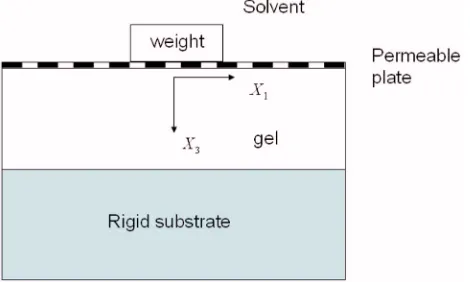
[image:6.612.321.556.52.193.2]The performance of the finite element method is tested by comparing the numerical results obtained by using the finite element method with those using a finite difference method for a problem studied in Ref.26. Figure3illustrates a thin layer of a gel immersed in a pure liquid solvent. The gel first undergoes free swelling subject to no constraint and
no applied forces. The swollen gel is then bonded to a rigid substrate, and subject to an applied weight. The solvent can migrate out from the top surface of the gel, and the gel thins down. The layer will eventually attain a new state of equi-librium.
LetL be thickness of the dry network subject to no me-chanical forces. This dry and undeformed configuration is used as the reference configuration, where a marker has the coordinates X1 and X2 in the plane of the layer, and the
coordinate X3 normal to the layer and pointing downwards.
After free swelling and equilibrating with the pure liquid solvent, the layer swells by an isotropic stretch, 1=2=3
= 3.215. The gel is then bonded to the rigid substrate, and subjected to a tractions, the weight divided by the area of the dry polymer. As the solvent migrates out,1 and2 remain
unchanged, but 3 changes with time and position. The
thickness of the gel is taken to be much smaller than the lateral dimensions of the gel, such that the field in gel is independent of X1 and X2. The functions 3共X3,t兲 and 共X3,t兲are to be determined.
In a finite element model, we use twenty eight-node brick elements, stacked up one on top of another in the di-rection of the thickness. To model the full layer of the gel, we impose vanishing displacements and flux in lateral direc-tions. The top surface of the gel is prescribed with the trac-tionsand the vanishing chemical potential, while the bottom surface of the gel is prescribed with the vanishing displace-ment and flux. Lettminbe the smallest time over which the solution is of interest to us, the size of the elementslemust be chosen such that le⬍
冑
Dtmin. Onceleis chosen, the timestep⌬t must also be limited by⌬t⬎le
2/
D.
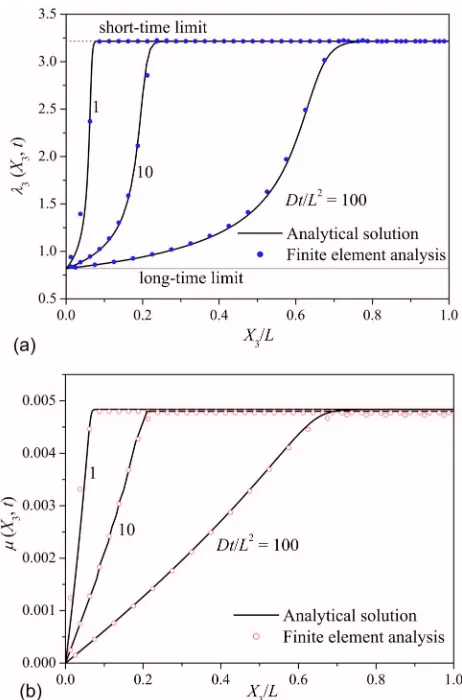
Figure 4 compares the functions 3共X3,t兲 and 共X3,t兲
obtained from the finite element method in this paper and that from a finite difference method by Hong et al.26 The agreement is good. At the short-time limit, the weight is applied, but the solvent has no time to migrate out, so that the stretch is unchanged,3共X3, 0兲= 3.215, but the chemical
potential jumps to a value higher than that of the external solvent, 共X3, 0兲⬎0. At the long-time limit, the chemical
potential in the gel equilibrates with that of the solvent, 共X3, 0兲= 0, and the stretch reduces to a new value. As a
consequence of the conditions of local equilibrium, the top surface of the gel共X3= 0兲reaches the long-time limit
instan-taneously, with the vanishing chemical potential as fixed by the external solvent, and the low stretch. In a short time, the interior of the gel is still largely in the state of short-time limit. As the time processes, the solvent migrates out gradu-ally, and the entire gel evolves toward the long-time limit.
B. Free swelling of a cubic gel
The free swelling of a cube of a gel, side L in the dry state is studied. Conditions of symmetry are imposed, so that only one-eighth of the cube is modeled, using 512 brick el-ements. Figure5shows the distribution of dimensionless true stressvxx/kTon swelling configurations共keeping the rela-tive ratio of volumes兲at different time, characterized by non-dimensional parameter Dt/L2. The true stress ij relates to the nominal stresssiKby
ij=siKFjK
detF. 共22兲
Immediately upon the beginning of the swelling, the homo-geneous gel 关Fig. 5共a兲兴 swells inhomogeneously 关Fig. 5共b兲
for Dt/L2= 1.25兴. The corners that have the largest contact
surface with the solvent swell first, followed by the edges and then other parts of the gel, which leads to a bowl-like surface of the gel and generates compressive stress to the gel, similar to beam bending. As time goes on 关Fig. 5共c兲 for Dt/L2= 25兴, the swelling at the edges and the centers catch
up with the swelling at the corners, so that the bowl-like surfaces become less concave. However, the deformation of the swelling gel is still inhomogeneous. This bowl-like sur-face in swelling gels has been observed experimentally that the gels swell faster at the corners than at the sides and the centers.35 It is also noticed that the compressive stress de-creases during swelling. As the swelling process reaches equilibrium关Fig.5共d兲forDt/L2→⬁兴, the fully swelling gel
[image:7.612.321.552.47.397.2]recovers the shape identical to the original one and becomes totally homogeneous with vanishing stress and large volu-metric change.
FIG. 4. 共Color online兲A gel共Nv= 10−3, = 0.2兲is subject to a nominal
stressvs/kT= −0.05. The finite element results are marked by discrete dots, compared with the analytical solution marked by solid lines. The stretch3
共a兲and chemical potential共b兲are inhomogeneous and evolves from the short-time limit to the long-time limit, which shows the creep behavior of a gel subject to mechanical loading.
C. Free swelling of a thin sheet
The compressive stress generated due to free swelling may lead to buckling of gels that have been extensively ob-served in experiments共e.g., Ref.36兲. This paper studies the buckling of a free swelling thin film gel. The aspect ratio of the in-plane dimension and the thickness is 12. Figure 6
shows the generation of wrinkling during swelling关Fig.6共b兲兴
starting from a homogeneous gel关Fig.6共a兲兴. The similar pat-terns of crease were observed experimentally by Tanaka et al.13 Besides the gels with geometric features 共e.g., thin film兲, the gels have geometric imperfections that exist for almost all experiments also have buckling patterns during free swelling, such as in Sayil and Okay’s36experiments.
The wrinkles generated during free swelling may be troublesome in applications. Experimentally, the swelling ra-tio of gels, one of the most important parameters to charac-terize gels, is usually measured gravimetrically as a function of time. In other words, one usually measures the weight change as a function of time during swelling. The gained weight of a gel is proportional to the total number of the small moleculesvC absorbed by the swelling gel. To study whether the wrinkles really affect the weight change, we compare the finite element results having wrinkles 关Figs.
6共b兲兴 with the numerical solution restraining the wrinkles during free swelling.
Figure7shows the total number of the small molecules
vC inside the swelling gel as a function of time. The finite element results are marked by discrete dots and the numeri-cal solution is given by a solid line. The finite element results fairly agree with the numerical results, although there are some discrepancies, which could be attributed to the differ-ent aspect ratios used, namely, 12 for finite elemdiffer-ent results and infinite for numerical results. This study concludes that the wrinkles do not significantly affect the weight change as a function of time. Therefore, people can ignore the wrinkles if they only concern the weight change.
D. Swelling of a partially constrained gel
A soft gel bonded to a stiff gel provides a model system to study pattern formation in elastic bodies. The kinetics of swelling soft gels on stiff gels is very important, especially in biological problems, such as the development of embryos.37 In this section, we will study the kinetics of swelling of soft gels bonded to nonswelling stiff gels in striped and circular geometries. This system was experimentally studied and an equilibrium state was determined theoretically.18
[image:8.612.60.289.52.345.2]Figure8共a兲shows the strip geometry consisting of one thin strip of soft gel bonded to another thin strip of stiff gel.
FIG. 5. 共Color online兲Contour plots of the nondimensional Cauchy stress
vxx/kTfor a free swelling cubic gel共sizeL⫻L⫻L兲at different time scale characterized by nondimensional parameterDt/L2. The initial state共i.e., dry
gel forDt/L2= 0兲is shown in 共a兲. During the free swelling, nonuniform
deformations appear for共b兲and共c兲withDt/L2= 1.25 and Dt/L2= 25,
re-spectively. Compressive stresses are also developed during free swelling. At the final state共or equilibrium state withDt/L2→⬁兲, the fully swelling gel
recovers the shape identical to the original one and becomes totally homo-geneous with vanishing stress and large volumetric change. The same scale
is used to show the large volumetric change. FIG. 6.共Color online兲Shapes of共a兲a dry gel共Dt/L2= 0兲and a swelling gel 共Dt/L2= 7.5兲. During the free swelling, the wrinkle patterns are developed.
[image:8.612.322.553.52.423.2]Leth andw denote the thickness and width of the soft gel, respectively. The soft gel is subjected to vanishing displace-ments and flux at the interface between soft and stiff gels. The zero chemical potential is enforced at the gel/solvent interface. Figures 8共b兲 and8共c兲 show the buckling patterns with the same scale atDt/h2= 1.4 andDt/h2→⬁共long-time
limitation or equilibrium state兲. It is observed that the tran-sient problem has distinct buckling pattern compared with the equilibrium state. The buckling results from the fact that fast swelling at the free edges共e.g., top of the soft gel兲 gen-erates compressive stress at the soft/stiff gels interfaces, as clearly shown in the contour plot of nondimensional stress
vxx/kT, which is also similar to beam bending. The wave-lengthof the equilibrium state is consistent with Mora and Boudaoud’s18theoretical analysis, i.e.,= 3.256h.
Figure9共a兲shows the geometry in which a disk of a soft gel is bonded to a stiff gel with the same shape, whereRiand Ro are inner and outer radius, respectively. We take Ri = 3.5 mm and Ro= 5 mm in this study. Vanishing displace-ment and flux boundary conditions are imposed at the inner radius and the vanishing chemical potential is used at the outer radius. Figures 9共b兲 and 9共c兲 show the buckling pat-terns atDt/共Ro−Ri兲2= 4.45 andDt/共Ro−Ri兲2→⬁共i.e.,
equi-librium state兲. A coronal buckling pattern 关Fig. 9共b兲兴 ob-served during the swelling finally disappears at the equilibrium state关Fig.9共c兲兴.
The different swelling behaviors of a soft, strip gel and a soft, disk gel indicate that the geometric shapes of the gels play a very important role on the kinetics of swelling of gels. These differences共Figs.8 and9兲can be qualitatively under-stood in the following. The swelling of the strip gel bonded to a stiff gel has an analogy to beam bending, i.e., compres-sive stress at the interface between soft and stiff gels. There-fore, no matter the thickness of the soft gel, the swelling-induced compressive stress leads to wrinkles, even at the equilibrium state as shown in Fig. 8共c兲. However, the anal-ogy to beam bending is not valid for the disk gel due to the
geometric constrain in the circumferential direction. In fact, it is noticed that the wrinkles for the disk gels关Fig.9共b兲兴are very similar to that of the free swelling thin film gels 关Fig.
[image:9.612.54.291.50.225.2]6共b兲兴, not buckling of strip gels关Figs.8共b兲and8共c兲兴. There-fore, at the equilibrium state关Fig.9共c兲兴, the wrinkling disap-pears and the fully swelling state is similar to that of the free swelling thin film gels.
[image:9.612.319.551.184.698.2]FIG. 7. The total mass of the small water molecules per unit volume of the dry gel as a function of time during free swelling of a thin film gel. The finite element results are given by the discrete dots and the numerical solu-tion is marked by the solid line. It shows that the buckling pattern does not significantly affect the total mass of the small water molecules inside the free swelling thin film gels that are important in many applications.
FIG. 8. 共Color online兲A swelling soft, strip gel bonded to a nonswelling stiff, strip gel. An illustration of the system of a soft gel and a stiff gel共a兲. During swelling共Dt/L2= 1.4兲, the soft gel wrinkles due to the compressive
stress共b兲. The wrinkles grow and remain at the equilibrium state共Dt/L2
→⬁兲.
VI. SUMMARY
We have developed a finite element method to simulate concurrent large deformation and mass transport for gels. The method is implemented in ABAQUS/standard finite ele-ment program via its USER-ELEMENT subroutine. Numeri-cal examples showed that this program is accurate by com-paring with the available numerical solutions. The program has been used to study several time-dependent processes of swelling gels, such as draining of fully swollen gels due to weight, free swelling-induced surface instability, and buck-ling pattern formation due to partially confined swelbuck-ling. Be-cause the potential sensitivity of material models 共i.e., free-energy density and mobility tensor兲on kinetic behaviors of
gels, we plan to study this effect in the future work.
ACKNOWLEDGMENTS
The work at ASU is supported by a startup grant for HJ from the Fulton School of Engineering and partially by the NSF through Grant No. CMMI-0700440. The work at Har-vard is supported by the DARPA through a project on pro-grammable matter, and by the NSF through a project on Large Deformation and Instability in Soft Active Materials.
1W. Pilnik and F. M. Rombouts, Carbohydr. Res.142, 93共1985兲. 2F. Fischelghodsian, L. Brown, E. Mathiowitz, D. Brandenburg, and R.
Langer,Proc. Natl. Acad. Sci. U.S.A.85, 2403共1988兲.
3R. Duncan,Nat. Rev. Drug Discovery2, 347共2003兲.
4B. Jeong, Y. H. Bae, D. S. Lee, and S. W. Kim,Nature共London兲388, 860
共1997兲.
5R. Langer, Nature共London兲392, 5共1998兲.
6Y. Luo and M. S. Shoichet, Nature Mater.3, 249共2004兲.
7A. P. Nowak, V. Breedveld, L. Pakstis, B. Ozbas, D. J. Pine, D. Pochan,
and T. J. Deming,Nature共London兲417, 424共2002兲.
8D. J. Beebe, J. S. Moore, J. M. Bauer, Q. Yu, R. H. Liu, C. Devadoss, and
B. H. Jo,Nature共London兲404, 588共2000兲.
9L. Dong, A. K. Agarwal, D. J. Beebe, and H. R. Jiang,Nature共London兲
442, 551共2006兲.
10A. Sidorenko, T. Krupenkin, A. Taylor, P. Fratzl, and J. Aizenberg,
Sci-ence315, 487共2007兲.
11M. Kleverlaan, R. H. van Noort, and I. Jones, Proceedings of the SPE/
IADC Conference, Amsterdam, Netherlands, 2005共unpublished兲.
12K. Y. Lee, M. C. Peters, K. W. Anderson, and D. J. Mooney, Nature
共London兲408, 998共2000兲.
13T. Tanaka, S. T. Sun, Y. Hirokawa, S. Katayama, J. Kucera, Y. Hirose, and
T. Amiya,Nature共London兲325, 796共1987兲.
14V. Trujillo, J. Kim, and R. C. Hayward,Soft Matter4, 564共2008兲. 15T. Tanaka and D. J. Fillmore,J. Chem. Phys.70, 1214共1979兲.
16I. J. Suarez, A. Fernandez-Nieves, and M. Marquez,J. Phys. Chem. B110,
25729共2006兲.
17Y. Li and T. Tanaka,J. Chem. Phys.92, 1365共1990兲. 18T. Mora and A. Boudaoud,Eur. Phys. J. E20, 119共2006兲.
19H. Murata, B. J. Chang, O. Prucker, M. Dahm, and J. Ruhe,Surf. Sci.570,
111共2004兲.
20P. J. Flory and J. Rehner,J. Chem. Phys.11, 521共1943兲. 21C. J. Durning and K. N. Morman,J. Chem. Phys.98, 4275共1993兲. 22J. Dolbow, E. Fried, and H. D. Jia,J. Mech. Phys. Solids52, 51共2004兲. 23H. Tsai, T. J. Pence, and E. Kirkinis,J. Elast.75, 69共2004兲.
24H. Li, R. Luo, E. Birgersson, and K. Y. Lam, J. Appl. Phys.101, 7共2007兲. 25K. Sekimoto,J. Phys. II1, 19共1991兲.
26W. Hong, X. H. Zhao, J. X. Zhou, and Z. G. Suo,J. Mech. Phys. Solids56,
1779共2008兲.
27R. M. Bowen,Continuum Physics共Academic, New York, 1975兲. 28K. K. Westbrook and H. J. Qi, J. Intell. Mater. Syst. Struct.19, 597共2008兲. 29W. Hong, Z. Liu, and Z. Suo共submitted兲.
30N. Suematsu, K. Sekimoto, and K. Kawasaki, Phys. Rev. A 41, 5751
共1990兲.
31E. Birgersson, H. Lib, and S. Wua,J. Mech. Phys. Solids56, 444共2008兲. 32X. H. Zhao, W. Hong, and Z. G. Suo, Appl. Phys. Lett.92, 3共2008兲. 33E. Riks, ASME Trans. J. Appl. Mech.39, 1060共1972兲.
34K. J. Bathe,Finite Element Procedures in Engineering Analysis共
Prentice-Hall, Englewood Cliffs, NJ, 1982兲.
35E. C. Achilleos, R. K. Prud’homme, K. N. Christodoulou, K. R. Gee, and
I. G. Kevrekidis, Chem. Eng. Sci.55, 3335共2000兲.
36C. Sayil and O. Okay, Polymer42, 7639共2001兲.
[image:10.612.60.291.56.417.2]37E. Brouzes and E. Farge, Curr. Opin. Genet. Dev.14, 367共2004兲.
FIG. 9. 共Color online兲A swelling soft, disk gel bonded to a nonswelling stiff, disk gel. An illustration of the system of a soft gel and a stiff gel共a兲. During swelling共Dt/L2= 4.45兲, the soft gel generates coronal wrinkles due
to the compressive stress共b兲. At the equilibrium state共Dt/L2→⬁兲the