White Rose Research Online URL for this paper: http://eprints.whiterose.ac.uk/87325/
Version: Submitted Version
Article:
Oostenbroek, Janine Maree and Over, Harriet orcid.org/0000-0001-9461-043X (2015) Young children contrast their behaviour to that of out-group members. Journal of Experimental Child Psychology. pp. 234-241. ISSN 0022-0965
https://doi.org/10.1016/j.jecp.2015.05.009
[email protected] https://eprints.whiterose.ac.uk/
Reuse
Items deposited in White Rose Research Online are protected by copyright, with all rights reserved unless indicated otherwise. They may be downloaded and/or printed for private study, or other acts as permitted by national copyright laws. The publisher or other rights holders may allow further reproduction and re-use of the full text version. This is indicated by the licence information on the White Rose Research Online record for the item.
Takedown
If you consider content in White Rose Research Online to be in breach of UK law, please notify us by
Young children contrast their behavior to that of out‐group
members
Janine Oostenbroek and Harriet Over University of York Acknowledgements We thank Steven Tipper and the Minerva Research Group on Cultural Cognition for advice, Saana Korki for data collection, Charlotte Murphy, Christopher Pease and Emma Holmes for stimuli creation and Matthew Leonard for coding. This work was supported by the Economic and Social Research Council (grant number ES/K006702/1).
Abstract
The tendency for children to overimitate and conform to unanimous majorities is pervasive. Here we tested whether social factors are powerful enough to lead children to overcome this tendency and contrast their behavior to that of others. In one condition, children were shown a video of three out‐group members performing the same action on a novel toy. Five‐year‐old children, but not four‐ year‐old children, in this condition were significantly more likely to produce the contrasting action than the action demonstrated by the group. On the other hand, children who saw the same actions performed by neutral individuals typically matched their actions to those of the group regardless of their age. By
demonstrating that five‐year‐old children actively contrast their behavior to that of out‐group members, these results provide an important comparison to
previous research on imitation and conformity and demonstrate the profound influence that social motivations exert over children’s copying behavior.
Key words:
social cognitive development; social learning; contrast effects; overimitation; conformity; group membership
Young children contrast their behavior to that of out‐group members Children are prolific imitators. Their inclination to imitate is so powerful that they faithfully reproduce the actions of a demonstrator even when those actions have no apparent purpose or causal function. This phenomenon is known as ‘overimitation’ (Lyons, Young & Keil, 2007). The tendency to overimitate is so strong that three‐ to five‐year‐old children copy the actions of a demonstrator even when they have been directly instructed not to, when they have been trained to identify irrelevant actions, and when doing so means they risk losing a competition (Lyons, Damrosch, Lin, Macris & Keil, 2011; Lyons et al., 2007). Perhaps just as powerful is the tendency to conform to unanimous majorities. Haun and Tomasello (2011) demonstrated that children sometimes conform to the opinions of a majority, even when those opinions are clearly false.
However, children do not always copy so faithfully (Flynn & Whiten, 2008). The social environment is one important factor in modulating the actions children reproduce (Nielsen, 2009; Over & Carpenter, 2013). For example, four‐ and five‐year‐olds imitate more faithfully when they have a goal to affiliate (Over & Carpenter, 2009) and when the model is watching their actions (Nielsen & Blank, 2011). Social factors have also been shown to influence how likely
children are to copy certain models. For example, young children are more likely to reproduce the actions of in‐group than out‐group members (Howard,
Henderson, Carrazza & Woodward, 2014). This has been interpreted as evidence that children ignore behavior modeled by out‐group members because it is less relevant to them (Howard et al., 2014).
Previous research has demonstrated that adults sometimes seek to distance their behavior from that of the out‐group (Ruys, Spears, Gordijn & De Vries, 2007). For example, adults react faster in a lexical decision task when primed with an elderly out‐group (Schubert & Hafner, 2003) and alter their preferences towards an object to make them dissimilar to those of an out‐group (Izuma & Adolphs, 2013).
We know from previous research that group membership exerts a powerful influence over young children’s behavior and cognition. For example, five‐year‐olds prefer members of their own group to members of another group, even when these groups are minimal (Dunham, Baron & Carey, 2011). These preferences influence children’s resource distribution such that children are more generous to in‐group members (Buttelmann & Bohm, 2014). Further research has demonstrated that, in addition to preferring in‐group to out‐group members, children show signs that they negatively evaluate out‐group members. For example, five‐year‐olds are more likely to attribute negative traits to the out‐ group compared to the in‐group (Aboud, 2003). Moreover, after their sixth birthday, children give negative resources to out‐group members rather than giving them to no‐one (Buttelmann & Bohm, 2014).
We were interested in whether children actively contrast their behavior to that of out‐group members. We showed children two possible ways to operate a novel light‐box. We then presented children with a video in which three
individuals on the video had been allocated to a group. We chose a Neutral condition rather than an in‐group comparison condition as we wanted to ensure that any differences between the conditions were driven by children’s responses to the out‐group rather than by their preference for their own group. We
predicted that children would imitate the actions of the three individuals on the video more often in the Neutral condition than in the Out‐group condition.
Demonstrating that children distinguish between out‐group members and neutral individuals is a first step towards showing contrast effects. However, assuming we found this pattern of results, it would be compatible with two different explanations. First, that children ignore members of their out‐group and second that they actively contrast their behavior to that of out‐groups. We thus had a further prediction about performance within the Out‐group condition. We reasoned that if children ignore the behavior of the out‐group, then they
should produce the two possible actions equally often in this condition. If children contrast their behavior to that of the out‐group, then they should
reproduce the action demonstrated by the out‐group significantly less often than the alternative action.
Our main interest was in whether five‐year‐olds would show these effects. Previous research has shown that children at this age overimitate (Horner & Whiten, 2005; Lyons et al., 2007) and that they do so more than younger
& Spelke, 2007), they also show signs of negatively evaluating out‐group members (Aboud, 2003).
We also wanted to explore whether younger children would show these effects. Thus, we later tested a sample of four‐year‐olds. Four‐year‐olds also imitate faithfully (Lyons et al., 2007) and sometimes conform to unanimous majorities (Haun & Tomasello, 2011) and their imitation too is influenced by social factors. However, previous research has suggested that whereas five‐year‐ olds show signs of out‐group negativity, four‐year‐olds do not (Aboud, 2003). It is thus possible that these younger children will not show as strong evidence of contrast effects.
Method Participants
Forty‐eight five‐year‐olds (mean 5;6; range 5;0 – 5;11; 24 girls) and 48 four‐year‐olds (mean 4;7; range 4;0 ‐ 4;11; 23 girls) participated. Three further
children were excluded: two five‐year‐olds (one due to parental interference and the other due to experimenter error), and one four‐year‐old (for failing to
complete the experiment).
Materials
The actors in the videos were two females and a male. The actor on the left demonstrated the relevant action first. After she completed the action, the actor beside her moved the light‐box in front of himself and repeated the same action. The third actor then did the same, such that the participant viewed the three models demonstrating the same action consecutively. In the Out‐group condition, the actors wore colored scarves and wristbands to signify they were in either the Yellow or Green group. In the Neutral condition the actors were not wearing any scarves or wristbands. Each video lasted about 35 seconds.
One of the actions demonstrated by the group was ‘prayer’ (see Figure 1a and c). For this action, the actor first pressed the palms of both hands together (as though in a prayer position) and pushed down on the lamp using the side of her hands to turn it on. She then moved her hands away from the light‐box and out to her sides before repeating the action to turn the lamp off. The second novel action was ‘elbow’ (see Figure 1b and d). For this action, the actor lifted her right hand to her right shoulder, turned the lamp on with her elbow, took her elbow off the lamp and out to the side of the light‐box, before repeating the action to turn the lamp off.
Figure 1. The models demonstrating the target actions on the novel light‐box in
the Out‐group and Neutral conditions. Panel (a) shows the first actor in the Out‐ group condition demonstrating the prayer action. Panel (b) shows the second actor in the Out‐group condition demonstrating the elbow action. Panel (c) shows the first actor in the Neutral condition demonstrating the prayer action and panel (d) shows the second actor in the Neutral condition demonstrating the elbow action.
Design
Children participated in one of two conditions in a between‐subjects design: Out‐group or Neutral. The dependent variable was the first action participants performed after being given the light‐box.
Procedure
the child that he or she was assigned to a Yellow or Green group (while this procedure appeared random to the child, it was actually fixed in order to ensure an equal number of children were allocated to each group). Children were asked to wear a scarf and wristband reflecting the color of their group. In addition, E asked children to complete a short categorization task involving moving photographs of in‐ and out‐group members towards and away from them and read them a brief story describing how the Yellow and Green groups compete against each other. This was done to increase the salience of the two groups and their significance for the children.
E then demonstrated the two actions (prayer and elbow) on the light‐box. As she demonstrated these actions, she said, “Look at this! Some people do it like this (demonstrated the first action). But some people don’t do it like that, they do
it like this (demonstrated the second action).” Then E positioned a laptop in
front of the participant showing three individuals on the screen and said, “Hmmm. These people are in the Yellow/Green group, a different group from you.
Let’s see how the people in the Yellow/Green group do it.” The participant then
watched a video of three out‐group members demonstrating one of the actions. After the video, E said, “So that’s how the people in the Yellow/Green group, the other group from you, do it.” After this, E shuffled some papers for five seconds
and then, turning back to the child said, “Ooh, just straighten up your
yellow/green scarf” before pushing the light‐box towards the child, saying, “Look
at this again! How do you want to do it?” The test phase lasted for 30 seconds or
until children made it clear that they were finished.
each other (this was to control for the possibility that competition alone leads to contrast effects). As in the Out‐group condition, E demonstrated the two actions on the light‐box. After this, E again positioned the laptop in front of the child, but in this condition the screen showed the three individuals without their colored scarves and wristbands. E then said, “Hmmm. Let’s see how these people do it”.
The participant then watched a video of three individuals demonstrating one of the actions. After the video, E said, “So that’s how those people do it”. As in the
Out‐group condition, E then shuffled some papers for five seconds before pushing the light‐box towards the child, saying, “Look at this again! How do you want to do it?” (just as she did in the Out‐group condition). The test phase was
identical to the Out‐group condition1.
Counterbalancing
The order in which E first showed children the two actions (prayer and elbow) was counterbalanced, as was the action children saw presented on the video. Within the Out‐group condition, half of children were assigned to the Yellow group (whereas the individuals on the video were assigned to the Green group) and half of children were assigned to the Green group (whereas the individuals on the video were assigned to the Yellow group).
Coding
The data were coded from video by the first author. Children’s responses were initially coded as either ‘prayer’ or ‘elbow’. An action was coded as ‘prayer’
if the child turned the lamp on with the side of either one or both hands and/or took both hands out to the side of the light‐box as modeled in the demonstration. An action was coded as ‘elbow’ if the child turned the lamp on with their elbow or a part of their arm directly above or below their elbow and/or took their elbow out to the side of the light‐box as modeled in the demonstration. ‘Prayer’ and ‘elbow’ responses were then coded as either matching or contrasting depending on whether they were the same as or different from the actions the group modeled on the video children saw. If children produced any other action, for example, turning on the light using the palm of their hand, this was coded as ‘other’. Children did not have to successfully turn on the light for their responses to be coded into these categories, reproducing the relevant actions on the light‐ box was sufficient.
An independent observer unaware of the hypotheses of the study coded a randomly selected 25% of the videotaped testing sessions at each age.
Agreement between the two raters was perfect, 100%.
Results Five‐year‐olds
Preliminary analyses revealed no effect of the counterbalancing variables on performance, so we collapsed across them and do not consider them further. As predicted, a chi‐squared test of independence revealed a significant difference between the two conditions, X2 (1, N = 33) = 13.60, p < .001, ϕ = .64, suggesting
that more children matched the actions of the individuals in the Neutral
squared test revealed that more children contrasted their actions to the group than matched those actions, X2 (1, N = 18) = 5.56, p = .018 providing evidence
that children did not ignore, but rather contrasted their behavior to that of the out‐group.
Not surprisingly, more children matched their actions to the individuals in the Neutral condition than produced the contrasting action, X2 (1, N = 15) = 8.07, p = .005 emphasizing that children’s default tendency is to imitate.
Fifteen children did not produce either matching or contrasting responses. Typically, these children turned on the light‐box with the palm of their hand (five in the Out‐group and six in the Neutral condition) although four children did not perform any action on the light‐box (one in the Out‐group and three in the Neutral condition). We do not discuss these actions further because we consider them uninformative in relation to our hypotheses: children who took no
information at all from the videos would presumably turn on the light‐box using the palm of their hand2. Following previous research, we assume that children
who used the palm of their hand did so because this was the action that was most strongly associated with the goal of turning on the light (Gergely, Bekkering & Kiraly, 2002).
2 Note, however, that if we re‐code these ‘other’ actions into the ‘contrast’ category, the
(a) (b)
[image:14.595.93.471.71.236.2]
Figure 2. The number of (a) five‐year‐old children and (b) four‐year‐old children
who contrasted vs. matched their actions to those of the group in the Out‐group and Neutral conditions. (Note that data for children who failed to provide a response, or produced ‘other’ actions, are not plotted).
Four‐year‐olds
Preliminary analyses of the data revealed no effect of the
counterbalancing variables on children’s performance, so we collapsed across them and do not consider them further. A chi‐squared test of independence revealed a significant difference between the two conditions, X2 (1, N = 33) = 5.54, p = .019, ϕ = .41, demonstrating that more children matched the actions of
the individuals in the Neutral condition than matched the actions of the
individuals in the Out‐group condition (see Figure 2b). However, within the Out‐ group condition, an observed vs. expected chi‐squared test revealed that
children did not contrast their actions to the group more often than they matched those actions, X2 (1, N = 17) = .529, p = .467. As a result, we cannot
Like the five‐year‐olds, more four‐year‐old children matched their actions to the individuals in the Neutral condition than produced the contrasting action, X2 (1, N = 16) = 6.25, p = .012. Fifteen four‐year‐olds did not produce either
matching or contrasting responses. Eleven children turned the light‐box on with the palm of their hand (six in the Out‐group and five in the Neutral condition), and four children did not perform any action on the light‐box (one in the Out‐ group and three in the Neutral condition).
Age Comparison
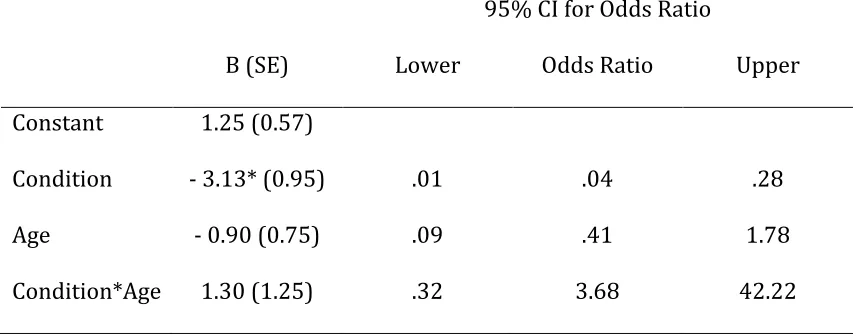
We compared the data from both ages in a logistic regression. The logistic regression model was statistically significant, X2 (3) = 21.20, p < .001. The model explained 37% (Nagelkerke R2) of the variance in children’s performance and
correctly classified approximately 76% of cases. The only significant predictor in the model was the condition children were assigned to. Children were more likely to contrast their behavior to that of out‐group members than to that of neutral individuals. Age was not a significant predictor and there was no significant interaction between age and condition (see Table 1).
Table 1
Beta Values, Odds Ratios and 95% Confidence Intervals for the Predictor Variables
of Condition, Age, Condition*Age Interaction, and the Constant in the Logistic
Regression Model
95% CI for Odds Ratio
B (SE) Lower Odds Ratio Upper
Constant 1.25 (0.57)
Condition ‐ 3.13* (0.95) .01 .04 .28
Age ‐ 0.90 (0.75) .09 .41 1.78
Condition*Age 1.30 (1.25) .32 3.68 42.22
Note: R2 = .00 (Hosmer & Lemeshow), .28 (Cox & Snell), .37 (Nagelkerke), * p = .001
Discussion
We investigated whether five‐year‐old children contrast their behavior to that of out‐group members. The comparison between the Out‐group and Neutral conditions demonstrated that children treat out‐group members differently from neutral individuals within a social learning context. Children matched the
Our results provide a counterpoint to research on imitation and conformity. Previous research has demonstrated that children overimitate (Horner & Whiten, 2005; Lyons et al., 2007) and conform (Haun & Tomasello, 2011). Here we show that, depending on the social context, children sometimes produce the opposite of the actions they have witnessed from a majority. These results complement previous research demonstrating that social factors
influence the extent to which children imitate (Nielsen & Blank, 2011; Over & Carpenter, 2009) and extend them by demonstrating that social factors can lead to contrastive behavior.
These results also contribute to our understanding of group membership. Previous research has demonstrated that children prefer members of their own group to members of other groups (Bigler, Jones, & Lobiner, 1997; Dunham et al., 2011; Kinzler et al., 2007). Additionally, from around the age of five or six
children start to treat out‐group members negatively compared to neutral individuals (Aboud, 2003; Buttelmann & Bohm, 2014). Our findings extend this, demonstrating that children behaviorally distance themselves from out‐group members. This can be taken as further evidence that young children are reacting to the behavior of the out‐group and not merely showing in‐group preferences.
(Aboud, 2003). Further research should investigate the possibility of developmental change in this behavior and measure how it relates to the emergence of out‐group negativity.
Our findings raise other important questions for future research. For example, it will be important to investigate the strength of children’s motivation to contrast their behavior to that of out‐group members and, in particular, whether children will contrast their behavior to that of the out‐group even if it makes their actions less efficient. It will also be important to investigate the motivations underlying contrastive behavior and whether contrast effects are driven by a desire to be different from the out‐group or the desire to be seen to be different from the out‐group.
The tendency for humans to overimitate and conform is extremely powerful. There are good reasons for this; copying others brings many benefits (Chudek & Henrich 2011). However, the tendency to copy can be overcome, and even reversed, by social processes. At least in some situations, children actively contrast their behavior to that of out‐group members. This provides a
noteworthy comparison to previous research and demonstrates the deeply social nature of the copying process.
References
Aboud, F. E. (2003). The formation of in‐group favoritism and out‐group prejudice in young children: Are they distinct attitudes? Developmental Psychology, 39 (1), 48‐60. doi: 10.1037/0012‐1649.39.1.48
Bigler, R. S., Jones, L. C., & Lobliner, D. B. (1997). Social categorization and the formation of intergroup attitudes in children. Child Development, 68 (3),
530‐543. doi: 10.1111/j.1467‐8624.1997.tb01956.x
Buttelmann, D., & Bohm, R. (2014). The ontogeny of the motivation that underlies in‐group bias. Psychological Science, 25 (4), 921‐927. doi:
10.1177/0956797613516802
Chudek, M., & Henrich, J. (2011). Culture‐gene coevolution, norm‐psychology and the emergence of human prosociality. Trends in Cognitive Sciences, 15 (5),
218‐226. doi: 10.1016/j.tics.2011.03.003
Dunham, Y., Baron, A. S., & Carey, S. (2011). Consequences of “minimal” group affiliations in children. Child Development, 82 (3), 793‐811. doi:
10.1111/j.1467‐8624.2011.01577.x
Flynn, E., & Whiten, A. (2008). Cultural transmission of tool use in young
children: A diffusion chain study. Social Development, 17 (3), 699‐718. doi:
10.1111/j.1467‐9507.2007.00453.x
Gergely, G., Bekkering, H., & Kiraly, I. (2002). Rational imitation in preverbal infants. Nature, 415, 755. doi: 10.1038/415755a
Haun, D. B., & Tomasello, M. (2011). Conformity to peer pressure in preschool children. Child Development, 82 (6), 1759‐1767. doi: 10.1111/j.1467‐
Horner, V., & Whiten, A. (2005). Causal knowledge and imitation/emulation switching in chimpanzees (Pan troglodytes) and children (Homo sapiens). Animal Cognition, 8 (3), 164‐81. doi: 10.1007/s10071‐004‐0239‐6
Howard, L. H, Henderson, A. M., Carrazza, C., & Woodward, A. L. (2014). Infants’ and young children’s imitation of linguistic in‐group and out‐group informants. Child Development, Advance online publication. doi:
10.1111/cdev.12299
Izuma, K., & Adolphs, R. (2013). Social manipulation of preference in the human
brain. Neuron, 78, 563‐573. doi:10.1016/j.neuron.2013.03.023
Kinzler, K. D., Dupoux, E., & Spelke, E. S. (2007). The native language of social cognition. PNAS, 104 (30), 12577‐12580. doi:
10.1080/15248372.2011.567200
Lyons, D. E., Damrosch, D. H., Lin, J. K., Macris, D. M., & Keil, F. C. (2011). The scope and limits of overimitation in the transmission of artefact culture. Philosophical Transactions of the Royal Society B, 366, 1158‐1167. doi:
10.1098/rstb.2010.0335
Lyons, D. E., Young, A. G., & Keil, F. C. (2007). The hidden structure of overimitation. Proceedings of the National Academy of Sciences, 104,
19751‐19756. doi: 10/1073/pnas.0704452104
McGuigan, N., Whiten, A., Flynn, E., & Horner, V. (2007) Imitation of causally opaque versus causally transparent tool use by 3‐ and 5‐year‐old children. Cognitive Development, 22, 353–364. doi: 10.1016/j.cogdev.2007.01.001
Nielsen, M., & Blank, C. (2011). Imitation in young children: When who gets copied is more important than what gets copied. Developmental Psychology, 47, 1050‐1053. doi: 10.1037/a0023866
Over, H., & Carpenter, M. (2009). Priming third‐party ostracism increases affiliative imitation in children. Developmental Science, 12, F1–F8. doi:
10.1111/j.1467‐7687.2008.00820.x
Over, H., & Carpenter, M. (2013). The social side of imitation. Child Development Perspectives, 7, 6‐11. doi: 10.1111/cdep.12006
Ruys, K. I., Spears, R., Gordijn, E. H., & De Vries, N. K. (2007). Automatic contrast:
Evidence that automatic comparison with the social self affects evaluative
responses. British Journal of Psychology, 98, 361‐374. doi:
10.1348/000712606X132949
Schubert, T. W., & Hafner, M. (2003). Contrast from social stereotypes in automatic behavior. Journal of Experimental Social Psychology, 39, 577‐