This is a repository copy of
Ab Initio Study of Binary and Ternary Nb (X,Y) A15
₃
Intermetallic Phases (X,Y = Al, Ge, Si, Sn)
.
White Rose Research Online URL for this paper:
http://eprints.whiterose.ac.uk/91414/
Version: Accepted Version
Article:
Papadimitriou, I, Utton, C, Scott, A et al. (1 more author) (2015) Ab Initio Study of Binary
and Ternary Nb (X,Y) A15 Intermetallic Phases (X,Y = Al, Ge, Si, Sn). Metallurgical and
₃
Materials Transactions A, 46 (2). 566 - 576. ISSN 1073-5623
https://doi.org/10.1007/s11661-014-2403-1
[email protected] https://eprints.whiterose.ac.uk/ Reuse
Unless indicated otherwise, fulltext items are protected by copyright with all rights reserved. The copyright exception in section 29 of the Copyright, Designs and Patents Act 1988 allows the making of a single copy solely for the purpose of non-commercial research or private study within the limits of fair dealing. The publisher or other rights-holder may allow further reproduction and re-use of this version - refer to the White Rose Research Online record for this item. Where records identify the publisher as the copyright holder, users can verify any specific terms of use on the publisher’s website.
Takedown
If you consider content in White Rose Research Online to be in breach of UK law, please notify us by
1
Ab initio study of binary and ternary Nb
3(X,Y) A15
intermetallic phases (X,Y= Al, Ge, Si, Sn)
I. Papadimitriou
a, C. Utton
a, A. Scott
b, P. Tsakiropoulos
aa
Department of Materials Science and Engineering, The University of ShefÞeld, Sir Robert HadÞeld Building, Mappin Street, ShefÞeld S1 3JD, England, UK
b
Institute for Materials Research, The University of Leeds, Leeds LS2 9JT, England, UK
Abstract
Elastic and thermodynamic properties of binary and ternary A15 phases containing
Al, Ge, Si and Sn were studied using the first-principles pseudopotential plane-wave
method based on density functional theory. The temperature dependence of the
enthalpy of formation for the A15 intermetallics is reported using the quasiharmonic
approximation. Elastic properties of the studied compounds were calculated at T = 0 K and were in agreement with the measured values reported in the literature. The elastic properties and thermodynamic data for the metastable A15-Nb3Si are reported
for the first time. The Nb3Si has the highest bulk, shear and Young’s modulus values
and is predicted to be less ductile than the other three binary A15 intermetallics. The calculations suggest (i) that Al and Sn have a positive effect on the ductility of the A15 compounds of this study, (ii) that Ge as a ternary addition has a ductilizing effect only in the A15-Nb3Si, and (iii) that Si as a ternary addition has a negative effect on
the ductility of all the A15 compounds of the present study. The linear thermal expansion coefficients of the Nb, Al, the A15 Nb3Al, Nb3Ge, Nb3Sn and Nb3Si (A15)
phases are reported. The Sn and Al additions in the Nb3Si stabilise the A15 structure,
while the Ge addition has the opposite effect, stabilising the tP32 Nb3Si.
* Corresponding author: [email protected], fax +440(0)1142225943
2
1. Introduction
High-temperature structural materials with operating temperature capability that
exceeds that of modern Ni-based superalloys are currently developed to meet
environmental and performance targets for future gas turbine engines. Alloys based on refractory metal intermetallic compounds can achieve a balance of mechanical and
environmental properties with low density and thus are considered as candidate
materials. The microstructures of these materials can contain intermetallics with the
A15 cubic structure [1, 2].
Niobium silicide based alloys have attracted much interest as the next generation
ultra-high temperature alloys owing to their creep, high temperature strength and
ambient temperature fracture toughness [3, 4]. Their microstructures consist of an Nb
solid solution phase in which are embedded silicide(s) and other intermetallic phase(s)
or vice versa, depending on alloy composition [3-5]. The choice of the latter is
influenced by considerations about achieving a balance of high and ambient
temperature properties [1, 3, 4].
The Nb3Si and Nb5Si3 silicides can be present in the microstructure of Nb silicide
based alloys [3, 4]. Both silicides can form as stable and metastable compounds [6].
In the Nb-Si binary phase diagram the equilibrium (stable) 5-3 silicide has the
βNb5Si3 tetragonal structure at high temperatures and the αNb5Si3 tetragonal structure
at low temperatures and the tetragonal (stable) Nb3Si transforms via a eutectoid
reaction to Nbss and Nb5Si3 [6] which can be used to generate desirable
microstructures in the alloys [3]. Metastable Nb3Si can form with the A15 cubic
3
Additions of Al, Ge and Sn in Nb-18Si (at.%) alloys have been shown to benefit their oxidation behaviour [5, 7-9] and to influence the transformation of βNb5Si3 to
αNb5Si3 [4]. These elements suppress the formation of the tetragonal (stable) Nb3Si
[10-12] and Sn plays a key role in the elimination of pest oxidation [5, 9]. The
effectiveness of Sn depends on its concentration and its synergy with other elements
in the alloy and on whether the A15-Nb3Sn is stable in the microstructure.
Furthermore, Sn can stabilise metastable forms of the Nb3Si when it is in synergy
with Fe and Cr [13]. The formation of A15-Nb3Al in Nb silicide based alloys is
possible depending on the Ti/Al ratio in the alloy [14].
In the equilibrium Nb-Si binary phase diagram the Nb3Si has a tetragonal Ti3
P-type crystal structure. In Nb-Si-Ti based alloys the formation of the A15 Nb3Sn
destabilises the tetragonal Nb3Si [10]. Some intermetallic phases with the A15 cubic
structure have also attracted interest because of their superconducting properties.
Niobium forms a number of superconducting A15 compounds that exhibit high
transition temperatures (Tc), namely Nb3Ge (23.6 K), Nb3Ga (20.2 K), Nb3Sn (18.9
K) and Nb3Al (18.8 K). It has been suggested that the A15 Nb3Si phase would have a
Tc above that of Nb3Ge, of the order of 25 K [15], owing to its small lattice parameter.
The A15 structure is a close-packed structure whose stability is largely governed by
size [15]. It has a primitive cell of 8 atoms and belongs to the space group O3h - Pm3n,
its Pearson symbol is cP8 and is of the Cr3Si type. The A3B cubic unit cell has two B
atoms at (0, 0, 0) and (0.5, 0.5, 0.5) sites and six A atoms at (0.25, 0, 0.5), (0.5, 0.25,
0), (0, 0.5, 0.25), (0.75, 0, 0.5), (0.5, 0.75, 0) and (0, 0.5, 0.75) sites. In the current
4
ternary compounds, two different atoms occupy either the (0, 0, 0) or (0.5, 0.5, 0.5)
sites.
The resistivity [16, 17], heat capacity [18, 19], electron-phonon interaction [20] and
magnetic susceptibility [21] of A15 compounds have been studied. There is limited
data about enthalpies of formation and Debye temperature of the A15-Nb3X (X=Sn,
Al, Si, Ge) compounds [18-19]. The elastic properties of Nb3Sn and Nb3Al have been
calculated [22, 23], but to the best of the authors’ knowledge no data exists for the
A15 Nb3Si and Nb3Ge intermetallics. There is experimental and theoretical data for
the vibrational and elastic properties of Nb, Si, Sn, Ge and Al [24, 25] and their
Debye temperatures [26]. There is also experimental data for the linear thermal
expansion coefficients of Nb, Al and Nb3Ge [25, 27, 28].
The motivation for the present study was to investigate the elastic and
thermodynamical properties of binary and ternary A15 Nb based intermetallics and to
compare the stability of A15-Nb3Si with the tP32-Nb3Si. Calculations of the elastic
constants and phonon properties are used to produce a complete set of data for the
studied intermetallics. This data will be used to support the design of Nb silicide
based alloys.
2. Computational details
2.1 Methodology
The calculations were performed using the CASTEP (Cambridge Serial Total
Energy Package) code [29]. The Kohn–Sham approach was used to calculate the
fundamental eigenvalues [30]. The interaction between valence electrons and core
5
approach [31]. The exchange-correlation energy was evaluated with the help of the
generalised gradient approximation (Perdew–Wang, PW91) [32]. To reduce the basis
set of plane wave functions used to describe the real electronic functions, norm
conserving pseudopotentials [33] were implemented and the valences for the atomic
configurations were Al-3s23p1, Sn-5s25p2, Nb-4d45s1, Ge-4s25p2 and Si-3s23p2. After
conducting careful convergence tests it was found that an energy cutoff of 700 eV was
sufficient to reduce the error in the total energy to less than 0.1 meV/atom. A
Monkhorst–Pack k-point grid separation of 0.03 Å−1 was employed for the integration
over the Brillouin zone according to the Monkhorst–Pack scheme [34]. A well
converged k-point set was needed to calculate high quality thermodynamic properties;
thus separate convergence tests were carried out to ensure that the error in the phonon
frequencies was less than 10-3 cm-1. A finite basis set correction and the Pulay scheme
of density mixing were applied for the evaluation of energy and stress, while the
electronic energy tolerance for the SCF solver was 1×10⁻¹⁰ eV. Geometry
optimisations of the structures were performed within the
Broyden-Fletcher-Goldfarb-Shanno (BFGS) minimization scheme [35] , with the following thresholds for
converged structures: energy change per atom, maximum residual force, maximum
atomic displacement and maximum stress less than 1×10⁻⁷ eV, 1×10⁻⁴ eV/Å,
1×10⁻⁴ Å and 0.001 GPa, respectively.
2.2 Elastic properties
The elastic constants of a material describe its response to an applied stress, or the
stress required to maintain a distortion. The method to determine elastic constants
consisted of applying a given strain and calculating the stress, since the unit cell was
kept fixed and only the internal coordinates were optimised. Both stress and strain
6
constants form a 6 x 6 matrix such that i=Cij j for small stress and strain . This
matrix can be reduced as the strain patterns (sets of distortions) are based on the
crystal structure of each phase which means that one pattern is sufficient for cubic
cells by taking advantage of the linear combinations of the second order elastic
constants. Six strain steps (varying from -0.003 to + 0.003) were used for each pattern
to obtain a consistent linear fit of the stress-strain relationship.
Thus, for the cubic binary and ternary A15 compounds of this study, and the bcc
(Nb), diamond (Si) and fcc (Al) structures a series of six geometry optimisations were
conducted in order to evaluate the three independent elastic constants C11, C12 and
C44. For the tetragonal Sn 12 geometry optimisations were required to calculate the
six independent elastic constants C11, C12, C13, C33, C44 and C66. After acquiring the
elastic constants matrix and confirming that the mechanical stability criteria [36] are
satisfied, the bulk (B), Young’s (E) and shear (G) modulus and Poisson’s ratio (v)
were obtained by using the Voigt-Reuss-Hill approximation (VRH) [37, 38]. The
Debye temperature at low temperatures was determined from elastic constants using
the equations in [39], since at low temperatures the vibrational excitations arise solely
from acoustic modes, i.e. when the Debye temperature is associated with lattice
vibrations. In order to confirm the values of the bulk moduli, a fit of the energies
versus the volumes of the strained structures in the third order Birch-Murnaghan
equation of state (B-M EOS) [40] was carried out.
2.3 Linear Response method
The entropic contributions play a predominant role in the structural stability of
intermetallic phases. In the case of strongly ordered compounds the main contribution
7
are considered to be relatively small [41]. Density Functional Perturbation Theory
(DFPT) or Linear Response, which is one of the most popular methods of lattice
dynamics [42-43], was used in order to obtain the vibrational density of states. When
ionic positions are perturbed, the dynamical matrix and phonon frequencies can be
obtained. The calculations first ensured that every system was in the ground state, i.e.,
the geometry optimisation was fully converged as any underconverged structure could
yield imaginary phonon frequency eigenvalues, which is indicative of mechanical
instability. After directly computing the phonon frequencies on Monkhorst-Pack
q-vector grid of separation of 0.05 Å−1, the results were interpolated onto a very dense
q-point set, thus the phonon density of states (DOS) was obtained for each phase
under investigation. By using the phonon DOS and the formulae in [42], the
vibrational contributions to the enthalpy, entropy and free energy versus temperature
as well as the Debye temperature were obtained using the quasiharmonic
approximation. Apart from the A15 compounds that were under study, the phonon
DOS of each element were also calculated separately in order to obtain the finite
temperature enthalpy of formation.
The linear thermal expansion coefficients were obtained by generating structures by
varying the ratio V/V0 (V0 being the equilibrium volume at 0 K) from 0.991 to 1.006
with an increment of 0.003 and conducting a phonon calculation for each volume. The
equilibrium volume V(T,P) was then calculated at every given temperature using the
quasiharmonic approximation by minimising the total free energy with respect to
volume, thus finding the equilibrium volume at each temperature. After calculating
the V(T,P) the linear thermal expansion coefficient was obtained. This procedure was
8
3. Results and discussion
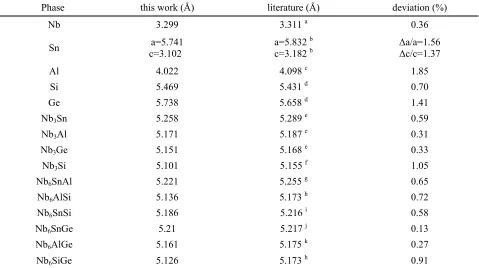
The calculated lattice constants of the pure elements and the binary and ternary
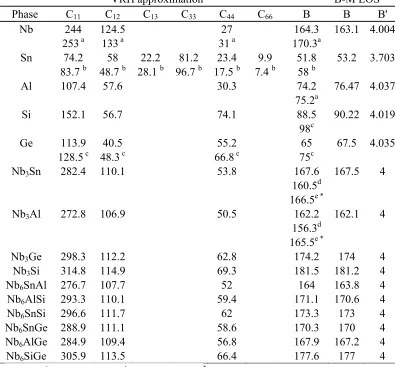
A15 phases are compared with the experimental ones in Table 1. It can be seen that in the present calculations and with the exception of Si and Ge the lattice constants are slightly underestimated but overall are in good agreement with the experimental values, with the lattice constant of Al showing the largest difference of 1.85 %. Table 2 gives the results for the independent elastic constants (Cij) and bulk moduli (B) for
all elements and compounds under study. In this Table the bulk moduli were
calculated from elastic constants according to the Voigt-Reuss-Hill (VRH) scheme
and values are also given for bulk moduli and first pressure derivatives of bulk moduli
(B') from the Birch-Murnaghan equation of state (B-M EOS). It is confirmed that the
mechanical stability criteria [36] are met for all phases. For the pure elements it can
be seen that the elastic constants are in good agreement with the experimental data.
The values of the bulk moduli of the Nb3Sn and Nb3Al are in good agreement with
other theoretical [22, 23] results and the consistency of the calculation is validated by
the results of the B-M EOS fitting. The current results show that the Nb3Si has the
highest bulk modulus of 181.5 GPa and that the bulk moduli of the Nb3Sn and Nb3Al
are close to each other being 167.6 GPa and 162.2 GPa, respectively, while the
corresponding value for Nb3Ge is 174.2 GPa. This means that the most resistant to
applied pressure of the four binary intermetallics of this study is the Nb3Si. From the
bulk modulus values of the ternary A15 phases it can be seen that the Si and Ge tend
to increase the bulk modulus, while the Sn and Al have the opposite effect.
The calculated values of the shear (G) and Young’s (E) modulus and the Debye
temperature ( D) are given in Table 3. The Nb3Si phase has the highest shear
9
(73.5 GPa), to Nb3Sn (65 GPa) to Nb3Al (61.6 GPa), which means that the most
resistant binary compound to reversible deformation upon shear strain is the Nb3Si.
The same ranking applies for the stiffness of the compounds as the elastic modulus
(E) values are 210 GPa for Nb3Si, 193.3 GPa for Nb3Ge, 172.7 GPa for Nb3Sn and
164 GPa for Nb3Al. Based on the values of the aforementioned moduli for the ternary
phases, it is suggested that the Si and Ge additions increase the moduli, while the Sn
and Al decrease them.
Ductile or brittle behavior of a material can be deduced by taking into account the
Cauchy pressure (C12 - C44 for cubic and C13-C44 and C12-C66 for tetragonal lattices)
and Pugh’s [44] index of ductility of shear modulus over bulk modulus ratio (G/B)
and Poisson’s ratio (v) [45, 46]. The values of the aforementioned properties are listed in Table 3. According to [47], for metallic bonding, a positive value of Cauchy
pressure means ductile behavior and brittle if negative. The other two conditions point
to brittle behavior when the G/B ratio is greater than 0.57 and the v is less than 0.26.
Bearing that in mind, it can be seen from Table 3 that the Nb3Si and Nb3Al are the
most and least brittle binary compounds, respectively, that the Sn and Al additions
may improve ductility, and that the Si has the opposite effect.
The calculations predict that when Al is added as a ternary addition in the A15 compounds the bulk and shear moduli decrease, the shear over bulk modulus ratio decreases and the Poisson's ratio increases, and that Si as a ternary addition in the A15 compounds has the exact opposite effect. When Sn is added as a ternary addition in the Nb3Al the bulk and the shear moduli decrease, the shear over bulk modulus ratio
decreases and the Poisson's ratio increases, and the opposite is the effect of Sn as a ternary addition in the Nb3Ge and Nb3Si. As a ternary addition in Nb3Si, the Ge
10
increases the Poisson's ratio but has the opposite effect when added to the Nb3Al and
Nb3Sn compounds. It is therefore suggested that Al and Sn have a ductilizing effect in
the A15 compounds of the present study, that Ge as a ternary addition has a positive effect only on the ductility of A15-Nb3Si, and that Si as a ternary addition has a
negative effect on the ductility of all the A15 compounds in the present study .
Comparing the shear moduli, Young’s moduli and Debye temperature values
calculated from the elastic constants of the Nb3Sn and Nb3Al of this study with
theoretical data in [22], it can be seen that there is disagreement, which in the case of Nb3Al is 17%, 15% and 18% in G, E and D, respectively, due to the deviation
between the shear elastic constant values of this study and [22] (the bulk modulus values (Table 2) are in good agreement). The Debye temperature of Nb3Al calculated
from the elastic constants in the present study is in very good agreement with the
experimental results [26]. It can thus be suggested that as the D value of the present
study is much closer to that in [26] than the value in [22] that the shear constant calculated in this study is closer to the actual value than in [22], owing possibly to the use of different pseudopotentials. The D value decreases from Nb3Si (420 K) to
Nb3Ge (376 K) to Nb3Al (374 K) to Nb3Sn (336 K). When Si or Ge are added to the
A15 structure the Debye temperature tends to increase. The aforementioned value
tends to decrease in the presence of Sn and Al.
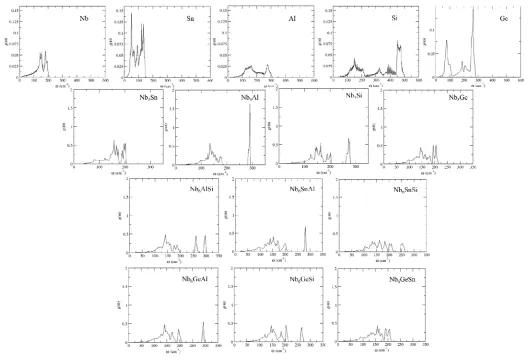
The vibrational density of states (DOS) for the elemental phases and A15
compounds under study were computed and all the eigenfrequencies were found to be
real, hence it was confirmed that the compounds under investigation are mechanically
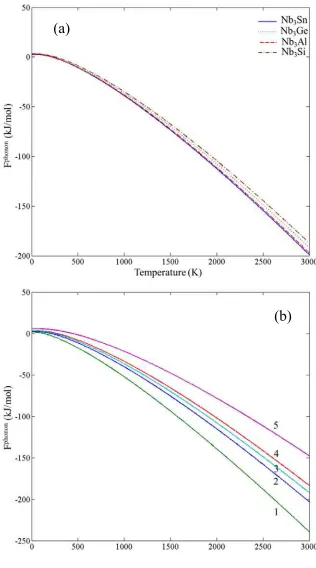
stable. The phonon DOS are shown in Fig. 1. After inserting the computed phonon
DOS in the relevant equations [42], the vibrational contribution to free energies per
11
compounds in Fig. 2. It can be seen that the Fphonon decreases faster in the order Nb3Si,
Nb3Al, Nb3Ge, Nb3Sn. In Fig. 3 the phonon contribution to the free energy of the
ternary compounds is shown. It can be seen that it decreases faster in the order
Nb6AlSi, Nb6GeSi, Nb6SiSn, Nb6GeAl, Nb6AlSn, Nb6GeSn. After taking Fphon into
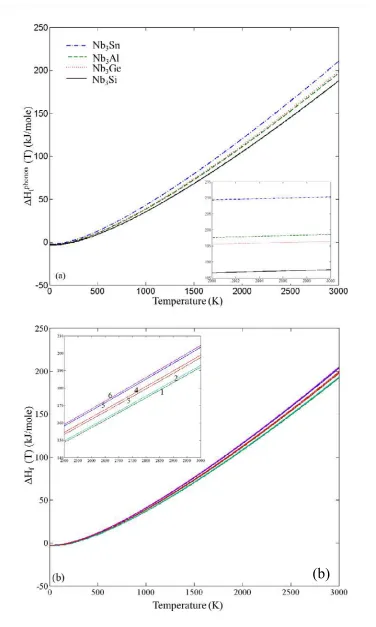
account, the phonon contribution to the enthalpy of formation ( Hfphon (T)) was
evaluated. The Hfphon (T) rises faster for Nb3Sn, owing to the steep descent of the
vibrational contribution to the free energy of Sn compared with the other elements, as
it can be seen in Fig. 4. The Hfphon (T) of Nb3Si on the other hand exhibits the
smallest slope of the four curves, which is attributed to the behaviour of the Fphon (T)
of Si, while the curves of Nb3Al and Nb3Ge are close to each other and have about
half the slope of the corresponding value of Nb3Sn. Regarding the ternary phases the
Hfphon (T) increases faster in the order Nb6AlSi, Nb6GeSn, Nb6GeAl, Nb6SiSn,
Nb6AlSn, Nb6GeSn. By taking into consideration the total internal energies of the
constituent elements and the compounds, the enthalpies of formation versus
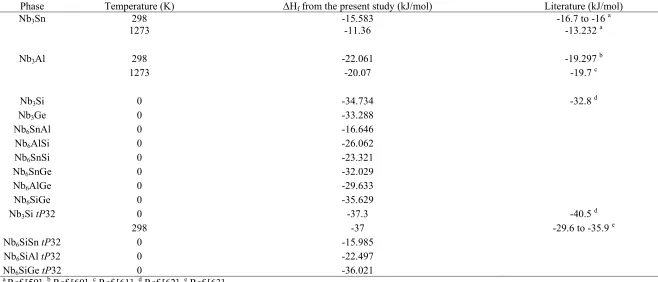
temperature ( Hf (T)) were obtained and they are shown in Figs 5 and 6. At T = 0 K
the heat of formation ( ) increases from Nb3Si (-34.734 kJ/mol) to Nb3Ge (-33.288
kJ/mol), to Nb3Al (-22.06 kJ/mol) to Nb3Sn (-16.54 kJ/mole). Table 4 shows the good
agreement between the present study and previous experimental and theoretical
results regarding the enthalpies of formation of the intermetallics. It can be seen that there is agreement of the enthalpy of formation of the tP32-Nb3Si with previous ab
initio calculation [62] and values from CALPHAD assessments [63].The Nb3Si phase
has the lowest Hf (T)of the binary A15 intermetallics, while the Nb3Sn is the phase
with the highest value in the whole range of temperatures. The Hf(T) of the tP32
Nb3Si [48] is also shown in Fig. 4 and Table 4. It is confirmed that the tetragonal
12 the enthalpy of formation of the tP32 Nb3Si exhibits a steeper ascent than that of the
A15 Nb3Si, in the whole range of temperatures the enthalpy of formation of the
former structure is always lower than that of the latter, owing mostly to the
considerably lower enthalpy of formation at T = 0 K. For the ternary intermetallics
containing Si and Sn, Al or Ge the enthalpy of formation at T = 0 K was calculated
for the A15 and tP32 structures and the values are given in Table 4. It is suggested
that the Sn and Al additions stabilise the A15 structure and the Ge addition stabilises
the tP32 structure.
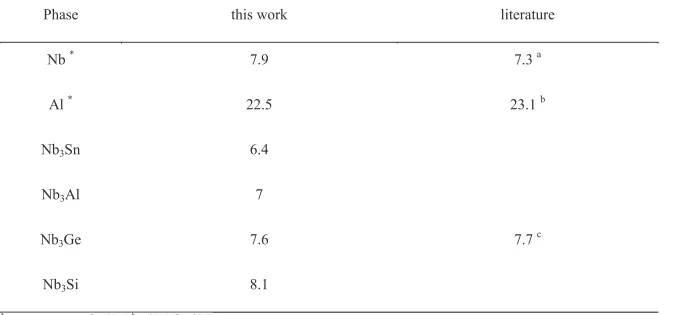
The linear thermal expansion coefficients of Nb, Al, Nb3Sn, Nb3Al, Nb3Ge and
Nb3Si (A15) phases are shown in Table 5. The agreement with the available
experimental data is excellent, a fact that demonstrates the power and usefulness of
the linear response method. Regarding the A15 phases the aforementioned value tends
to decrease in the order Nb3Si (8.1 10-6/K), Nb3Ge (7.6 10-6/K), Nb3Al (7 10-6/K),
Nb3Sn (6.4 10-6/K).
The resultant phonon DOS from the calculations was also used to calculate the
Debye temperature. It should be noted that it is more difficult to obtain accurate
values of D in that way than through the elastic constants (see section 2.2) because
D, as a low temperature property, is determined by low energy phonons i.e. the
acoustic phonons. The lower the temperature the smaller the part of Brillouin Zone
that contributes to thermodynamics. Despite this and although the values regarding the Nb3Sn and Nb3Al are somewhat underestimated, the calculated D values (Table
3) were in good agreement with both the experimental data [26] and the results of the
present study that were calculated from elastic constants values. For the elemental
phases the results were in good agreement with the literature. The overall correlation
13
4.Conclusions
First-principles calculations were carried out for binary and ternary A15
intermetallic compounds and their constituent elements. Elastic constants, the bulk,
shear and Young’s moduli, the Poisson’s ratio and the Debye temperature were
calculated. In the case of the Nb3Si, most of the data were obtained for the first time.
The temperature dependence of the enthalpy of formation of the intermetallic phases
is reported for the first time. The linear thermal expansion coefficients of Nb, Al,
Nb3Sn, Nb3Al, Nb3Ge and Nb3Si (A15) are also reported. Comparison with available
experimental and other theoretical data shows good agreement with this work. It is
concluded that the A15 Nb3Si has the highest bulk, shear and Young’s modulus
values and that it is the stiffest and less ductile of the four binary intermetallics of the
present study. Among the binary A15 compounds the D value of Nb3Si is the highest
compared with the Nb3Ge, Nb3Sn and Nb3Al compounds, while the ternary
A15-Nb6SiGe has the highest D value amongst the ternary intermetallics. It is suggested
that Al and Sn additions in the ternary A15 compounds improve ductility. The results for the enthalpy of formation would suggest that the Sn and Al additions in the Nb3Si
stabilise the A15 structure rather than the tP32, and that the Ge addition in the Nb3Si
has the opposite effect.
Acknowledgements
The support of this work by the F-P7 “Accelerated Metallurgy” project and the
14 References
1. D. M. Shah, D. L. Anton, D. P. Pope and S. Chin, Materials Science Engineering
1995, vol. A192/193 pp. 658-672.
2. E. Passa, G. Shao and P. Tsakiropoulos, Philosophical Magazine A 1997, vol. 75, pp. 637-655.
3. S. J. Balsone, B. P. Bewlay, M. R. Jackson, P. R. Subramanian, J. C. Zhao, A. Chatterjee and T. M. Heffernan, In Structural Intermetallics 2001, ed. K. J. Hemker, Dimiduk D. M., Clemens H., Darolia R., Inui M., Larsen J. M., Sikka V. K., Thomas . and Whittenberger J. D. (TMS, Warrendale, 2001), pp 99-108.
4. P. Tsakiropoulos: Beyond Nickel Based Superalloys. In R. Blockley, W. Shyy (Eds) Encyclopedia of Aerospace Engineering, (John Wiley & Sons, Ltd, 2010), pp. 2345- 2355.
5. J. Geng and P. Tsakiropoulos, Intermetallics 2007, vol. 15, pp. 382-395.
6. M.E. Schlesinger, H. Okamoto, A. B. Gokhale and R. Abbaschian, Journal of Phase Equilibria 1993, vol. 14, pp. 502-509.
7. J. Geng, P. Tsakiropoulos and G. Shao, Materials Science and Engineering A 2006, vol. 441, pp. 26-38.
8. K. Zelenitsas and P. Tsakiropoulos, Materials Science and Engineering A-Structural
Materials Properties Microstructure and Processing 2006, vol. 416, pp. 269-280.
9. M. R. Jackson, B. P. Bewlay and J. C. Zhao, US patent 6,913,655 B2, (July 5, 2005). 10. N. Vellios and P. Tsakiropoulos, Intermetallics 2007, vol. 15, pp. 1518-1528. 11. K. Zelenitsas and P. Tsakiropoulos, Intermetallics 2006, vol. 14, pp. 639-659. 12. L. I. Zifu and P. Tsakiropoulos, Intermetallics 2010, vol. 18, pp. 1072-1078. 13. N. Vellios and P. Tsakiropoulos, Intermetallics 2007, vol. 15, pp. 1529-1537. 14. Yonosuke Murayama and Shuji Hanada, Science and Technology of Advanced Materials 2002, vol. 3, pp. 145-156.
15. D. Dew-Hughes, Cryogenics 1975, vol. 15, pp. 435-454.
16. D. W. Woodard and G. D. Cody, Physical Review A-General Physics 1964, vol. 136, pp. A166-168.
17. Z. Fisk and G. W. Webb, Physical Review Letters 1976, vol. 36, pp. 1084-1086. 18. G. S. Knapp, S. D. Bader and Z. Fisk, Phys. Rev. B 1976, vol. 13, pp. 3783-3789. 19. G. W. Webb, Z. Fisk, J. J. Engelhardt and S. D. Bader, Phys. Rev. B 1977, vol. 15, pp. 2624-2629.
20. B. M. Klein, L. L. Boyer and D. A. Papaconstantopoulos, Physical Review Letters 1979, vol. 42, pp. 530-533.
21. W. Rehwald, M. Rayl, R. W. Cohen and G. D. Cody, Phys. Rev. B 1972, vol. 6, pp. 363-371.
22. M. Sundareswari, Swaminathan Ramasubramanian and Mathrubutham Rajagopalan, Solid State Communications 2010, vol. 150, pp. 2057-2060.
23. C. Paduani, Braz. J. Phys. 2007, vol. 37, pp. 1073-1076. 24. W. A. Brantley, J. Appl. Phys. 1973, vol. 44, pp. 534-535.
25. C. J. Smithells: Metal References Book. (5th Edition Butterworth, London, 1976). 26. C. Kittel: Introduction to Solid State Physics. (7th edition John Wiley & Sons, New York, 1996).
27. Robert Grill and Alfred Gnadenberger, Int. J. Refract. Met. Hard Mater. 2006, vol. 24, pp. 275-282.
28. H. Kawamura, K. Tachikawa, K. Takemura and S. Minomura, Journal of the Physical Society of Japan 1979, vol. 47, pp. 1365-1366.
29. S. J. Clark, M. D. Segall, C. J. Pickard, P. J. Hasnip, M. J. Probert, K. Refson and M. C. Payne, Z. Kristall. 2005, vol. 220, pp. 567-570.
30. W. Kohn and L. J. Sham, Physical Review 1965, vol. 140, pp. 1133-1138.
15 32. John P. Perdew, J. A. Chevary, S. H. Vosko, Koblar A. Jackson, Mark R. Pederson, D. J. Singh and Carlos Fiolhais, Phys. Rev. B 1992, vol. 46, pp. 6671-6687.
33. J. S. Lin, A. Qteish, M. C. Payne and V. Heine, Phys. Rev. B 1993, vol. 47, pp. 4174- 4180.
34. Hendrik J. Monkhorst and James D. Pack, Phys. Rev. B 1976, vol. 13, pp. 5188-5192. 35. B. G. Pfrommer, M. Cote, S. G. Louie and M. L. Cohen, J. Comput. Phys. 1997, vol. 131, pp. 233-240.
36. M. Born and K. Huang: Dynamical Theory of Crystal Lattices. (Oxford, 1956). 37. R. Hill, Proceedings of the Physical Society of London Section A 1952, vol. 65, pp. 349-355.
38. A. Reuss, Z. Angew. Math. Mech. 1929, vol. 9, pp. 49-58.
39. O. L. Anderson, Journal of Physics and Chemistry of Solids 1963, vol. 24, pp. 909- 917.
40. F. Birch, Phys Rev 1947, vol. 71, pp. 809-824.
41. Y. Wang, C. Woodward, S. H. Zhou, Z. K. Liu and L. Q. Chen, Scripta Materialia 2005, vol. 52, pp. 17-20.
42. Stefano Baroni, Stefano de Gironcoli, Andrea Dal Corso and Paolo Giannozzi, Rev. Mod. Phys. 2001, vol. 73, pp. 515-562.
43. S. De Gironcoli, Phys. Rev. B 1995, vol. 51, pp. 6773-6776. 44. S. F. Pugh, Philosophical Magazine 1954, vol. 45, pp. 823-843.
45. M. C. Gao, Y. Suzuki, H. Schweiger, O. N. Dogan, J. Hawk and M. Widom, Journal of Physics-Condensed Matter 2013, vol. 25.
46. M. C. Gao, O. N. Dogan, P. King, A. D. Rollett and M. Widom, JOM 2008, vol. 60, pp. 61-65.
47. D. G. Pettifor, Mater. Sci. Technol. 1992, vol. 8, pp. 345-349.
48. H. Nowotny, A. W. Searcy and J. E. Orr, J. Phys. Chem. 1956, vol. 60, pp. 677-678. 49. P. Soderlind, O. Eriksson, J. M. Wills and A. M. Boring, Phys. Rev. B 1993, vol. 48, pp. 5844-5851.
50. J. A. Rayne and B. S. Chandrasekhar, Physical Review 1960, vol. 120, pp. 1658- 1663.
51. G. Simmons and H. Wang: Single Crystal Elastic Constants and Calculated
Aggregate Properties: A Handbook. (1971).
52. C. Filippi, D. J. Singh and C. J. Umrigar, Phys. Rev. B 1994, vol. 50, pp. 14947- 14951.
53. W. K. Wang, H. Iwasaki, C. Suryanarayana, T. Masumoto, N. Toyota, T. Fukase and F. Kogiku, J. Mater. Sci. 1982, vol. 17, pp. 1523-1532.
54. F. J. Bachner, J. B. Goodenough and H. C. Gatos, Journal of Physics and Chemistry of Solids 1967, vol. 28, pp. 889-895.
55. W. B. Pearson: A Handbook of Lattice Spacings and Structures of Metals and Alloys. (1967), pp. 978.
56. F. Galasso, B. Bayles and S. Soehle, Nature 1963, vol. 198, pp. 984.
57. K. Schubert: in W. Koster (ed.), Kristallstrukturen Zweikomponentiger Phasen,. (1964), pp. 305.
58. M. Arita, H. U. Nissen and W. Schauer, J. Solid State Chem. 1990, vol. 84, pp. 386- 400.
59. C. Toffolon, C. Servant, J. C. Gachon and B. Sundman, Journal of Phase Equilibria 2002, vol. 23, pp. 134-139.
60. I. Shilo, H. F. Franzen and R. A. Schiffman, Journal of the Electrochemical Society 1982, vol. 129, pp. 1608-1613.
61. Kamal Mahdouk and Jean-Claude Gachon, Journal of Alloys and Compounds 2001, vol. 321, pp. 232-236.
62. Yue Chen, T. Hammerschmidt, D. G. Pettifor, Jia-Xiang Shang and Yue Zhang, Acta Materialia 2009, vol. 57, pp. 2657-2664.
1
Table 1
Lattice constants pure elements and binary and ternary A15 phases
Phase this work (Å) literature (Å) deviation (%)
Nb 3.299 3.311 a 0.36
Sn a=5.741
c=3.102
a=5.832 b c=3.182 b
a/a=1.56 c/c=1.37
Al 4.022 4.098 c 1.85
Si 5.469 5.431 d 0.70
Ge 5.738 5.658 d 1.41
Nb3Sn 5.258 5.289 e 0.59
Nb3Al 5.171 5.187 e 0.31
Nb3Ge 5.151 5.168 e 0.33
Nb3Si 5.101 5.155 f 1.05
Nb6SnAl 5.221 5.255 g 0.65
Nb6AlSi 5.136 5.173 h 0.72
Nb6SnSi 5.186 5.216 i 0.58
Nb6SnGe 5.21 5.217 j 0.13
Nb6AlGe 5.161 5.175 k 0.27
Nb6SiGe 5.126 5.173 h 0.91
a
2 Table 2
Elastic constants (Cij) and bulk moduli (B) of pure elements and binary and ternary A15 phases in GPa.
VRH approximation B-M EOS
Phase C11 C12 C13 C33 C44 C66 B B B'
Nb 244 124.5 27 164.3 163.1 4.004
253 a 133 a 31a 170.3a
Sn 74.2 58 22.2 81.2 23.4 9.9 51.8 53.2 3.703 83.7 b 48.7 b 28.1 b 96.7 b 17.5 b 7.4 b 58 b
Al 107.4 57.6 30.3 74.2 76.47 4.037
75.2a
Si 152.1 56.7 74.1 88.5 90.22 4.019
98c
Ge 113.9 40.5 55.2 65 67.5 4.035
128.5 c 48.3 c 66.8c 75c
Nb3Sn 282.4 110.1 53.8 167.6 167.5 4
160.5d
166.5e *
Nb3Al 272.8 106.9 50.5 162.2 162.1 4
156.3d
165.5e *
Nb3Ge 298.3 112.2 62.8 174.2 174 4
Nb3Si 314.8 114.9 69.3 181.5 181.2 4
Nb6SnAl 276.7 107.7 52 164 163.8 4
Nb6AlSi 293.3 110.1 59.4 171.1 170.6 4
Nb6SnSi 296.6 111.7 62 173.3 173 4
Nb6SnGe 288.9 111.1 58.6 170.3 170 4
Nb6AlGe 284.9 109.4 56.8 167.9 167.2 4
Nb6SiGe 305.9 113.5 66.4 177.6 177 4
a Ref. [25] , b Ref [50], c Ref. [24], d Ref. [23], e Ref. [22], *
3
Table 3
Calculated shear (G) and elastic moduli (E) in GPa, Poisson’s ratio (v), Cauchy pressure (C12-C44 for cubic, C13-C44 and C12-C66 for tetragonal lattices) in GPa, G/B ratio
and Debye temperature ( D) from elastic constants for pure elements and binary and ternary A15 phases.
G E D (K)
Phase VRH VRH v C12-C44 C13-C44 C12-C66 G/B Phonon DOS Elastic constants
Nb 37.4 37.5 c
104.3 104.9 c
0.394 0.397 c
97.5 0.228 277 268 275 b
Sn 16.3 18.4 c
44.3 49.9 c
0.357 0.357 c
54.1 -1.2 48.1 0.315 254 217 230 b
Al 28 26.2 c
74.7 70.6 c
0.334 0.345 c
27.3 0.377 394 420 428 b
Si 62.1 64.1 d
151 155.8 d
0.216 0.215 d
-17.4 0.701 647 628 645 b
Ge 46.9 113.4 0.209 -14.7 0.722 393 386 360 b
41 d 104 d
Nb3Sn 65
74.9 a *
172.7 195.3 a *
0.328 56.3 0.388 291 336 308 b 282 a *
Nb3Al 61.6
74.2 a *
164 193.5 a *
0.331 56.4 0.380 353 374 370 b 316 a *
Nb3Ge 73.5 193.3 0.315 49.4 0.422 344 376
Nb3Si 80.3 210 0.307 45.6 0.442 383 420
Nb6SnAl 63.2 168 0.329 55.7 0.385 332 355
Nb6AlSi 70.7 186.4 0.318 50.7 0.413 386 398
Nb6SnSi 72.8 191.6 0.316 49.7 0.420 360 378
Nb6SnGe 69.3 183.1 0.321 52.5 0.407 342 359
Nb6AlGe 67.6 178.8 0.323 52.6 0.403 350 377
Nb6SiGe 77 201.8 0.311 47.1 0.434 378 400
a Ref. [22], b Ref. [26] c
4
Table 4
Calculated Enthalpies of formation of binary and ternary A15 phases (unless denoted otherwise) compared with the literature.
a
Ref [59], b Ref [60], c Ref [61], d Ref [62], e Ref [63]
Phase Temperature (K) Hf from the present study (kJ/mol) Literature (kJ/mol)
Nb3Sn 298
1273
-15.583 -11.36
-16.7 to -16 a -13.232 a
Nb3Al 298 -22.061 -19.297
b
1273 -20.07 -19.7 c
Nb3Si 0 -34.734 -32.8 d
Nb3Ge 0 -33.288
Nb6SnAl 0 -16.646
Nb6AlSi 0 -26.062
Nb6SnSi 0 -23.321
Nb6SnGe 0 -32.029
Nb6AlGe 0 -29.633
Nb6SiGe 0 -35.629
Nb3Si tP32 0 -37.3 -40.5 d
298 -37 -29.6 to -35.9 e
Nb6SiSn tP32 0 -15.985
Nb6SiAl tP32 0 -22.497
5
Table 5
Linear thermal expansion coefficients of Nb, Al, Nb3Sn, Nb3Al, Nb3Ge and Nb3Si (10-6/K).
Phase
this work
literature
Nb
*7.9
7.3
aAl
*22.5
23.1
bNb
3Sn
6.4
Nb
3Al
7
Nb
3Ge
7.6
7.7
c
Nb
3Si
8.1
*
1
2
[image:23.612.142.458.83.651.2]
Fig. 2.Phonon contribution to free energies of the (a) binary A15 phases and (b) Sn (1), Nb (2), Ge (3), Al (4) and (5) Si.
(a)
3
4
Fig. 4. Phonon contributions to the enthalpy of formation of (a) the binary and (b) the ternary (Nb6AlSi (1), Nb6GeSn (2), Nb6GeAl (3), Nb6SiSn (4),
Nb6AlSn (5) and Nb6GeSn (6)) A15 phases.
(a)
5
Fig. 5. Enthalpy of formation curves showing the influence of each element under study in the (a) Nb3Sn and (b) Nb3Al intermetallics.
(b)
6
Fig. 6. Enthalpy of formation curves showing the influence of each element under study in the (a) Nb3Ge and (b) Nb3Si intermetallics. All phases are of A15 structure unless denoted otherwise.