This is a repository copy of Facebook Narratives. White Rose Research Online URL for this paper: http://eprints.whiterose.ac.uk/119706/
Version: Accepted Version
Book Section:
Davies, J.A. (2015) Facebook Narratives. In: Rowsell, J. and Pahl, K., (eds.) The Routledge Handbook of Literacy Studies. Routledge . ISBN 9780415816243 https://doi.org/10.4324/9781315717647.ch26
[email protected] Reuse
Unless indicated otherwise, fulltext items are protected by copyright with all rights reserved. The copyright exception in section 29 of the Copyright, Designs and Patents Act 1988 allows the making of a single copy solely for the purpose of non-commercial research or private study within the limits of fair dealing. The publisher or other rights-holder may allow further reproduction and re-use of this version - refer to the White Rose Research Online record for this item. Where records identify the publisher as the copyright holder, users can verify any specific terms of use on the publisher’s website.
Takedown
If you consider content in White Rose Research Online to be in breach of UK law, please notify us by
Facebook Narratives
Julia Davies
INTRODUCTION
In this chapter I accept the argument that storytelling is a basic human impulse and
suggest that Facebook provides a new medium through which individuals can
articulate and share their stories and experiences. I describe how the ‘narrative turn’
in social studies research situates narratives as a process of cultural reproduction and
drawing on this perspective, argue that the affordances of Facebook shape stories in
ways that reinforce particular cultural meanings.
DEFINITIONS AND HISTORICAL PERSPECTIVES
The Russian formalist Vladimir Propp has been widely credited with the brokering of
new ideas that influenced contemporary narrative research. First published in 1928,
Propp’s analysis of fairytales proposed a finite set of narrative plots lying at the root
of all stories. Propp’s attempt sought to demonstrate that irrespective of the number
of possible stories individuals could ever invent, plots themselves would always be
limited in number. Propp’s theory thus sought to describe a basic grammatical
structure, a core set of rules, which could generate an infinite number of stories.
Interest in narrative extended to the social sciences and later the sociolinguists Labov
and Waletzky (1967) explored the structures of oral narratives. Again, they argued
that stories had a core grammar, a syntax that could be identified, and that by first
studying simple narratives, more complex stories could be similarly theorised. The
work of such scholars, along with that of Bakhtin (1928/1986), fused connections
looking at narrative evolved, which considered the purpose of narratives in our
everyday life and how we use stories to tell the world back to ourselves. The
transition of narrative study from literature to social sciences, which has been
described by some as ‘the narrative turn’, is one which allows us to think about social
life as a set of actions and events that we can report upon through particular narrative
forms. The study of narrative, passed on through language and literature has an even
longer history, going back to the bible, the Koran and other religious texts, preceding
even Propp’s work, who followed the formalists and Russian structuralists (see
Czarniawska 2004). In this chapter though, we consider the history of narrative
research from the mid 20th century, before exploring how it has been used and could
be used, to explore one of the most recent text types, from the social network site of
Facebook.
CRITICAL ISSUES AND TOPICS
In this section I discuss how narrative has been theorised as part of the social science
narrative turn. I discuss important examples of theories from a range of disciplines in
three broad but over-lapping sections, acknowledging firstly the idea of narrative as a
human impulse; secondly as an act of identity and thirdly as an indicator of culture, or
Discourse.
Narrative as a primary act of mind
In her study of the novel, English Literature scholar, Hardy (1975: 4) reflected the
zeitgeist influence of social psychology on her discipline, describing narrative as a
crucial in life and … our ordinary and extraordinary day depends on the stories we hear. One piece of news, a change of intention, even a revision of memory, a secret, a disclosure, a piece of gossip may change our lives.
(Hardy 1975:16)
Here Hardy talks about stories not just as elaborated literary texts, but as scraps, as
‘gossip’, suggesting the idea of narrative fragments. This drive to story our lives is
seen by education researchers Sikes and Gale as definitive:
Human beings are storying creatures. We make sense of the world and the things that happen to us by constructing narratives to explain and interpret events both to ourselves and to other people.
(Sikes and Gale 2006 online)
Ethnographic linguist, Hymes (1996: 118), similarly highlights how the quotidian
underpins the stories we tell, that the everyday is structured by our stories and that we
modify the way we see our lives in every telling and re-telling; it is an iterative
process. This telling and re-telling, is something which the work of Bakhtin also
emphasizes. He talks about how we voice, re-voice and even ventriloquise the words
of others, weaving the meanings of those we have heard and read, within our own
utterances. In this way we are seen to take on the voices of our culture; the language
we speak is infused with cultural meanings that bring with them the stories of each
other and of our own biographies (Bakhtin 1981). Bakhtin’s study of the novel, like
Hardy after him, connects the written language of novels with the culture from which
they have arisen.
Clearly then, narrative is not just of literary interest, it has become established as an
important object of trans-disciplinary study – as a source of data, as lens through
Narrative and identity
Narrative has also been a crucial foundation for much psychological theory; the
elicitation of biography and dreams in spoken form are the staple of Freudian therapy,
for example. The psychologist Bruner (1990) discusses how in telling stories of our
lives, we do not simply re-tell, uncover or explain, but that the self-narrative process
is essentially creative. He is not referring to the act of creation as a purposeful
misrepresentation of ourselves or events in our lives – though misrepresentations may
of course become part of our repertoire and reflect something of our reality – but
rather, the idea of creation refers to our post-modern struggle to interpret ‘what is true
or real’. For Bruner, our lives are constituted by the narratives we create or to which
we subscribe, so that through our stories we construct not just our reality, but who we
are. Bruner describes how stories are less about ‘uncovering’ past events, and more
about a process of construction. He explains, ‘We seem to have no other way of
describing “lived time” save in the form of narrative’ (2004: 692). Further, evoking
the work of Bakhtin (1981), Bruner describes biographical narration as being more
than about the individual, it is a social practice, a collaborative process, where each
story is ‘enmeshed in a net of others’ (Bruner 1990: 113). The cultural context of our
stories is thus constituted by the voices of others and by the wider cultural Discoursesi
of the context; in this way the autobiographical stories we create are co-constructed
by those around us. Likewise, Bakhtin’s work reminds us that all our words come
from others; and that even, ‘ The ideological becoming of a human being … is the
process of selectively assimilating the words of others’ (Bakhtin 1981: 341). Across
the social science disciplines then, we see narrative theory becoming embedded into
Giddens emphasises both the individual and social importance of the process of
storytelling, describing it as an essential part of establishing who we are, creating
ourselves in particular ways for ourselves and others,
A person's identity is not to be found in behaviour, nor - important though this is - in the reactions of others, but in the capacity to keep a particular narrative going. The individual's biography, if she is to maintain regular interaction with others in the day-to-day world, cannot be wholly fictive. It must continually integrate events which occur in the external world, and sort them into the ongoing 'story' about the self.
(Giddens 1991: 54).
Here we see Giddens discuss narrative as ‘the reflexive project of the self’ (32), and
like Bruner, he sees individuals’ narratives as essentially embedded within wider
societal Discourses of, for example, romantic love (Giddens 1992). He sees how
individuals provide accounts for themselves that ‘make sense’ alongside taken for
granted culturally accepted broader narratives. Giddens’ work suggests narrative
research provides insights into how people see the world and their place within it; by
making sense of people’s stories, we gain insights into societal and cultural values and
norms. Langellier and Peterson (2004) describe how the act of telling a story is an act
of performance, that articulating stories for others, can for example, help us
demonstrate how we position ourselves and others in the world. They discuss the
process where recounting family stories within families help us talk particular roles
and histories into place, establishing and re-establishing each person in their family
‘role’. In this way we see how stories can be used to position ourselves in particular
Despite our predilection towards narrative, storying our lives is not necessarily easy;
Bruner describes it as a ‘cognitive achievement’ and suggests, ‘Recounting one’s life
is an ‘interpretive feat’ (Bruner 2004: 692). This feat is not just about being verbally
dexterous or articulate; this can be challenging of course and can make autobiography
semantically problematic/unstable, but because we can only use culturally produced
resources to tell our stories, we must use words and other modes which are already
saturated with meanings from our culture. We may struggle to articulate lived
experiences in new ways, to say something new; or we may too easily use the words
of others which can feel wrong, clichéd, clumsy and ‘ill-fitting’.
As Bakhtin (1981: 293) explains, ‘The word in language is always someone else’s’.
To tell a story that makes sense to others (and ourselves), it must be contextually
appropriate; we craft the narrative from cultural resources so as to fit what others
understand. Bruner describes how narratives reflect what is a ‘possible’ life within a
culture, explaining like this: ‘Indeed, one important way of characterizing a culture is
by the narrative models it makes available for describing the course of a life’ (2004:
694). Thus only the stories that are supported by any given contextual discursive
repertoire can be articulated (Bruner 2004). It is through cultural materials that we
voice our stories and if these are not shared, then the story cannot be made manifest.
As an illustration, Bruner provides the example of a series of stories from one family,
who even when they might disagree with each other’s evaluation of events in the
stories, all draw upon similar ideological discursive structures to make their
evaluations. Thus we see how they share the same basic parameters, the same
Discourses, even where their interpretation of the same events may vary. The family
evaluated and by analyzing the narratives, one can discern the prism through which
the family views the world. This is not to say that culture is static; Street and
Thompson (1993) and later Maybin (2006) use ‘culture as verb’, highlighting the way
culture comes into being, is negotiated, ideologically sensitive and malleable. Over
time, through the negotiation of meanings within stories, it is possible for cultural
groups to shift cultural understandings and definitions.
TERMINOLOGY: NARRATIVES/STORIES
I have used the terms narrative and story almost interchangeably and it is useful to
take a moment to discuss these terms. Cobley (2001: 6 - 7) provides a ‘simple’
explanation of the distinction between narrative and story, where story consists of the
events to be depicted, while narrative is the ‘showing or telling’ of the story, how the
story is told and what details are included. This definition assumes that stories
pre-exist their narration; that narrative is the vehicle through which pre-existing stories are
conveyed, and that we can separate one from the other. However if we see stories as
emerging through narrative, even where stories originate from lived or observed
experience, or are drawn from pre-existing narratives (such as in the re-telling of a
story), then the story is an integral part of the narrative. Every story is created anew
through each re-telling, nuanced within every new context or given expression in a
new mode or form.
Ochs and Capps (2001: 18) provide a wide definition, subsuming stories within
narrative and arguing that narrative is a ‘cognitively and discursively complex genre
description, chronology, evaluation and explanation’. Page (2012: 9 - 10) refers to
‘narrativity’ and provides a summary of three ways of recognising it:
it is generated by the recognition of reported events within a temporal framework. Second, the inferred connections between temporally ordered events are attributed with distinctive degrees of narrativity where causal events are attributed with distinctive degrees of narrativity where causal connections are understood as more narrative-like than temporality. Finally, narrativity is associated with sequences that signal a teleological focus, an overarching framework of complication and resolution, or a clearly defined point of closure attributed with interpretive significance.
In her study of stories in social media, Page (2012: 12) suggests that such stories often
deviate from ‘narrative dimensions associated with canonical forms of personal
narrative’, saying they are more ‘emergent, collaborative and context-rich’. These
features of Facebook narratives mean that analysis necessarily takes into account the
ways in which individuals participate in the creation of stories collaboratively and
over time.
STORY BASICS: THE FACEBOOK TEMPLATE
In this section I consider the fabric and structure of Facebook and the way in which
the affordances of the space structure text and thus affect meaning-making. I have not
included a comprehensive description of Facebook or of social network sites as these
can be found elsewhere (boyd and Ellison, 2008; Davies 2012) but here I focus on
those elements that impact on the fabric and structure of narrative within Facebook.
Kress (2010) refers to the cultural resources that can be used for meaning making and
his work on multimodality provides a thorough and sophisticated discussion of how
meanings are culturally situated within texts – both in words and multiple modes –
acronyms, emoticons, images, web links and a number of textually expressed
para-linguistic features unique to the space such as ‘liking’ and ‘poking’. Thus any analysis
of Facebook stories needs to take into account a repertoire of cultural meaning
making resources, including language. Despite the range of modes that co-exist
within, or that even ‘produce’ (Leander and Sheehy 2004) the space of Facebook, the
affordances of the site also constrain the way stories can be communicated.
Facebook updates appear within an online template; self-evidently, this template
structures updates or ‘statuses’ in a particular way so that self-representation is to a
great extent controlled by Facebook – including the fact that online interactants are
(sometimes controversially) all referred to as ‘Friends’. Outside Facebook this term
may be used somewhat differently, referring to established relationships of a
particular nature; whilst the meaning in Facebook may overlap with the way the term
is used beyond its perimeters, it does simply refer to the people who have been
‘accepted’ by a user and thus allowed to appear on a list of friends and to share certain
bits of information in Facebook. Notwithstanding that optionally, other familial
relationships can be signaled, (e.g. partnerships, marriages, maternity and paternity),
the site frames the way relationships are perceived by others in a somewhat
deceptively homogeneous way.
Online entries, or updates, are all date and time stamped at the point of upload. As in
blogs, they appear in chronological order, with the most recent item appearing at the
top of the screen. Posts immediately show how long ago they appeared e.g. ‘a few
seconds ago’; ‘two minutes ago’. After a while this detail changes to give specific
detected and stated by Facebook –e.g ‘mobile’ or iPhone™ / Android ™
Blackberry™ etc, for example one update from one of my Friends was annotated as:–
‘a few minutes ago in Sheffield via Blackberry™’. Such a template emphasizes the
importance of time and place within the narrative and suggests a diary, a logging of
events, maybe for posterity. It also reflects the importance of branding for the
sustainability of Facebook; this branding also locates the story materially in a world
where smartphones are selected with care and whose marketing is tied up with
identity presentation. As one 17 year old told me, ‘ you have your phone out nearly
all the time. It has to look good and you can’t be ashamed of it. You have to upgrade
when you can and people can tell what <brand> you’ve got by your updates’. In this
way we see how the trademarks form part of the stories, part of the grander narrative
of individuals’ lives as consumers of products, where my participant in this case cared
about her mobile ‘matching <my >outfit’ as well as ‘not looking lame when it says
what you’ve got on Facebook’. This awareness of brand, but also her meta-awareness
of the function of branding in her life seemed all to contribute to the notion that there
was some kind of management going on in terms of presentation of self within
Facebook as well as beyond. These identity markers of branding and style suggest
that identity work in Facebook narratives is performed not just in the textual elements
but in the material reality of the person creating the texts as she holds her smart
device. The work of Ochs and Capps who refer to the ‘performance’ of stories
resonates here; it is not just the substance of the stories but the way they are delivered
in terms of mode and medium, maybe the style, contribute to overall meanings.
Facebook users can opt to upload images alongside status updates and choose to name
cross-reference to these people’s profiles too. A digital signal alerts tagged (named)
friends, sending a textual notification, usually with an accompanying sound on a
mobile phone. In this way the tags serve to multimodally outline the network of
Friends; to immediately involve Friends who have been mentioned and to facilitate,
even nudge, their participation in the latest conversation/story/event. Tags help define
social perimeters/parameters in this way; they delineate as well as make connections
and operate as a kind of socio-digital-syntax, joining online texts as well as people.
Thus Facebook affordances draw in collaborators and actively encourage
co-authorship across time and space – since Friends may respond immediately or later.
Friends are of primary structural significance in Facebook; in making stories about
oneself and others, the naming of Friends digitally and syntactically binds them to that
story. The network of Friendship is the key socio-digital-syntactic structure and so
this becomes a prominent aspect of the semantics in Facebook. Here we can begin to
see that while Facebook provides a template and emphasizes certain aspects of
communication, the communication itself works both within and beyond the virtual
network, so that stories are not pinned down to time and space.
Images are easy to upload even from mobile devices and the software prompts
authors to consider uploading images within the text box where they write updates.
This fact, alongside the ease in which Smartphones can now take pictures, means that
the still image is a prominent textual feature of Facebook. The template thus
encourages users to seek opportunities to use images as part of a multimodal message;
Figure One: Facebook textbox with prompts
Images that are uploaded alongside a status appear in the original author’s photo
album called ‘timeline photos’ as well as in tagged friends’ albums. Thus, one image
can be displayed in multiple ways and appear in a range of online contexts; a single
image can be a component in a range of stories. Cultural resources are therefore
replicated in multiple stories and take with them meanings that are traceable via
hyperlinks. An image may appear within a story of one person’s night out, but may
also appear as part of a set of images shared with someone else on a story in their
timeline too. These stories can be linked to each other or read independently.
Particular stories, embedded in multimodal texts, can become particularly rich with a
range of accumulated meanings as they are shared across spaces in different ways –
but all drawing on similar cultural understandings or Discourses (e.g. see Davies 2013
Finally, a ‘Like’ button’ (with a ‘thumbs up’ icon) is adjacent to the comment button,
so those who perhaps have little time to upload text can simply affirm, or give a
positive acknowledgement about the status update. In sum, through its prompts,
Facebook gives Friends, images, place, time and affirmation from Friends, high value.
As Danath and boyd (2004) observe, social network sites are at least partly about
‘public displays of connection’ and even where stories are not ostensibly about the
display of Friends, signaling of Friendship occurs throughout the narrative frame that
is the Facebook template.
FACEBOOK STORIES
Page (2012: 69) identifies that the majority of Facebook status updates are
self-reporting stories; they fall into Ochs and Capps’ (2001) categorization of stories with
‘low tellability’ being mundane, often lacking obvious relevance, and rhetorical
finesse. They tend to fit with what Georgakopoulou (2007) describes as ‘small
stories’ and can include projections for the future, ‘breaking news’ stories and ‘shared
stories’ which recall or retell stories. As Page (2012) also points out, small stories
tend to typify Facebook updates and tend to foster social connections.
A single phrase can constitute more than one short story, such as, this one posted by
one of my Facebook Friends: ‘Today I washed the cats paws and baked a cake. Who
am I???’ Whilst this update is just a few words long, it comprises a story with
temporally organized events, and implicitly, character delineation; the story is
stylistically interesting, concluding with what feels like a disconnected question, but
which foregrounds the first person narrator in an interesting way. ‘Who am I?’
a poetic sensibility. The freshness of this free-standing update exemplifies the
‘creativity’ of language that Carter (2004) demonstrates is embedded in everyday
‘common talk’, yet here, unlike the face to face conversations Carter analysed, in
Facebook this story is time-stamped, and in this instance, read in the absence of the
author and ‘liked’ 12 times. The story is quite abstract, absurdist even and plays with
the notion of identity, where the writer purposefully constructs herself as intriguing,
hard to pin down. It fits with a genre of game playing too and as part of a wider set of
updates in this Friend’s site, forms part of a wider delineation of her character, her
evolving biography for others to read over time if they wish.
A Facebook update can constitute one, or multiple stories, while a single story may
also be told (or enacted) collaboratively across a series of updates, perhaps across
days or weeks as an individual or several people add to Facebook text through
comments, hyperlinks, images, and even through the addition of tags to images. Such
updates allow individuals to narrate aspects of their lives for others to read, for
themselves to reflect back upon, and for collaborators to amend or contribute to over
time (see Davies 2012; 2013; Page 2012). Each person’s Facebook Wall or site could
be viewed as a series of episodic stories told collaboratively across time,
accumulating to a jointly told biography. While the voice of one Facebook Friend
may lead a story with each of her updates, the comments of others (and herself)
contribute perspectives and evaluations that add to each story. Stories that participants
share on Facebook form part of the broader narrative that they make for themselves
and others; participants’ life narratives comprise the accumulation of many stories
range of sites – perhaps going from Flickr to Facebook and Twitter and into a blog,
for example (see Davies, 2008; 2014).
Some Facebook stories evolve where participants simultaneously interact both
face-to-face and online at the same time. Such interactions are also made more complex
when additional interactants occupy different geographical spaces but join in the
conversation. This can be seen as collaborative text making with participants in both
[image:16.595.200.390.310.497.2]distributed and onsite locations, as shown in Figure Two:
Figure 2: Synchronic Facebook interaction
The diagram illustrates how each set of friends occupies different spaces whilst
simultaneously sharing a space. They can filter information from one remote space
into the shared space and this can form a story which can be read by interactants and
others. Other Friends can contribute from numerous other distributed locations,
perhaps sharing information from where they are or adding commentaries and details
shared socio-cultural understandings that seem to create new ‘online’ centres. In this
way we see how the notion of ‘online’ has resonance for many users and how stories
can seem to be situated virtually. Nevertheless, because many updates begin with a
geographically located story (such as an image shown of friends in a bar), the
evolving story develops around that particular location irrespective of the location of
other interactants. In this way we see how the story meanings work differently for
differently located audiences and interactants.
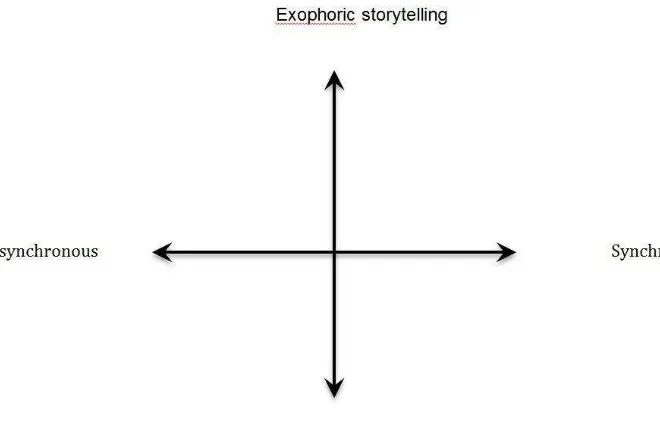
Page (2012: 146) provides a useful diagram (Figure 3) to illustrate the possibilities.
The diagram represents the distinction between endophoric (on site) and exophoric
(off site) interaction as well as the dimension of time, which shows the varying points
[image:17.595.118.448.422.639.2]of contact that are possible in online story-making:
Interaction within a space is endophoric, while interaction with people outside of a
specific place is exophoric. In her example Page refers to oral histories, but the
diagram can be adapted to suit Facebook. This kind of interaction has layers of
participation, with those present able to communicate via two media and modes –
using digital technology alongside physical voice and gesture, etc. Others are able to
participate just through digital technology. For example young women in a nightclub
are able to take a photo of themselves, jointly compose a comment to accompany it
and upload it to Facebook, tagged with all their names. They can comment on the
image and show each other their comments. Such activities (e.g. see Davies, 2014,
forthcoming) see Friends narrating their lives as they live it, and collaborating on how
to create a story of current activities. The text-making activity is an important
narrative line that is made on a moment-by-moment basis, like an extra semantic layer
within the present context. Friends who are not physically present may see the
images, the comments and participate in the interaction around the images. Thus
while the narrative is shared, authors are distributed across space; the ability of
multiple participants to comment and contribute to meanings allows Friends to create
stories of their lives and participate in ongoing events in different ways. As Gee
(1996) argues, these are Affinity Spaces, where different people are able to access
content in different ways and all types of contribution are valued.
CURRENT CONTRIBUTIONS AND RESEARCH
Facebook is a relatively new phenomenon; it was launched initially in the US in 2004
firstly just to Harvard students, but later to anyone aged 13 or over with an email
address. Facebook is not accessible globally however, since in some places such as
analyses of Facebook narratives are also emergent. Nevertheless, responding to the
legion numbers of people taking-up opportunities to use online social networks across
the globe, the field has attracted research interest from a wide range of disciplines,
such as psychology, sociology, linguistics, education and medicine. Within language
and literacy research, Facebook has been studied from many angles. For example,
Losh (2008) uses a linguistic analysis to explore 5 ways in which a group of users
expressed politeness on Facebook; Placensia and Lower (2013) look at
complimenting behavior; Maíz-Arévalo (2013) explores interactants’ uses of the
‘like’ button, while Eisenlauer (2014) refers to Facebook as a ‘third author’ which
provides a template for the ways in which people are able to narrate their lives. Page’s
study of stories in social media specifically addresses this topic and provides a wealth
of examples in a range of sites, including Facebook. Her work sets out the field very
clearly from a sociolingiuistic perspective and provides useful analytical frameworks.
In Higher Education, work has explored how Facebook might be harnessed to support
learning (Stirling 2014), while in schools the widespread blocking of the site would
render parallel projects superfluous. Thus much of the work about Facebook has
explored ways in which people use it to perform particular identities, to make
particular types of relationship, but less has been done to explore specific narratives,
or ways in which narratives emerge. Such narrative analysis may be embedded in
studies looking at specific issues, as opposed to analysing the stories themselves per
se, thus my own work explores how people represent themselves through Facebook,
how they performed gender in Facebook and how Facebook allows people to manage
complex relationships by filtering different kinds of access to profiles in different
RESEARCH METHODS IMPLICATIONS
Many written narratives, novels, for example, are self-contained, intended to be read
without the writer present; authors, film directors, playwrights and so on, expect their
texts to be independent, autonomous, self-standing, to be read beyond the context in
which they were written and consumed in places unknown to them as the text
producers. Thus we have global distribution of books and films which can be broadly
interpreted – sometimes with alternate cultural lenses – without the need for continual
recourse to ask questions of authors. This is not exclusively the case, especially where
the culture of a film requires background knowledge in order to fully understand the
plot. In oral presentations of stories it is often the case that knowledge of the teller
and his/her life is crucial in order to understand – as Langellier and Peterson (2004)
demonstrate. For example in telling family stories, insider knowledge as a family
member may be crucial for frames of reference to be understood. Facebook stories
often tend to be similarly deeply rooted in contexts and, often because Facebook is
used ‘on the move’, with Friends interacting using mobile devices, can be cryptic. As
in speech, explanations tend to be minimal and this is also partly because the audience
is usually assumed to know something about the teller – they are, after all, Facebook
Friends. Bernstein (1971) referred to elaborated and restricted codes; the former
being associated with stories where context is carefully set out and the narrator makes
it possible for people who are not part of the story’s context can understand.
Restricted codes refer to ways of telling, explaining and narrating that are less
explanatory and more associated with intimate circles. Whilst restricted codes have
long since been assumed to imply lack of linguistic dexterity, being cryptic and witty
can conversely require skillful manipulation of communication modes. Indeed it
than the other, and argued that, ‘Clearly one code is not better than another; each
possesses its own aesthetic, its own possibilities. Society, however, may place
different values on the orders of experience elicited, maintained and progressively
strengthened through the different coding systems’ (Bernstein 1971: 135). (This
tendency for Facebook stories to be strongly contextualised and cryptic, is perhaps the
reason why it is often seen as a waste of time, unbeneficial and inane, with pictures of
people’s breakfasts being cited as common instances of impoverished
communication).
Since Facebook updates are so often semantically dependent upon specific
socio-cultural settings, Facebook researchers are likely to need to seek clarification with
those who have authored and read the texts they want to cite in their work. Thus in my
own Facebook research for example, I have recruited all participants face-to-face.
Some of them, I asked permission to ‘friend’ on Facebook, and talked with them
about events of which their Facebook updates were a part. With others, I talked to
them about their Facebook pages and asked them to show me aspects of their
Facebook they were happy to share and explain. Explanations of the Facebook texts
were crucial, not just because I needed to be told simple contexts, but also it helped
me uncover the extent to which online contexts are somewhat slippery; boundaries are
fuzzy and interaction is frequently embedded in a variety of contexts at once and this
is not always apparent from simple screen-reading (Davies 2014). Thus I have taken a
‘connected approach’ (Leander and McKim 2003), looking at the online texts but
referring also to explanations offered by those involved in their authorship.
As with any research setting, it is important to become comfortable with a research
site and to abide by the usual protocols of behaviour within that setting. The same
applies to online research, that it is best to exist as a ‘quiet member’ or ‘lurker’, at
least in the beginning and not to participate until and unless you have started to
understand the rules and etiquette of the space. Even if a researcher has already been a
member of Facebook for a while, the ways of behaving amongst her/his friends may
be different to those of the research participants. This is especially important in a site
like Facebook where, owing to the variable ways in which Facebook Friends may
have organised their permission settings, a person’s behaviour may be witnessed by
many, even if they are unaware of it. Thus, because some Facebookers may not have
closed down all their interactions to ‘Friends only’, a researcher may come across
updates that they had not expected. This may not be of a concern to some people, but
for others, will feel like an invasion of privacy and it is the responsibility of the
researcher to behave responsibly about the data they come across. It is crucial that
researchers obtain the trust of participants since photographs of their relatives and
friends may often also be visible to researchers without friends and relatives’
knowledge. Clearly researchers should follow protocols as set out in their institutions’
ethical codes of practice and acquire permission to use anything at all from Friends’
pages. All these factors need to be discussed both before, during and after the process
of research. Sensitive issues, such as arguments that may occur, revelations about
lives and so on, should of course be respectfully treated and additional permissions
acquired should such episodes be used as data.
Ethical advantages in using Facebook as a research space includes the reciprocity of
participants’ sites, so too can they see the data on the researcher’s site. This can
support a more balanced relationship. Participants can easily contact the researcher
and vice versa, can ask for clarification and chat ‘backstage’ in private messages if
required.
While Facebook data will often reflect unremarkable everyday aspects of people’s
lives and mainly portray the quotidian aspects of living, mundane stories of relevance
to only a few, the data is also likely to be rich. The data will show how people make
relationships through a range of communication modes and will reflect idiosyncratic
behaviour patterns and established ways of doing things that bind individuals in
groups. They will behave and communicate in ways that mark out their groups in all
kinds of creative ways (Carter 2004). The analysis is likely to be both linguistic, and
multimodal, but also to have an ‘ethnographic texture’ (Green and Bloom 1996),
where researchers seek to understand the contexts in which texts are produced and
read.
EDUCATIONAL IMPLICATIONS OF THIS WORK
Page (2012, xv) gives two reasons for studying the stories that people tell about
themselves in social media formats. She succinctly argues the first as, ‘ Stories remain
one of the most pervasive genres people use to make sense of themselves and the
surrounding world’. Secondly, she refers to the ‘unprecedented measure’ of stories
that are daily documented online in the 21st century. These arguments are also the
basis upon which I have justified my own work; however further than this, as an
educational researcher, I argue that while so many of us and our students are actively
fully come to terms with the wider socio-cultural implications of these acts. As
mentioned above, Bruner has described how the stories of our lives are created in
conjunction with meanings that are ‘enmeshed in a net ofothers’ (Bruner 1990: 113).
Digital technologies allow us to distribute local meanings amongst friends across
wider networks. This allows us to draw in wider communities to local meanings,
extending intimacies in ways that we may not always remember or imagine. The
additional social and creative possibilities and dimensions that Facebook has opened
out allow Friends to enrich their lives and to be creative in new and exciting ways
(Davies 2012; 2013; 2014; Page 2012). The ubiquity of Facebook suggests that
millions of Friends find its affordances seductive; the allure of creating narratives
about our lives has long been established, but this is a new medium with
unprecedented power. It can be used synchronically, asynchronically and across
spaces. As such our meanings, grown through local understandings, may appear in
networks where the semantics may be misconstrued, mis-used or be seen as
inappropriate in new contexts. It is exciting and invigorating to be able to distribute
stories to many others, yet we do not always understand the range of meanings that
will be brought to our texts from elsewhere. This is an area where education is
appropriate; currently Facebook used at home for leisure activities tends not to be
taken seriously in academic circles. Yet the texts are powerful and need to be
acknowledged as worthy of educators’ attention – beyond dismissal or the banning of
social networking sites from school premises.
FUTURE DIRECTIONS
There remains a good deal of research to be pursued in the whole area of social
and language research in such spaces are yet to be fully understood. We are not yet
clear on the nature of the impact of digital technologies on our communication with
ourselves and with others, but it is clear that there are a great many. We need to
research more in order to understand the social and educational implications in order
that we can inform policy and practice in schools and beyond. There exists work
looking at time and space, (im)materiality as well as re-examinations of what we
mean by literacy. Until this point social network sites are generally deemed as
unsuitable for use in schools and so learning in this sphere happens off-site and often
unsupervised. In Higher Education the use of Facebook tends to be directed towards
harnessing it as a means for formal learning. Whatever its future in formal education,
Facebook or its successor, is likely to remain a space where stories are mediated and
as such a site worthy of investigation into meaning–making practices.
RELATED TOPICS
New Literacy Studies; affordances and constraints; m/Literacy; (im)materializing
literacies.
FURTHER READING
Davies, J. (2014) (Im)Material girls living in (im)material worlds: identity curation through time and space. In New Literacies around the Globe: Policy and Pedagogy. (Burnett, C., Davies, J., Merchant, G., and Rowsell, J. (Eds.)). London: Routledge. p. 72 – 87.
Hymes, D. (1996) Ethnography; Linguistics, Narrative Inequality: Toward an Understanding of Voice, London: Taylor and Francis.
Ito, M. et al (eds.) (2010) Hanging Out, Messing Around, and Geeking Out: Kids Living and Learning with New Media, Cambridge, MA: MIT Press
REFERENCES
Bakhtin, M. (1981) Discourse in the novel. In M.M.Bakhtin, trans. C. Emerson and M. Holquist The Dialogic Imagination: Four essays by M.M.Bakhtin. Austin, Texas: University of Texas Press.
Bakhtin, M. M. (1986) Speech genres and other late essays. (C. Emerson & M. Holquist, Eds.;V. W. McGee, Trans.). Austin: University of Texas Press.
Bernstein, B. (1971) Class, Code and Control: Volume 1 - Theoretical Studies Towards a Sociology of Language. London: Routledge.
Bold, C. (2012) Using Narrative in Research. London: Sage.
Bruner, J. (1990) Acts of Meaning. Cambridge, Massachessetts: Harvard University Press.
Bruner, J. (2004) Life as Narrative. Social Research, 71 (3), 691-711.
Carter, R. (2004) Language and Creativity: the art of common talk. London: Routledge.
Cobley, P. (2001) Narrative. (The New Critical Idiom). London: Routledge.
boyd, d., & Ellison, N. B. (2008) Social network sites: definition, history, and scholarship. Journal of Computer-Mediated Communication. 13(1), article 11. Available at: http://jcmc.indiana.edu/vol13/issue1/boyd.ellison.html.
Czarniawska, B. (2004) The narrative turn in social studies. In Narratives in Social Science Research. London: Sage. p1 - 16.
Davies, J. (2014) (Im)Material girls living in (im)material worlds: identity curation through time and space. In New Literacies around the Globe: Policy and Pedagogy. (Burnett, C., Davies, J., Merchant, G., and Rowsell, J. (Eds.)). London: Routledge.
Davies, J. (2013) ‘Trainee hairdressers’ uses of Facebook as a community of gendered
literacy practice’. Pedagogy, Culture and Society. 21(1), 147 – 149.
Davies, J. (2012) Facework on Facebook as a new literacy practice. Computers and Education. Vol. 59, 19 – 29.
Davies, J. (2008) Pay and Display: The Digital Literacies of Online Shoppers. In Lankshear, C. and Knobel, M. (Eds.) Digital Literacies: Concepts, Policies and Practices. New York: Peter Lang. p 227 - 248.
Eisenlauer, V., (2014 in press) Facebook as a third author---(Semi-)automated participation framework in Social Network Sites. Journal of Pragmatics.
http://dx.doi.org/10.1016/j.pragma.2014.02.006. Accessed 1.6.2014.
Gee, J. (1996) Social linguistics and literacies. 2nd ed. London: Falmer Press.
Georgakopoulou, A. (2007) Small Stories, Interaction, and Identities. Amsterdam: Benjamins.
Giddens, A. (1991) Modernity and Self Identity: self and society in the late modern age. Oxford: Polity.
Giddens, A. (1992) The Transformation of Intimacy: Sexuality, Love and Eroticism in Modern Societies. Cambridge: Polity.
Green, J. & Bloome, D. (1996) Ethnography and Ethnographers of and in Education: A Situated Perspective. In Flood, J. Heath, S. & Lapp, D. (eds.) A Handbook for Literacy Educators: Research on Teaching the Communicative and Visual Arts. New York. Macmillan. p1-12
Hardy, B. (1975) Tellers and Listeners: The narrative imagination. London: The Athlone Press.
Hymes, D. (1996) Ethnography, linguistics and narrative inequality: Toward an understanding of voice. London: Taylor & Francis.
Kress, G. (2010) Multimodality: A Social Semiotic Approach to Contemporary Communication. London: Routledge.
Labov, W. and Waletzky, J. (1967) Narrative analysis. In J. Helm (ed.), Essays on the Verbal and Visual Arts. Seattle: U. of Washington Press. p 12-44.
Langellier, K.M. and Peterson, E. (2004) Storytelling in Everyday Life. Philadelphia: Temple University Press.
Leander, K. and McKim, K. (2003) Tracing the everyday ‘Sitings’ of adolescents on the internet: a strategic adaptation of ethnography across online and offline spaces. In Education, Communication and Information, 3:(2), 211–236.
Leander, K. and Sheehy, P. (2004) Spatializing Literacy Research. New York: Peter Lang Publishers.
Losh, E. (2008) In Polite Company: Rules of Play in Five Facebook Games. Advances in Computer Entertainment Technology, 345 – 351.
Maiz-Arevalo, C. (2013) ‘‘Just click ‘Like’’’: Computer-mediated responses to
Maybin, J. (2006) Children’s Voices: Talk, Knowledge and Identity. London: Palgrave.
Ochs, E. and Capps, L. (2001) Living Narrative: Creating Lives in Everyday Storytelling. Cambridge Massachusetts & London, England: Harvard University Press.
Page, R. (2012) Stories and Social Media. London: Routledge.
Placencia, M.E. & Lower, A. (2013) Your kids are so stinkin’ cute! :-): Complimenting behavior on Facebook among family and friends. Intercultural Pragmatics. 10 (4), 617 - 646.
Propp, V. (1928 / 1968) Morphology of the Folktale. (The American Foklore Society and Indian University; Trans). Texas: University of Texas Press.
Sikes, P, and Gale, K. (2006) Narrative Approaches to Education Research. From, online papers on Research in Education for The University of Plymouth, UK.
Accessed 24th July 2013 at:
http://www.edu.plymouth.ac.uk/resined/narrative/narrativehome.htm#Narrative%20ac counts%20of%20lives
Stirling, E. (2014) We use Facebook chat in lectures of course!’ Exploring the use of Facebook Group by First-year undergraduate students for social and academic support. An Education in Facebook? Kent, M. and Leaver, T. (Eds.) London: Routledge.
Street, Brian V. & L. Thompson (1993) ‘Culture is a verb: Anthropological aspects of language and cultural process’. In D. Graddol, M. Byram (eds.) Language and
culture. Clevedon, UK: BAAL in association with Multilingual Matters. p. 23–43.
Bio: Julia Davies
Julia is Senior Lecturer in Education at The University of Sheffield; she co-directs The Centre for the Study of Literacies and co-edits the UKLA journal, Literacy. She researches vernacular digital text-making, exploring how social media impact upon literacy and identity.
iThis capitalisation honours the distinction between d/Discouses following Gee (1996), where Discourses refers to wider