Gaussian process and Radon transform
.
White Rose Research Online URL for this paper:
http://eprints.whiterose.ac.uk/135023/
Version: Accepted Version
Article:
Asl, ME, Koohbanani, NA, Frangi, AF orcid.org/0000-0002-2675-528X et al. (1 more
author) (2017) Tracking and diameter estimation of retinal vessels using Gaussian process
and Radon transform. Journal of Medical Imaging, 4 (3). 034006. ISSN 2329-4302
https://doi.org/10.1117/1.JMI.4.3.034006
(c) 2017, Society of Photo-Optical Instrumentation Engineers (SPIE). This is an author
produced version of a paper published in the Journal of Medical Imaging. Uploaded in
accordance with the publisher's self-archiving policy.
[email protected] https://eprints.whiterose.ac.uk/
Reuse
Items deposited in White Rose Research Online are protected by copyright, with all rights reserved unless indicated otherwise. They may be downloaded and/or printed for private study, or other acts as permitted by national copyright laws. The publisher or other rights holders may allow further reproduction and re-use of the full text version. This is indicated by the licence information on the White Rose Research Online record for the item.
Takedown
If you consider content in White Rose Research Online to be in breach of UK law, please notify us by
Tracking and diameter estimation of retinal vessels
using Gaussian process and Radon transform
Masoud Elhami Asl,aNavid Alemi Koohbanani,aAlejandro F. Frangi,band Ali Gooyab,* aTarbiat Modares University, Faculty of Electrical and Computer Engineering, Tehran, Iran
bUniversity of Sheffield, Centre for Computational Imaging and Simulation Technologies in Biomedicine, Department of Electronic and Electrical Engineering, Sheffield, United Kingdom
Abstract. Extraction of blood vessels in retinal images is an important step for computer-aided diagnosis of ophthalmic pathologies. We propose an approach for blood vessel tracking and diameter estimation. We hypoth-esize that the curvature and the diameter of blood vessels are Gaussian processes (GPs). Local Radon trans-form, which is robust against noise, is subsequently used to compute the features and train the GPs. By learning the kernelized covariance matrix from training data, vessel direction and its diameter are estimated. In order to detect bifurcations, multiple GPs are used and the difference between their corresponding predicted directions is quantified. The combination of Radon features and GP results in a good performance in the presence of noise. The proposed method successfully deals with typically difficult cases such as bifurcations and central arterial reflex, and also tracks thin vessels with high accuracy. Experiments are conducted on the publicly available DRIVE, STARE, CHASEDB1, and high-resolution fundus databases evaluating sensitivity, specificity, and Matthew’s correlation coefficient (MCC). Experimental results on these datasets show that the proposed method reaches an average sensitivity of 75.67%, specificity of 97.46%, and MCC of 72.18% which is comparable to the state-of-the-art.©2017 Society of Photo-Optical Instrumentation Engineers (SPIE)[DOI:10.1117/1.JMI.4.XX.XXXXXX]
Keywords: diameter estimation; Gaussian process; Radon transform; retinal imaging; vessel tracking. Paper 17019RR received Jan. 24, 2017; accepted for publication Aug. 9, 2017.
1
Introduction
Analysis of vascular structures in retinal images can be impor-tant for diagnosis of several pathologies related to diabetes, cardiovascular disorders, and hypertension.1,2For instance,
dia-betic retinopathy can be detected early by examining morpho-logical variations in vasculatures, preventing vision loss and blindness.3–5 To quantify these complications, accurate retinal vessel detection and diameter estimation are often required.6 Generally, semiautomatic or automatic vessel segmentation tools are preferred over manual delineation, because the latter is difficult and user-dependent. However, due to imaging imper-fections and noise, accurate delineation imposes a special chal-lenge on nonmanual methods, particularly when thin vessels are of concern.7
A wide range of vessel extraction methods from medical images has been proposed in the literature. Interested readers are referred to Patton et al.,8Lesage et al.,9Mookiah et al.,10 and Fraz et al.11for detailed reviews. However, each method only excels in a few particular quality aspects such as computa-tional load, robustness to variation of region of interest, and im-aging modality. The performance of vessel segmentation methods can usually be improved by a preprocessing step.12 The aim of this stage is to intensify valuable information and eliminate noise, which could otherwise adversely affect the final outcome. Different methods have been proposed for this purpose.13,14Even though a preprocessing step could improve
segmentation, it can lead to loss of important features, particu-larly at edges and narrow vessels. Therefore, despite some
relative successes, vessel extraction still remains an active research area.
Sun15classified blood vessel detection strategies into two
major categories: tracking- and scanning (pixel-based)-based approaches. In scanning methods, a number of features are com-puted for every pixel, and based on these features, each pixel is individually classified as a vessel or nonvessel sample. Since each pixel is classified independently, a disadvantage of such methods is that gaps can appear in the segmented vessels, lead-ing to an unconnected vessel network.16In contrast, tracking approaches track a single vessel at a time, rather than detecting the entire vascular network. Tracking consists of following the vessel centerlines guided by local information, usually search-ing for a path that best matches a given vessel intensity model profile.17Compared to pixel-based methods, the main problem
with tracking algorithms is the complexity of dealing with bifurcations.8 Furthermore, tracking approaches need initial
seed points, which can be selected manually or automatically. The main advantage of the tracking approaches is the guaranteed connectedness in the acquired vessel segments.15In addition, tracking approaches can provide accurate vessel specific widths and other structural information that is often unavailable using other methods.11Owing to these properties, a probabilistic
sel tracking approach is proposed that is able to handle thin ves-sels and detect bifurcations.
Aylward and Bullitt18proposed an algorithm for blood vessel tracking based on eigenvalue and eigenvector decomposition of the image Hessian matrix. Due to the fact that Hessian matrix is a second-order derivative descriptor for the local structure of the image, the algorithm’s efficacy is adversely and highly
influenced by the background noise, in particular when thin ves-sels are considered. To alleviate this, Xu et al.19 combined
Aylward’s method with the recursive geometrical tracking approach proposed by Sun.15 In contrast, Tavakoli et al.20 and Pourreza et al.21 proposed a tracking algorithm which
uses Radon transform to compute local line integrals of the image, thus not relying on the Hessian. As a result their pro-posed method performs relatively well in the presence of noise. Zhang and Couloigner22 proposed an algorithm to
increase the sensitivity of the Radon transform-based approaches when handling thick tubular objects. However, in these methods, the vessel trajectory is detected by searching for peak projection values in Radon space, which can be difficult and unreliable. In addition, these methods do not utilize any prior knowledge about the vascular structures (such as continu-ity and constraint of the curvature of the vessels).
Chutatape et al.,23on the basis of given training samples, designed a second-order derivative Gaussian matched filter to position the centerline points and estimated the width of the cross-sectional profile. Yin et al.16 proposed a probabilistic tracking method that used vessel sectional intensity profile for detection. In their approach, a vessel’s edge points and new directions were updated using a maximuma posteriori cri-terion, considering the local gray level statistics and the vessel’s continuity properties. However, due to using a Gaussian model to approximate the vessel’s cross-sectional intensity profile, the performance of their method is suboptimal when the vessel’s sectional intensity deviates from a Gaussian pattern. Other meth-ods for vessel tracking in the literature include Refs.24–26. The majority of these methods lack the required efficiency when dealing with noisy images and small vessels. Our method is par-ticularly designed to address these complications.
For robust tracking of blood vessels, a prior knowledge of the structures of vessels can be very useful. Continuity of centerline, curvature, and diameter of tubular vessel segments has been exploited by Sun.15Gooya et al.,27on the other hand, proposed
a level set-based shape regularization scheme for vessel segmen-tation that improved the continuity of the extracted structures, preventing gaps, however, the technique was computationally expensive. Aylward and Bullitt18used the inner product of tan-gents to centerlines to compare and update the vessel direction for effective tracking. Thus, the use of prior information has been exploited in different ways to extract vascular structures. The recent highlighted papers in this area are as follows: Azzopardi et al.28 proposed a filter based on a combination
of shifted filter responses that is sensitive to vessels. Continuing the previous work, Strisciuglio et al.29 selected the filters in an automatic process that opts for the best-perform-ing ones. Orlando et al.30 utilized a conditional random field
model and fully connected pairwise potentials to extract retinal vasculature. Deep neural networks have recently entered the retinal image segmentation field by Liskowski and Krawiec.31 After applying a preprocessing step, they use several deep learn-ing architectures to segment vessels. Second-order locally adap-tive derivaadap-tives have been used in several papers for extracting vessel structures; Zhang et al.32proposed a simpler version of
this method by avoiding a computation of full Laplacian in ves-sel enhancements (geometric diffusions), which is much easier to understand and reproduce.
In this study, a new approach is proposed to track blood ves-sel centerlines and their diameters. For a single fragment of a vessel having no bifurcations, the curvature and the diameter
often vary smoothly in such a way that the new direction and diameter can be statistically predicted from past values. We exploit these properties as prior information and hypothesize that the curvature and the diameter of blood vessels are Gaussian processes (GPs). To gain further noise robustness, we train the GPs by computing the local features, which are line integral descriptors, using Radon transform. Furthermore, in order to determine bifurcations, multiple GPs are deployed for estimation of the directions. The increased difference between estimated directions from each of these GPs is used to detect bifurcations. Combining GPs with Radon features results in a significantly improved performance in dealing with thin and noisy vessels.
The rest of this paper is organized as follows. A brief review of GP regression is presented in Sec.2, and this is followed by the proposed method for vessel tracking and diameter measure-ment in Sec.3. Experimental results and comparison to the state-of-the-art are described and discussed in Sec. 4, and finally, some concluding remarks are drawn in Sec.5.
2
Gaussian Process
A GP is a supervised learning method, which addresses the problem of learning input-output mappings from training data. GP provides a principal, practical, and probabilistic approach to learn these relations using kernels.33In GP, having observedN input vectorsx1; : : : ;xN, and their corresponding output variablest1; : : : ; tN, we wish to make a prediction for new inputxNþ1that we have not seen in the training dataset.34 For linear regression of values oft, we define the model pre-dicted values using yðxÞ ¼wTϕðxÞ, a linear combination of M fixed basis functions given by the elements of the vector
ϕðxÞ, wherewis anM-dimensional weight vector. The relation-ship between the observed and predicted variables is modeled as tn¼ynþεn, whereyn¼yðxnÞandεnis a Gaussian noise var-iable. If the values ofy1;· · ·; yN become jointly Gaussian dis-tributed, the functionyðxÞ is said to be a GP.
Thus, we are interested in the joint Gaussian distribution of the function valuesyðx1Þ; : : : ; yðxNÞ, which is denoted by the vectorygiven by
EQ-TARGET;temp:intralink-;e001;326;322
y¼Φw; (1)
whereΦis the design matrix. In practice, since we do not have any prior knowledge about the mean ofyðxÞ, it is set to zero. This assumption is equal to choosing the mean of the prior over the weight values, i.e.,pðwjαÞ, to be zero in the basis function viewpoint.
Under these hypotheses, the joint distribution of the target values tN ¼ ðt1; : : : ; tNÞT conditioned on the values of yN¼ ðy1; : : : ; yNÞT is given by an isotropic Gaussian
EQ-TARGET;temp:intralink-;e002;326;203
pðtNjyNÞ ¼NðtNjyN;β−1INÞ; (2)
whereIN denotes theN×Nidentity matrix, andβ is the pre-cision of the random noise.
According to the definition of GP, the marginal distribution pðyNÞis a Gaussian distribution of zero mean and its covariance is defined by a Gram matrixK
EQ-TARGET;temp:intralink-;e003;326;116
pðyNÞ ¼NðyNj0;KÞ: (3)
xn andxm, the corresponding valuesyðxnÞandyðxmÞare more correlated than the points with considerably different values.
Integrating over yextracts the marginal distribution pðtNÞ, conditioned on the input valuesx1; : : : ;xN, which is given by
EQ-TARGET;temp:intralink-;e004;63;708
pðtNÞ ¼
Z
pðtN;yNÞdyN ¼
Z
pðtNjyNÞpðyNÞdyN
¼NðtNj0;CNÞ; (4)
where the elements of covariance matrixCN are
EQ-TARGET;temp:intralink-;e005;63;637
Cðxn;xmÞ ¼kðxn;xmÞ þβ−1δnm: (5)
Thus far, a model for the joint Gaussian distribution over sets of data points is built using a GP viewpoint. Given a set of train-ing data, the main goal in regression is to make predictions of the target variables. In other words, in order to predict the target values, the predictive distributionpðtNþ1jtNÞshould be evaluated. According to Eq. (4), the joint distribution over tNþ1¼ ðt1; : : : ; tNþ1ÞT is given as
EQ-TARGET;temp:intralink-;e006;63;528
pðtNþ1Þ ¼NðtNþ1j0;CNþ1Þ; (6)
where the elements of covariance matrix CNþ1 are given by Eq. (5). It can be shown that the conditional distribution pðtNþ1jtNÞis a Gaussian distribution with the mean and covari-ance given as
EQ-TARGET;temp:intralink-;e007;63;453
mðxNþ1Þ ¼kTC−N1tN; (7)
EQ-TARGET;temp:intralink-;e008;63;422
σ2ðxNþ1Þ ¼c−kTC−N1k; (8)
whereCNis a covariance matrix with elements given by Eq. (5), kis a vector with elementskðxn; xNþ1Þfor n¼1; : : : ; N, and the scalar c¼kðxNþ1;xNþ1Þ þβð−1Þ. These equations are the key results that define a GP regression.
The prediction values in GP are strongly controlled by covariance function.35From a practical point of view, instead of defining a fixed covariance function, a parametric family of functions is used where their parameters are estimated from the data. Typical techniques to train the hyperparameters are based on the evaluation of the likelihood functionpðtNjθÞ, where the hyperparameters of the GP are denoted byθ. By esti-matingθand maximizing the log likelihood function, the hyper-parameters’value can be obtained.
3
Proposed Method
In what follows, first, we describe our blood vessel centerline tracking method using GP regression and Radon transform. Next, we extend the method to detect the bifurcations and track the diameters using multiple GPs. For better illustration, the proposed method is divided into three main steps: develop-ing a probabilistic algorithm for trackdevelop-ing the centerline in a sim-ple vessel which is the base algorithm, generalizing the basic algorithm to detect bifurcations and extracting the whole vessel tree, and estimating the diameters of the vessel lumen through an approach similar to the basic algorithm.
3.1 Vessel Centerline Tracking Method
In order to track blood vessel centerlines, we assume that in a single vessel fragment with no bifurcations, the curvature varies
smoothly and has a Gaussian distribution. Therefore, we hypothesize that the curvature of blood vessels, by differentiat-ing their positive and negative values, is a GP with a zero mean given by
EQ-TARGET;temp:intralink-;e009;326;708
pðtNÞ ¼NðtNj0;CNÞ; (9)
wheretN¼ ðt1; : : : ; tNÞTindicates the curvature along the ves-sel. As shown in Fig.1, curvature has a direct relationship with the directional variation, and the deduction is that the directional variation along a vessel is a zero mean GP. According to Fig.1, as the curvature increases, the corresponding directional varia-tion also increases. An advantage of using direcvaria-tional variavaria-tion, however, is that the positive and negative curvature values can be easily discerned. In this paper, we consider clockwise and anticlockwise directions as having positive and negative signs, respectively.
The first step to track the centerlines is feature extraction. These features are extracted by Radon transform and used as an input (xN) to the GP. The Radon transform in two dimensions (2-D) is given by integrating along lines having different dis-tance (ρ) and angle (θ) values from the origin. In a 2-D Euclidean space, the Radon transform of a functiongðx; yÞ is defined as
EQ-TARGET;temp:intralink-;e010;326;490
Rðρ;θÞ ¼ Z þ∞
−∞ Z þ∞
−∞
gðx; yÞδðρ−xcosθ−y sinθÞdxdy;
(10)
whereδðrÞis the Dirac function whose value is infinite at zero and zero in other arguments. Owing to cancelation of noise by the process of integration, Radon transform is robust to the pres-ence of noise.36To extract features for vessel centerline tracking,
a Radon transform is computed with the following settings:
EQ-TARGET;temp:intralink-;e011;326;379
ρ¼0; (11)
EQ-TARGET;temp:intralink-;e012;326;349
θ¼θN−89 deg; : : : ;θN−1 deg;θN;θN
þ1 deg; : : : ;θNþ89 deg; (12)
where θN is the vessel direction in the previous (N’th) step (which for starting the process is selected manually).
O3 O2
O1
R1
R2
R3
θ 0
θ1 θ 2
θ3 t1
t2 t3
O0
Fig. 1 The assumption to track blood vessel is that the curvature (the
reciprocal of the local radiusRn) along the vessel can be represented
as a zero mean GP. Since the curvature has a direct relationship with directional variation (ti), we can assume that directional variation is a
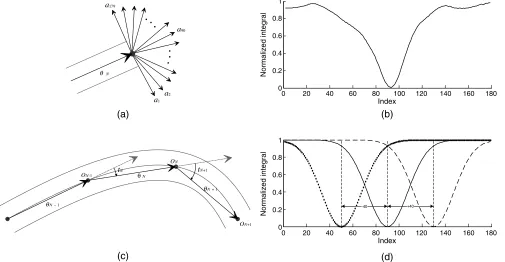
[image:4.630.327.565.551.694.2]Figure 2(a) schematically shows our Radon transform-based feature extraction algorithm. Before using Radon transform, weights are defined for each pixel on the basis of distance from the centerline point ON. Since the closest pixels to ON have more valuable information, the corresponding weights are higher (weights close to 1). Based on a cubic interpolation, the weighted line integrals are computed and form a vector con-taining 179 elements. Figure 2(b) shows an example of the extracted features. For this example, we assume that vessels are darker than the background (for retinal images), hence it is obvious that the middle elements of the extracted vector have smaller values compared to marginal ones.
In each step, our goal is to make a prediction of the direc-tional variationtNþ1for a new input vectorxNþ1by evaluating the predictive distribution pðtNþ1jtN;x1; : : : ;xN;xNþ1Þ. Using Eq. (9), the distribution over target values is directly given by
EQ-TARGET;temp:intralink-;e013;63;242
pðtNþ1Þ ¼NðtNþ1j0;CNþ1Þ: (13)
Consequently, as mentioned in Sec.2,pðtNþ1jtNÞwill be a Gaussian distribution whose mean and covariance are given by Eqs. (7) and (8), respectively. That is
EQ-TARGET;temp:intralink-;e014;63;178
pðtNþ1jtNÞ ¼NtNþ1jmðxNþ1Þ;σ2ðxNþ1Þ: (14)
SincepðtNþ1jtNÞhas a Gaussian distribution, the most prob-able value fortNþ1is a Gaussian distribution’s meanmðxNþ1Þ. Therefore,
EQ-TARGET;temp:intralink-;e015;63;113
tNþ1¼mðxNþ1Þ (15)
and the new vessel direction (θNþ1) is calculated by
EQ-TARGET;temp:intralink-;e016;326;418
θNþ1 ¼θNþtNþ1; (16)
where θN is the vessel’s previous direction. For instance, mðxNþ1Þ ¼0means no change in the local direction (zero cur-vature), andmðxÞ≫0means high curvature (high directional variation) in a vessel.
In order to find a new centerline point, we move forward a step in the new vessel direction (θNþ1). The step length has an inverse relationship with tNþ1, i.e., when the curvature increases, the step length decreases, and vice versa. More spe-cifically, we use the following relation to obtain the step length, d, at each iteration:
EQ-TARGET;temp:intralink-;e017;326;289
d¼1 π
π
2−tNþ1
: (17)
To generate training data, shown in Figs.2(d),4(b), and5(d), synthetic images are designed to simulate vascular structure. Vessels with various curvatures and diameters and also different kinds of bifurcations are modeled for both uniformly dark ves-sels and those having reflections around their centerlines which frequently occur in retinal images, caused by light reflection from vessel surfaces that are parallel to the incident light.37
By moving along the centerline in the synthetic images and computing Radon transform, two sets of training data are gen-erated for tracking both the directional variation and diameter of the lumen. To further enrich the training data, some noise was also added to the synthetic images before computing the Radon features. Examples of these synthetic images are shown in Fig.3. Each training data has a target value corresponding to the directional variation. For instance, in Fig.2(d), the corre-sponding target value for the dotted, solid, and dashed lines
a1
a2
a90
a179
θN
0 20 40 60 80 100 120 140 160 180 0
0.2 0.4 0.6 0.8 1
Index
0 20 40 60 80 100 120 140 160 180 Index
ON
ON-1
ON+1
tN+1
tN
θN– 1
θ N
θN+ 1
-40 +40
Normalized integral
0 0.2 0.4 0.6 0.8 1
Normalized integral
(a) (b)
(c) (d)
Fig. 2 Radon features and tracking of a simple vessel: (a)aishows the result of Radon transform in each
direction. (b) A real extracted feature vector. (c) Schematic of blood centerline tracking algorithm,Oi,θi,
andtirepresent the centerline points, vessel local directions, and its variation, respectively. (d) Samples
[image:5.630.66.571.63.325.2]are−40 deg, 0 deg, andþ40 deg, respectively, showing direc-tional variation for each one.
In summary, our vessel centerline tracking method can be explained as follows [see Fig.2(c)]. First, a seed point is selected and its corresponding feature vector is computed using the Radon transform. Then, a target directional variation is com-puted using Eq. (7). Finally, by adding this variation to the pre-vious direction, a new vessel direction is calculated. Moving a step forward along the new direction, this process continues until the end of the vessel is reached.
3.1.1 Estimation of the Kernel hyperparameter
The update process given in Eq. (16) requires evaluating a covariance matrix whose elements, in this paper, are defined using a radial basis function given by
EQ-TARGET;temp:intralink-;e018;63;400
kðxn;xmÞ ¼expð−αkxn−xmk2Þ; (18)
whereαis a hyperparameter controlling the degree of the cor-relation between the data points. We learn the latter from the training data by maximizing the likelihood function pðtNjαÞ with regard toα. In practice, we use a gradient descent approach, where we update the values ofαby moving along the gradient direction until convergence. Using the definition of a standard multivariate Gaussian distribution, the log likelihood function can be written as
EQ-TARGET;temp:intralink-;e019;326;752lnpðtjαÞ ¼− 1
2 lnjCNj− 1 2t
TC−1
N t− N
2 lnð2πÞ: (19)
Therefore, the gradient of the log likelihood function with respect to the parameterαis calculated as
EQ-TARGET;temp:intralink-;e020;326;698
∂
∂α lnpðtjαÞ ¼−
1 2tr
C−N1∂CN
∂α
þ1
2t TC−1
N ∂CN
∂α C −1
N t:
(20)
Furthermore, with respect to the predefined kernel [Eq. (18)], ∂CN
∂α elements are evaluated using
EQ-TARGET;temp:intralink-;e021;326;618
∂Cðxn;xmÞ
∂α ¼−kxn−xmk
2 expð−αkx
n−xmk2Þ
¼−kxn−xmk2kðxn;xmÞ: (21)
By following Eqs. (20) and (21), a good convergence is often achieved after 110 gradient iterations, taking less than 1 min.
3.2 Bifurcation Detection
Thus far, tracking of only simple vessels with no bifurcations was described. To obtain a more comprehensive description of the entire vascular tree, bifurcations must be detected and used to initiate further tracking. Note that, facing a bifurcation, the proposed algorithm in Sec.3.1will track the path with the smaller directional change, because it is hypothesized that cur-vature in a blood vessel has a zero mean Gaussian distribution. Therefore, using only one GP, a branch with a larger deviation angle can be dismissed. To address this problem, we will, therefore, use multiple GP’s to enable tracking through both branches.
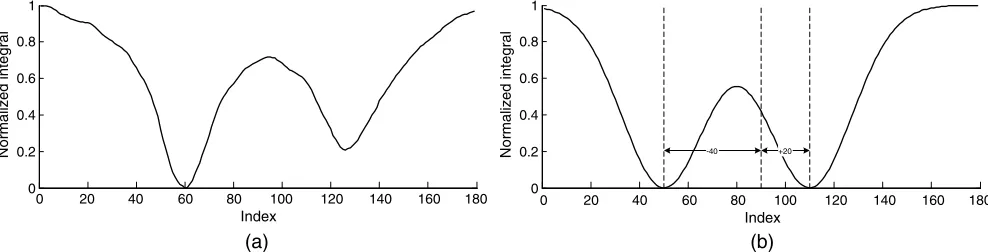
A different set of Radon transform-based features are used to detect the branching points. As shown in Fig.4(a), in the case of a bifurcation, the obtained feature vector may indicate two local minimums that correspond to the existing branches. Therefore, in order to track both, two directions are predicted in each step. To achieve this, we use a simple approach where two indepen-dent GPs are implemented to track the smaller and larger deviation angles, respectively.
In theN’th step, lettN;1andtN;2be targets of the two inde-pendent GPs. We assume thattN;1andtN;2indicate the left and right branches, respectively, thus tN;1≤tN;2. For example in Fig. 4(b), we have tN;1¼−40 and tN;2¼ þ20. In order to train GPs, bifurcation training data should also be added to
0 20 40 60 80 100 120 140 160 180 0
0.2 0.4 0.6 0.8 1
Index
0 20 40 60 80 100 120 140 160 180 Index
-40 +20
Normalized integral
0 0.2 0.4 0.6 0.8 1
Normalized integral
(a) (b)
Fig. 4 Extracted feature in a bifurcation: (a) a real extracted feature vector. (b) A synthetic feature vector
with the corresponding target values attN;1¼−40andtN;2¼ þ20.
Fig. 3 Examples of synthetic images to generate training data are
[image:6.630.61.305.59.191.2] [image:6.630.67.561.597.723.2]the previous data. Hence, for each training data,tN;1and tN;2, take different or the same values to represent a bifurcation or simple vessel points, respectively. For example, in Fig. 2(d)
for the doted profile, we define tN;1¼tN;2¼−40, whereas for the bifurcation shown in Fig.4(b), the corresponding targets are set astN;1¼−40and tN;2¼ þ20.
Having the training data, the kernel parameter is first estimated (see Sec. 3.1.1). Next, at each step, two Gaussian distributions, i.e., pðtNþ1;1jtN;1Þ andpðtNþ1;2jtN;2Þ are used to estimate the new target values at the means given by
EQ-TARGET;temp:intralink-;e022;63;642
tNþ1;1 ¼m1ðxNþ1Þ ¼kTC−N1tN;1; (22)
EQ-TARGET;temp:intralink-;e023;63;611
tNþ1;2 ¼m2ðxNþ1Þ ¼kTC−N1tN;2; (23)
wheretN;1andtN;2denote the left- and right-hand side branch values, respectively.
The difference between tNþ1;1 and tNþ1;2 directions is considered to be an indicator of a branching point. More specifically, if this difference becomes larger than 30 deg, we consider the current position as a bifurcation point. This thresh-old has been selected based on cross-validation experiments, minimizing the detection error on training data with known bifurcation points. Finally, when the difference between the estimated directional variations becomes less than the specified threshold, the smaller value is chosen for moving along the vessel centerline.
3.3 Diameter Estimation
In addition to the vessel centerline, diameter values are also tracked using an independent GP. Here, we assume that the diameter varies smoothly around its initial value following a nonzero mean Gaussian distribution given by
EQ-TARGET;temp:intralink-;e024;326;690
pðrNÞ ¼NðrNjr0;JNÞ; (24)
where r0 and JN represent the vessel’s initial diameter and covariance matrix, respectively.
The process of diameter tracking remains similar to before with exceptions due to some minor alterations due to the nonzero mean property of the GP. More specifically, Eq. (7) is reformulated as follows:
EQ-TARGET;temp:intralink-;e025;326;593
mðzNþ1Þ ¼aþkTJ−N1ðr−aÞ: (25)
aandzNþ1denote the mean of the GP and the feature vector in theNþ1’th step, respectively.JN and kare the kernelized covariance and similarity vector defined as earlier [see Eq. (18)]. Note that in this section, we use a different set of Radon features which are more appropriate for thickness detection. Namely, in each step after estimating vessel direction, we let
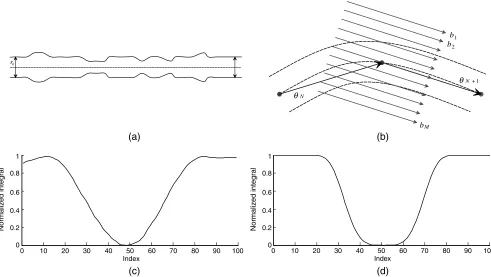
α¼θNþ1, and vary ρ to generate diameter sensitive features as shown in Fig.5(b). In this way, the line integrals are com-puted along the vessel direction, resulting in more robustness to random intensity variations across the vessel lumen. An example of such an extracted feature is shown in Fig. 5(c). A brief review of the proposed method is given in Algorithm1.
r0
θN
θN +1
b1 b2
bM
0 10 20 30 40 50 60 70 80 90 100 Index
0 10 20 30 40 50 60 70 80 90 100 Index
0 0.2 0.4 0.6 0.8 1
Normalized integral
0 0.2 0.4 0.6 0.8 1
Normalized integral
(a) (b)
(c) (d)
Fig. 5Feature extraction method for diameter estimation: (a) we assume that vessel diameter changes
smoothly along the initial diameter, (b) settingα¼θNþ1, we compute Radon transform for various values
[image:7.630.68.559.428.705.2]4
Experimental Results
In this section, we briefly introduce the criteria that are used to quantify the performance of the proposed algorithm and review the characteristics of the data sets. Next, using various noisy images, the robustness of the methods is investigated and com-pared with other state-of-the-art techniques.
4.1 Performance Criteria
The performance is evaluated based on classification of pixels into positive (vessel) and negative (background) groups. At the final stage of the tracking step, the centerline and diameter tracking results are used to construct a binary image, segment-ing the vascular network from the background. Pixels in the neighborhood of each centerline point with radiusdare con-sidered as vessel, wheredindicates the corresponding diam-eter. By comparing the segmentation result to the reference labeled data, we are able to quantify segmentation quality. We evaluate sensitivity, specificity, and Matthew’s correlation coefficient (MCC).
Sensitivity (SN), measured by the ratio of the number of cor-rectly classified vessel pixels to the total number of vessel pixels in the image field of view [TP∕ðTPþFNÞ], reflects the ability of the algorithm to detect the vessel pixels. Specificity (SP) is the ability to detect nonvessel pixels and is measured by the ratio of
the number of correctly classified background pixels to the total number of background pixels [TN∕ðTNþFPÞ].
The MCC is often used to measure the quality of a binary classification system when the size of samples in the two classes varies substantially. In retinal fundus images, around 10% of the pixels belong to the vessels; therefore, the MCC can be used to evaluate the algorithm’s performance. The MCC is defined as
EQ-TARGET;temp:intralink-;e026;326;675
MCC¼ ffiffiffiffiffiffiffiffiffiffiffiffiffiffiffiffiffiffiffiffiffiffiffiffiffiffiffiffiffiffiffiffiffiffiffiffiffiffiffiffiffiffiffiffiffiffiffiffiffiffiTP∕N−S×P
P×S×ð1−SÞ×ð1−PÞ
p ; (26)
whereN¼TPþTNþFPþFNis the total number of pixels of the image, S¼ ðTPþFNÞ∕N, and P¼ ðTPþFPÞ∕N. MCC returns a value between−1andþ1, whereþ1indicates a per-fect prediction, 0 indicates a random prediction, and−1 indi-cates a completely wrong prediction.
4.2 Databases
The DRIVE, STARE, CHASEDB1, and high-resolution fundus (HRF) databases are common databases used in this research to evaluate the performance of the proposed methods. The DRIVE database38consists of 40 color retinal images divided into train-ing and test sets, and obtained from a diabetic retinopathy screening program in The Netherlands. Each image has a size of 565×584 pixels with eight bits per color channel.
For the test images, two manual segmentations are available, set A and set B. 12.7% and 12.3% of pixels were marked as vessels in sets A and B, respectively. The performance is evalu-ated on the test set using set A, which is the ground truth.
The STARE database39consists of 20 color retinal images
with sizes of700×605 pixelsand eight bits per color channel
each, and are available in the PPM format. The database con-tains two sets of manual segmentations acquired by two differ-ent observers. The first observer segmdiffer-ented 10.4% of the pixels as vessels and the second one segmented 14.9%. Performance is evaluated using the first observer as the ground truth.
The CHASEDB1 dataset40consists of 28 color retinal fundus
images with sizes of999×960 pixels, acquired from both the
left and right eyes of 14 child subjects enrolled in the program Child Heart And Health Study in England. The data set contains two groups of manually segmented images provided by two observers. The public HRF image dataset41contains 45 images
with the size of3504×2336 pixels, divided into healthy,
glau-coma, and diabetic retinopathy groups. Ground truth segmenta-tion for these images has been made by a group of experts. For these datasets, we use green channel images as they provide a maximal contrast between vessels and the background.42
4.3 Qualitative Sample Results
The method described in Sec.3.1is able to track locally linear vessels without bifurcations. Figure6 shows results obtained from this algorithm when applied to real and synthetic data. The method is able to successfully track narrow and low con-trasted vessels as well as considerable diameter variations, sim-ulating stenoses and vasodilations in a synthetic vessel [see Fig.6(b)].
Figure7shows the performance of the same algorithm when applied to simulated and real vessels having bifurcations. As shown in Figs.7(a)and7(c), in addition to the missing branches, the bifurcation points are erroneously displaced in both cases. This error can be explained due to the use of a single GP,
Algorithm 1 Blood vessel tracking algorithm.
Input:Seed point and vessel initial diameter
Output:Vessel direction and diameter
1. Compute the vessel direction-related features using Radon transform (ρ¼0)
2. Estimate the kernel’s hyperparameter value
3. Generate the covariance matrix used to estimate the directional variation
4. Calculatet1andt2based on Eqs. (22) and (23)
5.if(t1−t2>30)then
6. {Bifurcation:}
7. Estimate new vessel directions for each branch
8.else
9. {Simple Vessel}
10. Select minimum oft1ort2as directional variation
11. Estimate new direction
12.end if
13. Compute diameter-related features using Radon transform (θ¼θNþ1)
14. Generate the covariance matrix used to estimate the vessel diameter
15. Estimate the vessel diameter (rNþ1) using Eq. (25)
which allows for tracking only one branch at a time, and the intensity information from the missing branch disturbs the proc-ess and causes deviations of the predicted centerline in the vicin-ity of the bifurcation. By using two GPs, as shown in Figs.7(b)
and 7(d), we can both resolve the localization problem and effectively detect the bifurcations.
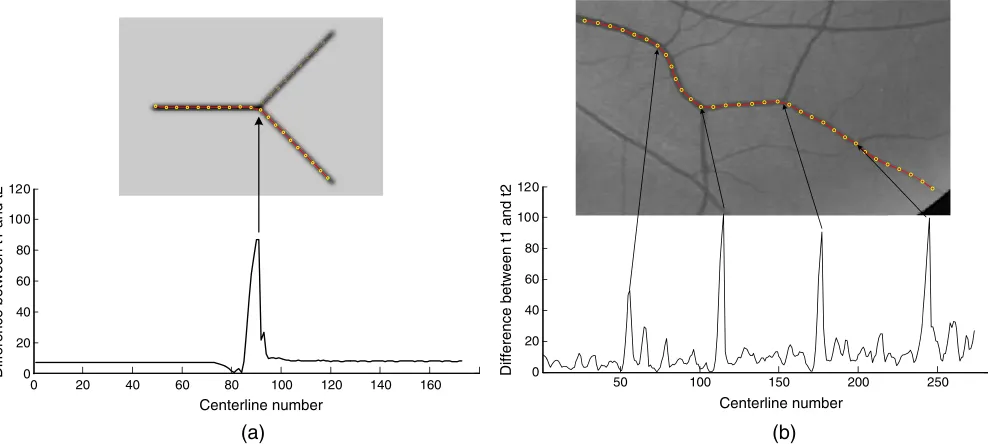
By moving forward along the vessel centerlines without bifurcations, a negligible difference betweent1andt2is detected and by approaching bifurcations, the difference increases. This is demonstrated using simulated and real images in Figs.8(a)
and8(b), respectively. As seen, the difference betweent1andt2 also shows the angle in the given bifurcation. In this paper, we apply a simple thresholding onjt1−t2jto detect bifurcations. To determine its value, we run cross validation experiments using 20 DRIVE data sets, where the threshold value is opti-mized to minimize the detection error. This process results in 30 deg as the optimal threshold. The example results in using multiple GPs for tracking narrow vessels in noisy images, and vessels with reflections on the centerlines are shown in Fig.9. It is worth noting that there are crossover points in retinal images that are required to be detected. The algorithm is able to track the main branches when two branches are perpendicular. However, approaching a crossover where the branches are not
0 20 40 60 80 100 120 140 160
Centerline number Centerline number
0 20 40 60 80 100 120
50 100 150 200 250
Difference between t1 and t2 0
20 40 60 80 100 120
Difference between t1 and t2
(a) (b)
Fig. 8 Approaching the bifurcations, the difference betweent1andt2(the predicted directional changes)
increases. Examples of (a) phantom and (b) retinal images.
Fig. 7Performance of the proposed algorithm in bifurcation. (a, c) Centerline deviation in bifurcations
using a single GP and (b, d) bifurcation detection using two independent GPs.
Fig. 6 Examples of vessel tracking and diameter estimation are
[image:9.630.64.304.59.271.2] [image:9.630.90.540.347.448.2] [image:9.630.69.563.501.723.2]perpendicular, the algorithm behaves the same as bifurcations and tracks both branches. In the final step, for generating a binary image, the algorithm eliminates the overlapped points.
4.4 Quantitative Results
The proposed algorithm is robust against the imaging noise owing to using the Radon transform and application of GP. In this section, we quantify its robustness by segmenting a few sets of synthetic images degraded with variable degrees of Gaussian noise. The maximum and minimum levels of inten-sities in these images are set to be zero and one. For visual
examination, some of these phantom images along with the acquired segmentations are shown in Fig.10. The quantitative results are also shown in Table 1. Despite adding a strong Gaussian noise with a variance of 0.5, the algorithm segments the images with an average sensitivity of 62.81%. Furthermore, the obtained segmentation matches the target vessels to a large extent.
Table1also shows the capability of the algorithm in tracking the vessels until their end, even in the presence of excessive noise. In general, sensitivity decreases as the variance of noise increases, which can be associated with the poor accuracy in the estimated diameters. As the integration region for diameter
Fig. 10 Phantom images affected by various levels of Gaussian noise (left) used to evaluate the
robust-ness of the proposed algorithm, and their corresponding results (right). Variances in each row are (a) 0, (b) 0.05, and (c) 0.5, respectively.
Fig. 9 Sample vessel tracking and bifurcations detection in retinal images. The original images (left) and
[image:10.630.108.523.59.270.2] [image:10.630.67.565.477.716.2]estimation is far smaller than that for direction estimation, features obtained for the former can be noisy, leading to the degraded performance, hence a reduction in the sensitivity.
4.5 Comparison with Other State-of-the-Art
Techniques
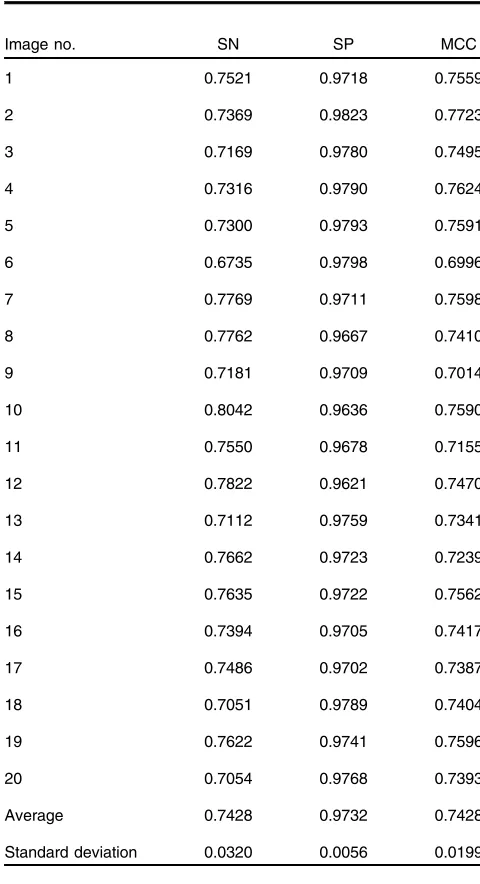
[image:11.630.324.564.84.526.2]The proposed method has been compared to the state-of-the-art based on the values of sensitivity, specificity, and MCC mea-sures, reported in the literature. Tables2and3show the results obtained for each of the test images in the DRIVE and STARE databases, respectively. It can be noticed that the proposed
Table 1 Results obtained from segmentation of images in Fig.10by
adding different values of Gaussian noise. lin, bif, cir, and sin indicate linear, bifurcation, circle, and sinuous phantom, respectively.
Noise variance Image SN SP MCC
0 lin 0.9989 0.9999 0.9989
bif 0.9632 0.9993 0.9760
cir 0.9996 0.9962 0.9406
sin 0.9262 0.9970 0.9411
Avg 0.9720 0.9981 0.9641
0.01 lin 0.9970 0.9992 0.9880
bif 0.8979 0.9994 0.9355
cir 0.9947 0.9970 0.9642
sin 0.9097 0.9977 0.9357
Avg 0.9498 0.9983 0.9558
0.05 lin 0.9357 0.9999 0.9669
bif 0.9139 0.9997 0.9507
cir 0.9139 0.9992 0.9417
sin 0.9121 0.9970 0.9330
Avg 0.9189 0.9989 0.9481
0.1 lin 0.8224 0.9999 0.9017
bif 0.8207 0.9996 0.8972
cir 0.8372 0.9997 0.9074
sin 0.8359 0.9983 0.8965
Avg 0.8291 0.9993 0.9007
0.5 lin 0.6211 0.9999 0.7813
bif 0.6391 0.9991 0.7754
cir 0.6463 0.9995 0.7893
sin 0.6061 0.9996 0.7626
Avg 0.6281 0.9995 0.7772
Table 2 Segmentation performance of the proposed method on the
DRIVE database.
Image no. SN SP MCC
1 0.7521 0.9718 0.7559
2 0.7369 0.9823 0.7723
3 0.7169 0.9780 0.7495
4 0.7316 0.9790 0.7624
5 0.7300 0.9793 0.7591
6 0.6735 0.9798 0.6996
7 0.7769 0.9711 0.7598
8 0.7762 0.9667 0.7410
9 0.7181 0.9709 0.7014
10 0.8042 0.9636 0.7590
11 0.7550 0.9678 0.7155
12 0.7822 0.9621 0.7470
13 0.7112 0.9759 0.7341
14 0.7662 0.9723 0.7239
15 0.7635 0.9722 0.7562
16 0.7394 0.9705 0.7417
17 0.7486 0.9702 0.7387
18 0.7051 0.9789 0.7404
19 0.7622 0.9741 0.7596
20 0.7054 0.9768 0.7393
Average 0.7428 0.9732 0.7428
[image:11.630.65.309.99.582.2]Standard deviation 0.0320 0.0056 0.0199
Table 3 Segmentation performance of the proposed method on
the STARE database.
Image no. SN SP MCC
1 0.7100 0.9719 0.7049
2 0.7241 0.9822 0.7421
3 0.7317 0.9623 0.6134
4 0.7688 0.9807 0.7851
5 0.7046 0.9830 0.7583
6 0.6933 0.9823 0.7401
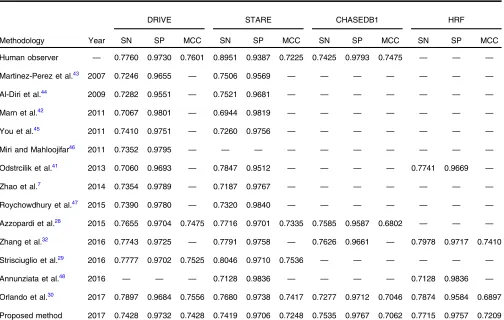
[image:11.630.325.567.575.741.2]method reaches an average sensitivity of 74.28% and 74.19%, specificity of 97.32% and 97.06%, and MCC of 74.28% and 72.48% on the DRIVE and STARE databases, respectively. Table 4 reports the results achieved on the new published CHASEDB1 and HRF databases. Results are increased in terms of specificity. An average sensitivity of 75.35% and 77.15%, specificity of 97.67% and 97.57%, and MCC of 70.62% and 72.09% are achieved on the CHASEDB1 and HRF databases, respectively. Table4compares the performance of the proposed algorithm with other state-of-the-art techniques on the DRIVE, STARE, CHASEDB1, and HRF databases. Overall, MCC is improved on average on the CHASEDB1 dataset, when com-pared to Refs.41and 30.
The proposed algorithm is able to successfully track tiny vessels. This is due to integration of the local intensities that are used to compute the Radon transformations in conjunction with the smoothness in the centerlines made by GP. However, missing some branches due to blood vessel discontinuity, which is one disadvantage of the tracking approach, adversely affects the sensitivity of the algorithm.
[image:12.630.61.304.69.385.2]The quantified results can be interpreted as follows: the specificity of the proposed algorithm is relatively high due to using local information around blood vessels and ignoring back-ground pixels and regions far away from the vessel centerline. However, the algorithm suffers from undesirable properties. The hypothesis for diameter estimation is that the corresponding distribution of vessel diameter is Gaussian with a mean at the initial diameter value. Considering the symmetry of Gaussian distribution, the hypothesis assumed is equivalent to equality of the diameter frequencies with smaller and larger values than
Table 3(Continued).
Image no. SN SP MCC
8 0.7104 0.9725 0.7262
9 0.7461 0.9627 0.7077
10 0.7308 0.9636 0.6930
11 0.7456 0.9718 0.7074
12 0.7700 0.9711 0.7503
13 0.7549 0.9697 0.7341
14 0.7427 0.9766 0.7453
15 0.7395 0.9725 0.7391
16 0.7490 0.9726 0.7575
17 0.7248 0.9719 0.7273
18 0.7838 0.9576 0.7182
19 0.7682 0.9545 0.6972
20 0.8067 0.9583 0.7178
Average 0.7419 0.9706 0.7248
[image:12.630.64.568.426.746.2]Standard deviation 0.0282 0.0084 0.0348
Table 4 Comparison of the proposed algorithm with existing methods using the DRIVE, STARE, CHASEDB1, and HRF databases.
DRIVE STARE CHASEDB1 HRF
Methodology Year SN SP MCC SN SP MCC SN SP MCC SN SP MCC
Human observer — 0.7760 0.9730 0.7601 0.8951 0.9387 0.7225 0.7425 0.9793 0.7475 — — —
Martinez-Perez et al.43 2007 0.7246 0.9655
— 0.7506 0.9569 — — — — — — —
Al-Diri et al.44 2009 0.7282 0.9551 — 0.7521 0.9681 — — — — — — —
Marn et al.42 2011 0.7067 0.9801
— 0.6944 0.9819 — — — — — — —
You et al.45 2011 0.7410 0.9751 — 0.7260 0.9756 — — — — — — —
Miri and Mahloojifar46 2011 0.7352 0.9795 — — — — — — — — — —
Odstrcilik et al.41 2013 0.7060 0.9693
— 0.7847 0.9512 — — — — 0.7741 0.9669 —
Zhao et al.7 2014 0.7354 0.9789 — 0.7187 0.9767 — — — — — — —
Roychowdhury et al.47 2015 0.7390 0.9780 — 0.7320 0.9840 — — — — — — —
Azzopardi et al.28 2015 0.7655 0.9704 0.7475 0.7716 0.9701 0.7335 0.7585 0.9587 0.6802
— — —
Zhang et al.32 2016 0.7743 0.9725 — 0.7791 0.9758 — 0.7626 0.9661 — 0.7978 0.9717 0.7410
Strisciuglio et al.29 2016 0.7777 0.9702 0.7525 0.8046 0.9710 0.7536 — — — — — —
Annunziata et al.48 2016
— — — 0.7128 0.9836 — — — — 0.7128 0.9836 —
Orlando et al.30 2017 0.7897 0.9684 0.7556 0.7680 0.9738 0.7417 0.7277 0.9712 0.7046 0.7874 0.9584 0.6897
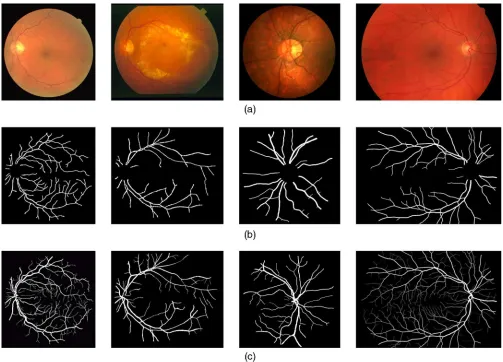
the initial diameter. However, since in retinal images vascular diameters decrease when moving away from the optic disk, the frequency of vessels with diameters smaller than the initial diameter is often greater. Thus, the diameters of narrow vessels are often overestimated as larger, lowering the specificity. This limitation happens at bifurcation and crossover points where the vessel width might not be continuous. Nevertheless, in contrary to pixel-based methods, the proposed tracking method provides direct diameter estimations and decomposes the vascular tree into constitutive branches. Sample segmentations obtained using our method are shown in Fig.11, which shows a reason-able resemblance to the reference segmentations.
The average processing time per image in DRIVE and STARE databases is about 90 s (Ubuntu 14.04 64 bit, used one processor core of Intel Core i7 @ 2.40 GHz and 8 GB RAM). It is worth noting that computational complexity for inverting a covariance matrix isOðn3Þand this fact along with the present integration in Radon transform would lead to more computa-tional complexity compared with the other methods.
5
Discussion and Conclusion
Considering the outbreak of diabetes, its effect on retinal ves-sels, and the growing demand for periodical examination of reti-nal images, the automatic areti-nalysis of retireti-nal images is a relevant problem in medical image processing. In this paper, we
presented a new approach to track blood vessel centerlines and their diameters based on GP and Radon transform. We assumed that for a single fragment of a vessel, its curvature and diameter are GPs whose kernel parameters are optimized by maximizing the likelihood of the data.
In order to test the performance of the algorithm, the retinal images in DRIVE, STARE, CHASEDB1, and HRF databases, with ground truth pixel labels, were used. We showed that the proposed method is robust to noise and thus able to track thin structures and central arterial reflex, where the signal quality drops significantly. This property is first due to integration of the local intensities used to compute the Radon transformations. Furthermore, the smoothness in the centerlines is enforced by spatial correlations of the predictions made by GP. The result is an increased specificity level when compared to other meth-ods. The proposed method directly measures the vessel diame-ters and detects the bifurcation points that can be useful for further postquantitative and compositional analysis.
[image:13.630.63.566.57.419.2]The proposed method relies on inverting covariance matrices and computing line integrals for Radon transformations, which can be computationally expensive. One possible interesting research direction is the development of a mechanism to make the algorithm computationally more efficient. This can be achieved using methods such as sparse GPs49,50or Fourier transforms to compute the Radon features.51,52
Fig. 11 Sample segmented results of retinal images from the DRIVE, STARE, CHASEDB1, and HRF
Disclosures
No conflicts of interest, financial or otherwise, are declared by the authors.
Acknowledgments
The authors would like to thank J. Staal,38 A. Hoover,39
G. Owen,40 J. Odstrcilik,41 and their colleagues for making their databases publicly available.
References
1. X. Jiang and D. Mojon,“Adaptive local thresholding by verification-based multithreshold probing with application to vessel detection in reti-nal images,”IEEE Trans. Pattern Anal. Mach. Intell.25(1), 131–137
(2003).
2. M. D. Abràmoff, M. K. Garvin, and M. Sonka,“Retinal imaging and image analysis,”IEEE Rev. Biomed. Eng.3, 169–208 (2010).
3. H. R. Taylor and J. E. Keeffe,“World blindness: a 21st century perspec-tive,”Br. J. Ophthalmol.85(3), 261–266 (2001).
4. M. D. Abràmoff et al.,“Automated early detection of diabetic retinopa-thy,”Ophthalmology117(6), 1147–1154 (2010).
5. E. Trucco et al.,“Validating retinal fundus image analysis algorithms: issues and a proposalvalidating retinal fundus image analysis algo-rithms,”Invest. Ophthalmol. Visual Sci.54(5), 3546–3559 (2013).
6. O. Faust et al.,“Algorithms for the automated detection of diabetic reti-nopathy using digital fundus images: a review,”J. Med. Syst.36(1), 145–157 (2012).
7. Y. Q. Zhao et al.,“Retinal vessels segmentation based on level set and region growing,”Pattern Recognit.47(7), 2437–2446 (2014).
8. N. Patton et al.,“Retinal image analysis: concepts, applications and potential,”Prog. Retinal Eye Res.25(1), 99–127 (2006).
9. D. Lesage et al.,“A review of 3D vessel lumen segmentation techniques: models, features and extraction schemes,” Med. Image Anal.13(6), 819–845 (2009).
10. M. R. K. Mookiah et al.,“Computer-aided diagnosis of diabetic reti-nopathy: a review,”Comput. Biol. Med.43(12), 2136–2155 (2013). 11. M. M. Fraz et al.,“Blood vessel segmentation methodologies in retinal
images: a survey,”Comput. Meth. Programs Biomed.108(1), 407–433
(2012).
12. T. Teng, M. Lefley, and D. Claremont,“Progress towards automated diabetic ocular screening: a review of image analysis and intelligent sys-tems for diabetic retinopathy,”Med. Biol. Eng. Comput.40(1), 2–13
(2002).
13. A. F. Frangi et al.,“Multiscale vessel enhancement filtering,”inInt.
Conf. on Medical Image Computing and Computer-Assisted
Intervention, pp. 130–137, Springer (1998).
14. R. Manniesing, M. A. Viergever, and W. J. Niessen,“Vessel enhancing diffusion: a scale space representation of vessel structures,”Med. Image Anal.10(6), 815–825 (2006).
15. Y. Sun,“Automated identification of vessel contours in coronary arterio-grams by an adaptive tracking algorithm,”IEEE Trans. Med. Imaging
8(1), 78–88 (1989).
16. Y. Yin, M. Adel, and S. Bourennane,“Retinal vessel segmentation using a probabilistic tracking method,”Pattern Recognit.45(4), 1235–1244
(2012).
17. C. Kirbas and F. Quek,“A review of vessel extraction techniques and algorithms,”ACM Comput. Surv. (CSUR)36(2), 81–121 (2004).
18. S. R. Aylward and E. Bullitt,“Initialization, noise, singularities, and scale in height ridge traversal for tubular object centerline extraction,”
IEEE Trans. Med. Imaging21(2), 61–75 (2002).
19. Y. Xu et al.,“An improved algorithm for vessel centerline tracking in coronary angiograms,”Comput. Meth. Programs Biomed.88(2), 131–
143 (2007).
20. M. Tavakoli et al.,“A complementary method for automated detection of microaneurysms in fluorescein angiography fundus images to assess diabetic retinopathy,”Pattern Recognit.46(10), 2740–2753 (2013).
21. R. Pourreza et al.,“A Radon transform based approach for extraction of blood vessels in conjunctival images,” in Mexican Int. Conf. on
Artificial Intelligence (MICAI 2008), pp. 948–956, Springer (2008).
22. Q. Zhang and I. Couloigner,“Accurate centerline detection and line width estimation of thick lines using the Radon transform,” IEEE Trans. Image Process.16(2), 310–316 (2007).
23. O. Chutatape, L. Zheng, and S. Krishnan,“Retinal blood vessel detec-tion and tracking by matched Gaussian and Kalman filters,”inProc. of the 20th Annual Int. Conf. of the IEEE Engineering in Medicine and Biology Society, Vol. 6, pp. 3144–3149, IEEE (1998).
24. E. Bekkers et al.,“A multi-orientation analysis approach to retinal vessel tracking,”J. Math. Imaging Vision49(3), 583–610 (2014).
25. R. Abielmona et al.,“Vessel tracking and anomaly detection using level 0/1 and high-level information fusion techniques,”inSoft Computing
Applications, pp. 769–780, Springer (2016).
26. Y. A. Tolias and S. M. Panas, “A fuzzy vessel tracking algorithm for retinal images based on fuzzy clustering,” IEEE Trans. Med. Imaging17(2), 263–273 (1998).
27. A. Gooya et al.,“A variational method for geometric regularization of vascular segmentation in medical images,”IEEE Trans. Image Process.
17(8), 1295–1312 (2008).
28. G. Azzopardi et al.,“Trainable COSFIRE filters for vessel delineation with application to retinal images,”Med. Image Anal.19(1), 46–57 (2015).
29. N. Strisciuglio et al.,“Supervised vessel delineation in retinal fundus images with the automatic selection of B-COSFIRE filters,” Mach. Vision Appl.27(8), 1137–1149 (2016).
30. J. I. Orlando, E. Prokofyeva, and M. B. Blaschko,“A discriminatively trained fully connected conditional random field model for blood vessel segmentation in fundus images,”IEEE Trans. Biomed. Eng.64(1), 16–
27 (2017).
31. P. Liskowski and K. Krawiec,“Segmenting retinal blood vessels with deep neural networks,”IEEE Trans. Med. Imaging35(11), 2369–2380
(2016).
32. J. Zhang et al.,“Robust retinal vessel segmentation via locally adaptive derivative frames in orientation scores,” IEEE Trans. Med. Imaging
35(12), 2631–2644 (2016).
33. C. M. Bishop et al.,Pattern Recognition and Machine Learning, Vol.1, Springer, New York (2006).
34. C. E. Rasmussen,Gaussian Processes for Machine Learning, MIT Press, Cambridge, Massachusetts (2006).
35. D. J. MacKay,“Introduction to Gaussian processes,”NATO ASI Ser. F
Comput. Syst. Sci.168, 133–166 (1998).
36. L. M. Murphy,“Linear feature detection and enhancement in noisy images via the Radon transform,”Pattern Recognit. Lett.4(4), 279–
284 (1986).
37. H. Narasimha-Iyer et al.,“Automatic identification of retinal arteries and veins from dual-wavelength images using structural and functional fea-tures,”IEEE Trans. Biomed. Eng.54(8), 1427–1435 (2007).
38. J. Staal et al.,“Ridge-based vessel segmentation in color images of the retina,”IEEE Trans. Med. Imaging23(4), 501–509 (2004).
39. A. Hoover, V. Kouznetsova, and M. Goldbaum,“Locating blood vessels in retinal images by piecewise threshold probing of a matched filter response,”IEEE Trans. Med. Imaging19(3), 203–210 (2000).
40. C. G. Owen et al.,“Measuring retinal vessel tortuosity in 10-year-old children: validation of the computer-assisted image analysis of the retina (CAIAR) program,”Invest. Ophthalmol. Visual Sci.50(5), 2004–2010
(2009).
41. J. Odstrciliki et al.,“Retinal vessel segmentation by improved matched filtering: evaluation on a new high-resolution fundus image database,”
IET Image Process.7(4), 373–383 (2013).
42. D. Marn et al.,“A new supervised method for blood vessel segmentation in retinal images by using gray-level and moment invariants-based fea-tures,”IEEE Trans. Med. Imaging30(1), 146–158 (2011).
43. M. E. Martinez-Perez et al.,“Segmentation of blood vessels from red-free and fluorescein retinal images,”Med. Image Anal. 11(1), 47–61
(2007).
44. B. Al-Diri, A. Hunter, and D. Steel,“An active contour model for seg-menting and measuring retinal vessels,” IEEE Trans. Med. Imaging
28(9), 1488–1497 (2009).
45. X. You et al.,“Segmentation of retinal blood vessels using the radial projection and semi-supervised approach,”Pattern Recognit.44(10), 2314–2324 (2011).
46. M. S. Miri and A. Mahloojifar,“Retinal image analysis using curvelet transform and multistructure elements morphology by reconstruction,”
47. S. Roychowdhury, D. Koozekanani, and K. Parhi,“Iterative vessel seg-mentation of fundus images,”IEEE Trans. Biomed. Eng.62(7), 1738–
1749 (2015).
48. R. Annunziata et al.,“Leveraging multiscale hessian-based enhance-ment with a novel exudate inpainting technique for retinal vessel seg-mentation,”IEEE J. Biomed. Health Inf.20(4), 1129–1138 (2016).
49. M. Seeger, C. Williams, and N. Lawrence,“Fast forward selection to speed up sparse Gaussian process regression,”inArtificial Intelligence
and Statistics 9, no. EPFL-CONF-161318 (2003).
50. E. Snelson and Z. Ghahramani, “Sparse Gaussian processes using pseudo-inputs,” in Advances in Neural Information Processing
Systems, pp. 1257–1264 (2005).
51. G. Beylkin,“Discrete radon transform,”IEEE Trans. Acoust. Speech Signal Process.35(2), 162–172 (1987).
52. A. Averbuch et al.,“A framework for discrete integral transformations II—the 2D discrete Radon transform,”SIAM J. Sci. Comput.30(2), 785–803 (2008).
Masoud Elhami Aslreceived his BSc degree in biomedical
engineer-ing from Sahand University of Technology in 2012 and his MSc degree in biomedical engineering from Tarbiat Modares University in 2015. Subsequently, he joined R&D department of Saadat Co and worked on ECG signal analysis. Currently, he is a visiting researcher in the Norwegian Colour and Visual Computing Laboratory (ColorLab) at NTNU, Norway. His research interest includes machine learning in medical image analysis and biological signal processing.
Navid Alemi Koohbananireceived his bachelor’s degree from the
University of Isfahan in 2013 and master’s degree from Tarbiat Modares University in 2015. He is now working toward his PhD in the Department of Computer Science, University of Warwick, Coventry. His research interests are medical image analysis and machine learning.
Alejandro F. Frangi(Alex) obtained his undergraduate degree in
telecommunications engineering from the Technical University of Catalonia in Barcelona in 1996 and his PhD at the Image Sciences Institute of the University Medical Center Utrecht in 2001 on model-based cardiovascular image analysis. He is a professor of biomedical image computing at the University of Sheffield (USFD), Sheffield, United Kingdom. He leads the Center for Computational Imaging and Simulation Technologies in Biomedicine and is the academic coordinator of the MSc Bioengineering: Imaging and Sensing program.
Ali Gooyaobtained his MSc degree in electrical engineering from