This is a repository copy of
A Screening Test for Disclosed Vulnerabilities in FOSS
Components
.
White Rose Research Online URL for this paper:
http://eprints.whiterose.ac.uk/129164/
Version: Accepted Version
Article:
Dashevskyi, S., Brucker, A.D. orcid.org/0000-0002-6355-1200 and Massacci, F. (2018) A
Screening Test for Disclosed Vulnerabilities in FOSS Components. IEEE Transactions on
Software Engineering. ISSN 0098-5589
https://doi.org/10.1109/TSE.2018.2816033
[email protected] https://eprints.whiterose.ac.uk/ Reuse
Unless indicated otherwise, fulltext items are protected by copyright with all rights reserved. The copyright exception in section 29 of the Copyright, Designs and Patents Act 1988 allows the making of a single copy solely for the purpose of non-commercial research or private study within the limits of fair dealing. The publisher or other rights-holder may allow further reproduction and re-use of this version - refer to the White Rose Research Online record for this item. Where records identify the publisher as the copyright holder, users can verify any specific terms of use on the publisher’s website.
Takedown
If you consider content in White Rose Research Online to be in breach of UK law, please notify us by
This is the author’s version of the work. It is posted at https://www.brucker.ch/bibliography/abstract/dashevskyi.ea-vulnerability-screening-2018 for your personal use. Not for redistribution. The definitive version was published inIEEE Transaction on Software Engineering, Vol. 44, pp. 1–23, 2018, doi: 10.1109/TSE.2018.2816033. BIBTEX, Word, EndNote, RIS
A Screening Test for Disclosed Vulnerabilities in
FOSS Components
Stanislav Dashevskyi, Achim D. Brucker, and Fabio Massacci
Abstract—Free and Open Source Software (FOSS) components are ubiquitous in both proprietary and open source applications. Each time a vulnerability is disclosed in a FOSS component, a software vendor using this component in an application must decide whether to update the FOSS component, patch the application itself, or just do nothing as the vulnerability is not applicable to the older version of the FOSS component used. This is particularly challenging for enterprise software vendors that consume thousands of FOSS components and offer more than a decade of support and security fixes for their applications. Moreover, customers expect vendors to react quickly on disclosed vulnerabilities—in case of widely discussed vulnerabilities such as Heartbleed, within hours. To address this challenge, we propose ascreening test: a novel, automatic method based on thin slicing, for estimating quickly whether a given vulnerability is present in a consumed FOSS component by looking across its entire repository. We show that our screening test scales to large open source projects (e.g., Apache Tomcat, Spring Framework, Jenkins) that are routinely used by large software vendors, scanning thousands of commits and hundred thousands lines of code in a matter of minutes.
Further, we provide insights on the empirical probability that, on the above mentioned projects, a potentially vulnerable component might not actually be vulnerable after all.
Index Terms—Security maintenance; Security vulnerabilities; Patch Management; Free and Open Source Software
F
1
I
NTRODUCTIONA
CCORDINGto a recent Black Duck study [1], more than65 percent of proprietary applications leverage Free
and Open Source Software (FOSS). This choice speeds up application development [2], as FOSS components are often used “as-is” without any modifications [3]. The price to pay is that vulnerabilities discovered in a FOSS component may affect the application that consumes it [4].
To avoid this problem a vendor could frequently and automatically update one’s product (and thus its FOSS components). Such a maintenance policy can be acceptable for some applications, e.g., a web browser, but hardly so for components used in business or industrial control sys-tems which may require regression testing, re-certification of compliance, or users’ training [5]. Therefore, economic theory dictates that many customers will keep old, but perfectly functioning versions of the main application [6], [7], [8]. A simple, ‘poor man’ example is updating one’s free version of Java: the new free Java component may disrupt the (expensive) existing Matlab/Simulink toolkit which uses it and whose updates are usually not free.
As a result, when a vulnerability about the current
version of the FOSS library is reported, the vendor must provide maintenance support for a software bundled with a FOSS release that was new then, but it is now several years older than the presently available FOSS version.
• A. D. Brucker is with University of Sheffield, United Kingdom.
• S. Dashevskyi is with University of Luxembourg, Luxembourg (he
performed part of this work while being with University of Trento, Italy).
• F. Massacci is with University of Trento, Italy.
Different choices are possible: update, patch, or don’t touch. The first choice may be appropriate if only few APIs of the library have changed. The last one may be the rational choice when the vulnerability doesn’t apply to the actually deployed version and the cost of changes is
massive. Such choice should bemade quickly and early, as it
requires to mobilize expertise in different areas: in the first case, functional experts must adapt the main application (just using the fixed release of the FOSS component); in the last scenario, security experts should check that there really is no problem.
Unfortunately, the strong economic advantage of using a FOSS component as a “black box” turns into a severe disadvantage when a software vendor that integrates this component into its products must check it for defects [3], [9]. A vendor may try to test its application against a working exploit, but for many vulnerabilities there are no public exploits [10]. Even if published exploits exist, they must be adapted to trigger the FOSS vulnerability in the context of the consuming application. An alternative is to apply static analysis tools against the FOSS component. Such analysis requires a solid understanding of the FOSS source code [3], as well as expertise in the tools [11], as they can generate thousands of potentially false warnings for large projects. Further, the analysis may require days for processing even a single ‘FOSS-release’, ‘main-application’ pair [12]. If several FOSS releases are used in many different products [13] the above solutions do not scale.
Alternatively, one could rely on publicly available vul-nerability data, such as the information published in the
US National Vulnerability Database1 (NVD). Among other
vulnerability characteristics, such data often provides the
information about the versions affected by vulnerabilities, but, due to effort constraints, it focuses only on the latest supported releases—often containing statements such as ‘’and all previous versions.” Our research, actually, shows that the NVD entries contain a substantial number of inaccu-racies in both directions: first, listing versions as vulnerable that are in fact secure and, second, omitting versions that are vulnerable. While the fist inaccuracy may result “only” in unnecessary security maintenance, the second may result in not acting upon potentially severe vulnerabilities.
Our solution to the hurdles of identifying which older versions of FOSS components are likely to be affected by newly disclosed vulnerabilities lies in the direction of “soundiness” [14] and is in the same spirit of Hindle et
al. [15]: “semantic properties of software are manifest in artificial
ways that are computationally cheap to detect automatically, in particular when compared to the cost [. . . ] of determining these
properties by sound (or complete) static analysis”.
We propose an automatic, scalablescreening testfor
es-timating if an older version of a component is affected by a newly disclosed vulnerability, using the vulnerability fix. The test is quick and can be used early in the process albeit it is approximate. Several screening criteria can be used with different level of precision. Static or dynamic tools can then be used later in the analysis.
The original contribution of this work is to combine an
adaptation thethin slicingtechnique [16] for finding relevant
vulnerable source code statements with the SZZapproach
adapted from ´Sliwerski et al. [17] for tracking the vulnerable code back to its introduction. We also build upon Fonseca and Vieira [18] who classified typical source code changes that fix injection security vulnerabilities, as well as Renieris and Reiss [19] for their concept of code dependencies in fault localization. To understand the limitations of proposed screening test we analyzed, in collaboration with an inter-national enterprise software vendor, several popular and large scale FOSS projects. We selected the FOSS projects based on the needs of our industrial partner, i.e., we selected the most often used components across a wide spectrum of enterprise applications and frameworks developed by our partner. First, we performed a manual validation to determine the potential error rate of different screening criteria, and, second, we did a large scale empirical analysis of the underlying assumptions (e.g., security fixes in our projects are mostly local as in [20], in contrast to what is found on normal bugs [21]), as well as the trade-offs between the likelihood that an older version is affected by a newly disclosed vulnerability and the maintenance effort required for upgrading, showing that the approach scales to thousands of revisions and MLoCs.
A side-effect of our validation is also an insight on the empirical probability that a potential vulnerable component might not actually be vulnerable if it is too old. Once again, the default rule used by many security databases (“X is vulnerable and all its previous versions”) is surely safe, but might be not so effective.
[image:3.595.325.535.115.198.2]The rest of the paper is structured as follows: we start with the problem statement and research questions (sec-tion 2), then continue with an overview of the related work (section 3). Next, we introduce the general terminology used throughout the paper (section 4), and introduce our
TABLE 1: Maintenance Cycles of Enterprise Software
Maintenance cycles of ten years or more are common for software used in enterprises. During this period, vendors need to fix security issues without changing either functionality or dependencies of the software.
Product Release EoLife ext. EoL
Microsoft Windows XP 2001 2009 2014
Microsoft Windows 8 2012 2018 2023
Apache Tomcat 2007 2016 n/a
Red Hat Ent. Linux 2012 2020 2023
SAP SRM 6.0 2006 2013 2016
Siemens WinCC V4.0 1997 2004 n/a
Symantec Altiris 2008 2013 2016
vulnerability screening test (section 5). Further, we discuss the data selection (section 7) and validation of the screening test (section 8). Finally, we discuss the security maintenance decision support for FOSS components (section 9), threats to validity (section 10), and conclude (section 11).
2
P
ROBLEMS
TATEMENTIf a new vulnerability is disclosed and fixed in the current
version of a FOSS component, the vendor of the consuming
application must assess (i) which releases are vulnerableand
(ii) what actions should be taken to resolve issues for its different
customers. This is far from trivial for most companies [3].
To illustrate the problem, Figure 1 shows the distribu-tion in time (as of 2014) of the numbers of instances and
customers for the past releases ofoneERP application from
a large industrial software vendor. Several customers used releases which were between five and nine years old. These releases included FOSS components that were “new” at the time but are now several years old. The vendor must now backtrack the FOSS release across its code base and for each of them take a decision.
Manually verifying whether a newly disclosed vulner-ability applies to older versions of software applications is not only tedious, but is also expensive in terms of resources. For example, if we consider the software illustrated at Figure 1, this activity would require to manually examine many different versions of a third-party FOSS component for which the vulnerability was reported.
Long support lifecycles such as the one illustrated in Figure 1 is not a characteristic only of ERP software. Table 1 provides an illustrative example of the life-cycle of several products with respect to the maintenance, from operating systems to web servers, from industrial control software to security products. For example, Red Hat Enterprise Linux released in 2012 has an extended support for 11 years (until 2023). Siemens WinCC v4.0 (software for industrial control systems) had a lifetime of 7 years, and Symantec Altiris (service-oriented management software) released in 2008 has an extended lifetime of 8 years.
backport the security fixes provided by FOSS developers, or implement own security fixes for different versions of the product, a team of software security experts may be more appropriate.
However, security experts, developers and customers may, naturally, have different priorities when deciding whether a component should be upgraded, fixed or left
alone: security experts want to minimize the attack surface
and, thus, prefer upgrades of potential vulnerable
compo-nents over staying with old versions. Developers and
cus-tomers try to minimize maintenance and operational risks
of changes and, thus, prefer staying with an old version if the security risk in doing so is low.
0
20, 000 40, 000 60, 000 80, 000 100 ,000 120 ,000
1998 2004 2012
No. of Systems
No. of Customers
[image:4.595.69.259.231.299.2]The distribution shows #systems (blue) and #customers (red) using the releases of one ERP application that arex-years old with respect to 2014 (values on the y-axis are omitted for confidentiality). In 2014, most business customers used releases (and corresponding FOSS components) that were between 9 and 11 years old. Each product version is most likely shipping different versions of different FOSS components. Hence, all these FOSS versions must be assessed when a new vulnerability in one them becomes publicly known.
Fig. 1: Single ERP application life time from 1998 to 2014, #systems and #customers using them in 2014.
Either way, we need to allocate resources to either port each application release, or audit their security. For example, developers could identify the vulnerable code fragment from the vulnerable release (by examining the source code with or without tools), thus focusing only on the relevant subset of the vulnerable component. This vulnerable code fragment could be later used in combination with running a static analysis security testing tool (SAST) on a potentially vulnerable version of a component to ascertain that the vul-nerability is indeed not present. Unfortunately, precise SAST tools do not scale well to large programs: tools providing a precise analysis can take days for one version of a compo-nent [12] or can generate too many false alarms [22], [23] – the situation depicted in Figure 1, where we must assess several FOSS versions at once, would be unmanageable.
To focus our efforts on the actual vulnerable products, we must tentatively identify within minutes (not hours or days) all products that are likely affected by the
vulnerabil-ity. We need the software equivalent of a clinical screening
test [24]: something that may be neither (formally) sound,
nor complete, but works well enough for practical problem
instances and is fast and inexpensive.2 Therefore, our first
research question is as follows:
RQ1: Given a disclosed security vulnerability in a FOSS
com-ponent, what could be an accurate and efficient screening test to estimate its presence in the previous revisions of the component?
2. A sound and complete solution is formally impossible to achieve: Rice’s theorem [25, Proof 5.28, pp243] states that no recursive program can take a non-trivial set of programs (e.g., all past releases of a FOSS component) and produce the subset of programs satisfying a non-trivial property (e.g., containing a semantically equivalent fragment of the vulnerable code fragment).
Our main goal here is to identify and assess heuristics that would be “cheap” enough for screening through a large number of revisions of many FOSS components, allowing at the same time to improve over purely syntactic methods described in the literature (for example, ´Sliwerski et al. [17] and Nguyen et al. [20]).
Once we have such a screening test, we may use it for company-wise estimates to empirically assess the likelihood that an older version of a FOSS component may be affected by a newly disclosed vulnerability, as well as the potential maintenance effort required for upgrading or fixing that version. This raises the following question:
RQ2: For how long the vulnerable coding is persistent in FOSS
code bases since its introduction? What are the overall secu-rity maintenance recommendations for such components?
3
R
ELATEDW
ORK3.1 Identifying the Vulnerable Coding
As our RQ1 is concerned with finding an appropriate
technique for capturing a vulnerable code fragment using vulnerability fixes, we build upon Fonseca and Vieira [18] as the basis for our idea of using an intra-procedural fix dependency sphere that we introduce in Section 5.4. The authors of [18] compared a large sample of fixes for injection vulnerabilities to various types of software faults in order to identify whether security faults follow the same patterns as general software faults: their results show that only a small subset of software faults are related to injection vulnerabilities, also suggesting that faults that correspond to this vulnerability type are rather simple and do not require a complex fix.
While the work by Fonseca and Vieira [18] provides only the analysis of security patches for injection vulner-abilities, and does not consider tracking the presence of corresponding vulnerable code fragments in software repos-itories, we found the classification of changes for security fixes proposed by the authors [18] to be extremely useful for our purposes. However, as we were also interested in other vulnerability types (see Section 7 for the vulnerability demographics of FOSS components used by our industrial partner), we had to extend the classification of fixes by Fon-seca and Vieira [18] (shown in Table 4), as well as to identify heuristics for tracking the vulnerable code fragments.
The work by Thome et al. [26] shows that sound pro-gram slices for the injection security vulnerabilities can be significantly smaller than traditional program slices, and that control flow statements should be included into slices. Therefore, we collect control-flow statements as well, in
contrast to the original approach ofthin slicing[16] on which
we build our implementation for capturing vulnerable code fragments using vulnerability fixes.
that capture specific classes of security vulnerabilities [26]. Acharya and Robinson [12] evaluated the applicability of static slicing to identifying the impact of software changes. Their findings suggest that for small programs (and change-sets) static slicing can be used effectively, but it faces serious challenges when applied routinely against large systems: they report that the build time for the intermediate repre-sentation of one version of a project took about four days and observed that one must investigate and resolve various accuracy trade-offs in order to make large-scale analysis possible.
Thome et al. [26] implemented a lightweight program slicer that operates on the bytecode of a Java program and allows to extract all sources and sinks in the program for computing a program chop that would help software developers to perform faster audits of potential XML, XPath, and SQL injection vulnerabilities. It runs significantly faster than traditional slicing evaluated by Acharya and Robin-son [12], however, still, it was close to impossible for our scenario (assessing thousands of revisions within seconds) to use precise tools based on byte code, as they require to build source code and resolve all dependencies as well. We found that for versions of Java projects which are older than five years from now, the latter could be very challenging. Moreover, we are interested in particular vulnerable code fragments that correspond to confirmed vulnerability fixes, but not in the whole set of slices that may contain all possible potentially vulnerable code fragments. Still, the approach by Thome et al. [26] can be used as a second-level test after our screening.
Considering the above, we have reverted to thin
slic-ing[16] and modified the original algorithm to include the
control flow statements, and limit the scope of slicing to the methods, where a security vulnerability was fixed.
To identify whether the library is called within the con-text of an application that consumes it, the approach by Plate et al. [30] can be also used as an additional test after our screening. However, the approach [30] cannot replace our own test as it requires to call a fully-fledged static analyzer to extract the call graph and fail our requirement of being inexpensive.
3.2 The SZZ Approach: Tracking the Origin of the Vul-nerable Coding
It is well known that to manually identify when exactly a certain vulnerability is introduced into a software com-ponent is a long process. For example, Meneely et al. [31] studied properties of source code repository commits that introduce vulnerabilities – the authors manually explored
68 vulnerabilities of Apache HTTPD,3 and they took six
months to finish their analysis.
Many studies on mining software repositories aim at solving the problem of manual analysis [17], [20], [32], allowing to automate this tedious task. The seminal work by ´Sliwerski, Zimmermann, and Zeller, widely known as SZZ [17], provided an empirical study on the introduction of bugs in software repositories, showing how to locate bug fixes in commit logs and how to identify their root
3. We did not include this project to our sample as it is written in C, while our current implementation supports only Java.
causes. Their method had inspired the work by Nguyen et al. [20] on which we also build our approach. Unfortunately, the original SZZ approach has several limitations [32]: for instance, SZZ identifies the origin of a line of code with the “annotate” feature of the version control system, therefore it could fail to identify the true origin of that line of code when the code base is massively refactored (e.g., the line of code is moved to another position within its containing method). In our case, such a limitation would be a problem, since the code of the projects that we considered has been massively changed over the course of time (for example, see Figure 6 in Section 7). Therefore, we adopted the heuristics by Kim et al. [32]: we perform cross-revision mapping of individual lines from the initial vulnerability evidence and associate them with their containing files and methods. This allows us to track the origin of lines of code even if they are moved, or their containing file or method is renamed, or they are moved to another location within the code base.
3.3 Empirical Studies on Trade-offs Between the Se-curity Risk Posed by the Presence of the Vulnerable Coding and the Maintainability
Di Penta et al. [33] performed an empirical study analyzing the decay of vulnerabilities in the source code as detected by static analysis tools, using three open source software systems. The decay likelihood observed by the authors [33] showed that most of potential vulnerabilities tend to be removed from the system before major releases (shortly after their introduction), which implies that developers may pri-oritize security issues resolution over regular code changes. One of the questions that the authors in [33] aimed to
answer is similar to the first part of ourRQ2, however we
use a different measure of the vulnerable coding: the lines of code relevant to a security fix as opposed to the lines of code relevant to a static analysis warning. Moreover, our main focus is on distinct vulnerabilities that already have evaded static analysis scans and testing by developers, therefore they will likely show different decay.
For assessing various “global” trade-offs between a vulnerability risk that a component (or a set of compo-nents) imposes and its maintainability, one feasible option is to employ various risk estimation models. Samoladas et al. [34] proposed a model that supports automated software evaluation, and specifically targets open source products. The set of metrics considered by the model is represented by various code quality metrics (including security), and community quality metrics (e.g., mailing lists, the quality of documentation and developer base). While this model takes security aspects into account, they are represented only by two source code metrics: “null dereferences” and “undefined values”, which is largely insufficient to cover the vulnerability fixes in our sample (see Table 4).
cannot be applied to assess individual components. As such approaches would not allow to answer the second part of
our RQ2, we resort to the code-base evidence for telling
whether it is likely that a certain version of a component imposes security risk.
4
T
ERMINOLOGY ANDD
EFINITIONSIn this section we briefly introduce the terminology used in the rest of the paper:
Fixed revision r1: the revision (commit) in which certain
vulnerability was fixed.
Last vulnerable revision r0: the revision in a source code
repository that immediately precedes the fix r1 when
moving forward in time. Thus,r0is thelastvulnerable
revision when moving forward in time, and it is thefirst
vulnerable revision, when moving backward.
Initial vulnerability evidence E[r0]: the set of lines of code that correspond to the vulnerable source code fragment
inr0, obtained using changes betweenr0andr1.
Vulnerability evidence E[r−i]: the set of lines of code from
the initial vulnerability evidence, that are still present
in some revisionr−ithat precedesr0.
Repository difference diff(r−i, r−i+1): the set of lines of
code changed (deleted and added) when changes from
r−itor−i+1were made.
Deleted lines del(r−i, ri+1): the set of lines of code deleted
when changes from r−i to ri+1 were made, s.t.
del(r−i, ri+1)⊆diff(r−i, ri+1).
Added lines add(r−i, ri+1): the set of lines of code added
when changes from r−i to ri+1 were made, s.t.
add(r−i, ri+1)⊆diff(r−i, ri+1).
Source code of a revision code(r−i): the set of lines of code
that belong to the source code ofr−i.
Set of relevant methods methods(locs,code(r−i)): set of
methods to which certain lines of codelocs⊆code(r−i)
belong.
Set of lines of code relevant to a set of methods
code(methods−i): the set of lines of code that belong
to the specified set of methods, s.t. code(methods−i)⊆
code(r−i).
Set of defined variables def(s): the function that returns a set of variables which values are defined or re-defined
in a statements.
Set of referenced variables ref(s): the function that
re-turns a set of variables which values are used ins.
Statement predicate isPredicateOf(s1, s2): this function
in-dicates whether a statement s1 is a conditional
state-ment, and a statements2is statement which execution
depends upons1(e.g., is a part ofthenorelsebranches
of a conditional expression in Java).
5
V
ULNERABILITYS
CREENINGIn this section we start answering RQ1 by discussing
al-ternative techniques for performing screening tests for the likely presence of a vulnerability.
As the fixed versionr1 of a FOSS component is usually
made available when a vulnerability is publicly disclosed, the information about source code modifications for im-plementing the fix transforming the last vulnerable version
r0 to r1 can be used to understand where the vulnerable
part in the source code is located [17], [37], [38]. Then, the approximate code fragment that is responsible for a vulnerability can be identified and tracked backwards in the source code repository history to identify a version that is not yet vulnerable [20].
Figure 2 illustrates an example for the vulnerability evolution in Apache Tomcat 6 (CVE-2014-0033): developers prohibited rewriting the URL string while handling session identifiers but a flag was not checked correctly and attackers could bypass the check and conduct session fixation attacks.
The vulnerability was fixed on 16/01/2014 in revision r1
(here: 1558822) by modifying the incorrect check (line 5)
in r0 (here: 1558788),4 making it impossible to set a
dif-ferent session identifier and rewrite the URL (lines 6 and 7). Searching for the presence of these lines in previous
versions, reveals that in r1−i (here: 1149130) created on
21/07/2011neither the check, nor the session fixation lines
are present. At that point in time, the URL rewriting set-up was not yet introduced by developers, and hence the code base does not yet have this particular vulnerability.
Indeed, the absence of the vulnerable code fragment
in some version r−i that is older than the fixed r1 is an
evidence, as opposed to aproof, that this version is poten-tially not vulnerable: the vulnerable lines of code might be present in a different form or even in completely different, refactored files. If security fixes are rather local [20], these
code lines constitute a prima facieevidence that we should
allocate SAST, testing, or code auditing resources to analyze in depth the versions that correspond to the revisions where the vulnerable coding is still present, whilst having a more
relaxed attitude on those versions precedingr−i.
Let code(r0)be a source code fragment that represents
a vulnerable version of software application r0 that also
contains a vulnerabilityV ⊆code(r0), which is responsible
for an unwanted behavior. What is currently known, is that
r0 contains the vulnerability, and the next revision of this
program r1 is fixed. It is unknown, however, whether an
older variant of the programr−i wherei≥1contains this
vulnerability as well.
The goal of our vulnerability screening test is similar to screening tests used by clinicians to identify possible presence of a disease in individuals [24] – quickly separate the likely healthy portion of individuals from the portion of individuals that is likely to have a certain disease. In
our case, we treat all revisions prior to r0(which is surely
vulnerable) as those that potentially have the vulnerability, while different vulnerability evidences obtained from the fix are our metric that separates the vulnerable part of the population from the non-vulnerable one.
Algorithm 1 illustrates a generic screening test for the potential presence of the vulnerable coding:
1) Init(r0, r1)is an abstract function that, using diff(r0, r1)
operation from the source code repository, retrieves the changes made during the fix and infers the code fragment responsible for the vulnerability – the initial
vulnerability evidenceE[r0]. An example of such
evi-dence can be the source code lines that were directly
r0 (16/01/2014)
ri (21/07/2011) r1 (16/01/2014)
...
In Apache Tomcat 6, CVE-2014-0033 is fixed at revision 1558822 (=r0) on 16/01/2014. Revision 1558788 (=r1) is the last vulnerable revision that lacks a check if URL rewriting
is disabled. The revisions prior and including 1149130 (=ri) from 21/07/2011 and earlier are not vulnerable to CVE-2014-0033, as the vulnerable feature is not present in these
[image:7.595.40.556.63.137.2]revisions.
Fig. 2: An example of the evolution of a vulnerable code fragment (CVE-2014-0033).
modified during a fix (such evidence is considered by the original SZZ approach by ´Sliwerski et al. [17], as well as by the method proposed by Nguyen et al. [20]). However, these modified lines of code may be not the ones actually responsible for the vulnerability, therefore we consider several other alternatives which we discuss in the next subsections.
2) for each revisionr−i, wherei≥1, the current
vulnera-bility evidence is represented by the lines of code from the initial vulnerability evidence that are still present
in r−i. We use the function Track(r−i, r−i+1, E[r−i])
that keeps track of these lines of code individually, as suggested by Kim et al. [32].
3) for each revision r−i, where i ≥ 1, there is a test
Test(r−i) which is essentially a binary classifier that
tells whetherr−iis likely vulnerable, based on whether
the current vulnerability evidence given a reliability
parameterδ. This parameter can be different for actual
screening tests that use different vulnerability evidence extraction techniques.
Extract the vulnerability evidence using the last
vulnerable revisionr0and the fixed revisionr1:
E[r0] ← Init(r0, r1) (1)
For each revisionr−i, wherei≥1, the evidence is
computed as follows:
E[r−i] ← Track(r−i, r−i+1, E[r−i+1]) (2)
Check, whether the source code ofr−iis still likely
to be vulnerable:
Test(r−i) =
(
r−iis vuln. if |E[r−
i]| |E[r0]| > δ
r−iis not vuln. otherwise
(3)
Algorithm 1:Generic screening test using vulnerabil-ity evidence
The key question, however, is how to identify the right
Init(r0, r1) function for the test? As this is the primary
concern of our RQ1, we start off with describing several
candidates and explaining how each of them works.
5.1 Deletion Screening Criterion
A prior work by Nguyen et al. [20] (inspired by the work of ´Sliwerski et al. [17]) has shown that the presence of the lines of code deleted during a security fix may be a good indicator on the likelihood that older software versions are
still vulnerable: if at least one line of the initial evidence is present in a certain revision, this revision is considered to be still vulnerable. Also, the results in [20] suggest that the functionality (i.e., files and methods) where a vulnerability was fixed at some point in time may be not yet vulnerable at the point in time where it was introduced into the code base, and that there may be earlier versions in which most of the relevant functionality (files and methods) already existed but the vulnerability itself was not yet introduced.
The approach works as follows:
1) It starts by collecting the deleted lines of code from a
vulnerability fix –deletion vulnerability evidence;
2) Then, it goes iteratively over older commits/revisions in the source code repository and checks for the pres-ence of these lines;
3) Finally, it stops either when none of the lines from the initial evidence are present, or when all com-mits/revisions are processed. When a vulnerability is fixed by only adding lines of code, there will be no evidence to track, and the authors in [20] conservatively assume that in such cases the whole version prior the
fix (namely, code(r0)) is vulnerable. This screening test
was appropriate for the empirical analysis of Vulnera-bility Discovery Models [39], which are typically based
on the NVD and its cautious assumption “r0is
vulnera-ble and so are all its previous versions” (see [20]), as this would create a consistent approximation of the NVD. Essentially, the overall approach can be seen as an instance of the generic screening test that we defined in
Algorithm 1. In this particular case, threshold δ = 0, and
our functions are instantiated as follows:
Initd(r0, r1) =
(
code(r0) if del(r0, r1) =∅
del(r0, r1) otherwise
(4)
Track(r−i, r−i+1, E[r−i+1]) = E[r−i+1]∩code(r−i)(5)
Test(r−i) = |E[r−i]|> δ= 0 (6)
5.2 Method Screening Criterion
An alternative simple heuristic is the following one:5 “if
a method that was changed during a security fix is still present in an older version of a software product, this ver-sion is still vulnerable”, under the conservative assumption the methods modified during the fix are responsible for a vulnerability. Again, this rule is likely imprecise but fast and inexpensive.
We instantiate the screening test for this heuristic as follows:
methods1 ← methods(add(r0, r1),code(r1)) (7)
methods0 ← methods(del(r0, r1),code(r0)) (8)
Initm(r0, r1) =
(code(r0)∩code(methods1))∪code(methods0)
(9)
ForTrack andTestwe use the same functions as for the
deletion screening. However, tracking the presence/absence of vulnerable methods (or a change in their size) may be still overly conservative, because for cases when a method did not contain vulnerable code since it was first introduced, it may be still reported as vulnerable.
5.3 “Combined” Deletion Screening Criterion
For the original deletion screening test (see Section 5.1), if lines were only added during a fix, there are no cues on where vulnerable code could be located. Therefore, we can combine the original test with the method tracking: when a vulnerability was fixed only adding lines of code, we assume that the whole method (or methods) where these lines were added are responsible, otherwise, the technique
works exactly as the original one (as before,δ= 0)
Inited(r0, r1) =
(
Initm(r0, r1) if del(r0, r1) =∅
del(r0, r1) otherwise
(10)
Track(r−i, r−i+1, E[r−i+1]) =E[r−i+1]∩code(r−i) (11)
Test(r−i) = |E[r−i]|>0 (12)
5.4 Fix Dependency Screening Criterion
Finally, we assume that not always the entire source code of fixed methods is responsible for the occurrence of a vul-nerability. For instance, Fonseca and Vieira [18] empirically show that most of injection vulnerabilities may be due to a missing call to a sanitizer function, which is typically located at methods where user input is processed. Therefore, we need to devise a better approximation of the vulnerability evidence. This is our novel contribution.
LetFbe the fixed lines of code obtained with diff(r0, r1).
In order to fix the lines of code F ⊆ code(r0), a
devel-oper might need to consider several other lines of code
related toF– the actual vulnerable code fragmentF′. Such
5. This heuristic was suggested by A. Sabetta from SAP Labs France in a private conversation. It is also suggested by several anonymous reviewers of a previous version of this paper.
expansion from F to F′ can be progressively scaled by
a parameter k: an expansion Dk(code(r0), F) that, given
a code fragment code(r0) and the fixed lines of code F,
returns the lines of code that F depends-on or that are
dependent-onF fork steps according to some criteria for
the notion of dependency. By D∗(code(r0), F) we
iden-tify the transitive closure of such dependencies such that
F′ ⊆ D
∗(code(r0), F) ⊆ code(r0): – the fix dependency
sphere6of the code fragmentF.
Therefore, we instantiate another screening test that con-siders the source code dependencies of the fixed source code fragment as follows:
Initf d(r0, r1) =
D∗(code(r1),add(r0, r1))∩D∗(code(r0),del(r0, r1))
(13)
Track(r−i, r−i+1, E[r−i]) =E[r−i+1]∩code(r−i) (14)
Test(r−i) =
|E[r−i]|
|E[r0]| > δ (15)
6
I
MPLEMENTING THE FIXD
EPENDENCYS
PHEREIf we had used traditional program slicing [40] for extracting the vulnerable code, we would likely find out that (using the
words by Sridharan et al. [16]) “traditional slices often grow too
large” and “unwieldy slices arise primarily from an overly broad
definition of relevance, rather than from analysis imprecision; while a traditional slice includes all statements that may affect a point of interest, not all such statements appear equally relevant
to a human”.
Therefore, we implemented the dependency expansion
D∗ as a generalized intra-procedural version ofthin slicing
introduced by Sridharan et al. [16], which improves over the notion of statement relevance of the original slicing al-gorithm by Weiser [40] to avoid collecting overly large slices. In particular, the thin slicing approach captures only the
producer statements– the statements that either copy a value
to the seed statements, or take part in computing that value. We further decided to limit the resulting slices to intra-procedural boundaries, since our analysis of vulnerability fixes (see Table 4) suggested that security fixes are rather “local”: in all cases the vulnerable code is located closely to the fixed lines of code (in most cases, within the same method).
We do not perceive our adaptation of the original thin slicing as the original contribution of this work: we only use it as a tool for extracting the vulnerable coding from vulner-ability fixes (as an implementation for the fix dependency screening criterion discussed in Section 5.4). However, we had to proceed with our own implementation due to the important technical difference with the original implemen-tation: our version had to work directly on the source code. In our case, the lines modified during a vulnerability
fix are seeds, and, similarly to [16], a slice includes a set
of producer statements for these seeds. To identify simple
dependencies between statements we look for relevance
relations between variables in them. We also include as a
set ofexplainer statementsthat are relevant to theseeds. These
are the following types of statements:
1) Producer statements: “[. . . ] statement sis a producer
for statementtifsis a part of a chain of assignments
that computes and copies a value tot” [16]. This is an
assignment of a value to a certain variable.
2) We distinguish the following types ofexplainer
state-ments:
a) Control flow statements: the statements that repre-sent the expressions in the condition branches under which a producer statement will be executed (this
concept is taken from [16] as well). A statement s
is control dependent on a conditional expression e
if ecan affect whether sis executed. A statements
is flow dependent on a statement tif it reads from
some variable v that is defined or changed at t, or
there exists a control flow path fromttoson which
vis not re-defined.
b) Sink statements– represents a statement that corre-sponds to a method call that has a parameter to which a value flows from a producer statement. Therefore,
a statementsis a relevant sink of the statementtifs
is a method call andsis flow-dependent upont.
1) SetRelf(s)←def(s)if any of the following holds
a) s∈Seeds∧def(s)6=∅
b) there exists a precedingtsuch that:
i) ref(s)∩Relf(t)6=∅, or
ii) isPredicateOf(t, s)∧Relf(t)6=∅
2) SetRelf(s)←ref(s)if any of the following holds
a) s∈Seeds∧def(s) =∅
b) there exists a precedingts.t. ref(s)∩Relf(t)6=∅
OtherwiseRelf(s)← ∅
Algorithm 2:Forward Slices of Relevant Variables
SetRelb(s)←ref(s)if any of the following holds:
1) s∈Seeds
2) there exists a preceding linets.t.
def(t)∩Relb(s)6=∅
// conservative: ignore step (3) for “light” slicing
3) there exists a preceding linets.t.
t∈Sinks∧ref(t)∩Relb(s)6=∅
4) there exists a succeedingts.t.
isPredicateOf(s, t)∧Relb(t)6=∅
Otherwise setRelb(s)← ∅
Algorithm 3:Backward Slices of Relevant Variables
We use Algorithm 2 for recursively finding a set of
source code statements which are affected by the seeds (a
forward slice). For instance, if a statement sis a seed and
is an assignment, we collect all other statements that are
located belowsand are flow-dependent upons(steps “1,a”
and “2,b,i”). Whensis a statement which execution depends
upon another preceding statementt(step “1,b,ii”), andtis
either a seed, or was collected because it is control- or flow-dependent upon a seed or another collected statement, we
collect the statement sas well. When a statement s is not
an assignment and it is a seed, we simply collect s (step
“2,a”). When s is neither an assignment, nor a seed (i.e.,
it is an explainer statement) we collect s only if there is
a preceding statement t that was collected because of the
variables referenced ins.
In this way, if we collect s, and it is a control flow
statement (e.g., an “if” statement), we also collect all other statements which execution can be affected by the values in
s(e.g., statements inside of the “then” and “else” branches
of an “if” statement). Whensis a sink of the forms(x, y, z),
and we collect this statement because the parameter xis a
variable that is relevant at some other preceding statement
t, we conservatively consider that x becomes relevant at
s. However, we also consider the parameters y and z to
become relevant atssincexmay be changed inside ofs, as
well as its value may be passed toyand/orz. Since this may
be too conservative, as we may end up collecting too many statements that are not actually relevant to the seeds, we
also implemented alightvariant of this slicing that ignores
the effect of the parameters: if a statement s of the form
s(x, y, z)is included into a slice because of the parameter
x, then we assume that neither x, nor other parameters
are changed inside of s, therefore their relevance will not
be propagated further (we empirically compare these two variants in Section 8).
Similarly, we use Algorithm 3 for recursively finding
a set of source code statements that affect the seeds (a
backward slice).
The original slicing algorithm by Weiser [40] requires that the resulting slices are executable, however, by design the slices that we yield do not have this requirement. As we mentioned at the beginning of this Section, we have deliberately sacrificed the precision in favor of scalability, and expect our slices to be non-executable, as we consider only syntactic dependencies. Therefore, our implementation proceeds as follows:
1) We start with the set of seed statements Seedsas the
slicing criteria, where every criterion can be represented
as a tuple hs, Vi (similarly to Weiser’s slicing
crite-rion [40]) wheresis the seed statement, andV is the set
of variables of interest in that statement: for each seed
statements, the set V consists of the variables which
values are used ins.
2) Then, for every seed statements, we iteratively identify
other statements that contain relevant variables that are dependent on (Algorithm 2) or influence (Algorithm 3)
the set of relevant variablesV in s(the statement sets
Relf andRelb).
3) The final slice will include all statements in the method, for which there is at least one variable that is relevant to the seeds, thus, will contain a union of statements
returned by Algorithm 2 and Algorithm 3 (Relf∪Relb).
7
D
ATAS
ELECTIONdevelopers of our industrial partner for the last five years (as of 2016). We included all components for which this number was at least five, and this sample contained 166 FOSS components.
Figure 3 shows the descriptive statistics of the sample of these 166 FOSS components. Figure 3a illustrates the cumulative size of the code bases of all components broken down by different programming languages in which these components were implemented: this distribution suggests that the largest code base corresponds to the components implemented in Java. Further, Figure 3b shows the distribu-tions of internal projects into which these FOSS components are integrated divided by Java an non-Java components: first, it shows that the number of internal projects that are using a FOSS component is fairly large, and second, it also suggests the prevalence of components implemented in Java.
To check whether this prevalence of Java projects was statistically significant, we applied non-parametric Wilcoxon test, since the data that we collected are not
nor-mally distributed (Shapiro-Wilk test returnedp <0.5), and
contains unpaired samples. The results of the Wilcoxon test confirmed that indeed Java components prevail in compar-ison to other kinds of components used by the developers of our industrial partner: the two distributions shown on Figure 3b have small-to-medium and statistically significant
difference (p < 0.5, Cohen’s d = 0.44). Our follow-up
discussions with the developers only confirmed this obser-vation. Therefore, we focused our efforts specifically on the components implemented mainly in Java.
In order to stress-test our method, we have selected several large Java-based components used by our industrial partner with high internal popularity and high number of reported vulnerabilities. These components are of similar size, and have been actively maintained for several years (at least seven). Table 2 lists these components.
However, the successful application of the proposed screening test depends on the availability and the quality of the relevant information that can be found in vulnerability databases. Specifically, a vulnerability database entry has to be a real vulnerability, and the information about its fix must be available. For example, ´Sliwerski et al. [17] provide a set of heuristics based on regular expressions that the authors of [17] used for spotting commits that fixed bugs in source code repositories. From our experience, this method may fail (see also Bird et al. [41]), and when it fails, the information about security fixes can be extracted from the vulnerability description itself, found when examining a bug tracker of the corresponding software project, mentioned in third-party security bulletins or in the mailing list archives, as well as exist in different other sources which may vary from project to project [18].
We used all aforementioned heuristics for recovering the vulnerability fix commits across the entire sample of vulner-ability entries (CVEs) reported for the selected components in the NVD (the “Total CVEs” column in Table 2). However, while doing that we found that it may be very difficult to establish the link between the CVEs and repository commits that fix them, especially when this information is not readily available in the NVD or other public information sources (Bird et al. [41] had made an observation that such linkage is
often missing for regular bugs as well). Therefore, we were able to recover fixes for only 55 CVEs across the selected components (the “Processed CVEs column” in Table 2).
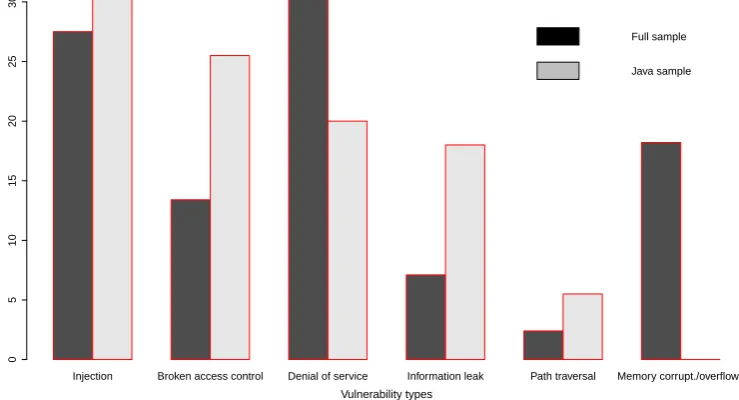
Figure 4 shows the distributions of vulnerability types from the entire sample of 166 FOSS components (dark bars), and the sample of 55 CVEs for the Java components selected for the evaluation (light bars). Both of these distributions suggest that the prevalent vulnerability types are “Injec-tion” (including “Cross-Site Scripting”, “Cross-Site Request Forgery”, and “Command/Code execution”), “Denial of Service”, and “Broken authentication/access control”. The distribution of vulnerability types for 55 Java CVEs did not have the “Memory corruption/overflows” vulnerability type since these are not typical for Java components (and if found, such vulnerabilities are likely to happen due to im-plementation bugs in the Java Virtual Machine rather than the software that runs on it). From these two distributions we conclude that the sample of 55 CVEs that we used for evaluation is representative of the general distribution of vulnerabilities in FOSS components used by our industrial partner.
Figure 7 describes the software infrastructure that we set up for running the proposed vulnerability screening tests.
After the vulnerability fix commit information is extracted,7
the Repository Utilityinvokes the Vulnerability Evidence
Ex-tractor component that extracts the vulnerable code
frag-ment according to a desired screening criterion (described through Sections 5.2–5.4): for instance, our lightweight slicer implementation (Section 6) is an instance of a fix depen-dency screening criterion (Section 5.4), and its purpose is to extract additional lines of code that have direct depen-dencies with the fixed lines of code. Different other imple-mentations for inferring the relevant vulnerable code can be
plugged into theVulnerability Evidence Extractorcomponent
instead, however, the rest of the proposed screening test will
remain the same: the Repository Utilitytracks the evidence
backwards in the software repository and stores it in the database for further analysis.
Existing program analysis frameworks (such as Wala
and Soot8) that support various program analyses can be
also used in place of the Vulnerability Evidence Extractor
component (Figure 7), and provide a refined screening test criterion by helping to cover more programming languages and potentially improving the precision/recall ratio of the test. However, these frameworks do not provide other com-ponents necessary for running the test.
As our main goal was is to identify whether even simple heuristics that consider local data and control dependencies can make a significant difference with respect to the purely syntactic methods described in the literature (for example, by ´Sliwerski et al. [17] and Nguyen et al. [20]), we leave the evaluation of more precise (and more complex) program
analyses in place of theVulnerability Evidence Extractor
com-ponent for the future work.
Fig. 3: Descriptive statistics of 166 FOSS components used by our industrial partner
We collected a sample of 166 FOSS components integrated into different internal projects: the figure on the left illustrates the sample in terms of the size of the cumulative code bases implemented in specific programming languages; the figure on the right shows the number of internal applications into which these components are integrated divided by Java and non-Java components.
(a) Relative size of cumulative code bases for different languages
Java ( 40%)
C++ ( 30%)
PHP ( 13%) C ( 10%)
JavaScript ( 5%) Other ( 2%)
(b) Internal projects relying on a component
0
50
100
150
200
250
300
#Inter
nal projects
[image:11.595.114.484.366.566.2]Java non−Java
Fig. 4: Distributions of vulnerability types
We compare the distributions of vulnerability types from the sample of 166 FOSS components used by our industrial partner and the subset of 55 Java CVEs that we used for evaluation. Both distributions suggest that the most prevalent type of vulnerabilities are “Injection”, “Denial of service” and “Broken access control” (Java distribution did not contain “Memory corruption/overflow” vulnerabilities).
Injection Broken access control Denial of service Information leak Path traversal Memory corrupt./overflows Vulnerability types
P
ercentage
0
5
10
15
20
25
30
Full sample
Java sample
During our study in [13], we also had informal inter-views with software developers and maintenance experts of our industrial partner in order to better understand how the maintenance decisions about vulnerable FOSS compo-nents are typically made. As a result, we understood that such decisions are usually taken on ad-hoc, component-by-component basis: a component may be forked due to porting or changes to a subset of features; custom fixes for security bugs can be implemented and other technical modifications can be performed, if necessary [43], [44], [45].
Thus, the unlikely but not rare decision to down-port
a security fix9 that a software vendor that relies on FOSS
components has to make may happen due to a combination of reasons:
1) The community that maintains the component may likely not provide the solution for the specific security
problem with an outdated version;10
2) The newer version of a FOSS component that provides the fix is largely incompatible with the coding of the
9. An example of forking and long-term maintenance is SAP’s decision to provide its own Java Virtual Machine for several years “because of end of support for the partner JDK 1.4.2 solu-tions”. See http://docplayer.net/22056023-Sap-jvm-4-as-replacement-for-partner-jdks-1-4-2.html.
TABLE 2: The sample of FOSS projects used in this paper
The FOSS components from our evaluation sample have been actively developed over several years (e.g., the commit speed is between 742 and 2551 commits per year). For each component, we also specify the total number of CVEs reported in the NVD, and the number of CVEs that we analyzed.
Project Total commits
Age (years)
Avg. commits (per year)
Total contributors
Current size (KLoC)
Total CVEs
Processed CVEs
µfiles touched
per fix
Apache Tomcat (v6-9)
15730 10.0 1784 30 883 65 22 1.5
Apache ActiveMQ
9264 10.3 896 96 1151 15 3 1.5
Apache Camel 22815 9.0 2551 398 959 7 3 1.0
Apache Cxf 11965 8.0 1500 107 657 16 10 2.0
Spring Framework
12558 7.6 1646 416 997 8 5 1.6
Jenkins 23531 7.4 2493 1665 505 56 9 1.9
Apache Derby 7940 10.7 742 36 689 4 3 2.7
application that consumes it, thus there is significant effort involved in migrating the application;
3) The internal changes of the library are of limited con-cern for the developers of the consuming application unless the functionality has been changed – the latter change is often being captured by a change in the APIs (See [5], [46] for a discussion);
Considering the above, we understood that a simple metric for change, the number of changed API of a com-ponent, is considered to be more interesting by developers as their focus is to use the FOSS component as a (black box) library.
Therefore, to provide also an indication for the de-mographics of the “number of API changes” (shown on
Figure 6) we include the Change Extractorcomponent from
Figure 7 for calculating the changes in the APIs for each commit in comparison to the fix:
1) For each commit, we identify all Java files; for each Java file, we count and sum the number of public methods; 2) Then, we take the difference between the current
com-mit and the comcom-mit of the fix (difference in method signatures) and count the number of public methods that are not present in the fix, or could have been changed.
3) We record the number of changed methods in the current commit with respect to the fix using the above two numbers.
After the vulnerability data is processed and all evi-dences are extracted, they are aggregated and stored in a CSV file or a SQLite database which can be used for further analysis.
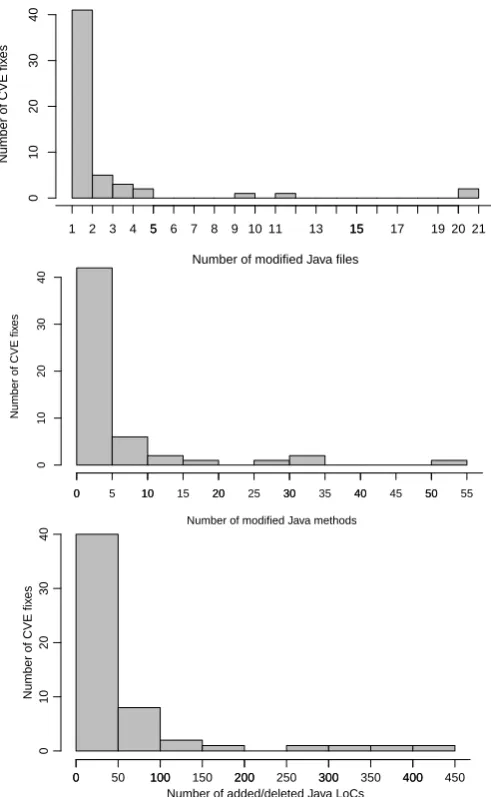
Figure 5 provides an intuition about the size of the changes made when fixing the CVEs from our sample. It combines the following three histograms: (1) the number of
modified files;11 (2) the number of modified Java methods;
(3) the number of distinct added/deleted lines of code. In the majority of cases (51 out of 55), at most 5 files were modified, while in 29 cases it was only 1 file. Additionally, in 40 cases the number of added/deleted lines of code was at most 50. This gives us an intuition that the majority of fixes were rather “local” and not spanning across multiple
11. Here we count only Java files, excluding unit tests.
files, methods, and commits (which would possibly require a more complex evidence extraction mechanism).
Number of modified Java files
Number of CVE fix
es
5 10 15 20
0
10
20
30
40
1 2 3 4 5 6 7 8 9 11 13 15 17 19 21
Number of modified Java methods
Number of CVE fix
es
0 10 20 30 40 50
0
10
20
30
40
0 5 10 15 20 25 30 35 40 45 50 55
Number of added/deleted Java LoCs
Number of CVE fix
es
0 100 200 300 400
0
10
20
30
40
0 50 100 150 200 250 300 350 400 450
[image:12.595.307.553.310.709.2]The three histograms provide an intuition about the amount of changes made when fixing CVEs from our sample. The majority of security fixes from our sample were rather “local”, not spanning across many files, methods, and lines of code.
For 49 out of 55 CVEs a fix was performed with a single commit. For every of those 6 CVEs that were fixed with several commits we used an ad-hoc procedure: for each commit that was a part of the vulnerability fix, we calculated the vulnerability evidence (lines of code) independently, and then merged the sets of lines of code from these separate evidences into a single set; afterwards, we tracked this merged set as a single vulnerability evidence starting from the oldest fix commit (exactly as we did it for vulnerabilities fixed with only a single commit).
FOSS projects
Number of pub
lic J
a
v
a methods changed wr
t. to a fix
ActiveMQ Camel Cxf Derby Jenkins Spring Tomcat
0
2000
4000
6000
8000
10000
12000
14000
[image:13.595.325.531.122.204.2]For every commit in which we tracked the vulnerable coding, we collected the number of public methods that were changed with respect to the public methods in corresponding fixes. The only exception was Jenkins – for this project we measured the number of changed methods in all commits (not only in those in which the vulnerable coding was present), as we found out that the repository history of this project was malformed (see Section 8 for an explanation). This distribution gives an intuition on the amount of such changes within each project.
Fig. 6: API changes statistics per project
8
V
ALIDATIONIn this section we describe the process of the validation
that we performed to answer the part of RQ1 about the
accuracy and performance of the vulnerability screening test, and to assess the overall usefulness of the approach for the problems outlined in Section 2.
The empirical evaluation of the lightweight slicer for finding security features inherent for injection vulnerabili-ties by Thome et al. [26] reports the running time between 50 seconds to 2 minutes on a project that has 28 KLoC on average. Table 3 reports the runtime of our approach over the entire repository: while we cannot directly compare the running time of our implementation of extracting the fix
dependency sphere and the slicer by Thome et al. [26]12, the
running time of our entire approach is comparable, which shows that it is practical.
Next, we review the vulnerabilities in our data set, and analyze their fixes to understand whether the fix depen-dency sphere would possibly capture them. The results of
[image:13.595.41.292.196.399.2]12. As we only extract the relevant code within a set of methods (it takes less than a millisecond), while the slicer by Thome et al. [26] extracts all potentially relevant sources and sinks.
TABLE 3: Runtime performance of fix dependency screening
The vulnerability screening test can provide an approximate evidence (based on actual code) about the presence of the newly discovered vulnerabilities by scanning the entire lifetime of a FOSS project in matter of minutes. Precise (but costly) static analyses can be deployed after that step, in surgical fashion.
Project Analyzed Data Time (in sec) #Commits #MLoCs mean (std) Apache Tomcat 141016 186.331 35 ( 19 ) Apache ActiveMQ 11598 27.904 28 ( 21 ) Apache Camel 8892 4.706 16 ( 7 ) Apace Cxf 53822 28.525 49 ( 33 ) Spring Framework 17520 3.854 44 ( 35 )
Jenkins 8039 9.416 16 ( 10 )
Apache Derby 7588 5.597 17 ( 11 )
this analysis for the conservative fix dependency screening are summarized in Table 4: it lists description of
vulner-ability types (taken from OWASP Top 1013), as well as
description of typical fixes for these vulnerabilities. The “completeness” column describes the dependencies of a fix that will be captured by the fix dependency sphere
D∗(code(r0), F). We claim that for these vulnerability types
and fixesD∗(code(r0), F)includes the fragment of the code
responsible for the vulnerability. Therefore, tracking the
evolution ofD∗(code(r0), F)fromr0and downwards may
be a satisfying indicator for the presence of a vulnerability. For each of selected vulnerabilities, we identified the set of ground truth values as follows:
1) We performed source code audits starting from the last
vulnerable revisionr0, moving backwards through the
repository history.
2) When we observed that any of the files initially modi-fied to fix a vulnerability had some changes in an earlier revision, we manually checked whether the vulnerabil-ity in that revision was still present.
3) We stopped the analysis either on a revision that we find to be not yet vulnerable (this implies that all earlier revisions are not vulnerable as well – we did several spot checks going further past the first non-vulnerable revision an that was indeed the case), or until we reached the initial revision of the repository.
Typically, when we go backwards in the repository history, we arrive at the initial commit that created the
repository – here if we use the diff tool, we will see that
no source code lines were deleted (because nothing existed before that point), but many new files were created (looking at the commit log we can confirm that it is indeed the initial commit). This is what typically should happen.
With Jenkins component, however, there exist two such points: the “true” initial commit where the repository was created, and the commit that deletes all original files (the very next commit adds them again) – it is unclear why
Jenkins developers did that. So if we rely only on thedifftool
to tell whether a certain file was created, our analysis will stop at this “fake” initial commit. We kept Jenkins in the full sample because the “true” and “fake” initial commits are not far away from each other in time, therefore, the analysis that we perform in Section 9 will still be valid. However, we decided to remove Jenkins from the manually checked sample as we wanted the ground truth to be accurate.
The textual description of a vulnerability is taken from public vulnerability databases (e.g., the NVD) and then combined with a search for references to the actual commits fixing that vulnerability – this information can be present in the NVD, the commit logs of the project’s software repository, or in various third-party sources. Once a vulnerability fix commit is obtained, the Repository Utility invokes the Vulnerability Evidence Extractor component that extracts the vulnerable code fragment according to a chosen screening test criterion. Once the vulnerable coding (evidence) is extracted, the Repository Utility tracks the evidence backwards in the software repository and stores it in the database. Please note that the Vulnerability Evidence Extractor component can be replaced by any heuristic or tool for extracting a vulnerable code fragment with different levels of granularity; in this work, to answerRQ1we used only the criteria described throughout Sections 5.2–5.4. Additionally we used the Changes Extractor component (described in Section 7) in order to identify a proxy for the update efforts for different software projects in different points in time.
Fig. 7: Software infrastructure for vulnerability screening
Size of modified methods (LoC) − log scale
Siz
e of vulner
ability e
vidence (LoC) − log scale
100 101 102 103
10
0
10
1
10
2
10
3
Apache ActiveMQ Apache Camel Apache CXF Apache Derby Apache Tomcat Jenkins Spring Framework
Our implementation of fix dependency sphere (see Section 6) could have “saturated” the analysis by including the whole method where the vulnerable code was present. This phenomenon may appear for general bug fixes [21], [47] but it was not present in our projects, as the (vulnerable) security checks and the related fix are normally quite distinct from the code of the method that implements other functionalities.
Fig. 8: Comparing the initial amount of lines of code
ob-tained with conservative fix dependency screening criterion
versus the initial size of the entire fixed method
The final sample for the manual assessment consisted of 126 data points across the total of 126193 revisions that correspond to the histories of 21 CVEs (randomly selected across the projects shown in Table 2): we went backwards it-eratively, and for many revisions the vulnerability evidence did not change. Therefore, we had to check only those points where it did actually change. In order to make sure that the sample size for the manual assessment was sufficient, we also approximated the potential error margin for the sample using Agresti–Coull confidence interval (see Section 8).
The manual assessment was carried out by three experts. At first, the experts had performed the assessment indepen-dently, and then compared their results and cross-checked them. The Kappa statistic for the inter-rater agreement
between the experts has reached0.87(the experts did not
reach perfect agreement for only 2 CVEs), which indicates that the agreement level was more than adequate.
In this way, we manually annotated every revision from
r0 and backwards with ground truth values, and obtained
theground truthbinary classifier:
T estgt(ri) =
(
1 ifriis still vulnerable
0 otherwise
Then, we ran every variant of the vulnerability screening test described in Section 5, and compared the results with
the ground truth classifier. For every revisionri< r0(where
i <0), this comparison had the following result:
1) True positive: a revision was correctly classified as
vul-nerable (e.g., a test marks the revision as vulnerable,
and we identified that it is indeed vulnerable with our ground truth analysis);
2) False positive: a revision was incorrectly classified as
vulnerable(type I error of a classifier);
3) True negative:a revision was correctly classified as
non-vulnerable;
4) False negative: a revision was incorrectly classified as
non-vulnerable(type II error of a classifier).
As a part of the answer to RQ1, we wanted to
[image:14.595.42.293.349.541.2]