A COMPARISON BETWEEN EFFECTS OF SPECIFIC
BALANCE TRAINING PROGRAMME AND GENERAL
BALANCE AND MOBILITY EXERCISE PROGRAMME FOR
IMPROVING BALANCE IN ELDERLY POPULATION
By
(Reg. No . 27101809)
PADMAVATH COLLEGE OF PHYSIOTHERAPY
PERIYANAHALLIA COMPARISON BETWEEN EFFECTS OF SPECIFIC
BALANCE TRAINING PROGRAMME AND GENERAL
BALANCE AND MOBILITY EXERCISE PROGRAMME FOR
IMPROVING BALANCE IN ELDERLY POPULATION
By
(Reg. No . 27101809)
Under the guidance of
Mr. G. ANANDAN , M.P.T. , MIAP., Associate Professor,
Padmavathi College of Physiotherapy
Submitted in Partial fulfillment of the requirements for the Degree of Master of Physiotherapy
From
The Tamilnadu Dr. M.G.R. Medical University, Chennai
PADMAVATH COLLEGE OF PHYSIOTHERAPY
PERIYANAHALLICERTIFICATE
This is to certify that the project entitled “A COMPARISON
BETWEEN EFFECTS OF SPECIFIC BALANCE TRAINING
PROGRAMME AND GENERAL BALANCE AND MOBILITY
EXERCISE PROGRAMME FOR IMPROVING BALANCE IN
ELDERLY POPULATION ”
Submitted by the candidate
(Reg. No . 27101809)
is a bonafide work done in partial fulfillment of the requirements for the Degree of Master of Physiotherapy from
The Tamilnadu Dr. M.G.R. Medical University, Chennai
Guide Principal
Viva-voce Examination held on ________________
DECLARATION
I hereby declare and present my dissertation entitled “A
COMPARISON BETWEEN EFFECTS OF SPECIFIC
BALANCE TRAINING PROGRAMME AND GENERAL
BALANCE AND MOBILITY EXERCISE PROGRAMME
FOR IMPROVING BALANCE IN ELDERLY
POPULATION””
the outcome of the original research work
undertaken and carried out be me , under the guidance of
Mr. G. ANANDAN , M.P.T. , MIAP.,Associate Professor , Padmavathi
College of Physiotherapy, Periyanahalli, Dharmapuri , Tamilnadu.
I also declare that the material of this dissertation had not
formed in any basis for the award of any other Degree previously
from the Tamilnadu Dr. M.G.R. Medical University, Chennai.
ACKNOWLEDGEMENT
First and foremost I thank LORD ALMIGHTY for
showering the blessings who always been my source of strength
and guided me in all endeavors leading to the completion of this
project.
My heartful gratitude to the Honorable Chairman
Mr.M.G.SEKAR,B.A.B.L. Padmavathi College of Physiotherapy,
Periyanahalli, for providing me the valuable opportunity for doing
my Bachelor Degree in Physiotherapy.
My sincere and devoted thanks to my project guide
Mr. G. ANANDAN , M.P.T. , MIAP.,
Associate Professor for
Padmavathi College of Physiotherapy , for his inspiration and
guidance throughout this thesis.
I wish to express my sincere thanks to Mr. K.KUMAR,
M.P.T.,M.I.A.P., Principal, Padmavathi College of Physiotherapy,
for his valuable advice , suggestions and encouragements in
making this project a successful one.
I express my special thanks to all of my FRIENDS
for
sharing their knowledge and support each and every step of this
thesis work.
I take this golden opportunity to thank each and every patient
who took part in this study, for his or her kind cooperation and
needed information
DEDICATED TO MY BELOVED
PARENTS , STAFFS
AND
TABLE OF CONTENTS
CHAPTERS Page No
I. INTRODUCTION
1. Introduction 1
II. REVIEW OF LITERATURE
1. Review of Literature 6
III. DESIGN AND METHODOLOGY
1. Research Design 20
IV. OBSERVATION & ANALYSIS
1. Observation & Analysis 24 V. RESULTS
1. Results 25
2. Discussion 40
VI. CONCLUSION
1. Conclusion 43
REFERENCES 44
APPENDICES
Appendix –A 48
Appendix – B 52
Appendix – C 54
Appendix – D 67
1
I. INTRODUCTION
Biological functions decline with age. Deterioration of balance is a well documented hallmark of the ageing process. Poor balance is initially detectable in the sixth decade of life but then accelerates so that it becomes the rule rather than the exception by one's late eighties. Balance disturbances frequently cause elderly people to seek medical advice and admission to hospitals and residential homes. Impaired balance has been correlated with an increased risk for falls and a resulting increase in the mortality rate of elder people. Approximately 35% to 40% of generally healthy, community-dwelling persons aged 65 or older fall annually. Regardless or severity of the injury, sequel from even a benign fall can be devastating. A single fall often results in a fear or falling, which leads to a loss of confidence in one's ability to perform routine tasks, restriction in activities, social isolation, and increased dependence on others. The ensuing deconditioning, joint stiffness, and muscle weakness that result from immobility can lead to more falls and further mobility restriction.
Identification of significant risk factors is an important step towards fall prevention. Several studies have been performed among both home- living and institutionalised populations to define risk factors associated with falls. These risk factors have included both patient-related or "intrinsic factors" (e.g. advanced age, specific diseases, muscle weakness, gait disorders, mental status alterations, medications) and environment- related or "extrinsic" factors (e.g
hazardous activities, time of day, environmental hazards) A number of reviews have described balance performance as a highly complex
2
with mixed success. Several fall prevention strategies have shown effectiveness in preventing falls and decreasing the risk of falling, although less is known about their effectiveness in preventing fall-related injuries. Exercise has been a key feature in reducing the risk for falls.
About 10%-25% of falls are associated with poor balance and gait abnormalities. Thus, balance training interventions have an important place in fall prevention. Literature on geriatric balance training is a merely of non-specific interventions characterized by conventional callisthenic (coordination) exercises, which often include aerobic or muscle-strengthening components. Many of these interventions have focused too heavily on simple maneuvers that are easier to quantify but that may not address adequately the varied needs of different individuals. Programs that are successful at improving balance took a more intensive approach to training.
However, because many different types of exercise programs were studied, it was impossible to determine which type was most effective.
Keeping this in mind this study was designed with the purpose of identifying the most appropriate balance training program for community dwelling elders with active lifestyle.
3
These scales have been selected for the study because:
1. They are very simple to administer.
2. They are quick and practical.
3. They are easy to be conducted in an Indian clinical setting.
4. The contents of these scales closely mimic the day activities and are easy for the patient to understand.
Statement of Question
Is a Specific Balance Training program better than a General Balance and Mobility exercise program for improvement of balance in community dwelling elderly population.
Research Hypothesis
Specific Balance-Strategy Training program is more effective in improving balance in elderly population as compared to the General Balance and Mobility exercise program.
Operational Definitions
Balance
4
an upright posture. It is the ability to control the center of gravity (COG) over the base of support in a given sensory environment.
Fall
A fall is defined as a sudden unintentional change in position, with or without loss of consciousness, causing the victim to land on the ground.
Timed Up And Go Test
Podsiadlo and Richardson (1990), modified the original Up and Go test, by timing the task of getting up from the chair, walking a distance of 3m, turning around and walking back to the chair. They proposed its use as a short test of basic mobility skills for frail community-dwelling elderly.
Berg Balance Scale
`The Berg Balance Scale is an easy to administer, safe, and simple and reasonably brief measure of balance for elderly people developed as a performance-oriented measure of balance in elderly individuals.
Balance Training Intervention
It is a set of exercise or training maneuvers that are administered to improve balance in the elderly. They are simple to administer and affordable as well as effective.
Limitation of the Study
5
Organization of Remaining Chapters
6
II. REVIEW OF LITERATURE
This chapter deals with the view of the literature associated with postural control and its changes in the elderly, falls, risk factors and methods identifying falls. It also talks about the various strategies to prevent falls and improve balance.
Postural Control
Postural control requires keeping the center of gravity over the base of support during both static and dynamic situations. The body must be able to respond to translations of the center of gravity voluntarily imposed e.g. intentional movement, and an involuntarily or unexpectedly imposed movement e.g. slip, trip.
7
Central processing is the second major physiological component of balance control. Horak and Nashner's systems approach to balance control proposes that the central nervous system maps the location of the center of gravity and adaptively organizes its response to disequilibrium by preprogramming postural sensorimotor strategies. The preprogrammed strategies are based on the body's biomechanical constraints, available sensory information, the environmental context, and prior experience.
The effector component of balance constitutes the biomechanical apparatus through which the centrally programmed response must be expressed. Factors such as range of motion, muscle torque and power, postural alignment, and endurance can all affect the capacity for a person to effectively respond to a disturbance of balance Studenski et al and Whipple and colleagues determined that elderly fallers produce significantly weaker distal lower extremity torque than healthy older adults.
Effects of Ageing on the Substrates of Postural Control
8
inelasticity of the surrounding dermal tissue, and peripheral nerve degeneration may all contribute to the decrease in cutaneous sensitivity.
Specific age related changes in the central nervous system such as loss of neurons and depletion of neurotransmitters, such as dopamine, and involutionary changes in the dendrite tree of motor neurons in the spinal cord disrupt the complex postural responses as well as educe the ability to compensate for age - related impairments in sensory input In addition, a general slowing of information processing, in conjunction with age-related decrease in nerve conduction velocity, would be expected to delay and further disrupt the generation of postural responses.
9
Falls in elderly
Everybody falls. Regardless of age, falling is a ubiquitous event experienced by all throughout life. Most falls, especially in children and young adults, are of minor consequence, are readily forgotten, and have no impact on subsequent function. Falls in the elderly, by contrast, are a major cause of morbidity and mortality.
A fall may result when the body's postural control systems fail to detect a displacement and do not reposition the center of mass over the base of support in time to avoid a "loss of balance".
In persons older than 85, approximately two thirds of injury related deaths are due to falls. It is estimated that 30% of community dwelling elders older than 65, 40% of those older than 80 years, and 66% of institutionalised elders fall each year. There is a greater-than-linear increase in the rate of falls between the ages of 60 to 65 and 80 to 85.
A fall often results in a fear of falling, which creates a loss of confidence restriction in activities, social isolation, and increased dependence on others. The ensuing deconditioning, joint stiffness, and muscle weakness that result from immobility can lead to more falls and further mobility restriction.
Risk Factors for Falls
10
Altered drug metabolism in elderly individuals and improper doses of psychoactive medications such as antidepressents, tranquilizers, sedatives, hypnotics and psychotropic drugs may contribute to falls in elderly by decreasing alertness, depressing psychomotor function, fatigue, etc. However, a few studies do not support this. Lipsitz in his study found that although neuroleptic use was more common among fallers, but it was not statistically significantly different than non-fallers. Various Vasodilators, NSAIDS, Diuretics, Antihypertensives and Cardio protective medications also act as potentially significant risk factors for falls. Some of the factors, such as sedative use and cognitive impairment, although low in prevalence, were associated with a very high risk of falling.
Impaired ambulation, impaired stepping and mobility and the use of assistive devices all act as significant risk factors associated with falls in the elderly. Tinette believed that balance problems such as unsteadiness in sitting down, standing on one leg unsupported, turning and unsteadiness after a gentle push on the sternum inability to pick up walking pace pose toe potential predisposing factors for falls. Poor general health indicating previous history of fall or injurious fall have strong evidence of being a significant risk factor prediction falls.
11
factors. Weak muscles and unstable or painful joints with reduced range may be a source of postural disturbances during voluntary movement. Decreased ankle dorsiflexion and plantarflexion was identified as a potential risk factor for falls by Studenski(1991).
Age related slowing in the neurological functioning such as slowing of the reaction time, impaired knee or plantar reflexes make the elderly more prone to falls. Inability to compensate for sensory modalities increases with age and contributes to balance failure in the elderly. The elderly group also shows impaired lower extremity sensory function.
Visual deficits are considered to be important determinants of the risk of falls in the elderly. In the prospective study of falls by Tinetti annd colleagues, elderly persons with a impaired vision had a 1.7 fold increased risk of fall compared with little or no near vision imairment, and those with impaired distance vision had a 1.4 fold increased risk of a fall. Nevitt and colleagues similarly found a deficit in distance visual acuity to be associated with a 1.5 fold increased risk of recurrent falls during a 1 year follow-up. Other visual defects such as impaired dark adaptation, double vision, errors in depth perception, cateracts and glaucoma may also contribute to falls in the elderly cohort.
12
Many falls in the elderly are attributed, at least in part, to environmental factors such as stairs, curbs or clutter. According to Nevitt et al, features of the home that make activities of daily living more difficult are poor lighting, inaccessible storage space, low seats and chairs are potentially important risk factors for falls. Environmental factors are implicated by self report as contributing to one third to one half of falls in community dwelling subjects.
Methods of Identify Falls
Evaluation of balance, particularly standing balance is a major part of routine neurological or medical assessment. It helps to understand how the postural control system works, aids clinical diagnosis and assessment of treatment efficacy. Lastly it can be used to identify elderly people with a history of falls and areas where they are at a risk of falling.
The earliest scientific study of human balance were conducted in 1853 by Romberg who assessed diseases of the Central Nervous System by the amount of sway when the subjects stood with eyes closed.
For a very long time the postural sway measurement was used to assess balance. They focused on abnormalities in postural sway as an indicator of balance disorders and then later progressed to more complex testing of responses under various conditions.
13
Balance Scale, Get Up and Go Test, and The Timed Up and Go Test are few well-known clinical measures of balance. Other two important functionally oriented balance assessment measures are Tinetti Balance Test of the Performance - Oriented Assessment of Mobility Problems and the Functional Reach Test. The Functional Reach Test(FRT) is a dynamic measure of stability during a self-initiated movement.
Katherine O' Berg et al compared clinical balance scales like Berg Balance Scale, Tinetti Balance Test of the Performance- Oriented Assessment of Mobility Problems and the Timed Up and Go Test with laboratory measurements of Balance. She found that clinical functional balance measures were superior to laboratory measures, when measuring basic functional activities rather than measuring the postural sway, because they were more predictive in the functional aspects of the subject.
The Timed Up and Go Test Description and purpose
14
group of mainly community -dwelling older adults without cognitive impairments (n=844, age range of total sample [N=2,305]=69-104 years was moderate (ICC[mode not stated]=56).
Construct validity has been supported through correlation of TUG scores with measurements obtained for gait speed (Pearson r=.75,n=40), postural sway (Pearson r=48,n=40), step length (Pearson r=-.74,n=40), barthel index (Pearson r=-.79,n=40), functional stair test (Pearson r=.59,n=20), and step frequency (Pearson r=-.59,n=40). For identifying falls, the TUGT was found to have a sensitivity and specificity of 87%. Ranges of TUGT scores have been reported for various sample of elderly people. In a study by Podsiadlo and Richardson (1991), 10 men and women without known pathology, aged 70-84 years (X= 75 years, S.D not specified), had a mean TUG score of 8.5 seconds (S.D not specified, range=7-10). In a study conducted by Steffen et al , in different age and gender groupings in community dwelling elders showed a mean score of 8 sec (N[males]=15,N[females]=22, S.D.=2), in both males and females of 60-69 age group. In the age group of 70-79, the mean score was 9 sec (N[males]=14,S.D.=3, N[females]=22,S.D.=2) and in age group of 79-80 it was 10 sec (N=8, S.D.=1) in males and 11-sec in females (N=15,S.D.=3).
Berg Balance Scale(BBS) Description and purpose
15
provided operational definitions for each task and the criteria to be representative of daily activities that require balance. They include simple mobility tasks (e.g. tandem standing, turning 360 degree, single leg stance). Some tasks are rated according to the quality of the performance of the task, where as the time taken to complete the task is measured for other tasks.
Reliability, Validity and Reference Data Studies of various elderly population (N=31-101, 60-90+ years of age) have shown high intrarater and interrater reliability (ICC[model not stated]=.98), ratio of variability among subjects to total =.96-1.0, r=.88. Test-retest reliability in 22 people with hemiparesis was also high(ICC[2,1]=.98).
Content validity of the BBS was established in a 3-phase development process involving 32health care professionals who were experts working in geriatrics settings. Criterion-related validity has been supported by moderate to high correlations between BBS scores and other functional measurements in a variety of older adults with disability: Barthel index (Pearson r=.67,n=31), Fugl-Meyer Test motor and balance subscales (Pearson r=.62-.94,n=60), Timed Up and Go Test (TUG) scores (Pearson r=.76,n=31), Tinetti balance subscale (Pearson r=.91,n=31) and the Emory functional Ambulation profile (Pearson r=-.60,n=28)
16
In a study of inner-city-dwelling older adults, Newton found a mode score of 53 (range= 29-56) on the BBS for 251 subjects aged 60-95 years (Mean=74.3, S.D.=7.9). Increasing age has not been shown to correlate with decreasing BBS scores.
Strategies to Prevent Fall
Researchers have shown that among intrinsic factors, impaired stance balance and mobility greatly increase the probability for falls, fractures, and functional dependency among the older adults. It has been estimated that between 10%and 25% of all falls are associated with poor balance and gait abnormalities. Despite the apparent relationship between impaired balance and increased likelihood for falls among the elderly individuals, studies examining the effects of exercise on improving balance and decreasing risk of falls in this population have mixed results. One possible reason for this inconsistency is the variation in exercise programs utilized in their studies.
Several investigators have examined the effect of a single form of exercise on balance in older adults, with mixed results. Lichtenstein et al reported an improvement in balance following high intensity strength training in older adults. Roberts found that a 6-week program of aerobic walking improved balance among older adults, but changes in falls were ot reported. Brown and Holloszy reported three months of strength and flexibility training. Judge et al found no relationship between balance and resistive training. Hu and Woollacott reported that exercises focusing on improving the organization of sensory information underlying balance control resulted in a decrease in stance postural sway in older adults. Other trials have used a general exercise program aimed at seniors, which may not have been sufficiently specific to be effective.
17
Single-intervention strategies that have proved effective among elderly persons deemed at risk for falling, either because of the presence of a known risk factor or because of a history of falls, include professionally supervised balance and gait training and muscle strengthening exercise; gradual discontinuation of psychotropic medications; and modifications of hazards in the home after hospital discharge. Cambell et al concluded in their study that tapering and discontinuation of psychotropic medications, including benzodiapines, other sleep medications, neuroleptic agents, and antidepressants, over a 14-week period were associated with a 39%reduction in the rate of falling.
Crilly et al found no improvement in postural sway in 50 older women following a 12-week program of balance retraining. Tinetti et al found a 31% reduction in the rate of fall among community dwelling older adults who participated in a multifocus intervention project that included the use of exercises to improve balance and ability to transfer safety. In the targeted risk factor approach, interventions applied and protocols selected varied somewhat for each individual intervention participant. These interventions included home-based gait, balance, and strength training exercises supervised by a physiotherapist; a medication review by the study nurse, who discussed possible changes with subjects and their physician; transfer-skills training; and home environmental medications.
18
strength or endurance training. Province et al, thus concluded that some form of balance retraining appears to be the most effective type of exercise for reducing fall risk. Means et al during there study in 1996 examined the effect of a general balance and mobility exercise program in a pilot study on a65 volunteers. In the year 2005, they carried out a study with 338 subjects which showed the effectiveness of the general balance and mobility exercise program. The program included active stretching, postural control, endurance walking and repetitive muscle coordination exercises starting with a relatively low level of exercise intensity (frequency and repetitions) of the individual exercises and was progressive. Participants were allowed some individual flexibility to progress at a comfortable pace.
Specificity of training is important not only to athletes but also to older people. When exercise mimics functional moves, consistent improvements are seen in most of the functional tasks assessed before and after training. Nitz and Choy(2004) in their study determined the effectiveness of specific balance strategy training programme for preventing falls among older people. They believed that no previous study had investigated the efficacy of a specific balance strategy practice, sensory integration, and added attention demands during function and multi-task practice. Each station task is graded to cater to various levels of ability so that participants can have the level of difficulty progressed to increase the challenge. All participants of the specific balance strategy-training programme significantly reduced the number of falls and functional measures. Thus, concluding that specific balance strategy training using workstation is superior to traditional exercise class for improving function and balance.
19
III. DESIGN AND METHODOLOGY
This chapter deals with the methods used for this study. These include information on the subjects, instrumentation used and the interventions given. Sample
A sample of convenience of 70 older adults took part in this study. The subjects were collected through a Geriatric camp organized at Padmavathy College Of Physiotherapy, Periannahalli, Dharmapuri and neighbour hood of the campus also volunteered for the study. Subjects who fulfilled the inclusion criteria and were ready to attend the exercise program regularly were selected.
Inclusion Criteria
1. Age above 65 years
2. Elderly who are community dwellers and not institutionalized or hospitalized.
3. Mini-mental status examination (MMSE) scores above 24. 4. No history of orthopedic surgery.
5. Not dependent on the assistance of another person.
Exclusion Criteria
1. An acute illness that may interfere in the participation for the study. 2. Unstable cardiac condition.
3. No other orthopedic or neurological illness. 4. Permanent history of dizziness.
20
Research Design
A comparative study design was used in this study. Instrumentation
1. Chair of 46cm of seating height. 2. Plinths and exercise mats. 3. Standard measuring tape 4. Markers
5. Weighing machine 6. Stopwatch
7. Wooden blocks of various heights
8. Chairs of different heights with and without armrests. 9. Cup and saucer
10. Balls of various size and weight. 11. Foam
12. Shelves of various heights. 13. Mirror
14. Weights (0.5,1,2kg) 15. Bed sheets
Protocol
21
initial balance scores, the specific intervention programme was applied for each group for a period of four weeks with five sessions per week. Each session lased for 25-30 minutes. The same subjects were assessed on the above mentioned balance scales after 4 weeks of training.
Procedure
The subjects were invited to participate in the study. A detailed explanation of the procedure was given after which the subjects signed an informed consent the subjects were assessed on the two balance scales: The Timed up and Go (TUGT)-Appendix C(2) and the Berg Balance Scale (BBS) Appendix C(3). Subjects of Group 1 received the General Balance and mobility exercise program (Appendix D-1) which consists of active stretching and strengthening of the lower limb muscles, postural control exercises, endurance walking and repetitive muscle coordination exercises. This programme initially started with a low level of intensity (low frequency and repetitions) of individual exercises and was progressive over the weeks. The resistance applied, rest period, etc was adjusted individually so that participants could exercise at a subjectively moderate intensity.
22
Timed up and Go Test (Appendis C-2)
The Timed up and go test measures the time it takes a subject to stand up from an arm chair, walk a distance of 3m, turn, walk back to the chair and sit down.
A chair of 46cm of seat height was used for the study. A 3m distance was marked off on the floor in front of the chair. A large board was placed on the mark at the end of the 3m. The test began with each subject sitting, back against the chair, arms resting on the lap and feet just behind the distance-marker on the floor. The subject is allowed to wear his shoes and use his usual walking aid, if any. The subject was instructed that on the word ‘go, he should stand up, walk comfortably and safely the board on the floor, walk around the board, come back and sit in the chair. They were informed that the trial would be timed. Timing began with the word ‘go’ and ended when the subject’s back rested against the chair upon returning. A practice trial was performed for all subjects before the recording of scores. This was to make the subject familiar with the procedure. Average of three trials was done and used for data analysis.
Berg Balance Scale (Appendis C-3)
23
24
IV
.OBSERVATION & ANALYSIS
Statistics were performed using SPSS software.
25
[image:33.612.154.498.139.357.2]V. RESULTS
26
27
28
29
30
31
32
33
34
This chapter deals with the results of the data analysis of the two intervention group scores on the two balance measures.
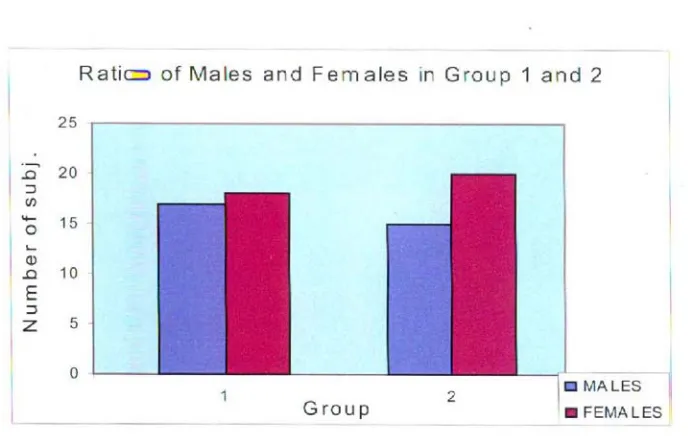
The group receiving General Balance and mobility exercise program (Group 1) consisted of 17 males and 18 females with a mean age of 69.24 ± 4.30 years while the Group 2 receiving Specific balance – strategy training programme consisted of 15 males and 20 females with a mean age of 69.89 ± 4.23 years. Both the groups were matched in terms of age, height and weight.
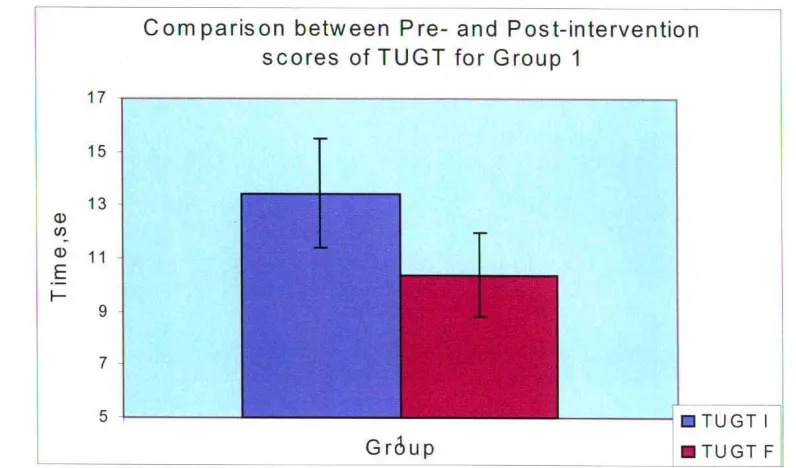
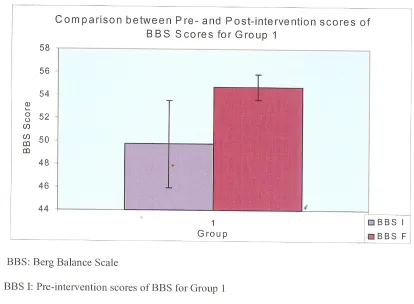
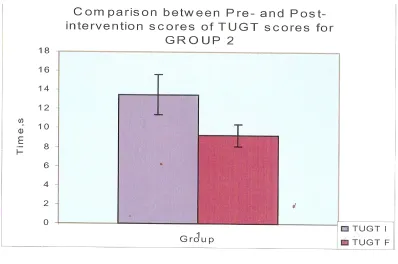
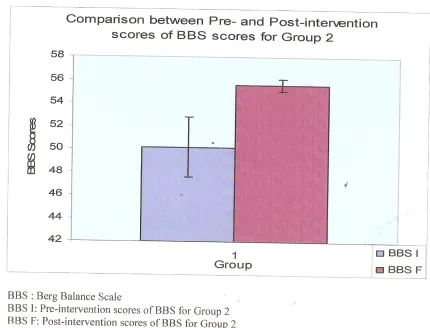
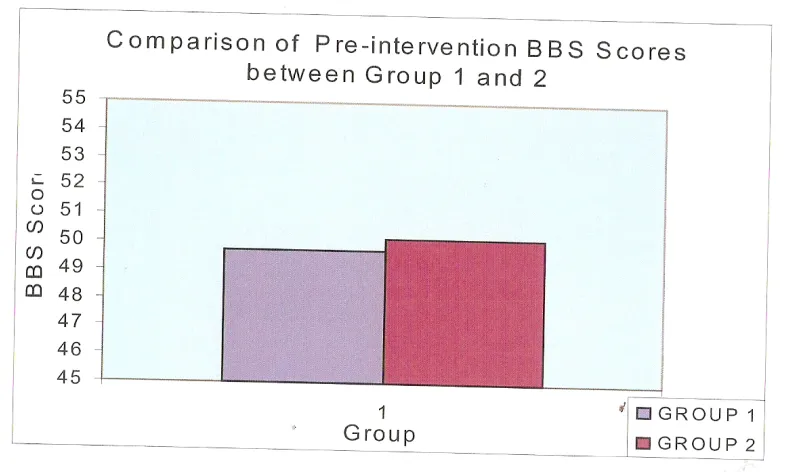
A student’s t-test was used to compare the performance of subjects of group 1 and 2 on Timed up and go test (TUGT) and Berg balance scale (BBS) prior to the intervention program. The analysis of Pre-intervention scores of TUGT between group 1 (X=13.45, S.D. = 2.04) and group 2 (X=13.51, S.D. = 2.09) did not show any significant difference ( t-value = 0.12, p = 0.909) indicating that both groups were matched in terms of TUGT scores. The BBS scores also showed no significant differences between both the groups ( Group 1 : X=49.74, S.D. = 3.78, Group x : X = 50.17, S.D. = 2.62) with t-value=0.55 and p=0.583.
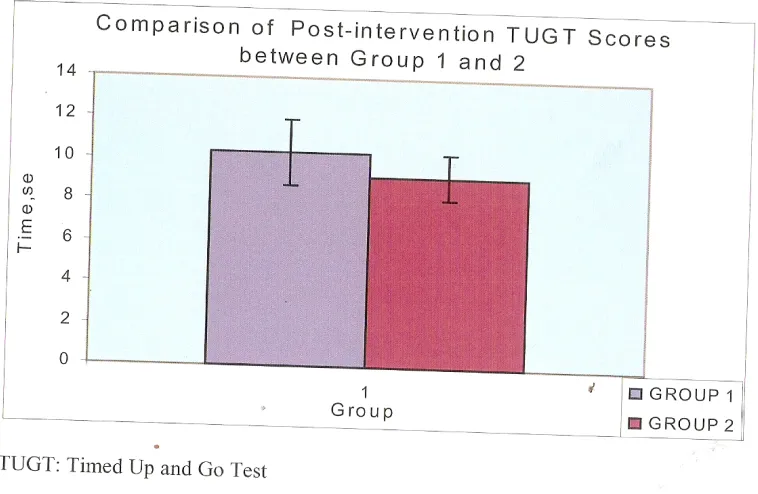
The comparison of Post-intervention scores TUGT between group 1 (X=10.38, S.D. = 1.59) and group 2 (X=9.27, S.D. = 1.13) revealed a significant difference with a t-value of 3.35 and p = .001 Subjects in group 2 showed significantly better results on TUGT. This was also seen for BBS scores (Group 1 : X = 54.69, S.D=1.13, Group 2: X = 50.17, S.D. = 2.62) with t-value = 0.55 and p = 0.583.
35
difference with a t-value of 3.35 and p=.001 Subjects in group 2 showed significantly better results on TUGT.
36
Table 1 : Demographic Data : Comparison between Group 1 and 2 (t-test)
Background information
Group 1 Group 2 t-value
Number of participants
35 35
Age, Yr 69.34 ± 4.30 69.89 ± 4.23 0.53N.S.
Height, cm 159.73 ± 9.33 159.49 ± 7.60 0.12 N.S.
Weight, kg 66.69 ± 6.99 66.29 ± 8.40 0.22 N.S.
Sex M = 17
F = 18
M = 15
F = 20
37
Table 2 : Comparison of Timed up and go (TUGT) and Berg balance scale (BBS) pre-intervention scores between group 1 and 2 (t-test)
Balance Scale Pre –
intervention Scores group 1 (N=35)
(Mean ± S.D)
Pre-intervention
Scores group 2
(N=35)
(Mean ± S.D)
t-value
Timed up and go test
(TUGT) 13.45 ± 2.04 13.51 ± 2.09 0.12
N.S.
Berg balance scale
(BBS) 49.74 ± 3.78 50.17 ± 2.62 0.55
38
Table 3 : Comparison of Timed up and go (TUGT) and Berg balance scale (BBS)
post-intervention scores between group 1 and 2 (t-test)
Balance Scale
Post – intervention Scores group 1 (N=35)
(Mean ± S.D)
Pre-intervention
Scores group 2 (N=35)
(Mean ± S.D)
t-value
Timed up and
go test (TUGT)
10.38 ± 1.59 9.27 ± 1.13 3.35**
Berg balance
scale (BBS) 54.69 ± 1.13 55.57 ± 0.56 4.15**
39
Table 4 : Intra-group comparison of TUGT and BBS scores )Paired t-test)
Balance Scale
Pre – intervention scores
(Mean ± S.D)
Post-intervention
Scores
(Mean ± S.D)
t-value
Group 1 :
TUGT 13.45 ± 2.04 10.38 ± 1.60 13.14**
BBS 49.74 ± 3.78 54.69 ± 1.13 10.05**
Group 2 :
TUGT 13.51 ± 2.09 9.27 ± 1.13 17.44**
BBS 50.17 ± 2.62 55.57 ± 0.56 12.90**
40
DISCUSSION
The results obtained reveal that subjects in both the groups: Specific balance -strategy training and the general balance and mobility exercise group benefited from the balance training interventions with a significant improvement in post-intervention Balance scores (Group 1 : p=.000, Group 2: p=.000) as compared to their pre-intervention scores. This can be seen in figures 5.2 to 5.5 and Table 4.
On comparison of Group 1 and Group 2 it was seen that although there was no statistically significant difference between pre-intervention Timed Up and Go Test (TUGT) scores of Group 1 and 2, the post-intervention TUGT scores revealed high level of significance with performance of subjects in Group 2 better than Group 1, Similar results were obtained from Berg Balance scores which showed no statistically significant difference in Pre-intervention scores but the Post-intervention scores showed a highly significant improvement in group 2.
41
could have resulted in more efficient movement in the improved functional ability to balance, ambulate in the environment and at a faster velocity. Support for this view comes from the improved outcomes from a similar multi-dimensional balance training program delivered as an individual intervention(69) rather than small groups.
On the other hand, the general balance and mobility exercises program also showed significant improvements unlike previous studies of general exercise programs aimed at seniors which did not show significant results(78-80).
The improvement shown in group 1 was less than that shown in group 2. A possible explanation could be that movement to the limits of stability was not an integral component nor were walking on different surfaces, turning and other rotational elements.
Clinical Implications
These data suggest that the Specific balance-training strategy is more effective in improving balance in community-dwelling older adults as compared to the general balance and mobility exercise. This helps us to choose a better balance training program in community-dwelling elderly population above 65 years in order to improve balance significantly even in a short time duration. The ultimate effect of this study is to improve balance with the aim of reducing injurious falls in the fall prone elderly population.
Future Research
42
reduction in falls following balance training in either groups. This can be done by maintaining a follow-up for few months to years.
43
CONCLUSION
This study thus concludes that although both General Balance and Mobility Exercise and Specific Balance-Strategy Training programme showed a significantly better improvement in balance as compared to Group 1.
44
REFERENCES
1. Nancy Harada, JoAhn Damron – Rodriguez, “Screening for balance and mobility impairment in elderly individuals living in residential care facilities”, Physical Therapy / Volume 75, Number 6 / June 1995.
2. Kirsten K Ness, James G Gurney, “Screening, Education, and Associated Behavioral Responses to Reduce Risk for falls among people over age 65 years attending a community Health fair”, Physical Therapy, Volume 85, Number 7, July 2003
3. S. Mathias, U.S.I., Nayak, PhD, B. Isaacs, MD, “Balance in elderly patients: the “Get-up and Go” test”, Arch Phys Med Rahabll, Vol 67, June 1986
4. Daniel L. Riddle, Paul W Stratford, “Interpreting Validity Indexes for Diagnostic Tests: An Illustration Using the Berg Balance Test”, Physical Therapy, Volume 79, Number 10, October 1999.
5. Patrick D. Neuls PT, DPT, Tammie L. Clark PT, DPT, “Usefulness of the Berg Balance Scale to Predict Falls in the Elderly”, Journal of Geriatric Physical Therapy, Volume 34, Number 1.
6. Mary E, Tinetti, M.D., Mark Speechley, Ph.D., “Risk Factors for falls among elderly persons living in the community”, The new England journal of medicine, Vol.319, No.26
7. Susan Morris, Meg E Morris, “Reliability of Measurements obtained with the Timed “Up & Go” Test in people with Parkinson disease”, Physical Therapy, Vol.81, Number 2, February 2012.
45
9. Teresa M. Steffen, Timothy A Hacker, Louise Mollinger, “Age-and Gender-Related Test Performance in Community- Dwelling Elderly People: Six-Minute Walk Test, Berg Balance Scale, Timed Up & Go Test, and Gait Speeds”, Physical Therapy, Volume 82, Number 2, February 2002.
10. Susan. L, Whitney, Janet L. Poole, “A Review of Balance Instruments for Older Adults”, September 1998, Volume 52, AGS.
11. Rebecca A. L. Liston, MSc, “Reliability and Validity of Measures Obtained From Stroke Patients Using the Balance Master”, Arch Phys Med Rehabil Vol. 77, May 1996.
12. Jennifer S. Brach, Jessie M. VanSwearingen, “Identifying Early Decline of Physical Function in Community-Dwelling Older Women: Performance – Based and Self-Report Measures”, Phsyical Theraphy, Volume 82, Number 4, April 2002.
13. Alon Rochelled, Joe Domowicz, “Evaluation and treatment of balance in the elderly : A review of the efficacy of the Berg Balance Test and Tai Chi Quan”, Rehabilitation 15 (2000), 49-56
14. Mary E. Tinetti, M.D., Sandra F. Ginter, R.N. “Risk Factors for Falls among elderly persons living in the community”, The New England Journal of Medicine. Vol.319, No.26
15. Patricia A, Hageman, PhD, PT, J. Michael Leibowitz, “Age and Gender Effects on Postural Control Measures”, Arch Phys Med Rehabil, Vol.76, October 1995.
16. Ka therine O. berg, M.Sc., PT, Brian E. Maki, PhD, “Clinical and Laboratory Measures of Postural Balance in an Elderly Population”, Arch Phys Med Rehabil, Vol.76, November 1992.
46
18. Mathias S, Nayak US, Isaacs B, “Balance in elderly patients: the “get-up and go” test”, Arch Phys Med Rehabil, June 1986.
19. Berg K, Wood-Dauphinee S, Williams JI, “Berg Balance Scale, The Chartered Society of Physiotheraphy”
20. PW Overstall, “The use of balance training in elderly people with falls”, Cambridge Journals, Volume-13, Issue 02, 2003
21. Stephen R. Lord, Ph.D, “Vision and Balance”, Geriatric Times, November / December 2003, Vol.IV, Issue 6.
22. Kristinsdottir EK, Fransson PA, “Postural control in elderly subjects”, Acta Otolaryngol, 2001 Sep, 121(6):700-6.
23. Linda D Bogle Thorbahn, “Use of the Berg Balance Test to Predict Falls in Elderly Persons”, Physical Therapy, Vol.76, No.6, June 1996.
24. Neurology Muscular Dystrophy, and Neuropathy Institute, “Loss of Balance”, www.beverlyhillsneuroology.com/loss-of-balance.html.
25. Claire Toulotte, Claudine Fabre, “Effects of physical training on the physical capacity of trail, demented patients with a history of falling: a randomized controlled trial”, Age and Ageing 2003; 32, British Geriatrics Society.
26. Andrea Vertesi, Judith A. Lever, RN, MSC, D. William Molloy MB, FRCPI, “Standardized Mini-Mental State Examination”, Canadian Family Physician, Vol-47, October, 2001.
27. Moraes C, Pinto JA Jr, “Impact of sociodemographic and health variables on mini-mental state examination in a community-based sample of older people”, Eur Arch Psychatry Clin Neurosci, 2010 Oct.
47
29. “Paired t test”, www.statsdirect.com/help/parametric methods/ ptt.htm
30. Sokal and Rohlf, “Paired t test”, Handbook of Biological Statistics.
31. Rosia Shier, 2004 “Paired t test”, Mathematics learning support centre.
32. “Independent T-Test using SPSS”, http://statistics.land.com/spss- tutorials/independent-t-test-using spss.
48
APPENDIX-A
MASTER CHART
GRP SL AGE SEX HEIGHT WEIGHT TUGT
1 TUGT F BBS 1 BBS F
1 1 77 2 152 65 14.25 12.7 50 54
1 2 66 2 162 53 14.82 10.48 48 55
1 3 70 2 148.5 75 12.98 11.75 50 54
1 4 72 2 145 62 14.37 9.49 49 55
1 5 66 2 158 62.5 14.91 11.31 45 54
1 6 65 2 170 73 13.87 12.81 42 53
1 7 67 2 154 58 10.12 8.14 53 56
1 8 71 1 168 51 12.9 9.25 56 56
1 9 65 2 155 70 11.15 7.92 53 56
1 10 65 2 149 58.5 11.47 9.96 54 55
1 11 67 2 146 67 16.36 10.95 45 54
1 12 67 1 157 67 11.32 8.42 54 56
1 13 78 1 168 73 13.03 11.68 48 53
1 14 66 2 150 65 18.12 12.19 49 53
1 15 65 2 149 63 16.97 11.09 49 54
1 16 73 2 145 71 16.91 12.89 45 53
1 17 67 2 151 63 14.93 11.32 45 54
1 18 70 1 165 65 13.24 9.51 54 56
1 19 69 2 157 69 13.22 11.71 50 54
1 20 72 1 165 63 14.55 9.6 49 55
1 21 77 1 169 67.5 14.25 11.53 50 54
1 22 65 2 154 68 12.69 9.69 53 55
49
1 24 68 1 169 81 15.12 10.52 50 55
1 25 67 1 164 55 13.84 10.94 45 54
1 26 65 1 176 75 10.12 8.14 53 56
1 27 65 1 172 76 10.15 7.57 53 56
1 28 65 2 154 63.5 13.87 12.81 42 53
1 29 74 2 148.5 67.5 14.83 10.99 47 54
1 30 79 1 166 67 11.45 9.89 53 56
1 31 77 1 169 64.5 14.25 11.53 50 54
1 32 68 1 174 65 9.85 7.88 50 56
1 33 65 1 167 78 13.87 11.86 45 53
1 34 70 1 167 74 13.24 9.51 54 56
50
GRP SL AGE SEX HEIGHT WEIGHT TUGT
1 TUGT F BBS 1 BBS F
2 1 65 1 165 85 7.75 6.93 53 56
2 2 65 2 150 63.5 12.56 10.23 53 55
2 3 74 2 148 75 17.85 11.9 51 55
2 4 70 1 170 48.5 12.02 8.16 50 56
2 5 69 1 167 68.5 14.16 9.21 49 55
2 6 65 1 169 70 12 7.51 51 55
2 7 72 1 165 75 16.31 9.49 49 56
2 8 70 2 151 56 18.1 10.21 47 54
2 9 65 1 164 70.5 12.75 9.77 55 56
2 10 68 2 149 74 13.28 8.7 51 55
2 11 67 2 157 66.5 12.56 10.41 53 56
2 12 65 2 148 71 12.97 9.36 48 55
2 13 70 1 163 49 12.09 8 50 56
2 14 65 2 152 65 13 10 54 56
2 15 77 1 164 74 13.75 9.21 53 56
2 16 73 2 157 65 13.17 9.58 47 56
2 17 75 1 166 53 10.86 7.69 48 56
2 18 71 1 166 68 10.31 7.94 55 56
2 19 65 2 152 57 14.83 8.22 55 56
2 20 73 1 169 72 13.07 8.73 48 56
2 21 77 2 152 57 15.26 10.64 50 56
2 22 73 1 169 76.5 14.57 9.53 47 55
2 23 65 2 155 65 14.55 10.49 47 55
2 24 72 1 171 73 16.31 9.49 49 56
2 25 69 2 150 59 13.31 8.75 50 55
51
2 27 77 2 149 60 12.72 9.13 53 56
2 28 73 2 155 65 12.84 9.49 46 55
2 29 76 1 169 83 11.65 7.93 48 56
2 30 69 1 168 67 14.15 9.2 49 55
2 31 65 2 158 66 12.99 9.12 48 56
2 32 67 1 161 69 11.57 7.93 48 56
2 33 75 2 155 61 15.36 10.66 49 56
2 34 65 2 156 60 13.88 10.01 53 56
2 35 65 1 165 65 12.97 9.36 48 55
Key Words
TUGT 1 – Pre-intervention Scores of Timed Up and Go Test TUGT F – Post-intervention Scores of Timed Up and Go Test BBS 1 – Pre-intervention Scores of Berg Balance Scale
BBS F – Post-intervention Scores of Berg Balance Scale Sex (1) – Male
Sex (2) – Female
52
APPENDIX - B
CONSENT FORM
Padmavathi College of Physiotherapy, Periannahalli, Dharmapuri. Title of the Study:
Balance and fall prevention in community dwelling elderly persons – A comparison between effects of specific balance training program and general balance and mobility exercise program.
You are invited to participate in a study, which measures the pre intervention balance scores followed by an exercise protocol of 14 weeks in duration. Your participation is required throughout the period of 4 weeks for 5 days a week. At the end, post-intervention balance scores will be measured using the same outcome measures. You have been invited to participate in the study based on the assumption that you fulfill the inclusion criteria and do not have any orthopedic or neurological illness.
Prior to the participation an investigator will take the medical history to determine whether you have had any major disease, which would make you intelligible to participate. You will be assigned a subject number so that your name will not be associated with any of the findings of the study.
53
The work also forms a part of the curriculum for the completion of dissertation in master’s program in neurological physical therapy. If you have any questions about this study, contact : SHEFALI WALIA at ISIC Institute of Rehabilitation Sciences. Your participation in the study in voluntary, and your decision whether or not to participate will not affect you in any way. If you elect to participate in the study, you have the right to withdraw from the study at any time.
Consent:
1. ………voluntarily consent to participate in this study as described above. I have had a chance to ask questions and was answered to my satisfaction.
Subject’s signature
54
APPENDIX - C
ASSESSMENT SCALES
1. Mini-Mental Status Examination
Maximum Score
Score Instructions
Orientation:
What is the (year (season) (date) (day) (month)?
Where are we: (state)
(country) (town) (hospital) (floor)?
5
5
_______
Ask for the date : Then proceed to ask other parts of the question. One point for each correct segment of the question. Ask for the facility then proceed to parts of the question. One point for each correct segment of the question
Registration :
Name three objects (bed, apple, shoe). Ask the patient to repeat them.
3 ___
55
Tention and calculation :
Count backwards by 7s. Start with 100 stop after 5 calculations.
Alternate question : Spell the word “ world ” backwards
5
5
_______
_______
Score the total number correct.
(93, 86, 79, 72, 65)
Score the number of letters in correct order. (dlrow = 5 dlrow = 3)
Recall:
Ask for the three objects used in question 2 to be repeated
3
_______
Score one point for each correct answer (bed, apple, shoe)
Language:
1. Naming: Name this object (watch, pencil)
2. Repetition: Repeat the following “No ifs, ands or buts.”
2
1
_______
56
3. Follow a 3-stage command:
“Take the paper in your right hand, fold it in half, and put it on the floor”
3
_______
_______
Allow one trial only. Score one point for correct answer.
Use a blank sheet of paper Score one point for each part correctly executed.
4. Reading: Read and obey the following : Close your eyes.
5. Write a sentence
6. Copying : Copy this design 1 1 1 _______ _______ _______
Instruction should be printed on a page. Allow patient to read it Score by a correct response.
Provide paper and pencil. Allow patient to wrote any sentence. It must contain a noun, verb, and be sensible
All 10 angles must be present Figures must interest Tremor and rotation are ignored.
57
2. Timed Up and Go
The total time taken by the subject to perform the prescribed task was noted using a stopwatch.
3. Berg Balance Scale
1. Sitting to standing
Instructions: Please stand up, try not to use your hands for support. ( ) 4 able to stand without using hand and stabilizes independently. ( ) 3 able to stand independently using hands.
( ) 2 able to stand using hands after several tries. ( ) 1 needs minimal aid to stand or stabilize ( ) 0 needs moderate or maximal assist to stand
2. Standing unsupported
Instructions: Please stand for 2 minutes without holding ( ) 4 able to stand safely 2 minutes
( ) 3able to stand 2 minutes with supervision ( ) 2able to stand 30 seconds unsupported
( ) 1need several tries to stand unsupported 30 seconds ( ) 0 unable to sand 30 seconds without support
3. Sitting with back unsupported but feet supported on floor or on a stool Instructions: Please sit with arms folded for 2 minutes.
( ) 4 able to sit safely and securely 2 minutes ( ) 3 able to sit 2 minutes with supervision ( ) 2 able to sit 30 seconds
58
4. Standing to sit
Instructions: Please sit down
( ) 4 sits safely with minimal use of hands ( ) 3 controls descent by using hands
( ) 2 uses back of legs against chair to control descent ( ) 1 sits independently, but has uncontrolled descent ( ) 0 needs assistance to sit
5. Transfers
Instructions: Arrange chairs for a pivot transfer. Ask patient to transfer one way toward a seat without armrest and one way toward a seat with arms. You may use two chairs or a bed / mat and a chair.
( ) 4 able to transfer safely with minor use of hands ( ) 3 able to transfer safely with definite need of hands ( ) 2 able to transfer with verbal cuing and / or supervision\ ( ) 1 needs one person to assist
( ) 0 needs two people to assist or supervise to be safe
6. Standing unsupported with eyes closed
Instructions : Please close your eyes and stand still for 10 seconds ( ) 4 able to sand 10 seconds safely
( ) 3 able to stand 10 seconds with supervision ( ) 2 able to stand 3 seconds
( ) 1 unable to keep eyes closed for 3 seconds but stands safely ( ) 0 needs help to keep from falling
7. Standing unsupported with feet together
Instructions : Place your feet together and stand without holding
59
( ) 3 able to place feet together independently and stand with supervision for 1 minute
( ) 2 able to place feet together independently but unable to hold for 30 seconds
( ) 1 needs to help to help assume the position but can stand for 15
seconds, feet together
( ) 0 needs to help to help assume the position and unable to stand for 15 seconds
8. Reaching forward with outstretched arm while standing
Instructions: Lift arm to 90ο. Stretch out your fingers and reach forward as far as you can. (Clinician places rules at the tips of the outstretched fingers-subject should not touch the ruler when reaching.) Distance recorded is from the fingertips with the subject in the most forward position. The subject should use both hands when possible to avoid trunk rotation.
( ) 4 reach forward confidently 20-30 cm (10 inches) ( ) 3 can reach forward safely 12 cm (5 inches) ( ) 2 can reach forward safely 5 cm (2 inches) ( ) 1 reaches forward but needs supervision
( ) 0 loses balance when trying, requires external support
9. Pick up object from the floor from a standing position
Instructions: Pick up the shoe slipper which is placed in front of your feet ( ) 4 able to pick up the slipper safely and easily
60
( ) 2 unable to pick up the slipper, but reaches 2-5 cm (1-2 inches) from thes lipper
and keeps balance independently
( ) 1 unable to pick up and needs supervision while trying
( ) 0 unable to try/needs assistance to keep from losing balance/falling
10. Turning to look behind over your left and right shoulders while standing Instructions:
Turn and look directly behind you over toward the left shoulder. Repeat to the right.
Examiner may pick an object to look at directly behind the subject to encourage a
better twist.
( ) 4 looks behind from both sides and weight shifts well
( ) 3 looks behind one side only, other side shows less weight shift ( ) 2 turns sideways only but maintains balance
( ) 1 needs close supervision or verbal cuing ( ) 0 needs assistance while turning
11. Turn 3600
Instructions: Turn completely around in a full circle, pause, then turn a full circle in the other direction.
( ) 4 able to turn 360 degrees safely in 4 seconds or less
( ) 3 able to turn 360 degrees safely, one side only, 4 seconds or less ( ) 2 able to turn 360 degrees safely, but slowly
61
12. Place alternate foot on step or stool while standing unsupported
Instructions: Place each foot alternately on the step stool. Continue until each foot
has touched the step stool 4 times.
( ) 4 able to stand independently and safely and complete 8 steps in 20 seconds
( ) 3 able to stand independently and complete 8 steps > 20 seconds ( ) 2 able to complete 4 steps without aid with supervision
( ) 1 able to complete > 2 steps need minimal assistance ( ) 0 needs assistance to keep from falling / unable to try
13. Standing unsupported one foot in front
Instructions: (Demonstrate to subject). Place on foot directly in front of the other. If you feel that you cannot place your foot directly in front, try and step far enough ahead that the heel of your forward foot is ahead of the toes of your other foot. (To score three points, the length of the step should exceed the length of the other foot and the width of the stance should approximate the subject’s normal stance width.)
( ) 4 able to place foot tandem independently and hold 30 seconds
( ) 3 able to place foot ahead of the other independently and hold 30 seconds
( ) 2 able to take a small step independently and hold 30 seconds ( ) 1 needs help to step but can hold 15 seconds
( ) 0 loses balance while stepping or standing
14. Standing on one leg
62
( ) 3 able to life leg independently and hold 5 > 10 seconds ( ) 2 able to life leg independently and hold = or > 2 seconds
( ) 1 tries to lift leg unable to hold 3 seconds but remain standing independently
( ) 0 unable to try or needs assistance to prevent fall
63
1. Group 1 – General Balance and Mobility exercise programme
Timing Activities
Week 1 Flexibility exercises (5 receptions, 15 sec hold) • Hamstring stretch
• Gluteus maximus and hip flexor stretch • Gastrocnemius and soleus stretch
Strengthening exercises – lower lime muscles (1 set
of 8-10 reps for each leg)
• Quadriceps (sitting and straight leg raises) • Hamstrings
• Gluteus Maximus • Gluteus Medius
Week 2 Flexibility exercises (as above) Strengthening exercises (as above)
Postural exercises (10 repetitions, 10 sec hold) • Trunk (Back Extension)
Coordination exercises
• Reciprocal leg movements (10 reps, eyes closed)
• Bridging (10 reps)
64
Week 3 Flexibility exercises (5 reps, 20 sec hold) Strengthening exercises (2 sets of 10 reps) Postural exercises (15 reps, 10 sec hold) Coordination exercises (repetitions increased) Week 4 Flexibility exercises (5 reps, 25 sec hold)
Strengthening exercises of lower limb (2-3 sets of 10 repetitions)
65
2. Group 2 – Specific balance – strategy training programme
Timing Response targeted Progressing the challenge
• Sit to stand to Sit
Lower limb strength
Functional ability Multiple tasks
Lower the height of the chair +/- upper limb assistance
Hold an item in the hands, balance a cup +/-water on a saucer/tray.
Add a cognitive task to the manual task
• Stepping in all directions (forwards, side and back)
Choice step reaction time
Lower limb strength and coordination
Use a mirror to provide visual feed back, increase speed of step
Perform stepping on a soft surface, close eyes
• Reaching to limits of stability
Challenging limits of stability Vestibular stimulation and integration
Upper and lower limb strengthening
Stick objects on a wall in the front by reaching to limits in all directions up and down while keeping feet in one position
Lunge forwards to pick up objects that are shifted to a high shelf to the side and behind, progress by
66
• Step up and down
Lower limb strengthening and endurance Step reaction time
Step up forwards, backwards and sideways over blocks of various heights, increase height, repetitions and speed of stepping
• Ankle, hip and upper limb balance strategy practice Lower limb strengthening Balance strategy training
Stand in front of a wall with toe touching a line ½ meter from the wall. Lean back towards the wall keeping balance and dorsiflexing feet and using arm movement to balance while lowering towards the wall.
• Sideways reach task
Medio-lateral muscle strengthening in lower limbs Vestibular stimulation and
integration Challenging of stability Multiple tasks and confounded proprioceptive input
Stand between a high and low table positioned on either side, pick up objects from one table and transfer to other table.
Move the tables further apart and increase weight and size of objects to increase challenge
The participant undertakes the task standing on an exercise mat on the floor
• Ball games Multiple taks
Hand eye coordination Vestibular stimulation Ballistic upper and lower limb activity
67
APPENDIX - D
DATA COLLECTION FORM
Group Number : _________ Subject Number
1. Name 2. Age 3. Sex 4. Address 5. Occupation 6. MMSE Scores
Pre-intervention Scores Post-intervention Scores
TUGT BBS TUGT BBS 1.
2. 3. Avg.
1. 2.
68
APPENDIX - E
SAMPLE DATA ANALYSIS
Student’s t-test for comparison of Pre-intervention scores of Timed Up and Go Test
(TUGT I) between Group 1 and Group 2
Group Number of Cases
Mean Standard Deviation
Standard Error
t-value Degrees of freedom
2 – Tail
Prob
Group 1
35 13.4486 2.043 .345 .12 67.97 .909
Group 2