Open Access
Research article
Development and validation of the Accommodation and
Enabling Scale for Eating Disorders (AESED) for caregivers in
eating disorders
Ana R Sepulveda*
1, Olivia Kyriacou
2and Janet Treasure
1Address: 1Department of Psychological Medicine, Section of Eating Disorders, King's College London Institute of Psychiatry, London, UK and 2Department of Psychology, Institute of Psychiatry, King's College London, UK
Email: Ana R Sepulveda* - [email protected]; Olivia Kyriacou - [email protected]; Janet Treasure - [email protected] * Corresponding author
Abstract
Background: Families of people with eating disorders are often caught up in rule bound eating and safety behaviours that characterise the illness. The main aim of this study was to develop a valid and specific scale to measure family accommodation in the context of having a relative with an eating disorder.
Methods: A new scale, the Accommodation and Enabling Scale for Eating Disorders (AESED), was jointly generated by professionals and expert carers through qualitative analysis. In the first stage, this instrument was given to 201 family members of relatives diagnosed with an eating disorder, with additional self-report measures including the Experience of Caregiving Inventory (ECI), the Hospital Anxiety and Depression Scale (HADS) and the Family Questionnaire (FQ). In the second stage, the sensitivity of the AESED to change was tested in a pre-and-post design study with a new sample of 116 caregivers, using a DVDs-distance skills training for caregivers.
Results: A 33 item instrument was derived consisting of five factors: Avoidance and Modifying Routine, Reassurance Seeking, Meal Ritual, Control of Family and Turning a Blind Eye, which together explained 60.1% of the variance. This scale had good psychometric properties in terms of Cronbach's alpha which ranged from 0.77 to 0.92. Regarding the convergent validity, most of the AESED subscales was moderately supported by correlations with anxiety (HADS; r = 0.24 to 0.48) and depression levels (HADS; r = 0.17 to 0.47), negative caregiving (ECI; r = 0.18 to 0.45), and expressed emotion levels (FQ; r = 0.17 to 0.51). Pre-post intervention assessments showed that the overall AESED scale (d = 0.38) and the avoidance and modifying routine (d = 0.52), meal ritual (d = 0.27) and control of the family (d = 0.49) subscales were sensitive to change.
Conclusion: Internal consistency was good and initial validity of the scale was adequate, it was able to discriminate differences between clinical variables, however, further work is needed to confirm the factor structure and validity of the AESED. Nevertheless, this scale may be of value in exploring and helping to improve carers' coping strategies and in examining the effectiveness of family based interventions.
Published: 23 September 2009
BMC Health Services Research 2009, 9:171 doi:10.1186/1472-6963-9-171
Received: 31 March 2009 Accepted: 23 September 2009
This article is available from: http://www.biomedcentral.com/1472-6963/9/171
© 2009 Sepulveda et al; licensee BioMed Central Ltd.
Background
Eating disorders (ED) have a considerable impact on affected families' lives. Clinical evidence suggests that family members of relatives with an ED suffer significant emotional strain and these families are often characterised by fraught and distressing patterns of interpersonal inter-action [1-5]. Interpersonal issues form one of the core per-petuating processes in Schmidt and Treasure's model of maintenance of anorexia nervosa [6]. Caregivers of ED patients have reported poor quality of life and their role is associated with high subjective burden of care, anxiety, depression, loss of behavioral or emotional control, and low psychological well-being [7-10].
It has been suggested that families may accommodate patients' symptoms in attempts to alleviate family conflict and stress [5,11,12]. Accommodation of symptoms by families may negatively impact on sufferer outcomes. It is thought that by tolerating or allowing symptomatic behaviours to continue they may gradually become rein-forced or even endorsed within the family context as car-egivers become increasingly entrapped within the rule bound eating, weight and shape control behaviours that characterise the illness. Many families accommodate to these symptoms by trying to avoid feelings of helplessness and anger in disputes during mealtimes or may offer reas-surance to the patient, thus organising family life around the illness. Assuming this accommodating role, caregivers display a range of emotional responses from guilt and self-blame, to anger and disgust, as well as high levels of anxiety and frustration for accepting these problematic behaviours and their impact on family functioning [13]. Hence, high levels of expressed emotion (EE) such as crit-ical comments directed towards their sufferer, intensifies conflicts within family and this has been shown to have a negative influence on treatment outcome [14]. In con-trast, there appears to be an association between greater familial distance in terms of living arrangements and carer well-being [15].
Dysfunctional family functioning is associated with a greater level of eating pathology (comorbidity, long-term duration of the illness, long-term dependency) as well as with more distressing caregiving experience [1,16]. Addi-tionally, people with ED characteristically display obses-sive compulobses-sive traits such as rigidity, ritualism, perfectionism, and meticulousness in their behaviours and thoughts [17]. Family members report giving into the ED relatives' rules associated with eating, such as accept-ing the use of kitchen scales for weighaccept-ing out portions, cutting solid food into minuscule pieces and allocating the patient's daily ration in small containers. In summary, families can be drawn into organising their life around eating disorder behaviours and accommodate to or ena-ble some of the core symptoms [18]. However the
assess-ment of this aspect of family functioning has not been thoroughly examined in relatives with eating disorders and a validated instrument has yet to be developed.
Families caring for an individual with an obsesive-com-pulsive disorder (OCD) are frequently characterized by compulsive behaviors, obsessive thinking and perfection-ism. These families present similarities with eating disor-der caregivers in how they respond to their relative's illness, as well as how they also accommodate symptoms in attempts to alleviate family strain, stress or distress [19,20]. Hence, an OCD spectrum may provide a good conceptual model due to its suggested overlap with eating disorders. Likewise, the concept of accommodation has already been developed and assessed in OCD caregivers, which is a useful starting point for a study of this nature. Calvocoressi and colleagues [21] have developed an instrument to formally measure this accommodation. The Family Accommodation Questionnaire (FAS) assesses the extent to which relatives of patients with an OCD engage in different types of accommodating behaviours, namely reassuring patients about their obsessions, refraining from saying things that might trigger symptoms, facilitating patient avoidance, participating in the patient's rituals, assisting patients with simple tasks or decisions, modify-ing work, family or social routines because of the patients' needs, or tolerating aberrant behaviours at home. Thus, it appears that the level of family accommodation is closely related to impaired parental functioning [7,22,23]. More-over it appears that the level of family accommodation likewise plays an important role in the patient's response to their treatment [24-26]. As we believe that there are apparently considerable similarities between the behav-iours and thoughts of carers of relatives with an OCD, as captured by the FAS, and the behaviours and thoughts of carers of relatives with an ED, we were interested in build-ing on and adaptbuild-ing the concepts assessed for people with an OCD to the families of people with eating disorders.
Skills training programmes specifically designed to improve coping skills for families have been associated with a reduction of levels of caregiver burden and psycho-logical distress [10,27,28]. These family-based interven-tions appear to be effective for ED caregivers and it is therefore important to have appropriate instruments capable of assessing further caregiving aspects such as car-ers' level of accomodation to ED behaviours. Further-more, we believe that this instrument will allow us to examine possible changes in caregivers' ability to cope with stressful situations and gauge possible improve-ments in their caregiving roles.
car-ers of relatives with an eating disorder; (2) to examine whether these behaviours are related to high depression and/or anxiety levels, to high expressed emotion and to negative caregiving aspects in the primary caregiver; (3) to examine whether the degree of family involvement in the patients' rituals is related to clinical or psychosocial fea-tures such as type of diagnosis, co-morbidity, the amount of weekly face-to-face contact between patient and carer, and any past ED history of the carer; and (4) to examine whether the instrument is sensitive to change.
Method
The development of the Measure
We used some of the general items from the Family
Accom-modation Questionnaire (FAS;[21]) in conjunction with specific eating disorder items that we have developed to capture all of the family accommodating behaviours. Per-mission to use or modify statements to ensure their rele-vance to eating disorders symptoms was given by the first author, Dr. Lisa Calvocoressi.
The FAS measures how relatives of patients with OCD engage in 12 types of accommodating behaviours and it is administered as an interview by a clinician or trained interviewer. These include the nine accommodating behaviours assessed by the original questionnaire (ie. reassure patients regarding the unfounded nature of their obsessions) and three new items related to the rituals (FAS-IR; Calvocoressi et al., 1999). Each item is scored on a scale ranging from 0 (i.e., None/Not at all) to 4 (i.e., Eve-ryday/Extreme). Total FAS scores range from 0 to 48 and are obtained by adding the item scores. The scale has good internal consistency (alpha = 0.76) for the first 9 original items; [21]. Cronbach's alpha coefficient for the total 12 items was 0.82 [19].
The items for the Accommodation and Enabling Scale for Eating Disorders were generated by a panel of clinicians and researchers using transcripts of recordings from a series of pilot carers' workshops and earlier quantitative and qualitative work with families [2,4,11,15,29]. The panel was made up of two psychiatrists (one of the authors of this paper, JT) currently working at the South London and Maudsley Hospital (SLaM) as well as three PhD level research psychologists in Psychology (two of whom are also co-authors of this paper, AR and OK). All of the panel members were working at the Eating Disorder Unit (EDU) at the time of the study. The items were reviewed by two "expert carers" (two mothers of daugh-ters with eating disorders) associated with our Unit. These two mothers have run carer support groups in the London region and have also collaborated closely with the EDU in previous research. Following several in-depth discussions by the panel, a total of 41 statements were established based on criteria of clarity, relevance and significance for
field-testing using a 5-point Likert scale (where 0 = never, 1 = rarely, 2 = sometimes, 3 = often, 4 = nearly always). Item 28 was modified into a Visual Analogue Scale (VAS) from 0 to 10, after feedback from the two expert carers who found it difficult to give a reliable answer to this item: "In general, to what extent would you say that the relative with an eating disorders controls family life and activi-ties?" Items referred to observations and experiences of the past month and are shown in Additional File 1.
Specifically, we developed 35 new items through our panel of clinicians and we used 6 items from the FAS-IR (AESED: items 29, 30, 31, 33, 34 and 35 (see Additional File 1)). Thus, a total of 41 items were tested.
Subjects and procedure
Recruitment and assessments were completed in two stages: in the first stage, and over a period of two years. Carers were given information regarding the assessment instruments and were asked about their interest in possi-ble family interventions at the Unit (n = 201). In the sec-ond stage and over a period of 18 months, a new set of participants were recruited from an ongoing study to par-ticipate in a novel DVD skills-based distance intervention programme (n = 116).
The participants in the first stage had been recruited to take part in a parallel study and were therefore excluded from the second stage. Caregivers for both stages were recruited from our research website http://www.eatingre
search.com, from B-eat (B-eat is a national charity based
in the UK providing support and help for people with eat-ing disorders and their families) and from carer support groups in the UK. B-eat includes carers of people who are in treatment and people who are not in treatment. Several specific groups of caregivers were included: 1) caregivers who had prior experience of a family intervention and who had expressed the need for more help, 2) caregivers of people admitted to the inpatient unit with no previous experience of carer work, 3) caregivers of patients cur-rently in the outpatient eating disorder and 4) caregivers of people either not in current treatment or in services elsewhere (recruited from the Institute of Psychiatry
web-site and B-eat). To be eligible for the study, the caregiver
These samples for both stages were self-selected and we are unable to accurately comment on the number of car-egivers who chose not to access information about the study. Also, we cannot provide reasons as to why, in either stage, caregivers chose not to participate in the interven-tion.
In the second stage, the participants were part of an ongo-ing study to assess the DVD programme. The participants from the DVDs skills-based distance intervention study completed a pack of self-report questionnaires (HADS, ECI, FQ described below) and the final version of the AESED once a written informed consent was obtained. Ethical committee approval was extended for the next stage of the study by the Institute of Psychiatry (Ref. No. 238/04). The post-intervention assessment was collected after the intervention (9 weeks later). The time interval between the first and second administration was the same across participants. The aim of the DVD-based training was to equip caregivers with the skills and knowledge needed to support and encourage those suffering from an eating disorder and to help them to break free from the traps that prevent recovery. The content of the interven-tion has been previously described elsewhere [10,20,30]. A comprehensive manual [30] accompanied the DVDs. The results from a previous pilot study suggested that car-egivers expressed high levels of satisfaction with most aspects of the training [31]. A total of 116 caregivers agreed to take part in this study until January 2008. The recruitment stage finished in May 2009. The secondary caregivers were excluded from statistical analysis due to the problem of lack of independence, and then 106 car-egivers were included for pre-post intervention analysis.
The questionnaires mentioned in the first stage were also used as validity measures for the AESED as they assess gen-eral aspects of caregiving and psychological morbidity. The validation analyses described below were conducted using the final version of AESED.
Measures
The Hospital Anxiety and Depression Scale HADS [32,33] is a 14-item instrument designed to detect the presence and severity of anxiety and depression. The scoring for both subscales ranges from 0-21. The subscales have shown high internal consistency (0.80 to 0.93 for anxiety and .81 to .90 for depression). A score of 11 or higher for each subscale is indicative of the corresponding mood disor-der.
The Experience of Caregiving Inventory ECI [34] is a measure of stress, appraisal, and coping in carers of an individual with a severe mental illness. The ECI is a 66 item self-report questionnaire (using a Likert scale method scored from 0 to 4). A total of eight subscales (Difficult
Behav-iours, Negative Symptoms, Stigma, Problems with Serv-ices, Effects on Family, Need to Backup, Dependency and Loss) measure negative aspects of caregiving and have reli-ability ranging between 0.74 and 0.91. A higher score indicates more negative appraisals (ECI-negative; ranges from 0 to 208). There are also two positive scales, Positive Personal Experiences and Good Relationship with the Patient, that measure positive aspects of caregiving. Higher scores indicate positive appraisals (ECI-positive; range from 0 to 56). However, for the validation purpose of this study only the overall score on the ECI-negative dimension was used in order to isolate specific negative aspects of caregiving in eating disorders.
The Family Questionnaire FQ [35] consists of 20 items measuring expressed emotion (EE), (10 for criticism (CC) and 10 for emotional over-involvement (EOI). The scor-ing ranges from 1 as "never/rarely" to 4 as "very often" and a higher total score indicates higher expressed emotion. The FQ has good internal consistency (ranging from 0.78 to 0.80 for emotional over-involvement (EOI) and from 0.91 to 0.92 for criticism (CC). The original authors pro-vide a cut-off point of 23 for CC as an indication of high criticism, and 27 for high EOI.
Statistical analysis
In the first stage, the following analyses were conducted to test the psychometric properties of the Accommodation and Enabling Scale (n = 201).
Principal Component Analysis
An exploratory factor analysis (PCA) was performed using the principle component extraction method with Varimax rotation using SPSS.13. An Eigenvalue >1, was used to retain possible factors/subscales. Only items that loaded at 0.40 or higher on the factor matrix were selected. The Kaiser-Meyer-Olkin (KMO) measure of sampling ade-quacy and Barlett's Test of Sphericity are reported for assessing the factor structure of the data. A screeplot and Monte Carlo technique after PCA for Parallel Analysis were then conducted to determine the number of factors to retain.
Reliability
The internal consistency of the subscales was assessed by measuring Cronbach's alpha for the total scale and item-scale. Item-total subscale correlations were calculated for ED caregivers.
Convergent and discriminant validity
clinical variables. Spearman correlation was used as four subscales of the AESED were skewed (non-normal distri-bution) and Mann-Whitney U tests were used due to cat-egorical variables. Distributions of the items and subscales scores are reported in terms of range, means, and standard deviation. Categorical variables were: type of diagnosis (anorexia/bulimia nervosa), comorbidity with drug/alcohol abuse, self-harm or gambling (yes/no) and caregivers with their own lifetime history of eating problems (current obesity or anorexia nervosa or bulimia nervosa not diagnosed when younger) (yes/no). The aver-age number of contact hours was converted to a binary measure (less than 21 h/w or more than 21 h/w).
In the second stage, the following analyses were con-ducted to test the sensitivity of the Accommodation and Enabling Scale (n = 116).
Responsiveness
Wilcoxon's signed-ranks test for paired samples and chi-square test were used to assess change following the car-egiver intervention. Effect sizes were calculated using
Cohen's d to indicate the magnitude of pre and post
dif-ferences. The guidelines for interpreting this value (d) are:
< 0.4 = small effect, > = 0.4 = moderate effect, > = 0.75 = large effect [36].
Results
Demographic data
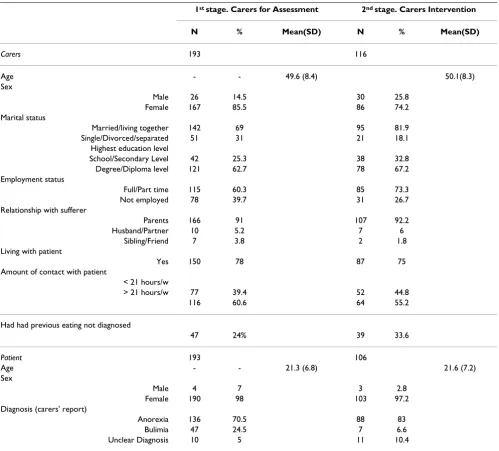
For the first stage, of the 201 primary caregivers that requested information and completed the battery of ques-tionnaires, only 193 returned fully completed question-naires (see Table 1). One hundred and sixty-seven caregivers (85.5%) were females. The average age of the caregivers was 49.6 years (SD = 8.4). Forty-two (25.3%) of the carers were educated up to secondary level and 121 (62.7%) were educated to higher education; the remain-ing thirty gave no information on their education (12%). One hundred and seventy-six carers (91.0%) were par-ents. One hundred and fifty carers (78.0%) were currently living with the patient. The patients were 98% females with a mean age of 21.3 years (6.8). Clinical symptoms reported by the carer were as follows: 90% (n = 147) restricted food intake, 49.4% (n = 80) exercised exces-sively, 34.2% (n = 55) vomited, 26% (n = 42) binged and 10.5% (n = 17) stole food/money for binges. Eighty-seven (45%) carers reported comorbid impulsive behaviours (alcohol abuse, illegal substances, self-harm or gambling) in patients.
In the second stage, a total of 194 caregivers from an ongoing study requested information of which 116 car-egivers (60%) agreed to participate in the intervention and were given the final version of the AESED (scale of 33 items). The data is shown in Table 1. Ten participants who
were secondary caregivers for the same relative were not included in the analysis, due to the problem of lack of independence of observations and because the emphasis was on primary caregivers and therefore more involved carers. Overall, from 106 primary caregivers who partici-pated in the intervention a total of 89 completed the pre and post intervention assessments (84% response rate). Seventeen carers did not complete the post-intervention assessment. We were not able to compile information as to why they did not complete this assessment.
Factor analysis of the Accommodation and Enabling Scale (AESED)
The first exploratory factor analysis was performed on the 41 items from the original instrument. A ten-factor struc-ture was derived, explaining 70% of the total variance. Following a preliminary appraisal of the results, a princi-pal components analysis was conducted excluding items with a factor loading lower than 0.4 on any individual fac-tor and those items that loaded equally on more than one factor. This revealed a five-factor solution with 33 items accounting for 60.1% of the variance. The KMO measure of sampling adequacy was 0.82, exceeding the recom-mended 0.6 and Barlett's Test reached statistical signifi-cance (p < 0.01). An inspection of the screeplot revealed a clear break after the fifth component. This was further supported by the results of Monte Carlo PCA for Parallel Analysis, which showed only five components with eigen-values exceeding the corresponding criterion eigen-values. These 5 factors were interpreted as themes of avoidance and modifying family routine, reassurance seeking, meal rit-ual, control of family and turning a blind eye. Table 2 shows the item loadings, variance explained, item-total correlations by subscales, communality values and relia-bilities for these five subscales. Communality values that demonstrated how well items' variance was explained by the five-factor solution ranged from 0.35 to 0.80. These values were above 0.30 and indicated that the variance of each item was adequately explained by the five-factor solution [37].
Table 2 shows the 33 statements chosen for the AESED. Eight items, 5, 6, 10, 11, 29, 30, 35 and 41 were deleted after the principal components analysis.
Scoring the AESED
9 and 10 was 4 for item 28, consisting of a Visual Ana-logue Scale (VAS). This scoring was done to allow for greater discrimination of caregivers' answers. The inclu-sion of the item 28, improved item homogeneity and overall scale and subscale reliability. Additionally, a total score was calculated in two ways a) by summing up the scores of all the items in order to obtain an overall score of family accommodation to eating disorder symptoms and b) by computing a total score by adding the mean domain scores of each subscale. As the two methods gave scores which correlated >0.9, we concluded that the over-all AESED score would be obtained by summing up the unweighted scores of all the items: the total scale is there-fore scored from 0 to 132. A higher score is associated
with higher family accommodation to eating disorder symptoms.
Reliability
Cronbach's alpha values for each of the subscales of the Accommodation and Enabling Scale were: 0.90 for the Avoidance & Modifying Routine subscale, 0.86 for Reas-surance Seeking subscale, 0.86 for the Meal Ritual sub-scale, 0.85 for Control of Family subscale and 0.77 for Turning a Blind Eye. The value for the total instrument was 0.92 (see Table 2).
Item-total subscale correlations and intercorrelation
[image:6.612.58.557.99.550.2]Correlational analyses between items and total subscales were conducted to measure the degree with which the
Table 1: Demographic details of carers and patients from the two studies
1st stage. Carers for Assessment 2nd stage. Carers Intervention
N % Mean(SD) N % Mean(SD)
Carers 193 116
Age - - 49.6 (8.4) 50.1(8.3)
Sex
Male 26 14.5 30 25.8
Female 167 85.5 86 74.2
Marital status
Married/living together 142 69 95 81.9
Single/Divorced/separated 51 31 21 18.1
Highest education level
School/Secondary Level 42 25.3 38 32.8
Degree/Diploma level 121 62.7 78 67.2
Employment status
Full/Part time 115 60.3 85 73.3
Not employed 78 39.7 31 26.7
Relationship with sufferer
Parents 166 91 107 92.2
Husband/Partner 10 5.2 7 6
Sibling/Friend 7 3.8 2 1.8
Living with patient
Yes 150 78 87 75
Amount of contact with patient
< 21 hours/w
> 21 hours/w 77 39.4 52 44.8
116 60.6 64 55.2
Had had previous eating not diagnosed
47 24% 39 33.6
Patient 193 106
Age - - 21.3 (6.8) 21.6 (7.2)
Sex
Male 4 7 3 2.8
Female 190 98 103 97.2
Diagnosis (carers' report)
Anorexia 136 70.5 88 83
Bulimia 47 24.5 7 6.6
Table 2: Principal Component Factor Analysis with Varimax rotation for a 5-factor solution of AESED for the carers of relatives with an eating disorder (1st stage; N = 193)
Factor Loadings Item-scale correlation Communality
Items 1 2 3 4 5
Factor 1:Avoidance &Modifying Routine (AMR) (Cronbach alpha 0.90)
38. Has helping your relative in the previously mentioned ways caused you distress?
0.79 0.12 0.10 - - 0.56 0.65
34. Have you modified your family routine because of your relative's symptoms?
0.78 - 0.17 0.15 - 0.60 0.67
37. Have you modified your leisure activities because of your relative's needs?
0.77 0.16 - 0.15 0.11 0.70 0.65
33. Have you avoided doing things, going places or being with people because of your relative's disorder?
0.76 0.16 - 0.26 - 0.61 0.68
39. Has your relative become distressed when you have not provided assistance?
0.75 0.23 0.10 - 0.15 0.64 0.66
36. Have you modified your work schedule because of your relative's needs?
0.69 0.11 - - - 0.45 0.50
40. Has your relative become angry/abusive when you have not provided assistance?
0.68 0.27 0.11 - 0.18 0.62 0.59
32. How often did you assist your relative in avoiding things that might make him/her anxious?
0.65 - 0.18 - 0.11 0.49 0.47
28. To what extent would you say that the relative with an eating disorder controls family life and activities?
0.64 0.23 0.13 0.25 - 0.64 0.55
31. How often did you participate in behaviours related to your relative's compulsions? Over the past week?
0.45 - 0.26 0.11 0.31 0.48 0.39
Factor 2: Reassurance Seeking(RS) (Cronbach alpha 0.86)
9. Repeated seeking of reassurance about whether she looks fat in certain clothes?
- 0.84 - - 0.11 0.43 0.73
7. Repeated questioning about whether she will get fat? 0.13 0.83 - 0.13 - 0.45 0.72 8. Repeated questioning whether it is safe or acceptable to eat
certain foods?
0.17 0.75 0.13 0.16 -0.15 0.51 0.66
22. Accommodation of routines of checking their body shape or weight?
- 0.67 0.20 - 0.10 0.45 0.52
13. Repeated conversations about negative thoughts and feelings?
0.17 0.67 - 0.14 - 0.48 0.50
14. Repeated conversations about self-harm? 0.27 0.63 - - 0.43 0.40
12. Repeated conversations about ingredients and amounts in food preparation
0.25 0.54 0.28 0.19 -0.26 0.52 0.54
21. Accommodation of the exercise routine of the relative with an ED?
0.11 0.48 0.33 - - 0.40 0.35
Factor 3: Meal Ritual(MR) (Cronbach alpha 0.86)
19. Accommodating to how the kitchen is cleaned? - - 0.89 - - 0.38 0.80
16. Accommodating to how crockery is cleaned? - - 0.84 - - 0.43 0.72
15. Accommodating to what crockery is used? 0.18 0.13 0.70 0.21 - 0.53 0.58
20. Accommodating to how food is stored? 0.13 - 0.68 0.14 - 0.43 0.50
18. Accommodating to what place food is eaten in? 0.32 - 0.65 0.31 - 0.59 0.64
23. Accommodating to how the house is cleaned and tidied? - 0.20 0.62 - 0.28 0.40 0.50 17. Accommodating to what time food is eaten? 0.24 0.14 0.53 0.32 -0.24 0.48 0.52
items for each subscale capture specific characteristics or homogeneity as shown in the Table 2. The overall Accom-modation and Enabling Scale score item-scale correla-tions ranged from 0.14-0.70. Item-scale correlation ranged from 0.48 to 0.70 in the Avoidance & Modifying Routine subscale, 0.40 to 0.52 in the Reassurance Seeking subscale, 0.38 to 0.59 in the Meal Ritual subscale, 0.51 to 0.55 in the Control of Family subscale, and finally, 0.14 to 0.32 in the Turning a Blind Eye subscale.
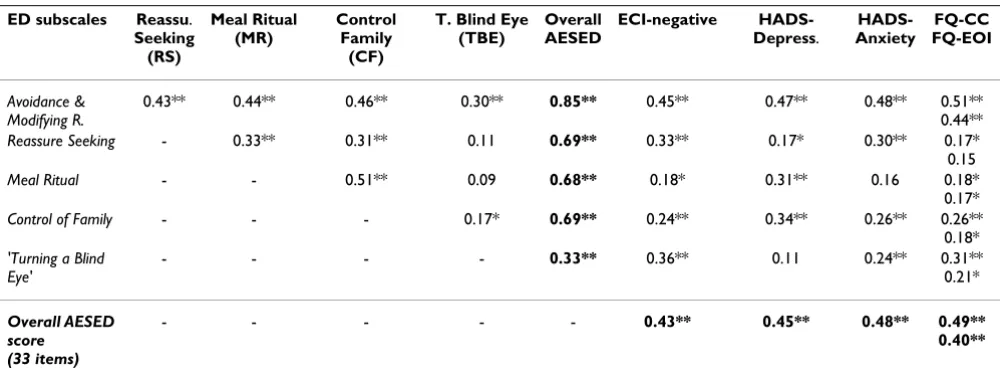
There were strong and significant correlations between the subscales scores and the total score of AESED (except for the Turning a Blind Eye subscale) with correlations
rang-ing between 0.68 and 0.85 (Table 3). However, moderate and significant correlations were found between subscales scores ranging from 0.30 to 0.51 (p < 0.01), except Turn-ing a Blind Eye subscale scores which showed low associ-ations with most of the subscale scores.
Convergent and Discriminant Validity of the
Accommodation and Enabling Scale for Eating Disorders (AESED)
The convergent and discriminant validity was studied by correlating the four subscales scores and the total score of the Accommodation and Enabling Scale with the level of negative appraisals measured by the ECI, the level of
3. Control cooking practice and ingredients used 0.28 0.18 0.14 0.78 - 0.55 0.75
4. Control what other family members eat - 0.22 0.23 0.78 - 0.51 0.72
2. Control what family members do and for how long in the kitchen
0.18 - 0.38 0.72 - 0.53 0.72
1. Control choice of food that you buy 0.35 0.14 - 0.71 - 0.55 0.65
Factor 5: 'Turning a Blind Eye' (TBE) (Cronbach alpha 0.77)
27. Ignore bathroom left in a mess 0.14 - - -0.13 0.76 0.14 0.62
24. Ignore food disappearing 0.13 - - 0.25 0.76 0.32 0.66
26. Ignore kitchen left in a mess 0.18 - - 0.25 0.72 0.29 0.62
25. Ignore if money is taken 0.13 - - -0.13 0.65 0.19 0.47
Eigenvalue 9.5 3.4 3.0 2.2 1.7
Percentage Variance explained 28.7 10.3 9.1 6.6 5.3 Cumulative percentage variance explained 17.3 30.3 43.1 52.2 60.1
[image:8.612.54.553.98.288.2]*Note. Bold values showing the five factor loadings *Note. Loadings below 0.10 are not presented.
Table 2: Principal Component Factor Analysis with Varimax rotation for a 5-factor solution of AESED for the carers of relatives with an eating disorder (1st stage; N = 193) (Continued)
Table 3: Correlations (Spearman) between the Accommodation and Enabling Scale (AESED) subscales scores and ECI-negative, HADS, FQ (1st stage; N = 193)
ED subscales Reassu. Seeking (RS)
Meal Ritual (MR)
Control Family
(CF)
T. Blind Eye (TBE)
Overall AESED
ECI-negative HADS-Depress.
HADS-Anxiety
FQ-CC FQ-EOI
Avoidance & Modifying R.
0.43** 0.44** 0.46** 0.30** 0.85** 0.45** 0.47** 0.48** 0.51**
0.44**
Reassure Seeking - 0.33** 0.31** 0.11 0.69** 0.33** 0.17* 0.30** 0.17*
0.15
Meal Ritual - - 0.51** 0.09 0.68** 0.18* 0.31** 0.16 0.18*
0.17*
Control of Family - - - 0.17* 0.69** 0.24** 0.34** 0.26** 0.26**
0.18*
'Turning a Blind Eye'
- - - - 0.33** 0.36** 0.11 0.24** 0.31**
0.21*
Overall AESED score
(33 items)
- - - 0.43** 0.45** 0.48** 0.49**
0.40**
[image:8.612.55.557.512.700.2]depression and anxiety measured by the HADS and with the level of expressed emotion measured by the FQ. The results are illustrated in Table 3. There were positive asso-ciations between negative appraisals of caregiving (ECI), AESED total score and subscale scores, HADS-depression and HADS-anxiety. All dimensions of the Accommoda-tion and Enabling Scale (AESED) were significantly related to EE (CC and EOI) measured by the Family Ques-tionnaire (Spearman's rho = 0.49 for EE-CC and Spear-man's rho = 0.40 for EE-EOI, n = 130, p < 0.01). The subscale of AESED that had the strongest correlation with the different instruments was the Avoidance and Modify-ing Routine (Spearman's rho > 0.45, p = 0.01).
The Accommodation and Enabling Scale (AESED) scores by clinical and psychosocial features are shown in Table 4. The Control of Family subscale was particularly high in carers with a relative with anorexia nervosa whereas the Turning a Blind Eye subscale was high in carers with a rel-ative with bulimia nervosa. Impulsive behaviours (alco-hol abuse, illegal substances, self-harm or gambling) in the ill relative were associated with high scores on the Reassurance Seeking and Turning a Blind Eye subscales. These behaviours were associated with caregiving burden and criticism.
Caregivers who had more than 21 hours a week contact with the patient presented higher scores in the overall AESED, as well as on individual subscales of Avoidance and Modifying routine, Reassurance Seeking, Meal Ritual and Control of the Family. These family members also presented higher levels of expressed emotion at home, specifically in terms of emotional over-involvement.
Caregivers with their own eating problems had a higher overall accommodation (AESED) index, reporting more difficulties with meal rituals and a higher tendency to ignore the negative consequences of the patient's symp-toms (turning a blind eye subscale). These carers also experienced high caregiving burden with more criticism and over-involvement (Table 4).
Responsiveness to change
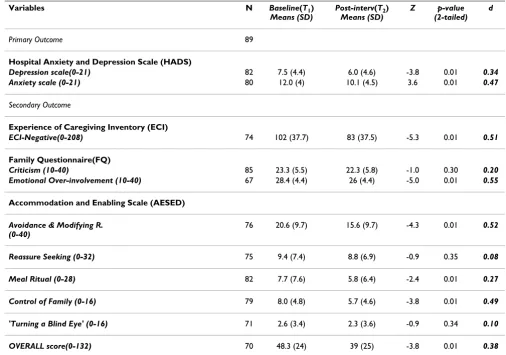
Following the caregivers' intervention the overall AESED index score was reduced (small effect size) and a moderate sized improvement was found on the avoidance and modifying routine (AMR) and the control of the family (CF) subscales (Z = -4.3 and Z = -3.8 p < 0.01, Wilcoxon's signed-ranks test for paired samples) (see Table 5). This improvement paralleled the reduction in anxiety and depression levels (HADS), caregiving burden (ECI) and expressed emotion (over-involvement), (FQ) following the intervention.
Over 61.3% of caregivers (n = 87) scored at or above the clinical threshold (score> = 11) for HADS-anxiety at
base-line compared with 48.3% (n = 43) after the intervention
(X2 = 6.4, df = 1, p = 0.011), and 20.1% (n = 29) scored at
or above the clinical threshold for HADS-depression
com-pared with 17% (n = 15) following the training (X2 = 13.3,
df = 1, p = 0.001). Regarding cut-off point for high EE, 56% of carers (n = 87) scored at or above 23 for high-CC at baseline compared with 50% (n = 45) after the
inter-vention (X2 = 31.4, df = 1, p = 0.001), and 65.5% (n =
100) scored at or above 27 for high-EOI at baseline
com-pared with 49.3% (n = 36) following the training (X2 =
17.9, df = 1, p = 0.001).
Discussion
The primary aim of this study was to develop and validate a new measure, the Accommodation and Enabling Scale for Eating Disorders (AESED), designed to measure accommodating and enabling behaviours by families/car-egivers of relatives with eating disorders. We found that an instrument with 33 items and five factors, Avoidance and Modifying Routine, Reassurance Seeking, Meal Ritual, Control of Family and Turning a Blind Eye, encapsulated the accommodating behaviours and thoughts that were expressed by caregivers.
The conceptualisation of the instrument was inspired by the seminal work in the families of people with OCD by Calvoressi and colleagues [19,21]. The specification to eating disorders was derived from qualitative and quanti-tative work in our department [2,4,11,15,29]. Although
the FAS has demonstrated a good internal consistency (α
= 0.82), our scale obtained higher alpha values for the
overall scale (α = 0.92).
Different subscales distinguished between the differential thoughts/behaviours resulting from clinical variables. The level of the family accommodation response depended on the type of diagnosis; family members felt more manipu-lated by patients with anorexia nervosa and families of patients with bulimia nervosa more commonly endorsed an attitude of tolerance of unacceptable behaviours in the
[image:10.612.56.554.111.578.2]Turning a Blind Eye total score (Spearman's rho = 0.35). Impulsive behaviours such as alcohol/illegal substances abuse, threats, self-harm and gambling behaviours were also associated with higher accommodation scores. The level of family accommodation was linked with the hours of face-to-face contact. In contrast to the OCD study, we did not find significant associations with illness severity;
Table 4: Carers' AESED scores by eating disorder diagnosis, co-morbidity, average number of contact hours a week and carers own eating problems (1st stage; n = 193)
Variables Avoidance & M.
Reassuranc S. Meal Ritual Control Family T. Blind Eye Overall AESED ECI-Negative FQ-CC FQ-EOI Total sample 19.7 (9.8) 11.2 (7.8) 7.7 (7.1) 8.5 (4.5) 2.3 (3.5) 49.4 (23.3) 103.9 (36.6) 23.4 (5.5) 28.2 (4.4) AN carers (N = 136)
19.9 (10) 11.3 (8.0) 8.1 (7.4) 8.9 (4.3)
1.7 (3.2) 49.8 (23.2) 103.1 (35.2) 23.4 (5.6) 28.5 (4.2) BN carers
(N = 47)
19.0 (9.8) 10.9 (7.6) 6.1 (6.2) 7.3 (5.1)
4.2 (3.8) 47.2 (23.3) 110.3 (37.4) 23.3 (5.5) 27.4 (4.7) p-value (2-tailed)
n.s. n.s. n.s. 0.046 0.001 n.s. *n.s. *n.s. *n.s.
Co-Morbidity+ (N = 87)
21.1 (9.6) 12.3 (7.8) 7.4 (7.2) 8.1 (4.7) 2.8 (3.6) 51.6 (22.6) 112.5 (34.6) 24.6 (5.6) 28.3 (4.6) Non Co-morbidity (N = 62)
19.2 (9.1) 9.1 (6.7) 6.8 (6.3) 8.6 (4) 1.7 (3.1) 45.2 (20) 91.2 (36.9) 22.1 (5.5) 27.7 (4.2) p-value (2-tailed)
n.s. 0.018 n.s. n.s. 0.035 n.s. *0.001 *0.01 *n.s.
less 21 hours/w (N = 70)
16.9 (9.1) 9.3 (7.9) 5.7 (6.2) 6.8 (4.8) 1.9 (3) 41.2 (21.2) 100.8 (33.2) 22.8 (5.6) 26.7 (4.3) more 21 hours/w (N = 106)
21.0 (10.3) 12.2 (7.6) 8.4 (7.2) 9.6 (4) 2.4 (3.5) 53.0 (23.6) 102.6 (38.4) 23.3 (5.3) 28.6 (4.2) p-value (2-tailed)
0.012 0.009 0.010 0.001 n.s. 0.005 *n.s. *n.s. *0.01
Mother previous eating problem ++ (N = 47)
21.6 (9.9) 12.0 (7.8) 9.0 (8.4) 9.1 (4.4) 3.6 (3.7) 55.9 (22.9) 114.9 (31) 25 (5.5) 29.9 (3.9) Mother without EP(N = 94)
19.5 (9.6) 10.2 (7.7) 5.8 (5.9) 8.0 (4.6) 1.6 (3) 44.6 (21.8) 100.5 (38) 22.6 (5.4) 27.5 (4.5) p-value (2-tailed)
n.s. n.s. 0.052 n.s. 0.002 0.032 *0.04 *0.02 *0.01
Note. Data are shown as means (SD = standard deviation).
Statistical comparison is shown between scores groups using the Mann-Whitney test. * Statistical comparison is shown between scores groups using the t-test.
+ Comorbidity-impulsive behaviours regard to alcohol abuse, illegal substances, self-harm or gambling
it is plausible that in ED it is the comorbid and difficult behaviours that accompany the disorder more than its severity that have a more potent effect on accommoda-tion, carer burden and perhaps outcome. This highlights the need to specifically target these comorbid characteris-tics in family interventions.
The instrument was sensitive to change after an interven-tion aimed at changing intrafamilial maintaining factors. Some domains, however, showed much more change than others which suggest that the intervention needs to be modified to target those areas which are resistant to change, such as reassurance seeking (RS) and ignoring dis-turbing behaviours (TBE). Nevertheless, few caregivers endorsed the turning a blind eye subscale which was more associated with impulsive behaviours and it is therefore possible that the lack of change represents a floor effect or that there was not a large enough sample of carers of peo-ple with bulimia nervosa symptomatology. In terms of psychological morbidity as assessed by the HADS, 61.3%
of caregivers scored at or above the clinical threshold for anxiety and 20.1% on depression and 56% of carers scored above threshold for CC and 65.5% for high-EOI at baseline. The number of caregivers above these clinical threshold points was significantly reduced, fol-lowing the training. The caregiving burden experienced by the relatives also decreased. The five types of accommoda-tion in eating disorders were related to higher depression and anxiety levels and high expresed emotion in family members. This is similar to what was found in OCD [7].
[image:11.612.50.556.110.465.2]Our own qualitative findings suggest that many carers who accommodate patients' symptoms do not believe that such accommodation improves the patient's out-come and also report experiencing distress when accom-modating to symptoms [39] which corroborates empirical evidence by Calvocoressi and colleagues in OCD [19]. Furthermore, the evidence shows clearly that carers expe-rience psychological morbidity, especially in terms of anx-iety at clinical levels, compared to family members of
Table 5: DVDs-skills-based intervention effect from means and standard deviations pre- to post-intervention from HADS, ECI, FQ and AESED scores.
Variables N Baseline(T1)
Means (SD)
Post-interv(T2) Means (SD)
Z p-value (2-tailed)
d
Primary Outcome 89
Hospital Anxiety and Depression Scale (HADS)
Depression scale(0-21) 82 7.5 (4.4) 6.0 (4.6) -3.8 0.01 0.34 Anxiety scale (0-21) 80 12.0 (4) 10.1 (4.5) 3.6 0.01 0.47
Secondary Outcome
Experience of Caregiving Inventory (ECI)
ECI-Negative(0-208) 74 102 (37.7) 83 (37.5) -5.3 0.01 0.51
Family Questionnaire(FQ)
Criticism (10-40) 85 23.3 (5.5) 22.3 (5.8) -1.0 0.30 0.20 Emotional Over-involvement (10-40) 67 28.4 (4.4) 26 (4.4) -5.0 0.01 0.55
Accommodation and Enabling Scale (AESED)
Avoidance & Modifying R. (0-40)
76 20.6 (9.7) 15.6 (9.7) -4.3 0.01 0.52
Reassure Seeking (0-32) 75 9.4 (7.4) 8.8 (6.9) -0.9 0.35 0.08
Meal Ritual (0-28) 82 7.7 (7.6) 5.8 (6.4) -2.4 0.01 0.27
Control of Family (0-16) 79 8.0 (4.8) 5.7 (4.6) -3.8 0.01 0.49
'Turning a Blind Eye' (0-16) 71 2.6 (3.4) 2.3 (3.6) -0.9 0.34 0.10
OVERALL score(0-132) 70 48.3 (24) 39 (25) -3.8 0.01 0.38
*d = Effect size was calculated on based of subscales' means and standard deviations
healthy controls, and that over-involved caregivers are particularly adversely affected [3,40].
Limitations of the Study
There are several limitations to this study. This is a self report measure and families may not have been able to reflect on these processes accurately. Consequently, an expert semi-structured interview might be more reliable and specific. The sample of cases of people with bulimia nervosa was small and so we may not have been able to highlight the specific difficulties that impact on interper-sonal relationships in this disorder. Overall, the the factor structure of the results presented in this article may require further scrutiny through a Confirmatory Factor Analysis, particularly to confirm the validity of the total score. It would also be essential to test the validity of the item 28 as a 5-point Likert scale with another sample. Therefore, this item was tentatively retained, pending the results from future data collection. Likewise, the sample may be limited in terms of representativeness due to the high proportion of female carers and the possibility that these carers are more actively involved in seeking help. Thus, a replication of the use of this scale with other carer samples is recommended. In addition, it would have also been of interest to examine whether scores on this instru-ment were related to more general measures of parenting styles. The intervention was developed before the findings using this instrument were delineated and it is therefore possible that interventions specifically targeted at these interpersonal reactions need to be developed. Finally, family accommodation is thought to fluctuate over time and it is unclear how much of the change is due to repeated measurement or passage of time, therefore longi-tudinal explorations are needed to identify patient and family factors that may affect changes in accommodation.
Conclusion
Tailored treatments for the family may be required based on how they organise themselves around the illness and this assessment tool that specifically addresses accommo-dation and enabling characteristics of each family can be a valuable component in this process. Caregivers can be administered the measure as a self-report questionnaire, possibly as part of the caregivers needs assessment. The AESED is a sensitive instrument for measuring change fol-lowing family interventions. Different subscales distin-guished between the differential thoughts/behaviours associated with diagnosis, co-morbidity, amount of face-to-face contact and whether the carer had had previous eating problems and these had an impact on the profile of accommodation in the family. This measure can therefore be of use for clinical and research contexts and can aid the identification of families that may benefit from interven-tions targeted at improving family responses and coping strategies.
Abbreviations
AESED: Accommodation and Enabling Scale for Eating Disorder; FAS: Family Accommodation Questionnaire; OCD: Obsessive Compulsive Disorder; ECI: Experience of Caregiving Inventory; HADS: the Hospital Anxiety and Depression Scale; FQ: Family Questionnaire; EE: Expressed Emotion; CC: criticism; EOI: Emotional Over-Involvement; ECI: Experience Caregiving Inventory; AN: Anorexia Nervosa; BN: Bulimia Nervosa; M: Mean; SD:
Standard Deviation; d: value for effect size; N: sample size;
n.s: no significant.
Competing interests
The authors declare that they have no competing interests.
Authors' contributions
ARS conceived and designed the study, oversaw all stages of data collection and performed the statistical analysis and drafted the manuscript. JT coordinated all stages of the study, gave feedback on design and reviewed the man-uscript. OK revised the data analysis, interpretation of results and reviewed the manuscript. All authors read and approved the final manuscript.
Additional material
Acknowledgements
This work was made possible by a grant from Mental Health Foundation and SLAM Trust fellowship at the Institute of Psychiatry, London. ARS was supported by a post-doctorate Fullbright and Spanish Education Ministry Fellowship (EX2004/0481) until October 2006. We would like to thank Jef-fery Barrera, Idan Naor, Laura Carral and Kimberley Davis for help with the data collection and entry. Thanks also to Nina Jackson's REID eating disor-der charity (No. 284286). And finally, we would also like to thank the par-ents that have taken part in this study.
References
1. Haigh R, Treasure J: Investigating the needs of carers in the area of eating disorders: Development of the Carers' Needs Assessment Measure (CaNAM). European Eating Disorders Review 2003, 11:125-141.
2. Perkins S, Winn S, Murray J, Murphy R, Schmidt U: A qualitative study of the experience of caring for a person with bulimia nervosa. Part1: The emotional impact of caring. International Journal of Eating Disorders 2004, 36:256-268.
3. Whitney J, Murray J, Gavan K, Todd G, Whitaker W, Treasure J:
Experience of caring for someone with anorexia nervosa: Qualitative study. British Journal of Psychiatry 2005, 187:444-459.
Additional file 1
The 41-original statements for the Accommodation and Enabling Scale for Eating Disorders (AESED). The data provided illustrates the 41-items were selected as part of the first questionnaire and the instruc-tions that were given to the caregiver participants.
Click here for file
4. Winn S, Perkins S, Murray J, Murphy R, Schmidt U: A qualitative study of the experience of caring for a person with bulimia nervosa. Part 2: Carers' needs and experience of services and other support. International Journal of Eating Disorders 2004,
36:269-279.
5. Winn S, Perkins S, Walwyn R, Schmidt U, Eisler I, Treasure J, et al.:
Predictors of mental health problems and negative caregiv-ing experiences in carers of adolescents with bulimia ner-vosa. International Journal of Eating Disorders 2006, 40:171-178. 6. Schmidt U, Treasure J: Anorexia Nervosa: Valued and Visible. A
Cognitive-Interpersonal Maintenance Model and its Implica-tions for Research and Practice. Br J Clin Psychol 2006, 45:1-25. 7. Amir N, Freshman M, Foa EB: Family distress and involvement
in relatives of obsessive-compulsive disorder patients. J Anxi-ety Disord 2000, 14:209-217.
8. de la Rie SM, van Furth EF, de Koning A, et al.: The quality of life of family caregivers of eating disorder patients. Eating Disorder
2005, 13:345-351.
9. Highet N, Thompson M, King RM: The Experience of Living with a Person with an Eating Disorder: The Impact on the Carers.
Eating Disorders: The Journal of Treatment & Prevention 2005,
13:327-344.
10. Sepulveda AR, Lopez C, Todd G, Whitaker W, Treasure J: An Examination of the Impact of Maudsley Eating Disorder Col-laborative Care Workshops on the Well-Being of Family Members: A Pilot Study. Social Psychiatry and Psychiatric Epidemiol-ogy 2008, 43:584-591.
11. Whitney J, Eisler I: Theoretical and empirical models around caring for someone with an eating disorder: The reorganiza-tion of family life and inter-personal maintenance factors.
Journal of Mental Health 2005, 14:575-585.
12. Whitney J, Haigh R, Weinman J, Treasure J: Caring for people with Eating Disorders: Factors associated with psychological dis-tress and negative caregiving appraisals in carers of people with eating disorders. Br J Clin Psychol 2007, 46:413-428. 13. Treasure J, Gavan K, Todd G, Schmidt U: Changing the
Enviror-ment in Eating Disorders: Working with Carers/Families to Improve Motivation and Facilitate Change. European Eating Disorders Review 2003, 11:25-37.
14. van Furth EF, van S, Martina LM, van Son MJ, Hendrickx JJ, van EH:
Expressed emotion and the prediction of outcome in adoles-cent eating disorders. Int J Eat Disord 1996, 20:19-31.
15. Sepulveda AR, Whitney J, Hankins M, Treasure J: Development and Validation of an Eating Disorders Symptom Impact Scale (EDSIS) for Carers of People with Eating Disorders. Health and Quality of Life Outcomes 2008, 6:28.
16. Wisotsky W, Dancyger I, Fornari V, Katz J, Wisotsky WL, Swencionis C: The relationship between eating pathology and perceived family functioning in eating disorder patients in a day treat-ment program. Eat Disord 2003, 11:89-99.
17. Bastiani AM, Altemus M, Pigott TA, Rubenstein C, Weltzin TE, Kaye WH: Comparison of obsessions and compulsions in patients with anorexia nervosa and obsessive compulsive disorder.
Biological Psychiatry 1996, 39:966-969.
18. Treasure J, Sepulveda AR, MacDonald P, Whitaker W, Lopez C, Zabala M, et al.: The Assessment of the Family of People with Eating Disorders. European Eating Disorders Review 2007, 15:1-9. 19. Calvocoressi L, Mazure CM, Kasl SV, Skolnick J, Fisk D, Vegso SJ, et
al.: Family accommodation of obsessive-compulsive symp-toms: instrument development and assessment of family behavior. J Nerv Ment Dis 1999, 187:636-642.
20. Treasure J, Sepulveda AR, Whitaker W, Todd G, Lopez C, Whitney J: Collaborative care between professionals and non profes-sional in the management of eating disorders:a description of workshops focused on interpersonal maintaining factors.
European Eating Disorders Review 2007, 15:24-34.
21. Calvocoressi L, Lewis B, Harris M, Trufan SJ, Goodman WK, McDougle CJ, et al.: Family accommodation in obsessive-com-pulsive disorder. Am J Psychiatry 1995, 152:441-443.
22. Albert U, Salvi V, Saracco P, Bogetto F, Maina G: Health-related quality of life among first-degree relatives of patients with obsessive-compulsive disorder in Italy. Psychiatric Services 2007,
58:970-976.
23. Storch E, Geffken GR, Merlo L, et al.: Family accommodation in pediatric obsessive-compulsive disorder. Journal Clinical Child and Adolescent Psychology 2007, 36:207-216.
24. Storch E, Geffken GR, Larson MJ, et al.: Clinical features associ-ated with treatment-resistant pediatric obsessive-compul-sive disorder. Comprehensive Psychiatry 2008, 49:35-42.
25. Ferrao Y, Shavitt RG, Bedin NR, Mathis ME, Carlos Lopes A, Fon-tenelle LF, et al.: Clinical features associated to refractory obsessive-compulsive disorder. Journal Affective Disorders 2006,
94:199-209.
26. Steketee G, Van NB: Family approaches to treatment for obsessive compulsive disorder. Revista Brasileira de Psiquiatria
2003, 25:43-50.
27. Uehara T, Kawashima Y, Goto M, Tasaki SI, Someya T: Psychoedu-cation for the families of patients with eating disorders and changes in expressed emotion: A preliminary study. Compr Psychiatry 2001, 42:132-138.
28. Zucker NL, Marcus M, Bulik C: A group parent-training pro-gram: a novel approach for eating disorder management. Eat Weight Disord 2006, 11:78-82.
29. Treasure J, Sepulveda AR, MacDonald P, Whitaker W, Lopez C, Zabala M, et al.: Interpersonal maintaining factors in eating dis-order: Skill sharing interventions for carers. International Jour-nal Child and Adolescent Health 2008, 1:331-338.
30. Treasure J, Smith G, Crane A: The Maudsley Model of Collaborative Car-ing: Skills based learning in caring for a loved one with an eating disorder
London: Routledge; 2007.
31. Sepulveda AR, Lopez C, MacDonald P, Treasure J: Feasibility and acceptability of DVD-based skills training for parents of peo-ple with an eating disorder. International Journal of Eating Disorders
2007, 41:318-325.
32. Snaith RP: The Hospital Anxiety And Depression Scale. Health Qual Life Outcomes 2003, 1:29.
33. Zigmond AS, Snaith RP: The hospital anxiety and depression scale. Acta Psychiatr Scand 1983, 67:361-370.
34. Szmukler GI, Burgess P, Herrman H, Benson A, Colusa S, Bloch S:
Caring for relatives with serious mental illness: the develop-ment of the Experience of Caregiving Inventory. Soc Psychiatry Psychiatr Epidemiol 1996, 31:137-148.
35. Wiedemann G, Rayki O, Feinstein E, Hahlweg K: The Family Ques-tionnaire: development and validation of a new self-report scale for assessing expressed emotion. Psychiatry Res 2002,
109:265-279.
36. Cohen J: Statistical power analysis for the behavioral science NJ.: Hillsdale. Elrbaum; 1988.
37. Tabachnick BC, Fidell LS: Using Multivariate Statistics 3rd edition. New York: Harper Collins Publishers Inc; 1996.
38. Magana AB, Goldstein JM, Karno M, Miklowitz DJ, Jenkins J, Falloon IR: A brief method for assessing expressed emotion in rela-tives of psychiatric patients. Psychiatry Res 1986, 17:203-212. 39. Kyriacou O, Treasure J, Schmidt U: Understanding how parents
cope with living with someone with anorexia nervosa: mod-elling the factors that are associated with carer distress. Int J Eat Disord 2008, 41:233-242.
40. Kyriacou O, Treasure J, Schmidt U: Expressed Emotion in Eating Disorders assessed via self-report: An examination of factors associated with Expressed Emotion in carers of people with Anorexia Nervosa in comparison to control families. Interna-tional Journal of Eating Disorders 2008, 41:37-46.
Pre-publication history
The pre-publication history for this paper can be accessed here: