T E C H N I C A L N O T E
Open Access
An enhanced method for sequence walking and
paralog mining: TOPO
®
Vector-Ligation PCR
Benjamin B Orcheski
1, Thomas M Davis
2*Abstract
Background:Although technological advances allow for the economical acquisition of whole genome sequences, many organisms’ genomes remain unsequenced, and fully sequenced genomes may contain gaps. Researchers reliant upon partial genomic or heterologous sequence information require methods for obtaining unknown sequences from loci of interest. Various PCR based techniques are available for sequence walking - i.e., the acquisition of unknown DNA sequence adjacent to known sequence. Many such methods require rigid, elaborate protocols and/or impose narrowly confined options in the choice of restriction enzymes for necessary genomic digests. We describe a new method, TOPO
®
Vector-Ligation PCR (or TVL-PCR) that innovatively integrates available tools and familiar concepts to offer advantages as a means of both targeted sequence walking and paralog mining.Findings:TVL-PCR exploits the ligation efficiency of the pCR
®
4-TOPO®
(Invitrogen, Carlsbad, California) vector system to capture fragments of unknown sequence by creating chimeric molecules containing defined priming sites at both ends. Initially, restriction enzyme-digested genomic DNA is end-repaired to create 3’adenosine overhangs and is then ligated to pCR4-TOPO vectors. The ligation product pool is used directly as a template for nested PCR, using specific primers to target orthologous sequences, or degenerate primers to enable capture of paralogous gene family members. We demonstrated the efficacy of this method by capturing entire coding and partial promoter sequences of several strawberry Superman-like genes.Conclusions:TVL-PCR is a convenient and efficient method for DNA sequence walking and paralog mining that is applicable to any organism for which relevant DNA sequence is available as a basis for primer design.
Background
Efforts to obtain desired gene and promoter sequences often rely on exploitation of fragmentary genomic or cDNA sequence information available from homologous or heterologous sources as a basis for PCR primer design. Various PCR-based sequence walking techniques have been developed for acquiring previously unknown genomic sequence flanking a known site [1-5]. All such techniques share a common strategy: creation of a distal priming site or sites for use in conjunction with priming sites in known genomic sequence. However, these tech-niques vary in how the distal priming site is created.
Our method employs the pCR
®
4-TOPO®
(Invitrogen, Carlsbad, California) as a linker, thereby combining the advantages of T/A ligation [2] with those of using avector as linker [1,3]. In our approach, called “TOPO
®
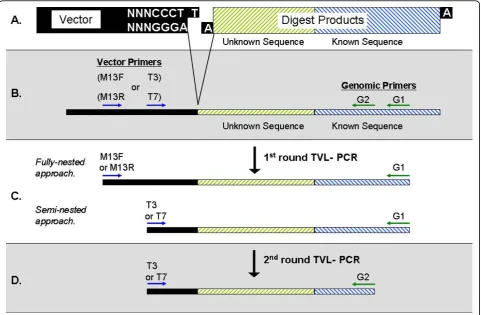
Vector-Ligation PCR” (TVL-PCR), the pCR4-TOPO vec-tor is employed as linker. Briefly, genomic DNA of interest is subjected to restriction digestion using any restriction enzyme that produces either blunt or recessed 3’ends. Digestion is followed by end-repair, producing a pool of fragments with single, 3’adenosine overhangs at each end. These fragments are shotgun ligated to pCR4-TOPO vector (Figure 1A), creating chi-meric molecules containing known priming sites at both ends (Figure 1B). The ligation product pool serves as template for the initial round of TVL-PCR (Figure 1C), and this product is used as template in the fully- or semi-nested second round of TVL-PCR (Figure 1D). The final product of TVL-PCR spans a segment of known sequence, an adjacent segment of the unknown sequence of interest, and a short vector segment. * Correspondence: [email protected]2Department of Biological Sciences, University of New Hampshire, Durham, NH, 03824, USA
We describe TVL-PCR and explain how we used it to obtain full length sequence and partial promoter sequence of several strawberry Superman-like genes. We also successfully used TVL-PCR for paralog mining (results not shown), which is the amplification of multi-ple members of a gene family using degenerate primers based on conserved sequences as priming sites.
Materials and methods
Template Preparation for TVL-PCR
DNA was isolated from unexpanded leaf tissue of Fra-garia virginiana accession L2 (CFRA 1995) as described [6], except that no chloroform:octanol solution was included in the microfuge tube to which CTAB slurry was transferred. Per reaction, 400 ng of genomic DNA was digested with 20 U of EcoRI, BamHI, or HindIII (New England Biolabs, Ipswich, Massachusetts) in a 40 μl reaction that was incubated overnight at 37°C.
Employed restriction enzymes must produce recessed 3’ (5’overhangs) or blunt ends. Digestion was verified by electrophoresis of 100 ng digested genomic DNA and undigested comparator on a 1% agarose TBE gel.
Repair of Fragment Ends and Addition of 3’A Overhang End-repair employed 20 μl (200 ng) of each digested DNA sample with 1μl of 10 mM dNTP mix, 1.3μl ster-ile water, 2.5μl of EconoTaq
®
buffer (Lucigen, Middle-ton, Wisconsin) and 0.2 μl (1 U) EconoTaq DNA polymerase. Reactions were incubated at 72°C for 30 minutes to fill in recessed 3’ends of cut sites, add a 3’ adenosine overhang, and heat-inactivate the restriction enzyme.Ligation
[image:2.595.58.540.89.404.2]solution, with 0.5μl (5 ng) of TOPO vector and 1 μl of supplied salt solution. The reaction was gently mixed and incubated at room temperature for one hour.
Primer Design
The design of the gene-specific primers relied on align-ments comprised of Superman-like sequences from four heterologous sources (Petunia, Nicotiana, Arabidopsis, and Malus), and strawberry Superman-like sequences obtained via conventional PCR amplification using degenerate primers targeted to sites conserved among the four heterologous sequences (results not shown). Two strategies were employed. For paralog mining of new Superman-like genes, degenerate primers were tar-geted to genomic sites identified as conserved among the heterologous and strawberry sequences. For sequence-specific walking to extend initially obtained gene segments, sequence-specific primers were targeted to genomic sites that were not conserved among the aligned heterologous and strawberry sequences. Geno-mic primers were always sited at least 50 bases upstream of the transition point from known to unknown sequence, to provide a sufficient read of known sequence in the resulting TVL-PCR product to confirm sequence identity and continuity.
TVL-PCR
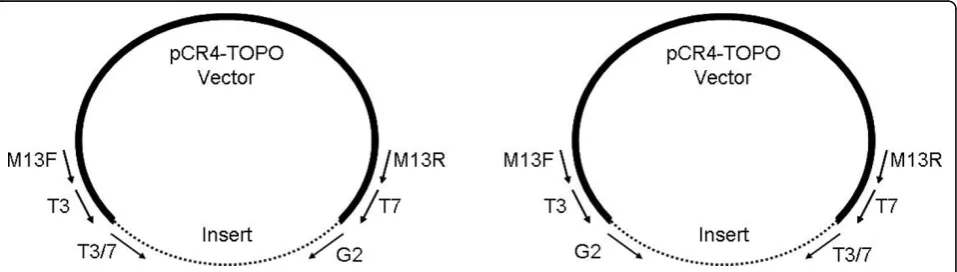
[image:3.595.60.539.549.685.2]The thermocycler profile used for both the first and sec-ond rounds of TVL-PCR was: initial denaturation at 94° C for 1 min; then 35 cycles of 94°C for 30 sec, 52°C for 30 sec, 68°C for 4 min; followed by a final extension at 68°C for 10 minutes. For each ligated template, two first-round amplification reactions were employed for the initial step of TVL-PCR, because the genomic frag-ment can ligate to the vector in alternate orientations (Figure 2). In one first-round TVL-PCR reaction (Figure 1C), the distal genomic primer (G1) was paired with the
M13F or T3 vector primer, while in the other the G1 primer was paired with the M13R or T7 vector primer. In the first round, use of a distal M13_ (M13F or M13R) vector primer allows for subsequent vector pri-mer nesting, while use of a proximal T_ (T3 or T7) vec-tor primer precludes subsequent vecvec-tor primer nesting (and is therefore recommended only if incompatibility exists between M13 primers and the distal genomic pri-mer). For the second-round of TVL-PCR (Figure 1D), each first-round product was used as a template, and the nested genomic primer (G2) was paired with the appropriate T_ vector primer (T3 or T7, respectively -see below).
The 25μl first-round TVL-PCR reactions contained 3
μl ligation reaction template, 0.5 μl of 20μM G1
geno-mic primer, 0.5μl vector primer, 0.1μl (0.5 U) Accu-Prime™Taq DNA Polymerase High Fidelity (Invitrogen), and 2.5 μl 10× AccuPrime PCR buffer II. The first-round product (10 μl) was visualized on a 2% agarose 1% TBE gel run at 4.1 V/cm for 80 minutes. The sec-ond-round of TVL-PCR was performed with 1 μl of first-round product as the template, and 0.5μl of 20μM stock of both the nested G2 genomic primer and the appropriate vector primer. If the first-round vector pri-mer was M13F or T3, then T3 was used as the second-round vector primer. If the first-second-round vector primer was M13R or T7, then T7 was used as the second-round vector primer.
Cloning and Sequencing of TVL-PCR Products
The amplification products from each second round TVL-PCR reaction were cloned using the Invitrogen TOPO TA Cloning
®
kit for sequencing, per the manu-facturer’s instructions. Transformed cells were plated on LB agar plates containing 50μg/ml ampicillin and were grown at 37°C overnight. Colony PCR was performed using M13 primers provided with the TOPO cloning kitto confirm insert size. Plasmids were isolated from clones of interest using the Promega Wizard
®
PlusSV Minipreps DNA Purification System (Promega, Madison, WI). The plasmid inserts were then sequenced bidirec-tionally on an Applied Biosystems 3130 Genetic Analy-zer (Applied Biosystems, Foster City, CA), using M13 forward and M13 reverse sequencing primers. The T3 and T7 sequencing primers cannot be used for this pur-pose, because their priming sites may be represented twice in the final TOPO clone: once in the cloning vec-tor itself and once in the cloned product of second round TVL-PCR (Figure 2).Results
Paralog Mining
Use of degenerate primers targeted to genomic sites conserved among heterologous Superman sequences resulted in acquisition of multiple candidate clones from strawberry accession L2 (results not shown), including that of clone 143-2-1. The latter sequence provided the basis for design of site-specific primers used for sequence walking in accession L2, as described below.
Sequence Walking
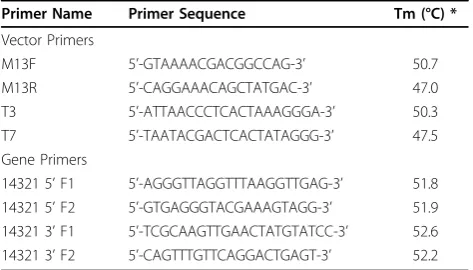
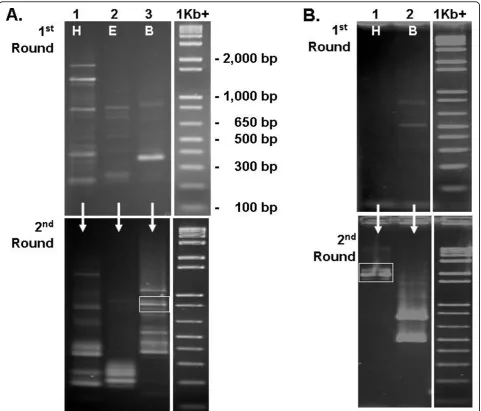
Specific primers targeted to non-conserved sites in clone 143-2-1 were designed (Table 1) and used to extend this gene fragment in both the 5’and 3’directions. For walk-ing in the 5’ direction, G1 primer 14321 5’F1 paired with the M13R vector primer produced a spectrum of products in the first-round reaction using HindIII (H),
EcoRI (E), orBamHI (B) digested genomic DNA as tem-plate (Figure 3A - top). The second round of TVL-PCR, using the first-round products as template with nested G2 primer 14321 5’F2 and the nested T3 vector primer, produced a diminished spectrum of bands in the H and E lanes, but a proliferation of bands in the B lane
(Figure 3A - bottom). After shotgun cloning of the sec-ond round TVL-PCR products, colony PCR, and sequencing of three clones selected on the basis of favorable size (> 500 bp), one clone containing a Super-man-like sequence was found. Its size corresponded to the boxed band in Figure 3A (bottom). This newly acquired sequence extended upstream from the known gene sequence to the putative start codon and beyond.
For walking in the 3’ direction, the first round of TVL-PCR employed G1 primer 14321 3’F1 paired only with the T3 vector primer. The product from this reac-tion (Figure 3B - top) was used as template for the sec-ond round of TVL-PCR using the nested G2 primer 14321 3’F2 in conjunction with the T3 vector primer. Shotgun cloning of the second round TVL-PCR pro-ducts (Figure 3B - bottom), followed by colony PCR and sequencing of two appropriately sized products (> 500 bp), yielded one product that contained the targeted sequence. The respective PCR product size corre-sponded to the boxed gel band (Figure 3B - bottom). This product was slightly less than 2 kb in length, and extended well into the 3’UTR of the targeted gene.
Overall, a total of five clones were sequenced from shotgun cloned and size-selected TVL-PCR products, of which one provided targeted sequence extension in the 5’direction and another in the 3’direction. The remain-ing three sequenced clones were not the targeted sequence, but displayed a vector primer sequence at one end and a respective genomic primer sequence at the other, indicating that each arose from non-specific prim-ing by the genomic primer.
Using methods similar to those described above, TVL-PCR was also used successfully to extend the sequence of Superman-like clone 7266 upstream far enough to surpass the putative start codon (results not shown). In addition, the use of degenerate primers resulted in the acquisition of 5’and 3’sequences from three additional Superman family sequences in strawberry. All straw-berry Superman-like genes isolated from chromosome walking via TVL-PCR have been deposited in GenBank under accession numbers, GU830924: 7266 5’ walk, GU830926: 14321 5’ walk, and GU830925: 14321 3’ walk.
Discussion
[image:4.595.56.293.551.686.2]TVL-PCR adds a useful new option to the toolkit of methodological choices for sequence walking. By exploiting T/A ligation by using the pCR4-TOPO vector as a linker, TVL-PCR expands the spectrum of restric-tion enzymes employable for digesrestric-tion of genomic DNA by eliminating dependence on corresponding restriction sites in the vector linker as encountered in Single Speci-fic Primer PCR [1] and Rapid AmpliSpeci-fication of Genomic DNA Ends [3].
Table 1 Primer Information.
Primer Name Primer Sequence Tm (°C) *
Vector Primers
M13F 5’-GTAAAACGACGGCCAG-3’ 50.7 M13R 5’-CAGGAAACAGCTATGAC-3’ 47.0 T3 5’-ATTAACCCTCACTAAAGGGA-3’ 50.3 T7 5’-TAATACGACTCACTATAGGG-3’ 47.5 Gene Primers
14321 5’F1 5’-AGGGTTAGGTTTAAGGTTGAG-3’ 51.8 14321 5’F2 5’-GTGAGGGTACGAAAGTAGG-3’ 51.9 14321 3’F1 5’-TCGCAAGTTGAACTATGTATCC-3’ 52.6 14321 3’F2 5’-CAGTTTGTTCAGGACTGAGT-3’ 52.2
Vector primer sequences are standard, and are provided here for convenience. Gene primers were designed by us.
Beneficially, methods that employ T/A ligation, including TVL-PCR and T-Linker PCR [2], preclude the possibility of genomic and/or vector fragment re-liga-tion to each other, or self-ligare-liga-tion (i.e., circularizare-liga-tion). Because genomic DNA fragments with 3’ adenosine overhangs can only ligate to a molecule having a 3’ thy-midine overhang, chimeric ligation constructs com-prised of multiple genomic fragments are also precluded.
With ligation-dependent methods, duplicate linker ligation at both ends of a genomic fragment would cre-ate opportunity for“single primer amplification”via lin-ker priming at both ends. The TVL-PCR procedure
[image:5.595.58.540.88.499.2]minimizes this problem by maintaining a high genomic DNA to vector ratio, minimizing the number of geno-mic fragments that acquire ligated vector molecules at both ends. We used 36 ng of genomic DNA in the ligation reaction, which after complete digestion with a six-base restriction enzyme should result in 8.2 billion fragments present in the ligation reaction. At a concen-tration of 10 ng/μl, 0.5μl of TOPO vector yields 1.2 bil-lion molecules, and thus roughly a ratio of seven genomic DNA fragments to one vector molecule. In various applications of the TVL-PCR technique, we have yet to encounter a product primed by a vector primer at both ends.
Conclusions
TVL-PCR is an efficient and effective method for geno-mic sequence walking. It offers significant advantages, allowing choice among a large selection of restriction enzymes, and requiring only small amounts of template DNA. Using TVL-PCR, we have isolated entire coding and partial promoter sequences of several Superman-like genes from strawberry.
Acknowledgements
This work was supported in part by New Hampshire Agricultural Experiment Station Project NH00433. This is Scientific Contribution 2387 from the New Hampshire Agricultural Experiment Station (NHAES). We gratefully acknowledge the editorial assistance provided by Melanie E. Shields.
Author details
1Genetics Graduate Program, University of New Hampshire, Durham, NH, 03824, USA.2Department of Biological Sciences, University of New Hampshire, Durham, NH, 03824, USA.
Authors’contributions
BBO conceived and developed the technique, and performed the research. TMD provided technical support, helped draft the manuscript, and contributed to the design and trouble shooting of the procedure. Both authors read and approved the final manuscript.
Competing interests
The authors declare that they have no competing interests.
Received: 10 November 2009 Accepted: 4 March 2010 Published: 4 March 2010
References
1. Shyamala V, Ames GF:Genome walking by single-specific-primer polymerase chain reaction: SSP-PCR.Gene1989,84:1-8.
2. Yuanxin Y, Chengcai A, Li L, Jiayu G, Guihong T, Zhangliang C: T-linker-specific ligation PCR (T-linker PCR): an advanced PCR technique for chromosome walking or for isolation of tagged DNA ends.Nucleic Acids Res2003,31:e68.
3. Mizobuchi M, Frohman LA:Rapid amplification of genomic DNA ends. Biotechniques1993,15:214-216.
4. Boulter CA, Natarajan D:A PCR-based method for isolation of genomic DNA flanking a known DNA sequence.Curr Issues Mol Biol1999,1:47-52. 5. Cormack RS, Somssich IE:Rapid amplification of genomic ends (RAGE) as
a simple method to clone flanking genomic DNA.Gene1997,
194:273-276.
6. Davis TM, Yu H, Haigis KM, McGowan PJ:Template mixing - a method of enhancing detection and interpretation of codominant RAPD markers. Theor Appl Genet1995,91:582-588.
7. Integrated DNA Technologies OligoAnalyzer.[http://www.idtdna.com/ analyzer/Applications/OligoAnalyzer/].
doi:10.1186/1756-0500-3-61
Cite this article as:Orcheski and Davis:An enhanced method for
sequence walking and paralog mining: TOPO®Vector-Ligation PCR.
BMC Research Notes20103:61.
Submit your next manuscript to BioMed Central and take full advantage of:
• Convenient online submission
• Thorough peer review
• No space constraints or color figure charges
• Immediate publication on acceptance
• Inclusion in PubMed, CAS, Scopus and Google Scholar
• Research which is freely available for redistribution