T E C H N I C A L N O T E
Open Access
URPD: a specific product primer design tool
Li-Yeh Chuang
1, Yu-Huei Cheng
2and Cheng-Hong Yang
3*Abstract
Background:Polymerase chain reaction (PCR) plays an important role in molecular biology. Primer design
fundamentally determines its results. Here, we present a currently available software that is not located in analyzing large sequence but used for a rather straight-forward way of visualizing the primer design process for
infrequent users.
Findings:URPD (yoUR Primer Design), a web-based specific product primer design tool, combines the NCBI Reference Sequences (RefSeq), UCSC In-Silico PCR, memetic algorithm (MA) and genetic algorithm (GA) primer design methods to obtain specific primer sets. A friendly user interface is accomplished by built-in parameter settings. The incorporated smooth pipeline operations effectively guide both occasional and advanced users. URPD contains an automated process, which produces feasible primer pairs that satisfy the specific needs of the
experimental design with practical PCR amplifications. Visual virtual gel electrophoresis and in silico PCR provide a simulated PCR environment. The comparison of Practical gel electrophoresis comparison to virtual gel
electrophoresis facilitates and verifies the PCR experiment. Wet-laboratory validation proved that the system provides feasible primers.
Conclusions:URPD is a user-friendly tool that provides specific primer design results. The pipeline design path makes it easy to operate for beginners. URPD also provides a high throughput primer design function. Moreover, the advanced parameter settings assist sophisticated researchers in performing experiential PCR. Several novel functions, such as a nucleotide accession number template sequence input, local and global specificity estimation, primer pair redesign, user-interactive sequence scale selection, and virtual and practical PCR gel electrophoresis discrepancies have been developed and integrated into URPD. The URPD program is implemented in JAVA and freely available at http://bio.kuas.edu.tw/urpd/.
Keywords:Polymerase chain reaction (PCR), Primer design, Web-based, Memetic algorithm (MA), Genetic algorithm (GA), Virtual gel electrophoresis
Findings Background
PCR (polymerase chain reaction) is one of the most popular technologies used in biological and biomedical studies. It is a time-saving and sensitive method that amplifies specific regions of the genome. Primer design is of fundamental importance in PCR-based methods. Many parameters and aspects need to be taken into ac-count when designing primers; the common ones are primer length/length difference, GC content, product size, the concentrations of the PCR buffer reagents, stable secondary structures, the melting temperature/
melting temperature difference, and the nucleotide composition of the primer 3” end (i.e., GC clamp), etc. [1-4]. Furthermore, the analysis for template sec-ondary structure, such as stem-loop structures in the template, particularly for RNA is advanced consider-ation on primer binding. Many methods have been developed to solve the inherent problems in primer design, e.g., genetic algorithms (GA) [5], greedy algo-rithms [6], and memetic algorithms (MA) [7]. Moreover, automated procedures are often implemen-ted to facilitate the PCR experiment. Several web-based services are available that provide primer de-sign. One example is the Primer3 software, which is a popular and frequently used primer design tool. Primer3 considers many different parameters, which * Correspondence:[email protected]
3
Department of Electronic Engineering, National Kaohsiung University of Applied Sciences, Kaohsiung, Taiwan
Full list of author information is available at the end of the article
allows users to reach their different objectives [8,9]. PrimerBlast, developed at NCBI, uses Primer3 to de-sign primers; it provides a specificity check using BLAST to avoid causing amplification of targets other than the input template. In addition, UniPrime2 [10,11], Primer3Plus [12], and PDA [13], are also use-ful tools for primer design. In this study, we provide a new, user-friendly web interface primer design service called URPD (yoUR Primer Design), which combines the NCBI Reference Sequences (RefSeq), UCSC In-Silico PCR, memetic algorithm (MA) and genetic al-gorithm (GA) primer design methods [7] to obtain feasible primer sets.
Implementation
Primer design
The MA and GA primer design methods are introduced into URPD as the core of the primer design. GA which is a well-known and heuristic search method that mimics the process of natural evolution [14-16] is inspired by Darwin's theory. In a GA, a solution is called an individual or a chromosome. A population contains many individuals, and each individual is different. The GA use evolutionary computations, i.e., selection, cross-over, mutation and replacement, to generate new off-springs from generation to generation. After each generation, individuals in a GA share information with each other and the superior individuals based on a fit-ness rule are refined thus the optimal solution is found. MA is inspired by Dawkins”notion of a meme [17]. It is similar but superior to GA. MA progress through a local search before being involved in the evolution process [18]. An MA assures that all individuals and offsprings gain some experiences thus the optimal solution is obtained from generation to generation. Both MA and GA are based on the natural process of evolution through reproduction. The major difference between the MA and the GA is the local search mechanism in the MA, which improves its search results and reduces the likelihood of premature convergence encountered in the GA [7]. Some useful processes, such as reading the information from a file, output of results via network transmission, better run selection, and a primer ranking mechanism are integrated in the system. The fundamen-tal performance (accuracy and run time) of the MA pri-mer design was compared to a GA and is shown in [7]. Furthermore, we also introduce the thermodynamic nearest-neighbor model [19] to enhance the melting temperature calculation of the system.
Sequence Database integration
The NCBI RefSeq [20] is integrated in URPD to provide available template sequences. By entering the Nucleotide Accession number, the corresponding sequence is
obtained as the template sequence to perform the pri-mer design. Moreover, UCSC InSilico PCR [21] is also integrated in URPD to acquire a virtual PCR product se-quence from an available primer pair input as a new template sequence for redesigning the primer into more feasible ones. This allows users to perform an iterative design and modify potential PCR primers.
Pipeline mechanism
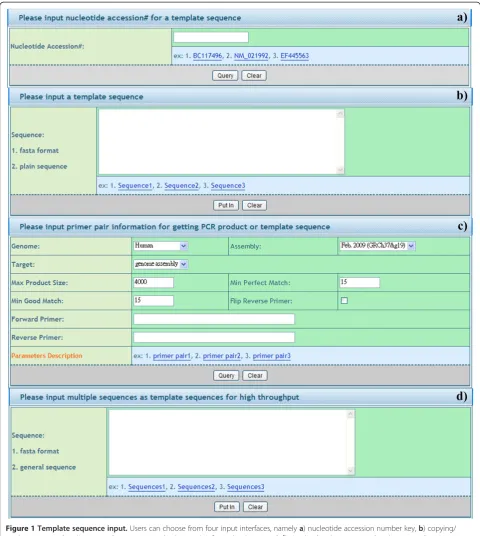
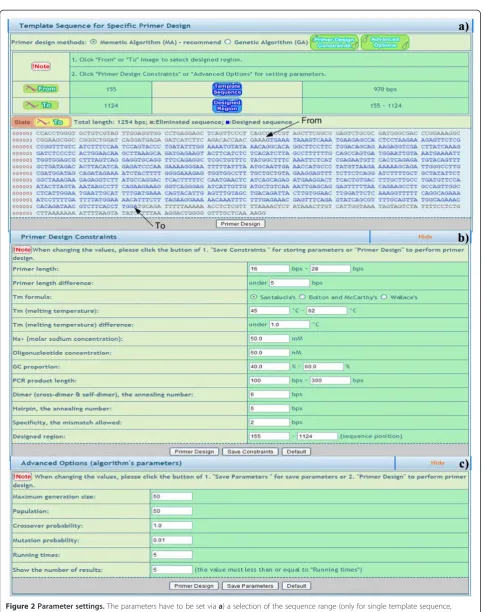
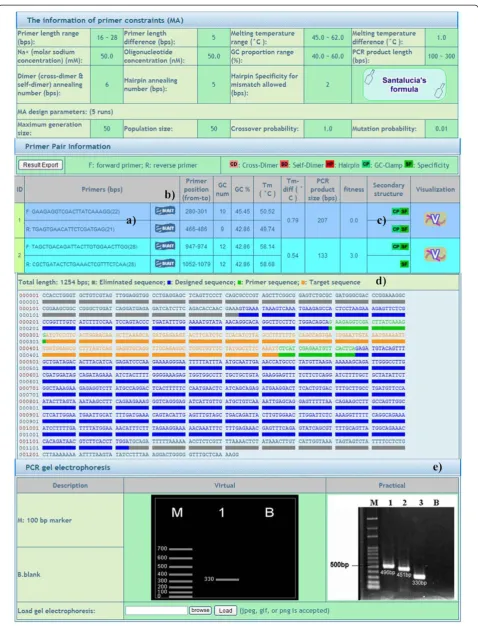
A pipeline mechanism is employed to effectively guide users. Three separate steps are included in the system. Template sequence input: users can choose from four input interfaces, namely a) nucleotide accession number key, b) copying/pasting or manual typing a template se-quence, c) primer pair information input, and d) copy-ing/pasting or manual typing a template sequences for high throughput (Figure 1). Secondly, the parameters can be set via a) a selection of a sequence range (only for single template sequence), b) input of primer design constraints, and c) primer design algorithm parameter adjustment (Figure 2). These parameters are useful for advanced users and are hidden by default for the occa-sional user. Finally, feasible primer pairs are output in one of four ways: a) URPD provides a ranked primer pair output (see Primer ranking mechanism for details). b) NCBI blast further enhances the specificity against the genome. c) Secondary structures of primers are clearly marked. d) The visualization shows the position of a primer pair and product information in a template sequence in color. e) A practical gel electrophoresis up-load function is also available for comparison to virtual gel electrophoresis (Figure 3).
Primer ranking mechanism
URPD implements a reliable primer ranking mechanism, which outputs a ranking of feasible primer pairs based on both their fitness score estimated by the MA/GA pri-mer design method and the melting temperature differ-ence between the designed primer pairs. The best primer set is always shown first. The fitness score esti-mation is based on the primer constraints, which in-clude the primer length, the primer length difference, the CG content, the melting temperature, the melting temperature difference, the PCR product size, dimers, hairpins, and the specificity (the detail estimation for fitness score is referred to [7]).
Secondary structure markers
Five secondary structures of primers are identified by clear markers in the URPD output. These are cross-dimers, self-cross-dimers, hairpins, GC-clamps, and the spe-cificity (Figure 3-c). This function is very useful for oc-casional users. It allows users to judge the quality of the designed primers. Cross-dimers, self-dimers, and
Chuanget al. BMC Research Notes2012,5:306 Page 2 of 9
hairpins are referred to AutoDimer [22]. GC-clamp checks whether the 3” terminal end of a primer is ei-ther nucleotide “G” or “C”. The check is used to avoid the denaturation of a primer when the temperature in the test tube is raised [9]. The specificity is evaluated
[image:3.595.57.538.88.625.2]for adequate primer annealing to the relevant positions by matching template sequences (internal) [23] and NCBI blast (external) [24]. Both the local and global searches are performed to further enhance the specificity.
Figure 2Parameter settings.The parameters have to be set viaa) a selection of the sequence range (only for single template sequence,
“From”and“To”are indicated by arrow lines),b) input of primer design constraints, andc) primer design algorithm parameter adjustment.
Chuanget al. BMC Research Notes2012,5:306 Page 4 of 9
Designed region selection and visualization
During the setting of parameters for the primer design, the designed region can be determined from a single template sequence by user system interaction (USI) (Figure 2-a). The function can be used to judge the qual-ity of the input template sequence. After the primer de-sign, the position of a primer pair and the product information in a template sequence is output visually (Figure 3-d). Via this function, users can explicitly iden-tify the locations of primers and select primers suitable for their own experiments. Moreover, visual virtual gel electrophoresis provides a simulated PCR environment which compares results to those of practical gel electro-phoresis (Figure 3-e). This provides a helpful validating mechanism in PCR experiments.
Results and discussions
Common output of URPD
Information regarding the primer constraints, such as primer length range, primer length difference, melting temperature range (°C), Na+(molar sodium concentra-tion), GC proportion range (%), PCR product length (bps), dimer (cross-dimer & self-dimer) annealing num-ber (bps), hairpin annealing numnum-ber (bps), and specifi-city for mismatches allowed (bps) are commonly output.
Algorithm design parameters, such as the maximum generation size, population size, crossover probability, and mutation probability are also shown. Finally, feasible primer information, such as primer length (bps), primer position (from-to), GC number, GC%, Tm (°C), Tm-diff (°C), PCR product size (bps), secondary structure, and visualization (Figure 3) are provided for all the inputs in URPD (Figure 1). The designed primer information can be output in a text file and then saved.
Experimental validation for URPD analysis
Chromosomal DNAs of Acinetobacter baumannii ATCC 19606 and the Staphylococcus aureus strain were extracted by a recommended protocol from “Molecular Cloning: A Laboratory Manual” 25]. These two DNAs were used as templates for producing the OXA-98 beta-lactamase gene (blaOXA) and penicillin-binding protein (pbp) PCR analysis. The DNA templates used for verifi-cation of the oligonucleotide primers included the genes encodingβ-lactamase gene (blaOXA 212 F and blaOXA 274 F) and penicillin binding protein gene (pbp 514 F). For all the genes, reaction mixtures (50 μL) included 2
μL template DNA (50 ng/μL), 5.0 μL of 10X Reaction Buffer (100 mM Tris–HCl , pH8.8 ; 500 mM KCl; 20 mM MgCl 2; 1% Triton X-100), 0.5 μL of YEAtaq DNA polymerase (5 U / μL), 1.0 μL of 10 mM dNTPs Mix, 10 pmol of each of the two primers, and 39.5μL of sterile water. The PCR program had the following parameters: 94°C (10 min); 35 cycles at 94°C for (1 min), 55°C (1 min), 72°C (1 min); and 72°C (10 min). The presence and sizes of amplicons were assessed by elec-trophoresis in 1% agarose gels stained with 0.001 mg/mL ethidium bromide. The PCR gel electrophoresis is shown in Figure 4, and the primers designed using accession number HQ425495.1 and AF540028.1 for blaOXA and pbp, respectively, are listed in Table 1.
Comparison to other primer design software
To date, various tools for facilitating primer design have been developed. Primer3Plus is the web based interface of the popular Primer3 primer design program and con-stitutes a superior alternative to the CGI-scripts that come with Primer3 [12]. UniPrime2 retrieves and aligns homologous sequences from Genbank automatically, identifies regions of conservation within the alignment, and generates suitable primers that allow amplification of various genomic regions [11]. PDA is a web-based tool that uses thermodynamic theories to evaluate the (See figure on previous page.)
[image:6.595.57.291.476.653.2]Figure 3Feasible primer pair output.Feasible primer pairs are output:a) URPD provides a ranked primer pair output. The best primer set is always shown first.b) NCBI blast further enhances the specificity against the genome.c) Secondary structures of primers are clearly marked.d) The visualization shows the position of a primer pair and product information in a template sequence in color.e) A practical gel electrophoresis upload function is also available for comparison to virtual gel electrophoresis.
Figure 4Validation of the URPD system by PCR analysis of the blaOXA resistance gene.Lane 1: 496 bp blaOXA amplified products for the blaOXA resistance gene. Lane 2: 451 bp blaOXA amplified products for the blaOXA resistance gene. Lane 3: 330 bp blaOXA amplified products for the penicillin-binding protein. The products were run on a 1%-agarose gel with a 100 bp ladder as a molecular size marker (Lane M).
Chuanget al. BMC Research Notes2012,5:306 Page 6 of 9
fitness of primers for primer design [13]. We compared URPD with these three web-based primer design soft-ware tools, i.e., Primer3Plus, UniPrime2, and PDA, in Table 2. We found that URPD is suitable for both advanced and occasional users and can facilitate small-scale experiments in regular laboratories.
Contributions of URPD
URPD's major contribution to primer design is the fact that it provides a method for reliably and simul-taneously evaluating the many constraints involved, and thus allows users to better screen primers at each of iteration. URPD uses heuristic methods to find possible primers and is thus feasible for the ana-lysis of large quantities of DNA templates. The con-tributions of URPD to primer design are summarized below:
1) The friendly and graphic user interface with its built-in parameters and incorporated smooth pipeline operations guides users in obtaining the desired results effectively. It also enables infrequent users to easily operate the system.
2) URPD contains an automated process, which produces feasible and specific primer pairs that satisfy the specific needs of the experimental design.
3) Accession numbers contained in NCBI RefSeq for different organisms are available as template sequences for the design of feasible primers. 4) URPD provides a high throughput primer design
function that is useful for large-scale experiments. 5) UCSC In-Silico PCR is integrated in URPD to acquire
[image:7.595.55.543.101.196.2]the product sequences that can be used to redesign the primers into more feasible ones (i.e., modification of potential PCR primers).
Table 1 - Nucleotide Sequences of Oligonucleotides used for PCR Amplification
Species ID Primers Nucleotide sequence (5’-3’) Primer length (bps) Tm (°C) GC% PCR targets Size (bp)
ATCC 19606 blaOXA212F GTGCTTCGACCGAGTATG 18 45.68 55.56 blaOXAresistance gene 496
blaOXA707R ACAACCATCCAGTTAACC 18 41.12 44.44
ATCC 19606 blaOXA274F GAGCACCATAAGGCAACC 18 45.68 55.56 blaOXAresistance gene 451
blaOXA724R TATTCCCTTGAGGCTGAAC 19 44.32 47.37
ATCC 6538p pbp514F ATGCTTTACGACAAAGTTTC 20 41.25 35.00 penicillin-binding protein 330
pbp843R TCTCAGCTAACATGTATGC 19 42.17 42.11
[image:7.595.58.545.483.725.2]The primers designed using accession number HQ425495.1 and AF540028.1 forblaOXAandpbp, respectively. F and R under the primers field represent forward primer and reverse primer, respectively. The number under the primers field represents the exact placement of the primer within the target sequence, e.g., the 212 F represents that the forward primer has the exact placement of 212 within the target sequence.
Table 2 Comparison of URPD with Primer3Plus, UniPrime2, and PDA
Features Software URPD Primer3Plus UniPrime2 PDA
Type web-based web-based web-based web-based
Availability http://bio.kuas.edu.tw/urpd/ http://www.bioinformatics.nl/ primer3plus/
http://uniprime. batlab.eu/
http://dbb.nhri.org.tw/ primer/
Primer design method Memetic Algorithm (MA) & Genetic Algorithm (GA)
Primer3-based Primer3-based ✘
User Interface intuitive user interface intuitive user interface, but complicated parameter settings
intuitive user interface
brief user interface
Sequence import single sequence or multiple sequences (high throughput)
single sequence single sequence single sequence or multiple sequences (high throughput)
Accession No. input ✓ ✘ ✘ ✘
UCSC In-silico PCR ✓ ✘ ✘ ✘
NCBI blast check built-in hyperlink built-in ✘
Template annealing check ✓ ✘ ✘ ✘
Pipeline leader ✓ ✘ ✓ ✓
Ranking mechanism ✓ ✘ ✘ ✓
Result file export text file text file e-mail MS-Excel
Visual PCR (gel electrophoresis) ✓ ✘ ✘ ✘
6) URPD contains a reliable primer ranking mechanism, outputs feasible primer set rankings based on both a fitness score estimated by effective methods and the melting temperature difference between designed primer pairs.
7) Visual virtual gel electrophoresis and in-silico PCR provide a simulated PCR environment.
8) Comparison of practical gel electrophoresis and virtual gel electrophoresis facilitates the PCR experiment.
Conclusions
URPD has been applied to design primers and subse-quently used to perform PCR experiments successfully. It is a user-friendly tool that provides specific primer design results. The pipeline design path allows easy operation, even by a beginner. Single template sequence and high throughput primer design are provided in URPD.
Moreover, advanced parameter settings can be accessed and set for more sophisticated PCR experiments. Several significantly novel functions, such as a nucleotide acces-sion number template sequence input, local and global specificity estimation, primer pair redesign, user-interactive sequence scale selection, and virtual and prac-tical PCR gel electrophoresis discrepancies have been developed and integrated into URPD.
Availability and requirements
The URPD web site and its user manual are freely ac-cessible at http://bio.kuas.edu.tw/urpd and http://bio. kuas.edu.tw/urpd/userManual.jsp, respectively. The user manual is also inculded as Additional file 1. The feasible primers are analyzed on-line. Both NCBI RefSeq [20] and UCSC In-Silico PCR [21] are constantly updated and retrieved on-line in an automated procedure. Our proposed application is mainly based on the iterative parameters of the population size and the running times. By setting the iterative parameters to smaller values, a faster performance is achieved; however, this impacts the quality of the designed parameters negatively. The de-fault values, i.e., a population size of 50 and five test runs, are usually sufficient for general primer designs. The retrieval formats for the used on-line databases is checked monthly to maintain proper on-line extraction of data.
Project name: URPD: A Specific Product Primer De-sign Tool.
Project home page: http://bio.kuas.edu.tw/urpd/. Operating system(s): Operating systems free with web browser.
Programming language: Java. Other requirements: Java 1.6.
License: none for academic users. For any restrictions applying to the use by nonacademics please contact the corresponding author.
Availability of supporting data
The data supporting the results of this article are included within the article (as Table 1). The data sup-porting the results of this article are also available at http://bio.kuas.edu.tw/urpd/experiments.jsp.
Additional file
Additional file 1: The user manual for URPD (yoUR Primer Design) -A Specific Product Primer Design Tool.
Abbreviations
blaOXA: OXA-98 beta-lactamase gene; CGI: Common Gateway Interface; bps: base pairs; DNA: Deoxyribonucleic Acid; GA: Genetic Algorithm; MA: Memetic Algorithm; pbp: penicillin-binding protein; PCR: Polymerase Chain Reaction; zPDA: Primer Design Assist; RefSeq: NCBI Reference Sequences; Tm: Melting Temperature; URPD: YoUR Primer Design; USI: User System Interaction.
Competing interests
The authors declare they have no competing interests.
Authors’contributions
L-YC provided the biochemistry background, introduced the bioinformatics needed, and verified the PCR experiment. Y-HC participated in the design of the algorithm, the development of the system, and the writing of the manuscript. C-HY coordinated and oversaw this study, and modified the manuscript. All authors read and approved the final manuscript.
Acknowledgements
This work is partly supported by the National Science Council (NSC) in Taiwan under grant NSC99-2622-E-151-019-CC3, NSC99-2221-E-151-056-, and NSC101-2221-E-464-001-.
Author details
1Department of Chemical Engineering, Institute of Biotechnology and Chemical Engineering, I-Shou University, Kaohsiung, Taiwan.2Department of Digital Content Design and Management, Toko University, Chiayi, Taiwan. 3Department of Electronic Engineering, National Kaohsiung University of Applied Sciences, Kaohsiung, Taiwan.
Received: 15 March 2012 Accepted: 20 May 2012 Published: 19 June 2012
References
1. Yuryev A, Huang J, Pohl M, Patch R, Watson F, Bell P, Donaldson M, Phillips MS, Boyce-Jacino MT:Predicting the success of primer extension genotyping assays using statistical modeling.Nucleic Acids Res2002,
30(23):e131.
2. Housley DJE, Zalewski ZA, Beckett SE, Venta PJ:Design factors that influence PCR amplification success of cross-species primers among 1147 mammalian primer pairs.BMC genomics2006,7(1):253. 3. Andreson R, Mols T, Remm M:Predicting failure rate of PCR in large
genomes.Nucleic Acids Res2008,36(11):e66.
4. Boyle B, Dallaire N, MacKay J:Evaluation of the impact of single nucleotide polymorphisms and primer mismatches on quantitative PCR.
BMC Biotechnol2009,9:75.
5. Wu JS, Lee C, Wu CC, Shiue YL:Primer design using genetic algorithm.
Bioinformatics2004,20(11):1710–1717.
6. Wang J, Li KB, Sung WK:G-PRIMER: greedy algorithm for selecting minimal primer set.Bioinformatics2004,20(15):2473–2475.
7. Yang CH, Cheng YH, Chuang LY, Chang HW:Specific PCR product primer design using memetic algorithm.Biotechnol Prog2009,25(3):745–753.
Chuanget al. BMC Research Notes2012,5:306 Page 8 of 9
8. Robertson JM, Walsh-Weller J:An introduction to PCR primer design and optimization of amplification reactions.Methods in Molecular Biology1998,
98:121–154.
9. Rozen S, Skaletsky H:Primer3 on the WWW for general users and for biologist programmers.Methods in Molecular Biology2000,132(3):365–386. 10. Bekaert M, Teeling EC:UniPrime: a workflow-based platform for improved
universal primer design.Nucleic Acids Res2008,36(10):e56. 11. Boutros R, Stokes N, Bekaert M, Teeling EC: UniPrime2: a web service
providing easier Universal Primer design. Nucleic Acids Res 2009, 37(Web Server issue):W209-W213.
12. Untergasser A, Nijveen H, Rao X, Bisseling T, Geurts R, Leunissen JA: Primer3Plus, an enhanced web interface to Primer3. Nucleic acids research 2007, 35(Web Server issue):W71-W74.
13. Chen SH, Lin CY, Cho CS, Lo CZ, Hsiung CA:Primer Design Assistant (PDA): A web-based primer design tool.Nucleic Acids Res2003,31(13):3751–3754. 14. Jong KD:Learning with genetic algorithms: an overview.Mach Learning
1988,3:121–138.
15. Goldgerg DE:Genetic algorithms in search, optimization, and machine learning. New York: Addison-Wesley; 1989.
16. Holland J:Adaptation in Nature and Artificial Systems. MIT Press; 1992. 17. Dawkins R:The selfish gene. USA: Oxford University Press; 2006. 18. Merz P, Freisleben B:A genetic local search approach to the quadratic
assignment problem.Proceedings of the 7th international conference on genetic algorithms1997, 465–472.
19. SantaLucia J Jr:A unified view of polymer, dumbbell, and oligonucleotide DNA nearest-neighbor thermodynamics.Proc Natl Acad Sci U S A1998,
95(4):1460–1465.
20. Pruitt KD, Tatusova T, Klimke W, Maglott DR:NCBI Reference Sequences: current status, policy and new initiatives.Nucleic Acids Res2009,
37(Database issue):D32–D36.
21. Rhead B, Karolchik D, Kuhn RM, Hinrichs AS, Zweig AS, Fujita PA, Diekhans M, Smith KE, Rosenbloom KR, Raney BJ,et al:The UCSC Genome Browser database: update 2010.Nucleic Acids Res2010,
38(Database issue):D613–D619.
22. Vallone PM, Butler JM:AutoDimer: a screening tool for primer-dimer and hairpin structures.Biotechniques2004,37(2):226–231.
23. Navarro G:A guided tour to approximate string matching.ACM Comput Surv2001,33(1):31–88.
24. Camacho C, Coulouris G, Avagyan V, Ma N, Papadopoulos J, Bealer K, Madden TL:BLAST+: architecture and applications.BMC Bioinformatics 2009,10:421.
25. Sambrook J, Russell DW:Molecular cloning: a laboratory manual. New York: Cold Spring Harbor Laboratory Press; 2001.
doi:10.1186/1756-0500-5-306
Cite this article as:Chuanget al.:URPD: a specific product primer design tool.BMC Research Notes20125:306.
Submit your next manuscript to BioMed Central and take full advantage of:
• Convenient online submission
• Thorough peer review
• No space constraints or color figure charges
• Immediate publication on acceptance
• Inclusion in PubMed, CAS, Scopus and Google Scholar
• Research which is freely available for redistribution