White Rose Research Online URL for this paper:
http://eprints.whiterose.ac.uk/153120/
Version: Published Version
Proceedings Paper:
Huber, Patrik orcid.org/0000-0002-1474-1040, Hu, Guosheng, Tena, Rafael et al. (5 more
authors) (2016) A Multiresolution 3D Morphable Face Model and Fitting Framework. In:
Proceedings of the 11th Joint Conference on Computer Vision, Imaging and Computer
Graphics Theory and Applications. SciTePress , pp. 79-86.
https://doi.org/10.5220/0005669500790086
[email protected] https://eprints.whiterose.ac.uk/
Reuse
This article is distributed under the terms of the Creative Commons Attribution-NonCommercial-NoDerivs (CC BY-NC-ND) licence. This licence only allows you to download this work and share it with others as long as you credit the authors, but you can’t change the article in any way or use it commercially. More
information and the full terms of the licence here: https://creativecommons.org/licenses/
Takedown
If you consider content in White Rose Research Online to be in breach of UK law, please notify us by
Patrik Huber
1, Guosheng Hu
2, Rafael Tena
1∗, Pouria Mortazavian
3, Willem P. Koppen
1,
William Christmas
1, Matthias R¨atsch
4and Josef Kittler
11Centre for Vision, Speech & Signal Processing, University of Surrey, Guildford, U.K. 2LEAR Group, INRIA Grenoble Rhˆone-Alpes, Montbonnot, France
3Samsung Electronics Research Institute, London, U.K. 4Reutlingen University, Reutlingen, Germany
Keywords: 3D Morphable Face Model, 3D Face Reconstruction, Face Model Fitting, Pose Estimation, Shape Recon-struction, Open Source Software.
Abstract: 3D Morphable Face Models are a powerful tool in computer vision. They consist of a PCA model of face shape and colour information and allow to reconstruct a 3D face from a single 2D image. 3D Morphable Face Models are used for 3D head pose estimation, face analysis, face recognition, and, more recently, facial landmark detection and tracking. However, they are not as widely used as 2D methods - the process of building and using a 3D model is much more involved.
In this paper, we present the Surrey Face Model, a multi-resolution 3D Morphable Model that we make available to the public for non-commercial purposes. The model contains different mesh resolution levels and landmark point annotations as well as metadata for texture remapping. Accompanying the model is a lightweight open-source C++library designed with simplicity and ease of integration as its foremost goals. In addition to basic functionality, it contains pose estimation and face frontalisation algorithms. With the tools presented in this paper, we aim to close two gaps. First, by offering different model resolution levels and fast fitting functionality, we enable the use of a 3D Morphable Model in time-critical applications like tracking. Second, the software library makes it easy for the community to adopt the 3D Morphable Face Model in their research, and it offers a public place for collaboration.
1
INTRODUCTION
3D face models and in particular 3D Morphable Mod-els are a powerful tool for computer vision. They have applications in 2D face processing such as track-ing, face analysis, recognition, pose estimation and pose normalisation. 3D Morphable Models (3DMM) were proposed by Blanz and Vetter in 1999 (Blanz and Vetter, 1999) and since then have been applied to a variety of these tasks. However they are not as widespread in use as their 2D counterparts (for exam-ple Active Appearance Models (Cootes et al., 2001)), yet they have certain distinct advantages over 2D methods. In a 3D model, the pose of a face is clearly separated from the shape. Its projection to 2D is mod-eled by a physical camera model, such as a perspec-tive or affine camera model. Also, the use of a 3D face model allows to model the light explicitly since 3D surface normals, self-occlusion and depth information are available. The illumination model separates light from the face appearance and is not encoded in the
∗now at Disney Research
texture parameters, as is for example the case in 2D AAMs. The most prominent approaches to modelling the environment or light sources in conjunction with 3DMMs are spherical harmonics (Aldrian and Smith, 2013; Zivanov et al., 2013) and the Phong illumina-tion model (Romdhani and Vetter, 2005; Hu et al., 2012).
Furthermore, a 3D Morphable Model can be used in a generative way to create specific faces or to gen-erate annotated training data for other algorithms that e.g. covers a large variety of pose angles, including more extreme poses like profile views. For exam-ple, R¨atsch et al. (R¨atsch et al., 2012) used 3DMM-generated data to improve the performance of a 2D pose regressor, while Feng et al. (Feng et al., 2015) augment the training data of their facial landmark detection with 3DMM data to make it more robust on larger pose angles. Very recently, 3DMMs have also been used directly with regression-based meth-ods (Huber et al., 2015; Zhu et al., 2015) with aspira-tions to provide a unified solution to landmark detec-tion and 3D model fitting.
Huber, P., Hu, G., Tena, R., Mortazavian, P., Koppen, W., Christmas, W., Rätsch, M. and Kittler, J. A Multiresolution 3D Morphable Face Model and Fitting Framework.
DOI: 10.5220/0005669500790086
On the other hand, a 3D Morphable Face Model is comparatively hard to obtain and use. To train a model, a number of good quality 3D scans are needed. These scans then need to be brought into dense corre-spondence with a mesh registration algorithm. After building a model, a model-to-image fitting algorithm is required, and these fitting algorithms are often very complex, slow, and are easily trapped in local min-ima. The non-trivial training and fitting is in our opin-ion one of the main reasons for the limited adoptopin-ion of 3D Morphable Face Models, and there is a lack of readily available 3D face model fitting frameworks.
In 2009, Vetter et al. published the Basel Face Model (BFM, (Paysan et al., 2009)) to spur research with Morphable Models. It surpassed existing mod-els (Sarkar, 2005; Blanz and Vetter, 1999) by the accuracy of the scanner used and the quality of the registration algorithm, and their multi-segment face model, along with fitting results and various metadata, can be obtained after signing a licence agreement. While this led to some adoption by other research groups (e.g. (van Rootseler et al., 2012; Aldrian and Smith, 2013)), the adoption is still limited. Addition-ally, while the BFM provides the model, they only provide fitting results for limited databases and do not provide algorithms to apply the model to novel im-ages. With the model and software framework pub-lished in this paper, we aim to go one step further and make our model available as well as a lightweight fit-ting framework promofit-ting the use of the model.
This paper introduces the Surrey Face Model
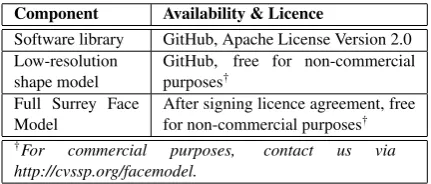
[image:3.595.308.524.110.202.2](SFM), a multi-resolution 3D Morphable Face Model. The model consists of three different resolution lev-els of shape and colour, a pose-invariant image tex-ture representation and metadata such as landmark point information. The model is available freely for non-commercial purposes. Alongside the model, we present a library to interface with the model and per-form basic pose and shape fitting. The main focus of the software is its ease of use and interoperability with the popular OpenCV library. The library is open source, available underApache License, Version 2.0, and actively developed on GitHub, creating a public place for exchange and contributions. In addition to the full 3DMM being available via the University, we release a low-resolution shape-only model distributed within the software. In contrast to the Basel Face Model, we offer the models at lower resolutions as well, which are much more practical for many appli-cations. We focus on ease of use of the framework for vision tasks such as face tracking, pose estimation and face frontalisation, and hope to further pave the way to make 3DMMs more widely adopted. Table 1 summarises how the different parts are available.
Table 1: Availability of the different components.
Component Availability & Licence
Software library GitHub, Apache License Version 2.0 Low-resolution
shape model
GitHub, free for non-commercial purposes†
Full Surrey Face Model
After signing licence agreement, free for non-commercial purposes† †For commercial purposes, contact us via
http://cvssp.org/facemodel.
The contributions of this work are threefold. First, we present the Surrey Face Model, a multi-resolution 3D Morphable Face Model that we make available to the public for non-commercial purposes. Second, we present a lightweight open-source Morphable Model software framework written in modern C++ that is designed with simplicity and ease of integration as its primary goals. Lastly, we make a low resolution shape model available together with the software to allow an immediate start with the framework. With this whole package, our aim is to make 3D Mor-phable Models easily available and to encourage re-search with 3D face models.
In the rest of this paper, we first describe the acqui-sition and the building process as well as the metadata of the Surrey Face Model in detail (Section 2). We in-troduce the resolution levels and show visualisations of the model and its PCA components. In Section 3, we then present the accompanying software frame-work and demonstrate its ease of use and flexibility by means of a 3D pose estimation and face frontalisa-tion example. Secfrontalisa-tion 4 concludes the paper.
2
THE SURREY FACE MODEL
The Surrey Face Model consists of a 3D Morphable Model, that is, a PCA shape model and a PCA colour model, each in different resolution levels, and accom-panying metadata, like a 2D texture representation and landmark annotations. The following sections will describe each part in detail.
2.1
3D Morphable Models
A 3D Morphable Model is based on three dimensional meshes of faces that have been registered to a refer-ence mesh, i.e. are in dense correspondrefer-ence. A face is represented by a vectorS∈R3N, containing the x, y and z components of the shape, and a vectorT∈R3N, containing the per-vertex RGB colour information. N
is the number of mesh vertices. The 3DMM consists of two PCA models, one for the shape and one for the
colour information. Each PCA model
M:= (¯v,σ,V) (1)
consists of the components ¯v∈R3N, which is the mean of the example meshes, a set of principal com-ponentsV= [v1, . . . ,vn−1]∈R3N×n−1, and the stan-dard deviationsσ∈Rn−1. n is the number of scans used to build the model. Novel faces can be gener-ated by calculating
S=¯v+ M
∑
i
αiσivi (2)
for the shape, where M ≤n−1 is the number of principal components and α∈RM are the 3D face instance coordinates in the shape PCA space. The same is calculated for the colour (or so-called albedo) model.
2.2
3D Scan Data
The Surrey Face Model is built using a number of high-resolution 3D scans that were acquired at our lab. The scans were captured using a 3dMDface2 camera system that consists of two structured light projectors, 4 infrared cameras that capture the light pattern and are used to reconstruct the 3D shape, and two RGB cameras recording a high-resolution face texture. Half the cameras record the face from the left side, the other half from the right side, resulting in a 180◦view of the face. The images are acquired under uniform illumination to ensure that the model texture is representative of face skin albedo only. The 3dMDface software reconstructs a textured 3D mesh from this information.
These scans can then be brought into dense corre-spondence using a 3D to 3D registration algorithm, in our case the Iterative Multi-resolution Dense 3D Reg-istration (IMDR) method (Tena et al., 2006). Figure 1 shows an example scan with the captured mesh on the left, the RGB texture in the middle, and the scan after registration to the 3D model. The registration process is described in more detail in the next section together with how we built the multi-resolution model.
Figure 1:(left): Raw mesh output from the 3dMDface soft-ware. (middle): Texture image from two angles captured by the 3dMDface cameras. (right): The scan and texture densely registered to the 3D model.
2http://www.3dmd.com/
Our recorded subjects represent a diverse range of skin tones and face shapes to well represent the mul-ticultural make up of many modern societies. Fig-ure 2 shows the perceived racial distribution of the 169 scans used to build the model. Non-Caucasian people are well-represented and significant numbers of subjects from other races are included allowing the model to generalise well to people from various backgrounds. This is in stark contrast to the BFM, which only contains a very insignificant number of non-Caucasian people.
[image:4.595.80.283.609.661.2]The age of the recorded people was categorised into 5 groups. 9 are teens (age 0-19), 106 young adults (20-29), 33 adults (30-44), 13 mature (45-59) and 8 seniors (60+). Similar to the BFM, most peo-ple are in the young-adult range, but the Surrey Face Model contains more people in the 30+ groups.
Figure 2: Racial distribution of the 169 scans used to train the Surrey Face Model. Our model is generated from a sig-nificant number of non-Caucasian people.
2.3
Multi-resolution Model Generation
The Surrey Face Model comes in three different res-olution levels. After obtaining the full set of scans, they are registered using the Iterative Multi-resolution Dense 3D Registration (IMDR) algorithm. It uses a deformable reference 3D face model and performs a combination of global mapping, local matching and energy-minimisation to establish dense correspon-dence among all the scans at different resolution lev-els. The generic reference face we used has 845 ver-tices and 1610 triangles. The following is a high-level overview of the process:
1. The target scan is denoised using Gaussian and median filtering if spikes and noise are present.
2. Perform a global mapping from the generic model to the target scan using facial landmarks, smoothly deforming the generic model.
be matched, its mirrored counterpart is used (and if that fails as well, the algorithm interpolates us-ing the neighbourus-ing matches).
4. The final set of matches guides an energy min-imisation process that conforms the model to the target scan. Steps 3 and 4 are iterated.
5. The generic face model is subdivided using the 4-8 mesh subdivision algorithm (Velho and Zorin, 2001).
[image:5.595.310.523.98.281.2]6. Steps 3 to 5 are repeated until the desired highest mesh resolution is achieved.
[image:5.595.73.301.382.517.2]Table 2 shows the three constructed resolution lev-els with their number of vertices and triangles. The smallest model consists of 3448 vertices and the full model consists of 29587 vertices. Figure 3 depicts the three mesh resolutions with a close-up on the model’s mesh. Note that the higher resolution meshes are built upon the lower resolutions, and therefore each ver-tex from a lower resolution mesh is also present in all higher resolution meshes, and has the same vertex index.
Table 2: The different model resolution levels.
Model name No. vertices No. triangles
sfm 29587 29587 59763
sfm 16759 16759 33211
sfm 3448 3448 6736
Figure 3: Close-up of the different mesh resolutions of the Surrey Face Model. (left): The low-resolution model with 3448 vertices.(middle): Medium-resolution model (16759 vertices)(right): The full resolution model (29587 vertices).
2.4
Shape and Colour Model
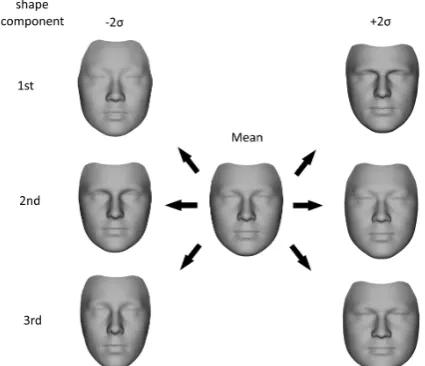
The shape and colour PCA models are built using aforementioned 169 registered scans. Of the result-ing PCA basis matrix, we keep 63 shape eigenvectors and 132 colour eigenvectors so that 99% of the origi-nal variation of the data is preserved after reconstruc-tion. To analyse the variations in the face model, we can visualise the directions of largest variance in the PCA space by taking the formula in Equation 2 and setting a specificαito a fixed value while setting all others to zero. The resulting face meshS can then be rendered. Figure 4 shows the mean of the model
Figure 4: The mean face and shape variation of the high-resolution Surrey Face Model. The figure shows the first three PCA shape coefficients at -2 and +2 standard devia-tions.
and the first three shape components set to±2 stan-dard deviations. The first components mainly account for global structure of the face, like global face shape (more round or square, slim or chubby) and size of the face. Later components model the finer structures of the face.
Figure 5 depicts the colour PCA model with the colour coefficients set to ±2 standard deviations. Varying the first component of the colour model re-sults mainly in a change of global skin colour from black to white, while the second component models more diverse changes relating to the gender. The third component encodes a mixture of skin colour and pos-sibly gender.
Along with the model, we publish annotations of the most commonly used facial landmark points for all resolution levels. When using the model, it is use-ful to have a standardised and known set of the loca-tion (i.e. vertex index) of certain points like the eye corners or the tip of the nose on the mesh. We pro-vide such metadata with the model. Whenever pos-sible, the points are defined on the generic reference face or in the lowest model resolution and valid on all model levels. Some points are only defined on the higher mesh resolutions because the mesh resolution at a lower level is too coarse and does not have a ver-tex at the landmark location. Figure 6 shows a set of manually selected landmark points on the mesh that correspond to a subset of the popular ibug facial point annotations3.
3http://ibug.doc.ic.ac.uk/resources/facial-point-annotations/
Figure 5: The mean face and colour variation of the high-resolution Surrey Face Model. The figure shows the first three PCA colour coefficients at -2 and +2 standard devia-tions.
Figure 6: The facial landmark points that are annotated on the mesh and available as metadata together with the model.
2.5
Texture Representation
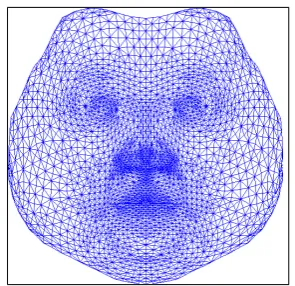
[image:6.595.341.489.95.238.2]The PCA colour model is a useful representation for the appearance of a face, but in some cases it is desir-able to use the pixel colour information (texture) from the image or a combination of the two. The texture from the input image remapped onto the mesh pre-serves all details of a face’s appearance, while some high-frequency information can be lost if a face is only represented using the PCA colour model. An-other reason to use the texture is to avoid a colour and light model fitting, for example in consideration of run-time. Therefore, we would like a 2D represen-tation of the whole face mesh that we can use to store the remapped texture. We create such a generic rep-resentation with the isomap algorithm (Tenenbaum et al., 2000): it finds a projection from the 3D vertices to a 2D plane that preserves the geodesic distance be-tween the mesh vertices. Our mapping is computed with the algorithm from Tena (Rodr´ıguez, 2007).
Figure 7: Texture representation in the form of an isomap. The 3D mesh vertices are projected to 2D with an algo-rithm that preserves the geodesic distance between ver-tices, resulting in a pose-independent, detail-preserving tex-tural representation of a face. Shown is the isomap of the
sfm 3448.
In contrast to other representations, like for exam-ple cube mapping, this isomap has the advantage that it can be stored as a single 2D image, and it has face-like appearance, i.e. it can be easily used with ex-isting face recognition and face analysis techniques. The isomap coordinates are only generated once, that is the isomaps of different people are in dense cor-respondence with each other, meaning each location in the map corresponds to the same physical point in the face of every subject (for example, a hypothetical pointx= [100,120]is always the center of the right
[image:6.595.78.304.339.450.2]eye). This makes the isomap especially suitable for processing with further algorithms.
Figure 7 shows the isomap of the low-resolution model as a wireframe. The isomap captures the whole face, while for example a rendering of the mesh would always only show parts of the face.
We provide texture coordinates generated with the isomap algorithm for each model resolution level.
3
SOFTWARE FRAMEWORK
The Surrey Face Model is accompanied by an open source software framework that is available on GitHub under Apache License, Version 2.0. It is a lightweight and cross-platform header-only library built using modern C++, which makes it very flex-ible, easy to use and simple to include into exist-ing software. The library requires no other depen-dency than applications developed using it linking to OpenCV-core. The software framework includes a low-resolution shape-only model (sfm shape 3448) to facilitate immediate use.
about the core functionality of the framework and then present the pose and landmark fitting algorithms included in the software and a basic use case example. The library, low-resolution shape model, example ap-plications and a complete documentation are available at https://github.com/patrikhuber/eos.4
3.1
Core Functionality
A 3D Morphable Model is represented using a thin layer on top of OpenCV. APcaModelclass contains a mean, the PCA basis vectors and eigenvalues, and aMorphableModelclass contains a shape and colour PCA model and texture coordinates, along with the functionality to retrieve a mesh that can be rendered. Figure 8 shows an UML-like overview of this basic functionality.
Figure 8: UML-like diagram of theMorphableModeland PcaModelclasses, which are simple wrappers for the un-derlying PCA and model metadata (diagram slightly sim-plified).
A model can be loaded as simple as: MorphableModel model =
load_model("sfm_shape_3448.bin");
֒→
The semantic landmark information (see end of Section 2.4) is stored separately as it differs depend-ing on the use-case and it can be accessed through aLandmarkMapperclass. In the following, we will extend this code snippet and build a 3D face frontal-isation example with the software framework in only a few lines of code.5
In addition to loading the Surrey Face Models, we provide a script to convert and load the Basel Face Model.
3.2
Landmark Fitting
The library includes methods to fit the pose and shape of a model and perform face frontalisation. This sec-tion describes the individual components and how they fit together.
4The functionality described in this paper is based on
v0.5.0. Naturally, software evolves, and certain parts might be slightly different in future versions. We encourage users to look at the example app of the most current version.
5For the sake of brevity, we omit namespaces in the code examples. Where not otherwise indicated, types and func-tions are either in thestdor our library’s namespace.
3.2.1 Pose Estimation
The first component presented here is pose (camera) fitting. Given a set of 2D landmark locations and their known correspondences in the 3D Morphable Model, the goal is to estimate the pose of the face (or the po-sition of the camera, which in this case is the identical problem). We assume an affine camera model and implement theGold Standard Algorithm of Hartley & Zisserman (Hartley and Zisserman, 2004), which finds a least squares approximation of a camera ma-trix given a number of 2D - 3D point pairs.
First, the detected or labeled 2D landmark points in the imagexi∈R3and the corresponding 3D model points Xi ∈ R4 (both represented in homogeneous coordinates) are normalised by similarity transforms that translate the centroid of the image and model points to the origin and scale them so that the Root-Mean-Square distance from their origin is√2 for the landmark and√3 for the model points respectively: ˜
xi=TxiwithT∈R3×3, and ˜Xi=UXiwithU∈R4×4. Using≥4 landmark points, we then compute a nor-malised camera matrix ˜C∈R3×4using theGold Stan-dard Algorithm (Hartley and Zisserman, 2004) and obtain the final camera matrix after denormalising: C=T−1CU.˜
Computing the camera matrixCinvolves solving a linear system of equations - the algorithm calculates the least squares solution, so any number of corre-sponding points can be given. This process is also very fast, taking only a few milliseconds to compute.
The function in our library can be run by simply loading and defining point correspondences and then calling the algorithm:
vector<cv::Vec2f> image_points = ...; vector<cv::Vec3f> model_points = ...; Mat affine_camera =
estimate_affine_camera(image_points, model_points);
֒→
֒→
which returns the estimated 3×4 affine camera matrix that can subsequently be used in the next steps.
3.2.2 Shape Fitting
The second component in our face frontalisation ex-ample consists of reconstructing the 3D shape using the estimated camera matrix. We implement a sim-ple shape-to-landmarks fitting similar to the algorithm from Aldrian & Smith (Aldrian and Smith, 2013). We find the most likely vector of PCA shape coefficients
αby minimising the following cost function:
E= 3N
∑
i=1
(ym2D,i−yi)2
2σ2 2D
+kαk22, (3)
whereNis the number of landmarks,yare detected or labelled 2D landmarks in homogeneous coordinates,
σ2
2Dis an optional variance for these landmark points, andym2Dis the projection of the 3D Morphable Model shape to 2D using the estimated camera matrix. More specifically,ym2D,i=Pi·(Vˆhα+¯v), wherePi is the
i-th row ofPandPis a matrix that has copies of the camera matrixCon its diagonal, andVhˆ is a modi-fied PCA basis matrix that consists of a sub-selection of the rows that correspond to the landmark points that the shape is fitted to. Additionally, a row of zeros is inserted after every third row to accommo-date for homogeneous coordinates, and the basis vec-tors are multiplied with the square root of their re-spective eigenvalue. The cost function in (3) can be brought into a standard linear least squares formula-tion. For details of the algorithm, we refer the reader to (Aldrian and Smith, 2013).
This functionality is directly mapped into code. The shape coefficients can be estimated as:
vector<float> shape_coefficients = fit_shape_to_landmarks_linear(model, affine_camera, image_points,
vertex_indices, lambda);
֒→
֒→ ֒→
The first three parameters are given from the previ-ous step. Thevertex_indicesare obtained with the supplied landmark annotation metadata and the map-ping facilities of the library - we refer to the online material for the full documentation.lambdais an op-tional regularisation parameter to constrain the opti-misation to plausible shapes.
The pose estimation and shape fitting steps can be iterated if desired to refine the estimates. The pose es-timation can make use of the shape estimate (instead of using the mean face) to refine the face pose. The shape estimate can in turn use the refined camera ma-trix to improve the shape fitting. The shape estimation is as fast as the pose estimation: each of them only in-volves solving a small linear system of equations and runs in the order of milliseconds.
3.2.3 Texture Representation
After obtaining the pose and shape coefficients, there is a dense correspondence between mesh vertices and the face in the input image. We can then remap the texture onto the model, and store it, and re-render it in arbitrary poses, e.g. frontalise it. The texture can be extracted and stored in the isomap introduced in Section 2.5 with another simple call to the library:
Mesh model_instance =
model.draw_sample(shape_coefficients);
֒→
Mat isomap = extract_texture(model_instance, affine_camera, input_image);
֒→
Note that, in addition to being used to remap the texture or visualise the model, draw sampleallows drawing arbitrary samples from the model, for exam-ple to generate artificial training data from the 3D face model.
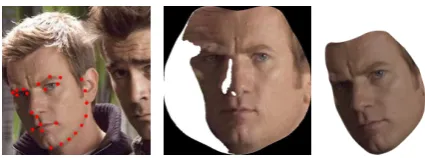
[image:8.595.308.521.227.306.2]Figure 9 shows an example fitting with the input image, the resulting shape and camera model fitting, and the extracted face texture as an isomap. In the figure, regions of self-occlusion are depicted as white spots; however, in the isomap, they are identified by the alpha channel.
Figure 9: An example result of the landmark fitting. (left): Input image from LFPW.(middle): The extracted face tex-ture as isomap. Regions of self-occlusion are depicted in white.(right): Resulting shape and camera model fitting.
This section presented how the proposed lightweight library makes it possible to build a real-time 3D pose estimation and face frontalisation system with little effort. The example code snippets from these sections can be combined into a fully working application with not many more lines than presented here. The pose estimation and landmark fitting run in a matter of milliseconds, while the texture remapping is the slowest component taking around 100 milliseconds (measured on an Intel Core i7-4700MQ). That is, to reduce dependencies of the framework and to make it run on any environment, it is not using OpenGL or any other acceleration technique. The main goals of the library are that it is simple, easy to use, easy to integrate into existing software and extensible. The full documentation, which includes additional functionality not presented here, as well as the complete and documented example application from this section, are available in the library repository.
4
CONCLUSIONS
the model and is actively developed on GitHub at https://github.com/patrikhuber/eos. The software fea-tures real-time shape model fitting and face frontalisa-tion funcfrontalisa-tionality and interoperability with OpenCV.
In contrast to existing work, the Surrey Face Model is available in multiple resolution levels and is built from racially diverse scans. Furthermore, a model-fitting software is available alongside the model to fit the model to novel images and videos. By designing the whole framework with simplicity as its foremost goal and using a public place for de-velopment and interaction, we hope to spur research with 3D Morphable Face Models in the community and encourage new parties to tackle their challenges with 3D face models. In addition to the full 3DMM being available via the University, we release a low-resolution shape model distributed directly within the public repository so that interested researchers can be ready-to-go in a matter of minutes.
Instructions to acquire the full model are available at http://cvssp.org/facemodel.
ACKNOWLEDGEMENTS
Partial support from the BEAT project (Euro-pean Union’s Seventh Framework Programme, grant agreement 284989) and the EPSRC Programme Grant EP/N007743/1 is gratefully acknowledged.
REFERENCES
Aldrian, O. and Smith, W. A. P. (2013). Inverse rendering of faces with a 3D Morphable Model. IEEE Trans-actions on Pattern Analysis and Machine Intelligence, 35(5):1080–1093.
Blanz, V. and Vetter, T. (1999). A Morphable Model for the synthesis of 3D faces. InProceedings of the 26th An-nual Conference on Computer Graphics and
Interac-tive Techniques (SIGGRAPH), pages 187–194. ACM
Press/Addison-Wesley Publishing Co.
Cootes, T., Edwards, G., and Taylor, C. (2001). Active ap-pearance models.IEEE Transactions on Pattern Anal-ysis and Machine Intelligence, 23(6):681 –685. Feng, Z.-H., Huber, P., Kittler, J., Christmas, W., and Wu,
X.-J. (2015). Random cascaded-regression copse for robust facial landmark detection. IEEE Signal Pro-cessing Letters, 22(1):76–80.
Hartley, R. I. and Zisserman, A. (2004).Multiple View
Ge-ometry in Computer Vision. Cambridge University
Press, second edition.
Hu, G., Chan, C.-H., Kittler, J., and Christmas, W. (2012). Resolution-aware 3D Morphable Model. In British Machine Vision Conference (BMVC), pages 1–10.
Huber, P., Feng, Z., Christmas, W., Kittler, J., and R¨atsch, M. (2015). Fitting 3D Morphable Models using local features. InIEEE International Conference on Image Processing (ICIP).
Paysan, P., Knothe, R., Amberg, B., Romdhani, S., and Vet-ter, T. (2009). A 3D face model for pose and illumi-nation invariant face recognition. In Proceedings of the 6th IEEE International Conference on Advanced Video and Signal based Surveillance (AVSS). R¨atsch, M., Huber, P., Quick, P., Frank, T., and Vetter,
T. (2012). Wavelet reduced support vector regres-sion for efficient and robust head pose estimation. In
IEEE Ninth Conference on Computer and Robot Vi-sion (CRV), pages 260–267.
Rodr´ıguez, J. R. T. (2007).3D Face Modelling for 2D+3D Face Recognition. PhD thesis, University of Surrey. Romdhani, S. and Vetter, T. (2005). Estimating 3D shape
and texture using pixel intensity, edges, specular high-lights, texture constraints and a prior. InIEEE Con-ference on Computer Vision and Pattern Recognition (CVPR), volume 2, pages 986–993. IEEE.
Sarkar, S. (2005). USF HumanID 3D face dataset. Tena, J. R., Hamouz, M., Hilton, A., and Illingworth, J.
(2006). A validated method for dense non-rigid 3D face registration. InAdvanced Video and Signal Based Surveillance, 2006 IEEE International Conference on Video and Signal Based Surveillance (AVSS’06), 22-24 November 2006, Sydney, Australia., page 81. IEEE Computer Society.
Tenenbaum, J. B., de Silva, V., and Langford, J. C. (2000). A global geometric framework for nonlinear dimen-sionality reduction.Science, 290:2319–2323. van Rootseler, R. T. A., Spreeuwers, L. J., and Veldhuis, R.
N. J. (2012). Using 3D Morphable Models for face recognition in video. InProceedings of the 33rd WIC Symposium on Information Theory in the Benelux. Velho, L. and Zorin, D. (2001). 4-8 subdivision.Computer
Aided Geometric Design, 18(5):397–427.
Zhu, X., Yan, J., Yi, D., Lei, Z., and Li, S. Z. (2015). Discriminative 3D Morphable Model fitting. In In-ternational Conference on Automatic Face and Ges-ture Recognition, FG 2015, 4-8 May, 2015, Ljubljana, Slovenia. IEEE.
Zivanov, J., Forster, A., Sch¨onborn, S., and Vetter, T. (2013). Human face shape analysis under spherical harmonics illumination considering self occlusion. In
International Conference on Biometrics, ICB 2013, 4-7 June, 2013, Madrid, Spain, pages 1–8. IEEE.