White Rose Research Online URL for this paper: http://eprints.whiterose.ac.uk/100443/
Version: Accepted Version
Article:
Hartley, Tom orcid.org/0000-0002-4072-6637, Hurlstone, Mark John and Hitch, Graham James (2016) Effects of rhythm on memory for spoken sequences : a model and tests of its stimulus-driven mechanism. Cognitive Psychology. pp. 135-178. ISSN 0010-0285 https://doi.org/10.1016/j.cogpsych.2016.05.001
[email protected] https://eprints.whiterose.ac.uk/ Reuse
This article is distributed under the terms of the Creative Commons Attribution-NonCommercial-NoDerivs (CC BY-NC-ND) licence. This licence only allows you to download this work and share it with others as long as you credit the authors, but you can’t change the article in any way or use it commercially. More
information and the full terms of the licence here: https://creativecommons.org/licenses/
Takedown
If you consider content in White Rose Research Online to be in breach of UK law, please notify us by
Manuscript Number: COGPSY-D-14-00177R2
Title: Effects of rhythm on memory for spoken sequences: A model and tests of its stimulus-driven mechanism
Article Type: Regular Article
Keywords: short-term memory; timing; serial order; speech perception; speech production
Corresponding Author: Dr. Tom Hartley,
Corresponding Author's Institution:
First Author: Tom Hartley
Order of Authors: Tom Hartley; Mark J Hurlstone, PhD; Graham J Hitch, PhD
DEPARTMENT OF PSYCHOLOGY Heslington
York YO10 5DD, UK
Dr. Tom Hartley
Tel: +44 (0) 1904 322903
Email: [email protected]
04 May 2016
Please find attached a revised version of our manuscript “Effects of rhythm on memory for spoken sequences: A model and tests of its stimulus-driven mechanism”.
We understand this paper has now been accepted pending requirements.
Having checked the requirements specified in your email of 3 May, we think the previous submission already met them, but we are re-uploading the files since this appears to be required by the online submission system.
In your email of 3 May you mentioned 4 points which needed to be met for production to proceed smoothly:
1) Manuscript source files in appropriate format.
We had previously provided the manuscript in docx format (submission COGPSY-D-14-00177R1), and do so again.
2) Figure source files
We had previously provided high resolution PDF files, which we believe meet the journals requirements as specified here:
https://www.elsevier.com/authors/author-schemas/artwork-and-media-instructions
We shall be happy to be guided if we have misunderstood these requirements.
3) Highlights
We had previously provided highlights as a docx file, and we do so again.
4) Graphical abstract
Highlights:
Addresses effects of rhythm and timing on immediate memory for spoken sequences.
Describes a new multi-scale oscillator mechanism sensitive to stimulus timing.
Data from two experiments are compared with the model s predictions
In line with a stimulus-driven mechanism, foreknowledge of timing brings no benefit.
1 Running head: EFFECTS OF RHYTHM ON VERBAL MEMORY: A MODEL
Effects of rhythm on memory for spoken sequences: A model and tests of its
stimulus-driven mechanism
Tom Hartleya*, Mark J. Hurlstonea,b,c, Graham J. Hitcha
a
Department of Psychology, University of York, Heslington, York, UK, YO10 5DD
b
School of Psychology, University of Western Australia, 35 Stirling Highway, Crawley WA 6009, Australia
c
Centre for Environment and Life Sciences, Commonwealth Scientific and Industrial Research
Organisation, Floreat, Australia
Corresponding Author:
Tom Hartley
Department of Psychology University of York
Heslington York UK
YO10 5DD
[email protected] +44 1904 322903
2
Abstract
Immediate memory for spoken sequences depends on their rhythm – different levels of
accuracy and patterns of error are seen according to the way in which items are spaced in time.
Current models address these phenomena only partially or not at all. We investigate the idea that
temporal grouping effects are an emergent property of a general serial ordering mechanism based
on a population of oscillators locally-sensitive to amplitude modulations on different temporal
scales. Two experiments show that the effects of temporal grouping are independent of the
predictability of the grouping pattern, consistent with this model’s stimulus-driven mechanism
and inconsistent with alternative accounts in terms of top-down processes. The second
experiment reports detailed and systematic differences in the recall of irregularly grouped
sequences that are broadly consistent with predictions of the new model. We suggest that the
bottom-up multi-scale population oscillator (or BUMP) mechanism is a useful starting point for a
3
Effects of rhythm on memory for spoken sequences: a model and tests of its
stimulus-driven mechanism
1 Introduction
Language is inherently serial, and the representation and control of serial order are
fundamental considerations for any model addressing linguistic processes or the interactions of
memory and language. Over half a century ago, Karl Lashley (1951) recognized that the capacity
for serial behavior had to be reconciled with evidence of parallel processing in the brain, and
suggested that rhythmic patterns of neural activity could play a mediating role. Since then
theoretical approaches to serial order within the language domain have tended to diverge, with a
proliferation of models for speech production (e.g., Dell, Burger & Svec, 1997; MacKay, 1970;
Vousden, Brown, & Harley, 2000), verbal short-term memory (e.g., Botvinick & Plaut, 2006;
Brown, Preece, & Hulme, 2000; Burgess & Hitch, 1999; Henson, 1998; Lewandowsky &
Farrell, 2008; Page & Norris, 1998), and speech perception (e.g., Grossberg, 2003). In each area
models have incorporated many of Lashley’s (1951) insights, but typically not that of the central
and potentially unifying importance of rhythm.
In the present paper, we focus on effects of rhythm and timing in auditory-verbal
short-term memory. Recall of rhythmically grouped sequences is typically much better than ungrouped
sequences, and the improvement is associated with characteristic changes in patterns of order
errors (Ryan, 1969a, 1969b). These phenomena place constraints on theories of serial order in
short-term memory and these in turn have implications for developing an understanding of the
broader problem of serial order in language more generally. We replicate and extend the work of
4
grouping which, we argue, are inconsistent with explanations of grouping in terms of strategic
processes such as rehearsal (Broadbent, 1975; Chi, 1976; Lewandowsky & Brown, 2005;
Parmentier & Maybery, 2008; Wickelgren, 1964; 1967), and beyond the scope of current
computational models of serial order in short-term memory. Using insights from such models,
we propose a new mechanism in which serial order is encoded by a population of oscillators
driven bottom-up by auditory-verbal input and sensitive to local variation in its temporal
structure. Through simulations we demonstrate that many subtle and detailed features of the
empirical data on short-term memory for grouped sequences can be understood as emergent
properties of this general mechanism. We conclude by discussing the potential of the bottom-up
multi-scale population oscillator (or BUMP) mechanism as a starting point for a more general
theory of serial order in language processing, potentially linking speech perception, speech
production and verbal short-term memory through their common dependence on rhythm and
timing.
1.1 Verbal short-term memory: structure, function and mechanisms
Although it might initially appear an esoteric skill, the capacity to retain ordered spoken
material over a brief interval is fundamental for many aspects of language processing. Thus,
many authors view verbal short-term memory as a property of the language processing system
(e.g., Allen & Hulme, 2006; Martin & Saffran, 1997; Monsell, 1987), and the capacity for
immediate verbal recall has been shown to play a key role in the acquisition of vocabulary and
language development (Baddeley, Gathercole, & Papagno, 1998). The mechanisms underpinning
verbal short-term memory have principally been studied in tasks involving the immediate serial
recall of sequences of items such as digits, letters or words. There is substantial evidence from
5
when items sound alike (Conrad, 1964) or take longer to say (Baddeley, Thomson, & Buchanan,
1975) or when the memory task is accompanied by irrelevant spoken output (Murray, 1967).
These effects of phonological similarity, word length and articulatory suppression, respectively,
fall into a systematic pattern that has been widely interpreted as reflecting the operation of a store
containing transient phonological memory traces that can be refreshed by subvocal rehearsal
(Baddeley & Hitch, 1974; see also Baddeley, 1986, 2007). Despite its critics (e.g., Jones, Hughes
& Macken, 2007), this account of verbal short-term memory as a “phonological loop” has been
highly influential. However, in its original form it offered no explanation of memory for serial
order and did not address key phenomena such as the shape of serial position curves, the
distribution of order errors, and effects of temporally grouping items during sequence
presentation. The following sections describe these phenomena and the computational models
that have attempted to explain them (for a fuller treatment of data and models, see Hurlstone,
Hitch, & Baddeley, 2014).
1.2 Serial order effects in verbal short-term memory
The most basic phenomenon is the serial position curve plotting the accuracy of recalling
items as a function of their position in a sequence. When items are presented at regular intervals,
the curve is characteristically bow-shaped reflecting a tendency for items at the beginning and
end of the sequence to be better recalled than items in the middle. The most common error in
recalling a sequence of familiar items is a transposition, where an item is recalled at an incorrect
position. These order errors obey the locality constraint (Henson 1996), in that the frequency of
transpositions decreases as displacement increases. However, different results are seen when
sequences are temporally grouped during presentation by inserting extra pauses, typically after
6
and the serial position curve is multiply-bowed, with a bow for each group (Frankish, 1985;
Hitch, Burgess, Towse, & Culpin, 1996; Ryan, 1969a, 1969b). The reduction in order errors is
largely due to a reduction in the frequency of adjacent transpositions, especially across group
boundaries (Henson, 1999; Maybery, Parmentier, & Jones, 2002). However, grouping increases
the frequency of ‘interposition errors’ (Henson, 1996), namely between-group transpositions that
preserve their within-group positions (Farrell & Lelièvre, 2009; Henson, 1999; Ng & Maybery,
2002, 2005; Ryan, 1969b). These effects of temporal grouping provide a rich set of constraints
on possible mechanisms for serial ordering.
1.2 Models of serial order
In recent years there has been considerable progress in developing computational models
of verbal short-term memory that offer mechanistic accounts of serial order and the associated
empirical phenomena (see e.g., Botvinick & Plaut, 2006; Brown et al., 2000; Burgess & Hitch,
1999; Farrell, 2012; Farrell & Lewandowsky, 2002; Henson, 1998; Lewandowsky & Farrell,
2008; Lewandowsky & Murdock, 1989; Page & Norris, 1998). We provide a brief overview of
the main features of these models below, and we show how temporal grouping effects help
discriminate amongst them.
Models of memory for serial order can be regarded as falling into two broad categories
depending on whether order is coded via associations between different items or, alternatively,
between items and a separate context signal. According to chaining models (Lewandowsky &
Murdock, 1989; Murdock, 1995), order is represented through associations between successive
items. Serial recall is accomplished by retrieving the first item, which cues the second item,
which cues the third item, and so on and so forth. Chaining is intuitively appealing but has
7
the tendency for items close together in a list to swap places (Farrell, Hurlstone, &
Lewandowsky, 2013). Since the chaining mechanism only activates forthcoming items, it cannot
readily explain how an earlier item can take the place of a later one as an error. Chaining is also
incompatible with sawtooth error patterns found in serial recall of lists comprising alternating
phonemically similar and dissimilar items (Henson, 1996; Henson, Norris, Page, & Baddeley,
1996)1.
The other, currently dominant, class of models makes the assumption that each item is
associated with the current state of an internal context signal that changes gradually during
sequence presentation. To recall the sequence, the context signal is replayed and items are
reactivated in parallel according to the similarity between the current state of the signal and the
state to which each item was associated. This process establishes an activation gradient across
the items, such that the correct item is most active, followed by its near neighbours (which are
associated with more similar states of the signal than more distant neighbours). Context signal
models typically involve a competitive queuing (Houghton, 1990) process that translates the
simultaneous pattern of activations into a sequential output, whereby the most active item is
selected, retrieved, and then immediately suppressed. This leaves the remaining items to compete
for selection when the replay of the context signal moves on to the next serial position, and so
on. Errors are modelled by assuming activation levels contain a certain amount of noise. Context
signal models can comfortably account for the locality constraint on transposition errors as
neighbouring items compete more strongly than distant items. Indeed local transpositions are a
characteristic property: if the wrong item is output at one serial position it is likely to come from
a neighbouring position, while the correct item will remain in competition at the next serial
8
position curve, as items at the start and end of a sequence have fewer competing neighbours than
items in the middle.
In the simplest models, the context signal is a monotonic marker that is most active at the
beginning of a list and becomes progressively weaker thereafter, as in the primacy model of Page
and Norris (1998). However, such a simple marker cannot readily deal with situations in which
the same item is repeated at different positions. This limitation has been addressed by assuming a
richer, two-dimensional context signal. For example, Houghton (1990) and later Henson (1998)
assumed that an additional end-of-list marker becomes increasingly active as the start-of-list
marker’s activity dies away. Such a signal represents approximate position relative to the start
and end of the sequence. This added dimension deals with the problem of lists containing
repeated items but is insufficient to account for temporal grouping effects. The characteristic
combination of multiply bowed serial position curves, reduced adjacent transposition errors and
increased interposition errors has been taken to imply that grouped sequences are organised
hierarchically (see e.g., McNicol & Heathcote, 1986). To accommodate grouping effects, models
typically assume a more complex multidimensional context signal. For example, in Henson's
(1998) start-end model (SEM) a temporally grouped list is represented via a pair of two-element
signals, one that represents the relative position of items within groups and another that
represents the relative position of groups within the list overall. The combination of these two
signals produces the necessary similarity structure to reproduce the multiply bowed serial
position curves and error patterns typically observed in recall of temporally grouped lists. The
higher overall level of recall associated with grouping arises straightforwardly from the increased
9
Other models differ chiefly in assuming a context signal that reflects either absolute
position from the start of the sequence, as in the context-serial-order-in-a-box (C-SOB) model
(Farrell, 2006; Lewandowsky & Farrell, 2008) and the model originally proposed by Burgess
and Hitch (1992), or a temporal correlate of absolute position, as in the oscillator-based
associative recall (OSCAR) model (Brownet al., 2000) and later versions of the Burgess and
Hitch model (Burgess & Hitch, 1999, 2006). OSCAR is particularly relevant here as it assumes
the context signal reflects the combined outputs of a set of free-running, endogenous oscillators
pre-set to run at different rates. To illustrate this, Brown et al. (2000) use an analogy of the
rotating hands on a clock face. Thus, for a regularly grouped list, the seconds, minutes and hour
hands might correspond to the rates of presenting individual items, groups and whole lists,
respectively. States of the clock face would be more discriminable from one another for a
grouped list, because of the presence of the extra hand, but by the same token would go through
a similar series during the presentation of each group. Once again, therefore, the hierarchical
structure of the context signal accounts for the different patterns of recall observed for ungrouped
and regularly grouped lists described earlier.
We note that context-based accounts of serial order in immediate memory connect with
related-mechanisms in more general accounts of time in memory (Brown, Neath, & Chater,
2007; Howard & Kahana, 2002). The key feature of these models is that they each aim to
provide a unifying account of temporal effects on memory across widely varying timescales (i.e.,
those involved in episodic memory and the free recall of supra-span lists). In Brown et al.’s
(2007) scale-invariant memory, perception and learning (SIMPLE) model, the distinctiveness of
different events in episodic memory is inversely related to their separation in time. This model
10
phenomena at different temporal scales, including episodic and free recall as well as immediate
serial recall. However, while the SIMPLE model has been applied successfully to grouping
effects seen in regularly timed lists, like the competitive queuing models discussed above, it
requires an additional, unspecified mechanism to capture temporal grouping effects. Howard and
Kahana’s temporal context model (TCM; Howard, Fotedar, Datey, & Hasselmo, 2005; Howard
& Kahana, 2002; Sederberg, Howard, & Kahana, 2008) provides a more mechanistic account in
terms of a dynamic distributed context signal that can be applied to a similarly wide range of
temporal phenomena in free recall and episodic memory. Unlike the models reviewed above, the
context signal in the TCM is sensitive to the content of its input—the activation of items during
presentation and retrieval drives the evolution of the context signal. However, the TCM has not
been applied to temporal effects in immediate serial recall and, since it contains no mechanism
that could account for systematic effects of temporal grouping on recall and on non-local
transposition errors, it is unclear that it could accommodate these phenomena.
In summary, regardless of which specific approach is adopted, all context signal models
which address temporal grouping effects account for them by assuming that the signal changes in
such a way as to combine information about the position of items or groups in the list overall,
with information about the position of items within groups. However, none of the models
specifies the mechanism through which groups are detected and the within-group component of
the context signal is reset. For example, Burgess and Hitch (1999) assumed that the context
signal reflects internal oscillators entrained to the rhythms of items and groups, but the processes
of entrainment were not implemented and the context signal was altered “by hand” to simulate
the recall of grouped and ungrouped lists. This omission is also a characteristic of the SEM
11
(Brown et al., 2000) it was simply assumed that grouped presentation recruits an additional
repeating component of the context signal and the processes whereby this takes place were left
unspecified. Indeed, Brown et al. (2000) were careful to emphasise that they had not modelled
the recruitment of oscillators of appropriate frequency, and that it may not be straightforward to
do this. Thus, while all the models succeed in reproducing the effects of regular, predictable
grouping patterns on serial recall, they beg the question of how it is that the context signal
changes in response to a rhythmic input (or indeed what processes determine the context signal
for an ungrouped input).
The absence of detailed implementation is an important limitation as a genuinely useful
model will generate insights into the representation of serial order for all kinds of verbal
sequence, including natural sequences, where the rhythms are typically irregular and vary in their
predictability. Present models clearly lack the information needed to do this. An interesting
partial exception is the multi-oscillator model developed by Henson and Burgess (1997) in an
attempt to account for the dependence of interposition errors on relative rather than absolute (i.e.
temporal) within-group position in sequences containing groups of unequal size (Farrell &
Lelièvre, 2009; Henson, 1999). These effects challenge models in which the context signal has a
strictly hierarchical structure based on absolute temporal position. To address them, Henson and
Burgess (1997) made use of two important ideas. One is that oscillators are arranged in pairs
with the same frequency but different phases 90 apart. The other is that oscillator pairs tuned to
different frequencies compete in parallel to represent the input. Henson and Burgess (1997) used
these assumptions to develop a model that was able to reproduce not only the classic effects of
regular temporal grouping but also the subtle effects for sequences containing groups of unequal
12
model in that they had to assume prior rhythmic parsing of the input and did not specify how the
phases of different oscillator pairs were synchronised. This lack of implementation detail means
it is not possible to predict how the model will behave when presented with unpredictable,
irregularly grouped sequences that cannot be parsed in advance.
The model we present here develops insights in the approaches taken by Henson and
Burgess (1997) and Brown et al. (2000), but addresses their limitations and those of the other
context signal models we have been discussing. We do this by meeting the challenge of
specifying a genuinely “bottom-up” processing mechanism whereby the context signal is
computed “on the fly” from the information in the physical stimulus, as it unfolds in real time.
Rather than assuming a set of free-running oscillators (Brown et al., 2000, Henson & Burgess,
1997), which as we have seen raises the unanswered question of how the relevant oscillators for
any sequence are recruited, we turn the problem around and assume instead a set of
frequency-sensitive detectors that respond to local rhythms in the stimulus input. We show that a context
signal based on the outputs of an array of such detectors has the desired properties and generates
predictions for human data in the recall of irregular or unpredictably grouped sequences. We go
on to describe experiments reporting human data and evaluate the degree to which our bottom-up
serial ordering mechanism can account for them.
To summarize: the most successful models explaining temporal grouping effects assume
that serial order is retained via associations between items and a context signal that changes
progressively during the presentation of a sequence. Although debate has focused on differences
between models regarding the precise nature of the context signal, a wider concern is that they
have concentrated on explaining only a limited set of data on the effects of temporal grouping
13
unpredictably. This is a significant problem because, in the general case, and especially in more
ecologically realistic circumstances, we cannot anticipate the rate or temporal structure of the
words and phonemes we encounter and whose serial order we must represent. Models capable of
representing sequences with arbitrary timing will necessarily be more general, and may provide
new insights into language processing outside the laboratory where the rate and structure of
speech we perceive and produce is neither regular nor predictable. In the next section we outline
a model that addresses this limitation by implementing a context signal that is sensitive to local
aspects of sequence timing.
1.4 Current Model
The current model’s basic architecture is common to most models of this type, as
outlined above. Thus, during presentation, each item is associated with the current state of a
temporal context signal. At recall, successive states of the temporal context signal are replayed,
and the learned associations reactivate the items. At each step items compete for selection on the
basis of their levels of activation and are then suppressed, so that the selected item is not
available for retrieval at the next serial position.
The model makes use of established signal processing mechanisms to analyze the
temporal structure of an auditory input, and assumes a set of neurally-plausible detectors
sensitive to local changes in the amplitude envelope of incoming speech. The responses of these
hypothetical neurons combine to form the temporal context signal. The property of bottom-up,
local sensitivity is crucial for the model’s sensitivity to unpredictable, irregularly grouped input
sequences as well as predictable regular temporal grouping patterns. For brevity, we call this the
14
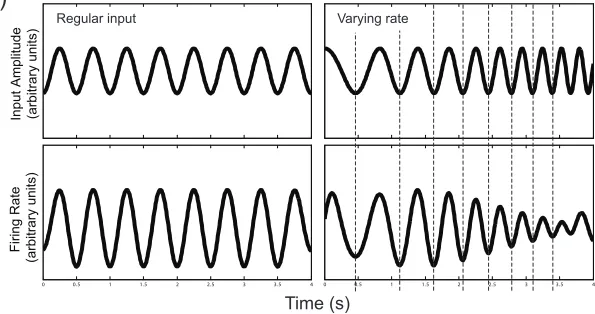
In the BUMP model, the context signal reflects the activity of a population of cells, each
with an intrinsic tuning which causes its activity to oscillate at a specific rate and phase in
response to local changes in the speech envelope (Figure 1a). This pattern of activity is
determined by the neuron’s characteristic impulse response, which can be thought of as an ideal
signal against which the incoming amplitude modulations are compared. More precisely, the
activity of each model neuron is determined by convolving its impulse response with the input
signal. If driven by more or less regular fluctuations in the amplitude of the speech signal at a
rate close to its intrinsic tuning, the amplitude of the neuron’s response will be strong and,
importantly, its phase will track that of the incoming stimuli. If driven at a markedly different
frequency, the amplitude of the response will be much lower. For example, a given neuron might
be tuned to respond maximally to regular modulations at 2Hz in phase with peaks in the speech
envelope (Figure 1b, left). Critically, each neuron’s activity will continue to track the phase of
amplitude modulations as their rate varies over a substantial range around its ideal tuning, albeit
with somewhat reduced amplitude (Figure 1b, right) but beyond this range the amplitude of the
neuron’s response falls away. Each neuron thus responds only to local amplitude modulations at
a specific temporal scale and neurons with similar tunings tend to respond in a coherent way to
amplitude modulations on the relevant scale.
Figure 1 here
In the current implementation, we use phase-offset pairs of model neurons tuned to the
same frequency, each pair forming a complex quadrature filter. For each frequency, one member
of the pair has a maximum response aligned with peaks in the speech envelope (0 phase) and
the other has a maximum response offset by 90 (Figure 2a). The response of such a pair to a
15
which we approximate as a series of triangular pulses. Figure 2b illustrates the responses of a
single pair of neurons with tunings close to the group repetition rate during presentation of three
groups of three items, as in Ryan (1969b). For easy visualisation, the offset responses of each
pair have been combined to illustrate the overall pattern of amplitude and phase responses during
sequence presentation with phase represented by hue and amplitude represented by brightness
(Figure 2c). Figure 2d shows that the phase of the output tracks local changes in the speech
envelope corresponding to groups of items, that is, the phase indicated by the joint response of
the pair goes through one complete cycle for each group of three items in the input sequence,
while the overall amplitude of the response remains more or less constant throughout. An
important feature of the model is that pairs of neurons tuned to different frequencies will show
different patterns of output, as described below.
Figure 2 here
In BUMP, the context signal used to encode a verbal sequence is the output of a
population of oscillator pairs whose tunings span the range of temporal scales over which
amplitude modulations are encountered in typical tasks (Figure 3). For example in a short,
irregularly-timed list of discrete items, there may be slow modulations on a temporal scale
corresponding to the length of the entire utterance (say 5s), more rapid fluctuations
corresponding to groups or clusters of items (perhaps around 1-2s), and still faster modulations
corresponding to presentation of the individual items themselves (0.75s). In the current
simulations, we use 15 pairs of oscillators in the range 0.1-1.3 Hz so as to cover such
fluctuations.
The outputs of oscillator pairs tuned to local amplitude fluctuations on different
16
time-scales. In the simplest example of an evenly-timed, ungrouped list, oscillators with tunings
close to the item presentation rate will respond strongly and in phase with the items. These
oscillators will go through one cycle per list item. Oscillators with tunings close to the list
presentation rate respond to the larger scale amplitude fluctuation associated with presentation of
the entire list and are insensitive to the relatively rapid changes associated with individual items.
These slower oscillators’ output will go through approximately half a cycle during presentation
of the list. Oscillators with intermediate tunings respond only weakly and their responses are
largely restricted to the beginning and end of the sequence. However, for a regularly grouped list,
we have already seen that oscillators with tunings close to the group presentation rate are also
recruited, and go through one cycle per group (see Figure 2d). A critical advantage of the
bottom-up mechanism in the BUMP model, and in particular the sensitivity of the context signal
to local changes in the input, is that it can also deal with irregularly grouped stimuli. These
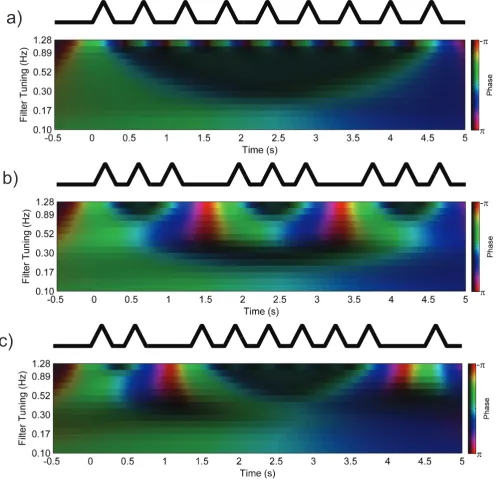
features are illustrated in Figure 3 which compares the context signal generated for a) an
ungrouped list of nine items, b) a list with an evenly spaced 3-3-3 grouping pattern and c) an
uneven 2-6-1 pattern.
Figure 3 here
In the BUMP model, grouping tends to be advantageous because it activates a broader
population of oscillators, resulting in a more distinctive representation of serial position that
reduces competition between neighbouring items at retrieval, as seen qualitatively in the
comparison between Figure 3a and 3b. An important property of the model is that some temporal
grouping patterns are more favourable than others. Regular grouping patterns (3-3-3) powerfully
activate oscillators tuned to the grouping rate, which enhances overall recall, albeit at the
17
group presentation rate in Figure 3b). Irregular grouping patterns similarly favour intergroup
transpositions although the correspondence between different positions is less clear-cut (see
Figure 3c). The inconsistency of group durations means that oscillators in this range are less
strongly activated than would be the case for regularly grouped lists. Context signals associated
with different list positions are, on average, less distinctive, though some serial positions
(especially those in very short groups or at the beginning or end of longer groups) may be
protected relative to those in ungrouped or regularly-grouped lists.
Overall, the BUMP model predicts that certain grouping patterns will be more favourable
for serial recall than others. We report two experiments testing the model. The first addresses its
basic assumption that the benefit of auditory-verbal grouping depends on bottom-up processing
of information about the temporal structure of the speech envelope as distinct from top-down
encoding strategies based on an expected structure (Experiment 1). We then compare the specific
predictions of the model with empirical data on the recall of irregularly grouped lists for a wide
range of different grouping patterns (Experiment 2), and with data from Ryan (1969a).
2
Empirical tests of BUMP’s bottom
-up mechanism
As we have seen, a major assumption of the BUMP model is that the state changes of the
putative timing signal responsible for ordering in serial recall are driven by bottom-up,
stimulus-based properties, rather than top-down expectations regarding the list structure. One way of
testing this assumption is by exploring whether the effects of temporal grouping are sensitive to
the availability of foreknowledge of the grouping structure on an upcoming trial.
We have already noted the widely held assumption that grouping effects in immediate
serial recall reflect the implementation of optional strategies such as rehearsal (Broadbent, 1975;
18
1967). This is plausible when one considers that almost all documented studies of temporal
grouping have employed either the same pattern of grouping throughout the entire experiment
(Farrell & Lewandowsky, 2004; Frankish, 1985, 1989; Henson, 1996; Hitch et al., 1996;
Maybery et al., 2002; Parmentier & Maybery, 2008; Ryan, 1969b) or a small set of different
patterns presented in blocked fashion (Farrell & Lelièvre, 2009; Henson, 1999). In such cases,
participants may be able to capitalize on their foreknowledge of the locations of the pauses and
use them to engage in extra rehearsal of the preceding group, thereby strengthening within-group
positional codes.
An important but neglected exception to the above generalization is a study by Ryan
(1969a; Experiment 2) in which participants received auditorily presented lists of nine digits.
Although lists were always presented in three temporal groups, these varied in size to give 28
different grouping patterns that varied unpredictably from trial to trial. Even though participants
could not anticipate the pattern of grouping on a forthcoming trial, there were systematic
differences in recall, with serial position curves exhibiting scalloped profiles specific to and
consistent with the pattern of grouping in question. These results suggest that the genesis of
grouping effects—in the auditory modality at least—is attributable to a bottom-up ordering
mechanism. Nevertheless, Ryan’s results do not preclude the possibility that top-down processes
based on foreknowledge of the list structure might modulate the effects of grouping. Thus, it is
possible that when the list structure is predictable—as would be the case in a version of Ryan’s
experiment in which the different grouping patterns were presented in separate blocks of trials—
the effect of a particular pattern of grouping on serial recall might be stronger. However, since
Ryan did not incorporate such a condition in her study, the answer to this question is presently
19
In the following experiments, we sought to obtain further evidence for the contention that
temporal grouping effects in the auditory modality are attributable to a bottom-up ordering
mechanism. We accomplished this by manipulating the predictability of the grouping structure of
temporally grouped lists.
2.1 Experiment 1
We compared the effects of temporally grouping spoken lists of nine digits into threes
when advance knowledge of the grouping structure either was or was not available. In one
condition (predictable 3-3-3), all lists were temporally grouped into threes. In a second condition
(unpredictable 3-3-3), a separate set of participants received lists in which there was wide
trial-to-trial variability in the grouping pattern, rendering it virtually impossible to predict the
grouping structure on a forthcoming trial. Crucially, lists were presented in groups of threes on
only a randomly distributed 20% of trials. In a further baseline condition (ungrouped), another
set of participants received lists that were devoid of any grouping cues. The three conditions
were compared by contrasting the recall of lists grouped in threes in the unpredictable 3-3-3
condition with recall on corresponding experimental trials in the predictable 3-3-3 and
ungrouped conditions.
If advance knowledge of the grouping structure is necessary for the manifestation of
grouping effects then these effects should be absent in the unpredictable 3-3-3 condition. If, on
the other hand, advance knowledge simply modulates rather than underpins the effects of
grouping, then these effects should be present in both grouping conditions, but stronger in the
predictable condition. If, however, grouping effects are present in both conditions in equal
20
One potential problem of interpretation is that participants might have a default strategy
of subjectively grouping lists into threes. Subjective grouping is a common strategy with visually
presented ungrouped lists (see e.g., Farrell & Lelièvre, 2009; Henson, 1996; Madigan, 1980) and
might be expected to occur with spoken lists too. The problem for interpretation is that if
participants were to subjectively group all lists into threes then performance in the predictable
and unpredictable 3-3-3 conditions would be very similar, rendering it difficult to determine
whether this is due to the bottom-up nature of grouping or the ubiquity of a subjective 3-3-3
grouping strategy. We attempted to avoid such ambiguity by including conditions in which any
tendency to group subjectively using rehearsal would be disrupted by requiring articulatory
suppression during list presentation (see e.g., Lewandowsky & Brown, 2005). If the effects of
grouping in the predictable and unpredictable 3-3-3 conditions are comparable, then the
conclusion that grouping is due to bottom-up processes would be bolstered by the survival of this
pattern under articulatory suppression.
2.1.1 Method
Participants. Thirty members of the campus community at the University of York took
part in the experiment in exchange for course credit or payment of £4.
Stimuli & Apparatus. The stimuli were spoken lists consisting of the digits 1-9. Lists
were generated quasi-randomly according to the following constraints: (1) no ascending or
descending runs of more than two digits, (2) no adjacent digits in immediately neighbouring
positions, (3) no repetitions of the same digit, and (4) no digits in adjacent lists sharing the same
within-list position. Digits were recorded in a monotone male voice with a 16-bit resolution at a
sampling rate of 22, 050 kHz using Sony Sound Forge 8.0 software. They were normalized to
21
PC. Stimulus presentation was controlled by the same computer equipped with a 17 inch monitor
using software developed in-house. The digits were presented via Senheisser HD 265 Linear
headphones at a sound level of approximately 65dB.
Design. The experiment employed a 3 × 2 mixed factorial design in which list-type
(ungrouped vs. predictable 3-3-3 vs. unpredictable 3-3-3) was a between-participant factor, and
secondary task (no suppression vs. suppression) was a within-participant factor.
Counterbalancing was employed on the latter factor. Ten participants were randomly allocated to
each of the three between-participant conditions.
Blocks of 50 lists were constructed as follows. In the ungrouped condition, items were
presented at a uniform rate, whilst in the predictable and unpredictable 3-3-3 conditions two
extended temporal pauses served to demarcate lists into three groups. In the predictable 3-3-3
condition, the extended pauses were always located after the third and sixth items so as to create
lists that were perceptually grouped into threes. In the unpredictable 3-3-3 condition, the
locations of the two extended pauses varied from trial to trial to create 21 different patterns of
grouping. These were 3-3-3, 1-6-2, 6-1-2, and all permutations of 2-4-3, 4-4-1, 2-5-2 and 3-5-1.
Lists grouped 3-3-3 were presented on trials 2, 8, 13, 20, 26, 30, 33, 39, 43 and 48. The 20
irregular grouping patterns each occurred twice in a random order in the remaining trials.
Procedure. Participants were tested individually in a quiet room in the presence of the
experimenter. In the no suppression condition, a trial began with the presentation of the words
“Get Ready” in the centre of the computer display followed by a fixation cross. A list of nine
spoken digits presented via the headphones then followed. In the ungrouped condition, the
inter-stimulus interval (ISI: offset-to-onset) was 300 ms, whilst in the unpredictable 3-3-3 and
22
was 150 ms and the between-group ISI (the interval separating groups) was 750 ms. These
timings equated list presentation durations in all conditions. At the end of each trial a question
mark presented in the central screen position signified the cue to begin recall. Participants
subsequently reported the sequence in forward serial order by writing each item in one of nine
locations on a response sheet, where each location represented an item in the to-be-recalled list.
The recall interval was fifteen seconds in duration and upon completion the next trial
commenced automatically. To alert participants to the beginning of the next trial a tone sounded
two seconds before the recall interval expired.
The structure of the trials in the suppression condition was the same as outlined above,
except that the “Get Ready” signal was replaced with the word “Suppress”. At the onset of this
signal participants spoke the word “the” repeatedly at the rate of two utterances per second until
the recall cue appeared on screen. The experimenter monitored participants at all times to ensure
compliance with the suppression instructions. If participants failed to keep to the rate of two
utterances per second they were encouraged to try harder. Both the no suppression and
suppression blocks were preceded by three practice trials.
2.1.2 Results
Only data for trials corresponding to those in which 3-3-3 lists were presented in the
unpredictable condition were subjected to analysis (viz. trials 2, 8 13, 20, 26, 30, 33, 39, 43, and
48 of each condition). Restricting analysis to these trials ensured that comparisons between
conditions were based on equal numbers of observations made at corresponding points. The data
were scored using a strict serial recall criterion: an item was only scored as correct if its output
23
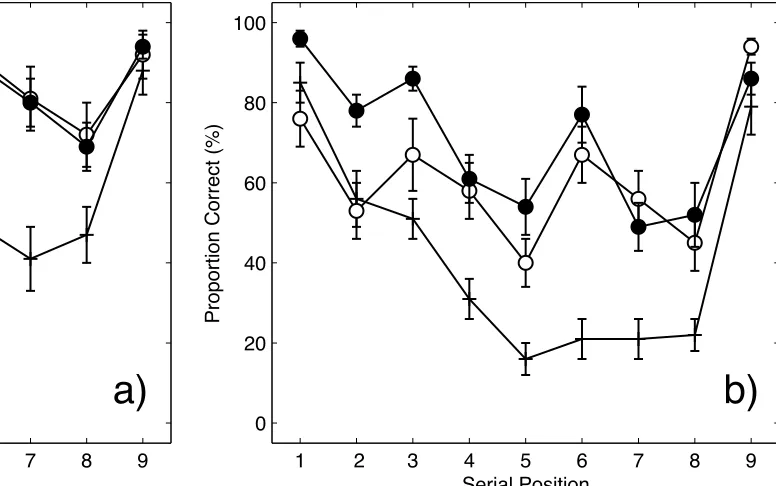
Accuracy. Figure 4 shows the accuracy serial position curves for each list-type for (a) the
no suppression condition and (b) the suppression condition. Considering first the no suppression
condition, it can be seen that performance was comparable for predictable and unpredictable
3-3-3 lists and greater than for ungrouped lists. The serial position functions for predictable and
unpredictable 3-3-3 lists are characterised by multiple bowing within groups combined with
primacy and recency across the list as a whole. By comparison, the serial position function for
ungrouped lists shows steeper primacy and recency effects over the list as a whole. The curves
for ungrouped lists were also slightly scalloped, suggesting some subjective grouping took place.
Performance in the suppression condition was generally poorer, but the pattern was broadly
similar. Thus, the recall advantage for predictable and unpredictable 3-3-3 lists persisted, as did
the multiple bowing of the serial position curve. Interestingly, recall of unpredictable 3-3-3 lists
was actually slightly better than for predictable 3-3-3 lists due to superior recall of items in the
first group.
Figure 4 here
A 3 (list-type: ungrouped vs. predictable 3-3-3 vs. unpredictable 3-3-3) × 2
(secondary-task: suppression vs. no suppression) ANOVA revealed a significant main effect of list-type
[F(2, 27) = 9.08, p < .01], a significant main effect of secondary-task [F(1, 27) = 102.6, p <.001],
and a significant list-type × secondary-task interaction [F(2, 27) = 4.74, p < .05]. The interaction
materialized because in the no suppression condition recall of predictable and unpredictable
3-3-3 lists did not differ significantly [t(18) < 1], whereas in the suppression condition unpredictable
3-3-3 lists were recalled with greater accuracy than predictable 3-3-3 lists, although this
comparison did not reach conventional significance levels [t(18) = 1.42, p = .17]. Recall of
24
[t(18) = 2.58, p < .05], and with suppression [t(18) = 3.20, p < .01]. Recall of unpredictable 3-3-3
lists was also significantly better than ungrouped lists without [t(18) = 3.19, p < .01], and with
suppression [t(18) = 6.06, p < .001].
Errors. Errors were classified as omissions (items not recalled) and transpositions (items
recalled in the wrong serial position). As expected, omissions were much less frequent overall
than transpositions (5% vs 29% of responses), and grouping reduced transpositions (ungrouped
41%, unpredictable 3-3-3 23%, predictable 3-3-3 25%). Suppression reduced performance
primarily by increasing transpositions (from 21% to 38%). Transpositions were further classified
according to transposition distance, defined as the absolute numerical difference between an
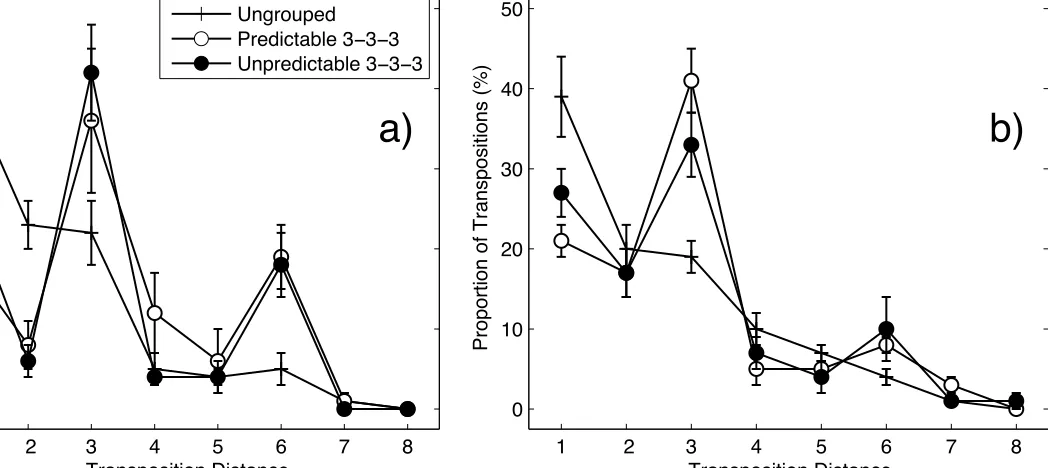
item’s input and output serial positions. Figure 5 shows the transposition gradients for each list
-type, for (a) the no suppression condition and (b) the suppression condition, in terms of the
proportion of transpositions as a function of transposition distance. As can be seen, the curves for
predictable and unpredictable 3-3-3 lists exhibit interpositions, as reflected by larger amplitude
peaks at transposition distance 3 and to a lesser extent distance 6. In contrast, transposition
gradients for ungrouped lists showed a much smoother decrease with increasing transposition
distance. However, it is apparent that the gradients for ungrouped lists exhibit small deviations at
transposition distances 3 and to a lesser extent distance 6. Such deviations suggest that, in line
with the modest scalloping of the associated serial position curves, some degree of subjective
grouping into threes took place in this condition.
Figure 5 here
Table 1 shows the proportions of transpositions within and between groups as a function
of list-type and secondary-task. Transpositions between groups are further sub-divided into
25
predictable and unpredictable 3-3-3 lists were not only associated with larger proportions of
interpositions, but also smaller proportions of other transpositions between groups and within
groups (with the exception that in the suppression condition the proportion of transpositions
within groups was comparable for ungrouped and unpredictable 3-3-3 lists).
Table 1 here
Two 2 (list-type: ungrouped vs. grouped) × 3 (error-type: within-group transpositions vs.
interpositions vs. “other” between-group transpositions) × 2 (secondary task) ANOVAs were
carried out on the log-odds transformed error proportions. The first analysis compared
predictable 3-3-3 and ungrouped lists, whilst the second compared unpredictable 3-3-3 and
ungrouped lists. For the first ANOVA, there was a significant main effect of error-type [F(2, 36)
= 3.69, p < .05], and importantly a significant list-type × error-type interaction [F(2, 36) = 9.82,
p < .001], with grouping increasing the proportion of interpositions [t(9) = 3.10, p <.05], but
decreasing the proportion of other between-group transpositions [t(9) = 1.90, p < .10] and
within-group transpositions [t(9) = 2.30, p <.05]. For the second ANOVA, there was a similar
significant list-type × error-type interaction [F(2, 36) = 17.15, p < .001]. As before, grouping
increased the proportion of interpositions [t(9) = 4.40, p < .01] and decreased the proportion of
other between-group transpositions [t(9) = 5.28, p < .001]. However, grouping did not
significantly modify the proportion of within-group transpositions [t(9) < 1]. There was also a
significant error-type × secondary-task interaction [F (2, 36) = 3.96, p < .05], which arose
because articulatory suppression did not significantly influence the proportion of within-group
transpositions [t(9) <1], or interpositions [t(9) = 1.81], but did significantly increase the
26
2.1.3 Discussion
The main results of the experiment are straightforward. In the no suppression condition,
grouping exerted a multiplicity of effects including an elevation in recall accuracy; effects of
primacy and recency within groups; a reduction in transpositions between groups; and an
increase in interpositions. These effects were present in equal measure for both predictable and
unpredictable 3-3-3 lists. Articulatory suppression depressed performance, as expected, but
critically the effects of grouping persisted for both predictable and unpredictable 3-3-3 lists,
suggesting that the corresponding effects in the absence of suppression were not attributable to
participants subjectively rehearsing lists in threes.
That characteristic grouping effects were observed with unpredictably grouped lists
suggests that advance knowledge of the grouping structure is not necessary for their
manifestation. Furthermore, that recall of predictable 3-3-3 lists was no better than unpredictable
3-3-3 lists—with recall of unpredictable 3-3-3 lists actually being superior in the suppression
condition—additionally suggests that foreknowledge of the grouping structure does not modulate
the effects of grouping. The present results therefore favour the view that—in the auditory
modality at least—temporal grouping effects are largely attributable to a bottom-up mechanism,
with little role for top-down driven strategies based on foreknowledge of the grouping structure.
We note, however, that top-down subjective grouping strategies do seem to play a minor role in
the recall of ungrouped auditory lists, as evidenced by modest scalloping of the serial position
curve and interposition errors of the type associated with temporally grouped lists.
We note also that the present results do not preclude the possibility that foreknowledge
may be beneficial for other patterns of grouping besides 3-3-3. It is possible that grouping into
27
pattern of grouping (Ryan, 1969a; Wickelgren, 1964, 1967). This may be because the positions
of items in groups of three can be specified in terms of unambiguous “beginning”, “middle”, and
“end” positional codes (Wickelgren, 1964, 1967). One could argue that these codes are
sufficiently unambiguous that they do not benefit from the further elaboration provided by
foreknowledge of the list structure. However, for lists containing groups of more than three items
such codes require elaboration and advance knowledge of the grouping pattern might prove
beneficial. We sought to explore this possibility in our next experiment.
2.2 Experiment 2
The first aim of Experiment 2 was to extend the generality of the previous results by
examining the effect of foreknowledge of the grouping pattern for a range of irregular patterns
besides regular grouping in threes. To accomplish this, we conducted a replication and extension
of the study of Ryan (1969a; Experiment 2). As in Experiment 1, we compared serial recall
performance for predictably and unpredictably grouped lists in a between-participants design, but
this time we dropped the ungrouped list condition. The unpredictable grouping condition was
based on the corresponding condition from the previous experiment, except that we increased the
number of grouping patterns from 21 to 28, each pattern being presented on an equal number of
occasions. As before, the presentation order of the grouping patterns was random, meaning that
participants were unable to predict the pattern of grouping on a forthcoming trial. Note that this
condition is identical to Ryan’s Experiment 2 in all respects, except that she used only two
presentations of each grouping pattern, whereas we increased this number to ten to improve
28
ance for each pattern. The predictable grouping condition—which Ryan did not include—was
identical, except that the different patterns of grouping were presented in blocks of 10 trials, so
that within each block participants could predict the pattern of grouping on forthcoming trials.
If our previous failure to observe a beneficial effect of foreknowledge of the list structure
on the serial recall of lists grouped into threes is attributable to the special status of this grouping
pattern then we would expect recall performance for other grouping patterns to be better when
the pattern is known in advance. We would further expect serial position curves for the different
grouping patterns lists to exhibit more pronounced scalloping when the pattern is predictable. By
contrast, if recall performance and the degree of scalloping of serial position curves for different
grouping patterns are unaffected by predictability this would be further support for a bottom-up
account of grouping in the auditory modality.
The second aim of Experiment 2 was to compare recall performance for different
grouping patterns against predictions of the BUMP model. We discuss this second aspect after
having first described the main empirical findings.
2.2.1 Method
Participants, Stimuli, & Apparatus. Twenty-eight members of the campus community
at the University of York took part in the experiment in exchange for course credit or payment of
£6. The apparatus and stimuli were the same as those used for Experiment 1 except that new
quasi-random lists of digits were created for each participant subject to the same constraints
outlined previously.
Design & Procedure. The experiment had a 2 (list-type: predictably grouped vs.
unpredictably grouped) × 28 (grouping pattern) mixed factorial design. List-type was a between
29
28 patterns of grouping comprised 3-3-3 and all permutations of 1-1-7, 1-6-2, 1-3-5, 2-2-5,
1-4-4, 2-3-4. In order to ensure the duration of the experimental session was acceptable to
participants whilst obtaining a sufficient number of observations for each pattern of grouping,
half of them received one subset of 14 patterns (subset A: 1-1-7; 1-5-3; 1-6-2; 1-7-1; 2-2-5;
2-5-2; 2-6-1; 3-1-5; 4-1-4; 4-3-2-5-2; 4-4-1; 5-1-3; 5-2-2-5-2; 7-1-1), whilst the other half received the other
subset (subset B: 1-2-6; 1-3-5; 1-4-4; 2-1-6; 2-3-4; 2-4-3; 3-2-4; 3-3-3; 3-4-2; 3-5-1; 4-2-3;
5-3-1; 6-1-2; 6-2-1). There were 10 lists for each pattern of grouping. For unpredictably grouped
lists, patterns were assigned to trials in a different random order for each participant, whereas for
predictably grouped lists, the 14 patterns were presented in blocks of 10 trials, each block
involving a single pattern. A digram-balanced Latin Square was used to assign the 14 grouping
patterns to blocks for each of the 14 participants receiving each subset (A or B).
The procedure was identical to that for the no suppression condition of Experiment 1.
2.2.2 Results
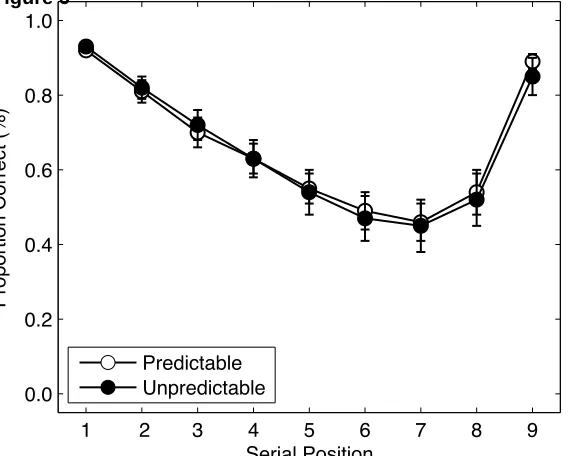
Overall accuracy. Figure 6 shows accuracy serial position curves, averaged across the
different grouping patterns, for predictably and unpredictably grouped lists. By inspection
performance on the two list-types was near identical. Also apparent is that the shape of the serial
position curves resembles that expected for ungrouped lists, with a smooth monotonic decrease
in recall performance from the first position onwards initially, followed by an upturn in the trend
line towards the end of the list. As we will see shortly, the smooth and continuous appearance of
these aggregate curves disguises systematic and substantial variability in the shapes of the curves
for the different grouping patterns. The overall performance data were subjected to a 2 (list-type:
predictably grouped vs. unpredictably grouped) × 9 (serial position) ANOVA, which revealed a
30
neither the main effect of list-type [F(1, 26) <1], nor the interaction between list-type and serial
position [F(8, 208) <1], were significant.
Figure 6 here
Accuracy by grouping patterns. The proportion of correct responses for each of the
different groupings for predictably and unpredictably grouped lists is illustrated in Table 2. It is
clear that there was considerable heterogeneity in recall performance across the different
groupings for both list-types, ranging from 51.4% (unpredictable 1-7-1) to 80.2% (predictable
3-3-3). Crucially, however, for the majority of groupings recall performance was very similar for
predictably and unpredictably grouped lists.
Table 2 here
The proportion correct data were subjected to two separate 2 (list-type) × 14 (patterns)
ANOVAs, one for subset A the other subset B. We have already established that overall recall
performance for predictably and unpredictably grouped lists did not differ statistically. What is
of interest in the present analyses is whether any interactions between list-type and patterns are
significant, indicating that, for some groupings at least, recall performance differed significantly
between the two list-types. The analyses revealed this was not the case. For subset A, there was a
significant main effect of patterns [F(13, 156) = 7.24, p < .001], however, importantly neither the
main effect of list-type [F(1, 12) <1], nor the list-type × patterns interaction [F(13, 156) <1],
reached significance. For subset B, there was once again a significant main effect of patterns
[F(13, 156) = 4.23, p < .001], however, once more, neither the main effect of list-type [F(1, 12)
31
To further illustrate the close correspondence between performance in the predictable and
unpredictable conditions for the different groupings, panel (a) of Figure 7 shows the scatterplot.
As can be seen, there is a strong positive relationship between performance on the different
groupings for the two list-types (r =.72). It is also useful to consider the relationship between
performance on the different groupings in the original study of Ryan (1969a) and performance
on the same groupings in the present study. Panel (b) of Figure 7 shows a scatterplot of Ryan’s
data against the present data for predictably grouped lists, whilst panel (c) shows Ryan’s data
against the present data for unpredictably grouped lists. As can be seen, there are strong positive
correlations with Ryan’s data in each case (r = .74 for predictably grouped lists, and r = .72 for
unpredictably grouped lists). The similarity of the pairwise correlations between these three
different data sets is striking.
Figure 7 here
Interestingly, the product of the group sizes is a good predictor of recall performance
across the different grouping patterns in each data set (r =.76 for predictably grouped lists, r =
.75 for unpredictably grouped lists and r = .73 for Ryan’s data). Indeed, the predictive value of
the product of the group sizes is at the limit set by the reliability of the behavioural data, as
reflected by the correlations shown in Figure 7.
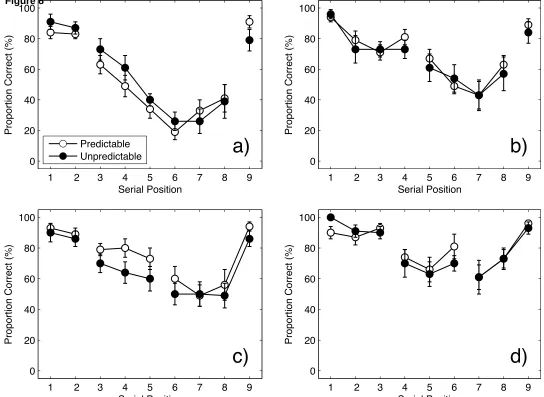
Serial position curves. Figure 8 shows sample serial position curves for four different
grouping patterns for predictably and unpredictably grouped lists: 2-6-1; 4-4-1; 2-3-4 and 3-3-3.
Curves for all 28 grouping patterns confirm the general picture and can be inspected as
supplementary materials (Figures S1-18). In marked departure from the smooth and continuous
appearance of the aggregate serial position curves (see Figure 6), these curves often—but not
32
for both predictably and unpredictably grouped lists, with no evidence that the degree of
scalloping was any greater when the grouping pattern was predictable.
Figure 8 here
2.2.3 Discussion
The present results extend the generality of those of the previous experiment by
showing—for a variety of different temporal grouping patterns—that foreknowledge of the
grouping structure on an upcoming trial does not benefit serial recall. Unpredictably grouped
lists were recalled with levels of accuracy indistinguishable from predictably grouped lists, and
performance on the different grouping patterns was strongly correlated between the two
list-types. The different groupings also exerted similar effects on the serial position curves for the
two list-types, the curves for both often exhibiting scalloping consistent with the pattern of
grouping. These results are a further indication that the impact of a particular pattern of grouping
on serial recall is not modulated by top-down strategies based on knowledge of the grouping
structure, and provide compelling evidence that in the auditory modality positional information
is encoded by a bottom-up mechanism sensitive to grouping structure.
Consistent with Ryan’s (1969a) original findings, we observed considerable
heterogeneity in recall performance across the different groupings (see also Supplementary
Information, Table S1). Indeed, there was a strong positive correlation not only between
performance on the different grouping patterns for predictably and unpredictably grouped lists,
but also with Ryan’s data. Like Ryan, we found that regular grouping into threes was the most
effective form of grouping, whilst irregular groupings containing one large and two small groups
(e.g., permutations of the patterns 7-1-1 and 6-2-1) were generally the least effective. Ryan
33
This assertion is supported by our observation that the product of the group sizes is a potent
predictor of recall performance (see also Supplementary Information, Table S2) in that this
provides a metric for the degree of regularity of the grouping pattern. Small products are
associated with irregular groupings where one group is much larger than the others, whereas the
largest product and highest level of recall corresponds to equal groups of three. However, while
the “product rule” provides an excellent empirical yardstick for predicting the overall
effectiveness of different grouping patterns, it does not explain how such patterns determine
overall recall performance, or have anything to say about more detailed characteristics of recall
such as serial position curves and errors. As we shall see shortly, these characteristics are
emergent properties of the bottom-up mechanism employed in the BUMP model. For now, we
note that the central finding of the current experiment—that predictably and unpredictably
grouped lists are recalled with equal efficacy—is consistent with the bottom-up feature of the
BUMP model. However, the plausibility of the model would be further bolstered if it could be
demonstrated that it can provide a quantitative account of the heterogeneity in recall performance
across the different groupings. We turn to this next.
3. Simulations of grouping
The detailed implementation of the BUMP model is described in Appendix A. For
simplicity, simulations used a minimal implementation of competitive queuing to assess whether
the key empirical phenomena can be explained solely in terms of properties of the context signal.
Thus, associations between items and temporal context are stored simply as the mean activation
of the context vector (i.e. the activity of the set of idealized “neurons” in the model) during the
presentation of each item. To determine an item’s activation at retrieval we replay the context
34
using a Euclidean distance metric: the closer the stored context vector is to the current context,
the more active the item becomes. As each item’s activation peaks, it competes with the other
items to determine which is recalled (we simulate a large number of competitions in which
Gaussian noise is added to each item’s activation, leading to occasional errors). Once retrieved,
the item’s activation is suppressed which is normally sufficient to prevent it from being
reselected—the degree of suppression decays exponentially over time. We analyze the winning
item at each serial position.
Briefly we simulate the retrieval of a temporally structured list by:
i) Creating an input signal based on amplitude modulations associated with the
presentation of each item. The timing of the onsets of the items follows that used by
Ryan (1969a). The duration of the items is not recorded in the original paper, but in
the simulations it is held constant (0.3s). (Examples of the input signal used for
ungrouped, and 3-3-3 and 2-6-1 grouped lists were shown in Figure 3).
ii) The context signal generated by the input signal is calculated. The context signal is
the time-varying response of a population of cells, which act as temporal filters with
different AM tunings (scales), spanning the range of frequencies encountered in the
task. In the simulations reported here the population comprised 15 log-spaced
frequencies ranging from 0.10Hz to 1.28Hz (see Appendix). The precise details are
not critical to the model’s key predictions, though the overall span and log-spacing
may have important effects, as we discuss later. Each frequency is represented by two
phase-shifted filters. Examples of the evolution of phase and amplitude responses to
35
iii) Each item is associated with the state of the context signal during its presentation,
which is stored.
iv) At retrieval the context signal is replayed. Items to be recalled are activated according
to the similarity between the current state of the context signal and the stored
association. Items compete to be output, with the most active item being selected at
the time points where the similarity of the current and stored states of the context
signal is greatest. However, activation also includes Gaussian noise, which means that
the correct item will not always be selected. After selection, the activation of the
selected item is subject to inhibition which typically prevents it being reselected in
immediately following serial positions.
v) The order of the retrieved items is compared to the correct order, and responses at
each serial position are recorded as correct or incorrect, with transpositions of ±1, ±2,
±3 also being counted separately.
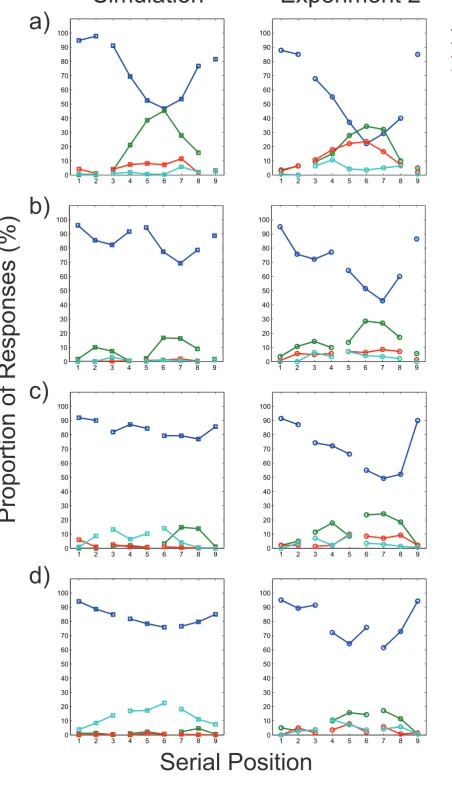
We simulated 100,000 retrieval attempts for each of the 28 experimental grouping
patterns.
In the simulations reported next, model parameter values were chosen without fitting to
the data to give overall levels of performance approximately in line with experimental
observations (items correct, lists correct, serial position curves) for ungrouped lists: filter depth
n=15; filter spacing =1.2; base frequency fb=0.1 Hz; filter width b=(1/fb0.5)=5 s (See
Appendix A for further explanation). In Appendix B we present a detailed exploration of the
effects of varying parameter values on the model’s performance, including the results of fitting
key parameters to our experimental data.