This is a repository copy of Problem-solving dissension and international entry mode performance.
White Rose Research Online URL for this paper: http://eprints.whiterose.ac.uk/113786/
Version: Accepted Version
Article:
Ji, J., Dimitratos, P. and Huang, Q. (2016) Problem-solving dissension and international entry mode performance. International Marketing Review, 33 (2). pp. 219-245. ISSN 0265-1335
https://doi.org/10.1108/IMR-10-2014-0328
[email protected] https://eprints.whiterose.ac.uk/ Reuse
Unless indicated otherwise, fulltext items are protected by copyright with all rights reserved. The copyright exception in section 29 of the Copyright, Designs and Patents Act 1988 allows the making of a single copy solely for the purpose of non-commercial research or private study within the limits of fair dealing. The publisher or other rights-holder may allow further reproduction and re-use of this version - refer to the White Rose Research Online record for this item. Where records identify the publisher as the copyright holder, users can verify any specific terms of use on the publisher’s website.
Takedown
If you consider content in White Rose Research Online to be in breach of UK law, please notify us by
Problem-Solving Dissension and International Entry Mode
Performance
Junzhe Ji
Tongji University, Department of Business Administration, 1239 Siping Road, Shanghai 200092, China
Email: [email protected]
Pavlos Dimitratos
University of Glasgow, Adam Smith Business School, West Quadrangle, Glasgow G12 8QQ, UK
Email: [email protected]
Qingan Huang
University of East London, School of Business and Law, Stratford Campus
Water Lane, London E15 4LZ
Email: [email protected]
Corresponding author: Dr. Junzhe Ji
Department of Business Administration, Tongji University, 1239 Siping Road,
Shanghai 200092, China.
Problem-Solving Dissension and International Entry Mode Performance
Abstract
Purpose
This paper examines international decision-making, information processing and
related performance implications. We explore the relationship between international
decision-making and problem-solving dissensions related to entry mode decisions. In
addition, we investigate the effects of dissension on entry mode performance, and the
moderating effect of the foreign direct investment (FDI) vs. non-FDI decision as it
relates to dissension-mode performance. Despite their significance from an
information processing perspective, these issues have not been sufficiently explored in
international entry mode research.
Design/methodology/approach
This research presents data collected from 233 privately owned internationalized
Chinese firms. The analysis in this investigation includes hierarchical ordinary least
squares (OLS) regression.
Findings
The findings suggest an inverse U-shaped relationship between dissension and entry
non-FDI decisions on this curvilinear dissension–performance association. These
findings support and refine the rationale of the information processing perspective.
Originality/value
These findings add realistic elements to the alleged “rational” international
decision-making doctrine assumed in previous entry mode literature. Our findings
show the importance of the heterogeneity of information processing in entry mode
strategic decision-making processes (SDMPs), and its effects on specific decision
types. We believe that this is the first empirical study to use an information processing
perspective to examine the effects of SDMPs on entry mode performance.
Keywords: Problem-solving dissension, international entry mode performance,
information processing perspective, strategic decision-making process, Chinese
private firms
Paper type: Research paper
Introduction
Compared to the great deal of attention paid to the determinants of entry mode
choice in international marketing research (Efrat and Shoham, 2013; Ekeledo and
Sivakumar, 2004; Forlani et al., 2008; Pinho, 2007), relatively little attention has been
on research that deals with strategy content and emphasizes the alignment of this
critical form of governance choice with institutional and transaction cost conditions to
attain superior mode performance in foreign markets (Brouthers and Hennart, 2007;
Hennart and Slangen, 2015). This solution, however, ignores the performance
implications of the process by which an entry mode decision is made. Indeed, process research (like content research) has played an important role in explaining decision
outcomes in the strategic decision-making literature (Elbanna, 2006). Consequently,
the need to shed light on the entry mode decision-making process and its
organizational consequences has become more urgent (Brouthers and Hennart, 2007;
Canabal and White, 2008; Hennart and Slangen, 2015).
Most of the strategic decision-making process (SDMP) literature focuses on the
way in which managers interact to process and act upon information related to
decisions (Clark and Maggitti, 2012; Parayitam and Dooley, 2009). Information
processing refers to the collection, interpretation and synthesis of information with
regard to organizational decisions (Galbraith, 1974; Tushman and Nadler, 1978).
Based on the information processed, strategic decision-makers “formulate the
organization’s interpretation” (Daft and Weick, 1984, p. 285; see also Wood and
Williams, 2014). According to the information processing perspective (Galbraith,
1974), the more complex the decision, the greater the need for decision-makers to
process information to achieve a given level of performance (Parayitam and Dooley,
2009). As the main framework in SDMP research, this theoretical perspective has
(Atuahene-Gima and Li, 2004; Citroen, 2011; Dooley and Fryxell, 1999; Souitaris and
Maestro, 2010), but it has yet to explain the consequences of decision-making in an
international context.
The international market entry mode decision concerns the nature of activities in
foreign markets, and is one of the most critical strategic decisions in the cross-border
context. As firms face more uncertainties when making an international decision
compared to their domestic one (Brouthers, 1995), they have a substantially greater
need for high-level information processing in international decision-making
(Herrmann and Datta, 2002; Kumar and Subramaniam, 1997). The information
processing perspective is useful in understanding how managers utilize information to achieve effective mode decision-making, which complements the research on what decision-makers should consider in mode decision-making.
Our review of the literature has identified only two empirical studies (Ji and
Dimitratos, 2013; McNaughton, 2001) that examine the effect of SDMP
characteristics on mode performance. Although the elements of information
processing have been substantially addressed, these studies do not employ the
information processing perspective, relying instead on behavior theory (Simon, 1955).
These studies examine only SDMP characteristics that follow the analytical
convention in strategic decision-making, such as decision rationality, hierarchical
centralization and formalization.
Drawing on the information processing perspective, the present study seeks to
focus on a major SDMP characteristic, namely problem-solving dissension
(henceforth referred to as “dissension”), which refers to the degree of differences on
objectives, methods and solutions to problems between decision-makers in a given
SDMP (Clark and Maggitti, 2012; Papadakis et al., 1998). We select this construct for
its theoretical and practical significance. First, the notion of dissension is critical to
understanding managerial information processing behavior under uncertainty, in
which the objectives, means and effects of mode decision are not given. Dissension
departs from the decision-making logic that underpins hierarchical and
procedure-based SDMPs, which are more applicable in a stable context (Sarasvathy,
2001).
Unlike procedural rationality and hierarchical centralization, which emphasize
analytical comprehensiveness and power distribution, respectively (Ji and Dimitratos,
2013), dissension represents a conceptually distinct SDMP dimension (see Clark and
Maggitti, 2012; Papadakis et al., 1998) that draws from a different view of strategic
decision-making in terms of “muddling through” (Lindblom, 1959). In contrast with
the analytical convention, executives often have to muddle through when they are
provided with unclear goals, have unambiguous means, and lack complete
information in strategic decision-making (Elbanna, 2006); although this applies to
entry mode decision-making as well (Kumar and Subramaniam, 1997), past mode
studies do not assess the performance implications of dissension.
Among international entry modes, the foreign direct investment (FDI) vs.
market, which plays a critical role in mode decision-making and has considerable
implications for information processing (Pan and Tse, 2000; Herrmann and Datta,
2002). FDI modes refer to wholly owned foreign subsidiaries and joint ventures,
while non-FDI modes include exporting, licensing, and franchising. According to Pan
and Tse (2000), choosing between FDI vs. non-FDI is the main task for
decision-makers in the initial stages of entry mode decision-making, and affects the
choice of mode in subsequent stages. Compared to the non-FDI choice, FDI is a more
complex form involving more uncertainties (Pan and Tse, 2000), and requiring
higher-level information processing in order to be effective (Herrmann and Datta,
2002).
Based on the information processing perspective and SDMP literature, this study
explores two research questions: (1) how does dissension affect mode performance,
and (2) what is the role of FDI vs. non-FDI decision-making in the dissension-mode
performance association. Based on a sample of 233 internationalized Chinese firms,
the findings suggest a curvilinear relationship between dissension and mode
performance, and a moderation of the FDI vs. non-FDI decision in this association.
This study makes important contributions to the research on mode performance.
First, it moves beyond the process approach to explore mode performance (Ji and
Dimitratos, 2013; McNaughton, 2001). We believe that it is the first study to employ
the information processing perspective to assess the impact of a mode
decision-making process on mode performance, excluding process studies on mode
significance of the relationship between foreign market information and international
entry has long been recognized (Johanson and Vahlne, 1990), but little is known about
how decision-makers interact to process such information, or the associated
performance implications on mode decision-making; this study advances our
understanding in this area, and accentuates the connection between mode decision
types and the ways in which information is processed.
Second, extant studies (Ji and Dimitratos, 2013; McNaughton, 2001) have
examined SDMP characteristics in terms of decision rationality, hierarchical
centralization, and formalization derived from the traditional analytical paradigm
(Papadakis et al., 1998), while the current study highlights the role of cognitive
dissent based on the view of “muddling through” when the objective, means, and
solutions are not clear (Lindblom, 1959). Higher-order relations and interactions
confirm the complexity of the influences of SDMPs (Rajagopalan et al., 1993), and
provide a more complete picture of the association between SDMPs and mode
performance (Ji and Dimitratos, 2013; McNaughton, 2001).
Third, this study suggests means by which to achieve superior mode performance
through an appropriate arrangement of cognitive dissension in international
decision-making. Along with what decision-makers should consider when making
mode decisions (Brouthers, 2002; Brouthers et al., 2003; Brouthers et al., 2008;
Papyrina, 2007), our findings suggest that effective information processing in
international market entry may also provide a competitive advantage for firms (Child
This paper is structured as follows. In the second section, the paper reviews the
literature on entry mode performance and information processing research, and
advances its two hypotheses. Following this, the methodological aspects are discussed.
In the penultimate section, the results of the statistical analysis and discussion of
findings are presented. The final section analyzes the implications, explores the
limitations, and offers suggestions for further research.
Theoretical background and research hypotheses
Strategic decision-making research is often classified in terms of content
research and process research (Elbanna, 2006). Content research deals with strategy
content, such as international expansion, mergers and acquisitions, and diversification.
In contrast, process research concerns the process by which strategic decisions are
made and implemented (Elbanna, 2006; Rajagopalan et al., 1993).
International entry mode performance
Entry mode performance captures the return aspects of mode decision-making
(Brouthers and Hennart, 2007). Emphasizing economic efficiency, prior studies have
primarily used financial and market measures as a proxy of entry mode performance
(e.g., Brouthers et al., 2003; Brouthers and Nakos, 2004). This investigation
essentially disregards the endogeneity of mode choice, meaning that managers are the
entry mode decision-making agents (Shaver, 1998). Given the heterogeneity of goals
decision-making perspective on mode performance can focus on the extent to which
managers are satisfied with the progress toward pre-set goals and objectives linked to
entry modes in foreign markets (Dean and Sharfman, 1996), which incorporate
broader considerations in mode decision outcomes.
Extant content research on mode performance relies on transaction cost analysis
(TCA) and its combination with other perspectives such as the institutional or real
options perspectives (Brouthers, 2013). Early studies on mode performance
concentrate on whether a particular mode type produces an outcome that is superior to
other mode types. The evidence (e.g., Anand and Delios, 1997; Pan et al., 1999;
Woodcock et al., 1994) provides mixed results, suggesting that the mode type itself,
independent of the decision context, cannot explain mode performance sufficiently.
The vast majority of later studies (with the exception of Kim and Gray (2008))
support the view that modes that follow a TCA solution perform better than modes
that do not (Brouthers, 2002; Brouthers et al., 2003; Brouthers et al., 2008; Papyrina,
2007). Brouthers (2013) indicates that an evaluation of mode performance should
include refined and relevant institutional and resource factors in the transaction cost
framework. While the logic regarding the minimization of transaction costs still
prevails, some researchers (Dikova and Sahib, 2013; Herrmann and Datta, 2002;
Kumar and Subramaniam, 1997) posit that mode decision-making and associated
organizational outcomes are constrained by decision-makers’ experiences and
cognitive limitations.
included in effective mode decision-making; however, it ignores the effects of SDMPs
on information processing, and thus sheds little light on whether or why some
processes lead to better entry mode decisions than others (Brouthers and Hennart,
2007; Hennart and Slangen, 2015). Only two empirical studies (Ji and Dimitratos,
2013; McNaughton, 2001) address this issue; both studies state that entry mode
decision-making processes are not necessarily fully rational. Ji and Dimitratos (2013)
find that a process characterized by analytical comprehensiveness and centralization
influences mode performance, while McNaughton (2001) observes that formalization
in the market channel decision process does not improve channel performance (among
small Canadian software firms). As this area of research is still in its infancy, Hennart
and his colleagues (Brouthers and Hennart, 2007; Hennart and Slangen, 2015) ask that
additional studies from various theoretical perspectives should be undertaken.
Information processing perspective
Managers must engage in information processing activities, and deal with
decision-related uncertainty, in order to achieve organizational goals (Clark and
Maggitti, 2012; Turner and Makhija, 2012). Uncertainty limits managers’ ability to
plan decision-making activities prior to executing them (Luo et al., 2012). Decisions
with high degrees of uncertainty usually involve a large number of decision
components, as well as a high level of coordinative intricacy and dynamism
(Crawford and Lepine, 2013; Weigelt and Miller, 2013).
information processing grows in order to achieve a given level of performance. This
occurs since uncertainty escalates the need for an increased level and quality of
information (Luo et al., 2012; Tushman and Nadler, 1978). Alternatively, managers
could simplify the decision task and create more self-control components for the
decision, thus reducing the amount of information processing needed (Galbraith, 1974;
Tushman and Nadler, 1978). This “subtraction” logic shares some commonalities with
the effectuation literature (Gabrielsson and Gabrielsson, 2013; Sarasvathy, 2001),
which contends that, due to high uncertainty, decision-makers may abandon their
intention to maximize potential returns and instead emphasize control, flexibility and
the investigation of future contingencies.
The information processing perspective represents a major theoretical framework
in the area of SDMP research, which views SDMP as the way in which one exchanges,
processes and interprets decision information (Dooley and Fryxell, 1999). Dissension,
as a unique SDMP dimension, emphasizes managerial interpretative dynamism over
decision information in the decision-making process. In SDMPs, dissent arises when
decision-makers express different opinions about facts and information, the proper
course to follow, or the solution to a problem (Dooley and Fryxell, 1999; Parayitam
and Dooley, 2009). As top executives make choices based on the information
processed, diverse interpretations of the decision situation in SDMPs can have
significant and complex implications on the decision outcome.
On the one hand, dissension in strategic decision-making could promote
heterogeneous interpretations, critical evaluation, and effective learning (Clark and
Maggitti, 2012; Dooley and Fryxell, 1999). On the other hand, it could introduce
difficulties regarding the integration of diverse opinions and lead to affective
confrontation (Ensley and Pearce, 2001; Olson et al., 2007). It may be that dissension
produces both effects simultaneously (Papadakis, 1998; Wong and Tjosvold, 2010).
Eisenhardt and Zbaracki (1992, p. 34) argue that “one step to enhance the realism of
conflict (dissension) is to explore the benefits and costs of conflict”.
Positive effects of dissension may occur in the entry mode decision-making
process for three reasons. First, dissension is a result of the diverse perceptual filters
present in the decision-making process; because these filters are subjective, they allow
for a variety of interpretations over decision information (Kellermanns et al., 2008).
Decision-makers could consider multiple perspectives, specialized knowledge, and
values when evaluating risk, commitment, control and returns (Dooley and Fryxell,
1999).
Second, when dissension arises from entry mode SDMPs, it invites
decision-makers to scrutinize the feasibility of a proposed decision and alternatives in
solving entry problems (Miller et al., 1998; Olson et al., 2007). Decision-makers
would be likely to seek and analyze additional information, which would aid the
decision-making process (Minichilli et al., 2009).
Third, the exchange of information between the decision-makers responsible for
provides a strong incentive to collect and share information related to different
viewpoints (Buyl et al., 2011; Xie et al., 1998). To conclude, the positive effects of
dissension may facilitate the way in which managers process diverse information to
arrive at an appropriate entry mode that improves mode performance.
Negative effects of dissension in entry mode decision-making are also likely to
occur for three reasons. First, successful entry mode decision-making should be based
on the trade-offs between risks and returns (Brouthers, 2002). Strong dissension
happens frequently when decision-makers stick to local rather than global interpretive
schemes or beliefs (Miller et al., 1998; Xie et al., 1998). This makes it difficult and
costly to integrate divergent views.
Second, cognitive differences regarding decision objectives, methods and
solutions are task-related; however, dissension regarding tasks can easily transform
into personal affective conflicts (Ensley and Pearce, 2001). This is because “members
whose ideas are disputed may feel that others in the group do not respect their
judgment” (Pelled et al., 1999, p. 7). Such negative feelings could hinder effective
communication (Miller et al., 1998; Olson et al., 2007) and divert the attention of
decision-makers from subsequent interpretation of the situation (Kellermanns et al.,
2008).
Third, the decisions associated with internationalization are likely to pertain to
the personal or departmental stakes of each decision-maker. Strong dissension may
partially reflect competing interests (Gnizy and Shoham, 2014). In such a situation,
entry mode choice. To sum up, the detrimental effects of dissension will probably
hinder managers’ ability to process information effectively, which may increase their
chances of selecting an inferior mode, and result in poor entry mode performance.
As dissension has been shown to have both positive and negative impacts on
strategic decision-making outcomes, we suggest that a curvilinear relationship might
exist between the level of dissension and entry mode performance. Under the
condition of too little dissension, multi-faceted external, internal, and transaction cost
conditions associated with entry mode may be overlooked, foregoing an opportunity
to develop a deeper understanding of the foreign market entry situation and its
relationship to entry objectives (Parayitam and Dooley, 2009). Invalid assumptions
could be accepted without challenges in mode decision-making. In addition, Janis
(1972) observes that group-thinking usually arises in the decision-making process.
This pure pursuit of consensus or conformity in entry mode decision-making may
distract managers from an objective evaluation of alternative viewpoints, and oppress
their appreciation for innovative ideas (Barkema and Shvyrkov, 2007). Further
evidence shows that conflict avoidance undermines decision quality as, frequently,
only positive spin is presented by managers in organizational decision-making
(Emmons, 2007). In sum, too little dissension fails to provide a critical evaluation,
which increases the chance of selecting an inappropriate mode, and leads to inferior
mode performance.
Under the condition of too much dissension, entry mode decision-makers may be
involved in disagreements and continuing discussions (Wong and Tjosvold, 2010).
Integrating highly divergent views, and thereby formulating an overall interpretation
of the entry decision, is difficult. Substantial evidence in SDMP research suggests that
strong dissension is usually associated with communication failure (Miller et al., 1998;
Olson et al., 2007) and a low level of commitment (Wong and Tjosvold, 2010). In
sum, too much dissension makes it difficult to integrate diverse views in mode
SDMPs, which, in turn, is likely to decrease information processing speed, deter
information exchange and cause decision quality to deteriorate.
Under the condition of moderate dissension, both the diversity and unity needed
for the collective understanding of an entry situation can be satisfied. Organizational
learning studies (Fiol, 1994; Gnizy et al., 2014) have supported the view that
successful decision-making requires decision-makers to develop a collective
understanding and incorporate the novel and different aspects relating to a balanced
SDMP (Fiol, 1994). This requirement is difficult to meet when too much or too little
dissension is present. By comparison, moderate-level dissent in entry mode
decision-making incorporates sufficient cognitive heterogeneity, and allows for the
integration of different views, which could address both the quality and pace of
information processing in mode decision-making, and may contribute to superior
mode performance. According to the arguments above, we posit that:
Hypothesis 1. In entry mode decision-making, there will be a curvilinear effect of
dissension will be associated with low levels of mode performance.
Moderating hypothesis
The information processing perspective suggests that, to be effective, complex
decision-making requires a larger and more diverse amount of information processing
than simple decision-making does (Galbraith, 1974). This contingency stance
embraces the balance between the nature of the task and the information processing it
requires (Luo et al., 2012).
Mode type is a key strategic decision for international marketers, and the choice
between FDI vs. non-FDI modes is fundamental to mode decision (Pan and Tse, 2000).
FDI modes represent complex engagement forms and involve great uncertainties
(Dimitratos et al., 2014; Johanson and Vahlne, 1990). FDI decisions require
managerial consideration of not only strategic issues, including foreign market size
and potential, knowledge transfer, size of investment, potential lock-in effects and
management expatriation, but also local operational arrangements, since firms will
partially or fully engage in foreign value-added activities (Pan and Tse, 2000). In
addition, when employing FDI modes, decision-makers must consider coordination
activities and processes, as well as control mechanisms, which define the role of the
relevant subsidiary in the overall supply chain of the firm (Birkinshaw and Morrison,
1995; Filatotchev et al., 2007).
FDI requires diverse processing and large chunks of information (Luo et al.,
above, when the level of dissension is very high or very low, it may not lead to
effective interpretation in a decision situation. If the entry information linked to FDI
modes cannot be synthesized by efficacious information processing between
decision-makers, the entry mode decision will not be well understood (Amason and
Schweiger, 1994). This is likely to result in an inappropriate entry choice and inferior
mode performance. In the same vein, moderate-level dissension may correspond with
superior FDI mode performance because of the link between decision complexity and
effective information processing.
Non-FDI modes are primarily transaction-based entries with predictable results
that are relatively easy to manage (Johanson and Vahlne, 1990). Since non-FDI modes
require lower levels of information processing, an increase in dissension from low to
moderate may not promote mode performance, as it surpasses the desired level (Luo
et al., 2012). Furthermore, discord arising from non-FDI mode decision-making is
likely to be interruptive, counterproductive and time-consuming, because it hinders
efficient processing and causes delays (Xie et al., 1998). In terms of understanding
and efficiency, simpler decisions tend to suffer from many heterogeneous opinions. A
number of unintended consequences regarding frictions between decision-makers, and
an increase in opportunity costs, are likely to occur, leading to deterioration in mode
performance.
Therefore, the dissension-mode performance relationship varies between FDI
and non-FDI decisions because, in order to be effective, these two mode types require
dissension that correspond to the effective interpretation of decision situations satisfy
the associated high demand for information processing, and generate superior mode
performance. For non-FDI decisions, which are simpler, low-level dissension may
meet the information processing requirements, and lead to high-level mode
performance. By comparison, high levels of dissension are likely to exceed the
desired level for information processing, and moderate levels of dissension may
sacrifice efficiency; in both cases, mode performance can be reduced. Therefore, we
hypothesize that:
Hypothesis 2. AnFDI (vs. non-FDI) mode choice will moderate the curvilinear
relationship between dissension and entry mode performance: For FDI mode decisions, the entry mode performance will be highest when the levels of dissension are moderate; for non-FDI mode decisions, the entry mode performance will be
highest at low levels of dissension.
Data and method
Unit of analysis
As the unit of analysis, we focus on the most important international entry mode
decision for privately owned internationalized Chinese manufacturing firms.
Informants were asked to determine their most important international entries through
an overall assessment, including: the importance of this entry to firm development,
the magnitude of the consequences of the entry on firm operations, and the
The most important entry was sought in order to attach strategic weight to this
international mode decision (cf. Hambrick and Mason, 1984). Privately owned
Chinese firms were chosen because their decision-making and behaviors associated
with internationalization have been examined rather infrequently, and could be
different from their state-owned counterparts, since the Chinese government
frequently intervenes in the international decision-making of state-owned firms (Liu
et al., 2008).
Sample and data collection
A questionnaire was mailed to members of the China Council for Promotion of
International Trade (CCPIT), located in the Yangtze Delta (Shanghai and Zhejiang
province) and the capital of China (Beijing). CCPIT, a non-governmental organization,
represents 70,000 internationalized Chinese firms. The selected regions are among the
most active areas for Chinese international business activities, which account for
nearly 25% of total provincial outward FDI stock, 30% of outward investors
(MOFCOM, 2013a) and 23% of the value of exports from China (MOFCOM, 2013b).
The questions in this survey were derived from previously developed scales, which
were refined and finalized based on the suggestions of four academics and 11 Chinese
managers. Following prior studies conducted in China (e.g., Davies and Walters, 2004;
Luo, 2001), an independent contractor who had a close connection with CCPIT was
employed to facilitate the accessibility to respondents, and improve response rates in
companies, a final pool of 2,513 privately owned manufacturing firms was generated.
The questionnaire was sent to 550 firms that were randomly selected from the
sample frame. This number was chosen for its statistical significance, as well as cost
considerations. A second mailing was dispatched to those firms that did not reply four
weeks after the first mailing. Between the two mailings, reminder phone calls were
also placed. We employed a key informant method to target the firm owner, CEO or
top-level manager responsible for international operations. Ultimately, we received
267 questionnaires (response rate of 49%), out of which 233 replies were identified to
be useable. This high response rate was attributed to the careful preparation and
execution of the survey, and the strong social capital of the contractor.
We first assessed the representativeness of our sample through a t-test of key firm characteristics, including number of employees and years of operation (p = 0.84; p = 0.91, respectively) between the final sample used and the pool of the sample frame.
There were no significant differences in these characteristics between the two groups
of firms. In addition, the potential geographic effect and non-response bias were
assessed through a t-test of firm revenues, years of international operations between the Yangtze Delta and Beijing (p = 0.75; p = 0.64, respectively), and early and late responses (p = 0.79; p = 0.30, respectively) corresponding to the first and second mailings (Armstrong and Overton, 1977). The results suggest that the location effect
and non-response bias are negligible.
Over 80% of foreign market entries occurred following China’s World Trade
internationalization of private Chinese firms (Voss et al., 2008). This concentration
reduces the potential effect of decision-making time on decision outcomes. The
retrospective bias regarding time difference between decision-making and reporting
can be a potential threat to the validity of a cross-sectional SDMP study (Huber and
Power, 1985; Miller et al., 1997); in this study, the time difference for the majority of
our sample (58%) is between one and two years. This is sufficient time for the effect
of the entry mode decision to emerge, and does not create any serious retrospective
difficulty (cf. Dean and Sharfman, 1996). In addition, we incorporated a control
variable to capture the potential time-lag effect between mode decision-making and
reporting of mode performance (Miller et al., 1997).
Operationalization of variables
Dependent variable. We used a five-item seven-point Likert scale (Cronbach’s alpha = 0.79; composite reliability = 0.83) to measure entry mode performance.
Respondents were asked to assess the degree of satisfaction (1 = very dissatisfied, 7 =
very satisfied) regarding the international entry mode used in relation to: the overall
objectives of the entry mode decision; the linkages achieved with local partners; the
enhancement of the firm’s competitive position; the success in learning critical skills
or capabilities; and the overall decision-making effectiveness. The measures capture
the decision-making level mode performance, with levels based on Kale et al. (2002)
and Walter et al. (2008).
for three reasons. First, there are no well-documented measures regarding valid
objective measurements for decision-level performance (Dean and Sharfman, 1996).
Second, subjective performance measures work well in both SDMP and international
entry mode studies (Brouthers et al., 2003; Priem et al., 1995). Third, private Chinese
firms are unlikely to report financial indicators during interviews in a pilot study
before the actual survey.
Independent variable. Problem-solving dissension was measured using a three-item seven-point Likert scale (Cronbach’s alpha = 0.76; composite reliability =
0.76) drawn from Papadakis et al. (1998) and Pelled et al. (1999). Respondents were
asked to assess the extent of dissension (1 = not at all, 7 = very much) on: the
objectives sought by the entry mode decision; the proper methodology to follow; and
the proper solution to the problem.
Moderator. We measured the moderator (FDI vs. non-FDI decisions) using a dichotomous scale. Based on the replies of informants regarding the entry mode that
they used, we coded joint ventures and wholly owned subsidiaries into FDI as “1”,
and exporting, licensing and franchising contracts into non-FDI as “0”.
Controls. We employed 19 control variables. First, we used two variables, firm size and firm turnover in the last year before the entry, that capture the potential
impact of resource sufficiency on performance (Walter et al., 2008). Firm size was
measured by the natural logarithm of the number of employees. With regard to firm
turnover in the last year before entry, respondents were asked to choose a turnover
government’s classification of revenue between micro-, small-, medium-, and
large-sized manufacturing businesses, firm turnover was coded “1” when it was under
RMB 5 million, “2” when it was between RMB 5 million and RMB 30 million,
“3” when it was between RMB 30 million and RMB 300 million, and “4” when it
was RMB 300 million and over.
Second, based on replies to the question on the “primary industry in which the
firm operates”, we were able to categorize firms into four groups: electronics,
chemicals, textiles, and others; the first three accounted for over 92% of the firms
investigated. Three dummy variables were then employed to control for the potential
impact of industry differences on mode decision-making (Brouthers and Brouthers,
2003).
Third, we provided five choices of motives for this international entry, including
market-seekers, strategic asset-seekers, natural resource-seekers,
competitor/customer-followers, and other motives; the first four constitute the main
motives for Chinese firms to enter foreign markets (Lu et al., 2010) and play an
important role in the mode choice of Chinese firms (Shi et al., 2001). Four dummy
variables were then used to measure these four motives.
Fourth, we included two demographic variables for decision-makers, age and
international experience, as they partially reflect the information processing capacity
of decision-makers for mode decision-making (Herrmann and Datta, 2002). Following
Ralston et al. (1999), the age of the decision-maker was measured through a
were between 41 and 51, and “3” when they were 52 or older. The international
experience of the decision-maker was measured by the total number of years spent on
assignments abroad, study abroad and work in a foreign unit.
Fifth, environmental aspects in the host country, in terms of stability and
munificence, are important location advantages in Dunning’s framework (Dunning,
1988), and are likely to be critical for mode choice and performance (Brouthers et al.,
1999). In this study, environmental uncertainty (Cronbach’s alpha = 0.83; composite
reliability = 0.83) was measured through three seven-point Likert items drawn from
Brouthers et al. (2003); it addressed the extent (1 = not at all, 7 = very much) of the
general uncertainty of the political, social, and economic conditions of the host
country, risk of converting and repatriating the income of the firm, and risk due to
possible host government actions such as expropriation. Environmental munificence
(Cronbach’s alpha = 0.71; composite reliability = 0.73) was developed by Khandwalla
(1977) and measured by a scale of three seven-point Likert items addressing the ease
of survival (1 = not at all, 7 = very much) in the foreign market, richness of
opportunities in the environment, and dominance by the firm in the foreign
environment.
Sixth, psychic distance refers to perceived social, economic and legal differences
between the home and the foreign country entered, and is an important predictor of
entry performance (Evans and Mavondo, 2002). Drawn from Klein and Roth (1990),
psychic distance was measured by five seven-point Likert items (Cronbach’s alpha =
not at all, 7 = very much) of dissimilarities between the two countries in terms of:
language; established business practices; economic environment; communication
infrastructure; and the legal system at the time of international entry.
Seventh, local experience and linkages in the host country provide entrants with
firm-specific advantages and important information channels (Shi et al., 2001; Chen et
al., 2004). Local experience in the host country was measured by a two-item
seven-point scale (Cronbach’s alpha = 0.70; composite reliability = 0.70) developed
by Shi et al. (2001) to measure the extent (1 = not at all, 7 = very much) of the firm’s
familiarity with the foreign country, and its operational know-how in that country
before international entry. Drawn from Chen et al. (2004) and Zhao and Hsu (2007),
local linkages were measured by a four-item seven-point Likert scale (Cronbach’s
alpha = 0.72; composite reliability = 0.75) that assessed the significance relative to
decision-making (1 = not significant, 7 = very significant) of four of the
international entrants’ connection types, including firms from previous business
relationships, the overseas ethnic (Chinese) community, local government, and
pioneering ethnic (Chinese) firms from the same industry.
Eighth, we found SDMP characteristics to be important to mode performance (Ji
and Dimitratos, 2013), controlling for the effects of two key SDMP variables:
decision rationality and hierarchical centralization. Decision rationality was measured
by a five-item seven-point Likert scale (Cronbach’s alpha = 0.77; composite
reliability = 0.81) drawn from Dean and Sharfman (1996). Respondents were asked to
analysis of relevant information, use of analytic techniques, focus of attention on
crucial information, and overall evaluation of analytic intensiveness regarding the
entry mode decision-making process. Hierarchical centralization was measured by a
five-item seven-point Likert scale (Cronbach’s alpha = 0.74; composite reliability =
0.75) drawn from Wally and Baum (1994). Informants were asked to assess the extent
(1 = not at all, 7 = very much) of delegation in this decision, necessity of
consensus-seeking among group members, necessity of justification for decentralized
decision-making, inability to control the decision-making progress, and hierarchical
levels in mode decision-making.
Ninth, to control for the time-lag effect on entry performance (Miller et al., 1997),
we employed a variable from the time of the entry decision, which was measured by
the number of years elapsed between the decision-making and the reporting of mode
performance.
Test–retest reliability (stability). To examine whether the replies ran steadily over time,we compared our data with the answers from follow-up phone calls to 210 (90%
of) respondent firms concerning their entry mode choices, number of employees, and
years of business operations. There was high consistency between early questionnaire
and late phone call answers (phi = 0.98 for entry modes, Pearson r = 0.89 for number of employees, and Pearson r = 0.93 for years of operations).
Internal consistency. A satisfactory degree of internal consistency was met, as all values of the Cronbach’s alpha and composite reliability were higher than 0.7 (Fornell
Construct validity. Convergent and discriminant validities were examined through a confirmatory factor analysis of all multi-item constructs (Anderson and Gerbing,
1988). The results show that the overall measurement model fit the data fairly well
( = 1.67; goodness of fit index = 0.90; comparative fit index = 0.94; root mean
square error of approximation = 0.05; normed fit index = 0.90; non-normed fit index =
0.92). The loadings of all items were significant in their associated latent constructs,
with the lowest t-value being 7.55, which confirmed the satisfactory convergent
validity of the constructs in the model. Discriminant validity was also deemed to be
present because none of the confidence intervals (± two standard errors) around the
correlation estimate (phi value) between the pairwise constructs included 1 (Anderson and Gerbing, 1988).
Common method bias. We took several measures to detect and control for the potential threat of common method variance. First, following Podsakoff et al. (2003),
we deliberately controlled for this undesired effect in the instrument design and data
collection stages through a separation of the independent and dependent variables into
different sections and pages of the questionnaire, a reversal of some item anchors, and
an assurance of anonymity and confidentiality to informants.
Second, a correlational marker technique was utilized to examine this possible
bias (Lindell and Whitney, 2001). We introduced a marker variable entitled
“manufacturing advantages”, which shared the same Likert scale, and was
theoretically unrelated to the constructs of interest. The pairwise correlations of the
matrix, partialling out the marker. We found that there was no significant difference
between the respective correlation matrices, and the significance level of coefficients
was unchanged (cf. Gabrielsson et al., 2012).
Third, we employed a confirmatory factor analysis approach, suggested by
Podsakoff et al. (2003, p. 894), by controlling for the effects of a single unmeasured
latent method factor. A method factor with all of the measures of multi-item constructs
as indicators was added to the measurement model-oblique, and was then compared
with the measurement model. The model fit ( = 1.56; comparative fit index =
0.95; normed fit index = 0.90; non-normed fit index = 0.94) showed that the method
factor improved the measurement model fit, but the difference between the two
models was not substantial (increase in rho = 0.01) (Walter et al., 2008). Collectively, our evidence suggests that common method variance did not affect the findings of the
study.
Analysis, findings and discussion
Characteristics of informants and responding firms
In this research, 40.4% of key informants were CEOs or managing directors, and
the remainder were mainly sales or production directors/managers. Most of them
(67.4%) were under 41 years of age and, on average, had been working with the
current firm for 5.2 years. These firms were relatively small, with an average of 328
employees. In line with the findings of Ramasamy et al. (2012), over 50% of
by opportunities in foreign markets. The focal entry mode decisions included 63 FDI
and 170 non-FDI choices, suggesting that most of the firms were still at an early stage
of internationalization.
Statistical analysis
This study employed hierarchical ordinary least squares OLS regression to carry
out the analyses and test the hypotheses. In order to control for the collinearity
between variables and their interactions in the equation (Aiken and West, 1991), all
variables except the categorical variables were standardized prior to the analyses.
Findings and discussion
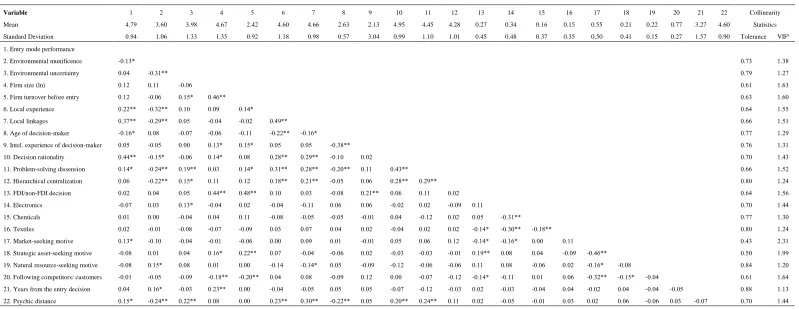
Findings. Descriptive statistics and the correlation matrix for the variables of interest are presented in Table 1. In the matrix, no correlation coefficient is higher
than 0.49, and the indicator of variance inflation factors is close to 1. It appears that
the collinearity effect of the regression variables is not substantial (cf. Neter et al.,
1996).
Insert Table 1 here
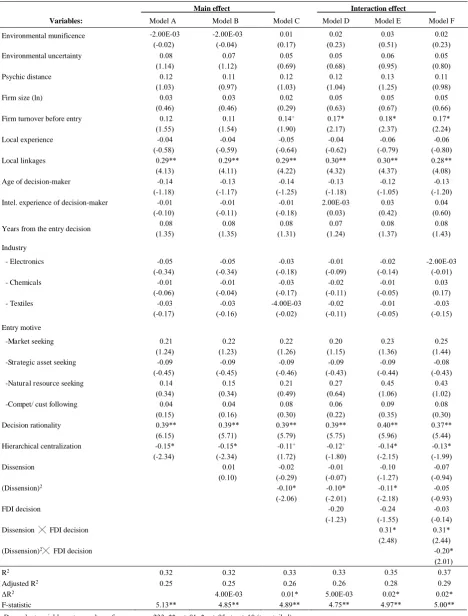
In Table 2, we display the results of the hierarchical OLS regressions. To test
the hypothesized curvilinear effect of dissension and the moderating effect of FDI vs.
non-FDI decisions on this curvilinear association, we followed the procedures
suggested by Janssen (2001). In total, six regression models between Model A and
performance were examined. The addition of the variable of dissension and the
squared dissension term into the base model constituted Model B and Model C,
respectively. The moderator, namely FDI vs. non-FDI decision, and its linear
interaction with dissension, were subsequently entered into the equation to form
Model D and Model E, respectively. In the final model, Model F, the interaction term
between the squared dissension and the moderator was included to test the
hypothesis that the curvilinear association between dissension and mode
performance is moderated by FDI rather than non-FDI decision.
The F-statistics that reflect the overall model fit are highly significant for all six
regression models, confirming the overall robustness of all models. Compared with
the base Model A, the overall model fit of Model B did not significantly improve after
the inclusion of the dissension variable. By comparison, the addition of the squared
dissension term led to a significant increase of R2 for Model C (p< 0.05). In addition, the inclusion of the moderator, namely FDI vs. non-FDI in Model D, did not generate
a significant change of R2. Compared with Model E, an inclusion of the higher-order
interaction contributed to an increase of R2 for Model F (p< 0.05).
Insert Table 2 here
With regard to the main effects of the independent variable, the regression results
in Models B and C show that dissension itself has no direct or significant impact on
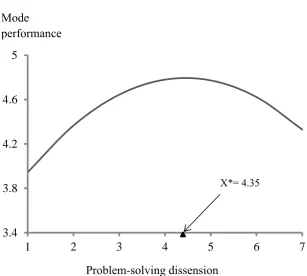
mode performance, while its quadratic form is significantly and negatively (b = -0.10;
performance. To facilitate interpretation, we converted the solution with the
coefficients presented in Table 2, based on standardized data, into the original scales
and computed the derivative of mode performance with respect to dissension. The
optimal level of dissension is about 4.35, indicating that when the level of dissension
is lower than optimal, an increase in the level of dissension is positively associated
with a higher level of entry mode performance. As the level of dissension increases
beyond the optimal level, however, an increase in the level of dissension reduces entry
mode performance. Figure 1 illustrates this relationship.
Insert Figure 1 here
In relation to the interaction between the squared dissension variable and FDI/
non-FDI decision, the interaction in Model F is negatively and significantly (p < 0.05) associated with entry mode performance, which confirms the moderating effect of
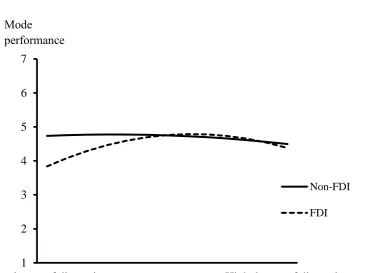
FDI vs. non-FDI decision proposed by Hypothesis 2. In order to further interpret this
significant interaction, the interaction was plotted (cf. Aiken and West, 1991). As
shown in Figure 2, for FDI decisions, mode performance is highest when dissension is
at moderate levels, while for non-FDI decisions, mode performance is highest when
dissension is at the lowest levels. This evidence lends support to Hypothesis 2.
Insert Figure 2 here
With respect to the control variables, we found that only local linkages (p < 0.01) and decision rationality (p < 0.01) had significant and positive impacts on mode performance in a consistent pattern in the regression models, while hierarchical
mode performance across models.
Discussion. Our findings suggest that dissension, which reflects a diverse interpretation of the entry situation, exerts a complex influence on entry mode
performance. The dissension–performance association is apparently quite
idiosyncratic, which is a finding that generally lends support to the information
processing perspective (cf. Atuahene-Gima and Li, 2004).
As to the main effect, the results attest to the significance and complexity of the
managerial interpretative dynamism in international entry mode decision-making. The
identified inverse U-shaped dissension–performance association suggests that
dissension improves or hinders information processing in entry mode SDMPs
depending on its intensity. This finding sheds light on the association between SDMP
and mode performance, and reconciles extant contradictory results found in domestic
contexts (Amason, 1996; Olson et al., 2007; Papadakis, 1998; West and Schwenk,
1996). It appears that the overall positive, insignificant and negative effects are all
possible and conditional on the level of dissension, particularly in international
decision-making contexts. The curvilinear effect of dissension on the current research
is seemingly identified in the entry mode decision-making process for the first time, in
contrast to the linear relations observed in prior mode SDMP studies (Ji and
Dimitratos, 2013). Apparently, this is also the first time this effect has been
established in international decision-making studies, thereby substantially extending
prior literature (Aharoni et al., 2011; Papyrina, 2007).
dissension effects are different when the decision task varies, which is the key tenet of
the information processing view. For non-FDI modes, in which the decision situation
is relatively easy to understand, increased dissension exaggerates the negative effects
of dissension and leads to a decrease in mode performance. By comparison, FDI
decisions that involve considerably higher uncertainty and complexity demand a
larger amount, and heterogeneity, of information processing (Luo et al., 2012;
Parayitam and Dooley, 2009). Without achieving this information balance, the FDI
decision situation will not be effectively understood. To effectively deal with FDI
decisions, dissension at moderate levels facilitates collective understanding and
diversity in decision-making (Fiol, 1994), which is conducive to superior mode
performance.
Conclusions
Implications for theory
With regard to theoretical implications, this study contributes to the entry mode
research in international marketing, since the current research substantially enriches
and extends the entry mode performance research agenda (Brouthers, 2013). It is, to
the best of our knowledge, the first empirical study to use an information processing
perspective to examine the effect of SDMP on mode performance, which substantially
complements the content research on mode performance. Previously, entry mode
performance has been studied primarily through research that stresses the effects of
internal resource factors on mode performance (Brouthers and Hennart, 2007;
Papyrina, 2007). In this literature, managerial dissension related to the diverse
interpretation of the decision situation in SDMPs is disregarded because uniform and
rational criteria replace human agency in decision-making.
In line with organizational behavioral considerations (Simon, 1955), this study
advances the SDMP view of mode performance (Ji and Dimitratos, 2013;
McNaughton, 2001). Our investigation of mode performance supports the
contingency perspective from an information processing view. We found that the
overall effect of managerial dissension on mode performance was based on its
intensity. When decision type varies, the effects of dissension on mode performance
can be better understood through different higher-order relationships, which confirms
the complexity of the effects of SDMPs on mode performance (Rajagopalan et al.,
1993). Overall, our evidence supports the contingency perspective regarding the
effective implementation of organizational processes in international decision-making
(cf. Child and Hsieh, 2014).
The construct of focus in the present study suggests that the objectives,
methodology and solutions in international decision-making are not predetermined.
This stance resonates with the notion of effectuation (Gabrielsson and Gabrielsson,
2013; Read et al., 2009); international entrepreneurial decision-makers use a set of
available means to pursue and choose between future contingencies when uncertainty
is high. This alternative logic extends previous extant SDMP literature on mode
traditional causation logic that underpins hierarchical and procedure-based SDMPs
(Sarasvathy, 2001).
Further, the findings confirm the importance of information processing and
organizational processes to entry mode decision performance, and are compatible with
the view that managerial decision-making, in the context of internationalization, can
be a competitive advantage for firms (Aharoni et al., 2011). Therefore, the findings
contribute significantly to the entry mode performance literature on how to achieve
effective international mode decision-making through appropriate employment of
managerial dissension.
Managerial relevance
The findings of this study suggest that, in the context of international
decision-making in management, mode performance can be improved through
cognitive diversity and dynamism. Managers pay attention to both the constructive
and the precarious implications of dissension in decision-making. This is of particular
importance to Chinese managers. Traditionally, the Chinese decision-making style
emphasizes consensus or conformity (Olson et al., 2007), which may exclude the
beneficial effects of dissension from the process of making difficult decisions.
Chinese managers ought to be cautious, as pure relationship- or authority-seeking
decision-making could constrain effective information processing in an international
context.
moderate levels, and to avoid too little or too much dissension in order to achieve
enhanced entry mode performance in an international setting. Furthermore, it has been
suggested that decision-makers should welcome engage cognitive heterogeneity in
accordance with the degree of decision uncertainty. When international
decision-making requires intricate coordination and dynamism, it is prudent for
managers to engage a certain number of experts with diverse experience to facilitate a
more accurate interpretation of a decision situation. In simpler international
decision-making, an emphasis on rapid information processing tends to be more
effective.
Limitations and future research directions
The current study is subject to limitations that may provide valuable directions for
further research. First, this study investigated one critical type of strategy process
related to managerially interpretative dynamism and its effect on entry mode
performance. Hence, it depicts an incomplete picture of information processing
effects on performance. In order to further understand information processing,
information sources, processing modes and structures of top management groups
could be examined as well (Citroen, 2011). Given the decision-level emphasis of this
study, the adoption of a subjective rather than objective measurement of decision
effectiveness would have been justified. Nevertheless, objective measures may have
certain advantages over subjective ones regarding long-term performance. A more
employ both types of measures.
Although the survey method used is the prevalent design in SDMP studies (e.g.,
Elbanna and Child, 2007; Papadakis et al., 1998), it may suffer a recall bias and
potential time-lag effect between the making of the decision and the reporting of
satisfaction (Huber and Power, 1985; Miller et al., 1997). Future research could
incorporate an alternative research design, such as experimental, simulation or
longitudinal, to enhance the validity of the findings. Moreover, this study is missing a
few important controls, such as firm performance at the time of reporting mode
performance, the number of people involved in the decision, and their past experience
with mode decisions; all these aspects may have an impact on mode performance,
which should be included in future research. In addition, this study employs
categorical variables to capture firm turnover before the entry and age of
decision-maker due to difficulty in data collection, which could be replaced by
continuous variables in future research.
Addressing the request from mode researchers, the current study employs a
process approach to investigate mode performance (Brouthers and Hennart, 2007;
Canabal and White, 2008). Nevertheless, the study may have overlooked the
relationship between content and process factors. A promising direction for future
research would be to understand the association between content and process factors,
and their effects on mode choice and performance. Apart from this, an FDI vs.
non-FDI decision was selected to represent the different necessity levels of
processing could consider other classifications of mode choice, such as solo venture
vs. joint venture.
References
Aharoni, Y, Tihanyi, L. & Connelly B. L. (2011), “Managerial decision-making in
international business: A forty-five-year retrospective”, Journal of World
Business, Vol. 46 No. 2, pp. 135-142.
Aiken, L. S., & West, S. G. (1991), Multiple regression: Testing and interpreting
interactions, Sage, Newbury Park, CA.
Amason, A., & Schweiger, D. (1994), “Resolving the paradox of conflict, strategic
decision making, and organizational performance”, International Journal of
Conflict Management, Vol. 5, pp. 239-253.
Amason, A. C. (1996), “Distinguishing the effects of functional and dysfunctional
conflict on strategic decision making: Resolving a paradox for top management teams”, Academy of Management Journal, Vol. 39 No. 1, pp.
123-148.
Anand, J., & Delios, A. (1997), “Location specificity and the transferability of
downstream assets to foreign subsidiaries”, Journal of International Business
Studies, Vol. 28 No. 3, pp. 579-603.
Anderson, J. C., & Gerbing, D. W. (1988), “Structural equation modeling in practice:
A review and recommended two-step approach”, Psychological Bulletin, Vol.
Armstrong, J. S., & Overton, T. S. (1977), “Estimating nonresponse bias in mail
surveys”, Journal of Marketing Research, Vol. 14 No. 3, pp. 396-402.
Atuahene-Gima, K., & Li, H. (2004), “Strategic decision comprehensiveness and new product development outcomes in new technology ventures”, Academy of
Management Journal, Vol. 47 No. 4, pp. 583–597.
Barkema, H. G., & Shvyrkov, O. (2007), “Does top management team diversity
promote or hamper foreign expansion?”, Strategic Management Journal, Vol.
28 No. 7, pp. 663-680.
Birkinshaw, J. M., & Morrison, A. J. (1995), “Configurations of strategy and structure
in subsidiaries of multinational corporations”, Journal of International
Business Studies, Vol. 26 No. 4, pp. 729-753.
Brouthers, K. D. (1995), “The influence of international risk on entry mode strategy in
the computer software industry”, Management International Review, Vol. 35
No. 1, pp. 7-28.
Brouthers, K. D. (2002), “Institutional, cultural and transaction cost influences on
entry mode choice and performance”, Journal of International Business
Studies, Vol. 33 No. 2, pp. 203-221.
Brouthers, K. D., & Brouthers, L. E. (2003). “Why service and manufacturing entry
mode choices differ: The influence of transaction-cost factors, risk and trust”, Journal of Management Studies, Vol. 40 No. 5, pp. 1179–1204.
Brouthers, K.D. (2013), “A retrospective on: Institutional, cultural and transaction
International Business Studies, Vol. 44 No. 1, pp. 14-22.
Brouthers, L. E., Brouthers, K. D., & Werner, S. (1999). “Is Dunning’s eclectic
framework descriptive or normative?”, Journal of International Business Studies, Vol. 30 No. 4, pp. 831–844.
Brouthers, K. D., Brouthers, L. E., & Werner, S. (2003), “Transaction cost-enhanced
entry mode choices and firm performance”, Strategic Management Journal,
Vol. 24, pp.1239–1248.
Brouthers, K.D., Brouthers, L.E. & Werner, S. (2008), “Real options, international
entry mode choice and performance”, Journal of Management Studies, Vol. 45
No. 5, pp. 936-960.
Brouthers, K. D., & Hennart, J.-F. (2007), “Boundaries of the firm: Insights from international entry mode research”, Journal of Management, Vol. 33 No.3, pp.
395-425.
Brouthers, K.D. & Nakos, G. (2004), “SME international entry mode choice and
performance: A transaction cost perspective”, Entrepreneurship Theory &
Practice, Vol. 28 No. 3, pp. 229-247.
Buyl, T., Boone, C., Hendriks, W., & Matthyssens, P. (2011), “Top management team
functional diversity and firm performance: The moderating role of CEO characteristics”, Journal of Management Studies, Vol. 48 No. 1, pp. 151-177.
Canabal, A and G.O. White (2008), “Entry mode research: Past and future”,
International Business Review, Vol. 17, pp. 267-284.