C
G
P
esis by Keenan Crane
In Partial Ful llment of the Requirements for the Degree of
Do or of Philosophy
California Institute of Technology adena, alifornia
2013
ii
iii
iv
A
e opportunity to write a dissertation is the consequence of extreme privilege: I am paid to sit around and think while others toil in the eld. My thanks go rst and foremost to the taxpayer who unknow-ingly (or unwillunknow-ingly) donated slivers of precious income so that I might discover something useful. Im sorry I can’t promise much, but please trust that we are doing something good! anks also to the community that told me boys can succeed at mathematics and computer science—you might try telling the girls that too. Most of all, this privilege stems from the people I met along the way.
First and foremost: the advisors. Most PhD students are lucky to get one mentor during who is switched on, attentive, and supportive. I have hadfour! Ulrich:this thesis clearly contains your DNA.
v
Long before Caltech there were two other mentors, without whom things would have ended badly! Eliot: who in their right mind picks up a high school kid as a research assistant, and wastes hour upon precious research hour explaining totally banal stu like linear systems and Monte Carlo? You do, apparently—and it has made all the di erence. anks for showing me the pleasure of nding things out (and for all the zzy juice). John:you saved my ass. Lets just leave it at that! anks for being “big on topology; small on topography.” anks for elding questions from foreign trolls. Most of all, thanks for believing in me. (By the way, I think this thesis more than quali es me for induction into the Secret Society of the uaternion Handshake!)
en there were my cohorts at Caltech. anks to the older ones, for being there when I landed. I asked too many questions. You made me eat too many Oreos!Patrick:thanks for bearing with me as I learned the fundamentals. I know it wasn’t easy! But it was fundamental. Lily: thank you for being my director. What a strange video we made of that poor pigs liver! Nathan: why were you still there?! Im glad you were. Long live the lab in Jorgensen, and lunches on the bridge. anks too to the younger ones. Patrick:thanks for indulging with me in some truly bizarre questions. Do we know yet how to intersect a city with a ray? Fernando:thanks for being part of DDG: e Next Generation. Someday we will know everything there is to know about triangles—and can move on to quads! Mike: thanks for being stuck in a room with me for four years! anks for letting no one ignorant of geometry enter there. anks for putting the Shredder in his place. anks for the great debates, and for permitting me to vex you with all things convex. anks toSimonfor talking cars, life, and for reminding me how sexy I am! Do you know the equation for a cow? anks be to Alex, though he may never know what I am keen on. anks toKatherine, for an excellent week of eigenvectors. anks toMelissafor getting us out of the lab and up onto the volcano; thanks toTom for getting us out to the racetrack; thanks toChristianfor getting us out to the bar. Many thanks to Maria, Jeri, Sydney, Sheila, Lisa, PatandDavefor locking me back in when I was locked out, for
vi
me!), and for helping me get where I was going next. anks to the ACM:Matt, Vilas, Grier, Yisong, Parisa, Leo, Steve, Keith, Carrino, Dave, Ari, Anthony, Vlad, Petersen,and yes even youClausen. You taught me the skills I use every day—you made me do things I regret even to this day. ( ere is so much more to say here… see my email of March , .) Finally, thank you toMichaelfor introducing me to digital geometry processing in the rst place. Without your most excellent class I would never have applied to Caltech, nor made this stu my lifes work (so far…).
Much time was spent in lands afar.Mark:thanks for long meandering discussions of architecture and geometry, and for asking “how do you pick a research topic?” [PKK ] anks toMadeleine Robertfor giving me the keys and looking the other way.Mario, So en, Yuliy, ibaut, Ian: thanks for jazz, Gruyère, Mario, meringues, wine on the train, and strange Swiss towns full of erotic alien art…! en there is the land of Gänseliesel. Max:for giving me a kitchen; for making me neighbors with Minkowski.Clarisse, Ulrich, Alessio, Henrik, Knut, Lars:thank you forneverstaying on topic, for Cuban cafés, and for the “Gauss” tour. For warning me of the unstylishness of cappuccino a er noon. For American movies without English subtitles. For calling me peanut and making me sing Gwen Stefani. For Uli the Bee! In the land of Sachertorte, thanks toChris and Olga, my gracious hosts. I am so lucky to have friends like you two. anks toElisabeth Hackerfor managing the important stu . anks toMorten, Brittany, Michael, Filip, and Viktoriiafor schnapps, Heurigers, and death by ma a. anks to brotherJustin, my fellow nomad, for spreading the good word of DDG, and for showing me his black umbrella last Friday night. Finally, there was Berlin. anks to Sasha, UlrichandAnnett Gillmeisterfor making it possible; thanks toBoris, Steffen, Stefan, Andre, Felixfor enlightenment in a tiny corner co ee room on the th oor. (Big Brother is watching!)
vii
anks to friends and family, who give me the things my work cannot. ank you Chesterians Nick, Luke, Tucker, Jon, Patrick, for reminding me to always,alwaysput safety second. ank you Caitlin, Lauren, Maggie, Eyrún, Mike, Emily, Kim, ``Wolf,'' Kris, Shaun, Artur, David, Dan,
Danielle, Matt, Pratyush, Meganfor BBQs, Tubular Tuesdays, Tour de Franzia, hot tub crawls, par-ties at the Cats, parpar-ties on the West Side, parpar-ties in Old Town, parpar-ties in New Town, parpar-ties down-town, pancake parties, birthday parties, holiday parties, house parties, housewarmingparties, dinner parties, melancholy Bollywood dance parties, going away parties, coming back parties, bachelor par-ties, and at long last, graduation parties. ank youCole, Robin, Anya, Mikefor encouraging me to do my best (and forget the rest). ank youSarah, Orion, Beth Anne, August, Forrest, Metz, for be-ing there whenever I went back home. ank youHarold, Devin, Andrewfor reminding me of art in the midst of all my nerdiness. ank youChris, for always letting me be candid—our conversations have made a di erence. ank youJerry, for your considerate and sel ess character—it is an inspira-tion. ank youJessica, for a friendship I will always treasure. It has helped me become a more whole and balanced person. ank you grandparentsLee, Trudy, Kathryn, Gina, Frank, for thinking about my future before I was old enough to say your names or see your faces, and later for your unrelenting e ort to understand what Im doing out here on the lunatic fringe. ank you parents,Christine, Dennis, Donna, for loving me long before I was a Caltech PhD. ank you Dad for waking up early in the morning to help me with HyperCard. ank you Mom, for supporting unconditionally all my crazy pursuits. ank you Donna for helping me become a better adult. Finally, thank youRebecca, my rst and best friend, for always being on my side (even when we disagree).
viii
A
is thesis introduces fundamental equations and numerical methods for manipulating surfaces in three dimensions viaconformal transformations. Conformal transformations are valuable in appli-cations because they naturally preserve the integrity of geometric data. To date, however, there has been no clearly stated and consistent theory of conformal transformations that can be used to develop general-purpose geometry processing algorithms: previous methods for computing conformal maps have been restricted to the at two-dimensional plane, or other spaces of constant curvature. In con-trast, our formulation can be used to produce—for the rst time—general surface deformations that are perfectly conformal in the limit of re nement. It is for this reason that we commandeer the title
onformal eometry roc sing.
e main contribution of this thesis is analysis and discretization of a certaintime-independent Dirac equation, which plays a central rôle in our theory. Given an immersed surface, we wish to construct new immersions that (i) induce a conformally equivalent metric and (ii) exhibit a prescribed change in extrinsic curvature. Curvature determines the potential in the Dirac equation; the solution of this equation determines the geometry of the new surface. We derive the precise conditions under which curvature is allowed to evolve, and develop e cient numerical algorithms for solving the Dirac equation on triangulated surfaces.
ix
C
Acknowledgments iv
Abstract viii
Introduction
. Contributions . . . . . Related Work . . . .
Background
. Notation . . . . . Curves and Surfaces . . . . . Conformal Immersions . . . . . Half-Densities . . . . . uaternions . . . . . uaternionic Di erential Forms . . . . . Geometry in the uaternions . . . .
e uaternionic Dirac Operator
. Basic Properties . . . . . Relationship to Spin Dirac Operator . . . . . Relationship to Laplace-Beltrami . . . . . Vector Analysis . . . .
e Shape Space of Conformal Immersions
x
. Spin Transformations . . . . . Curvature Potential . . . . . Conformal Shape Space . . . . . . Local Analysis . . . . . . Nontrivial Topology . . . . . . Sphere Inversions . . . . . . . Möbius Balancing . . . . . . . e Canonical Metric . . . . . . Boundary Conditions . . . . Discretization
. uaternionic Matrices . . . . . Discrete Dirac Operator . . . . . Curvature Potential . . . . . Adjoint Matrices . . . . . Dirac Equation . . . . . Spin Transformations . . . . . Boundary Conditions . . . . . Validation . . . . . . uasi-Conformal Error . . . . . . Eigenvalue Spectrum . . . . . . Convergence . . . . . Comparison . . . . Applications
xi
. . . Filtered Flows . . . . . . Isometric Curve Flows . . . . . . Conformal Surface Flows . . . . . . Implementation . . . . . . . Exactness . . . . . . . Möbius Balancing . . . . . . Comparison . . . . . Special Surfaces . . . . . . Dirac Spheres . . . . . . Dirac Disks . . . . . . Constant Mean Curvature . . . . . . Complex Tori . . . . . Numerics and Performance . . . . . . Building the Eigenvalue System . . . . . . Building the Poisson Problem . . . . Conclusion
C
I
e world around us is full of shapes: airplane wings and cell phones, brain tumors and rising loaves of bread, fossil records and freeform architectural surfaces. To a large extent, our ability to mas-ter these domains is limited by our capacity to design, process, and analyze this geometry. e aim of igital eometry roc sing(DGP) is to extend ideas from classical signal processing to new algo-rithms for working with three-dimensional shape. In doing so, however, one must address a classical signal processing question: how does one process data while preserving its integrity? And what does “integrity” even mean in the context of three-dimensional geometric data? We adopt the perspective that the integrity of a geometric signal can be characterized by preservation of localmetricproperties, i.e., lengths and angles associated with a given surface. As we will see, this approach has some very attractive bene ts from a computational perspective; it is also linked to a rich and beautiful body of knowledge from surface theory.
rotate scale shear
Globally, these modes induce di erent types of surface deformations. For instance, if all three modes are permitted then we get arbitrary smooth deformations, which provide great exibility but make it di cult to preserve signal integrity. If shearing is not allowed then the angle between any pair of vectors is preserved and we obtain conformal deformations. If in addition we prohibit scaling then length is also preserved and we get ometricdeformations, i.e., both length and angle are perfectly preserved. Finally, if all three modes are prohibited then we getrigidity: the shape looks exactly like the one we started with. Actually, in most cases isometric deformations are also rigid (up to global rotation and translation). For instance, Cauchys rigidity theorem tells us that the boundary of any convex body (e.g., the unit sphere) cannot be deformed isometrically—in general, many of the objects we encounter in everyday life are likewise isometrically rigid.
Examining the list of possible motions, one is naturally inclined to ask: why not allow shearing but prohibit scaling? In other words, why not try to preserve area instead of angle? is idea certainly has a natural appeal, but one should be careful to understand what area preservation really implies. For instance, we can preserve area on the sphere by swirling its surface around in a uid-like motion (computed here by advecting mesh vertices in a divergence-free velocity eld):
From the perspective of geometry processing, this type of motion is undesirable because it can lead to arbitrarily bad degeneration of mesh elements, and distortion of data associated with the surface. In other words, like smooth deformations, general area-preserving motions are “too exible” to preserve signal integrityճ. In contrast, angle-preserving motions are more rigid and hence better preserve the kinds of features we are interested in. Finally, one can try to preserve various properties of the metric only approximately—for instance,el ticenergies are commonly used in geometry processing to nd a deformation that is “as rigid as possible,” i.e., as close as possible to isometric [SA , CPSS ]. Later in this thesis we will describe a similar approach: preserve angles exactly, but try to preserve area as well as possible (Section . . . ).
e next question we must answer is: how does one manipulate a surface in space without dis-torting angles? Traditional methods consider maps into the complex plane, which are useful only for problems such as surface parameterization and planar shape deformation where the target surface is at. We instead consider maps into thequaternionsH, which allows us to work directly with surfaces inR3(Chapter ). In particular, we introduce thequaternionic Dirac operatorand use it to develop novel integrability conditions for conformal deformations (Chapter ). A key feature of our theory is that a deformation can be expressed via a scalar function that prescribes the extrinsic curvature. Prac-tically speaking, this setup allows us to “paint” a change in curvature on a surface and produce the corresponding conformal deformation (Chapter ). For instance, a model that has already been care-fully detailed (le ) can be further altered without compromising texture or geometric detail (middle), whereas standard mesh editing tools do not respect these features (right):
ese transformations also preserve mesh quality—here a grid of equilateral triangles (top le ) is sub-stantially deformed while preserving triangle shape almost perfectly (top right); similarly, a carefully ճ e present colloquial use of the term “area-preserving” or “volume-preserving” in geometry processing is perhaps
quadrangulated beetle (bottom le ) becomes an old beat-up car (bottom right) while preserving the shape of quadrilaterals:
When applied to a task likesurface fairing, where we wish to smooth out or regularize a given surface, our approach gracefully preserves texture and mesh quality throughout all stages of the ow:
Moreover, we can take integration time steps orders of magnitude larger than those seen in classical approaches (Section . ).
solv-ing an eigenvalue problem and a Poisson equation; matrices have the same sparsity as the standard cotangent discretization of the Laplace-Beltrami operator [Mac , Duf ]. e linearity of this for-mulation is most unusual: if one instead wants to prescribe standard quantities (such as the induced metric, principal curvatures, etc.) more di cultnonlinearproblems must be solved [ESP ].
Conformal maps have already proven invaluable in applications like computational medicine [GWC+ ] and anatomy [LD ] because they are cheap to compute and preserve important geo-metric structure. For example, they preserve the numerical conditioning of discrete Poisson prob-lems, and preserve the integrity of signals associated with a surface [CPS ]. Exceptional numerical methods for parameterization [GY , MTAD , SSP ] and uniformization [JKG ] have been developed by applyingintrinsictools from Riemann surface theory. However, conformal maps have thus far seen relatively little use in broader geometry processing applications due to the lack of a read-ily discretizable theory for surfaces immersed in three dimensions. e purpose of this thesis is to extend the applicability of conformal maps in geometry processingbeyond the traditional context of parameterization/uniformization.
.
Contributions
e main outcome of this thesis is a clearly stated and consistent theory of conformal immersions from which one can develop a broad class of conformal geometry processing algorithms. In particular, letf be an immersion of a compact surfaceMintoR3. We describe numerical procedures for constructing new immersionsf˜that, up to discretization error, (I) induce the same conformal structure onMand (II) satisfy additional application-speci c criteria. For instance, to regularize noisy data one might de ne a fairing energyE(such as the Willmore energy) and require thatE(f˜)<E(f).
establish the rst numerical algorithm for Willmore ow that does not exhibit a time step restriction based on grid spacing (Section . ).
Much of the work in this thesis appears in the following publications:
• Keenan Crane, Ulrich Pinkall, and Peter Schröder, “Spin Transformations of Discrete Sur-faces,”ACM Transactions on Graphics (SIGGRAPH), ( ), .
• Keenan Crane, Ulrich Pinkall, and Peter Schröder, “Robust Fairing via Conformal Curvature Flow,”ACM Transactions on Graphics (SIGGRAPH), ( ), .
A signi cant portion of the material (esp. Chapters and ) is previously unpublished, and ap-pears on a private collaborative research blog shared by the above authors during the years - .
.
Related Work
Di erential representations are well-studied in digital geometry processing [BS ] but ignore the question ofintegrability: under what condition does a prescribed di erential quantity come from an actual surface? e standard practice is to forgo this question and instead look for a surface that best approximates prescribed data in the least-squares sense, as rst proposed by Yu et al. [YZX+ ]. For conformal maps we need to be more careful since the closest surface may be far from conformal, even when the new di erential comes from a similarity transformation at each point (see Section . for several comparisons).
Conformal deformations have also been studied in the context ofcage-b ed editing, where coor-dinate functions on a coarse volumetriccageinduce transformations of an enclosed surface [LLCO , BCWG ]. e main di culty is that the only conformal maps fromR3to itself areMöbi transfor-mations, which are far too rigid for surface editing. As a result, cage-based methods are inherently lim-ited to so-calledqu i-conformalmaps, which can still introduce signi cant distortion (Section . ). On the other hand, these methods are highly e cient since they need only evaluate simple (o en closed-form) coordinate expressions. It may therefore make sense to use our method inconjunction with existing methods to produce a nal, high-quality surface (see Sections . and . ).
Discrete conformal maps have been studied extensively in the case ofsurface parameterization where the target surface has constant curvature (such as the plane or the sphere). A common approach is to compute a pair of discrete harmonic functions that describe a map into the plane, requiring the so-lution of a linear system [Mer , DMA , LPRM , GY ], or an eigenvalue problem [MTAD ]. Conformal transformations can also be constructed by prescribing values at vertices that directly con-trol the rescaling of the metric [BCGB , YKL+ , SSP ]. However, a metric alone is not su cient to describe an embedding—one must therefore restrict the scope of the problem to metrics of con-stant curvature in order to realize the nal surface. We instead store values at vertices that encode both local rescaling androtation, which is ultimately su cient to describe the extrinsic geometry of a deformation (Section . ).
Several methods allow prescription of extrinsic curvatures [ESP ] and metric properties such as length [EP ]. However, the resulting energies are expressed in terms of vertex positions, making them highly nonlinear. Using higher-order di erential quantities (such as our functionρ) as primary degrees of freedom may prove useful in this setting.
C
B
.
Notation
e following notation is adopted throughout unless otherwise indicatedճ. Single angle brackets〈·,·〉 and bars| · |denote the Euclidean inner product and norm (respectively) either on individual vectors inRnor evaluated pointwise for vector-valued functions; double brackets〈〈·,·〉〉and bars|| · ||denote theL2inner product and norm on functions. e symbol×denotes the usual cross product onR3. When applied to vector elds, operators like〈·,·〉and×act pointwise. Vector space isomorphism is denoted byV =W for any two vector spacesV,W. e symbol1denotes a function equal to one at every point, or a vector containing a one in each entry. e symboliddenotes the identity map.
Ifφ(t)is a time-varying quantity, thenφ˙denotes the time derivative ofφat time zero, i.e.,
˙
φ:= d dtφ
t=0
.
For any quantityφ(s)de ned along a D curve,φ′denotes the spatial derivative:
φ′:= d dsφ.
Indices are typeset without serifs (e.g., i,j,k) to distinguish them from the basis for imaginary quaternions (i,j, andk). Superscriptsx,y, andzdenote components of vectors inR3.
.
Curves and Surfaces
is section reviews standard concepts from the di erential geometry of surfaces and outlines the no-tation we adopt in this thesis. Importantly, expressions in this section apply to general immersed sur-faces, whereas in the remainder of the thesis we will adopt the convention that surfaces are described by aconformalimmersion (see Section . ).Caveat lector!
e objects we consider in this thesis are - and -dimensional hypersurfaces immersed in Eu-clidean space, i.e., curves in the EuEu-clidean planeR2and surfaces in EuclideanR3. Explicitly, we de-scribe the shape of a curve or surface via a map f :M →Rn+1whereMis a topologicaln-manifold with boundary∂M. We assume throughout thatMis compact, connected, and orientable, and will subsequently indicate when it is closed (∂M = ;) or simply connected (π1(M) =0). Since the
di-mension ofMis no greater than two it has a uniquely de ned smooth structure, hence a well-de ned tangent bundleTMand di erentiald f :TM→TRn=Rn. Tangent vector elds onMare typically denoted by capital Roman lettersX,Y,Z, etc., and we use the notationd f(X)to denote the pushfor-ward ofX to the ambient spaceRn. For convenience we will sometimes abbreviate the pushforward with a caret, e.g.,
ˆ
X :=d f(X),
and will more generally use a caret to distinguish vector elds on the ambient spaceRnfrom those on the domainM. roughout we assume that f is animmersion, meaning thatd f maps nonzero vectors to nonzero vectors. (Note that immersions are not in general injective, i.e.,f(M)may have self-intersections.) Two immersionsf andf˜areregularly homotopicif there exists a continuous family of immersions ft:M→Rn,t∈[0, 1]such thatf0= f andf1=f˜.
Since f is an immersion we can use it to de ne an inducedRiemannian metric
(also known as thefirst fundamental formI(X,Y)). WhenM is a surface, we letAdenote the total area
A:=
∫
M
σ,
whereσis the inducedvolume form
σ(X,Y):=〈N,d f(X)×d f(Y)〉,
andN is the unit normal. More precisely, the unit normal orGa s mapN :M →Sn−1⊂Rnis a smoothly varying unit vector eld onMsuch that
〈N,d f(X)〉=0
for all vector eldsX. Our convention is to letNbe theoutwardnormal, i.e., normal vectors drawn on a closed compact surface are visible from a point at in nity. For a vector eldZˆon the immersed surface we use⊤to denote the tangential part and⊥to denote the normal part, i.e.,
ˆ
Z⊤:= ˆZ− 〈Zˆ,N〉N,
ˆ
Z⊥:=〈Zˆ,N〉N.
SinceN is aunit vector eld, its di erentiald N must produce vectors orthogonal toN itself, i.e., d N(X)is a vector eld tangent to the surface. Hence, there must exist a tangent space endomorphism S:T M→T Msuch that
d f(SX) =d N(X)
for all vector eldsX. We adopt the somewhat unconventional nomenclature thatd N is called the Weingarten mapandSis called theshape operator(traditionally these terms are used interchangeably, but we wish to distinguishd N, which produces immersed vector elds, from S, which produces intrinsic ones). Using these operators, we can express the second fundamental form as
and the normal curvature alongX as
c(X):=−〈d N(X),d f(X)〉
|d f(X)|2 =
II(X,X) g(X,X).
It is not hard to verify thatSis self-adjoint with respect to g and henceII is symmetric inX andY. On surfaces, we will useX1,X2to denote unit vectors along the directions of principal curvature and
c1,c2to denote the corresponding curvatures, i.e.,
SXi=ciXi
and hence
d N(Xi) =cid f(Xi).
SinceS is self-adjoint with respect to g it follows that the principal directions are orthogonal with respect to the induced metric, i.e.,g(X1,X2) =0. We de ne the Gaussian and mean curvature of an immersed surface as
K=c1c2,
H=c1+c2
2 ,
For vector eldsX,Y on EuclideanRn, the Levi-Civita connection∇ˆ can be expressed as ˆ
∇XY=d Y(X)
whered denotes the exterior derivative andY is viewed as a vector-valued -form. In other words, to di erentiate a vector eldY we simply take its usual directional derivative alongX. If∇is the Levi-Civita connection on an immersed hypersurfacef :M→Rn, then we can decompose∇ˆ as
ˆ
∇XˆYˆ =d f(∇XY) +II(X,Y)N,
i.e., the derivative of a tangent vector eld consists of a tangential part determined by the intrinsic co-variant derivative and a normal part given by the second fundamental form. (Recall thatXˆ=d f(X) andYˆ =d f(Y); here we extendXˆandYˆ arbitrarily to smooth vector elds onRn.) We then have
d f(∇XY) = ( ˆ∇XˆYˆ)⊤,
II(X,Y) =〈N,( ˆ∇XˆYˆ)⊥)〉.
roughout we usediv,grad,curl, and∆to denote the divergence, gradient, curl, and Laplace-Beltrami operators induced by f. e quantity 12∆f is called thecurvature normal, equal tocNfor curves andH Nfor surfaces.
.
Conformal Immersions
Why is it useful (or even reasonable) to work with conformal maps? For readers already familiar with geometry processing, the conformal assumption may sound like a “special” condition, tailored to very speci c problems and application domains. As we will see, however, conformal immersions are a natural tool for analyzing general surfaces (i.e., when doing pen-and-paper derivations)—even if one has no interest whatsoever incomputingconformal maps. Moreover, this convention puts absolutely no restriction on the type of geometry we are able to work with in practice.
To better motivate the use of conformal maps, consider the much simpler case of curves. In many situations a curve appears as just a subset of the plane, with no explicit parameterization:մ
Conceptually, we can always imagine that this curve is the image f(M)of some mapf :M→R2. In other words, as long as we know such a map exists, we can use it tore onabout the curve without ever having to explicitly compute the function f itself. Moreover, since we do not have to go to the trouble of computingf, we may as well assume that it is as nice as possible. For curves, one particularly nice convention is to let f be anarc-lengthor ometricparameterization f :[0,L]→R2;s 7→ f(s), which means that length is locally preserved: |d f(X)| = |X|. In this case quantities like thetotal length of the curve can be expressed as just
ℓ=
∫L
0
d s.
For a general parameterization we would instead have to write something like
ℓ= ∫ L 0 v u u
t∂ fx
∂s
2
+
∂ fy
∂s
2
d s or equivalently ℓ=
∫L
0
Æ
detg d s,
wherefxandfyare the two coordinate functions associated with f, andgis the induced metric. In other words, we have to account formetric d tortionas we go fromM intoR2, which o en com-մ is curve, for instance, was extracted from the painting“Yellow, Red, Blue” by Kandinsky, who very likely had no
plicates our understanding of the curve. Conversely, an isometric parameterization provides simple algebraic expressions that convey a clear picture of the underlying geometry.
Like curves, surfaces o en come without an explicit parameterization. Nowhere is this statement more true than in digital geometry processing, where a surface begins life as a big jumble of points or triangles oating in space! Unlike curves, however, we cannot always expect to nd a parameterization free of metric distortion, which explains why cartographers have so many di erent projections of the globe:
On the other hand, we can always describe a surface using an angle-preserving orconformalmap— no matter what the surface looks like! In other words, we do not have to make any special assumptions about the surface under consideration. As with curves, this convention tends to produce simple alge-braic expressions that make it easy to understand the behavior of the geometry. As just one example, consider theLaplace-Beltrami operator∆acting on a scalar functionφ, which in the case of a general immersionf :R2⊃Ω→R3;(s
1,s2)7→ f(s1,s2)is typically expressed as
∆φ= ∑2
i,j=1
1
p
detg
∂ ∂si
Æ
detg gij ∂
∂sjφ
!
.
For a conformal immersion this expression simpli es to just
∆φ= p1
detg
∂2 ∂s12+
∂2 ∂s22
!
φ.
In general, we do not even need to imagine that the domain of f is the Euclidean plane (or any other metric space, for that matter). To be more precise, letM be a topological surface. Acomplex structureյonMis a vector bundle automorphismJ :TM→TMsuch that
J2=−id.
IntuitivelyJ represents a -degree rotation in each tangent space, just as the imaginary uniti repre-sents a -degree rotation in the complex plane. An immersion f :M→R3is thenconformalif for
allX ∈TM
d f(JX) =N×d f(X). ( . )
Intuitively: an immersion is conformal if -degree rotations in the tangent space yield -degree rotations in the ambient space. One can easily verify that this de nition agrees with the usual notion of a conformal immersion, namely that|d f(X)|= |d f(JX)|and〈d f(X),d f(JX)〉= 0for allX. Note that we adopt the usual right-hand rule for the cross product, which means thatJ is e ectively acounter-clockw erotation.
It is perhaps more intuitive to turn this story around: any immersion f →R3induces a natural complex structure onM, obtained by rotating each vector degrees around its normal—in essence, the normal eld of an immersed surfacedefin the complex structure. In other words, start withany immersionf and de neJX as the unique vector such that Equation . holds. en f is conformal յNote thatJ is more typically called analmost complex structure, but for surfaces this data is su cient to uniquely
by construction. Note that one does not need to invoke deeper results here (like uniformization): the existence of a conformal immersion is guaranteed by the fact that an immersed surface already has a smoothly varying Riemannian (and hence conformal) structure.
.
Half-Densities
Intuitively, ahalf-densityis a function that maps each tangent vector to a scalar multiple of its length, where the scaling coe cient depends only on the basepoint. Since this function depends only on the length of a vector (and not its direction), its graph over each tangent space is a circular cone. A half-density on a surface can therefore be visualized as a collection of cones with varying aspect ratio, as depicted above.
More precisely, let M be a topological surface with complex structureJ, and let f : M → R3 be any immersion compatible with this structure (i.e.,d f(JX) =N×d f(X)for allX). Every half-density onMcan be expressed as a map
whereφis some real-valued function onM. (Notably, half-densities are not -forms since they are not linear in the argumentX.) We will typically denote half-densities by expressions likeφ|d f|to make explicit both the reference immersion f and the corresponding coe cient functionφ. In other words,
φ|d f|(X):=φ|d f(X)|.
Note that for any other conformal immersion f˜we can always nd a functionφesuch thatφe|df˜|=
φ|d f|, namelyφe:=φ|d f|/|df˜|. In other words, there is nothing special about the particular immer-sion we choose to represent a given half-density (other than the fact that it agrees with the conformal structure onM).
e fact that we can write all half-densities with respect to a single reference immersion f means that they have a natural vector space structure induced by the vector space structure of the associated coe cient functions, i.e.,φ1|d f|+φ2|d f|:= (φ1+φ2)|d f|. is space also has a natural inner product
〈〈φ1|d f|,φ2|d f|〉〉:=
∫
M
φ1φ2|d f|2,
i.e., we take the inner product of the two coe cient functions with respect to the volume form|d f|2
induced by the reference immersion. We will denote the space of half-densities onM byH(M), (or justHwhen the domain is understood.) An important property of half-densities is that their norm is preserved byarbitrarydi eomorphismsξ ∈Diff(M), not just volume-preserving di eomorphisms
ξ ∈SDiff(M). is fact will come into play in Chapter .
A central object in our discussion of conformal immersions is themean curvature half-density
µ:=H|d f|
Likewise, a local increase in mean curvatureHis easily mistaken for an increase in bending, but in reality an increase in mean curvature can also result from uniform shrinking and a simultaneous decre ein bending. In contrast, the e ect of manipulating mean curvature half-densityµis unam-biguous: increasingµexaggerates bending; decreasingµmitigates it.
.
uaternions
equaternionsHare a number system well-suited to expressing three-dimensional geometric rela-tionships; they also provide a natural algebraic language for conformally immersed surfaces [KNPP ].
uaternions can be viewed as a four-dimensional real vector space with basis{1,i,j,k}along with the associative, noncommutativeHamilton product, which is uniquely determined by the relationship
i2= j2=k2=i j k=−1.
eimaginary quaternionsImHare elements of the three-dimensional subspace spanned by{i,j,k}. roughout this thesis we use imaginary quaternions to represent vectors inR3via the natural iden-ti caiden-tion
We useReandImto denote the real and imaginary parts of a quaternion, respectively, i.e.,
Re(a+b i+c j +d k) = a,
Im(a+b i+c j +d k) = b i+c j +d k.
We will sometimes express a quaternionqas the sum of a real scalar partqs∈R⊂Hand an imaginary vector partqv∈R3=ImH⊂H, writing
q=qs+qv
as an abbreviation forq=qs+qvxi+qvyj+qvzk. In this case, the Hamilton product of two quater-nionsq,pbecomes
q p=qsps− 〈qv,pv〉
| {z }
real
+qspv+ psqv+qv×pv
| {z }
imaginary
.
In the case whereqandpare purely imaginary we omit the subscriptvand simply write
q p=q×p− 〈q,p〉. ( . )
econjugateof a quaternionq=a+b i+c j+d kis the involution given by
q:=a−b i−c j −d k,
i.e., conjugation simply negates the imaginary part. In particular,q=−qwheneverq∈ImH. Con-jugation reverses the order of a product, i.e.,
q p=pq,
and can be used to concisely express the Euclidean inner product for any p,q∈H=R4:
〈p,q〉=Re(pq).
In particular,
Finally, ifqis aunitquaternion then the action
q7→q x q
on vectors x ∈ ImHrepresents a rotation of Euclidean -space, i.e.,q x q is a rotated version of x. Explicitly,q=cos(θ/2)−sin(θ/2)urepresents rotation by an angleθaround the axisu∈R3. More
generally, if|q| ̸=1then this action represents asimilarity, i.e., rotation and uniform scaling by a factor
|q|2. is representation will be especially important in our description of conformal deformations,
since conformal maps are local similarity transformations.
.
uaternionic Di erential Forms
uaternion-valueddifferential formsprovide a convenient language for discussing conformal immer-sions. On an orientable surfaceM, these objects are quite easy to describe:
• -formsareH-valued functions onM;
• -formsare real-linear maps taking a vector eld onM to anH-valued function; • -formsare rescalings of the volume formσby anH-valued function.
For example, the immersion f can be thought of as a quaternionic -form, the di erentiald f can be thought of as a quaternionic -form (taking any vector eldX to the correspondingH-valued functiond f(X)), and the volume formσitself can be thought of as a quaternionic -form. For a
-formα,real-linearmeans that
α(hX+Y) =hα(X) +α(Y)
ewedge product∧of two -formsα,βyields a -form
α∧β(X,Y):=α(X)β(Y)−α(Y)β(X),
and one can easily verify the basic identities
α∧β=−β∧α,
α∧hβ=αh∧β
wherehis again real-valued. To give a concrete example, the induced volume form of a general im-mersion f can be expressed as the quaternionic -form
σ= 1
2d f∧N d f,
since then
2σ(X,Y) = d f(X)N d f(Y)−d f(Y)N d f(X) = −(d f(X)d f(Y)−d f(Y)d f(X))N = −2(d f(X)×d f(Y))N
= 2〈N,d f(X)×d f(Y)〉.
In the special case wheref is conformal, we will denote the volume form by the symbol
|d f|2.
is convention makes explicit the fact that the volume is induced by the immersion f, which is useful in contexts involving several di erent immersions. e notation| · |2is motivated by the fact thatσis uniquely determined by the relationshipσ(X,JX) =|d f(X)|2. Also note thatg(X,X) =
〈d f(X),d f(X)〉=|d f(X)|2; hence, one can also think of|d f|2as the Riemannian metric induced byf.Div ionby|d f|2identi es any -formωwith the corresponding scalar multiple of the volume form, i.e.,
ω
|d f|2 :=ω(X,JX),
• |d f|2represents the Hodge star on -forms (⋆φ=φ|d f|2),
• J represents the Hodge star on -forms (⋆dα(X) =dα(JX)), and • 1/|d f|2represents the Hodge star on -forms (⋆ω=ω/|d f|2).
In the particular case of the -formd f, we can also use the unit normal to express the Hodge star, i.e.,
⋆d f =N d f. Using the Hodge star, one can write the wedge product of -forms as
α∧β=α ⋆ β−⋆αβ,
and the induced Laplace-Beltrami operator on -forms as
∆ =⋆d⋆d.
Finally, theL2inner product on quaternion-valued functionsψ,ϕ:M→His given by
〈〈ψ,ϕ〉〉:=
∫
M
ψϕ|d f|2.
.
Geometry in the
uaternions
function. In particular, any quaternionic functionψ:M→Hcan be decomposed as
ψ = a + d f(Y) + b N
quaternion real tangent normal
for some vector eldYand pair of real-valued functionsa,bonM. In other words, it can be written as the sum of a real part, a tangential part, and a normal part, respectively, as depicted below.
When working with purely imaginary quantitiesq,p∈ImHrepresenting vectors inR3, we will repeatedly take advantage of the relationship
q p=q×p− 〈q,p〉
to simplify calculations. For instance, for any tangent vector eldYˆ = d f(Y)and pair of normal vector eldsZˆ1=b1N,Zˆ2=b2Nwe have
ˆ
In other words: normal vector elds commute with each-other; normal and tangent vectors anti-commute. Similarly, for any pair of orthonormal tangent vector eldsd f(X),d f(JX)we have
d f(X)d f(JX) =d f(X)×d f(JX) =N|d f(X)|2,
C
T
Q
D
O
On any conformally immersed surface f :M→ImHwe de ne a di erential operatorDon smooth quaternion-valued functions, which we call thequaternionic Dirac operator:
Dψ:=−d f∧dψ
|d f|2 . ( . )
Very roughly speaking, the Dirac operator can be thought of as a generalized gradient operator: it describes the rst-order derivatives of a given function. In the quaternionic setting, however, the derivative of a function is a function of the same type. For instance, a real-valued function and its gradient vector eld can both be expressed in terms of quaternion-valued functions, as discussed in Section . . For this reason, the operatorDprovides a uni ed treatment of di erential operators on immersed surfaces, as will be discussed in Section . . More generally, Dirac operators play an impor-tant role in physics and geometry, and will be central to our treatment of conformal deformations. In particular, we will be interested in thetime-independent Dirac equation
(D−ρ)ψ=γψ ( . )
.
Basic Properties
We rst establish some basic properties of the quaternionic Dirac operatorD, where as usual we as-sume thatf :M →R3is an immersion of a compact connected orientable surfaceM which inherits a complex structureJ from the unit normal eld on f(M). Oncloseddomains (∂M=;), we show thatDexhibits the behavior expected of any Dirac operator, namely that it is self-adjoint and (weakly) elliptic. ese properties are desirable from an applications point of view, because on a compact do-main any self-adjoint elliptic operator has an orthonormal eigenbasis and a discrete spectrum of real eigenvalues—hence, we can think of the operatorDin much the same way as we think about a real symmetric matrix. ( ese properties become especially valuable when we analyze the con guration space of conformal immersions—see Chapter .) For surfaces with boundary, the behavior ofD de-pends on the particular choice of boundary conditions. Motivated by applications described in this thesis, Bohle and Pinkall [BP ] provide a geometric characterization of boundary conditions for which the resulting Dirac operator is self-adjoint and elliptic—these results are summarized in Sec-tion . . .
Proposition . . . LetM be closed (i.e., ∂M =0). en for any two differentiable functionsψ,ϕ: M→Hwe have
〈〈Dψ,ϕ〉〉=〈〈ψ,Dϕ〉〉,
i.e.,D self-adjoint.
Proo . We have
〈〈ψ,Dϕ〉〉=−
∫
M
ψd f∧dϕ
|d f|2 |d f|
2=−
∫
M
ψd f∧dϕ=
∫
M
dψ∧d fϕ−
∫
M
d(ψd fϕ).
By Stokes’ theorem the latter term vanishes and we get
∫
M
dψ∧d fϕ=−
∫
M
ϕd f∧dψ=〈〈ϕ,Dψ〉〉=〈〈Dψ,ϕ〉〉.
Proo . Let(s1,s2)be local coordinates onM. en for any quaternionic functionψwe have
d f∧dψ = ∂∂sf
1d s
1+ ∂f
∂s2d s
2∧∂ ψ ∂s1d s
1+∂ ψ ∂s2d s
2
= ∂f
∂s1
∂ ψ ∂s2 −
∂f
∂s2
∂ ψ ∂s1
d s1∧d s2,
hence
Dψ= ∂ f
∂s2
∂ ψ ∂s1−
∂ f
∂s1
∂ ψ ∂s2.
Locally, then, the symbol ofDis a linear mappD:R2→Hgiven by
pD(s1,s2) = ∂ f
∂s2s1−
∂ f
∂s1s2
(i.e., we replace each partial derivative operator∂ /∂siwith the corresponding coordinate variablesi). LettingX = (s1,s2), we can also write the symbol as
pD(X) =d f(JX).
But sincef is an immersion,d f is nondegenerate. Hence,Dis weakly elliptic.
.
Relationship to Spin Dirac Operator
e Dirac operator for a spin- / particle in the plane is given by
−i(σx∂x+σy∂y),
whereσxandσyare thePauli matric
σx=
0 1
1 0
,σy=
0 −i
i 0
.
Proposition . . . In local coordinat , the quaternionic Dirac operatorD equivalent to the spin-Dirac operator d cribed above.
Proo . Note that any functionψ:M→Hcan be written as
for some pair ofC-valued functionsϕ1,ϕ2. De ne∂ and∂ via
∂ ψ:=12(∂x−i∂y)ψ, ∂ ψ:= 12(∂x+i∂y)ψ.
At any given point, we can choose coordinates such that our immersionf maps to thej,k-plane, i.e., f = j zfor somez:M→C. We then have
d f∧dψ= j d z∧((∂ ϕ1d z+∂ ϕ1d z) +j(∂ ϕ2d z+∂ ϕ2d z))
= (j∂ ϕ1+∂ ϕ2)d z∧d z
=−2(j∂ ϕ1+∂ ϕ2)(i|d f|2).
Dividing through by−1/|d f|2we getDψ=2(j∂ ϕ1+∂ ϕ2)i, which means the matrix ofDis
D=2
0 ∂
∂ 0
i=i(σx∂x+σy∂y),
i.e., our quaternionic Dirac operator is locally the same as the spin Dirac operator up to sign.
.
Relationship to Laplace-Beltrami
Dirac operators are o en referred to as “square roots of the Laplacian.” Here we make this relation-ship explicit for the quaternionic Dirac operatorD.
Proposition . . . Let∆be the Laplace-Beltrami operator induced by a conformal immersionf. en
D2ψ= ∆ψ+d N∧dψ
|d f|2
for any functionψ:M→H.
Proo . Recalling the de nition ofD(Equation . ), we have
|d f|2Dψ = −d f∧dψ
⇐⇒ −d f d fDψ = −d f ⋆dψ+ ⋆d f
|{z}
−d f N
dψ
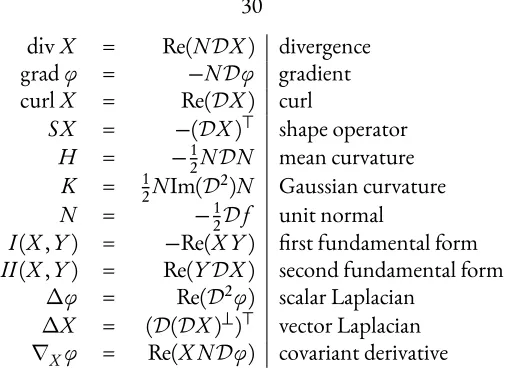
divX = Re(NDX) divergence gradφ = −NDφ gradient
curlX = Re(DX) curl
SX = −(DX)⊤ shape operator H = −12NDN mean curvature
K = 12NIm(D2)N Gaussian curvature
N = −12Df unit normal
I(X,Y) = −Re(X Y) rst fundamental form II(X,Y) = Re(YDX) second fundamental form
∆φ = Re(D2φ) scalar Laplacian
∆X = (D(DX)⊥)⊤ vector Laplacian
∇Xφ = Re(X NDφ) covariant derivative
Table . : Standard di erential operators expressed using the quaternionic Dirac operatorD. Here X andY are tangent vector elds,φis a scalar function, andNis the unit normal eld.
where in the last step we take advantage of the fact that f is an immersion. Taking the derivative of both sides, we get
−d f∧d(Dψ) =d⋆dψ+d N∧dψ.
Notice that the le -hand side of this expression has the same form as the right-hand side of the rst line above, replacingψwithDψ. Making this substitution, we get
|d f|2D2ψ=d⋆dψ+d N∧dψ
or equivalently
D2ψ= ∆ψ+d N∧dψ
|d f|2 .
Note that we can therefore obtain the Laplacian of a real functionφby extracting the real part of
D2φ, i.e.,∆φ=Re(D2φ)sinced N∧dφis a tangent-valued -form.
.
Vector Analysis
[image:41.612.162.422.56.240.2](Chapter ).
Consider any quaternionic functionψ:M →H. If we decompose this function into three com-ponentsψ=a+d f(Y) +b N (Section . ), then a concise way to summarize the e ect ofDonψ is
Dψ=
0 −curl 0
Jgrad −S grad
0 −div 2H
a Y b ( . )
Using this relationship we can express all of the standard di erential operators on a surface, as summa-rized in Table . . e remainder of this section serves to verify these facts. To obtain an expression for each component of the -formDψwe simply evaluate the -form−d f∧dψon a pair of orthogonal vectorsX,JX which have unit length with respect to the induced metric, i.e.,
|d f(X)|=|d f(JX)|=1.
Proposition . . . Leta:M→Rbe a real differentiable function onM. en
Da=d f(Jgrada),
i.e., applying the Dirac operator to a real function yields a -degree rotation of its gradient ( an immersed vector field).
Proo . We have
Da = −d f∧d a(X,JX)
= −(d f(X)d a(JX)−d f(JX)d a(X)) = N d f(JX)d a(JX) +N d f(X)d a(X) = N d f(d a(X)X +d a(JX)JX) = N d f(grada)
= d f(Jgrada).
Proposition . . . LetY be a vector field onM. en
Proo . We have
−DYˆ =d f∧dYˆ(X,JX) =d f(X)dYˆ(JX)−d f(JX)dYˆ(X).
Remembering thatdYˆ(JX)is just the ambient covariant derivative∇ˆJdXYˆ, the rst term becomes ˆ
X∇JdXYˆ = ˆX(d f(∇JXY)
| {z }
=:Zˆ
+II(JX,Y)N) = ˆX( ˆZ−g(SJX,Y)N).
SinceXˆ andZˆare both tangent vector elds we haveXˆZˆ= ˆX×Zˆ− 〈Xˆ,Zˆ〉=〈NXˆ,Zˆ〉N− 〈Xˆ,Zˆ〉. We therefore get
〈NXˆ,Zˆ〉N− 〈Xˆ,Zˆ〉 −g(SJX,Y) ˆX N
= 〈N d f(X),d f(∇JXY)〉N− 〈d f(X),d f(∇JXY)〉 −g(SJX,Y)d f(X)N = g(JX,∇JXY)N−g(X,∇JXY) +g(SJX,Y)d f(JX).
Similarly, the second term of our initial expression forDYˆ can be written as
d f(JX)dYˆ(X) =−g(X,∇XY)N−g(JX,∇XY)−g(SX,Y)d f(X).
Taking the di erence of these two terms we get a real part
g(JX,∇XY)−g(X,∇JXY) = (curlY)N,
a tangential part
g(SX,Y)d f(X) +g(SJX,Y)d f(JX) = d f(g(SY,X)X+g(SY,JX)JX) = d f(SY),
and a normal part
(g(X,∇XY) +g(JX,∇JXY))N = (divY)N.
All together, we get
Proposition . . . LetN be the unit normal field on f(M). en
DN =−2H N.
Proo . Recall that the directions of principal curvatureX1,X2are orthonormal with respect to the induced metric, and are eigenvectors of the shape operatorSwith associated eigenvaluesc1,c2,
re-spectively. We therefore have
−DN = d f∧d N(X1,X2)
= d f(X1)d N(X2)−d f(X2)d N(X1) = d f(X1)d f(SX2)−d f(X2)d f(SX1) = c2d f(X1)d f(X2)−c1d f(X2)d f(X1)
= 2H(d f(X1)×d f(X2))
= 2H N.
Proposition . . . Letb be a real function onM. en
D(b N) =d f(gradb) +2b H N.
Proo . is result follows immediately from Propositions . . and . . .
e propositions above e ectively determine the3×3matrix form of D(Equation . ) and thereby verify the rst ve identities in Table . ; the remainder of this section serves to verify the rest.
Proposition . . . e Ga sian curvature of a conformally immersed surface f can be expr sed
K=1
2N(ImD
2)N.
Proo . From Proposition . . , we have
Im(D2)N = d N∧d N
and evaluating the -formd N∧d N on the principal directionsX1,X2yields
d N∧d N(X1,X2) = d N(X1)d N(X2)−d N(X2)d N(X1) = 2d N(X1)d N(X2)
= 2c1c2d f(X)d f(JX) = 2KN|d f|2.
Multiplying through byN/2|d f|2yields the result.
Proposition . . . e unit normal fieldN on a conformally immersed surface f can be expr sed
N =−1 2Df.
Proo . We have
d f∧d f(X,JX) =d f(X)d f(JX)−d f(JX)d f(X) =2d f(X)d f(JX) =−2N|d f(X)|2.
Hence,
Df =−2N|d f|
2
|d f|2 =−2N.
Proposition . . . e first fundamental form of a conformally immersed surface f can be expr sed
I(X,Y) =−Re( ˆXYˆ).
Proo . We have
Re( ˆXYˆ) =Re( ˆX ×Yˆ− 〈Xˆ,Yˆ〉) =−〈d f(X),d f(Y)〉=−I(X,Y).
Proposition . . . LetX andY be any two vector fields onM. e second fundamental form induced by a conformal immersion f can be expr sed
Proo . From Proposition . . , we have
DXˆ=−(curlX +d f(SX) + (divX)N).
Since bothYˆ(curlX)andYˆ(divX)Nare tangent-valued, we are le with just
Re( ˆY d f(SX)) = Re( ˆY×d f(SX)− 〈Yˆ,d f(SX)〉) = −〈Yˆ,d f(SX)〉
= −〈d f(Y),d N(X)〉 = II(X,Y).
Proposition . . . LetXˆ be a tangent vector field on a conformally immersed surface f. en
∆ ˆX = (D(DXˆ)⊥)⊤
Proo . From Proposition . . we get
(DXˆ)⊥= (divX)N,
and from Proposition . . we get
D((divX)N)⊤=d f(grad ◦divX) = ∆ ˆX.
Proposition . . . Letφbe a real-valued function onM and letX be a tangent vector field. en
∇Xφ=Re( ˆX NDφ).
Proo . From Proposition . . we haveDφ=d f(Jgradφ), hence ˆ
We then get
C
T
S
S
C
I
Given a surface in space, one can easily determine its curvature. A natural question is: given a curvature function, when can one uniquely determine the corresponding surface? is chapter in-vestigates this question in the context of a conformal immersion f (Section . ) and its associated mean curvature half-densityµ(Section . ). In particular, we show how to recoverf by integrating
.
Shape Spaces
Shape spac are, generally speaking, con guration spaces associated with a given piece of geometry, such as a curve in the plane or a surface in space. Shape spaces can be thought of in analogy with simple con guration spaces appearing in mechanics. For instance, the orientation of a rigid body spinning in space can be identi ed with a rotation relative to some initial, canonical con guration. To build an explicit description of this space, recall that every unit quaternionq∈H=R4determines a rotation x7→q x q of vectorsx∈ImH=R3(Section . ). Geometrically, then, the con guration space of a spinning rigid body looks like the collection of unit vectors inR4—in other words, the -sphereS3:
e nice thing about this description is thatS3has a concrete geometry, which allows one to talk clearly about things like “shortest paths of rotations” and “derivatives of rotations,” etc. As empha-sized in the cartoon above, however, usingS3to represent rotations is in some sense redundant. In particular, any two quaternionsqand−qdescribe the same rotation: q x q = (−q)x(−q). To make this representation unique, we could “glue together” opposite points on the sphere, i.e., we could take the quotientS3/±1, yielding thereal projective spaceRP3. is set is again a geometric space,
endowed with natural notions of length, tangent vectors, etc. In practice, however, it is o en more convenient to work with the “redundant” spaceS3, which can be easily visualized and has a nice
alge-braic representation (namely, the quaternions).
topology. e subsetΣcan always be expressed as the image of a general immersion f : S2→R3,
i.e., we can always nd an f such that f(S2) = Σ. And, just as quaternions were a redundant rep-resentation of orientations, immersions are a redundant reprep-resentation of shape. For surfaces, the redundancy comes from the fact that we can rst “swirl the sphere around” before mapping it into space. More precisely, ifξ : S2 → S2is any di eomorphism of the sphere, then the map f ◦ξ is
another immersion describingΣ, i.e., sinceξ(S2) =S2, we havef(ξ(S2)) =f(S2) = Σ:
it allows one to take advantage of e cient computational tools like numerical linear algebra.
As discussed in Section . , we can also use aconformalimmersionf :M →R3to describe any surface. is representation exhibits a much simpler reparameterization symmetry: if two conformal immersions describe the same surface, then they di er only up to a conformal di eomorphism of the sphere, i.e., aMöbi transformation. Unlike the full space of di eomorphisms Diff(S2)which is
in nite dimensional and hence quite challenging to discretize, the space of Möbius transformations is nite dimensional (six dimensional, in fact) and hence much more manageable from a numerical point of view. For instance, it is computationally feasible to compare two functions by searching over the Möbius group, as done, for example, by Lipman and Daubechies [LD ]. However, one important question remains: how does one represent the conformal immersions themselves? e immersion functionf is an inconvenient choice, since the collection of such functions looks nothing like a vector space, i.e., in most cases the sum of two conformal immersions does not even come close to being conformal. ( is fact is quite salient in the discrete setting: take the sum of two surfaces with “nice” texture coordinates and the result will not be so nice!)
An important observation made by Kamberov et al. [KPP ] is that, apart from a few excep-tional cases, a global conformal immersion is uniquely determined by itsmean curvature half-density
µ=H|d f|. Yet unlike conformal immersions f, half-densitiesdohave a vector space structure, as discussed in Section . . is structure is the essential feature that allows us to work with conformal transformations in geometry processing: although we cannot “add together” two conformal immer-sions, wecanadd the corresponding half-densities and easily recover a surface that resembles both of them in a way that is highly intuitive. In this thesis, we provide a detailed analysis of the corre-sponding shape spaceM(Section . ). Notably,Malso exhibits a conformal reparameterization symmetry (e.g., Möbius transformations in the case ofS2), an observation which may prove valuable
.
Curves and Isometry: A Prelude to Surfaces
Before developing a shape space for surfaces, we examine the much simpler case of curves, which helps illustrate the general method for establishing integrability conditions in terms of curvature. Namely, we write down each relevant constraint in terms of positions or tangents, di erentiate it in time, then convert it to a constraint on curvature using established relationships. e only di erence in the case of surfaces is that these relationships become more intricate.
As discussed in Section . , we view any planar curve as the image of an arc-length or ometric immersion
f :[0,L]→R2
whereL∈Ris the total length of the curve, and isometry means that length is locally preserved, i.e.,
|d f(X)|=|X|
for all tangent vectorsX. Associated with this curve is a unit tangent eldT := f′and corresponding curvature normalcN =T′(see above); we usedℓto denote the usual length element on the real line.
Which curvature functionsc:[0,L]→Rdescribe a valid curve? In the case where f is anopen curve (i.e., no constraints on the endpoints), it is fairly easy to see that any such function is valid: simply integratecto get the unit tangentsT, then integrateT to get new positionsf˜. More explicitly, if we letθbe the cumulative angle
θ(s):=θ0+
∫ s
0
cdℓ,
then the new unit tangent eld is given byT˜(s) = (cosθ(s), sinθ(s)). We can then recover the posi-tionsf˜via
˜
f(s) = f˜0+
∫ s
0
Note that the curve f˜is determined only up to a global rotation and translation, speci ed by values
θ0∈Rand