This is a repository copy of Peripheral urbanisation in Mexico City. A comparative analysis
of uneven social and material geographies in low-income housing estates
.
White Rose Research Online URL for this paper:
http://eprints.whiterose.ac.uk/123140/
Version: Accepted Version
Article:
Janoschka, M orcid.org/0000-0002-6092-9052 and Arreortua, LS (2017) Peripheral
urbanisation in Mexico City. A comparative analysis of uneven social and material
geographies in low-income housing estates. Habitat International, 70. pp. 43-49. ISSN
0197-3975
https://doi.org/10.1016/j.habitatint.2017.10.003
© 2017, Elsevier. Licensed under the Creative Commons
Attribution-NonCommercial-NoDerivatives 4.0 International
http://creativecommons.org/licenses/by-nc-nd/4.0/
[email protected] https://eprints.whiterose.ac.uk/ Reuse
Items deposited in White Rose Research Online are protected by copyright, with all rights reserved unless indicated otherwise. They may be downloaded and/or printed for private study, or other acts as permitted by national copyright laws. The publisher or other rights holders may allow further reproduction and re-use of the full text version. This is indicated by the licence information on the White Rose Research Online record for the item.
Takedown
If you consider content in White Rose Research Online to be in breach of UK law, please notify us by
Title page
Peripheral urbanisation in Mexico City
A comparative analysis of uneven social and material geographies
in low-income housing estates
1. Author details
Corresponding author
Dr Michael Janoschka
University Academic Fellow for Critical Urban Transformations
School of Geography
University of Leeds
Leeds LS2 9JT
United Kingdom
Contact: [email protected]
Second author
Dr Luis Salinas Arreortua
Researcher at the Department of Social Geography
Institute of Geography
Universidad Nacional Autónoma de México
Contact: [email protected]
2. Acknowledgements
This article presents results stemming from two research projects implemented at the
Institute of Geography of the National Autonomous University of Mexico,
“
housing policies and for
M
)
V
M
which is financed by the Mexican National Council for Scientific Research (CONACyT, Project
number: 247398), and Metropolitan governments and housing policy in urban periph
which has been financed by the National Autonomous University of Mexico (PAPIIT
programme, Project number: IA300416). The authors appreciate additionally the financial
support received from the Programme for Academic Mobility of the National Autonomous
University of Mexico. Preliminary versions of this manuscript were discussed at two
Peripheral urbanisation in Mexico City
A comparative analysis of uneven social and material geographies
in low-income housing estates
Michael Janoschka (Leeds) and Luis Salinas Arreortua
Abstract
Large-scale housing programmes targeting low-income households have dramatically transformed Latin American cities over the last quarter of a century, creating uneven social and material geographies of peripheral urbanisation. Having experienced the sprawl of 600,000 housing units since the turn of the century, the Metropolitan Area of Mexico City can be considered a striking example of the profound territorial restructuring that has been taking place in cities across the continent. By considering nuanced perspectives rooted in political economy to address the
alteration of space and place, this article analyses the social and spatial dynamics in peripheral low-income housing estates in Mexico City. It draws from empirical research in two municipalities that have the highest metropolitan concentration of newly built low-income housing estates. The comparative discussion of the results demonstrate that mutually entangled processes of
abandonment and insurgent appropriation of peripheral urban habitat in two neighbourhoods may be considered as facets of a political process that has promoted the financialisation of housing and a class-related urban restructuring.
Key words
Peripheral urbanisation; low-income housing; housing policies; housing financialisation; urban restructuring; Mexico City
1. Introduction
Housing policies for low-income households have radically altered the living conditions of the urban poor in Latin America for the last quarter of a century. This is mainly due to the implementation of large-scale housing programmes that may subsidise part of the construction costs and provide households with vouchers and state-backed mortgages. By doing so, public administrations have been assuring private investment in affordable housing in many countries of the Global South (Bredenoord et al., 2014; Gilbert, 2004; Salcedo, 2010). Consequently, homeownership has become increasingly normalised as an endeavour accessible to those on lower incomes, mainly through market-driven housing programmes backed by public mortgage schemes (Buckley et al., 2016; Gilbert & de Jong, 2015; Monkkonen, 2011). The resulting commodification and takeover by private interest and finance
(Rolnik, 2013: 1059),
creating uneven social and material C Most of
Critical reflections about the entanglements between public policies, real estate and finance have recently acknowledged the importance of political economy to focus on housing financialisation (Aalbers, 2016; Christophers, 2014; Fernandez & Aalbers, 2017). This goes hand in hand with claims to better understand the effects of housing policies around the globe by applying multipolar and cosmopolitan modes of urban theory- P . Taking into consideration the case of Mexico City, which is exceptional in scale and scope, this article offers a unique opportunity to analyse urban processes that have now become paradigmatic in many cities in and beyond Latin America. It will develop differentiated perspectives on the political economy, the territorial transformation and the social consequences of 21st century peripheral urbanisation. By understanding the latter of interrelated processes that entangle citizens and states in the production of cities of great
C article addresses the uneven social and material geographies in low-income housing estates in the Metropolitan Area of Mexico City. While discussing mutually entangled processes of abandonment and insurgent appropriation of peripheral urban habitat, it also sheds lights on the complex relationship between peripheral urbanisation, housing financialisation and planning policies.
Accounting for 235,000 approved housing units since the turn of the century, the two municipalities of Zumpango and Tecámac in the Metropolitan Area of Mexico City may be considered the most outstanding example of contemporary peripheral urbanisation in Latin America (SEDUR, 2017). The concentration of low-income housing estates in both places has motivated empirical research with a mixed-method approach. In a first step, desk-based research analysed official statistics such as census data and planning permissions, as well as land changes documented by Google earth. Then, one in-depth case study was carried out in each municipality. On one hand, the housing estate of Los Héroes Tecámac II may be considered a comparatively successful urban expansion that has triggered manifold individual and self-organised habitat appropriations and now inspires a nascent vibrancy of urban life. On the other hand, the neighbourhood Paseos de San Juan in Zumpango embodies a profound decay, stimulated by the abandonment of thousands of housing units. In both areas, participant observation and more than 50 semi-structured interviews to local residents were undertaken1. Analysing this data against the background of the political economy of peripheral urbanisation in Mexico City, the article provides nuanced considerations about the mechanisms and consequences of low-income housing policies, which have dramatically shaped peripheral urban habitat elsewhere in Latin America and the G “ 2. The argumentation will be structured in four steps. After first providing a review of contemporary provision of low-income housing in Latin American cities, we will then address the political economy of peripheral urbanisation in Mexico City. Subsequently, the uneven social and material geographies of peripheral urbanisation will be analysed for the cases of Zumpango and Tecámac. This informs our final reflections covering the strategic role that peripheral urban habitat plays for contemporary urban restructuring.
2. E a characterisation of low-income housing in Latin American cities
Despite major policy efforts supporting the urban poor in Latin America to obtain adequate shelter, populations in the region have been facing for decades substantial quantitative and qualitative housing deficits (Gilbert, 2014). Official figures range from roughly one fifth of all households in countries such as Costa Rica, Chile and Uruguay to more than 70 per cent in Bolivia, Peru and
1 Empirical research took place during 2016 and 2017. Interviews were recorded and transcribed.
2 For instance, the expansion of peripheral low-income housing has been similarly intensive in countries such
Nicaragua. Within this general panorama, Mexico stands in a middle range of one third of the population subject to housing deficits (IDB, 2012). At the same time, housing policies have been experiencing over the last 25 years a significant shift. On one hand, a diffusion of policies elaborated at transnational institutions such as the World Bank, the Inter-American Development Bank, the OECD, the Lincoln Institute of Land Policy, UN-Habitat and UN-ECLAC has been taking place. Lobbying as well as the employment of financial resources by these advocate groups have been targeting mainly the commodification of housing and its progressive transformation into an investment asset that may be integrated into globalised financial markets (Mosciario & Aalbers, 2017; Rolnik, 2013). On the other hand, more than a decade earlier than the mentioned institutions, the Chilean government under the dictator Pinochet established as soon as in 1977 a -income housing provision that was later highlighted as a substantial step towards market-driven approaches (Gilbert, 2004; Jha, 2007; Salvi del Pero, 2016). Its diffusion as well as successive readjustments of key mechanisms provided to be of enormous influence across Latin America, with Brazil, Mexico, Colombia, Peru and Costa Rica at the forefront of profound transformation of housing policies (Acolin & Green, 2017; Calderón, 2015; Held, 2000; Klink & Denaldi, 2014).
The main feature of the Chilean model of low-income housing consists in settling and implementing a
strategy that aims at ing W B
(1993) bears in its title. In real practice, this means a consequent reorientation of housing policies by shifting responsibilities from the state to private actors. Over time, the role of the public sector has been progressively reduced: It provides only the legal and administrative framework for different kinds of subsidies and loans, which are granted either to construction companies or to dwellers (Gilbert, 2004). Conversely, all other steps ranging from the acquisition of land to the planning of house types and their architectonic design, the construction and the organisation of effective demand for the schemes has eventually become the task of private actors (Imilan, 2016).
Under these conditions, the economic, social and territorial consequences have been subject to discussion within urban studies. While it has been acknowledged that market-driven schemes increased considerably the number of delivered housing units thus tackling successfully housing deficits, they have been criticised to exacerbate social segregation by displacing the poor to ever more peripheral locations (Barandier et al., 2017; Dohnke et al., 2015; Gaffney, 2010; Rolnik et al., 2015; Tapia, 2012). In the same way as during previous times of state-driven promotions, contemporary low-income housing schemes fundamentally focus on standardised housing types that deny liveable urban habitat and fall short of considering individual circumstances of the . Consequently, the insufficient quality and size of housing units have been commonly reflected, and in cities such as Santiago de Chile it has been recognised that the average size of low-income housing units has been shrinking substantially over time (Tapia, 2012). Other studies focused on deficient public infrastructure such as schools, medical services and transportation, as well as the abandonment of housing estates by state institutions, for instance concerning maintenance and security. This has often provoked rapidly worsening living conditions and demonstrates the exclusive focus of policies prioritising housing provision over the construction of urban habitat (Fuentes & Hernandez, 2014; Libertun de Duren, 2017; Salcedo, 2010).
However, since low-income housing policies explicitly promote private homeownership (Hidalgo, 2005), another effect may be considered crucial: Experiences from other world regions such as Southern Europe suggest that mortgage and private homeownership foster the biopolitical control of
populations I is characteristic to neoliberal
experiences of low-income households in affordable housing estates (Ferguson et al., 2014; Rolnik, 2013; Ward et al., 2015).
3. The political economy of low-income housing in the periphery of Mexico City
Contrary to previous periods, when peripheral urbanisation in Mexico meant primarily the expansion of informal settlements under limited public control (Aguilar, 2008), contemporary housing policies have been narrated from different angles. For instance, they have been simultaneously considered as a means to reduce informality, democratise homeownership and provide economic incentives for the real estate industry (Gilbert & de Jong, 2015). Public administrations and institutions played a fundamental role in establishing a proper political economy of low-income housing that since the turn of the century focused on market-driven housing provision. Beyond transforming the role of the state in producing and promoting housing, policies aimed also at incorporating different forms of social property3 to the real estate market (Pradilla Cobos, 2016; Salinas, 2016). While positioning the housing sector as central to economic growth, real estate developers along with mortgage financing agents were given a prominent role to promote standardised low-income housing, mainly consisting of rows of single-family houses on tiny plots with living areas between 30 and 50 m2 (Boudreau et al., 2015). Only between 2000 and 2015, an overall number of 686,926 housing units were authorised in 409 different residential developments across municipalities in the Metropolitan Area of Mexico City, with roughly 90 per cent of these units targeting populations on lower income scales (SEDUR, 2017). The typically highly homogeneous residential developments are classified by public administrations in three categories: progressive social housing; social interest housing; and popular housing4. This differentiation is insofar important, since it defines different levels of finish of the interior of the house, plot sizes and the public infrastructure provision granted to each neighbourhood. Consequently, progressive social housing lies usually at the bottom of a price range of between 12,000 and 25,000 US-$5, which in Mexico City is considered as low-income housing. However, the slightly better equipped social interest housing can be purchased for approximately 15,000 US-$, while popular housing may reach the upper level of the mentioned scale.
Households qualify for residential mortgages once they have a formal and stable employment in the public or private sector. Then they may apply for loans offered by two state institutions, INFONAVIT6 and FOVISSTE7. Both retain a fixed mandatory sum of approximately five per cent of the annual salary of all employees in the public (FOVISSTE) and the private sector (INFONAVIT) to two publicly managed funds that provide housing mortgages to its contributors. Within this scheme, a close collaboration between the Federal and State administrations, the two funds and real estate developers exist. Amongst others, both public institutions announce annually the approximate number of mortgages to be granted on a Federal and municipal level. This constitutes a clear signal to real estate companies to adjust the number and location of new housing units (Soederberg, 2015), typically on land that was purchased and granted previously with building permissions. Additionally, both INFONAVIT and FOVISSTE incentivise workers to exercise their right to apply for loans, regardless their real needs. This
3 Such as the community-owned ejido lands.
4 In Spanish language: vivienda social progresiva, vivienda de interés social and vivienda popular.
5 Calculations are based on an exchange rate of 18.5 Mexican pesos per dollar, equivalent to the average
exchange rate in June 2017. In local currency, house prices range from 220,000 to 462,500 Mexican pesos.
6 Abbreviation for: Instituto del Fondo Nacional para la Vivienda de los Trabajadores.
7 Abbreviation for: Fondo de la Vivienda del Instituto de Seguridad y Servicios Sociales de los Trabajadores del
happens by communicating mortgage availability. Nevertheless, such statement is more than simple information. It explicitly threatens employees, by issuing the warning that a rejection of a mortgage at this stage may result in the denial of any future mortgage application.
Under such conditions, mortgage lending has experienced a considerable expansion, from an annual average of 142,700 loans granted by both institutions in the late 1990s to a peak of more than 600,000 in 2013 and 2014 (Salinas, 2016). This was primarily possible because of the progressive securitisation of residential mortgages, a process that was organised by the Federal Mortgage Company8 (FMC). The FMC places INFONAVIT and FOVISSTE mortgages in special trusts, insures the pool to a 100 per cent against default and sells securities to institutional investors such as pension and equity funds. Transformed into cash flow back to INFONAVIT and FOVISSTE, this money is used to create additional mortgages. Interesting enough is that this practice converted the Mexican market of residential mortgage-backed securitisation into the largest of its kind in Latin America (Soederberg, 2015). Additionally, real estate developers are allowed to directly access the databases of both public institutions containing the exact salary of each employee. This policy enables them to calculate in situ the maximum mortgage for any prospective customer interested in the purchase of a property. Since monthly mortgage rates are capped at 30 per cent of the net household income, real estate companies may offer to a potential client the corresponding mortgage, adjusting this value to the available housing types within a residential development. But realtors may also anticipate from this data their repayment conditions. Interest rates depend on the amount of the mortgage and the solvency of the client, but are usually in a range between nine and twelve per cent9, several points above inflation10. In a scenario of steadily declining rates of non-performing loans as experienced over the last two decades, this locks high financial profitability for INFONAVIT and FOVISSTE, as well as for the buyers of mortgage-backed securities.
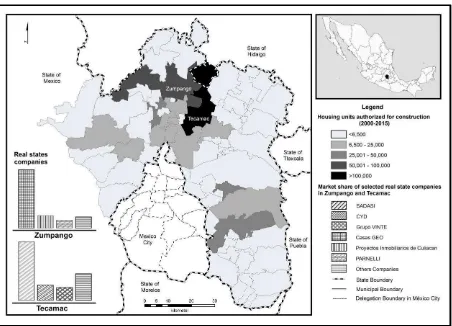
On the other hand, policies have also provoked spatial oligopolies, since the real estate market has become dominated by a reduced number of companies that cluster in specific cities and regions (Coulomb et al., 2009; Inclán-Valadez, 2014). In the Metropolitan Area of Mexico City, concentration is alarming: For instance, the company Desarrollos Inmobiliarios Sadasi was granted permission for building 62,700 housing units only in the municipality of Tecámac, equivalent to more than two thirds of the aggregate. On the other hand, in the neighbouring Zumpango municipality, another big player in the housing market, GEO Hogares Ideales (Casas GEO), dominates the local market with 71,780 housing units approved by local authorities nearly 80 percent of the total sum (Figure 1). Similar concentrations exist in other municipalities, thus indicating the existence of market agreements.
8 In Spanish language the FMC is named Sociedad Hipotecaria Fedeeral (SHF). 9 This interest rate is slightly lower than the interest rates that private banks offer.
Figure 1: Peripheral urbanisation in the Metropolitan Area of Mexico City.
Source: Own elaboration, based on data from SEDUR (2017).
An attempt to encapsulate the political economy of low-income housing in Mexico may elucidate primarily on the mechanisms of establishing planning security for the real estate industry. In other words, private profit develops out of the guaranteed emission of state-backed mortgages, financing the purchase of housing units to low-income households who could not meet the solvency criteria of private banks. At the same time, financial markets receive important stimuli through the securitisation of these mortgages, hiding an underappreciated risk for public finances from the guarantees provided by the FMC. Public administrations may celebrate the goal of completing an unprecedented number of new affordable housing units, promoting at the same time hundreds of thousands of jobs in the construction sector. But the market-driven economy of low-income housing has paradoxically shifted which population is targeted by this public policy: Since the turn of the century, an average of 75 percent of all INFONAVIT and FOVISSTE loans were awarded to households whose earnings exceed at least two minimum salaries11 (Salinas, 2016). This means that housing policies do not satisfy any more the needs of the poorest sectors of public and private employees but focus on those who have sufficient income to qualify as a potentially solvent client for a loan. On the other hand, policies do not serve the majority of the population that works in the informal sector and lives in irregular settlements, which still represent nearly 60 per cent of the entire housing stock of the Metropolitan Area (Connolly, 2009). Contrary to the arguments of politicians referring policies,
11 As of January 2017, the minimum salary reaches approximately 1,600 pesos per month, which is equivalent
they increasingly operate as a method to expand residential mortgages to those unable to qualify for private loans, inclining the risk-balance of such financialisation .
4. Social geographies and everyday challenges of uneven peripheral urbanisation in two municipalities: Tecámac and Zumpango
Since the turn of the century, peripheral urbanisation in the Metropolitan Area of Mexico City has strongly concentrated in only half a dozen of municipalities (see also Figure 1). Having jointly attracted more than one third of all new dwellings, Tecámac and Zumpango are two territorial expansion: Local governments authorised respectively 143,247 and 91,984 new housing units in 106 different residential projects (SEDUR, 2017). Tecámac has become the home of nearly 450,000 inhabitants, while in Zumpango approximately 200,000 people reside (INEGI, 2015). Although both municipalities share many common aspects, their material realities differ also importantly: Tecámac has a long-stretched municipal expansion that situates residential developments in a 25 to 50 km distance from the historic centre of Mexico City. Zumpango is slightly more remote, with urbanisations located 40 to 60 km away from the old city centre. This renders also into the two case studies, which were respectively developed since the mid-2000s: Paseos de San Juan, a residential development in Zumpango located on average at 54 km from the historic city centre, was planned and constructed by Casas GEO on a 118 ha plot that now accommodates 9,500 housing units. On the other hand, Los Héroes Tecámac II consists of 25,910 housing units on a 308 ha building site that was developed by Sadasi. It is on average at 29 km from the old town.
However, more than a decade after the first dwellers moved into the two neighbourhoods and approximately five years after the final completion of construction works, both places -Paseos de San Juan and Los Héroes- have now generated two very different material and social environments. Paseos de San Juan remains a peripheral locality with only limited urban facilities that hinder the
daily needs. At a first sight, the urbanisation provides a bleak picture. It is reined by abandonment and decay, with strong visual signs of apparently deserted and damaged housing, alongside with a sharp deterioration of public space and common infrastructure (see Image 1). Official data from the National Statistical Institute has estimated uninhabited housing12 at more than 37 per cent (3,573 units; INEGI, 2010). Consequently there is also only very basic commercial infrastructure available in the neighbourhood, such as small kiosks selling only elementary food and beverages. The stalls foreseen for an open-air market have been abandoned, and rental offers for houses at very low prices are frequent. At the same time, illegal occupation has been repeatedly reported, and it is visually present by signposts threatening possible occupiers of abandoned housing with lynching.
The perceived situation of Los Héroes is however very different to the previous description, it may be rather conceived as a place with a nascent vibrancy that has triggered multiple transformations to a space initially produced by the building corporation for the sake of private profit. Commercial activities typically associated to informal urban habitat, such as so-called tianguis, a type of regular open-air markets, as well as the occupation of public space by street vendors, have widely spread. Many owners have converted their front yards and eventually the whole original house into shops and restaurants. They provide trade and services that may range from very basic goods to activities proper to socially upgrading communities, such as canine hairdressers and accessories, technical and language schools, automotive parts trade or carwash services. Additionally, most houses have undergone a massive
transformation of their façades, and many owners have modified the design and size of their housing, adding second, third and fourth floors to expand living space (see Image 1). There are several real estate companies that offer their services, and the presence of an increasing diversity of urban amenities turns the area visually into a more integrated part of the urban fabric.
Image 1: Abandoned housing in Paseos de San Juan (left) vs. adaptation of housing in Los Héroes (right)
Source: Own photography, 2017.
Conversely to the sharply contrasting visual imagery, our analysis of the interviews in both neighbourhoods may identify a myriad of shared problems. For instance, discourses habitually criticise strongly the actual living conditions, in an account that may be resumed in three common topics:
1. Transportation. Since only reduced local employment opportunities exist, regular commuting to more central locations is compulsory for many people. Commuting itself presents a major concern, since there is a lack of rapid, reliable and cheap public transport. It is conditioned by heavy traffic congestions during rush hours since no proper transport systems such as metro or express bus lines exist. As a consequence, many people have to commute for between four and six hours daily. Furthermore, they may have to spend up to one third of their income exclusively on transportation.
2. Insecurity, especially at night-time and in public space. Assaults and other aggressions have been commonly reported, as well as burglaries, drug-dealing and other drug-related crime. At the same time, neighbours criticise the absence of policing and state control, since several police stations have been virtually abandoned, with remaining police forces being accused of being corrupted and bribed by delinquents.
3. Lack of maintenance of the public areas and services. After the sale of approximately 80 per cent of the housing stock, the control over public space is being released from the developer to the corresponding municipality, and this is identified as the immediate starting point of a rapid and profound decay. Such abandonment includes a lack of maintenance of public space,
no reduced investment to repair and
replace damaged infrastructure.
However, despite these aspects demonstrating the common concerns of residents in both neighbourhoods, it is especially interesting to further expand on the observed social and material differences between both neighbourhoods. In this regard, three key factors are crucial to explain their highly dissimilar long-term consolidation paths:
2. Type of settlement. Los Héroes was authorised as a residential development of social interest, while Paseos de San Juan has both progressive social housing and social interest housing. This slight difference chiefly explains the uneven allocation of local public infrastructure, such as childcare and recreational facilities.
3. Urban integration. Los Héroes is located in a part of the metropolitan area that for decades has been physically and socially integrating and developing towards a stronger consolidation of the urban fabric. This difference explains a better access to services such as hospitals and the presence of local job opportunities in the manufacturing industry or the service sector. The combination of these three factors implicated that the marginally better housing substance in Los Héroes appealed to a somewhat more affluent layer of costumers, whereas the proportion of those attracted by cheapest property prices is to some extent higher in Paseos de San Juan. This translates into more social capital in Los Héroes to cope with the previously analysed constraints of the new environment. Moreover, people have more economic prospect and ability to expand and adapt houses, and to invest into entrepreneurial activities. Over the elapsed time span of more than a decade, this has produced large material differences. While in Paseos de San Juan many inhabitants abandon their neighbourhood because it is not feasible for them to commute on a daily basis, pay credits and suffer hostile living conditions, in Los Héroes people have started to reinvent lives in a new
A 13, urban habitat has been substantially
transformed and appropriated. And those who abandoned Los Héroes were able to sell their property to settle elsewhere, whereas in Paseos de San Juan mortgages are just left unpaid and houses abandoned. However, both neighbourhoods share a series of severe social and territorial consequences that question the viability of the contemporary housing policies applied in the periphery of Mexico City, respectively in other Latin American cities with similar pathways.
5. Urban politics and peripheral urban habitat final reflections
This article has analysed the uneven social and material geographies of peripheral urbanisation under contemporary conditions of neoliberal urban restructuring in the Metropolitan Area of Mexico City. The massive production of low-income housing in its periphery demonstrates the capacity of market-driven housing programmes fostered by publicly-organised mortgage schemes to provide quantitative solutions to housing deficits in middle-income economies. However, our analysis shows that (adequate) housing is only one out of many ingredients required to produce urban habitat. With regard to this, the examples of Zumpango and Tecámac give fruitful insights into some of the essential failures of housing policies focusing exclusively on constructing, financing and selling buildings. Such policies produce fragmented experiences of futile residential expansion, since they lack to create adequate urban habitat that may foster local communities. Moreover, they illustrate that adequate peripheral urbanisation would require an intimate connection of housing policies with a series of coordinated and multi-scalar urban planning policies. However, this would also entail efforts to promote the geographical decentralisation of economic activities across the metropolitan area. The experience from Mexico suggests that this coordination of planning policies does not take place satisfactorily. Low-income housing schemes may be considered as a proper development regime that is fundamentally based upon vigorous alliances between public administrations, especially on the Federal level, and actors from the real estate industry. The allocated resources to INFONAVIT and
13 For an in-
FOVISSTE mortgages provide developers with the necessary information and security to properly plan the construction of housing. At the local level, land-use regulations are often bypassed, e.g. by the Federal government imposing the authorisation of residential developments against the professional criteria of municipal planners and urbanists. All together there is no proper metropolitan coordination that regulates and directs investment into a spatially and socially sustainable form of peripheral urbanisation, which may be in dialogue with other infrastructures (Salinas, 2017). The lack of synchronisation between housing policies and urban planning policies produces fragmented urban landscapes, which are disarticulated from each other and the surrounding environment. Public administrations incentivise the production of housing, nonetheless ignoring the construction of liveable urban habitat in which housing is not only a place surrounded by walls but a space that provides both shelter and the means for social reproduction. The experience of Paseos de San Juan allows us to understand the isolation and alienation generated by the massive construction of low-income estates in a peripheral area without liveable urban habitat. In symbolical terms, it represents the situation in many other places across the country, with an estimated number of 400,000 abandoned peripheral low-income housing units (INFONAVIT, 2017). In the meantime, Los Héroes demonstrates how the positive externalities of urban development in surrounding areas permit a somewhat better social integration and appropriation of urban space.
Finally, against the background of market-driven urban restructuring it would be important to consider the metropolitan scale behind the thriving logics of valorisation of space. In this regard, the isolation of residential developments in Zumpango and the partially successful expansion in Tecámac are intensely related to transformations taking place in central areas of Mexico City. Since the early 2000s, market-oriented logics have strongly incentivised private real estate in selected districts. Public policies targeting the densification of these areas p , including substantial house price increases (Delgadillo, 2016). Urban renovation and housing replacement chiefly targeted middle and upper-middle classes, and this has radically altered the social geographies in the city, triggering widespread gentrification (Connolly, Wigle, 2017; Janoschka et al., 2014). Simultaneously, displacement pressures are echoed by class restructuring. Residents on lower incomes are systematically priced out and pulled away from central areas. And the provision of low-income housing stimulates their move to the Northern and Eastern periphery, in an attempt to reorganise the city region in socio-spatial terms. In this regard, the move of hundreds of thousands of households to the periphery epitomises the multiple contradictions of low-income housing policies, peripheral urbanisation and planning policies in Mexico, Latin America and probably many other
middle- G “ .
References
Aalbers, M. (2016). The Financialization of Housing. A political economy approach. London, New York: Routledge.
Acolin, A. & Green, R. (2017). Measuring housing affordability in São Paulo metropolitan region: incorporating location. Cities 62: 41-49.
Aguilar, A. (2008): Peri-urbanization, illegal settlements and environmental impact in Mexico City. Cities 25 (3): 133-145.
Barandier, J. R., Bodmer, M. & Lentino, I. (2017): Evidence of the impacts of the national housing programme on the accessibility of the low-income population in Rio de Janeiro. Natural Resources Forum 41: 105-118.
Boudreau, J.-A., Gilbert, L. & Labbé, D. (2016). Uneven state formalization and periurban housing production in Hanoi and Mexico City: Comparative reflections from the global South.
Environment and Planning A 48 (12): 2383-2401.
Bredenoord, J., van Lindert, P. & Smets, P. (2014). Affordable Housing in the Urban Global South. Seeking Sustainable Solutions. London, New York: Routledge.
Buckley, R. M., Kallergis, A. & Wainer, L. (2016). The emergence of large-scale housing programs: Beyond a public finance perspective. Habitat International 54: 199-209.
Caldeira, T. (2017). Peripheral urbanization: Autoconstruction, transversal logics, and politics in cities of the global south. Environment and Planning D: Society and Space 35 (1:, 3-20.
Calderón, J. (2015). Programa de vivienda social nueva y mercados de suelo en el Perú. EURE 41 (122): 27-47.
Christophers, B. (2014). Wild Dragons in the City: Urban Political Economy, Affordable Housing Development and the Performative World-making of Economic Models. International Journal of Urban and Regional Research 38 (1): 79-97.
Conn P O M C colonias
populares, 1990 to 2005. International Development Planning Review 31 (1): 1-35.
C P J W ‘ I D ‘
Conservation Zone of Mexico City. Planning Theory & Practice 18 (2): 183-201.
Coulomb, R.; León, P.; Puebla, C. & J. Castro (2009): Efectos de la promoción privada en la producción de vivienda de interés social en México. Tecnología y Construcción 25.2.
Delgadillo, V. (2016). Selective modernization of Mexico City and its historic center. Gentrification without displacement? Urban Geography 37 (8): 1154-1174.
Dohnke, J., Heinrichs, D., Kabisch, S., Krellenberg, K. & Welz, J. (2015). Achieving a Socio-Spatial Mix? Prospects and Limitations of Social Housing Policy in Santiago de Chile. Housing Studies 30 (6): 839-857.
Ferguson, B., Smets, P. & Mason, D. (2014). The new political economy of affordable housing finance and urban development. In: Bredenoord, J., van Lindert, P. & Smets, P. (2014). Affordable
Housing in the Urban Global South. Seeking Sustainable Solutions. London, New York: Routledge.
Fernandez, R. & Aalbers, M. (2017). Housing and Capital in the Twenty-first Century: Realigning Housing Studies and Political Economy. Housing, Theory and Society 34 (2): 151-158.
Fuentes, C. & Hernandez, V. (2014). Housing finance reform in Mexico: the impact of housing vacancy on property crime. International Journal of Housing Policy 14 (4): 368-388.
Gaffney, C. (2010). Mega-events and socio-spatial dynamics in Rio de Janeiro, 1919-2016. Journal of Latin American Geography 9 (1): 7-29.
G L M K M M
financialisation. Transactions of the Institute of British Geographers 41 (3): 313-327.
Gilbert, A. (2004). Helping the poor through housing subsidies: lessons from Chile, Colombia and South Africa. Habitat International 28: 13-40.
Gilbert, L. & de Jong, F. (2015). Entanglements of Periphery and Informality in Mexico City. International Journal of Urban and Regional Research 39 (3): 518-532.
Harvey, D. (2003). The New Imperialism. Oxford, New York: Oxford University Press.
Held, G. (2000). Políticas de viviendas de interés social orientadas al mercado: experiencias recientes con subsidios a la demanda en Chile, Costa Rica y Colombia. United Nations: Santiago de Chile.
Hernández, J. C. (2017): El habitar en los conjuntos urbanos en el Estado de México en el marco de la Política habitacional 2001-06, y el abandono de la vivienda. URBS. Revista de Estudios Urbanos y Ciencias Sociales 7 (1): 137-143.
Hidalgo, R. (2005). La vivienda social en Chile y la construcción del espacio urbano en el Santiago del siglo XX. Santiago de Chile: Pontificia Universidad Católica de Chile.
IDB (Inter-American Development Bank, 2012). Room for Development. Housing Markets in Latin America and the Caribbean. New York: Inter-American Development Bank.
Imilan, W. (2016). Políticas y luchas por la vivienda en Chile. El camino neoliberal. Working Paper Series Contested Cities (WPCC 16004).
Inclán-Valadez, C. (2014): Building New Geographies in Urban Mexico: The Case of the Casas GEO. In: Irazábal, C. (ed.): Transbordering Latin Americas: liminal places, cultures, and powers (t)here. New York: Routledge.
INEGI (Instituto Nacional de Estadística y Geografía, 2017): Índices de Precios al Consumidor, Inflación. Available online at: http://www.inegi.org.mx (Access: 15/05/2017).
Janoschka, M., Sequera, J. & L. Salinas (2014): Gentrification in Spain and Latin America a critical dialogue. International Journal of Urban and Regional Research 38 (4): 1234-1265.
Janoschka, M. & J. Sequera (2016): Gentrification in Latin America: addressing the politics and geographies of displacement. Urban Geography 37 (8): 1175-1194.
Jha, A. K. (2007). Low-income housing in Latin America and the Caribbean. The World Bank, En Breve, 101.
Klink, J. & Denaldi, R. (2014). On financialization and state spatial fixes in Brazil. A geographical and historical interpretation of the housing program My House My Life. Habitat International 44: 220-226.
Libertun de Duren, N.R. (2017). The social housing burden: comparing households at the periphery and the centre of cities in Brazil, Colombia, and Mexico. International Journal of Housing Policy. DOI: http://dx.doi.org/10.1080/19491247.2017.1298366
Monkkonen, P. (2011). Do Mexican Cities Sprawl? Housing-Finance Reform and Changing Patterns of Urban Growth. Urban Geography 32 (3): 406-423.
Mosciaro, M. & Aalbers, M. (2017): Asset-based welfare in Brazil. Housing Studies. DOI: http://dx.doi.org/10.1080/02673037.2017.1364712
Murray, C. & Clapham, D. (2015). Housing policies in Latin America: overview of the four largest economies. International Journal of Housing Policy 15 (3): 347-364.
Peck, J. (2015). Cities beyond Compare? Regional Studies 49 (1): 160-182.
Pradilla Cobos, E. (2016): Zona Metropolitana del Valle de México: neoliberalismo y contradicciones urbanas. Sociologias 18.42: 54-89.
Rolnik, R. et al. (2015). O Programa Minha Casa Minha Vida nas regiões metropolitanas de São Paulo e Campinas: aspectos socioespaciais e segregação. Cadernos Metropole 17(33): 127-154.
Salcedo, R. (2010). The Last Slum: Moving from Illegal Settlements to Subsidized Home Ownership in Chile. Urban Affairs Review 46 (1): 90-118.
Salinas, L. (2016). Política de vivienda y gestión metropolitana en la expansión de la periferia de la Zona Metropolitana de la Ciudad de México. Cuadernos Geográficos 55 (2): 217-237.
Salinas, L. (2017). Gestión metropolitana en la Zona Metropolitana del Valle de México: entre la legalidad y la voluntad política. Papeles de Población 23(91): 143-169.
Salvi del Pero, A. (2016). Housing policy in Chile: A case study on two housing programmes for low-income households. OECD Social, Employment and Migration Working Papers 173. Paris: OECD Publishing.
SEDUR (Secretaría de Desarrollo Urbano y Metropolitano del Estado de México, 2017). Conjuntos habitacionales autorizados. Data retrieved from official enquiries at SEDUR.
Soederberg, S. (2015). Subprime Housing Goes South: Constructing Securitized Mortgages for the Poor in Mexico. Antipode 47 (2): 481-499.
Tapia, R. (2012). Vivienda social en Santiago de Chile. Análisis de su comportamiento locacional, período 1980-2002. Revista INVI 26 (73): 105-131.
Ward, P., Jiménez Huerta, E. & Di Virgilio, M. (eds., 2015). Housing policy in Latin American cities. A New Generation of Strategies and Approaches for 2016 UN-Habitat III. London, New York: Routledge.