Abstract: Warpage is one of the major defects in injection molding and this affects the quality of the materials. Some techniques are used to minimize the warpage by the changing the parameter settings. The optimization techniques were applied to the parameter to find the optimized value. The popular method in optimizing the parameter is Genetic Algorithm (GA) and this has the limitation of big stochastic components. The main objective of this research is to propose the Human Behavior Based Optimization (HBBO) in the warpage. This method doesn’t have large stochastic and has a fast convergence rate. The orthogonal Array is used to measure the warpage for the different parameter settings. The fiber reinforced component is used to measure the performance of the proposed method. The Back Propagation Neural Network is used to find the relationship between the warpage and other factors. Then optimization technique is applied to find the parameter value. The experimental result of the proposed HBBO method in Warpage optimization is compared with other existing method in warpage optimization. The HBBO method has the warpage of 0.0858 and the GA method has the warpage of 0.0953.
Index Terms: Fiber reinforced component, Human Behavior Based Optimization, injection molding, orthogonal Array, and Warpage.
I. INTRODUCTION
Plastic Injection Molding is one of the main process in the production of the plastic parts. Many researchers are attempted to simply the production of the plastic injection molding with no required adjustments [1]. The major applications of the polymer are in the transparent product in automobile and aerospace engineering. For example, astronaut viewing window, aircraft windshield, and vehicle window [2]. Warpage is one of the representative defects in the polymer manufacturing and has to be reduced for the plastic products quality. Reducing the cycle time and warpage for the polymer manufacturing process increases the high product quality and high productivity [3]. The optimal mold design for the polymer manufacturing helps to produce the high quality product with good mechanical property and stylish appearance. The trials and errors techniques are used to optimize the process of the design including shrinkage, lower warpage, weld lines, unbalances, air traps, residual stress etc. This method is more time consuming and also
Revised Manuscript Received on August 05, 2019.
Ekta Sandeep Mehta Jain, Department of Mechanical, Koneru Lakshmaiah College of Engineering, India, Vaddeswaram, India.
Rajesh Kumar Bhuyan, Department of Mechanical, Koneru Lakshmaiah Education Foundation (Deemed to be University), Vaddeswaram, India.
increases the final costs [4-5].
The complex methods were applied to find the optimized parameter with the integration of the simulation software such as bridge rib and injection location [6]. Optimization of parameter in the manufacturing has become the primary focus in the industries to reduce the defects in the system and increases the quality with productivity. Design of Experiments (DOE) is the set of tools involves in finding the suitable parameter for the manufacturing, methods like Taguchi method and response surface methodology [7]. In the last decades, the various researchers are involved in applying the several techniques for the reducing defect rate in the manufacturing system [8]. Finite Element software like MoldFlow are used to find the optimal parameter for the manufacture of the component based on the different methods like DOE, genetic algorithm and Artificial Neural Network (ANN) [9 -10]. In this research, the HBBO method is used to identify the optimal parameter for the warpage. The orthogonal array is used to predict the warpage on the different parameter settings. The proposed method is tested on the fiber reinforced materials of ABS on simulation software.
The organization of the paper as follows, Literature survey is given section II, proposed method is presented in section III, and Experimental results given in section IV. The conclusion of this work is done in Section V
II. LITERATURESURVEY
The material warpage affects the quality and analysis of the material in the simulation helps to minimize the warpage. The latest research involves in various optimization algorithms to reduce the warpage in the materials.
Satoshi Kitayama, et al. [11] analyzed the cooling performance of the conformal cooling channel in the Plastic Injection Molding (PIM) in the manner of experimentally and numerically. The cyclic time and warpage are also considered with the cooling system performance. The various factors such as cooling temperature, injection time, packing pressure, Melt temperature, cooling time and packing time are considered in the design variables. Numerical simulation of PIM is applied to sequential approximate optimization based on the radial basis function network which is used to find a pareto-frontier. The experimental results show that cooling performance is increased compared to the conventional method. The warpage is still
needs to be minimized and some other parameters are
Simulation and Optimization of Warpage of
Fiber Reinforced using Human Behavior Based
Optimization
needed to be considered.
Reza Azad and Hamzeh Shahrajabian, [12] designed the composites of wood plastic using the injection molding of squared parts with the thickness of 1.25 mm. The various process conditions are used to determine the volumetric shrinkage and warpage. The Box-Behnken DOE are used to carry out this experiment. Analysis of Variance or known as ANOVA is used to analysis the importance of each model and parameter. The experiment shows that the melt temperature and packing time are the two most important factors for the wood content and warpage on the volumetric shrinkage. This method is needed to be tested on the ABS materials. The execution time of the optimization method is high.
Chil-Chyuan Kuo, et al. [13] developed the closed chamber to maintain the chamber temperature and modeling space of Fused Deposition Modeling (FDM) to increase the modelling space. The modeling space has approximately increased the size of 2.75 times. The Taguchi method is used to find the optimal process parameter to reduce the warpage of ABS prototype. The investigation shows that the bed temperature and the chamber temperature have the effect on the ABS prototypes warpage. The verification test is applied to find the optimal value for the experiment. The optimization method can be used to increase the performance.
Xinyu Wang, et al. [14] analysis the functional relationship between the 12 process parameters and the maximum warpage is processed by the Kriging surrogate model approximately. The dynamic and conventional parameters are included to find the optimal value for the manufacturing. The global optimization technique is applied for the identifying the optimum solution sequentially. The outcome shows that the dynamic injection molding method is used to reduce the maximum warpage of the plastic. The evolutionary optimization technique can efficiently analysis the relationship between the parameters.
Kun Li, et al. [15] designed the objective function for the minimum warpage problem. The several design parameters such as melt temperature, holding pressure, injection time, fiber aspect ratio, fiber content are considered in the optimization process. The Genetic Algorithm (GA) is combined with Back Propagation Neural Network (BPNN) is established for the fiber-reinforced composite for injection molding process. The various parameter influences are analyzed by this method in the warpage. The BPNN model was developed based on the simulation of the non-linear relationship between warpage and design parameter. The genetic algorithm (GA) depends upon the big stochastic components and the convergence highly depend on the initial solution.
In order to overcome the above mentioned issues, this method involves reducing the warpage using proposed HBBO method.
III. PROPOSEDMETHOD
Warpage is one of the major defect in the injection molding and identify the optimal parameter for the lower warpage is very important. Some researches are carried out to optimize the warpage using different method. One of the popular method is applied in GA algorithm and this has the limitation
of large stochastic components. In this research, the HBBO method is proposed to minimize the warpage using various factors. The factors consider to optimize the warpage are melt temperature, holding pressure, injection time, fiber aspect ratio, fiber content. The proposed method identifies the optimize parameter setting for low warpage in the mold flow simulation software. The fiber reinforced component are used to evaluate the effectiveness of the proposed method. The proposed HBBO method is analyzed in this research in terms of warpage with different methods.
A. Design
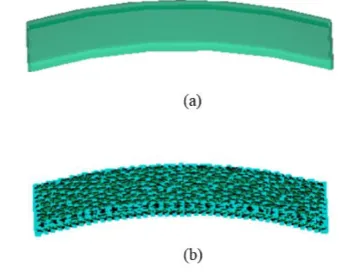
[image:2.595.336.506.301.440.2]The top cover of telephone is used as the model, as followed in the research [15] is shown in Fig. 1. The model has the length of 218.50 mm, width of 50 mm and the height of 26 mm and it is in the design of “fusion” grid. The global grid side length is 6.43 mm and in the string of 0.1 mm. The triangle units’ number is 2666. The Acrylonitrile butadiene styrene (ABS) is selected as a material.
Fig. 1. The geometric model and Finite element B. Taguchi’s Orthogonal Array
Table I.The design settings of Orthogonal Array Level
Factor
Fiber aspect ratio Fiber content/%
Injection time/s
Melt temperature/°C
Mold temperature/°C
Holding pressure/MPa
A B C D E F
1 10 10 2 210 40 32
2 25 15 3 220 45 34
3 30 20 4 230 50 36
4 40 25 5 240 55 38
5 50 30 6 250 60 40
C. Moldflow Simulation
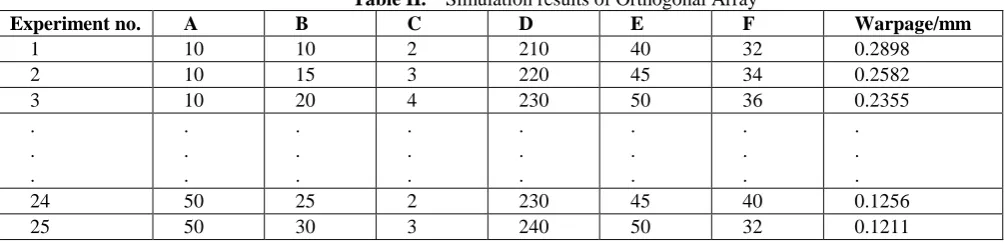
Based on the orthogonal DOE, 25 trials are considered with varying parameters similar to that research [15]. The Computer Aided Engineering (CAE) of warpage result is collected in the Moldflow software, as given in the Table 2.
The orthogonal experiments are used to analyze the influence of various parameters like fiber aspect ratio, fiber content, injection time, melt temperature, mold temperature, and holding pressure. The experimental factors influence on
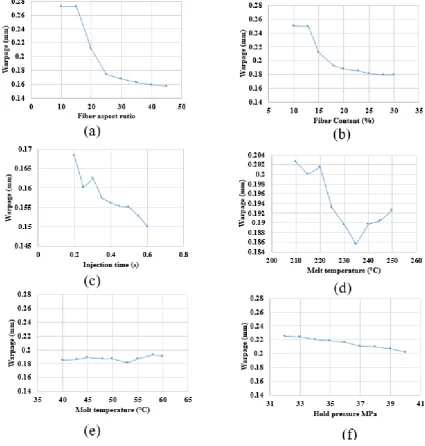
the warpage is measured and provide in order. The influences of the various parameter are shown in Fig. 3. The importance of parameter is A > B > D > E > C > F. The relationship of the parameter and warpage is given in the Fig. 3. The result shows that the fiber parameter influences on the top cover warpage is important than the parameter settings in the fiber reinforced composite injection molding. The fiber parameter influences on injection molding of fiber-reinforced composites cannot be underestimated.
Table II. Simulation results of Orthogonal Array
Experiment no. A B C D E F Warpage/mm
1 10 10 2 210 40 32 0.2898
2 10 15 3 220 45 34 0.2582
3 10 20 4 230 50 36 0.2355
. . .
. . .
. . .
. . .
. . .
. . .
. . .
. . .
24 50 25 2 230 45 40 0.1256
25 50 30 3 240 50 32 0.1211
D. Back Propagation Neural Network
The network is developed with one input layer with five neurons and 5 factors are given as input to neurons. Two hidden layer are developed with 20 neurons in each input layer and output layer has one neurons. The factors have influences on the warpage value of the plastics. The input of each neurons is obtained from the output of the previous layers, as shown in the Eq. (1).
N
neti ij jx
j
(1)
Where netirepresent the total input with the
i
thneuronsfrom the previous layers. The xij represents the connection
weight of jth neurons in the layer. The N denotes the
number of neurons in the forward layer, ith neurons in the
previous layer and x j denotes the output of jth neurons in
the forward layer.
The output of the ithneurons is outi is the processing input
using the transfer function fs, the function of the hyperbolic
tangent is denoted in the Eq. (2).
11 neti e s
outi f neti
neti e
(2)
The experimental data of the research [15] is used to train the system before predicting the warpage of plastics. In the training process, the error values are minimized for the
connection weight
x
ij between the prediction value and theactual value.
E. Human Behavior Based Optimization
Humans in the social culture trying to reach their subjective commitments. A person achieved the goals is called successful person. The person has to fully dedicate himself to work for complete their particular goal. The point of view is differing for the person to person to achieve each individual goal to get success. The individuals are functioning and training in several arenas and get expert in the area [16]. In the particular area, one person has highly skilled than another and others in the area to study from the expert and develop their abilities in the same field. Based on the human behavior, the algorithm has five stages as follows [16]:
Step1:Initialization Step2:Education Step3:Consultation
Step4:Fieldchangeprobability Step 5: Finalization
This stage involves in assessing the individuals and distributed in the different area. An individual for Nvar is
given in the Eq. (3), as follows in [16]:
. N pop
N Indi round N field
(3)
Where N Indi. denotes the number of initial population in
the
i
th field. After initial value is set, the function values areprocessed. This is denoted as
1 2 Nrar
function value = f x ,x ,...x .
Step 2. Education
In this phase, each individual is make an effort to learn and develop from the skilled individual. This have the greatest function number in particular area. The coordinate system is processed and each individual is the source for model this process. The effect area is limited in the sphere surrounding of the expert individual. The radial coordinate
r is occurredbetween the rmink1d and rmaxk d2 , where d is the Euclidian space that is present between the individual and source, and the weighting factor is represented aski [16].
Furthermore, the procedure find that N1 arbitrary angular coordinates
1 2, ,...N1
, where N1 may be present within 0 and 2π radius and the another angles is chosen between 0 and π radians [16].Step 3. Consultation
In this phase, each individual selects the experts in an arbitrary guide from the culture and consulting with them. The few specific variables are updated by the guide in this procedure. If the superior function cost is updated, then it will be exchanged with it. The number of random variables that is processed as follows [16], in the Eq. (4).
var
NcroundN (4) Where represent the consultation factor to identify the number of updated random variables.
Step 4. Field change probability
In every iteration, a person can modify his area. The possibility of shifting area is processed by a rank probability technique. In this technique, each area is arranged with respect to its best function value, as given in Eq. (5) below [16]:
1 Oi Pi
N field
(5)
Where Pi and Oi are the area updating possibility and
sorting command is for the ith area, respectively. The finest
function cost value is the fewer possible in the field and area with poor function cost is possible for area changing. While creating an arbitrary number within 0 and 1, the equation is verified, and if it is satisfied, occurs the field changes [16].
f r and Pi field changing occurs
i
An assortment possibility for every individual in Eq. (6) in the research [16].
1 .
ind
j
j N
k k
f indivual P S
f indivual
(6)
Where P S j. is the possible feature selection for the jth
individual Nind is the number of individuals in the
considerable field. The roulette wheel selection method is used to select the individuals.
Step 5. Finalization
The location of the individuals is updated in the phase of the consultation and education. The function cost of the individuals is evaluated and algorithm will stop once it attains the stopping condition or the algorithm will process to phase 2. The terminating conditions are as given below [16]:
a. The number of iteration is equal to maximum iterations.
b. Maximum function calculation is achieved.
c. The typical variation in the main function cost is lesser than the function accept limit.
IV. EXPERIMENTALRESULTS
Fig. 2. Different parameter in warpage - (a) Fiber aspect ratio, (b) Fiber content, (c) Injection time, (d) Melt temperature, (e) Molt temperature, and (f) Hold pressure.
The different parameter with the relationship in the warpage of the injection molding materials are shown in the Fig. (2) (a-f). This shows that the fiber aspect ratio is important parameter in the warpage. The optimization method identifies the optimized parameter for minimizing warpage. The BPNN investigate the relationship between warpage and the parameters.
[image:5.595.53.293.629.780.2]Fig. 3. Influence degree of different parameter in Warpage
Table III. Simulation Result Parameter
Fiber aspect
ratio
Fiber content
Injection time
Melt temperature
Mold temperature
Holding
pressure Warpage
% s °C °C MPa mm
Recommended parameter 25 20 2 230 50 40 0.1939
GA optimization [15] 46.94 29.53 4.02 246.63 40.18 39.06 0.0953
CAE verification of GA [15] 47 30 4 247 40 39 0.102
PSO 47.84 30.24 4.65 248.64 41.42 40.24 0.0941
HBBO 47.25 31.28 3.84 226.47 42.61 42.04 0.0858
CAE verification of HBBO 48 32 4 227 43 42 0.0935
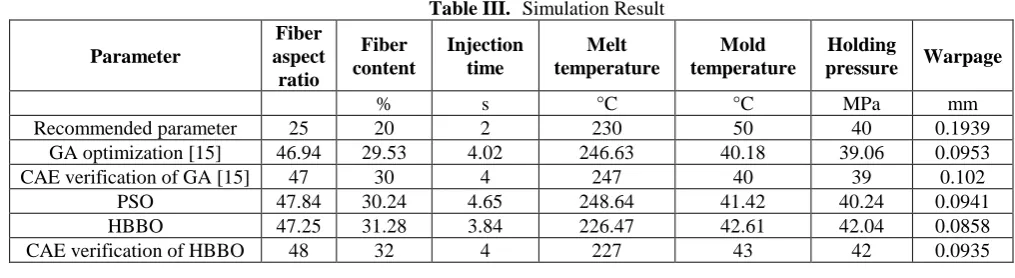
The optimization method is applied to these factors for the warpage reduction and this provide the optimized value for the warpage in injection molding. The proposed HBBO is applied to these factors and identify the optimized value for the less warpage. The value acquired by the proposed method compared with existing method in warpage is shown in Table 3. This shows that the HBBO method has the lower warpage compared with the existing method. The CAE verification is done for the GA and HBBO method that shows the efficiency of the proposed method. In this work, 6 factors have been considered in this method such as Fiber aspect ratio, Fiber content, injection time, melt temperature, mold temperature and Holding pressure. The optimized value of the proposed method is attained as fiber aspect ratio as 47.25, fiber content as 31.28%, injection time is 3.84s, melt temperature as 226.47°C, mold temperature as 42.61°C, and Holding pressure as 42.04 MPa. The proposed method has the highest performance compared to the existing method for warpage optimization.
V. CONCLUSION
Warpage is the important quality index in the short fiber reinforced injection molding process. Some researches were made to reduce the warpage in the material by optimal setting of parameters. The popular technique is to apply the GA and this has large stochastic value involves in complex structures. In this research, the HBBO method is proposed to minimize the warpage optimization. This method is developed based on the human behavior in the different field and contains low stochastic value. The orthogonal array is used to measure the warpage at the different parameter settings. The BPNN is used to find the relationship between the various factors and warpage. The optimization method is used to find the optimal parameter settings to minimize the warpage. The fiber reinforced component is simulated in the moldflow software and optimization method is analyzed. The factors such as fiber aspect ratio, fiber content, melt temperature, molt temperature, injection time and hold pressure are considered. The experiment result shows that proposed method has low warpage compared to the existing method due to the low stochastic value of the proposed method. The warpage of the HBBO is 0.0858 mm and the warpage of GA is 0.0953 mm. The future work of the method is evaluated for the different materials in the warpage optimization.
REFERENCES
1. W. C. Chen, M. H. Nguyen, W. H. Chiu, T. N. Chen, and P. H. Tai. (2016). Optimization of the plastic injection molding process using the Taguchi method, RSM, and hybrid GA-PSO. The International Journal of Advanced Manufacturing Technology, 83(9-12), pp. 1873-1886. 2. Y. Xu, Q. Zhang, W. Zhang, and P. Zhang. (2015). Optimization of
injection molding process parameters to improve the mechanical performance of polymer product against impact. The International Journal of Advanced Manufacturing Technology, 76(9-12), pp. 2199-2208.
3. S. Kitayama, Y. Yamazaki, M. Takano, and S. Aiba. (2018). Numerical and experimental investigation of process parameters optimization in plastic injection molding using multi-criteria decision making.
Simulation Modelling Practice and Theory, 85, pp. 95-105.
4. R.J. Bensingh, R. Machavaram, S.R. Boopathy, and C. Jebaraj. (2019). Injection molding process optimization of a bi-aspheric lens using hybrid artificial neural networks (ANNs) and particle swarm optimization (PSO). Measurement, 134, pp. 359-374.
5. E. Oliaei, B. S. Heidari, S. M. Davachi, M. Bahrami, S. Davoodi, I. Hejazi, and J. Seyfi. (2016). Warpage and shrinkage optimization of injection-molded plastic spoon parts for biodegradable polymers using taguchi, ANOVA and artificial neural network methods. Journal of Materials Science & Technology, 32(8), pp. 710-720.
6. S. Sudsawat, and W. Sriseubsai, (2018). Warpage reduction through optimized process parameters and annealed process of injection-molded plastic parts. Journal of Mechanical Science and Technology, 32(10),
pp. 4787-4799.
7. C. Shen, L. Wang, and Q. Li. (2007). Optimization of injection molding process parameters using combination of artificial neural network and genetic algorithm method. Journal of Materials Processing Technology, 183(2-3), pp. 412-418.
8. M. Moayyedian, K. Abhary, and R. Marian. (2018). Optimization of injection molding process based on fuzzy quality evaluation and Taguchi experimental design. CIRP Journal of Manufacturing Science and Technology, 21, pp. 150-160.
9. H. Kurtaran, B. Ozcelik, and T. Erzurumlu, (2005). Warpage optimization of a bus ceiling lamp base using neural network model and genetic algorithm. Journal of materials processing technology, 169(2), pp. 314-319.
10. F. Yin, H. Mao, L. Hua, W. Guo, and M. Shu. (2011). Back propagation neural network modeling for warpage prediction and optimization of plastic products during injection molding. Materials & design, 32(4),
pp. 1844-1850.
11. S. Kitayama, H. Miyakawa, M. Takano, and S. Aiba. (2017). Multi-objective optimization of injection molding process parameters for short cycle time and warpage reduction using conformal cooling channel. The International Journal of Advanced Manufacturing Technology, 88(5-8), pp. 5-8, pp. 1735-1744.
12. R. Azad, and H. Shahrajabian. (2018). Experimental study of warpage and shrinkage in injection molding of HDPE/rPET/wood composites with multiobjective optimization. Materials and Manufacturing Processes, pp. 1-9, 2018.
13. C. C. Kuo, Y. R. Wu, M. H. Li, and H. W. Wu. (2018). Minimizing warpage of ABS prototypes built with low-cost fused deposition modeling machine using
developed closed-chamber and optimal process parameters.
Advanced Manufacturing Technology, pp.1-10, 2018.
14. X. Wang, J. Gu, C. Shen, and X. Wang. (2015). Warpage optimization with dynamic injection molding technology and sequential optimization method. The International Journal of Advanced Manufacturing Technology,78(1-4), pp.177-187.
15. K. Li, S. Yan, W. Pan, and G. Zhao. (2017). Warpage optimization of fiber-reinforced composite injection molding by combining back propagation neural network and genetic algorithm. The International Journal of Advanced Manufacturing Technology, 90(1-4), pp. 963-970. 16. P. Jangir, S. Parmar, And I. Trivedi. (2017). Human Behavior Based Optimization Algorithm for Optimal Power Flow Problem with Discrete and Continuous Control Variables. International Journal of Engineering Technology Research & Management, 1(2), pp. 26-35.
AUTHORSPROFILE
Prof. Ekta S Mehta, faculty with Mechanical Engineering Department from Zeal College of Engineering and Research Pune. She is Pursuing Phd from KL University Vaddeswaram and has 11.10 Years of academic experience in varied kinds of academic institutions. She has Completed her B.E. in Mechanical from RGPV Bhopal and also has completed her M.E. (Mechanical) Specialization in Advanced Production Systems from RGPV Bhopal. She Previously worked as a Assistant Professor in Mechanical Engineering Department Bhopal in 2007 and She is working as a Assistant Professor in pune since 2010. She has taught various subjects from the areas of Manufacturing , Metallurgy , Material Science & Machine Design. She has presented a paper in a National & International Journal & Conferences & Attended Many Workshops . Ekta has lead Under graduate students for their Projects & Seminar . Ekta has also contributed actively in University work. She is PG recognized Teacher. She is a Member of Professional Society (ISTE).