International Journal of Innovative Technology and Exploring Engineering (IJITEE) ISSN: 2278-3075, Volume-8 Issue-10, August 2019
1244 Retrieval Number H6969068819/2019©BEIESP
DOI: 10.35940/ijitee.H6969.0881019
Published By:
Blue Eyes Intelligence Engineering & Sciences Publication
A Systematic Learning on Variety of Recommender
Systems for Online Commodities
D. Anand Joseph Daniel, M. Janaki Meena
Abstract: In a sophisticated high-end product market, all firms often come up with a vast number of goods to partake the market shares. Owing to the availability of enough information of various products that enters the market or due to lack of right information, customers are prone to the state of dilemma in comparing and choosing the most appropriate ones. In most of the cases, the product specifications are mentioned, still whether these features suit the customers need is a concern. Online reviews tend to benefit the consumers and the goods developers. Here again, finding out the more supportive reviews become a challenge. Considering these factors, this article intends to be particular in reviewing the existing evaluation strategies and recommender systems that have grown progressively favorable in present era and are employed widely for casual to commercial items.
Keywords: High-end products, Online reviews, Customer needs, Evaluation strategies, Recommender system.
I. INTRODUCTION
As online purchasing increases several folds, e-commerce enterprises became competitive and there is an upward shift in designing recommendation engines that predict the product that shall be chosen by the consumers. Customer feedback about the product helps in re-evaluation and improvement of the guidelines or processes of products. Examining clients’ profile, purchasing and surfing history assists in making effective suggestions for the products of a firm. A recommendation system is a software which predicts the products that could be referred to an intended user . Any Recommendation/ recommender Systems (RS) has to collect the required data by a retrieval task to suggest suitable products for the customers. It also alleviates data overloading problems by filtering, prioritizing and effectively delivering only the relevant facts. Product reviews by users other than domain professionals provide vital information to help product manufacturers to perceive the users’ favorites. Such reviews are purely based on consumers’ own point of view, like the ones that are shown in figures 1 and 2. The review of the first figure might tune certain readers to read that book, thus it is positive for the people involved in the print and sales of the book This review will also be fruitful for designing similar products either in printed form or in e-form.
Revised Manuscript Received on August 01, 2019
D. Anand Joseph Daniel, Assistant Professor, Department of Computer Science and Engineering, Anand Institute of Higher Technology, Chennai, Tamil Nadu, India.
Dr. M. Janaki Meena, Professor, School of Computing Science and Engineering, Vellore Institute of Technology, Chennai, Tamil Nadu, India.
Fig 1. Helpful positive review
Not only positive reviews benefit the buyers and the designers, but also negative ones that do a lot for both of them. Certain expensive commodities would work great at the beginning, gradually its function may degrade, when the user notes this down as an online review, the designer would try to enhance the durability of the product or increase warranty of the product or modifies the price such that the mindset of consumers changes to buy. When making online suggestions, there are structures that undergo cold start issue that occurs due to lack of transaction details for the new user. [1] Certain research in the design of recommendation systems confirm that social media helps to give a better idea to design products to attract consumers. Collaborative systems do estimation by considering similar preferences of the user which were suggested to others by analyzing their previous likes.
Fig 2.Helpful negative review
1245 Retrieval Number H6969068819/2019©BEIESP
DOI: 10.35940/ijitee.H6969.0881019
Published By:
Blue Eyes Intelligence Engineering & Sciences Publication
Obtaining the real product characteristics from user reviews requires persistent effort and intelligence. Further investigations are to be made on customer reviews and continue focusing the types of similar products is more preferable to deal with e-commerce. Each Individual’s opinion guides public and government when making crucial decisions [4, 5]. Opinions are those that come out of experience, knowledge and beliefs lead to fruitful results. It can be attained from surveys, media, web based applications or manual collection. Nevertheless it requires effective tools and methods to retrieve opinions and brief them. The rise in applications and total app store revenue has speeded up app-store data mining and opinion learning. App app-store designers need to take maximum steps to better understand the users by providing techniques to limit opinion spam. [6] related that in what way that the reviews are helpful for the designers; in fact, the reviews of product developers and buyers vary. The study included a user centric model to conduct a user study and to assess how users do them apart from merely choosing the reviews to get rated by the designers. Again the report concentrates on modeling user services and its domain based on user basis. Furthermore it develops a practicable technical system to model the notion of usefulness and certify it. The research also focused on regression and sorting of existing methods through testing and validation. Productive results are obtained using hybrid algorithms which attained a robust link between the proposed system and the assessments of manufactures. This study uses Pearson product-moment correlation coefficient which is purely intended to analyze how user reviews correlates with that of designers’ perceptions and how these views are useful to them. Likewise each study might be comprised of its own methods to categorize features from online reviews that assist in getting any item of one’s choice. A list of such works has been reviewed in the aspect of improving recommendation quality, by which only those commodities that meet the desired criteria are moved forward.
A. Reviewed terms and methods
Collaborative learning involves user group to resolve complexities or share knowledge by coordinating with each other. It is comprised of social rules and data processing methods. In this technique, recommendation of new items is impossible unless these are rated by others. It includes memory (neighborhood) and model based schemes.
Content based recommendation system recommends on the basis of quality, speciality and preference of the products other than user similarities. It uses tags to identify alike contents. In this context, the user might not be free to choose products that are already rated or preferred. It is preferred for new products recommendation but not for new users [7].
Knowledge based recommendation engines are especially helpful for products that are purchased rarely or with fewer ratings.
Certain above mentioned systems are combined in hybrid recommendation that includes a set of machine learning models, thus to enhance a specific class of recommendation method.
SentiWordNet is used here, which assigns WORDNET synset describing objective, positive and negative reviews. SentiWordNet identifies attributes and
allocates term label, where in feature selection, techniques like point-wise mutual information and chi square can be used.
Opinion lexicon is a set of words with either polarity, which is used in the case where no such predefined training dataset is used. Constructing huge sized lexicon is tedious and so automated systems are used for expanding the present lexicons are required.
Due to inadequate data to make certain predictions, cold start issue occur in developing recommendation systems.
Synonymy in recommendation system denotes to a condition of similar products with different names that makes the system difficult to distinct among the products.
Membership level refers to user awareness which is defined by considering usage time, purchasing, etc. by the consumers.
Cognitive map is a directed graph which models any real structure.
II OPINION MINING
International Journal of Innovative Technology and Exploring Engineering (IJITEE) ISSN: 2278-3075, Volume-8 Issue-10, August 2019
1246 Retrieval Number H6969068819/2019©BEIESP
DOI: 10.35940/ijitee.H6969.0881019
Published By:
Blue Eyes Intelligence Engineering & Sciences Publication
As adjectives’ and adverbs’ role is great, they are retrieved from each text. The same goes with certain verbs and other consecutive words. Then it is subjected to algorithm and after a series of approaches like text classification, probability/empirical distribution, clustering, a pair of lexicons is retrieved as output. When SentiWordNet and the proposed system are compared, the results show that ~73% and ~88% words are effectively classified.
Adapted from [9]
Fig3.Modified entropy classifier with bipartite graph clustering
As there is a steadfast increase in online opinion, there are chances for unusual circumstances also, in where warning system alerts the marketers to follow any preventive steps. This system would be based on object related success values, reviews and interaction types. [10] proposed a new reputation generation method corresponding to opinion fusion and mining that retrieves reputation data and tracks public viewpoint. In this reputation generation method, filtered opinions are classified by means of fused main opinion set which comprises of similar contents. It also computes several recommender systems and reputation visualization on the basis of opinion resemblance and for the sake of offering enough reputation data to the customers accordingly. Furthermore it also develops a minor-scale real time evaluation to quantify the user acceptance of this proposed system. [11] used neuro-fuzzy method to learn linguistic instructions from information. If the designers consider spreading negative facts spoil their brands, construction of warning mechanism would benefit them. An illustration of such scenario is depicted in figure 4. It functions in accordance with knowledge basis, where data collection is from different sources. Then both the facts that states good about the product and the pros and cons from the marketers’ database and user review respectively are
extracted as input and then it employs fuzzy method which differentiate critical conditions from non-critical ones. On detecting any unusual or critical situations, marketers would receive the warning alerts.
[image:3.595.328.523.101.318.2]Adapted from [11]
Fig 4.Neuro-fuzzy based warning system
B. Common recommender systems
LinkedIn is a collaborative filtering recommendation system that adopts Apache Hadoop to recommend individual the profession they wish to go for or group they are likely to join.
Amazon employs content based recommender method named as item-item collaborative filtering, that suggests previous users’ preferences to the present user.
Hulu works with offline product based collaborative filtering which identifies contents that the customers are interested in.
Netflix is a content provider that includes a combination of around 107 recommendation algorithms to improve prediction efficiency.
Google news personalization system recommends news to customers with respect to their previous clicks.
Further Google, Goodreads, YouTube and social media use recommendation systems to assist users make suitable selection [12].
1247 Retrieval Number H6969068819/2019©BEIESP
DOI: 10.35940/ijitee.H6969.0881019
Published By:
Blue Eyes Intelligence Engineering & Sciences Publication
III ENTERPRISE KNOWLEDGE RECOMMENDATION (EKR) SYSTEM
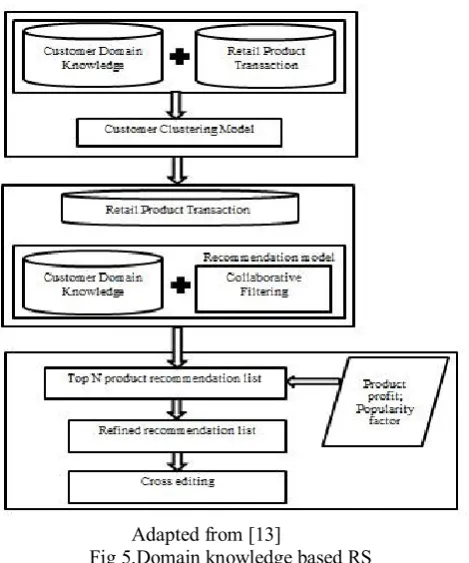
[13] emphasized the significance of domain knowledge in RS by proposing a personalized recommendation method that overcomes scalability and data sparsity problems. Among the various personalized RS including collaborative filtering and content and rule based recommendation, collaborative method suits well since it does not require any investigation on content features of suggested items and its operational accuracy is also strong. Domain knowledge further enhances the impact of personalized RS and it is also recommended in cross selling. Also it balances the suggested results and the varying needs of customers. It improves the actual implementation of this system to obtain the outcomes more practicable and productive. In this case, domain knowledge system helps to find out the relevant data, where it is sub-divided into consumer (structured details of users maintained in relational catalog), retail (unstructured format) and business principle (necessities for exploiting company’s income) and experts’ (over suggestions of popular items are avoided) dimension domain knowledge.
[image:4.595.53.288.319.601.2]Adapted from [13]
Fig 5.Domain knowledge based RS
In figure 5, consumer domain and trade transaction is used for user grouping supervision, whereas product domain is employed to improve existing collaborative model and product profit refines the object suggestion set. In collaborative filtering, the object and the object set are compared to generate a recommendation set. Since it is computationally complex and weakens the recommender output, it results in scalability and timelessness defect when the number of users and items increases more rapidly. Therefore, to handle this scenario, grouping is done prior to the actual processing and then generates object suggestion by comparing it with other group of users (objects).
It assigns priority to both precision of RS and profit of the objects. The total profit (T) is defined as in equation (3.1).
(3.1)
International Journal of Innovative Technology and Exploring Engineering (IJITEE) ISSN: 2278-3075, Volume-8 Issue-10, August 2019
1248 Retrieval Number H6969068819/2019©BEIESP
DOI: 10.35940/ijitee.H6969.0881019
Published By:
Blue Eyes Intelligence Engineering & Sciences Publication
IV REAL TIME RECOMMENDATION SYSTEM
[18] Developed an outline for intelligent model that is referred by knowledge based structure, learning schemes and intellectual processes and criticality system to extend the notion of knowledge based recommendation method. Apart from these, it includes individuals, products, area, context and criticism as knowledge model. For this purpose, it employs fuzzy cognitive maps with two levels. The first one indicates the items’ details, users, interest and recommendations whereas the next level describes the present scenario, data relating to the products and consumers, contexts and so on.[19]proposed a real-time recommendation system known as Far seer that includes combined offline and online strategies that recommends newly created content to the users. [20] explored various features and potentials of prediction algorithms in recommender schemes. It states some of the shortcomings of collaborative filtering method such as cold-start, data sparsity, scalability and synonymy. Unlike the existing systems that work with respect to rating similarity, [21] combines user preferences and opinions, named to be preference and opinion based RS for efficient suggestion. It also implements a novel feature and opinion extraction approach known as adverb based opinion feature retrieval strategy that retrieves the opinion of the user from the review. Feature opinion retrieval and the recommendation are the issues concerned here in which the designed recommender system depends on concern and requirement. Further, it uses PORE algorithm where the aforementioned approaches are integrated. Then to make use of the effectiveness of this study, it develops a restaurant recommender engine and the results are validated. [22] develops a 2-message system that describes the opinion analysis of customers with online review statements. It demonstrates that customers with better membership level would have a stable comment by review polarity rather than the users with lower membership factor. [23] selected items from e-commerce blogs rather than from transaction records. Since the user views are too big to handle, it builds distributed indexing based back end scheme that retrieved the required user reviews in a short time. The components of the designed recommendation method are purchase-intent detection, demographic information retrieval (bootstrapping algorithm) and article recommendation. In constructing feature vectors, query-independent and dependent product features are assigned. Besides, it sorted out two limitations that this method would be possible only when demographic features are available and then it is applicable with only social media. Measures are yet to be taken featuring these two demerits. Moreover the results of demographic recommender methods are usually unsatisfactory but effective when combined with knowledge based or hybrid RS. [24] Evaluated the characteristics of certain graphs such as clustering co-efficient and degree distribution, and figured out the relation among them. [25] presented a Multi-objective Ranked Bandits (MRB) that functions using implicit feedback in dynamic representations offering online suggestions. According to this concept, clicks provide feedbacks which are exploited to enhance further recommendations. This method depends on scalability, a cluster of recommender quality metrics, a dynamic prioritization model to weigh the quality metrics and the bandit strategy.[26] used diffusion based RS and evaluated
in a real time context. In improving personalized recommendations, the role of tag data and attractor (personal and global) is essential. In this tag based weighted variant approach three types of user attitudes and tags are dealt which comprises of user, product and tag set. Consumer and product based recommendations that fall under collaborative filtering method can be implemented by exploring Euclidean distance, cosine metrics and Pearson correlation. Personalized RS can be extended through these methods.
V EVOLUTIONARY ALGORITHMS (EA) FOR RECOMMENDATION SYSTEM
1249 Retrieval Number H6969068819/2019©BEIESP
DOI: 10.35940/ijitee.H6969.0881019
Published By:
Blue Eyes Intelligence Engineering & Sciences Publication
VI HYBRID RECOMMENDATION SYSTEM
In order to extract the exact data by gaining effective system optimization and by overcoming certain shortcomings including limitations about data, functions along with information overload of the pure recommendation system, hybrid RS is helpful which filters and customizes the required data. Many articles validate the hybrid recommender systems since combining two or more algorithms would be of more efficient than a single one as the demerits of one system could be handled by any other. Many present recommendation methods fail to overcome the shortcomings in making precise suggestion of learning sources because of the variations in learning way, understanding ability and the sequential learning patterns. This is resolved by the addition of learner info. Employing several recommender engines usually suppress the limitations of a standalone system in a combined approach. Integration of methods/algorithms could be performed in several ways like,
Application of algorithms separately and then merging the results.
Using content based filtering in collaborating model or vice-versa.
Developing a hybrid RS with content based and collaborative filtering methods together.
[32] developed a hybrid knowledge based recommendation method that satisfies the above criteria and also alleviates cold start and rating sparseness issues. Ontology model used in this approach is to model and denote the learners’ domain knowledge, whereas sequential pattern mining identifies the related configurations. Its intention is,
To create ontology that represents the knowledge of the users and learning resources.
To compute ratings’ resemblance and make Target Learners’ (TL) estimations.
To generate top N Learning Products (N-LP) by means of collaborative filtering.
To apply sequential pattern mining to NLP thereby to create ultimate recommendations for TL. Similarly cold start problem can be alleviated using contextual and personalized event RS to exploit client favorites, and since the existing methods in this field is valid for a limited period, this method can be integrated with content preferences and context effects generated from consumers’ history apart from exploiting temporal influence, spatial restraints and social impact. [33] also deals with cold start problem and finds out the relation between each norm and complete rating using enhanced fuzzy multi criteria systems based on collaborative and product based ontological semantic filtering methods. It also uses fuzzy cosine and Jaccard mechanisms in determining the overall similarity between consumers/products in relation with the impact of co-rated product set cardinality over the consistency of the resemblance process. Additionally, it adopts a convex combination of consumer and similarities based on gradient descent method such that the predicted error gets minimized. In handling new user cold start issue, resemblance metric, irrelevant users; choosing membership functions and data dependency also hybrid technique would be practicable. [34] Two common methods being widely used are collaborative and content based filtering, of which the former method relates to the liked-mind customer
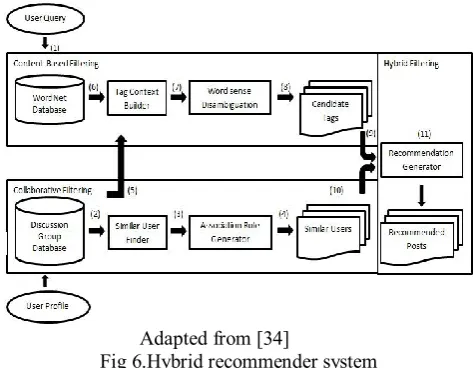
reviews, whilst the other corresponds to the product findings with respect to the consumers’ past preferences. The demerits of these strategies are overcome by combining certain methods such that to enhance the accurateness. It proposed association rule mining model to identify similar users,(rather than co-rated user reviews) to whom the relevant reviews are suggested. Here it used WordNet lexical database system to relate with the semantic contents (not using related keywords). The core function of this approach is to identify the customer resemblance neighborhood from the discussion group.
[image:6.595.307.544.188.372.2]Adapted from [34]
Fig 6.Hybrid recommender system
In figure 6, the following steps are processed.
Similar user finder retrieves similar users to the present user in terms of popular posts collected from discussion group database.
Association rule generator assists in generating more similar users.
Tag context builder creates tag based on WordNet database.
International Journal of Innovative Technology and Exploring Engineering (IJITEE) ISSN: 2278-3075, Volume-8 Issue-10, August 2019
1250 Retrieval Number H6969068819/2019©BEIESP
DOI: 10.35940/ijitee.H6969.0881019
Published By:
Blue Eyes Intelligence Engineering & Sciences Publication
Sometimes recommender system fail to suggest new standard items rather recommends ideal similar products repeatedly and so the consumers’ preference is unmet. In such cases, building up of protocols and other knowledge based factorization system as an integrated form, helps in sorting out of these difficulties.
C. Weighted Hybridization (WH)
WH integrates the results of several recommender systems to obtain a recommended list by combining the values using linear process. [36] applied linear weighted integrated system based on six large real time datasets to provide adaptability in various social annotation networks. It is also feasible and extensible apart from minimizing complexities in reference with data overload and limited utility. It evaluated fundamental and tag specific resource recommendation and proved that this hybrid method is effective than factorization algorithm.
D. Switching Hybridization (SH)
SH is preferred in a context of avoiding complexities of one system. Suppose, if a new user problem is occurred in content based RS, it can be switched to collaborative filtering. Though this mechanism is beneficial in terms of sensitiveness of the respective recommenders, it is of more complex due to the switching process where it increases the required attributes to the RS
E. Cascade Hybridization (CH)
CH includes iterative refinement model to construct a preference order among several products. Here the first RS results in a recommender list which is then refined by next RS. This method is considered to be very effective and provides noise tolerance because of the coarse-to-finer iterative effect.
F. Mixed Hybridization
In mixed hybrid RS, several of the recommendation results are combined, where each product includes more than one recommendation.
VII ASSESSMENT CRITERIA
Any of the algorithms used in the recommender system must undergo evaluation metrics to determine accuracy and coverage, which mostly relies on the process employed. In evaluation metrics, estimation and rank efficiency, decision-making, multiplicity, object coverage and serendipity are some of the factors that must be included. Among them accuracy and coverage are given importance widely. Accuracy is related to the portion of right recommendations whereas coverage refers to the products to which recommendations are available. Such metrics can be classified into two:
G. Statistical Accuracy Metrics (SAM)
Mean absolute and root mean square error and correlation comes under SAM, in which the estimated and the actual user ratings are normally compared in order to assess the accuracy of the method used. Mean absolute error (m) is the recommendation variation from customers’ precise value as per equation (7.1).
(7.1)
where, pc,p refers to the estimated rating for consumer (c) on product (p), rc,p denotes the actual rating and N indicates the total ratings. Similarly the root mean square error (r) can be defined as in equation (7.2),
(7.2)
H. Decision support Accuracy Metrics (DAM)
Some of the common DAM are F-measure, receiver operator characteristics, precision, recall which assist in choosing the best products from the vast list of them. Precision relates only to the relevant products, on the other hand, recall refers both to the relevant and the suggested products.
(7.3)
(7.4)
F measure simplifies precision and recall as defined in
equation (7.3) and (7.4) where its result compares algorithms and datasets. In assessment study, different metrics that associate to various consumer and business objectives are to be noted. Besides, conducting rigorous offline analysis in preparing and sampling data and aggregating outcomes are also required.
VIII COMPARATIVE ANALYSIS
Collaborative filtering depends on ratings, content based approaches on reviews, knowledge based engines on communication with users and demographic based RS makes use of demographic data to predict suggestions.
Knowledge based methods are efficient in cold start environment, without the availability of enormous data, whereas collaborative techniques works well with sufficient data.
Fuzzy cognitive map model is not persuasive and efficient and that covers only partial reviews.
The potentials of data integration and automatic data extraction could be done through WordNet.
Intelligent recommender engine suits for validity
(recommends based on actual need),
1251 Retrieval Number H6969068819/2019©BEIESP
DOI: 10.35940/ijitee.H6969.0881019
Published By:
Blue Eyes Intelligence Engineering & Sciences Publication
In account of natural language processing, choosing an appropriate algorithm is quite difficult due the involvement of huge numbers of algorithm.
On extensive training, deep learning methods involve multi view deep modeling that automatically learns features based on surfing details and queries which also outperform matrix factorization.
In case of reputation systems too, the results depends that one must consider statistical data in rating procedures. A novel reputation method requires addition algorithm to generate effective recommendation.
Recommender rules are significant for any RS, and for knowledge based system, these rules are adjusted such that it could be well adapted to variety of users.
Bootstrapping process suits for immediate profiling of new users.
The application k-means clustering in the RS is less expensive and improves the overall performance in terms of centroid selection.
In terms of implicit opinion in dynamic states of RS, MRB is workable.
IX CONCLUSION
In data economy and networks, where recommender system is widely helpful and adopted, positive and negative reviews of users have to be analyzed to conclude about the quality and attributes of the products, where it pinpoints the necessary data such that the user favorites for a particular item could be predicted. The features and techniques of each of the reviewed article are distinctive or similar capable to handle a few task effectively. At the availability of broader diversity of inputs, an individual is flexible enough to use different types of recommendation engines for similar tasks. Therefore it can be recommended that hybridization (probably with knowledge based RS) proves to an efficient method in resolving the existing limitations such cold-start, data sparsity, information overload, prediction error, etc. and to develop a better robust system.
REFERENCES
1. Amin Shahmohammadi, EhsanKhadangi and AlirezaBagheri, Presenting New Collaborative Link Prediction Methods for Activity Recommendation in Facebook Neurocomputing, Vol. 210, 2016, pp. 217–226, http://dx.doi.org/10.1016/j.neucom.2016.06.024.
2. Nikos Tsirakis, VasilisPoulopoulos, PanagiotisTsantilas and IraklisVarlamis, Large Scale Opinion Mining for Social, News and Blog Data, Journal of Systems and Software, Vol. 127, 2017, pp. 237–248, http://dx.doi.org/10.1016/j.jss.2016.06.012.
3. Chia-Lin Hsu, Li-Chen Yu and Kuo-Chien Chang, Exploring the Effects of Online Customer Reviews, Regulatory Focus, and Product Type on Purchase Intention: Perceived Justice as a Moderator, Computers in Human Behavior, Vol. 69, 2017, pp. 335–346,
http://dx.doi.org/10.1016/j.chb.2016.12.056.
4. NecmiyeGenc-Nayebi and Alain Abran, A Systematic Literature Review: Opinion Mining Studies from Mobile App Store User Reviews, Journal of Systems and Software, Vol. 125, 2017, pp.207– 219, http://dx.doi.org/10.1016/j.jss.2016.11.027.
5. M.Thangamani and V.Ravindra Krishna Chandar, Adverse Drug Reactions using Data Mining Technique, Journal of Excellence in Computer Science and Engineering, Vol. 1, No. 1, 2015, pp.11- 14,
http://dx.doi.org/10.18831/djcse.in/2015011002.
6. Ying Liu, Jian Jin, Ping Ji, Jenny A.Harding and Richard Y.K.Fung, Identifying Helpful Online Reviews: A Product Designer’s
Perspective, Computer-Aided Design, Vol. 45, No. 2, 2013, pp. 180– 194, http://dx.doi.org/10.1016/j.cad.2012.07.008.
7. CharuC.Aggarwal, Recommender Systems, Springer International Publishing, Switzerland, 2016.
8. Shiliang Sun, Chen Luo and Junyu Chen, A Review of Natural Language Processing Techniques for Opinion Mining Systems, Information Fusion, Vol. 36, 2017, pp. 10–25,
http://dx.doi.org/10.1016/j.inffus.2016.10.004.
9. JyotiS.Deshmukh and Amiya Kumar Tripathy, Entropy based Classifier for Cross-Domain Opinion Mining, Applied Computing and Informatics, 2017, http://dx.doi.org/10.1016/j.aci.2017.03.001. 10. Zheng Yan, Xuyang Jing and WitoldPedrycz, Fusing and Mining
Opinions for Reputation Generation, Information Fusion, Vol. 36, 2017, pp. 172–184, http://dx.doi.org/10.1016/j.inffus.2016.11.011. 11. Carolin Kaiser, Sabine Schlick and FreimutBodendorf, Warning
System for Online Market Research – Identifying Critical Situations in Online Opinion Formation, Knowledge-Based Systems, Vol. 24, No. 6, 2011, pp. 824–836,
http://dx.doi.org/10.1016/j.knosys.2011.03.004.
12. Y.Vidya and B.Shemimol, Secured Friending in Proximity based Mobile Social Network, Journal of Excellence in Computer Science and Engineering, Vol. 1, No. 2, 2015, pp. 1-10,
https://dx.doi.org/10.18831/djcse.in/2015021001.
13. LinglingZhanga, CaifengHua, Quan Chena, Yibing Chena and Yong Shi, Domain Knowledge Based Personalized Recommendation Model and its Application in Cross-selling, International Conference on Computational Science, Omaha, 2012, 1314-1323.
14. DietmarJannach, Markus Zanker, Alexander Felfernig and Gerhard Friedrich, Recommender Systems: An Introduction, Cambridge University Press, USA, 2011.
15. Olga C.Santos and Jesus G.Boticario, Modeling Recommendations for the Educational Domain, 1st Workshop on Recommender Systems for Technology Enhanced Learning, Vol. 1, No. 2, 2010, pp. 2793-2800, https://dx.doi.org/10.1016/j.procs.2010.08.004.
16. J.Song, H.Zhan, J.Yu, Qi Zhang and Y.Wu, Enterprise Knowledge Recommendation Approach Based on Context-aware of Time-sequence Relationship, Procedia Computer Science, Vol. 107, 2017, pp. 285–290, http://dx.doi.org/10.1016/j.procs.2017.03.104. 17. Haoyi Wang, XiaohuiGuo,Yushun Fan and Jing Bi, Extended Access
Control and Recommendation Methods for Enterprise Knowledge Management System, IERI Procedia, Vol. 10, 2014, pp. 224-230,
http://dx.doi.org/10.1016/j.ieri.2014.09.081.
18. Jose Aguilar, PriscilaV.Diaz and Guido Riofrio, A General Framework for Intelligent Recommender Systems, Applied Computing and Informatics, 2016,
http://dx.doi.org/10.1016/j.aci.2016.08.002.
19. Dongsheng Li, Qin Lv, Xing Xie, Li Shang, Huanhuan Xia, Tun Lu and NingGu, Interest-Based Real-Time Content Recommendation in Online Social Communities, Knowledge-Based Systems, Vol. 28, 2012, pp. 1–12, http://dx.doi.org/10.1016/j.knosys.2011.09.019. 20. F.O.Isinkaye, Y.O.Folajimi and B.A.Ojokoh, Recommendation
Systems: Principles, Methods and Evaluation, Egyptian Informatics Journal, Vol. 16, No. 3, 2015, pp. 261–273,
http://dx.doi.org/10.1016/j.eij.2015.06.005.
21. Hongyan Liu, Jun He, Tingting Wang, Wenting Song and Xiaoyang Du, Combining User Preferences and User Opinions for Accurate Recommendation, Electronic Commerce Research and Applications, Vol. 12, No. 1, 2013, pp. 14–23,
http://dx.doi.org/10.1016/j.elerap.2012.05.002.
22. Jia Chen and Gang Kou, How Online Review Valance Affect on Consumer Opinion Evaluation?,Procedia Computer Science, Vol. 91, 2016, pp. 635-641, http://dx.doi.org/10.1016/j.procs.2016.07.159. 23. W.Xin Zhao, Sui Li Y.HeL.W.Wen and Xiaoming Li, Exploring
Demographic Information in Social Media for Product Recommendation, Knowledge and Information Systems, 2016, Vol. 49, No. 1, pp. 61–89, http://dx.doi.org/10.1007/s10115-015-0897-5. 24. A.Mitra, S.Ghosh, P.Basuchowdhuri, M.K.Shekhawat and S.K.Saha,
Recommendation System based on Product Purchase Analysis, Innovations in Systems and Software Engineering, Vol. 12, No. 3, 2016, pp. 177–192, http://dx.doi.org/10.1007/s11334-016-0274-x. 25. AnisioLacerda, Multi-Objective Ranked Bandits for Recommender
Systems, Neurocomputing, 2017,
International Journal of Innovative Technology and Exploring Engineering (IJITEE) ISSN: 2278-3075, Volume-8 Issue-10, August 2019
1252 Retrieval Number H6969068819/2019©BEIESP
DOI: 10.35940/ijitee.H6969.0881019
Published By:
Blue Eyes Intelligence Engineering & Sciences Publication
26. Pei Wu and Zi-Ke Zhang, Enhancing Personalized Recommendations on Weighted Social Tagging Networks, Physics Procedia, Vol. 3, No. 5, 2010, pp. 1877-1885,
http://dx.doi.org/10.1016/j.phpro.2010.07.032.
27. C.Rana and S.K.Jain, An Evolutionary Clustering Algorithm based on Temporal Features for Dynamic Recommender Systems, Swarm and Evolutionary Computation, Vol. 14, 2014, pp. 21–30,
http://dx.doi.org/10.1016/j.swevo.2013.08.003.
28. 28. Pavlos Kefalas and YannisManolopoulos, A Time-Aware Spatio-Textual Recommender System, Expert Systems with Applications, Vol. 78, 2017, pp. 396–406,
http://dx.doi.org/10.1016/j.eswa.2017.01.060.
29. Laizhong Cui, PengOu, Xianghua Fu, Zhenkun Wen and Nan Lu, A Novel Multi-Objective Evolutionary Algorithm for Recommendation Systems, Journal of Parallel and Distributed Computing, Vol. 103, 2017, pp. 53–63, http://dx.doi.org/10.1016/j.jpdc.2016.10.014. 30. EdjalmaQ.Silva, CelsoG.Junior, LuizM.L.Pascoal and
ThiersonC.Rosa, An Evolutionary Approach for Combining Results of Recommender Systems Techniques based on Collaborative Filtering, Expert Systems with Applications, Vol. 53, 2016, pp.204– 218, http://dx.doi.org/10.1016/j.eswa.2015.12.050.
31. Rahul Katarya and Om PrakashVerma, An Effective Collaborative Movie Recommender System with Cuckoo Search, Egyptian Informatics Journal, 2016, http://dx.doi.org/10.1016/j.eij.2016.10.002. 32. John K.Tarus, ZhendongNiu and AbdallahYousif, A Hybrid Knowledge-Based Recommender System for E-Learning Based on Ontology and Sequential Pattern Mining, Future Generation Computer Systems, Vol. 72, 2017, pp. 37–48,
http://dx.doi.org/10.1016/j.future.2017.02.049.
33. N.R.Kermany and S.H.Alizadeh, A Hybrid Multi-Criteria Recommender System using Ontology and Neuro-Fuzzy Techniques, Electronic Commerce Research and Applications, Vol. 21, 2017, pp. 50–64, http://dx.doi.org/10.1016/j.elerap.2016.12.005.
34. Ahmad A.Kardan and MahnazEbrahimi, A Novel Approach to Hybrid Recommendation Systems based on Association Rules Mining for Content Recommendation in Asynchronous Discussion Groups, Information Sciences, Vol. 219, 2013, pp. 93–110,
http://dx.doi.org/10.1016/j.ins.2012.07.011.
35. Y.Li, Dong Wang, H.He, L.Jiao and Yu Xue, Mining Intrinsic Information by Matrix Factorization-Based Approaches for Collaborative Filtering in Recommender Systems, Neurocomputing, 2017, http://dx.doi.org/10.1016/j.neucom.2017.03.002.
36. Jonathan Gemmell, Thomas Schimoler, BamshadMobasher and Robin Burke, Resource Recommendation in Social Annotation Systems: A linear-Weighted Hybrid Approach, Journal of Computer and System Sciences, Vol. 78, No. 4, 2012, pp. 1160-1174,
http://dx.doi.org/10.1016/j.jcss.2011.10.006.
AUTHORS PROFILE
D. Anand Joseph Daniel is Research Scholar in Department of Computer Science and Engineering, Vellore Institute of Technology, Chennai Campus, India. He holds an M.E Degree from Hindustan College of Engineering, Anna University. He has 10 years of teaching experience. His Research areas include Recommendation System, Opinion Mining, and Machine Learning.
M Janaki Meena is working as a professor in the School of Computing Science and Engineering at VIT Chennai. She has got totally 19 years of teaching experience in various engineering institutions in Tamilnadu. Her research interests include text mining,