Bret Hartman
Donald J. Flinn
Konstantin Beznosov
Shirley Kawamoto
Mastering Web Services
Publisher: Joe Wikert
Executive Editor: Robert Elliott Editorial Manager: Kathryn A. Malm Developmental Editor: Adaobi Obi Tulton Managing Editor: Pamela Hanley
New Media Editor: Brian Snapp
Text Design & Composition: Wiley Composition Services This book is printed on acid-free paper. ∞
Copyright © 2003 by Bret Hartman, Donald J. Flinn, Konstantin Beznosov, and Shirley Kawamoto. All rights reserved.
Published by Wiley Publishing, Inc., Indianapolis, Indiana Published simultaneously in Canada
No part of this publication may be reproduced, stored in a retrieval system, or transmitted in any form or by any means, electronic, mechanical, photocopying, recording, scanning, or otherwise, except as permitted under Section 107 or 108 of the 1976 United States Copyright Act, without either the prior written permission of the Publisher, or authorization through payment of the appropriate per-copy fee to the Copyright Clearance Center, Inc., 222 Rose-wood Drive, Danvers, MA 01923, (978) 750-8400, fax (978) 750-4470. Requests to the Pub-lisher for permission should be addressed to the Legal Department, Wiley Publishing, Inc., 10475 Crosspoint Blvd., Indianapolis, IN 46256, (317) 572-3447, fax (317) 572-4447, E-mail: [email protected].
Limit of Liability/Disclaimer of Warranty: While the publisher and author have used their best efforts in preparing this book, they make no representations or warranties with respect to the accuracy or completeness of the contents of this book and specifically disclaim any implied warranties of merchantability or fitness for a particular purpose. No warranty may be created or extended by sales representatives or written sales materials. The advice and strategies contained herein may not be suitable for your situation. You should consult with a professional where appropriate. Neither the publisher nor author shall be liable for any loss of profit or any other commercial damages, including but not limited to special, inci-dental, consequential, or other damages.
For general information on our other products and services please contact our Customer Care Department within the United States at (800) 762-2974, outside the United States at (317) 572-3993 or fax (317) 572-4002.
Wiley also publishes its books in a variety of electronic formats. Some content that appears in print may not be available in electronic books.
Trademarks:Wiley, the Wiley Publishing logo and related trade dress are trademarks or registered trademarks of Wiley Publishing, Inc., in the United States and other countries, and may not be used without written permission. All other trademarks are the property of their respective owners. Wiley Publishing, Inc., is not associated with any product or ven-dor mentioned in this book.
Screenshot(s) reprinted by permission from Microsoft Corporation.
OASIS code copyright © OASIS Open (2003). All Rights Reserved. Reprinted with permission. Library of Congress Cataloging-in-Publication Data:
ISBN 0-471-26716-3
To Dana, Sarah, and Will.
—Bret
To Jane and Jason.
—Don
To Alla, Vladimir, Valerij, Olga, and Alissa.
—Konstantin
The concepts discussed in this book represent the work of many people. In particular, an enormous amount of credit goes to the architects and engineers at the Quadrasis unit of Hitachi Computer Products (America), Inc., who were instrumental in devel-oping new solutions for Web Services security and Enterprise Application Security Integration (EASI).
First, we would like to thank the Quadrasis engineering, sales, and marketing teams who conceived, implemented, and deployed the first-of-its-kind platform for applica-tion security integraapplica-tion called EASI Security Unifier: Barry Abel, Bob Atlas, Prasad Bhamidipati, Ted Burghart, Christopher Chaney, Jennifer Chong, Bob Clancy, Heather Cooper, David Cushing, Steve Cushing, Sean Dolan, Fred Dushin, Kurt Engel, Robert Frazier, Ian Foster, Ken Gartner, Harriet Goldman, Chris Green, Lakshmi Hanspal, Tim Heitz, John Horsfield, Bill Huber, Doug Hufsey, Peter Jalajas, Steve Jewkes, Jim Kelly, Chris Lavertu, Eric Maruta, Jon Mason, Geoff Matter, David Miller, Brian Moffat, Rick Murphy, Tim Murphy, David Murray, Hiroshi Nakamura, Patricia Prince, Ramanan Ramanathan, Hans Riemer, Kathleen Ruggles, Mark Schuldenfrei, Swati Shikhare, Narizumi Shindo, Sandeep Singh, Po Sun, Philip Teagle, Millind Thakre, Bill Thomas, Julie Trask, Stephanie Tyler, Rost Vavrick, Eric Wells, Mark Wencek, Robert Winant, and Jonathan Wu.
We would also like to thank Hitachi management who actively encouraged and supported the development of EASI Security Unifier: Bob Freund, Kiyoshi Kozuka, Kazuaki Masamoto, Soichi Oyama, Masato Saito, and Yousuke Tsuyuki.
Xtradyne is the development partner of Quadrasis for SOAP Content Inspector, a software Web Services firewall product. We appreciate the technical and business efforts from the entire Xtradyne staff, including: Jörg Bartholdt, Gerald Brose, Tim Eckardt, Uwe Eisert, Matthias Jung, Annette Kiefer, Philip Leatham, Marina Mueller, Nicolas Noffke, Frank Rehberger, Sebastian Staamann, Reimo Tiedemann, and Marcus Wittig.
Acknowledgments
We are grateful to Credit Suisse First Boston for helping us refine the concept of EASI and testing it in the real world, especially Kalvinder Dosanjh, Ted Gerbracht, and John Kirkwood.
The Security Assertion Markup Language (SAML) and WS-Security specifications, which are being defined by the Organization for the Advancement of Structured Infor-mation Standards (OASIS), are central to the content of this book. We thank the many members, representing over forty different companies, of the OASIS Security Services and Web Services Security Technical Committees for their ongoing efforts to define and evolve these important standards.
Thanks to Ian Bruce, Jeremy Epstein, Randy Heffner, Michael Howard, Emil Lupu, Marybeth Panock, and Zdenek Svoboda for reviewing various parts of this book and helping us keep at least most of our facts straight. Thanks also to the folks at Wiley who made this book possible: Robert Elliott, Pamela Hanley, Emilie Herman, and Adaobi Obi Tulton. We appreciate all of their support and feedback for these many months.
Finally, we especially want to thank our families: Dana, Sarah, and Will Hartman; Jane and Jason Flinn; Alissa Kniazeva and Olga Beznosova; and Michael, Amanda, and Victoria Hinchey. We know this writing has been a challenge for you, as you patiently put up with all of the late nights and lost weekends. We thank you for your under-standing and support.
A basic premise of this book is that applications requiring Web security services can utilize a unified security architecture. Authentication, authorization, accountability, administration and cryptography security services can be provided by a lightweight but robust architecture common to all defined applications.
This is an awesome concept. But does it work? In a word . . . YES.
At Credit Suisse First Boston, we have implemented the EASI unified security archi-tecture. We carefully documented our requirements and mapped the specifications against requirements for 11⁄
2years. In 2002, we implemented the EASI unified security architecture, carefully testing and validating each API, mapper, and component. In 2003, this architecture is set to be our standard for new application development, allowing us to reuse established security services, reduce time to develop and reduce cost of development efforts.
Our expectations are high for the EASI framework. Web Services are used exten-sively within Credit Suisse. If you can think of how it could be used, we probably use it that way within CSFB. Flexibility, ease of implementation, and robustness were crit-ical to us when looking at any type of framework. Also, international regulatory and audit requirements strongly encouraged us to find ways to standardize and reduce complexity.
Like all truly awesome concepts, making a difficult and elusive “paradigm change” is required. There could be a separate book solely on management of the various types of cultural changes and challenges that accompany implementation. The approach that we used at CSFB was to create a strong interdepartmental team to coordinate efforts, monitor progress and deal with issues.
In the end, however, I believe implementation of such a unified architecture is inevitable. Resistance is truly futile. Redefining the security solution space for each developed application is no longer an option. Simply put, production environments have become too complicated for limited support resources. Security and trust are vir-tually impossible to maintain as applications must transverse legacy mainframe and
Foreword
client/server environments, complete with their known but daily updated vulnerabil-ities. The EASI architecture simplifies the environment to known, secured and trusted components.
Also, the useful life of legacy applications can be extended. Old security services can be retired and new security services integrated without rewriting applications.
Software companies understand the significance of these concepts. Microsoft via .Net Framework and Sun via Sun ONE have indicated their understanding and appre-ciation of the concepts by their commitment to providing common security architec-tural frameworks. At CSFB, we use the EASI architecture as our base and integrate .Net and Sun ONE into EASI.
I trust that you will come to appreciate the concepts presented in this book. I can personally vouch for the fact that many lost weekends were spent in its authorship. Bret and his team would occasionally show up at Credit Suisse bleary eyed from another weekend on “the book,” trying to finish the writing, rewriting and edits.
When Bret asked me to write this foreword, I was personally pleased . . . but not for the reason you might initially think.
We have a fairly healthy back-and-forth, which started when we discovered we went to rival schools in Cambridge, by the river at the same time. So I can’t resist this opportunity.
Bret, although you and your team are mostly MIT grads, I am reminded of the fol-lowing quote from Anna Freud:
“A much needed source for those building secure, next generation Web Services.” Michael Howard Senior Program Manager, Security Engineering, Microsoft Corp.
“Without strong security, Web Services will, in the end, have but little impact on busi-ness. Mastering Web Services Securityprovides important practical guidance and theory for building secure services now and preparing for future secure Web Services stan-dards.”
Randy Heffner VP & Research Leader, Giga Information Group
“The authors manage to cover an impressive collection of WS security topics in a no-nonsense, how-to style, while zeroing in on important techniques and critical points with specific source code examples and diagrams.”
Max Levchin co-founder, PayPal, Inc
“Bret Hartman and his fellow authors have set the standard for Web Services security books with Mastering Web Services Security. Their coverage is both broad and deep, dis-cussing the range of security issues facing companies who are implementing Web Ser-vices, while delving into the difficult details of cryptography and application security infrastructures in a clear, understandable manner. Their balanced coverage of security on both the .NET and J2EE platforms is especially valuable, especially considering the solid chapters on interoperability, security administration, and building secure Web Services architectures. I recommend this book for all IT managers, architects, and enterprise security professionals who need a real understanding of how to build and manage secure Service-oriented architectures.”
Jason Bloomberg Senior Analyst, ZapThink LLC
Advance Praise for
Mastering
Web Services Security
“Web services are the next wave of business integration, with one major hurdle in their way: security. This comprehensive explanation of the state of the art in web services security will help remove that hurdle. Readers will learn both about the risks and the solutions. Not just a user’s guide, this book explains the architectural issues in distrib-uted systems, thus motivating the solutions. There’s an alphabet soup of evolving standards, and this volume gives up to the minute coverage of all of them, including XML Signature, SAML, and WS-Security. Consistent examples that run through the book make it easy to apply the ideas to real systems. Important reading for anyone involved in web services.”
Jeremy Epstein Director of Product Security, webMethods Inc.
“In Mastering Web Services Securitythe authors provide us with an excellent technical and historical synopsis of the web services security environment and its historical rela-tionship to other distributed computing environments. The book blends a presentation of the challenges of securing web services with descriptions of the security technolo-gies developed to address these challenges. The major strength of the book is that it provides detailed examples of the use of these technologies to develop and deploy secure web services on the existing web services platforms. The book is also forward looking and presents for the reader a road map of the activities that will shape the future of web services security.”
Acknowledgments v
Foreword vii
Introduction xix
Chapter 1 Overview of Web Services Security 1
Web Services Overview 2
Characteristics of Web Services 3
Web Services Architecture 3
Security as an Enabler for Web Services Applications 4 Information Security Goals: Enable Use, Bar Intrusion 5 Web Services Solutions Create
New Security Responsibilities 5
Risk Management Holds the Key 6
Information Security: A Proven Concern 7
Securing Web Services 8
Web Services Security Requirements 9
Providing Security for Web Services 10
Unifying Web Services Security 12
EASI Requirements 13
EASI Solutions 14
EASI Framework 15
EASI Benefits 18
Example of a Secure Web Services Architecture 19
Business Scenario 19
Scenario Security Requirements 22
Summary 23
Contents
Chapter 2 Web Services 25
Distributed Computing 25
Distributed Processing across the Web 27
Web Services Pros and Cons 29
Extensible Markup Language 30
Supporting Concepts 32
SOAP 36
SOAP Message Processing 37
Message Format 39
SOAP Features 44 HTTP Binding 45
SOAP Usage Scenarios 45
Universal Description Discovery and Integration 46
WSDL 48
Other Activities 50
Active Organizations 51
Other Standards 51
Summary 52
Chapter 3 Getting Started with Web Services Security 53
Security Fundamentals 54
Cryptography 56 Authentication 58 Authorization 63
Walk-Through of a Simple Example 64
Example Description 65
Security Features 66
Limitations 67 Summary 70
Chapter 4 XML Security and WS-Security 73
Public Key Algorithms 73
Encryption 74
Digital Signatures 78
Public Key Certificates 80
Certificate Format 82
Public Key Infrastructure 83
XML Security 85 XML Encryption 85 XML Signature 88 WS-Security 95 Functionality 96
Security Element 97
Chapter 5 Security Assertion Markup Language 99 OASIS 100
What Is SAML? 100
How SAML Is Used 101
The Rationale for Understanding the SAML Specification 104
Why Open Standards Like SAML Are Needed 105
Security Problems Solved by SAML 105
A First Detailed Look at SAML 107
SAML Assertions 109
Common Portion of an Assertion 109
Statements 112 SAML Protocols 116 SAML Request/Response 117 SAML Request 117 SAML Response 121 Bindings 122 Profiles 122 Shibboleth 127 Privacy 128 Federation 129
Single Sign-on 129
The Trust Relationship 130
Related Standards 130
XACML 130
WS-Security 130 Summary 131
Chapter 6 Principles of Securing Web Services 133
Web Services Example 133
Authentication 135
Authentication Requirements 135
Options for Authentication in Web Services 137
System Characteristics 141
Authentication for ePortal and eBusiness 143
Data Protection 145
Data Protection Requirements 145
Options for Data Protection in Web Services 146
System Characteristics 147
eBusiness Data Protection 150
Authorization 150
Authorization Requirements 150
Options for Authorization in Web Services 153
System Characteristics 154
eBusiness Authorization 155
Chapter 7 Security of Infrastructures for Web Services 157
Distributed Security Fundamentals 158
Security and the Client/Server Paradigm 158
Security and the Object Paradigm 160
What All Middleware Security Is About 161
Roles and Responsibilities of CSS, TSS, and Secure Channel 163 How Middleware Systems Implement Security 164
Distributed Security Administration 174
Enforcing Fine-Grained Security 175
CORBA 176
How CORBA Works 177
Roles and Responsibilities of CSS, TSS, and Secure Channel 179
Implementation of Security Functions 182
Administration 186
Enforcing Fine-Grained Security 187
COM+ 188
How COM+ Works 188
Roles and Responsibilities of CSS, TSS, and Secure Channel 192
Implementation of Security Functions 193
Administration 195
Enforcing Fine-Grained Security 196
.NET Framework 197
How .NET Works 199
.NET Security 203
J2EE 207
How EJB Works 208
Roles and Responsibilities of CSS, TSS, and Secure Channel 210
Implementation of Security functions 212
Administration 213
Enforcing Fine-Grained Security 216
Summary 217
Chapter 8 Securing .NET Web Services 219
IIS Security Mechanisms 219
Authentication 220
Protecting Data in Transit 221
Access Control 222
Logging 222
Fault Isolation 224
Creating Web Services with Microsoft Technologies 224 Creating Web Services out of COM+ Components 225 Creating Web Services out of COM
Components Using SOAP Toolkit 226
Creating Web Services with .NET Remoting 228
Creating Web Services Using ASP.NET 229
Implementing Access to eBusiness
with ASP.NET Web Services 233
ASP.NET Web Services Security 234 Authentication 235
Data Protection 243
Access Control 244
Audit 251
Securing Access to eBusiness 256
Summary 257
Chapter 9 Securing Java Web Services 259
Using Java with Web Services 260
Traditional Java Security Contrasted
with Web Services Security 261
Authenticating Clients in Java 262
Data Protection 262
Controlling Access 263
How SAML Is Used with Java 263
Assessing an Application Server
for Web Service Compatibility 265
JSR Compliance 265
Authentication 266
Authorization 267
Java Tools Available for Web Services 267
Sun FORTE and JWSDP 268
IBM WebSphere and Web Services Toolkit 269
Systinet WASP 270
The Java Web Services Examples 271
Example Using WASP 271
Example Using JWSDP 280
Summary 284
Chapter 10 Interoperability of Web Services Security Technologies 287
The Security Interoperability Problem 288
Between Security Tiers 289
Layered Security 290
Perimeter Security 291
Mid-Tier 294
Back-Office Tier 297
Interoperable Security Technologies 297
Authentication 297
Security Attributes 298
Authorization 300
Maintaining the Security Context 301
Handling Delegation in Web Services 302
Using a Security Framework 305
Client Use of EASI 305
Target Use of EASI 307
Securing the Example 307
Framework Authentication 308
Framework Attribute Handling 310
Framework Authorization 310
Example Using JWSDP 311
What Problems Should an EASI Framework Solve? 317
Web Services Support for EASI 318
Making Third-Party Security Products Work Together 318 Federation 319
Liberty Alliance 320
The Internet versus Intranets and Extranets 322 Summary 322
Chapter 11 Administrative Considerations for Web Services Security 325
Introducing Security Administration 325
The Security Administration Problem 326
What about Web Services? 327
Administering Access Control and Related Policies 327
Using Attributes Wisely 328
Taking Advantage of Role-Based Access Control 329 Delegation 341
Audit Administration 343
Authentication Administration 343
How Rich Does Security Policy Need to Be? 344
Administering Data Protection 345
Making Web Services Development and Security
Administration Play Well Together 346
Summary 347
Chapter 12 Planning and Building a Secure Web Services Architecture 349
Web Services Security: The Challenges 350
Security Must Be In Place 350
What’s So Tough About Security for Web Services? 351
What Is Security? 351
Building Trustworthy Systems 352
Security Evolution—Losing Control 354
Dealing with the “ilities” 355
EASI Principles for Web Services 355
Security Architecture Principles 356
Security Policy Principles 357
Determining Requirements 358
Functional Requirements 360
ePortal Security Requirements 360
eBusiness Security Requirements 362
Nonfunctional Requirements 364
Applying EASI 369
ePortal EASI Framework 370
Addressing ePortal Requirements 372
eBusiness EASI Framework 375
Addressing eBusiness Requirements 378
Deploying Security 381
Perimeter Security 382
Mid-Tier Security 384
Back-Office Security 385
Using a Security Policy Server 386
Self-Administration 386
Large-Scale Administration 387
Storing Security Policy Data 388
Securing UDDI and WSDL 391
Security Gotchas at the System Architecture Level 391 Scaling 392 Performance 392 Summary 393
Glossary 395
References 415
Index 423
Web Services are a promising solution to an age-old need: fast and flexible information sharing among people and businesses. Web Services enable access to data that has previ-ously been locked within corporate networks and accessible only by using specialized software. Along with the benefits of Web Services comes a serious risk: sensitive and pri-vate data can be exposed to people who are not supposed to see it. Web Services will never attain their tremendous potential unless we learn how to manage the associated risks.
Web Services represent the next phase of distributed computing, building on the shoulders of the previous distributed models. Widespread distributed computing started with the Transmission Control Protocol/Internet Protocol (TCP/IP). Using TCP/IP to build distributed products was hard work for application programmers, who just wanted to build business applications. To ease the burden of distributed program-ming the computer industry developed the Distributed Computing Environment (DCE) based on the client/server computing paradigm, followed by the Common Object Request Broker Architecture (CORBA). About the same time, Microsoft introduced the Component Object Model (COM), followed by Distributed COM (DCOM) using DCE technology as a base, and COM+. Sun, building on its Java language introduced the Java 2 Platform, Enterprise Edition (J2EE), with its popular Enterprise Java Beans (EJBs), using many concepts and research ideas from the previous technologies. Each step made distributed computing easier but each technology still lived, for the most part, in its own world, making interoperability between the different middleware technologies difficult. Now Web Services have burst on the scene. There are two major Web Services goals—to make distributed computing easier for the business programmer and to enhance interoperability. These goals are aided by:
■■ Loose coupling between the requesting program and the service provider
■■ The use of Extensible Markup Language (XML), which is platform and language neutral
Hopefully, all the positive lessons that we learned from the previous distributed models will be incorporated into the Web Services model.
Introduction
When all the past distributed models were being implemented, one technology, secu-rity, always seemed to be tackled last. The mantra was, “let’s get the model working first, then we will worry about security.” Inevitably, this resulted in poorly performing and difficult-to-use security. As we all know, distributed security is a tough problem.
What, if anything have we learned from our past experiences? For one thing, here we are at the early stages of Web Services, and we are able to bring you a book on the concepts of distributed security as it applies to Web Services. In it we detail the work of a number of specification groups and vendors that are working on security related to the basic technologies of Web Services: XML and SOAP. So, we have learned some-thing from the past. However, you will see, as we describe Web Services security, that there are still limitations in the Web Services security model, and that parts of the model are not yet fully coordinated.
You can read new articles almost every day announcing that Web Services will not suc-ceed without security. We hope that this book will help spread the word on what is needed for Web Services security and what is missing today. Hopefully, this book will also help you develop your own security solutions in the distributed world of Web Services.
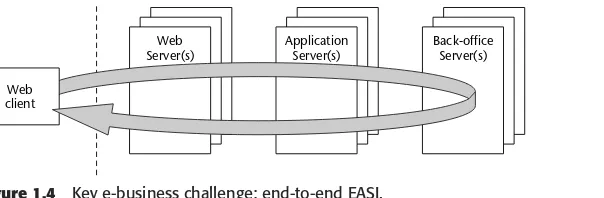
It is not sufficient to limit Web Services security to your company’s perimeter fire-wall. In today’s world of electronic commerce, customers, suppliers, remote employ-ees, and at times even competitors, are all invited into the inner sanctum of your computing system. Consequently, distributed security using the Web Services para-digm requires end-to-end security—a service request is made, which goes through the perimeter firewall, into your application servers and applications at the heart of your corporate network, to the persistent store of your sensitive data in the back-office. As we will show, the tentacles of Web Services reach deep into your system in many of the new architectural designs brought about by Web Services. Consequently, this book shows you how to secure your enterprise from end to end, using theory, examples, and practical advice.
Underlying end-to-end e-business is the broader technology of distributed comput-ing and the various distributed security technologies. Everybody in the computcomput-ing field and many typical computer users have heard of Hypertext Markup Language (HTML) and Secure Sockets Layer (SSL) but fewer have heard of EJB, COM+, or CORBA. But these technologies lie at the heart of modern distributed computing systems that are found behind the perimeter firewall. This area, which we call the mid-tier, is the most complex and most neglected area of end-to-end, enterprise security. Some recent gov-ernment surveys have shown the mid-tier to be highly vulnerable to break-ins, result-ing in significant financial loss. With the increasresult-ing e-business-driven movement toward letting outsiders into the mid-tier, the mid-tier is becoming even more sensitive to break-ins, with the potential for greater financial loss and privacy violations.
If you have any responsibility, direct or indirect, for any part of the security of your site, you owe it to yourself to read and study this book. Distributed security is not an easy subject, and Web Services security adds another level of complexity. It follows that parts of this book are not easy, but the returns for yourself and your company are sig-nificant if you master this complex subject.
and explain the thinking behind many of the security specifications that are at the fore-front of the technology today. We are well positioned to do this since the authors are members of many of the committees and organizations writing these specifications, as well as doing hands-on work designing and building enterprise security products.
Our emphasis is on showing you how to build and understand the complexities of a secure end-to-end Web Services system. Consequently, we do not cover in depth some of the more arcane aspects of security such as cryptography, Public Key Infra-structure (PKI), or how to build the middleware systems themselves. We do, however, discuss these specialized security technologies in terms of how you use them in a Web Services system and give you an understanding of their features so that you can judge the best match for your needs.
This book gives you both a detailed technical understanding of the major compo-nents of an end-to-end enterprise security architecture and a broad description of how to deploy and use Web Services security technologies to protect your corporation and its interaction with the outside world.
Overview of the Book and Technology
Enterprise security is an ongoing battle. On the one side are those who want to break into your system, either for fun or for some advantage to themselves or their organiza-tion. On the other side are people like yourself who are putting up defenses to prevent these break-ins. This ongoing battle results in continuing changes to security solutions. Another dimension is that there is an evolving set of security requirements, such as giv-ing a new group of outsiders controlled access to your system for e-business purposes. For these reasons we have concentrated on explaining the underlying thinking behind today’s enterprise security solutions so that you can judge the worth of new solutions as they come on the scene and judge when old solutions are no longer good enough.
An important requirement for Web Services is to support secure interoperation between the underlying object models, such as .NET and J2EE, as well as to support interoperation between the perimeter security and the tier, and between the mid-tier and legacy or back-office systems. To this end, we give significant detail describing the problems of maintaining secure interoperability and how you can overcome these problems. The distributed security community, as represented by the Organization for the Advancement of Structured Information Standards (OASIS), the World Wide Web Consortium (W3C), and the Internet Engineering Task Force (IETF), have offered the solutions to some of these problems in specifications that have been developed by the cooperative efforts of their member companies. Other organizations, such as the Web Services Interoperability Organization (WS-I) and the Java Community Process (JCP) have worked on additional solutions. We cover them all to bring to you the pertinent, distributed security work and thinking.
We look at solving the security problem from an end-to-end corporate viewpoint as well as from the major technical viewpoint for authentication, authorization, secure transport and security auditing. By presenting enterprise security from these two viewpoints, we give you both a top-down and bottom-up approach to understanding the problems and the solutions.
In some cases, there are no standard solutions. In such cases, we bring you the latest thinking and guidance towards solutions. The best solution is one where there is an open standard, because the solution will have gone through a rigorous examination and debate among the security experts in order to reach the status of a standard. How-ever, standardization is a slow process, and we all are under pressure to solve the prob-lem now. In situations where there is not yet a consensus, we put forth solutions that we or others have implemented, and describe the different possible solutions under debate in the distributed security community.
We have tried to balance the theory and understanding of Web Services security to give you the ability to determine when you can use today’s solutions and when you should reject an inadequate solution and find something better. There is a saying to the effect that it is better to teach someone how to farm than to just give him today’s meal. This is the philosophy that we have tried to follow. We hope that the knowledge you get from this book will prepare you to build secure systems that are ready for the new solutions, requirements, and threats that will always be coming down the road.
If you have read our previous book, Enterprise Security with EJB and CORBA (Hart-man, Flinn, and Beznosov 2001), you will notice that some of the ideas and text have been derived and updated from this work. For example, the concept of Enterprise Application Security Integration (EASI) is a refinement of the Enterprise Security Inte-gration (ESI) concept discussed in the previous book. Our work on Web Services secu-rity is a natural evolution from ideas in the previous book because we believe that Web Services security should be viewed in the context of an overall enterprise security architecture. Although there is a lot of new technology to discuss, the fundamental principles of building an enterprise security architecture remain the same.
You may also notice differences in writing styles and emphasis among the chapters. There are four authors of this book, and we all have different areas of security exper-tise and opinions about the most important issues to consider. We have worked to maintain consistency of terminology throughout the text, but variations are bound to appear in a book that covers such a variety of complex topics. We hope that our differ-ent perspectives will be useful to you by giving you several differdiffer-ent ways to think about Web Services security solutions.
How This Book Is Organized
This book is divided into three major sections:
■■ Chapters 1–3 provide a basic introduction to Web Services and security issues to get you started. For securing very simple Web Services applications, this may be all the information you will need. Chapter 3 describes a Web Services application using .NET that provides limited Web Services security without the necessity to develop any security code.
■■ Chapters 4–7 describe the technology building blocks of Web Services security in detail. The chapters define the security technologies that support Web Ser-vices security, with particular emphasis on how security works with XML. These chapters will be of interest to people who want to get a good under-standing of Web Services security and supporting infrastructure technologies but aren’t necessarily interested in building secure applications.
■■ Chapters 8–12 compose the final section of the book, which goes into the details of how Web Services security is applied when building applications. Chapters 8 and 9 describe the features available when Web Services are imple-mented on the most popular application platforms, namely .NET and J2EE. The remaining chapters cover the advanced topics of interoperability, administra-tion, and integration. Our final chapter on planning and implementing a com-plete security architecture pulls together all the concepts you have learned.
Chapter 1 introduces the subject of Web Services security and the new technologies that are used to solve the Web Services security problem. We lay the groundwork for under-standing how the subsequent chapters fit into the whole solution. We introduce the con-cept of risk management in the balancing of system performance and complexity on one hand with the value of the resources being protected on the other hand. We introduce the concept of Enterprise Application Security Integration and how it supports end-to-end enterprise security. We wrap up with a description of our fictional enterprises, ePortal and eBusiness, which are used in a running example throughout the rest of the book.
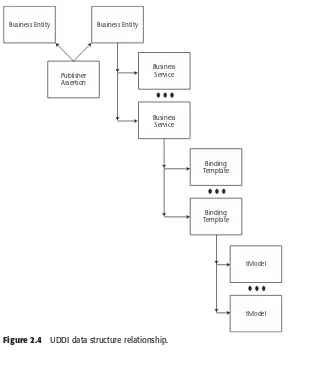
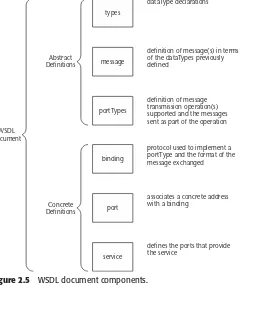
Chapter 2 starts with a detailed description of Web Services and the benefits they can bring to distributed computing. It moves on to describe the language of Web Services, XML, followed by the XML messaging protocol, SOAP. After describing SOAP, this chap-ter introduces the Web accessible Universal Description, Discovery, and Integration (UDDI) service, which is used to discover a Web Service so that the requester is able to communicate with the service. The next component described is the Web Services Description Language (WSDL), which is an XML-based, machine-generated, and machine-readable document that details how to access a Web Service. As usual when one is interested in interoperability, there is a need for standards and standards bodies. This chapter covers the prominent standards bodies working in the area of Web Services.
Chapter 3 looks at the security technologies that are the basis of Web Services secu-rity. It introduces the fundamentals of cryptography, authentication, and authoriza-tion. There is a natural progression through these technologies. The most basic is the underlying cryptography, then authentication, which uses cryptography, then autho-rization, which depends on the principal having been authenticated. The chapter goes on to describe the uses of these security technologies to implement a simple Web Ser-vice using our ePortal and eBusiness example introduced in Chapter 1. This simple example uses only one of the Web Services technologies, namely .NET. While basic security measures may be used for protecting a simple system, Web Services systems may often be more complex. This chapter discusses the limitations of the basic approach and points the way to the complete set of security technologies described in the rest of the book, which are needed for enterprise deployments.
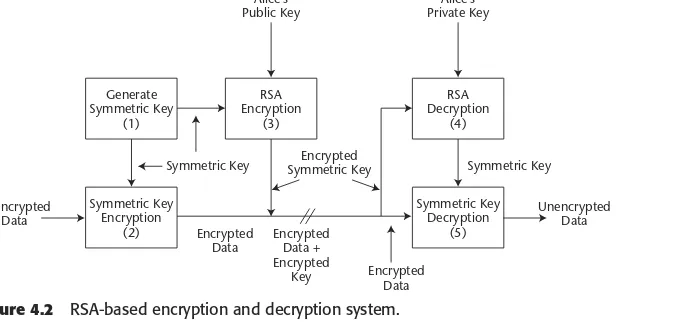
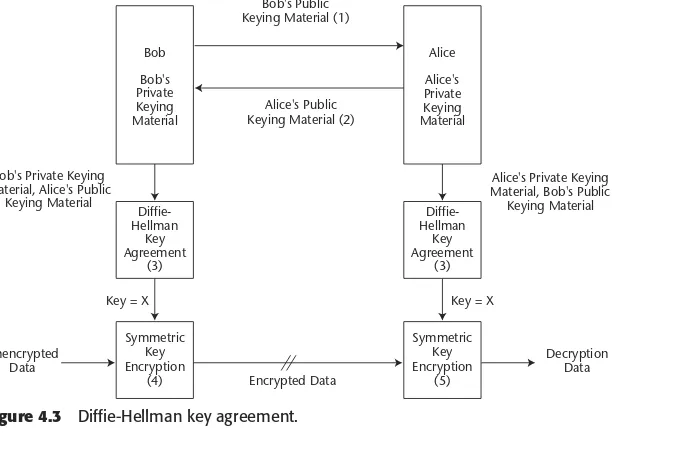
Chapter 4 discusses measures for securing XML and SOAP messages. Because many of these measures are based on cryptography, this chapter describes public key cryp-tography and explains how it is applied, in particular it discusses digital signatures as well as public key infrastructure (PKI). This chapter provides an overview of some of the more popular cryptographic technologies such as RSA, Diffie-Hellman, and DSA. Public key certificates, which are a necessary ingredient in establishing trust in a pub-lic key, are introduced. From there, it shows how encryption and digital signatures can be applied to XML documents. Finally, it discusses how such measures are being tai-lored to SOAP and Web Services and introduces the WS-Security specification, which may be used to secure SOAP documents.
Chapter 5 discusses the Security Assertion Markup Language (SAML) specification, which is directed at securing the basic credentials using XML. It describes how SAML is used in general and how it may be used in conjunction with Web Services. It takes a detailed look at the specifications for the various SAML assertions and the details of its request-reply model. The single sign-on (SSO) approach of the SAML browser/artifact profile is described. The chapter also looks at how SAML fits into a larger architecture. We describe the concept of distributed SAML authorities that perform the security func-tions of authentication, attribute retrieval, and authorization, and the protocols for accessing these authorities. The protocols for application-to-application transport of the SAML assertions are also covered. This chapter gives an example of a SAML-based solu-tion to the issues of privacy, SSO, and federasolu-tion by examining the Shibboleth project.
Chapter 6 brings together several of the previously defined security technologies and describes them within the context of the Web Services example introduced in Chapter 1. We divide the security solutions into connection-oriented and document-oriented solutions, look in more detail at possible security solutions, and determine how they fit into security for Web Services. After discussing the security of XML-based SOAP messages as they are communicated from one domain to another, we examine authentication, authorization, and data protection at the Web Services interfaces, and describe the relationship of the WS-Security and SAML specifications. Since Web Ser-vices are new and no best practices have yet been established, this chapter gives ways to analyze Web Services security needs and determine how to address those needs.
Chapter 7 gives an overview of the security in the various middleware technologies used to build Web Services applications. It discusses the middleware client-server and object paradigms, the basic building blocks of modern distributed architectures. The chapter then describes the distributed security fundamentals of authentication, message protection, access control, trust, administration, and fine-grained access control. It then explains the security mechanisms of the popular distributed middleware technologies that you will use for building Web Services applications: CORBA, COM+, .NET, and J2EE.
Chapter 8 describes how secure Web Services may be implemented using Microsoft technologies. It describes the different ways that you can create a Microsoft Web Ser-vice application using COM+, COM with the SOAP toolkit, .NET remoting, and ASP.NET. The chapter then explains the mechanisms available for securing Web Ser-vices based on ASP.NET—the most flexible and effective way to develop interoperable Web Services in the Microsoft world. We use our example, ePortal and eBusiness, in conjunction with ASP.NET to illustrate the security of ASP.NET-based Web Services.
Chapter 9 describes securing Web Services when the target Web Service is a J2EE application server or Java application. We look at what makes Web Services security different from traditional EJB security, and how one would secure an J2EE container in the Web Services environment. Throughout, we refer to the new JSRs that the JCP is developing and has developed to make Java compatible with Web Services. We then use our ePortal and eBusiness example to illustrate how to make a traditional applica-tion server Web Services aware. We introduce a product by Systinet that provides a Web Services development platform for application servers and discuss some of the security issues related to this approach. We also develop the same scenario using Sun’s Java Web Services Developer Pack (JWSDP).
Web Services and point out that these specifications still have limitations in some of the areas of secure interoperability, such as federation and delegation. We also enumerate and describe much of the security work that is underway in the area of Web Services. We show how SAML and WS-Security can be used together to secure Web Services mes-saging. We conclude that the security technologies available today are still lacking important features when one attempts to use Web Services over the Internet, except in very constrained cases. Our conclusion is that Web Services will be used first in the intranet, then move to the extranet, and finally, as the Web Services security community solves the problems in these domains, move on to applications used over the Internet.
Chapter 11 describes the security administration of Web Services in terms of the security of the underlying middleware, as well as the Web Services data protection methods. The chapter begins by discussing the basics of security administration, the grouping of principals by security attributes, and the use of the Role Based Access Control (RBAC) model, and how these may be used in Web Services. While RBAC is quite useful in access control, this chapter points out some of the difficulties and draw-backs in administering RBAC-based systems. We address the administration of dele-gation, while pointing out the risks of this approach and the necessity of careful assignment of delegation. Applying risk management to access control in complex sys-tems, we recommend auditing as an integral part of the security system. The chapter then addresses the administration of data protection in SOAP messages.
Chapter 12 brings together the theory and approaches from the previous chapters using a practical example of securely deploying a Web Services business scenario. We walk you through the actual planning and deployment of our example, ePortal and eBusiness. We point out many of the pitfalls that could snare you in your deployment and describe how to avoid them. By providing a realistic scenario, we describe how firewalls, Web servers, browsers, EJB containers, .NET applications, the middleware infrastructure, and legacy systems all have to work together to secure an enterprise Web Services system.
Who Should Read This Book
This book should be read by anyone who has a responsibility for the security of a dis-tributed enterprise computing system using Web Services. This includes managers, architects, programmers, and security administrators. We assume that you have some experience with distributed computing as applied to enterprise systems, but we do not expect you to have experience with security as applied to large distributed systems. In addition, some experience with XML, EJB, and .NET is helpful but not necessary.
Be forewarned that distributed security is not an easy subject, so don’t expect to absorb some of the more technical chapters in a single reading. We also don’t expect each of our audience members to read all the parts of the book with equal intensity.
Managers should read Chapters 1, 2, 3, 12, and the introduction and summary of the other chapters. Where managers have a special responsibility or interest, we invite them to delve into the pertinent chapters.
Architects and programmers should read all of the chapters, although programmers might only need to skim Chapters 1 and 3. Those who are familiar with ASP.NET security can skim Chapter 8, and those familiar with J2EE can skim Chapter 9. We
recommend skimming those chapters even though you are familiar with the technol-ogy because some of the information is quite new and not readily available elsewhere. Security administrators should pay particular attention to Chapters 4, 5, 10, 11, and 12. They should also read Chapters 3 and 7, and read at least the introduction and summary to the other chapters.
What’s on the Web Site
Our Web site at www.wiley.com/compbooks/hartman contains the complete source code for securing the fictional corporations ePortal and eBusiness that we use as an example throughout this book. The Web site also contains any errata and updates to this book.
Since distributed security is an active, growing technology, we will, from time to time, update you on those security technologies that are expanding or those that are dying off, as well as the new technologies that come on the scene.
Summary
If you don’t want your company to appear on the nightly news with the lead, “<Your company> has reported a break-in by hackers. The break-in resulted in large financial losses and the disclosure of privacy information of thousands of their customers, including stolen credit card numbers,” you should learn how to protect your prise system. That is the purpose of this book, to teach you how to protect your enter-prise when deploying Web Services. The technologies and concepts that we describe in this book begin with Web Services, and then move on to relating the Web Services interfaces to the security of the rest of your distributed system.
One weak link in the security of your enterprise can result in the failure of its secu-rity. Consequently, we describe the security of each part of your company, from the customers, suppliers, and partners beyond your perimeter firewall to securing the heart of your corporate system. By using both theory and examples, we educate you on how to build a secure Web Services system today and how to anticipate and be ready for the security systems of tomorrow.
We trust that you will be able to apply the theory, concepts, and approaches to dis-tributed Web Services security that we discuss as you deploy and upgrade the security of your company’s enterprise system. As you move deeper into this new computing paradigm of cooperative computing, you will need all the skills that you can muster to beat the bad guys. We hope our efforts in describing Web Services security will help you in this regard.
1 In today’s global marketplace, the Internet is no longer just about email and Web sites. The Net has become the critical conduit powering a growing list of revenue-generating e-business activities—from e-commerce and e-supply chain management to online marketplaces and collaboration. Web Services leverage the ubiquity of the Internet to link applications, systems, and resources within and among enterprises to enable excit-ing, new business processes and relationships with customers, partners, and suppliers around the world.
While early Internet applications helped individualscommunicate with each other, Web Services are focused on helping applicationscommunicate with each other. In the past, a purchasing agent might send a purchase order to a supplier via email. In the age of Web Services, a company’s purchasing application communicates via the Internet directly with a supplier’s warehousing application to check price and availability, sub-mitting the purchase order to the supplier’s shipping application—automatically, with little or no human intervention.
The benefits of Web Services are not limited to interactions between different com-panies. Business units within the same enterprise often use very different processing environments. Each policy domain (that is, scope of security policy enforcement) is likely to be managed differently and be under the control of different organizations. What makes Web Services so interesting is that they provide interoperability across security policy domains.
Overview of Web
Services Security
C H A P T E R
Web Services represent a fundamental shift, one that promises tremendous benefits in terms of productivity, efficiency, and accuracy. Indeed, corporate IT organizations are only just beginning to understand the full potential of Web Services. But, while they offer attractive advantages, Web Services also present daunting challenges relating to privacy and security. No longer is the “back office” hermetically sealed from the out-side world. In exposing critical business functions to the Internet, Web Services can expose valuable corporate data, applications, and systems to a variety of external threats. These threats are not imaginary. They range from random acts of Net vandal-ism to sophisticated, targeted acts of information theft, fraud, or sabotage. Either way, the consequences can be catastrophic to the organization.
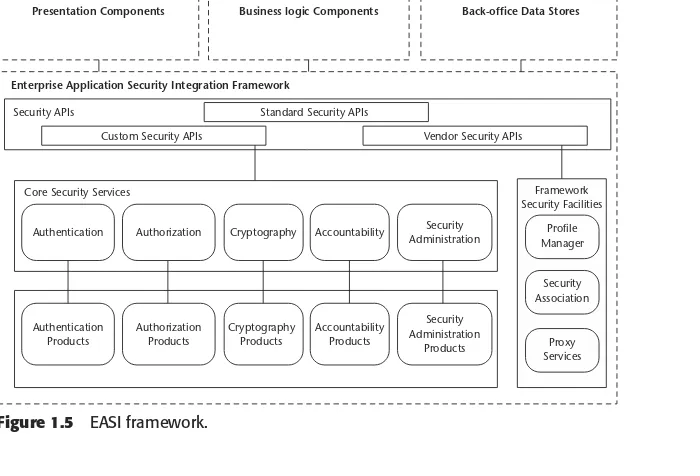
Given the potential risks, security must be a central focus of any Web Services imple-mentation. Just as IT organizations are turning to proven Enterprise Application Inte-gration (EAI) architectures to address systems inteInte-gration issues, they can take advantage of new Enterprise Application Security Integration (EASI) architectures that enable end-to-end integration of scalable, best-of-breed security technologies for their Web Services. An overview of these architectures will be discussed later in this chapter. What makes security for Web Services so challenging is the distributed, heteroge-neous nature of these services. Web Services technology is based on the interoperation of many different software applications running on a variety of geographically dis-persed systems in a complex, multidomain environment via the Internet. The Extensi-ble Markup Language (XML); SOAP; Universal Description, Discovery, and Integration (UDDI); Web Services Description Language (WSDL); and other protocols and mechanisms are employed to enable platform-independent interaction across domains via the Internet.
Web Services Overview
Web Services are XML-based messages delivered via Internet standard protocols. XML is a text-based method for representing data, and will be discussed in greater detail in Chapter 2, “Web Services.” Web Services messages can contain documents or procedure invocations. Specific definitions of Web Services vary widely, and range from “A web service is an application that exists in a distributed environment, such as the Internet” (Sun Microsystems FAQ) to “A Web Service is an interface that describes a collection of operations that are network accessible through standardized XML messaging.” (Kreger 2001). Often, instead of defining a Web Service, an author describes the properties of a Web Service or defines it in terms of the protocols normally associated with it.
For the discussions in this book, we define a Web Service as an XML-based messag-ing interface to computmessag-ing resources that is accessible via Internet standard protocols. We will even go a bit beyond this to say that the Web Services messaging protocol is SOAP, which we will describe in greater detail in Chapter 2. Please note that while Web Services may use “the Web,” Web Services are not tied to a single transport protocol.
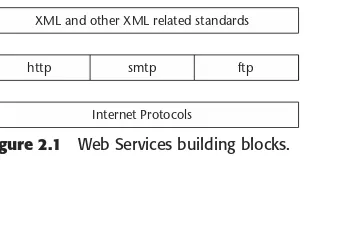
Although the most common way to exchange a Web Service request is via the Web transport Hypertext Transfer Protocol (HTTP), other transport protocols, such as File Transfer Protocol (FTP) or Simple Mail Transfer Protocol (SMTP), can also support Web Services.
Characteristics of Web Services
Web Services expand the Web from a user front end to an application service. With Web Services, the originator of a Web connection is no longer just the consumer or supplier of information. The originator can participate in a distributed application environment and issue remote procedure calls to request services. The use of Internet standard pro-tocols and other standards by Web Services allows services to work across diverse environments, solving cross-platform interoperability issues.
Intranet and extranet applications are likely to be the major beneficiaries of Web Ser-vices. Consumer-oriented applications don’t need the kind of access to distributed pro-cessing that Web Services promise. Distributed propro-cessing is more commonly needed for large-scale corporate applications. Additionally, for security reasons, companies aren’t likely to allow access to the more powerful capabilities that Web Services can provide unless there is a larger measure of trust and partnership between the parties than exists for retail, consumer transactions.
Web Services facilitate the creation and resolution of requests involving parties from different organizations, whether the organizations are two separate companies or two business units within the same company. The actual requester of the service creates a request contained in an XML message. This message may be signed for authentication purposes by the requester, as we discuss later in this chapter.
Web Services Architecture
Web Services are an Internet protocol-based interface to processing. As one would expect, Web Services are generally stateless and follow a request/response model of interaction. Web Services standards provide a way to locate interfaces and exchange data in an understandable way. For Intranet applications, SOAP messages may be received directly by application servers. For extranet applications, because of security concerns, SOAP messages are likely to be received by Web Servers or integration servers that pass the messages on to the appropriate applications.
Other than the interface to the service, there are no requirements as to how the ser-vices are provided. For instance, a Web Serser-vices front end can be added to an existing information-processing infrastructure. This is particularly useful for organizations that have an existing infrastructure in place. Figure 1.1 shows an example of how Web Ser-vices can be provided in this way. Alternately, applications can be engineered to use a consistent Web Services model in all tiers.
Figure 1.1 Typical Web Services environment.
Security as an Enabler for Web
Services Applications
Corporations are discovering the power of Web Services-enabled e-business applica-tions to increase customer loyalty, support sales efforts, and manage internal informa-tion. The common thread in these diverse efforts is the need to present end users with a unified view of information stored in multiple systems, particularly as organizations move from static Web sites to the transactional capabilities of electronic commerce. To satisfy this need, legacy systems are being integrated with powerful new Web Services-based applications that provide broad connectivity across a multitude of back-end sys-tems. These unified applications bring direct bottom-line benefits. For example:
On the Internet. A bank cements relationships with commercial customers by offering increased efficiency with online currency trading. This service requires real-time updates and links to back-office transactional and profitability analysis systems.
On extranets. A bank and an airline both increase their customer bases with a joint venture—a credit card that offers frequent flyer credits sponsored by the bank. This service requires joint data sharing, such as purchase payment and charge-back information, as well as decision support applications to retrieve, manipulate, and store information across enterprise boundaries. Additionally, employees from both companies need to access information.
On an intranet. A global manufacturer accelerates the organizational learning curve by creating a global knowledge sharing system for manufacturing research and development. Plant engineers on one continent can instantly share process breakthroughs with colleagues thousands of miles away.
Client Tier
Application Client
Presentation
Tier Component Tier
Web Server
Back-Office Tier
Mainframes
Databases Web
Services
J2EE ASP.NET
COM+ CORBA Browser
Java Program
HTML/ HTTP Web
Services Interface
SOAP/IIOP
RMI/DCOM/IIOP
HTML/ HTTP
SOAP/ HTTP
On the other hand, these new e-business applications can have a dark side. They can open a direct pipeline to the enterprise’s most valuable information assets, presenting a tempting target for fraud, malicious hackers, and industrial espionage.
Appropriate protections are a prerequisite for doing business, both for maintaining an organization’s credibility with its stakeholders and for protecting its financial via-bility. For example:
■■ The bank offering currency trading needs to protect the integrity of its core sys-tems from unauthorized transfers or tampering.
■■ The bank and airline in a joint venture may compete in other areas or through other partnerships. A secure barrier, permitting authorized transactions only, must be erected between the two enterprise computing environments.
■■ The manufacturer posting proprietary discoveries needs to ensure that com-petitors or their contractors cannot eavesdrop on the system. Attacks from both the outside and the inside must be blocked.
Enterprises rely on information security mechanisms to safeguard their Web Ser-vices applications.
Information Security Goals: Enable Use, Bar Intrusion
Information security focuses on protecting valuable and sensitive enterprise data. To secure information assets, organizations must provide availability to legitimate users, while barring unauthorized access. In general, secure systems must provide the fol-lowing protections:
Confidentiality. Safeguard user privacy and prevent the theft of enterprise infor-mation both stored and in transit.
Integrity. Ensure that electronic transactions and data resources are not tampered with at any point, either accidentally or maliciously.
Accountability. Detect attacks in progress or trace any damage from successful attacks (security auditing and intrusion detection). Prevent system users from later denying completed transactions (nonrepudiation).
Availability. Ensure uninterrupted service to authorized users. Service interrup-tions can be either accidental or maliciously caused by denial-of-service attacks.
To provide these four key protections, information security must be an integral part of Web Services system design and implementation.
Web Services Solutions Create
New Security Responsibilities
The breadth of information security in Web Services applications is broader than you might expect. Many system architects and developers are accustomed to thinking about security as a low-level topic, dealing only with networks, firewalls, operating systems, and cryptography. However, Web Services change the risk levels associated with deploying software because of the increased ability to access data, and as a
consequence, security is becoming an important design issue for any e-business soft-ware component.
The scope of Web Services security is so broad because these applications typically cut across lines of business. There are many examples of new business models that drive security needs:
E-commerce sites on the Internet. These rely on credit card authorization services from an outside company. A federated relationship between an e-commerce company and a credit card service depends on trustworthy authenticated communication.
Cross-selling and customer relationship management. This relies on customer information being shared across many lines of business within an enterprise. Cross-selling allows an enterprise to offer a customer new products or services based on existing sales. Customer relationship management allows the enter-prise to provide consistent customer support across many different services. These e-business services are very valuable, but if they are not properly con-strained by security policies, the services may violate a customer’s desire for privacy.
Supply chain management. This requires continuing communication among all of the suppliers in a manufacturing chain to ensure that the supply of various parts is adequate to meet demand. The transactions describing the supply chain that are exchanged among the enterprises contain highly proprietary data that must be protected from outside snooping.
Bandwidth on demand. This allows customers to make dynamic requests for increases in the quality of a telecommunications service and get instant results. Bandwidth on demand is an example of self-administration, in which users han-dle many of their own administrative functions rather than relying on an administrator within the enterprise to do it for them. Self-administration pro-vides better service for customers at a lower cost, but comes with significant security risks. Because corporate servers, which were previously only available to system administrators, are now accessible by end users, security mechanisms must be in place to ensure that sensitive administrative functions are off-limits.
In each of the preceding cases, one enterprise or line of business can expose another organization to increased security risk. For example, a partner can unintentionally expose your business to a security attack by providing its customers access to your business resources. As a result, security risk is no longer under the complete control of a single organization. Risks must be assessed and managed across a collection of orga-nizations, which is a new and very challenging security responsibility.
Risk Management Holds the Key
A large middle ground exists between the options of avoiding e-business applications based on Web Services altogether, fatalistically launching unprotected systems, or burdening every application with prohibitively costly and user-unfriendly security measures.
This middle ground is the area of risk management. The risk-management approach aims not to eliminate risk but to control it. Risk management is a rigorous balancing process of determining how much and what kind of security to incorporate in light of business needs and acceptable levels of risk. It unlocks the profit potential of expanded network connectivity by enabling legitimate use while blocking unauthorized access. The goal is to provide adequate protection to meet business needs without undue risk, making the right trade-offs between security and cost, performance, and functionality.
Consider four different Web Services users: an Internet service provider (ISP), a hos-pital administrator, a banker, and a military officer. Each has a different security concern:
■■ The ISP is primarily concerned about availability, that is, making services avail-able to its customers.
■■ The hospital administrator wants to ensure data integrity, meaning that patient records are only updated by authorized staff.
■■ The banker is most concerned about accountability, meaning that the person who authorizes a financial transaction is identified and tracked.
■■ The military officer wants confidentiality, that is, keeping military secrets out of the hands of potential enemies.
The challenge is to implement security in a way that meets business needs cost-effectively in the short term and as enterprise needs expand. Meeting the challenge requires a collaborative effort between corporate strategists and information technol-ogy managers. Understanding the business drivers for information security helps clar-ify where to focus security measures. Understanding the underlying application architecture—how components work together—clarifies the most practical approach for building system security.
Industrial experience in managing e-business information security is generally low. Security technology is changing rapidly, and corporate management is not well equipped to cope with risk management changes caused by technology changes. New versions of interconnected Web Services systems and software product versions continue to appear, and with each release, a whole new set of security vulnerabilities surfaces.
Managing security risk in distributed Web Services applications is daunting, but fol-lowing some basic rules for building security into component-based applications lays the groundwork for a solid risk management approach. Although this book does not provide detailed advice on security risk management, we do describe principles for building secure Web Services applications that are independent of any specific tech-nology and will continue to be a guide for you as technologies evolve. Other chapters in this book, particularly Chapter 12, “Planning and Building a Secure Web Services Architecture,” supply many insights on Enterprise Application Security Integration (EASI) that will place your risk-management approach on a firm foundation.
Information Security: A Proven Concern
Information security is a serious concern for most businesses. Even though the report-ing of computer-based crime is sporadic because companies fear negative publicity and continued attacks, the trend is quite clear: Information security attacks continue to
be a real threat to businesses. According to a recent Computer Security Institute Sur-vey, 90 percent of interviewed businesses reported that they had detected computer security breaches in the last year. In addition, 74 percent of the businesses reported that the attacks caused financial losses, such as losses from financial fraud or theft of valu-able intellectual property.
Threats to businesses result from both internal and external attacks. In the same sur-vey, 71 percent of businesses said that they detected insider attacks (by trusted corpo-rate users). This last statistic is very important from the perspective of this book—to meet corporate needs, a complete end-to-end security solution must address insider attacks.
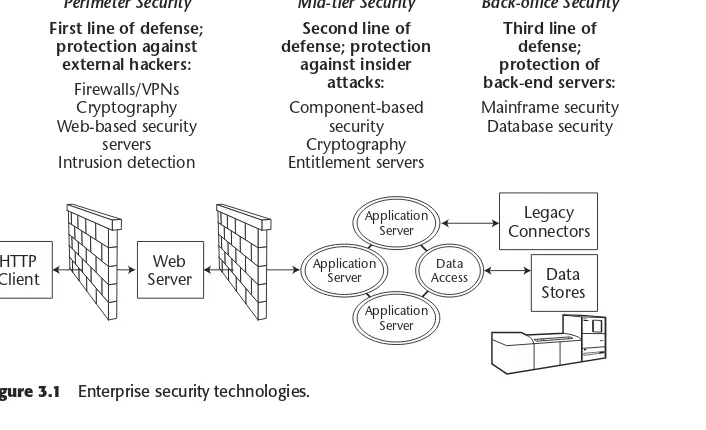
Web Services solutions blur the line between the inside world containing trusted users and the outside world containing potentially hostile attackers. As we’ve dis-cussed, a primary purpose of Web Services architectures is to open up the corporate network to the external world, thus allowing valuable corporate resources to be acces-sible to outsiders. Outsiders (such as business partners, suppliers, or remote employ-ees) may have data access rights to corporate information very similar to those of many insiders. As a result, protection mechanisms must be in place not only at the external system boundaries, but also throughout the enterprise architecture.
According to a META Group survey, 70 percent of businesses view information security as critical to their corporate mission. Because of the continuing threat, many businesses are increasing their spending on security; large corporations are increasing their spending the most.
We’re concerned about the way businesses spend their money on security. We’ve seen many of them address security using a fragmented, inefficient approach, in which various corporate divisions each build their own ad hoc security solutions. Piecemeal security solutions can be worse than no security at all because they can result in:
■■ The mistaken belief that the system issecure
■■ Redundant spending across the organization
■■ Point solutions that don’t scale or interoperate
■■ Increased maintenance, training, and administration costs
Applying security products without thinking about how they all fit together clearly does not work. We believe that businesses should build and leverage a common secu-rity infrastructure that is shared across the enterprise. A unified approach to Web Ser-vices security is the only way to address complex multitier Web SerSer-vices applications, which we’ll explain later in this chapter.
Securing Web Services
The pervasive reach and platform-agnostic nature of Web Services demands a security framework that enables enterprises to secure and control access to applications and data, without impeding the exchange of data that is essential for successful Web Services.