Abstract:Cloud Computing has emerged as an effective system to support the implementation and growth of e-learning in the higher education sector, as well as in institutional libraries. This rising trend has attracted several service providers to the market in a very short span of time. Students and faculties associated with higher education are experiencing an increased need for the use of CC Services to aid development and enhancement of their knowledge base and to help meet the requirement of constant access to the latest research data. While providing such services, however, sufficient consideration and importance has not been attributed to the Quality of Service (QoS) provided and as experienced by the user thus referenced as Quality of Experience (QoE). Currently, no standard model exists that could effectively define the QoE parameters from the users’ point of view. Hence it has become increasingly necessary to monitor, track, and quantify the variables of QoE for cloud computing-based e-learning applications and develop a new QoE Metrics Model. This information would help compare and identify the gaps between user expectations and the real QoS experience. In the current work, various variables of the functional and runtime layers of cloud computing applications, along with user demographic factors, and CC Service dimensions are studied. Dimension and scope are defined using the SERVQUAL model and its factors as a baseline. The new Innovative User-Centric Quality of Experience Metrics Model proposes to improve QoE by providing recommendations that increase the adaptability and effectiveness of cloud computing systems.
Index Terms: Cloud Computing; Higher Education; Innovative model; Metrics; Quality of Experience
I. INTRODUCTION
Cloud relies on sharing of resources to achieve coherence and economies of scale. Cloud Computing provides three services through internet on pay as per use basis; SaaS (Software as a Service), PaaS (Platform as a Service) and IaaS (Infrastructure as a Service) as evident from the following diagram. The ever-changing information technology environment has left none untouched, including the libraries that form the information backbone of higher education systems.
Revised Manuscript Received on December 22, 2018.
Jolly Upadhyaya, Ph.D. Scholar, Computer Science, UPES, Dehradun,
India
Dr. Neelu Jyothi Ahuja, Professor, School of Computer Science, UPES, Dehradun, India
Kapil Dev Sharma, Assistant Professor, Mechanical Engineering, JIMSEMTC, Greater Noida,
Services
Internet
User A User B User C
Fig.1 Cloud Environment
One of the emerging trends has been to move away from investing in physical server "hardware" and lean more towards the use of environments in the "cloud," thus providing broader access to products and services libraries acquire or subscribe to, or research data that libraries collect to support the higher education and research needs of their user base. This trend has been on the rise since the library budgets went on the decline in mid to late 2000’s. Such moves can be attributed to the need to save costs (hardware, technical support), the need for innovative flexibility, the need for libraries to become more of a community-run resource exploiting the wide and deep technical knowledge-base, the need to increase accessibility of library resources via OPACs (Online Public Access Catalogues) supported by cloud-hosted systems, and finally, the need to ensure libraries are constantly in sync with emerging technologies. Cloud Computing is an approach where Information Technology capabilities and services are delivered to the users through the Internet by a service provider [1]. Users only pay for the service they use [2]. Almost all cloud service providers charge for cycles or time used and an accounting or billing method is required based on the terms of the contract before using or providing the service. Cloud computing is becoming a necessity gradually as it is now frequently used by all linked with higher education, including students and instructors, and is increasingly being adopted worldwide. Sharing study or research material via the cloud or using the cloud to process large sets of data for scholarly research is starting to become the norm. Most of it is due to the micro-services structure offered by the cloud service providers which allows managing information and related transactions more efficiently.
Cloud Computing in Libraries and Higher
Education: An Innovative User-Centric Quality
of Service Model
Though cloud computing has numerous advantages, there are challenges in the quality of service provided and the quality of service experienced that represent the levels of performance, reliability and the difference between providers’ promises, users’ expectations and users’ actual experience.
Through a detailed survey of the literature, it was discovered that many researchers have contributed towards quality of service models on metrics such as scheduling techniques, admission control, traffic control, dynamic resource provisioning etc., but a quality performance monitoring model from the user’s perspective still faces challenge. Various studies relating to the issue of quality of service from providers’ perspective have been conducted by researchers but there have been not many efforts in determining the quality in terms of users’ experience, as it aims at assessing the way end users subjectively experience the quality of an application [3]. Establishing the user as the center of study provides a more holistic approach towards the understanding of the influence of different factors on the users’ experience during function and runtime, and the effects of the demographic factors of the users in accordance to the measures of the QoE approach. The current model will monitor and provide proposals to enhance the Quality of Experience for the user of cloud computing applications in the higher education sector. Various QoE metrics and variables have been monitored, analyzed and quantified to develop this model.
II. RELATED WORK
This section briefly discusses the related work that has been carried out by other researches and has been published in various journals and conferences. Special attention has been paid to select the relevant and recent work. Cloud computing applications may have many users at the same time and all may have different requirements in terms of quality of service. Providing a guaranteed QoS environment in such dynamic environment is a challenging task. But even then, over the time researches have tried to develop different mechanisms, systems and frameworks which can investigate the aspect of QoS requirements of different services.
Buyya, Garg and Calheiros, proposed a framework for managing QOS requirements with special reference SLA management. It integrates the virtual technologies with the market-based resource provisioning for flexible resource allocation to user applications. But the proposed model does not support different Cloud providers for IaaS, PaaS and SaaS together. According to NIST (Special Publication 500-307 in 2015), the Quality Model can be extended and integrated into Quality of Service (QoS) models that address the context of a quality metric, the observation and computing results based on a metric or the scenario that make use of metrics. Feng et al, have proposed an optimal resource allocation model for revenue maximization. But it considers only the mean response time as the QoS attribute to be satisfied. Den Bossche, Vanmechelen and Broekhove, proposed a system which attempts to maximize use of local resources while minimizing the use of external resources without
compromising the QoS requirements. But it does not deal with the failures which may occur after the scheduling has been done which may result in increase in cost of execution and effect overall quality.
M. Salam et al, presented a QoS oriented federated cloud computing framework where multiple independent cloud providers can cooperate seamlessly to acquire more resources in peak time to fulfill their QoS targets and pre-defined SLAs. The distinct feature of this framework was QoS oriented capabilities to address dynamic re-source management to improve the effective usage resources. But complex services were not constructed using services from different cloud providers and no provision was made for distributed denial of service attacks. R. Karim et al, proposed a mechanism to map the users QoS requirements of cloud services to the right QoS specifications of SaaS then map them to best IaaS service that offers the optimal QoS guarantee. The end to end QoS was calculated. They proposed a set of rules to perform the mapping process. A case study was used to illustrate and validate the solution. But no performance evaluation was done based on real QoS dataset of cloud services. S. Lee et al, proposed an architecture which employed the agent technology to handle the monitoring of requested QoS requirements and SLAs to support verification and validation. Its weak point was lack of self-learning algorithms to determine the timing of automatic resource allocation. P. Zhang et al, presented a QoS framework for adaptive QoS management process and mobile cloud computing to manage QoS assurance in mobile cloud computing environment. But no good model with a suitable configuration was generated.
The literature discussed above is mainly concerned with the cloud workflow. None of it discusses the selection of QoS attributes and quantifying them from the user’s point of view. During the literature study of QoS models in cloud computing that many researchers have proposed the scheduling techniques, admission controls, traffic control, dynamic resource provisioning etc. to handle the issue of QoS in cloud computing. But to the best of our knowledge no model has been proposed till now which deals with QoS issues from the perspective of user experience particularly in the sector of higher education.
III. DEFINITIONS AND EXISTING MODELS
There has been a growing need to define models and standards to establish protocols related to quality of service. Below are definitions of the standards terms and already existing models referenced in this paper.
QoE provides much better indication to what extent the application will be used, and what will be its’ real impact on the human quality of life.
Quality of Service (QoS): denotes the levels of performance, reliability and the difference between providers’ promise, user expectations & end-user’s experience of a service provider.
User: refers to the IT administrators of the libraries who are also the end-users of the cloud computing applications as the libraries subscribe for these services for their students so that the students get the access to these sites for online learning.
This paper proposes and outlines a new “Innovative Model” taking into consideration the foundational standards for QoE as identified and established in the SERVQUAL model merging in it the Cloud Computing Service (CCS) Attributes which analyze the major quality variables recommended by NIST],USA for ensuring the QoS of cloud computing applications also the functional & runtime layer’s quality indicators & variables which are critical as user level quality indicators to ensure the QoS of the functional requirements and operations of the cloud computing services[16]. Also, certain demographic attributes of the user are also taken into consideration as they play an important role in the way a user accesses any internet service, thus helping in rightly assessing the quality of experience from users’ point of view.
A. SERVQUAL Model (Taken as base for creating prototype)
SERVQUAL is a multidimensional instrument (i.e. questionnaire or measurement scale) designed to measure the QoS by considering the respondents, expected and encountered quality of service along the five dimensions of service quality [5]. The tool aims at developing a standard model to measure the users’ service quality experience based on the SERVQUAL scale [6] that includes multiple measures of the five identified quality dimensions. Using the following dimensions, the QoS is measured and a model which quantifies the identified variables is developed for the user and service provider.
Empathy: Pertains to the providence of tenderness and personal regard to users.
Responsiveness: Pertains to the inclination to assist and impart prompt service.
Assurance: Pertains to the skills and affability of staff and their capacity for belief and conviction.
Reliability: Pertains to the capability to execute the desired service trustworthily.
Tangibility: Pertains to the visible impression of the provisions which can be personal, or network related. B. Cloud Computing Service Indicators (CCS Attributes)
There are some critical attributes of cloud service as expressed by the National Institute of Science and Technology (NIST) in the US which are associated with the current technical overview of cloud computing. The current study uses these NIST recommendations to explore the variables and to ensure that the cloud service provider
delivers the QoS required and expected by the user. [7] This conceptual model for QoE recognizes the value of service provided and encountered as important factors for the cloud computing platform, including the various variables under consideration, which are:
Compatibility (COM): The key service attribute required if an organization wants to engage in automated business process with other organizations.
Management of Cloud Service (MCS): The tracking of operational information and feeds that data to the appropriate management resource.
Measurement of Service (MOS): The actual monitoring of the success or failure, it additionally deals with the generation of bills from the data usage of the resource by adhering to the norms of pre-defined billing scheme.
Self Service (SS): The personal arrangement by the user, this is a system that allows users to create, set and launch applications & services in a cloud computing environment.
Resource Management (RM): The service providers that attend to various customers with conditional services.
Wide Network Access (WNA): The facilities provided in a private cloud network that are available for access from a wide range of devices.
Rapid Elasticity (RE): The ability to provide scalable services.
C. User Level: Quality Indicators
The functional layer refers to the functional requirements of the service that should be met within the context of the business unit and the enterprise. The attributes of functional objectives are elaborated as User Level Quality Indicators. These are the essential factors of the function layer which should adhere to the requirements of the service provided. [7] The various attributes of the functional layer that will be assessed are related to the management and association of the provider with the user. In this layer, the following variables are measured to satisfy the QoE parameters:
User Accessibility: The factor whether the features of the application are easy to use and looks appealing to the eyes.
Trustworthiness: Whether the application is ethically justified and reliable.
Response: The readiness of the system to provide service. Assurance: The knowledge and courtesy expressed in the system and its ability to inspire trust and confidence in its safety.
User Orientation: The Individualized attention to the users.
User Accessibility: The factors included are usage, no. of active sessions, resource allocation, and redundancy.
Trustworthiness: Dependability and recoverability of the application.
Response: The response time taken to provide service. Assurance: Availability, accessibility, security and technical support service by the service provider.
User Orientation: The integrity of the service provided. D. Demographic Factors
The study analyses the role of demographic factors of the users such as age, gender, income, occupation and highest level of education as these play an important role while analyzing the above variables from the users’ perspective.
All the above-mentioned variables are put in a single framework (Fig.1) so that during the formulation of the prototype model of the Innovative Metrics Model, the effect of each variable can be analyzed individually along with the SERVQUAL attributes in assessing and analyzing the quality of service and quality of experience from the users’ perspective. This helps in creating a complete QoE model for the users. C C S A tt ri but e s (X -A x is ) Compatibility (COM)
Management of Cloud Service (MCS)
Measurement of Service (MOS)
Self Service (SS)
Resource Management (RM)
Wide Network Access (WNA)
Rapid Elasticity (RE)
User -Le v el Q u al ity In d ic a to rs R u n ti me Q u al ity In d ic a to rs De mog raphi c F act or s User Accessibility Trustworth iness Response Assurance User Orientatio n User Accessibility Trustworth iness Response Assurance User Orientatio n Age Gender Monthly Income Highest Qualificati on Occupatio n Y- Axis
Fig.2 Overview of the proposed Innovative User-Centric QoE Model
IV. HYPOTHESIS FRAMED
Related to the current work, some hypotheses are framed to provide a clear objective of the proposed model.
1. The variables that are related to providing quality of service in cloud computing applications and services to improve and standardize the quality of service & experience from the users’ perspective should be identified.
2. Propose a detailed inventory of metrics and processes for quantification of some selected variables from the identified ones which emphasize more on quality of experience of cloud computing applications in online learning.
3. Design a quality of service computing framework and further develop it into a prototype conceptual model.
For proving these hypotheses, first the difference between the expected and experienced quality of service should be
known. It is expressed in a diagrammatic form below Fig.2 and it is implemented further in framing the pilot survey for the users.
User’s expectations based on SERVQUAL dimensions
User’s expectations based on Demographic factors User’s expectations based on
functional layer indicators User’s expectations based on
Runtime layer indicators
User’s actual experience based on SERVQUAL
dimensions User’s actual experience based on functional layer
indicators User’s actual experience
based on runtime layer indicators User’s actual experience
based on demographic factors
Quality of Experience (QoE) by the
user.
Fig.3: Conceptualized innovative model
(Paths between expected and experienced quality of service represent the difference between these values.)
V. DATA COLLECTION AND ANALYSIS TOOLS
Researchers have increasingly used emails and websites to collect survey data [8], however, to collect the quantitative information about items in a population, statistical surveys are used [9]. This study utilizes a descriptive research design which is very useful for gathering information about a respondent’s interests, beliefs, attitudes, opinions and behavior [10]. Descriptive research describes data and attributes of the population being studied and is often collected using statistical surveys. The survey instrument designed for this study is based on the SERVQUAL items and variables from the runtime, functional, and demographic sectors. The main variables are measured using the 5 degrees Likert scale. The data collected is then used to test each hypothesis. This research used the instrument / questionnaire-based data collection report to validate the above-mentioned approach, and to quantify and validate the above-mentioned hypotheses
In addition, post pilot, to get the real-world scenario, quantitative data from some real-time case studies was taken from the providers and an extended survey conducted to get the providers perspectives by using the said questionnaire.
Focusing on large colleges of higher education in India, the current work examines the difference between service quality expected and experienced, based on the factors defined by ACM Symposium on Cloud Computing, socio-economic, and demographic factors. Future study should be done using this instrument and applying to a larger participant population.
Table 1: Results of Pilot Interview Survey data of Analysis conducted in 2017-18 from 10 participants (n=10). The variables included represent various factors that define i) Expectations of Quality of Service and ii) Experience of quality of service. The answer from respondents ranged from numerical value 1 -7 and the mean for it was calculated, where choosing ‘1’ meant, participant strongly disagree with the statement while choosing ‘7’ meant strongly in agreement.
Variables Mean Standard Deviation
Median Average Absolute deviation from Median
(i) Expectations of Quality of Service
- on tangibles 3.70 1.34 3.50 1.10
- on Assurance 4.30 1.89 4.50 1.50
- on Responsiveness
5.00 1.41 5.00 1.00
- on Reliability 3.70 2.11 3.00 1.00
- on Empathy 4.00 1.63 4.00 1.70 ii) Experience of
Quality of Service
- on tangibles 3.60 1.78 3.50 1.40
- on Assurance 4.20 1.93 4.50 1.60
- on Responsiveness
3.80 1.93 3.50 1.60
- on Reliability 4.10 1.91 3.50 1.50
- on Empathy 5.40 1.84 6.0 1.40
Overall Quality of Service
Experienced
[image:5.595.40.293.275.597.2]5.50 0.972 6.00 0.70
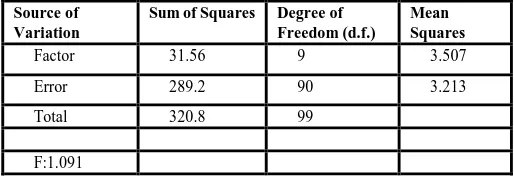
Table 2: ANOVA (one-way Analysis of variance) summary table for the results from Table 1
Source of Variation
Sum of Squares Degree of
Freedom (d.f.)
Mean Squares
Factor 31.56 9 3.507
Error 289.2 90 3.213
Total 320.8 99
F:1.091
*Note: Here, n =10. The probability of this result assuming null hypothesis is 0.377. Since this was calculated at a 95% Conference Interval, this result would not be significant.
VI. SIGNIFICANCE
Focusing on the large colleges of higher education, the current work examines the difference between service quality expected and experienced along with the SOCC features and demographic factors. At present, research that measures user satisfaction is lacking. So, to get the firsthand experience of the users and gather the data, a pilot survey was conducted at higher education college on cloud computing-based technology users to access the semantic content and readability of the survey instrument. Difficulty, ambiguity and misunderstanding of technical terms were put into focus. The SERVQUAL constructs validated in the prior researches have been used here which is a technique that can be used for performing a gap analysis of a service’s quality performance against users’ service quality needs.
The survey instrument for the pilot survey consisted of two parts. Part-I dealt with the existing users of cloud computing and has questions related to the quality of service expected and experienced by the user. Part-II focused on potential users in higher education (libraries, students etc.) who have yet to adopt cloud computing platforms or services.
The first pilot survey was conducted with the Librarian In-Charge of JaganNath Institute of Management and Sciences (JIMS), Engineering &Technical Campus, Greater Noida, India. She listed two factors as delaying the adoption of cloud computing for their library, namely, not being sure about the quality of service provided, and secondly, not being sure about the integration of cloud computing technology with the existing model. This was helpful insight into the status of the services and has provided motivation for further assessment in this area. The second pilot survey response came from the Deputy Librarian, Reader Services at Dr. B.R. Ambedkar Central Library, Jawaharlal Nehru University, New Delhi.
She is familiar with various service providers and the range of services they offer and agrees that it is easier to manage and use content accessible online. She reports that her staff is well trained to support such online services due to the successful collaboration with the cloud service providers who are responsive and well-versed in responding to the requests they put forth.
It is important to remember the reference to cloud service uses is aligned to the ability to access OPAC to locate the availability of material or access to electronic content licensed or procured from various providers or aggregators of online services.
[image:5.595.40.297.636.726.2]The current study generated descriptive statistics to identify trends variance range and standard deviation for the data collected for a variable. The statistical data thus generated was analyzed using descriptive statistics (frequencies and percentages, mean, standard deviation, skewness and kurtosis, and inferential statistics (shared covariance, structural equation modeling [SEM], and analysis of variance [ANOVA]). It was then analyzed using descriptive statistics (frequencies and percentages, mean, standard deviation, skewness and kurtosis) and inferential statistics (shared co-variance, structural equation modeling, and ANOVAs).
VII. CONCLUSION
Focusing on the use of cloud computing applications in the higher education sector, this study collected data to examine the relationship between service qualities: expected and experienced. While trying to understand the adaptability of cloud computing in libraries in the higher education sector, the study aimed at developing a standard instrument to measure service quality from the user’s perspective, which will include but will not be limited to using the SERVQUAL scale with its key indicators. Another set of variables were developed to measure the comparison between expected and experienced quality of service by the users using the service-oriented cloud computing dimensions and the service quality indicators at the user and runtime layers. There was also an analysis to reflect on demographic factors while evaluating the QoE. Not only was this instrument helpful to the organizations in providing the empirical data to understand the level of user’s satisfaction so that they can enhance/standardize their quality of service levels, but it also helped understand the active role of demographic factors in evaluating QoS. Assessing the role of cloud computing services for higher education providers, including the institutional libraries, it helped understand the adoption and increase of such services needed to support the growth in the education sector. It exposed the increase in demand for online education resources and their easy availability versus the more widespread in-class education with access only to print or on-site material in most institutions in India. Hosting or making resources available in the cloud will remove the barriers and push the boundaries of scale in education. Not all institutions will adopt cloud computing at the same rate and early adopters will need to manage expectations between users and service providers. This paper filled the gap in performance measurement for cloud computing services in libraries and higher education through the Innovative User-Centric Quality of Experience Metrics Model piloted here.
REFERENCES
1. Akpan, Helen Anderson., & Vadhanam, B. Rebecca. “A survey on Quality of Service in Cloud Computing. IJCTT, Vol. 27, No 1. Sep. 2015.
2. Arbalidousti, F., Nasri, R., & Davoudi, M. R. “Developing a new Architecture to improve ITSM on Cloud Computing Environment.”
IJCCSA. Vol 4 No 1, Feb 2014.
3. Ardagna, D., Casale, G., Ciavotta, M., Pérez, J. F., & Wang, W. Quality-of-service in cloud computing: modelling techniques and their applications. Journal of Internet Services and Applications. 2014.
4. Bardsiri, Amid Khatim & Hashmi, Seyyed Mohsen. Quality of Service metrics for cloud computing services evaluation. IJISA; Vol. 6 No.12, Nov 2014.
5. Bieberstein, N., Bose, S., Walker, L., & Lynch, A. Impact of Service Oriented Architectures on Enterprise Systems, Organizational Structures and Individuals. 2005.
6. Cloud Computing in Higher Education: A Guide to Evaluation and Adoption. White Paper, CISCO 2016.
7. Creswell, John W. Research Design: Qualitative, Quantitative, and Mixed Methods Approaches. Sage publications. 2003.
8. Cronin. Jr, J & Taylor, Steve. Measuring Service Quality - A Re-examination and Extension. The Journal of Marketing. 56. 55-68. 10.2307/1. 1992.
9. Dogac et al. Exploiting Web Semantics: Taxonomies vs Ontologies. IEEE Data Eng. Bull Pg. 10-16. 2002.
10. Eugene Gorelik. Cloud Computing Models Working Paper. CISL. Jan 2013.
11. Gay, L.R. Educational Research: Competencies for Analysis and Application. Merril Pr. 1992.
12. Kim, W., Kim, S.D., Lee, E., & Lee, S. Adoption issues for cloud computing: ACM Proceedings of the 7th International Conference on Advances in Mobile Computing and Multimedia in Kuala Lumpur, Malaysia. ACM. 2009.
13. K. Brandis et al. Towards a Framework for Governance Architecture Management in Cloud Environments: A Semantic Perspective. PERSICON Corporation, Friedrichstr, Germany. 2013.
14. Mary, N. Ani Brown K., & Jayapriya. An Extensive Survey on Quality of Service in Cloud computing. IJCSIT, 2014, Vol. 5 (1); pg. 1-5. 15. Mell, P., & Grance, T. The NIST Definition of Cloud Computing;
Recommendations of the National Institute of Standards and Technology. Recommendations of the National Institute of Standards and Technology. NIST Special Publication. 2011.
16. NIST. Cloud Computing Service Metrics Description. NIST Cloud Computing Reference Architecture and Taxonomy Working Group. Special Report. 2015.
17. Robinson, B. Gathering storm. Federal Computer Week, 2009, 23(1), 28-29.
18. Shahin, Arash. SERVQUAL and Model of Service Quality Gaps: A Framework for Determining and Prioritizing Critical Factors in Delivering Quality Services. ResearchGate. 2006.
19. Sharma, Aman Kumar & Ganpati, Anita. Cloud Computing: An Economic Solution to Higher Education. IJAIEM. Mar 2013, Vol 2, Iss 3.
20. Upadhyaya, Jolly, & Ahuja, Neelu J. “Quality of Service in Cloud Computing in Higher Education: A Critical Survey and Innovative Model”, IEEE Conference. Feb 2017.