International Journal of Innovative Technology and Exploring Engineering (IJITEE) ISSN: 2278-3075, Volume-8 Issue-6, April 2019
Novel Approaches for Image Denoising using
Augmented Algorithms
SK. Faiz Ahmed, K. Ramesh Reddy
Abstract: Images recurrently received in an impaired quality due to indigent image capturing, scanning and transmitting devices. This demands the image denoising. In this paper, we proposed two novel approaches for image denoising. The first one based on geometrical pixel location computes the details of the processed image with modifications in encoding and decoding process. The input image filtered and the selected geometric positions were encoded. During the image decoding process, the original geometric locations were observed for quality of denoising. The computed parameters are Peak Signal to Noise Ratio (PSNR), Structural Similarity index (SSIM), Mean Square Error (MSE) and computation time. The second approach based on an improved genetic algorithm (GA). The existing techniques mostly involve non-neighbourhood creates suspicion in the calculation of the contents of an image .These redundancies further cause the complications and able to be abused to evacuate the commotion in the image. Thus, our proposed improved GA approach based on the scheme called picture denoising component with enhanced hereditary calculation. The results obtained shows the superiority of the proposed two approaches in image denoising.
Keywords: Image denoising, Genetic Algorithm, Geometric pixel location, Pixel encoder, PSNR, SSIM.
I. INTRODUCTION
Denoising an image is a main mechanism task to correcting noise and its reproduction on a display. The image basically consists of several features like colour, contrast, texture, edge etc., The bottleneck in removing the noise in an image by maintaining at appropriate levels. Several researchers have done exhaustive research for past three to four decades and various techniques have been developed. Major denoising strategies incorporate Gaussian separating, Wiener sifting, and wavelet thresholding. A lot more techniques have been created. Detailed analysis and evaluation of state-of-the-art denoising methods methods are close to optimal when applied to natural images. By applying this denoising method directly on the noisy image still room for enhancement in several directions. For instance, while these methods manage to correctly remove most of the noise, then there is an increment in terms of PSNR and SSIM. Then constructing a denoised image follows.
II. RELATED WORK
At first, we considered the paper of Lebrun et al. [17] for a complete description of the image denoising problem, as well as a detailed analysis and analogy of ultra-modern denoise mechanism.
Revised Manuscript Received on April 10, 2019.
SK.Faiz Ahmed, Research Scholar, Department of Computer Science & Engineering, Rayala Seema University (Government), Kurnool (A.P), India.
Dr. K. Ramesh Reddy, Assistant Professor, Department of Computer Science, Vikrama Simhapuri University, (Government), Nellore (A.P), India.
It has been known by Levin and Nadler [20] and Chaterjee and Milanfar [12] that the advanced denoise operate routine are close to optimal when applied to natural images. whereas for many images the noise model is unknown; in such cases, there is still ample room for improvement see Lebrun et al. [19] and references therein for blind denoising algorithms. Different techniques in the literature in this area and one of the best by Lysaker et al.[15]. The advancement of novel technologies have created new functionalities in high speed data internet paths [24] which are essential for multimedia applications.
III. PROPOSED METHODOLOGY
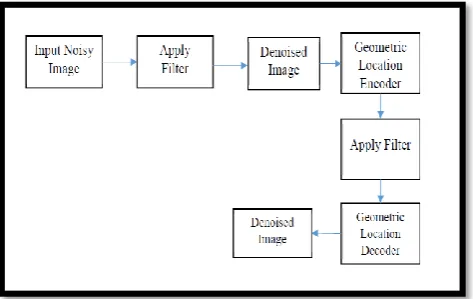
Many denoising techniques are in literature, the techniques improved in PSNR and SSIM values. For further improvement will possible only carrying filtering technique modification. The proposed methodology improves the noise reduction simply by encoding and decoding of denoised image. In the first step of proposed technique, we applied common denoising technique, then for the denoised image geometric located encode mechanism for each color channel is applied. For each color channel apply same denosing technique which is applied before encoding. After denoising process for each channel geometric decoder is applied to retrieve images with as original color. After that combine all channels to form original image.
A. Geometric Location Encoder and Decoder
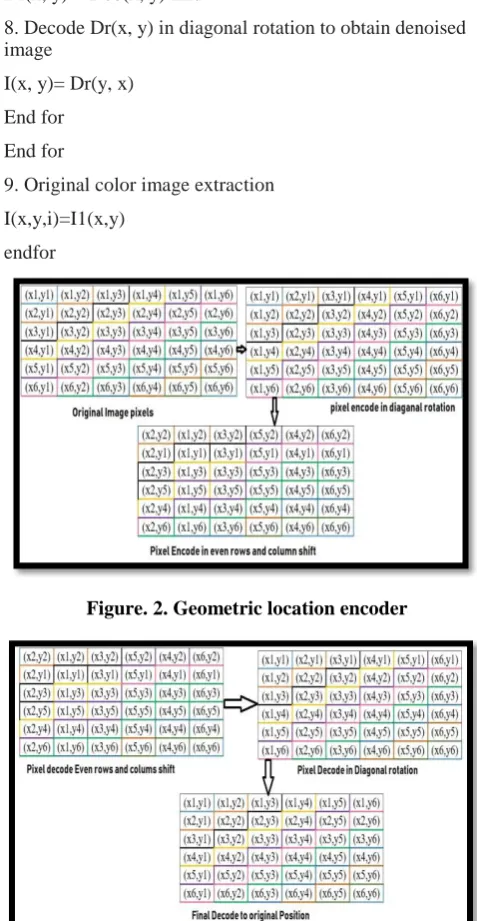
[image:1.595.308.545.554.703.2]Let I(x, y) be the color image, Decompose the image into three color components R, G and B. The proposed process of geometric encoder is explained using figure.1. First for each color channel pixel location in diagonal wise are rotated then even rows are moved between nearer columns and even columns are shifted in forward direction.
Similarly, the decoder decodes the encoded image in the according to sequence opposite to encoder as shown in figure.2.
B. Image Denoise Algorithm
The pixel values of image I(x,y) is indicate by F(m,n)={1(x,y),x ∈ 1,3,3,4,....m, y ∈ 1,2,3,4,....n }
The pixel encode in diagonal rotation is given by Dr(x, y) = I(y, x) for x=1, 2, 3,..m and y=1,2,3,..n
Then, encoding of pixel done through x direction. Both odd and even rows considered for this purpose.
Dre(x, y) =Dr(x, y) for x=0, 2, 4,…..m and y=0,1,2,3,4……n
Dro(x, y) = Dr(x, y) for x=1, 3, 5,…..m and y=0,1,2,3,4…..n
After pixel encode in row direction, pixel encode by selecting even and odd columns is given by
Dce(x, y) = De(x, y) for x=0, 2, 4,…..m and y=0,2,4,…..n
Dco(x, y) = De(x, y) for x=1, 3, 5,…..m and y=1,3,5,…..n
Then, for each column encoded image and row encoded the filtered technique is applied. Once the denoising completes each and every block is mixed to form original image size through decoding process. The proposed denoise for color image clearly explained in following algorithm.
C. Proposed Denoised Technique for color image Input : Image I(x, y), Filter technique F.
Output: Denoise Image.
Initialization: m=number of rows of I(x, y) ,n= number of columns of I(x, y).
1. C=number of color channels
2. R(x, y) = I(x, y, 1), Red channel of I(x, y). 3. G(x, y) = I(x, y, 2), Green channel of I(x, y). 4. B(x, y) = I(x, y, 3), Blue channel of I(x, y). For i= 1 to C do
If i==1 I1(x,y)=R(x,y) Else if i==2 I1(x,y)=G(x,y) Elseif i==3 I1(x,y)=B(x,y) End if
for x =1 to m do for y =1 to n do
5. Apply filter F to original image d(x, y) =F(I(x, y)) 6. Apply encoder technique and get Dce(x, y) and Dco(x, y) 7. Apply filter F to both the encoded blocks
Dce(x,y),Dco(x,y) and combine If x= even and y=even
Dr(x, y) = Dce(x, y)
Dr(x, y) = Dco(x, y) End
8. Decode Dr(x, y) in diagonal rotation to obtain denoised image
I(x, y)= Dr(y, x) End for
End for
9. Original color image extraction I(x,y,i)=I1(x,y)
endfor
[image:2.595.303.542.59.520.2]
Figure. 2. Geometric location encoder
Figure .3. Geometrical Pixel location decoder
IV. IMPROVED GENETIC ALGORITHM
The Genetic Algorithm had a unique feature of fact finding technique. It also gives best outcomes for the optimization issues. Chromosomes (cms) is routinely entered in a progression of segments. Further each part is identified and known as excellence.
a. Fitness-Function
The fitness function is another parameter associated with each cms in the health worth. Further, another sophisticated health worth recommend the cms for outcome.
The (P[o|λ]) , probability is determined by the finest probability consideration.
International Journal of Innovative Technology and Exploring Engineering (IJITEE) ISSN: 2278-3075, Volume-8 Issue-6, April 2019
The reason to choose the cms from different samples and structures is shown by the health opinion of the chromosomes. The selected element covers large area when the opposing chromosome done better.
pi= Fi/
The above equation utilized for wellness estimation.
Pi= Standardized wellness estimation of a mth cms and Fi= Wellness estimation of a cms in the populace. The concept of Pre and Post selections is an important function in Genetic Algorithm.
3. Crossover
The crossover utilized to connect subparts of the folks towards conveys successors. During this process, the supervisor is expected to associate and bond the streamlined materials.
4. Mutation
The process of mutation is used to improve the performance of GA. The salient feature of mutation is the self-assertiveness in transforming the measure of finest details in chromosomes.
Algorithm
Step 1 : Proposed Algorithm
Step 2 : Initializing population While (not termination coordination) do:
Step 3 : Mutation with Croosover Step 4 : Calculating fitness values Step 5 : Function Local_Search() Step 6 : Count Iteration
Step 7 : do
Step 8 : Temp ← XC for j ← 1 to COUNT_POINT Step 9 : Change_Bit (Temp [Abs_Point])
Step 10 : Endfor
Step 11 : Chromosome.Fitness Step 12: Buildng new population Step 13: End
Two half and halves are proposed to be associated over the pixel framework of the watchmen.For each new individual, each and every one of these cross breeds has meet chance to be picked one-point portion discretionarily describes a segment of the pixel grid of the individual. All pixels to the other side of that fragment start from one parent and the different pixels begin from the other parent
Three changes are proposed to be associated over the new individual. Yet again, each and every one of them has a comparative chance to be discretionarily picked darken applies the effect of cloudiness to the image of the individual. Each pixel is selected the estimation of a weighted ordinary among it and its neighbors, making the image smoother. The strategy associated as dimness affect is open in unpredictable a little self-assertive trouble can be associated with 5% of chance to each section of the pixel organize. Constrain.Expands all the individual pixels of he picture by a proportionate subjective factor, which helps or clouds the image as a rule.
[image:3.595.309.549.51.255.2]V. RESULTS
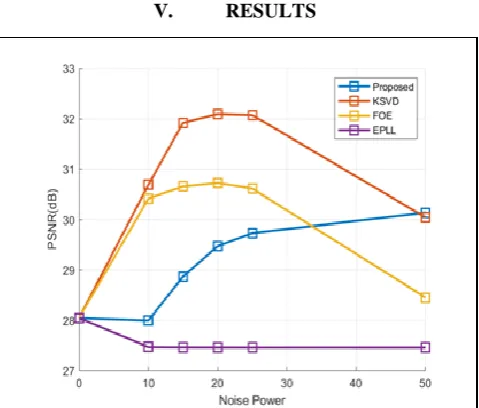
[image:3.595.308.548.286.484.2]Figure.4. Performance evaluation in PSNR of proposed mode.
Figure.5. Performance evaluation in SSIM of proposed mode.
Fig. 6 The original image and its histogram Fig.6. Original images. The image has been then made
[image:3.595.308.550.510.690.2]Figure. 7.a. Image with salt and pepper noise
Fig 7.b)
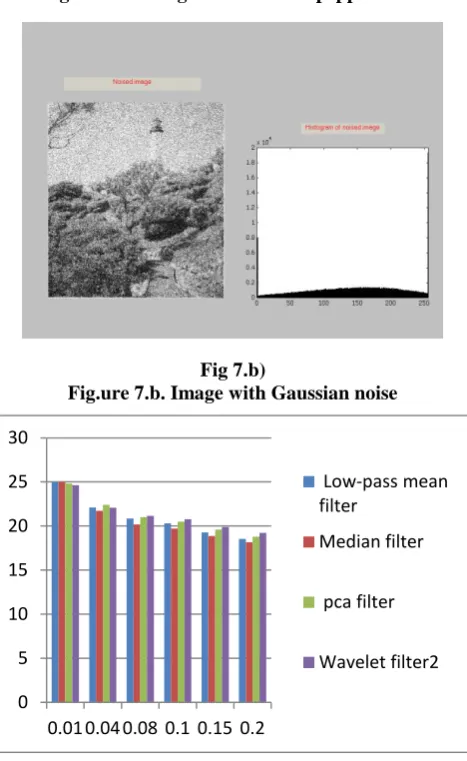
Fig.ure 7.b. Image with Gaussian noise
Fig 8: PSNR value on the noise variance of the Gaussian noise
VI. CONCLUSION
This paper showed a novel image denoising procedure using BM3D filtering method with proposed encoder and decoder system. The proposed methodology improves the noise reduction. In the first step of proposed technique, we applied standard denoising technique, then for the denoised image geometric located encoding technique for each color channel is applied. Decompose the image into three color components R, G and B. For each color channel apply same denosing approach which is applied before encoding. After denoising process for each channel geometric decoder is
combine all channels to form original image.This paper proposed two algorithms that gives better results appeared differently in relation to existing methodologies.
REFERENCES
1. S. P. Awate and R. T. Whitaker, “Higher-order image statistics for unsupervised, informationtheoretic,adaptive, image filtering,” in ProcIEEE Comput. Soc.Conf. Comput.Vis Pattern Recognit., vol.2. Jun. 2005, pp 44–51.
2. T. Batard and M. Berthier, “Spinor Fourier transform for image processing,” IEEE J. Sel.Topics Signal Process., vol. 7, no. 4, pp. 605– 613, Aug. 2013.
3. T. Batard and M. Bertalmío, “Generalized gradient on vector bundle— Application to image denoising,” in Scale Space and Variational Methods in Computer Vision (Lecture Notes in Computer Science), vol. 7893. Berlin, Germany: Springer-Verlag, 2013, pp. 12–23. 4. T. Batard and M. Bertalmío, “On covariant derivatives and their
applications to image regularization,” SIAM J. Imag. Sci., vol. 7, no. 4, pp. 2393–2422, 2014.
5. M. Bertalmío, Image Processing for Cinema. Boca Raton, FL, USA: CRC Press, 2014.
6. M. Bertalmío and S. Levine, “Denoising an image by denoising its curvature image,” SIAM J.Imag. Sci., vol. 7, no. 2, pp. 187–201, 2014. 7. P. Blomgren and T. F. Chan, “Color TV: Total variation methods for
restoration of vectorvalued images,” IEEE Trans. Image Process, vol. 7, no. 3, pp. 304–309, Mar. 1998.
8. X. Bresson and T. F. Chan, “Fast dual minimization of the vectorial total variation norm and applications to color image processing,” Inverse Problems Imag., vol. 2, no. 4, pp. 455–484, 2008.
9. A. Buades, B. Coll, and J.-M. Morel, “A non-local algorithm for image denoising,” in Proc.IEEE Comput. Soc. Conf. Comput. Vis. Pattern Recognit., vol. 2. Jun. 2005, pp. 60–65.
10. A. Buades, B. Coll, and J.-M. Morel, “Non-local means denoising,” Image Process. On Line, vol. 1, Sep. 2011.
11. A. Chambolle, “An algorithm for total variation minimization and applications,” J. Math.Imag. Vis., vol. 20, no. 1, pp. 89–97, 2004. 12. P. Chatterjee and P. Milanfar, “Is denoising dead?” IEEE Trans. Image
Process., vol. 19, no.4, pp. 895–911, Apr. 2010.
13. K. Dabov, A. Foi, V. Katkovnik, and K. Egiazarian, “Image denoising by sparse 3D transform-domain collaborative filtering,” IEEE Trans. Image Process., vol. 16, no. 8, pp. 2080–2095, Aug. 2007.
14. G. Ghimpe¸teanu, T. Batard, M. Bertalmío, and S. Levine, “Denoising an image by denoising its components in a moving frame,” in Image and Signal Processing (Lecture Notes in Computer Science), vol. 8509. Berlin, Germany: Springer-Verlag, 2014, pp. 375–383.
15. J. Hahn, X.-C. Tai, S. Borok, and A. M. Bruckstein,“Orientationmatching minimization for image denoising and inpainting,” Int. J. Comput. Vis., vol. 92, no. 3, pp. 308–324, 2011. 16. Kodak Lossless True Color Image Suite. [Online]. Available:
http://r0k.us/graphics/kodak/,accessed Oct. 2013.
17. M. Lebrun, M. Colom, A. Buades, and J. M. Morel, “Secrets of image denoising cuisine,”Acta Numerica, vol. 21, no. 1, pp. 475–576, 2012. 18. M. Lebrun, “An analysis and implementation of the BM3D image
denoising method,” Image Process. On Line, vol. 2, pp. 175–213, Aug. 2012.
19. M. Lebrun, M. Colom, and J. M. Morel, “The noise clinic: A universal blind denoising algorithm,” in Proc. IEEE Int. Conf. Image Process., Oct. 2014, pp. 2674–2678.
20. A. Levin and B. Nadler, “Natural image denoising: Optimality and inherent bounds,” in Proc.IEEE Int. Conf. Comput. Vis. Pattern Recognit., vol. 2. Jun. 2011, pp. 2833–2840.
21. Sk.Faiz ahmed, Dr.K.Ramesh Reddy," Image denoising with improved genetic algorithm " Intl Journal. Emerging Technologies and Innovative Research (JETIR), Volume 5 | Issue 12 pp.22-27,Dec-2018. 22. Sk.Faiz ahmed, Dr.K.Ramesh Reddy," A Novel Approach for Color
Image Denoising using Geometrical Pixel Location Encoding and Decoding Technique.”in Proc.IEEE Int. Conf. on Intelligent Sustainable Systems (ICISS 2019), Feb.2018,pp.365-368, ISBN: 978-1-5386-7798-8
23. Sk.Faiz ahmed, Dr.K.Ramesh Reddy,” Gray Image Denoising Using Geometrical Pixel location Encoding and Decoding with improved 24. BM3D Technique” Int Journal Reaseacrch and Analytical Reviews
(IJRAR), Volume 6 | Issue 1 pp.569-571,January-2019. 0
5 10 15 20 25 30
0.01 0.04 0.08 0.1 0.15 0.2
Low-pass mean filter
Median filter
pca filter
[image:4.595.52.286.212.593.2]International Journal of Innovative Technology and Exploring Engineering (IJITEE) ISSN: 2278-3075, Volume-8 Issue-6, April 2019
Author-1 Photo
Author-2 Photo
25. Research in Electrical, Electronics and Instrumentation Engineering, Vol. 6, Issue 7, pp.5649-5659,July 2017.
26. Sk.Faiz ahmed, Dr.K.Ramesh Reddy," Image denoising with improved genetic algorithm " Journal of Emerging Technologies and Innovative Research (JETIR), Volume 5 | Issue 12 pp.22-27,Dec-2018.
27. Shaik. Mahaboob Basha and B. C. Jinaga, “A robust approach for qualitative compression in JPEG 2000 standard,” 2012 Asia Pacific Conference on Postgraduate Research in Microelectronics and Electronics, Hyderabad, 2012, pp.224-228.
AUTHORS PROFILE
Sk.Faiz Ahmed, Reasearch Schlor in Computer Science & Engineering, from Rayala Seema University (Government), Kurnool, A.P. India. He was completed his B.Tech(CSE) in 2005, M.Tech in 2008.He has 12 years of teaching experience.