David A. SANTOS [email protected]
Contents
Preface iv
To the Student v
1 Preliminaries 1
1.1 Sets and Notation . . . 1
1.2 Partitions and Equivalence Relations. . . . 4
1.3 Binary Operations. . . 6
1.4 Zn . . . 9
1.5 Fields . . . 13
1.6 Functions . . . 15
2 Matrices and Matrix Operations 18 2.1 The Algebra of Matrices . . . 18
2.2 Matrix Multiplication . . . 22
2.3 Trace and Transpose . . . 28
2.4 Special Matrices. . . 31
2.5 Matrix Inversion. . . 36
2.6 Block Matrices . . . 44
2.7 Rank of a Matrix . . . 45
2.8 Rank and Invertibility . . . 55
3 Linear Equations 65 3.1 Definitions . . . 65
3.2 Existence of Solutions . . . 70
3.3 Examples of Linear Systems . . . 71
4 Vector Spaces 76 4.1 Vector Spaces . . . 76
4.2 Vector Subspaces . . . 79
4.3 Linear Independence . . . 81
4.4 Spanning Sets. . . 84
4.5 Bases . . . 87
4.6 Coordinates . . . 91
5 Linear Transformations 97 5.1 Linear Transformations . . . 97
5.2 Kernel and Image of a Linear Transformation99 5.3 Matrix Representation . . . 104
6 Determinants 111 6.1 Permutations . . . 111
6.2 Cycle Notation. . . 114
6.3 Determinants . . . 119
6.4 Laplace Expansion . . . 129
6.5 Determinants and Linear Systems . . . 136
7 Eigenvalues and Eigenvectors 138 7.1 Similar Matrices. . . 138
7.2 Eigenvalues and Eigenvectors . . . 139
7.3 Diagonalisability . . . 143
7.4 Theorem of Cayley and Hamilton . . . 147
8 Linear Algebra and Geometry 149 8.1 Points and Bi-points inR2 . . . 149
8.2 Vectors inR2 . . . 152
8.3 Dot Product inR2 . . . 158
8.4 Lines on the Plane . . . 164
8.5 Vectors inR3 . . . 169
8.6 Planes and Lines inR3 . . . 174
8.7 Rn . . . 178
A Answers and Hints 182 Answers and Hints . . . 182
GNU Free Documentation License 262 1. APPLICABILITY AND DEFINITIONS . . . 262
2. VERBATIM COPYING . . . 262
3. COPYING IN QUANTITY . . . 262
4. MODIFICATIONS . . . 262
5. COMBINING DOCUMENTS . . . 263
6. COLLECTIONS OF DOCUMENTS . . . 263
7. AGGREGATION WITH INDEPENDENT WORKS263 8. TRANSLATION . . . 263
9. TERMINATION . . . 263
Preface
These notes started during the Spring of 2002, when John MAJEWICZ and I each taught a section of Linear Algebra. I would like to thank him for numerous suggestions on the written notes.
The students of my class were: Craig BARIBAULT, Chun CAO, Jacky CHAN, Pho DO, Keith HAR-MON, Nicholas SELVAGGI, Sanda SHWE, and Huong VU. I must also thank my former student William CARROLL for some comments and for supplying the proofs of a few results.
John’s students were David HERNÁNDEZ, Adel JAILILI, Andrew KIM, Jong KIM, Abdelmounaim LAAYOUNI, Aju MATHEW, Nikita MORIN, Thomas NEGRÓN, Latoya ROBINSON, and Saem SOEURN.
Linear Algebra is often a student’s first introduction to abstract mathematics. Linear Algebra is well suited for this, as it has a number of beautiful but elementary and easy to prove theorems. My purpose with these notes is to introduce students to the concept of proof in a gentle manner.
David A. [email protected]
To the Student
These notes are provided for your benefit as an attempt to organise the salient points of the course. They are a very terseaccount of the main ideas of the course, and are to be used mostly to refer to central definitions and theorems. The number of examples is minimal, and here you will find few exercises. Themotivation or informal ideas of looking at a certain topic, the ideas linking a topic with another, the worked-out examples, etc., are given in class. Hence these notes are not a substitute to lectures: you must always attend to lectures. The order of the notes may not necessarily be the order followed in the class.
There is a certain algebraic fluency that is necessary for a course at this level. These algebraic prerequisites would be difficult to codify here, as they vary depending on class response and the topic lectured. If at any stage you stumble in Algebra, seek help! I am here to help you!
Tutoring can sometimes help, but bear in mind that whoever tutors you may not be familiar with my conventions. Again, I am here to help! On the same vein, other books may help, but the approach presented here is at times unorthodox and finding alternative sources might be difficult.
Here are more recommendations:
• Read a section before class discussion, in particular, read the definitions.
• Class provides the informal discussion, and you will profit from the comments of your classmates, as well as gain confidence by providing your insights and interpretations of a topic. Don’t be absent!
• Once the lecture of a particular topic has been given, take a fresh look at the notes of the lecture topic.
• Try to understand a single example well, rather than ill-digest multiple examples. • Start working on the distributed homework ahead of time.
• Ask questions during the lecture. There are two main types of questions that you are likely to ask.
1. Questions of Correction: Is that a minus sign there? If you think that, for example, I have missed out a minus sign or wrote Pwhere it should have been Q,1 then by all means, ask. No one
likes to carry an error till line XLV because the audience failed to point out an error on line I. Don’t wait till the end of the class to point out an error. Do it when there is still time to correct it!
2. Questions of Understanding: I don’t get it! Admitting that you do not understand something is an act requiring utmost courage. But if you don’t, it is likely that many others in the audience also don’t. On the same vein, if you feel you can explain a point to an inquiring classmate, I will allow you time in the lecture to do so. The best way to ask a question is something like: “How did you get from the second step to the third step?” or “What does it mean to complete the square?” Asseverations like “I don’t understand” do not help me answer your queries. If I consider that you are asking the same questions too many times, it may be that you need extra help, in which case we will settle what to do outside the lecture.
• Don’t fall behind! The sequence of topics is closely interrelated, with one topic leading to another. • The use of calculators is allowed, especially in the occasional lengthy calculations. However, when
graphing, you will need to provide algebraic/analytic/geometric support of your arguments. The questions on assignments and exams will be posed in such a way that it will be of no advantage to have a graphing calculator.
• Presentation is critical. Clearly outline your ideas. When writing solutions, outline major steps and write in complete sentences. As a guide, you may try to emulate the style presented in the scant examples furnished in these notes.
Chapter
1
Preliminaries
1.1 Sets and Notation
1 Definition We will mean by aseta collection of well defined members orelements.
2 Definition The following sets have special symbols.
N={0, 1, 2, 3, . . .} denotes the set of natural numbers.
Z={. . . ,−3,−2,−1, 0, 1, 2, 3, . . .} denotes the set of integers.
Q denotes the set of rational numbers.
R denotes the set of real numbers.
C denotes the set of complex numbers.
∅ denotes the empty set.
3 Definition (Implications) The symbol =⇒ is read “implies”, and the symbol ⇐⇒is read “if and only if.”
4 Example Prove that between any two rational numbers there is always a rational number.
Solution:◮ Let(a, c)∈Z2,(b, d)∈(N\ {0})2, a b <
c
d. Thenda < bc. Now
ab+ad < ab+bc =⇒ a(b+d)< b(a+c) =⇒
a b <
a+c b+d,
da+dc < cb+cd =⇒ d(a+c)< c(b+d) =⇒
a+c b+d <
c d,
whence the rational number a+c
b+d lies between a b and
c d. ◭
☞
We can also argue that the average of two distinct numbers lies between the numbers and so ifr1< r2are rational numbers, thenr1+r2
2 lies between them.
5 Definition LetAbe a set. Ifabelongs to the set A, then we writea∈ A, read “ais an element of A.” If adoes not belong to the setA, we writea6∈ A, read “ais not an element ofA.”
6 Definition (Conjunction, Disjunction, and Negation) The symbol∨is read “or” (disjunction), the symbol ∧is read “and” (conjunction), and the symbol¬is read “not.”
7 Definition (Quantifiers) The symbol∀is read “for all” (theuniversal quantifier), and the symbol∃is read “there exists” (theexistential quantifier).
We have
¬(∀x∈A, P(x)) ⇐⇒ (∃ ∈A,¬P(x)) (1.1)
¬(∃ ∈A, P(x)) ⇐⇒ (∀x∈A,¬P(x)) (1.2)
8 Definition (Subset) If∀a∈A we havea∈ B, then we writeA⊆B, which we read “Ais a subset ofB.”
In particular, notice that for any setA,∅⊆AandA⊆A. Also
N⊆Z⊆Q⊆R⊆C.
☞
A=B ⇐⇒ (A⊆B)∧(B⊆A).9 Definition Theunionof two setsAandB, is the set
A∪B={x: (x ∈A) ∨ (x∈B)}.
This is read “AunionB.” See figure1.1.
10 Definition Theintersectionof two setsAandB, is
A∩B={x: (x ∈A) ∧ (x∈B)}.
This is read “AintersectionB.” See figure1.2.
11 Definition Thedifferenceof two sets AandB, is
A\B={x: (x ∈A) ∧(x6∈ B)}.
This is read “Aset minusB.” See figure1.3.
A B
Figure 1.1:A∪B
A B
Figure 1.2:A∩B
A B
Figure 1.3:A\B
12 Example Prove by means of set inclusion that
Solution:◮ We have,
x∈(A∪B)∩C ⇐⇒ x∈(A∪B)∧x∈ C
⇐⇒ (x∈A∨x∈ B)∧x∈C
⇐⇒ (x∈A∧x∈ C)∨(x∈B∧x∈C)
⇐⇒ (x∈A∩C)∨(x∈B∩C)
⇐⇒ x∈(A∩C)∪(B∩C),
which establishes the equality. ◭
13 Definition Let A1, A2, . . . , An, be sets. The Cartesian Product of these nsets is defined and denoted by
A1×A2× · · · ×An ={(a1, a2, . . . , an) :ak∈Ak},
that is, the set of all orderedn-tuples whose elements belong to the given sets.
☞
In the particular case when all theAkare equal to a setA, we write A1×A2× · · · ×An =An.Ifa∈Aandb∈ Awe write(a, b)∈A2.
14 Definition Letx∈R. Theabsolute value ofx—denoted by|x|—is defined by
|x|=
−x if x < 0,
x if x≥0.
It follows from the definition that forx∈R,
−|x|≤x≤|x|. (1.3)
t≥0 =⇒ |x|≤t ⇐⇒ −t≤ x≤t. (1.4)
∀a∈R =⇒
√
a2=|a|. (1.5)
15 Theorem (Triangle Inequality) Let (a, b)∈R2. Then
|a+b|≤ |a|+|b|. (1.6)
Proof: From1.3, by addition,
−|a|≤a≤|a|
to
−|b|≤b≤|b|
we obtain
−(|a|+|b|)≤ a+b≤(|a|+|b|),
Homework
Problem 1.1.1 Prove that between any two rational numbers there is an irrational number.
Problem 1.1.2 Prove thatX\(X\A) =X∩A.
Problem 1.1.3 Prove that
X\(A∪B) = (X\A)∩(X\B).
Problem 1.1.4 Prove that
X\(A∩B) = (X\A)∪(X\B).
Problem 1.1.5 Prove that
(A∪B)\(A∩B) = (A\B)∪(B\A).
Problem 1.1.6 Write the union A∪B∪Cas adisjoint union of sets.
Problem 1.1.7 Prove that a set withn≥0elements has 2nsubsets.
Problem 1.1.8 Let(a, b)∈R2. Prove that
||a|−|b||≤|a−b|.
1.2 Partitions and Equivalence Relations
16 Definition LetS6=∅be a set. ApartitionofSis a collection of non-empty, pairwise disjoint subsets of Swhose union isS.
17 Example Let
2Z={. . . ,−6,−4,−2, 0, 2, 4, 6, . . .}=0
be the set of even integers and let
2Z+1={. . . ,−5,−3,−1, 1, 3, 5, . . .}=1
be the set of odd integers. Then
(2Z)∪(2Z+1) =Z, (2Z)∩(2Z+1) =∅,
and so{2Z, 2Z+1}is a partition ofZ.
18 Example Let
3Z={. . .−9, ,−6,−3, 0, 3, 6, 9, . . .} =0
be the integral multiples of3, let
3Z+1={. . . ,−8,−5,−2, 1, 4, 7, . . .}=1
be the integers leaving remainder1upon division by3, and let
3Z+2={. . . ,−7,−4,−1, 2, 5, 8, . . .}=2
be integers leaving remainder2upon division by3. Then
(3Z)∪(3Z+1)∪(3Z+2) = Z,
(3Z)∩(3Z+1) =∅, (3Z)∩(3Z+2) =∅,(3Z+1)∩(3Z+2) =∅,
and so{3Z, 3Z+1, 3Z+2} is a partition ofZ.
☞
Notice that0and1do not mean the same in examples17and18. Whenever we make use of this notation, the integral divisor must be made explicit.19 Example Observe
R= (Q)∪(R\Q), ∅= (Q)∩(R\Q),
20 Definition LetA, Bbe sets. ArelationRis a subset of the Cartesian productA×B. We write the fact that(x, y)∈ Rasx∼y.
21 Definition LetAbe a set andRbe a relation onA×A. Then Ris said to be
• reflexiveif(∀x∈A), x∼x,
• symmetricif(∀(x, y)∈A2), x∼ y =⇒ y∼x,
• anti-symmetricif(∀(x, y)∈ A2),(x∼y)∧(y∼x)
=⇒ x=y,
• transitiveif(∀(x, y, z)∈A3),(x∼y)∧(y∼ z)
=⇒ (x∼z).
A relationRwhich is reflexive, symmetric and transitive is called anequivalence relationonA. A relation Rwhich is reflexive, anti-symmetric and transitive is called apartial orderonA.
22 Example LetS={All Human Beings}, and define∼onSasa∼bif and only ifaandbhave the same mother. Thena ∼ asince any humana has the same mother as himself. Similarly,a ∼ b =⇒ b∼ a and(a∼b)∧(b∼c) =⇒ (a∼c). Therefore∼is an equivalence relation.
23 Example LetLbe the set of all lines on the plane and writel1∼ l2 ifl1||l2 (the linel1is parallel to the linel2). Then∼is an equivalence relation onL.
24 Example In Q define the relation a b ∼
x
y ⇐⇒ ay = bx, where we will always assume that the denominators are non-zero. Then∼is an equivalence relation. For a
b ∼ a
b sinceab=ab. Clearly a
b ∼ x
y =⇒ ay=bx =⇒ xb=ya =⇒ x y ∼
a b.
Finally, if a b ∼
x y and
x y ∼
s
t then we have ay = bx and xt = sy. Multiplying these two equalities ayxt=bxsy. This gives
ayxt−bxsy=0 =⇒ xy(at−bs) =0.
Now ifx=0, we will havea=s=0, in which case triviallyat =bs. Otherwise we must haveat−bs=0 and so a
b ∼ s t.
25 Example LetXbe a collection of sets. WriteA∼BifA⊆B. Then∼is a partial order onX.
26 Example For(a, b)∈R2 define
a∼b⇔a2+b2> 2.
Determine, with proof, whether∼is reflexive, symmetric, and/or transitive. Is∼an equivalence relation?
Solution:◮ Since02+02≯2, we have0≁0and so∼is not reflexive. Now,
a∼b ⇔ a2+b2
⇔ b2+a2
⇔ b∼a,
so ∼ is symmetric. Also0 ∼ 3since 02+32 > 2 and3 ∼ 1 since32 +12 > 2. But0 ≁ 1since 02 +12 ≯ 2. Thus the relation is not transitive. The relation, therefore, is not an equivalence relation.
27 Definition Let∼ be an equivalence relation on a setS. Then theequivalence class ofais defined and denoted by
[a] ={x∈S:x∼a}.
28 Lemma Let∼be an equivalence relation on a setS. Then two equivalence classes are either identical or disjoint.
Proof: We prove that if(a, b)∈S2, and[a]∩[b]6=∅then[a] = [b]. Suppose thatx ∈[a]∩[b]. Nowx∈ [a] =⇒ x∼a =⇒ a∼x, by symmetry. Similarly,x∈ [b] =⇒ x∼b.By transitivity
(a∼x)∧(x∼b) =⇒ a∼b.
Now, ify∈ [b]thenb∼y. Again by transitivity,a∼y. This means thaty∈[a]. We have shewn thaty∈[b] =⇒ y∈[a]and so[b]⊆[a]. In a similar fashion, we may prove that[a]⊆[b]. This establishes the result. ❑
29 Theorem Let S 6= ∅ be a set. Any equivalence relation on S induces a partition of S. Conversely, given a partition ofSinto disjoint, non-empty subsets, we can define an equivalence relation onSwhose equivalence classes are precisely these subsets.
Proof: By Lemma28, if∼is an equivalence relation onSthen S= [
a∈S [a],
and[a]∩[b] =∅ifa≁b. This proves the first half of the theorem.
Conversely, let
S=[ α
Sα, Sα∩Sβ =∅ ifα6=β,
be a partition ofS. We define the relation ≈on Sby lettinga ≈ bif and only if they belong to the sameSα. Since theSα are mutually disjoint, it is clear that≈is an equivalence relation on Sand that fora∈Sα,we have[a] =Sα. ❑
Homework
Problem 1.2.1 For(a, b)∈(Q\ {0})2define the relation
∼as follows: a ∼ b ⇔ ab ∈ Z. Determine whether this relation is reflexive, symmetric, and/or transitive.
Problem 1.2.2 Give an example of a relation onZ\ {0}
which is reflexive, but is neither symmetric nor transi-tive.
Problem 1.2.3 Define the relation∼inRbyx ∼ y ⇐⇒
xey=yex. Prove that∼is an equivalence relation.
Problem 1.2.4 Define the relation∼inQbyx ∼ y ⇐⇒
∃h ∈ Z such that x = 3y+h
3 . [A] Prove that ∼ is an equivalence relation. [B] Determine [x], the equivalence ofx∈Q. [C] Is 2
3 ∼ 4 5?
1.3 Binary Operations
30 Definition LetS, T be sets. Abinary operationis a function
⊗:
S×S → T
(a, b) 7→ (a, b)
We usually use the “infix” notationa⊗brather than the “prefix” notation⊗(a, b). IfS=T then we say that the binary operation isinternal orclosedand ifS6=T then we say that it isexternal. If
a⊗b=b⊗a
then we say that the operation⊗iscommutativeand if
a⊗(b⊗c) = (a⊗b)⊗c,
we say that it isassociative. If⊗is associative, then we can write
a⊗(b⊗c) = (a⊗b)⊗c=a⊗b⊗c,
without ambiguity.
☞
We usually omit the sign⊗and use juxtaposition to indicate the operation⊗. Thus we write abinstead ofa⊗b.31 Example The operation+(ordinary addition) on the setZ×Zis a commutative and associative closed binary operation.
32 Example The operation − (ordinary subtraction) on the set N × N is a commutative, non-associative non-closed binary operation.
33 Example The operation ⊗ defined by a⊗b = 1+ab on the set Z×Z is a commutative but non-associative internal binary operation. For
a⊗b=1+ab=1+ba=ba,
proving commutativity. Also, 1⊗ (2 ⊗3) = 1 ⊗(7) = 8 and (1 ⊗ 2)⊗ 3 = (3)⊗ 3 = 10, evincing non-associativity.
34 Definition Let Sbe a set and ⊗: S×S→Sbe a closed binary operation. The couple hS,⊗iis called analgebra.
☞
When we desire to drop the sign⊗and indicate the binary operation by juxtaposition, we simply speak of the “algebraS.”35 Example BothhZ,+iandhQ,·iare algebras. Here+is the standard addition of real numbers and · is the standard multiplication.
36 Example hZ,−i is a non-commutative, non-associative algebra. Here− is the standard subtraction operation on the real numbers
37 Example (Putnam Exam, 1972) Let Sbe a set and let∗be a binary operation ofS satisfying the laws ∀(x, y)∈ S2
x∗(x∗y) =y, (1.7)
(y∗x)∗x=y. (1.8)
Shew that∗is commutative, but not necessarily associative.
Solution:◮ By (1.8)
x∗y= ((x∗y)∗x)∗x.
By (1.8) again
By (1.7)
((x∗y)∗((x∗y)∗y))∗x= (y)∗x=y∗x,
which is what we wanted to prove.
To shew that the operation is not necessarily associative, specialise S=Zandx∗y= −x−y (the opposite ofxminusy). Then clearly in this case ∗is commutative, and satisfies (1.7) and (1.8) but
0∗(0∗1) =0∗(−0−1) =0∗(−1) = −0− (−1) =1,
and
(0∗0)∗1= (−0−0)∗1= (0)∗1= −0−1= −1,
evincing that the operation is not associative. ◭
38 Definition Let Sbe an algebra. Thenl ∈ Sis called a left identityif ∀s ∈ Swe havels =s. Similarly r∈Sis called aright identity if∀s ∈Swe havesr=s.
39 Theorem If an algebraSpossesses a left identityl and a right identityrthenl =r.
Proof: Sincelis a left identity
r=lr.
Sinceris a right identity
l=lr.
Combining these two, we gather
r=lr=l,
whence the theorem follows.❑
40 Example InhZ,+ithe element0 ∈ Z acts as an identity, and inhQ,·ithe element1 ∈ Qacts as an identity.
41 Definition LetSbe an algebra. An elementa∈Sis said to beleft-cancellableorleft-regularif∀(x, y)∈
S2
ax=ay =⇒ x=y.
Similarly, elementb∈ Sis said to beright-cancellableorright-regularif∀(x, y)∈S2
xb=yb =⇒ x=y.
Finally, we say an elementc∈Siscancellableorregularif it is both left and right cancellable.
42 Definition LethS,⊗iandhS,⊤ibe algebras. We say that⊤isleft-distributivewith respect to⊗ if
∀(x, y, z)∈S3, x⊤(y⊗z) = (x⊤y)⊗(x⊤z).
Similarly, we say that⊤isright-distributivewith respect to⊗if
∀(x, y, z)∈S3, (y⊗z)⊤x= (y⊤x)⊗(z⊤x).
We say that⊤ isdistributivewith respect to⊗if it is both left and right distributive with respect to⊗.
Problem 1.3.1 Let
S={x∈Z:∃(a, b)∈Z2, x=a3+b3+c3−3abc}.
Prove that S is closed under multiplication, that is, if x∈Sandy∈Sthenxy∈S.
Problem 1.3.2 LethS,⊗ibe an associative algebra, let a ∈ S be a fixed element and define the closed binary operation⊤by
x⊤y=x⊗a⊗y. Prove that⊤is also associative overS×S.
Problem 1.3.3 OnQ∩] −1;1[define the a binary opera-tion⊗
a⊗b= a+b
1+ab,
where juxtaposition means ordinary multiplication and
+is the ordinary addition of real numbers. Prove that
➊ Prove that ⊗ is a closed binary operation on
Q∩] −1;1[.
➋ Prove that⊗is both commutative and associative.
➌ Find an element e ∈ R such that (∀a ∈ Q∩] −
1;1[) (e⊗a=a).
➍ Given e as above and an arbitrary element a ∈ Q∩] −1;1[, solve the equationa⊗b=eforb.
Problem 1.3.4 OnR\ {1}define the a binary operation
⊗
a⊗b=a+b−ab,
where juxtaposition means ordinary multiplication and
+is the ordinary addition of real numbers. Clearly⊗is a closed binary operation. Prove that
➊ Prove that⊗is both commutative and associative.
➋ Find an element e ∈ R\ {1} such that (∀a ∈ R\ {1}) (e⊗a=a).
➌ Given e as above and an arbitrary element a ∈ R\ {1}, solve the equationa⊗b=eforb.
Problem 1.3.5 (Putnam Exam, 1971) Let S be a set and let ◦be a binary operation onS satisfying the two laws
(∀x∈S)(x◦x=x),
and
(∀(x, y, z)∈S3)((x◦y)◦z= (y◦z)◦x).
Shew that◦is commutative.
Problem 1.3.6 Define the symmetric difference of the sets A, B as A△B = (A\B)∪(B\A). Prove that △
is commutative and associative.
1.4
Zn
43 Theorem (Division Algorithm) Letn > 0be an integer. Then for any integerathere exist unique integers q(called thequotient) andr (called theremainder) such thata=qn+rand0≤r < q.
Proof: In the proof of this theorem, we use the following property of the integers, called the well-ordering principle: any non-empty set of non-negative integers has a smallest element.
Consider the set
S={a−bn:b∈Z∧a≥bn}.
ThenS is a collection of nonnegative integers and S 6= ∅as ±a−0·n ∈ Sand this is non-negative for one choice of sign. By the Well-Ordering Principle, S has a least element, sayr. Now, there must be someq ∈ Zsuch that r = a−qnsincer ∈ S. By construction,r ≥ 0.Let us prove thatr < n. For assume that r ≥ n.Thenr > r−n= a−qn−n =a− (q+1)n≥ 0, sincer−n≥0.But thena− (q+1)n∈Sanda− (q+1)n < rwhich contradicts the fact that ris the smallest member ofS. Thus we must have0 ≤r < n.To prove thatrandqare unique, assume thatq1n+r1 = a=q2n+r2,0 ≤ r1 < n,0 ≤ r2 < n.Thenr2−r1 =n(q1−q2), that is,ndivides(r2−r1). But|r2−r1|< n,whencer2 =r1. From this it also follows thatq1 =q2. This completes the proof.❑
follows:
..
. ... ... ... ...
−10 −9 −8 −7 −6
−5 −4 −3 −2 −1
0 1 2 3 4
5 6 7 8 9 ..
. ... ... ... ...
The arrangement above shews that any integer comes in one of 5 flavours: those leaving remainder 0 upon division by5, those leaving remainder1upon division by5, etc. We let
5Z={. . . ,−15,−10,−5, 0, 5, 10, 15, . . .}=0,
5Z+1={. . . ,−14,−9,−4, 1, 6, 11, 16, . . .}=1,
5Z+2={. . . ,−13,−8,−3, 2, 7, 12, 17, . . .}=2,
5Z+3={. . . ,−12,−7,−2, 3, 8, 13, 18, . . .}=3,
5Z+4={. . . ,−11,−6,−1, 4, 9, 14, 19, . . .}=4,
and
Z5 ={0, 1, 2, 3, 4}.
Let n be a fixed positive integer. Define the relation ≡ by x ≡ y if and only if they leave the same remainder upon division byn. Then clearly≡is an equivalence relation. As such it partitions the set of integersZinto disjoint equivalence classes by Theorem29. This motivates the following definition.
45 Definition Letnbe a positive integer. Thenresidue classesupon division bynare
0=nZ, 1=nZ+1, 2 =nZ+2, . . . , n−1 =nZ+n−1.
Theset of residue classes modulo nis
Zn ={0, 1, . . . , n−1}.
Our interest is now to define some sort of “addition” and some sort of “multiplication” inZn.
46 Theorem (Addition and Multiplication Modulon) Letnbe a positive integer. For(a, b)∈(Zn)2 define a+b=r, wherer is the remainder ofa+bupon division by n. anda·b=t, wheretis the remainder ofabupon division byn. Then these operations are well defined.
Proof: We need to prove that given arbitrary representatives of the residue classes, we always obtain the same result from our operations. That is, ifa=a′ andb=b′ then we havea+b =
a′+b′anda·b=a′·b′.
Now
a=a′ =⇒ ∃(q, q′)∈ Z2, r∈N, a=qn+r, a′ =q′n+r, 0≤r < n,
Hence
a+b= (q+q1)n+r+r1, a′+b′ = (q′+q1′)n+r+r1,
meaning that botha+banda′+b′leave the same remainder upon division byn, and therefore
a+b=a+b=a′+b′=a′+b′.
Similarly
ab= (qq1n+qr1+rq1)n+rr1, a′b′ = (q′q1′n+q′r1+rq1′)n+rr1,
and so bothabanda′b′leave the same remainder upon division byn, and therefore
a·b=ab=a′b′=a′·b′.
This proves the theorem. ❑
47 Example Let
Z6={0, 1, 2, 3, 4, 5}
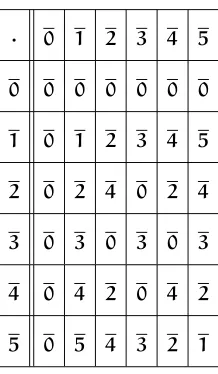
be the residue classes modulo 6. Construct the natural addition + table for Z6. Also, construct the natural multiplication·table forZ6.
Solution:◮The required tables are given in tables1.1and1.2. ◭
+ 0 1 2 3 4 5
0 0 1 2 3 4 5
1 1 2 3 4 5 0
2 2 3 4 5 0 1
3 3 4 5 0 1 2
4 4 5 0 1 2 3
[image:16.612.415.524.342.529.2]5 5 0 1 2 3 4
Table 1.1: Addition table forZ6.
· 0 1 2 3 4 5
0 0 0 0 0 0 0
1 0 1 2 3 4 5
2 0 2 4 0 2 4
3 0 3 0 3 0 3
4 0 4 2 0 4 2
5 0 5 4 3 2 1
Table 1.2: Multiplication table forZ6.
We notice that even though 2 6= 0 and 3 6= 0 we have 2·3 = 0 in Z6. This prompts the following definition.
48 Definition (Zero Divisor) An elementa6=0ofZn is called azero divisor ifab=0for someb∈Zn.
We will extend the concept of zero divisor later on to various algebras.
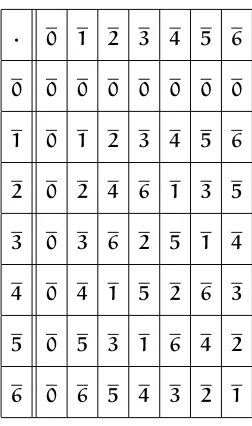
49 Example Let
Z7 ={0, 1, 2, 3, 4, 5, 6}
[image:16.612.78.191.345.530.2]+ 0 1 2 3 4 5 6
0 0 1 2 3 4 5 6
1 1 2 3 4 5 6 0
2 2 3 4 5 6 0 1
3 3 4 5 6 0 1 2
4 4 5 6 0 1 2 3
5 5 6 0 1 2 3 4
[image:17.612.406.532.48.261.2]6 6 0 1 2 3 4 5
Table 1.3: Addition table forZ7.
· 0 1 2 3 4 5 6
0 0 0 0 0 0 0 0
1 0 1 2 3 4 5 6
2 0 2 4 6 1 3 5
3 0 3 6 2 5 1 4
4 0 4 1 5 2 6 3
5 0 5 3 1 6 4 2
6 0 6 5 4 3 2 1
Table 1.4: Multiplication table forZ7.
Solution:◮The required tables are given in tables1.3and1.4. ◭
50 Example Solve the equation
5x=3
inZ11.
Solution:◮Multiplying by9on both sides
45x=27,
that is,
x=5.
◭
We will use the following result in the next section.
51 Definition Let a, b be integers with one of them different from0. The greatest common divisor dof a, b, denoted byd=gcd(a, b)is the largest positive integer that divides bothaandb.
52 Theorem (Bachet-Bezout Theorem) The greatest common divisor of any two integersa, bcan be writ-ten as a linear combination ofaandb, i.e., there are integersx, ywith
gcd(a, b) =ax+by.
Proof: LetA={ax+by:ax+by > 0, x, y∈Z}. Clearly one of±a,±bis inA, as one ofa, bis not zero. By the Well Ordering Principle,Ahas a smallest element, sayd. Therefore, there are x0, y0 such thatd=ax0+by0.We prove thatd=gcd(a, b).To do this we prove thatddivides aandband that iftdividesaandb, thentmust also divide thend.
We first prove thatd dividesa. By the Division Algorithm, we can find integersq, r, 0 ≤ r < d such thata=dq+r.Then
[image:17.612.70.199.49.261.2]Ifr > 0, thenr ∈ A is smaller than the smaller element ofA, namelyd,a contradiction. Thus r=0.This entailsdq=a,i.e. ddividesa.We can similarly prove thatddividesb.
Assume thattdividesaandb. Then a= tm, b= tnfor integersm, n.Hence d =ax0+bx0 = t(mx0+ny0),that is,tdividesd.The theorem is thus proved.❑
Homework
Problem 1.4.1 Write the addition and multiplication ta-bles of Z11 under natural addition and multiplication modulo11.
Problem 1.4.2 Solve the equation 3x2−5x+1 = 0 in
Z11.
Problem 1.4.3 Solve the equation 5x2=3
inZ11.
Problem 1.4.4 Prove that ifn > 0is a composite integer,
Znhas zero divisors.
Problem 1.4.5 How many solutions does the equation x4+x3+x2+x+1=0have inZ11?
1.5 Fields
53 Definition LetFbe a set having at least two elements 0F and1F (0F 6=1F) together with two operations
· (multiplication, which we usually represent via juxtaposition) and + (addition). A field hF,·,+i is a triplet satisfying the following axioms∀(a, b, c)∈F3:
F1 Addition and multiplication are associative:
(a+b) +c=a+ (b+c), (ab)c=a(bc) (1.9)
F2 Addition and multiplication are commutative:
a+b=b+a, ab=ba (1.10)
F3 The multiplicative operation distributes over addition:
a(b+c) =ab+ac (1.11)
F4 0F is the additive identity:
0F+a=a+0F=a (1.12)
F5 1F is the multiplicative identity:
1Fa=a1F =a (1.13)
F6 Every element has an additive inverse:
∃−a∈F, a+ (−a) = (−a) +a=0F (1.14)
F7 Every non-zero element has a multiplicative inverse: ifa6=0F
∃a−1∈F, aa−1 =a−1a=1F (1.15)
The elements of a field are calledscalars.
An important property of fields is the following.
Proof: Assume thatab=0F. Ifa6=0F then it has a multiplicative inversea−1. We deduce
a−1ab=a−10
F =⇒ b=0F.
This means that the only way of obtaining a zero product is if one of the factors is0F.❑
55 Example hQ,·,+i, hR,·,+i, and hC,·,+iare all fields. The multiplicative identity in each case is 1 and the additive identity is0.
56 Example Let
Q(√2) ={a+√2b: (a, b)∈Q2}
and define addition on this set as
(a+√2b) + (c+√2d) = (a+c) +√2(b+d),
and multiplication as
(a+√2b)(c+√2d) = (ac+2bd) +√2(ad+bc).
ThenhQ+√2Q, ,+iis a field. Observe 0F =0,1F =1, that the additive inverse ofa+√2bis−a−√2b, and the multiplicative inverse ofa+√2b,(a, b)6= (0, 0)is
(a+√2b)−1= 1 a+√2b =
a−√2b a2−2b2 =
a a2−2b2 −
√ 2b a2−2b2.
Herea2−2b26=0since√2is irrational.
57 Theorem Ifpis a prime, hZp,·,+iis a field under ·multiplication modulopand+ addition modulo p.
Proof: Clearly the additive identity is 0 and the multiplicative identity is 1. The additive inverse ofaisp−a. We must prove that everya ∈Zp\ {0}has a multiplicative inverse. Such anasatisfiesgcd(a, p) =1and by the Bachet-Bezout Theorem52, there exist integersx, ywith px+ay=1.In such case we have
1=px+ay=ay=a·y,
whence(a)−1 =y.❑
58 Definition A field is said to be ofcharacteristicp6=0if for some positive integerpwe have∀a∈F, pa=
0F, and no positive integer smaller thanpenjoys this property.
If the field does not have characteristicp6=0 then we say that it is ofcharacteristic 0. ClearlyQ,Rand Care of characteristic0, whileZp for primep, is of characteristicp.
59 Theorem The characteristic of a field is either0or a prime.
Proof: If the characteristic of the field is0, there is nothing to prove. Letpbe the least positive integer for which∀a∈ F, pa=0F. Let us prove thatpmust be a prime. Assume that instead we
Homework
Problem 1.5.1 Consider the set of numbers
Q(√2,√3,√6) ={a+b√2+c√3+d√6: (a, b, c, d)∈Q4}.
Assume thatQ(√2,√3,√6)is a field under ordinary addition and multiplication. What is the multiplicative inverse of the element√2+2√3+3√6?
Problem 1.5.2 LetFbe a field anda, btwo non-zero elements ofF. Prove that
−(ab−1) = (−a)b−1=a(−b−1).
Problem 1.5.3 LetFbe a field anda6=0F. Prove that
(−a)−1 = −(a−1).
Problem 1.5.4 LetFbe a field anda, btwo non-zero elements ofF. Prove that
ab−1= (−a)(−b−1).
1.6 Functions
60 Definition By a function or a mapping from one set to another, we mean a rule or mechanism that assigns to every input element of the first set a unique output element of the second set. We shall call the set of inputs thedomain of the function, the set of possible outputs thetarget set of the function, and the set ofactualoutputs theimageof the function.
We will generally refer to a function with the following notation:
f:
D → T
x 7→ f(x)
.
Here f is the name of the function, D is its domain, T is its target set, x is the name of a typical input andf(x)is the output or image ofxunderf. We call the assignmentx7→f(x)theassignment ruleof the function. Sometimesxis also called theindependent variable. The set f(D) = {f(a)|a∈D}is called the imageoff. Observe thatf(D)⊆T.
α
1 2
2 8
3 4
Figure 1.4: An injection.
β
2 2
1 4
3
Figure 1.5: Not an injection
61 Definition A functionf:
X → Y
x 7→ f(x)
is said to beinjectiveorone-to-oneif∀(a, b)∈X2,we have
This is equivalent to saying that
f(a) =f(b) =⇒ a=b.
62 Example The functionαin the diagram 1.4 is an injective function. The functionβ represented by the diagram1.5, however, is not injective,β(3) =β(1) =4, but 36=1.
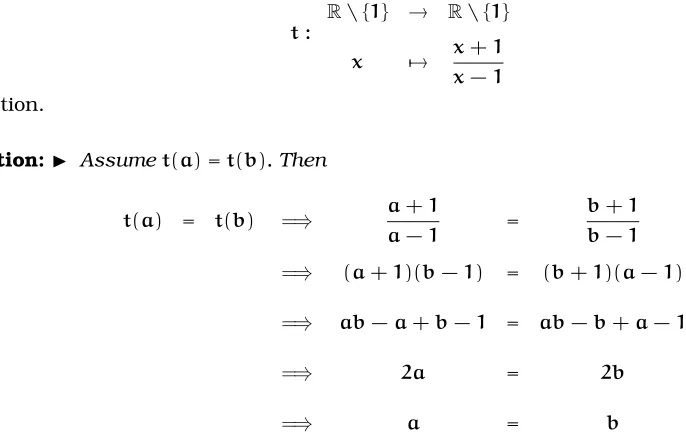
63 Example Prove that
t: R
\ {1} → R\ {1}
x 7→ x+1
x−1 is an injection.
Solution:◮ Assumet(a) =t(b).Then
t(a) = t(b) =⇒ a+1
a−1 =
b+1 b−1
=⇒ (a+1)(b−1) = (b+1)(a−1)
=⇒ ab−a+b−1 = ab−b+a−1
=⇒ 2a = 2b
=⇒ a = b
We have proved thatt(a) =t(b) =⇒ a=b, which shews thattis injective. ◭
2 1
3
[image:21.612.64.487.137.523.2]2 4 β
Figure 1.6: A surjection
8 γ
2 2
[image:21.612.100.443.151.371.2]1 4
Figure 1.7: Not a surjection
64 Definition A functionf:A →Bis said to besurjectiveoronto if(∀b∈B) (∃a∈A) :f(a) =b.That is, each element ofBhas a pre-image inA.
☞
A function is surjective if its image coincides with its target set. It is easy to see that a graphical criterion for a function to be surjective is that every horizontal line passing through a point of the target set (a subset of they-axis) of the function must also meet the curve.65 Example The function β represented by diagram 1.6 is surjective. The function γ represented by diagram1.7is not surjective as8does not have a preimage.
66 Example Prove thatt: R → R
x 7→ x3
Solution:◮ Since the graph oftis that of a cubic polynomial with only one zero, every horizontal line passing through a point inRwill eventually meet the graph ofg, whencetis surjective. To prove this analytically, proceed as follows. We must prove that (∀ b ∈ R) (∃a) such that t(a) =b.We chooseaso thata=b1/3. Then
t(a) =t(b1/3) = (b1/3)3 =b.
Our choice ofaworks and hence the function is surjective. ◭
67 Definition A function isbijectiveif it is both injective and surjective.
Homework
Problem 1.6.1 Prove that
h: R → R
x 7→ x3
is an injection.
Problem 1.6.2 Shew that
f: R \
3 2
→ R\ {3}
x 7→ 2x6x−3
Chapter
2
Matrices and Matrix Operations
2.1 The Algebra of Matrices
68 Definition LethF,·,+ibe a field. Anm×n(mbyn)matrixAwithmrows andncolumns with entries overFis a rectangular array of the form
A=
a11 a12 · · · a1n
a21 a22 · · · a2n
..
. ... · · · ...
am1 am2 · · · amn
,
where∀(i, j)∈ {1, 2, . . . , m}×{1, 2, . . . , n}, aij∈ F.
☞
As a shortcut, we often use the notation A = [aij]to denote the matrix Awith entries aij. Notice that when we refer to the matrix we put parentheses—as in “[aij],” and when we refer to a specific entry we do not use the surrounding parentheses—as in “aij.”69 Example
A=
0 −1 1
1 2 3
is a2×3matrix and
B=
−2 1
1 2
0 3
is a3×2matrix.
70 Example Write out explicitly the4×4matrixA= [aij]whereaij =i2−j2.
Solution:◮ This is
A =
12−11 12−22 12−32 12−42
22−12 22−22 22−32 22−42
32−12 32−22 32−32 32−42
42−12 42−22 42−32 42−42
=
0 −3 −8 −15
3 0 −5 −12
8 5 0 −7
15 12 7 0
.
◭
71 Definition Let hF,·,+i be a field. We denote byMm×n(F) the set of all m×n matrices with entries overF. Mn×n(F)is, in particular, the set of all square matrices of sizenwith entries overF.
72 Definition Them×nzero matrix0m×n ∈Mm×n(F)is the matrix with0F’s everywhere,
0m×n=
0F 0F 0F · · · 0F
0F 0F 0F · · · 0F
0F 0F 0F · · · 0F
..
. ... ... · · · ...
0F 0F 0F · · · 0F
.
Whenm=nwe write0n as a shortcut for0n×n.
73 Definition Then×nidentity matrix In ∈ Mn×n(F)is the matrix with 1F’s on the main diagonal and
0F’s everywhere else,
In =
1F 0F 0F · · · 0F
0F 1F 0F · · · 0F
0F 0F 1F · · · 0F
..
. ... ... · · · ...
0F 0F 0F · · · 1F
.
75 Example ForA=
1 1
−1 1
0 2
andB=
−1 1
2 1
0 −1
we have
A+2B=
−1 3
3 3
0 0.
.
76 Theorem Let(A, B, C)∈(Mm×n(F))3and(α, β)∈F2. Then
M1 Mm×n(F)is close under matrix addition and scalar multiplication
A+B∈Mm×n(F), αA∈Mm×n(F) (2.1)
M2 Addition of matrices is commutative
A+B=B+A (2.2)
M3 Addition of matrices is associative
A+ (B+C) = (A+B) +C (2.3)
M4 There is a matrix0m×n such that
A+0m×n (2.4)
M5 There is a matrix−A such that
A+ (−A) = (−A) +A=0m×n (2.5)
M6 Distributive law
α(A+B) =αA+αB (2.6)
M7 Distributive law
(α+β)A=αA+βB (2.7)
M8
1FA =A (2.8)
M9
α(βA) = (αβ)A (2.9)
Proof: The theorem follows at once by reducing each statement to an entry-wise and appealing to the field axioms.❑
Homework
Problem 2.1.1 Write out explicitly the3×3matrixA= [aij]whereaij=ij.
Problem 2.1.3 Let
M=
a −2a c
0 −a b
a+b 0 −1
, N=
1 2a c
a b−a −b
a−b 0 −1
be square matrices with entries overR. FindM+Nand2M.
Problem 2.1.4 Determinexandysuch that
3 x 1
1 2 0
+2
2 1 3
5 x 4
=
7 3 7
11 y 8
.
Problem 2.1.5 Determine2×2matricesAandBsuch that
2A−5B=
1 −2
0 1
, −2A+6B=
4 2
6 0
.
Problem 2.1.6 LetA= [aij]∈Mn×n(R). Prove that
min
j maxi aij≥maxi minj aij.
Problem 2.1.7 A person goes along the rows of a movie theater and asks the tallest person of each row to stand up. Then he selects the shortest of these people, who we will call theshortest giant. Another person goes along the rows and asks the shortest person to stand up and from these he selects the tallest, which we will call thetallest midget. Who is taller, the tallest midget or the shortest giant?
Problem 2.1.8 (Putnam Exam, 1959) Choose five elements from the matrix
11 17 25 19 16
24 10 13 15 3
12 5 14 2 18
23 4 1 8 22
6 20 7 21 9
,
2.2 Matrix Multiplication
77 Definition Let A = [aij]∈ Mm×n(F)andB= [bij] ∈Mn×p(F). Then the matrix productAB is defined as the matrixC= [cij]∈Mm×p(F)with entriescij =Pnl=1ailblj:
a11 a12 · · · a1n
a21 a22 · · · a2n ..
. ... · · · ...
ai1 ai2 · · · ain
..
. ... · · · ...
am1 am2 · · · amn
b11 · · · b1j · · · b1p
b21 · · · b2j · · · b2p
..
. · · · ... · · · ... bn1 · · · bnj · · · bnp
=
c11 · · · c1p
c21 · · · c2p ..
. · · · ...
· · · cij · · · ..
. · · · ...
cm1 · · · cmp
.
☞
Observe that we use juxtaposition rather than a special symbol to denote matrix multipli-cation. This will simplify notation.In order to obtain theij-th entry of the matrixABwe multiply elementwise thei-th row ofAby thej-th column ofB. Observe thatABis am×pmatrix.78 Example LetM=
1 2 3 4
andN=
5 6 7 8
be matrices overR. Then
MN= 1 2 3 4 5 6 7 8 =
1·5+2·7 1·6+2·8
3·5+4·7 3·6+4·8
= 19 22 43 50 , and NM= 5 6 7 8 1 2 3 4 =
5·1+6·3 5·2+6·4
7·1+8·3 7·2+8·4
= 23 34 31 46 .
Hence, in particular, matrix multiplication is not necessarily commutative.
79 Example We have
1 1 1
1 1 1
1 1 1
2 −1 −1
−1 2 −1
−1 −1 2
=
0 0 0
0 0 0
0 0 0
,
overR. Observe then that the product of two non-zero matrices may be the zero matrix.
80 Example Consider the matrix
A=
2 1 3
0 1 1
4 4 0
with entries overZ5. Then
A2 =
2 1 3
0 1 1
4 4 0
2 1 3
0 1 1
4 4 0
=
1 0 2
4 0 1
3 3 1
.
☞
Even though matrix multiplication is not necessarily commutative, it is associative.81 Theorem If(A, B, C)∈Mm×n(F)×Mn×r(F)×Mr×s(F)we have
(AB)C=A(BC),
i.e., matrix multiplication is associative.
Proof: To shew this we only need to consider the ij-th entry of each side, appeal to the associativity of the underlying fieldFand verify that both sides are indeed equal to
n
X
k=1 r
X
k′=1
aikbkk′ck′j.
❑
☞
By virtue of associativity, a square matrix commutes with its powers, that is, if A ∈ Mn×n(F), and(r, s)∈N2, then(Ar)(As) = (As)(Ar) =Ar+s.82 Example LetA∈ M3×3(R)be given by
A =
1 1 1
1 1 1
1 1 1
.
Demonstrate, using induction, thatAn =3n−1Aforn∈N, n≥1.
Solution: ◮ The assertion is trivial for n = 1. Assume its truth for n− 1, that is, assume An−1=3n−2A. Observe that
A2=
1 1 1
1 1 1
1 1 1
1 1 1
1 1 1
1 1 1
=
3 3 3
3 3 3
3 3 3
=3A.
Now
An =AAn−1=A(3n−2A) =3n−2A2=3n−23A=3n−1A,
83 Theorem LetA ∈ Mn×n(F). Then there is a unique identity matrix. That is, if E∈ Mn×n(F) is such thatAE=EA=A, thenE=In.
Proof: It is clear that for anyA ∈ Mn×n(F),AIn = InA = A. Now becauseEis an identity, EIn=In. BecauseIn is an identity,EIn =E. Whence
In =EIn =E,
demonstrating uniqueness. ❑
84 Example LetA = [aij]∈Mn×n(R)be such thataij=0fori > jandaij =1ifi≤ j. FindA2.
Solution:◮ LetA2 =B= [bij]. Then
bij= n
X
k=1
aikakj.
Observe that thei-th row ofAhas i−1 0’s followed byn−i+1 1’s, and thej-th column ofA hasj 1’s followed byn−j0’s. Therefore ifi−1 > j, thenbij =0. Ifi≤j+1, then
bij= j
X
k=i
aikakj=j−i+1.
This means that
A2 =
1 2 3 4 · · · n−1 n
0 1 2 3 · · · n−2 n−1
0 0 1 2 · · · n−3 n−2
..
. ... ... ... · · · ... ...
0 0 0 0 · · · 1 2
0 0 0 0 · · · 0 1
.
◭
Homework
Problem 2.2.1 Determine the product
1 −1
1 1
−2 1
0 −1
1 1
1 2
.
Problem 2.2.2 LetA=
1 0 0
1 1 0
1 1 1
, B=
a b c
c a b
b c a
Problem 2.2.3 Finda+b+cif
1 2 3
2 3 1
3 1 2
1 1 1
2 2 2
3 3 3
=
a a a
b b b
c c c
.
Problem 2.2.4 LetN=
0 −2 −3 −4
0 0 −2 −3
0 0 0 −2
0 0 0 0
. FindN2008.
Problem 2.2.5 Let
A=
2 3 4 1
1 2 3 4
4 1 2 3
3 4 1 2
, B=
1 1 1 1
1 1 1 1
1 1 1 1
1 1 1 1
be matrices inM4×4(Z5). Find the productsABandBA.
Problem 2.2.6 Letxbe a real number, and put
m(x) =
1 0 x
−x 1 −x
2
2
0 0 1
.
Ifa, bare real numbers, prove that 1. m(a)m(b) =m(a+b).
2. m(a)m(−a) =I3, the3×3identity matrix.
Problem 2.2.7 A square matrixXis calledidempotentifX2=X. Prove that ifAB=AandBA=BthenAandBare idempotent.
Problem 2.2.8 Let
A= 0 1 2 0 1
2 0 0
0 0 1 2 .
Calculate the value of the infinite series
I3+A+A2+A3+· · ·.
Problem 2.2.9 Solve the equation
−4 x
−x 4
2 =
−1 0
0 −1
overR.
Problem 2.2.10 Prove or disprove! If(A, B)∈(Mn×n(F))2are such thatAB=0n, then alsoBA=0n.
Problem 2.2.11 Prove or disprove! For all matrices(A, B)∈(Mn×n(F))2,
(A+B)(A−B) =A2−B2.
Problem 2.2.12 Consider the matrixA=
1 2
3 x
, wherexis a real number. Find the value ofxsuch that there are
non-zero2×2matricesBsuch thatAB=
0 0
0 0
.
Problem 2.2.13 Prove, using mathematical induction, that
1 1
0 1
n
=
1 n
0 1
.
Problem 2.2.14 LetM=
1 −1
−1 1
. FindM6.
Problem 2.2.15 LetA=
0 3
2 0
. Find, with proof,A2003.
Problem 2.2.16 Let(A, B, C)∈Ml×m(F)×Mm×n(F)×Mm×n(F)andα∈F. Prove that
A(B+C) =AB+AC,
(A+B)C=AC+BC,
α(AB) = (αA)B=A(αB).
Problem 2.2.17 LetA∈M2×2(R)be given by
A=
cosα −sinα
sinα cosα
.
Demonstrate, using induction, that forn∈N, n≥1.
An=
cosnα −sinnα
sinnα cosnα
.
Problem 2.2.19 LetA∈M3×3(R),
A=
1 1 1
0 1 1
0 0 1
.
Prove that
An=
1 n n(n2+1)
0 1 n
0 0 1
.
Problem 2.2.20 Let(A, B) ∈ (Mn×n(F))2 andk be a positive integer such thatAk = 0n. If AB = Bprove that B=0n.
Problem 2.2.21 LetA=
a b
c d
. Demonstrate that
A2− (a+d)A+ (ad−bc)I2=02
.
Problem 2.2.22 LetA∈M2(F)and letk∈Z, k > 2. Prove thatAk=02if and only ifA2=02.
Problem 2.2.23 Find all matricesA∈M2×2(R)such thatA2 =02
Problem 2.2.24 Find all matricesA∈M2×2(R)such thatA2 =I2
Problem 2.2.25 Find a solutionX∈M2×2(R)for
X2−2X=
−1 0
6 3
.
Problem 2.2.26 Find, with proof, a4×4non-zeromatrixAsuch that
A
1 1 1 1
1 1 1 1
1 1 1 1
1 1 1 1
=
1 1 1 1
1 1 1 1
1 1 1 1
1 1 1 1
A=
0 0 0 0
0 0 0 0
0 0 0 0
0 0 0 0
.
Problem 2.2.27 LetXbe a2×2matrices with real number entries. Solve the equation
X2+X=
1 1
1 1
Problem 2.2.28 Prove, by means of induction that for the followingn×nwe have
1 1 1 · · · 1
0 1 1 · · · 1
0 0 1 · · · 1
..
. ... ... · · · ...
0 0 0 · · · 1
3
=
1 3 6 · · · n(n2+1)
0 1 3 · · · (n−1)n 2
0 0 1 · · · (n−2)(2n−1) ..
. ... · · · ...
0 0 0 · · · 1
.
Problem 2.2.29 Let
A=
1 −1 −1
−1 1 −1
−1 −1 1
.
Conjecture a formula forAnand prove it using induction.
2.3 Trace and Transpose
85 Definition LetA = [aij]∈ Mn×n(F). Then thetrace ofA, denoted bytr(A)is the sum of the diagonal elements ofA, that is
tr(A) = n
X
k=1 akk.
86 Theorem LetA= [aij]∈ Mn×n(F), B= [bij]∈Mn×n(F). Then
tr(A+B) =tr(A) +tr(B), (2.10)
tr(AB) =tr(BA). (2.11)
Proof: The first assertion is trivial. To prove the second, observe thatAB= (Pnk=1aikbkj)and BA= (Pnk=1bikakj). Then
tr(AB) = n
X
i=1 n
X
k=1
aikbki= n
X
k=1 n
X
i=1
bkiaik =tr(BA),
whence the theorem follows.❑
87 Example Let A ∈ Mn×n(R). Shew thatA can be written as the sum of two matrices whose trace is different from0.
Solution:◮ Write
A= (A−αIn) +αIn.
Now,tr(A−αIn) = tr(A) −nαandtr(αIn) = nα. Thus it suffices to takeα6=
tr(A)
n , α 6= 0. SinceRhas infinitely many elements, we can find such anα.
88 Example Let A, Bbe square matrices of the same size and over the same field of characteristic0. Is it possible thatAB−BA=In? Prove or disprove!
Solution:◮ This is impossible. For if, taking traces on both sides
0=tr(AB) −tr(BA) =tr(AB−BA) =tr(In) =n
a contradiction, sincen > 0.◭
89 Definition Thetranspose of a matrix of a matrix A = [aij] ∈ Mm×n(F) is the matrixAT = B = [bij] ∈ Mn×m(F), wherebij =aji.
90 Example If
M=
a b c
d e f
g h i
,
with entries inR, then
MT =
a d g
b e h
c f i
.
91 Theorem Let
A = [aij]∈Mm×n(F), B= [bij]∈Mm×n(F), C= [cij]∈Mn×r(F), α∈F, u∈ N.
Then
ATT =A, (2.12)
(A+αB)T = AT+αBT, (2.13)
(AC)T = CTAT, (2.14) (Au)T = (AT)u. (2.15)
Proof: The first two assertions are obvious, and the fourth follows from the third by using induction. To prove the third putAT = (α
ij), αij = aji, CT = (γij), γij = cji, AC = (uij)and CTAT = (v
ij). Then
uij= n
X
k=1
aikckj= n
X
k=1
αkiγjk = n
X
k=1
γjkαki=vji,
whence the theorem follows.❑
92 Definition A square matrix A ∈ Mn×n(F) is symmetric if AT = A. A matrixB ∈ Mn×n(F) is skew-symmetricifBT = −B.
93 Example Let A, B be square matrices of the same size, with A symmetric and B skew-symmetric. Prove that the matrixA2BA2is skew-symmetric.
Solution:◮ We have
(A2BA2)T = (A2)T(B)T(A2)T =A2(−B)A2 = −A2BA2.
94 Theorem LetFbe a field of characteristic different from2. Then any square matrixAcan be written as the sum of a symmetric and a skew-symmetric matrix.
Proof: Observe that
(A+AT)T =AT +ATT =AT +A,
and soA+AT is symmetric. Also,
(A−AT)T =AT −ATT = −(A−AT),
and soA−AT is skew-symmetric. We only need to writeAas
A= (2−1)(A+AT) + (2−1)(A−AT)
to prove the assertion. ❑
95 Example Find, with proof, a square matrixAwith entries inZ2suchAis not the sum of a symmetric and and anti-symmetric matrix.
Solution:◮InZ2every symmetric matrix is also anti-symmetric, since−x =x. Thus it is enough
to take a non-symmetric matrix, for example, takeA=
0 1
0 0
. ◭
Homework
Problem 2.3.1 Write
A=
1 2 3
2 3 1
3 1 2
∈M3×3(R)
as the sum of two3×3matricesE1,E2, withtr(E2) =10.
Problem 2.3.2 Give an example of two matrices A ∈ M2×2(R) andB ∈ M2×2(R) that simultaneously satisfy the following properties:
1. A6=
0 0
0 0
andB6=
0 0
0 0
.
2. AB=
0 0
0 0
andBA=
0 0
0 0
.
3. tr(A) =tr(B) =2. 4. A=AT andB=BT.
Problem 2.3.3 Shew that there are no matrices
(A, B, C, D)∈(Mn×n(R))4such that
AC+DB=In, CA+BD=0n.
Problem 2.3.4 Let (A, B) ∈ (M2×2(R))2 be symmetric matrices. Must their productAB be symmetric? Prove or disprove!
Problem 2.3.5 Given square matrices (A, B) ∈
(M7×7(R))2 such thattr A2
=tr B2
=1, and
(A−B)2=3I7, findtr(BA).
Problem 2.3.6 Consider the matrix A =
a b
c d
∈
M2×2(R). Find necessary and sufficient conditions on a, b, c, dso thattr A2
= (tr(A))2.
Problem 2.3.7 Given a square matrix A ∈ M4×4(R) such thattr A2
= −4, and
(A−I4)2=3I4, findtr(A).
Problem 2.3.8 Prove or disprove! If A, B are square matrices of the same size, then it is always true that
tr(AB) =tr(A)tr(B).
Problem 2.3.9 Prove or disprove! If (A, B, C) ∈
Problem 2.3.10 Let A be a square matrix. Prove that the matrixAAT is symmetric.
Problem 2.3.11 LetA, Bbe square matrices of the same size, with A symmetric and B skew-symmetric. Prove that the matrixAB−BAis symmetric.
Problem 2.3.12 LetA∈Mn×n(F), A = [aij]. Prove that
tr AAT
=Pni=1Pnj=1a2ij.
Problem 2.3.13 LetX ∈Mn×n(R). Prove that ifXXT =
0nthenX=0n.
Problem 2.3.14 Letm, n, pbe positive integers andA∈ Mm×n(R), B ∈ Mn×p(R), C ∈ Mp×m(R). Prove that
(BA)TA= (CA)TA
=⇒ BA=CA.
2.4 Special Matrices
96 Definition The main diagonal of a square matrix A = [aij] ∈ Mn×n(F) is the set {aii : i ≤ n}. The counter diagonalof a square matrixA = [aij]∈Mn×n(F)is the set{a(n−i+1)i:i≤n}.
97 Example The main diagonal of the matrix
A=
0 1 5
3 2 4
9 8 7
is the set{0, 2, 7}. The counter diagonal ofAis the set{5, 2, 9}.
98 Definition A square matrix is adiagonalmatrix if every entry off its main diagonal is0F.
99 Example The matrix
A=
1 0 0
0 2 0
0 0 3
is a diagonal matrix.
100 Definition A square matrix is ascalarmatrix if it is of the formαIn for some scalarα.
101 Example The matrix
A=
4 0 0
0 4 0
0 0 4
=4I3
is a scalar matrix.
102 Definition A ∈Mm×n(F)is said to beupper triangularif
(∀(i, j)∈{1, 2,· · · , n}2),(i > j, aij=0F),
that is, every element below the main diagonal is0F. Similarly,Aislower triangular if
(∀(i, j)∈{1, 2,· · · , n}2),(i < j, aij=0F),