Abstract: The Mobile Ad hoc Networks (MANETs) have been emerging as a technology offering many advantages to the users as regards cost and ease. The MANET is the collection of the connected mobile nodes and the connection is by the wireless links forming a temporary topology of network operating without centralized administration or the base station. Routing indicates a method by which information gets forwarded from transmitters to recipients. This is a strategy which guarantees the connection between two of the nodes in this network. For this work, there was a routing algorithm that was proposed for an efficient determination of an optimal path from the source to the destination in the MANETs. The Ad hoc On-Demand Distance Vector Routing (AODV) based protocol has been a routing protocol that has been designed for operating the MANET. This algorithm had been designed by means of using the TABU Search (TS) and the Shuffled Frog Leaping Algorithm (SFLA) which has been a metaheuristic algorithm that is a representation. The TABU_SFLA proposed had carried out two other operations generated in the neighbourhood for determining the optimal path and to minimize the time of execution. The results were compared to prove that the proposed TABU_SFLA was able to outperform all other algorithms that were well-suited for adapting the problem of routing optimization.
Index Terms: Ad hoc On Demand Distance Vector (AODV), Mobile Ad hoc Network (MANET), Multipath Routing, Shuffled Frog Leaping Algorithm (SFLA) and Tabu Search (TS).
I. INTRODUCTION
The Mobile Ad hoc Network (MANET) has now become a new collection of the wireless mobile nodes forming a temporary network in a manner that was dynamic. The primary challenge that is faced in the MANET was the identification of any new path to communicate among nodes. Thus the network has been characterized by means of the absence of that of the infrastructure that was centralized, limited bandwidth, multi-hop, node heterogeneity, constraints of energy, and so on. This concept of routing which is found in the MANET will now indicate a path identification that exists between both the source and its destination in which the packets may be forwarded. The process is found to be extremely challenging owing to its dynamic features, the frequent changes to topology and also its limited bandwidth. This type of routing protocol has to find the path that is identified as the shortest existing between the source and its destination and should also be adaptive. All such routing protocols have been grouped into three categories. They are
Revised Manuscript Received on September 06, 2019
Indhumathi E, Research Scholar, Bharathiyar University, Coimbatore
Dr. Baby Deepa V. ,Asst. Professor, Government Arts College(Auto), Karur.
the proactive, the reactive and the hybrid protocols [1]. In the case of single path routing, the time that is required for this process of route discovery which was found to be high on being compared with multipath routing which in turn helps in increasing reliability. These multiple paths are ideally determined and should also consider node-disjoint paths or the link disjoint paths. The former has another intersection of nodes for all the paths known as the NULL set. In the same way, the edge-disjoint paths also have an intersection of that of the edge set for all possible paths called the NULL sets. This means, no other node or edge can be common to any of the two paths [2].
The Ad-hoc on demand Multipath Distance Vector (AOMDV) is taken to be a routing protocol with a link disjoint that serves as an extension to the Ad-hoc On-Demand Distance Vector (AODV) that determine several of the other paths. The Dynamic Source Routing (DSR) has been now extended for the determination of multiple paths like the Split Multipath Routing (SMR). These node-disjoint paths further guarantee failure independence and this may not be possible by the link disjoint paths. At the same time, the node disjoint paths are not able to guarantee transmission independence. Such types of transmission independence will now refer to a transmission that did not have interference of the packets from the source to the destination. Furthermore, there are some more parameters that have to be taken into consideration to guarantee transmission independence that is coupling and its correlation. For making this multipath routing much more efficient, controlling of traffic in different paths which is needed. Multipath routing has been chosen since it has the ability to be the one which is well-suited in the MANET since it has a high level of its node density.
For addressing the problems of routing in the MANETs, in the case of the optimal path not being determined for data transmission from the source to its destination, there may be some serious issues faced such as high level of transmission delay and high consumption of energy by the nodes. So, it becomes important for the algorithm of routing optimization to be able to solve such problems. In the case of a network that is densely deployed, the problem of routing optimization includes a problem of combinatorial optimization. It has been proven to be a problem that was Non-Deterministic Polynomial (NP)-hard along with an exponentially growing computational effort using the number of nodes and the links found in these networks [3].
Hybrid Tabu-Shuffled Frog Leaping Algorithm
for Multipath Quality Route Selection Routing
In High Mobility Network
A MANET routing algorithm needs a service with time constraints for the determination of the path from the source to the destination as the MANET topologies are changed often compared to the other networks. In case the routing algorithm is not able to provide a service with a time constraint, the nodes will not be able to properly transmit all data to their destination on time. So, for the purpose of providing these time-constraint services, a routing algorithm will have to identify optimal solutions inside a reasonable time frame. For the purpose of solving this issue, all recent investigations have been focusing on the heuristic algorithms. From among the other heuristic algorithms, there is an algorithm of an exhaustive search which is a normal and general technique that contains the possible candidates that find global solutions to the NP-hard problems where the problems in routing optimization are solved by employing the same algorithm [4].
However, in order to identify optimal solutions with this algorithm, there is a need to have an excessive time of computation. In order to avoid the numerical difficulties, and to bring down the burden of computation, their efforts devoted to finding solutions of high quality within a particular time frame using techniques that are metaheuristic as opposed to finding global solutions. Even though these meta-heuristic algorithms cannot guarantee getting optimum solutions, they achieve an acceptable level of solutions within a reasonable time frame. For the purpose of this work, there is a hybrid TABU-SFLA that is proposed in MANET routing. The rest of the investigation has been organized thus. All related work in literature has been discussed in Section 2. There are different methods that are used clearly explained in Section 3. The results of the experiment have been explained in Section 4 and the conclusion had been made in Section 5.
II. RELATEDWORK
Chaudhry et al., [5] had suggested Particle Swarm Optimization (PSO) that was Adaptively modified (APSO) in order to suit the scenario and this had re-enforced the heuristic technique known as the Forwarding Search Space (FSS) for overcoming the convergence and the time of computation of the PSO. In the FSS, there was a Forwarding Zone (FZ) that was chosen between the source and the destination so that, there was an optimal solution within the area. The APSO had applied for the effective routing found in the FZ as opposed to a complete network. In order to make use of these complementary traits of the APSO and the FSS for which the hybrid FZ-APSO had been proposed. There were some comparative results of a simulation that had evidenced the proposed FZ-APSO algorithm which improved significantly the routing performance based on the consumption of energy, time taken for computation, network lifetime and end-to-end delay.
Prasath and Sreemathy [6] had investigated an optimized protocol of the DSR for the MANETs. In order to identify optimal paths among these communicating nodes, a traditional DSR was modified by means of employing the Firefly Algorithm (FA). Recently, there was a population-based method, the FA that was stimulated by means of surveillance of the real firefly and its behaviour of
brightness. Thus, the FA was used for the method that was based on the MANET that can improve the routing performance of the DSR that had a packet transfer that was well-organized. There was also an optimal route that was identified based on the link quality, end-to-end delay, and node mobility. There were simulations that were conducted using 25 nodes along with a traditional DSR performance, the link quality-based DSR to choose a route that was proposed by the FA. This was compared by various parameters like the number of hops that are in the destination, the retransmitted packets, the end-to-end delay, and the throughput.
For the purpose of improving the performance of the MANET, there was an efficient routing algorithm known as the Least Mobility High Power (LMHP) that had been presented by Arumugham and Chenniappan [7]. This source node will discover routes by sending the LMHP-Route Discovery (LMHP-RD) based message to its neighbours that were identified in the phase of neighbour discovery. For this, the neighbours reply to the LMHP-Route Request (RREQ) packet which is to its source node consisting of information of displacement and power on the intermediate nodes. These source nodes will collect information regarding routes that are available with the details of displacement and power. By using identified information, a source node will compute the completeness weight used for every node. On the basis of the transmission completeness weight that was computed, the method will choose one single route having a maximum weight for performing transmission of data. The method had also improved the performance of throughput and further increases the network lifetime.
Robinson et al., [8] had further proposed another new presentation of the multipath routing algorithm that had been based on local re-routing called the PSO-Based Bandwidth and Link Availability Prediction (PSOBLAP) algorithm for ensuring a forwarding continuity along with several failures of compound link. In this phase of route discovery, each node will establish a new link existing between their neighbouring nodes. In the case of its route failure that leads to data loss, the MANET routing had been developed by means of its node mobility. In the prediction phase, there were also several other parameters of mobility, link quality, the bandwidth available and so on that were employed. The node that was chosen broadcasts information among the nodes and the details had been verified even before any transmission takes place. For cases of such link failure, these nodes had been stored inside a link that was blacklisted. Also, all of these routes were completely diverted in order to identify a good link to be its forwarder or for the intermediate node. The scheme had been proposed was able to attain progress which was significant in its packet delivery ratio, end-to-end delay and path optimality.
Wei et al., [9] had further proposed another Multi-Objective Multicast Routing-Differential Evolution algorithm (MOMR-DE) for the purpose of resolving the problem of multicast routing. The Quality of Service (QoS) was identified in a found in a problem of multicast routing is dependent on the bandwidth, jitter, delay, and cost. Thus, all such aspects had been taken to be multi-objective for the designing of routing protocols. In case the actual consumption of battery power was high, the chances of the life reduction of the network owing to path breaks were found to be more. At the same time, battery energy of a node had been consumed in order to ensure there was a high-level QoS that was found in multicast routing for transmitting correct data. thus, the lifetime of the network had to be taken into consideration to be an objective of the multi-objective found as a problem in multicast routing.
Yang et al., [10] had further proposed an Improved Energy and Mobility Ant Colony Optimization (IEMACO) based routing algorithm. The algorithm initially accelerates its speed of convergence for that of the routing algorithm and this will reduce the route discovery packets by means of an introduction of a new offset coefficient for the probability of such transmission. Once this is done, based on the energy consumption and its rate, there was a Remaining Lifetime of nodes (RLTn) that had been considered. This information was obtained on both velocity and position had predicted the Remaining Lifetime of the Link (RLTl). This algorithm further combines the RLTn and the RLTl for designing the method for the generation of pheromone. The results of its simulation had proved that on being compared to the Ad Hoc On-demand Multipath Distance Vector (AOMDV) algorithm and multipath routing with the Ant Hoc Max-Min-Path (AntHocMMP) algorithm, the IEMACO algorithm was able to drastically reduce the route discovery frequency and had also possessed a lower rate of packet loss along with end-to-end delay.
Singh et al., [11] had presented the Genetic oriented QoS Multicast Routing (GA-QMR) algorithm. These wireless nodes identified in the MANETs will come with the sparse resources like a limited lifetime of the residual battery, limited memory aside from limited power. For the purpose of being able to choose a new and optimal route from the source to its destination had been based on the parameters of choice. All were required in order to satisfy the bandwidth, the rate of packet success, packet loss rate, jitter, and end-to-end delay. There had also been some simulation experiments that were performed for the 08 mobile in order to predict the performance of the proposed algorithm. The results that were retrieved were ideally carried out for this proposed work and it was observed that there were optimal routes that were successfully traced where the algorithm proposed was able to achieve a fast convergence that was guaranteed.
In the case of MANETs the judgment of optimal, as well as a reliable routing, between the source and the destination can be a very challenging task since the nodes and their nature of mobility can be deficient in the network infrastructure that is dynamic. There had been a reliable and ordered routing path that was discovered between the source and its destination identified in the MANETs that had been discovered by Krishna et al., [12]. In order to be able to meet this
challenging task, the focus of the work had been on the hybrid algorithm that was a new combination of the PSO and the Genetic Algorithm (GA) which defined the PSO-GA. The hybrid approach along with its motivation was a combination of the primary advantage of these algorithms. As shown earlier, the final performance of the approach was compared to all the existing methods.
III. METHODOLOGY
Every one of these wireless nodes in the MANET will act as the mobile router to send data packets to the other nodes. As a consequence, the choice of adaptive, robust, effective and suitable protocols is very important. The primary goal of these routing protocols was to bring down delay, maximize the efficiency of energy, network lifetime and network throughput. For the purpose of this section, AODV routing protocols, a hybrid TABU_SFLA, and the TS were discussed.
A.Ad-hoc On-Demand Distance Vector Routing (AODV) Protocol
The AODV was identified to be a reactive routing protocol employing the current topology of traffic for identifying its path. This protocol was found to be quite different from the other protocols of routing as it includes a destination sequence number for identifying paths that are more recent. The protocol further follows the new process of route discovery that was employed in the DSR. This will operate in two phases. The first one had been the route discovery and the subsequent one was the maintenance of the route. There was a primary difference between the DSR and the AODV where the former makes use of source routing wherein data packets carry the entire path that has to be traversed. In the case of the AODV, however, the source node and the intermediate node will carry information on the next neighbour based on the flow for transmission of data packets. The phase of route discovery will begin by means of sending a hello message for performing any inter-nodal communication. There was also an attempt made to identify the neighbour node and identify issues in connectivity to send the Route Error (RERR) message. The next phase will communicate the node and will also send the RREQ message to all neighbours and the message that propagates this in a multi-hop manner until such time it arrives at its destination [13].
There could also be a new intermediate to resolve packet drops by means of ensuring creation of the RRER message with a destination sequence number that is higher. Once this RERR was received, the sender node will start yet another fresh process of discovery for identifying its target node.
B.Tabu Search (TS) Algorithm
The TS had been presented by Glover and its was a method that was metaheuristic. It was used for solving problems of combinatorial optimization. There was some widespread attention received in recent times since it is found to be different from other local search techniques in a way in which the TS was able to permit it from moving to a solution that was newer in order to render its objective function. The TS had further made use of the TABU List and this had only short term memory to record and further guide this search. There were also some long-term memories that were employed with additional information in order to improve the diversification or the intensification of this search [14].
This scheme has been outlined below; begin with the initial (or current) solution which is x known as the configuration and evaluation of its criterion function. Following a particular set of various candidate moves known as the neighborhood N (x) for its current solution which is x has to be made. In case the best of the moves are not in TABU or is the best satisfying its aspiration criterion, pick the move and take it as its new and current solution. Now repeat this process for a particular number of such iterations. On its termination, a solution that has been obtained and is the best until now is the TS. It is also important to note that the solution has been picked for a particular iteration and is put within the TL. This will not be reversed for the next 1iterations and the solution is the TABU. The 1 will be the TL size. At the time the length reaches this size, its first solution will be freed from remaining TABU and a new solution will enter this list. This process will continue and the TL will act as its short term memory. There is a criterion of aspiration that reflects the value of its criterion function and in case the TABU solution has now resulted in the criterion function value which is better compared to the best-known one, the criterion of aspiration will be satisfied and the restriction on TABU will be relived thus moving the solution.
If Sb denotes the solution which is the best obtained until
now, the TL. There is also an algorithmic description for the TS has been summarized as below:
(1) Initialize - Generate the initial solution x. Now let Sb =
x. k = 1, TL =
.(2) Generate the candidate set. Now randomly pick out some solutions that are obtained from its neighborhood for x in order to form a new candidate set which is N (x).
(3) Move. (a) In case N (x) =
, then back to step 2 for regenerating this candidate set. If not, identify its ideal and best solution y found in N(x). (b) In case y
TL, i.e., if it is TABU, and y is not able to satisfy the criterion of aspiration, let N (x) = N (x) – {y}. Now go to 3(a). If not, let x = y. And let the Sb = y if y in case it is found to be better than Sb.(4) Output. In case the termination condition has been satisfied, then stop. The output is Sb. If not, let TL =
TL
{x}. (Now add a new solution to the tail of its TL and ifits length is found to be more than a size which is predefined, the head item will be removed from its list). Let k =k + 1 and now return to step 2.
C.Shuffled Frog Leaping Algorithm (SFLA)
The SFLA is now a combination of Genetic-based Memetic Algorithms (MAs) along with the Particle Swarm Optimization (PSO) based on social behavior. It has a population that has a new set of these frogs (or solutions) partitioned into memeplexes. There are several memeplexes that are for different cultures of the frogs and in each of them, the individual frog will now hold several ideas which have been influenced by means of the ideas of the other frogs and this will evolve by means of a memetic evolution process. Once there are a predefined number of steps, all these ideas are finally among the memeplexes in a process of shuffling [15].
This local search along with the process of shuffling will take place until there is a convergence criterion that is met. The pseudo code describes the initial population to be the P frogs that are randomly created and for the problems that are S-dimensional (the S variables), the frog i will be represented
as
X
i
(
x x
i1,
i2,...,
x
iS)
. Once this is completed, the frogs are divided into memeplexes that consist of n frogs (P = m × n). During this process, the frog will first now get into the memeplex and later the next one will move into the second memeplex and the frog m will into the mth memeplex and then the frog m+1 to the first memeplex and so on. Within every such memeplex, those frogs that have the best fitness and the worst fitness ideally get identified to be Xb and Xw. The frogthat has the fitness that is the global best will be Xg. Once this
is done, there is another process that is extremely similar to the PSO will be applied for improving the frog that has the fitness which is the worst (not every frog) in every cycle [16].
;
( );
( );
;
int ;
Begin
Generate random population of P solutions frogs
For each individual i P calculate fitness i
Sort the population P in descending order of their fitness
Divide P o m memeplexes
For each mem
det min ;
Im sin (1) (2);
Re ;
;
;
eplex er e the best and worst frogs
prove the worst frog position u g equations or
peat for a specific number of iterations
End
Combine the evolved memeplexes
Sort the population P ;
min ;
;
in descending order of their fitness
Check if ter ation true
End
(
i)
() (
b-
w)
Change in frog position D
rand
X
X
(1)
max max
w w i
i
New position X
current position X
D
D
D
D
(2)
Wherein rand ( ) is the random number that falls between 0 and 1 and the Dmax denotes the actual change made to the
position of the frog that is allowed. In case the same process is in a position to produce a solution that is better, it will now replace the frog found to be the worst and if not, the calculations are made in (1) and (2) will be repeated in connection to a frog that is the global best (the Xg replaces the
Xb). In case there is no improvement seen, there is also
another new solution that has generated randomly for replacing a frog. These calculations will now continue for a certain number of these iterations. In accordance with this, the prime parameters of the SFLA were: the actual number of frogs P, the number of generation for every such memeplex even before a shuffling takes place, the actual number of shuffling iterations, the maximum step size and finally the number of memeplexes that are taken into consideration.
D.Proposed Hybrid Tabu_SFLA Algorithm
For both the cases of exploration and exploitation, there was a contradiction observed in the process of search. The former stresses on looking out for a new region of search in its global range and the latter focusses on the local area fine search [17]. The SFLA shows some advantages like simple realization, lower control parameters, and simple structure. The population has been produced with some of the random functions. In the process of such local search, the solution that is the worst will be updated without the best solution being updated. While updating its worst solution, the iterations are not taken into consideration and thus, the speed of convergence will begin to get slow when the ability of local search is not very good [18]. The TS permits solutions that are non-improving for being accepted from escaping the local optimum. This is using the TABU list and may be applied to the discrete, as well as the continuous spaces. For the problems that are more challenging, the TS will obtain various solutions through routing and the rivals can surpass these solutions.
The prime goal of this type of hybridization was to advance the efficiency of the basic algorithms, the expanding of search space, improving their local exploration and enhancing their convergence. They design some effective, coherent and flexible algorithms. For enhancing the quality, as well as convergence of these shuffled frogs found in the basic SFLA, the work had introduced another new hybrid TABU_SFLA method. Here, all solutions can participate in its evolution and by using the process of memetic evolution, the TS can enhance the global and the local search ability. The frogs will now obtain updated information and this is used for inserting the local searches based on the neighborhood in order to find the local, as well as the global best frogs by employing the roulette wheel selection. This will be able to exploit all frogs that have better memes (the value) for developing newer ideas that ensure fast convergence [19]. The application of the TS
strategy to the local exploration and the integration of local search information will be able to bring about an increase in the accuracy and also in the rate of convergence.
The SFLA will now integrate these two and reaches higher levels of convergence. the operations were able to optimize the frog which is present in the population and also transfer information. There is also a new variable neighborhood descent that was used for raising the quality of frogs and their diversification. By means of employing the TS into the SFLA, the local deep search was able to enhance the rate of convergence along with the accuracy of the local and the global best.
The pseudo code for the TABU_SFLA algorithm is as below:
1. ;
2. ;
3. : ( );
4. ;
5. int ;
6.
Begin
Generate random population of P frogs
For each individual i in P calculate fitness i
Sort the population P in descending order of their fitness
Divide P o m memeplexes
Fo :
min , ;
;
7. { }
8. . ( )
9. ( ( ())
10. ( )
11.
w
best w
w
r each memeplex
Deter e the worst frog X
X X
tabuList
tabuList push X
While not stoppingCondition
SNeighborhood getNeighbors bestCandidate
bestCandidate
.
12. ( )
13. ( ( . ( )
( ( ( ) ) )
14.
SNeighborhood firstElement
for sCandidate in SNeighborhood
if not tabuList contains sCandidate and
fitness sCandidate fitness bestCandidate
bestCandidate sCandidate
15. ( ( ( ))
16. . ( )
17. ( . m
end if
end for
if fitness bestCandidate fitness sBest
sBest bestCandidate
end if
tabuList push bestCandidate
if tabuList size
ax )
. ()
18. ( ( ) ( ) )
;
19. ( )
TabuSize
tabuList removeFirstElement
end if
End while
If fitness sBest fitness Xw
Xw sBest
End
Combine shuffle the
;
20. ;
21. min ;
30. ;
evolved memeplexes
Sort the population P in descending order of their fitness
Check if ter ation criterion is satisfied
IV. RESULTSANDDISCUSSION
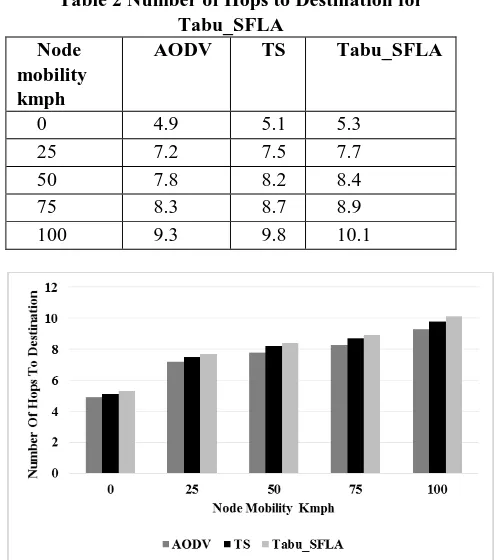
[image:6.595.311.560.143.423.2]In this section, the experimental setup are: 80 nodes in 4 sq km. Each node has 250 m range. Experiments are carried out using 0 to 100 node mobility in kmph. The AODV, TS and tabu_SFLA methods are used. The Packet Delivery Ratio (PDR), end to end delay and number of hops to sink as shown in tables 1 to 3 and Fig 1 to 3.
Table 1 Packet Delivery Ratio for Tabu_SFLA Node
mobility kmph
AODV TS Tabu_SFLA
0 0.9074 0.9483 0.971
25 0.8543 0.898 0.9191
50 0.8634 0.9023 0.924
75 0.8363 0.8789 0.9006
100 0.7823 0.8245 0.8402
Fig 1 Packet Delivery Ratio for Tabu_SFLA
[image:6.595.52.288.144.402.2]From the Fig 1, it can be observed that the tabu_SFLA has higher PDR by 6.77% & 2.36% for 0 node mobility, by 7.3% & 2.32% for 25 node mobility, by 6.78% & 2.37% for 50 node mobility, by 7.4% & 2.43% for 75 node mobility and by 7.14% & 1.88% for 100 node mobility when compared with AODV and TS.
Table 1 End to End Delay for Tabu_SFLA
Node mobility kmph
AODV TS Tabu_SFLA
0 0.0015 0.0014 0.0013
25 0.0018 0.0018 0.0017
50 0.0039 0.0039 0.0038
75 0.0052 0.0052 0.005
100 0.0175 0.0174 0.0167
Fig 2 End to End Delay for Tabu_SFLA
From the Fig 2, it can be observed that the tabu_SFLA has lower end to end delay by 14.28% & 7.41% for 0 node mobility, by 5.71% & 5.71% for 25 node mobility, by 2.59% & 2.59% for 50 node mobility, by 3.92% & 3.92% for 75 node mobility and by 4.67% & 4.1% for 100 node mobility when compared with AODV and TS.
Table 2 Number of Hops to Destination for Tabu_SFLA
Node mobility kmph
AODV TS Tabu_SFLA
0 4.9 5.1 5.3
25 7.2 7.5 7.7
50 7.8 8.2 8.4
75 8.3 8.7 8.9
100 9.3 9.8 10.1
Fig 3 Number of Hops to Destination for Tabu_SFLA From the Fig 3, it can be observed that the tabu_SFLA has higher number of hops to destination by 7.84% & 3.84% for 0 node mobility, by 6.71% & 2.63% for 25 node mobility, by 7.41% & 2.41% for 50 node mobility, by 6.97% & 2.27% for 75 node mobility and by 8.24% & 3.01% for 100 node mobility when compared with AODV and TS.
V.CONCLUSION
The MANET nodes are dynamic and self-organised since it is infrastructure-less. Provision of reliability is very important at the time of designing its routing protocol. The AODV protocol further provides multi-hop routing that is loop-free, dynamic and self-starting. This denotes the control packets have been broadcast at the time of need and thus will eliminate the need for routing updates being broadcast periodically. The TS is a method of mathematical optimization which belongs to the techniques of local search. It can enhance the local search method and its performance by means of employing their memory structures. The TABU list will have several attributes that have been very effective. The work has proposed the hybrid TABU_SFLA algorithm and retails the SFLA framework and also employs a neighbourhood structure-based method called the TS. It further avoids the areas explored already within the solution space and will move towards
the optimal solution in the local memetic evolution.
[image:6.595.50.292.518.774.2]TABU_SFLA to have a higher PDR by about 6.77% and 2.36% for the 0 node mobility, by about 7.3% and 2.32% for the 25 node mobility, by about 6.78% and 2.37% for the 50 node mobility, by about 7.4% and 2.43% for the 75 node mobility and by finally by about 7.14% and 1.88% for the 100 node mobility on being compared to the AODV and the TS.
REFERENCES
1. Kout, A., Labed, S., & Chikhi, S. (2018). AODVCS, a new bio-inspired routing protocol based on cuckoo search algorithm for mobile ad hoc networks. Wireless Networks, 24(7), 2509-2519. 2. Saritha, V., Krishna, P. V., Alagiri, I., Viswanatham, V. M., &
Obaidat, M. S. (2018, May). Efficient Multipath Routing Protocol with Quality of Service for Mobile Ad Hoc Networks. In 2018 IEEE International Conference on Communications (ICC) (pp. 1-6). IEEE. 3. Garg, D., & Gohil, P. (2012). Ant Colony Optimized Routing for
Mobile Ad Hoc Networks (MANET). International Journal of Smart Sensors and Ad Hoc Networks (IJSSAN), 2(3), 8-13.
4. Zhao, W., Ammar, M., & Zegura, E. (2004, May). A message ferrying approach for data delivery in sparse mobile ad hoc networks. In Proceedings of the 5th ACM international symposium on Mobile ad hoc networking and computing (pp. 187-198). ACM.
5. Chaudhry, R., Tapaswi, S., & Kumar, N. (2018). Forwarding zone enabled PSO routing with network lifetime maximization in MANET. Applied Intelligence, 48(9), 3053-3080.
6. Prasath, N., & Sreemathy, J. (2018). Optimized dynamic source routing protocol for MANETs. Cluster Computing, 1-13.
7. Arumugham, K., & Chenniappan, V. (2019). Least Mobility High Power (LMHP) Dynamic Routing for QoS Development in Manet. Wireless Personal Communications, 105(1), 355-368.
8. Robinson, Y. H., Balaji, S., & Julie, E. G. (2018). PSOBLAP: Particle Swarm Optimization-Based Bandwidth and Link Availability Prediction Algorithm for Multipath Routing in Mobile Ad Hoc Networks. Wireless Personal Communications, 1-29.
9. Wei, W., Qin, Y., & Cai, Z. (2018). A multi-objective multicast routing optimization based on differential evolution in MANET. International Journal of Intelligent Computing and Cybernetics, 11(1), 121-140. 10. Yang, D., Xia, H., Xu, E., Jing, D., & Zhang, H. (2018).
Energy-Balanced Routing Algorithm Based on Ant Colony Optimization for Mobile Ad Hoc Networks. Sensors, 18(11), 3657. 11. Singh, S., Koslia, M., & Poonia, R. C. (2018). A GA-QMR: Genetic
Algorithm Oriented MANET QoS Multicast Routing. Recent Patents on Computer Science, 11(4), 268-275.
12. Krishna, S. R. K. M., Ramanath, M. B. N. S., & Prasad, V. K. (2018). Optimal reliable routing path selection in MANET through hybrid PSO-GA optimisation algorithm. International Journal of Mobile Network Design and Innovation, 8(4), 195-206.
13. Nayak, P., & Sinha, P. (2015, December). Analysis of random way point and random walk mobility model for reactive routing protocols for MANET using NetSim simulator. In 2015 3rd International Conference on Artificial Intelligence, Modelling and Simulation (AIMS) (pp. 427-432). IEEE.
14. Zhang, H., & Sun, G. (2002). Feature selection using tabu search method. Pattern recognition, 35(3), 701-711.
15. Ebrahimi, J., Hosseinian, S. H., & Gharehpetian, G. B. (2011). Unit commitment problem solution using shuffled frog leaping algorithm. IEEE Transactions on Power Systems, 26(2), 573-581.
16. Afzalan, E., Taghikhani, M. A., & Sedighizadeh, M. (2012). Optimal placement and sizing of DG in radial distribution networks using SFLA. International Journal of Energy Engineering, 2(3), 73-77. 17. Sun, H., & Zhao, J. (2011). Application of particle sharing based
particle swarm frog leaping hybrid optimization algorithm in wireless sensor network coverage optimization. Journal Of Information &Computational Science, 8(14), 3181-3188.
18. Jiang, J. G., Su, Q., Li, M., Liu, M., & Zhang, L. (2013). An improved Shuffled Frog Leaping Algorithm. J. Inf. Comput. Sci, 10, 4619-4626. 19. Sarkheyli, A., Zain, A. M., & Sharif, S. (2015). The role of basic, modified and hybrid shuffled frog leaping algorithm on optimization problems: a review. Soft Computing, 19(7), 2011-2038.
AUTHORSPROFILE
Indhumathi E.. received MCA from Government Colloge (Auto), Kumbakonam, M.Phil from Bharathidasan University. Doing PhD in CS in Bharathiyar University. She has 15 years of Academic experience. She published her research work in 3 journals and attended Seminars and workshops.