Learner autonomy in modern higher education
AlexeyDanilenko1*,IrinaKosmidis1,VictoriaShershneva1, and YuliaVainshtein1
1Siberian Federal University, Kirenskogo st., 26, Krasnoyarsk, 660074, Russia
Abstract. This article deals with the concept of learner autonomy as well as the peculiarities of the use of the learner autonomy-based educational technology in the educational system of Russia. The analysis of the concept of learner autonomy is given basing on the works of both foreign and Russian specialists: the origin of the concept is traced back, different variants of defining the concept are given, and the teacher role in the context of learner autonomy is laid emphasis on. Generalizing the views the authors put forward their own definition of the concept of learner autonomy. The authors also point out the correlation of learner autonomy and the concept of communicative concept proposing their own view of communicative competence structure. Besides, the authors consider the prospect of implementing the learner autonomy-based educational technology into the realm of adaptive learning, which is also topical for modern Russian Education.
Keywords: academic mobility, life-long learning, autonomous learning, learner autonomy, independent learning, self-instruction, learning strategies.
1 Introduction
The pedagogy of the XXth century is marked by the creation of a wide range of educational technologies: The Montessori Method of education, Waldorf education, Dewey’s Instrumental pedagogy, and many others. The technology based on the concept of learner autonomy is worth mentioning as a separate point. Though this concept came to be used in Russia a short time ago, it has become the object of interest of homeland specialists due to the topicality of learner autonomy in global education. In this regard, the following questions have to be answered: is learner autonomy a personal characteristic or an educational technology? What are the prospects of learner autonomy being Russian education?
To answer the questions raised, we must first trace the roots of learner autonomy in foreign pedagogy. The word “autonomy” comes from Greek «αὐτονομία» which literally means “setting law for oneself”. The idea of a student taking the responsibility over his studying, hailed by learner autonomy ideologists, is not new. Galileo Galilei said: “A person cannot be taught. One can only help a person reveal everything in oneself” [1].
To some extent, Jean-Jacques Rousseau’s ideas also anticipated the creation of learner autonomy concept. He realized the importance of student responsibility for his own
learning and the value of the knowledge gained independently. He offered the following strategy of working with students: “arise the students’ interest, offer them a problem and leave it for the students to be solved. Everything they know must be gained by them personally, and not be transmitted by you. Do not correct any mistakes as long as they see them. If they cannot do it, help them; only by making mistakes can they learn something” [2].
Kolb model, which was put forward by an American educator David Kolb in the mid-1980s, stands on the same ground. This theory describes stage-by-stage development of mental activities. According to Kolb model, at the stage of learning the main material students are offered a certain range of tasks with the aim to independently gain knowledge and skills; it is gaining knowledge in individual work which plays the main role in the model [3].
2 Learner autonomy – the history of the concept
At the same time, certain economical and social changes, which had taken place in the world, lead to the creation of a language-teaching technique basing on the learner autonomy concept. When speaking of the theoretical prerequisites for learner autonomy, M. Gremmo and P. Riley show the importance of 1960s social progress when social orientation shifted itself from material values to personality development and social interactions [4]. H.Holec states that “language learning education becomes the interlink to global economy, and language skills are transformed into a kind of economic capital”, indicating to economic reasons for language learning spreading which results in the creation of a new language teaching concept [5]. Russian researchers Zh. S. Anikina and L. I. Agafonova see the reasons for learner autonomy concept creation in the global informational explosion of the 60’s and 70’s, the development of Internet technologies, commercialization of education, as well as the development of international tourism [6].
The concept of learner autonomy appeared in Nancy University Language Centre (Centre de Recherches et d’Applications en Langues – CRAPEL) in 1971 with respect to the project of the British Council for Foreign Language Learning. The centre was founded by Yves Chalonne; after his death in 1972 the centre was headed by Henry Holec, who published “Autonomy and Foreign Language Learning” in 1981. In this work autonomy was defined as “the ability to take responsibility for his own learning.” The centre activities were aimed at creating such an educational model which would develop personal freedom, independent goal setting and self-assessment skills. The CRAPEL specialists consider the following conditions to be essential for successful learner autonomy development:
1)Unlimited access to a resource centre equipped with authentic materials;
2) Psychological training of student aimed at organization, control, and self-assessment [6].
It should be noted that the actively developing concept of learning autonomy received no acclaim in Soviet pedagogy. First of all, it can be assigned to the fact that the ideological and collective orientation of the Soviet education did not share the idea of personalization of education which hindered the development of learner autonomy in the USSR. Besides, the political isolation of the country could not promote to the spread of foreign scientific ideas, including the concept of learner autonomy.
learning and the value of the knowledge gained independently. He offered the following strategy of working with students: “arise the students’ interest, offer them a problem and leave it for the students to be solved. Everything they know must be gained by them personally, and not be transmitted by you. Do not correct any mistakes as long as they see them. If they cannot do it, help them; only by making mistakes can they learn something” [2].
Kolb model, which was put forward by an American educator David Kolb in the mid-1980s, stands on the same ground. This theory describes stage-by-stage development of mental activities. According to Kolb model, at the stage of learning the main material students are offered a certain range of tasks with the aim to independently gain knowledge and skills; it is gaining knowledge in individual work which plays the main role in the model [3].
2 Learner autonomy – the history of the concept
At the same time, certain economical and social changes, which had taken place in the world, lead to the creation of a language-teaching technique basing on the learner autonomy concept. When speaking of the theoretical prerequisites for learner autonomy, M. Gremmo and P. Riley show the importance of 1960s social progress when social orientation shifted itself from material values to personality development and social interactions [4]. H.Holec states that “language learning education becomes the interlink to global economy, and language skills are transformed into a kind of economic capital”, indicating to economic reasons for language learning spreading which results in the creation of a new language teaching concept [5]. Russian researchers Zh. S. Anikina and L. I. Agafonova see the reasons for learner autonomy concept creation in the global informational explosion of the 60’s and 70’s, the development of Internet technologies, commercialization of education, as well as the development of international tourism [6].
The concept of learner autonomy appeared in Nancy University Language Centre (Centre de Recherches et d’Applications en Langues – CRAPEL) in 1971 with respect to the project of the British Council for Foreign Language Learning. The centre was founded by Yves Chalonne; after his death in 1972 the centre was headed by Henry Holec, who published “Autonomy and Foreign Language Learning” in 1981. In this work autonomy was defined as “the ability to take responsibility for his own learning.” The centre activities were aimed at creating such an educational model which would develop personal freedom, independent goal setting and self-assessment skills. The CRAPEL specialists consider the following conditions to be essential for successful learner autonomy development:
1)Unlimited access to a resource centre equipped with authentic materials;
2) Psychological training of student aimed at organization, control, and self-assessment [6].
It should be noted that the actively developing concept of learning autonomy received no acclaim in Soviet pedagogy. First of all, it can be assigned to the fact that the ideological and collective orientation of the Soviet education did not share the idea of personalization of education which hindered the development of learner autonomy in the USSR. Besides, the political isolation of the country could not promote to the spread of foreign scientific ideas, including the concept of learner autonomy.
Various studies devoted to the phenomenon of learner autonomy have revealed its versatility. We will consider a couple of examples to illustrate how the views on learner autonomy might vary. Thus, Holec sees learner autonomy as the ability acquired during the learning process. Another specialist, L. Dickinson, understands it as a learning model, where all students bear responsibility for all decisions related to their studies, as well as for the outcomes [7].
As the concept of learner autonomy was gaining its theoretical justification, certain attention was paid to the teacher role in the context of this concept. For example, P. Voller marks three stages of teacher-student interaction:
1) the transition of educational process control from the teacher to the student; 2) partnership relations with students;
3) observing applied learning strategies and the ways of interacting with students from the teacher side [8].
Besides, the Chinese specialist S. Yan ascribes the teacher place in the context of learner autonomy to the following roles:
1) Organizer – the teacher takes the responsibility for organizing classroom activities, offering appropriate and effective tasks that will best meet students’ needs and expectations. The teacher should be aware of the importance of giving clear instructions to what it is to be done.
2) Facilitator – the teacher lends students psycho-social and technical assistance. Psycho-social assistance implies the ability to motivate students which helps them overcome difficulties. Technical assistance includes helping students plan and carry out learning activities, evaluate progress and acquire knowledge and skills. In a classroom language learning environment, the teacher also acts as the model of a native speaker - in this role the teacher encourages students into using the foreign language and corrects the mistakes that appear in students’ speech.
3) Counselor – the teacher must show the example of effective communication with an attempt to mesh speaker intention and hearer interpretation [9].
3 Learner autonomy, capability of learning autonomy, the
technology of learner autonomy development
We think it necessary to make our view of learner autonomy more specific in order to avoid confusion in the conceptual framework we use. We put the following meaning into “learner autonomy”: the ability of the student to take responsibility over his or her own learning. It is important to note that we see learner autonomy not only as the ability which manifests at various stages of (its development during) the educational process, but also as the readiness to apply this ability in practice in future career. By “capability of learner autonomy” we mean a personality trait of the student which is manifested in an acquired ability to take responsibility for his or her own learning being represented at several levels: 1) setting learning objectives; 2) choosing personal learning strategy; 3) intermediate and overall self-reflection related to learning objectives.
4 Learner autonomy in Russian educational system
We have already mentioned the fact that learner autonomy concept could not be developed under the conditions of the Soviet education. The system, which was famous for teaching exact sciences, had issues with the effectiveness of teaching foreign languages. Thus, if it was possible to shift the teaching methods for mathematics, psychics and other exact sciences from the Soviet educational system to a new Russian one, then there was no point in borrowing the Soviet foreign language teaching method. This circumstance cleared the way for a number of overseas foreign language teaching methods to be implemented in the Russian educational system, including the concept of learner autonomy.
Another reason for learner autonomy to appear in the Russian educational system can be found in the following sociopolitical step. In the 1990s European states signed the Bologna agreement. One of its objectives was to raise academic mobility in higher education which would, in turn, require such personal traits as independence and responsibility for learning. Russia’s joining the Bologna agreement in 2003 promoted the spread of the learner autonomy concept in Russian educational system.
The obligatory requirements for education in Russia are presented in the Federal state learning standard of higher education. It contains the list of competencies that a graduate must acquire that also includes “the capability for self-management and self-instruction”, that, in our opinion, can be reached by plunging students into learner autonomy environment throughout mastering academic program.
It should be noted that plunging students into learner autonomy conditions can also successfully be used in adaptive e-learning, in which it is possible to adapt educational content to student’s individual abilities, knowledge and skills. The created individual educational trajectories are used as the basis for adaptive e-learning courses on foreign language. The obtained theoretical conclusions may be used for developing learning strategies in teaching various subjects [10].
The founders of the concept of learner autonomy thought free access to authentic materials to be one of the factors of its development. Nowadays, the enormous development rates for information and computer technologies (ICT) provide education with a wide range of tools for educational process. It also creates favorable conditions for developing learner autonomy, since the use of ICT in educational process enables orientation on personal achievements.
It is obvious that the objective of language learning is not only studying vocabulary, grammar, cultural peculiarities typical for native speakers. The long-run objective is to develop oral skills, i.e. the readiness to express thoughts verbally, to perceive the utterance of an interlocutor. Due to the orientation of learner autonomy on individual work, teaching oral skills, which demands the combination of pair and group work, requires further development. In our opinion, the use of learner autonomy in teaching foreign language makes sense only in case the learner autonomy skills are used as the certain foundation, which is necessary for forming personal traits that develop responsibility for student’s own learning for more effective foreign language mastering. Teaching verbal aspect of a foreign language has to be carried out with the application of pair and group work. In our opinion, the use of learner autonomy technology in teaching foreign languages is essential for developing the certain foundation which contributes to developing such personal traits as responsibility for learning, independence in making decisions, confidence in one’s abilities. These traits will help form oral skills in further studying.
4 Learner autonomy in Russian educational system
We have already mentioned the fact that learner autonomy concept could not be developed under the conditions of the Soviet education. The system, which was famous for teaching exact sciences, had issues with the effectiveness of teaching foreign languages. Thus, if it was possible to shift the teaching methods for mathematics, psychics and other exact sciences from the Soviet educational system to a new Russian one, then there was no point in borrowing the Soviet foreign language teaching method. This circumstance cleared the way for a number of overseas foreign language teaching methods to be implemented in the Russian educational system, including the concept of learner autonomy.
Another reason for learner autonomy to appear in the Russian educational system can be found in the following sociopolitical step. In the 1990s European states signed the Bologna agreement. One of its objectives was to raise academic mobility in higher education which would, in turn, require such personal traits as independence and responsibility for learning. Russia’s joining the Bologna agreement in 2003 promoted the spread of the learner autonomy concept in Russian educational system.
The obligatory requirements for education in Russia are presented in the Federal state learning standard of higher education. It contains the list of competencies that a graduate must acquire that also includes “the capability for self-management and self-instruction”, that, in our opinion, can be reached by plunging students into learner autonomy environment throughout mastering academic program.
It should be noted that plunging students into learner autonomy conditions can also successfully be used in adaptive e-learning, in which it is possible to adapt educational content to student’s individual abilities, knowledge and skills. The created individual educational trajectories are used as the basis for adaptive e-learning courses on foreign language. The obtained theoretical conclusions may be used for developing learning strategies in teaching various subjects [10].
The founders of the concept of learner autonomy thought free access to authentic materials to be one of the factors of its development. Nowadays, the enormous development rates for information and computer technologies (ICT) provide education with a wide range of tools for educational process. It also creates favorable conditions for developing learner autonomy, since the use of ICT in educational process enables orientation on personal achievements.
It is obvious that the objective of language learning is not only studying vocabulary, grammar, cultural peculiarities typical for native speakers. The long-run objective is to develop oral skills, i.e. the readiness to express thoughts verbally, to perceive the utterance of an interlocutor. Due to the orientation of learner autonomy on individual work, teaching oral skills, which demands the combination of pair and group work, requires further development. In our opinion, the use of learner autonomy in teaching foreign language makes sense only in case the learner autonomy skills are used as the certain foundation, which is necessary for forming personal traits that develop responsibility for student’s own learning for more effective foreign language mastering. Teaching verbal aspect of a foreign language has to be carried out with the application of pair and group work. In our opinion, the use of learner autonomy technology in teaching foreign languages is essential for developing the certain foundation which contributes to developing such personal traits as responsibility for learning, independence in making decisions, confidence in one’s abilities. These traits will help form oral skills in further studying.
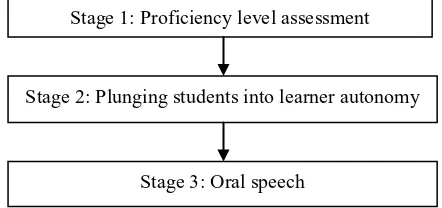
Thus, a course on a foreign language (designed for four years) under the conditions of learner autonomy is to consist of three stages. At the first stage the current foreign language proficiency level is to be assessed in order to complete classes and to create individual educational trajectories in e-learning environment. The second stage is devoted to plunging
students into learner autonomy with the aim to develop independence in making decisions, to choose an individual trajectory of studying educational content and to evaluate progress. At the third stage the attention is paid to the most important objective of foreign language learning – oral speech, both as monologue and dialogue.
Fig. 1. A foreign language course under the conditions of learner autonomy
Speaking of oral speech training we imply communicative competence development. This notion was coined in 1970s by Dell Hymes to emphasize the dependence of the use of certain lexical items or grammar structure on speech situations [11]. In our opinion, communicative competence is divided into three levels – linguistic, speech and professional ones. The linguistic level, in its turn, consists of three equally important sublevels:
1) Lexical, which includes obtaining certain vocabulary and using lexical items depending on speech context.
2) Grammatical, which implies knowledge of the language grammatical system and an ability to use grammar rules in different types of speech.
3) Phonetic, which unites knowledge of the language phonetic system and prosody and an ability to pronounce words and sentences correctly.
Speech level is divided into the following sublevels:
1) Discursive – an ability to build logically finished utterances and to perceive interlocutor speech adequately.
2) Strategic – an ability to compensate lacking knowledge in case of communication breakdown.
Taking a special place in this structure, professional level of communicative competence includes:
1) an ability to use the foreign language interdisciplinarily,
2) an ability to apply foreign language skills in professional activities.
The hierarchy of communicative competence levels is formed as follows: linguistic level acts as the foundation for developing this competence as to make an utterance it is necessary to obtain certain vocabulary (obtaining vocabulary is included into lexical sublevel of linguistic level of communicative competence) and grammar structures (grammatical sublevel). Speech level, which takes the second step of the hierarchy, is gradually developed basing on the elements of linguistic level – various layers of vocabulary and necessary grammar structures. Speech level is followed by professional level – mastering the professional language is possible only after the development of linguistic and speech levels. The essence of professional level is to develop skills and abilities required for special purpose application of the foreign language in professional activities [12].
Stage 1: Proficiency level assessment
Stage 2: Plunging students into learner autonomy
[image:5.482.114.335.130.234.2]Professional level
Speech level (discursive, strategic sublevels)
Linguistic level (lexical, grammatical, phonetic sublevels)
Fig. 2. The structure of communicative competence.
5 Results
The experiment was carried out at Siberian Federal University within a period of four years. To assess efficiency of the educational process implementation of the abovementioned technology, the academic record comparison with the use of Mann – Whitney U-test was made between the control group and the experimental group before the onset of studying, during each stage and after accomplishing each stage. The students were offered to take a placement test and a final test assessed in points at each stage. In doing so hypothesis H0={point distribution in the control group and the experimental group is equal} under the alternative hypothesis H1={point distribution in the experimental group takes a bigger value} was checked. Taking the results of the experiment into account, it is fair to say that with a probability of 95% better academic record in learning foreign language was reached in the experimental group, furthermore, the following personal trait were formed – self-sufficiency, responsibility, confidence in one’s abilities. Being applied at Siberian Federal University, the technology of learner autonomy development has shown that the traits acquired at the second stage of the experiment contribute to the future progress in mastering a foreign language.
6 Conclusions
Thus, basing on the analysis of the various views on learner autonomy concept, the authors have proposed their own idea of it underlining the ambiguity of learner autonomy. The correlation between teaching foreign language under the conditions of learner autonomy and communicative competence development has been pointed out. The difference between the notions “learner autonomy”, “capability of learner autonomy”, and “technology of learner autonomy development” has been shown. The authors have also analyzed the current state of affairs in Russian educational system, paying attention to the fact that Russia’s joining the Bologna agreement in 2003 promoted the spread of learner autonomy concept in Russian education. The article also presents the results of the experiment carried out at Siberian Federal University to show the effectiveness of the technology of learner autonomy development in teaching foreign language.
The reported study was funded by RFBR according to the research project №18-013-00654
References
1. P. Benson,Teaching and Researching: Autonomy in Language Learning (2nd edition),272 (2001)
2. D. Thanasoulas, What is Learner Autonomy and How Can It Be Fostered,URL: http://iteslj.org/Articles/Thanasoulas-Autonomy.html (2000)
Professional level
Speech level (discursive, strategic sublevels)
Linguistic level (lexical, grammatical, phonetic sublevels)
Fig. 2. The structure of communicative competence.
5 Results
The experiment was carried out at Siberian Federal University within a period of four years. To assess efficiency of the educational process implementation of the abovementioned technology, the academic record comparison with the use of Mann – Whitney U-test was made between the control group and the experimental group before the onset of studying, during each stage and after accomplishing each stage. The students were offered to take a placement test and a final test assessed in points at each stage. In doing so hypothesis H0={point distribution in the control group and the experimental group is equal} under the alternative hypothesis H1={point distribution in the experimental group takes a bigger value} was checked. Taking the results of the experiment into account, it is fair to say that with a probability of 95% better academic record in learning foreign language was reached in the experimental group, furthermore, the following personal trait were formed – self-sufficiency, responsibility, confidence in one’s abilities. Being applied at Siberian Federal University, the technology of learner autonomy development has shown that the traits acquired at the second stage of the experiment contribute to the future progress in mastering a foreign language.
6 Conclusions
Thus, basing on the analysis of the various views on learner autonomy concept, the authors have proposed their own idea of it underlining the ambiguity of learner autonomy. The correlation between teaching foreign language under the conditions of learner autonomy and communicative competence development has been pointed out. The difference between the notions “learner autonomy”, “capability of learner autonomy”, and “technology of learner autonomy development” has been shown. The authors have also analyzed the current state of affairs in Russian educational system, paying attention to the fact that Russia’s joining the Bologna agreement in 2003 promoted the spread of learner autonomy concept in Russian education. The article also presents the results of the experiment carried out at Siberian Federal University to show the effectiveness of the technology of learner autonomy development in teaching foreign language.
The reported study was funded by RFBR according to the research project №18-013-00654
References
1. P. Benson,Teaching and Researching: Autonomy in Language Learning (2nd edition),272 (2001)
2. D. Thanasoulas, What is Learner Autonomy and How Can It Be Fostered,URL: http://iteslj.org/Articles/Thanasoulas-Autonomy.html (2000)
3. D. Kolb, Experiential learning: experience as the source of learning and development,272 (1984)
4. M-J. Gremmo, P. Riley, System, Autonomy, self-direction and self-access in language teaching and learning: the history of an idea, 23(2), 154 (1995)
5. H. Holec, Foreign language learning: meeting individual needs, Learnertraining: meeting needs in self-direct learning,36 (1980)
6. Zh. S. Anikina, L.I. Agafonova, Vestnik Tomskogo gosudarstvennogo ped-agogicheskogo universiteta,Learner autonomy in language teaching: history of the concept in foreign pedagogy, 4 (82), 25 (2009)
7. L. Dickinson, Self-instruction in Language Learning, 156 (1987)
8. P. Voller, Autonomy and interdependence in language learning,Does the teacher have a role in autonomous learning,105 (1997)
9. S. Yan, Journal of Sociological Research,Teachers' roles in autonomous learning, 2, 559 (2012)
10. Yu.V. Vainshtein, R.V. Esin, G.M. Tsibulsky, Education and Informatics, Adaptive model of developing individual educational trajectories for blended learning, 2, 86 (2017)
11. E.V. Krasilnikova, Pedagogicheskiy vestnik, Communicative competence in the proceedings of homeland and foreign specialists,1(58), 188 (2009)