MyLexics: An Assistive Courseware for Dyslexic Children to
Learn Basic Malay Language
Muhammad Haziq Lim Abdullah, Syariffanor Hisham, Shahril Parumo
Faculty of Information and Communication TechnologyUniversiti Teknikal Malaysia Melaka (UTeM) {haziq, syariffanor, shahrilparumo}@utem.edu.my
Introduction
Dyslexia is a language-based learning disability resulting in people experiencing difficulties in reading, spelling, writing and speaking due to inability to differentiate sound components. These problems are sometimes accompanied by short-term memory difficulties, a lack of organizational skills and time management issues which all have an impact on learning. Dyslexia can occur regardless of age groups and in some cases; dyslexics may have higher IQ level compare to others.
MyLexics is a courseware that was designed to help dyslexic children learn to read and write in the Malay language. This project is collaboration between the Faculty of Information & Communication Technology, UTeM and Malaysia Dyslexia Association. The President of Dyslexia Association of Malaysia, Mrs. Sariah Amirin (1998 – present) is also the subject matter expert in the development of MyLexics’s contents.
MyLexics was developed based the ‘Dual coding theory’by Allan Paivio (Paivo and Begg, 1981)who suggested that a recall or recognition can be enhanced by presenting information in both visual and verbal form, combined with the Scaffolding teaching strategy (Wood et. al, 1976).– providing assistance to student on a as-needed basis, fading it as the competence increases. The courseware content has been structured as building-up process: The children learn the individual ‘alphabets’ and then combine the alphabets to make ‘syllables’, finally they add the combined syllables to other syllables to form ‘words’. The implementation of stated principles via multimedia elements allows independent and interactive learning, and yet engages the learners in interesting tasks. MyLexics is expected to contribute to the development of teaching technology in Malay language education for dyslexic children in Malaysia. This is aligned with the project by Ministry of Education Malaysia (MOE) called Dyslexia Pilot Projects (DPP) that was launched in March 2004 and currently being implemented in 30 government aided primary schools throughout the country. Apart from DPP by MOE, MyLexics is also in line with teaching activities conducted by non-government organizations, namely by the Kuala Lumpur Dyslexia Association. It has undergone an acceptance testing. The feedback and positive results from the dyslexic children at the center were very much promising.
Why MyLexics?
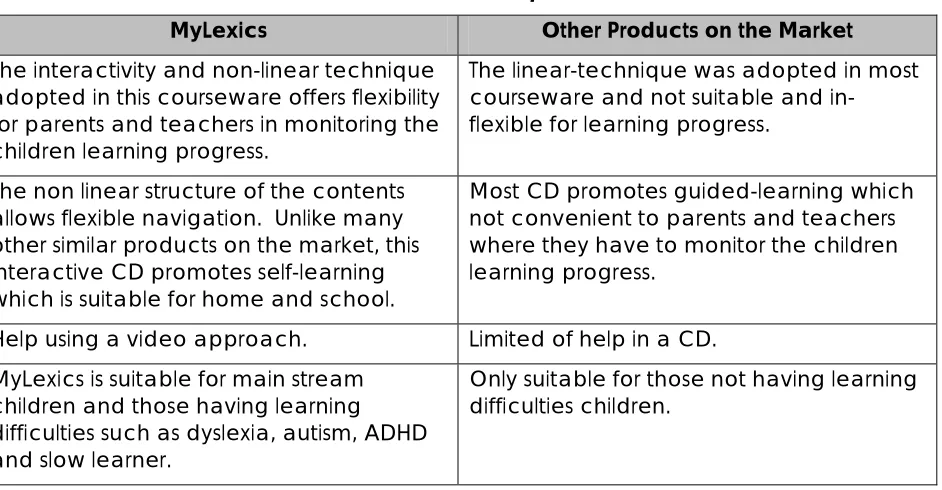
types of learning difficulties such as autism and slow learner. Table 1 shows the comparison between MyLexics and other similar products in the market.
Table 1. Product Comparison
MyLexics Other Products on the Market
The interactivity and non-linear technique adopted in this courseware offers flexibility for parents and teachers in monitoring the children learning progress.
The linear-technique was adopted in most courseware and not suitable and
in-flexible for learning progress.
The non linear structure of the contents allows flexible navigation. Unlike many other similar products on the market, this interactive CD promotes self-learning which is suitable for home and school.
Most CD promotes guided-learning which not convenient to parents and teachers where they have to monitor the children learning progress.
Help using a video approach. Limited of help in a CD. MyLexics is suitable for main stream
children and those having learning difficulties such as dyslexia, autism, ADHD and slow learner.
Only suitable for those not having learning difficulties children.
MyLexics: Courseware Modules
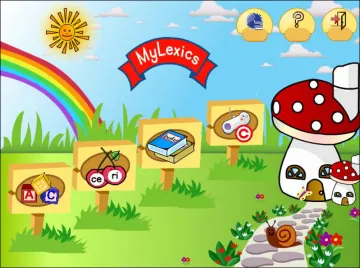
MyLexics is the first courseware in Malaysia for dyslexic children learning to read and write in Malay language. The courseware integrates all multimedia elements that supports interactive and self-learning environment both at school and at home. MyLexics comprises of Modul Pembelajaran which consists of three sub-modules (Abjad, Sukukata and
Perkataan) are described in the further text.
Figure 1: MyLexics Main Menu
Abjad (Alphabet) Module
This module will give the users the foundation of recognizing and writing letters of the alphabet. First, they will be introduced to a letter and the shape of the letter. Then they will learn to recognize all the letters by its categories: Vowels and consonants. Among vowel letters, dyslexics always get confused with vowel ‘e’ and ‘i’. This is due to the similar sounds of the letter (Mohd Yusoh et. al, 2008). Thus, the letters are displayed in separated pages. Figure 3 shows a sample screen for writing a vowel.
Figure 3: Introducing and Writing a Vowel
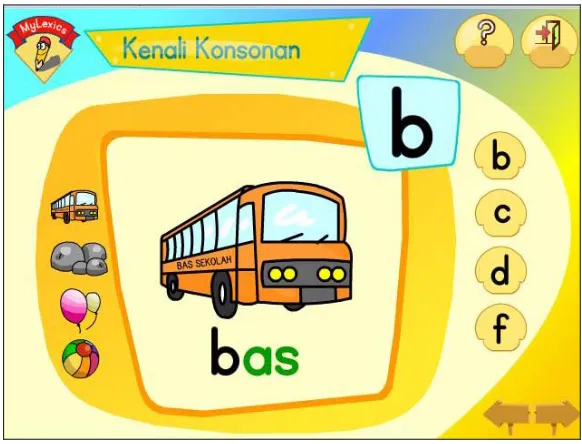
Dyslexics always rely on pictures and contextual clues to say a word (Earnshaw and Seargeant, 2005). This is due to their poor decoding skill especially of symbols like letters. To overcome this problem, MyLexics associated letters with images and audio. Here, dyslexics will associate the shape of the image with the letter itself. This is an example of dual coding theory concept. The dyslexics are given cues by images and audio to help them recognize letter that they do not immediately recognize. Figure 4 shows a sample screen of recognizing a letter in Consonant Module.
[image:4.612.151.442.451.673.2]Sukukata (Syllables) Module
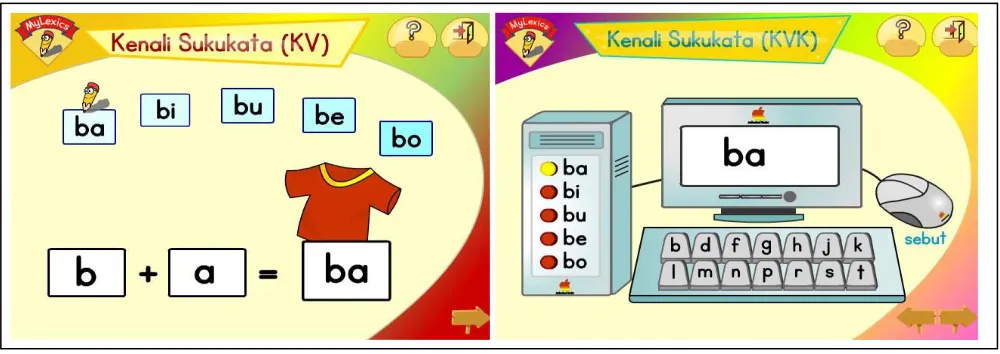
[image:5.612.54.554.249.426.2]In Abjad Module, dyslexics learn the individual vowel and consonant and its sound. In this module, they will learn the combination of a vowel and a consonant to form a syllable. As MyLexics is targeted to preschoolers, only two-letter syllables are covered. The method used is quite straightforward. In MyLexics, dyslexics will learn syllables using Simultaneous Oral Spelling (SOS) technique. This technique stresses four main components of learning, which are 1) Hear it, 2) Say it, 3) See it, 4) Write it. Here, the SOS uses multi-sensory approach where learners use their vision and hearing to learn the syllables. In addition, in order to capture and sustain dyslexics’ attention and interest, simple animations are provided with interesting illustration of the letter combination process. Figure 5 below shows sample screens for Sukukata Module.
Figure 5. ‘Sukukata’ Module
The learner can click on the syllable, hear the sound of syllable, and watch a 2D animation of combination of the letters to make the syllable. Like in Abjad module, vowel ‘i' and ‘e’ are displayed in separate screen.
Perkataan (Words) Module
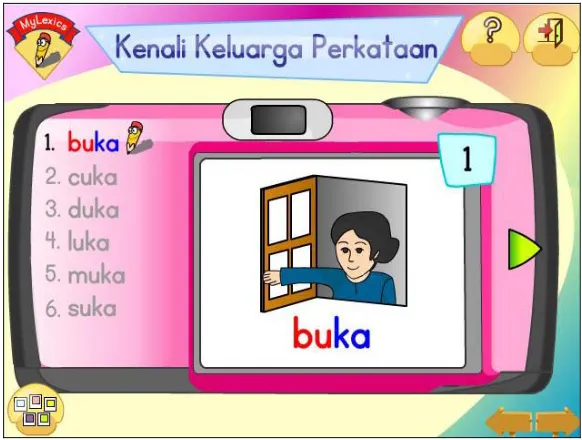
which will help the dyslexics to retain more information. Next, the system will highlight the next picture with an animation of letter transition in the first word. Voice-over is provided to explain the transition. Figure 6 shows the word set. The learners can continue with the next family word by clicking at the arrow button.
Figure 6. Perkataan Module
Comparison with other products
There are several products on the Malaysian market to teach reading such as Siri Cepat
Membaca Bacalah Anakku and ReadEasy (http://readnetwork.com). Bacalah Anakku is a
package of basic learning of Malay language for children, consisting of 8 books, 1 booklet, 1 VCD and 12 scan cards. The comparison between MyLexics and Bacalah Anakku are shown in the Table 1.
Recognition of the initiative
• Silver Medal, E-learning for Disability: An Assistive Multimedia Courseware for Dyslexics, UTeM Exhibition 2008 (In conjunction with Malacca Education Carnival), Innovation Category, Melaka International Trade Centre, 27-30 March 2008.
• Gold Medal, MyLexics: An Assistive Multimedia Courseware for Teaching and Reinforcing Basic Skills in Reading Malay Language among Dyslexics, The 18th International Invention, Innovation and Technology Exhibition (ITEX07), Kuala Lumpur Convention Centre, 18-20 May 2007.
Acknowledgement
This work is funded by UTeM under the Short Research Grant Scheme by Centre for Research and Innovation Management (CRIM), UTeM.
References
1. Paivio, A. & Begg, I. (1981). The Psychology of Language. New York: Prentice-Hall.
2. Wood, D., Bruner, J., & Ross, G. (1976). The role of tutoring in problem solving. Journal of child
psychology and psychiatry, 17, 89-100.
3. Mohd Yusoh, Z.I., Devaraju, A., Zakaria, M.H. & Techanamurthy, U. (2008). An Overview of
Learning Contents in MyLexics - An Assistive Multimedia Courseware for Dyslexics. In: Proc. The13th International Conference in Education, Brunei Darul Salam
4. Earnshaw, T. & Seargeant, A. (2005). Dealing with dyslexia and other reading difficulties. Prentice
Hall
5. ReadNetwork, http://readnetwork.com
About the Authors
This article was wrote by Muhammad Haziq Lim Abdullah, Syariffanor Hisham, Shahril Parumo. In addition to the authors of this article, other researchers who were involved in this project are Wan Sazli Nasaruddin Saifuddin, Mohd Hafiz Zakaria, Anusuriya Devaraju and Zeratul Izzah Mohd Yusoh.
Muhammad Haziq Lim Abdullah is a lecturer and researcher at the
Faculty of Information and Communication Technology at Universiti Teknikal Malaysia Melaka (UTeM). He has a Master of Multimedia from Swinburne University of Technology, Australia and Bachelor of Information Technology (Honours) (Multimedia Studies) from Universiti Kebangsaan Malaysia. His research interest are in the area of assistive technology and artificial intelligence.
Syariffanor Hisham is a lecturer and researcher at the Faculty of
Information and Communication Technology at Universiti Teknikal Malaysia Melaka, Malaysia. She has a Bachelor Degree in Information Technology (Universiti Utara Malaysia) and an MSc in Multimedia Technology from the University of Manchester. Her PhD thesis at the University of York, UK is about Localising User-interface design for elderly users inMalaysia. Her research interests are mainly in the area of Human-Computer Interaction including assistive technology, culture and people
with special needs.
Shahril Parumo is a lecturer and researcher at the Faculty of Information