Developing methods of controlling quality costs
A. V. Gorbunova1,*, O. N. Maximova1, and V. A. Ekova1 1
Volzhsky Polytechnical Institute (Branch of) VSTU, Volzhsky, Russian Federation
Abstract. The article examines issues of managing quality costs, problems of applying economic methods of quality control, implementation of progressive methods of quality costs management in enterprises with the view of improving the efficiency of their evaluation and analysis. With the aim of increasing the effectiveness of the cost management mechanism, authors introduce controlling as a tool of deviation analysis from the standpoint of the process approach. A list of processes and corresponding evaluation criteria in the quality management system of enterprises is introduced. Authors also introduce the method of controlling quality costs and propose it for the practical application, which allows them to determine useful and unnecessary costs at the existing operating plant. Implementing the proposed recommendations in the system of cost management at an enterprise will allow to improve productivity of processes operating and reduce wasted expense on the quality of the process on the basis of determining values of useful and useless costs of quality according to criteria of processes functioning in the system of quality management.
1 Introduction
The mechanism of managing quality cost requires scientific understanding and practical solutions to issues related to the introduction of new, effective and consistent with applicable accounting standards, methods of systematization and quantification of quality costs. It is reasonable to develop and implement them due to the need to timely identify and predict adverse situations in the expenditure of resources on quality management, as well as to give the managers of enterprises objective information about the actual level of quality costs.
It is especially important to enhance the effectiveness of assessing and analyzing quality costs in the framework of the widely introduced process approach to quality management. Methods of systematization and evaluation of quality costs used by enterprises should be aimed at timely determination of quality cost within processes, an accurate analysis of their deviations according to the criteria of processes, at identification of the causes of these deviations and at the development of effective corrective actions. This is especially true for companies actively developing a progressive quality management system based on process approach to enhance their competitive positions in domestic and foreign markets. Since enterprises are oriented at achieving managerial progress in the field of quality controlling, it becomes necessary to introduce effective tools for monitoring and evaluating quality costs, that allow optimization of these costs within individual processes, as well as in the context of the entire quality management system.
The necessity to increase the efficiency of quality costs management on the basis of applying the new ways of their systematization and quantification from the
standpoint of modern trends in quality management determines the relevance of this article.
The purpose of the article is to give theoretical justification and to develop practical recommendations for improving the mechanism of quality cost management by applying new advanced methods of systematization and evaluation of quality costs on the basis of managerial, scientific and technical progress achievements.
To achieve this goal it is necessary to fulfill particular tasks: to justify theoretically the implications of process approach in enterprises subject to the division of quality costs according to the types of quality management processes; to develop and propose methods of controlling quality costs; to make basic conclusions.
2
Theoretical aspects of the process
approach to quality management
The desire to strengthen their competitive position forces economic entities to view quality management as an evolutionary process, based on the constant application of new internationally recognized organization and production management methods based on the achievements of management progress. Among these methods is the process approach to quality management on the basis of existing ISO standards, that ensures regularity of management at the junction of individual processes within their system as well as in case of their combination and interaction [1, 2, 3, 4].
(productivity) of the functioning processes of an enterprise.
All processes of the company according to their functional (target) purpose can be divided into basic, controlling, and maintaining [5]. Therefore, quality costs according to the types of quality management processes can be divided into the following groups: quality costs for basic processes, quality costs for maintaining processes and quality costs for controlling processes. Each cost group according to the types of processes includes a set of useful costs (ensuring compliance with the stated requirements and saving of resources allocated for achieving objectives in the quality field) and unnecessary costs (related inconsistencies and causing the overuse of resources) [6, 7, 8].
Since each process is characterized by a number of criteria allowing us to supervise and analyze the work process, all the cost groups in the proposed classification should be considered in the context of the criteria of the processes taking place in the system of quality management. This gives the opportunity to assess in value terms the resources allocated for achieving the objectives of quality within a particular process, and the totality of the processes in the enterprise [9, 10, 11].
Among the most common and important functions of quality management (planning, organization, coordination, motivation, etc.) control is extremely important because it allows you to develop the strategy and tactics of optimal allocation of resources in the interest of product improvement, to identify the cost of individual errors in the production process and, while ensuring the required level of quality, to evaluate effectiveness and to identify areas for improvement of the quality management system as a whole [12, 13].
Controlling operates as an instrument of quality costs management, allowing to improve the deviation analysis in quality costs management, and the managerial decisions made on its basis [14]. The use of controlling as a tool of deviation analysis according to the criteria of the process from the standpoint of the process approach allows you to increase the effectiveness of control within each individual process, and in the framework of the process approach to the management of quality costs in general.
The process of controlling quality costs is a system of communication, development and implementation of management decisions and their informational support. The system structure of controlling the quality costs means both functional and organizational structure, a set of organizational relations, as well as specific schemes of interaction between management authorities. The technique of controlling quality costs consists of computer and office software, document management system. These subsystems of controlling quality costs are integrated in a single information space, largely defining efficiency of the mechanism for the quality costs management in an enterprise.
The traditional mechanism of managing quality costs involves planning the values of quality costs, expenditure of resources as planned (determination of the actual quality costs values), comparison of planned and actual values of quality costs (identification of deviations) and if there are deviations – the adoption of measures to eliminate them.
The improved mechanism of quality costs management based on controlling contains new unit in its structure – "Controlling quality costs" (Fig. 1), which allows you to analyze deviations of quality costs and find the resources to eliminate them within the ongoing enterprise control.
[image:2.595.310.535.213.312.2]Regular detection and complete deviation analysis of quality costs within each process provides the basis for preventing the accumulation of negative deviations in the totality of processes in the quality system and, thereby, becomes an integral part of the effective mechanism of quality costs management at an enterprise.
Fig. 1. Improved mechanism of quality cost management.
Applying controlling as a part of the quality costs management mechanism is crucial for businesses. Controlling of quality costs performs as an effective tool of quality cost management and is able to maintain control of these costs from the standpoint of the process approach used at enterprises.
3 Methods of controlling quality costs
The proposed methodology of controlling the quality costs is based on defining the range of allowed values for the processes criteria, on analyzing the corresponding deviations of the actual costs of quality from the standard by the methods of controlling; on identifying the magnitude of useful and unnecessary quality costs according to the criteria of the process and its general effectiveness [10].
The method is based on a common understanding of the process as a set of interacting activities that transforms inputs (input streams) to outputs (output streams) using appropriate resources [15]. Parameters (criteria) of the process represent the characteristics (information) by which the process owner and the senior manager can judge the effectiveness of process execution and to evaluate the degree of achievement of planned results [16].
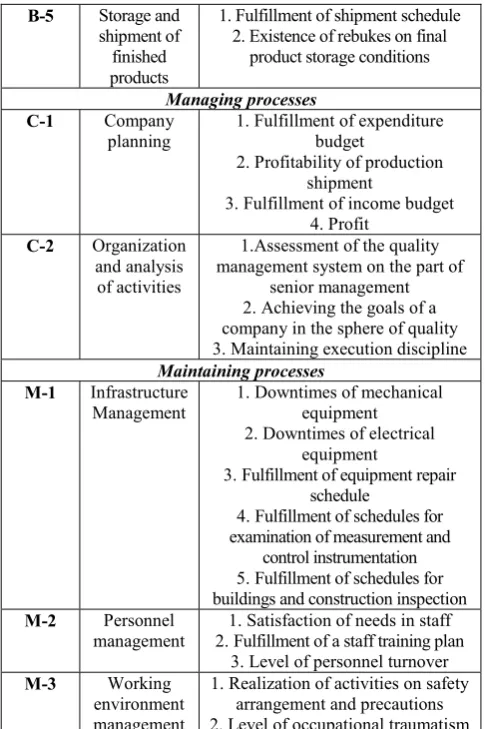
A list of the basic, maintaining and managing processes, functioning as a part of the quality management system, are presented in Table 1. Each company develops its own list of processes that reflect the types and characteristics of production at the enterprise. However, since enterprises are oriented on the common for all economic entities requirements of ISO, a similar approach is used for qualifying managing and maintaining processes as well as to the criteria characterizing them.
[image:3.595.303.546.69.434.2]Analysis of the processes operating in the system of quality management of an enterprises shows that the substantive part of the criteria of processes (primarily the basic and maintaining) allows you to link process costs directly with the cost of required product quality level, achieved on the basis of the process approach to quality management, which, consequently, justifies the necessity of applying controlling to the management of quality costs. A company has the right to choose its own criteria for the process according to the types of processes occurring in the enterprise, and in accordance with the requirements of the "Quality Manual", applicable instructions and methodological documents of the quality management system.
Table 1. The list of processes and their corresponding criteria in the quality management system of enterprises. Code
of the process
Name of the
process Name of the criterion
Basic processes
B-1 Determining, planning and analyzing the requirements of consumers
and production
1. Providing bids for the beginning of the planned period (a month) 2. Providing applications for the end of the planned period (a month)
3. Satisfaction of consumers 4.Fulfillment of a plan on the amount of shipped products, the share of exports in a total shipment
volume B-2 Procurement
of basic materials
1. Fulfilling the production needs in basic materials and compliance of
the purchased materials with the established procurement
requirements 2.Downtimes due to the absence
(delays in delivery) of basic materials
3. The volume of inadequate basic material
4. Proficiency level of basic material suppliers B-3 Procurement
of auxiliary materials
1. Fulfilling the production needs in auxiliary materials and compliance of the purchased materials with the
established procurement requirements 2. Proficiency level of auxiliary
material suppliers B-4 Production 1. Fulfillment of a production
schedule
2. Fulfillment of normatives on nonexceeding the output of inadequate production in the total
production volume 3. Technological downtimes
B-5 Storage and shipment of finished products
1. Fulfillment of shipment schedule 2. Existence of rebukes on final
product storage conditions
Managing processes
C-1 Company planning
1. Fulfillment of expenditure budget
2. Profitability of production shipment
3. Fulfillment of income budget 4. Profit
C-2 Organization and analysis of activities
1.Assessment of the quality management system on the part of
senior management 2. Achieving the goals of a company in the sphere of quality 3. Maintaining execution discipline
Maintaining processes
M-1 Infrastructure Management
1. Downtimes of mechanical equipment 2. Downtimes of electrical
equipment
3. Fulfillment of equipment repair schedule
4. Fulfillment of schedules for examination of measurement and
control instrumentation 5. Fulfillment of schedules for buildings and construction inspection M-2 Personnel
management
1. Satisfaction of needs in staff 2. Fulfillment of a staff training plan
3. Level of personnel turnover M-3 Working
environment management
1. Realization of activities on safety arrangement and precautions 2. Level of occupational traumatism
The methodology of controlling the quality costs includes the following main stages:
1. Stating the criteria of a process, including the identification of their type, units of measurement, significance.
2. Calculation of the quality costs according to the criteria of a process, including:
- setting the range (maximum and minimum) of allowed values for process criteria and calculation of the actual values of each criterion; identifying absolute deviations (+/-) of maximum (taken as standard) from the actual criterion value Dia;
- calculation of the actual costs value by the criterion of the process, based on resource provision of the actual criterion value Ccia;
- calculation of regulatory costs by the criterion of the process based on the amount of absolute deviation of the process criterion values:
a i a ci r
ci C D
C (1)
where Ccir – value of costs on the criterion of the process, accounting for deviations of regulatory criterion value from actual, %;
a i
a ci
C – actual quality costs by the criterion i, RUB;
i – criterion of a process.
- calculation of the absolute deviation (+/-) of the normative costs value Ccir by the criterion of a process
from actual values of these costsCcia;
- calculation of the total sum of regulatory quality costs according to the criteria of a process:
¦
n ir ci r
ci C
C
1
(2)
where Ccir – regulatory quality costs according to the criteria of a process, rub.;
n – number of criteria.
- calculation of the total sum of actual costs according to the criteria of a process:
¦
n ia ci a
cp C
C
1
(3)
where Ccia– actual costs according to the criterion i of a process, rub.
- a comparative analysis of the total actual and regulatory quality costs according to the criteria of a process, aimed at detecting either any cost overruns or saving money according to the criteria of a process, that proves their effective use. Identifying the causes of adverse deviations associated with the overconsumption of resources is carried out by means of the factor multicomponent analysis.
The implementation of factor analysis is carried out in three stages. In the first stage, the adverse deviations in the value of unnecessary quality costs according to the criteria of a processes are associated with various factors, performing as reasons for these deviations. Herewith, the greatest number of factors (causes) that cause deviations was selected. The second stage is the study of the causes of deviations. All the causes are divided depending on the source of problems on the economic (related to prices of supplied raw materials; the value of stocks of finished products, etc.) and production (related to the organization and technology of production and regularity of supply, honesty of suppliers, the presence of complaints, the operation of the equipment and contractors, etc.). By the method of logical reasoning the most important causes of adverse deviations in the unnecessary costs value according to the criteria of processes are defined. The third stage is the development of measures aimed at eliminating the causes of deviations and, respectively, returning the process into a stable state.
3. Calculating the values of useful and unnecessary costs of a process including:
- calculating the useful (allowing you to save money) costs according to the criteria of a process:
¦
n iusfi
usf C
C
1
(4)
where Cusfi– useful costs of a process according to
the criterion i;
- calculating the unnecessary (causing over-expenditure of money) costs according to the criteria of a process:
¦
n iuni
un C
C
1
(5)
where Cuni– unnecessary costs of a process according to the criterion i;
n – the number of criteria;
4. Calculation of the effectiveness of the process as the relationship of the total amount of useful costs according to the criteria of a process (Cusf) and total cost value by the criteria of a process:
% 100
¸¸¹ · ¨¨© §
c usf c
pr
TCP C
Ef (6)
where TCPc – total cost value by the criteria of a process.
Approbation of the methods of quality costs controlling was carried out in the joint-stock company "V. Makarov Pipe Plant "Profil-Akras" (Volzhsky) in terms of the basic process (B-2) "Procurement of basic materials (metal)" [20].
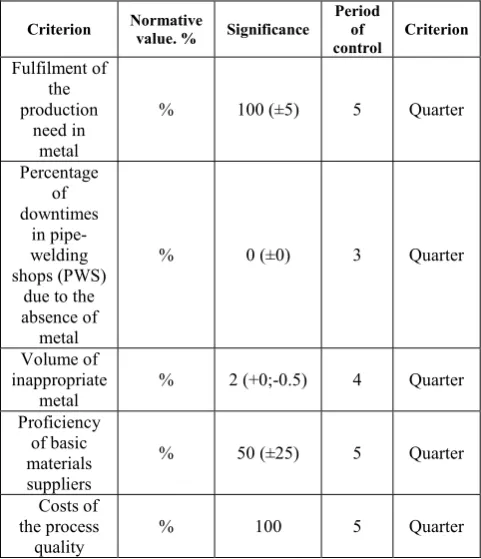
Specification on the process requires a number of criteria of the process, "Procurement of basic materials". Their normative value and significance of each criterion are presented in Table 2.
Table 2. Criteria of the process "Procurement of basic materials (metal)" and their normative values.
Criterion Normative
value, % Significance
Period of control Fulfillment of the
production need in metal
100 (±5) 5 Quarter Percentage of
downtimes in pipe-welding shops (PWS) due to the
absence of metal
0 (±0) 3 Quarter
Volume of
inappropriate metal 2 (+0;-0,5) 4 Quarter Proficiency of basic
materials suppliers 50 (±25) 5 Quarter
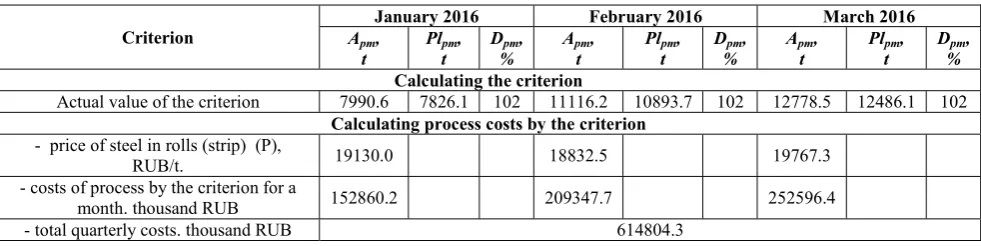
Table 3. Calculation of the criterion "Fulfillment of the production need in metal".
Criterion
January 2016 February 2016 March 2016
Apm,
t
Plpm,
t
Dpm,
%
Apm,
t
Plpm,
t
Dpm,
%
Apm,
t
Plpm,
t
Dpm,
%
Calculating the criterion
Actual value of the criterion 7990.6 7826.1 102 11116.2 10893.7 102 12778.5 12486.1 102 Calculating process costs by the criterion
- price of steel in rolls (strip) (P),
RUB/t. 19130.0 18832.5 19767.3
- costs of process by the criterion for a
month. thousand RUB 152860.2 209347.7 252596.4
[image:5.595.48.548.206.786.2]- total quarterly costs. thousand RUB 614804.3
Table 4. Calculation of the criterion " Percentage of downtimes in pipe-welding shops due to the absence of metal".
Criterion
January 2016 February 2016 March 2016
Pp.
h.
NP. h.
PD. %
Pp.
h.
NP. h.
PD. %
Pp.
h.
NP. h.
PD. % Calculating the criterion
Actual value of the criterion Machine 20-76 Machine 10-40 Machine 10-32 17.3 19.25 22.1 10.6 600 552 552 696 2.9 3.5 4.0 1.5 17.3 19.25 22.1 10.6 648 648 648 648 2.7 2.9 3.4 1.6 17.3 19.25 22.1 10.6 713.6 720 710.4 710.4 2.4 2.7 3.1 1.5
Calculating process costs by the criterion
- productivity in pipe-welding
workshops. t/hour 5.46 5.93 6.23
- amount of pipes unproduced due to downtimes Aup. t
94.5 102.6 107.8
- actual costs of reproduction Cr.
RUB/t. 1931.2 1322.6 1400.2
– costs of process by the criterion
per month. thousand RUB 8890.83 12744.53 16066.83
– total quarterly costs. thousand
RUB 37702.2
Table 5. Calculation of the criterion " Volume of inappropriate metal"of the process".
Criterion
January 2016 February 2016 March 2016
Amount of inaprop. met... ton Price. RUB/t. Total. thous. RUB Amount of inaprop. met... ton Price. RUB/t. Total. thous. RUB Amount of inaprop. met... ton Price. RUB/t. Total. thous. RUB
Calculating the criterion
Actual value of the criterion
214.9 4505.1 968.1 305.9 4583.0 1401.9 346.9 5342.0 1852.9
Vim. % 214.9/7826.1*100%=2.75% 305.9/10893.8%= 2.8% 346.9/12486.1% = 2.78%
Calculating process costs by the criterion
- costs of process by the
criterion per month. thousand RUB
968.1 1401.9 1852.9
- total quarterly costs. thousand
RUB
4222.9
Table 6. Calculation of the criterion "Proficiency of basic materials suppliers".
Criterion
January 2016 February 2016 March 2016
Ps.
unit n. unit
Pbms.
% Ps.
unit n. unit
Pbms.
% Ps.
unit
n. Pbms.
% Calculating the criterion
Actual value of the criterion 4 7 57 4 7 57 4 7 57
Calculating process costs by the criterion
(informational and consulting services)
[image:6.595.47.543.225.366.2]- total quarterly costs. thousand RUB 27.6
Table 7. Normative and actual criteria values of the process "Procurement of basic materials (metal)".
Criterion Criterion value
normative actual deviation. (+/–)
Fulfilment of the production need in metal 100 (±5) -105 102 -3 Percentage of downtimes in pipe-welding shops (PWS) due to the absence of metal 0 (±0) 2.7 +2.7
Volume of inappropriate metal 2 (+0.-0.5)- 2 2.7 +0.7 Proficiency of basic materials suppliers 50 (±25)- 75 57 -18
Table 8. Improved list of criteria for the process "Procurement of basic materials (metal)".
Criterion Normative value. % Significance Period of
control Criterion Fulfilment of the production
need in metal % 100 (±5) 5 Quarter
Percentage of downtimes in pipe-welding shops (PWS) due to the absence of metal
% 0 (±0) 3 Quarter
Volume of inappropriate
metal % 2 (+0;-0.5) 4 Quarter
Proficiency of basic
materials suppliers % 50 (±25) 5 Quarter
Costs of the process
quality % 100 5 Quarter
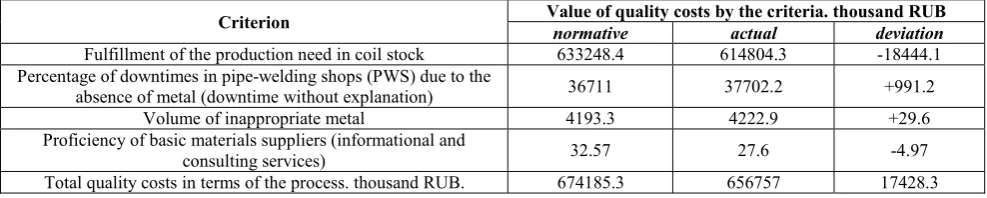
Table 9. Calculation of normative quality costs according to the criteria of the process "Procurement of basic materials (metal)" with regard to deviations.
Criterion Value of quality costs by the criteria. thousand RUB
normative actual deviation
Fulfillment of the production need in coil stock 633248.4 614804.3 -18444.1 Percentage of downtimes in pipe-welding shops (PWS) due to the
absence of metal (downtime without explanation) 36711 37702.2 +991.2
Volume of inappropriate metal 4193.3 4222.9 +29.6
Proficiency of basic materials suppliers (informational and
consulting services) 32.57 27.6 -4.97
Total quality costs in terms of the process. thousand RUB. 674185.3 656757 17428.3
Comparison of normative and actual values of criteria upon the results of operation of the process. "Procurement of basic materials (metal)" for the 1st quarter of 2016 showed the results presented in Table 7.
In our opinion. to determine the type of corrective measures. and to provide timely warning about the "weaknesses" of the process to the process owner. it is recommended to apply controlling. which will allow you to determine the strengths and weaknesses of the process. to set the normative value of quality costs. to identify favorable or unfavorable deviation of the actual values of the quality costs from the standard and analyze them to find out the causes of deviations and eliminate them. and to develop corrective and preventive actions for the effective functioning of the process.
A new criterion. "Costs of the process quality ". is introduced to the process "Procurement of basic materials (metal)" (see Table 8).
Determination of quality costs by the criteria of a process is presented in Table 9.
The results of approbation showed that in terms of a process useful costs include: the cost of providing the production needs in coil stock; costs of determining the level of proficiency of basic materials suppliers. and the
unnecessary costs – costs associated with downtime due to the absence of the metal; the costs associated with the availability of unsuitable metal.
[image:6.595.51.545.404.503.2]composition and structure of useful and unnecessary quality costs of pipe products.
The authors developed a system of corrective actions that will significantly reduce the influence of these factors on the magnitude of quality costs by reducing unnecessary and increasing useful costs.
The results of calculating the value of useful and unnecessary quality costs within the process (Table 10) show that implementation of controlling allowed to reduce unnecessary costs per quarter on 1020.8 thousand RUB.
In fact. the reduction of unnecessary costs means preventing waste of resources on the achievement of required production quality as a part of the process. "Procurement of basic materials (metal)".
[image:7.595.51.292.288.568.2]The efficiency of the process after implementation of controlling increased by 0.2 p.p.
Table 10. Improved list of criteria for the process "Procurement of basic materials (metal)".
Criterion Normative
value. % Significance
Period of control
Criterion
Fulfilment of the production
need in metal
% 100 (±5) 5 Quarter
Percentage of downtimes
in pipe-welding shops (PWS)
due to the absence of metal
% 0 (±0) 3 Quarter
Volume of inappropriate
metal
% 2 (+0;-0.5) 4 Quarter
Proficiency of basic materials suppliers
% 50 (±25) 5 Quarter
Costs of the process quality
% 100 5 Quarter
Application of controlling in the management of quality costs for all the ten existing enterprise processes over a long period of time will provoke a significant increase of efficiency of enterprise activity in the sphere of resource expenditure for quality management.
Thus saved money can be directed to further development of the enterprise. increasing its competitiveness in internal and foreign markets.
4 Conclusions
The introduction of controlling into the management of quality costs allows based on the detection of the value of useful and unnecessary quality costs according to the criteria of the process to achieve a significant improvement in the functioning of the process. enhance
its productivity. reduce unnecessary costs of the process quality.
The proposed method is applied in such a way that in the case of low effectiveness of process it will be possible to identify and analyze its causes.
Since each process is characterized by a number of criteria to supervise and analyze the work process. all the cost groups in the proposed classification should be considered in the context of the criteria of the processes taking place in the system of quality management that provides an opportunity to assess in value terms the resources allocated for achieving the objectives of quality within a particular process. and the totality of the processes in an enterprise.
Regular detection and complete analysis of the deviations in quality cost within each process provides the basis for preventing accumulation of negative deviations in the totality of the processes of the quality system and. thereby. becomes an integral part of the effective management mechanism for quality costs in an enterprise.
References
1. E.M. Karlik. D.S. Demidenko. Economic issues. 9. 21-29 (1983).
2. P.P. Novichenko. T.D. Popova. Accounting the costs of product quality improvement (Finances and statistics. Moscow. 1986)
3. T.D. Popova. Bookkeeping. 11. 71-72 (2001) 4. P. Freedman. Audit: controlling costs and financial
results while analyzing the quality of products (UNITY. Moscow. 1997)
5. U.P. Adler. S.E. Schepetova. Standards and quality. 2. 29-35 (2002).
6. T. Nakamura. Quality. trade and economics. 23-31 (1970)
7. I.H. Ansoff. Strategic management (Economics. Moscow. 1989)
8. K.M. Rakhlin. L.E. Skripko. Standards and quality. 3. 49-51 (1997).
9. D.N. Babenkov. Management of an industrial enterprise on the basis of process aproach to accounting and analysis of quality costs (Moscow. 2002)
10. A.N. Kanivets. Mechanism for evaluating costs efficiency in the quality management system of an enterprise (Tambov. 2005)
11. Zh.A. Chesnokova. Improving the organization of quality costs management in the industrial enterprise (Saratov. 2007)
12. F.I. Palitsyn. V.M. Proleyko. Economic methods of production quality management (Mechanical Engineering. Moscow. 1981)
13. N.K. Rozova. Quality management (Vector. St. Petersburg. 2005)
15. British standard BS 6143: Guide to the economics of quality. Part 1. Process cost model (NTK Trek. Moscow. 2003).
16. I.A. Budischeva. Ya.D. Plotkin. Regulating costs of ensuring production quality (Publ. of standards. Moscow. 1989)
17. I.V. Malova. Practice of implementing the system of accounting and analysis of quality costs (NTK Trek. Moscow. 2005)
18. S.V. Zakora. Development of total quality management (TQM) system in the industrial enterprise (Saratov. 2004)
19. P. Khorvat. Issues of theory and practice of management 4. 44-56 (2000)