Abstract: Artificial Neural Network (ANN) is a subdivision of Artificial Intelligence are extensively used to answer a complex civil engineering concerns. The following paper would predict the compressive strength and slump, having several mixtures with 28 days. ANN model with 7 different parameters that comprises: Slag (SL), Fly Ash (FL), Fine Aggregate (FA), Coarse Aggregate (CA), Super Plasticizers (SP), Cement (C), Water (W) respectively as input while concrete slump and while compressive strength as output. The same inputs are provided and are developed as another model. The slump and compressive strength of concrete are determined by ANN through its machine learning which is identified by validation, testing and training results. This kind of strength conjecture will help the concrete factories that manufactures the concrete, which when used in concrete will result in definite strength.
Keywords: Back propagation algorithm, Slump, Compressive strength, Artificial Neural Network.
I. INTRODUCTION
Concrete is one of the important building materials being used around the globe. Concrete is praised for its substantial compressive strength. Compressive strength of concrete is generally found based on a regular compression test. However, a standard compression test is completed after 28 days. If the required compressive strength is not attained, costly alternative efforts ought to be done. Consequently the quality of the materials used is also important. Workability is another major properties that needs to be satisfied to create concrete of high quality. Concrete workability is the ease of mixing, placing and finishing with the minimum loss [1]. It depends on 1. Consistency 2. Cohesiveness. Workability plays acts an vital role in modeling slumps. In laboratory Modeling slump and compressive strength of concrete are not adequate to include many factors that need to be concerned when scheming concrete mixes [2]. In spite of the complexity with the mix pattern procedure made use of and other issues to consider, a concrete mixture which cannot be laid easily or simply compacted thoroughly does not properly give the required strength and durability properties [3].
Revised Manuscript Received on March 08, 2019.
M. Deepak, Assistant Professor, Department of Civil Engineering, Karpagam College of Engineering (Autonomous), Coimbatore, India
A. Gopalan, Professor, Department of Civil Engineering, Karpagam College of Engineering (Autonomous), Coimbatore, India
R. Akshay Raj, U.G Student, Department of Civil Engineering, Karpagam College of Engineering (Autonomous), Coimbatore, India
S.Shanmugi, U.G Student, Department of Civil Engineering, Karpagam College of Engineering (Autonomous), Coimbatore, India
P.Usha,U.G Student, Department of Civil Engineering, Karpagam College of Engineering (Autonomous), Coimbatore, India
ANN is a successful tool meant for modeling difficult non-linear solutions. An architecture of the neural network mainly illustrates or mock the capabilities of a brain's learning. Most of the working illustrations or the modeling of neural networks mainly use the Back-Propagation (BP) paradigm, which uses many methods. The method for minimizing the error at a great speed is Lavenberg-Marquardt method. ANN are being used widely for modeling and prophetic complex non- linear equation and so therefore it is now used in the prediction of slump and compressive strength of concrete [4,5,6].
II. CONCEPTS OF ANN
Artificial neural systems are a group of massively similar architecture that may solve difficult problems through cooperating with highly interconnected but basic computing components. ANNs comprising of multiple arrays or tiers of simple processing units, neurons joined in onward direction merely are called feed forward neural networks with information going in frontward direction solely. The Feed Forward Neural Networks generally consists of an outcome layer, a number of intermediate hidden layers (depends on the trail and error basis) and a input layer. Each neuron is interconnected at the very least i.e., with at least one neuron, each connection is normally evaluated using a real quantity, called weight coefficient [7]. Back Propagation Neural Networking (BPNN) is actually a most chosen one among the experts for modeling indeterminate complications because of its capability to match complex nonlinear and not known relationships. BPNN is a multi-layer feed-forward neural network (MFNN) trained utilizing back-propagation (BP) algorithm. BP algorithm examines a different group of weights load leading to qualified neural networking having diversity in predicting overall performance and convergence speed. To reduce the BPNN's chance of discrepancy it is very essential to progress an perfect model. The ANN through its learning mechanism will be able to draw a practical relationship between insight and outcome info, by minimization of mistake between the real output and predicted outcome [8]. The major benefit of ANNs is, it may not blindly predict some model application form, which is the requirement in the limit approach. [9]. In civil engineering elements there are several neural network applications [10]. The results likewise is compared with the ones obtained from the regression study. For obtaining knowledge about the specific property of concrete, scientific relationships by means of regression equations are conventionally used and
proposed.
Modeling of Concrete Slump and Compressive
Strength using ANN
III. NEURAL MODEL DEVELOPMENT
Collection of the multilevel parameters is determined by complexity of inter-relation to end up being approximated as well as the amount with quality of datasets [11]. A good alternative to human neural system is the Artificial Neural Network (ANN), with nodes addressing the neurons and weight associations within the corresponding nodes. The basic processing components are the nodes and artificial neurons and are organized in levels. It include an input layer, output layer and a number of advanced hidden layers. Several studies prior to now have indicated the thumb rules just for deciding how many hidden neurons [12]-[15]. However, by experimentation process, the number of layers and the number of neurons in the hidden level are decided. The major network which is used worldwide is the Feed-Forward Neural Network (FFNN) which empowers only relationships in ahead direction easily by interconnected neurons. On other circumstance the most applying neural network are based on the back-propagation paradigm. The accuracy of the result and minimizing the error is obtained by upgrading the weights and biases in each cycle by an ideal momentum coefficient and learning rate for Back Propagation (BP) algorithm. The BP mode of operation has 3 sets namely Training set, Testing set and Validation set. By training the network, the training set helps to fit the parameters on the model. Using the Back propagation algorithm for multilayer network, this data set is commonly employed to find the ‘optimal’ weights. To fine tune the parameters of the model, the validation set is used. The performance of fully trained model is tested using testing set. Some weight examination can be employed to clarify the contact between the type variables as well as the output varying in ANNs. Based on the input elements and the productivity factors, the weight analysis computes the strength of the connections. In addition to this, the weight analysis computes the potency of the relation between the output as well as input factors quantitatively. ANN tends to anticipate the concrete slump efficiently, which gives a better degree of accuracy than other models. The input parameters are given to the network after training the network. From the existing weight values and pattern developed at the period of training, the output values are calculated. By executing the network, it is extremely superfast because the program only computes the multilevel node principles once. The coefficient of determining R2 is acquired to examine the exactness of a prepared network.. The greater the R2 value, the better the prediction. For efficient learning of the networking, a suitable learning rate and momentum coefficient is employed intended.
IV. METHODOLOGY
The study uses a Back propagation feed forward neural network, the data, matrix size of [103x7] were obtained. The data is classified into 3 sets’ viz., training set, validation set, and testing set. To have good heterogeneity of records in training, testing and validation, records was shuffled. For achieving faster training and to neglect getting stuck in local optima and for making all the data ranges between 0 and 1 normalization is done. It is just by considering specific data and dividing the same by the highest value of the individual
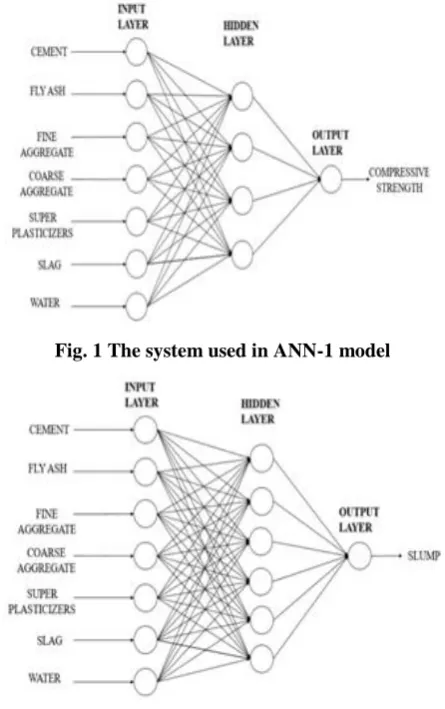
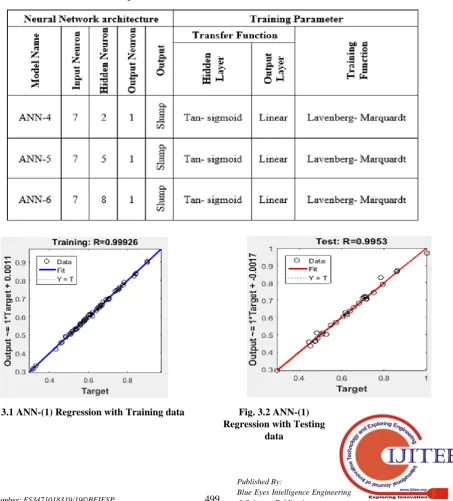
parameter For ANN-(1) The matrix size test data [31x7] and train data is [62x7], while the matrix size of validation data is [10x7] .The various inputs are slag (SL), fly ash (FL), fine aggregate (FA), coarse aggregate (CA),super plasticizers (SP), cement (C), water (W). For ANN-(2) ,103 records with FL, SP, SL, FA, W, CA and C are taken as input and For ANN-(3) ,103 records with FL, FA, CA, W, SL, SP, and C are taken as input, for ANN-(1), ANN-(2) and ANN-(3) , compressive strength is taken as output . For ANN-(4), ANN-(5) and ANN-(6), 103 records with FL, SP, SL, FA, W, CA and C are taken as input , while slump value is used as output for all the three models. Neural network model was developed using MATLAB software package, back propagation algorithm was used the logistic sigmoidal function at insight layer, and linear function in the outcome layer. While hyperbolic tangent sigmoidal function was used in the hidden layer.
V. RESULTS AND DISCUSSION
[image:2.595.315.538.358.713.2]This paper is mainly based on estimating the concrete slump and compressive strength based on concrete mix constituent data using the Artificial Neural Network. Higher the number of input variables leads to higher dimensionality and complexity of the models being developed.
Fig. 1 The system used in ANN-1 model
Table. 1 Description of Network Architecture used in Compressive Strength Models
Table. 2 Description of Network Architecture used in SLUMP Models
Fig. 3.1 ANN-(1) Regression with Training data Fig. 3.2 ANN-(1) Regression with Testing
data
Fig. 3.3 ANN-(1) Regression with Validation data
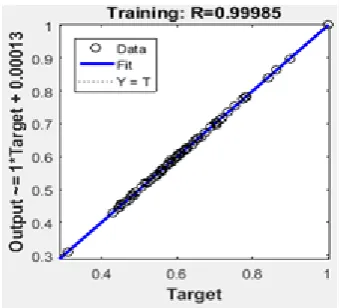
[image:4.595.339.513.251.406.2]Fig. 4.1 ANN-(2) Regression with Training data
Fig. 4.2 ANN-(2) Regression with Testing data
[image:4.595.82.258.251.401.2]Fig. 4.3 ANN-(2) Regression with Validation data
Fig. 5.1 ANN-(3) Regression with Training data
Fig. 5.2 ANN-(3) Regression with Testing data
[image:4.595.77.256.429.586.2] [image:4.595.336.518.436.601.2] [image:4.595.81.256.613.763.2]Table. 3 The Statistical Values of the Proposed ANN-(1), ANN-(2) AND ANN-(3) Model
[image:5.595.347.510.244.383.2]For ANN- (1) As the result of training, the record values of R, MSE, RMSE was found as 0.99926, 0.00002, and 0.00486 respectfully. During testing, these values were found as 0.9953, 0.000058 and 0.0076289 respectively. For ANN- (2) the statistical values of R, MSE, and RMSE from training found as 0.99985, 0.02233, 0.1494 respectively. On testing, it is found as 0.75334, 0.04838, and 0.21995 respectively. For ANN- (3) the statistical values of R, MSE, RMSE from testing found as 0.69101, 0.040109 and 0.20047 respectively. As the result of validation, the values of R are MSE, and RMSE from validation found as 0.9996, 0.128, and 0.1303, respectively. From the results, R values higher and closer to one and lower values of MSE and RMSE ensures good prediction. Therefore, it is concluded that the neural network model’s performance is good.
Fig. 6.1 ANN-(4) Regression with Training data
[image:5.595.346.511.407.562.2]Fig. 6.2 ANN-(4) Regression with Testing data
Fig. 6.3 ANN-(4) Regression with Validation data
Fig. 7.1 ANN-(5) Regression with Training data
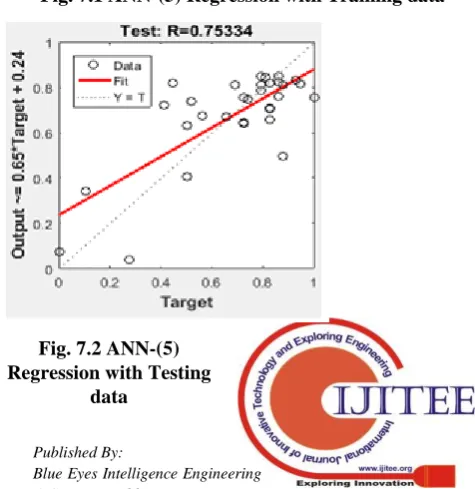
Fig. 7.2 ANN-(5) Regression with Testing
data Statistical
Parameters
ANN-1 ANN-2 ANN-3
Training set
Testing set
Validation set
Training set
Testing set
Validation set
Training set
Testing set
Validation set
R 0.99926 0.9953 0.99848 0.99985 0.98577 0.99143 0.99985 0.99741 0.99894
Mean Squared
Error
0.00002 0.0000582 0.00020 0.00000 0.00017 0.000453 0.0000045 0.000061 0.000103
[image:5.595.81.257.440.582.2] [image:5.595.306.544.580.825.2] [image:5.595.77.258.606.765.2]Fig. 7.3 ANN-(5) Regression with Validation data
[image:6.595.337.520.58.381.2]Fig. 8.1 ANN-(6) Regression with Training data
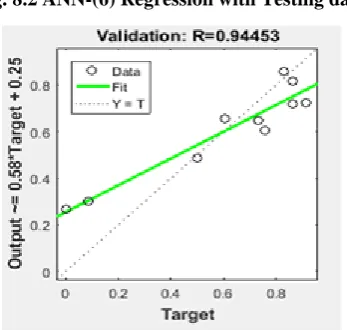
[image:6.595.80.253.101.259.2]Fig. 8.2 ANN-(6) Regression with Testing data
Fig. 8.3 ANN-(6) Regression with Validation data
Table. 4 The Statistical Values of the Proposed ANN-(4), ANN-(5) AND ANN-(6) Model
Statistical Parameters
ANN-4 ANN-5 ANN-6
Trainin g set
Testing set
Validation set
Trainin g set
Testing set
Validation set
Training set
Testing set
Validatio n set
R 0.93237 0.73605 0.94054 0.86848 0.75334 0.84624 0.69101 0.81961 0.94453 Mean
Squared Error
0.01329 0.00863
4 0.0485 0.02233 0.04838 0.02516 0.04019 0.0212 0.04055
RMSE 0.11522
6
0.09291 9
0.2202271 55
0.14943 23
0.21995 45
0.1586190 4
0.200474 4
0.14560 2
[image:6.595.342.516.221.386.2] [image:6.595.62.539.440.757.2]For ANN-(4), the statistical values of R, MSE, RMSE was found as 0.93237, 0.0132, and 0.1152. On testing, these values were found as 0.73605, 0.00863,and 0.0929 respectively .For ANN-(5), the statistical values of R, MSE, and RMSE from training found as 0.86848, 0.02233, 0.1494 respectively, these values were found in testing as 0.75334, 0.04838, and 0.21995 respectively. For ANN-(6), the values of R, MSE, RMSE from testing found as 0.69101, 0.040109 and 0.20047 respectively, R value was found low due to insufficiency of data ,though the data shuffled several times. Values of R, MAE, and RMSE from validation found as 0.94453, 0.0405, and 0.20137, respectively. Obtaining R values higher and closer to at least one and lesser values of MSE and RMSE ensures good prediction. Therefore, it can be concluded that the performance on the neural networking model is good.
VI. CONCLUSION
The ANN model operate in assessing the compressive strength and concrete slump of concrete. Higher R values plainly indicate the fact that neural network modeling is definitely well suited. The MSE values are quite small means that the outcomes will be most appropriate. Furthermore, rendering for the compressive strength outcomes predicted by employing ANN- (1), ANN- (2) and ANN- (3) models, the outcomes of ANN-(3) model are closer to the real outcomes. According to the slump outcomes expected by employing ANN-(4), ANN-(5) and ANN (6) models, the outcomes of ANN-(6) model are closer to the real investigation outcomes. L, RMSE and MSE record values which can be computed and intended for matching experimental outcomes with ANN model results have demonstrated this condition. This research uses data set which contains limited data. Using even more data units is suggested which might bring out unique conclusions. The conclusions have confirmed the prediction of compressive strength values and slump of mortars using ANN.
REFERENCES
1. I.-C. Yeh, “Modeling slump flow of concrete using second-order
regressions and artificial neural networks,” Cement and Concrete Composites, vol. 29, no. 6, pp. 474–480, 2007
2. Mansour M Y, Eng Struct, 26 (2004) 781-799.
3. P.K. Mehta and P.J.M. Monteiro, Concrete: Structure, Properties and
Materials. 3rd ed. New York: McGraw Hill, 2006.
4. A. Jain, S. K. Jha,, and S. Misra, “Modeling the compressive strength of
concrete using Artificial Neural Networks,” Indian Concr. J., pp. 17-22, Oct. 2006.
5. H. G. Ni, and J. Z. Wang, “Prediction of Compressive Strength of
Concrete by Neural Networks,” Cem. Concr. Res., vol. 30, no. 8, pp. 1245-1250, 2000.
6. T. Ji, T. Lin, and X. Lin, “A Concrete Mix Proportion Design
Algorithm based on Artificial Neural Networks,” Cem. Conc. Res., vol. 36, no. 7, pp. 1399-1408, 2006.
7. D. Svozil, V. Kvasnicka, J. Pospichal, “Introduction to multi– layer Feed – Forward Neural Networks”, Chemometrics and Intelligent Laboratory System, Vol. – 39, pp. - 43 – 62 1997
8. M. Sazli, “A Brief Review of Feed- Forward Neural Networks”
Commun.Fac.Sci.Univ.Ank.Series A2-A3, Vol.50, No.-1, pp.-11-17, 2006
9. Ji T, Lin T & Lin X, Cement Concrete Res, 36 (2006) 1399-1408.
10.Yeh I C, Chen I C, Ko T Z, Peng C C, Gan C C & Chen J W, J Technol,
17(4) (2002) 583
11.Schalkoff, R. J. (1995). “Artificial Neural Networks.” McGraw Hill, Singapore.
12.S. Tamura and M. Tateishi, “Capabilities of four layered feedforward neural network: four layer versus three,” IEEE Trasactions on Neural Networks, vol. 8, no. 2, pp. 251-255, 1997.
13.D. Hunter, Y. Hao, M.S. Pukish, J. Kolbusz and B.M Wilamowski,
“Selection of proper Neural Network sizes and architectures-A comparative study,” IEEE Transaction on Industrial Informatics, vol. 8, no. 2, pp. 228-240, 2012.
14.P.C. Pendharkar and J.A.Rodger, “Technical efficiency based selection
of learning cases to improve the forecasting efficiency of neural networks under monotonicity assumption,”, Decision Support Systems, vol. 36, no. 1, pp. 117-136, 2003.
15.K. Jinchuan and L. Xinzhe, “Empirical analysis of optimal hidden layer
neurons in neural network modeling for stock prediction,” in Proceedings of Pacific-Asia Workshop on Computational Intelligence and Industrial Applications, vol. 2, pp. 828-832, Dec. 2008
16.M. Deepak , K. Ramakrishnan, "ANN Modelling for Prediction of Compressive Strength of Concrete Having Silica Fume and
Metakaolin”, International Journal of ChemTech Research, Vol.8,