Report
www.ncsl.org.uk
SCHOOL LEADERSContents
Summary
2
1. What we know from inspections
5
Her Majesty’s Chief Inspector’s annual report
5
Distilling the essence of leading learning
7
2. What we know from research
9
Characteristics of outstanding headteachers as school leaders
9
Impact of school leadership on pupil outcomes
10
Quantifying what makes a difference
11
Leadership differences by sector
15
Leadership, learning and high-performing school systems
16
3. Development of leaders of learning by schools
18
Leadership development case studies
18
4. What we know from policy
23
The Children’s Plan: personalisation of learning
23
The Children’s Plan: leadership
24
National Strategies
25
5. What we know from leadership development provision
26
Specialist Schools and Academies Trust
26
Training and Development Agency for Schools
26
Office for Standards in Education, Children’s Services and Skills
27
6. Current NCSL provision
30
Review of provision
30
Guiding principles
31
Importance of clarity and simplicity
32
Dimensions of school leadership
32
7. How we use what we know: implications and conclusions
37
Implications
37
Conclusions
37
This review explores how school leaders create a learning community to improve learning for all. If effective schools are those where a range of outcomes for children and young people are provided for, and where pupils make better progress than predicted on the basis of where they started, then the quality of the teachers and the learning they provide are central to success. The steps taken to attract, appoint, develop, support and retain good teachers are vital responsibilities for school leaders. Leadership is not just a second order effect influencing through others – it is integral to the learning of the whole school community.
The overarching questions for this review are:
How do school leaders successfully lead learning?
What therefore are the implications for the development of leaders?
We start by gathering evidence on what we know about the leadership of learning from various sources. We consider what we know from inspections, followed by what we know from research, and then provide some case studies of the development of the leadership of learning in various school settings. We then go on to explore the policy context and models of good practice underpinning particular national initiatives. By examining the range of current leadership development provision we highlight the value of some existing approaches and indicate the potential of some new emphases. The review concludes with a summary of the eight implications for consideration by the National College for School Leadership (NCSL) and others engaged in developing the leadership of learning.
What we know from inspections
Section 1sets out the role of school leaders in securing those characteristics of effective schools which are regularly identified in inspections by the Office for Standards in Education, Children’s Services and Skills (Ofsted). The leadership of learning is described in several Ofsted case studies, which show the importance of engaging headteachers in the design and delivery of learning and the methods used by the best of them to engage with their staff and to support the improvement of teaching and learning. There is a revival in the notion of pedagogic leadership and the importance of headteachers sustaining a teaching commitment. They lead by example, model good practice and are recognised by their staff as not asking anything of them that they would not do themselves.
Characteristically, in effective schools, it is often headteachers and senior staff who also provide first-level support to the handful of students who are making least progress. Alongside the ‘mechanics’ of monitoring, evaluating and giving feedback on lessons, such effective leaders also set the tone in terms of how learning is understood, they actively develop all their staff in ways which improve teaching and learning and they ensure that the organisation is designed and operated in ways that focus on learning.
What we know from the research
analysed in terms of their impact on pupils’ results and this suggests the statistical significance of two sets of activities in particular:
1. Promoting and participating in teacher learning and development
2. Planning, coordinating and evaluating teaching and the curriculum
Evidence on the cumulative difference that good teaching can make to pupils from early on in their schooling is used to suggest a similar model might be proposed for the progressive value of teacher development for newly qualified teachers (NQTs) and over their first few years in post. This fits with reports that effective leaders engage heavily with new staff and it helps to focus our enquiry on staff development and continuous professional development (CPD) methods in effective schools.
What we know from the case studies
Section 3looks at particular settings where CPD is well developed or where new models of CPD are being pioneered. These examples suggest the effectiveness of multi-layered approaches that include in-school staff development opportunities as well as access to local CPD provision, the use of school networks and carefully targeted use of national provision. High-performing schools both develop teachers and develop leaders of learners in processes which make good use of modelling, coaching, mentoring and regular dialogue in ways which are informed by pupil feedback and pupil results. These schools provide learning of a consistently high quality in a learner-centred environment where teachers are also learners and the whole school is a learning community.
In such communities, the same values, principles and vision apply to educators and learners alike. Pupils are seen as partners with views that count. Monitoring and evaluation apply as much to teaching and learning as to pupils’ progress and, as learning communities, such schools look outwards, seeking new knowledge from practice elsewhere, testing their approaches beyond the school, and building moral, social and organisational capital. Their CPD approaches are in turn evaluated for their impact and so subject to continuous improvement. The importance of a learning culture in the staff room as well as the classroom is underlined. The skills of designing, delivering and evaluating CPD are therefore central for leaders of learning.
Implications of the policy context
Section 4sets out the national context from The Children’s Plan(DCSF 2007) and the National Strategies programme (DCSF 2008). It examines the implications of prioritising the personalisation of learning for leaders in terms of the tasks and skills and explores the demands being made on leaders by this wider policy context. Leaders will need to demonstrate the approach they are looking for by personalising staff development and by creating an institutional culture that puts learning first – for both pupils and teachers.
How current leadership development provision addresses these issues
that school leaders have to balance or connect if they are to offer a consistent vision and priorities to staff and the community. TDA’s approach to CPD and links with wider performance development help to indicate a more comprehensive approach. Ofsted, while not having a direct role in delivering staff development, has a potentially important role in helping schools prioritise staff and leadership development and in identifying and sharing best practice. A recent thematic survey on CPD provides useful indicators for what works well in both developing teaching and the leadership of learning.
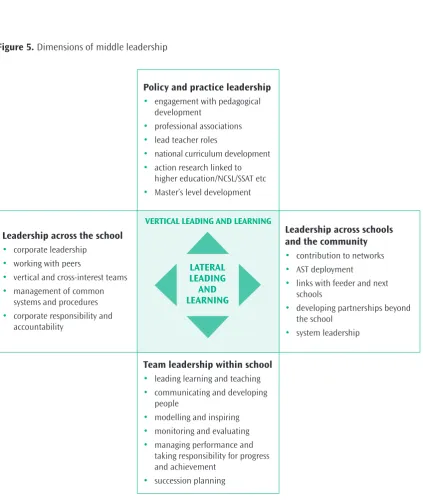
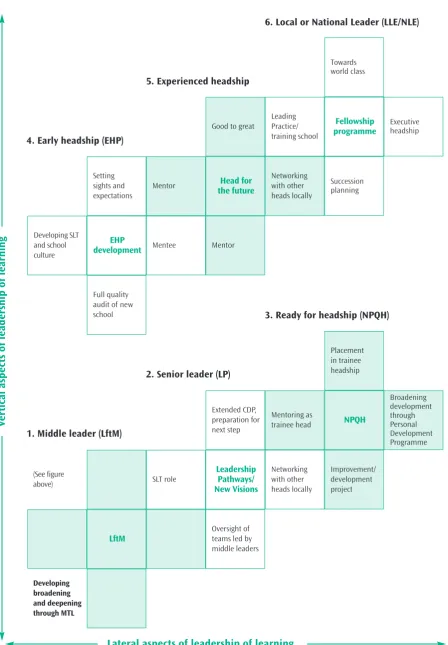
The contribution of NCSL itself is examined in Section 6 to highlight the way both content and methods in programmes need to mirror the requirements of leadership of learning in schools. Participation in NCSL programmes should foster collaborative work and help to develop skills in observation, feedback, motivational work, coaching and mentoring. Over time this will build up the leader of learning as a systems leader capable of working across school and community settings. The vital tasks at all these levels are: modelling, monitoring and dialogue. Such skills need careful definition and long-term fostering. The section concludes with an analysis of leaders’ abilities to work both ‘vertically’ (within their own team or school) and ‘laterally’ (corporately across teams within the school and collaboratively across schools locally and regionally). Over time an individual’s leadership of learning will change, from first appointments in middle or senior leadership right through to the system leadership of experienced leaders, but many of the skills and much of the commitment and values will run through their leadership career as a vital core.
Conclusions
Section 7 discusses in more detail the following eight implications for NCSL and others.
1. Good leadership powers the drive for school improvement and pupils’ success.
2. Well-led schools are clear on their missions and proactive about their futures.
3. In highly effective schools, leaders are involved in learning and with learners. As pedagogical leaders they are both highly skilled in teaching and learning and deploy considerable leadership skills.
4. Effective leadership provides for CPD of all staff, including structured opportunities for leadership development.
5. As far as possible, effective leaders of learning apply the same principles, values and expectations to staff as to student learning, building a community of learners.
6. The development of pedagogical leadership uses a range of practical approaches within the home, school or a group of schools utilising the experience of outstanding schools.
7. NCSL and other central agencies have important roles bringing coherence and cohesion to the leadership development agenda, supporting and complementing local provision, and training and accrediting facilitators and centres.
1. What we know from inspections
Her Majesty’s Chief Inspector’s annual reports
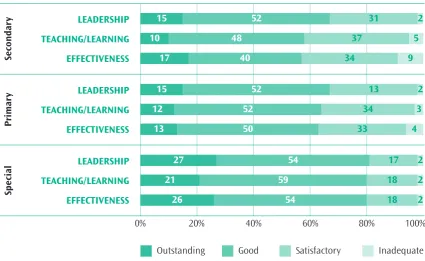
Over a 20 year period, Her Majesty’s Chief Inspector’s (HMCI) annual reports (Ofsted 2008) provide a starting point for an analysis of the role of school leadership and management in developing the quality and effectiveness of schools. In 2007/08, 57 per cent of secondary, 63 per cent of primary and 80 per cent of special schools were judged good or better in terms of the overall effectiveness, efficiency and inclusivity of their provision (see Figure 1). These proportions closely mirrored judgements for teaching and learning in the three sectors, although the grades for the effectiveness of leadership and management tended to flatter secondary school leadership.
[image:6.595.86.512.368.629.2]The annual report recognises that: ‘The quality of the leadership and management remains, with that of teaching and learning, a key factor of the school’s success or otherwise’ (Ofsted 2008: 30).
Figure 1.The overall effectiveness of schools inspected between September 2007 and July 2008
Table shows percentages of schools and judgements of leadership and teaching & learning [N=6075 primary, 1164 secondary and 352 special schools.]
The annual report gives a clear picture of effective leaders establishing a culture in which the key elements are: high expectations, engagement, distributed leadership and impact evaluation. System-wide improvement requires that leaders recognise what the deficits are and where they lie. They need to look beyond day-to-day issues with a vision and drive that demonstrates their ambitions for pupil achievement.
From all this evidence Ofsted has no doubt where the observed strengths and weaknesses in teaching and learning lie, and these are set out in Table 1.
LEADERSHIP TEACHING/LEARNING EFFECTIVENESS 15 Se con da
ry 52 31 2
10 48 37
17 40 34 9
LEADERSHIP TEACHING/LEARNING EFFECTIVENESS 15 P ri m a
ry 52 13 2
12 52 34 3
13 50 33 4
LEADERSHIP TEACHING/LEARNING EFFECTIVENESS 27 Spe ci a
l 54 17 2
21 59 18 2
26
0%
54 18 2
Outstanding Good Satisfactory Inadequate 5
Table 1.Effective and ineffective teaching in primary and secondary schools P ri m a ry sc h ool s P ri m a ry sc h ool s
CHARACTERISTICS OF INADEQUATE TEACHING
• ineffective teaching methods, low expectations, weaknesses in planning, poor use of assessment
• tasks and resources fail to meet the needs of pupils of different abilities
• often pedestrian or pays too little attention to what pupils need to do to improve
• insufficient time to develop pupils’ independent and sustained writing in English
• opportunities to use and apply mathematics too restricted to short everyday problems rather than more extended work
• in science poor subject knowledge is the main weakness
• setting tasks for pupils that are not
sufficiently demanding limits opportunities to extend knowledge and understanding and apply what has been learnt
• these missed opportunities result in loss of interest, slow progress and deteriorating behaviour
• uninspiring teaching is often too dependent on published materials which are not well matched to pupils’ needs
• undue focus on preparation for tests CHARACTERISTICS OF THE BEST TEACHING
• enthusiastic, knowledgeable and focused clearly on developing pupils’ understanding of important skills
• constructive relationships between pupil and staff
• pupils encouraged to become independent in their learning
• assessment used well to monitor pupils’ progress – enabling pupils to understand how well they are doing and teachers to plan challenging activities
• challenges and engages pupils
Distilling the essence of leading learning
While Ofsted’s annual report provides the headlines on what works, lessons from good practice can be drawn from the more detailed picture of teaching and learning in individual school inspection reports, as illustrated in the following three case studies.
CASE STUDY: GABLE HALL SCHOOL (11–16 MIXED)
This secondary school in Thurrock was considered to be outstanding when inspected in 2007. Inspectors found a strong culture of self-evaluation and parents were clear about the high aspirations for pupils. Traditional values for behaviour were found alongside an innovative curriculum programme, equipping young people with excellent personal skills and consistently good qualifications and impacting on the aspirations and success of the local community. Leadership and management were seen as crucial to this success, with a “wise and well-respected headteacher” leading a large, experienced senior team. Clear roles among the deputy headteachers had a focus on teaching and learning and gave a high profile to effective support for students with learning difficulties. Middle managers took responsibility for monitoring teaching and standards in their departments and advanced skills teachers (ASTs) promoted outstanding practice both in the school and beyond. The commitment to staff professional development was outstanding, with considerable commitment of resources and strong student involvement. The school’s development plans showed an unrelenting focus on maintaining the school’s ethos and raising achievement and standards even further. The headteacher used his skills and experience to manage and support other secondary schools in the local authority.
CASE STUDY: MALVIN'S CLOSE FIRST SCHOOL (4–9)
A 2005 inspection report found highly effective teaching led pupils to learn extremely well and to achieve high standards. Staff were committed to excellence and very analytical of their performance. Very capable teaching assistants (TAs) played their part, particularly in supporting those with learning difficulties. Much of the school’s success was founded on excellent lesson planning, with exemplary use of assessment information. Work was well matched to pupils’ capabilities and built on what they had already learnt. Teachers were very clear about what pupils were expected to learn, using challenging questions to assess and extend pupils’ understanding as the lesson progressed. Excellent marking contributed to pupils’ understanding of how they were doing and how they might improve.
This effective learning was clearly based on an overall school culture, instilled with thoughtful leadership. A further inspection visit in 2007, focusing on the curriculum, found there was a clear road map for learning. National assessment results showed that standards in English and mathematics were consistently and significantly above the national average, despite attainment on entry to the school being below average. These results were achieved with careful monitoring and evaluation by curriculum leaders, which ensured classroom work was always exciting and demanding for the pupils. Alongside a strong focus on basic skills, there was both a culture of high expectations and a belief that children should be stimulated and excited by learning, which developed wider skills and attitudes, as well as academic knowledge and understanding.
As an example of team building and consistency of a high order, it was clear that the school’s leaders had engaged all staff with a shared vision of the pursuit of excellence and an understanding of how, in the overall jigsaw picture of the curriculum, each individual lesson played an important part. A shared ethos gave staff the confidence to allow the time and space to go ‘off piste’ for richness and diversity; innovation was positively encouraged.
CASE STUDY: LENT RISE COMBINED PRIMARY SCHOOL (4–11)
Inspirational leadership from the headteacher was seen as the driving force behind this school’s success. Staff and governors shared the head’s vision for excellence, and worked tirelessly to achieve this aim. The level of their success was reflected in pupils’ excellent academic achievement and the rapid progress they made in their personal development. The school’s work was monitored rigorously and complacency not tolerated. Much was expected of staff who, in turn, had very high expectations of themselves and their pupils. Strengths were celebrated and areas for development tackled ruthlessly. Teachers kept a very close check on the progress of individual pupils and used this information exceptionally well to plan lessons, with the necessary challenge and support for pupils of differing ability. A list of key words in the report gives an impression of what the leaders had done here: ‘Inspiration … drive … vision … work … impact … high expectations … celebration ... no complacency … progress tracking … rigorous monitoring and assessment … planning … continuous improvement … challenge … support … celebration’. Despite a hint of a top-down model, reflecting what the headteacher does, there was recognition of the distributed leadership of two deputy heads and a picture of a whole staff team sharing common purposes and understanding their contribution to this.
2. What we know from research
Characteristics of outstanding headteachers as school leaders
A detailed picture of the characteristics of highly effective leaders has emerged from interviewing a large cross-section of the staff of the schools designated as national support schools (NSSs), whose headteachers are NLEs (Matthews 2007). Responses from a range of different staff were highly consistent in identifying how heads were seen by their colleagues, what they stood for and where their priorities lay. Responses were seldom about structures and systems that invariably worked well; they focused on clusters of personal and professional attributes summarised here in order of the frequency with which they were cited:
Clear pupil-centred vision and purpose ensured pupils reached their potential. Maximising young people’s well-being and achievements was at the heart of these schools.
Getting the best or most out of people was related to the philosophy, leadership approach and personal skills of the headteacher, including:
• Motivating, encouraging, trusting and valuing colleagues to do well • Modelling, leading by example, especially in teaching
• Providing an opportunityto undertake greater responsibility and undergo development programmes from the second year of teaching
• Promoting professional developmentfocused on teaching, learning and leadership, and keeping abreast of change; coaching is much in evidence
• Encouraging initiativeand allowing people – students and staff – to experiment, confident they will be supported
• Showing interestand being generous with praise, encouragement and help in moving forward • Knowing the names of a very high proportion of learners; valuing and respecting them
• Being community-minded, involving, consulting and being engaged within the local community • Building teamsand empowering them
Approachability and the ability and readiness to listen.Closeness to the core work of the school meant that headteachers were aware of people’s needs and what colleagues were already doing.
Innovativeheads were identified as looking out for new ideas and being entrepreneurial.
Enthusiasm, associated with commitment, passion, hard work and energy. This is also motivational, especially when accompanied by a sense of humour.
Determination and decisiveness;without denying the importance of consultation and distributed leadership the best heads are credited with having high expectations, setting high standards and being very demanding.
Effective communication skillsto imbue staff with confidence, relate to learners and manage day-to-day transactions, consultation and corporate decision making.
A focus on quality, which applies most to learning and teaching but is reflected through analysis and observation, high expectations, moral purpose and a striving for excellence, on the basis that learners deserve nothing less.
These leadership qualities reinforce the argument that headteachers should be good role models. They resonate with A Model of School Leadership in Challenging Urban Environments(NCSL, 2004) and
Impact of school leadership on pupil outcomes
Research about the impact of school leadership on pupil outcomes is associated with Leithwood and Riehl (2003), who describe the way leaders mobilise and work with others towards shared goals. This has the following implications:
• leaders do not merely impose goals on followers, but work with others to create a shared sense of purpose and direction
• leaders primarily work through and with other people; they help to establish the conditions for others to be effective
• leadership encompasses a set of functions that may be performed by many different people in different roles throughout a school
More recent and ongoing work, sponsored by the Department for Children, Schools and Families (DCSF), points to the impact of leadership values and virtues on the school’s culture as an important influence on the improvement of student learning.
Table 2. Summary of key messages
Source: Day et al (2007)
EXPLANATIONS
The leadership practice of headteachers is behind the internal processes and pedagogic practices that directly result in school improvement
Headteachers are adaptive in their leadership strategies, within a core values framework governed by principles of care, equity and performance
Headteachers’ expectations emanate from a view of pupil achievement that includes behaviour, academic, personal and social and affective dimensions
Some saw headteachers as using data to plan for individual pupil needs and to make decisions about school improvement. Others saw headteachers as involved in the detail of curriculum development and the pedagogy of improvement. Most saw them as promoting CPD and encouraging innovation
All headteachers distributed leadership, but the forms, purposes and extent of distribution varied
Crucial to school improvement is the headteacher’s use of a range of strategies to build effectiveness: their management of the school’s vision, direction, change agenda, and their influence in expectation raising, capacity building, staffing, leadership and management structures, cultures and pedagogy KEY MESSAGES
1. The primacy of the headteacher
2. Leadership qualities and values
3. Expectations and outcomes
4. Leadership of teaching and learning
5. Leadership distribution
These defining values and virtues are elaborated in their paper. For example, ‘leadership of teaching and learning’ includes the following indicators that are positively associated with improved student outcomes:
• a curriculum expanded beyond the confines of traditional academic subjects, in order to boost student engagement in school and their achievement
• priority and consistent emphasis given to improving teaching practice across the school
• allocating and distributing personnel and resources so as to foster student achievement
• use of detailed analyses of student progress and achievement data to inform teaching
• a whole-school approach to pupil behaviour management
The research confirms earlier reports on the repertoire of basic leadership practices, although this seems to be mediated by context, with a greater number of practices being required to effect change in more disadvantaged schools.
Quantifying what makes a difference
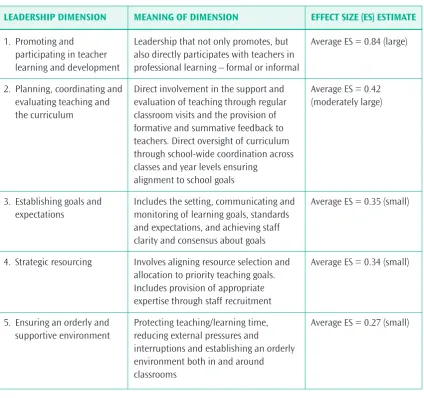
Table 3.Leadership dimensions derived from studies of effects of leadership on student outcomes
Source: Robinson (2007)
LEADERSHIP DIMENSION
1. Promoting and participating in teacher learning and development
2. Planning, coordinating and evaluating teaching and the curriculum
3. Establishing goals and expectations
4. Strategic resourcing
5. Ensuring an orderly and supportive environment
EFFECT SIZE (ES) ESTIMATE
Average ES = 0.84 (large)
Average ES = 0.42 (moderately large)
Average ES = 0.35 (small)
Average ES = 0.34 (small)
Average ES = 0.27 (small) MEANING OF DIMENSION
Leadership that not only promotes, but also directly participates with teachers in professional learning – formal or informal
Direct involvement in the support and evaluation of teaching through regular classroom visits and the provision of formative and summative feedback to teachers. Direct oversight of curriculum through school-wide coordination across classes and year levels ensuring
alignment to school goals
Includes the setting, communicating and monitoring of learning goals, standards and expectations, and achieving staff clarity and consensus about goals
Involves aligning resource selection and allocation to priority teaching goals. Includes provision of appropriate expertise through staff recruitment
Protecting teaching/learning time, reducing external pressures and
It is useful to look in more detail at the two most influential dimensions.
1. Promoting and participating in teacher learning and development.This involved more than just providing opportunities for staff development. The leader participates with his or her staff as the leader, learner or both. Such learning can be formal (staff meetings and professional development) or informal (discussions about specific teaching problems). The impact of this dimension underlines the value of school leaders as the ‘leading learners’ of their school. In higher achieving and higher gain schools, school leaders are more likely to be active participants in teacher learning and development and more likely to participate in staff discussions of teaching and teaching problems (the importance of dialogue will be underlined later in this review). Staff see these leaders as an accessible source of instructional advice. Robinson highlighted the way that professional development in these schools was seen as both theoretical and practical, enabling teachers to integrate their learning into their own practice and to continue to develop their own thinking and inquiry. Such professional development was participative, varied in methods and focused on the impact on students. This study revealed the learning processes and type of facilitation required for more effective professional development.
2. Planning, coordinating and evaluating teaching and the curriculum.Leaders in higher performing schools were distinguished by their active oversight and co-ordination of the instructional programme – an idea captured by the term ‘shared instructional leadership’. They were more directly involved in co-ordinating the curriculum across year levels than in lower performing schools and in activities such as developing progressions of teaching objectives for reading across year levels. Such leaders were found to be directly involved in classroom observation and subsequent feedback, with positive comments from staff about how useful such feedback was and how helpful appraisal interviews were in identifying ways to improve teaching. There was greater emphasis in higher performing schools on staff monitoring student progress and using test results to improve learning programmes.
Research also suggests that strong oversight of teaching and the curriculum by school leaders has more impact in elementary than in high schools. Robinson cites concepts of coherence and alignment when offering explanations of the power of a co-ordinated curriculum. Students are more likely to learn when their experiences connect with and build on one another. The more fragmented and overloaded a curriculum, the less likely students are to revisit, internalise and understand a complex concept. A coherent and co-ordinated curriculum is also likely to enhance teacher learning, because common objectives and assessment tools make it easier for teachers to focus on teaching problems and make a more sustained effort to develop or acquire the expertise needed to solve them.
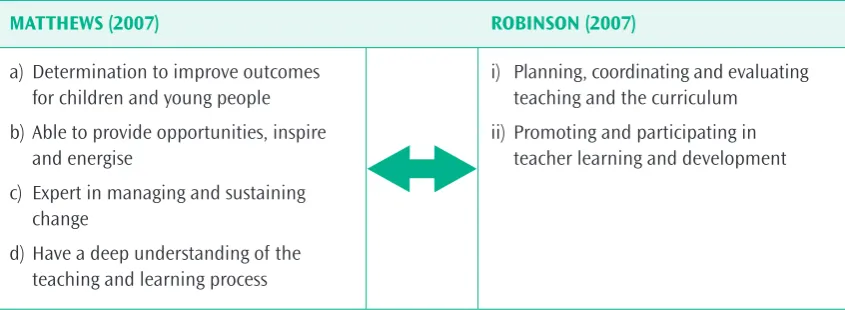
Robinson’s two most powerful dimensions can be usefully matched against the characteristics of effective leaders (NLEs), as in Table 4 below.
Table 4.Influential behaviours of school leaders
NLEs comprise a strong sample of effective leaders and examples of evidence of aspects (a) to (d) (see above) – as applied in primary and secondary schools – are illustrated in the following sections.
a) Determination to improve outcomes for children and young people
Both primary and secondary NLEs are commonly seen by their colleagues as:
• putting children and young people first, reflected in perceptions like ‘nothing but the best will do’; ‘nothing is too much trouble to improve or enrich their learning’; ensuring that ‘every child does matter’
• sharing a moral purpose: ‘making a difference to pupils’ lives’; ‘providing a quality environment, in contrast to that from which many children may come’
• maximising potential is a driving theme: NLEs see social disadvantage as being no excuse, but a challenge to helping all children achieve their potential; there is ‘scrupulous attention to individual performance’
• clear strategies for raising achievement (although recognising that achievements are not always measured by exam results) including a strong focus on literacy and numeracy as potential barriers to wider educational success and a commitment to high-quality teaching that draws on data to target its efforts
b) Able to provide opportunities, inspire and energise
Trust, engagement, consistency of purpose and approach, and common vision and values are valued in these highly successful schools. Distributed leadership needs to share the same ethos so that everyone feels valued, supported and inspired. Leaders are likely to be aware of individual children’s needs and problems, and to engage with the variety of projects going on. The energy, enthusiasm and personal interest shown by these leaders is highly motivational, creating a climate of initiative, innovation and success. Typically, the heads inject energy through leading by example. Many of them, and their senior colleagues, teach and set themselves very high standards in doing so. Many of the secondary heads make timetabled curriculum contributions, often with harder to teach classes.
MATTHEWS (2007)
a) Determination to improve outcomes for children and young people
b) Able to provide opportunities, inspire and energise
c) Expert in managing and sustaining change
d) Have a deep understanding of the teaching and learning process
ROBINSON (2007)
i) Planning, coordinating and evaluating teaching and the curriculum
c) Expertise in managing and sustaining change
Evidence for headteachers’ capacity to manage change comes from inspection reports and the testimony of their colleagues. Citations for primary headteachers reflect headteachers who encourage creativity, feed ideas from elsewhere into the school and constantly present new challenges. Equally important is the attention given to ‘managing systems and structures to review and sustain the successful initiatives’. Both primary and secondary headteachers are careful to balance their drive and vision with the need to inform, enlist support and secure consensus. Effective consultation and communication contribute to the success of new initiatives. While having high expectations of what is possible such leaders are sensitive to where people are, and they are well attuned to external developments. Characteristically, changes and innovations have been carefully considered and discussed, then purposefully implemented. Examples were found at school level (such as management restructuring) or in the local area (through the Leading Edge development). Expertise in managing change is reflected in strong and distributed leadership, strategic acumen, and having systems and structures in place, while adapting to people and needs. These heads get things done, but take people with them.
d) Have a deep understanding of the teaching and learning process
The quality of learning and teaching is central to outstanding headteachers’ work. In general NLE primary headteachers have a deep understanding of teaching and learning processes and the skills to help colleagues hone their effectiveness. They are in touch with what is going on in lessons, and good at evaluating and analysing what needs to be improved. For example, an excellent leader was described as ‘about the school constantly monitoring and assessing what is going on … always in the playground at the beginning and end of the day … eats lunch with the children to gather information’. Almost all of the primary heads are very ‘hands on’ in respect of engagement in teaching and learning, despite other commitments. Although there are different demands in secondary schools, exceptional leaders are still seen as those who regard finding some time to teach as a priority and central to their leadership example. They become part of the quality assurance arrangements and systems of the school. They can judge them from the inside. They also like to teach, but feel they must model high standards of teaching. NLEs are in every sense headteachers, in contrast to some perceptions of system leaders as being primarily executives. They have different styles, but common strategies and systems for maximising the quality of teaching and effectiveness of learning. In these heads a good understanding of teaching and learning processes was linked to a range of performance improvement measures. Practical target setting arose from regular classroom observation, while systematic performance management achieved small but significant changes.
Leadership differences by sector
Matthews (2007) found little difference in the leadership characteristics of primary and secondary headteachers, other than those related to pedagogical language, and closeness to teaching and learning support staff and their issues. The characteristics of highly effective headteachers appeared both to provide a model for less experienced or effective heads, through system leadership, and to provide the confidence and enthusiasm for other members of staff, such as ASTs, co-ordinators and heads of department, to work with their counterparts in very different schools. Through their own leadership these heads appeared to turn their schools into learning organisations, to the benefit of the system as a whole.
Leadership, learning and high-performing school systems
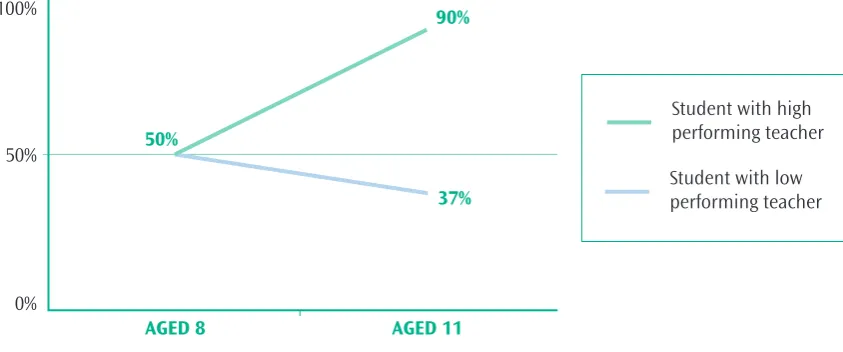
[image:17.595.87.509.441.617.2]A recent study of teaching and learning in highly successful school systems (McKinsey & Company 2007) identified three key factors: getting the right teachers in the first place, developing them into effective instructors and ensuring the system was right for every child. Their report drew on North American research that showed the differential impact of high and low performing teachers. For instance, significant differences in pupil achievement could be traced to the quality of teaching over a three-year period, such as from ages 8 to 11 with the gap between the ‘best’ and the ‘worst’ steadily widening (see Figure 2).
Figure 2. The effect of teacher quality
Source: McKinsey & Company (2007)
It follows that school leaders need to have a relentless focus on improving the quality of instruction in their classrooms. McKinsey & Company maintain that this implies getting three things to happen:
1. individuals need to be aware of the specific weaknesses in their own practice (emphasising the need for effective monitoring, evaluation and feedback)
2. individuals need to gain understanding of specific best practices (through the demonstration of such practices in an authentic setting)
3. individual teachers need to be motivated to make the necessary improvements 90%
0% 50% 100%
AGED 8 AGED 11
37%
Student with high performing teacher
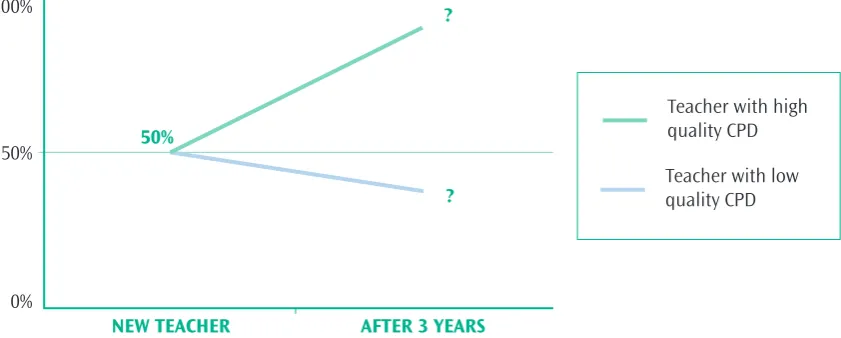
It seems logical to suggest that the effect of the quality of teacher learning can have a similar impact over the first three years of teaching. Evidence from the Ofsted case studies cited earlier suggests there is an upward performance trajectory for all new teachers when tailored high-quality CPD is offered alongside a constant focus on raising the quality of teaching. On this basis we might propose an outline of the performance of new teachers, as in Figure 3.
Figure 3.The predicted effect of the quality and intensity of CPD
The McKinsey & Company report quotes a policy-maker in Boston: ‘the three pillars of reform are
continuous professional development, continuous professional development and continuous professional development’. This chimes with Robinson’s research in suggesting schools need to emulate the focus of top performing systems, both in terms of recruiting the best teachers they can and in giving high priority to their development. Section 3 that follows will therefore explore the way this development of learning has been led in effective schools.
?
0% 50% 100%
NEW TEACHER AFTER 3 YEARS ?
Teacher with high quality CPD
An effective school will not only have its own strategy for improving the work of individual teachers from ‘satisfactory’ or ‘good’ to ‘outstanding’, it will also be keen to share its practice with other schools. Three examples are given here.
Leadership development case studies
CASE STUDY: LEADERSHIP AT OLDWAY PRIMARY SCHOOL
A much larger than average primary school, Oldway mostly takes children with a below expected attainment for their age. It produces results that are generally regarded as outstanding academically, in the arts and in sport. The headteacher is an NLE and the school’s leadership, management and capacity to improve are all highly regarded. High-quality learning experiences, within a culture of continuous improvement, and the headteacher’s high aspirations for all staff and pupils, are reflected in the excellent outcomes for pupils at the end of Year 6. A very strong SLT, able to pinpoint the school’s strengths and weaknesses through self-evaluation, are committed to raising standards with comprehensive systems to track pupils’ progress and effective monitoring of teaching and learning. Teachers’ strengths and areas for development are identified to provide teaching targets and measurable plans for professional development.
Ofsted reports highlight the effective personalisation of learning, and identify:
• teachers confident to use a range of teaching styles suited to the learning objectives of the lessons
• high expectations and a rigorous pace generating very effective learning
• imaginative and stimulating activities often aimed at encouraging pupils to show initiative and to take responsibility for their learning
• excellent procedures for checking how well pupils are achieving in English, mathematics and science
• work well matched to pupils’ individual needs
• pupils enjoy the challenge of each lesson and make excellent progress in developing the skills needed for future success
• TAs give very effective support to those who find learning difficult
• marking gives clear guidance to pupils on how to improve their work
• pupils evaluate for themselves how well they have achieved, and consider how they can improve further
• teachers’ experience and skills are used to the best advantage across the curriculum
• the curriculum has huge breadth and is enriched by a wide range of clubs and visits
• exceptional planning ensures that studies are balanced and adapted highly effectively to meet pupils’ differing needs
The secrets of this school’s success can be summarised as follows1:
Continuity of headship: the headteacher, who was appointed 16 years ago, has stayed and led the school to its current heights. He identifies the most critical aspect as ‘recruiting the right type of teacher’ and then creating an ethos in which everyone wants to achieve the highest standards. An open approach allows good practice to be modelled, shared and absorbed into planning.
Modelling: the headteacher believes pedagogical professional development is best led by good practitioners, including leaders of literacy and mathematics, the special educational needs co-ordinator (SENCO) and the assessment manager. ‘Teachers need to be able to see good practice, work alongside expert peers and share planning and evaluation with them.’
Succession planning: this is represented in a strong group of deputy and assistant headteachers, each with responsibility for a two-year stage of learning.
Middle leaders are responsible for all the planning, learning and teaching, with lead roles in a subject or aspects through the school – from foundation to Key Stage 2. There are clear expectations that these middle leaders will innovate and lead change, set direction and plan, and motivate and influence others. They are expected to make good use of in-depth professional knowledge and expertise, to value other staff and to foster teamwork within the school.
The keys to subject leadership are ‘coaching and being coached’. They have to be able to work with others: establishing where people are, identifying the quality of their planning, their learning objectives and their use of assessment as a basis for the next stage of planning, and measuring the impact of their teaching. They need to ‘know what “good” is’.
CPD is internally organised, with much coaching. There is a leadership development progression structure from the moment an NQT starts in the school. As part of a team led by someone with a teaching and learning responsibility (TLR) post, they quickly gain more responsibility for planning aspects of the year group’s work. They are also part of a curriculum development team before progressing to year group or subject leadership, heading towards a middle leader TLR post and the prospect of a SLT post for the able and ambitious. There is a clear progressive route through intermediary roles that allow them to develop and hone skills in leading learning.
The school’s approach to any new initiative is measured, never adopting it unquestionably but analysing aspects that will add to the school’s provision or cause them to review what they do. As an NLE, the head has reassessed his school’s practices to see how they apply in schools needing support. Accurate assessments of the children, staff, planning and the curriculum point to what needs to be tackled.
CASE STUDY: TORBAY LEADERSHIP ACADEMY (TLA)
A local authority/Torbay Schools’ initiative brings together all leadership development activity under one umbrella. In partnership with national organisations it will develop local solutions for leadership development in Torbay, believing in the importance of leadership development in context. Headteachers and aspirant leaders at all stages of their careers will be able to access information on a range of local, national and international leadership development opportunities. These include: local opportunities in partner schools; training commissioned by Torbay Local Authority; programmes provided by national organisations, for example NCSL, TDA, the Greater Teaching Council (GTC) and the British Council; accredited courses run by universities and an online system. TLA endorses NCSL’s core goals. Oldway is now lead school of the Torbay/South Devon Cluster of five schools who are part of the NCSL Middle Leadership Pilot. TLA also intends to widen leadership development across children’s services and to increase opportunities for pupils to develop leadership skills.
CASE STUDY: OUTWOOD GRANGE COLLEGE BUSINESS AND TRAINING CENTRE
This outstanding school in Wakefield is one of the largest in the country. Designated as a training school and as leaders in learning recognised by SSAT, DCSF and TDA for outstanding CPD, the school supports the learning and professional development of all staff. It designs and delivers a range of bespoke programmes, as well as collaborating with other providers. Its programme covers a variety of topics, including leadership, school improvement and system redesign, and has gained international, national and regional recognition. Brand new facilities centre round a new business and training centre with a purpose-built conference theatre. There is also access to rooms with 30 networked computers, a state of the art e-learning zone and all classrooms with interactive whiteboards. These facilities are hired out to outside training providers.
The College states: ‘we use expert practitioners to lead areas of training at all levels. Our teachers and trainers are highly praised by delegates from other centres, both locally and from further afield. The professional development of staff from our own college and other schools is of paramount importance, so we select and support colleagues at all levels in delivering excellent practice. We can design and offer a comprehensive programme of training for leaders at all levels which are tailored to suit specific requirements based on accurate identification of professional learning needs’.
The school aims to become one of three pilot ‘hub’ training centres sponsored by SSAT. Its CPD opportunities include a range of open days, taster days for potential teachers and access sessions for other teaching professionals. It offers all support staff training on the way schools work and what is expected of them. In addition, the school hosts a number of professional development programmes, such as:
• Educational and Professional Studies (EPS): a compulsory weekly session for both NQTs and initial trainee teachers (ITTs), with topics such as classroom management, behaviour management, child protection and ‘What makes a good lesson?’
• Teacher Learning Academy (TLA): a professional development opportunity for any member of teaching staff at the College. This is accredited by TDA (at three levels including a Master’s degree) and a submission can focus on classroom experiences and innovations, mentoring and coaching or action-based research
• Transforming Middle Leaders: a bespoke course designed to focus on the key issues of middle leadership, available to all after successful completion of their NQT year with modules on timetabling, managing a department, the ‘difficult conversation’, leading in a time of change and department innovation
• Digging Deep: available to colleagues after successful completion of the Transforming Middle Leaders course and focused on whole-College initiatives with core sessions, master classes and work shadowing with a member of the SLT
It is the variety of methods and levels involved here that demonstrate the commitment to CPD. The College is now working in support of three other schools, all of which have provided acting headship experience to its vice-principals. It provides leadership development programmes at each of these schools, including a ‘leadership challenge’ conference for SLTs and a comprehensive Transforming Middle Leaders programme. The great advantage of these programmes is that the standard programme can be closely tailored to the middle leader cadre in the supported school. The College is also a committed exponent of promoting professional development through opportunities for staff to apply for assignments at assistant principal level or other developmental roles2.
CASE STUDY: RAVENS WOOD TEACHING SCHOOL
Here they have developed the concept of a ‘teaching school’ (akin to a teaching hospital) as a centre of excellence in the enhancement of teaching and pedagogic leadership skills, with noted ‘improving teacher’ and ‘outstanding teacher’ programmes. There are four core requisites:
1. A teaching school will be an outstanding school, over a sustained period of time.
2. There must be a firm belief in the ideal of upward convergence. This is about raising the performance of the highest achieving, while reducing the gap between them and the lower achieving. It applies both to student achievement and teacher quality.
3. The school must be involved in school-to-school work. However effective a school’s internal staff development may be, an additional dimension is provided through involvement in developing colleagues in other schools.
4. The school recognises intrinsic benefits from contributing to the improvement of the system. Benefits accrue when schools decide to test their ideas and the transferability of their practices to a different context.
Peer modelling is reinforced in ‘learning threes’: interdisciplinary groups in which one member plans and prepares a lesson, drawing from the suggestions of the other two. The first then teaches the lessons observed by the others who provide developmental feedback – a process repeated until all three have been involved in the different roles. This powerfully improves teaching and opens up practice to critical appraisal by peers.
These schools are typified by growing their own leaders and feeding them into the system. They secure outstanding quality through engagement in succession planning and training more graduate teacher programme (GTP) teachers than they can use. They turn out teachers with high expectations, who will make a substantial contribution to other schools and who have a heightened perception of what is possible. Such system-leading schools demonstrate a range of outreach and partnership initiatives undertaken by their headteachers as consultant leaders. They have engaged in and promoted a wide range of school-to-school initiatives, participated in a range of networks and are involved themselves in leading visits abroad.
Berwick (2001), in writing about the Ravens Wood case study, identifies a specific dimension of moral capital, expressed through school leadership which is committed to ‘supporting and rewarding staff who share and create knowledge, encouraging links with similar learning communities and providing a learning environment that allows staff (and students), within reason, to fail in order to learn’. Such an effective learning community, in which staff learning is key to enhancing student learning, has three dimensions:
1. Creating a collaborative culture:a collegiate approach ensures knowledge is shared through expectations and systems (such as ‘learning threes’)
2. Ensuring staff learning:a non-negotiable process includes appraisal, coaching and mentoring and systems for peer learning, as well as opportunities for action research
3. Widening the community to include links with other cultures:networks, learning partnerships and outreach work can include engagement with national organisations and education in other countries
The best learning communities are characterised by their consistency of approach to learning and learners, whether educators or students. This consistency shows not only in the quality of interactions, communications and relations between all members of the community, but in synergy between periodic reviews of students’ progress and reviews of teaching and learning. Parity between what is expected of students as learners and staff as learners, and the contribution each make to their own learning, is central to this philosophy.
Investment in social and organisational capital is indispensable to each of these case studies. Educators need to reveal and share their expertise, contributing jointly to the accumulation of knowledge. Role modelling and practice that is open to the scrutiny of colleagues is expected at all levels. A strong coaching culture within a school similarly builds social capital and supports the notion that staff have a responsibility for both their own learning and that of their colleagues3.
The hallmark of a professional organisation is that all who lead, coach and mentor can model effective practice and teach it to others. The only way to be sure that a member of staff has really learnt something is if they have coached or mentored another colleague through the process. This develops capacity to share knowledge – often tacit, builds a common language about teaching and learning; spreads good practice and supports an enquiring, problem-solving culture. Where such systemic and cultural approaches are sustained over several years it is not surprising that pupil results have risen consistently year-on-year.
4. What we know from policy
The Children’s Plan: personalisation of learning
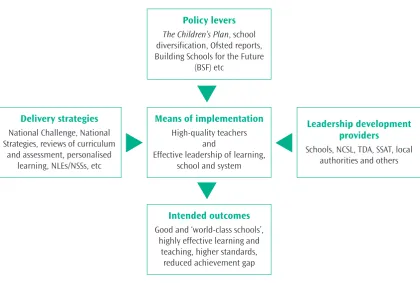
[image:24.595.88.509.311.594.2]Leadership of learning needs to be set in the context of The Children’s Plan(DCSF 2007) and other national initiatives. In a series of interconnected issues leadership is clearly crucial to the improvement of schools and other children’s services, as indicated in Figure 4 below. In considering the leadership of learning alongside a range of government policy and national strategies, we start with the overarching framework represented by The Children’s Plan(Chapters 3 and 4). We shall touch on only certain aspects of that plan: the personalisation of learning and the importance of leadership.
Figure 4. Leadership at the heart of school and system improvement
Personalisation requires closer engagement in the leadership and management of learning at every stage, from foundation through to 14–19, with attention to developments in pedagogy. The Children’s Plan
underlines the value of developing expectations of participation, fulfilment and success. It demands ambitious objectives, challenging personal targets, rapid intervention to keep pupils on track and vigorous assessment to check and maintain progress; it calls for clear plans to support those who do not or cannot maintain trajectory.
Evidence on how personalised learning might be operationalised suggests some common elements for all schools (Soles et al 2007: 8–9). Leaders should work with staff and the community to articulate a vision and approach that works in their context, generating a dialogue about teaching and learning, and ensuring teaching quality is monitored. They should lead by example, modelling how students are treated, setting expectations for high achievement and thinking constantly about how learning could be improved.
Means of implementation High-quality teachers
and
Effective leadership of learning, school and system
Policy levers The Children’s Plan, school diversification, Ofsted reports, Building Schools for the Future
(BSF) etc
Leadership development providers Schools, NCSL, TDA, SSAT, local
authorities and others Delivery strategies
National Challenge, National Strategies, reviews of curriculum
and assessment, personalised learning, NLEs/NSSs, etc
Intended outcomes Good and ‘world-class schools’,
Both leaders and teachers should be able to use data to understand every student’s progress and focus resources accordingly. Pupils will be involved in shaping their own learning. Leaders will provide high-quality CPD for all staff that is also personalised to meet their needs. They will create the structures, systems and processes to underpin all this and to sustain school improvement.
The NCSL resource, Leading for Personalising Learning framework(West-Burnham 2008) summarises the implications for leadership in terms of a change process based on professional learning. Since personalising learning represents a significant challenge to long established practices and procedures, it is essential that school leaders secure commitment and build confidence in these new ways of thinking and working. The leadership framework helps with some of the detail of this process, identifying such aspects as:
• building leadership knowledge and capacity around personalised learning and its elements
• open communication about the process
• building a shared consensus around values and principles
• ensuring effective professional development strategies at each stage
• maximising networking to learn from the success of others and to disseminate successful practice
• ensuring that the change process is inclusive and involves all stakeholders
• monitoring, reviewing and evaluating against values and strategies
The Children’s Plan: leadership
Leadership features prominently in The Children’s Plan. It recognises that a world-class system will need confident leaders to deliver within their own institutions and to work with others across a range of services for children and young people. It highlights the opportunities for innovation and reform stemming from the heavy retirement rate of headteachers in the next few years. NCSL’s succession planning strategy is aimed at recruiting a new generation of school leaders able to deliver the extended services envisaged by the Plan. In particular the revised National Professional Qualification for Headship (NPQH), started in 2008, is designed with these wider responsibilities in mind, including the leadership of learning and teaching. There is much focus on developing the new integrated centre leaders and school business managers, whose presence will free up headteachers to focus on teaching and learning and to work on improving performance.
National Strategies
In order to implement the Plan, an expanded system of support materials and development opportunities has been provided under the National Strategies programme (DCSF 2008). This reveals something more of how learning is to be developed and led in the future. While increasing the effectiveness of strategic leadership in local authorities and school networks is seen as vital for the wider goals of the system, the focus at local level is on well-planned teaching that addresses individual needs. The management and leadership of learning and teaching are seen as crucial to improving outcomes at school level. A focus on the primary programme for literacy and mathematics, for instance, provides a range of support materials to improve planning and teaching. All are intended as a basis for CPD.
In Key Stage 3 the National Strategies actually promote a process called ‘Leading in Learning’ which stresses deep learning as an active, social process and which is explicit about learning skills, processes and strategies. Leading in Learning involves the systematic and explicit development of thinking and learning skills and strategies across the curriculum. In enabling pupils to understand themselves better as learners, it supports a wider repertoire of learning approaches in different subjects. Pinpointing the work leaders will need to do is helped by this list of core elements:
• a strong research base into learning and cognition
• collaborative learning by groups of teachers
• systematic support across a whole school, backed by materials and consultancy from the Key Stage 3 National Strategy
The approach promotes the explicit teaching and learning of thinking skills within and across subjects. Teachers focus on a particular thinking skill and then collaborate to connect lessons across three chosen subjects using a common strategy. The model is innovative in requiring collaboration across departments to teach an agreed thinking skill, using three-lesson cycles based on a common teaching strategy, one lesson in each of three chosen subjects – with an emphasis on developing and discussing a selected thinking skill and how it might be used. The approach encourages teachers and pupils to look beyond subject confines to thinking and learning more generally. This Leading in Learning initiative supports collaborative planning and teaching with a common language about thinking and learning. It helps develop good practice in monitoring pupils’ learning progression as a basis for future planning and teaching. It also supports senior leaders in establishing a whole-school approach to developing thinking skills – a good example of leading collaborative work on school-wide pedagogy.
Apart from NCSL a number of national organisations contribute to the structuring of leadership development in ways relevant to the leadership of learning. This section explores the thinking of three of these: the Specialist Schools and Academies Trust (SSAT), the Training and Development Agency for Schools (TDA) and the Office for Standards in Education, Children’s Services and Skills (Ofsted). The contribution of NCSL itself is examined in Section 6.
Specialist Schools and Academies Trust
Action research is a strong feature of programmes such as the two-year ‘middle level leaders’ available to teachers in academies and schools affiliated to SSAT. The emphasis on the development of critical and analytical skills, skills in self-evaluation, lesson observations and feedback, and personalising learning would all seem relevant to the development of leaders of learning. Like NCSL, SSAT also provides a ladder of leadership programmes for its affiliated schools and academies, for NQTs through to executive headteachers.
SSAT has promoted pedagogical leadership strongly in its programmes and publications, notably through work on ‘deep learning’ and its implications for school leadership. ‘Deep learning’ is described as redefining the role of the teacher in the classroom since it requires the teacher to work on student ownership of the learning to the point of refocusing on teaching the student how to learn (Taylor 2006). Such ‘deep learning’ calls for ‘whole-school leadership which values learning above all other pressing demands’ and where ‘joined-up thinking’ brings together what have previously been separated in ‘pastoral’ and ‘curriculum’ concerns. These past divisions are seen as reflecting an old style of ‘top-down leadership’, and what is now required is described as ‘bottom-up leadership’ which puts student needs as the central focus for ‘deep learning’.
However, Taylor concludes with a reality check:
But there are real challenges for school leaders committed to personalising learning. At the heart of the matter for schools and educators is the often paradoxical interplay of short-term accountability and real learning. Schools in the UK are accountable for outcomes at the end of key stages, as defined by narrow assessment criteria. Successful learning is more or less defined by the outcome of summative assessments. There is no measure that tracks students a decade later, to ask what was actually learned, what was really useful: was learning a “deep”? The challenge for school leaders is to effect system and cultural change to allow personalised learning to flourish. We owe it to our students to make this happen. However, the reality for us all is that personalised learning cannot be delivered at the expense of our contextualised value-added results. The leadership challenge, as ever, is to manage the external measures of our effectiveness without compromising the conditions that lead to our ultimate holy grail: deep learning.
(Taylor 2006)
Training and Development Agency for Schools
TDA aims to ensure that all new policy and practice continues to consider the link between standards, CPD and performance management. It considers it is essential that its own qualifications and standards frameworks provide a basis for improving the quality of learning in all schools (TDA 2007a). In identifying the attributes, knowledge and skills that teachers, and others in the workforce, need at different career stages, TDA provides tools which leaders can use in supporting and developing professional practice. To this end TDA is increasingly focusing on helping schools and their leaders to understand how to use standards and qualifications frameworks to best support teaching and learning.
To this end TDA is closely concerned with the role of high-quality CPD in workforce development. It is developing its ability to advise local authorities and schools about the types of CPD that would make the greatest difference for the entire workforce. Having undertaken research into effective CPD, TDA has produced guidance and training on all aspects of CPD, including self-evaluation and the impact evaluation of CPD. The Agency is also working with over 600 schools to identify and disseminate effective CPD practice and supporting pilot work on CPD subject networks and subject leadership. TDA is working with local authorities to build CPD leadership capacity in schools and has conducted an initial enquiry into this field (TDA 2007b). CPD leaders are critical to developing sustained training and development practice within schools. In work with NCSL, TDA is looking to develop the roles of CPD leaders as a way of ensuring all school leaders understand what constitutes high-quality effective CPD. A range of training materials and national programmes, together with regional networks, are all helping to develop this role.
It is important that schools should make informed decisions about how to develop or access CPD using the whole range of possible approaches. Since much of this training and development will take place within schools, TDA proposes to improve both the availability of materials and resources for local CPD and to develop better information about external providers and resources available.
Finally, TDA sees a wider need for a performance development approach that better identifies performance levels of all staff, using the standards frameworks to determine where there are gaps between current and required skill levels. This work on training and development is intended to help SLTs and school CPD leaders to identify the highest quality and most appropriate training and development for their workforce.
Office for Standards in Education, Children’s Services and Skills
Ofsted does not itself provide leadership development programmes, but its instruments, criteria and thematic reports are central to the work of school leaders. Ofsted’s inspection methods are largely based on the self-evaluation undertaken by the school and recorded in the self-self-evaluation form (SEF) which prompts schools about the criteria used in evaluating aspects such as the leadership of learning. Ofsted’s indicators for the quality of leadership and management of schools stress the links between leadership and its impact in terms of the outcomes for learners and the quality of teaching provision. They therefore draw attention to topics mentioned earlier in this review, such as setting the direction for teaching and learning, monitoring and improving the quality of teaching and using targets to raise standards. In particular, Ofsted looks at how well leaders and managers promote the professional development of the whole school’s workforce and the impact of CPD on outcomes for learners. ‘Promotion of professional development’ is one of many criteria for the quality of leadership and management and a step towards the engaged pedagogic leadership reflected in this review.
contributed to staff retention and promotion. Teachers who had been involved in CPD that was carefully designed and focused on specific skills had made gains in their knowledge and understanding. This was beginning to be reflected in their teaching and in pupils’ learning. The keys to success were thorough, focused planning and regular monitoring.
A particular example from a secondary school illustrates the important role of middle leaders in these processes. A new head of languages was described as planning in detail how to tackle weaknesses identified in an Ofsted inspection. He tackled each criticism with appropriate actions and well-chosen CPD activities. These activities included support from the school’s senior managers, external training and visits to other schools. Time was set aside for him to meet with and support his team, and to discuss progress with the headteacher every fortnight. The plan identified the ways in which improvements would be recognised; for example, better motivation of boys would be seen in higher numbers choosing the subject in Key Stage 4 and post-16. The considerable impact of this comprehensive approach included more vibrant teaching, better GCSE results, greater numbers continuing with the subject and more enthusiasm from boys.
The Ofsted report describes the CPD arrangements in its 29 survey schools as a ‘logical chain’ of procedures that entails:
Identifying school and staff needs
Planning to meet those needs
Providing varied and relevant activities
Involving support staff alongside teachers
Monitoring progress and
Evaluating the impact of the professional development
Overall, CPD was found to be most effective in schools where senior managers fully understood the connections between each link in the chain. They recognised the potential of CPD for raising standards and therefore gave it a central role in planning for improvement. Schools that had designed their CPD effectively and integrated it with their improvement plans found that teaching and learning improved and standards rose.
As a result of this thematic report Ofsted urged TDA to work with schools on:
• managers’ skills in evaluating the impact of their CPD arrangements
• practical tools to enable schools to assess the value for money of their CPD
• more subject-specific training and development in primary schools
• effective methods for identifying staff’s individual needs
• models of individual training plans for schools to adopt or adapt
• more effective use of coaching and mentoring
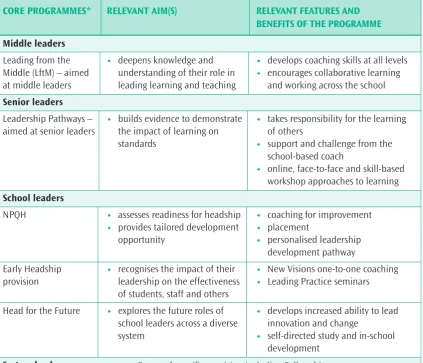
Review of provision
[image:31.595.88.512.378.741.2]Since ‘high-quality leadership of teaching and learning’ is one of NCSL’s four priority concerns, it is not surprising that its provision includes much on pedagogic leadership, the leadership of learning and teaching. All programmes are strong in building leadership self-knowledge, developing coaching skills and accessing sources of new knowledge and best practice (see Table 5). Such leadership requires a range of specific knowledge and skills, including: clear understanding of the characteristics of good and excellent teaching; process skills such as observation, analysis and feedback; data-handling and interpretive skills; understanding of assessment, monitoring and evaluation; skills in progress tracking and target setting; the concepts of personalised and accelerated learning; and methods of support, challenge and intervention with both pupils and teachers. Above all, the pedagogic leader needs to be able to model outstanding teaching and to produce effective learning.
Table 5.