Core business
RE
FORM
Dale Bassett
Andrew Haldenby
Luke Tryl
Core business
The authors
Core business
Reform
Reform is an independent, non-party think tank whose mission is to set out a better way to deliver public services and economic prosperity. Reform is a registered charity, the Reform Research Trust, charity no. 1103739. This publication is the property of the Reform Research Trust.
We believe that by reforming the public sector, increasing investment and extending choice, high quality services can be made available for everyone.
Core business
Dale Bassett
Andrew Haldenby
Luke Tryl
Contents
Executive summary 5
1 A narrow core 6
2 The hollow core 12
3 The importance of academic education 21
4 Conspiracy, not cock-up 23
5 Core business 26
References 30
Executive summary
What 16 year olds should expect at the end of compulsory education is rightly back on the education policy agenda, in particular due to the Conservative Party’s review of school examinations in England led by Sir Richard Sykes. The English system offers a much lower level of attainment compared with competitor countries.
The English system expects students to achieve two academic GCSEs – English and mathematics – at age 16. Other developed countries typically expect four or five as a minimum. Of the ten leading developed countries, eight require examinations in at least four academic subjects.
The academic examinations taken by English students can be of much lower quality. For this paper, leading English, maths and science academics have analysed examinations in those subjects for 16 year olds from France, Germany, Japan, the US and Canada. They have found that mathematics and science GCSEs in England are of a much lower quality than in other countries. English GCSE is of a comparable quality. Academic qualifications are becoming more important in the modern economy. They benefit individuals: GCSEs add 15 per cent to average earnings, whereas vocational qualifications can actually reduce earnings by up to 0.2 per cent. They improve general economic growth by enabling people to move between occupations. In contrast, vocational qualifications lead to occupational segregation, where different people become concentrated in different jobs, irrespective of their actual abilities.
The danger is that genuine academic qualifications such as the individual sciences or modern foreign languages will become restricted to independent, grammar and the best comprehensive schools, reducing social mobility. Only 0.2 per cent of individuals progress from non-academic routes into higher education. Countries such as Japan and Canada already expect a high level of academic achievement from all pupils. Countries such as Germany and France are increasing the academic requirement of students. But England is stuck in a rut. Since the mid-1980s, and under governments of both parties, the assumption has been that a large minority of English students are not up to studying academic qualifications. Politicians have continued on a vain quest to invent a robust vocational route and to create parity of esteem between vocational and academic qualifications. The reality is merely that many children have been directed to follow poorly-regarded courses at the expense of academic qualifications.
In the last five years, the Government has accepted that there should be some “core” academic study. In 2005, it argued that the key measure in school performance tables for 16 year olds should include English and maths, and that students should study functional English and maths. The first proposal was right since it sends a clear incentive to schools and a clear message to students that English and maths are essential subjects. The second was wrong since the level of “functional skills” is far below that of GCSEs.
In this year’s white paper, Your child, your schools, your future, the Government proposed a “guarantee” to pupils in regard to their school education, which will go into statute via the new Children, Schools and Families Bill. But the guarantee provides only a guarantee of choice of routes of learning rather than a broad core of high quality study.
English pupils need a different kind of guarantee – an expectation of academic achievement at the level of Japan and Canada. Two key reforms are necessary:
Introducing a strong academic core for all pupils, consisting of five academic GCSEs, and changing school league tables to incentivise attainment in the core.
1
A narrow core
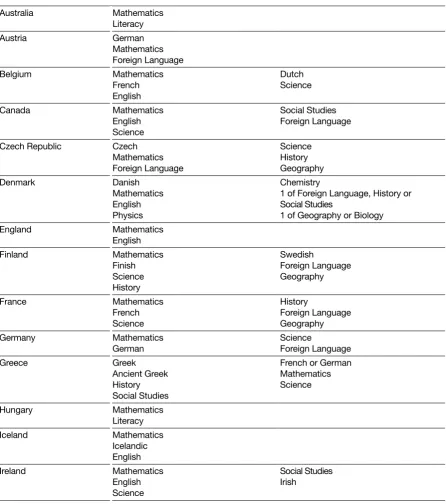
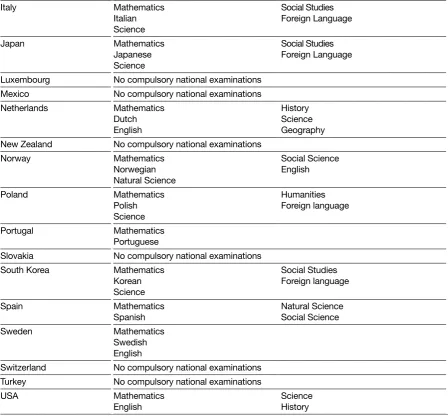
[image:8.595.114.561.228.733.2]England currently has one of the narrowest curricula in the world for 16 year olds. The English system requires only two academic qualifications at age 16, compared to four or five in most other leading countries.1
Figure 1: Compulsory examinations at 16 in OECD countries
Source: International Review of Curriculum and Assessment Frameworks; Eurydice
Australia Mathematics Literacy Austria German Mathematics Foreign Language Belgium Mathematics French English Dutch Science Canada Mathematics English Science Social Studies Foreign Language
Czech Republic Czech Mathematics Foreign Language Science History Geography Denmark Danish Mathematics English Physics Chemistry
1 of Foreign Language, History or Social Studies
1 of Geography or Biology
England Mathematics English Finland Mathematics Finish Science History Swedish Foreign Language Geography France Mathematics French Science History Foreign Language Geography Germany Mathematics German Science Foreign Language Greece Greek Ancient Greek History Social Studies
French or German Mathematics Science Hungary Mathematics Literacy Iceland Mathematics Icelandic English Ireland Mathematics English Science Social Studies Irish
1 Qualifications and Curriculum Development Agency (2009), The International Review of Curriculum and Assessment Frameworks (INCA)
A narrow core
Figure 1: Compulsory examinations at 16 in OECD countries
Source: International Review of Curriculum and Assessment Frameworks; Eurydice
Italy Mathematics Italian Science Social Studies Foreign Language Japan Mathematics Japanese Science Social Studies Foreign Language
Luxembourg No compulsory national examinations Mexico No compulsory national examinations Netherlands Mathematics Dutch English History Science Geography New Zealand No compulsory national examinations
Norway Mathematics Norwegian Natural Science Social Science English Poland Mathematics Polish Science Humanities Foreign language Portugal Mathematics Portuguese
Slovakia No compulsory national examinations South Korea Mathematics
Korean Science Social Studies Foreign language Spain Mathematics Spanish Natural Science Social Science Sweden Mathematics Swedish English
Switzerland No compulsory national examinations Turkey No compulsory national examinations
USA Mathematics
English ScienceHistory
League tables compel English and maths GCSE
In fact the English system does not formally require any academic examinations at all. It specifies a programme of study, but there is no statutory requirement to follow GCSEs in these subjects. The programme of study comprises:
> Statutory study of English, mathematics, science, ICT (information communication technology),
physical education, citizenship and religious education.
> Four “entitlement areas” in the humanities, modern foreign languages, design and technology and
the arts.2
In practice, however, almost all students do take at least one GCSE in each of English and maths. Partly this is a longstanding cultural expectation that school leavers should attempt those two qualifications. Partly it is due to the performance tables which measure school performance according to the proportion of students that achieve five GCSEs at A* to C (or equivalent) including English and maths. The result is that large numbers of students are not studying other academic subjects.
Core business A narrow core
1
Figure 2: Estimated percentage of 2008 cohort studying core academic subjects
Source: Reform calculations; Joint Council for Qualifications (2009), GCSE, Applied GCSE and Entry Level Certificate Results Summer 2009
Subject Estimated percentage of cohort sitting GCSE Core + Additional Science or Triple Science 71
History 31
Geography 28
French 28
German 10
Spanish 9
English Literature 76
The problem with science
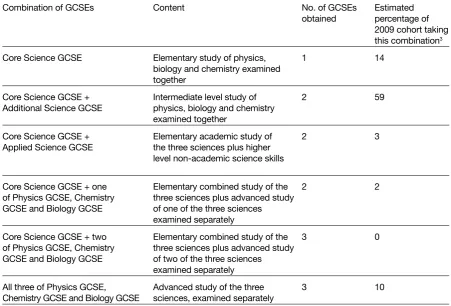
Figure 3: Available combinations of science GCSEs
Source: Qualifications and Curriculum Authority (2003), Changes to the key stage 4 curriculum
Combination of GCSEs Content No. of GCSEs Estimated
obtained percentage of
2009 cohort taking
this combination3
Core Science GCSE Elementary study of physics, 1 14
biology and chemistry examined
together
Core Science GCSE + Intermediate level study of 2 59 Additional Science GCSE physics, biology and chemistry
examined together
Core Science GCSE + Elementary academic study of 2 3 Applied Science GCSE the three sciences plus higher
level non-academic science skills
Core Science GCSE + one Elementary combined study of the 2 2 of Physics GCSE, Chemistry three sciences plus advanced study
GCSE and Biology GCSE of one of the three sciences
examined separately
Core Science GCSE + two Elementary combined study of the 3 0 of Physics GCSE, Chemistry three sciences plus advanced study
GCSE and Biology GCSE of two of the three sciences
examined separately
All three of Physics GCSE, Advanced study of the three 3 10 Chemistry GCSE and Biology GCSE sciences, examined separately
[image:10.595.111.563.361.667.2]Core business A narrow core
1
The combination of Core Science and Additional Science, followed by a majority of pupils, should theoretically offer a reasonable standard of science (albeit perhaps not ideal preparation for A-level study), but there are two concerns. Firstly, the papers are “combined”, testing all three sciences simultaneously; Professor Alan Spivey’s analysis in Chapter 2 indicates that combined science exams are generally of markedly lower quality than exams in the separate sciences. Secondly, while in theory students studying Core and Additional Science should be taught the full higher-level content of Additional Science, in practice schools can focus on Core Science (achievement of a C in which satisfies league table requirements) while neglecting Additional Science, since the two are graded separately.
“Functional skills” are not a solution
The Government is placing a new emphasis on “functional skills”, which feature in the Diploma and are also now being incorporated into GCSEs and their own qualification. Functional skills are designed to provide everyday competencies in maths, English and ICT.4 The Qualifications and Curriculum
Development Agency (QCDA) is encouraging schools to enter people for functional skills assessments as well as the maths and English GCSE, arguing that “that way, students’ functionality will be guaranteed and they will be best prepared for progression to further study and employment”.5
The functional skills criteria clearly lack academic rigour. In mathematics the subject criteria published by Ofqual only anticipate the highest tier of the functional skills assessment reaching level 6 mathematics, the expected average attainment of a 14 year old.6
It is striking, then, that the Government’s view is that functional skills should be the primary focus of 14-19 education, with the 2005 Government white paper stating that “achieving functional skills in English and maths must be at the heart of the 14-19 phase”.7
The academic superpowers
Reform has examined the education systems of a wide range of leading developed countries. Three of the highest performing countries – Canada, Japan and South Korea – ensure that all pupils cover a core academic curriculum until 16.
Japan: rigour for all
The Japanese education system is based on ensuring a standard, rigorous, academic curriculum for all students.8 Japan prescribes a minimum of 675 hours per year for core subjects, one of the highest
requirements within the OECD.9 The core is much broader than England, including Japanese, social
studies (history/geography), mathematics, science, fine art, music, industrial arts, homemaking and foreign languages.10
The Japanese curriculum is not only broad but also rigorous. The level of mathematics, for instance, has been found in general to be of the same standard of mathematics education in the US two years later.11
The most common complaint from parents is not that the level of work is too easy but rather that it is too hard and that there is too much to cover.12
In general, teaching is focused on ensuring that students are able to identify patterns in data and making connections among ideas and evidence in order to ensure that students have the basic transferable skills which they need.13 Those that are underachieving are expected to participate in after school classes or
attend Juku,14 special schools designed to ensure that everyone reaches a high school level of maths and
literacy. The school day can be as long as 12 hours excluding homework.
4 http://www.qcda.gov.uk/6062.aspx. 5 http://www.qcda.gov.uk/22533.aspx.
6 Ofqual (2009), Functional skills criteria for mathematics.
7 Department for Education and Skills (2005), 14-19 Education and Skills.
8 Willis, D. et al. (2008), Frontiers of Education: Japan as “Global Model or “Nation at Risk”.
9 Qualifications and Curriculum Development Agency (2009), The International Review of Curriculum and Assessment Frameworks (INCA)
Internet Archive (www.inca.org.uk).
10 Ibid.
11 Whitman, N. (2003), Learning from Japanese middle school math teachers. 12 National Center for Education Statistics (2008), The Education System in Japan. 13 http://www.ed.gov/pubs/ResearchToday/98-3038.html.
Core business A narrow core
1
The Japanese education system rejects the idea that people are born with different levels of ability and are suited to different study. The system is predicated around an understanding that accomplishment can always be increased: as one teacher said, “as far as inborn ability goes, I can’t say it isn’t there, but I can say that it doesn’t matter. Regardless of whether you have ability, if you persevere you can get a good outcome”.15 The vocational training that is provided is almost entirely enterprise based and industry led, in
contrast to most other countries in which public education institutions have been the leaders.16
Canada: academia in ascendency
Canada was one of the first countries to discuss falling standards and grade inflation.17 Although the
education system varies between the states there is a common format. Students study for diploma exams at age 16 (that contribute towards an end-of-high-school diploma at the age of 18). Students are expected to study English, social sciences, science and mathematics, along with a range of optional subjects.
Almost all provincial governments stipulate the minimum amount of time that should be spent on the core subjects. In British Columbia, for instance, 65 per cent of time must be spent studying maths, English and science.18 In both Alberta and British Columbia the system offers students the opportunity to pick the level
at which they study the core subjects, ensuring that a basic academic education is accessible to all.19
Massachusetts: the leading laboratory
Massachusetts is widely cited as one of the top performing states in the US.20 All students sit standardised
tests (known as MCAS21 tests) in science, maths, English and history at the end of the 10th grade (age
16).22 Efforts have been made to combat grade inflation and there is an expectation of a universal minimum
standard on MCAS assessments.23
Alongside South Carolina and Missouri, Massachusetts scores highest on National Assessment of Educational Progress (NAEP) tests and was one of the few states to register a statistically significant score improvement between 2003 and 2007.24
Seeing the light
This trend has been recognised by other countries across the world who are seeking to change their systems to deepen and broaden an academic core of study.
Germany: from complacency to reform
Until recently Germany took the approach of limiting academic study to the best students and seeking to teach the remainder vocational skills. But the German education debate was changed beyond all recognition by the publication of the 2000 PISA report, in which Germany performed below the OECD average in all three tested areas.25 Indeed reading was below all but two of the countries who participated. Nearly a
quarter of the 15 year old students did not exceed level 1 of the reading competency scale. That means that those students might perhaps be able to read a text aloud, but they are not really able to recognise what are they reading about.26
15 Stevenson, H. and Nerison-Low, R. (2002), To Sum It Up: Case Studies of Education in Germany, Japan, and the United States. 16 Keeves, J. et al. (2002), The Handbook on Educational Research in the Asia Pacific Region.
17 The Alberta Teachers’ Association (2009), A Brief History of Public Education in Alberta.
18 Qualifications and Curriculum Development Agency (2009), The International Review of Curriculum and Assessment Frameworks (INCA)
Internet Archive (www.inca.org.uk).
19 Government of Alberta Education (2009), Curriculum Handbooks for Parents 2009-2010.
20 O’Leary Morgan, K. and Morgan, S. (ed.) (2005), Education state rankings 2005-2006; pre K-12 education in the 50 United States, 4th ed. 21 Massachusetts Comprehensive Assessment System.
22 The history test has however been abandoned for this year due to the state’s budget problems. 23 http://www.doe.mass.edu/mcas/overview.html?faq=4.
24 National Centre for Education Statistics (2007), Mathematics 2007 National Assessment of Educational Progress at Grades 4 and 8. 25 OECD (2000), PISA 2000.
26 Leutner, D. and Wirth, J. (2005) “What We Have Learned from PISA so far: A German Educational Psychology Point of View”, KEDI
Core business A narrow core
1
Up until this point Germany had always assumed that it led the way in world education, so the 2000 results were labelled as “the PISA shock”.27 This triggered a national debate around education and led to a
wholesale review of the system, with headlines such as “Abysmal marks for German students”28 and
“Germany brings home a poor report card”.29 German politicians immediately accepted that the results
had to be an impetus for reform. Then Education Minister Edelgard Bulmahn accepted that the results “show that we have considerable flaws in our school system”.30
The results led to calls to abandon the traditional three school structure.31 The more vocational
Hauptschule, for the least academic 30 per cent of students, were criticised for effectively having become a “school for leftovers”.32 Ministers introduced more standards for maths, German and science taught in the
Hauptschule33 and standardised curricula for pupils in all schools in these subjects and a modern foreign
language,34 recognising the importance of the basic academic core.
Texas: following the lead
Texas’ persistent poor performance in the NAEP35 led it to look to the more successful states in the US in
order to improve its education.36 Its Texas Assessment of Knowledge and Skills tests (TAKS), standardised
tests which all students are supposed to sit at the age of 16, have been subject to criticism for numerous reasons, particularly because of grade inflation, dilution and because poorer performing pupils were often excluded from the tests in order to boost results.37 Policymakers recognised the need for reform through
higher standards and a broad academic curriculum. As a report to the Texas State Senate education select committee stated: “Now is the time to take the next steps – to push all students farther. Texas can, with some further improvements, establish itself as a ‘high skill state’.”38
In response it has this year scrapped TAKS assessments, instead introducing compulsory, academic, end of course assessments in maths, all three sciences, English language and literature, history and geography.39
France: a common platform
The publication of the 2003 PISA results revealed that French students were performing poorly relative to other nations in maths, reading and science.40 The French response was to strengthen the Brevet, the
standard examination which all students take at the age of 16, to require all students to study a modern foreign language, economics, physics, chemistry, biology and art education.41 The 2005 Education Law was
designed to ensure that “compulsory schooling guaranteed every student the means necessary to the acquisition of a common platform made up for an ensemble of knowledge that it is absolutely necessary to master ... to build a personal and professional future and succeed in their lives in society”.42
27 Martens, K. and Leibfried, S. (2008), “The PISA Story – How educational policy went international: a lesson in politics beyond the nation-state”, The Atlantic Times, January.
28 Frankfurter Allgemeine Zeitung (2001), “Miserable Noten für deutsche Schüler”, 4 December. 29 Deutsche Welle (2001), “Germany Brings Home a Bad Report Card”, 4 December.
30 Deutsche Welle (2003), “Germany Searching for Educational Solutions”, 7 March. 31 Deutsche Welle (2007), “Experts Push For Overhaul of German School System”, 26 July. 32 Beck, M. et al. (2007), Reform in the German Educational System: An Ongoing Process.
33 Waldow, F. (2009), “What PISA Did and Did Not Do: Germany after the ‘PISA-shock’”, European Educational Research Journal, Vol. 8 No. 3. 34 Deutsche Welle (2003), “Germany To Introduce Federal School Standards”, 5 December.
35 National Centre for Education Statistics (2007), Mathematics 2007 National Assessment of Educational Progress at Grades 4 and 8. 36 Texas Institute for Education Reform (2007), Texas Public Schools Today and Tomorrow: Call to Action and Agenda for Success
Academic Standards for the Schools We Need.
37 Terry, B. (2007), Implementing End of Course Examinations, Texas Public Policy Foundation.
38 Texas Institute for Education Reform (2007), Texas Public Schools Today and Tomorrow: Call to Action and Agenda for Success
Academic Standards for the Schools We Need.
39 Terry, B. (2007), Implementing End of Course Examinations, Texas Public Policy Foundation.. 40 OECD (2003), PISA 2003.
41 Qualifications and Curriculum Development Agency (2009), The International Review of Curriculum and Assessment Frameworks (INCA)
Internet Archive (www.inca.org.uk).
2
The hollow core
The other dimension of education standards is depth of study. A strong education comprises both a broad range of subjects and subjects studied at appropriate depth.
Reform asked leading academics to conduct a major new qualitative analysis of exam papers at 16 in core subjects across the UK’s main competitor countries. The academics compared exams in English (or the equivalent national language), mathematics and science with those of France, Germany, Japan, the US and Canada.
These countries have been selected as in terms of population and GDP per capita they are the UK’s statistical neighbours. All of the countries selected take part in the PISA study in maths, science and reading and have some form of equivalent examination at the age of 15/16 in maths, science and English or the national language. The American states of Massachusetts, New York and Texas have been selected in order to give a broad overview of educational attainment in the US. Based on their performance in the 2007 NAEP test of reading Massachusetts was the highest performing state, New York was slightly above the median state performance and Texas’ scores were below that of the median state.43
The analysis is based on GCSE papers and the equivalent international exams taken by most students at 16 from 2008 and 2009 (where available; some countries’ systems differ slightly). The academics have considered three main criteria: the content covered, the difficulty of the exam and the style of questions. Sample questions from the six countries’ exam papers are presented in the Appendix.
What emerges are clear differences in content, difficulty and style of question, which reduce the value of England’s exams. The analysis shows that GCSEs, which mark a key stage where the basic tools of language and science should have been mastered, are often less rigorous than their international counterparts. This particularly appears to be the case in the sciences, where intellectual coherence and rigour have been sacrificed for topicality and accessibility.
Science
Professor Alan C. Spivey, Department of Chemistry, Imperial College London
Content
England, France, Canada, Texas: combined disciplines lack depth
The countries which offer general or combined science papers clearly lack advanced content in comparison to more specialised exams focusing on each of the scientific disciplines individually.
The English GCSE papers44 cover biology, chemistry and mechanics. The French paper45 covers just
chemistry and physics, while both Canadian papers (Alberta46 and British Columbia47) and the Texas paper
are very similar in style, content and difficulty and cover a broad range of general science topics. In the case of England a list six basic equations are provided in a form which avoids the use of symbols and uses words instead. The Texas exam48 is accompanied by a detailed periodic table (PT) and a formula sheet; both symbols
and words are provided for equations and units are indicated for all constants, as with the English paper. The content of the combined science papers is at a significantly lower level than the other specialist papers from Germany,49 New York50 and Massachusetts,51 although even some of these (e.g. Texas) have breadth of
coverage greater than for the English paper.
43 National Centre for Education Statistics (2007), Mathematics 2007 National Assessment of Educational Progress at Grades 4 and 8. 44 OCR GCSE Additional Science B Unit 1 Higher Tier January 2009.
45 National Brevet Diploma Physics/Chemistry 2009. 46 Grade 9 2006.
47 Science 10 Form A June 2009. 48 TAKS Grade 10 April 2009.
49 Bavaria Realschulen Physics Final Examination 2008.
The hollow core
Germany, Massachusetts, New York: individual sciences push students further
The German paper is much more specialised and covers specific aspects of physics. The Massachusetts chemistry paper provides a PT and a chemistry formula and constants sheet not dissimilar to that provided in a UK university; symbols and units are clearly indicated. The range of topics is significantly wider, requiring knowledge of advanced, specialised topics. In the case of both Germany and Massachusetts the depth is significantly greater than in England and in the case of the Massachusetts papers the breadth is greater too. There is a separate three-hour New York paper for each of chemistry, physics and biology, and accordingly both the breadth and depth of required knowledge is greater than most of the other papers examined.
Difficulty
Canada and England: an aversion to rigour
Many of the English chemistry questions actually require no chemical knowledge but simply an ability to add up (e.g. “which formula contains 7 atoms?”) or apply simple logic. The numerical difficulty of the problems is minimal. There is a clear aversion to academic rigour and competence/familiarity with scientific nomenclature in these papers; units of measurement are avoided and all scope for original interpretation of the problem is discouraged by the narrow nature of the questions. The English papers show a noticeable intellectual deficiency when compared with the other countries.
The level of difficulty of the Canadian papers is similar to that of the English papers, i.e. it is relatively low, but the time pressure on these papers will be higher due to the large number of questions. Many of the questions while having a science context simply test logic and ability to interpret data – which just happens to be science based. Of the papers examined, the Canadian are the most similar to those used in England in terms of level. There is a balance of recall and reasoning with a high proportion of the former – particularly, a large number of questions testing specific, specialised, obscure and not very fundamental, terms and definitions.
France and Germany: a rigorous scientific approach
In the French papers, the use of units is clearly emphasised and an ability to work with equations containing symbols for quantities such as kinetic energy is clearly required.
The German questions are not so prescriptive about how the answer should appear. For example the very first question on the paper requires a graph to be plotted from some data – the equivalent question on the English paper has a grid already prepared with axes and more hints as to how to do this. Again there is a balance of recall and reasoning but the emphasis is on reasoning and numeracy; no hints as to which equations to use are provided.
Style
England, Canada, Texas: steering the answer in the right direction
In the English papers, the questions are highly structured, the marks per part indicated, and the space provided for the answer clearly limited. The two papers provided have significant overlap of diagrams and questions. There is balance of recall and reasoning but the difficulty and volume of both is low in comparison to most of the other scripts examined.
Core business The hollow core
2
New York, Massachusetts, Germany: focus on academics and reasoning
The Massachusetts papers have a number of MCQs but also several “open response” questions. The papers require recall and reasoning but the emphasis is on the latter. In general, and probably because of the format, the answers required are more qualitative than quantitative – in contrast to the German papers which are highly quantitative. The level of the Massachusetts papers is significantly higher than in English. It is difficult to compare the level of difficulty with the more challenging German paper because the MCQ format necessarily gives strong hints as to the answers – in many cases a minimal knowledge of chemistry will narrow the answer to one or two choices.
The New York papers are the most overtly academic in style and require the students to refer to a published chemistry reference table for data. The difficulty of the questions and the breadth of chemistry examined is very similar to the Massachusetts paper. The New York paper most closely resembles a university examination paper and the balance of recall vs. reasoning lies heavily on the side of reasoning. Unlike the Canadian papers and the English papers, chemistry knowledge and understanding is required to perform most of the reasoning; just logic is not sufficient.
Combined science is more “topical” but less scientifically coherent
On the Texas paper, there is clear intent in these papers to make the questions “topical and interesting” in much the same manner as the English, French and Canadian papers (but unlike the German and other US ones). This seems to be a hallmark of combined science papers and is always accompanied by a greater reliance on logic/common sense over scientific knowledge and understanding to answer the questions. For most of these questions the correct answer can be narrowed down to one or two possibilities by simple logic or application of common sense. In the German paper, for example, no attempt is made to make the questions topical – the data provided is of a form that might be the output of a real experiment rather than a contrived data set clearly dreamt up by the examiner to fit a particular relationship.
It is clear that the “combined science” papers are less rigorous in their requirements for numeracy and also for real scientific understanding than the single subject papers. The level and rigour required to complete the German, New York and Massachusetts exam papers was significantly higher than the English papers against any criteria.
Mathematics
Professor Peter Cameron, Director of Pure Mathematics, Queen Mary, University of London
Content
The content of the English papers52 is broadly similar to that of most of the comparison countries, covering
a wide selection of geometry, algebra, graphing and using statistical data. There are two main differences: the first is that on some of the papers (particularly Germany53) the content is markedly more advanced than
on England’s GCSE. The second is that some countries (e.g. Japan54 and Canada55) put a much greater
emphasis on basic algebraic and numerical manipulation.
Germany: more advanced content
The content of the German paper in particular is far more advanced than that of the GCSE, with questions more likely to be found on an AS-level paper. British Columbia also has some content more advanced than is found on the GCSE.
Japan and British Columbia: building the basic toolkit
The papers from Japan and British Columbia contain question after question focusing on rearranging equations, simplifying or factorising expressions and so on. This emphasis on basic algebraic and numerical skills is clearly designed to build up the basic toolkit of manipulation which is essential for any further advancement in mathematics.
52 AQA GCSE Specification A Higher Tier Paper 2 June 2008. 53 Brandenburg State Year 10 2008.
Core business The hollow core
2
Difficulty
The English papers avoid multiple choice questions, unlike the North American and Japanese exams. However on the English papers candidates are frequently led through the solutions in very small steps. This prevents the students from having to understand the mathematics needed to work out the right method for solving a larger or multi-stage problem.
New York: students need deep understanding to problem-solve
The New York papers’56 open-ended questions provide no steps or guidance whatsoever, posing challenging,
multi-stage problems and leaving the students to work out how best to approach them. These questions require students to have a deep understanding of the mathematics involved as well as an ability to think about the steps involved in tackling a particular mathematical problem, rather than the “functional” approach of solving a series of single, small-scope questions generally found on the English papers.
British Columbia, Japan and Texas: multiple choice but not dumbed down
Many of the international papers have a reliance on multiple choice, although in some of these cases (e.g. New York) they are also supplemented by numerous and extensive open-ended questions. In fact some of the MCQs, particularly those from the New York exams, could be better than the English equivalents, as they avoid the multiple stage approach but still pose challenging problems. The Texas paper,57 despite not
requiring a particularly advanced standard of maths, does ask some challenging one-step MCQs. The papers from British Columbia and Japan, with their emphasis on basic manipulation, are quite suited to multiple choice, although obviously this is likely to increase students’ marks on questions they could not otherwise answer.
Style
In England each question is restricted to a single topic, discouraging students from understanding how the different elements of mathematics relate to one another; other countries mix different parts of the syllabus in a single question. Also, the English papers shy away from asking for proofs or explanations. I think that application will succeed in most of the questions on all of the papers. But those requiring proof or reasoning are more likely to test innate ability (teaching proof is hard, though essential!).
France and New York: testing reasoning not recall
Some questions on the French58 and New York papers require proofs or explanations which demonstrate
real understanding of a mathematical concept and require the ability to work through a problem. The nearest the English papers come to this is “Show your working”, which is not really the same thing.
Perhaps unsurprisingly the North American papers are strongest on this. Many of them are expressed as “word problems” describing everyday situations and requiring the student to figure out how the mathematics applies. There is nothing similar in the English papers.
Texas and France: students need a good level of understanding
The Texas paper mostly covers arithmetic and algebra but contains many questions of the form “what extra information is needed ...?” or “which statement best describes ...?” that require a degree of reasoning or lateral thinking from students, although the mathematics itself is not much more advanced on this paper.
56 Regents Examination in Geometry Fall 2008. 57 TAKS Grade 10 April 2009.
Core business The hollow core
2
Questions like the below, from the French paper, may appear trivial but do have some value:
France
National Brevet Diploma 2009
Exercise 1
A = 8 + 3 x 4
1 + 2 x 1,5 1 Calculate A
2 To calculate A, a student typed the following sequence into his calculator.
Explain why he has not obtained the correct answer.
By asking why a naive sequence of keypresses on a calculator will not give the correct answer to a given problem, this question requires some understanding of both the rules for algebraic calculation and the mode of operation of a calculator.
English
Professor Francis O’Gorman, Head of English, University of Leeds
Content
What is taught varies – rightly – across countries
What can a comparison tell us? I must be clear, first of all, about some context. The idea of an “equivalent” is potentially misleading, since the education structures of different countries (modes and expectations of teaching and assessment, time spent studying, relationship between education at 16 and earlier years) are not taken into account in my analysis. Similarly, the place of “English” (or the national language) as part of the wider curricula is not consistent. And it is important to remember that the skills in English usage are tested and taught in many other subjects. Matters of expression, and accurate and clear writing, as well as the ability to construct arguments, to analyse problems verbally, and to comprehend written and spoken language are not the monopoly of studying “English”.
Style
The need to test what can be taught
Core business The hollow core
2
France, Canada and the US: relying on the tick-box
However, the extensive use of multiple choice on “comprehension” exercises raises some harder questions. The examinations in French in France59 and in English in New York,60 British Columbia,61 Texas62 and
Massachusetts63 are among those using MCQs as assessment modes (in Texas in March 2009, students
were tested through MCQs on their understanding of a short 11-image comic). MCQs have advantages, not least that they are easy and cheap to mark, and – so long as there are no ambiguities in the questions or answers (which there often are) – “objective” to mark as well. But it is easy to see the limits of MCQs: they test understanding, but sometimes crudely; they don’t permit discursive answers that try to catch more shaded forms of meaning; guesswork can sometimes produce good results; and they let the exam question do a lot of the thinking for you.
England: writing from scratch
AQA, the English awarding body whose papers I considered,64 declines to use this method in the current
specification, and prefers in both the Foundation and Higher Tier of GCSE English to concentrate on the more teachable skills of “Writing to Inform, Explain or Describe”. The preference is for grappling with the challenge of a blank piece of paper. Actually, they take this the full extent, and don’t have answer booklets with the questions inside, but simply exam papers, and genuinely blank exam booklets for the students’ responses. Pupils really do have to face the daunting prospect of a tabula rasa.
This is by no means the case in the international examinations. The tasks for the GCSE paper involved writing about an experience, a person the pupil admired, and the winning invitation: “Write a letter to a Minister for Education informing him or her of the things you think should be done to improve education for teenagers”. These are appropriately motivating assignments, but not ones in which less able pupils will fail to secure marks with good teaching. Appropriate guidance on structuring essays – helpful but not restraining – is given for the Foundation level.
Difficulty
England and Germany: an opportunity to shine
On the AQA papers, ability to read and understand is tested through questions about extracted or anthologised literary texts and there is a keenness to ask some searching questions. Steinbeck’s Of Mice and Men may be a little over-familiar as a text for study at this level, but a question such as, “Choose two characters from the list below, say why you think they are important in the novel and how Steinbeck presents them” give plenty of opportunity for students to shine. Being able to say why you think something is important is a valuable skill.
The German paper65 I looked at was perhaps the most demanding (with England in second place). It was a
four-hour test in discursive ability (both in discussion format and in essays), and it offered a tough examination in verbal ability to construct argument and reflect on ideas.
US and Canada: begging the question
Of course, every paper I considered includes some writing task or other (I have not considered coursework elements here in any context). British Columbia, for instance, had unsurprisingly the North American preference for “writing prompts” rather than actual specific questions. Their test for last year after all the MCQs included asking pupils to take up the prompt: “The lessons we learn affect our future”.
Actually, I think pupils should get used to answering specific questions at this stage: no one can escape the responsibility for responding directly to questions in later life, so it seems a pity to avoid them at this stage. But for all the challenges around science and maths in an international context, I saw evidence in these examples of assessment in national languages of strength in England. In its current specification, AQA has offered, I think, probing assessment that encourages meaningful teaching – not least because it assesses that which can be taught. And it has avoided the peril of the tick-box.
59 National Brevet Diploma College Level French 2009.
60 Regents High School Comprehensive Examination in English Session One 2008. 61 English 10 Release Exam 2008/09.
Core business The hollow core
2
Educational disadvantage
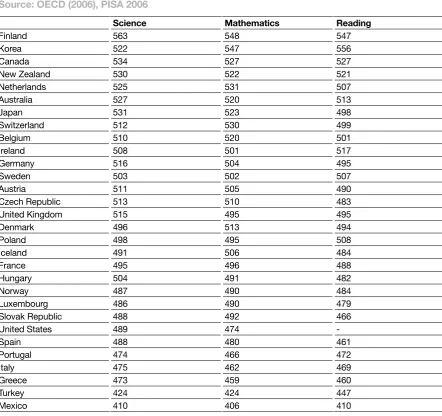
The poor quality of England’s core academic exams relative to our most successful competitors is evidenced by two international surveys of education: the Trends in International Mathematics and Science Study (TIMSS) and the Programme for International Student Assessment (PISA).66 Neither are perfect surveys;
PISA has been criticised for being too applied67 and disadvantaging those from different cultural contexts,68
whilst TIMSS has faced the charge of ignoring large areas of mathematical testing69 and having a rapidly
[image:20.595.115.558.264.680.2]fluctuating sample which makes comparison over time difficult. But they do suggest that those countries which maintain a rigorous core academic curriculum are the ones which perform better and are producing the best educational outcomes.
Figure 4: PISA 2006 mean scores
Source: OECD (2006), PISA 2006
Science Mathematics Reading
Finland 563 548 547
Korea 522 547 556
Canada 534 527 527
New Zealand 530 522 521
Netherlands 525 531 507
Australia 527 520 513
Japan 531 523 498
Switzerland 512 530 499
Belgium 510 520 501
Ireland 508 501 517
Germany 516 504 495
Sweden 503 502 507
Austria 511 505 490
Czech Republic 513 510 483
United Kingdom 515 495 495
Denmark 496 513 494
Poland 498 495 508
Iceland 491 506 484
France 495 496 488
Hungary 504 491 482
Norway 487 490 484
Luxembourg 486 490 479
Slovak Republic 488 492 466
United States 489 474
-Spain 488 480 461
Portugal 474 466 472
Italy 475 462 469
Greece 473 459 460
Turkey 424 424 447
Mexico 410 406 410
66 Biesta, G. (2009), “Good education: what it is and why we need it”. Inaugural lecture, University of Stirling. 67 Prais, S. (2003), “Cautions on OECD’s recent educational survey”, Oxford Review of Education , No. 29. 68 Wu, M. (2009), A critical comparison of the contents of PISA and TIMSS mathematics assessments.
Core business The hollow core
2
Figure 5: TIMSS 2003 mean scores (OECD countries in bold)70
Source: National Centre for Education Statistics (2007), Trends in International Mathematics and Science Study 2007.
Science Mathematics
Singapore 578 605
Chinese Taipei 571 585
Korea 558 589
Hong Kong 556 586
Japan 552 570
Estonia 552 531
Hungary 543 529
Netherlands 536 536
Belgium (Flemish) 516 537
Australia 527 505
United States 527 504
Slovak Republic 517 508
Sweden 524 499
Lithuania 519 502
Russian Federation 512 508
Latvia 512 508
Malaysia 510 508
New Zealand 520 494
Slovenia 520 493
Scotland 512 498
England 498 498
Israel 488 496
Italy 491 484
Norway 494 461
Bulgaria 479 476
Romania 470 475
Serbia 468 477
Moldova 472 460
Armenia 453 478
Cyprus 441 459
Macedonia 449 435
Iran 449 411
Bahrain 438 401
Indonesia 420 411
Egypt 421 406
Lebanon 393 433
Palestinian National Authority 435 390
Tunisia 404 410
Chile 413 387
Morocco 396 387
Philippines 377 378
Botswana 365 366
Saudi Arabia 398 332
Ghana 255 276
South Africa 244 264
Core business The hollow core
2
GCSEs in decline
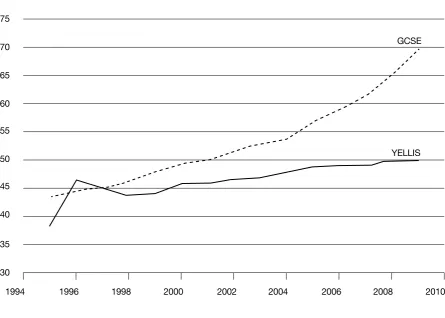
Analysis by Robert Coe of Durham University for the Office of National Statistics suggests that standards have indeed fallen.71 Coe compares GCSE results with students’ performance on YELLIS (Year 11
Information System), a test in mathematics and vocabulary which is used as a comparison to measure a student’s ability.72 His analysis shows that students with the same YELLIS score now achieve higher
[image:22.595.115.561.282.600.2]average GCSE results than in the past. Coe suggests that performance in maths increased by almost 0.8 of a grade in the decade to 2006; history and French by around two-thirds of a grade; and English by just under half a grade.73
Figure 6: The decline in standards74
Source: Joint Council for Qualifications (2009), GCSE, Applied GCSE and Entry Level Certificate Results Summer 2009; Centre for Evaluation & Monitoring (2009), Average YELLIS test scores for Year 10 testing cohort
Figure 6 shows that between 1995 and 2009 the number of pupils achieving 5 or more A* to C grade GCSEs increased by 60 per cent, whereas YELLIS performance increased only gradually.75 This would
indicate that the same GCSE grade now corresponds to a lower level of performance.
71 Coe, R. (2007), Changes in standards at GCSE and A-level: Evidence from ALIS and YELLIS. 72 www.yellisproject.org.
73 Coe, R. (2007), Changes in standards at GCSE and A-level: Evidence from ALIS and YELLIS.
74 Percentage of UK cohort achieving five or more A*-C GCSEs or equivalent against average YELLIS test scores for Year 10 testing cohort from the preceding year.
75 Joint Council for Qualifications (2009), GCSE, Applied GCSE and Entry Level Certificate Results Summer 2009; Centre for Evaluation & Monitoring (2009), Average YELLIS test scores for Year 10 testing cohort.
75
65
55
45
35 70
60
50
40
30
1994 1996 1998 2000 2002 2004 2006 2008 2010
GCSE
3
The importance of academic education
The nature of the 21st century society and economy means that every citizen will need a basic level of academic competency to be able to play a full role, be that engaging with government, re-skilling to change career or just being able to do one’s job properly. Fulfilling the needs of the 21st century economy, and being able to play a full and active role in society, will require all children to develop academic skills.
The new workforce
A good academic education forms the basis of the most successful elements of the UK economy. Sir Stuart Rose, who runs Marks & Spencer, complained recently that British education is producing people who are “not fit for work” and said of some school leavers that: “They cannot do reading. They cannot do arithmetic. They cannot do writing.” Tesco’s Sir Terry Leahy has said that “standards are still woefully low in too many schools”.76
Economic developments are fuelling an ever increasing need for academic ability.77 There is demand for
a more educated society and a higher level of personal capability.78 The Leitch Review of Skills projected a
50 per cent increase in the share of highly skilled occupations, such as managers and professionals, and a decrease in low skilled occupations, by 2020.79 The real value of academic excellence is shown by the
Government’s immigration points system, which places a very high value on master’s degrees, PhDs and other academic qualifications above their vocational rivals.80
In the modern economy employers need school leavers to have developed the ability to think and reason beyond basic literacy and numeracy. Businesses are placing greater emphasis on capabilities of the mind onto which they can add specialist training.81 Professions such as nursing also require the adaptive, critical
and problem-solving skills that academic training can deliver. Reform’s previous research has shown that employers consistently value the ability to think and the transferable academic abilities that enable people to learn new skills, over and above specific vocational training.82 Vocational skills can be developed on the
job; it is the academic grounding that needs to be in place.
Despite the impact of the recession on graduate recruitment, modern economies will have to continue to expand participation in higher education.83 The UK will need more graduates, not fewer; the earnings
premium for graduates has held up despite increasing numbers.84 The academic route remains by far the
most successful path for school leavers to follow.
The economic costs of discouraging academic training
By encouraging individuals to make limited educational decisions, the bias against academic training contributes to the labour market phenomenon of occupational segregation (where different people become concentrated in different jobs, irrespective of their actual abilities).85 This segregation of people into
different occupations (or roles within occupations) introduces rigidities into labour markets that interfere with the allocative efficiency of these markets. This not only means that the right person is not allocated to the right job, but that the supply of skilled workers in the economy is discouraged more generally.
These problems in the labour market damage, in turn, prospects for economic growth. Encouraging individuals to make limited educational decisions leads to them under-investing in (particular types of) human capital, discourages entrepreneurship and creates an opportunity cost of foregone GDP and productivity (as people are discouraged from acquiring human and financial capital).
76 Armitstead, L. (2009), “Sir Stuart Rose: Schools are not providing workers with the right skills”, The Daily Telegraph, 24 November. 77 Barro, R. (2001), “Human capital and growth”, The American Economic Review, Vol. 91 No.2.
78 Haldenby, A. et al. (2008), The mobile economy, Reform.
79 Leitch, S. (2006), Prosperity for all in the global economy – world class skills. 80 UK Border Agency (2009), www.ukba.homeoffice.gov.uk.
81 CBI (2007), Shaping up for the future: The business vision for education and skills. 82 Bassett, D. et al. (2009), A new level, Reform.
83 Haldenby, A. et al. (2008), The mobile economy, Reform.
84 Walker, I. and Zhu, Y. (2008), “The college wage premium and the expansion of higher education in the UK”, Scandinavian Journal
of Economics, Vol. 110 No. 4.
85 Fortin, N. and Huberman, M. (2002), “Occupational Gender Segregation and Women’s Wages in Canada: An Historical Perspective”,
Canadian Public Policy, Vol. 27 No. 1. Occupational segregation has horizontal and vertical components. Horizontal segregation occurs
Core business
The importance of academic education
3
The new divide
The continuing move away from academic qualifications could lead to a new cultural divide developing, entrenching privilege and further impacting on the UK’s poor social mobility.86 A number of grammar and
the best comprehensive schools are already encouraging their pupils to follow more rigorous routes such as the three separate science GCSEs, while independent schools are increasingly offering well-regarded qualifications like the International Baccalaureate and International GCSE.87 Meanwhile the most
disadvantaged children are deprived of opportunities for rigorous academic study, and are instead pushed to follow non-academic qualifications that boost league table results. Only 0.2 per cent of individuals progress from non-academic routes into higher education, meaning this vital door of social mobility is closed to these children deprived of choice.88
The key to participation in society
“Education is fundamentally implicated not only in a country’s economic and social development, but also in the personal development of its citizens”, according to the 2007 TIMSS report.89 A century ago a
small elite participated in and ran society. Today we expect everyone to be able to participate. Indeed, a mark of a civilised nation is that the majority of the population are able to participate in politics and society. As Schumpeter (1942) and Lipset (1960) argued, a better education correlates strongly with a belief in democratic values and support of democratic practices.90
86 Bosanquet, N. et al. (2008), Shifting the unequal state: From public apathy to personal capability.
87 Curtis, P. (2009), “Government bars state schools from offering International GCSE”, The Guardian, 4 November. 88 The Panel on Fair Access to the Professions (2009), Unleashing Aspiration.
89 National Centre for Education Statistics (2007), Trends in International Mathematics and Science Study 2007.
4
Conspiracy, not cock-up
The difference in the culture and the expectations of English education for 16 year olds is no accident. It lies in a series of policy decisions over the last 25 years which have sought to restrict access to academic qualifications and move a sizeable proportion of children into non-academic routes.
The capability myth
At the root of this direction of policy is the idea that not everyone is suited to an academic education and that for some people studying at the vocational level is the most suitable course of action.91 This “capability
myth” is damaging the most disadvantaged children, who are suffering from what Professor E. D. Hirsch of the University of Virginia calls “the soft bigotry of low expectations”.92
This attitude has been repeatedly demonstrated by educational policymakers, who have made attempt after attempt to create durable and effective vocational routes despite the failure of successive vocational initiatives. The Tomlinson Report said that the new qualification should “place all learning in a single framework, which emphasises the equally valid, but different, academic and vocational learning”.93 Lord Leitch’s skills review
claimed that “parity of esteem of the vocational route [is] needed to achieve world-leading levels of post-16 participation in education and training”.94 The Government’s 2005 white paper on 14-19 education argued
that “we need a range of qualifications which reward different types of learning”.95
This culture directly contrasts with the countries examined earlier in this report. Whereas in the UK there is a widespread belief that some children are just “not academic”, in these other countries this attitude simply does not exist and there is a prevailing assumption and understanding that almost everyone can and should follow a full programme of academic study to 16.
If it is accepted that not everyone can do this, it becomes necessary to construct an apparatus of non-academic qualifications for the rest of the population to undertake. This explains the calamitous history of vocational qualifications since the mid-1980s, in which central government has introduced, reintroduced and scrapped qualification after qualification.
A brief history of 14-16 education over the last 25 years
Academic changes Vocational changes
1986 GCSEs introduced, replacing O-levels and CSEs NVQs introduced
1992 GNVQs introduced
1994 A* grade introduced for GCSEs 1990s GCSEs moved from three tiers to two
(except maths)
1995 Beaumont Review recommended improvements
in specifications and assessment of NVQs
1996 Dearing Review recommended creation of a Key
Skills qualification and a national framework for qualifications
1997 Introduction of Key Skills
91 For example, Curtis, P. (2009), “Don’t say I was wrong”, The Guardian, 12 May. Former Chief Inspector of Schools Chris Woodhead argues: “I think it would be unlikely that large numbers of grammar school kids would come from those disadvantaged areas – the genes are likely to be better if your parents are teachers, academics, lawyers, whatever … If we had had a system whereby those young people were able to follow practical educational courses that gave them a sense of worth, a sense that they weren’t dull and less intelligent than others, it would have been much better for them.” Another example of this view is Murray, C. (2008), “We Can’t All Make the Grade”,
Standpoint, October: “Many children are just not gifted enough to learn to read and write at more than a rudimentary level, far short of the
level required by a GCSE, and the schools can only tweak their performance at the margins. An educational system that serves all the children must begin by recognising that truth.”
92 Hirsch, E. D. (1996), The schools we need and why we don’t have them.
93 Working Group on 14-19 Reform (2004), 14-19 Curriculum and Qualifications Reform: Final Report. 94 Leitch, S. (2006), Prosperity for all in the global economy – world class skills.
Core business
Conspiracy, not cock-up
4
A brief history of 14-16 education over the last 25 years
1998 National Qualifications Framework introduced
2000 Vocational GCSEs (VGCSEs) introduced
2004 Requirement to study a modern foreign language and design and technology dropped
Vocational GCSEs now classified as just GCSEs
Requirement to spend 50% of teaching time on core subjects abolished
Tomlinson Report called for introduction of 14-19 Diplomas
League tables changed to include all equivalent qualifications, not just GCSEs and GNVQs 2005 First league tables measuring 5 A*-C (or equivalent)
including English and maths
2006 Maths GCSE moved from three tiers to two Leitch Review called for vocational routes to have “parity of esteem” with academic routes to increase post-16 participation
Double Award Science replaced with Core Science plus either Applied Science or Additional Science
2007 Introduction of Functional Skills GNVQs phased out
2008 First teaching of the Diplomas
National Qualifications Framework replaced with Qualifications and Credit Framework
2009 Introduction of modular GCSEs League table measure excluding English and maths dropped
2010 First teaching of new English, maths and ICT GCSEs incorporating functional skills 2011 First teaching of “academic” Diplomas
The GCSE: a qualification for all
The GCSE was introduced in September 1986, to replace the O-level and CSE, which had been criticised for creating a two-tier system. It was intended to be a qualification for the masses that would solve the previous problems of segregation in the education system; then Education Secretary Sir Keith Joseph hoped at least 80 per cent of 16 year olds could pass the exam.96 Students could achieve grades A to G (with
A* added later), with a C set to be equivalent to a C grade at O-level or a grade 1 at CSE.
Key Skills
Sir Ron (now Lord) Dearing’s 1996 review of 16-19 qualifications recommended that a new Key Skills qualification should be created, to address “concern in all quarters about current standards of achievement in communication and the application of number”.97 He also proposed that the “key skills” within, say,
mathematics GCSE, should be awarded their own separate grade.
The key skills were identified as communication, application of number, and ICT. Working with others, improving own learning and performance, and problem solving, were classified as “wider” key skills.98
The original Key Skills Qualification was introduced in 1997,99 with a major overhaul in 2004.100
From 2007 there was a new emphasis on “functional skills” in English, ICT and maths. A new set of qualifications is being developed to provide these functional skills, and existing GCSE curricula are being re-written to incorporate them.101
96 Sofer, A. (1985), “Young idea – and so wrong”, The Times, 25 November. 97 Dearing, R. (1996), Review of Qualifications for 16-19 Year Olds.
98 http://www.direct.gov.uk/en/EducationAndLearning/QualificationsExplained/DG_10039028. 99 http://www.qcda.gov.uk/6566.aspx.
Core business
Conspiracy, not cock-up
4
National Qualifications Framework: formalised equivalence
The Dearing Review also recommended the creation of a common national framework for qualifications “to recognise explicitly the equivalence in national terms of the value of achievement”.102 The National
Qualifications Framework was introduced in 1998 to fulfil this objective.103 In introducing a formal national
measure of the equivalence of different qualifications, the Government allowed for the first time the “value” of vocational qualifications to be quantified relative to that of academic qualifications.
The conflation of academic and vocational
Sir Mike Tomlinson’s 2004 review of 14-19 education proposed the creation of a new Diploma, eventually to subsume GCSEs, A-levels and their equivalent vocational qualifications.104 The report called for a
“unified framework” and a “common format” for all 14-19 education, whether academic or vocational. Although Tomlinson’s proposals were not implemented in their entirety, the introduction of the Diploma from 2008 has resulted in the conflation of academic and vocational education.
The Higher Diploma, equivalent to 7 A*-C GCSEs, consists of principal learning (focused on the chosen Diploma subject), additional and specialist learning (additional options) and generic learning (including functional skills and ten days’ work experience).105 At least 50 per cent of all subject content must be
“applied learning” and is supposed to be taught in a “work-related environment”.106
By attempting to provide both academic and vocational study, the Diploma risks delivering neither effectively.107 Sir Mike Tomlinson’s review of 14-19 education, which recommended the introduction of
the Diploma, correctly identified many of the problems present in the system, including disengagement, underachievement, the burden of over-assessment, a lack of transparency in the examination process and grade inflation.108 However the Diploma solves few of these problems and exacerbates others. The
vocational focus may undermine the rigorous, academic aspects of the curriculum;109 insisting on an
academic slant and academic assessment for the vocational aspects risks jeopardising the effectiveness of that vocational training.110
Parity of esteem
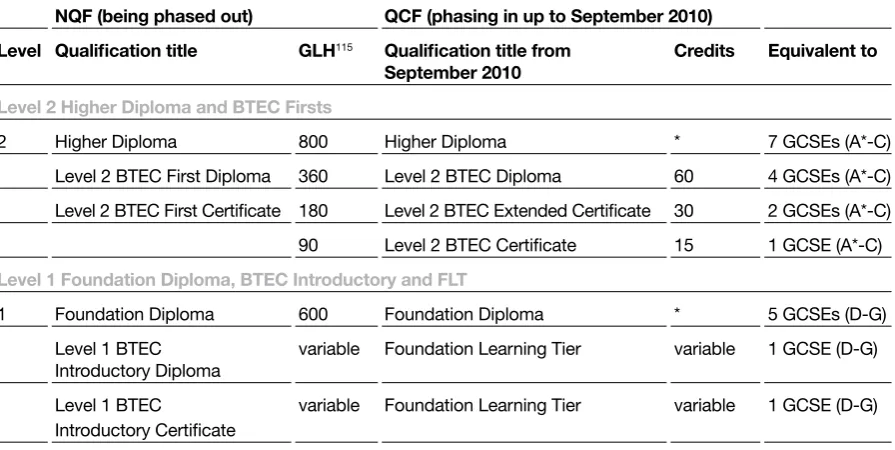
The continuing focus on vocational education has led to another damaging principle: parity of esteem. In an effort to encourage children to undertake vocational qualifications, government has asserted that those qualifications are equal in value to their academic counterparts. This is embodied in the National Qualifications Framework (NQF) which, for example, states that a BTEC First Certificate is equivalent to two GCSEs at A*-C.111 The NQF is now being phased out and replaced with the Qualifications and
Credit Framework (QCF) which is intended to “present qualifications in a way that is easy to understand and measure”.112
102 Dearing, R. (1996), Review of Qualifications for 16-19 Year Olds. 103 Education Act 1998.
104 Working Group on 14-19 Reform (2004), 14-19 Curriculum and Qualifications Reform: Final Report. 105 http://www.ofqual.org.uk/100.aspx.
106 Bassett, D. et al. (2009), A new level, Reform. 107 Ibid.
108 Working Group on 14-19 Reform (2004), 14-19 Curriculum and Qualifications Reform: Final Report.
109 Paton, G. (2008), “Diplomas ‘not hard enough’ for brightest pupils, claims head”, The Daily Telegraph, 28 November. Dr Bernard Trafford, head of the Royal Grammar School in Newcastle, argues that “if we really want to produce world-class engineers, sixth-formers need to do a lot of work at ‘hard subjects’, including maths and physics”.
110 House of Commons Education and Skills Committee (2007), 14-19 Diplomas. The select committee noted that: “Several of those from whom we received evidence warned of the potential for ‘academic drift’ – i.e., that the practical and applied nature of the curriculum could be downgraded and replaced with more ‘classroom-based’ and theoretical activity, either through unfamiliarity with vocational teaching and learning methods, and/or as a consequence of a residual belief that ‘academic’ learning was the ‘gold standard’.” The Association for College Management in its evidence to the committee said: “We should not fall into the old trap of imagining that the only way to secure parity of esteem is to make the vocational side qualifications resemble academic side qualifications. Indeed we suggest that the parity of esteem debate is unhelpful: let us concentrate on developing first rate qualifications that offer all of our young learners an excellent, modern and accessible education.”
111 Qualifications and Curriculum Authority (2006), The National Qualifications Framework.
Core business
[image:28.595.115.563.138.363.2]Conspiracy, not cock-up
4
Figure 7: The National Qualifications Framework and the Qualifications and Credit Framework
Source: Edexcel113 and Department for Children, Schools and Families114
NQF (being phased out) QCF (phasing in up to September 2010)
Level Qualification title GLH115 Qualification title from Credits Equivalent to
September 2010
Level 2 Higher Diploma and BTEC Firsts
2 Higher Diploma 800 Higher Diploma * 7 GCSEs (A*-C)
Level 2 BTEC First Diploma 360 Level 2 BTEC Diploma 60 4 GCSEs (A*-C) Level 2 BTEC First Certificate 180 Level 2 BTEC Extended Certificate 30 2 GCSEs (A*-C)
90 Level 2 BTEC Certificate 15 1 GCSE (A*-C)
Level 1 Foundation Diploma, BTEC Introductory and FLT
1 Foundation Diploma 600 Foundation Diploma * 5 GCSEs (D-G) Level 1 BTEC variable Foundation Learning Tier variable 1 GCSE (D-G) Introductory Diploma
Level 1 BTEC variable Foundation Learning Tier variable 1 GCSE (D-G) Introductory Certificate
*Diplomas have not yet been allocated a credits value on the QCF
This quantification of the “equivalence” of different qualifications has a dual effect. On the one hand, it persuades students to undertake vocational qualifications. On the other, it acts as a strong incentive for schools to enter students for vocational qualifications, since they count disproportionately towards success in performance tables. A school could claim, for example, that all of their students had achieved five GCSEs at A*-C if they passed one GCSE at grade C and achieved one BTEC First Diploma, requiring no formal external examination.
Fully 70 per cent of elite graduates on the Teach First scheme felt that their school’s leadership encouraged pupils to choose courses that would benefit the school’s league table results rather than meeting each pupil’s long term needs.116
BBC education correspondent Mike Baker has argued that “the sad reality is that the British have always looked down on vocational education”.117 The truth is that employers, universities and students know the
difference. 60 per cent of leading Russell Group universities, for example, have said that they will not accept Diploma for entry, despite it being technically equivalent to three and a half A-levels