Fractional Chemotaxis Diffusion Equations.
T.A.M. Langlands∗
Department of Mathematics and Computing,
University of Southern Queensland,
Toowoomba Queensland 4350, Australia.
B.I. Henry†
Department of Applied Mathematics, School of Mathematics,
University of New South Wales, Sydney NSW 2052, Australia.
(Dated: April 8, 2010)
Abstract
We introduce mesoscopic and macroscopic model equations of chemotaxis with anomalous
sub-diffusion for modelling chemically directed transport of biological organisms in changing chemical
environments with diffusion hindered by traps or macro-molecular crowding. The mesoscopic
mod-els are formulated using Continuous Time Random Walk master equations and the macroscopic
models are formulated with fractional order differential equations. Different models are proposed
depending on the timing of the chemotactic forcing. Generalizations of the models to include linear
reaction dynamics are also derived. Finally a Monte Carlo method for simulating anomalous
subdif-fusion with chemotaxis is introduced and simulation results are compared with numerical solutions
of the model equations. The model equations developed here could be used to replace Keller-Segel
type equations in biological systems with transport hindered by traps, macro-molecular crowding
or other obstacles.
PACS numbers: 05.40.Fb,02.70.Bf,87.17.Jj,05.10.Gg,82.39.Rt,87.10.Rt
I. INTRODUCTION
Diffusion and chemotaxis are fundamental to the motion of bacteria [1], the directed mo-tion of neutrophils in response to infecmo-tion [2], hypoxia stimulated angiogenesis [3] and many other biological transport processes [2]. These transport processes can further be compli-cated by traps [4], macromolecular crowding [5] or other obstacles resulting in anomalous subdiffusion characterized by an ensemble averaged mean square displacement of diffusing species, hr2(t)i, that scales sublinearly in time, i.e., hr2(t)i ∼ tγ with 0 < γ < 1, [6–17].
In this paper we introduce mesoscopic and macroscopic models for transport in biological systems with chemotaxis and anomalous subdiffusion.
The classic macroscopic model for the evolution of a diffusing species, with concentration n(x, t), in the presence of a chemoattractant, with concentration c(x, t), is the Keller-Segel model [18]
∂n ∂t =D
∂2n
dx2 −χ
∂ ∂x
n∂c ∂x
(1)
where D and χ denote the diffusion coefficient and the chemotactic coefficient respectively. In this model if the chemoattractant is removed the evolution corresponds to standard Brownian diffusion with hr2(t)i ∼t.
Anomalous subdiffusion can be modelled as fractional Brownian motion (fBm) [19–21] or Continuous Time Random Walks (CTRWs) [22, 23] with long-tailed waiting-time den-sities [13]. Both of these models are non-Markovian and both exhibit the same sublinear scaling for the ensemble averaged mean square displacement. However the second moment of the velocity scales differently in the two models [24] and the time averaged mean square displacement differs from the ensemble averaged mean square displacements in the CTRW model, but not in the fBm model [25]. Both possibilities should be considered when inter-preting results from experiments using single particle tracking [25] or fluorescence recovery after photobleaching [26] and a simple test has been devised for analysing experimental data to determine which model is most appropriate [27].
At the macroscopic level, anomalous subdiffusion can be modelled through a modified diffusion equation
∂C
∂t =D(γ, t)∇
2C (2)
frac-tional Brownian motion (fBm) this operator is given by [20, 21]
DI(γ, t) =D(γ)γtγ−1 (3)
In the Continuous Time Random Walk (CTRW) model [22], with power law waiting times [13], the fractional temporal operator is given by
DII(γ, t) = D(γ)
∂1−γ
∂t1−γ (4)
where D(γ) is a generalized diffusion coefficient with units ofm2s−γ and
∂1−γ
∂t1−γY(t) =
1 Γ(γ)
∂ ∂t
Z t
0
Y(t′) (t−t′)1−γdt
′
(5)
defines the Riemann-Liouville fractional derivative of non-integer order 1−γ for 0< γ < 1. The fractional derivative is an integer order derivative of the fractional integral
∂−γ
∂t−γY(t) =
1 Γ(γ)
Z t
0
Y(t′) (t−t′)1−γdt
′ (6)
which itself is a generalization of the Cauchy formula d−nY(t)
dt−n =
Z t
0
Z tn−1
0
. . .
Z t2
0
Z t1
0
Y(t0)dt0
dt1
. . .
dtn−1
= 1
Γ(n)
Z t
0
Y(t′) (t−t′)1−ndt
′
for non-integer n. The fractional integral, Eq(6), defines a power law weighted average of the function Y(t).
There have been various attempts to modify the fractional macroscopic diffusion equa-tions to include force fields and reacequa-tions [13, 28]. The Fokker-Planck equation for diffusion in a force field can readily be generalized by replacing the diffusion coefficient with a time dependent fractional operator as above. This has been justified within the framework of CTRWs, for force fields that vary in space but not time [13, 29] and for force fields that vary in time but not space [30]. However these derivations do not extend to the more general case of anomalous subdiffusion in a general external force field f(x, t) that varies in both time and space. Two obvious possible generalizations in this case are [31]
∂n ∂t =
∂1−γ
∂t1−γDγ∇
2n− 1
ηγ
∂1−γ
∂t1−γ∇(f(x, t)n(x, t)) (7)
and [32–34]
∂n ∂t =
∂1−γ
∂t1−γDγ∇
2n− 1
ηγ
∇
f(x, t)∂ 1−γ
∂t1−γn(x, t)
If the force field is purely space dependent then the two models are equivalent and the so-lution is time subordinated to the concentration of diffusing species in the standard Fokker-Planck equation. This temporal subordination is not physically appropriate for time de-pendent external force fields [32]. However an alternate formulation using an Ito stochastic differential equation has been proposed with a modified subordination in which the force varies in real time rather than the random time [33]. In chemotaxis there may be a physical link between the time scale of the diffusion and the time scale of the effective force field since the latter depends on the concentration of another diffusing species. Similarly in the fractional Nernst-Planck equation considered in [35, 36] the force field from the membrane potential depends on concentrations of the diffusing species.
In Section II we introduce four different models of chemotaxis with anomalous subdiffu-sion. The different models are characterized by differences in the nature of the anomalous diffusion (fBm or power law CTRWs), and differences in the details of the underlying random walk processes.
In Section III numerical solutions of the associated discrete space equations are obtained for each model. The numerical results are compared with Monte Carlo random walk simula-tions, with chemotactic forcing, on the same grid and using the same parameters. Differences between the model results are discussed in Section IV.
II. FRACTIONAL CHEMOTAXIS DIFFUSION MODELS
A. Model I
To model chemotaxis with fractional Brownian motion we consider an ad hoc model in which we replace both the diffusion coefficient and the chemotactic coefficient by fractional temporal operators as in Eq. (3). This yields
∂n ∂t =γt
γ−1
Dγ
∂2n
∂x2 −χγ
∂ ∂x
n∂c ∂x
(9)
whereγ is the anomalous diffusion exponent,Dγ is the anomalous diffusion coefficient (with
units m2s−γ), and χ
γ is the analogous anomalous chemotaxis coefficient. This model
B. Model II
A simple model for chemotaxis with fractional diffusion from power law CTRWs starts with the master equation
ni(t) =ni(0)Φ(t) + t
Z
0
n
pr(xi−1, t
′
)ni−1(t
′
) +pl(xi+1, t
′
)ni+1(t
′
)oψ(t−t′)dt′ (10)
where ψ(t) is a (power law) waiting time density,
Φ(t) = ∞
Z
t
ψ(t′)dt′ (11)
is the corresponding survival probability, and pr(x, t) and pl(x, t) are the probabilities of
jumping from x to the adjacent grid point to the right and left directions respectively. The physical interpretation of the master equation, Eq.(10), is that the number of particles at grid point iat timetis comprised of those particles that were at point iat timet= 0 which have not yet jumped (the first term on the right hand side) together with those particles that were at an adjacent grid point i±1 at an earlier time t′
but then jumped to point i at time t after waiting a time t−t′
. The probabilities pr(x, t) and pl(x, t) are dependent
on the chemoattractant concentrations, c(x, t), at the neighbouring points of the pointx at time t. The master equation, Eq. (10), is a continuous time representation of the transition probability law in [37].
Following Stevens [37], the probabilities of jumping to the left or right direction are based on the proportion of the chemoattractant on either side of the current point via
pl(xi, t) =
v(xi−1, t)
v(xi−1, t) +v(xi+1, t)
, (12)
and
pr(xi, t) =
v(xi+1, t)
v(xi−1, t) +v(xi+1, t)
, (13)
wherev(x, t) is a sensitivity function that depends on the concentration of the chemoattrac-tant:
v(x, t) = exp (β c(x, t)). (14)
Note that with the above we have
and
pl(xi, t)−pr(xi, t) =
eβc(xi−1,t)−eβc(xi+1,t)
eβc(xi−1,t)+eβc(xi+1,t). (16) Using the notationL {f(t)}(s) or fb(s) to denote the Laplace transform with respect to time of a functionf(t) we have the Laplace transform of Eq. (10),
b
ni(s) =ni(0)Φ(b s) +{L {pr(xi−1, t)ni−1(t)}(s) +L {pl(xi+1, t)ni+1(t)}(s)}ψb(s). (17)
Using the identity
b
Φ(s) = (1−ψb(s))/s, (18)
which follows from the Laplace transform of (11), we have
sbni(s)− ni(0) =
b
ψ(s)
b
Φ(s){−nbi(s) +L {pr(xi−1, t)ni−1(t)}(s) +L {pl(xi+1, t)ni+1(t)}(s)}. (19)
We now consider a heavy-tailed waiting-time density which behaves for long-times as
ψ(t)∼ κ
τ
t τ
−1−γ
(20)
where γ is the anomalous exponent, τ is the characteristic waiting-time, and κ is a di-mensionless constant. Using a Tauberian (Abelian) theorem [38] we can write the Laplace transform for this density function as (for small s)
b
ψ(s)∼1− κΓ (1−γ)
γ (sτ)
γ
. (21)
Using Eq. (18), we then find the corresponding asymptotic form for the survival probability
b
Φ(s)∼ κΓ (1−γ)
γ τ
γ
sγ−1 (22)
and the ratio
b
ψ(s)
b
Φ(s) ∼Aγ s1−γ
τγ (23)
where
Aγ =
γ κΓ (1−γ).
Specific cases of waiting time densities are the Mittag-Leffler density [39]
ψ(t) =−d
dtEγ
−
t τ
γ
where Eγ(z) is the Mittag-Leffler function [40], and the Pareto law used by [41]
ψ(t) = γ/τ
(1 +t/τ)1+γ. (25)
The corresponding values for Aγ can be shown to be
Aγ = 1 and Aγ =
1
Γ (1−γ) (26)
for (24) and (25) respectively. Note the ratio in Eq.(23) is only valid long-times for the Pareto density, Eq. (25), whilst it is exact for the Mittag-Leffler density for all times. In addition, if γ = 1 we do not use Eq. (25) but instead use Eq. (24).
With Eq. (23), Eq. (19) now becomes
sbni(s)−ni(0) =
Aγs1−γ
τγ {−nbi(s) +L {pr(xi−1, t)ni−1(t)}(s) +L {pl(xi+1, t)ni+1(t)}(s)}.
(27)
Noting that the Laplace Transform of a Riemann-Liouville fractional derivative of order α, where 0< α≤1, is given by [40]
L
dαf(t)
dtα
(s) =sαfb(s)−
dα−1f(t)
dtα−1
t=0
(28)
we can invert the Laplace transforms in Eq.(27) to obtain dni
dt = Aγ
τγ
d1−γ
dt1−γ {−ni(t) +pr(xi−1, t)ni−1(t) +pl(xi+1, t)ni+1(t)} (29)
where we have ignored the last term in Eq. (28). Numerical solutions of this discrete space fractional differential equation for Model II are considered in Section III.
The spatial continuum limit of Model II can be obtained in the usual way by setting xi =x and xi±1 =x±∆x and carrying out Taylor series expansions in x. Retaining terms to order (∆x)2 and using the normalization p
l(x, t) +pr(x, t) = 1 we first find that
−ni(t) +pr(xi−1, t)ni−1(t) +pl(xi+1, t)ni+1(t) = ∆x
∂
∂x(n(x, t)[pl(x, t)−pr(x, t)]) +∆x
2
2 ∂2
∂x2n(x, t). (30) This simplifies further after carrying out Taylor series expansions in Eq.(16), to arrive at
pl(x, t)−pr(x, t) ≈
e−β∆x∂c
∂x −eβ∆x ∂c ∂x
e−β∆x∂c∂x +eβ∆x∂c∂x,
= −tanh
β∆x∂c ∂x
,
≈ −β∆x∂c
We can now combine the results in Eq.(30) and Eq.(31) with Eq. (29) to obtain
∂n ∂t ≃
∂1−γ
∂t1−γ
Aγ∆x2
2τγ
∂2n
∂x2(x, t)−
Aγβ∆x2
τγ
∂ ∂x
∂c(x, t)
∂x n(x, t)
+O(∆x4) (32)
and then taking the limit ∆x→0 and τ →0, with
Dγ =
Aγ∆x2
2τγ (33)
and
χγ =
Aγβ∆x2
τγ , (34)
we have
∂n ∂t =
∂1−γ
∂t1−γ
Dγ
∂2n(x, t)
∂x2 −χγ
∂ ∂x
∂c(x, t) ∂x n(x, t)
. (35)
Equation (35) provides a useful approximation for the space and time evolution of the con-centration of an anomalously diffusing species that is chemotactically attracted by another species. In the CTRW master equation, Eq.(10) for this model the probabilities to jump left or right are determined at the start of the waiting times. We will consider another model in Section D where the probabilities to jump left or right are determined at the end of the waiting times. But first, in the next section, we consider an alternate formulation, based on a generalized master equation approach.
C. Model III
In this section we follow the generalised master equation approach of [30, 42, 43], extended to take into account the effect of the chemoattractant. To begin we write the balance equation for the concentration of particles, n, at the site i
dni(t)
dt =J
+
i (t)−J
−
i (t), (36)
where Ji± are the gain (+) and loss (-) fluxes at the site i. We also have the conservation
equation for the arriving flux of particles at the point i given by the flux of particles either leaving the site i−1 and jumping to the right or leaving the sitei+ 1 that move to the left:
Ji+(t) =pr(xi−1, t)Ji−−1(t) +pl(xi+1, t)Ji−+1(t) (37)
where pl(x, t) and pr(x, t) are given in Eqs. (12) and (13). We can combine Eq. (37) and
viz;
dni(t)
dt =pr(xi−1, t)J −
i−1(t) +pl(xi+1, t)Ji−+1(t)−Ji−(t). (38)
The loss flux at the site i is given by
Ji−(t) =ψ(t)ni(0) + t
Z
0
ψ(t−t′)Ji+(t ′
)dt′. (39)
The first term represents those particles that were originally at i at t = 0 and wait until time t when they leave. The second term represents particles that arrived at some earlier time t′
and wait until time t to leave. Here ψ(t) is the usual waiting-time density used in Model II. We can combine Eq. (36) and Eq. (39) to obtain
Ji−(t) = ψ(t)ni(0) + t
Z
0
ψ(t−t′)
Ji−(t ′
) + dni(t
′
) dt
dt′ (40)
and then we can solve for the loss flux using Laplace transform methods. The Laplace transform of Eq.(40) with respect to time yields
b
Ji−(s) =ψb(s)ni(0) +ψb(s)
h b
Ji−(s) +snbi(s)−ni(0)
i
(41)
which simplifies further as
b
J−
i (s) =
b
ψ(s)
b
Φ(s)nbi(s). (42)
Now using the approximation in Eq. (23) for a heavy-tailed waiting-time density and invert-ing the Laplace transform we have
J−
i (t) =
Aγ
τγ
d1−γn i(t)
dt1−γ . (43)
We now substitute the expression for the loss flux, Eq.(43) back into the balance equation, Eq.(38), to obtain
dni(t)
dt = Aγ
τγ
pr(xi−1, t)
d1−γn i−1(t)
dt1−γ +pl(xi+1, t)
d1−γn i+1(t)
dt1−γ −
d1−γn i(t)
dt1−γ
. (44)
Numerical solutions of this discrete space fractional differential equation for Model III are considered in Section III.
The continuous space representation of Eq.(44) is found by setting xi = x and xi±1 =
x±∆x so that ∂n(x, t)
∂t = Aγ
τγ
pr(x−∆x, t)
∂1−γn(x−∆x, t)
∂t1−γ
+pl(x+ ∆x, t)
∂1−γn(x+ ∆x, t)
∂t1−γ −
∂1−γn(x, t)
∂t1−γ
The continuum limit representation can then be found by carrying out Taylor series expan-sions about x, similar to the steps used to reduce (29) to (35). This results in the equation
∂n ∂t =
∂1−γ
∂t1−γDγ
∂2n(x, t)
∂x2 −χγ
∂ ∂x
∂c(x, t) ∂x
∂1−γn(x, t)
∂t1−γ
. (46)
Model II and Model III are similar to the fractional Fokker Planck equations, Eq.(7) and Eq.(8) respectively with forcing from the chemotactic gradient ∂c∂x(x,t).
D. Model IV
We now re-consider the master equation for the CTRW model but with the jump prob-abilities calculated after the particle has waited and immediately prior to jumping. The master equation in this case is given by
ni(t) =ni(0)Φ(t) +pr(xi−1, t)
t
Z
0
ni−1(t
′
)ψ(t−t′)dt′+pl(xi+1, t)
t
Z
0
ni+1(t
′
)ψ(t−t′)dt′. (47)
It is convenient to introduce the auxiliary function
mi(t) =
Z t
0
ni(t ′
)ψ(t−t′)dt′, (48)
which has the Laplace transform
b
mi(s) = bni(s)ψb(s). (49)
The Laplace transform of Eq.(47) with respect to time can then be written as
(sbni(s)−ni(0))Φ(b s) =−ψb(s)bni(s) +L {pr(xi−1, t)mi−1(t)}(s) +L {pl(xi+1, t)mi+1(t)}(s), (50) and after the inverse Laplace transform,
Z t
0
∂ni
∂t′ Φ(t−t ′
)dt′ =mi(t) +pr(xi−1, t)mi−1(t) +pl(xi+1, t)mi+1(t). (51)
Proceeding to the continuum limit with Taylor series expansions about x, similar to the steps in Model II and Model III, we obtain
t
Z
0
Φ(t−t′)∂n(x, t
′
) ∂t dt
′
≃ ∆x
2
2
∂2m(x, t)
∂x2 −∆x 2β ∂
∂x
∂c(x, t)
∂x m(x, t)
and then using the auxiliary function definition in Eq.(48) we find
t
Z
0
Φ(t−t′)∂n(x, t
′
) ∂t dt
′
≃ ∆x
2
2
t
Z
0
∂2n(x, t′
)
∂x2 ψ(t−t
′
)dt′
−∆x2β ∂ ∂x
∂c(x, t)
∂x
t
Z
0
n(x, t′)ψ(t−t′)dt′
+O(∆x4). (53)
Asymptotic expressions for the convolution integrals in Eq.(53) can be obtained by con-sidering asymptotic expansions in Laplace space and then inverting. Thus we now consider the terms L t Z 0
Φ(t−t′)∂n(x, t
′ ) ∂t dt ′
(s) = Φ(b s)L
∂n(x, t) ∂t
(s), (54)
L t Z 0
∂2n(x, t′
)
∂x2 ψ(t−t
′
)dt′
(s) = ψb(s)
∂2
b
n(x, s)
∂x2 , (55)
L t Z 0
n(x, t′)ψ(t−t′)dt′
(s) = ψb(s)bn(x, s). (56)
For long times (small s) we have, with the use of Eqs. (21) and (22)
b
Φ(s) ≃ s
γ−1τγ
Aγ
+O(s2γ−1), (57)
b
ψ(s) ≃ 1− (sτ)
γ
Aγ
+O(sγ). (58)
Using these expansions in Eqs. (54) – (56) and taking the inverse Laplace transforms to replace the convolution integrals in Eq. (53) we obtain
τγ
Aγ
∂γ−1
∂tγ−1
∂n(x, t) ∂t ≃
∆x2 2
∂2n(x, t)
∂x2 −∆x 2β ∂
∂x
∂c(x, t) ∂x n(x, t)
+O(∆x4), (59)
and in the limit ∆x→0 and τ →0 ∂n(x, t)
∂t = ∂1−γ
∂t1−γ
Dγ
∂2n(x, t)
∂x2 −χγ
∂ ∂x
∂c(x, t) ∂x n(x, t)
(60)
as previously in Eq. (35).
Conversely, for short times (large s) we have
b
Φ(s) ≃ 1
s +O(s
−νγ−1), (61)
b
ψ(s) ≃ Bγs
−νγ
τνγ +O(s
whereνγ =γ and Bγ = 1 if use the Mittag-Leffler (24) and νγ = 1 and Bγ =γ if we use the
Pareto (25) density. The resulting equation for Eq. (53) becomes for short-times
∂n(x, t) ∂t =D
∗
γ
∂1−νγ
∂t1−νγ
∂2n(x, t)
∂x2 −χ
∗ γ ∂ ∂x ∂ ∂t
∂c(x, t) ∂x
∂−νγn(x, t)
∂t−νγ
(63)
with the modified coefficients
D∗
γ =
Bγ∆x2
2τνγ (64)
and
χ∗
γ =
Bγβ∆x2
τνγ . (65) In the case of the Mittag-Leffler density (24), the short-time equation can be simplified to
∂n(x, t) ∂t =D
∗
γ
∂1−γ
∂t1−γ
∂2n(x, t)
∂x2 −χγ
∂ ∂x
∂c(x, t) ∂x
∂1−γn(x, t)
∂t1−γ
−χ∗γ
∂ ∂x
∂2c(x, t)
∂x∂t
∂−γn(x, t)
∂t−γ
. (66)
Equation (66) is similar to the governing equation of Model III given by Eq. (46) except for the last term. However this term will be close to zero at short times so the two equations are asymptotically equivalent in this short time limit. Conversely if we use the Pareto density (25) then Eq. (63) becomes
∂n(x, t)
∂t =γD1
∂2n(x, t)
∂x2 −γχ1
∂ ∂x
∂c(x, t) ∂x n(x, t)
−γχ1
∂ ∂x
∂2c(x, t)
∂x∂t
∂−1n(x, t)
∂t−1
. (67)
If we again consider the last term to be small then the resulting equation is similar to the standard chemotaxis equation (1), apart from the multiplicative factor γ that multiplies each term on the right hand side. The effect of this multiplicative factor is to slow the initial temporal behaviour of the solution (linear rescaling).
III. FRACTIONAL CHEMOTAXIS REACTION-DIFFUSION MODELS
In this section we consider extensions of the CTRW based fractional chemotaxis diffusion models to incorporate reactions. In the absence of chemotaxis, extensions of CTRW based fractional diffusion models to include linear reactions were derived in [44, 45] and extensions to include nonlinear reactions were derived in [46, 47].
A. Model II
Following the approach in [44] we can incorporate reactions in CTRW models by in-creasing or dein-creasing the concentration of particles during the waiting times by an amount proportional to the evolution operator for the reaction dynamics. The master equation for Model II with linear reaction dynamics incorporated in this way becomes
ni(t) =ektni(0)Φ(t) + t
Z
0
n
pr(xi−1, t
′
)ni−1(t
′
) +pl(xi+1, t
′
)ni+1(t
′
)oek “
t−t′
”
ψ(t−t′)dt′ (68)
wherek is the per capita rate gain (k >0) or loss (k <0) of particles. Again Laplace trans-form methods can be used to convert the integral equation representation into a (fractional) differential equation. The Laplace transform of Eq. (68) with respect to time yields
b
ni(s) =ni(0)Φ(b s−k) +L {pr(xi−1, t)ni−1(t)}(s)ψb(s−k)
+L {pl(xi+1, t)ni+1(t)}(s)ψb(s−k), (69)
and after rearranging we find
sbni(s)−ni(0) =kbni(s) +
b
ψ(s−k)
b
Φ(s−k){−bni(s) +L {pr(xi−1, t)ni−1(t)}(s)
+L {pl(xi+1, t)ni+1(t)}(s)}, (70)
where we have used (18). With the result in Eq.(23) we can inverting the Laplace transform to obtain
dni
dt = e
ktAγ
τγ
d1−γ
dt1−γ e
−kt[−n
i(t) +pr(xi−1, t)ni−1(t) +pl(xi+1, t)ni+1(t)]
+ kni(t) (71)
The continuum limit, found by taking Taylor series expansions about x, is
∂n ∂t =e
kt∂1−γ
∂t1−γ
e−kt
Dγ
∂2n(x, t)
∂x2 −χγ
∂ ∂x
∂c(x, t)
∂x n(x, t)
+kn(x, t). (72)
We note if n(x, t) is not self-chemotactic then the solution of (72) is given by n(x, t) = ekty(x, t) where y(x, t) is the solution of (35) with y replacing n.
B. Model III
To incorporate reactions in Model III we start by modifying Eq. (36) to
dni(t)
dt =J
+
i (t)−J
−
i (t) +kni(t) (73)
where k, again, is the per capita rate gain (k > 0) or loss (k < 0) of particles. We also modify the expression for the loss flux, Ji−(t), in (39) to
J−
i (t) =e
kt
ψ(t)ni(0) + t
Z
0
ek “
t−t′”
ψ(t−t′)Ji+(t′)dt′ (74)
where the exponential factors take into account the per capita addition or removal of particles as in [44].
Now solving for the gain flux,Ji+(t), in Eq. (73) we find
Ji+(t) =J
−
i (t) +
dni(t)
dt −kni(t) (75)
and using Eq. (74) gives
J−
i (t) =e
ktψ(t)n i(0) +
t
Z
0
ek “
t−t′
”
ψ(t−t′)
J−
i (t ′
) + dni(t
′
)
dt −kni(t
′
)
dt′. (76)
Now using Laplace transform theory we find
b
J−
i (s) =ψb(s−k)ni(0) +ψb(s−k)
h b
J−
i (s) +sbni(s)−ni(0)−kbni(s)
i
(77)
and upon solving for the flux, we find a similar expression to Eq. (42),
b
Ji−(s) =
b
ψ(s−k)
b
This Laplace trasnform can now be inverted to find the loss flux given by the modified fractional derivative [44, 45] of the concentration at i,
Ji−(t) =e
ktAγ
τγ
d1−γ
dt1−γ e
−kt
ni(t)
, (79)
whereAγ is a constant given by 1 or 1/Γ (1−γ) if we use the waiting-time density in Eq. (24)
or Eq. (25) respectively.
Now using (37) and (79) in (73) we find
dni(t)
dt =pr(xi−1, t)e
ktAγ
τγ
d1−γ
dt1−γ e
−kt
ni−1(t)
+pl(xi+1, t)ekt
Aγ
τγ
d1−γ
dt1−γ e
−kt
ni+1(t)
−ektAγ
τγ
d1−γ
dt1−γ e
−ktn i(t)
+kni(t). (80)
The continuum limit following from setting xi = x, xi±1 = x± ∆x, and Taylor series expansions about x, is given by
∂n
∂t =Dγe
kt∂1−γ
∂t1−γ
e−kt∂2n(x, t)
∂x2
−χγ
∂ ∂x
∂c(x, t) ∂x e
kt∂1−γ
∂t1−γ e
−ktn(x, t)
+kn(x, t).
(81)
C. Model IV
The master equation for Model IV, Eq.(47), modified to include linear reaction dynamics is given by
ni(t) =ektni(0)Φ(t) +pr(xi−1, t)
t
Z
0
ni−1(t
′
)ek “
t−t′”
ψ(t−t′)dt′
+pl(xi+1, t)
t
Z
0
ni+1(t
′
)ek “
t−t′”
ψ(t−t′)dt′. (82)
Following similar steps used to simplify Eq. (47) and using Taylor series expansions we find
t
Z
0
ek “
t−t′”
Φ(t−t′)∂n(x, t
′
) ∂t dt
′
≃ ∆x
2
2
t
Z
0
∂2n(x, t′
) ∂x2 e
k“t−t′”
ψ(t−t′)dt′
+k t Z 0 ek “
t−t′
”
Φ(t−t′)n(x, t′)dt′−∆x2β ∂ ∂x
∂c(x, t)
∂x
t
Z
0
n(x, t′)ek “
t−t′
”
ψ(t−t′)dt′
+O(∆x4).
Using Laplace transforms and the asymptotic expressions in Eqs. (57) and (58) (evaluated for s−k small) we arrive at Eq. (72) for long times.
For short times we find
∂n(x, t) ∂t =D
∗
γe
kt ∂1−νγ
∂t1−νγ
e−kt∂
2n(x, t)
∂x2
−χ∗γe
kt ∂
∂x ∂ ∂t
∂c(x, t) ∂x
∂−νγ
∂t−νγ e
−kt
n(x, t)
+kn(x, t) (84) with νγ and the modified coefficients as defined previously for Model IV in section II.
IV. NUMERICAL SOLUTIONS AND MONTE CARLO SIMULATIONS
It is straightforward to obtain numerical solutions of the above model equations using dif-ference approximations. In this section we describe numerical solutions for self-chemotactic variants of the model equations and we compare the solutions with Monte Carlo simulations. Implementation details for the Monte Carlo simulations are described in the Appendix A. In the results reported here simulations were conducted on a one-dimensional lattice using the Pareto waiting-time density (25) with the characteristic waiting-time τ = 0.1, fractional exponentγ = 0.5, and chemotactic sensitivity,β. The simulation results are from an average of 200 runs with 10, 000 particles initially located at the origin.
As our starting point for numerical solutions of the macroscopic models we consider the discrete space variants of Model II, III, and IV given by Eq (29), (44), and (47) respectively. A discrete space variant for Model I, analogous to the discrete space variant for Model II, is given by
dni(t)
dt =
Aγγtγ−1
τγ [pr(xi−1, xi, t)ni−1(t) +pl(xi+1, xi, t)ni+1(t)−ni(t)] (85)
The discrete space equations for Models II and III were solved using an implicit time stepping method with the fractional derivatives approximated using the L1 scheme [48] as in [49]. For Model IV, the integrals in the discrete space representation were approximated by taking the unknown concentration,ni±1(t), to be piecewise linear in time.
The numerical solutions of the discrete space equations and the Monte Carlo simulations were performed using the same space grid size and similar values for the parameters τ, γ, and β. We also chose the same initial condition (one at the origin and zero elsewhere). The constant Aγ was chosen as in Eq. (26) since we used the Pareto density, Eq. (25), in the
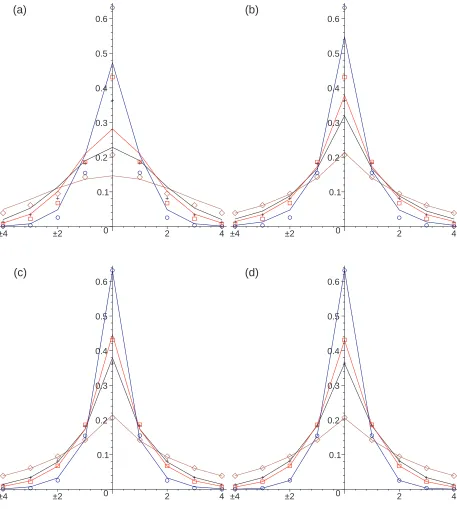
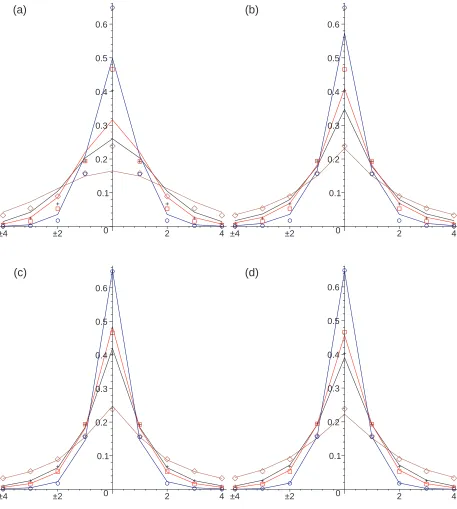
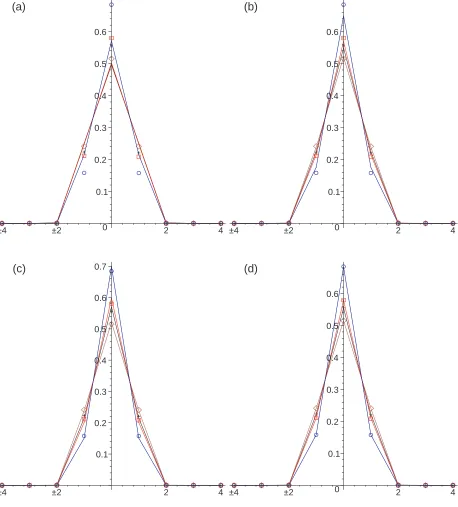
In Figure 1 we compare the Monte Carlo simulation results with the numerical solution of the discrete space equations for each model with the chemotactic sensitivity parameter, β = 0.1. Further results are shown in Figures 2 and 3 for the sensitivity parameter values β = 1 andβ = 10 respectively.
The numerical solutions for Model III Eq (44) and Model IV (47) are in close agreement with the Monte Carlo simulations at all times. The numerical solution for Model II does not fit with the Monte Carlo simulations well at short times but it provides a good fit at long times (t= 20). The numerical solution for Model I does not fit the Monte Carlo simulations well, especially for small values of β, where the predicted shape near the origin is smoother than that exhibited by the simulation data.
The closer agreement between the numerical results for Models III and IV and the Monte Carlo simulations is due to the timing of the chemotactic forcing. In models III and IV, and in the Monte Carlo simulations the chemotactically influenced jumping probabilities are determined at the end of the waiting times, whereas in Model II they are determined at the start of the waiting times. This difference is less marked if the chemotactic concentration varies slowly in time.
Overall, the numerical solutions for Model III provide better agreement with the Monte Carlo simulations than the numerical solutions for Model IV. This better agreement can be seen at the intermediate value of β = 1 in Figure 2. This better agreement may be due to differences in numerical errors in approximating the discrete space equations for Model II and Model IV rather than due to differences between the equations themselves.
V. SUMMARY AND DISCUSSION
0 0.1 0.2 0.3 0.4 0.5 0.6
–4 –2 2 4
(a)
0 0.1 0.2 0.3 0.4 0.5 0.6
–4 –2 2 4
(b)
0 0.1 0.2 0.3 0.4 0.5 0.6
–4 –2 2 4
(c)
0 0.1 0.2 0.3 0.4 0.5 0.6
–4 –2 2 4
[image:18.595.77.534.69.578.2](d)
FIG. 1: Color Online. One-dimensional subdiffusive chemotaxis simulation results (circles) with
β = 0.1 showing the concentration profile at t= 0.4 (blue circles),t= 2 (red squares),t= 4 (black
crosses), and t = 20 (brown diamonds) compared with the numerical solution of the governing
equations for models I (a), II (b), III (c) and IV (d) (solid lines). The peak height decreases with
0 0.1 0.2 0.3 0.4 0.5 0.6
–4 –2 2 4
(a)
0 0.1 0.2 0.3 0.4 0.5 0.6
–4 –2 2 4
(b)
0 0.1 0.2 0.3 0.4 0.5 0.6
–4 –2 2 4
(c)
0 0.1 0.2 0.3 0.4 0.5 0.6
–4 –2 2 4
[image:19.595.77.534.69.578.2](d)
FIG. 2: Color Online. One-dimensional subdiffusive chemotaxis simulation results with β = 1.0
showing the concentration profile att= 0.4 (blue circles),t= 2 (red squares),t= 4 (black crosses),
andt= 20 (brown diamonds) compared with the numerical solution of the governing equations for
models I (a), II (b), III (c) and IV (d) (solid lines). The peak height decreases with time in the
0 0.1 0.2 0.3 0.4 0.5 0.6
–4 –2 2 4
(a)
0 0.1 0.2 0.3 0.4 0.5 0.6
–4 –2 2 4
(b)
0.1 0.2 0.3 0.4 0.5 0.6 0.7
–4 –2 2 4
(c)
0 0.1 0.2 0.3 0.4 0.5 0.6
–4 –2 2 4
[image:20.595.78.536.72.579.2](d)
FIG. 3: Color Online. One-dimensional subdiffusive chemotaxis simulation results with β = 10.0
showing the concentration profile att= 0.4 (blue circles),t= 2 (red squares),t= 4 (black crosses),
andt= 20 (brown diamonds) compared with the numerical solution of the governing equations for
models I (a), II (b), III (c) and IV (d) (solid lines). The peak height decreases with time in the
as in Eq.(8). The modelling is further complicated if the force itself is affected directly or indirectly by the subdiffusing particles. This is the case in fractional electro-diffusion and fractional chemotaxis diffusion, the case considered here.
In this article we have introduced and investigated four models for particles undergoing anomalous subdiffusion in the presence of chemotactic forcing. The first being based on an
adhocextension to the fractional Brownian motion equation (Model I), two models based on Continuous Time Random Walk (CTRW) master equations where concentration-dependent jump probabilities were evaluated before (Model II) or after (Model IV) the particle waiting, and a fourth model derived from a generalized master equation (Model III). Concentration-dependent jump probabilities were used to incorporate the effect of chemotaxis in discrete space representations of the models and in the Monte Carlo (MC) simulations.
Evaluating the jump probabilities prior to waiting in the CTRW formulation (Model II) resulted in a macroscopic equation (valid in the long time limit) with the fractional derivative acting upon the chemotactic gradient. Conversely, using a generalized master equation approach with the probabilities evaluated after waiting but prior to jumping gave a macroscopic equation where the fractional derivative does not act upon the gradient (Model III). The CTRW formulation with the jump probabilities evaluated after waiting (Model IV) could only be reduced to a Fractional Fokker-Planck continuum equation in the asymptotic limit for long and short times. For long-times Models II and IV coincide whilst for short-times we found Models III and IV coincide asymptotically if a Mittag-Leffler density is used.
We also introduced Monte Carlo methods for simulating anomalous sub-diffusion in a chemotactic force field. In the Monte Carlo simulations the chemotactically influenced jump lengths were computed at the end of the waiting times, similar to Models III and IV. This could explain the excellent agreement we found between numerical solutions for Models III and IV and the Monte Carlo simulations. The numerical solutions for Model II also showed good agreement at long times. The numerical solutions based on the fractional Brownian motion equation, did not agree well with the Monte Carlo results.
The essential difference between the CTRW models for chemotaxis with subdiffusion that were considered in this paper is the timing of the detection and response to the chemotactic gradient. In Model II the organism or cell detects the chemotactic gradient but is then trapped before it responds. In Model III the organism or cell detects and responds to the chemotactic gradient after having been trapped.
Recently it has been established that the chemotactic motion of many cells is directed by internal Ca2+ gradients [52] which are themselves established as the cell moves through an external chemotactic gradient. If the cell becomes trapped then upon release it will initially continue in the direction of the internalCa2+gradient, corresponding to the external chemo-tactic gradient at the pre-trapping time. Model II could be used to model this chemochemo-tactic motion with subdiffusion.
Other organisms or cells have spatially separated sensor regions that allow for instan-taneous detection and response to chemical gradients [53]. For example crustaceans have chemosensory hairs along their appendages. The motile response to chemical gradients de-tected by spatially separated sensors is referred to as tropotaxis. This type of chemotaxis, with subdiffusion, would be better modelled by Model III (or Model IV).
In our application of CTRWs to chemotaxis with subdiffusion we considered the sim-plest case in which the subdiffusion arises from the physical and biological constraints of the medium, for example from traps or from effective crowding by other molecules. More gener-ally one could consider models in which the chemotaxis is itself affecting the characteristics of the subdiffusion. One way to model this behaviour would be to consider a waiting time density (and survival probability) with the time scale parameterτ and the scaling exponent γ taken to be functions of the concentration of the chemoattractrant. The models considered in this paper provide a foundation for such future studies.
Acknowledgments
This work was supported by the Australian Research Council.
[1] G. Wadhams and J. Armitage, Nature Reviews: Molecular Cell Biology 5, 1024 (2004).
[2] P. Van Haastert and P. Devreotes, Nature Reviews, Molecular Cell Biology 5, 626 (2004).
[3] M. Owen, T. Alarcon, P. Maini, and H. Byrne, J. Math. Biol. 58, 689 (2009).
[4] M.J. Saxton, Biophys. J.92, 1178 (2007).
[5] J. Dix and A. Verkman, Annu. Rev. Biophys.37, 247 (2008).
[6] R.N. Ghosh and W.W. Webb, Biophys. J. 66, 1301 (1994).
[7] T.J. Feder, I. Brust-Mascher, J.P. Slattery, B. Baird, and W.W. Webb, Biophys. J. 70, 2767
(1996).
[8] M.J. Saxton, Biophys. J.70, 1250 (1996).
[9] E.D. Sheets, G.M. Lee, R. Simson, and K. Jacobson, Biochem.36, 12449 (1997).
[10] P.R. Smith, I.E.G. Morrison, K.M. Wilson, N. Fernandez, and R.J. Cherry, Biophys. J. 76,
3331 (1999).
[11] E.B. Brown, E.S. Wu, W. Zipfel, and W.W. Webb, Biophys. J.77, 2837 (1999).
[12] R. Simson, B. Yang, S.E. Moore, P. Doherty, F.S. Walsh, and K.A. Jacobson, Biophys. J.74,
297 (1998).
[13] R. Metzler and J. Klafter, Phys. Rep.339, 1 (2000).
[14] M.J. Saxton, Biophys. J.81, 2226 (2001).
[15] M. Weiss, H. Hashimoto, and T. Nilsson, Biophys. J 84, 4043 (2003).
[16] D.S. Banks and C. Fradin, Biophys. J89, 2960 (2005).
[17] E. Ozarslan, P. J. Basser, T. M. Shepherd, P. E. Thelwall, B. C. Vemuri, and S. J. Blackband,
J. Magnetic Resonance183, 315 (2006).
[18] E. Keller and L.A. Segel, J. Theor. Biol. 30, 225 (1971).
[19] S. Adelman, J. Chem. Phys. 64, 124 (1976).
[20] K.G. Wang and C.W. Lung, Physics Letters A 151, 119 (1990).
[21] K.G. Wang, L.K. Dong, X.F. Wu, F.W. Zhu, and T. Ko, Physica A203, 53 (1994).
[23] H. Scher and M. Lax, Phys. Rev. B.7, 4491 (1973).
[24] E. Lutz, Physical Review E64, 051106 (2001).
[25] Y. He, S. Burov, R. Metzler, and E. Barkai, Physical Review Letters101, 058101 (2008).
[26] A. Lubelski and J. Klafter, Biophysical Journal94, 4646 (2008).
[27] M. Magdziarz, A. Weron, K. Burnecki, and J. Klafter, Physical Review Letters 103, 180602
(2009).
[28] B. I. Henry, T. A.M. Langlands, and P. Straka, inComplex Physical, Biophysical and
Econo-physical Systems: World Scientific Lecture Notes in Complex Systems, edited by R. L. Dewar
and F. Detering (World Scientific, Singapore, 2010), vol. 9, pp. 37–90.
[29] E. Barkai, R. Metzler, and J. Klafter, Phys. Rev. E 61, 132 (2000).
[30] I. M. Sokolov and J. Klafter, Phys. Rev. Lett.97, 140602 (2006).
[31] I. M. Sokolov, Phys. Rev. E63, 056111 (2001).
[32] E. Heinsalu, M. Patriarca, I. Goychuk, and P. H¨anggi, Phys. Rev. Lett. 99, 120602 (2007).
[33] A. Weron, M. Magdziarz, and K. Weron, Phys. Rev. E 77, 036704 (2008).
[34] E. Heinsalu, M. Patriarca, I. Goychuk, and P. H¨anggi, Phys. Rev. E79, 041137 (2009).
[35] B. I. Henry, T. A.M. Langlands, and S. L. Wearne, Phys. Rev. Lett.100, 128103 (2008).
[36] T. A.M. Langlands, B. I. Henry, and S. L. Wearne, J. Math. Biol 59, 761 (2009).
[37] A. Stevens, SIAM Journal on Applied Mathematics 61, 172 (2000).
[38] G. Margolin, Physica A 334, 46 (2004).
[39] E. Scalas, R. Gorenflo, F. Mainardi, and M. Raberto, Fractals 11, 281 (2003).
[40] I. Podlubny, Fractional differential equations, vol. 198 of Mathematics in Science and
Engi-neering (Academic Press, New York and London, 1999).
[41] S.B. Yuste, L. Acedo, and K. Lindenberg, Phys. Rev. E69, 036126 (2004).
[42] A.V. Chechkin, R. Gorenflo, and I.M. Sokolov, J. Phys. A: Math. Gen.38, L679 (2005).
[43] I. M. Sokolov and J. Klafter, Chaos, Solitons and Fractals 34, 81 (2007).
[44] B. I. Henry, T. A.M. Langlands, and S. L. Wearne, Phys. Rev. E 74, 031116 (2006).
[45] I.M. Sokolov, M.G.W. Schmidt, and F. Sagu´es, Phys. Rev. E73, 031102 (2006).
[46] A. Yadav and W. Horsthemke, Phys. Rev. E 74, 066118 (2006).
[47] S. Fedotov, Phys. Rev. E 81, 011117 (2010).
[48] K. Oldham and J. Spanier,The Fractional Calculus: Theory and Applications of
(Academic Press, New York and London, 1974).
[49] T.A.M. Langlands and B.I. Henry, Journal of Computational Physics 205, 719 (2005).
[50] I. M. Sokolov, E. Barkai, and J. Klafter, Europhys Letts 46, 431 (1999).
[51] T. A.M. Langlands, B. I. Henry, and S. L. Wearne, Phys. Rev. E 77, 021111 (2008).
[52] R. A. Brundage, K. E. Fogarty, R. A. Tuft, and F. S. Fay, Science254, 703 (1991).
[53] D. B. Dusenbery,Sensory Ecology: How Organisms Acquire and Respond to Information.(W.
H. Freeman and Co., New York, 1992).
[54] B.I. Henry, T. A.M. Langlands, and P. Straka, in preparation (2010).
Appendix A: Monte Carlo Simulations
In this section we briefly describe the Monte Carlo method used to simulate chemotaxis on a periodic one-dimensional lattice with long-tailed waiting-time density (subdiffusion). For each simulation run, the following steps are conducted
1. Set the number of grid points, simulation time, and the initial number of particles.
2. Initialise the parameters for the waiting-time and jump-length probability density functions.
3. Set up the initial particle positions.
4. For each particle generate a random waiting-time, δt, (time of the first jump).
5. Initialise the output time tout = ∆t.
6. Find the time of the next jump by finding the minimum of all jumping times, tjump.
7. If tjump> tout then go to step (8) otherwise go to step (9).
8. Store the current particle positions. Add ∆ttotout. Iftout exceeds the simulation time
then simulation ends otherwise go to step (7).
9. Generate a random jump-length, δx (see below).
10. Generate a new waiting time and update this particle’s jumping time and position (tjump =tjump+δt xnew =xold+δx ).
1. Generation of Waiting Times
The waiting times for each particle/jumper were generated by comparing a uniform ran-dom number,r∈(0,1), with the cumulative probability function of the waiting-time density. We use the Pareto density (25) as the density which has used by Yuste, Acedo, and Lindeberg [41]. The generated waiting-time is given as
δt=τ(1−r)−1γ −1
(A1)
where r∈(0,1) is a uniform random number.
2. Generation of Jump Distances
The jump distance for each particle/jumper is generated by comparing an uniform random number, r∈(0,1), with the cumulative probability function of the jump-length density.
For the simulations we use the jump-length probability density nearest neighbour jumps only:
δx=
−∆x, 0≤r < pl,
∆x, pl ≤r <1
(A2)
where ∆xis the grid spacing andpl =pl(xi, t) is the probability of jumping to the left given
previously in Eqs. (12) and (14).
To evaluate the probabilities of jumping to the left or right for Eq. (A2), requires the approximation of the chemoattractant concentration, c(xi, t), in Eq. (14). This is estimated
by the proportion of chemoattractant particles at the grid point,xi, compared with the total