The 4th International Conference on Computational Methods (ICCM2012), Gold Coast, Australia www.ICCM-2012.org
November 25-27, 2012, Gold Coast, Australia www.ICCM-2012.org
Tunnel Reinforcement Optimization for Nonlinear Material
T. Nguyen*1,2, K. Ghabraie1,2, T. Tran-Cong1,2
1
Computational Engineering and Science Research Centre 2
Faculty of Engineering and Surveying
University of Southern Queensland, Toowoomba, Queensland, Australia *Corresponding author: [email protected]
Abstract
In this paper, topology optimization is applied in optimizing tunnel reinforcement. Nonlinear behavior of geotechnical material is considered to illustrate the practical material behavior under working condition. The adjoint method is used to derive the nonlinear sensitivities. A revised bi-directional evolutionary optimization (BESO) is used to maximize the structural stiffness of reinforced tunnel with a prescribed volume of reinforcement. The developed BESO method is illustrated in a simple example of tunnel reinforcement design to verify the proposed approach.
Keywords: Topology optimization, tunnel reinforcement, BESO method, nonlinear material.
Introduction
Tunnel reinforcement is used to stabilize the opening and reduce deformation at the tunnel face. Due to complexity of geotechnical modeling, obtaining a reasonable design methodology is not very easy. Currently, tunnel reinforcement design is mainly relied on past experience and empirical recommendations. Design of tunnel reinforcement could be converted to optimizing the reinforcing material layouts in the design domain. Topology optimization can be used to deal with this type of problems and result in more efficient reinforcement design.
regarded as working in the elastic regime. Another severe issue in tunnel reinforcement design, namely tunnel and sidewall heave caused by swelling or squeezing rock, was addressed in their continuous research by Yin and Yang (2000b). Liu et al. (2008) tackled a similar problem by another approach. A Fixed-Grid Bidirectional Evolutionary Structural Optimization (FG BESO), which was thought to overcome mesh-dependent zigzag of boundary problem in intermediate and final results, was proposed by Liu et al. (2008). A simultaneous optimization of shape and distributed reinforcement of an underground excavation for elastic material was also explored by Ghabraie (2010) using Bidirectional Evolutionary Structural Optimization (BESO) method.
These studies have opened a new trend in topology optimization applications on shape and reinforcement design of underground excavation. However, most of previous researches merely considered homogeneous, linear elastic material model, except for the nonlinear material model concerned for tunnel shape optimization by Ghabraie (2009). Although linear elastic material model is still commonly used in geomechanics, these results should be considered as the first step to move forward to more sophisticated nonlinear material models.
In this paper, application of topology optimization is investigated in finding optimal tunnel reinforcement design considering nonlinear material behavior. An effective optimization method, BESO, is employed. Firstly, sensitivity analysis for nonlinear material is derived based on which switching process is performed between original and reinforced elements. An elastic perfectly-plastic Mohr Coulomb model is utilized for both original and reinforced material. In order to overcome numerical instabilities, filtering and averaging techniques are also considered (Huang and Xie, 2007). For illustration, a simple example of optimizing tunnel reinforcement distribution is presented.
Optimization statement and sensitivity analysis
The investigated reinforcement design is aimed at minimizing a functional of the tunnel displacement under a predefined volume of reinforcement material. The external work along the tunnel wall is chosen as a proper objective function for measuring tunnel deformation. With linear material models, this objective function is equivalent to the mean compliance which has been widely used in linear structural topology optimization (Chu et al. 1996).
The optimization problem can be stated as:
(1)
subject to:
where W is the total external work, u is the displacement vector, f is the external force vector, n is the number of iterations in solving the non-linear equilibrium equations, Ve is the volume of element e, VRis the prescribed reinforced volume, and M is the
total number of elements in the design domain. xe is the design variable of element e.
xe = 1 means that element e is reinforced and xe = 0 means element e is not reinforced.
Equilibrium requires the residual force vector to be eliminated, i.e
(2)
where fint is the internal force vector. The internal force vector can be expressed as:
(3)
where Ce is the matrix to transform local force vector of element to global force
vector, and De is the matrix defining the stress-strain relationship. The sensitivity of
the objective function due to a change in variable x is:
(4)
Note that the second sum vanishes because at any point either the external force is zero or the displacement is fixed.
The adjoint method is applied by adding an adjoint term to the objective function (1):
(5)
Differentiating Eq. (5) and using Eq. (2) we obtain
(6)
In order to eliminate the unknown part
, i is selected as
(7)
(8)
In order to calculate the sensitivity of the internal force vectors, we use the material interpolation scheme suggested by Stolpe and Svanberg (2001) to evaluate the matrix
De in terms of the design variables as
(9)
where Deis the stress-strain matrix of the e-th element, , are the matrices of
reinforced elements (material 1) and unreinforced elements (material 2). xe is the
design variable of the e-th element, De = at xe = 0 and De = at xe = 1. q is a
penalty factor. A value of q = 0 results in a linear interpolation and a positive value of q penalizes the intermediate values of design variables.
Differentiating Eq. (9), yields
(10)
From Eq. (3) and Eq. (10), we have:
(11)
Substitute Eq. (11) into Eq. (8), we have:
(12)
function. It can be clearly seen that the variation of objective function due to switching two materials is directly related to values of elemental total strain energy itself and independent of size of displacement increments.
The utilized optimization method requires a switching procedure of material between original rock and reinforced rock; hence, the element itself can be concerned as the design variable during optimization process.
Numerical calculation of sensitivity numbers
Elastic perfectly plastic Mohr-Coulomb model are employed for both original (material 2) and reinforced material (material 1). Two cases need to be considered as follows:
Case 1: the element is made of material 1 (xe = 1), Eq. (12) becomes:
(13)
If , with being the yield strain of material 2, the element assumed to be made of material 2 is in its elastic region and Eq. (13) takes the form:
(14)
Otherwise, if that element behavior is elastic perfectly plastic and Eq. (13) takes the form:
(15)
Or
(16)
Case 2: the element is made of material 2 (xe = 0), Eq. (12) becomes:
(17)
If , with being the yield strain of material 1, the element assumed to be made of material 1 is in its elastic region and thus Eq. (17) takes the form:
(18)
(19)
Or
(20)
where: , , , are the yield stresses and yield strains of material 1 and material 2, respectively.
BESO procedure:
Based on the derived sensitivity numbers, BESO procedure repeatedly switches elements between the two phases of material: original rock (weak element) and reinforced rock (strong element). It has been realized that the BESO optimization method is prone to numerical instabilities due to mesh dependency and formation of checkerboard patterns (Sigmund and Petersson, 1998). In order to overcome these deficiencies, a linear filtering technique (Huang and Xie, 2007) is utilized here. The filtered sensitivity number for an element can be calculated as:
(21)
where M is the total number of elements, and is a weight factor given as: (22)
where is the distance from centers of elements i and j, and r is the (predefined) filter radius.
Huang and Xie (2007) suggested averaging the sensitivity numbers in consecutive iterations to enhance the convergence properties of the method. The averaging scheme is presented as:
(23)
Example and Discussion
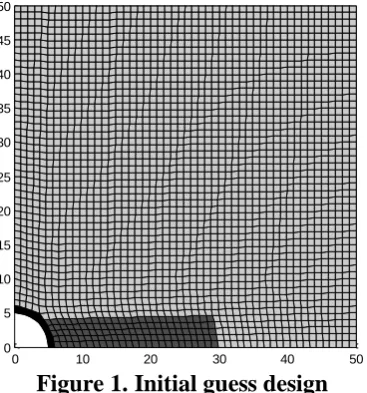
[image:7.595.92.276.98.295.2]To verify the approach it is used to optimize the reinforcement design of a circular tunnel under hydrostatic in situ stress conditions. Volume of reinforced material is predefined as 5 percent of the design domain area. A plane strain circular tunnel under geostatic condition is considered. The design domain is taken as a square of side length 10h (h is the tunnel diameter and h = 10m) The area around the tunnel wall is restricted to non-designed elements illustrated by black colored elements. An initial support design (the dark grey area) is also assumed as sketched in Fig. 1. Due to symmetry condition, only a quarter of design domain is modeled in finite element analysis with suitable symmetric constraints. Rock mass around the tunnel is assumed to be homogeneous. Other considered engineering properties of original rock and reinforced rock are shown in Table 1.
Table 1: Material properties
Material properties Original rock Reinforced rock
Young modulus (GPa) Poisson’s ratio
Friction angle (0) Dilation angle (0) Cohesion (MPa)
0.1 0.3 27 0 0.1
0.3 0.3 32 0 0.3
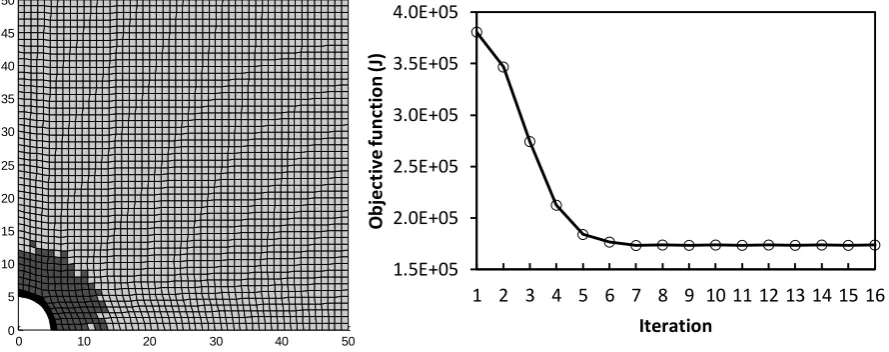
The optimum reinforcement distribution achieved is shown in Fig. 2. As expected the tunnel reinforcement is distributed evenly around the tunnel wall in hydrostatic stress condition. The objective function variations are also shown in Fig. 2. It can be seen that the objective function reduces gradually with smooth changes and converges to a minimum after a few iterations.
Figure 1. Initial guess design
0 10 20 30 40 50
[image:7.595.82.518.384.470.2]Conclusion
A newly derived sensitivity analysis for reinforcement design in BESO method with nonlinear materials has been presented. In this approach, elastic perfectly plastic Mohr-Coulomb model has been chosen to consider material behavior. The results of a simple example involving optimal reinforcement distribution around a circular tunnel have been illustrated. It is shown that application of topology optimization in tunnel support design considering nonlinear material behavior is achievable with relatively simple numerical methods. More complicated geotechnical properties and geological conditions should be considered in future research to obtain more realistic material behavior.
References
Chu, D., Xie, Y.M., Hira, A. and Steven, G. (1996). Evolutionary structural optimization for problems with stiffness constraints. Finite Elements in Analysis and Design, 21, pp. 239-251.
Ghabraie, K., (2009), Exploring topology and shape optimization techniques in undergorund excavation. Phdthesis - RMIT University.
Ghabraie, K., Xie, Y.M., Huang, X. and Ren, G., (2010), Shape and reinforcement optimization of underground tunnels. Journal of Computational Science and Technology, , 4(1), pp. 51-63.
Huang, X. and Xie, Y.M., (2007), Convergent and mesh-independent solutions for bi-directional evolutionary structural optimization method. Finite Elements in Analysis and Design, 43(14), pp. 1039-49.
Liu, Y., Jin, F., Li, Q. and Zhou, S. (2008), A fix-grid bidirectional evolutionary structural optimization method and its applications in tunnelling engineering. International Journal for Numerical Methods in Engineering, 73, pp. 1788-1810.
Sigmund, O. and Petersson, J., (1998). Numerical instabilities in topology optimization: A survey on procedures dealing with checkerboards, mesh dependencies and local minima. Structural Optimization, 16(1), pp. 68-75.
Stople, M. and Svanberg, K., (2001). An alternative interpolation scheme for minimum compliance topology optimization. Struct Multidisc Optim, 2001(22), pp. 116-124.
Yin, L., Yang, W. and Guo, T. (2000), Tunnel reinforcement via topology optimization. International Journal for Numerical and Analytical Methods in Geomechanics, 24, pp. 201-213.
Yin, L. and Yang, W., (2000a), Topology optimization for tunnel support in layered geological structures. International Journal for Numerical Methods in Engineering, 47, pp. 1983-1996.
Yin, L. and Yang, W., (2000b), Topology optimization to prevent tunnel heaves under different stress biaxialities. International Journal for Numerical and Analytical Methods in Geomechanics, 24, 783-792.
1.5E+05 2.0E+05 2.5E+05 3.0E+05 3.5E+05 4.0E+05
1 2 3 4 5 6 7 8 9 10 11 12 13 14 15 16
O
b
je
ct
ive
fu
n
ct
io
n
(J)
[image:8.595.83.528.83.259.2]Iteration
Figure 2. Reinforcement distribution and variation of objective function
0 10 20 30 40 50