Exploring Training and Development
in Queensland SME Training and
Development Innovators
A dissertation submitted by
Jeremy p. Novak
MMgt, PGrad Cert Mgt (USQ), Dip. Elec.
For the award of
Masters of Business Research
i Jeremy P. Novak
0068045
Abstract
There has been considerable international and national interest in recent years in the
role of training and development (T&D) in Small and Medium size Enterprises
(SMEs). This growth in interest is primarily owing to the recognition of the
importance of SMEs to economic regeneration, the contribution of T&D to
productivity and efficiency, and the role T&D could play in bridging skill shortage
gaps and skill development in organisations. Furthermore, T&D practices are crucial
in the growth of SMEs. Despite the importance of SMEs to national economies, the
academic and professional discipline of HRM, while well-established, remains
embryonic when translated to SMEs in contemporary dynamic environments.
Specifically, studies on training and development have predominantly focused on
larger organisations and have been limited in SMEs. This research is the first of its
type in Queensland and in Australia to examine the T&D practices of SME
innovators that have either received awards or have been publically recognised for
their T&D support.
The overall research objective of this study is to examine the T&D processes and
practices within Queensland SME training and development innovators SMEs. This is
done in order to identify good practice regarding training and development in the
Queensland SME sector. Four research questions were developed to inform this
research objective, including: RQ1: What are the drivers (internal and external) of
training and development in innovative SMEs?, RQ2: What are the characteristics of
a training and development climate in innovative SMEs?, RQ3: What are the
characteristics of training and development processes and practices in innovative
SMEs?, and finally RQ4: What is the perceived role of T&D practices in organisation
performance. Eleven sub research questions were also developed.
This study employs a qualitative methodology since the field of T&D does not
have a single, rigid methodology, and the use of interpretive methods are welcomed.
This approach facilitates a more in-depth understanding of the complex nature of
training and development. The research adopted a phenomenological approach,
ii Jeremy P. Novak
0068045
managers or their designated representative. The overall approach followed was a
multiple-case research design where each mini-case case was considered as an
independent experiment in generating the necessary information for the purposes of
analysis. An in-depth semi-structured interview program was conducted with 30
SME owners/managing directors or their representatives responsible for T&D in the
firm. The thirty SME mini-case studies formed the context of analysis for T&D in
these organisations. The following criteria were applied in selecting interviewees:
SMEs that have been publicly recognised for their T&D practices; organisational
size ranging from 10 - 200 employees; SMEs within the State of Queensland; and
any ABS industry categories excluding agriculture.
Content analysis was performed on the interview data and secondary data using
NVivo qualitative analysis software. Data strips were identified as themes and
sub-themes from the interview transcripts were entered as direct quotes into a matrix
representing the categories.
The results indicated that the T&D in Queensland SME innovators have some
similarities and differences from the general SME population. It was found that
presence of a HR manager and government requirements were the predominant
internal drivers and external drivers of T&D respectively. In exploring the attitudes
of SME managers in innovative T&D SMEs, the results showed that all the study
participants possess a passion for T&D. This overall passion seems to be a major
determinant of the T&D culture in their firms. Managers who possessed diploma
levels and higher seem to display a more positive attitude towards T&D and valued
formal T&D or a combination of formal and informal T&D approaches more, than
interviewees with lower levels of qualification.
Within the context of the T&D process, there was very little demonstration of
objectives established for work behaviour, skills, attitudes, specific knowledge and
learning outcomes that they needed to achieve at the conclusion of their T&D
activities. As with T&D objectives, less than half of the participating SMEs claimed
to have a written T&D policy.
The finding that participating T&D SMEs generally did not engage in TNA and
iii Jeremy P. Novak
0068045
effective T&D in participating SMEs. Since TNA is an important input into other
aspects of the T&D process, a lack of attention to this aspect could have a negative
flow-on effect on the other aspects of the T&D process such as T&D design and
implementing appropriate T&D practices. Ultimately this could result in ineffective
T&D.
Regarding the issue of T&D design, the majority of SME participants designed
their T&D both internal to the firm and by employing an external T&D expert such
as a Registered Training Organisation (RTO). Internally designed T&D seems to be
most valued by interviewees and has been identified as a strength by the majority of
SMEs. SME participants did not see the value of engaging an expert to capture
important information feeding into the T&D designing process.
Regarding the characteristics of the T&D practices in innovative T&D SMEs,
all participating SMEs indicated that they use both internal and external trainers.
Those that utilised internal trainers described this practice as a cheaper option and
internal trainers understand the SME requirements better. Those that utilised external
training providers did so because they saw the external trainer as the expert in
training. All participating SMEs used formal off-the job training and all but one
SME used informal and formal on-the-job training. This was closely followed by
mentoring, temporary assignments, and job rotation. The use of both informal and
formal T&D practices paint a positive picture for participating SMEs since their
importance in achieving sustainable competitive advantage is stressed by several
authors.
Participating SMEs did not utilise evaluation and feedback for strategic
purposes. This lack of systematic evaluation may impede a clear understanding of
the effectiveness of T&D in participating SMEs.
Despite a mixed reaction to the role of training and development in organisational
performance, the majority of interviewees expressed the view that T&D activities
helped their firm to be more competitive and it assisted in enhancing their
iv Jeremy P. Novak
0068045
Certification of Dissertation
I certify that the ideas, experimental work, results, analyses, software and
conclusions reported in this dissertation are entirely my own effort, except where
otherwise acknowledged. I also certify that the work is original and has not been
previously submitted for any other award, except where otherwise acknowledged.
21/2/2012
Signature of Candidate Date
ENDORSEMENT
……… ………..
v Jeremy P. Novak
0068045
Acknowledgements
I would like to acknowledge the efforts and the guidance that Associate Professor
Retha Wiesner has forward me throughout my journey not only in the Master of
Business Research but through my Post Graduate Certificate and Masters of
Management Degrees. Associate Professor Retha Wiesner has mentored me in such
a way that it has developed not only my academic writing skills and research abilities
but has shown me a pathway to becoming an academic with sound research and
teaching skills.
I would like to further recognise the assistance of my associate supervisor Dr Bruce
Millet who has supported my candidature and moreover, given assistance and
guidance when most needed. I further would like to pass my gratitude towards the
academic staff of University of Southern Queensland Business School.
I would especially like to highlight the support and guidance that my wife May
Novak has given me throughout the journey in my Masters degrees and in particular
this Master of business research degree. Without your support, dedication or
assistance May I would not have made it to this point in my education and academic
career, so thank you very much my love.
To my three little daughters Jasmine Kimberley Novak, Danielle Sarah Phoebe
Novak, and Annaliese Zoe Alice Novak the journey has been long and it is finally
over. I hope I have been a good role model for you all and instilled that with great
persistence and dedication and no matter what the barriers are anything is possible.
More importantly I hope I have distilled in you the quote of a great man that has
been said to me constantly throughout my life:
“What the mind can conceive the body will achieve”
vi Jeremy P. Novak
0068045
TABLE OF CONTENTS
Abstract ... i
Certification of Dissertation ... iv
Acknowledgements ... v
CHAPTER 1 INTRODUCTION ... 1
1.0 Introduction ... 1
1.1 Background ... 4
1.2 The research problem ... 6
1.3 Research objective and research questions ... 8
1.3.1 Research Objective ... 8
1.3.2 Research questions ... 9
1.4 Justification of this research ... 10
1.5 Defining Key Terms in the Study ... 11
1.5.1 Training and Development ... 11
1.5.2 Small and Medium Enterprise (SME) ... 12
1.6 Brief Overview of Methodology ... 13
1.7 Delimitations of Scope and Key Assumptions ... 13
1.8 Structure of the study ... 14
1.9 Summary ... 15
CHAPTER 2 THEORETICAL PERSPECTIVES AND DRIVERS OF TRAINING AND DEVELOPMENT IN SMES ... 17
2.1 Introduction ... 17
2.2 Description of the theoretical framework ... 17
2.3 Theoretical Approaches Underpinning Training and Development in SMEs ... 20
2.3.1 Human Capital Theory ... 20
2.3.2 Internal Labour Market Theory ... 23
2.3.3 Resource Based Theory ... 25
2.4 Organisation Contextual Characteristics: Drivers of T&D ... 27
2.4.1 Organisation Contextual Characteristics (Internal Drivers) ... 27
2.4.1.1 The Impact of Organisation Size on T&D ... 27
2.4.1.2 The Impact of the Presence of a HR Manager on T&D ... 31
2.4.1.3 The Impact of a Strategic Plan on T&D... 33
2.4.2 External Drivers of T&D ... 34
vii Jeremy P. Novak
0068045
2.4.2.2 The Impact of the Development of New Technology on T&D ... 37
2.4.2.3 The Impact of Quality Initiatives on T&D ... 39
2.4.2.4 The Impact of Pool of Talent Issues on T&D ... 41
2.4.2.5. The Impact of Increased Competition on T&D ... 44
2.5 Summary ... 47
CHAPTER 3: TRAINING AND DEVELOPMENT IN SMEs ... 48
3.1 Introduction ... 48
3.2 Training and Development Climate ... 48
3.2.1 Management's Attitude towards Training and Development ... 48
3.2.2 T&D resource allocation ... 54
3.2.3 Training and Development Objectives... 57
3.2.3.1 Strategic T&D Objectives at the Organisational Level ... 58
3.2.3.2 Objectives at the Training Event Level ... 60
3.2.4 Training and Development Policies ... 62
3.3 Training and Development Processes ... 65
3.3.1 Training Needs Analysis ... 65
3.3.2 T&D design ... 68
3.3.3 Implementation of T&D Approaches and Practices ... 72
3.3.4 T&D Evaluation and Feedback ... 75
3.4 T&D and Organisation performance ... 78
3.5 Summary ... 80
CHAPTER 4: RESEARCH METHODOLOGY ... 82
4.1 Introduction ... 82
4.2 Research Objective and Research Questions ... 82
4.3 Research Design and Methodology ... 83
4.3.1 Unit of analysis and sampling ... 86
4.4 Data Collection − Interview Methodology ... 90
4.4.1 Interview Protocol Development ... 90
4.4.2 Interview Procedure ... 92
4.4.3 Reliability and Validity ... 94
4.4.4 Data Analysis ... 95
4.4.5 Use of Nvivo ... 95
4.5 Ethical Issues ... 96
4.6 Limitations of Qualitative Methodology ... 96
viii Jeremy P. Novak
0068045
CHAPTER 5: INTERVIEW RESULTS ... 99
5.1 Introduction ... 99
5.2 Demographics of Participating Organisations and Interviewees ... 99
5.2.1 Organisational Size ... 101
5.2.2 Industry Categories ... 101
5.2.3 Positions and Qualifications of Interviewees ... 102
5.3 The Drivers of T&D in Innovative SMEs ... 104
5.3.1 Internal drivers of T&D ... 104
5.3.1.1 The impact of organisational size on T&D ... 105
5.3.1.2 The Impact of a HR manager on T&D ... 109
5.3.1.3 Existence of a strategic plan ... 110
5.3.2 External Drivers of Training and Development ... 112
5.3.2.1 Government requirements on the T&D of apprentices and trainees ... 113
5.3.2.1.1 The impact of Workplace health and safety (WH&S) on T&D ... 114
5.3.2.1.2 The impact of Licensing Requirements on T&D ... 115
5.3.2.1.3 The impact of Government contracts requirements on T&D ... 116
5.3.2.2 The impact of pool of talent issues on T&D ... 117
5.3.2.3 The impact of Technology in T&D ... 119
5.3.2.4 The impact of quality issues on T&D ... 122
5.3.2.5 The impact of competition on T&D ... 123
5.4 What are the characteristics of T&D climate in innovative SMEs? ... 125
5.4.1 What are the attitudes of SME managers towards T&D in innovative SMEs towards T&D? ... 125
5.4.2 What is the resource allocation (budget) for T&D in innovative SMEs? ... 128
5.4.3 What is the importance and relevance of strategic T&D objectives in innovative SMEs? 130 5.4.4 What T&D policies are in place in innovative SMEs and why? ... 132
5.5 What are the characteristics of the T&D processes and practices in innovative SMEs? 133 5.5.1 What is the role of a training needs analysis in innovative SMEs? ... 133
5.5.2 What are the characteristics of the design of T&D on innovative SMEs? ... 137
5.5.3 What are the characteristics of the T&D practices in innovative SMEs? ... 141
5.5.3.1 Internal versus external training providers in innovative SMEs ... 141
5.5.3.2 T&D approaches in innovative SMEs... 144
5.5.3.2.1 Formal on-the-job T&D in innovative SMEs ... 145
ix Jeremy P. Novak
0068045
5.5.3.2.3 Informal on-the-job training and mentoring in innovative SMEs ... 148
5.5.3.2.4 Informal on-the-job training in innovative SMEs ... 148
5.5.3.2.5 Mentoring in innovative SMEs ... 150
5.5.3.2.6 Temporary assignments and job rotation in innovative SMEs ... 151
5.5.3.2.7 Most valued T&D approach in innovative SMEs ... 153
5.5.4 What is the role of evaluation of the T&D effort in innovative SMEs? ... 154
5.6 What is the perceived role of T&D practices in organisation performance? ... 160
5.6.1 What is the perceived role of T&D in human resource performance outcomes SMEs? 160 5.6.2 What is the perceived role of T&D in the financial performance of innovative SMEs? 165 5.7 Summary ... 171
CHAPTER 6: DISCUSSION, PRACTICAL IMPLICATIONS, DIRECTIONS FOR FUTURE RESEARCH AND CONCLUSIONS ... 172
6.1 Introduction ... 172
6.2 RQ 1: What are the drivers (internal and external) of T&D in innovative T&D SMEs? 172 6.3 RQ 2: What are the characteristics of a T&D climate in innovative T&D SMEs? .. 177
6.4 RQ 3: What are the characteristics of T&D processes and practices in innovative T&D SMEs?... 181
6.5 RQ4: What is the perceived role of T&D practices in organisational performance? 186 6.6 Implications for Practice and Policy ... 188
6.6.1 Implications for SMEs ... 189
6.6.2 Implications for Policy Making ... 192
6.7 Recommendation for Future Research ... 193
6.8 Conclusion ... 196
Reference List ... 199
LIST OF TABLES Table 4.1 Research design ... 85
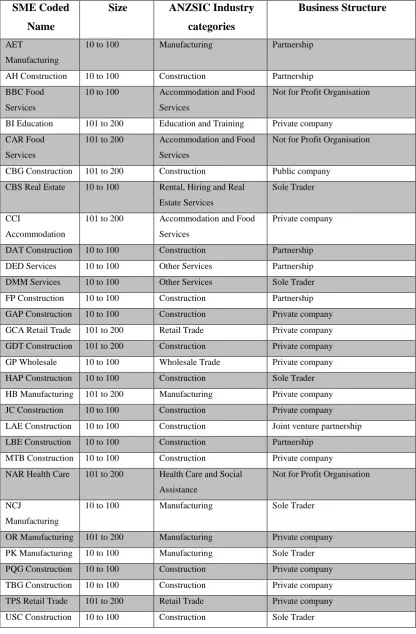
Table 5.1 Sample Characteristics (N=30) ... 100
Table 5.2 Themes and examples reflecting the positive impact of firm size on T&D ... 105
Table 5.3 Themes and examples reflecting the negative impact of size on T&D ... 108
x Jeremy P. Novak
0068045
Table 5.5 Themes and examples reflecting the impact of the presence of a HR Manager on
T&D ... 110
Table 5.6 Themes and examples reflecting the impact of the existence of strategic plan on T&D ... 111
Table 5.7 Themes and examples reflecting limited or no impact of the existence of strategic plan on T&D ... 112
Table 5.8 Examples of sub-themes and examples regarding the impact of WH&S on T&D ... 114
Table 5.9 Sub-themes and Comments on the impact of licensing requirements on T&D ... 115
Table 5.10 The impact of government contract requirements on T&D ... 117
Table 5.11 Examples of sub-themes and examples regarding the impact of pool of talent issues on T&D ... 118
Table 5.12 Examples of sub-themes and examples regarding the impact of technology on T&D ... 120
Table 5.13 Examples of sub-themes and examples regarding the impact of quality on T&D ... 123
Table 5.14 The impact of competition on T&D ... 124
Table 5.15 Examples of management attitude towards T&D ... 126
Table 5.16 Examples of resource allocation to T&D ... 129
Table 5.17 Example of sub-themes regarding why SMEs identify T&D objectives ... 130
Table 5.18 Examples of sub-themes regarding why SMEs do not identify T&D objectives ... 131
Table 5.19 Themes and examples regarding the existence of T&D Policies in innovative SMEs ... 132
Table 5.20 Themes and examples regarding the absence of T&D Policies ... 133
Table 5.21 Example of how innovative SMEs conducted a TNA ... 134
Table 5.22 Examples of absence of TNA ... 136
Table 5.23 Comment on the design of the T&D ... 138
Table 5.24 Themes and examples of regarding the use of internal training providers ... 143
Table 5.25 Themes and examples of regarding the use of external training providers ... 144
Table 5.26 Themes and examples of regarding the use of formal on-the-job T&D ... 146
Table 5.27 Themes and examples regarding the use of formal off-the-job T&D ... 148
Table 5.28 Themes and examples regarding the use of informal on-the-job training ... 149
Table 5.29 Themes and examples regarding the use of mentoring ... 151
Table 5.30 Themes and examples regarding the use of job rotation and temporary assignments ... 152
xi Jeremy P. Novak
0068045
Table 5.33 Themes and examples regarding the evaluation of T&D participant’s opinion 157
Table 5.34 Themes and examples regarding why no formal evaluation is done ... 158
Table 5.35 Themes and examples regarding the importance of evaluation and feedback . 159 Table 5.36 Themes and examples regarding increased skills and enhanced development of employees ... 161
Table 5.37 Themes and examples regarding enhanced employee commitment ... 162
Table 5.38 Themes and examples regarding the impact of T&D on staff satisfaction ... 163
Table 5.39 Themes and examples regarding the impact of T&D on employee turnover ... 164
Table 5.40 Themes and examples regarding the impact of T&D on financial performance of innovative SMEs ... 166
Table 5.41 Measurement methods of staff outcomes... 167
Table 5.42 Measurement methods of financial performance ... 168
Table 5.43 Themes and examples regarding the impact of T&D on the competitive advantage of innovative SMEs ... 170
LIST OF FIGURES Figure 1.1 Counts of Queensland SMEs developed for this research from information from the Australian Bureau of Statistics (2007, 2012) ... 5
Figure 1.2 Map of Queensland ... 6
Figure 1.3 An outline of the thesis chapters ... 14
Figure 2.1 Conceptual Framework developed from Smith and Hayton (1999) and Al-Khayyat and Elgamal (1997) models ... 18
Figure 5.1 Size of participant organisations ... 101
Figure 5.2 Industry Category of Participants ... 102
Figure 5.3 Position of interviewee ... 103
Figure 5.4 Qualifications of Participants ... 103
Figure 5.5 Approaches Used in Innovative SMEs ... 145
LIST OF APPENDICES Appendix A: Interview Schedule ... 226
Appendix B: Introductory Letter... 231
Appendix C: Consent Forms ... 232
Appendix D: SME Representative Information statement and Informed Consent Form .... 234
1 Jeremy P. Novak
0068045
CHAPTER 1 INTRODUCTION
1.0 Introduction
The business community is made up of a diverse range of businesses. This diversity
encompasses different industry sectors, legal structures, organisation structure,
geographical location, gender ratios or gender of the CEO owner manager, and size
of the organisation to name a few factors. The features of a small to medium-sized
enterprises (SMEs) vary greatly compared to a large organisation. SMEs: have a
tendency to have informal relationships, no divide between planners and doers,
managers tend to have fewer qualifications, appointments and promotions tend to be
based on family or friendships, tend to operate for fewer hours each week, tend to
open communication flows and everyone is prepared to contribute as needed.
Further to this research suggests that SMEs tend to have more informal and
inadequate planning. Additionally, SMEs are less likely to have a business,
strategic, marketing, financial and other assorted plans and formalised human
resources management (HRM) practices. Whereas a large organisation tend to have
formalised and extensive business and strategic plans, formal internal and external
relationships and more male CEO/managers. They also tend to divorce of planning
from doing, qualifications are used as a basis for employment and promotion, they
can operate 24 hours a day, they have clear job descriptions and mostly have the
presence of a dedicated HR manager (Australian Bureau of Statistics 2012; Bishop
2012; Bryan 2006; Kaplan & Warren 2010; Kellermanns & Eddleston 2007; Lawlor
& Tovey 2011; Mazzarol 2006; Petridou & Glaveli 2008; Poutziouris 2003; Thoms
et al. 2002; Werner & DeSimone 2009; Wiesner & Innes 2010; Wiesner &
McDonald 2001).
Whilst there is a clear differentiation between SMEs and large organisations perhaps
the greatest diversity exists within the SME sector itself. For example SMEs can
have a diverse range of legal structures such as, sole traders, partnerships, Pty Ltd
company, cooperative, non for profit and trust (ASIC 2012). As SMEs are generally
independently owned and operated; having close control by the owner/manager; and
2 Jeremy P. Novak
0068045
significant impact on shaping the organisation (Australian Bureau of Statistics,
2005). Further to this research suggests that SMEs are less likely than larger
employers to provide T&D to employees (Panagiotakopoulos 2011; Ahmad & Halim
2012; Birdthistle & Fleming 2005; Bryan 2006; Craig & Moores 2010; RW 2002;
Schaper et al. 2011; Wiesner et al. 2007).)
Despite the diversity that exists amounts SMEs, SMEs have been described by the
academic community an imperative to the economies of countries. SMEs have long been recognised by governments as the “engine room” of economic growth for
countries (Bhutta et al. 2008; Jones 2004 ; Pansiri & Temtime 2010; Wijewardena et
al. 2008). According to the OECD (2010) SMEs are an important source of job
creation in the OECD economies. The OECD (2010 p 26) further went on to state that “SMEs are best seen as agents of change in the economy, introducing new
products and services and more efficient ways of working. They underpin the
adaptation of our economies and societies to new challenges and drive economic development.” Similarly it is viewed that SMEs play an important role in creating a
dynamic and successful economy (Giambonaa & Birchall 2011). The European
Union highlighted that SMEs created more jobs than larger organisations since
between 2002 and 2010, eighty-five-percent of all jobs in the European Union was
attributed to SMEs (Commission of the European Communities 2009, 2012).
The Asia Pacific economic cooperation (APEC) has also recognised the importance
of SMEs. SMEs account for around ninety percent of all businesses, employ
approximately sixty percent of the work force and generate around thirty percent of
all exports (APEC 2012). According to the Central Bank of Malaysia (2007) the
Malaysian government acknowledged the potential of SMEs and were very
optimistic of the potential for growth inside the entrepreneurial and SME
community. To enhance and galvanise SMEs in Malaysia, the government of the
day established a SME bank to assist these organisations financially. In addition to
this the government developed various programs including training and development
programs to simulate innovation(Central Bank of Malaysia 2007).
In the past the traditional view on innovation has very often been linked to the
3 Jeremy P. Novak
0068045
only associated with science, technology and engineering as government policies
were tailored towards this (Commission of the European Communities 2006; OECD
2010) . However, there has been a paradigm shift in the late 20th and early 21st
century towards a better understanding of innovation pertaining to SMEs.
In the 1990’s researchers such as Dogson & Rothwell (1991) and Oakey & Cooper
(1991) identified a number of critical success factors for innovative strategies in
SMEs. The factors that constitute as critical success factors include: analysing
competitors, developing co-operations and partnerships, encouraging a company
culture, creating a structure reflecting in the effective use of systems and technology
and investors in organisations human capital which are currently known as process
innovation (Laforet & Tann 2006). Laforet and Tann (2006) further went on to
highlight in their findings that more innovative SMEs provide more T&D for staff
especially with regard to their managers than in less innovative SMEs. The term
innovation has changed towards encompassing the creation of a multitude of new
services and products, the development of workplaces and external relations and the
development of business processes and practices such as T&D regardless of size
(Drucker 2009; OECD 2010).
Similarly the European Commission (2012) stated on their web site that “European innovation performance is intimately linked to its people's skills and competences.”
The European Commission further concluded it has long been viewed that, a key
instrument to improving European innovation performance is the T&D of people
within the work place. Innovative behaviour can be also demonstrated by the way
that the Managing Director/owner thinks about the process and practices that set
their organisation apart from their competitors, this includes the T&D process and
practices (Wood et al. 2011).
The OECD (2010) clearly outlines that one of its criteria of an innovative SME is
the training and development practices in SMEs. Similarly the APEC small and
medium enterprise working group (SMEWG) highlighted in their strategic plan
(2009-2012) that a priority in identifying innovation was the T&D activities
conducted by SMEs (APEC 2009). In addition to the OECD and APEC the
4 Jeremy P. Novak
0068045
innovation and skills into one category as they identify that for SMEs to be
innovative there needs to be T&D involved (European Commission 2012).
In Australia the scope of innovative activity across all size of businesses, as
measured by the Australian Bureau of Statistics (2011) Business Characteristics
Survey (BCS), covers four types of innovation namely: operational processes;
organisational/managerial processes; goods or services; and marketing methods.
Within the organisational/managerial process innovation category, business
innovation has been classified as incorporating knowledge management processes to
better use or exchange information, development of knowledge or skills within the
business and new methods of organising work responsibilities and decision making.
In light of the discussion above, for the purpose of this study, a T&D Innovator
could be classified as an organisation that has a Managing Director/owner who
demonstrates innovative behaviour by the way that she or he thinks about the process
and practices of their firm (where the organisational/managerial processes
incorporate the development of knowledge or skills). Within this context, activities
such as T&D processes and practices within the business and the development of
knowledge management processes promote an efficient use or exchange of
information that sets their organisation apart for their competitors (Australian Bureau
of Statistics 2011; Wood et al. 2011).
1.1 Background
There has been considerable international and national interest in the role of training
and development (T&D) in SMEs in recent years (Asia Pacific Economic
Cooperation 2002; Boohene et al. 2008; Choo 2006; European Commission 2012;
Jones 2004 ; Kotey & Sheridan 2004; OECD 2010). This growth in interest is
primarily owing to the recognition of the importance of SMEs to economic
regeneration, the contribution of T&D to productivity and efficiency as well as the
role T&D could play in bridging skill shortage gaps and skill development in
organisations. Furthermore, T&D practices are crucial to the growth of SMEs (APEC
5 Jeremy P. Novak
0068045
dearth of research focusing on T&D in SMEs as is evident from the literature review
chapters to follow.
This study was conducted within the business context of Queensland, Australia. A
review of the data from 2007 and the latest data available from the Australian Bureau
of Statistics (ABS) 2012, counts Australian Businesses, including Entries and Exits,
indicates that there is a steady growth with inside the small to medium size enterprise
bracket however, there was movement both in entries and exits. There was a slight
increase of medium-sized firms in Australia due to the reduction of employees in
some large organisations however, the percentage of SMEs to large organisations
overall remained proportionately comparable. In general the data from Australian
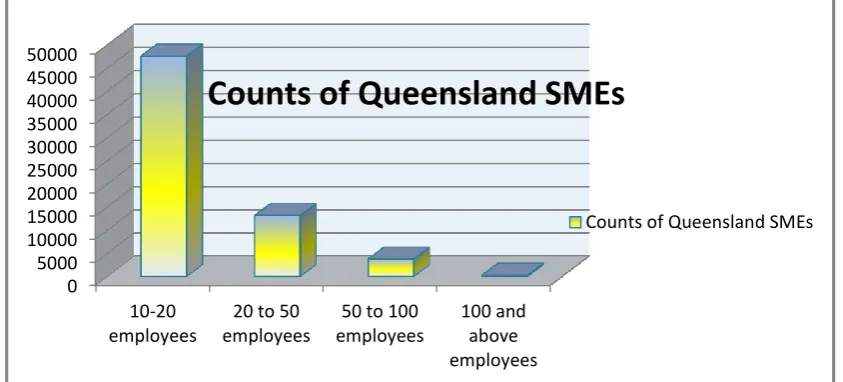
Bureau of Statistics (2007, 2012) indicates that Queensland SMEs SMEs comprise of
approximately 96.4 percent of all Queensland businesses and counts for
[image:17.595.110.532.384.575.2]approximately 80 percent of all private sector employment.
Figure 1.1 Counts of Queensland SMEs developed for this research from information from the Australian Bureau of Statistics (2007, 2012)
Queensland’s geographical location is on the North-eastern seaboard of Australia
having a geographic area of 1,730,648 sq. km which is 23 percent of the total area of
Australia (Australian Bureau of Statistics, 2010).
0 5000 10000 15000 20000 25000 30000 35000 40000 45000 50000
10-20 employees
20 to 50 employees
50 to 100 employees
100 and above employees
Counts of Queensland SMEs
6 Jeremy P. Novak
[image:18.595.188.454.71.360.2]0068045
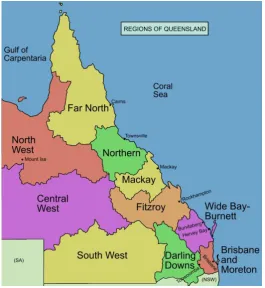
Figure 1.2 Map of Queensland (http://www.worldgenweb.org)
The rest of this chapter outlines the research problem, the research objective and
research questions, provides justification for the research, describes the contribution
of the research, defines key terms in the study, outlines the delimitations of the scope
of the study and presents the structure of the study.
1.2 The research problem
The research problem of this study could be narrowed down to two major issues: The
first relates to the lack of research on training and development (T&D) in SMEs and
the second, to the distinct lack of T&D models/frameworks within the SME sector
(Al-Khayyat & Elgamal 1997; Smith 2006). This is will now be discussed in greater
7 Jeremy P. Novak
0068045
Despite the importance of SMEs to national economies, the academic and
professional discipline of HRM, while well-established, remains an emerging area
when translated to SMEs in contemporary dynamic environments. Specifically,
studies on T&D have predominantly focused on larger organisations (Bishop 2012;
Curran et al. 1993; Kerr & McDougall 1999; Kotey & Sheridan 2004; Macpherson &
Jayawarna 2007; Reid et al. 2002; Wiesner & McDonald 2001; Wilkinson 1999).
Fisher and Dowling (1999), Kitay and Lansbury (1997), and Kramar (1999) further
identified that factors such as globalisation, advances in technology, and labour
market conditions have created an external environment dominated by increasing
competition (Anthony et al. 1996). It has been shown that a key to managing these
challenges is via the effective T&D of skills and talent in SMEs, which could create
competitive advantage and improve the performance of a SME (Brooks & Nafukho
2006; Caudron 1999; Wright et al. 1994; Yorks 2005).
In addition, there is extensive literature on the business forces that drive large
organisations and how management can design and deliver training interventions.
However, there is a dearth of data and literature available in relation to these issues
within the SME sector (Curran et al. 1993; Kerr & McDougall 1999; Kotey &
Sheridan 2004; Macpherson & Jayawarna 2007; Reid et al. 2002; Wiesner &
McDonald 2001; Wilkinson 1999). While there is a growing body of literature on the
subject of T&D in SMEs, much of the research into SME T&D appears fragmented
and unrelated (Kitching & Blackburn 2002). Accordingly, the major weakness of
any current discussion of SME T&D is the lack of research on its character,
availability, and effectiveness (Curran et al. 1993). As a result many authors have
called for further research on T&D in SMEs (Harney & Dundon 2006; Jones 2005;
Kent et al. 2003; Macpherson & Jayawarna 2007; Matlay 2004).
In addition, researchers whose work is focused on the SME sector have expressed
dissatisfaction with the theoretical foundation and models of T&D that have been
developed within large organisational contexts over time (Al-Khayyat & Elgamal
1997; Byrom et al. 2002; Camp et al. 1986; Campbell 1971; Jones 2005). Further to
this it has been argued that SMEs are not just scaled down versions of large
8 Jeremy P. Novak
0068045
applicable in SMEs (Wiesner & Innes 2010). It is evident that there exists a need for
SME specific models (Byrom et al. 2002). Moreover, studies of T&D models that
specifically focus on SMEs in the Australian context are lacking, which could create
problems for the development of T&D best practice in SMEs.
In order to address these gaps in the literature, this research focuses on the T&D
processes and practices of SMEs that are proactive and innovative in T&D. The
context of this study is SMEs in Queensland that have either received awards or have
been publically recognised for their T&D support, efforts and initiatives. The reason
for this approach is that these SMEs provide an excellent context of analysis for
exploring and analysing good practice in T&D within the SME sector (Drummond &
Stone 2007). Using the typology of Rogers (1995) innovators in T&D could be
classified as industry leaders regarding T&D processes and practices. For example
these innovators are recognised for their excellence in the T&D practices through
awards such as that of the Queensland Government (Department of Education and
Training 2010).
1.3 Research objective and research questions
In view of the discussion above, the overall research objectives and the research
questions of this study will now be outlined.
1.3.1 Research Objective
The overall research objective of this study is to examine the T&D processes and
practices within Queensland SME T&D innovators (these SMEs have been
recognised for their proactive efforts in the area of T&D). This is done in order to
9 Jeremy P. Novak
0068045
1.3.2 Research questions
The following research questions have been formulated to inform the research
objective above. Specific research issues are associated with each research question.
RQ 1: What are the drivers (internal and external) of T&D in innovative
SMEs?
RI1.1: What are the internal drivers of T&D in innovative SMEs (such as size,
presence of HR manager and existence of a strategic plan) and how do they impact
on T&D in these SMEs?
RI1.2: What are the external drivers of T&D in innovative SMEs (such as government
requirements, new technologies, quality issues, pool of talent issues and increase in
competition) and how do they impact on T&D in these SMEs?
RQ 2: What are the characteristics of T&D climate in innovative SMEs?
RI2.1: What are the attitudes of SME managers towards T&D in innovative SMEs?
RI2.2: What is the resource allocation (budget) for T&D in innovative SMEs?
RI2.3: What is the importance and relevance of strategic T&D objectives in
innovative SMEs?
RI2.4: What T&D policies are in place in innovative SMEs and why?
RQ3: What are the characteristics of T&D processes and practices in
innovative SMEs?
RI3.1: What is the role of a training needs analysis in innovative SMEs?
RI3.2: What are the characteristics of the design of T&D on innovative SMEs?
RI3.3: What are the characteristics of the T&D practices in innovative SMEs?
RI3.4: What is the role of evaluation of the T&D effort in innovative SMEs?
RQ4: What is the perceived role of T&D practices in organisation
performance?
RI4.1: What is the perceived role of T&D in human resource performance outcomes
10 Jeremy P. Novak
0068045
RI4.2: What is the perceived role of T&D in the financial performance outcomes in
innovative SMEs?
1.4 Justification of this research
The justification of undertaking this research is based upon the identification of a
theoretical gap of T&D in Queensland SMEs, and the lack of studies in the area of
T&D and SMEs generally. This research could inform good practice and assist
SMEs in their T&D practices. Further to this, it could act as a T&D blue print that
SMEs could potentially utilise to improve their competitive advantage and survival
in the global market place, therefore contributing to the state of Queensland and
Australia both from an economic importance and social aspect.
This research has the potential to provide an enhanced understanding on how
innovative SMEs use T&D to cope with the changing environment in order to
survive and grow. Additionally this research attempts to be of value to government
policy makers at federal, state and local levels as well as individual managers and
owners of SMEs (Australian Bureau of Statistics 2001, 2012). The outcomes of this
research could inform private and government agencies engaged in the provision of
training programs to SMEs, to become more focused in their approach to SMEs in
order to fulfil the needs of their SME clients to a greater extent. In relation to the
role of governments with regards to the T&D of SMEs, it has been increasingly
recognised that government strategies need to be discussed and understood further
(APEC 2012 Central Bank of Malaysia 2007,De Faoite et al. 2004; Lange et al.
2000; Matlay 2005, 2008; Scottish Government 2009, 2012). This research may
therefore assist in the development of a more responsive and focussed approach to
training by training agencies (Department of Education Employment and Workplace
Relations 2008; Department of Employment and Training 2008; Hoque & Bacon
2006).
Several gaps in the literature justify the exploration of T&D in innovative SMEs.
11 Jeremy P. Novak
0068045
development practices in SMEs (See for example Wiesner et al. (2007) and
Drummond & Stone (2007)), there remains a dearth of studies in the area of good
or best practice regarding T&D in SMEs (Dawe & Nguyen 2007). As pointed out in
the previous section, there is a shortage of appropriate T&D frameworks addressing
T&D processes and practices in Australian SMEs Smith and Hayton (1999) and
Al-Khayyat and Elgamal (1997). As a result many authors have called for further
research on T&D in SMEs (Harney & Dundon 2006; Jones 2005; Kent et al. 2003;
Macpherson & Jayawarna 2007; Matlay 2008). Also, SMEs often don’t have the
funds to employ training managers and this research will assist other SMEs in better
structuring and implementing their T&D processes and practices (Kerr &
McDougall 1999; Lange et al. 2000; Westhead & Storey 1997). By focusing on
innovative SMEs, this project has the potential and ability to develop the internal
strategic T&D capabilities of SMEs.
This research is important since in times of economic upturn and downturn, T&D
has a major role to play in either addressing skills shortages or skill deficiencies of
new and existing staff. Recent literature argues that T&D will remain the most
critical human resource management challenge worldwide and in Australia,
regardless of region, industry or organisational size (Australian Government 2012;
Arup 2008; Boohene et al. 2008; Clarius Group 2009; Scottish Government, 2012;
Skillstech Australia 2011). The focus on the experiences of innovative T&D SMEs
is new in the Australian context and often lacking, therefore this research will assist
in valuable learning experiences in relation to the implementation of T&D processes
and practices.
1.5 Defining Key Terms in the Study
1.5.1 Training and Development
12 Jeremy P. Novak
0068045
1.5.2 Small and Medium Enterprise (SME)
SMEs are defined variously in different countries and across industry sectors
(Wiesner & Innes 2010). Even in Australia, the Australian Bureau of Statistics (ABS)
applies different size categories for small business depending on the industry sector.
A small organisation is defined by the ABS as fewer than 100 employees in the
manufacturing sector and fewer than 20 in retail, wholesale, construction and service
sectors. In Australia, as of June 2007 there were just over 2 million actively trading
businesses. However, approximately 60 percent of these had only one staff member
(the owner) and are non-employing small organisations (Australian Bureau of
Statistics 2008). Therefore while there are many small organisations, for many of
them T&D of staff is not an issue.
In this study, we drew on the definition by Wiesner and Inness (2010) who conducted
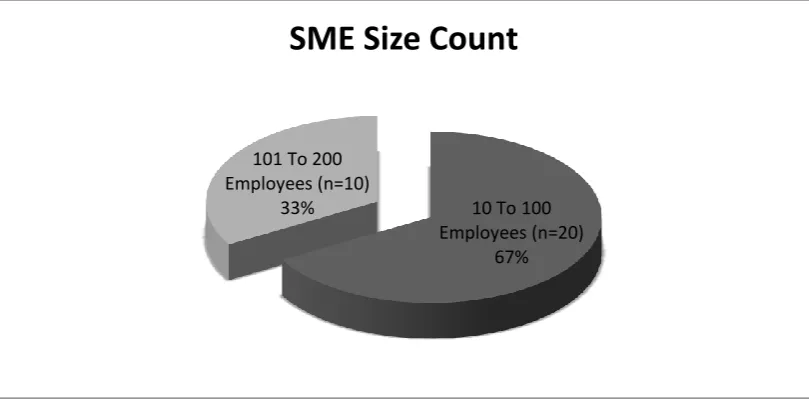
a national survey on HRM practices in Australian SMEs. They define a small
business as an organisation employing 10 to 100 employees and a medium business as
101 to 200 employees. The lower limit of ten employees is used because T&D is a
functional aspect of HRM and SMEs with a workforce with more than 10 employees
will be expected to have some kind of T&D activities in place (Wiesner & Innes 2010).
1.5.3 T&D Innovator
In the introduction the aspect of innovation in a SME was discussed. For the purpose of
this thesis the author relied on the definitions below:
A T&D Innovator could be classified as an organisation that has a Managing
Director/owner who demonstrates innovative behaviour by the way that she or he
thinks about the process and practices of their firm (where the
organisational/managerial processes incorporate the development of knowledge or
skills). Within this context, activities such as T&D processes and practices within the
business and the development of knowledge management processes promote an
efficient use or exchange of information that sets their organisation apart for their
13 Jeremy P. Novak
0068045
1.6 Brief Overview of Methodology
The research method employed in this study was qualitative in nature, consisting of
thirty semi-structured in-depth interviews with a selected group of SMEs in
Queensland. The research adopted a phenomenological approach, building up ideas
and accumulating material from multiple interviews with SME managers or their
designated representative (Ghauri et al. 1995).
The research design of this study into the use of T&D practices in innovative SMEs
is based on an exploratory research design. The use of an exploratory design is
warranted primarily owing to the limited empirical evidence available about T&D
practices in SMEs (Ghauri et al. 1995; Hussey & Hussey 1997; Patton 2008).
NVivo was employed in analysing the interview data and other organisation specific
reports in order to help answer the research questions. The details of the
methodology are discussed in chapter 4.
1.7 Delimitations of Scope and Key Assumptions
There are a number of limitations embedded in the nature and scope of this study.
As this study involved SMEs in a specified geographical region i.e. State of
Queensland, and is limited to the involvement of the SME Managing/owners or their
representative, results are only reflective of what has happened in the state of
Queensland within a specific timeframe and may therefore not be generalisable to a
larger context. The participation of SME manager/owners or their representatives
was voluntary and owing to the nature of the sample (SME T&D innovators),
self-selection bias and self-efficacy may occur, since participating organisations are
known for their success in the T&D area (Leedy & Ormrod 2005).
The method itself has some inherent limitations, for example the interviewing skills
of the researcher is imperative since the results are derived from interviews and the
information gathered is subject to the level of personal skills and the ability of the
14 Jeremy P. Novak
0068045
interviewer and his/her ability to effectively ask open ended questions is essential
(Morse & Richards 2002; Patton 2008; Zikmund 2003). These limitations will be
discussed further in chapter 4.
1.8 Structure of the study
This thesis comprises six chapters as outlined in Figure 1.3.
Figure 1.3 An outline of the thesis chapters
Chapter 1: Introduction
Setting the scene and outlining the problem to be investigated
Chapter one provides the background to the study, outlines the research problem and
research questions, outlines the working definitions used in this thesis and describes
the structure of the study and the related thesis chapters.
Chapter 2: Literature review − providing a theoretical framework and drivers
of training and development
Chapter two discusses the theoretical underpinnings of the study and critically
discusses the drivers of T&D.
Chapter 3: Literature review – training and development in SMEs
CHAPTER 1: INTRODUCTION Setting the scene and outlining the problem to be investigated
CHAPTER 2: LITERATURE
REVIEW Theoretical framework
and drivers of T&D
CHAPTER 3: LITERATURE REVIEW Training and development in SMEs
CHAPTER 4: RESEARCH METHODOLGY CHAPTER 5: DATA
ANALYSIS AND RESULTS CHAPTER 6:
15 Jeremy P. Novak
0068045
Chapter three provides a detailed overview of the T&D literature on organisation
contextual characteristics, the T&D process and finally a brief discussion on the link
between T&D and organisation performance.
Chapter 4: Research Methodology
Chapter four provides a description of the research design and research methods
employed in this study.
Chapter 5: Data analysis and results
Chapter five presents the analysis of the primary data collected through the
interviews of SMEs. This data was analysed for the purposes of addressing the
identified research questions.
Chapter 6: Discussion and conclusions
Chapter 6 represents a discussion, interpretation and integration of the results with
relevant literature. Practical implications, recommendations for future research and
conclusions are also outlined.
1.9 Summary
This chapter introduced the vital role and importance of SMEs to the economic
regeneration, the contribution of T&D to productivity and efficiency as well as the
role T&D could play in bridging skill shortage gaps and skill development in
organisations. The research problem and the research questions explored in this
study as also introduced in this chapter along with a brief overview of the research
methodology. The major research objectives of this study are to: firstly, examine the
T&D processes and practices within Queensland SME T&D and secondly, this
research explores the perceived role of T&D practices in SME organisation
performance.
This chapter also presented a discussion on the justification of this research, defining
16 Jeremy P. Novak
0068045
presented along with a brief overview of the methodology used in this study. Finally
17 Jeremy P. Novak
0068045
CHAPTER 2 THEORETICAL PERSPECTIVES AND
DRIVERS OF TRAINING AND DEVELOPMENT IN
SMES
2.1 Introduction
The purpose of this chapter is to provide an overview of the literature pertaining to
Training and Development (T&D) processes and practices within Queensland SME
T&D innovators. This chapter will firstly outline a conceptual framework developed
for this research. Secondly a review of the literature pertaining to the underlying
theories underpinning T&D is outlined. Finally the literature relating to the drivers of
T&D in SMEs (external and internal drivers) will be discussed.
2.2 Description of the theoretical framework
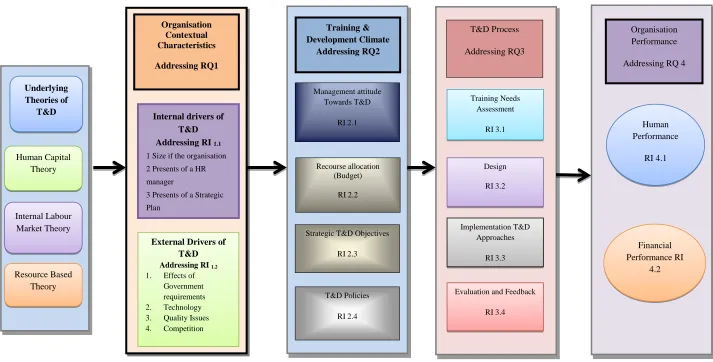
The following initial conceptual framework of T&D at the organisational level of
SMEs (see Figure 2.1) is proposed. This framework falls under the umbrella
discipline of Human Resources Management (HRM), and sub-discipline of Human
Resources Development. As depicted in Figure 2.1, the framework comprises four
components: Training and Development Drivers; Training and Development
Climate, Training and Development Process and Training and Organisation
performance. The theories underlying these components will be outlined and
thereafter a discussion follows which describes the four components of the
framework and their links with the respective research questions.
The following framework (see figure 2.1) shows the key elements to be discussed in
18 Jeremy P. Novak
[image:30.842.52.765.114.476.2]0068045
Figure 2.1 Conceptual Frameworkdeveloped from Smith and Hayton (1999) and Al-Khayyat and Elgamal (1997) models Internal drivers of
T&D Addressing RI 1.1
1 Size if the organisation
2 Presents of a HR
manager
3 Presents of a Strategic
Plan
External Drivers of T&D
Addressing RI 1.2
1. Effects of Government requirements 2. Technology 3. Quality Issues 4. Competition Organisation Contextual Characteristics Addressing RQ1 RQ1 Training & Development Climate Addressing RQ2 Organisation Performance
Addressing RQ 4
Recourse allocation (Budget) RI 2.2 Management attitude Towards T&D RI 2.1
Strategic T&D Objectives
RI 2.3 T&D Policies RI 2.4 T&D Process Addressing RQ3 Training Needs Assessment RI 3.1 Design RI 3.2
Evaluation and Feedback
19 Jeremy P. Novak
0068045
It should be noted that the framework above is not meant as a methodological
framework guiding hypothesis or to be imposed on the data, it is merely a visual
representation of the structure of this thesis.
The above conceptual framework used in this study, draws on the work of Smith et
al (1999), Smith and Hayton (1999) and Al-Khayyat and Elgamal (1997). These
researchers carried out two major projects examining the determinants of employer
training for the Australian National Training Authority (Smith & Hayton 1999).
Smith et al (1999) made key linkages between workplace change in Australian
enterprises and T&D. They developed a model which focuses on employer training
development. Their model attempted to explain the factors that influence the
decisions of enterprises to train their employees. It emerged from their research that
there was a clear link between training, organisational development and the drivers
for employer training (Smith & Hayton 1999). They also examined the relationship
between employer training and organisational change in Australian enterprises.
Their research found that the central driver of training at the enterprise level as the
introduction of workplace change such as quality initiatives (Smith & Hayton 1999).
Al-Khayyat and Elgamal’s (1997) model comprises of a macro training and
development model (MTDM) which was built upon the two types of training and
development models which are dominant in the literature: the micro and the macro
view approach of training activities (Al-Khayyat & Elgamal 1997). The micro view
of training is recognised as the dominant model in the literature and is used
extensively (Goldstein 1986; Nadler & Wiggs 1986). This model focuses on the
examination and explanation of individual training events. However, Al-Khayyat
and Elgamal (1997) views this model as one that fails to account for environmental
elements surrounding the training activities. The macro perspective is used less
frequently in the literature, however, it attempts to explain the internal and external
environment that impact upon the training activities in an organisation, such as
management attitude towards training (internal) and industry norms (external)
(Anderson 1993; Tseng 1984).
Al-Khayyat’s and Elgamal’s MTDM is similar to that of the macro model developed
20 Jeremy P. Novak
0068045
organisational level. The next three sections are based on the work of Al-Khayyat & Elgamal’s (1997) macro training and development model (MTDM). Their
framework has been adapted to investigate themes unique to SMEs.
As evident from the framework depicted in figure 2.1, the literature review
commences with a discussion of the theoretical approaches underpinning this study
(section 2.3). The discussion then focuses on the various drivers of T&D in a SME
context (section 2.4) and thereafter components relevant to the T&D climate and the
T&D process in SMEs (chapter 3) will be outlined. Finally a short discussion of the
role of T&D in organisation performance will follow (chapter 3).
2.3 Theoretical Approaches Underpinning Training and
Development in SMEs
The concept of change by learning is the underlying principle of training. Training is
the means within an organisation by which the objective of human resource
development (HRD) is achieved (Al-Khayyat and Elgamal, 1997, Delahaye 2005,
Werther and Davis, 1985). Three theories which underpin training and development
have been identified for the purpose of this thesis: Human Capital Theory, Internal
Labour Market Theory, and Resource Based Theory. These are now explained.
2.3.1 Human Capital Theory
The central notion of the Human Capital Theory is that training is a long-term proposition and an investment in employee’s skills, capabilities, and knowledge; all
of which are embodied in and inseparable from the individual in an organisation
(Becker 1964; Dess et al. 2003; Smith 1998). The Human Capital Theory also argues
that an increase in the training of staff will result in increases in productivity for the
business on the one hand and higher wages and skills for the people that undertake
that training, on the other hand (Becker 1986; Samson & Daft 2009; Terjesen 2005).
Human capital theory (HCT) was first conceptualised after the Second World War
when the world was experiencing the rise of economic prosperity across many
countries, in particular the United States of America (Schultz 1959; Smith 1998).
21 Jeremy P. Novak
0068045
al. 1999; Becker 1964; Strober 1990). Economists of this time traditionally viewed
training in terms of return on investment. Moreover the HCT is based on the seminal
works of authors such as Becker (1964); Ben-Porath (1967), Mincer (1999), and
Schultz (1959). Schultz conducted a longitudinal research from 1932 to 1957, which
looked at the contribution of education to labour productivity (Becker 1964).
However, it was Schultz (1960 p. 571 cited in Smith 1996 p. 77) who first articulated
the assumption of theorists that education was a form of investment:
“I propose to treat education as an investment in man… I shall refer to it as human capital… it is a form of capital if it renders a productive service of
value to the economy. The principal hypothesis underlying this treatment of education is that some important increases in national income are consequence of additions to the stock of this form of capital.”
It appears from the literature that this approach was formulated after Becker (1962)
conducted research into the private returns to individuals of investment in education,
in particular educational and vocational training investment. Today, this approach is
synonymous with human capital investment (Delahaye 2005; Mincer 1999). Becker
(1964) identified the concepts of two distinct types of training: general training and
specific training. Specific training is informal on the job training that is specific to the organisation’s requirements. These skills that an employee gains are usually not
transferable to another organisation, thus reducing the poaching of trained employees
(Smith & Hayton 1999; Strober 1990). General training is conducted by registered
training providers to build personal skills, knowledge, education, and abilities. This
type of training is focused on how cognitive abilities could be enhanced to result in
higher productivity (Becker 1964; Smith 2007; Terjesen 2005).
Becker (1986) also proposed that general training and specific training in an organisation are only separated by the organisation’s views of the importance and
effectiveness of training. Consequently funds allocation is usually slanted towards
the most appropriate form of training to help the organisation. However, there has
been some debate by human capital theorists regarding the practicality of training;
22 Jeremy P. Novak
0068045
training; and whether training produces the same benefits to both the organisation
and trainees (Smith 1998; Swart 2006).
It has also been argued that industry-based training should be regarded as a form of
investment into human capital, because on the one hand, individuals undergoing this
type of training are likely to progress to better positions with higher pay and on the
other hand, organisations benefit by the positive impact of training on productivity.
Furthermore, Becker (1986) and Terjesen (2005) argue that these skills are needed in
order to perform a job which is valued by the organisation. Thus the knowledge and
skill advancement gained by personnel can be rewarded by the organisation with
increased pay and promotions. Furthermore Barcala et al. (1999) suggested that most of the studies into HCT are concerned with the role of an individual’s investment in training. Regardless of the differing views, Becker’s approach is now a
widely used theory. His theory is used to understand human capital investment, in
particular educational and vocational training investment in organisations. Moreover
HCT has also improved the concepts of generic and specific training (Smith &
Hayton 1999; Strober 1990). However, a review of the literature into HCT in SMEs
finds there is a research bias towards large organisations (Barcala et al. 1999; Smith
& Hayton 1999; Strober 1990).
There have been conflicting views about the effectiveness of the human capital
theory, especially in SMEs. On the positive side, Plummer and Taylor (2004)
conducted empirical studies into entrepreneurship education and found that in order
for SMEs to grow, they need to invest in their employees through training and
development. On a more critical note, Swart (2006) and Smith (2006) argue that the
theoretical framework of the human capital theory does not deliver what it sets out to
do and that it is not clear whether training produces the same benefits for the
organisation and the individual and it is unclear exactly how it contributes to
corporate performance. Furthermore, Smith (1998) concluded that despite the central
concept of training and development as a long term focus on the human factor of the
organisation, it does not explain the mechanisms of skill development at the
23 Jeremy P. Novak
0068045
2.3.2 Internal Labour Market Theory
The Internal Labour Market theory is concerned with how an organisation’s
administration unit selects and allocates labour that is governed by a set of
administration and procedures (Smith, 1998). This approach was based more or less
on the winning of employee commitment through the prospect of long-term career
advancement, employee welfare programs and packages, seniority pay systems and
job security in which there was great support from management staff and unions
alike. It has been viewed that such arrangements in some ways suited the principles
and strategies of HRM and can create cross-organisational synergy (Chapman 1999;
Pieroni & Pompei 2008; Salaman et al. 2005; Stace & Dunphy 2001).
Doeringer and Piore (1971) defined internal labour market as “…an administrative
unit, such as manufacturing plant, within which the pricing and allocation of labour
is governed by a set of administrative rules…” The internal labour market (ILM)
concept was initially developed by American institutional labour economists who
conducted empirical analyses of labour markets soon after the Second World War
(Baily 1974). The research conducted by the American institutional labour
economists was not concerned with the behaviour of individuals within an
organisation; rather they were focused on developing and constructing middle-level
hypotheses involving the reduction of phenomena to broad analytical constructs
(Creedy & Whitfield 1992).
Other early research of internal labour market research made distinctions between
two types of internal market. Firstly, it was based on the organisation and secondly
on the profession of the personnel (Creedy & Whitfield 1992). The theory was
quickly further developed in an attempt to explain the disparity of earnings in an
organisation between similar jobs in different organisations by labour economists of
that time (Salaman et al. 2005; Smith 1998). Some authors such as Cappelli (1993)
suggested that the theory was developed due to two reasons. Firstly, to help in the
24 Jeremy P. Novak
0068045
skill sets of staff in their organisation. Secondly, it was an attempt to reduce the high
cost of recruiting, selecting, training and constantly renegotiating with skilled
workers. From these initial developments, Creedy and Whitfield (1992) argue that
the internal labour theory comprises four characteristics including: employment
stability; point of entry; constrained wage adjustment; and attachment of wages to
jobs.
In recent years ILM research has focused on employing organisations and how they
view occupational characteristics as constraints in which the organisation shapes its
internal ILM. The research focus on three main areas which include (i) the
determinants of wage changes within ILM, (ii) nature and extent of the recruitment
and promotion policies within an organisation, and (iii) the level of labour turnover.
Further to this, the ILMT can be depicted as the internalisation of the employment
relationship where it is not concerned with the role of training in increased
productivity; rather it is concerned with progression of employees on the internal job
ladder and the acquisition of skills in order to achieve such progression.
Interestingly Edwards (1979) and Strober (1990) described the ILMT as the 'bureaucratic control' and ‘political system’ of an organisation because the manager
of an organisation possesses the decision-making power in relation to not only the decision ‘who’ receives the training but ‘which’ jobs are placed on the job hierarchy.
Consequently, this affects the earnings of prospective employees.
It has been said that when economies are growing the ILMT comes into its own.