ESCalate Developing Pedagogy and Practice 2010/11 Grant Project
Final Report
Date submitted 18 December 2011
Project Title Teacher Educators' experience and use of reflection in the Lifelong Learning Sector
Project Leader Liz McKenzie
Institution University of Plymouth
Project Start date 1 March 2011
Project End date 31 December 2011
FINAL REPORT December 2011
Dr Liz McKenzie School of Education
Faculty of Health, Education and Society Plymouth University
Drake Circus Plymouth PL4 8AA
1. Top line summary
Title: Teacher Educators’ experience and use of reflection in the Lifelong Learning Sector.
This project investigated teacher educators’ experience and use of reflection within the Post-Compulsory or Lifelong Learning sector.
It used a sequential, mixed methods design, employing a questionnaire and a semi-structured interview.
Twenty four teacher educators for the Lifelong Learning sector, from a
partnership network within the South West, completed a questionnaire about their own experience and use of reflection. The questionnaire also asked about how they introduced reflection to their trainees and the techniques they used to support the trainees’ reflection. Findings indicated that the majority of teacher educators had been introduced to reflection whilst gaining their own teaching qualification or other academic study. The majority appear to be very reflective with Brookfield and Schön identified as theorists they personally found useful. These also featured as theorists commonly used with trainees, along with Kolb and Gibbs.
Interviews with eight experienced teacher educators broadly support the questionnaire findings, with Kolb and Schön mentioned as the theorists most frequently used to introduce reflection to students. Although the teacher educators use a range of theories and models with their students, Brookfield’s
critical lenses were the most frequently discussed technique, both for developing their own personal reflection and that of their students.
Key words: teacher educators, reflection, reflective practice, Lifelong Learning.
2. Project overview
Introduction
Project aims and objectives
The project aimed to investigate the experience and use of reflection of teacher educators within the Lifelong Learning sector and how they introduce and support reflection with trainee teachers. It explores the theories which teacher educators personally find most useful, and how they customarily engage in reflection eg. through personal introspection, by keeping a journal, through discussion with colleagues. The project also explores how teacher educators introduce reflection to trainee teachers, the theories and models they teach and the techniques they use to support the trainees’ reflection eg. reflective journals, interactive journals, peer/mentor discussion. It builds on research I have already undertaken looking at the experience of reflection of trainee teachers in the Lifelong Learning sector (McKenzie, 2010a, 2010b).
Background to the study.
The literature on teacher education consistently refers to the role of reflection as a means of developing practice (Smyth, 1989; Adler, 1991; Hatton & Smith, 1995; Bean & Stevens, 2002; Jay & Johnson, 2002; Fendler, 2003; LSDA, 2003; Harkin, 2005; Pollard, 2005; Alger, 2006). Although the difficulty of defining reflection is also noted (Moon, 1999; Roffey-Barentsen and
Malthouse, 2009), not least because of the range of associated terms, such as reflective practice, reflective learning, reflective writing, critical reflection. The differing views of the nature of reflection in the literature, whilst indicating that reflection constitutes a ‘lively’ area of critical debate (Tummons, 2007:73), may also lead to confusion for those expected to make use of reflection. Indeed there is recognition that students are often uncertain about the process of reflection and what is expected of them (Loughran, 1996; Bolton, 2001, Mueller, 2003; Moon, 2004). Gay and Kirkland (2003) suggest that many trainee teachers don’t have a clear understanding of what reflection is, or how to do it. So if reflection is required for professionals to develop their practice, then it would seem essential that this is clearly defined and
adequately supported at all stages, but particularly during teacher education.
The work of Schön (1983; 1987) has been identified as promoting the growth in the use of reflection for professional development evident through the 1980s (Fendler, 2003; Kilminster et al, 2010). His distinction of
action and reflection-on-action is a widely accepted characterization of reflective practice which frequently features in texts for trainee teachers (Hillier, 2005; Roffey-Barentsen and Malthouse, 2009). Several other
significant texts on reflection/reflective practice were also produced during the 1980s (Kolb, 1984; Boud et al, 1985; Brookfield, 1987) which also feature in texts for trainee teachers. Kolb’s experiential learning cycle proposes two dimensions of concrete experience - abstract conceptualisation and active experimentation – reflective observation which are then integrated to form a four stage cycle (Kolb, 1984; Fawbert, 2003; Gray et al, 2005; Hillier, 2005), broadly interpreted as Plan, Do, Reflect, Read/Theorise (Woolhouse et al, 2001; Roffey-Barentsen and Malthouse, 2009). Kolb’s model was
subsequently developed into a six stage sequence by Gibbs (1988) which includes emotions/feelings (Woolhouse et al, 2001; Roffey-Barentsen and Malthouse, 2009). Boud et al (1985) also incorporate feelings in their three stage model, which comprises Experience, Reflective processes and
Outcomes, with recursive loops encompassing behaviour, ideas and feelings, between experience and the resultant reflective activity. Brookfield (1995) encourages use of other points of view through his model of four ‘critical lenses’, which supplement the view of the teacher with those of the learners, colleagues and theories from the literature (Hillier, 2005; Roffey-Barentsen and Malthouse, 2009).
Despite Moon’s (2004:1) assertion that ‘we all reflect’, there is evidence in the literature that individuals may differ in their capacity for and engagement with reflection (Boud et al 1985; Reiman, 1999). With regard to trainee teachers, studies have identified differences in their capacity for reflective thought (Freese, 1999; Manouchehri, 2002; Giovannelli, 2003; Griffin, 2003).
Sumsion (2000) suggests the individual’s view of learning and a narrow focus on practical aspects of teaching as associated with poor engagement with reflection. Furthermore Day (1993) suggests that teachers may approach reflection differently at different times/stages in their career, so that the requirements of beginning teachers may differ from those of more experienced practitioners, such as teacher educators. The findings
suggest that we cannot assume that reflection happens automatically for all individuals, or that they will all use reflection in such a way as to improve performance (Reiman, 1999; Moon, 2004). Consequently it would seem that student teachers should to be offered a variety of techniques in order to support their use of reflection (Adler, 1991).
While there has been a lack of detail about teacher educators, the
complexities of the role are becoming well documented (Korthagen et al, 2005; Murray et al, 2011; Boyd et al, 2011). They occupy a dual role, since as they teach they simultaneously model teaching (Korthagen et al 2005; Murray et al 2011) and this includes the development and modelling of reflective practice (Loughran, 1996; Murray 2007; Hughes 2005), as well as using reflection to develop their own practice (Murray et al 2011). Harkin (2005) notes that within the Lifelong Learning sector the interpretation of reflective practice and the range of theory to be covered in teacher education programmes are left to those teaching them. Consequently as Tanner and Davies (2009) emphasise, teacher educators’ own knowledge and ability to
critically reflect on practice is vitally important for the development of critical reflection amongst their students.
This study represents a preliminary investigation of the experience and use of reflection by teacher educators within the Lifelong Learning sector.
Methodology
The project used a mixed methods design, in which a questionnaire was used to sample teacher educators’ experience and use of reflection and to obtain biographical data which was then used to select individuals to participate in a semi-structured interview.
Questionnaires were used as they represent a relatively economical, standardised means of obtaining information from a number of participants (Bell, 2002; Opie, 2004). Self completion questionnaires were used both to provide general information about participants’ experience and practice and to provide a means of identifying individuals for interview. The questionnaires were analysed to provide quantitative data about length and range of
experience of teacher education programmes, preferred theories and ways of engaging with reflection and approaches to introducing and supporting
reflection with trainee teachers. The questionnaire also asked if respondents were prepared to be interviewed about their experience of reflection.
Questionnaires were completed at the beginning of a staff development session on reflection, which was part of a staff development day held by the University for teacher educators teaching the Certificate in Education (Cert Ed) and Postgraduate Certificate in Education (PGCE) within the partnership network. The network comprised the University and seven partner colleges and all were represented at the session. Twenty two teacher educators completed questionnaires on the day and a further two were returned electronically.
The questionnaires were used to select a purposive sample of individuals to participate in a semi-structured interview on the basis of three criteria: their willingness to be interviewed, their length of experience (five years or more) and their institution, to give a spread across the University and the partner colleges. Eight individuals from across the University and four partnership sites were selected for interview. The original plan had been to interview ten individuals and two further individuals were identified for interview, but it wasn’t possible to arrange a convenient interview time before project deadline. All the interviews took place in a quiet location in an educational institution convenient for the interviewee.
Findings
The questionnaire findings.
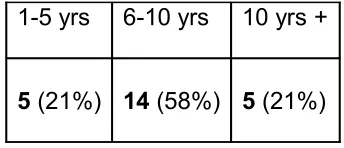
[image:6.595.166.338.223.297.2]The questionnaire sample included individual with a range of experience in teacher education, from 2 – 22 years (see Table 1).
Table 1: Teacher educators’ length of experience
1-5 yrs 6-10 yrs 10 yrs +
5 (21%) 14 (58%) 5 (21%)
As Table 2 shows, their experience spanned across a range of provision including City & Guilds (C&G) PTLLS (Preparing to Teach in the Lifelong Learning Sector), CTLLS (Certificate to Teach in the Lifelong Learning Sector), DTLLS (Diploma to Teach in the Lifelong Learning Sector) and the University’s Cert Ed/PGCE programmes. All had experience of teaching the Cert Ed/PGCE, incorporating DTLLS, most had experience of teaching on other teacher education programmes, with a half referring to City & Guilds 730/740 series of programmes and a third the newer PTLLS/CTLLS
programmes. Those who only had experience of Cert Ed/PGCE were mainly based in the University, though over half of the university staff had previously worked in colleges, so had prior experience of teaching on City & Guilds programmes.
Table 2: Teacher Educators’ range of experience
Cert Ed PGCE
C&G 730/740
PTLLS-CTLLS
24 (100%) 12 (50%) 8 (33%)
For over half the sample their experience of reflection began with taking a teaching qualification themselves (63%), though for others it came via their degree or other study (17%) counselling (8%), nursing (4%), social work (4%) management (4%) or other workplace experiences (see Table 3).
[image:6.595.170.355.556.628.2]Table 3: Introduction to reflection.
[image:7.595.172.344.375.463.2]The majority (63%) do not use a reflective journal, although a couple say they do ‘sometimes’ (8%) or that they used to (8%), only around a fifth, 21% say they do so regularly (see Table 4).
Table 4: Teacher Educators’ personal use of journals.
Journal No. %
No 15 63
Yes 5 21
sometimes 2 8
Past 2 8
24 100
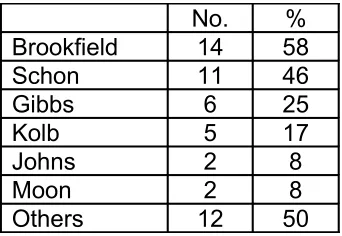
As Table 5 shows, Brookfield was the theorist most frequently mentioned as the one teacher educators personally found most useful (58%), while Schön was a close second (46%), with Gibbs (25%), Kolb (17%), Moon (8%) and Johns (8%) also featuring . Other theorists, such as Dewey, Flanagan, Lewin, Bolton, Tripp, were also mentioned by single individuals.
Table 5: Theorists Teacher Educators personally find most useful.
No. %
Brookfield 14 58
Schon 11 46
Gibbs 6 25
Kolb 5 17
Johns 2 8
Moon 2 8
Others 12 50
No. %
Own teaching qual. 15 63
Other study 4 17
Counselling 2 8
Nursing 1 4
Social work 1 4
management 1 4
24 100
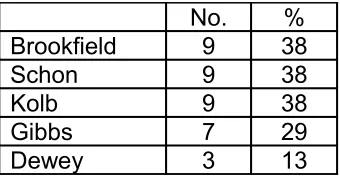
[image:7.595.165.336.626.744.2]Most of the teacher educators said they aimed to introduce reflection as soon as possible, with several referring to ‘at interview’ or induction, although it may not be formally introduced until later in the course. They aim to offer their students a range of different theories, with Kolb, Brookfield and Schön being most frequently mentioned (38%), followed by Gibbs (29%), though the questionnaire data doesn’t tell the whole story since some respondents didn’t specify, just saying ‘all of them’ or putting a couple of names and then ‘etc.’, so interviews would reveal more information.
Table 6: Theorists mentioned as used with trainees.
No. %
Brookfield 9 38
Schon 9 38
Kolb 9 38
Gibbs 7 29
Dewey 3 13
Interview findings.
The interviews findings are broadly in line with those of the questionnaires regarding journals. The majority of the interviewees do not keep a reflective journal, though half of them have done in the past, often for course
requirements, such as their own teaching qualification, counselling or nursing:
‘I kept journals for ten years anyway in my personal life, I don’t keep them now’
None of the interviewees require their students to do so, although a couple mentioned that they recommend it:
‘I actually suggest to them that they keep a journal because I’ve said to them at any point in any of the assignments that you’re completing you can use your journal’
Several mentioned that students would only write a journal if they could see it was a course requirement with marks attached to it:
‘so it’s either got to be part of the assessment or the reality is it won’t be done’
However their students were required to provide written evidence of reflection via lesson evaluations, assignments, target setting and individual
development plans (IDPs):
‘They reflect in their IDPs and they have to write reflective summaries every time they submit, on different domains.’
Several of the interviewees mentioned how the focus of reflection was directed for the students, rather than them being able to reflect on issues which may have arisen from their own concerns:
‘It’s all within a framework, so there may be something lost there’
‘it is there, it’s a much more ordered reflective process.’
The programme had introduced new grading criteria for the reflective element of the students’ IDPs, which some interviewees expressed concerns about:
I have quite a deal of concern about people reflecting upon their lives in quite intimate and sincere ways and then you actually say at the end this is a pass’
It would be interesting to hear the teacher educators’ views on these and their impact on the students’ reflective writing, once they have used the criteria and they have become embedded in the programme.
Kolb and Schön were mentioned as the theorists most frequently used to introduce reflection to students, often one followed by the other. Schön’s notion of ‘the swamp’ was specifically mentioned:
‘I talk about the swamp land … because what I want them to do right from day one is to look at their practice and know that everyone goes out there and ends up in swampland’
As was the value of the practical application of Kolb to practice:
‘So I tend to …. really focus on Kolb’s learning cycle and get them to do at least a loop and a half, if not two loops of it’
All the interviewees mentioned using Brookfield with their students:
Brookfield I’ve used. I think his idea of looking at things through different lenses is really helpful
Other theorists, such as Dewey, Gibbs, Flanagan, Johns and Bolton were also mentioned, although the lack of time to develop a broader understanding of reflection was commented on:
‘What I am doing now is making them do reflective practice without necessarily knowing about it in depth’
‘We used to spend more time on the theoretical underpinning’
Brookfield was mentioned by the half the interviewees as one they personally found most useful:
Brookfield absolutely … because he’s an education writer and talks about reflection in terms of education, he’s picked up on a sort of essence there that I just think makes it more appropriate’
One preferred Schön, one Johns and two said they didn’t use any particular theory or model:
‘I don’t know what one I’m working under, but I obviously am because I don’t let it go’
Although there are consistencies in the ways in which the teacher educators introduce and support reflection with their trainees and some sharing of resources/experiences takes place, most of them are not fully aware of exactly which theorists their colleagues use and how or when they are introduced:
‘I kind of think here they [other tutors] probably do very similar’
This study has begun to explore teacher educators’ experience of reflection and the ways in which they use reflection personally and with their students to develop practice. Although the teacher educators use a range of theories and models with their students, Brookfield’s critical lenses were the most
frequently discussed technique, both for developing their own personal reflection and that of their students.
During most of the interviews the discussion gave rise to something which caused the interviewee to pause for thought and to comment that this was something they needed to think further about, whether it was the directed nature of reflection, not knowing exactly what colleagues were doing, or the possible impact of grading reflection:
‘I hadn’t really engaged with or thought about [that], now that’s going to wrestle in my head now, thank you’
These will be issues to explore in a future staff development session.
Project impact
Short term:
o The staff development session provided input about reflection as a stimulus for discussion.
o The project has highlighted the role of reflection for teacher educators within the partnership and given them the opportunity to consider this important aspect of their practice – for
themselves and their students.
Long term:
o A future staff development session is planned to feedback the project findings and provide an opportunity for discussion of these.
o The project has highlighted the value of sharing practice to explore the theories and models used and promote consistency of experience for student teachers.
o Dissemination of project findings at national conferences will highlight the role of reflection for teacher educators.
References.
Adler, S. (1991) The reflective practitioner and the curriculum of Teacher Education. Journal of Education for Teaching, Vol. 17 No. 2 p139-150.
Alger, C. (2006) ‘What went well, what didn’t go so well’: growth of reflection in pre-service teachers. Reflective Practice, Vol. 7, No. 3,p 287-301.
Bean, T.W. and Stevens, L.P. (2002) Scaffolding Reflection for Preservice and Inservice Teachers. Reflective Practice, Vol. 3, No.2, pp205-218.
Bell, J. (2002) Questionnaires. In. Coleman, M. and Briggs, A.R.J. (Eds)
Research Methods in Educational Leadership and Management. London: Paul Chapman Publishing.
Bolton, G. (2005, 2nd Edn.) Reflective Practice: Writing and professional development London: Paul Chapman, Sage publications.
Boud, D., Keogh, R. and Walker, D. (1985) Promoting Reflection in Learning: a model Ch1 In Boud, D., Keogh, R. and Walker, D. (Eds) Reflection: Turning Experience into Learning. London: Kogan Page Ltd.
Brookfield, S. (1995) Becoming a Critically Reflective Teacher. San Francisco: Jossey Bass.
Day, C. (1993) Reflection: A necessary but not sufficient condition for
professional development. British Educational Research Journal, Vol. 19, No. 1, p83-91.
Fawbert, F. (ed) (2004) Teaching in Post-compulsory Education: Learning, Skills and Standards.London: Continuum.
Fendler, L. (2003) Teacher Reflection in a Hall of Mirrors: Historical Influences and Political Reverberations. Educational Researcher, Vol. 32, No. 3, pp16-25.
Freese, A.R. (1999) The role of reflection in preservice teachers’ development in the context of a professional development school. Teaching and Teacher Education, Vol. 15, p895-909.
Gay, G. and Kirkland, K. (2003) Developing Cultural Critical Consciousness and Self-Reflection in Preservice Teacher Education. Theory into Practice, 2003, Vol. 42, No. 3.
Giovannelli, M. (2003) Relationship between Reflective Disposition Toward Teaching and Effective Teaching. Journal of Educational Research, Vol. 96, No. 5,
Gray, D., Griffin, C. and Nasta, T. (2005, 2nd Edn.) Training to Teach in Further and Adult Education. Cheltenham: Nelson Thornes.
Griffin, M. L. (2003) Using Critical Incidents to Promote and Assess Reflective Thinking in Preservice Teachers. Reflective Practice, Vol. 4, No2, p207-220.
Harkin, J. (2005) Fragments stored against My Ruin: the place of educational theory in the professional development of teachers in further education.
Journal of Vocational Education and Training, Vol.57, No.2, pp165-179
Hatton, N. and Smith, D. (1995) Reflection in teacher education – towards definition and implementation. Teaching and Teacher Education, Vol. 11, No 1, p33-49.
Hillier, Y. (2005, 2nd Edn.) Reflective teaching in further and adult education.
London: Continuum.
Hughes, J. (2005) I Didn’t Have Voice Until I Joined This Group.’ The Use of Dialogue Journals in the Education of New post-compulsory Education
Teachers. Journal of Vocational Education and Training, Vol. 57, No.1. p81-94.
Jay, J.K. and Johnson, K.L. (2002) Capturing complexity: a typology of reflective practice in teacher education. Teaching and Teacher Education, Vol. 18, p73-85.
Kilminster, S., Zukas, M., Bradbury, H. and Frost, N. (Eds.) Introduction and Overview. In: Bradbury, H., Frost, N., Kilminster, S. and Zucas, M. (2010)
Beyond Reflective Practice: New Approaches to Professional Lifelong Learning. London: Routledge.
Kolb, D. A. (1984) Experiential Learning: Experience as The Source of Learning and Development. New Jersey: Prentice-Hall.
Korthagen, F., Loughran, J. and Lunenberg, M. (2005) Teaching teachres – studies into the expertise of teacher educators: and introduction to this theme issue. Teaching and Teacher Education, Vol 21, No.2. pp107-115.
Learning and Skills Development Agency (2003) Recollected in tranquillity?: FE teachers’ perceptions of their initial teacher training. www.LSDA.org.uk.
Loughran, J.J. (1996) Developing Reflective Practice: Learning about Teaching and Learning through modelling. London: Falmer.
Manouchehri, A. (2002) Developing teaching knowledge through peer discourse. Teaching and Teacher Education, Vol. 18, p715-737.
McKenzie, L.M. (2010a) Challenging the metaphor: Reflection – mirror or kaleidoscope? Paper presented at BERA Annual Conference, 1st - 4th
September, University of Warwick.
McKenzie, L.M. (2010b) PERHAPS? Exploring Possibilities for Reflective Practice. Paper presented at the 16th International Reflective Practice Conference, 23rd-25th June, Putteridge Bury Campus, University of
Bedforshire.
Moon, J. A. (1999) Reflection in Learning and Professional Development: Theory and Practice. London: RoutledgeFalmer
Moon, J. A. (2004) A Handbook of Reflective and Experiential Learning.
London: RoutledgeFalmer.
Mueller, A. (2003) Looking Back and Looking Forward: always becoming a teacher educator through self-study.Reflective Practice, Vol. 4, No.1, p67-84.
Murray, J. (2007) Countering insularity in teacher education: academic work on pre-service courses in nursing, social work and teacher education. Journal of Education for Teaching, Vol. 33, No. 3, pp271-291.
Murray, J., Czerniewski, G. and Barber, P. (2011) Teacher educators’ identities and work in England at the beginning of the second decade of the twenty-first century. Journal of Education for Teaching, Vol. 37, No. 3, pp261-277.
Opie, C. (2004) Research Procedures. . In. Opie, C. (Ed) Doing Educational Research: A Guide to First Time Researchers. London: Sage Publications.
Pollard, A. (2005, 2nd Edn.) Reflective Teaching. London: Contimuum.
Reiman, A.J. (1999) The evolution of the social roletaking and guided reflection framework in teacher education: recent theory and quantitative synthesis of research. Teaching and Teacher Education, Vol. 15, p597-612.
Roffey-Barentson, J. and Malthouse, R. (2009) Reflective Practice in the Lifelong Learning Sector. Exeter: Learning Matters.
Schön, D. A. (1983) The Reflective Practitioner: How professionals think in action. Aldershot: Ashgate Publishing.
Schön, D.A. (1987) Educating the Reflective Practitioner: Towards a New Design for Teaching and Learning in the Professions. San Francisco: Jossey-Bass.
Smyth, J. (1989) Developing and sustaining critical reflection in teacher education. Journal of Teacher Education, Vol. 40, No. 2, p2-9.
Sumsion, J. (2000) Facilitating Reflection: a cautionary account. Reflective Practice, Vol 1, No2, p199-214.
Tanner, H. and Davies, S. M. B. (2009) How engagement with research changes the professional practice of teacher educators: a case study from the Welsh Education Research Network, Journal of Education for Teaching, Vol. 35, No. 2, pp373389.
Tummons (2007) Becoming a Professional Tutor in the Lifelong Learning Sector. Exeter: Learning Matters.
Woolhouse, M., Jones, T. and Ree, M. (2001) Teaching the Post-16 Learner: A guide to planning, delivering and assessing learning. Tavistock: Northcote House.
3. Outputs
LSRN November 2011 Annual conference: presentation on reflection, the experience of trainee teachers and teacher educators in the Lifelong Learning Sector.
SRHE December 2011 Annual conference: presentation ‘Engaging with reflection: the experience of trainee teachers and teacher educators in post-compulsory education’.
4. Details of any future planned dissemination activities
I will provide a follow-up staff development session to the teacher educators who participated in the study to present my findings and provide an
opportunity for discussion and sharing of good practice.
I intend to present locally at the VC’s annual conference of my own institution and at any other local opportunities.
I also intend to present at national conferences such as the TEAN annual conference and at SRHE again in 2012, hopefully DPR 2012 and possibly BERA too.
I plan at least one paper from this project, likely journals: Journal of Education for Teaching, Reflective Practice, Journal of Further and Higher Education.
Provisional titles:
A mirror to look at ourselves: Teacher Educators’ experience of reflection in the Lifelong Learning Sector.
Context and Change: The experience of teacher educators in the Lifelong Learning Sector.
5. Expenditure profile
A final budget sheet outlining major costs associated with the project submitted to HEA.
6. Project summary (249 words)
This project builds on previous research undertaken with trainee teachers in the Lifelong Learning sector which explored their experience of reflection of (McKenzie, 2010a, 2010b). The project aimed to investigate the experience and use of reflection of teacher educators within the Lifelong Learning sector and how they introduce and support reflection with trainee teachers. It used a sequential, mixed methods design, employing a questionnaire and a semi-structured interview.
Twenty four teacher educators for the Lifelong Learning sector, from a
partnership network within the South West, completed a questionnaire about their own experience and use of reflection during a staff development session. Eight experienced teacher educators were then selected to participate in a semi-structured interview.
Findings indicated that the majority of teacher educators had been introduced to reflection whilst gaining their own teaching qualification or other academic study. They aimed to introduce reflection as early as possible within the course, often starting with Kolb and Schön, and these along with Brookfield and Gibbs, were the most frequently mentioned theorists for use with students. While the teacher educators use a range of theories and models with their students, Brookfield’s critical lenses were the most frequently discussed technique, both for developing their own personal reflection and that of their students. There are consistencies in the ways in which the teacher educators introduce and support reflection with their trainees and
some sharing of resources/experiences takes place, but the interviews suggested several areas for collaboration which could form the focus for future staff development.
Liz McKenzie is a Lecturer in Education on the International Masters Programme at Plymouth University. She has ten years experience as a teacher educator within the Lifelong Learning Sector including City & Guilds programmes and Cert Ed/PGCE PTLLS, CTLLS, DTLLS. A Fellow of the HEA and IfL she holds both QTS for schools and QTLS. Research interests include reflection/reflective practice and the professional identities of HE in FE practitioners.