COMPARISON AND
EVALUATION OF DATA
MODELLING FRAMEWORKS
By
Simon Milton,
BSc
(HoNs)
C2_ ...
~.__ {G~.,\.~-t~)
Submitted in fulfilment of the requirements for the degree of
DOCTOR OF PHILOSOPHY
UNIVERSITY OF TASMANIA
background information and duly acknowledged in the Thesis, and to the
best of my knowledge and belief no material previously published or
written by another person except where due acknowledgement is made
in the text of the Thesis
Simon Milton
HOBART, MAY 2000
This Thesis may be made available for loan and limited copying in
accordance with the Copyright Act
1968
Simon Milton
Abstract
DATA MODELLING FRAMEWORKS are used to construct models of reality for use in
information systems, computer science and software engineering. Currently, there is a plethora of data modelling frameworks each possessing a view of the world, in that each data modelling framework has a distinct set of terms that are used to create models of reality. We are interested in finding a unifying framework in which to compare and study data modelling frameworks. We tum to the study of ontologies to find a theory with potential as a unifying framework. Ontologies are studied in philosophy and are concerned with 'what there is'. An ontology defines the categorial structure of reality and the terms that are fundamental for describing reality. Consequently, ontologies are ideally suited to comparing and evaluating data modelling frameworks, and an ontology has the potential to provide a unifying framework for data modelling frameworks. In this thesis we consider using ontology in this role and examine using a specific commonsense realistic ontology from philosophy in the role of a unifying framework.
We are seeking to establish the nature and degree of synonymity between the world view of a pragmatically selected ontology and of several representative data modelling frameworks. We propose and apply two qualitative methods to help us. By applying these methods, we can begin to understand the efficacy of our approach and the generality of using an ontology as a unifying framework.
Acknowledgements
I WOULD LIKE to thank my supervisors, Chris Keen (School of Information Systems, The University of Tasmania) and Ed Kazmierczak (The University of Melbourne), for their professionalism and support during my study. Both have generously provided encouragement and engaged in stimulating interactions that have helped me through difficult points along the way. I am particularly grateful to Ed for his numerous suggestions and discussions during the development of this work and for reading everything so critically.
Thanks also to my colleagues and fellow students at The University of Tasmania: I especially wish to thank Cathy Urquhart, who helped me survive the rigours of study and showed me by example a new way through; Bernard Gunther, for his companionship in the department; and Linda Dawson for her level-headed and helpful suggestions in Hobart and Melbourne. I thank them all for their professional support.
I would also like to thank my very good and long-standing friend Glynne Ridgeway, for providing me with a refuge in which I could write without interruption either from students or from my adorable Abyssinian cats.
My parents have taught me consistently to follow my interests, to reach my goals and to succeed. They have shown consistent support and encouragement together with positive suggestions during periods of despair.
Lastly, but by no means least, heartfelt thanks to Philip for his love, patience and understanding through the years.
DECEMBER I 999
This thesis is dedicated to the memories of both my grandfather, Archibald Carl Milton ("The Mulga") and my uncle, Raymond Alan Milton, both of whom died during the writing and examination of the thesis. May they rest in peace.
Table of Contents
Chapter 1 Introduction
1·1 Data Modelling and Ontology
1 ·2 Motivation 1 ·3 Focus ofResearch 1 ·4 Research Method 1·5 Thesis Outline
Chapter 2
Background Literature
2·1 Ontology
2·2 Data Modelling Frameworks
Chapter 3
Using Terms and Concepts in Ontological Comparisons and Evaluations of Data Modelling Frameworks
3· 1 Relating Ontologies and Data Modelling Frameworks Through Terms and Concepts
3·2 Comparative Method 3·3 Evaluative Method
Chapter 4
Selecting an Ontology
4· 1 Selecting an Ontology by Pragmatism
4·2 The Philosophical Heritage of Chisholm's Ontology
4·3 Chisholm's Ontology
4·4 Static Concepts in Chisholm's Ontology 4·5 Dynamic Concepts in Chisholm's Ontology
Chapter 5
The Candidate Data Modelling Frameworks
5·1 Entity Relationship Model 5·2 Functional Data Model 5·3 Semantic Data Model 5·4 NIAM
5·5 OMT's Object Model
l
2
4
5
7
9
I I
I I
30
31
37 42
71 71
73 75 78
Chapter 6
An Ontological Comparison of Data Modelling Frameworks
with Chisholm's Ontology 84
6· 1 Results 84
6·2 Discussion of Results 6·3 Reflections
Chapter 7
Results of Evaluating the Functional Data Model using Chisholm's Ontology
7·1 Results Comparing FDM with Chisholm's Ontology 7·2 Results Comparing Chisholm's Ontology with FDM
7 · 3 Consolidation of Results and Implications
7·4 The Extensibility ofFDM 7 · 5 Reflections
Chapter 8
85 92
94
95 100
103 105 106
Results of Evaluating OMT's Models using Chisholm's Ontology 108
8·1 OMT's Dynamic and Functional Models
(the Dynamics of OMT) 109
8·2 Results Comparing OMT's Models with Chisholm's Ontology
8·3 Results Comparing Chisholm's Ontology with OMT's Models
8·4 Consolidation of Results and Implications
8·5 The Extensibility of OMT
8·6 Reflections
Chapter 9 Conclusions
9· 1 A Critical Analysis of Our Study 9·2 Our Findings
9·3 Limitations and Constraints 9·4 Further Research
9·5 Closing Remarks and Summary
References
II5
123
129 131
132
133 134
139 144 145 146
List of Figures
Figure 1 Ontology and Systems Analysis and Design Grammars:
Representation and Interpretation Mapping 17
Figure 2 Ontological Completeness I7
Figure 3 Ontological Clarity I8
Figure 4 Degree of Overlap in Coverage of Semantic Field 39
Figure 5 Evaluating Data Modelling Frameworks 42
Figure 6 Sample Results for a Bidirectional Comparison
of an Ontology and a Data Modelling Framework 44
List of Tables
Table 1 Extract from the Table of Concepts for the Entity-Relationship Modelling Framework
Table 2 Sample Results for a Comparison of
Data Modelling Frameworks with an Ontology 40
Table 3 Consolidation of Coverage for Compound Concepts 40
Table 4 Consolidated Results Showing the Level of Coverage in a Data Modelling Framework of the Semantic Field
for Concepts from an Ontology 46
Table 5 Concepts for Statics in Chisholm's Ontology 62
Table 6 Concepts for Dynamics in Chisholm's Ontology 69
Table 7 Concepts for the Entity-Relationship Model 72
Table 8 Concepts for the Functional Data Model 74
Table 9 Concepts for the Semantic Data Model 77
Table 10 Concepts for NIAM 79
Table 1
f
Concepts for the Statics of OMT (OMT's Object Model) 82Table 12 Results of the Comparison of
Selected Data Modelling Frameworks Using
Chisholm's Ontology 8 5
Table 13 Expanded Results for /Individual/ 86
Table 14 Expanded Results for the Concept I Attribute/ 88
Table 15 Indicative Results of Comparing the FDM with
Chisholm's Ontology 95
Table 16 Expanded Results for /Individual/ 96
Table 17 Expanded Results for I Attribute/ 97
Table 19 Indicative Results of Comparing Chisholm's Ontology
with Concepts from FDM IOI
Table 20 Expanded Results for /Entity/ IOI
Table 21 Expanded Results for /Function/ I02
Table 22 Consolidated Results for Comparing FDM with
Chisholm's Ontology I03
Table 23 Concepts for the Dynamics of OMT II4
Table 24 Results of Comparing OMT's
Object, Dynamic, and Functional Models with
Chisholm's Ontology I I 5
Table 25 Expanded Results for /Individual/ I 16 Table 26 Expanded Results for I Attribute/ I I7
Table 27 Expanded Results for /State/ I20
Table 28 Results of Comparing Chisholm's Ontology
with OMT's Models I23
Table 29 Expanded Results for /Object/ 124
Table 30 Expanded Results for /Link-Association/ 125
Table 31 Expanded Results for /Event/ I27
Table 32 Expanded Results for /State/ I28
Table 33 Expanded Results for /Concurrency/ 129
Table 34 Consolidated Results Showing Levels of Coverage
CHAPTER
I
Introduction
THERE ARE MANY data modelling frameworks in use today, each of which has a number of terms that are used to abstract from reality and build static and, in some cases, dynamic models of the world. The terms from a data modelling framework, together with their associated meanings, implies a view of reality. For example, the Entity-Relationship (ER) data modelling framework has a term called 'entity' that is used to represent significant independent things found in reality. Another term called 'relationship' relates two or more entities. Further, ER allows for the description of entity classes and the attributes that each member of a specific class may exhibit. Other data modelling frameworks differ from ER in the teITilS provided. The differences may be in the names given to teITilS that in other respects fulfil a very similar purpose to 'entity' from ER. Alternatively, there may be several terms in one data modelling framework to achieve the same modelling objective as one from ER. It may also be the case that the meaning behind terms (or groups of terms) may be different, in subtle or radical ways, from related teITilS in ER. The difference in terms is recognition that they all have a different view of reality, and by implication encourage modellers to view things differently when constructing abstractions using the terms. There are also claims of the 'superiority' of this data modelling framework over that, or that one data modelling framework is more 'natural' than another. In this thesis we begin to search for a unifying framework with which we can reconcile the different views of reality possessed by the many data modelling frameworks.
research that will help us reach our long-term goal of a unifying framework. The scope of this thesis is restricted to consideration of modelling languages that consider data or static structures and we use the term 'data modelling framework' in this context.
1·1 Data Modelling and Ontology
Many modelling frameworks have been proposed during the last three decades, beginning with semantic models (Hull and King, 1987, Peckham and Maryanski, 1988), and progressing through to object models (Banerjee et al., 1987, Cattell, 1991, Dobbie, 1990, Lecluse et al., 1988, Rumbaugh et al., 1991, Boman et al., 1997). Modern data modelling methods involve establishing an abstraction of data and information from the world which is acceptable and relevant for an organisation and its purposes. Semantic data modelling frameworks (Hull and King, 1987, Peckham and Maryanski, 1988) were motivated by the need to increase the semantic representation. that was shown to be lacking in the relational model (Codd, 1970). Object models, in contrast, have been established partly to enable reuse of software components, and partly to improve the semantic content of modelling frameworks. Object models have been described as being more natural than other data modelling frameworks. There has been further influence on modelling frameworks by semantic nets and other aspects of artificial intelligence (Brodie, 1982, Hammer and McLeod, 1990, Hammer and McLeod, 1981).
The large number of data modelling frameworks available makes the task of selecting a modelling framework very difficult, and there is no universally accepted principle that determines the suitability of one data modelling framework over andther. Additionally, claims of universality for, or quality of, specific data modelling fotmeworks are largely unsubstantiated. Nevertheless, data modelling frameworks are used for modelling reality, and for this reason we are interested in finding a unifying framework that can be used in conjunction with data modelling frameworks for the purpose of studying them. Ontology is useful for this purpose because of its role in Philosophy-that of considering the "furniture of the world" (Bunge, 1977). Philosophers who construct ontologies seek an understanding that "... deals with the most general properties of beings in all their different varieties" (Kim and Sosa, 1995). It is in this way that ontologies perform an analogous role to that played by data modelling frameworks.
Ontological studies is an ancient and mature field (Flew, 1989), dating back to Aristotle and Plato (Kim and Sosa, 1995). The study of ontologies provides us with a source of independent views on 'what there is' in reality, and it may, in due course, be able to provide us with a unifying framework for data modelling frameworks.
Other groups of researchers view ontologies as being restricted to a particular domain such as those used in artificial intelligence research (Vickery, I 997). The
world view of a civil engineer is an example of a domain-specific ontology. In these types of ontology, categories are constructed that represent the vocabulary of the universe of discourse in which the group is likely to be interested.
We are interested in ontologies that are of the more general type and not confined to one problem domain, or that describe categories of a restricted sort. This is because data modelling frameworks are not restricted to one class of modelling problem and are needed to build representations of reality which are widely applicable in a similar way to ontologies constructed by philosophers.
An ontology tells us what terms are needed to describe 'what there is' (physical and non-physical) in reality and, more deeply, the ontology also provides the concepts that fully define each term. They also establish ontologically fundamental categories into which terms are placed, and thereby establishing what categories are needed. For example, an ontology may outline the fundamental categories as being 'individual', 'attribute', and 'event'. The terms may be 'individual', 'attribute', 'relation', 'class', 'set', and 'event'. Each term is then explained and related to the fundamental categories. Terms may define or elaborate upon specific categories, such as 'event', 'attribute', or 'individual', or their relationship to one of the categories is defined and explained. The terms are what is needed to adequately describe 'what there is'; The categories are the minimum number of ontological categories to which terms relate.
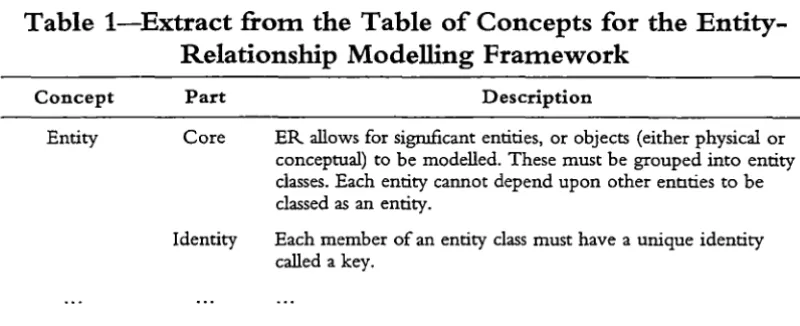
We are interested in exploring the role of ontologies that talk about the general nature of objects in reality as a unifying framework for data modelling frameworks. Data modelling frameworks also provide us with the terms with which we can build models of reality. For example, 'entity', 'entity class', 'relationship', 'attribute' are terms that can be used to describe 'what there is'. Each term has a meaning that governs the sort of things to which it refers when building models ofreality.
Terms from both the ontology and the modelling frameworks have meaning through concepts that describe their nature. The totality of terms and concepts embodies the world view of a data modelling framework and an ontology. Our aim is to compare and contrast the views of reality as embodied in terms from various data modelling frameworks with the view of reality as found in terms from an ontology. For example, how similar are the terms 'individual' and 'entity'? In doing so, we can begin to examine the role that ontologies can play as a unifying framework for understanding data modelling frameworks.
We believe that a unifying framework for data modelling frameworks has three features or capacities. Firstly, it has a coherent set of concepts. Secondly, each data modelling framework can be expressed within the unifying framework. Thirdly, that the unifying framework can be used to analyse any data modelling framework. In this context 'analysis' means the ability to compare, evaluate, extend, and understand the view that each data modelling framework has with respect to the world.
therefore important to select an ontology that is useful for our aims and objectives. Essentially, we use pragmatics to select an ontology.
1 ·2 Motivation
There is previous research using ontologies in information systems and data modelling. The work falls into three categories, some of which provides further motivation for our work.
Firstly, the tools and techniques used in systems analysis and design have been examined using ontology in order to discuss the quality with which they represent reality (Weber, 1997, Wand, 1996, Wand et al., 1995, Wand and Weber, 1995, Wand and Weber, 1993). Quality is defined in terms of the clarity and accuracy with which tools are capable of representing real world phenomena. In their work, clarity and accuracy of representation is categorised by examining, in specific ways, the mathematical mapping between grammars that represent firstly, the modelling tool under investigation (for example, ER, or data-flow) and, secondly, a selected ontology as the theoretical measure of representational fidelity. In comparing grammars in this way, there is a concentration on the construction of lawful models in a tool according to the syntax specified in the grammar. Thus, only the structure of the relevant tool is examined against the ontology. The work published to date, uses a scientific and systems oriented ontology by Mario Bunge (Bunge, 1977, Bunge, 1979 ). Our work differs in that we are seeking a unifying framework for qualitative studies of data models. We also consider a different ontology from Mario Bunge's. This thesis represents the first step towards achieving the goal of a unifying framework in that we compare the terms and associated concepts that constitutes the world view of an ontology with terms and concepts from several representative data modelling frameworks. Through the methods we propose and use in this thesis, we study the ontology of each data modelling framework and see how they compare with the world view embodied in our selected ontology. From this experience, we comment on the success or otherwise of our quest for a unifying framework based on the selected ontology.
Secondly, researchers in artificial intelligence have used domain-specific ontologies to guide the construction of models for knowledge representation (Vickery, 1997). Our work is different from this in that we seek to compare the world view implicit in specific data modelling frameworks using the world view found in a metaphysical ontology. We seek to compare and contrast the world view implicit in a modelling framework itself and not in a specific model constructed using a data modelling
framework or to consider what a specific group considers to be the categories of 'what there is'. Further, we use ontology in the sense of it being the study of 'what there is' in a mature and long recognised area of philosophy, and not to create our own theory.
modelling techniques which classifies them according to their ontologies, i.e., the type
of application for which they are intended to support, the set of abstraction mechanisms (or, structuring principles) they support, as well as the tools they provide ... " (op cit.). It differs from our own work in that we seek a unifying framework for data modelling frameworks by considering a suitable ontology from philosophy and that we are working from the premise that all data modelling framework should be capable of modelling similar things. If we find that the modelling frameworks do not reflect a selected ontology, then further explanation and investigation is required.
We select an ontology using pragmatic criteria for the purpose of comparing and evaluating data modelling frameworks. By using the selected ontology in this way, we expect to be able to assess its usefulness in providing a theoretical basis for a unifying framework.
1·3 Focus of Research
We are interested in conducting ontological studies of a number of data modelling frameworks. Implicit in each data modelling framework is a view of the world that is encapsulated in the nature of the terms used to construct models. To illustrate this, we briefly consider three examples. Firstly, the entity relationship modelling :framework discusses 'entity classes' and 'relationships' between members of entity classes. A member of an entity class (entity) must not be dependent, for its existence, upon any other element in the model. Each entity can be described using attributes, and each entity class has the same set of attributes for all of the entities within it. The set of attributes is the maximum number of attributes that can be exhibited by any entity in the class. Secondly, OMT consists of 'objects' that are grouped into 'classes'. Each instance in a specific class exhibits attributes. Attributes are specified at the class level. A rich and rigid class hierarchy is specified that allows inheritance of structure and behaviour. Associations are allowed between instances of certain classes and are specified through links. Thirdly, the functional data model discusses 'entities' (representing both 'objects' and 'attributes') and 'functions' between entities. Further, the type structures can represent generalisations of entities.
These three examples of data modelling frameworks all purport to be useful in constructing data models. Some people might claim that one of them is superior to the others. We may call this an example of a 'religious war' (my modelling :framework is better than yours). Maybe the users of a specific data modelling :framework claim it to be more natural than other :frameworks. We are interested in discussing ways by which these claims can be rationalised, and we seek a unifying :framework which can be used for debating such issues as those raised here.
from an ontology and, in doing so, we can begin to evaluate the role ontologies may play as a unifying framework for data modelling frameworks.
Terms found in an ontology or a data modelling framework are given meaning through an associated concept. For example, 'individual' may be a term in an ontology. The term called 'individual' is given meaning through its associated concept that is in tum conveyed by the author of the ontology through his or her writing. In a data modelling framework there may be a term called 'entity'. It too has an associated concept that is described in the literature and in accepted usage. Each term from an ontology and a data modelling framework can be described in this way in that each term has an associated concept giving it meaning. It can be said that the world view of an ontology and of a data modelling framework is contained in the totality of terms and concepts for each. We are interested in examining and relating the world view of an ontology with that of data modelling frameworks.
The terms and concepts describing those terms are used for a qualitative comparison and evaluation of the world view of the ontology and the world view of the data model.
Once we have pragmatically selected an ontology as a potential unifying framework then we can use the ontology in several tangible ways.
We can use the terms and associated concepts from an ontology as the basis for an ontological comparison of a number of data modelling frameworks. The ontology, through its terms, guides the comparison. We begin by extracting the concepts from the ontology that are relevant for a comparison. We then compare the world view embodied in the ontology with the world views encapsulated by the respective data modelling frameworks through the concepts associated with terms in each data modelling framework.
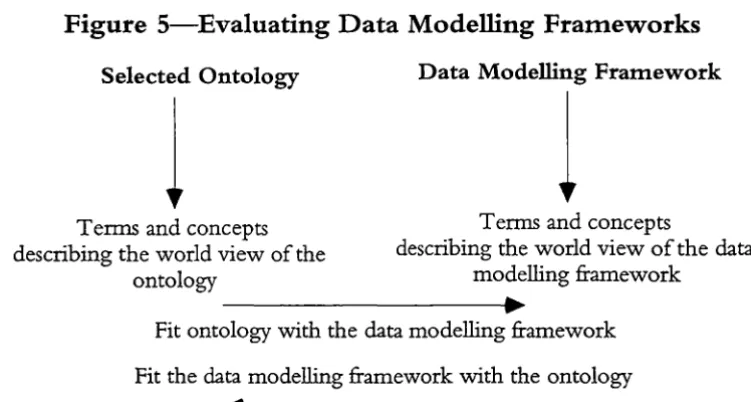
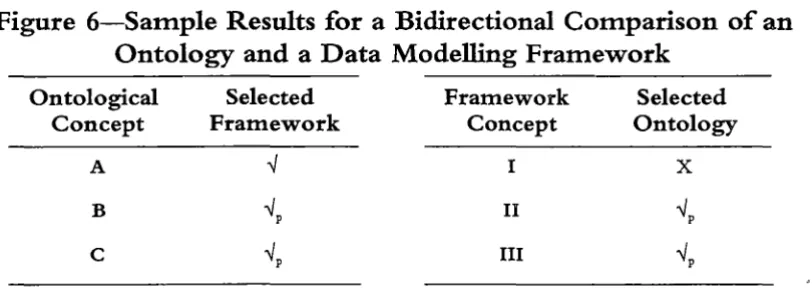
Secondly, we can perform an ontological evaluation of a specific data modelling framework, and examine the similarities and differences between the world view as embodied in a data modelling framework and the world view as described by an ontology. In the evaluation we examine questions relating to the presence of concepts in data modelling frameworks that are absent from the ontology, and examine questions relating to the presence of concepts in the ontology that are absent in the data modelling framework. In this approach we extract a complete set of terms and concepts from the ontology and data modelling framework, and then examine similarities and differences between them on the basis of concepts. Of interest are the areas of agreement and difference between the concepts of the two. Differences, in particular, are analysed in order to more deeply understand them and to suggest parts of a data modelling framework requiring extension in order that it more closely relates to concepts from the ontology.
extensions are likely to be made. Additionally, issues raised from exammmg the ontology with respect to widely used data modelling frameworks can be verified against a user community drawn from an industrial setting.
We examine the methods in greater detail in Chapter 3 where we develop the ideas outlined here and describe the methods, the results for which are then presented in chapters 6, 7, and 8. It is critical when presenting methods to also discuss the analysis of results from applying the methods. As we introduce the methods we also introduce the mechanisms that we use to analyse the results we obtain.
The selection of an ontology for the methods we describe in this thesis is critical for several reasons. Firstly, there is a multitude of ontologies, and each ontology has its own philosophical background that reflects the outlook of the author of the ontology and in turn will indicate its usefulness for certain tasks that we envisage. Secondly, not all ontologies will be suited to work with data modelling frameworks through the sorts of terms they use and categories that they determine. Thirdly, few ontologies deal with both dynamic and static terms describing reality. We consider past use of ontologies in information systems in Chapter 2 and discuss the criteria used in this thesis for a pragmatic selection of an ontology for the thesis in Chapter 4 where we also describe the selected ontology.
There are two research questions in which we are interested for this study. Firstly, we seek to establish the suitability of the selected ontology as a unifying framework. This can only be achieved by using the ontology in the ways that we've outlined and then analysing our experience. Secondly, we would like to know what ontology is implicit in the data modelling frameworks that we study.
Consequently, we examine the following research questions:
• How suitable is a specific ontology as a unifying framework for data modelling frameworks?
• Is this specific ontology tacit in data modelling frameworks?
1 ·4 Research Method
In any research there needs to be a clear research philosophy that logically leads to the methods applied and to the nature of knowledge that is gained from the experience of applying the methods. Also, an approach must be clearly shown so that others can follow a similar path should they so wish, and so that others can understand the approach based upon the premises.
There are three aspects to our study:
• The methods themselves that we use as a first step towards finding a unifying framework.
• The selection of the ontology for the study.
An ontology is used in this research to study a number of representative data modelling frameworks. We propose two methods that are qualitative and that we use to analyse and compare a number of data modelling frameworks and an ontology through the meaning of terms from the ontology and the data modelling frameworks. The two analytical comparative methods are described in detail in Chapter 3 and use 'concepts' (Kim and Sosa, 1995) that embody terms as a basis for comparison of an ontology and data modelling frameworks. Concepts are a way of thinking about terms from the ontology and from the data modelling frameworks. Some terms are complex, and for a complex term, its associated concept may be made up of a number of parts, and it is through the various parts that terms are given their fullest meaning. We utilise Umberto Eco's semiotic theory (Eco, 1976) to analyse and discuss our results.
The analytical methods we use explore the similarities and differences between concepts in the ontology and those in the data modelling frameworks. We recognise, and will cover in our critical analysis of the methods in Chapter 9, that replication of methods based on these ideas are likely to produce (we would hope small) differences in results. This is due to the philosophical and qualitative nature of this study, where we analyse and evaluate data modelling frameworks using concepts from an ontology with the aim of comparing world views.
Secondly, we propose a set of pragmatic criteria that we then use to select an ontology. That is, we select an ontology based upon the purpose to which it will be put, and consequently, the selected ontology must be able to fulfil the pragmatic criteria. We discuss this in detail in the first section of Chapter 4. An alternative approach is to nominate the ontology to be used.
Finally, we need to describe the way in which we expect to acquire knowledge or make discoveries through application of methods in this thesis. We expect to gain insight into five groups of subject. Firstly, we expect to gain knowledge about the use of ontology as a unifying framework and its use in the methods we apply. Secondly, we can conclude insights, based upon the selected ontology, into the specific data modelling frameworks we examine. Thirdly, we can form propositions, that require farther investigation, concerning the way that modelling could be handled in practice by analysts in information systems modelling and representation. Fourthly, we can draw limited generalisations about central concepts that a modelling framework must have that are expressed in various terms found in the modelling framework. Lastly, we may be able to draw conclusions about the ontology that are implied in the data modelling frameworks studied.
In all of the categories we take the position that, given the subjects of our methods, and the fact that little is known about our approach, all findings are made in an a posteriori fashion and according to the epistemology of empiricism (Dancy and
This thesis is original in that we propose and develop the idea of ontology as a meta-theory or unifying framework for arguing about data modelling frameworks. In particular the thesis is original in the following ways. Firstly, the methods comparing an ontology with a number of data modelling frameworks are new because, to our knowledge, for the first time we propose and apply methods that recognise the qualitative nature of terms and concepts in an ontology and in data modelling frameworks, and that uses this trait in their procedure. Secondly, the ontology used in this thesis has not been used in published ontological studies in information systems more generally, or in published ontological studies of data modelling frameworks particularly. Thirdly, we claim through experience and argument that the ontology used in this thesis is suitable to be developed as a unifying framework for data modelling frameworks. Finally, there are a number of specific findings that emerge from our specific results that are outlined in the results chapters and in our conclusions.
1·5 Thesis Outline
In Chapter 2 we place our thesis in the context of ontology and of data modelling frameworks, and we define terms such as 'ontology' and 'data modelling framework'. We examine research that is related to our research goals, and discuss where our research fits with respect to these.
We proceed in Chapter 3 to describe in detail the methods that we use to investigate our research questions. We more formally define 'concept', the relationship between 'term' and 'concept', and how these relate to the world view embodied by a data modelling framework or an ontology.
In Chapter 4, we outline the pragmatics of selecting an ontology. That is, we select an ontology based on some criteria that in tum are based on how we intend to use the ontology, and we examine its philosophical heritage to ensure that it is appropriate for our work before describing the selected ontology in detail.
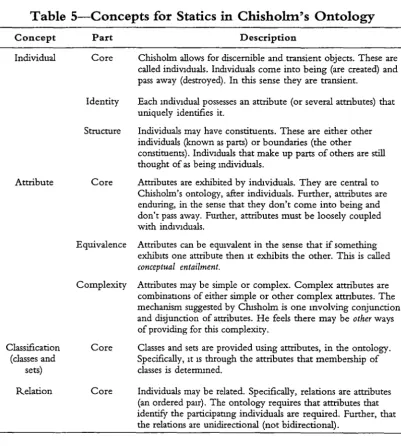
Chapter 5 contains a description of the data modelling frameworks that we use in this thesis. We are using the entity-relationship modelling framework, the functional data model, the semantic data model, NIAM, and OMT's object model. For each data modelling framework and for the selected ontology we go further and describe significant strengths, and weaknesses and list key terms with associated concepts and meaning that result from our analysis of them. As discussed these concepts are used in the methods we propose and so are useful to describe.
of OMT in that chapter, thus re-emphasising the fact that dynamics is not of primary focus in the thesis.
CHAPTER
2
Background Literature
IN THIS CHAPTER we discuss the literature that is relevant for our study and its
relationship with our goals. We begin by defining 'ontology' and by discussing work using ontology in information systems and related areas, and how this work relates to our research goals. In describing uses of ontology we outline a specific class of ontologies in which we are interested, and we differentiate between ontologies of the nature we desire and those that are for specific problem domains and various business applications. The latter group is most popular in artificial intelligence and may be called 'domain specific' ontologies.
In Section 2·2 we examine previous research which surveys, compares, categorises, and rationalises about data modelling frameworks. We also define the term 'data modelling framework' and specify the classes of data modelling frameworks under study in this thesis and list the specific data modelling frameworks we examine. The selected data modelling frameworks are described in detail in Chapter 5. The particular methods that are used to study the selected ontology with the chosen data modelling frameworks are described in Chapter 3.
2·1 Ontology
Ontology is the study of world views. It is the study of 'what there is.' Within the field of Ontology, an ontology written by a philosopher can be described ...
". . . as a particular system of categories accounting for a certain vision of the world. As such, this system does not depend upon a particular language:
Aristotle's ontology is always the same, independently of the language used to describe it." (Guarino, 1998)
"Metaphysics, most generally, the philosophical investigation of the nature, constitution, and structure of reality. It is broader in scope than science. e.g., physics and even cosmology (the science of the nature, structure, and origin of the universe as a whole), since one of its traditional concerns is the existence of non-physical entities, eg., God." (Audi, 1995)
Ontology is an important part of metaphysics. We can expand upon this by examining another aspect of ontology that is more specific to our particular needs. In these extracts, entity refers to anything that is, and has a meaning different from that in information systems.
"[Ontology is t]he study of being in so far as this is shared in common by all entities, both material and immaterial. It deals with the most general properties of beings in all their different varieties" (Kim and Sosa, 1995)
"Metaphysics can also be understood in a more definite sense, suggested by Aristotle's notion (in his Metaphysics, the title of which was given by an early
editor of his works, not by Aristotle himself) of "first philosophy," namely, the study of being qua being, i.e. of the most general and necessary characteristics
anything must have in order to count as being an entity (ens). Sometimes
'ontology' is used in this sense, but this is by no means common practice, 'ontology' being often used as a synonym for metaphysics" (Audi, 1995)
For our purposes, we find the following definition most helpful:
Definition 2·1-0ntology
"Ontology, understood as a branch of metaphysics, is the science of being in general, embracing such issues as the nature of existence and the categorial structure of reality .... Different systems of ontology propose alternative categorial schemes. A categorial scheme typically exhibits a hierarchical structure, with 'being' or 'entity' as the topmost category, embracing everything that exists." (Honderich, 1995)
Essentially, this is in alignment with our research goals, because ontology of this nature represents an independent theory through which the building blocks of reality are described. From here on, we use the word 'ontology' in this sense. Later in the thesis, we select an ontology of this type and nature, based upon pragmatic criteria.
In contrast, artificial intelligence (AI) researchers (Vet and Mars, 1998, Vickery, 1997) use ontology in a different but related way. Guarino goes on to explain that:
"[o]n the other hand, in its most prevalent use in AI, an ontology refers to an engineering artifact, constituted by a specific vocabulary used to describe a
certain reality, plus a set of explicit assumptions regarding the intended meaning of
the vocabulary words." (Guarino, 1998)
We call this type of ontology a domain-specific ontology. For example, economics,
or plant taxonomy each has its own categories of terms and intended meaning for terms
To help clarify the distinction between the two interpretations of ontology that he defines, Guarino continues by saying:
"[t]he two readings of 'ontology' ... are indeed related [to] each other, but in order to solve the terminological impasse we need to choose one of them, inventing another name for the other: we shall adopt the AI reading, using the word conceptualization to refer to the philosophical reading. Specifically, two
ontologies can be different in the vocabulary used (using English or Italian words, for instance) while sharing the same conceptualization." (sic) (Guarino,
1998)
We, in contrast, take an alternative approach and maintain the term 'ontology' for the former use. However, we do take note of the distinct uses of the word. The term 'conceptualization' is not recognised in this sense in philosophy. Conceptualism is a specific philosophical stance with associated issues and definitions. Conceptualisation, in contrast, and as mentioned in the quotation, is a term coined by the AI community in the way described above. Nevertheless, we note the problems with using the term, and continue.
The problem thus turns to defining what is meant by a conceptualisation. Informally, a conceptualisation is an intentional definition of what there is, as opposed to describing a specific state of affairs. A state of affairs may be described using terms that are consistent with a particular conceptualisation. For example, a conceptualisation that is a crude object model is that the world consists of 'objects' that are described using 'properties'. One state of affairs that adheres to this conceptualisation is a model of a university constructed using this modelling framework. A second example, that adheres to this conceptualisation, is a model of the European Community governance structure and interactions (Communities, 1999), again constructed using the modelling framework outlined. We can place Guarino's discussion concerning conceptualisation in the context of data modelling frameworks by likening the AI use of ontology to a specific model constructed in a particular data modelling framework (the two examples just cited). The philosophical use of ontology is akin to the world view embodied in the data modelling framework itself (such as the very crude and partial object model also described). That is, the world view implicit in the constructs and the meaning behind the constructs of a data modelling framework.
examining the frameworks in the context of an ontology written by a philosopher, he categorises modelling frameworks according to the ontology of application in which the framework is often found to be of use.
The categorisation used by Mylopoulos is general, but is constructed in a manner that does not take into account any categorisation from the philosophical study of onfology, and more generally it neither provides nor suggests a unifying framework for data modelling frameworks. Nevertheless, it is a recognition that there is an ontology implied by every data modelling framework. It is for this reason that it is important for us in that it generally supports our approach to data modelling frameworks in that we say that each framework possess an ontology. Mylopoulos' categorisation is a more useful categorisation of data modelling frameworks than has been constructed to date (Peckham and Maryanski, 1988), because of the fact that it recognises that each data modelling framework possesses an ontology. However, it begs the question of the origin of each ontology, and consequently it suggests that searching philosophy for relevant ontologies might be fruitful. Our research differs in that we seek a unifying framework for data modelling frameworks based on an ontology selected from philosophy, a mature intellectual endeavour that can yield an independent theory which could prove useful as a unifying :framework.
Others in information systems have applied ontology using material explicitly from philosophy. Work commenced by Yair Wand and Ron Weber (Wand and Weber, 1989) is the most relevant example for the purposes of our research goals. In order to remind us of our objectives before considering their research in more detail, we restate our research goals and how they relate to ontology.
We intend to use an ontology as a unifying framework that suggests unifying principles for the design of data modelling frameworks. This means we are not interested in ontologies for individual problem domains like those in artificial intelligence, because data modelling frameworks are used to create models of reality for a great many problem domains or business applications. Instead, we are interested in ontologies as understood by philosophers. Ontologies establish the terms from which a description of reality can be built, and this characteristic is ideal for our purposes because we seek the unification data modelling :frameworks that are used in a similar way. We intend to do this by comparing the world view found in specific data modelling :frameworks with the world view embodied by a selected ontology. We expect to achieve this by comparing the terms used in data modelling :frameworks with the terms used in an ontology.
We need to take into account two issues when considering the work by Y air Wand and Ron Weber and associated research in the context of our goals. We must discuss their research goals and methods used in their research, and how they relate to our objectives. We must also consider their choice of ontology and the ways in which the ontology has been used in their research.
analyse modelling methods (Wand, 1996, Rohde, 1995, Wand et al., 1995, Wand and Weber, 1993, Wand and Weber, 1990, Wand and Weber, 1989, Green, 1996),
discussed application of ontology to conceptual modelling (Wand and Weber, 1993,
Wand et al., 1995, Wand, 1996), and interpreted specific semantic data models (data modelling frameworks, as we would call them) in the light of their selected (and modified) ontology (Wand, 1989, Weber and Zhang, 1996, Wand, 1996, Wand et al.,
1995, Wand and Woo, 1993, Wand et al., 1993), including object models (Wand,
1989, Wand and Woo, 1993, Parsons and Wand, 1993). We discuss each of these areas of research in the following subsections. We conclude the discussion by examining, in more detail the ontology used by Wand and Weber and associated researchers. In the examination, we contrast that ontology with our objectives and outline our selection method.
Their research is motivated by a desire to better understand the process of analysing, designing, and implementing information systems, and so develop a theory that can be used as a basis for much of information systems analysis and design. It is for this reason they select an ontology that is described as a systems ontology, and are keen to integrate the various aspects of information systems analysis, design and implementation.
Ontological Studies
of
Systems Analysis and Design Methodologies
The main focus of the work by Wand and Weber is on systems analysis and design methodologies (Wand, 1989, Wand et al., 1995). They note, that despite the plethora of design methodologies, there does not exist a general theoretical foundation for tools and techniques used in systems analysis and design, and they state that a comparison of the many techniques is not possible without a unifying theory. Without such a theory, they say, it is also impossible to establish rules by which design of systems can proceed. It is for these reasons that Wand and Weber began to seek a "common paradigm" (Wand, 1989) for systems analysis and design.
Wand and Weber use a systems ontology to assess the modelling power of various methodologies in terms of a set of constructs based on an ontology, and the completeness of a constructed model can be assessed. We expand on these concepts below.
Wand and Weber argue "that systems analysis and design methods can be characterized in terms of
1) the origin of the modelling constructs used in the methodology; and
2) how the methodology deals with structure and behaviour." (Wand, 1989)
reality driven. Secondly, it is recognised that models of both statics and dynamics are required.
Upon identifying a need for a general theory for analysis and design, Wand and Weber propose that it is useful to use the same constructs for both domains, and that ontology is a useful place from which to get such a set of constructs. In their work, they analyse methods for strengths, weaknesses, and completeness of system description "in terms of an ontologically-based common set of constructs" (Wand, 1989). We pause to point out that we too desire to regularise the things used to construct models so that both domains can be satisfied, and we are encouraged by their use of ontology for the purpose.
In the view of Wand and Weber (Wand, 1989), an analysis and design process creates an information system design that can be implemented. An information system is a human-centred creation of a real-world system as perceived by somebody, and built to deal with information processing functions in organisations. The process of constructing an information system is a transformation from human perceptions to an artifact representing these perceptions. This process involves three transformations. Firstly,
analysis that creates, from human perceptions, a model of (perceived) reality. Secondly, design that transforms a model of reality to a model of the information system. Thirdly, implementation that transforms a model of an information system to an implemented artifact. It is in the first transformation that work by Wand and Weber has implications for our work, that is, the part dealing with the creation of a model of (perceived) reality. Much of their work deals with this first part of the process of analysis and design.
Their early work into the first aspect of analysis and design (Wand, 1989) resulted in an informal comparison between tools and the ontology, together with a categorisation of the domain in which the studied tools reside. The domain is categorised as being either information system, or real world. This informal comparison later progressed to be a more formalised (Wand and Weber, 1993) understanding of the representational clarity with which a model of reality is created from human perceptions using a specific tool. In this, they examine the grammars that information systems analysis and design methods provide to describe aspects of the real world. A grammar in this context "generates a language, which is a set of strings over some alphabet .... In these grammars, sentences provide a graphical representation of some real-world phenomena" (Wand and Weber, 1993). Further, two mappings between the ontological constructs and the tool can be described. Firstly, a representation mapping, from a grammar representing the ontology (or real-world view) to the grammar representing the tool from analysis and design method (or model of reality) can be described. Secondly, an interpretation mapping from the tool's grammar to the ontology (or real-world view). One can then analyse each of the mappings to describe the quality of the representation and interpretation quality of the models that the analysis and design tool is likely to produce. Figure 1 shows the two mappings.
These mappings can be used to define terms to specify how well constructs from each map into the other. There is the idea of ontological expressiveness (Wand,
Figure 1-0ntology and Systems Analysis and Design
Grammars: Representation and Interpretation Mapping
(Wand and Weber, 1993, Wand, 1996)
representation mapping
interpretation mapping
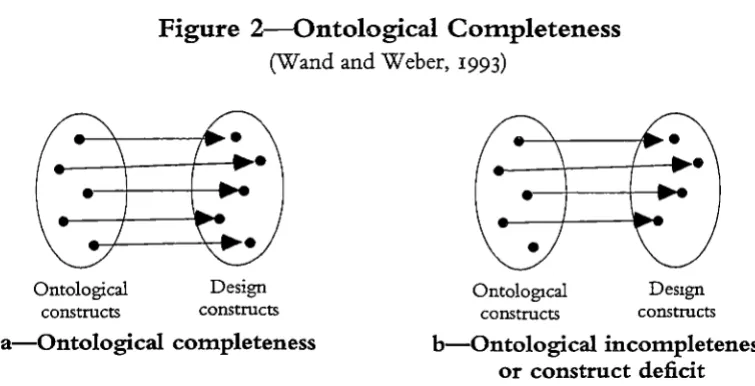
Firstly, ontological completeness is where a grammar from the analysis tool perfectly
represents concepts from the grammar of the ontology. This is shown in Figure 2 a, and is where all constructs of the ontology grammar are mapped to constructs of the analysis and design grammar. In contrast, ontological incompleteness, also known as
construct deficit is where a construct from the ontology grammar has no construct into which it maps. This is depicted in Figure 2b.
Figure 2-0ntological Completeness
(Wand and Weber, 1993)
.,--+---+----•
Ontological constructs
Design constructs
a-Ontological completeness
Ontological constructs
Design constructs
b-Ontological incompleteness or construct deficit
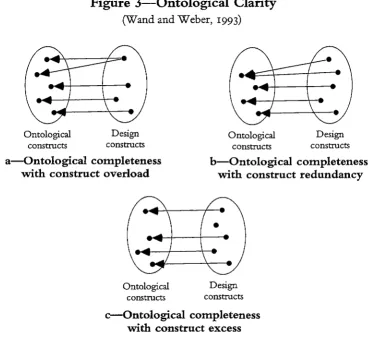
Secondly, ontological clarity concerns the quality of the interpretation mapping.
These are construct overload (Figure 3 a), construct redundancy (Figure 3 b), and construct excess (Figure 3 c). Construct overload is where several ontological constructs are
mapped onto the single construct in the grammar. Construct redundancy is where several constructs from the tool's grammar map onto a single construct from the ontology's grammar. Construct excess occurs when the tool's grammar has a surplus of constructs with respect to the ontology's grammar. In other words, this is where, for a construct from the tool's grammar, there cannot be found an equivalent in constructs of the ontology's grammar. As referred to above, Figure 3a-c shows the various concepts associated with ontological clarity.
[image:26.569.115.493.363.556.2]they achieve the same measure of ontological completeness and clarity. That is, with respect to an ontology, each has the same measures of completeness and clarity. Wand and Weber make it clear (and this seems reasonable) that if the grammar's ontological clarity is deficient in some way, then the grammar must be modified to create, effectively, a new grammar. Further, they make the point that "a grammar that appears to be ontologically incomplete, may achieve completeness through being extensible. If a grammar is extensible, constructs in the grammar can be combined via production rules to form other constructs." (Wand and Weber, 1993)
[image:27.570.127.495.238.579.2]Ontological constructs
Figure 3-0ntological Clarity
(Wand and Weber, 1993)Design
constructs Ontological constructs
Design constructs
a-Ontological completeness with construct overload
b-Ontological completeness with construct redundancy
Ontological constructs
•
Design constructs
c-Ontological completeness with construct excess
precise and defined mathematically. It is debatable whether formalisation really gains us anything in the context of a semantic comparison that we desire. It also requires that the modelling tool under investigation similarly be precisely defined. Formalising the tool in a grammar may compromise the meaning attached to parts of the tool and the meaning of constructs and concepts may be restricted by the formalising process. Our research differs from this in that we use the world view of the tools (in our case the data modelling frameworks) and compare this with the world view as encapsulated in an ontology. Given that the data modelling tools are imprecise and at best are semi-formal, a more pragmatic and qualitative comparison of world views is required than has been provided by this previous work.
Conceptual Modelling and Ontology
A more recent effort in an area related to modelling tools, is the work by Yair Wand and others concerning potential theoretical foundations for conceptual modelling in information systems development (Wand et al., 1995, Wand, 1996). One of the three foundations, as outlined in this work, is ontology. They argue that ontology, concept theory, and speech act theory all are potentially theoretical bases for conceptual modelling. Each is considered in tum in their work. Our interest is in their commentary on the use of ontology in this context because conceptual modelling is directly relevant with respect to the use of data modelling frameworks (or data models) and so is directly relevant to our work.
Conceptual modelling, according to work cited by Y air Wand and associates, is variously described as "a formal description of some aspects of the physical or social reality for the purpose of understanding and communicating" (Wand et al., l 99 5 ), or "an abstract model of the enterprise" (Wand et al., 1995). "A conceptual model should reflect knowledge about the application domain rather than about the implementation of the information system" (Wand et al., 1995). Clearly, from this, it is the construction of a model of an application domain that is critical. The implementation from the constructed models is not of interest to us here.
An important aspect of their 1995 paper (Wand et al., 1995) is that it considers a critical question with respect to conceptual modelling languages:
" ... how does one go about defining an 'appropriate' conceptual modelling language? The power of a modelling language lies in the semantics of its constructs. The semantics defines what individual constructs and their combinations 'stand for' in the modelled domain." (Wand et al., 1995)
which deals with the order and structure of reality"
011
and et al., l 99 5) . Once again,there is agreement with the approach of using ontology to examine what is needed to model reality. We need to consider their experiences, and address any issues they felt to be important. Our research must also complement their experiences, or it should extend their research for specific purposes.
The researchers mention three specific limitations of using ontology in the way envisaged C:Wand et al., 1995). We paraphrase them here. Firstly, there is no ontology that is generally accepted. Secondly, that ontological models seem to assume an objective reality, while the world is only known through human perceptions. Thirdly, the specific model selected by Wand and his colleagues does not deal with the organisational and behavioural aspects of information systems.
In analysing these criticisms, several things can be said. Firstly, there is no measure of absolute 'goodness' of ontologies. It is therefore important to fully justify the appropriateness of using a particular ontology for a specific purpose. Further, each ontology has a heritage that shows its attitude to how reality is perceived. The ontology selected by Wand and Weber is a scientific ontology (Bunge, 1977). In this thesis, we choose an ontology different fromBunge's andjustify that choice pragmatically. Conceptual modelling concerns modelling reality, and as such a unification of the world view of a data modelling framework with that from an ontology seems a useful goal. This differs from the approaches taken by Wand and Weber in that they have not studied ontology from the aspect of data modelling frameworks generally. Finally, if a consideration is taken to the philosophical heritage of an ontology, the second criticism from the paragraph above may also be ameliorated. This is because depending upon the philosophical heritage that its author holds to be true, an ontology may allow for a less 'objective' view of 'what there is'.
We believe that ontology is useful for our goals because it is independent of technology, the language contemplated, and is a mature field of study. The work by Y air Wand and associates supports our view and they have found ontology useful for related work.
Ontological Studies
of
Semantic Data and Object Models
Wand and Weber have studied data modelling frameworks in more depth than has been discussed above. They have examined relationships as used ER modelling (Chen, 1976, Wand et al., 1993). They have also examined the modelling methodology called NIAM (Nijssen and Halpin, 1989, Weber and Zhang, 1996), and explored a theoretical basis for object modelling frameworks C:Wand and Woo, 1993, Wand, 1989). Further, they have considered in more depth the concept of class in object modelling frameworks (Parsons and Wand, 1993). The consideration of object modelling techniques and frameworks comes from criticism that object modelling lacks a theoretical basis (Li, l 99 l) .
construct, and assistance is formulated, in the form of guidelines for practitioners wishing to better use relationships in projects, indicating when and where to use relationship as opposed to other elements of the ER modelling tool. The ontology does not have an element that corresponds to relationship. Instead, it is argued that a relationship is really one of two things. Firstly, it may represent a shared property between two entities. Secondly, it may represent a part-whole relationship between entities (otherwise known as aggregation or composition). This differs from our own research in that it studies a very specific element of a particular data modelling framework. Nevertheless, it provides more support for recognising distinct world views that are contained in the terms defined in ontologies and data modelling frameworks, and it also recognises that there is a level deeper than structure at which comparison may take place. To contrast with our work, we are attempting to use ontology as a unifying framework that can be applied in comparing and evaluating data modelling frameworks. Their work supports the combination of ontology and data modelling frameworks, indicated by comments such as "we believe the work demonstrates potential benefits of applying concepts from ontology to database design" (Wand et al., 1993). This would obviously flow through to considering ontology as a possible unifying framework between the reasonably large number of data modelling frameworks being used today.
More recently, Bunge's ontology has been used to evaluate NIAM (Weber and Zhang, l 996). In this research the comparison is in the form of grammatical comparison
in a way similar to work reported in the preceding subsections (Wand and Weber, 1989, Wand and Weber, 1993, Wand, 1996), that is, in comparing structural elements from the ontology and from the selected modelling tool used in either conceptual modelling or systems analysis and design. Further, the deeper analysis of the semantic rather than structural differences and similarities is absent. There is no recognition of the implied world view of the data modelling framework and how it differs from or is similar to the world view as represented in the ontology. This is alluded to in the concluding remarks:
"[i]mplicit in our prediction is a 'naive' theory of semantics that attributes clearer meaning to one-to-one mappings between ontological constructs and grammatical constructs." (Weber and Zhang, 1996)
In this context, a construct is an element of the grammar representing the modelling tool (in this instance NIAM). This shortcoming is addressed in our approach, and we endeavour to compare the similarities and differences in world view as represented by the ontology and a modelling framework using concepts. The world view of a modelling framework or an ontology is in the language that is used to define or describe constructs (or what we call terms) of each. It is therefore through the concepts giving meaning to terms that the world view of modelling frameworks and ontologies can be compared or related at the semantic level.
entity-attribute-relationship (Griethuysen, 1982) style of modelling framework, or utilise tools that are not 'object oriented'. Additionally, there are divergent approaches to object modelling in the database systems community, the programming community, and the object systems community. Part of the early work by Wand and others has been in establishing a "formal model for objects" through ontology. This is closest to our objectives, in the sense that it is a unifying theory for object models (Wand, 1989, Takagaki and Wand, 1991). Further, related work concerns the formulation of rules or guidelines to aid the construction of object models (Wand and Woo, 1993). Three things can be said about this work in relation to our objectives. Firstly, since the formalisms and the analysis come from a specific ontology, namely Bunge's adapted ontology, we do not discuss the formalisms per se since a comparison of specific ontologies is beyond the
scope of the thesis. However, there is a detailed discussion for our reflections later in the thesis where we relate our experiences with object modelling and the ontology selected for our work. Our objectives also lie with data modelling frameworks beyond object data models (semantic data modelling :frameworks). However, we gain support, through their work, for using ontology in the work we are undertaking. Thirdly, in the next sub-section, we discuss the ontology used by Wand and Weber and subsequently by related researchers, and briefly discuss our method for selecting an ontology.
The Ontology Used in Past Studies (Bunge' s Ontology)
Wand and Weber, in their work (and in work by others), have adapted an ontology by Mario Bunge (Bunge, 1977). Conceived and written during the late 1960s and l97os, Bunge's ontology is exact, scientific, and well developed. In this work, Bunge is motivated to make more exact the ontological and metaphysical aspects of science. Part of his research during that decade or so is his ontology, which is a complete theory to encompass physical (or concrete) reality.
Reported in two volumes (Bunge, 1977, Bunge, 1979), the ontology is mathematically rigorous and highly formalised. In motivating his work, Bunge cites as a critical factor his dislike for most of the metaphysical work to that date, and he describes certain schools of philosophy in derisory terms. He keenly seeks an ontology that, once and for all, sets aside 'woolly polemics' and utilises formal tools and scientific principles in setting out 'what there is' in reality. By way of introduction, Bunge presents an essay (pp. 1-25 in Volume I) on what he sees as the key misconceptions that abound in metaphysics and where 'scientific ontology' can correct them. In the essay he betrays a keen objection to anything that is not 'physical' or part of the 'concrete world'. Only 'objects [that] can be studied scientifically' should be included in any theory about metaphysics.
in the thesis.
No ontology can claim to be the 'best' or even a 'good' one. It is therefore critical to select an ontology that suits one's needs. Wand and Weber have done that, citing several reasons for selecting Bunge's ontology. Bunge's ontology is comprehensive, well-formalised, and refers extensively to previous work in ontology (and philosophy of science). Further, Bunge's ontology is based on systems. It is also described by Bunge as being a scientific ontology that does not indulge in endless debate over esoteric issues and limits itself to concrete or physical modelling, and it also holds firmly that reality is determined by tight and formalised theory.
The requirement that the ontology be system based is not really of importance, because all of reality can be characterised as systems. For this reason, one could describe the systems to which Bunge's ontology is applied using many ontologies. Again, the fact that the ontology is formalised is not of particular importance. Formalisation helps us in situations where all the subjects of research are formalised using the same axioms or bases. In this research some of the subjects are semi-formal or appear formalised, but are in fact so in a superficial or contrived way, and the formalisation present does not progress beyond the structural level. Finally, the fact that in describing an ontology a philosopher engages in debate with others in his or her field is irrelevant to our considerations. Central to our deliberations is the suitability of the ontology to the goals of our research. Whether or not an ontology, as it is presented, discusses work by other philosophers is simply a side-issue and should not become a catalyst for distraction. In fact, selecting an ontology that is dogmatic in its assertion that all things behave according to preexisting theory may be dangerous.
We are a little more relaxed with our requirements than Wand and Weber, and we feel that selection should be based upon fitness for purpose. We are seeking a unifying framework for data modelling frameworks. It therefore makes sense that the selected ontology discuss items that are similar to those present in most data modelling frameworks. Further, we do not feel that it is essential to select a systems based ontology. We are keen to seek unification of data modelling frameworks, and these being semi-formal tools, it is therefore reasonable to widen the selection of ontology from those that are formalised to those that are less formal. We also seek to investigate ontologies that concern more than simply physical reality. This contrasts with Bunge:
" ... we maintain that the ontologist should stake out the main traits of the real world as known through science, and that he should proceed in a clear and systematic way. He should recognize, analyse and interrelate those concepts enabling him to produce a unified picture of reality."
Essentially, Bunge desires a unifying theory that brings together theories of the physical world as known through contemporary science. Moreover, his understanding of metaphysics is completely divorced from the more arbitrary nature of human existence.