
by
"r "s
c ' '
Stephen F.Foley
B.Sc. (Southampton)
M.Sc. (Memorial University of Newfoundland)
Submitted in fulfilment of the requirements for the degree of
Doctor of Philosophy
)
/ University of Tasmania
1-
This thesis embodies the major results of my research in the Geology Department, University of Tasmania between 1982 and 1986. It consists of five major articles and two minor articles [included as appendices] which have been prepared for--publication in the following international- journals or conference proceedings:
Part Status
Earth Sci Rev I in press
Tschermaks Min Petr Mitt II published
Contrib Mineral Petrol III published
Contrib Mineral Petrol IV in press
Proc Fourth Internat Kim Conf V submitted Geochim Cosmochim Acta App.III in prep. American Mineralogist App.IV published
These have been modifed only slightly for inclusion in this thesis to avoid excessive repetition.
Many of these papers have co-authors as listed in the table of contents. For the articles included as major parts, the work is
predominantly my own: the contributions of co-authors are indicated in the acknowledgements [pages vi-vii).
The thesis contains no material which has been accepted or submitted for the award of any other degree or diploma in any university and, to the best of my knowledge and belief, contains no copy or paraphrase of
material previously published or written by another person, except where due reference is made.
Stephen F. Foley
THESIS CONTENTS
Section Page
Statement
Acknowledgements vi
List of tables viii
List of figures ix
Abstract xii
PART I : The ultrapotassic rocks : characteristics, classification, and constraints for petrogenetic models.
[S.F.Foley, G.Venturelli, D.H.Green and L.Toscanh]
1.1 Introduction 1
1.2 Rationale for classifications 2
1.3 Ultrapotassic rock data 3
1.4 Ultrapotassic rock classification 4
1.4.1 Major elements
1.4.1.1 Group I 9
1.4.1.2 Group II 10
1.4.1.3 Group III 18
1.4.1.4 Group IV 18
1.4.2 Geological setting 19
1.4.3 Ultramafic nodules 23
1.4.4 Trace elements . ... 25
1.4.5 Isotopes 34
1.5 Petrogenetic constraints
1.5.1 Scope 37
1.5.2 Previous models for the petrogenesis of ultrapotassic rocks
1.5.2.1 Crystal fractionation 38
1.5.2.2 Involvement of crustal material 39
1.5.2.3 Zone refining 40
1.5.2.4 Partial melting of a pre-enriched mantle source ...41 1.5.3 The origin of chemical variations in ultrapotassic rocks
1.5.3.1 Primary magmas 42
111- 1.5.3.4 Variation at the magma
1.5.3.4.1 Accessory phases 1.5.3.4.2 Volatile components 4.5.3.4.3 Pressure-temperatur 1.5.3.5 Some comments on Group 1.6 Summary and synthesis
generation stage 55
55 55
variations 57
IV rocks 57
59
PART II : The oxidation state of lamproitic magmas : an experimental study of the liquidus phases of the Gaussberg olivine leucitite with variable oxygen fugacity.
[S.F.Foley] 63
2.1 Introduction and rationale 63
2.2 Gaussberg olivine leucitite 64
2.3 Experimental methods 68
2.4 Experimental results
2.4.1 Series I 70
2.4.2 Series II 74
2.5 Comparison of spinels between basaltic and ultrapotassic rocks 78
2.6 Element partitioning 81
2.7 Application to ultrapotassic rocks 85
2.8 Summary 88
PART III : The effect of fluorine on phase relationships in the system KA1S104 - Mg2SiO4 - S102 at 28 kbar and the solution mechanism of fluorine in silicate melts.
[S.F.Foley, W.R.Taylor and D.H.Creen) 90
3.1 Introduction 90
3.2 Experimental methods 91
3.3 Results
3.3.1 Phase relationships 92
3.3.2 Mineral compositions 97
3.4 The dissolution mechanism of fluorine in silicate melts ... 104
3.4.1 Spectroscopic methods 104
3.4.2 Spectroscopic results
3.4.2.1 Basic melts 105
3.4.2.2 Silicic melts 111
iv
PART IV : The role of fluorine and oxygen fugacity in the genesis of the ultrapotassic rocks.
[S.F.Foley, W.R.Taylor and D.H.Green] 115
4.1 Introduction 115
4.2 Fluorine in ultrapotassic rocks 116
4.3 Oxygen fugacity and ultrapotassic magmas 121 4.4 A model for the Fe203/FeO ratio of an ascending
lamproitic magma 123
4.5 Genesis of ultrapotassic rocks with a range of silica contents 130 4.6 Application to other ultrapotassic rock groups 133
4.7 Summary 134
PART V : The genesis of lamproitic magmas in a reduced, fluorine-rich mantle
[S.F.Foley] 136
5.1 Introduction 136
5.2 The reduced mantle origin hypothesis for lamproites ... 138
5.3 Experimental methods 139
5.3.1 Techniques 139
5.3.2 Rock compositions 142
5.3.3 Mineral compositions 144
5.4 Experimental results 144
5.4.1 Olivine lamproite 147
5.4.2 Leucite lamproite 152
5.4.3 Experiments with variable fluid compositions ... 159
5.5 Discussion 165
5.5.1 Applicability of the experiments to lamproite
petrogenesis 165
5.5.2 Melting of mantle with input of reduced fluids ... 167 5.5.3 Survival of diamonds and lamproite-kimberlite
comparisons 170
APPENDIX 1: Ultrapotassic rock data base 173
Group I 173
Group II 202
Group II] 208
V
APPENDIX 2: Rare earth element contents of Antarctic lamproites ...260 APPENDIX 3: Experimental techniques for melting studies on rock
- compositions in the presence of reduced C-0-H fluids
[S.F.Foley and W.R.Taylor] 261
Abstract
A3.1 Introduction 261
A3.2 Theoretical C-0-H fluid compositions in a reduced mantle ... 263 A3.3 Experimental procedures for reduced fluid experiments ... 263
A3.3.1 Experimental details 266
A3.3.2 Capsule piercing technique for mass spectrometric
fluid analysis ... 267
A3.3.3 C-lW fluid test experiments 270
A3.3.4 C-lw experiments with sample 275
A3.3.5 'CWI - experiments with sample 277
A3.4 Implications of the C-lW fluid tests for melting in
the mantle ... 281
APPENDIX 4: The origin of Al-rich spinel inclusions in leucite from the leucite lamproites of Western Australia
[A.L.Jaques and S.F.Foley]
[back pocket]
Acknowledgements
I am greatly indebted to many people for discussions, instruction in techniques, and provision of information during the research for, and production of this thesis. The following deserve special acknowledgement: - Prof. David Green, my supervisor, for his advice and guidance at all
stages. His unusually rapid comprehension and assessment of new results and ideas led to many suggestions which have improved interpretation and experimental design.
- Wayne Taylor, for assistance with computing, instruction in the use and interpretation of FTIR, groundwork in the development of the
capsule-piercing technique for mass. spectrometry, development of the thermodynamic model presented in Part Iv, and many useful discussions.
- Giampiero Venturelli [Parma, Italy], for his collaboration in producing a more thorough database of ultrapotassic rocks than would otherwise have been achieved, and for discussions, criticisms and clarifications of the resulting review. Lorenzo Toscani [Parma, Italy] also assisted in database compilation.
- Lynton Jaques [Canberra, Australia] for many comments on parts of the thesis in its early stages, and for provision of large amounts of material prior to publication. His great knowledge of the West Kimberley lamproites constantly led to refinement of the aims and interpretations of my
experimental program, and contributed directly in estimation of the olivine lamproite composition used in Part V, and in the study of the Al-spinels (Appendix 4).
- Keith Harris, for the manufacture of many experimental parts, for his expertise in glasswork, and for valuable discussions on experimental design and interpretation.
- Wielaw Jablonski, Ron Berry and Ross Lincolne for maintaining a functional microprobe, including battling with a reluctant integrated wavelength/energy dispersive system.
- Noel Davies, for essential assistance in operation of the mass spectrometer and FTIR spectrometer.
- David Ellis [now A.N.IJ., Canberra], for his boundless enthusiasm for study of the Gaussberg rock in the early part of my research, and for advice and discussions on phase theory and the manipulation of
multidimensional projections.
Vii
- Tony Crawford, for discussions and unpublished information about the Spanish lamproites, and for many opinions, often unsolicited, about igneous geochemistry.
- Graerne Wheller, for his efforts in computer programming which made the production of Part I much easier, and for discussions about Indonesian volcanic rocks.
- Many colleagues in the Geology Department at Tasmania who have assisted at different stages with a variety of tasks or have helped with
clarifications through discussion: John Adam, Steve Eggins, Trevor Falloon, Ramsay Ford, Klaus Nickel, Nic Odling, Neil Ortez, Ewan Reid, Bob Tingey, Rick Varne, Margaret Wallace and Jan van Moort.
- Various correspondents who have generously supplied material before publication or samples for analytical or comparative study; John Sheraton, Barbara Scott-Smith, Alan - Edgar, Steve Bergman, Dave Nelson, Peter Nixon and Roger Mitchell.
- Visitors to Tasmania who have given valued opinions and advice; Alok Gupta, Kurt Mengel, Alan Thompson and Trevor Green.
- Other members of the Geology Department, who made for a happy and stimulating work environment.
- Many members of the Athletic Association of Tasmania for many enjoyable, relaxing hours spent at various athletics meets in Tasmania and Melbourne, and my non-geological flatmates Cameron Beech, Francis Tumeo, Veddy
Viii LIST OF TABLES
Table Page
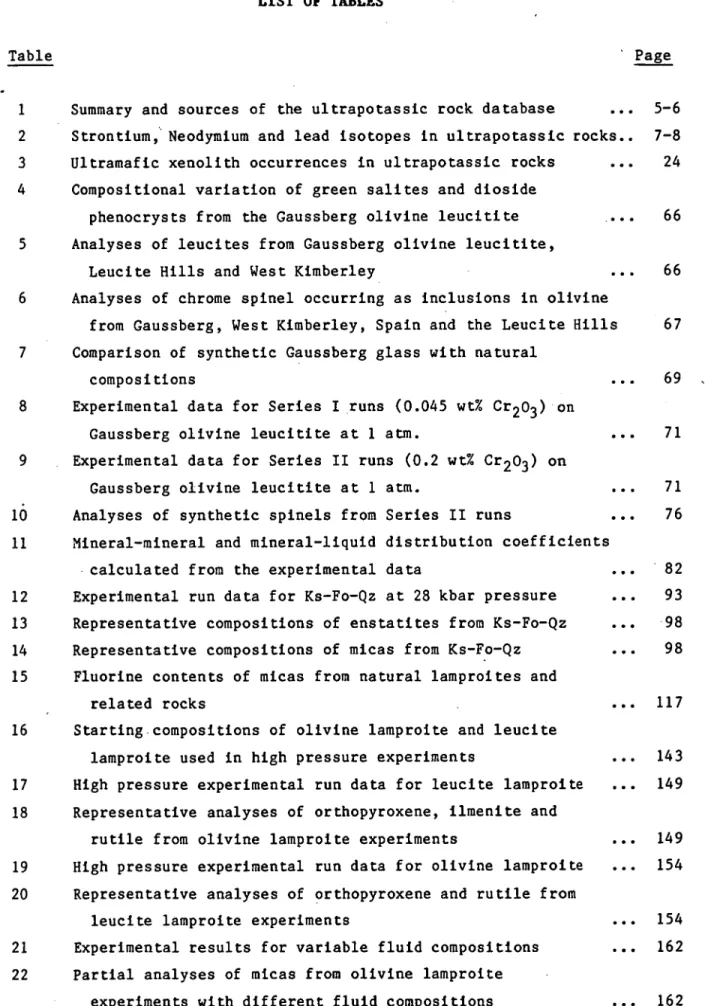
1 Summary and sources of the ultrapotassic rock database ... 5-6 2 Strontium, Neodymium and lead isotopes in ultrapotassic rocks.. 7-8 3 Ultramafic xenolith occurrences in ultrapotassic rocks ... 24 4 Compositional variation of green salites and dioside
phenocrysts from the Gaussberg olivine leucitite ... 66 5 Analyses of leucites from Gaussberg olivine leucitite,
Leucite Hills and West Kimberley ... 66
6 Analyses of chrome spinel occurring as inclusions in olivine
from Caussberg, West Kimberley, Spain and the Leucite Hills 67 7 Comparison of synthetic Caussberg glass with natural
compositions ... 69
8 Experimental data for Series I runs (0.045 wt% Cr20 3 ) on
Caussberg olivine leucitite at 1 atm. ... 71 9 Experimental data for Series II runs (0.2 wt% Cr 2 03 ) on
Gaussberg olivine leucitite at 1 atm. ... 71
là
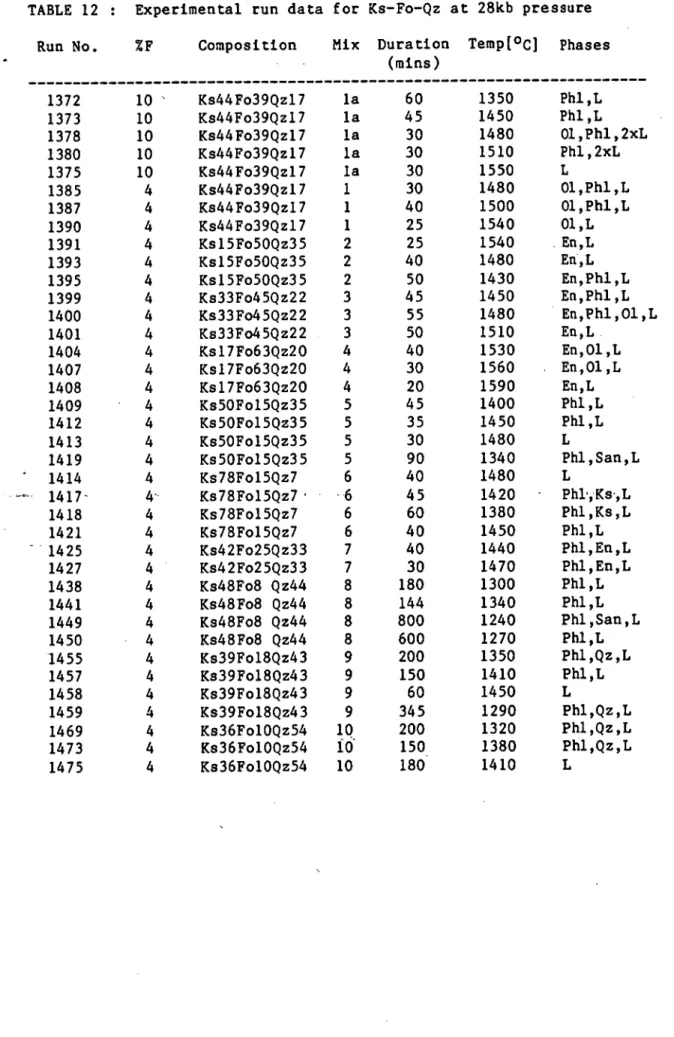
Analyses of synthetic spinels from Series II runs ... 76 11 Mineral-mineral and mineral-liquid distribution coefficientscalculated from the experimental data ... 82 12 Experimental run data for Ks-Fo-Qz at 28 kbar pressure ... 93 13 Representative compositions of enstatites from Ks-Fo-Qz ... 98 14 Representative compositions of micas from Ks-Fo-Qz ... 98 15 Fluorine contents of micas from natural lamproites and
related rocks ... 117
16 Starting.compositions of olivine lamproite and leucite
lamproite used in high pressure experiments ... 143 17 High pressure experimental run data for leucite lamproite ... 149 18 Representative analyses of orthopyroxene, ilmenite and
rutile from olivine lamproite experiments ... 149 19 High pressure experimental run data for olivine lamproite ... 154 20 Representative analyses of orthopyroxene and rutile from
leucite lamproite experiments ... 154
21 Experimental results for variable fluid compositions ... 162 22 Partial analyses of micas from olivine lamproite
LIST OF FIGURES ix
FIGURE PAGE
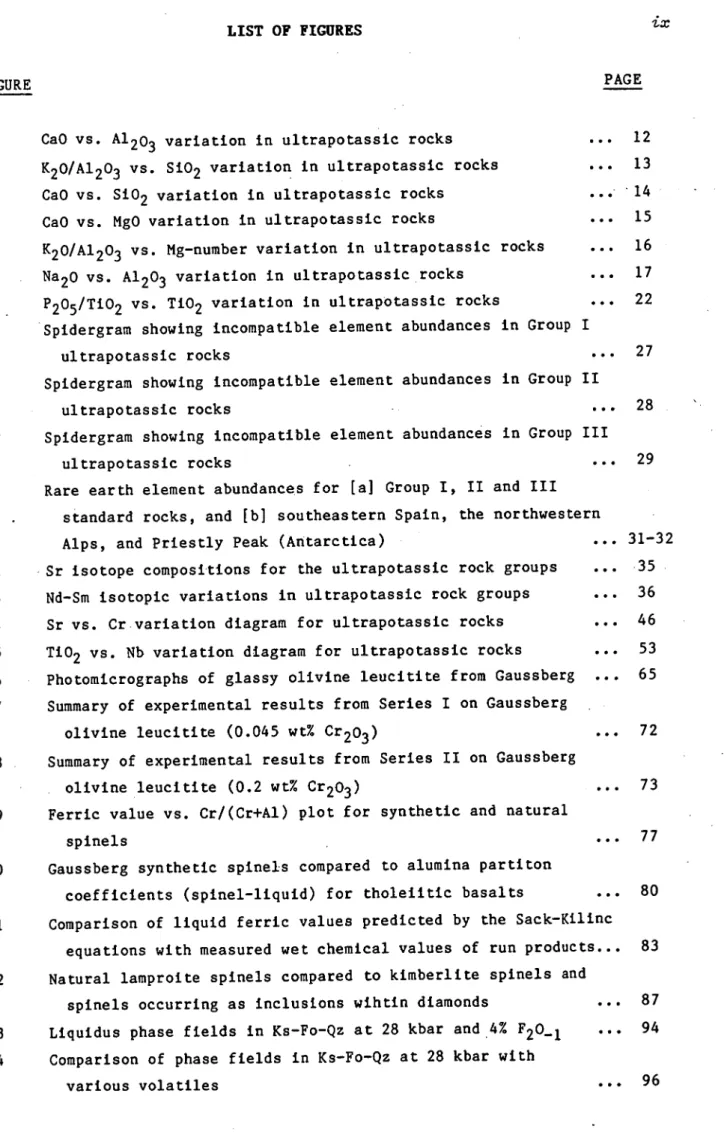
1 CaO VS. A1 2 03 variation in ultrapotassic rocks ... 12 2 K20/A1 2 03 vs. Si0 2 variation in ultrapotassic rocks ... 13 3 CaO vs. S10 2 variation in ultrapotassic rocks . . . 14 4 CaO vs. MgO variation in ultrapotassic rocks ... 15 5 K20/Al 2 03 vs. Mg-number variation in ultrapotassic rocks ... 16 6 Na 2 0 vs. A1 2 03 variation in ultrapotassic rocks ... 17 7 P205/Ti02 vs. Ti0 2 variation in ultrapotassic rocks ... 22 8 Spidergram showing incompatible element abundances in Group I
ultrapotassic rocks ... 27
9 Spidergram showing incompatible element abundances in Group II
ultrapotassic rocks ... 28
10 Spidergram showing incompatible element abundances in Group III
ultrapotassic rocks ... 29
11 Rare earth element abundances for [a] Group I, II and III standard rocks, and [b] southeastern Spain, the northwestern
Alps, and Priestly Peak (Antarctica) ... 31-32 12 Sr isotope compositions for the ultrapotassic rock groups ... 35 13 Nd-Sm isotopic variations in ultrapotassic rock groups ... 36 14 Sr vs. Crvariation diagram for ultrapotassic rocks ... 46 15 T10 2 vs. Nb variation diagram for ultrapotassic rocks ... 53 16 Photomicrographs of glassy olivine leucitite from Gaussberg ... 65 17 Summary of experimental results from Series I on Gaussberg
olivine leucitite (0.045 wt% Cr203) ... 72 18 Summary of experimental results from Series II on Gaussberg
olivine leucitite (0.2 wt% Cr203) ... 73
19 Ferric value vs. Cr/(Cr+Al) plot for synthetic and natural
spinels ... 77
20 Gaussberg synthetic spineis compared to alumina partiton
coefficients (spinel-liquid) for tholeiltic basalts ... 80 21 Comparison of liquid ferric values predicted by the Sack-Kilinc
equations with measured wet chemical values of run products... 83 22 Natural lamproite spinels compared to kimberlite spinels and
spinels occurring as inclusions wihtin diamonds ... 87 23 Liquidus phase fields in Ks-Fo-Qz at 28 kbar and 4% F 2 0_ 1 ... 94 24 Comparison of phase fields in Ks-Fo-Qz at 28 kbar with
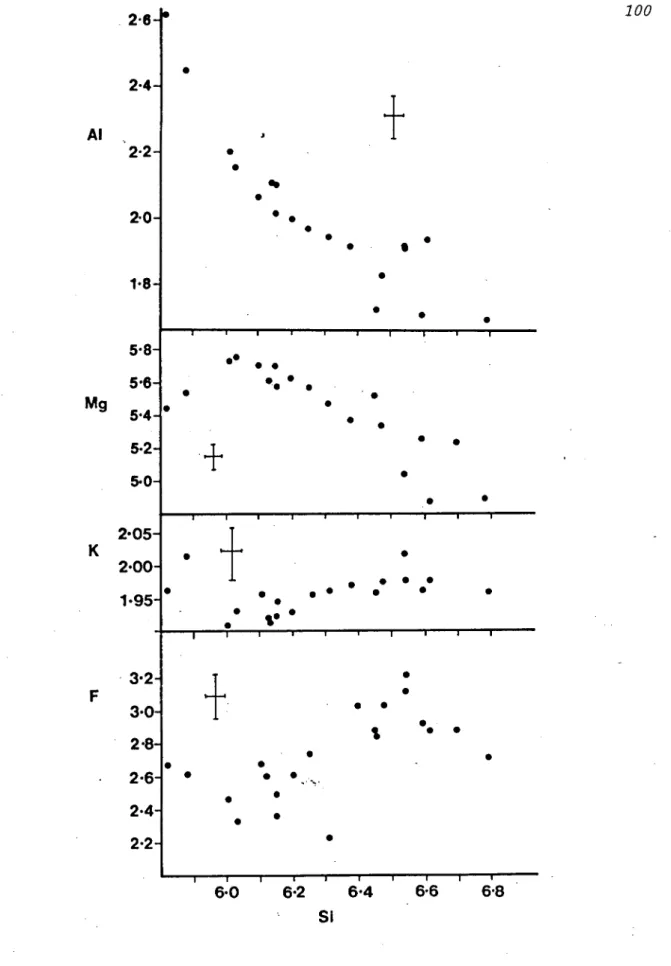
25 Compositional variation in phiogopites in Ks-Fo-Qz experiments.. 100 26 Al vs. octahedral site occupancy for phiogopites in Ks-Fo-Qz
experiments compared to natural micas and intermediate
synthetic micas ... 101
27 Compositional variation in phlogopites in Ks-Fo-Qz under
water-saturated conditions ... 103
28 Mid infrared spectra of Ks44Fo 39 Qz 17 glasses with 0, 0.3 and
0.9 wt% fluorine ... 107
29 Mid infrared difference spectra for Ks 4 4Fo 39 Qz 17 glasses
revealing the effect of fluorine on the silicate network ... 108 30 Far infrared difference spectra for Ks44F0 39 Qz 17 glasses
showing bonding of F with K, Al and Mg ... 109 31 Compositional variation in natural ultrapotassic rock micas
from Leucite Hills, Gaussberg, West Kimberley, southeastern
Spain and Priestly Peak. ... 118
32 Relative positions of the forsterite-enstatite phase boundary
in Ks-Fo-Qz with various volatile components ... 120 33 Schematic diagram showing [a] p0 2 vs. pressure, and -
[b] emplacement path relative to oxygen buffers, for the
oxidation model discussed in the text ...127-128 34 Curve showing the amount of water dissociation required to
maintain oxygen fugacity with depth in the oxidation model ... 129 35 The effect of pressure on the forsterite-enstatite phase
boundary in Ne-Fo-Qz ... 132
36 Change in XH20 of the fluid phase with f02 in the system
-C-0--H, showing the position of 'CWI' experiments ... 140 37 The f02 region for 'CWI' experiments with respect to common
reference buffers ... 141
38 Calculated fluid species distribution in the C-0-H system
at iron-wustite and carbon-water ... 145
39 Mass spectra of collected fluid from Run 1934 at 5kbar/11000C
with leucite lamproite sample ... 146
40 Pressure-temperature grid of olivine lamproite experimental
results - ... 148
41 Schematic theoretical liquidus diagram for melting of a mica-
harzburgite ...150-151
42 Pressure-temperature grid of leucite lamproite experimental
results ... 153
Xi
crystallisation . . .156-157
44 Reconciliation of leucite lamproite liquidus phase fields
with mica-harzburgite melting model: 2. water contents ... 158
45 Schematic diagram contrasting equilibrium and peritectic crystallisation at subliquidus temperatures in olivine
lamproite and leucite lamproite compositions ... 160 46 - Back-scattered electron images of olivine lamproite run -
products with different fluid compositions ...163-164 47 Schematic diagram of phase relationships in a model mantle
with excess C-0-F1 fluids to illustrate the evolution of
mantle systems during redox melting ... 168 48 Variation in compositionof C-0-H fluids with oxygen fugacity... 264 49 The effect of pressure and temperature on the position of
the carbon saturation surface ... 265
50 Diagram of the capsule piercer used in mass spectrometric
analysis of experimental fluid compositions ... 268 51 Mass spectra intensity/time traces for fluid test
experiment Run 1771 at 20 kbar/12000C ... 269 52 Comparison of fluid test CH4 /H 2 0 ratios with calculated values.. 273 53 Capsule design for reduced-fluid experiments ... 274 54 Pressure vs. f0 2 plot showing f02 range of CW-CIW experiments... 279 55 Mass spectra for collected fluids from a leucite lamproite
ABSTRACT
This thesis consists of a review of ultrapotassic igneous rock occurrences and three experimental programs designed to examine the petrogenesis of the lamproites.
A - definition for ultrapotassic rocks is introduced using the whole-rock chemical screens K20>3 wt%, MgO>3 wt% and K20/Na20>2. Three major end-member groups are recognised; Group I (lamproites) are
characterised by low CaO, A1203 and Na 2 0, high K 2 0/A1203 and Mg-number, and extremely high incompatible element contents; Group II have low Si0 2 and high CaO, and lower incompatible elements than group I although they have high relatively Sr; Group III rocks occur in orogenic areas and have high CaO and A1203, and low Ti0 2 , Nb and Ba typical of island arc rocks. -Primary magmas-for all three groups probably originate by partial melting
of mantle material enriched in incompatible elements. The chemical signatures of the groups indicate differences in (i) source composition prior to enrichment, (ii) the chemical nature of the enriching agent, and
(iii) pressure-temperature conditions of melting.
The liquldus mineralogy of a pristine, primary leucite lamproite from-- Gaussberg, Antarctica, was studied at .1 atm with controlled f0 2 , oxygen fugacity at the time of crystallisation of the Gaussberg rock is shown by ferric value [10OFe 3 /(Fe 3 +Fe 2 )] of spinel, Fe 2 03 content of leucite and Mg-number of olivine, to have been just below NNO. Application of the spinel ferric value calibration to other lamproites indicates that they began to crystallise at f0 2 ranging from MW to above NNO. The ferric value of spinel is very sensitive to changes in oxygen fugacity, and may prove useful as a diamond survivability indicator': diamonds are unlikely to survive in the more oxidised lamproite magmas.
The effect of fluorine, an important constituent of ultrapotassic rocks, on phase relationships in the kalsilite-forsterite-quartz system was studied at 28kbar. Fluorphiogopite is found to be stable to 3000C higher than hydroxyphlogopite, and the peritectic point PHL+EN+F0+L, which can be used to model melting of a mica-harzburgite mantle, lies at an equally magnesian composition. Fluorine acts as a melt polymerising agent as shown by the expansion of the enstatite phase volume relative to
forsterite and by FTIR spectroscopic studies. Fluorine forms bonds with network modifying cations and removes KA10 2 groups from the
xiii
melts due to the action of OH released by HF dissolution; the viscosity will be lowered by fluorine in either case due to the formation of fluoride complexes.
A model is developed for the origin of lamproitic magmas by partial melting of a mica-harzburgite mantle in a reduced environment in the presence offluorine. Lamproitestypically carry depleted mantle nodules and have H20-and F-rich, but CO 2 -poor compositions. Primary lamproite magmas appear to range in silica content from around 40 wt% (olivine lamproites) to at least 52 wt% (leucite lamproites). In a reduced mantle (f0 2 1W to IW+2 log units) CH4 will be the dominant carbon species in fluids, and CO 2 will be very rare even in a carbon-rich environment. CH4 also acts as a depolymeriser, so that production of silicic melts will be optimised in a reduced, fluorine-rich mantle. Olivine lainproites may be produced by melting of a similar composition at higher pressures.
Calculations show that oxidation from the proposed reduced conditions at source to observed surface oxidation states can be achieved by dissociation of only 0.1 wt% H20 driven by diffusive loss of H2.
Silica-poor rocks of Group II may originate in an oxidised environment with abundant CO 2 but little H 2 0. Fluorine will maintain a large phase
field for mica in these conditions so that initial melts will be magnesian and strongly silica-undersaturated.
A technique is developed for liquidus experiments at high pressures in the presence of reduced H20>CH 4 fluids. Two lamproite compositions were studied by this technique to test the hypothesis outlined above. The
olivine lamproite has olivine as the liquidus phase at all pressures studied (up to 40 kbar), but the increasing stability of orthopyroxene+ mica with pressure indicates that there may be a OL+OPX+PHL point at the liquidus between 45 and 55 kbar. This is consistent with the occurrence of diamonds in olivine lamproitës. The leucite lamproite has liquidus fields for olivine, mica and orthopyroxene with increasing pressure, but has no point where the three coexist. These phase relationships can be
interpreted to fit the mica-harzburgite melting model (with melting at 20 kbar) if minor olivine fractionation occurs at high pressures, or possibly if
the water content of the source differs from that of the experiments. Thus, pressure variation may be the principal control of lamproite chemistry.
Several experiments with variable CH4 /H 2 0 or H20/CO2 fluids enable comparison of melting behaviour at varying f0 2 . At very low f02, melting temperatures are increased due to lowered water activity, but mica
PART I
THE ULTRAPOTASSIC ROCKS : CHARACTERISTICS, CLASSIFICATION, AND CONSTRAINTS FOR PETROGENETIC MODELS
'A little boy goes into a grocer's shop with a penny
in his hand and asks: "Could I have a penny's worth
of mixed sweets?" The grocer takes two sweets and hands
them to the boy saying: "Here gou have two sweets. You
can do the mixing yourself."
Niels Bohr
quoted by Heisenberg [1958]
1.1 INTRODUCTION
The terms ultrapotassic and highly potassic are generally used to-describe rocks which have high-contents of K 2 0 and other incompatible elements together with a high K 2 0/Na 2 0 ratio, and yet have other features such as high Mg-number [lOOMg/(Mg+Fe)], Ni and Cr which are characteristic of relatively primitive basaltic magmas. This unusual chemistry leads to the frequent occurrence of leucite and mica as phenocryst phases together with olivine.
Much has been written about ultrapotassic rock occurrences with relatively little attempt to systematically document and compare them. Early workers produced treatises on alkaline petrographic provinces in which they developed petrographically-based classifications which led to an array of rock names s uchras orendite, wyoiningite [Cross 1897],
katungite, mafurite [Holmes and Harwood 19321, cedricite and wolgidite [Wade and Prider 19401 which have little, if any, applicability to rocks outside the type area. This unwieldly nomenclature has led to a tendency to lump ultrapotassic rocks into a single group, a situation which has led to some confused petrogenetic speculation. A number of recent papers
[Jaques et al. 1984a; Scott-Smith and Skinner 1984a; Mitchell 1986;
A large part of the nomenclature problem is due to the mineralogical diversity: the great variability in appearance and abundance of the
'definitive' minerals results in multiple names for rocks which may be very similar chemically. A petrographically - based classification is
therefore less suitable for ultrapotassic rocks, and indeed other types of alkaline rocks, than-for the more common, less alkaline rockgroups.
The purpose of this paper is to introduce specific chemical
parameters to delimit the term ultrapotassic, to review the available data and from it suggest a classification scheme which will be useful for
petrogenetic modelling.
1.2 RATIONALE FOR CLASSIFICATIONS
Petrological studies proceed from an empirical data gathering stage to petrogenetic modelling, a process in which classification is an
important intermediate stage. The structuring of the classification is important if it is to assist in petrogenetic modelling. Classifications used in petrology are of two basic types; partition classifications and resemblance classifications [cf. Kdrner 1966]. A partition classification attempts to define groups according to rigid rules in the manner of
mathematical sets. It is the more empirical of the two types and is the basis of the petrographic classifications used for naming rocks. The applications of partition classifications in petrology tend to be more
archival than heuristic because of the rigidity of the resultant boundaries. They are useful for comparative descriptions but are less useful for
borderline cases which are essential to discussions of petrogenesis.
The classification developed here for ultrapotassic rocks is a resemblance classification by which rocks are grouped on the basis of similarity to standard members and dissimilarity from standard
non-members. Rocks are therefore treated as transitional between end-members rather than being partitioned into small distinct groups. This is more suited to the complexity of processes which are involved in petrogenesis, the modelling of which is too inexact a science for the definite groupings produced by a partition classification. The retention of transitional types due to inexact boundaries in a heuristic
introduction of strict but arbitrary partitions produces artificial boundaries which run the risk of being carried over into petrogenetic models. The proposition of end-members is not intended to imply uniqueness of process, since each end-member will be the result of a complex
interaction of physical and chemical processes. These must be considered at a later stage than classification. However, recognition of end-members should help to isolate which conditions are involved in each case.
A resemblance classification is necessarily more genetic than a partition classification in that it requires abstraction of a greater number of properties of the rocks. We group them chiefly by major element chemical characteristics, but also selectively consider geological setting, ultrarnafic nodule content and trace element characteristics. Because of
this the resemblance classification must be more susceptible to changes, either in the data base or in its theroetical grounding, than is a
petrographic partition classification. It is important to remember in using any classification that "... any decision as to which classification is best is itself a hypothesis, which subsequent investigations may lead us to reject" [Copi 1978, p.4951.
1.3 ULTR.APOTASSIC ROCK DATA
Current usage of the terms ultrapotassic and highly potassic appears to rest on an assumed mutual understanding amongst petrologists as
to which rocks are included without a widely used definition. This
usage is derived from descriptions ofa few classic localities such as the Roman region of Italy, the western branch of the East African rift valley, the Leucite Hills of Wyoming, and the West Kimberley area of Western
Australia. In order to review occurrences of ultrapotassic rocks a definition must be adopted, and here we introduce limits based on whole-rock chemistry.
Owing to the continuous variation in oxide abundances, chemical screens are necessarily arbitrary, but are chosen to approximately coincide with general usage. The chemical screens used are:
treated as ultrapotassic.
[21 K20 > 3 wt% : This avoids confusion with rocks which have a high K 2 0/Na 2 0 ratio but only low total alkalies, and thus excludes virtually all kimberlites.
[31 MgO > 3 wt% : to restrict attention to mafic as opposed to salic rocks.
In a survey of the literature, 827 analyses of ultrapotassic rocks from 82 localities were found using these chemical screens. These are summarised in table 1 together with sources of data and ages, where available. Table 1 also lists the groupings as defined in the next section, and latitutdes and longitudes: location maps for many of these localities are given by Bergman [1986].
The choice of chemical screens allows inclusion of most major rock types generally treated in discussions of ultrapotassic rocks, but also includes many which are not. The most notable of these are ultrabasic (eg. Pen, Oka) and alkaline lamprophyres (especially minettes), and vaugnerites and durbachites which are generally treated as ferromagnesian-rich
granitic rocks. The presence or absence of particular minerals is not used in defining the term ultrapotassic. We do not follow the tendency of some petrologists to treat ultrapotassic as being synonymous with
.leucite-bearing. Leucite is a common mineral in many ultrapotassic rocks but is not diagnostic and also occurs in rocks with a K 2 0/Na 2 0 ratio which may be barely greater than 1 [Duda and Schmincke 1978; Baker et al. 1964; Gupta and Yagi 1980; Holmes and Harwood 19371.
Table 2 reports available Sr, Nd, Pb and 0 isotope measurements for ultrapotassic rocks. Unfortunately, most of these are from samples for which major and trace element analyses are not available, so that only an approximate treatment of the isotope data is possible.
1.4 ULTRAPOTASSIC ROCK CLASSIFICATION
0 .0 a. 1. U V 14 41. .0 a V a
C'4 .41
N 41.
0.41 a.
.410 -4 05
0
1050-4 41 P..050 .0
I.' 0 IIU 0
.I44
OVO .0
.40 51140 V
410.0 NO .4 I.0 .4••4 a.... 14.0.4 .414 0 •<.0 a
VO N4.0 0 51
0 10 .41.1 0 0
00510.110 .4415.4 10
.4.4 '0.0 41.41.4.4 '0
05 a4l0.a. U 41.40.4
.4 00140 140 000
41000>0
V 41 0* 000
O a K .10 0.-I
00.4.4 00
0 ) Z .41 .4(0
'It co
a. -4 0 .4 a 0. 41 00 0 I.. 0 10.4
a. P..
-4 a. -4 I.' V 00 .0 0 CE .0 14 a O.10 00
0.4 co N
44 00.0'
a
11 41
4/)
V V .0 N 0 0
p.. 41 0
a. .4..4
-4 0010
- CO
N .403 N
0s 0 - 50.0 .4 0000 0 00 "'4 OOaO 14* L. L.
0>00
.0 0.0 .0
U) N U) C/)
'4 0 - a.
0 .45 0 41 14
Os 41
14*4 14 14 140 0.0. 0..4 0 co
0 0 0 0 0 0 I It P.. -. 11. 0 • N 154151 Vt a.
• 0 I
I 0.. I Vt 15. I.' V 4...4.4 1. 14 14 P.. I -0.4 I P- •..P.• 154 VS .4 .4 P.) I I .4 050
V I Cl 41 41 0 00
4.' I.' Sl.. I- -. .41 151 p.. .4Vt I 0 .4
41 10 ) 0 00 41 00 41 0. 0
C) 0OO
0
a
0 .4 .4 0
O 0
010 N 0 50 0 .4
.4.4 00 Vt --4 II 14.4
415.45 0.41
.4-Ia 000
OS 0 .4'.,
I. 0 0. 0.
Vt OC 0. a -1 1.
- 0
.0 '0 -
I.- 0
-4 1* 10 a.
a 1-- 0
0541 0
414 -4.- 0s 14 410
9 -. 0 41 0
0000
0 0 .0 0
0.4 014 051.4
sO 1410
.4105 405 a qi 01 4.' 10
100. 1.00% 10 OS Vt - •-.-I 0.
000 a.4
...40
.410 50 N '40.4 0. .00 I 14 .4.4 a. 50
co C'4 as .0 41 I.. .0 00.4 a. * l- 0005
C-
-- 0 '4-4100.
>000 00.-.Xa V4 .441 11400.0
000.41.0.4 0
.404100'4*l0O.0111a0 aoI- .414410
.004100..0 U ..,a.0e'O.O 0001.V01 a 1.4 41 .4 00 41.0 I.. 41 00 41 0
-. C 0.00 N a. U C V.410 0w 1010
0001.
04141
0 0.0 CI C. '0 .4
0410
•. V 0 .4•-
00 0.0
0 0s a. aa. o 0
00 0
4100 000
- 1414 4141
0 NO I. 1401.' 41 a. 50 • 41 0. '4 41 1 0 .4
- .4.4 •. 0 .00 10 1050 .-4 a. 41. a.
a -. a.
a
N U) .. .-I...r-.
U a. a.
Z '0 .0 O - a.
.-I 4 a U
a.
Cl) - 0 a. -I 41
0 0 .0
0 0
1 a. sO-C 0 C/) U
Vt 0 sO 0 .-I as a. 0 5151 0 0
0 .C.-I0s0 41 a 10 NOB N 1. -. 44 a a '4 00 a
.-I o-.a-.I..
to P...4 0
- .-.0o .0 1.0000044 41.0 0 0 41 U) 14
...' a a.
.0
•- .-. .- .4
00
0 000NO 41
.0 50 0.0 0 0 14.-I
a. N a. Ca. 1 0 0 1.. U Cl) N .-.a. ..
.-. - . a. .4 .- a. I.' ... N
50 • a. 1.4.4 06 0 0 .0 0 1. 0 --. 10 10 a N Oi
- P.. 0.4
50 P.. P.4 10 1. 0
a.-. 0 0 a 0 0
0 0 0014 -4 05-4 - a .. a. a. 10 a. -0, - a.*4 0.
..a. 0.
.-. .0 N 0 II 1. 0 0 0. 0a.I .00 4150 50 a. - .0 11.4 0 0 CI 00
.1 1.1
154 0 ....4 10 •. 1..
-a . 50 Ch a15. , .4 41 11 a -I .4 .0 50.4 44.4 0 0 1 a i.' a.
mr.0 05-4 i. 41 .4 o
a. 41 0 a 10
41-4 U) SI 41 '0
a as
U a 1 0 0 .4 0 0 .0 .4 14.-I
1.0
41.10.4 0.0-I 0 4I*4>.00.0 0*404) 41
0 0 .441
OCI.'00.4
0 .0 U V .4 V
..I 0 0.4.4 14 0.4.4 0.41 U .0 a. 0
.451 C 0 41 N L. 41
1. 4) 15." N 41 .0 V W.0 14.-I 0 a 044
0 00
*414 004100000.0.400.00.41 0
Vt 0151.41I4Vt.4VtVt p..'Ita..4151N5O 415.4 .4.4 .450.0 14 0.1050
15114 15450
.414.4 N.450
151 .41 -1 'It
0303 C0NNNNNN03 00 000 0 00 0203 000 020302 1.2021002
0303000303000000000 0 >0OO .00 00 P.. 050 00 P.. 0 155 a. I'S 0 0.0 0 11. .0 N .0.4 0 0 0 0
O 0 000 0 .40.4.4.4-' N 1550
'0VtVt50 14 0.' 0-. 00 .40 -
I411 .-Vt1It
.4114
.4050'
.4.450 'I5.4 P.. ... ... II) Vt ...
ZZEZZE ZZ ZE ZZZ ZZZ
000
CON
00 000 10(010 0000 CO1010U)
000000000000000 0000000 00
P..Slt 00 .01 000 01"' .441.50 15410 '0155(4
N50I5.V55015I.4VtVt.4 NN'0 VtNP...oa.Nr-
'0.0.050505050 0-0 .4150 .0.4415 .4151.4 415.4 .4C'1.0 '0.4P..50 .4.050.410(450.4(4 50
VV
00 U)
00 00
41U 0 V 0
I/SO U) =
14
U
.41 41 41 .0
CO 00 0(3 (0 IC U)
0 0 U)
41 .4 U) N • < 1 0 0 41 .4 0 V
N N 41 .4 41 0 C U) (0 E 0 .41 1. 1. 0. .0 0 0
U) Cl) 41 0. 0 41 (0(0* 41 a C
- 5) 41
0 a < I
(05' a 0
0 0 '4 SI 1.
.0 0 0 41
0014.4 0 C 0 41 a 0415'
0 0 V 0 - 0 Z C < 0 41 41
'4 .4 41 14
'4 41 0.
- .0 0 0 V.. 0 1 0 0' 0 0 0
0 41 0 0 E * * 4 00
C .0 41 I 0 1.10 0 0 0 1.11) 41 41 41.4 1. *4 1. .0 10
'4 L.
0 0l-4 41
04/) Z - a I-I 4) 41.0
0
.4 41 Z 0 0 0.4
41
14 0
41 0 0 02 - • 0
'4 a
00
.0 00 41
41.0 V I- 0 • .4*. .00010
00.400
41 41 .0 0 0 -
(l).-I0V .41 C .10 00 .00 (01441 .400
410.4
41 4100V
.-INaO 000411-4 000.0>0
.4<014 41 i....aCaOC
OV-'O 0C
14.4000.4 4214 041 0. 41 00 01.
• 41 OOI.I-.s 0.40 0
0
*1. .041 OUEN O 1.200 00.41-4.0014 .41*40*4*441 '4
00
E .0 U) • 0 .0 - - a 0 1. 41 0. 0. a -4 Z - -
0 - .10 0.-C .0 0. 0 41 4141
041.005'
41 N I 0 .0 41 0.40
.10010 41 0 410 * 000140 .441
41.4 .4 0.041
*4 04
• 41 41
II 4 V 1. .4 0 0 14.4 0 41 (5) 1-4 0 0 41 14 • 41 C 41
410000.4410
* I
4145 .4
0.1 00.4 4 V
V 0.0
0' 14 111.10
0 • 4 0*11
400.40.4 .4041.4> 41
C E '4 .0 0 0 0 E '4 C .4 .4 41 0
'4 0..1 0 V 0 C 0 SI .00 .0 Z 0 41 0
a , 0 0
* * N 0 14 - 41 41 N 0 41 • 0.0 0 Z .0 .4 41 SI 0 - 4 Z 41 02 Z 0 41 0 '4 41
41.4 .-0 41 a 10.-I
I-. 00 8= .4
01001414 *.4.4 Na> 0014.40.0>0 Ne 100 0.0
000 41 ma 0.000 010 00141-I •..014 '4
••V 1.41410.Oa*.00I-IO .414000000
0.> 0. 0 >
54
4*4 .0 .4 . 14 41 0 10 •tfl 0 41 0 0 5' 41 00>00
0 41 0, 0 00 .0 0 I 41 0 41 45 0 00 41 .l'4 .4
03.4.00 "4 14.0 .10.-I 00 .400 14.-la .41 '4 U41'4
0140 .4000 0.4100.400.0000.4100.0
0.1414V.40000N.4I.'0.4N 100'4.40.4O0 .41S)aO4Ila*4
0.-I 410 .441 4141
1400
00. ..414 0.44 .4>0 .400
<10> NE 4100
00044
010100.
02011..4aaaoeaooaao
.N.411001010I4'000E10N0 N100N1010 U)> 10.4 ZU)Z (5)10<
1-4 .41
II
00*4 *4 Cl)
41.
I1-
r- 0 0 U (1 -I '-I 0 C) -41 40 0* (.5 40 .-I05 41-4)0 0 1._I 0_I '-I UsC) 410 I-' 40 - .41 N -40 (.5 0I .41 N .41 0 • '41 40 (.540 M N 0 *0 N - PS -
U' I
0% 40
•1* 40 • (1'. P..
- PS
21
0 40
.0 0*
41
I. I.
41
1. •0 0
0 41 U. 41
'-I
-. a .0
- - 0 -
41 41,-I
In -4 1J 0 41 .0 .4
co 0-(
CS 00. C
- '00* V 41
1.. 0 0 U
4141 4141 C
0
o; o
C 0 0
C 0 0 z w 40
.4 I... 0 05
(.5 z -
40 0S ..
-11 40 41 .-I Os 14
41 - - 40
(.1 .4 .41
0 41
*0 *0 Us .040 5.40 .0 00* 005 •.'
0.
.4 U 0
..4.40.-Ico
.-I41 40 C) U. C
41-4
(.5 N
-40 -40
gn rn
'41I (.51
((*1W. '.5(1*
vi . "sm 40 r- • 40
('540 ('5 (.5
N 05 -40 _•(.5 c540 .4.41 -r.
0*1 40-I *00% 0*41
.4115 -IPS
•C'I .40 r-. • 40
40 -
as
- 14
41 0 C 41 .0 '0 0
0 40 84
o
*0 PS 40
'S 05 05
-I 40
05 4 I
.-4
41 - .4 0 41 - C 40 -4
40 Aj
05 0 •. 41 .0 0
- .. 0 L.
0
U -W 84 0 .4 .4 41 41
U 0
0 0 0 4) .4 U '-I
o U
U) 40 41 . 0. 0 0
N PS (1* -40 ('5 ('51 a m .0% 40 ('540 I..' '0 '-0% (1* 40 40,
0% - 40 pS. 40 40 -40 0% 'S 0% 0 (1* C 40 .4
0% .)4
- 0 0 U 41 40 U .41 41
U
U 41
41 U 0 4 41 .4 U 0 U. 40
40 '0 *0 50 (.5 0% I ('50 • N *0 40 *0 '.5 (.5 '41 *0 *0 *0 .41 .41(15 N N • 0 '0 *0 0 '-0% -4 '-I -4 41 40 .41 -4 -I 4; U 0 0. *0
..0S 40 I .41 PS OS 'S
I- N
-(15 -,m N • '.5 15 • -.
- '01 40lS
-
*01 - 0
0% 40 NI
--I
p..
• '0 US (IS • (P. *0.41 • *0 *0*0 • 0 * *00% N -(
(1% •
US (1* • - (IS VS • - VS Us .4 (P. (#5 VS
0%
p.
-- .0 • .Q .-.
I I I-rn
-(N
• • • . • •-e
40*0 *0*0 0% 40
0 0
• ('5
.41 • PS • 50
p.. • - .0 -1 N
N N
- - - - 0 4' 1.1 1.1
0 *00 0 0" .41 (.5 0*
(.4
• S • US U • N • 41 0 U • .410 • VS • P.. • U'. - • (.5 • PS
N - .0 -.0 - • - ('5 40 N 4
+ I I • I • I • (5 I1 IN
I S + I
- ('5 - (*4 - - - . p.. .,*b .-. .-. 40 . .-. . -41 00* Ps w ('5
N Ps N.0 - C4 P. 4040 -. VS - PS 0% - .1 ('5*0 - -' IflPS -( '.5 '050 N 0% (1540
0-0 PS
N • - PS ('5 *0 • PS ('5 • 'S N • PS PS 40 50 • PS 40 *0 ('5 • PS I'S • PS 40 PS PS • US • - . N P. PS PS • VS
PS 0 .410 VS *00 US 0 US. 0 US 0% 0 m . '00 'SO VS 0 US 0 '0040 0 PS 0
0 I of 0 0 I -. I 0 I - 0 I 0 0 0 I 0 I 0 10 I 0 10 I 0 co
• PS • .0 0 • .50 P.40 • N (50 • ,IS • . OS (( P. PS (5. - P.. US p.. 5 PS .41 PS 0% PS
*0P5
p..
00 0.0 0 00 0-' 00 0 00 Cl 0 00 00 0000 000 000
d 0 d C. d
0 Z
- 41
Us U. 41 .4 0 41 40 41 0 .14
•
4) .4 41 U U V .4 41
.14 U -. 0 41
U
41 41 41 .0 41 .0 41 U 40 0 41 4) 1.1 4)
41 U .1 41 U .4 U C C 40 Z
40 41 .4 .4 U 41
.0 .4 .4 U 41 0 41 41 40 41 .4' 0
0 41 0 U 10 0 U 0 0 U 41 .0 41 0 41 I '.-s .4 U. U U
41 0 .4 40 U 41 '0 41 0 U 0 .0 U 41 U .50 .4 .0
.4 U. U 0 U 41 0 Do U U U .4 U 4) U 0 41 to
0) '.4
classification suggested by Barton [1979] but are separated here purely on a chemical basis. Some minerals such as clinopyroxene and leucite have distinctive compositions in each group, and some minerals occur
exclusively in one particular -group. However, mineralogy can-serve only as a guide to a chemical classification and is not treated as diagnostic for two reasons: (a) heteromorphism is a major problem in alkaline rocks due to the large number of potential minerals, many of which do not occur as
phenocrysts, so that occurrence of a particular mineral may be due only to conditions and degree of crystallisation; (b) presence or absence of a given mineral is a partition-type delimiter and cannot be transitional, and thus must be of secondary importance in our resemblance classification.
The major groupings are illustrated in chemical variation diagrams in figures 1 to 6. The K 2 0/Si0 2 plot conventionally used to classify basaltic rock types is not used as it does not distinguish between the .major types of ultra potassic rocks. Figures 1-4 contain diagrams which are
more useful as group discriminants, -whereas figures 5-6 depict additional features of petrological interest. Because of the large number of
analyses group IV rocks are plotted separately in figures 1 to 6 for clarity and are cross-referenced to groups I, II and III by the lines serving as approximate group delimiters. These lines are not intended as strict boundaries but merely include the majority of analyses in each group for comparison with group IV and for ease of reference. The plots in figures 1 to 6 emphasise the gradational nature of ultrapotassic rock chemistry in that even after removal of a substantial transitional group strict boundaries are, in many cases, difficult to draw.
The major element characteristics of the groups, together with other pertinent features, are outlined below. They are discussed In further detail in the section on petrogenesis. -
1.4.1 MAJOR ELEMENTS: 1.4.1.1 Group I
frli
rocks are best distinguished by their low contents of A1203, CaO and Na20 (figures 1, 3 and 4). They have high K20/A1 2 03, generally above 0.6, and frequently are perpotassic (K 2 0/Al203 > 1) (figure 2). Si02 content is variable (36 - 60 wt %), but high K20/Al203 is maintained even in rocks richest in silica, The Mg-number is generally higher than in the other
groups. -
Group I is best separated from group III by A120 3 content
(particularly CaO vs A1 2 03 ; figure 1) and from group II by CaO and S102. The incompatible trace elements such as Ba, Rb and Zr, whilst high in all ultrapotassic rocks, are most abundant in group I. The best examples are from West Kimberley and Gaussberg, and these are preferred to the Leucite Hills as standard members because of the relatively low Si02, high CaO madupites of the Leucite Hills which could be considered transitional between groups I and II. Rocks from other areas such as the northwestern Alps, southeastern Spain, Koudiat-el-Anzazza (Algeria) and West Greenland have chemical characteristics which are less extreme than the group I end-members.
The chemistry of the lamproites, especially the low A120 3 , leads to distinctive mineral compositions such as low Al clinopyroxene, mica and - amphibole [Barton 1979; Cundari and Ferguson 1982] and the occurrence of rare Al-free accessory minerals such as priderite [(K,Ba)(Ti,Fe) 8 0 16]
1
wadeite [Zr 2 K4 Si 6 0 18 ] and shcherbackovite [(Na,K)(Ba,K)(Ti,Nb)2Si4O14]. For more details of lamproite mineralogy, see Mitchell [1986], Bergman
[1986] and source references listed in table 1.
1.4.1.2 Group II
Members of this group are distinguished chiefly by their consistently low S10 2 ( < 46 wt %), and most of the overlap with the low-silica olivine lamproites of group I is removed by reference to the high CaO of group II (figures 1, 3 and 4). They also have low A1203
(figure 1) but, due to less extreme [<20, have lower K20/A1203 (figure 2). Na 2 0 is also low and Mg-number is variable but mostly above 60. The rocks of this group are commonly referred to as kamafugites [Sahama 1974, Gallo et al. 19841 and are equivalent to Bartons Toro-Anko1e Type. The Toro Ankole rocks are the most abundant members of this group and will
GROUPS L IT, ifi
1218
16
14
12
0
10
4
2
0 0 0 0 0
e0 0
go
0 0
0 0 0 *
0
• 0 * 0 0 0
• • **. •+
•
0S • * *0 0 F. •
• * a
a
• ••
a 0*
*
•
.
%
• •a a $o%0* * *
a
•• •.*
*0 *
00
•
•
a
a • e a
a • a00 *
:. *
a I
•*a 'a 0 0
•0 0 a • • :..
a a a a S a •. -
a *
I I I I I I I
0 2 4 6 8 10 12 14 16 18 20 22
WT % AL203
GROUP IV
18
16
14
12
010
4
2
n
AS*
,! S I S* A A
$
4* LAD
* *
UAa'
•
0 *
0 0 *
$
U t
A
H 00
a
13 0
08
0 0$,U* G
U
*
dI4)a a
S S 0 I 0
*
1*0
2 4
6 8 10
12 14 16
18 20 22
1.8
1.6
1.4
1.2
co
Ji.o00.8
C'20.6
0.4
0.2
n
IllGROUPS 1,11, III
a
a
a a
a a
a
a a
a, ,•.
a. • a:.. • sass. a
a • a a a • S •9 •ss
a, • aa /. •j
• a •e •a
s. •a
• 0 • a • *. •S.
• *
a • • • 0 sa a• •a
0 oo 0 a
0 0000 •a a a .
0 a *. a
Cb 0 a9a,
o90 800 49 •• a
* a
0 0
0
0 00 0 0 0
4
0 0
23
* a
25
30 35 40 45
50 55 60 65
70 75
WT % S102
GROUP IV
a a
0 0
• 8
•
S
•8A 0
8 0
• $ A8 £ A
t
' *8 *
o1
DODI * 0 0
•
0•
d*
o
o A o
a
•
0
I I
40 45 50 55
60 65 70 75.
WT % S102
1.8
1.6
1.4
1.2
Cl.,
0
ol 1.0
00.8
0.6
0.4
0.2
AnGROUPS I, II, III
144 r•l 10
16
14
12
0
10
4
2
SS
n
25 30 35 40 45 50 55 60 65
WT%S102
GROUP IV
18
16 -
14
12 -
10-
6-
4-
2-
A I I
0
*
*
I
* £
• D *
*4;t
Aa A
0
*
0Aba 0 0
A 5
0
0
•
a •
0
0
a 0 0
*
I I
GROUPS I, IL III
15lb
16
14
12
0
10
4
2
n
O 2 4 6 8 10 12 14 16 18 20 22 24 26 28 30
WT%MGO
GROUP IV
18
16
14
12
0
1O
4
2
n
4
$
a a
* 4
* £
o 'qa
1*$
• * $
o $ $
$0 *
43
• La
4A •
g •
' mo a
• a
0400 0
• *b
* I
GROUPS I, II, III
160
S S
S
• S S
S • • • • * 555
• 8
S • ;.. •*).S• ••:
•.. •
• S • S. *
•* StS*• S
S S • • S S •9SS
• S •
• • : • •
• 0 S• • 0
•• .
t.S*.0 *
SI •* 0*. • •* • *
a •
i * Ib:0•, 0•
••
•OS* 0 06
o
* • •
i0 * 0
0 00
S S
0
40 50 60 70 80 90
100MG/(MG+FE)
GROUP IV
1.8
1.6
1.4
1.2
1.0
0.6
0.4
0.2
An30
100
1.8
1.6
1.4
1.2
co
01.0
00.8
0.6
0.4
0.2
AnI I I I
0•
a
.
* • 0 0 IVA
0 0 t C6
A
S
I I I
GROUPS I, II, III
1722
I.20
0 00
0 0
18
0
0 0
16
*** 0* 0
,14
0 00 00
0 •*.
12
• a••
•. a
• • a
•0* • a
10
..., • iaa a a
•a .a• • OS * 0 a
0 00 * • •0
• • 6 a 0 a
• 0. 0 a
aa.
a a 0
6
• 0 0• • a a. •
4
• a• •aa a
• 0
2
A
#
0
1
2
3
4
WT % NA2O
GROUP IV
22
I I20
I I -18
0 0*
0
16
14
12
a 016 0
0 *'** a
0
0
°
0a
tllq I oq
ova
a o.AA
0
10
£ 0 0So
to
$ $
$ S.
*
6
4
2
I I •1
A
•
5
0 1 2.
3 4 5
lamprophyres from a number of areas (table 1). Petrographically, group II rocks often contain melilite, perovskite and kalsilite due to the low S10 2 contents, and groundmass carbonate frequently occurs.
1.4.1.3 Group III
This group is equivalent to •Bartons "Roman Province Type", but no general rock name like lamproite or kamafugite has been applied. The principal major element characteristic of group III is their high A1 2 03 content, which leads to low K 2 0/A1 2 03 (generally less than 0.5; figure 2) despite K 2 0 contents which are normally higher than group It rocks. The CaO content of the more basic group III rocks Is generally
intermediate between that of groups I and II, and decreases toward more differentiated rocks (figure 3). Mg-number is lower than in the other groups, being only rarely above 70 (figure 5), and rocks with extremely low silica contents ( < 42 wt %) do not occur, although contents less than 50 wt % are common.
For the standard members we take the Roman Province volcanics since they form the bulk of the analyses, but there is less variation between localities in group III, so that the distinction of a specific end-member is not so important here. The Indonesian examples are also typical of group III and will be used later in petrogenetic arguments because of
their simpler tectonic environment.
The high A1 2 03 content is the principal factor in determining
the mineralogy of these rocks: plagioclase is common, as is clinopyroxene which contains greater amounts of A1203 than in group I [Barton 1979; Cundari and Ferguson 1982]. Leucites characteristically have low Fe 203 contents, but this may be due to the high A1 2 03 content of the rocks rather
than reflecting oxygen fugacity, since the Fe 2 03 content depends on KDJ:3part 21. The high A1203 and Sb2 together prevent
crystallisation of Al-free accessories and silica-undersaturated minerals such as kalsilite, melilite, perovskite, priderite and wadeite which are characteristic of the other two groups. The rocks from the Alban Hills, central Italy, are an exception, frequently containing mnelilite.
1.4.1.4 Group IV
fr
included in group Iv is to some extent arbitrary, since the only criterion. is that they have intermediate characteristics. Rocks from one locality frequently have a range in composition, and some samples fall close to one group end-member. However, other samples from the same locality are
chemically very different and fall outside the field for the group. Rather than separate rocks from one locality. into separate groups, they are included in Group IV. Most localities included in group IV do not have any samples with characteristics close to end-members of the other groups.
Group IV rocks are generally transitional between groups I and III (figures 1 to 6) rather than between I and II or II and III. This is because rocks from end-member localities for groups I and III are
relatively well separated chemically (figures 1-4) whereas transitional members between, for example, groups I and II are from suites which contain rocks strongly resembling group end-members, such as the Leucite Hills. Many group [V rocks have high Mg-number and Si0 2 less than 55 wt %
(figures 1 to 5). Figure 6 indicates that many have distinct Na 2 O vs A1 2 03 characteristics which are not purely transitional.
A large part of group IV is taken up by rocks which are not usually considered at all in discussions of ultrapotassic rocks, some of which may result from very different petrogenetic processes. These are treated only briefly here as the purpose of this paper is to discuss the three very different group end-members.
1.4.2 GEOLOGICAL SETTING
This section considers the setting of ultrapotassic rocks in terms of both tectonics and associated rock types. In broad tectonic terms,
group I rocks occur either in stable continental areas or in orogenic areas. Group II rocks occur dominantly in rift environments, and group III rocks occur exclusively in active orogenic zones.
The standard members of group I occur in stable continental areas and normally have no associated non-ultrapotassic rocks, except possibly kimberlites in the case of Western Australia [Atkinson et al. 19841. Other group I rocks occur in orogenic areas and may be associated with calc-alkaline or shoshonitic rocks (eg. northwestern Alps, southeastern Spain). These non-standard suites are apparently not always directly
et al. 1979; Venturelli et al. 1984a,b) since the magmas may be emplaced after the cessation of continental collision and subduction. The contrast between the stable continental and orogenic rocks is expressed chemically in the diagram P205 /Ti02 vs T102 (figure 7). Group I rocks from stable
continental areas have high T10 2 whereas rocks from more recently tectonically active areas have lower T10 2 and a greater spread in
T10 2 . The orogenic versus continental distinction is further illustrated by the group II and III rocks (figure 7b). The rocks from the northwestern Alps, southeastern Spain, Algeria and Corsica appear to form a distinct province associated with Mediterranean tectonics, and have similar T10 2 characteristics to group III lavas of the Roman province, but with slightly higher T1 2 . The Pendennis minette, which also falls into the low T10 2 region, is associated with group IV rocks from Jersey and Devonshire with Hercynian tectonics of the English Channel area. The
dividing line in. figure 7a between non-orogenic and orogenic areas is quite sharp at around 2 wt % T10 2 , with rocks from continental North America grouped closely at 1.7 to 2.8 wt % T10 2 .
The region indicated for group II in figure 7b is dominantly due to the Toro Ankole volcanics of the East African rift which form the bulk of the analyses. The Toro Ankole volcanics are part of an extensive suite of alkaline rocks in the western branch of the rift valley [Pouclet 1980a,b; Pouclet et al. 19841. Associated rocks include alkali basalts and
nephelinites which have progressively higher K20/Na20 and total alkalies and lower silica northwards [Pouclet et al. 1984] towards the Toro Ankole volcanic field where ultrapotassic rocks occur together with carbonatites
[Von Knorring and Du Bois 1961; Nixon and Hornung 19731.
Group II also includes a number of ultrabasic lamprophyres and
olivine melilitites which plot amongst the Toro Ankole rocks in figure 7b, and are also associated with rifts. The Oka, Fen and Aland Islands
lamprophyres form part of a widespread province of rift-associated rocks throughout the North Atlantic region approximately 500 my old [Doig 19701. The remaining association of group II rocks is between
olivine melilitites and kimberlites in South Africa [McIver 1981] and on the Anabar Shield where the two rock types occur together in the same igneous body [Ukhanov 1963]. A kimberlite from the Kimberley area of South Africa qualifies
as
ultrapotassic [Dawson 19721, and has group IiGROUP 1
224
3
0
I—I
•-'-.
2
0 C\2
0 00 £
o0 0
£ £ S
£
'cP
*
oct £4)
S
•• •
•°
$4. I
. S
I _
O 1 2 3 4 5 6 7 8 9 10
WT % T102
GROUPS 2 & 3
4 -
—r---
S
S
3-
I 0
0
•
S
0
S
• 0
.50
0
TlIdtlur
0
0 0
0 0
00o°e
0C, 0 0 8 O% 0 8
00 I -
1
ru
C'2 0
L()
0
C\2
p4
1
ni
0
groups I and II may be transitional in nature between ultrapotassic rocks and kimberlites [Scott-Smith and Skinner 1984b].
The scatter amongst group II to high P205/Ti02 values at high T102 is due to the Damodar Valley glitnmerites [Gupta et al. 19831 which have
unusual mica-carbonate-apatite mineralogy and may not represent primary mantle-derived liquids. The Italian kamafugites of San Venanzo and Cupaello plot in a similar position to Roman region lavas in figure 7b.
Group III rocks form the alkaline end-member of orogenic island arc volcanics in Indonesia and Italy, and also occur behind the Aleutian Arc. In Indonesia, where the occurrences are better documented than the Aleutians and the tectonic setting is simpler than Italy, they are associated with a chemically continuous series with increasing K 2 0 from arc tholeiites,
through shoshonites to leucitites [Wheller et al. 19861. This series includes members which are leucite-bearing but do not meet the chemical definition of ultrapotassic rocks used in this paper. Similar leucite-bearing rocks occur in other orogenic areas with no ültrapotassic representatives eg. Utsuryo Island, Korea [Harunioto 1970; Nelson et al. 1986].
1.4.3 ULTRANPIC NODULES
Ultrapotassic rocks commonly contain sedimentary xenoliths as well as high grade metamorphic rocks of presumed lower crustal origin.
Ultramafic nodules of accidental or cognate origin are rarer, and where present are usually subordinate to crustal xenoliths. The ultramaf Ic nodule occurrences are summarised in table 3 from which it can be seen
that nodule mineralogy Is variable, with each ultrapotassic group having characteristic types. The most notable feature for ultrapotassic rock genesis is the rarity of garnet- and spinel-lherzolites which are common in many less potassic alkaline rocks. [Green 1970; Frey and Green 1974; Menzies 1983; Harte 19831.



![TABLE 13: Representative compositions of enstatites from experimental products at 28kb and 4%-F20-1- [analyses normalised to 100%]](https://thumb-us.123doks.com/thumbv2/123dok_us/8478593.341996/108.835.56.744.107.1249/table-representative-compositions-enstatites-experimental-products-analyses-normalised.webp)
![Figure 26: Plot of total Al vs. octahedral site occupancy for phiogopites for fluorine-present experimental runs: Field N = magnesian compositions [1,3,71; • = silicic compositions [10,9,8,5]; • = comp.6; Other fields marked are U = natural lamproit](https://thumb-us.123doks.com/thumbv2/123dok_us/8478593.341996/111.835.60.752.141.1145/octahedral-occupancy-phiogopites-experimental-magnesian-compositions-compositions-lamproit.webp)
![Figure 27: Compositional variation in phiogopites from the H20 saturated Ks-Fo-Qz system of Gupta and Green [in prep.]](https://thumb-us.123doks.com/thumbv2/123dok_us/8478593.341996/113.835.84.738.64.997/figure-compositional-variation-phiogopites-saturated-gupta-green-prep.webp)
