Improving Software Quality – a benchmarking approach
Asad Imam*, Shakeel A. Khoja** & Imranuulla Shariff***
* Department of Computer Engineering,
Software Quality Assurance Specialist & Researcher, Karachi-Pakistan
** Department of Computer Science and Engineering,
Bahria University (Karachi Campus), Pakistan. Email:[email protected]
*** Executive Director,
Pakistan Institute of Quality Control, Pakistan. Email:[email protected]
Abstract – It is difficult to improve software quality by relying on conformance to industry standards by continuously upgrading from one standard or model to another standard or model because this exercise is complicated for some software organizations. ‘Many multinational companies, developed internal standards based on the military standards, and then sought to improve the standard even further as their software development processes matured. The software development systems based on these internal, commercial standards, and improved over the years have proved to be good systems’ [1].
This paper will show you how to build up an efficient, workable system from basic principles through to writing ‘Quality Manuals’, ‘Forms’ and ‘Templates’ that can improve software quality by using CMMI (SW), CMM (SW) and ISO 9000-3:1997. The results of this research can be used in improving development and testing processes.
Keywords: Software Quality, Capability Maturity Model Integration (SW), Capability Maturity
Model (SW), ISO 9001:2000, Research Survey, Quality Management System Manual.
1
Introduction
A huge number of software standards, methodologies, practices, models and guidelines are introduced to current era of software engineering. These standards tend to be one size fits all approach that may be optimum for some projects but is often times ill-suited for others [2] because they are continually improving which has become a complicated exercise for software industries, however, many companies developed internal standards based on the military standards, and then improve the process as their software development processes matured. The software development systems based on these internal, commercial standards, and improved over the years have proved to be good systems [3].
1.1
Previous related research
According to a research in 1998, ‘Improving Software Quality’ by Sharon Wheeler and Sheryl Duggins of Southern Polytechnic State University, “There is no absolute formula that can be used to improve software quality but there are many guidelines and approaches that have been provided by the quality experts and industry professional.”[1]. They presented ten (10) steps program on building an effective Software Quality Assurance (SQA) department and investigated whether organizations with SQA departments produce better results than organizations without SQA department.
standards and/or Software Process Improvement (SPI) methodologies are not known by 40% (44) organizations”. The study also indicated that an increased research effort is needed in the areas of SQM and SPI. However, there is first and foremost a need for the dissemination of information and education about SQM and/or SPI. Most of the organizations without SQM and/or SPI do not know which standards and methodologies exists. Without such knowledge, it is difficult for them to start software quality management and software process improvement [4].
Moreover, a doctorate research in end 2001 “The Complex Quality World - Developing Quality Management System” by “Katalin Balla” [5], presented a Quality Management System (QMS-Quality through Managed) model to improve software quality. This model is a solution towards an important problem faced nowadays by many software specialists: to do quality improvement and measurement in an efficient and well-managed way, taking into account the most popular approaches to software quality. Finally the author suggested that the QMS model could be tested by further software companies. It could be completed with more details after having the experience of applying it in more software companies.
In 2004, another Integrated Model of ISO 9001:2000 and CMMI has been presented by University of Seoul students, they present an integrated model of ISO 9001:2000 and CMMI which will be useful tool for ISO registered organizations aim to attain higher CMMI Levels. Even, they provide an example of writing out a quality manual by using the integrated model but it was not practically implemented at any organization [6].
1.2
Problem domain
A point-counterpoint discussion of the value of standards in improving the quality of software is presented in the communications of ACM with Schneidewind and Fenton: Schneidewind says that there are many examples of standards improving software product quality: Space Shuttle, World Wide Web and Local Area Networks, whereas Fenton says that he found no evidence that software standards improve the quality of the resulting software products cost-effectively. Software engineering standards post unique problems: software standards overemphasize process; many software standards are not standards; it is impossible to measure conformance to software standards; many software standards prescribe, recommend or mandate the use of technology that has not been validated objectively; and many software standards are simply too big. [7]
G. Gordon Schulmeyer said that he has seen standards applied successfully, whereas previous implementation and quality assurance without standards was inadequate [3]. Of significance to the software quality engineering professional is the realization that the software process models, specifications and standards are multifaceted. In effect, they are used as “tools” in a variety of situations in software engineering [8]. James Dobbins said that there is nothing wrong with systems developed based on Total Quality Management (TQM) or continuous process improvement. Many multinational companies, such as BOEING, developed internal standards based on the military standards, and then sought to improve the standard even further as their software development processes matured. The software development systems based on these internal, commercial standards, and improved over the years have proved to be good systems [9].
1.3
Proposed research
models for the implementation of guidelines which they considered a useful tool for improving software quality but somehow they were not practically implemented
This research concentrate on how to build up an efficient, workable system from basic principles through to writing ‘Quality Management System Manuals’ which is compatible for ISO 9001:2000 (guided by ISO 9000-3:1997) , CMM (level2) and CMMI (staged representation, level2) that will improve software quality
1.4
Scope of the research
Although, there are number of software standards available but current research focused ISO 9001:2000 QMS using the guidelines of ISO 9000-3:1997, CMM for software (up to level2) and CMMI for software (staged representation up to level2). However, CMM is retired and CMMI replaces it but it was included to understand the mapping of CMM with CMMI so organization which is at CMM levels can benefits from the current research.
2
ISO 9000-3:1997, ISO 9001:2000, CMM (SW) and CMMI (SW)
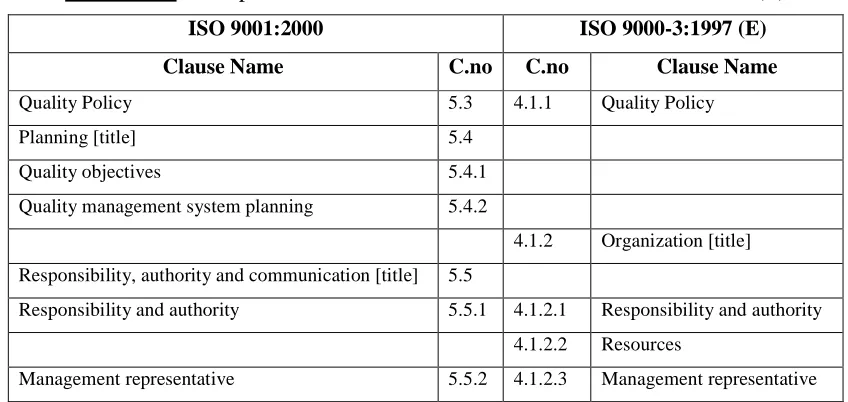
[image:3.595.85.509.391.592.2]ISO 9000-3:1997(E) is the guidelines for the application of ISO 9001 to the development, supply, installation and maintenance of computer software while audit will be carried out against all clauses of ISO 9001:1994/ ISO 9001:2000. In order to understand the relationship of ISO 9000-3:1997 with ISO 9001:2000, example of 1-1 mapping of few clauses is summarized in table below:
Table 2.1 : Correspondence between ISO 9001:2000 and ISO 9003:1997 (E)
ISO 9001:2000 ISO 9000-3:1997 (E)
Clause Name C.no C.no Clause Name
Quality Policy 5.3 4.1.1 Quality Policy
Planning [title] 5.4
Quality objectives 5.4.1
Quality management system planning 5.4.2
4.1.2 Organization [title]
Responsibility, authority and communication [title] 5.5
Responsibility and authority 5.5.1 4.1.2.1 Responsibility and authority
4.1.2.2 Resources
Management representative 5.5.2 4.1.2.3 Management representative
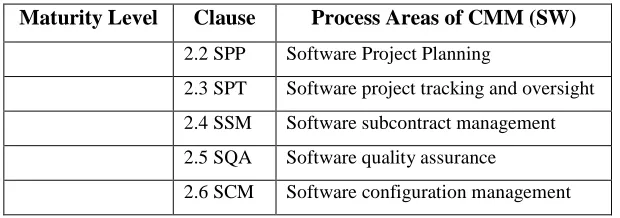
Assume some clauses and abbreviations to CMM (SW), example of this abbreviation is given up to CMM (level2) for software as below. Keep them similar to CMMI (SW) in order to show the easy mapping of CMM (SW) with CMMI (SW). Below is an example of such few mappings as discussed above -
Table 2.2 : Assumed clauses and Abbreviations of CMM (SW) Key Process Areas Maturity Level Clause Process Areas of CMM (SW)
Maturity Level Clause Process Areas of CMM (SW) 2.2 SPP Software Project Planning
2.3 SPT Software project tracking and oversight
2.4 SSM Software subcontract management
2.5 SQA Software quality assurance
2.6 SCM Software configuration management
[image:4.595.144.454.90.199.2]Clause Ids of CMMI, staged representation for software are already defined by CMU/SEI [12], one of the example is given as below
Table 2.3 : Clauses and abbreviations of CMMI (staged, SW) Key Process Areas Maturity
Level
Clause Process Areas of CMM (SW)
2. Repeatable 2.1 RM REQUIREMENTS MANAGEMENT
2.2.PP PROJECT PLANNING
2.3 PMC PROJECT MONITORING AND CONTROL
2.4 SAM SUPPLIER AGREEMENT MANAGEMENT
2.5 M&A MEASUREMENT AND ANALYSIS
2.6 PPQA PROCESS AND PRODUCT QUALITY ASSURANCE
2.7 CM CONFIGURATION MANAGEMENT
2.1
Mappings of ISO 9000-3:1997, CMM (SW), CMMI (SW)
Clause level mapping between ISO 9000-3:1997 with CMM for Software is explained by CMU/SEI [13]. Note that ISO 9000-3:1997 is mapped with CMM (SW) and reason for mapping ISO 9000-3 with CMM (SW) , instead of mapping CMM (SW) with ISO 9000-3 is due to the fact that ISO 9000-3 has predefined list of clauses and audits are performed against ISO 9001:2000 clauses while CMM (SW) has no specific clause ids and CMM assessment are considered against KPAs including Goals, Commitment, Abilities and Activities etc., so if any KPAs is missing in this mappings then we will assume that they do not mapped with ISO 9000-3 (for software) and thus missing KPAs would be focused individually in the suggested Quality Management System Manual.
Similarly, 1 to N mapping between CMMI (staged representation, SW) against the practices of CMM (SW) is explained by US Air Force Software Technology Support Centre.[14], which is also supported by CMU/SEI. Note that the abbreviations used for CMM (SW) practices are collected from the last section, Table 2.2 ‘Clauses of CMM (SW)’ in which some abbreviations were assumed against each practices of CMM (SW).
From this survey, select an existing ‘Quality Manual’ for an in-depth study Finally, based on the mappings, and research survey, mapped a ‘Quality Manual’ as defined by ISO 9001:2000 with existing software standards, thus we can demonstrate an efficient, workable system from basic principles to writing ‘Quality Manual’, ‘Forms’ and ‘Templates’ that can improve software quality.
3
Research survey
[image:5.595.113.450.332.537.2]A research survey for Pakistan software organizations was carried out in order to make the ‘Quality Management System Manual –QMSM’ compatible with software industry. It comprises 50 questions, each question is asked on five (5) different levels of ratings. Questions are further divided in four (4) assessment areas as ‘Organization Profile’, ‘Quality Assurance’, ‘Existing Software Standards or Software Models’ and ‘Feedback on Existing Software Standard’. Ratio of the questions can be represented as below
Figure 1.1 : Percentage of questions asked in each assessment areas
34% questions were related to the issues faced during the implementation of software standards which is a problem domain of current research, 28% questions related to feedback after implementing any software standards to know if its brings some improvement/disciplines in core areas of development cycle or it is same as previous which is a solution domain of current research, 26% questions were asked about the company profile to understand the organization background as how the policies working which will be utilized in defining the organization’s scope in the quality manual, 12% questions related to understand the process approach and the degree of quality assurance which aimed to introduce a true meaning of quality assurance rather than testing department only, it was so required
% Questions asked in each category
Organization , 34%
Quality Assurance , 28% Software Standards/ Models
, 26%
Feedback on existing standards , 12%
because almost all organizations just implement a testing department and consider thus department to guarantee optimal products without introducing the complete Quality Assurance department
3.1
Findings and results
It is observed that all certified/assessed software organizations have membership of membership governing body that has good reputation in IT industry; they score 9/10 points while none of non certified organization owned any such membership which is a first impression of maturity changed in certified organizations as compared to non certified organizations.
Furthermore, Non certified organizations does not establish the organization purpose, vision, mission or quality objective because they were interested in providing IT solution rather than defining the quality objectives while certified organizations score 8/10 points in defining the quality objective.
[image:6.595.81.515.351.444.2]Similarly, the survey can help researchers in improving the weakness of software processes in the quality management system manual and they are also useful in GAP Analysis study of existing profile including, organization profile, quality assurance, understandings about existing processes and feedback on ongoing processes.
Table 3.1 : Findings from market research survey
Areas %No (NC) %Yes (NC) %No (C) %Yes (C)
Organization Profile 43.59 56.41 3.85 96.15
Quality Assurance 44.44 55.56 0.00 100.00
Existing Software Standards or Models 82.35 17.65 26.47 73.53
Feedback on Existing Software Standard 26.19 73.81 25.00 75.00
As organizations are further divided in two (2) categories i.e. non certified or non assessed (NC) software organizations and certified or assessed (C).software organizations. Non certified are such organizations who does not attain any assessment levels like CMM / CMMI or does not attain any other quality certification like ISO 9001:2000 QMS while Certified organizations are such organizations who attain any one of above assessment/certification level. As certified organizations are more mature in processes due to which it is required to distinguish them separately.
60% of software organizations does not consider any guidelines for the improvement of processes while 40% were interested to get a label of higher level certification/assessment in order to gain some reputation in the market but were not familiar as how to improve productivity, they prefer the consultancy firm which can guarantee them successful implementation of ISO/CMM or CMMI.
All software organizations were interested to accept thus quality management system manual which will help them to achieve the label of certifications/assessment while 60% give a green signal of accepting any such integrated model which will either improve the quality of software or not because they consider that they can further improve the processes, however in another question related to understanding the guidelines, 80% responded low confident level in improving the processes themselves which is one of the simple task of updating quality management system manual.
These concerns are considered in the quality management manual such as introduction of documentation requirement, definition of organization purpose, description of main services and products, requirement management, software and project planning, project monitoring, control of software project, maintaining the subcontract, degree of corrective and preventive actions and the implementation of software quality assurance department
4
Structure of Quality Management System Manual (QMSM)
In 2004, an Integrated Model of ISO 9001:2000 and CMMI (SW) [8] was presented which shows the combination of CMMI (SW) practices and ISO 9001:2000 requirements because they targeted the integrated model to be useful to ISO 9001:2000 registered organization(s) that plan to adopt CMMI (SW). The quality manual presented in this research is not an integrated model and it is not targeted toward specific organization. It focuses initials cycles of software development that can improve software quality and considered the mapping of different software standards in order to make them compatible with industry standard.
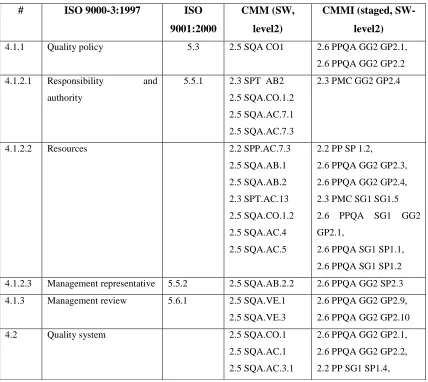
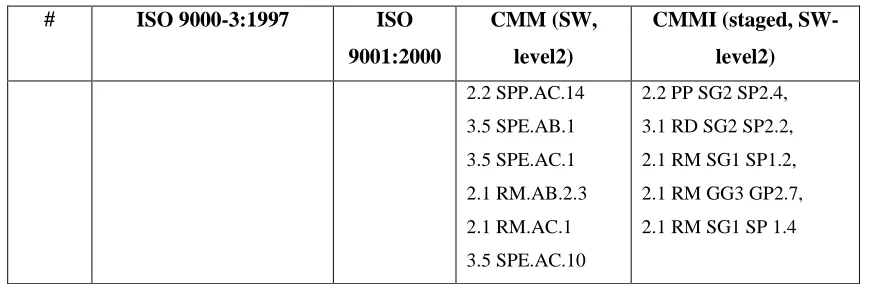
[image:7.595.85.513.368.750.2]The structure of quality management system manual for improving software quality will follow ISO 9001:2000 clause 4.2 guidelines as a base to show the structure but the guidelines ISO 9000-3:1997 will be followed. Example of this structure is mentioned in the table below
Table 4.1:- Structure of quality management system manual
# ISO 9000-3:1997 ISO
9001:2000
CMM (SW, level2)
CMMI (staged, SW-level2)
4.1.1 Quality policy 5.3 2.5 SQA CO1 2.6 PPQA GG2 GP2.1,
2.6 PPQA GG2 GP2.2
4.1.2.1 Responsibility and
authority
5.5.1 2.3 SPT AB2
2.5 SQA.CO.1.2
2.5 SQA.AC.7.1
2.5 SQA.AC.7.3
2.3 PMC GG2 GP2.4
4.1.2.2 Resources 2.2 SPP.AC.7.3
2.5 SQA.AB.1
2.5 SQA.AB.2
2.3 SPT.AC.13
2.5 SQA.CO.1.2
2.5 SQA.AC.4
2.5 SQA.AC.5
2.2 PP SP 1.2,
2.6 PPQA GG2 GP2.3,
2.6 PPQA GG2 GP2.4,
2.3 PMC SG1 SG1.5
2.6 PPQA SG1 GG2
GP2.1,
2.6 PPQA SG1 SP1.1,
2.6 PPQA SG1 SP1.2
4.1.2.3 Management representative 5.5.2 2.5 SQA.AB.2.2 2.6 PPQA GG2 SP2.3
4.1.3 Management review 5.6.1 2.5 SQA.VE.1
2.5 SQA.VE.3
2.6 PPQA GG2 GP2.9,
2.6 PPQA GG2 GP2.10
4.2 Quality system 2.5 SQA.CO.1
2.5 SQA.AC.1
2.5 SQA.AC.3.1
2.6 PPQA GG2 GP2.1,
2.6 PPQA GG2 GP2.2,
# ISO 9000-3:1997 ISO 9001:2000
CMM (SW, level2)
CMMI (staged, SW-level2) 2.2 SPP.AC.14
3.5 SPE.AB.1
3.5 SPE.AC.1
2.1 RM.AB.2.3
2.1 RM.AC.1
3.5 SPE.AC.10
2.2 PP SG2 SP2.4,
3.1 RD SG2 SP2.2,
2.1 RM SG1 SP1.2,
2.1 RM GG3 GP2.7,
2.1 RM SG1 SP 1.4
4.1
Scope of QMSM
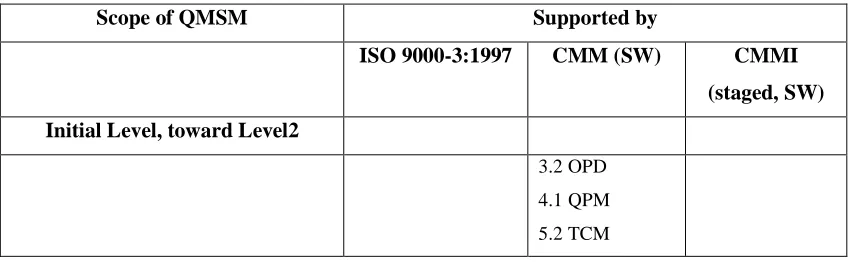
[image:8.595.81.520.89.232.2]Scope is divided in three (3) levels e.g. ‘1-Initial Level’, ‘2-Defined Level’ and ‘3-Advanced Level’. Initial Level’ is the scope of current research which will target ISO 9000-3:1997, CMM (SW-level2) and CMMI (staged-(SW-level2) while ‘Defined Level’ and ‘Advanced Level’ are for future considerations because previously, the mapping was carried out irrespective of the CMM/CMMI levels. Research will use ‘Initial Level’ as a scope of QMSM as in table 4.2.
Table 4.2:- Scope of Quality Management System Manual
Scope of QMSM Supported by
ISO 9000-3:1997 CMM (SW) CMMI (staged, SW) Initial Level, toward Level2
Requirement Management 4.2
4.3
4.4.6
2.1 RM 2.1 RM
Software Project Planning 4.1.2.2
4.2
4.3
4.4.2
4.9
2.2 SPP 2.2 PP
Software Project Monitoring and Control 4.1.2.1
4.1.2.2
4.4.2
4.4.6
2.3 SPT
3.4 ISM
2.3 PMC
Software Subcontract Management 4.6.2
4.6.3
4.6.4
4.16
2.4 SSM 2.4 SAM
Measurement and Analysis 2.2 SPP
2.3 SPT
Scope of QMSM Supported by
ISO 9000-3:1997 CMM (SW) CMMI (staged, SW) Initial Level, toward Level2
3.2 OPD
4.1 QPM
5.2 TCM
4.2
Documentation Structure
[image:9.595.86.516.90.221.2]Irrespective of scope levels, documentations are divided in five (05) categories in a specific flow. This documentation requirement is carried out as per ISO 9001:2000 clause 4.2. Throughout the quality management system manual, the documentation structure from table 4.3 will be carried out to meet any scope of QMSM.
Table 4.3:- Documentation Structure of QMSM
Level 1 Name Abbreviation
01 Quality Policy POL
02 Quality Objectives OBJ
Level 2 Name Abbreviation
01 Organization Scope SCP
02 Standard Operating Procedures <SCP>_SOP
03 Quality Management Manual QMM
Level 3 Name Abbreviation
01 Master List of documents MDOC
02 Master List of External documents EDOC
03 Master List of Approved documents ADOC
04 List of Obsolete documents OBS
Level 4 Name Abbreviation
01 Organizational Structure OSTR
02 Forms / Records <SCP>_REC
5
Conclusions
It is required to focus the QMSM at initial level rather than skipping initial level and selecting the level of choice but if the scope of QMSM is ignored then there is no guarantee of quality improvement.
6
Future Work
Although the suggested structure of QMSM is restricted toward ISO 9001:2000- guidelines of ISO 9000-3:1997, CMM for software level2 and CMMI staged representation level2 still then it improved software quality. It is not only limited toward the mappings among each other. For further research, QMSM can be updated above level2 of CMM (SW) and CMMI (staged representation, SW) by using the same documentation structure and same scope as defined in chapter 4 provided the benchmarking approach should be the technique of research else the result will only derived a QMSM which will either guaranteed or will not guaranteed improvement in software quality.
Furthermore, Currently ISO 9000-3:1997 is replaced by 90003:2004 as guidelines for the application of ISO 9001:2004 to computer software. This newer version of guideline is much more compatible with CMMI for software (both representations) so for advanced level research, researchers can suggest latest structure of QMSM. If ISO 90003:2004 is included then there is no need to include CMM (SW) in order to understand the mappings of CMMI (SW) because ISO 90003:2004 is much more compatible to CMMI (SW). Although, it requires much more research to show the compatibility between ISO 90003:2004 and CMMI (SW) but atleast the differences and similarities can be figured by understanding both of them thoroughly.
Secondly as CMM (SW) is retired and has been replaced by CMMI (SW) still then it was utilized by some or few researchers (like current research) because it is used as a tool to understand CMMI (SW) but while using ISO 90003:2004, once has to consider only ISO 90003:2004 and CMMI (SW) – irrespective of the it’s staged or continuous representation
7
References
[1] Improving Software Quality” by Sharon Wheeler and Sheryl Duggins. Computer Science Dept. Southern Polytechnic State University. 1998 ACM 1-58113-030-9/98/0004- “Conclusion”.
[2] Software Quality Professional: VOL. 8, Issue Two/© March 2006, ASQ publication: Page.28, “Are Standards the Answer?”
[3] Handbook of Software Quality Assurance edited by G. Gordon Schulmeyer and James I. McManus. – 3rd ed-1998. : Page.104, “Standardization of Software Quality Assurance – Conclusion”
[4] “Software Quality Management and Software Process In Denmark” by Karlheinz Kautz and Faisal Ramzan. IEEE-2001“Abstract, Future Work
[5] “The Complex Quality World – Developing Quality Management System” by Katalin Balla. 2001. ISBN: 90-386-1003-3
[7] Copyright text extracted from Handbook of SQA [3] who reprinted the text with permission from Schneidewind, Norman F. and Fenton, Norman, “Do Standards Improve Quality?” Page: 22, 23. In IEEE Software (New York, IEEE, January, 1996) © 1996 IEEE.
[8] The Software Quality Engineer Primer 2002 © Quality Council of Indiana: Page.II-19, “Model Situations and Applications”
[9] Dobbins, James H., “Adequacy of ISO 9000 Certification for DOD Weapon System Software Development Contractors.” In: Program Manager, March-April 1996, Page: 42-51
[10]Handbook of Software Quality Assurance / edited by G. Gordon Schulmeyer and James I. McManus, 3rd ed-1998 : Page.91, “Standardization of Software Quality Assurance – Introduction”
[11]Haase, V., Messnarz, R., Koch, G., Kugler, H.J and Decrinis, P. (1994), Bootstrap: Fine-Tuning Process Assessment. IEEE Software
[12]CMMI for Software Engineering (CMMI-SW, V1.1) Staged Representation, August 2002, CMU/SEI/2002-TR-029, ESC-TR-2002-029. “Appendix D, “Required and Expected Model Elements
[13]A Comparison of ISO 9001 and the capability maturity model for Software Technical Report CMU/SEI-94-TR-12 ESC-TR-94-12 July 1994. Page 74“Appendix E. Cross-References Between ISO 9001 and ISO 9000-3 ” (note: table headings refer to audit title due to which some readers are confused)
[14]CMMI-SE/SW V1.1.1 to SW-CMM V1.1, US Air Force Software Technology Support Center (STSC) – 2002 http://www.stsc.hill.af.mil/consulting/cmmi/documents.html