Effective Implementation:
A Case Study of the Introduction of ICT in One School
by
Jillian Abell M.Ed.Studies (Tas), B.A. (Tas), Grad.Dip.Lib. (TCAE).
Submitted in partial fulfilment of the requirements
for the degree of
Doctor of Education
University of Tasmania
This thesis contains no material which has been accepted for a degree or diploma by the University or any other institution, except by way of background information and duly acknowledged in the thesis. To the best of my knowledge and belief, this thesis contains no material previously published or written by another person, except where due acknowledgement is made in the text of the thesis, and nor does the thesis
contain any material that infringes copyright.
Signed
ABSTRACT
The objectives of this case study were to provide insights into conditions that assist effective implementation of ICT and online learning in one school, the assessment of innovation and change using a concerns based adoption model (CBAM) and how school leadership interventions have an impact on change management. The methodology involved questionnaires for all students from years 7 — 12 and all teachers from
kindergarten to year 12, with an interview for a selective group of teachers, known for their "best practice" in online teaching. Findings include the utility of the CBAM model to monitor the implementation of educational change and to describe, explain and
predict probable teacher behaviours with professional development planning. The study finds that effective ICT implementation can be compared with the effective
ACKNOWLEDGEMENTS
I am very grateful to the following people for their support and assistance with this study:
• The students who responded to questionnaires as well as the teaching and administrative staff who responded to questionnaires and participated in the interviews or other data collection strategies, and so, all generously assisted with their time;
• The Principal, whose interest, understanding and trust was very much appreciated over the several years of the duration of the research and particularly, the thesis documentation phases;
• Supervisors, aside from their role, were so wise, patient and always encouraging, keeping the final goal in sight and within reach;
• Husband, Geoff and children, Sally and Robin, who have not only patiently tolerated the whole EdD journey, but sustained me with moral, physical and financial support with the research project;
• Jenny Wallis and Sharron Hewer, whose stimulating collegial conversations, optimism and critical literacy over many years in our professional roles were invaluable aids in the thesis preparation; and
• Sue Ekins, Pam Morse, Carey Bourke and Tessa Hampton are particular friends whose succinct reflections on teaching over a long period of time, provided pragmatic guidance in choosing the research directions about teachers' concerns.
To all these people, I am so glad to say thank you.
TABLE OF CONTENTS
Page
Abstract iii
Acknowledgements iv
Table of Contents
List of Tables vii
List of Figures viii
Chapter 1 Introduction 1
Background 3
Purpose and significance of the study 5
Conceptual framework 6
Scope of the study 9
Assumptions 10
Limitations of the study 10
Definition of terms 12
Summary 15
Outline of the study 16
Chapter 2: Literature review 17
Introduction 17
Innovation models 19
Concerns-Based Adoption Model 26
Leadership and change models 41
Boys and ICT at home and school 60
Learning communities 61
ICT and the transformation of education 62
Summary 63
Chapter 3: Methodology 67
Introduction 67
Case study approach 67
Development of the CBAM SoC questionnaire and LoU interviews 72
Methodology 73
Selection of participants 75
Recruitment of participants 75
Students 76
Teachers 76
Data Analysis 77
Chapter 4: Results 84
Introduction 84
Students 84
Students' home computer use 86
Students' experiences at school 94
Students' acquisition of ICT skills, competencies and understandings 98
Teachers 100
Teachers' computer use and computer based teaching 100 A school-based survey of teachers' ICT attitudes and skills 109 Teachers' stages of concern in online learning and levels of use of
ICT in teaching and learning 110
Teachers' responses to open-ended statements of concern about
integrating ICT and online learning into the curriculum 114
Teachers' levels of use of ICT in teaching and learning 119
Other documentary evidence 125
Summary 130
Chapter 5: Summary and Discussion 132
Introduction 132
Findings 132
Students' home internet connectivity, home use and homework 133
Students' experiences at school 134
Teachers' computer use 136
Comparison with findings in related studies 139
Innovation models 142
CBAM models 143
Leadership and change models 145
Interpretation of findings and implications of the study 151
Conclusion 154
Recommendations for future research 157
References 159
Appendices 169
Appendix I: Information sheets and accompanying letters 169
Appendix II: Student Questionnaire 184
Appendix III: Levels of Use (LoU) Teacher Questionnaire 190
Appendix IV: Teacher Interview Schedule 195
Appendix V: Stages of Concern about the Innovation 196 Appendix VI: Stages of Concern Questionnaire (SoCQ) 197
Appendix VII: SoCQ questions groups by Stages 0-6 200
Appendix VIII: SoCQ Quick Scoring Device 201
Appendix IX: Teachers' percentile scores for the SoCQ 202 Appendix X: Format for the LoU Branching Interview 204
Appendix XI: LoU Rating Sheet 205
Appendix XI Conceptual framework 206
LIST OF TABLES Table
2.1 Theoretical background and empirical studies used in building the
Page
conceptual framework 18
2.2 Features of four case studies in the OECD/CERI project 24
2.3 Stages of Concern 28
2.4 Stages of Concern about the Innovation and typical expressions 30
2.5 Levels of Use 37
2.6 Levels of Use Categories 38
4.1 Students' questionnaire responses 85
4.2 Students' home computer use and connectivity 87
4.3 Students' use of computers outside school 88
4.4 Frequency of students' computer use outside school 88
4.5 Number of students' hours spent per week on computer applications
outside school 90
4.6 Number of hours spent per week using other forms of ICT (Information
and Communications Technology) outside school 91
4.7 Percentage of students using computer applications and other technology
over a week 91
4.8 Number of students' hours spent on homework per week on computers
outside School 94
4.9 Frequency, extent and type of students' computer use in a typical week
at school 95
4.10 Frequency of type of students' computer use at school 95
4.11 Frequency of students' time spent using computers at school 96
4.12 Frequency of students' lesson time or private study time spent using
computers at school 96
4.13 Students' preferences for learning 97
4.14 Teachers' home computers and connectivity 102
4.15 Teachers' time spent on computers in a typical week at school 104 4.16 Frequency of teachers time spent using computers for school-related
work 104
4.17 Frequency of teachers' setting class work involving computer-based
tasks 105
4.18 Teachers' experiences and attitudes about using a computer in their
teaching 105
4.19 Teachers' online practice in last two years 109
4.20 Mean Percentiles 112
4.21 Frequency and percentage of highest concerns stages, for the individual
teachers displayed in Appendix
ix
1134.22 Teachers' Open-Ended Statements of Concern 116
4.23 Application of CBAM instruments at a glance. 125
4.24 Documented information 128
5.1 Summary of major findings 140
LIST OF FIGURES
Figure Page
1.1 Conceptual framework for the research study 8
2.1 The Rogers' Diffusion of Innovation Model 20
2.2 Rogers' Rate of Adoption of Innovations 21
2.3 Concerns Based Adoption Model 27
2.4 SoC Stages of Concern 34
4.1 Distribution of student responses by year group 85
4.2 Percentage distribution of student responses by year group 86
4.3 Frequency and percentage distribution of home use and connectivity
by year group 87
4.4 Percentage frequency of students' computer use outside school 89 4.5 Number of students' hours spent per week using computer applications
outside school 92
4.6 Number of students' hours spent per week using other forms of
technology outside school 93
4.7 Students' comments 97
4.8 Profile of Year 8 students' self-evaluations of ICT connectivity 98 4.9 Profile of Year 8 students' self-evaluations of ICT competencies 99
4.10 Teachers age 101
4.11 Teachers' years of teaching experience 101
4.12 Teachers' classes 101
4.13 Teachers' home access to a computer, internet and email connectivity 102 4.14 Frequency of teachers' time spent using computers for school related
work 105
4.15 Frequency of teachers' setting class work involving computer-based tasks 106 4.16 Teachers' experiences and attitudes about using a computer in their
teaching 108
4.17 Teachers' composite concerns profile 110
4.18 Mean percentiles for teachers' stages of concern 112
4.19 Percentage frequency of teachers at the highest stage score 114
CHAPTER 1: INTRODUCTION
The introduction of ICT into schools has not yet delivered the promised revolution and improvement in standards and student achievement. Is it a matter of keeping the faith, or persevering whilst making some further adjustments or abandoning the project as misconceived? Or do we need to do some radical rethinking?
(David Hargreaves, 2004, p.1.)
The aim of this exploratory and qualitative case study was to explore, develop and apply a
range of methods for evaluating the effective implementation of ICT and online learning in
a school. The study was undertaken because there is a need for evidence informed policy
and practice on increasing levels of ICT and new learning infrastructures to drive school
improvement and school effectiveness. The research outcomes from this case study are
likely to assist in this regard.
School managements, state governments and federal policy makers have recognized that
teachers need extensive resources so as to enhance organisational capacity and to change
teaching practices in regard to the use of technology. Nominally, the key public policy
factors for ICT innovation and change in schools are often grouped into six main areas:
availability and provision of equipment, infrastructure and broadband connectivity,
technical support, leadership, development of online educational content and professional
development time. These same factors reflect the federal government's research themes
(Ministerial Council on Education, Employment, Training and Youth Affairs, 2003) and in
its inclusion of ICT in its '10 point agenda' for Taking schools to the next level — the national educational framework for schools. Other large scale funding examples of these
key public policy trends are the technology grant programs in each of the Australian states
In March 2000, Australia's Ministerial Council for Employment, Education, Training and
Youth Affairs (MCEETYA) had endorsed a policy guideline for the implementation of ICT
in teaching and learning in its statement, called the Adelaide Declaration on the National Goals for Schooling in the Twenty First Century, MCEETYA 2000). The overarching
goals of the plan, were that:
all students will leave school as 'confident, creative and productive users of new technologies, particularly information and communication technologies, and understand the impact of those technologies on society".
(MCEETYA 1999, p. 2)
• all schools will seek to integrate information and communication technologies into their operations, to improve student learning, to offer flexible learning opportunities and to improve the efficiency of their business practices.
(MCEETYA 2000, p. 3)
MCEETYA's ICT in Schools Taskforce provides strategic advice to the Australian
Education System Official Committee (AESOC) on the use of information and ICT to
support teaching and learning. In 2000, it endorsed the development of an ICT in Schools
Research Strategy to identify the kind of research important to the successful adoption of
ICT in teaching and learning and proposes models whereby this research is made readily
available to practitioners and the community. In proposing a conceptual model for a
discussion paper on the emerging ICT research agenda, the authors, Pugh and Yaxley
(MCEETYA 2002b) called for 'participatory action research' by stakeholders and a
balance of four overlapping dimensions, namely learning possibilities, the necessary
conditions for learning, educational effectiveness, and accountability. They argued that the
the major focus of ICT research in education, which will in turn contribute to the ongoing
need for accountability to all stakeholders.
Background
In the past five years in the USA, UK and Australia, some educators and policy makers,
often influenced by Cuban's (2001) dramatic critique of computers being "oversold and
underused" in American schools, occasionally question the huge financial investment of
ICT in schools and demand new evidence of the school or classroom effects or the gains in
student achievement outcomes (Becker, 2000; BECTA, 2003a, 2003b; Cuttance, 2001;
Hargreaves, 2004; MCEETYA ICT in Schools Taskforce, 2002a; OECD, 2001). In
Australia, there have been concerns built on substantial evidence based practice that the
potential for ICT in Australian schools has not been fully realised (Meredyth et al. 1999).
Pragmatically, there is now an urgency for educators and school administrators to assess
the research outcomes. Hargreaves (2004), as in the opening vignette, suggests some
radical rethinking. He has called for a re-conceptualisation of ICT innovation and
transformation in schools with a different "Research and Development" model.
There is a lack of consensus in relation to the purpose of technology in schools. Is it a
teaching tool to prepare students for the workplace, for raising student achievement, to
improve school climate and student engagement, or to foster other change and reforms,
such as the way teachers teach? As a long time skeptic of educational technology in the
U.S.A., Larry Cuban (2001) believed educators need to agree on the goals for using this
technology, which would then enable more apt decisions to be made on how much to spend
Most of the national research in terms of ICT use in Australian schools reports a heavy
reliance on qualitative surveys rather than quantitative measures of differences in student
achievement. Internationally funded and longitudinal studies (WA sites, 2003; BECTA's
ImpaCT2, 2003; OECD's CERI studies, 2003; and the ongoing PISA, 2000-2005
investigations), however, have sought to develop instruments for measuring the impact of
ICT integration on students' achievement.
This study highlights those methodological problems that exist in attempting prescriptive or
normative research approaches. One notable conclusion from this study is that more
national longitudinal and empirical studies are needed to document the school and
classroom effects of successful implementations of ICT and online learning. To achieve
that, the studies will need to focus on more outcomes of the teachers' successful use of ICT
and online learning. It is anticipated that the research outcomes from this study could help
describe the conditions (environment, organisation and change strategies) in a school that
are likely to assist the effective implementation of change and school improvement through
the integration of ICT in teaching and learning.
To achieve these objectives, information has been retrieved via the web-based information
services and networked subscription databases for the last ten years. In particular, the
Australian Education Index via WinSPIRS, the American and Australian databases via
Proquest, the EdNA ICT research website, the international ISTE.org and the English
BECTA ICT research discussion forum have been the most valuable information services.
Technology related publication links for 'white papers' on both Australian and USA
federal government education websites have been major leads to what has been valued in
It is noteworthy that the success of the literature review for retrieving large systemic studies depended on these electronic databases and digital resources rather than the tradition printed journal and monograph literature. Notwithstanding the subject area, a preference on the part of the researcher existed for using the Internet connectivity of the educational innovation networks online and the online refereed papers from academic institutions disseminating descriptive research reports.
Purpose and significance of the study
Beyond the integration of ICT into normal classroom practice, the research base for online learning and the conditions necessary to support the needs of learners online in junior and middle schooling in Australia is limited. In the tertiary and senior secondary sectors, where flexible learning, distance education and specialist IT discipline teaching models exist, the research provides new evidence that this new form of teaching and learning requires
change strategies for professional learning, technology standards, curriculum standards and communication tools to be effective.
Too often, new ICT school programs and initiatives falter when teachers' concerns about changes are inadequately handled before the innovation or initiative is implemented. Supporting implementation is a function of leadership because it is the most likely stage (in the cycle of plan, develop, implement and evaluate) where an educational initiative is likely to fail (Darling-Hammond, 1996).
1. to better understand students' and teachers' attitudes to, and levels of use, of ICT;
2. to provide insights into the conditions that assist effective implementation,
particularly the issues that must be addressed when instituting any new ICT
program or innovation.
3. to capture the assessment of innovation and change using a 'concerns based
adoption model' (CBAM) so as to describe, explain and predict probable teacher
behaviours in the change process; and
4. to reflect on, and to provide an understanding of how to further develop change
strategies and interventions that have an impact on school improvement.
This study was unique because assessment of the implementation of online learning as an
innovation and change using the CBAM model had not been conducted in a K-12
Australian school. The only related study is the one by Newhouse (1999) in which the
CBAM model was employed in a three year interpretive case study in an Australian
secondary school where he examined how teachers adjusted to the availability of portable
computers.
Conceptual framework
The task of synthesizing the four purposes of this study, as pieces in one puzzle, from the
point of view of the researcher's role as a change facilitator in the case study setting
required a conceptual framework. Such a theoretical framework could potentially provide
a holistic understanding, common terminology and a reduction in tautology.
Reflection has long been a guiding metaphor in the philosophy of education and the review
John Dewey's philosophy on the moral, situational aspects of teaching and Schon's
reflective practitioner (cited in Smith, 2001). The role of reflection has been described
repeatedly in studies of teacher effectiveness (Stronge, 2002) and principal leadership
(Sergiovanni, 1999, 2000). They have refined the metaphor through multiple lens and
views like refracted light on mirror images. The metaphor provided the writers and
researchers with insight into contextual approaches and the connections between words and
actions, even though they may contain assumptions beyond the explicit meanings that the
researcher wishes to make.
'When / use a word," Humpty Dumpty said, in a rather scornful tone, "it means just what I choose it to mean-neither more nor less."
"The question is," said Alice, "whether you can make words mean so many different things." "The question is," said Humpty Dumpty, "which is to be the master - that's all."
(Lewis Carroll's Through the Looking Glass,1872, p. 198)
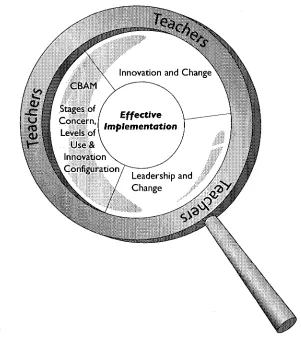
The notion of a looking glass provides a useful metaphor for this study. The lens of the
looking glass can reduce the complexity of the educational scene or context and highlight
particular features for further study. From the literature search, these directions were
discernible. First, the innovations model, and specifically Rogers' (1995) "diffusion of an
innovation" model, could predict attitudes to and rates of adoption of ICT innovations.
Second, the "concerns based adoption model" of the "stages of concern" and "levels of
use" (CBAM, 1981) could prove a useful staff development tool for describing the
effective implementation of ICT for online teaching and learning. Third, the leadership and
organisational change implementation models could provide strategies for successful
implementation of online learning.
These directions, or theoretical constructs, formed the conceptual framework of this study
or the clear glass in the lens of a looking glass, rather than the reversed image facing Lewis
Carroll's characters. One of the fundamental strengths of a looking glass or a magnifying
glass is its ability to provide a different, but still unified view of what it is examining. It
CBAM
Stages of Concern, Im
Levels of Use & Innovation Configuration
removes data that is not relevant to them in their current role or task. Yet, at the same time,
the lens cut through the surface view and exposes deeper levels. Both the focus and the
magnification can be altered dynamically at any time. The study's context, rationale and
significance as well as logic for organising the analysis of data is represented in the looking
glass in Figure 1.1. In the hands of school leaders, it is a lens for guiding the teachers,
providing the insights and the interventions into the conditions that assist effective
[image:16.560.121.422.276.632.2]implementation of ICT and online learning.
Figure 1.1 Using the looking glass metaphor as a conceptual framework for the
As Bailey (1991) describes, as the underlying constructs are encompassed, the scope of
the research study is put into a context and defined, marking the boundaries of the study.
The embedded 'units of analysis' are delineated (Yin, 1994, P. 22) and the logic for
organising the analysis of data is clear. Nevertheless, as Hocking (1988) notes, the
conceptual framework will not limit the introduction of new elements which can emerge
in the course of the data collection, nor constrain the interpretation of the significance of,
or relationships between the various elements.
Scope of the study
As the focus of the study was on effective implementation and change, and the process
rather than the outcome, the research methodology adopted was a case study. The
methodological approach was a case study employing questionnaires for all students from
years 7— 12 and all teachers from kindergarten to year 12, with an interview for a
selective group of teachers, known for their "best practice" in online teaching. The project
was conducted over a period of two years at an independent school in Tasmania, which is
a school for boys, aged from kindergarten to year 12. As an entity in itself, comprising
bounded units of mini-schools, staff and student groups, and facilitating purposeful
sampling, this school is in terms of this study, nominally representative of large
independent schools in Australia.
In part, the study involved a questionnaire that focused on students' computer use and
online learning and one that focused on the adoption of ICT and online learning for
innovative teaching practices. It was not intended as an evaluation or as an audit of ICT
The process for approval of the research within the school grew out of discussions over a number of years, between the Principal and the researcher (who is employed as a teacher at the school). Discussions regarded a mutual aim to focus on the change occurring with the implementation of ICT programs. The Principal gave approval in writing to formalise Stephens School's [pseudonym] support of this research study and the case study
methodology.
Assumptions
One major assumption that is not testable in the research methodology of this case study is that of the underlying belief in the value of ICT in school improvement. Also inherent in this case study is the assumption that the examination of the change process of the effective implementation of ICT is a valid measure for the impact of ICT on student performance or achievement.
Limitations of the study
The study was conducted with some limitations. One weakness in the exploratory case study research was the subjectivity and intensive use of empirical evidence and a volume of rich data with a temptation to try to capture everything. This is similar to Eisenhardt's (Huberman & Miles, 2002) point of view that the result of theory building which is rich in detail can lack the simplicity of overall perspective.
observer does or does not do will have some effect on what is being observed or what
happens, it is simply inevitable". Conversely, the danger is to "go native" and lose
scientific detachment. Sensitivity to these limitations; however, as Babbie (1999)
concludes, may provide a partial protection. It is a more ethical stance than the complete
participant where the group under study is not aware of the research. Burns (2000)
suggests that the end result is an analytical description and interpretation of a highly
complex system. In the end, Babbie (1999) advises that the researcher has to rely on
understanding and good judgement about the situation, guided by both methodological and
ethical considerations.
This case study research will not necessarily produce propositions that can be generalised
across all ICT implementations in K-12 independent boys' schools; however, it is intended
to go beyond mere reflection of one change facilitator and participant-observer to report on
multiple dimensions and to provide the insights into conditions that assist effective
implementation in similar schools. Using multiple sources of evidence to increase validity
(Yin, 1994), and to guide empirical inquiry under rubrics of trustworthiness and
authenticity (Lincoln & Guba, 2002) can be strengths of case study research.
The need for balancing ethical and methodological considerations occurred with data
collection as well. The Principal believed that his permission for the case study in the
school, his governance and the existence of the school rule which covered the collection of
personal information "in loco parentis" meant that the researchers' requirement for active
consent by parents (that is, parents signing a consent form and returning it to the
researcher) created unnecessary logistical issues at the school. It could be argued,
contributed to some teacher resistance to ongoing involvement in the research. By the time
the teachers who were also class tutors, received their copy of the teachers' questionnaire,
they could have handled several distribution and receipt/return batches for the parent
consent forms and student questionnaires.
One diagnostic instrument of the CBAM model, the concept of the mapping of the
Innovation Configuration (Hall and Loucks, 1981), was outside the scope of this study. It
involves identifying and defining the operational components of a professional
development program, then analysing the patterns of use of the components by the teachers
and the interventions by change facilitators. The configuration is the form a process or
product takes on during actual use and adaptation. A limitation rather than a weakness of
the study, it meant that the important benefit of the innovation configuration for consensus
building was not available. In this study, Innovation Configuration has been employed in a
different way to meet the purpose of achieving a better understanding of students' and
teachers' attitudes to, and levels of use of ICT. Data has been gathered on student use at
home and students' experiences at school, students' skills, competencies and
understandings of ICT, as well as teachers' use, skills and attitudes to ICT and online
learning.
Definition of terms
`ICT ' is Information and Communications Technology' and generally refers to the
hardware, software, skills and communications of using networked computers. Specifically,
it refers to the convergence of information and communications technologies.
when the delivery is via the online tools, the Internet or an Intranet, that is, computing and
communications technologies. It includes courses, parts of courses or units of work that
involve an integral online component.
The term, learning technology, adopted by most Australian states represents a process wherein students are engaged in activities or strategies for working and thinking using
technological tools or processes (ACCE, 2000). An identifiable change of focus from the
term to a "more commonly shared reference of ICT" has occurred in the most recent years
(Finger and Trinidad, 2002, p.2).
Teachers' technology competencies refers to those competencies or capabilities that teachers demonstrate when using technology, such as when using computers and the
internet in their classrooms (ISTE 2002).
Teacher behaviour is the way a teacher performs in their normal process of teaching.
An effective school is defined as one in which students are able to achieve, in a wide range of endeavours, at a level consistent with their potential (DEST, 2004).
School improvement is defined within a framework of teacher effectiveness and the
capacity of every student to learn, given the right support and learning environment (DEST,
The case study is defined as an empirical study that investigates a phenomenon within its real-life context, especially when the boundaries between phenomenon and context are not
clearly evident (Yin, 1994).
Innovation is used in terms of substantive and positive change brought and diffusion of innovation is the process by which an innovation is communicated through certain channels
over time among the members of a social system (Rogers, 1995).
Along a theoretical continuum of models of integration of ICT skills and competencies in
teaching and learning, often termed simply as integration of ICTs, there are existing descriptions of curriculum management and varied pedagogical approaches over the last 20
years as well as years into the future. First is the specialist IT subject in a school
curriculum which integrates ICT skills and competencies with information technology from
the subject discipline. In this model, other subjects may remain unchanged or
cross-curriculum links may be developed. The second model focuses on equipping all teachers
with ICT skills and competencies to enable them to integrate ICTs into classroom practice.
In this second model, there is an expected impact on teachers' pedagogical practices and
classroom organisation. Third, when the ICT is a lever for curriculum change, it impacts
potentially on curriculum content, teachers' pedagogical practice and students' information
literacy. Along this continuum, is a systemic model of innovation and whole-school
change for transformative leadership, school improvement and student outcomes. Finally,
as reminded by Rogers (1995), the continuum involves the discontinuance of innovations
The Concerns-Based Adoption Model (CBAM) is a conceptual framework that describes, explains and predicts likely teacher behaviours in a change process (Hall and Hord, 2001).
It includes three principal diagnostic dimensions or change measurement tools: Stages of
Concern (SOC), Levels of Use (LoU) and Innovation Configuration (IC). Stages of Concern (SOC) is a dimension of CBAM in which educators can experience seven
different reactions when they are implementing an innovation. Levels of Use (LoU) is the second dimension of CBAM which educators experience as they become more familiar
with using an innovation. The third dimension of Innovation configurations (IC) or different ways in which teachers adapt innovations their own situations. Innovation
Configuration has been employed in a different way to meet the purpose of achieving a
better understanding of students' and teachers' attitudes to, and levels of use of ICT. .
Data has been gathered on student use at home and students' experiences at school,
students' skills, competencies and understandings of ICT, as well as teachers' use, skills
and attitudes to ICT and online learning.
Summary
This chapter introduced the study, including its background, the purpose and significance,
the conceptual framework, scope, assumptions, limitations and the definition of terms. In
summary, the purposes of the exploratory study are:
• provide insights into the conditions that assist effective implementation,
particularly the issues that need to be addressed when instituting any new ICT
program or innovation;
• describe, explain and predict likely teacher behaviours in the change
• provide an understanding of how to develop change strategies and
interventions that have had an impact on school improvement.
Outline of the study
The next section, Chapter 2, explores and reviews recent research and literature, building
the conceptual framework relevant for this study as well as identifying some criteria by
which this exploratory study can be judged successful. In Chapter 3, the exploratory case
study approach, the CBAM Stages of Concern and the CBAM Levels of Use diagnostic
instruments are introduced. The methodology in Chapter 3 continues with the selection of
participants, the recruitment of those student and teacher participants, as well as the data
analysis procedures for the students' and teachers' questionnaires, teachers' interviews
and teachers' open-ended statements are described. Chapter 4 focuses on the results from
the surveys, interviews, and the open-ended statements. Chapter 5 discusses the findings,
compares those findings with outcomes in related studies, presents the interpretation of the
findings, the implications of the study, and concludes with the recommendations for future
CHAPTER 2: LITERATURE REVIEW
But wasn't ICT meant to usher in a transformation of education? Isn't that why governments spend so much on it? Is this why the critics write books with titles like 'oversold and underused' or the 'false promise of technology in the classroom?'
(David Hargreaves, 2004 p. 4.)
Introduction
This literature review examines current research literature and empirical studies
investigating the effective implementation of ICT and online learning in K-12 education in
Australia and internationally. The main areas of focus are innovation, concerns-based
theory, leadership and change in education. The review focuses on the reports of recent
studies identified through database indexing services. Recent studies are reviewed
systematically against the conceptual framework of selective models of educational
Table 2.1
Theoretical background and empirical studies used in building the conceptual framework
Theoretical models Research studies
Enablers and barriers to ICT
Trust
Alignment Interventions
• Yin (1994)
• Rogers' (1995)
• OECD/CERI (1999-2001) • Venezky &Davis (2002)
• Hall, George & Rutherford (1977)
• Hall & Loucks (1981) • Hord etal., (1987)
• Hall, Loucks, Rutherford & Newlove (1975)
• Loucks, Newlove & Hall (1998) • Newhouse (1999)
• Cheung, Hattie & Ng (2001) • Hall and Hord (2001) • Adams (2002)
• Newhouse, Trinidad & Clarkson (2002)
• Schiller (2003)
• Fisher, Dwyer & Yocam (1996) • Dwyer (1994)
• Fullan (2003) • Hargreaves (2004) • Bishop & Mulford (1996) • Silins & Mulford (2002) • Cuttance (2001)
• Stoll, Fink & Earl (2003) • Eadie(2000)
Meredyth, Russell, Blackwood, Thomas & Wise (1999) • BECTA (2003)
• Zhao et al. (2002) • Tearle (2003) • Oliver (2005) • Bishop (1999) • Fullan (2003)
• Bryk & Schneider (2003) • Mulford & Johns (2004) • Fullan (2003)
• Gurr & Broadbent (2004) • Hall & Hord (1987) • Hall & Hord (2001) Case study model
(See Chapter 3: Methodology) Innovation models:
Rogers' (1995) diffusion of innovations defined as the [change] process by which an innovation is
communicated through certain channels over time among members of a social system where the innovation is an idea, practice, or project that is perceived as new
Concerns model:
Concerns Based Adoption Model (CBAM)
comprising Stages of Concern (SOC) and the Levels of Use (LOU) and Open-Ended Statements
Transformational Leadership
• Schiller (2003) • Hall & Hord (2005) • Sergiovanni (1999)
• Leithwood, & Riehl, (2003) • Cuttance (2001)
• Venezlcy & Davis (2002) • Silins & Mulford (2000) • Silins & Mulford (2002) • Mulford & SilMs (2003)
• Mulford & Johns (2004a, 2004b)
Boys and ICT at home and school • DEST (2003)
• Downes (1998) • Meredyth et al. (1999) • Silins and Mulford (2002) • Cuttance & Stokes (2003)
Learning communities • Hord (1997)
• Hall & Hord (2005) • McLaughlin (1998) • Cuttance (2001)
• Stoll, Fink & Earl (2004) ICT and the transformation of education • MYCEETYA (2000)
• DEST (2001)
Innovation models
Everett Rogers' (1995) Diffusion of Innovation, which first appeared in 1971, contributed a
typology for the adopter of an innovation going through the several stages of awareness,
interest, trial, decision and adoption. Rogers found that participants in his studies differed
in their readiness to accept change, with some adopting the change quickly and others
taking much longer. The five adopter categories were labelled on an S-shaped curve based
on a normal distribution (see Figure 2.1):
• innovators, (enthusiasts — 2.5%) eager to try new ideas;
• early adopters, (visionaries — 13.5%) or leaders, open to change;
• early majority (pragmatists 34%), but followers as more cautious in their adoption of an innovation;
EgVly
Earty
• laggards (skeptics — 16%) or resistors.
That is, Rogers (1995) argued that plotted graphically, the pattern of the adoption and
diffusion of the innovation would typically follow this bell-shaped curve. The implication
is that over time, over 80% would eventually take up the innovation following the early
adopters. In addition, Rogers (1995) argued that change agents can affect these adoption
rates by the provision of knowledge or training. It was to become a classic and well known
model that described the change process, as it identified five common categories of people
relative to their rate of adoption of innovations.
Figure 2.1 The Rogers' Diffusion of Innovation Model "Adopter categorization on the basis of relative time of adoption of innovations". (Rogers, 1995, p. 257)
thirty years where innovation, change and diffusion were interlinked yet evolving concepts.
In this revised theoretical framework, updating a 1983 edition, Rogers (1995) also
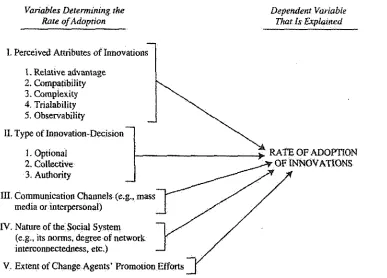
identified the five characteristics by which an innovation may be described: relative
advantage, compatability, complexity, trialability, and observability. The characteristics
were 'perceived attributes' showing how individuals' perceptions of these characteristics
can predict the rate of adoption of the innovation. As well as the five attributes identified
in the 1983 edition, Rogers (1995) named four other variables that affect the rate of
the communication channels diffusing the innovation (e.g. mass media or interpersonal);
the nature of the social system (e.g., its norms); and the extent of the change agents' efforts
in diffusing (promoting) the innovation. Hence, on the basis of Rogers' claims, the rate at
which the innovation is adopted in any organisation is affected by the adopters, the
innovation and the information disseminated about it (see Figure 2.2). In addition, the
importance of this change research model in predicting the likely future rate of adoption of
innovations based upon the attributes perceived was a recognition also, that the receivers'
perceptions count as much or more than the change agents' perceptions.
Variables Determining the Dependent Variable
Rate of Adoption That Is Explained
I. Perceived Attributes of Innovations I. Relative advantage
2. Compatibility 3. Complexity 4, Trialability 5. Observability
II. Type of Innovation-Decision I. Optional
2. Collective 3. Authority
In. Communication Channels (e.g., mass media or interpersonal)
IV. Nature of the Social System (e.g., its norms. degree•of network interconnectedness, etc.)
[image:29.560.75.462.311.589.2]V. Extent of Change Agents' Promotion Efforts
Figure 2.2 Rogers' Rate of Adoption "Variables determining the rate of adoption of
innovations" (Rogers, 1995, p. 207).
Employing one part of Rogers' diffusion research model, Venezky and Davis (2002) report
a three-year research scheme was conducted from 1999-2001, within an international group
of 94 school-based case studies in 23 member countries for the OECD/CERI (Organisation
of Economic Co-operation and Development/ Centre for Educational Research and
Innovation) ICT Program. Called ICT and the Quality of Learning, the project's objectives were to examine the different ways that ICT relates to school innovation, and to uncover
the critical variables that relate to the successful implementation of school improvements
and effective ICT.
The aim of the project methodology was to develop an evidence-based elucidation of
school policy and practices with ICT through confirmation or validation of a set of five
research hypotheses. Leask (2001, 2) reported that one research hypothesis (hypothesis 2)
was that "the diffusion of the innovation/improvement (and therefore of ICT) followed the
traditional diffusion pattern for innovations, as outlined by Rogers (1995".
The OECD/CERI ICT study did not attempt to describe the process of adoption beyond the Rogers' (1995) traditional diffusion model described in Figure 2.1 above. Venezky and
Davis (2002, 21) found that the traditional pattern did hold in most cases, across all the
case studies internationally. The exceptions were schools where a "high intensity ICT site"
had recently been built, where a selection of staff had been involved in intensive training or
where other administrative pressures gave teachers no alternative but to accept the ICT as
part of their teaching. Reports from the case studies were often quite different in their
descriptions of what innovation was actually being diffused or adopted: some highlighted
teacher ICT competencies or classroom practices, and others highlighted organisational or
Another research hypothesis (Venezky and Davis 2002) attempted to probe the elements
required for successful implementation of ICT. Successful implementation of ICT depends
mostly upon staff competence in the integration of ICT into instruction and learning. This
hypothesis assumed that teachers mediate ICT applications when they are successful, and
that ICT's academic value relates positively to teacher competence. The rival hypothesis is
that the school technological infrastructure and student ICT competence rather than staff
competence determine ICT implementation outcomes.
Hence the critical elements suggested were staff ICT competence, ICT infrastructure and
student ICT skills. Despite the lack of a consistent pattern emerging initially, the notion of
"critical levels" and context were found to make a difference. Venezky and Davis (2002)
report that in Germany and Singapore, case studies indicated that a critical level of ICT
infrastructure must be reached before teacher ICT skills had any impact, and that where
demands on teachers are high, teacher competencies are critical or where the demands are
mostly on the technology, then the latter becomes the dominant factor.
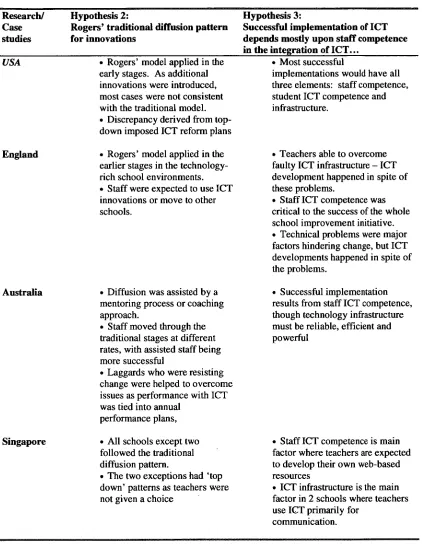
Accepting that they were each school's own goals and critical levels for innovative use of
ICT, Table 2.2 concatenates or links the comparable features of the multiple-site case
studies at a glance. This table is gleaned from the case studies reported by both the
Table 2.2
Features of four case studies in the OECD/CERI project
Research/ Case studies USA England Australia Singapore Hypothesis 2:
Rogers' traditional diffusion pattern for innovations
• Rogers' model applied in the early stages. As additional innovations were introduced, most cases were not consistent with the traditional model. • Discrepancy derived from top-down imposed ICT reform plans • Rogers' model applied in the earlier stages in the technology-rich school environments. • Staff were expected to use ICT innovations or move to other schools.
• Diffusion was assisted by a mentoring process or coaching approach.
• Staff moved through the traditional stages at different rates, with assisted staff being more successful
• Laggards who were resisting change were helped to overcome issues as performance with ICT was tied into annual
performance plans, • All schools except two followed the traditional diffusion pattern.
• The two exceptions had 'top down' patterns as teachers were not given a choice
Hypothesis 3:
Successful implementation of ICT depends mostly upon staff competence
in the integration of ICT...
• Most successful
implementations would have all three elements: staff competence, student ICT competence and infrastructure.
• Teachers able to overcome faulty ICT infrastructure — ICT development happened in spite of these problems.
• Staff ICT competence was critical to the success of the whole school improvement initiative. • Technical problems were major factors hindering change, but ICT developments happened in spite of the problems.
• Successful implementation results from staff ICT competence, though technology infrastructure must be reliable, efficient and powerful
• Staff ICT competence is main factor where teachers are expected to develop their own web-based resources
• ICT infrastructure is the main factor in 2 schools where teachers use ICT primarily for
communication.
In their report, Venezky and Davis (2002) concluded that the adoption generally followed a
traditional pattern for diffusion of innovations, except where schools selected staff on the
basis of their ICT abilities or had other means of over-riding the normal diffusion pattern.
Significantly, they found that the acquisition of ICT skills by staff did not necessarily lead
to deployment of those skills in teaching. The optimal conditions, such as sufficient
professional development opportunities, or adequate ICT infrastructure or appropriate
leadership could advance the diffusion process.
Several clarifying distinctions emanating from this research are relevant to the later reviews
of the Concerns Based Adoption Model of Levels of Use of an innovation. Although the
outcome of the OECD/CERI study in many participating countries was that the teaching
staff ICT competencies and the reliable technical infrastructure were both required for
successful implementation of ICT in a school, the balance is critical and that also depended
on the individual school context. The stages of the implementation were important as the
teaching staff become more competent in both implementing ICT into the curriculum and
adapting ICT to their own style of teaching and assessments.
The OECD/CERI project does not deal with the discontinuance of innovation which
Rogers (1995) describes as either a result of the replacement by a more effective innovation
or disenchantment due to failure of the innovation to bring results. One major outcome
from the OECD/CERI project is not immediately relevant for this study. It is that the ways
in which ICT is used is one of the most critical variables for determining its impact on
student achievement, due to increased access to educational resources and increased
Concerns-Based Adoption Model
Developed at the Research and Development Center for Teacher Education at the
University of Texas at Austin, the Concerns Based Adoption Model or CBAM was
originally conceptualised by Hall and colleagues in 1974 (Hall and Hord, 1987; Hord,
Rutherford, Huling-Austin and Hall, 1987). According to Hord (1990), they were working
in teacher education, where they identified categories of teachers' reactions or concerns as
those teachers experienced adoption and implementation processes for new curricula. It has
evolved into a comprehensive and systemic change model that allows change facilitators
and researchers to understand organisational change, particularly educational change from
the point of view of those affected by the change.
The assumption made by CBAM regarding innovation was that it is a dynamic process and
that change involved developmental growth. The diagnostic tools developed each use a
different measure to collect contextual data concerning aspects of the implementation of
the innovation. In turn, the data collected and intervention strategies can be used to design
a blueprint for change, such as a staff development plan.
The summary by Hord, et al.(1987, pp. 5-6) identified the major implications for planning
any professional development program:
• Change should be characterized as a process, not an event.
• Change is accomplished by individuals, not organisations.
• Change is a highly personal and highly individual experience.
• Change involves developmental growth as individual users increase skill
• Change is best understood in operational terms that relate to daily practice.
• The focus of facilitation should be on individuals, innovations, and the user
environment, instead of material or physical components.
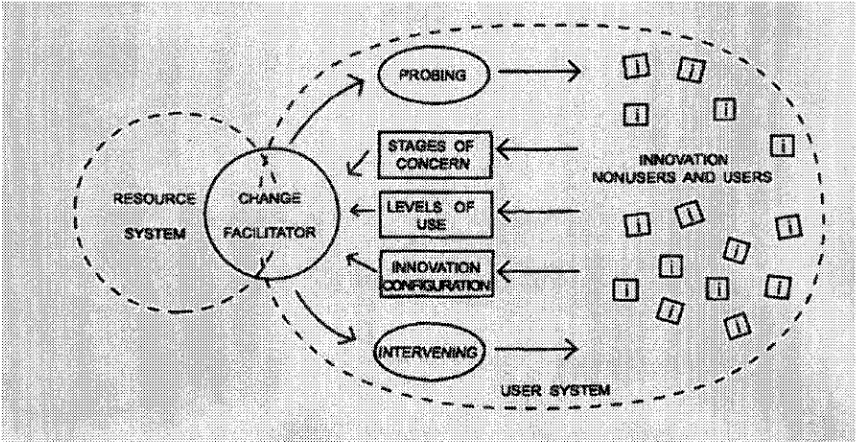
Hence, the CBAM identified the pre-conditions or the issues that a change facilitator needs
to be sensitive to, in order to understand how the change is being perceived and that some
change can be anticipated. The diagrammatic CBAM in Figure 2.2 below, as developed by
the CBAM project team illustrates the relationship between the diagnostic tools for the
[image:35.560.56.487.354.575.2]change facilitator.
Figure 2.3 Concerns Based Adoption Model (Hord et al., 1987, p. 10)
As a contemporary theoretical framework that explains and predicts likely teacher
tools for studies about educational innovations and change. They include the Stages of
Concern or SoC (Hall, George and Rutherford, 1977), Level of Use or LoU, (Loucks,
1975) and the Innovation Configuration or IC, (Hall and Loucks, 1981). The first two
dimensions are explanatory and focusing on the implementation, whilst the third is
diagnostic, developed much later and focuses on the nature of the innovation itself. Each
dimension has its own research method and instrument to collect and present the analysed
data. As this research study is concerned only with only the first two dimensions, they are
summarised below in Table 2.3.
Table 2.3
Stages of Concern (Hall, George, and Rutherford, 1977) and Levels of Use (Hall, Loucks, Rutherford, and Newlove, 1975)
Stages of Concern Levels of Use
0 Awareness 0 Non-use
1 Informational I Orientation
2 Personal II Preparation
3 Management III Mechanical use
4 Consequence IVA Routine
5 Collaboration IVB Refinement
6 Refocusing V Integration
VI Renewal
Stages of Concern
The Stages of Concern [SoC] (Hall, George and Rutherford, 1977), describe how teachers
or any adopters perceive an innovation and their feelings about it. The purpose of this
affective SoC dimension is to analyse feelings, observations, problems, successes, and
failures whilst progressing through the change process. The stages were not mutually
exclusive, but the intensity of specific stages varied as implementation progressed. It uses
a set of seven to describe teachers' concerns about the innovation. The instrument used is a
questionnaire, (see Appendix DI) with a set of scales to prepare both numerical and
graphical representations of the type and strengths of participants' concerns in the SoC Quick Scoring Device, (reproduced in Appendix
The strength of the SoC model is its application to monitor implementation of educational
innovations in staff development planning (Hord, 1987). Change facilitators are able to
determine the readiness of individuals to embrace an innovation. It requires attention to the
individuals' needs for information, assistance and support prior to a focus on the impact of
the innovation. The concerns model, originally proposed by Fuller in the 1960's abstracted
to 'self (Stages 0, 1), 'task' (Stages 3, 4) and 'impact' (Stages 5, 6) served as a basis for
the development of the SoC stages (Hall, George, and Rutherford, 1977, p. 12). Table 2.4
brings together the stages of concern, and the typical expressions of concern about an
— 4 Consequence
5 Collaboration
Impact
[image:38.559.76.497.124.728.2]6 Refocusing
Table 2.4
Types of concern, stages of concern about the innovation and typical expressions (compiled
from Hall and Hord, 2001, pages 61-63)
Types Stage of Concern — 0 Awareness
Typical Expression of Concern
Jam not concerned about it
Little concern or involvement with the innovation is indicated.
I would like to know more about it.
A general awareness of the innovation and interest in learning more detail about it is indicated. The person seems to be unworried about himself/herself in relation to the innovation. She/he is interested in substantive aspects of the innovation in a selfless manner such as general characteristics, effects, and requirements for use.
How will using it affect me?
Individual is uncertain about the demands of the innovation, his/her inadequacy to meet those demands, and his/her role with the innovation. This includes analysis of his/her role in relation to the reward structure of the organisation, decision making, and consideration of potential conflicts with existing structures or personal commitment. Financial or status
implications of the program for self and colleagues may also be reflected.
1 Informational
Self
2 Personal
3 Management I seem to be spending all my time in getting material ready.
Attention is focused on the processes and tasks of using the innovation and the best use of information and resources. Issues related to efficiency, organizing, managing, scheduling, and time demands are utmost.
Task
How is my use affecting kids?
Attention focuses on impact of the innovation on student in his/her immediate sphere of influence. The focus is on relevance of the innovation for students, evaluation of student outcomes, including performance and competencies, and changes needed to increase student outcomes.
Jam concerned about relating what Jam doing with what other instructors are doing?
The focus is on coordination and cooperation with others regarding use of the innovation.
I have some ideas about something that would work even better?
The focus is on exploration of more universal benefits from the innovation, including the possibility of major changes or replacement with a more powerful alternative. Individual has definite ideas about alternatives to the proposed or existing form of the innovation.
Interpretation of Stages of Concern profiles
In a school setting, the Stages of Concern (Hall, George and Rutherford, 1977), profile can
be drawn from the data collected. As discussed in the manual (Hall et al., 1977),
interpretation ranges from the simplest form (to identify the highest stage score), through to
the complex profile (wherein the highs and lows of the percentile scores for all seven stages
are drawn). The higher the score, the more intense are the concerns, although the higher
and lower scores are not absolute, being relative to other stage scores for the individual.
According to the authors of this instrument, there are two ways to treat group data. One is
to tally the number of individuals who are high on each score. Another way is to aggregate
group data by developing a concerns profile that presents the mean scores for the group. The authors' (Hall et al., 1977, p. 41) caution that the "more individuals are aggregated, the
less likely the mean is to be representative of the individual scores" is an important
consideration for the present study. Normally, group averages reflect the dominant high
and low SoC of the composite group; however, individual highs need to be checked first in
the event that there are distinct subgroups. This can be the first straightforward translation
of the group data, wherein a frequency count can be provided of high stage scores (Hall et
al., 1977).
As it is possible to have concerns at more than one stage at a time, and at various
intensities, this array of concerns is reflected graphically in a concerns profile. The stages
of concern are represented on the horizontal axis. The relative intensity of the concerns
is represented on the vertical axis. The peaks indicate stages that are more intense and the
troughs show the less intense stages. Analysis of the concerns profiles, either in tabulated
For example, in a concerns profile that is representative of a non-user or an early user in an
innovation process, that person has the greatest concerns at Stage 1 (Information) and Stage
2 (Personal) as described in Table 2.4 above. This concerns profile indicates the need for
more knowledge about the innovation itself and about the personal impacts. Therefore, this
person is less concerned with Stage 3 (Management) and even less concerned with the
consequences of Stage 5 (Collaboration) or how the innovation will impact on students or
be modified and used in the future with Stage 6 (Refocusing). If the person becomes more
experienced with the innovation over time, the self concerns decrease and the task or
management concerns increase (Hall, George and Rutherford, 1977).
As Hall and Hord (2001, 65) explain, the typical concerns profiles collected over time
extend the snapshots into a motion picture, wherein there is a hypothesized pattern of
"wave motion" as a change process unfolds as it is intended. Following first use of the
innovation, self concerns diminish and task concerns become more intense. Within time,
impact concerns increase in intensity. At that time, self and task concerns decrease. Figure
2.4 presents a graphical representation of this normalised and rounded wave motion pattern
for the stages of concern in the implementation of an innovation and change process.
As such, with typical stages guiding the understanding, the researchers intended that the
interpretation of the profiles could be an effective guide to facilitate the implementation of
staff development planning or a change process at any particular time in the life-cycle of
the implementation of an innovation. Then, analysis of the concerns profile could enable
concerns-based interventions to resolve the concerns and move the individual or the group
In forma tio na l a a 2 ,.. r.. .- .- .- - -... -.... ... -... ••:' .... ■ -
_
.. ....- 4/
N .s o d er l i dr % ■ • A_
....•
."/ -
/..,/'
•
•
•• i
..
%_.
..
■
-' /-- S —
S. .
/
.•"-
N: A
k ' • • . ‘••■ ._ _ ... %.„„, - . - .., , „. • .; ' • • • / ■• .* - .• • •• . .* — — _ - _ 100 0 ; CC 20
2
8
Self Task Impact
1 2 3 4 5
Stages of Concern
Nonuser
Inexperienced User
[image:42.560.64.484.62.501.2]Experienced User Renewing User =18
Figure 2.4 SoC Stages of Concern (Hall and Hord, 2001, p.56)
Techniques for assessing stages of concern
Monitoring of any change process included three ways to assess the concerns: the
One-Legged Interview, the Open-Ended Concerns Statements and the SoC Questionnaire. Over
the decades of CBAM research documenting the interventions by school principals and
small unnoticed interventions that they call incidents or critical opportunities whereby the
change facilitator has a conversation or 'one-legged interview' with an innovation user.
Another intervention is the task of asking teachers to write a description of their concerns
when given a blank piece of paper that has the following statement written at the top:
When you think about [the innovation] what concerns do you have? Please be frank and answer in complete sentences.
This simple technique described in the manual by Newlove and Hall (1998) and used to
provide a description of the concerns that can be content analysed is a useful tool with
many strengths (Hall and Hord, 2001). It is a well-recognised technique for trainers or
commonly used by professional development facilitators, for example, when endeavouring
to understand expectations of the participants at the outset of a workshop, however; it is a
technique that can be used at any time. Further, a very effective validation strategy for a
workshop presenter is to match the feedback from participants at the end of the workshop
to ascertain is their concerns have been effectively targeted. Newlove and Hall (1998) cite
Hall's own earlier comments:
Educators would like to think that they always function at the impact concern level. However, it is a basic finding of [our] research that almost everyone, when first confronted with a "new innovation", will have relatively intense personal and informational concerns. It is important to recognise that self-concerns are a fully legitimate part of change. Rather than indicting people for having self self-concerns, the role of the adoption agents and policy/decision-makers should be to aid in the resolution of self concerns and to facilitate movement toward task- and impact-related concerns. When planning for innovation implementation, managers of change need to anticipate self concerns and initiate actions to accommodate and resolve them at the outset of the innovative effort. The crime is in not having self concerns, but in others not accepting their legitimacy and constructively addressing their resolution.
(Newlove and Hall, 1998, p. 3)
In terms of reliability, there are two key potential disadvantages with this technique. The
simply a few dot points or nil information, turning in a blank sheet. Second, assessors may
not agree or be trained on the content analysis.
In contrast to the Open-Ended Concerns Statements, the Stages of Concern Questionnaire
(See Appendix VI) is a rigorous technique for measuring concerns. According to Hall and
Hord (2001, p. 68), the thirty five item questionnaire has strong reliability estimates
(test/retest reliabilities from .65 to .86) and internal consistency (alpha co-efficients range
from .64-.83 Constructed to apply to any educational innovation, the thirty five questions in
the questionnaire can stay the same, except for the small change of inserting the name of
the innovation. The SoC Questionnaire is used to construct 'concerns profiles'. Such a
technique has both strong reliability and validity, being able to be used for formal
implementation assessments. The only disadvantage is that it involves a questionnaire
which can develop resistance in a program evaluation if is used too often. Using the SoC
Quick Scoring Device (Appendix VIE) the raw score obtainable for each stage is converted
using a percentile table to develop the graphical representation.
Levels of Use
In contrast to the affective dimension of the Stages of Concern Questionnaire, the Levels of
Use (LoU) is a behavioural dimension, representing how respondents are acting with
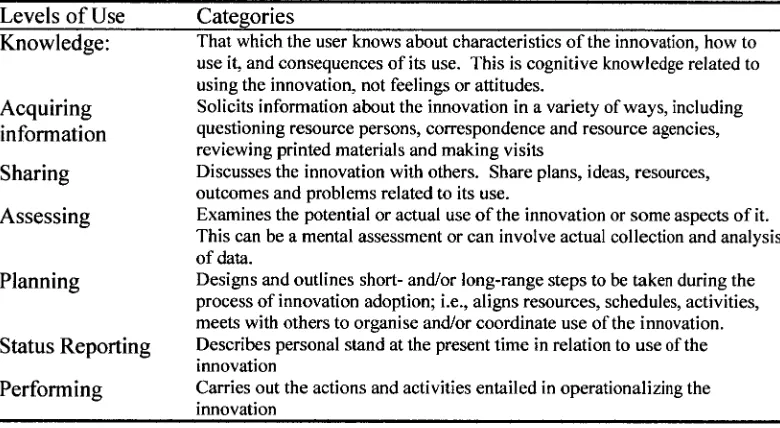
respect to change. Table 2.5 indicates the levels of use of the innovation by identifying the