Reducing Emissions
in Croatia
- the Costs of
Mitigation
Chapter 12
12
Archived
at
Reducing Emissions in Croatia – the Costs of Mitigation
Chapter 12 Summary
In order to avoid dangerous climate change resulting from an increase in temperature of over 2ºC, global GHG emis-sions must be cut by 50-85% by 2050. Croatia’s trajectory for emisemis-sions growth in the Business as Usual (BAU) case is estimated to result in 42 million tonnes of CO2e in 2020 – a significant increase from today. The EU has committed to
reducing emissions by 20% by 2020. Croatia has committed to reducing emissions by an average of 5% for the period 2008-2012 from a baseline level of 36 million tonnes under the Kyoto Protocol. Croatia will also share at least part of the EU commitment for 2020, especially with respect to emissions from major point sources such as power plants and industrial sources.
The energy sector is the largest source of GHG emissions in Croatia (73% in 2006). There are many potential measures to reduce emissions from the energy sector by 2020. It is estimated that by implementing the measures in the Energy Efficiency Master Plan, 1% of the national GDP could be saved. Emission reductions from households and the service industry could amount to almost 2 million tonnes by 2020 with a net economic benefit from energy cost savings. Indus-trial efficiency measures could also have a positive financial impact on companies. Producing electricity from renewable resources, increasing the efficiency of conversion and transmission, and – more controversially – moving to more nuclear power and electricity generated from burning waste, could yield significantly fewer emissions. Reducing fuel consump-tion in transportaconsump-tion through fuel-efficient vehicles, lower-carbon fuels, using biodiesel or other biofuels, or reducing car travel through better urban planning, public transportation, and traffic systems are also potential areas where emissions can be cut.
The agricultural sector accounts for almost 11% of Croatian emission (2006). Agriculture can play a role in reducing direct emissions from agricultural soils and improved livestock and manure management. Agriculture also has an indirect impact on emissions due to fertiliser production and emissions from transport. Finally, agriculture can have an impact on mitigation due to land use, land use changes and forestry (LULUCF) activities related to converting arable land to grassland or forests, converting drained arable land back to wetlands, or increasing soil in carbon storage management practices.
Industrial processes were responsible for approximately 13% of Croatia’s emissions in 2006. Within the industrial pro-cesses sector, cement-related emissions reductions can be achieved using measures, such as increasing the amount of clinker in cement to EU standards and through indirect measures, such as incinerating waste materials for energy and building concrete rather than asphalt roadways. Additionally, changing the industrial process for manufacturing nitric acid can also lead to significant reductions. Reducing the emissions from fertilizer and lime production may also be an option, but no information is available on the potential savings in Croatia.
The waste management sector was responsible for a little under 2% of total emissions in 2006. Emissions can be re-duced in the sector by utilising landfill methane as a source of energy/ electricity.
LULUCF measures in Croatia also present significant possibilities for reducing net emissions. In 2006, land use changes amounted to an estimated net reduction of 7.5 million tonnes – almost a quarter of Croatia’s emissions. However, only approximately 1 million of this can be counted in international negotiations. Further, carbon sequestration in soils due to agricultural practices could have significant impacts, both on soil quality and on the net emissions from Croatia.
12.1. Introduction
As shown in Section 2, Croatia may face serious con-sequences from climate change that will affect indi-vidual economic sectors and human development as a whole. Croatia will also be required to reduce its emissions of greenhouse gases. In order to avoid dan-gerous climate change – an increase of more than 2ºC – world experts believe that the CO2eI concentrations
I CO2e is an abbreviation for carbon dioxide equivalent, which in-cludes both CO2 and other greenhouse gases (by reflecting the
relative impact that the other gases have on global warming com-pared to CO2). All gases have been expressed in terms of CO2e for
this chapter for the sake of simplicity and to reflect international practice.
II The OECD is the Organisation for Economic Cooperation and De-velopment and represents 30 of the largest economies of the world that comprise over 60% of global GDP. See www.oecd.org.
Box 12-1: Croatia’s emissions in comparison to other countries and obligations upon entering the EU
Croatia is somewhere in between the “developed” and “developing” classification in terms of emis-sions. OECD countriesII – which can be described as
“developed countries” – had an average emissions level of 11.4 tonnes per person in 2005 (10.8 tonnes/ person in 1990).4 In contrast, developing countries
had emissions rates of 2.4 tonnes per person in 2005 (1.7 tonnes/ person in 1990).5 With a population of
4.44 million people,6 Croatia emitted 6.94 tonnes
per person in 2006 – not including land use chang-es. When land use changes are considered, Croatia was responsible for 5.26 tonnes per person in 2006 because of the growth of forests.7 In order to avoid
dangerous climate change, Croatia, along with the rest of the world, will have to be a part of the solu-tion. Without a successful global effort to drastically reduce emissions, Croatia and the world will face more severe consequences.
Croatia’s obligation once it enters the EU is not yet known. It will probably constitute part of the final accession negotiation. The EU has a new burden sharing methodology for reaching the 20% reduc-tion target collectively. This imposes different
indi-vidual targets for EU countries, taking into account the economic strength of the country. For sources of GHGs not covered by the European Trading Scheme (ETS) the range of obligation in the EU is +20% to -20% - i.e. some countries will be allowed to increase emissions up to 20% and some will be required to cut emissions by as much as 20%. Croa-tia will be allowed to increase its GHG emissions in the non-ETS sector by 15-17%, compared to 2005.
In the EU-ETS sector mostly major emitters at one location (such as power plants, oil refineries, etc.) there will be a single EU-wide cap instead of different caps for each member state. In total, a 21% reduction compared to 2005 emissions will be required in the ETS sector. The basic principle for allocation will be auctioning, which will be open to all member states equally. The power sector will have to buy all alloca-tions to emit GHGs through an auction process and industry sources will have some free allocations. Ex-ceptions, possibly higher levels (up to 100%) of free allocation to industries particularly vulnerable to international competition (‘carbon leakage’) will be determined in 2010.
Figure12-1: Windmills on the island of Pag.
in the atmosphere must not exceed 450 parts per mil-lion (ppm). Currently, the levels are at 380 ppm and rising by 1.9 ppm per year. Pre-industrial levels were approximately 275 ppm.1
The IPCC states that, in order to accomplish this, by 2050, global emissions must be cut by 50%-85%. Be-cause of population growth, this will mean that emis-sions throughout the world must be cut to a maximum of 2 tonnes per person.2 The Stern analysis, along with
the most recent global HDR,3 outlines two different
paths for countries striving to reach this goal. The first path would be taken by “developed countries” – re-quired to reduce emissions by 25-40% by 2020 and by 80% by 2050. The European Union has already com-mitted to reducing emissions by 20% by 2020, but is ready to increase this reduction to 30% if other indus-trial countries will agree to cut their emissions.
Croatia has already begun the process of reducing emis-sions – having committed to reducing emisemis-sions by 5% compared to 1990 levels by 2012 under the Kyoto Pro-tocol. In 1990 Croatian emissions were 32.527 million tonnes of CO2e.8 However, because much of its electricity
was imported from other parts of the former Yugoslavia, these were very low emissions rates that did not allow for economic growth. Croatia has therefore negotiated that the base-year level be set at 36.027 million tonnes of CO2e – 3.5 million tonnes more than the actual levels.9
This means that Croatia has a target of 34.225 million tonnes for 2012, not including land-use changes.
Croatia’s GHG emissions in 2006 (the last year for which data is available) amounted to 30.834 million tonnes CO2e, (a 14.4% reduction compared to the agreed-upon
baseline value under the Kyoto Protocol and a 5.2% re-duction in emissions in comparison to actual 1990 emis-sion levels). This number does not include the amount of GHG emissions removed by carbon sinks – mostly increasing forest biomass. For the last five years the
aver-age increase in GHG emissions has been 1.7 % per year, III These four sectors that emit GHGs represented over 99% of all emissions in Croatia in 2006. the main reason for this being the increase of emissions from the energy sector.10
While many different aspects affect Croatia’s emis-sions, the primary sectors are:
- The energy sector (73.13% of 2006 emissions) – including transportation, production of electric-ity, manufacturing and industry energy produc-tion, and fugitive emissions from oil/ natural gas/ coal production.
- The agricultural sector (11.37% of 2006 emis-sions) – including from livestock, manure man-agement and soil manman-agement.
- Industrial processes (12.99% of 2006 emissions) – including mostly cement production, lime duction, ammonia production, nitric acid pro-duction and consumption of chemicals that are potent GHGs in refrigeration and air conditioning equipment.
- Emissions from waste sites (1.92% of 2006 emis-sions) – mostly methane gas released from land-fills.III
- Land use changes (-24.29% of 2006 emissions) – cre-ation of carbon sinks due to the expansion of forests.
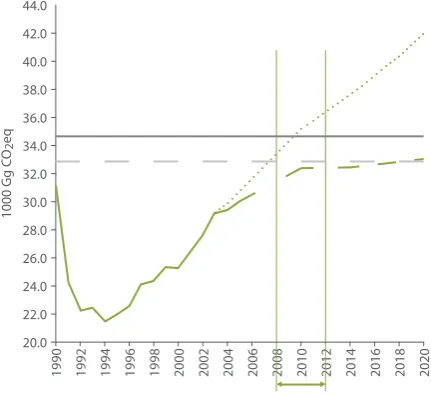
However, this is the current situation. In analysing what Croatia can do to reduce emissions by 2020, it is neces-sary to have a basic idea of what could happen if no steps are taken to reduce emissions – the BAU scenario. Under this scenario, the MEPPPC estimates that emis-sion levels (not counting changes in land use and sinks from forests) would reach approximately 42 million tonnes of CO2e by 2020 – an increase of 16.6% from the
There are many measures that can be introduced to reduce emissions, and the latest National Communi-cation on Climate Change suggests that emissions can be stabilized by 2020.12 No estimates are given within
this document for how much this stabilization would cost Croatia. Furthermore, no estimate is given for the maximum amount of emissions reductions that would be possible, if the best-case scenario occurred and all reduction measures were introduced successfully.
In order to analyse the economic impacts of mitiga-tion measures, this chapter uses the available informa-tion on the likely costs of various emissions reducinforma-tions in Croatia. Most of this analysis was undertaken using research carried out under the LIFE-funded project, which analysed the marginal costs for various mea-sures to reduce emissions in various sectors.13 The
costs per tonne of reduction represented are derived mostly from Ekonerg’s analysis of marginal costs for 2012. Although these costs are likely to change for 2020, this chapter uses those costs to provide a gen-eral range of reduction costs, rather than a definitive number (See Box 12-2 for more on the methodol-ogy of calculating costs). It is important to note at the outset that for certain measures, there may be other economic benefits from participating in the European Trading Scheme (ETS), which has an aver-age value of EUR 25 per tonne of carbon. There are also other international voluntary schemes where financial resources may be made available for miti-gation measures. This would mean that any measure with a marginal cost of less than EUR 25 per tonne of reduction might actually be profitable for actors that implement them if they can sell the credits on the market.
The purpose of this chapter is to give a basic outline of the types of measures that could be introduced to reduce net emissions, how many net emissions could be reduced by 2020 under a “best case scenario,” and what the general range of costs for those emissions reductions would be. No single number can answer the question – how much would it cost Croatia to re-duce its emissions by 20-30% by 2020. However, this chapter provides suggestions for moving forward that would not overly burden the economy and restrict hu-man development.
Removals (LULUCF) Solvent and Other Product Use Energy Agriculture
Industrial Processes Waste
1990 1995 2000 2001 2002 2003 2004 2005 2006 Year
-10000 -5000 0 5000 10000 15000 20000 25000 30000 35000
Tonnes of C
O2eq
[image:5.609.51.271.105.413.2](x1000)
Figure 12-2: GHG emissions from various sectors in Croatia.
Figure 12-3: Likely emissions scenario for Croatia until 2020 – 2008 to 2012 is the period for the Kyoto Protocol.
The dotted line represents the current projections of emmissions under BAU scenario. The dark striped line represents the projections of emmissions if Croatia introduces measures to reduce emmissions and stabilise them by 2020.
20.0 22.0 24.0 26.0 28.0 30.0 32.0 34.0 36.0 38.0 40.0 42.0 44.0
1990 1992 1994 1996 1998 2000 2002 2004 2006 2008 2010 2012 2014 2016 2018 2020
1000 Gg C
O2
eq
Source: MEPPPC 2008b.
[image:5.609.56.272.532.729.2]Box 12-2: Methodology for calculating emissions reduction potentials and costs
To calculate the likely costs/ benefits of reducing emis-sions, this analysis focused solely on 2020. The basic concept is to take how much CO2e can be reduced by
a certain measure in that year. Then multiply the total potential reduction by the cost of reduction per tonne of emissions (marginal cost of reduction of CO2e). If the
measure actually has a net benefit – i.e. it is cheaper than carrying out a process that emits more carbon – then the marginal cost of reduction is negative. Energy efficiency measures are a good example of this. Own-ing a fuel-efficient car or usOwn-ing compact fluorescent light-bulbs (CFLs) saves money over a short time span. On the other hand, if a measure costs extra money – such as replacing coal fired power plants with solar photovoltaic cells – the measure has a positive mar-ginal cost for reduction of CO2e.
Most of the numbers for potential emissions reduc-tions were taken from Ekonerg’s series of top-down models and studies for the LIFE project in 2006 and 2007. In some areas the potential of the reduc-tion measures were only available for either 2015 or 2012. The annual marginal costs of reduction for most measures were calculated in the Ekonerg studies utilizing capital costs, operational costs, and a discount rate of 4%. In those cases, the reduction potentials from previous years were assumed to be the same for 2020 – though they may be larger.
The costs associated with these measures should be considered as rough estimates only. This is
be-cause the initial model was based on a timeframe until 2012, whereas this analysis is looking at 2020. Additionally, these estimates did not include the administrative and institutional costs associated with implementation – which may be large in the households and services sector. Because of this and other uncertainties in cost, this analysis took the estimated values plus/ minus EUR 10 per tonne. In certain cases where the initial capital costs would be significant, the timeframe for overall use, once the measure becomes operational, would be more important (such as solar, wind, and nuclear energy production), estimates were taken from the IPCC’s most recent assessment of likely costs of mitigation for economies in transition.14 For the agricultural
sector an independent analysis was carried out for the purposes of this Report.
While exact numbers have been calculated for most measures, it is better to provide a range of potential values that reflect the uncertainty of costs – grouping them in terms of whether the measures might have a net economic gain, be close to cost neutral, be economically advanta-geous in the case of a cost of EUR 25 per tonne, or be more expensive.
12.2. Reducing emissions due to
energy use
The energy sector is the largest source of GHG emis-sions in Croatia – covering emisemis-sions from all activi-ties, including fossil fuel consumption and fugitive emissions from fossil fuel production, transport, pro-cessing, storage and distribution (See Figure 12-4).
Energy consumption in general is rising in Croatia, though in 2006 total energy consumption was slightly lower than in 2005. Within the energy sector, there are many important, new developments. First, energy efficiency can potentially play a vital role in Croatian energy policy. One of the goals of energy policy in the Republic of Croatia, defined in the Strategy of En-ergy Sector Development15 is to improve the overall
efficiency of energy production, central transforma-tion/ conversion, transmission/ transport, as well as energy consumption. However, as no implementation strategy for energy efficiency currently exists, energy savings and improved energy efficiency have not yet been achieved. Consequently, the total primary en-ergy consumption intensity (enen-ergy used per Euro of GDP) in Croatia is 20.1% higher than the EU-15 aver-age.16 This is a burden to both the national economy
and physical environment. It is estimated that approx-imately 1% of national GDP is wasted as a result of low energy efficiency. 17
As part of the EU accession process, Croatia is swiftly moving forward with its energy efficiency and renew-able energy plans. According to the EU Directive,IV
member states must adopt and aim to achieve an overall national energy savings of 9% in the ninth year of application of the Directive. The Croatian national target is calculated based on the average consump-tion of energy for 2001-2005. Therefore, Croatia must immediately begin to move forward with energy ef-ficiency measures (See Chapter 13 for more on energy efficiency activities in Croatia).
Furthermore, Croatia has committed to producing at least 5.8% of all its electricity from renewable energy sources other than major hydropower plants, by the end of 2010.18 This begins to put Croatia on the path
towards efficiency and greener energy. Croatia’s new energy strategy will identify numerous goals for renew-able energy production in order to meet predicted 2020 energy requirements. However, at the time of drafting this Report, this strategy had not been finalised. Emis-sions by energy sub-sectors are presented in Figure 12-4. Many potential measures exist to reduce emis-sions from the energy sector, which can be divided into the following categories: electricity production, energy use for industrial use, energy used by households and the service sector, and energy used for transport.
[image:7.609.60.506.567.750.2]IV Directive 2006/32/EC on energy end-use efficiency and energy services.
Figure 12-4: CO2 emission by sub-sectors from the energy sector in the period 1990-2006 (x 1000 tonnes CO2)
1990 1995 2000 2001 2002 Year
2003 2004 2005 2006 0
2,500 5,000 7,500 10,000 12,500 15,000 17,500 20,000 22,500 25,000
Total C
O2 emissions
Emissions from Energy Uses
Energy Industries
Commercial/Institutional, Residental, Agriculture/Forestry/Fisheries Transport (Road & Off-Road)
Manufacturing industries & Constr.
Natural gas scrubbing
The energy sector is the largest source of GHG emissions in Croatia
12.2.1. Measures in reducing emissions from electricity production
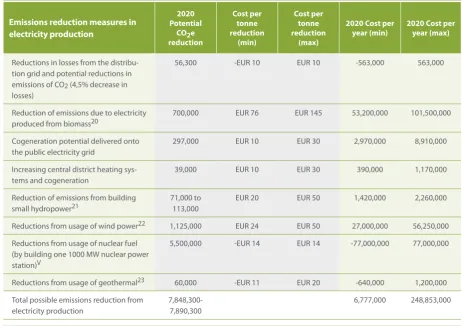
Electricity production generates GHG emissions through the burning of fossil fuels. The consumption of energy from electric and heat power production in thermal power plants, public heating plants and pub-lic cogeneration plants resulted in approximately one fifth of all emissions in Croatia in 2006. The basic ways to reduce emissions from production are to change the fuel, which drives electricity production, or to increase the efficiency of the production system. Changing the fuel involves shifting some electricity production to sources that do not emit GHGs (such as nuclear fuel), emit less GHGs (such as natural gas), or renewable sources (such as biomass that does not involve cutting down trees, solar electricity, wind energy, etc.). Reduc-tions due to decreased demand are also possible and discussed in section 12.2.2 and 12.2.4. The list of po-tential emissions reduction measures, their popo-tential
for GHG emissions by 2020 and the associated costs per tonne of reduction are listed in Table 12-1. As can be seen, numerous measures can be taken that have net costs close to zero, though this does not include implementation costs.
If all these measures were implemented, it would re-sult in a GHG reduction of 7.848-7.890 million tonnes. However, the majority of this reduction (5,500,000 tonnes) results from the construction of a new 1000 MW nuclear power station. This may not be the most sustainable or politically acceptable option, even if it would result in significant reductions. Where to put a nuclear plant and what to do with the waste are important questions that must be addressed using the principles of fairness and sustainability. Indeed, this is an issue being discussed for the recently pro-posed Energy Strategy. It should also be noted that the use of biomass for electricity production is very expensive.
V Cost estimates from IPCC (Sims et al. 2007) estimate for Economies in Transition for 2030.
Emissions reduction measures in electricity production
2020 Potential
CO2e
reduction
Cost per tonne reduction
(min)
Cost per tonne reduction
(max)
2020 Cost per
year (min) 2020 Cost per year (max)
Reductions in losses from the distribu-tion grid and potential reducdistribu-tions in emissions of CO2 (4,5% decrease in
losses)
56,300 -EUR 10 EUR 10 -563,000 563,000
Reduction of emissions due to electricity produced from biomass20
700,000 EUR 76 EUR 145 53,200,000 101,500,000
Cogeneration potential delivered onto the public electricity grid
297,000 EUR 10 EUR 30 2,970,000 8,910,000
Increasing central district heating sys-tems and cogeneration
39,000 EUR 10 EUR 30 390,000 1,170,000
Reduction of emissions from building small hydropower21
71,000 to 113,000
EUR 20 EUR 50 1,420,000 2,260,000
Reductions from usage of wind power22 1,125,000 EUR 24 EUR 50 27,000,000 56,250,000 Reductions from usage of nuclear fuel
(by building one 1000 MW nuclear power station)V
5,500,000 -EUR 14 EUR 14 -77,000,000 77,000,000
Reductions from usage of geothermal23 60,000 -EUR 11 EUR 20 -640,000 1,200,000 Total possible emissions reduction from
electricity production
7,848,300- 7,890,300
[image:8.609.99.562.407.733.2]Emissions reduction measure in industry
2020 Potential
CO2e
reduction
Cost per tonne reduction
(min)
Cost per tonne reduction
(max)
2020 Cost per year (min)
2020 Cost per year (max)
Use of biomass for energy use for industry and construction
100,000 -EUR 45 -EUR 25 -4,500,000 -2,500,000
Increased energy efficiency in industry and construction (including cogeneration)
800,000 -EUR 30 -EUR 10 -24,000,000 -8,000,000
Use of biologically-based waste products for energy use for industry - especially refuse derived fuel (re-used materials) of biological and fossil origin and dried sludge - especially in the cement industry
202,000 -EUR 10 EUR 10 -2,020,000 2,020,000
Increasing the energy efficiency of the process of clinker production
53,000 EUR 0 EUR 20 0 1,060,000
Reduction of emissions of CH4 by using
waste as an alternative source of energy in the production of cement and other industrial goods (removing the source of CH4)
130,000 Unknown Unknown Unknown Unknown
Pumping CO2 underground after
production (technology unproven)
500,000 Unknown Unknown Unknown Unknown
Total possible emissions reduction from energy use in industry
[image:9.609.55.511.379.701.2]1,785,000 -30,520,000 -7,420,000
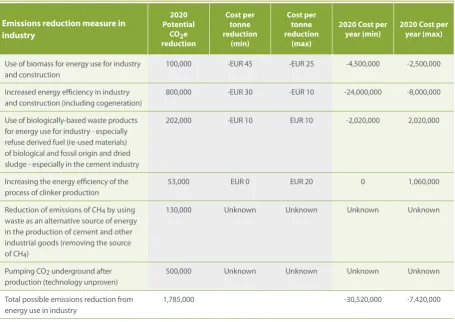
Table 12-2: Potential emissions reductions and costs per measure for the year 2020 from changes in energy use in industry 24
12.2.2 Measures in reducing emissions due to energy use in industry
Another area within energy where emissions can be reduced is in industry – by changing the way energy is produced or increasing efficiency. The possible mea-sures are outlined in Table 12-2. If all meamea-sures were introduced, the total emissions reduction during the year 2020 would be 1.785 million tonnes. Most of these measures are either cost neutral or would actu-ally have a positive impact on the balance sheets of in-dustries. This is because most use waste as a fuel (which does not have as high a purchase cost as, for instance, natural gas) or involve increasing energy efficiency.
It should be noted that the last measure noted in the table – pumping CO2 underground for Enhanced Oil
Recovery (EOR) purposes or into water, after
produc-tion – needs further analysis in Croatia, as its use as a long-term solution is questionable: Underground CO2
might seep out at a later date, essentially a postpone-ment of emissions. However, if this seepage occurs over a few centuries, this would not be a problem, as CO2 is not toxic if it leaks slowly. Additionally the
12.2.3. Measures in reducing emissions through changing energy use in households and the service industry
Better energy use within households and the ser-vice industry reduces emissions through a variety of mechanisms. The first and most economically advantageous way to reduce emissions is through energy efficiency. Energy efficiency measures can be used in the construction of new buildings, rede-signing the building envelopes (e.g. installing more insulation) and roofs, and introducing technology such as efficient light-bulbs (CFLs – compact fluo-rescent light-bulbs) and appliances, in both offices
and in households. Additionally, there are relatively inexpensive (in the long term) measures such as installing solar collectors and biomass heating sys-tems. Finally, the installation of photovoltaic solar systems and advanced solar systems is the most ex-pensive measure, though the potential exists for its implementation.
In total, emissions reductions from this sub-sector could be up to 1.981 million tonnes by 2020, with a net benefit of between EUR 57.8 million and 102.9 million for that year. This is mostly due to savings in energy use. However, while energy efficiency in households may have the significant potential to reduce emissions and be economically advantageous, the associated
Measures in households and the service sector
2020 Potential
CO2e
reduction
Cost per tonne reduction
(min)
Cost per tonne reduction
(max)
2020 Cost per
year (min) 2020 Cost per year (max)
Savings of electricity in households – due to lighting changes (CFLs)
416,000 -EUR 145 -EUR 125 -60,320,000 -52,000,000
Savings of electricity in households – energy efficient appliances
282,000 -EUR 145 -EUR 125 -40,890,000 -35,250,000
Savings of electricity in households due to reduction of consumption of electricity for heat
28,000 -EUR 145 -EUR 125 -4,060,000 -3,500,000
Reduction of heat losses - due to complete reconstruction of building envelopes
26,000 -EUR 40 -EUR 20 -1,040,000 -520,000
Reducing heat losses from roofs 4,000 -EUR 40 -EUR 20 -160,000 -80,000
Reducing heat losses from windows 22,000 -EUR 40 -EUR 20 -880,000 -440,000
Energy Efficiency in offices 461,000 -EUR 25 -EUR 5 -11,525,000 -2,305,000
Reducing heat losses on new buildings 134,000 -EUR 25 -EUR 5 -3,350,000 -670,000
Solar collectors for water heaters 20,000 -EUR 10 EUR 10 -200,000 200,000
Renewable energy use in offices 109,000 -EUR 10 EUR 10 -1,090,000 1,090,000
Use of biomass in small heating systems and households
379,100 EUR 10 EUR 30 3,791,000 11,373,000
Use of fuel cells and Photo-voltaic cellsVI 39,000 EUR 40 EUR 192 1,560,000 7,488,000 Solar energy - advanced systems 61,000 EUR 250 EUR 275 15,250,000 16,775,000
Total possible emissions reductions from measures in the households and services sector
[image:10.609.101.558.350.738.2]1,981,100 -102,914,000 -57,839,000
Table 12-3: Potential emissions reductions and costs per measure for the year 2020 from changes in energy in households and services 25
implementation costs (such as subsidies for CFLs, for construction costs, etc.) make this less economically attractive – though still beneficial. These savings will also rely on policies and energy efficiency standards for appliances and isolation materials, including build-ing codes for new buildbuild-ings with specific energy effi-ciency requirements. In addition, public information on energy efficiency will assist people in making the right choices. Product labels that clearly indicate energy con-sumption (and money saved) is one of the key tools. Most of these measures are underway to some extent in Croatia (see Chapter 13 for more on existing activities related to this).
12.2.4. Measures in reducing emissions through changing energy use in transport
As Croatia develops economically, more people are buying cars and driving. There are also more emis-sions from air and sea travel. Thus, the transportation sector represents a significant and growing portion of emissions – mostly from road transport. In 2006, transportation emissions were one fifth of all emis-sions in Croatia. Transportation emisemis-sions grew from 4.266 million tonnes per year in 1990 to 6.226 million tonnes in 2006 – which was largest increase for any sub-sector within energy during that period.26
Measures in the transport sector
2020 Potential
CO2e reduction
Cost per tonne reduction
(min)
Cost per tonne reduction
(max)
2020 Cost per
year (min) 2020 Cost per year (max)
Using vehicles with less emissions (140 gCO2/km)
200,000 -EUR 60 -EUR 40 -12,000,000 -8,000,000
Using fuels with less carbon - LPG and CNG versus diesel or gasoline
100,000 -EUR 10 EUR 10 -1,000,000 1,000,000
Using biodiesel 370,000 EUR 90 EUR 110 33,300,000 40,700,000
Using bioethanol and hydrogen cells 270,000 EUR 90 EUR 110 24,300,000 29,700,000
Measures in inter-city passenger transport - improving roads, encouraging railroad travel, sea and intermodal transport, decrease of traffic jams
96,000 Unknown Unknown Unknown Unknown
Measures in city passenger travel- building bike lanes, encouraging public transport, decrease of traffic jams
81,000 Unknown Unknown Unknown Unknown
Measures in goods transport - ensuring efficiency of motors/ low emissions, putting "spoilers" to decrease air resistance on vehicles, encouraging fuel efficient driving
460,000 Unknown Unknown Unknown Unknown
Total possible emissions reductions from measures in the transport sector
1,577,000 (940,000 in the cost
analysis)
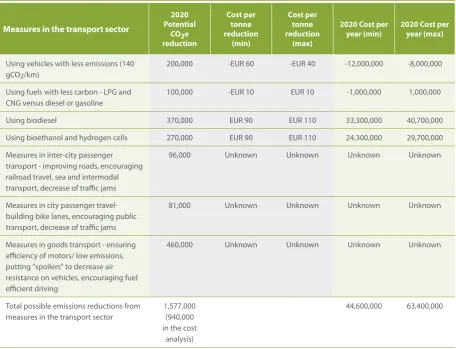
[image:11.609.54.511.317.666.2]Reductions in emissions from transport will require using vehicles (including public transportation vehi-cles and goods transport vehivehi-cles) that are more fuel effi-cient, changing fuels to less carbon intensive fuels, using biodiesel or other biofuels, or by reducing the amount of kilometres travelled by cars in general. Reducing the emissions per kilometre travelled by personal vehicles to 140 gCO2/ km (from 2003 levels of approximately 164
gCO2/km)27 would achieve large cost effective savings.28
This level 140 gCO2/km is approximately the emissions
for vehicles that use 4.5 litres per 100 km of regular gaso-line and 5 litres of diesel per 100 km.
While Croatia does not produce cars, the Govern-ment can have significant influence over the type of cars that are bought and sold through fees on carbon and other emissions, requiring better labelling of fuel economy, encouraging fuel efficient driving habits, etc. Additionally, there is a large level of potential emissions savings by switching fuels from gasoline or diesel to compressed natural gas (CNG) or liquid petroleum gas (LPG) – both of which are produced in relatively small amounts in Croatia but can be import-ed. The same is true for biodiesel – for which there is a production capacity of 20,000 tonnes per year in Croa-tia.29 It should be noted that in this analysis, the costs
for utilising biodiesel, bioethoanol, and other biofuels is considered the same. This is probably not actually the case,30 but given the level of uncertainty in future
price, it is the estimate used in this calculation.
In total, implementing all measures would lead to re-ductions of over 1.5 million tonnes per year in 2020 (See Table 12-4). It is important to note that the measures for which the cost is unknown are probably good practices for the sustainable development of cities and transpor-tation in general. Encouraging alternative (non-auto) transportation and effective inter-city/ intra-city traffic flows is desirable regardless of climate change.
12.3. Reducing emissions in the
agricultural sector
12.3.1. Global GHG emissions from agriculture
One sector where emissions reductions are only just beginning to be examined in Croatia is agriculture. Agriculture is a significant source of nitrous oxide and methane emissions – both GHGs.31 Agricultural soils
and livestock directly emit GHGs, while indirect emis-sions come from fossil fuel use in farm operations, the production of agrochemicals and the conversion of land from forests to fields.32 In 2004, direct emissions
from agriculture represented 13.5% of all global an-thropogenic GHG emissions.33 The total global
con-tribution of the agricultural sector, including all direct and indirect emissions, is estimated at 8.5-16.5 billion tonnes of CO2e – 17% to 32% of all global man-made
GHG emissions.34 In the EU (excluding Bulgaria and
Romania), agricultural direct emissions contributed to 9.2% of the total GHG emissions in 2004.35
Livestock farming and fertiliser use are by far the two most significant sources of GHGs from agriculture, while enteric fermentation and ruminant livestock (cattle, sheep and goats) produce methane, con-tributing to about 60% of all global methane emis-sions.36 Manure usage, storage and decomposition
To date, carbon losses from agricultural soils have not been reported in the national GHG inventories. How-ever, these are substantial and in the EU-15 have been estimated at 10-20 million tonnes of CO2e per year,
adding 4-8% to GHG emissions in the EU-15.37
12.3.2. GHG emissions from Croatian agriculture
In 2006, the Croatian agricultural sector emitted 3.5 million tonnes of CO2e – 11.4% of the country’s
an-thropogenic GHG emissions in that year.38 In the
pe-riod 2001-05, livestock farming was responsible for a little over half of the direct GHG emissions from ag-riculture, while crop production produced the rest.39
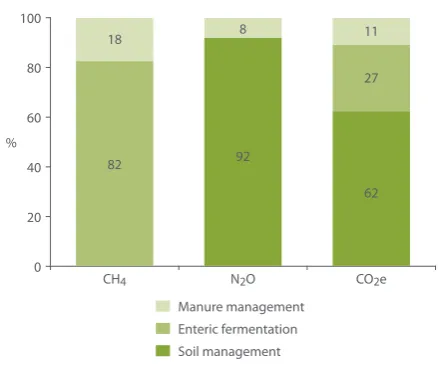
Most methane is produced from enteric fermentation (of which cattle produce the most – see Figure 12-5). The vast majority of nitrous oxide emissions resulted from current soil and manure management practices.
The biggest single source of GHGs in agriculture was from fertilisers applied to agricultural land, followed by the enteric fermentation from cattle, crops (nitro-gen-fixing crops, crop residues and related nitrogen leaching), and manure management (See Figure 12-6 for all of the categories). Besides the emissions pre-sented in Figure 12-6, two additional sources of GHGs result from agriculture: the burning of residues and carbon losses from agricultural soils. Burning agricul-tural residues is prohibited in Croatia and is thus not included in the national GHG inventory.40 While some
farmers still practise this, these emissions have been estimated at about 1000 tonnes of CO2e per year – a
[image:13.609.295.502.410.624.2]very small amount. The UNFCCC does not require car-bon losses from agricultural soils to be reported in the national GHG inventories. These have been estimated at 1.179 million tonnes per year in Croatia, adding an additional 35% to emissions from farming.41
Figure 12-5: GHG emissions by gas and management/ natural process.
0 20 40 60 80 100
%
Manure management Enteric fermentation Soil management CH4
82 18
N2O
92 8
CO2e
[image:13.609.53.273.436.623.2]62 27 11
Figure 12-6: GHG emissions by source.
Enteric ferm. cattle 23%
Crops 16%
Grazing 3% Others 7%
Enteric ferm. others 3%
Manure from soil 7%
Manure mngm. 3% Fertilisers
30%
12.3.3. Croatian GHG agriculture emissions forecast
Future GHG emissions from the Croatian farming sector are very difficult to estimate for a number of reasons:
1. Croatian agriculture is still at a crossroads, strug-gling to accommodate both numerous small-scale family farms and large-scale agricultural compa-nies. Its future development is unclear.
2. In 2000, Croatia had half the livestock of the 1980s.42
The Government has initiated several programmes aimed at increasing livestock numbers43 and this
policy is likely to continue. Consequently, GHG emissions – notably methane – would increase.
3. The consumption of fertilisers decreased by almost a third during 1999-2006. By subsidising the price of natural gas for fertiliser production44 and by
forcing the sole domestic fertiliser manufacturer (Petrokemija) to sell fertiliser below the market price,45 the Government has stimulated higher
consumption. As this policy will probably continue, fertiliser consumption is likely to remain the same or increase – resulting in similar or increased ni-trous oxide emissions.
4. The EU Nitrates Directive forces Croatia to improve its manure management and to reduce nitrogen losses. With the assistance of the World Bank, the Government has already started related pilot proj-ects.46 It is very likely that in the near future
ma-nure management in Croatia will be substantially improved, resulting in lower GHG emissions from manure.
5. The Croatian organic farming sector has expanded rapidly in recent years. During 2000-2007 the area farmed organically increased from 13 to 7,577 hectares, but this still represents only 0.62% of all agricultural land in Croatia. Increasing the practice of organic farming could reduce GHG emissions (See Box 12-3).
Croatia’s latest report to the UNFCCC47 presents an
as-sessment of the mitigation potential for Croatia and GHG emissions scenarios until 2020. Overall, in the BAU sce-nario, GHG emissions are projected to increase 13% by 2020 – up to around 3.9 million tonnes in agriculture.
12.3.4. Possible mitigation measures
Agriculture can play a role in climate change mitiga-tion through three mechanisms:
1. By reducing GHG emissions from agricultural soils, livestock and manure management (e.g. reduced or more efficient use of fertilisers, prevention of ni-trogen leaching from soil, improved manure man-agement, reduction or replacement of ruminants
Box 12-3: Mitigation potential of organic farming
Organic farming contributes to the reduction of greenhouse gas (GHG) emissions because it re-duces the consumption of fossil fuels (notably those used in fertiliser manufacturing), reduces emissions of CO2, methane and nitrogen oxides
and reduces the vulnerability of soils to erosion, while at the same time increasing carbon stocks in the soil.48 Consequently, conversion to organic
farming is considered a viable way of reducing GHG emissions. Depending on the commodity produced, organic farming emits 6-31%,49 18%,50
29-37%,51 or 48-60%52 less GHGs than
non-organ-ic farming. Average CO2 emissions per unit area
from organic beef are 57% lower than for non-organic production.53 However, if there are
sub-stantially lower yields, organic farming results in higher GHGs per kg of product.
Numerous studies have shown that, despite their reliance on frequent mechanical weed control, organic farming systems can increase soil organic matter stocks.54 One study55 also found that
be-sides the total carbon, organic farming results in more particulate organic matter (fine fraction of soil organic matter which is difficult to form) than conventional farming. Various long-term trials have shown that the annual carbon increase in soil from organic farming is 12-28%.56 Surprisingly, the
“biodynamic”VII treatment accumulated the most
amount of carbon in the soil despite the fact that it was supplied with about 20% lower organic matter in manure than other manure-based treatments.
with other livestock, a less nitrogen-rich diet for livestock, less burning of crop residues, etc.).
2. By reducing its indirect emissions, notably those arising from fertiliser production, transport and application.
3. By restoring natural vegetation (e.g. converting arable land to grassland or forests or converting drained arable land back to wetlands), or by en-hancing carbon storing management practices (e.g. the inclusion of grassland crops in arable ro-tations, reduced soil disturbance, avoiding bare soil, etc.). This mechanism can be regarded as a change in “Land Use, Land Use Changes and For-estry” which must be officially recognized in inter-national negotiations for Croatia to gain credits for this reduction. However, the analysis in this Report demonstrates the tremendous mitigation possibility of this measure. (See Section 12.6)
In Croatia, all three mechanisms are likely to have a positive mitigation effect. The second measure, how-ever, cannot be regarded as a direct mitigation mea-sure of the agriculture sector, since the mitigation ac-tion has to be tackled primarily by the industrial sector and the transport sub-sector of energy.
12.3.5. Possible mitigation scenarios for agriculture
This Report presents seven possible mitigation sce-narios. They are based on different approaches and technologies that could theoretically be applied to realise mitigation effects:
1. The “BAU (business as usual)” scenario assumes the continued gradual development of high-input agriculture, resulting in a 20% increase in livestock numbers and a 20% increase in fertil-iser consumption by 2020.
2. The “Manure 50%” scenario assumes improved manure management, complying with the require-ments of the EU Nitrates Directive by 2020 and emit-ting 50% less GHGs from manure than in 2005.
3. The “Fert -70%” scenario, envisages a 70% re-duction in fertiliser consumption by 2020. This is based on a World Bank assessment suggest-ing that a 63-78% cut in nitrogen fertiliser use would be required to ensure that nitrate content in Croatian waterways falls below the Maximum Admissible Concentrations (MAC).57
4. The “Ruminants reduced 25%” scenario, project-ing a substitution of 25% of ruminant livestock with non-ruminant livestock (e.g. swine and poultry) by 2020, but maintaining the same live-stock unit value (body weight) as 2005.
5. The “Organic 25%” scenario, assumes the conver-sion of 25% of agricultural land to organic farm-ing by 2020. It envisages the same crop and live-stock mix as in 2005 and the calculation is based on a study commissioned by the UNFAO58 and a
follow-up study.59 It does not take into account
the carbon sequestration effect of organic man-agement.
6. The “Best available technology (BAT)” scenario assumes adopting the best available practice to reducing GHGs by 2020. It assumes the manure management efficiency of the “Manure 50” nario and fertiliser inputs in the “Fert -70%” sce-nario. In addition, it assumes a 30% reduction of non-fertiliser related leaching and a 30% reduc-tion of emissions from applied organic manures. It has the same crop and livestock mix as in 2005.
The measures that are evaluated in the cost-benefit analysis are:
- Business as Usual.
- Implementation of the Best Available Technolo-gies including better manure management, de-creased fertilizer use, a 30% reduction of non-fertiliser related leaching and a 30% reduction of emissions from applied organic manures.
- Implementation of changes in the livestock mix towards non-ruminant livestock, keeping the same level of total livestock units.
Box 12-4: Information on the cost-benefit analysis for agriculture
A cost-benefit assessment must first establish which and whose costs and benefits are to be assessed. Is it only the direct costs linked with the introduction of mitigation measures? And should the assess-ment also include related public investassess-ments and environmental costs arising from GHG emissions. Similarly, it should be known who should pay these costs, why, and to what extent. Should it be society (from public money), the food processing and to-bacco industry, consumers or farmers themselves? There are justifiable arguments for and against all of these options, but discussing these is beyond the scope of this Report.
Based on the available data, the following factors were considered to calculate the cost of mitigation:
1. The investment and costs of technological changes required to implement mitigation mea-sures (e.g. purchase of new machinery, livestock, etc.).
2. Lost opportunity costs linked with the intro-duction of mitigation measures (e.g. lost rev-enue resulting from the replacement of highly profitable crops with carbon-building grasses/ legumes).
3. Public investments – hidden and direct subsi-dies, legislation and informative/capacity build-ing programmes preventbuild-ing climate-destruc-tive practices and/or facilitating the adoption of mitigation measures.
4. The costs of implementing the changes.
The benefits calculated included:
1. Extra profit generated by the introduction of the mitigation measure (e.g. increased yield, re-duced cost of fertiliser use, etc.).
2. Saved public money (e.g. reduced subsidies for fertiliser manufacturing and transport).
The crop and gross-margin calculations are based on the information provided by the Croatian Agricultural Extension Institute60 and Znaor (2008). Public
invest-ments are taken from Znaor (2008). The cost of ma-nure management compliance with the EU Nitrates Directive and subsidies required for the introduc-tion of measures are taken from a World Bank (2008) study on the topic. The soil carbon calculations are based on Znaor (2008) and assume a net sequestra-tion of 0.7 tonnes of carbon per hectare per year.
12.3.6. Cost-benefit analysis of agriculture measures
The analysis of the costs and benefits of reducing emissions from the Croatian agricultural sector is dif-ficult to carry out and is currently unavailable. Croa-tia lacks the standard gross margins for crops and livestock and the data on agricultural investments are scarce and often location-specific. Additionally, there is very little quantitative information on organic matter turnover, its decomposition and humification that specifically relates to the situation in Croatia. As a sound cost-benefit analysis of each mitigation mea-sure is beyond the scope and resources of this Report, we can only present a tentative cost-benefit calcula-tion. Although this gives a likely order of magnitude, it should be treated with caution.
The “Fert -70%” scenario leads to reduced yields but benefits from the money saved from less fertiliser pur-chase. The “Manure 50%” scenario involves significant investment and adaptation costs related to stables and manure facilities. The BAT scenario combines the costs and benefits allocated under “Fert -70%” and “Manure 50%”, though there would be additional benefits from reduced non-fertiliser induced nitrogen leaching. It should be noted that some form of fertilizer reduction and manure management might be necessary and will probably be implemented under EU regulations, though it is unclear exactly how much.
12.4. Reducing emissions from
industrial processes
With the collapse of industry in Croatia in the early 1990s, emissions from industrial processes dropped by more than a third. Since then, industrial processes have increased gradually and were responsible for ap-proximately 13% of Croatia’s emissions in 2006.61 Most
of those emissions were from either cement produc-tion, lime producproduc-tion, ammonia production (for fertilis-ers), or nitric acid production. These processes emit CO2
and other GHGs such as methane and nitrous oxide.
The first industry examined is the cement industry. For each tonne of cement produced, ¾ of a tonne of CO2 is
emitted through the chemical process. This does not include the energy needed to produce and distribute the cement (discussed earlier). There are four manu-facturers of cement in Croatia producing mainly Port-land cement with a dry process (which leads to fewer emissions).VIII In 2006, 3.7 million tonnes of cement
were produced, however, this is increasing. Production of cement is expected to grow to 4.43 million tonnes in 2020. The value of the Portland cement sold in 2007 was EUR 225 million.62 A second type of cement called
“Aluminate cement,” is also produced, though its emis-sions are negligible compared to those related to the
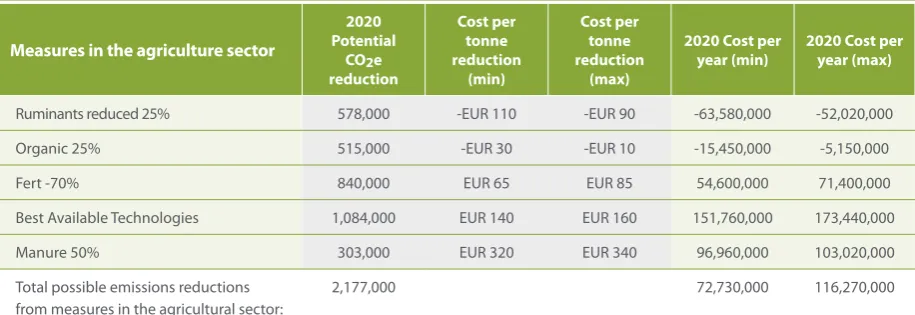
Measures in the agriculture sector
2020 Potential
CO2e
reduction
Cost per tonne reduction
(min)
Cost per tonne reduction
(max)
2020 Cost per
year (min) 2020 Cost per year (max)
Ruminants reduced 25% 578,000 -EUR 110 -EUR 90 -63,580,000 -52,020,000
Organic 25% 515,000 -EUR 30 -EUR 10 -15,450,000 -5,150,000
Fert -70% 840,000 EUR 65 EUR 85 54,600,000 71,400,000
Best Available Technologies 1,084,000 EUR 140 EUR 160 151,760,000 173,440,000
Manure 50% 303,000 EUR 320 EUR 340 96,960,000 103,020,000
Total possible emissions reductions from measures in the agricultural sector: Ruminants reduced 25% + 25% organic + Best Available Technologies
[image:17.609.52.510.564.721.2]2,177,000 72,730,000 116,270,000
Table 12-5: Potential emissions reductions and costs per measure for the year 2020 from changes in the agriculture sector
VIII Dalmacijacement d.d., Holcim Hrvatska d.o.o., Našicement d.d.
and Istra Cement d.o.o.
-EUR 200 -EUR 100 EUR 0 EUR 100 EUR 200 EUR 300 EUR 400
C
ost per t
onne of r
educ
tion
Ruminan
ts
reduc
ed 25%
Or
ganic 25%
Fer
tiliz
er 70%
BA
T
M
anur
e 50%
Cost per tonne reduction CO2e (min) Cost per tonne reduction CO2e (max) Scenario for measures
Figure 12-7: Estimated marginal costs per tonne of CO2e
production of Portland cement. In total, the industry employs a little over 2000 people who are directly in-volved in the industry.
During cement production, CO2 is released into the
at-mosphere as a by-product of clinker production. Clin-ker production has increased 42.8 % since 1990. Ac-cording to trends, emissions will increase by 538,000 tonnes CO2 by 2020 (to 3,100,000 tonnes) if no actions
are taken. This emissions projection includes emis-sions from energy consumption, which is covered in Section 12.2 above. By reducing the amount of clin-ker in cement to EU standards, it would be possible to reduce emissions significantly in 2020, for a net cost close to zero. This means that it may be economically beneficial to do this for the companies if regulations allow it. Considering the upcoming impact of the ETS system and the current carbon fee in place in Croatia, the option seems particularly economically viable. However, certain legal and technical issues must be resolved before this option can be implemented.
Other potential indirect CO2 emissions reduction
mea-sures in other sectors related to cement production (energy, waste management, transport) include:63
- Preventing emissions of GHG at waste collection sites. This means mostly burning fuel from waste materials (already included in Table 12-2) and consequently reducing emissions from the waste that would otherwise lie in the waste storage site.
- Building concrete roadways that uses less energy than asphalt roadways. These roadways emit less CO2 directly and indirectly. Concrete roads are more
enduring and need less maintenance than asphalt roads. Concrete roads also affect fuel savings. Cargo vehicles could save up to 10% of fuel driving on concrete roads. In some EU countries (Germany, Belgium, and Austria) 25% of the roads are con-crete, whereas, in Croatia they are rarely built.
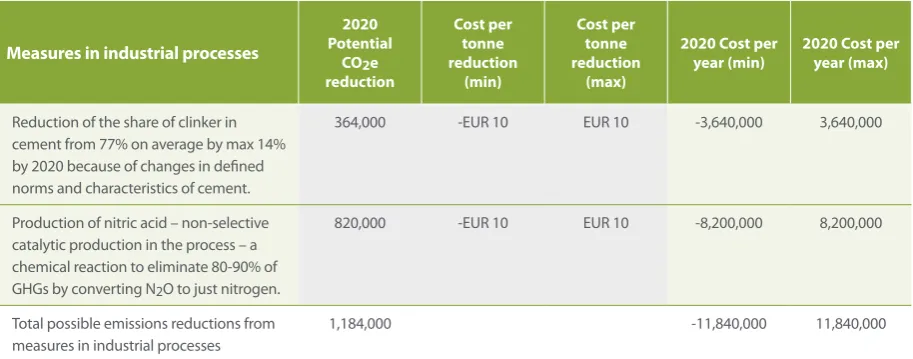
A second industry examined is nitric acid production. In the production of this chemical – which is used for a variety of processes – the GHG nitrogen oxide is released. By changing the industrial process that produces nitric acid, it would be possible to decrease emissions significantly. By assuming the same emis-sions levels and same reduction potential for 2020 as for 2012, the potential reduction would be 820,000 tonnes of CO2e in 2020. The cost would be minimal,
and, similar to changing the amount of clinker pro-duction, may actually be economically beneficial (less than EUR 1 per tonne of reduction), which would be worth reducing if those emissions reductions can be sold on the carbon market.64
Fertiliser and lime production are also important sources. The fertiliser industry is particularly impor-tant: the Petrokemija fertiliser manufacturer alone ac-counts for 30% of Croatia’s natural gas consumption and 5% of Croatia’s anthropogenic GHG emissions.
Measures in industrial processes
2020 Potential
CO2e
reduction
Cost per tonne reduction
(min)
Cost per tonne reduction
(max)
2020 Cost per
year (min) 2020 Cost per year (max)
Reduction of the share of clinker in cement from 77% on average by max 14% by 2020 because of changes in defined norms and characteristics of cement.
364,000 -EUR 10 EUR 10 -3,640,000 3,640,000
Production of nitric acid – non-selective catalytic production in the process – a chemical reaction to eliminate 80-90% of GHGs by converting N2O to just nitrogen.
820,000 -EUR 10 EUR 10 -8,200,000 8,200,000
Total possible emissions reductions from measures in industrial processes
[image:18.609.102.559.568.747.2]1,184,000 -11,840,000 11,840,000
However, no data is available regarding reduction po-tentials in these industries.
By changing industrial processes, it appears possible to reduce emissions from cement and nitric acid pro-duction by over 1 million tonnes in 2020. The econom-ic impacts of these reductions are unclear as the mar-ginal costs of reduction are close to zero. The current air pollution fee assessed by the Croatian Government will become 18 HRK (EUR 2.46) per tonne in 2009. This fee increase will mean that the marginal costs of in-troducing measures would decrease by EUR 2.46 per tonne for both industries.
12.5. Reducing emissions from
waste management
The final emissions source analysed is waste manage-ment. The waste management sector was responsible for 591,000 tonnes of CO2e in 2006 – a little under 2%
of total emissions. These emissions are primarily from the escape of methane gas from waste sites after the decomposition of waste material. Therefore, emissions reduction is possible by:
- Reducing the amount of waste that goes to waste sites – either by reducing the actual amount of waste or taking some of the waste and using it as a fuel source in other processes, such as heat generation for industry
- Treating the waste through thermal waste treat-ment (essentially burning waste), or
- Burning the escaping methane gas – potentially using it as an energy source.
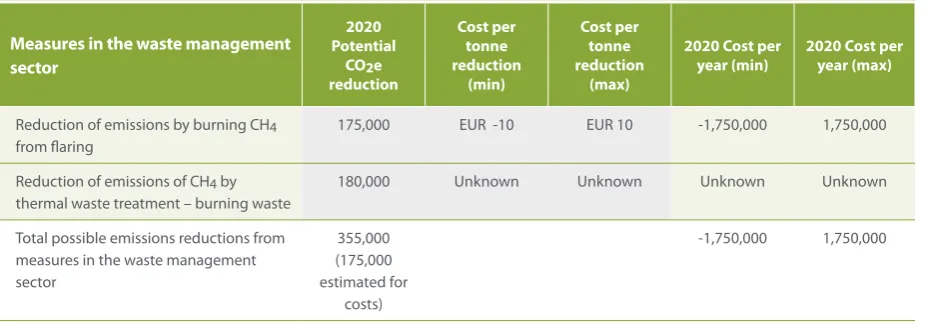
While costs were not available for all these measures, the likely marginal costs for the reduction of emissions by burning methane at the sites is estimated to be close to zero – or between EUR -10 and 10 per tonne.67 This
measure could reduce emissions by 175,000 tonnes per year in 2020 (see Table 12-7). Thus, the net cost-benefit would be somewhere between EUR -1,750,000 million and EUR 1,750,000 per year for 2020.
The costs for the other measures are not available, but are likely to be low – and might result in a net benefit. HEP is already undertaking preliminary planning for a plant which uses waste as the fuel for producing en-ergy – essentially burning waste for fuel.
Measures in the waste management sector
2020 Potential
CO2e
reduction
Cost per tonne reduction
(min)
Cost per tonne reduction
(max)
2020 Cost per
year (min) 2020 Cost per year (max)
Reduction of emissions by burning CH4
from flaring
175,000 EUR -10 EUR 10 -1,750,000 1,750,000
Reduction of emissions of CH4 by
thermal waste treatment – burning waste
180,000 Unknown Unknown Unknown Unknown
Total possible emissions reductions from measures in the waste management sector
355,000 (175,000 estimated for
costs)
[image:19.609.52.516.515.676.2]12.6. Reducing net emissions
due to land-use, land use
changes and forestry (LULUCF)
Carbon can also be absorbed by the environment in a number of ways. A major “carbon sink” in Croatia is the changes in land use. Significant portions of Croa-tian land have gradually become forested and are in-cluded as a reduction in CO2e. In 2006, this amounted
to an estimated net reduction of 7,490,000 tonnes – or almost a quarter of all Croatia’s emissions. Forests cover 37% of the mainland of Croatia, 81% are owned by the State and the rest are privately owned.69 Essentially,
this means increasing the amount of forests, shrubs, or the thickness of trees in forests. Interestingly, the cur-rent level of almost 7.5 million tonnes of reductions has occurred, not as a result of climate change concerns, but rather because of other factors such as abandoned farmland and nature protection measures. The aver-age amount of reductions due to land-use changes from 1990-2006 was 7.75 million tonnes.70 It is unclear
whether this amount of forest biomass growth will con-tinue into the future, but it seems probable.71
However, as no cost-benefit analysis is available for these reductions in Croatia, it cannot be included in this analy-sis in terms of the likely costs of this measure. While cost-benefit analyses are available for other countries,72 it is
unlikely that the results transfer well to the situation in Croatia, where land use changes are contributing to miti-gation without specific climate change policies encour-aging this. Furthermore, it is likely that only part of the total sink belonging to forest management activity will be counted in the post-Kyoto period. Under the current Kyoto Protocol allocations, Croatia has a cap for what can be counted as a sink - 0.97 million tonnes CO2e.
An additional change in land use that could have a sig-nificant impact is increasing the carbon content in soils.
Through changes in farm management – the use of grass-clover crops, the application of green manures/ green cover crops and under-sowing of cereals – car-bon can be absorbed by the soil which produces better farming conditions including guarding against water loss (see Chapter 8). An annual carbon sequestration of 700 kg C per hectare over a 15-year period is possible with the right management techniques. A linear annual increase of the agricultural area under this type of man-agement could amount to 943,000 hectares (all arable and land under orchards and vineyards) by 2020.IX
This practice is estimated to cost EUR 65-85 per tonne of removal if 700 kg of carbon is mitigated per year per hectare. This calculation is based on the public money (subsidies) envisaged to stimulate farmers to practice this measure – an average annual cost of approximately EUR 101 million. This subsidy is, however, questionable. One could argue that the application of green manure and other carbon/building measures constitutes a good farming practice and as such should not be paid for by public money. If the cost of practising these measures were transferred to farmers, the net cost to the Govern-ment would be greatly reduced, though the cost would still exist. Furthermore, there are advantages to increas-ing the level of carbon in soils related to retainincreas-ing mois-ture – which is already a problem in Croatian soils. This estimate of costs deserves further review, as the IPCC es-timates that significant reductions through this method-ology would be possible for under EUR 13 per tonne.73
Land Use, Land Use Changes and Forest Cover
2020 Potential
CO2e
reduction
Cost per tonne reduction
(min)
Cost per tonne reduction
(max)
2020 Cost per
year (min) 2020 Cost per year (max)
Soil sequestration of carbon (700 kg per hectare per year)
2,533,000 EUR 65,00 EUR 85,00 164,645,000 215,305,000
Increased forest mass 7,000,000 Unknown Unknown Unknown Unknown
[image:20.609.102.560.646.748.2]Total possible CO2e reduction for LULUCF 9,533,000 164,645,000 215,305,000
Table 12-8: Potential carbon reduction and costs per measure for the year 2020 from changes in LULUCF
Currently Croatia only receives “credit” for its interna-tional commitments under the Kyoto Protocol of a little less than one million tonnes of CO2e reduction, due to
LULUCF. Since the potential appears to be drastically more than that – up to an astounding 9.5 million tonnes, it is important to further examine the cost/ benefit of implementing these changes and the methodology for accounting for them in international reporting. In the “post-Kyoto” negotiations, these could play an important role in Croatia’s position.
12.7. Economic analysis of
measures
12.7.1. Measures that are likely to be economically beneficial to Croatia
As a first step in reducing emissions, Croatia should move forward with any project that is likely to yield a negative marginal cost (or a net economic gain).
Sub-sector of
emissions Emissions reduction measure
2020 Potential CO2e reduction
2020 cost per year (min)
2020 Cost per year (max)
Probable responsible stakeholder
Agriculture - changes in farming techniques
Switching to 25% organic farming
515,000 EUR -15,450,000 EUR -5,150,000 MAFRD/ farmers
Agriculture - Livestock changes
25% of ruminants replaced by non-ruminants
578,000 EUR -63,580,000 EUR -52,020,000 MAFRD/ farmers
Energy - for industry use
Use of biomass for energy use for industry and construction
100,000 EUR -4,500,000 EUR -2,500,000 MELE/ MEPPPC
Energy - for industry use
Increased energy efficiency in industry and construction (including cogeneration)
800,000 EUR -24,000,000 EUR -8,000,000 MELE/ MEPPPC
Energy - use for Transport
Using vehicles with less emissions (140 gCO2/km)
200,000 EUR -12,000,000 EUR -8,000,000 Individual citizens/ MELE/ MEPPPC/
Ministry of Transportation Energy - use in
households and services
Savings of electricity in households – due to lighting
changes (CFLs)
416,000 EUR -60,320,000 EUR -52,000,000 Individual citizens/ MELE
Energy - use in households and services
Savings of electricity in households – energy efficient
appliances
282,000 EUR -40,890,000 EUR -35,250,000 Individual citizens/ MELE
Energy - use in households and services
Savings of electricity in households due to reduction of consumption of electricity
for heat
28,000 EUR -4,060,000 EUR -3,500,000 Individual citizens/ MELE
Energy - use in households and services
Reducing heat losses from roofs
4,000 EUR -160,000 EUR -80,000 Individual citizens/ construction firms/ MELE/ MEPPPC Energy - use in
households and services
Reducing heat loss from windows
22,000 EUR -880,000 EUR -440,000 Individual citizens/ construction firms/ MELE/ MEPPPC Energy - use in
households and services
Reduction of heat loss - due to complete reconstruction of
building envelopes
26,000 EUR -1,040,000 EUR -520,000 Individual citizens/ construction firms/ MELE/ MEPPPC Energy - use in
households and services
Energy Efficiency in offices 461,000 EUR -11,525,000 EUR -2,305,000 Individual firms/ MELE/ MEPPPC
Energy - use in households and services
Reducing heat loss on new buildings
134,000 EUR -3,350,000 EUR -670,000 Construction companies/ Individual
citizens/ firms/ MELE/ MEPPPC Total reduction due to "no
regret" options that have a net economic gain once
implemented
3,566,000 -241,755,000 -170,435,000
[image:21.609.52.512.274.738.2]Table 12-10: Measures that may be neutral in terms of marginal cost per tonne of reduction
Sub-sector of
emissions Emissions reduction measure
2020 Potential CO2e reduction
2020 cost per year (min)
2020 Cost per year (max)
Probable responsible stakeholder
Energy - electricity production
Reductions from usage of nuclear fuel (by building a 1000 MW nuclear power
stations)
5,500,000 EUR -77,000,000
EUR 77,000,000 HEP/ MELE/MEPPPC
Energy - electricity production
Reductions from usage of geothermal
60,000 EUR -640,000 EUR 1,200,000 Individual firms/ MELE
Energy - electricity production
Reductions in loss from the distribution grid and
potential reductions in emissions of CO2 (4.5%
decrease in loss)
56,300 EUR -563,000 EUR 563,000 HEP/ MELE
Energy - for industry use
Use of biologically-based waste products for energy use for industry - especially refuse derived fuel (re-used materials) of biological and fossil origin and dried
sludge - especially in the cement industry
202,000 EUR -2,020,000 EUR 2,020,000 Individual industries/ waste
management companies
Energy - use for transport
Using fuels with less carbon - LPG and CNG versus diesel or gasoline
100,000 EUR -1,000,000 EUR 1,000,000 MELE/ Ministry of the Sea, Transport, and Infrastructure
Energy - use in households and services
Renewable energy use in offices
109,000 EUR -1,090,000 EUR 1,090,000 Individual firms/ MELE
Energy - use in households and services
Solar collectors for water heaters
20,000 EUR -200,000 EUR 200,000 Construction companies/ Individual citizens/
firms/ MELE/ MEPPPC
Industrial processes - cement production
Reduction of the share of clinker in cement from 77%
on average by max 14% by 2020.
364,000 EUR -3,640,000 EUR 3,640,000 Cement Companies/ MEPPPC
Industrial processes - nitric acid production
Production of nitric acid - non-selective catalytic production in the process
- a chemical reaction to eliminate 80-90% of GHGs by converting N2O to just
nitrogen.
820,000 EUR -8,200,000 EUR 8,200,000 Nitric acid producers
Waste treatment Reduction of emissions by burning CH4 from flaring
175,000 EUR -1,750,000 EUR 1,750,000 Waste management companies
Total reduction of emissions resulting from
possible "cost neutral" options